
Deuteronomy 26:2

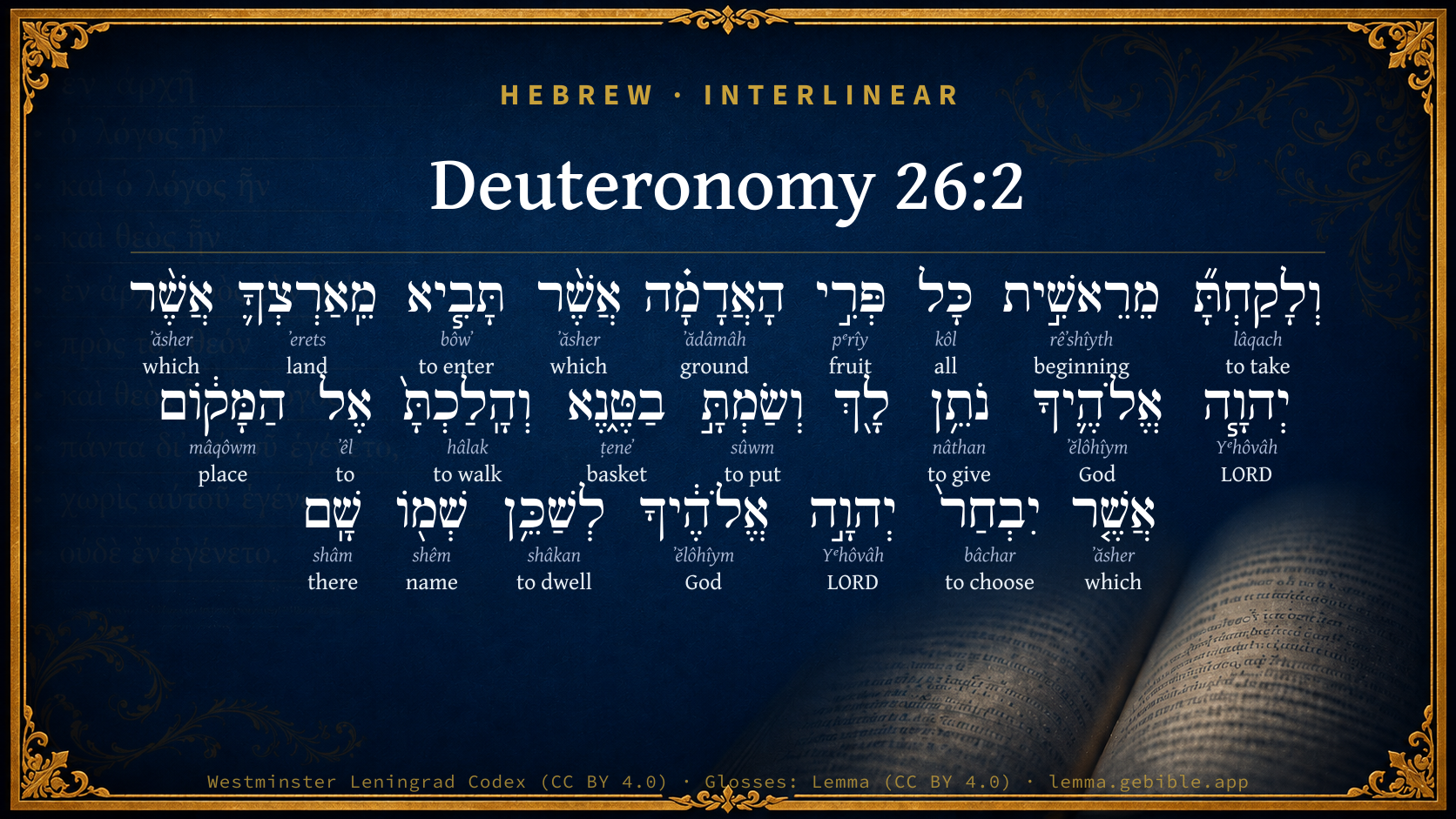
Hebrew (Westminster Leningrad Codex) Deuteronomy 26:2 appears in the Hebrew Old Testament. The text above is from the Westminster Leningrad Codex. Each word links to its Strong’s number, a concise gloss, and parsing drawn from the Open Scriptures Hebrew Bible morphology. Click any word for its full Brown-Driver-Briggs (BDB) entry.
Download image
Cite this verse

Deuteronomy 26:2 (World English Bible). Public Domain. Lemma interlinear Bible study tool, https://lemma.gebible.app/v/deuteronomy/26/2.

Show BibTeX & RIS
BibTeX
RIS
English Translation
that you shall take of the first of all the fruit of the ground, which you shall bring in from your land that Yahweh your God gives you; and you shall put it in a basket, and shall go to the place which Yahweh your God shall choose, to cause his name to dwell there.
World English Bible · Public Domain
Highlights
  • 1 first appearance in the Hebrew Bible
Full analysis ↓
Download a study sheet

One document with this verse’s original text, its word-by-word gloss line, the meaning frame, cross-references with their text, attributed commentary, and full source and license credits — printable, and it pastes into notes with its structure intact.

This verse Autodidact and up

Study sheet (.html) Plain text (.txt)

A passage Seminary Student

Up to 50 verses in one chapter. A passage sheet keeps up to 6 commentary sources and 12 cross-references per verse, in the order this page ranks them, and says so on the sheet whenever that leaves anything out. Ask for a single verse and you get the Autodidact verse sheet above.

Everything on this page stays free to read, with no account — the sheet is a download of what is already on screen, not access to it.

Want to remove ads? Support Godless Engineer
Compare translations 3

The same verse in 3 English versions, stacked beneath the original-language interlinear above. Click any original word for its lexicon entry.

Each is an independent rendering of the whole verse — the interlinear is not word-aligned to these translations.

Highlighted words mark where these versions differ — a whole-verse word diff, not a word-by-word alignment.

  • World English Bible Public Domain
    that you shall take of the first of all the fruit of the ground, which you shall bring in from your land that Yahweh your God gives you; and you shall put it in a basket, and shall go to the place which Yahweh your God shall choose, to cause his name to dwell there.
  • King James Version Public Domain
    That thou shalt take of the first of all the fruit of the earth, which thou shalt bring of thy land that the LORD thy God giveth thee, and shalt put it in a basket, and shalt go unto the place which the LORD thy God shall choose to place his name there.
  • unfoldingWord Literal Text CC BY-SA 4.0
    then you shall take from the first of all the harvest of the land that you have brought in from the land that Yahweh your God is giving to you. And you shall put in a basket and go to the place that Yahweh your God will choose to make his name stay there.

unfoldingWord Literal Text — © unfoldingWord, licensed CC BY-SA 4.0. Word-aligned USFM3 via Door43 (git.door43.org/unfoldingWord/en_ult).

Versions to compare (up to 4)

3 of 4 selected

Show all 18 translations

Every available English version of this verse, each an independent rendering of the whole verse.

  • World English Bible Public Domain
    that you shall take of the first of all the fruit of the ground, which you shall bring in from your land that Yahweh your God gives you; and you shall put it in a basket, and shall go to the place which Yahweh your God shall choose, to cause his name to dwell there.
  • Berean Standard Bible Public Domain
    you are to take some of the firstfruits of all your produce from the soil of the land that the LORD your God is giving you and put them in a basket. Then go to the place the LORD your God will choose as a dwelling for His Name,
  • Majority Standard Bible Public Domain
    you are to take some of the firstfruits of all your produce from the soil of the land that the LORD your God is giving you and put them in a basket. Then go to the place the LORD your God will choose as a dwelling for His Name,
  • King James Version Public Domain
    That thou shalt take of the first of all the fruit of the earth, which thou shalt bring of thy land that the LORD thy God giveth thee, and shalt put it in a basket, and shalt go unto the place which the LORD thy God shall choose to place his name there.
  • American Standard Version (1901) Public Domain
    that thou shalt take of the first of all the fruit of the ground, which thou shalt bring in from thy land that Jehovah thy God giveth thee; and thou shalt put it in a basket, and shalt go unto the place which Jehovah thy God shall choose, to cause his name to dwell there.
  • Revised Version (1885) Public Domain
    that thou shalt take of the first of all the fruit of the ground, which thou shalt bring in from thy land that the LORD thy God giveth thee; and thou shalt put it in a basket, and shalt go unto the place which the LORD thy God shall choose to cause his name to dwell there.
  • Geneva Bible (1599) Public Domain
    Then shalt thou take of the first of all the fruite of the earth, and bring it out of the lande that the Lord thy God giueth thee, and put it in a basket, and goe vnto the place, which the Lord thy God shall chose to place his Name there.
  • Douay-Rheims (1899) Public Domain
    Thou shalt take the first of all thy fruits, and put then? in a basket, and shalt go to the place which the Lord thy God shall choose, that his name may be invocated there:
  • Young's Literal Translation Public Domain
    that thou hast taken of the first of all the fruits of the ground which thou dost bring in out of thy land which Jehovah thy God is giving to thee, and hast put `it' in a basket, and gone unto the place which Jehovah thy God doth choose to cause His name to tabernacle there.
  • Literal Standard Version CC BY-SA 4.0
    that you have taken from the first of all the fruits of the ground, which you bring in out of your land which your God YHWH is giving to you, and have put [it] in a basket, and gone to the place which your God YHWH chooses to cause His Name to dwell there.
  • Unlocked Literal Bible CC BY-SA 4.0
    then you must take some of the first of all the harvest of the land that you have brought in from the land that Yahweh your God is giving you. You must put it in a basket and go to the place that Yahweh your God will choose as his sanctuary.
  • unfoldingWord Literal Text CC BY-SA 4.0
    then you shall take from the first of all the harvest of the land that you have brought in from the land that Yahweh your God is giving to you. And you shall put in a basket and go to the place that Yahweh your God will choose to make his name stay there.
  • Darby Bible Public Domain
    that thou shalt take of the first of all the fruit of the ground, which thou shalt bring of thy land which Jehovah thy God giveth thee, and shalt put it in a basket, and shalt go unto the place that Jehovah thy God will choose to cause his name to dwell there;
  • World Messianic Bible Public Domain
    that you shall take some of the first of all the fruit of the ground, which you shall bring in from your land that the LORD your God gives you. You shall put it in a basket, and shall go to the place which the LORD your God shall choose to cause his name to dwell there.
  • Webster's Bible Public Domain
    That thou shalt take of the first of all the fruit of the earth, which thou shalt bring of thy land that the LORD thy God giveth thee, and shalt put it in a basket, and shalt go to the place which the LORD thy God shall choose to place his name there.
  • Free Bible Version CC BY-SA 4.0
    take some of the firstfruits of all your crops produced by the land that the Lord your God is giving you and place them in a basket. Then go to the place the Lord your God will choose to live with you,
  • Bible in Basic English Public Domain
    You are to take a part of the first-fruits of the earth, which you get from the land which the Lord your God is giving you, and put it in a basket, and go to the place marked out by the Lord your God, as the resting-place of his name.
  • JPS Tanakh (1917) Public Domain
    that thou shalt take of the first of all the fruit of the ground, which thou shalt bring in from thy land that the LORD thy God giveth thee; and thou shalt put it in a basket and shalt go unto the place which the LORD thy God shall choose to cause His name to dwell there.

Literal Standard Version (2020), Covenant Press — licensed CC BY-SA 4.0. Text via the HelloAO Bible API (eBible.org). Unlocked Literal Bible (unfoldingWord) — licensed CC BY-SA 4.0. Text via the HelloAO Bible API (eBible.org). unfoldingWord Literal Text — © unfoldingWord, licensed CC BY-SA 4.0. Word-aligned USFM3 via Door43 (git.door43.org/unfoldingWord/en_ult). Free Bible Version, Dr. Jonathan Gallagher — licensed CC BY-SA 4.0. Text via the HelloAO Bible API (eBible.org).

Word by word

More ways to search: Search by grammar → Find every occurrence → Compare this word →

Practice this passage: Drill this verse → Learn its vocabulary →

בַטֶּ֑נֶא
ṭeneʼ
H2935
“in/at the · basket”
Preposition, Determined + Noun, Common, Masculine, Singular, Absolute
Part of Speech
Preposition + Noun
Type
Common
Gender
Masculine
Number
Singular
State
Absolute
Full BDB Definition

Origin: from an unused root probably meaning to weave

TWOT: 812a

basket
  1. וְלָקַחְתָּ֞ lâqach H3947 “and · to take” Conjunction + Verb, Qal, Sequential Perfect, 2nd Person, Masculine, Singular
  2. מֵרֵאשִׁ֣ית rêʼshîyth H7225 “from · beginning of” Preposition + Noun, Common, Feminine, Singular, Construct
  3. כָּל kôl H3605 “all of” Noun, Common, Masculine, Singular, Construct
  4. פְּרִ֣י pᵉrîy H6529 “fruit of” Noun, Common, Masculine, Singular, Construct
  5. הָאֲדָמָ֗ה ʼădâmâh H127 “the · ground” Particle, Definite Article + Noun, Common, Feminine, Singular, Absolute
  6. אֲשֶׁ֨ר ʼăsher H834 “which” Particle, Relative
  7. תָּבִ֧יא bôwʼ H935 “to enter” Verb, Hiphil, Imperfect, 2nd Person, Masculine, Singular
  8. מֵֽאַרְצְךָ֛ ʼerets H776 “from · land · your” Preposition + Noun, Common, Both, Singular, Construct + Suffix, Personal, 2nd Person, Masculine, Singular
  9. אֲשֶׁ֨ר ʼăsher H834 “which” Particle, Relative
  10. יְהוָ֧ה Yᵉhôvâh H3068 “LORD” Noun, Proper
  11. אֱלֹהֶ֛יךָ ʼĕlôhîym H430 “God(s) · your” Noun, Common, Masculine, Plural, Construct + Suffix, Personal, 2nd Person, Masculine, Singular
  12. נֹתֵ֥ן nâthan H5414 “giving” Verb, Qal, Participle Active, Masculine, Singular, Absolute
  13. וְשַׂמְתָּ֣ sûwm H7760 “and · to put” Conjunction + Verb, Qal, Sequential Perfect, 2nd Person, Masculine, Singular
  14. וְהָֽלַכְתָּ֙ hâlak H1980 “and · to walk” Conjunction + Verb, Qal, Sequential Perfect, 2nd Person, Masculine, Singular
  15. אֶל ʼêl H413 “to” Preposition
  16. הַמָּק֔וֹם mâqôwm H4725 “the · place” Particle, Definite Article + Noun, Common, Masculine, Singular, Absolute
  17. אֲשֶׁ֤ר ʼăsher H834 “which” Particle, Relative
  18. יִבְחַר֙ bâchar H977 “to choose” Verb, Qal, Imperfect, 3rd Person, Masculine, Singular
  19. יְהוָ֣ה Yᵉhôvâh H3068 “LORD” Noun, Proper
  20. אֱלֹהֶ֔יךָ ʼĕlôhîym H430 “God(s) · your” Noun, Common, Masculine, Plural, Construct + Suffix, Personal, 2nd Person, Masculine, Singular
  21. לְשַׁכֵּ֥ן shâkan H7931 “to dwell” Preposition + Verb, Piel, Infinitive Construct
  22. שְׁמ֖וֹ shêm H8034 “name · his” Noun, Common, Masculine, Singular, Construct + Suffix, Personal, 3rd Person, Masculine, Singular
  23. שָֽׁם shâm H8033 “there” Adverb

About this verse

These counts appear in no published source. They are computed here, from the morphology-tagged text and Lemma’s own curated glosses. What Lemma adds →

25
words
20
distinct lemmas
Pentateuch
section

Notable vocabulary

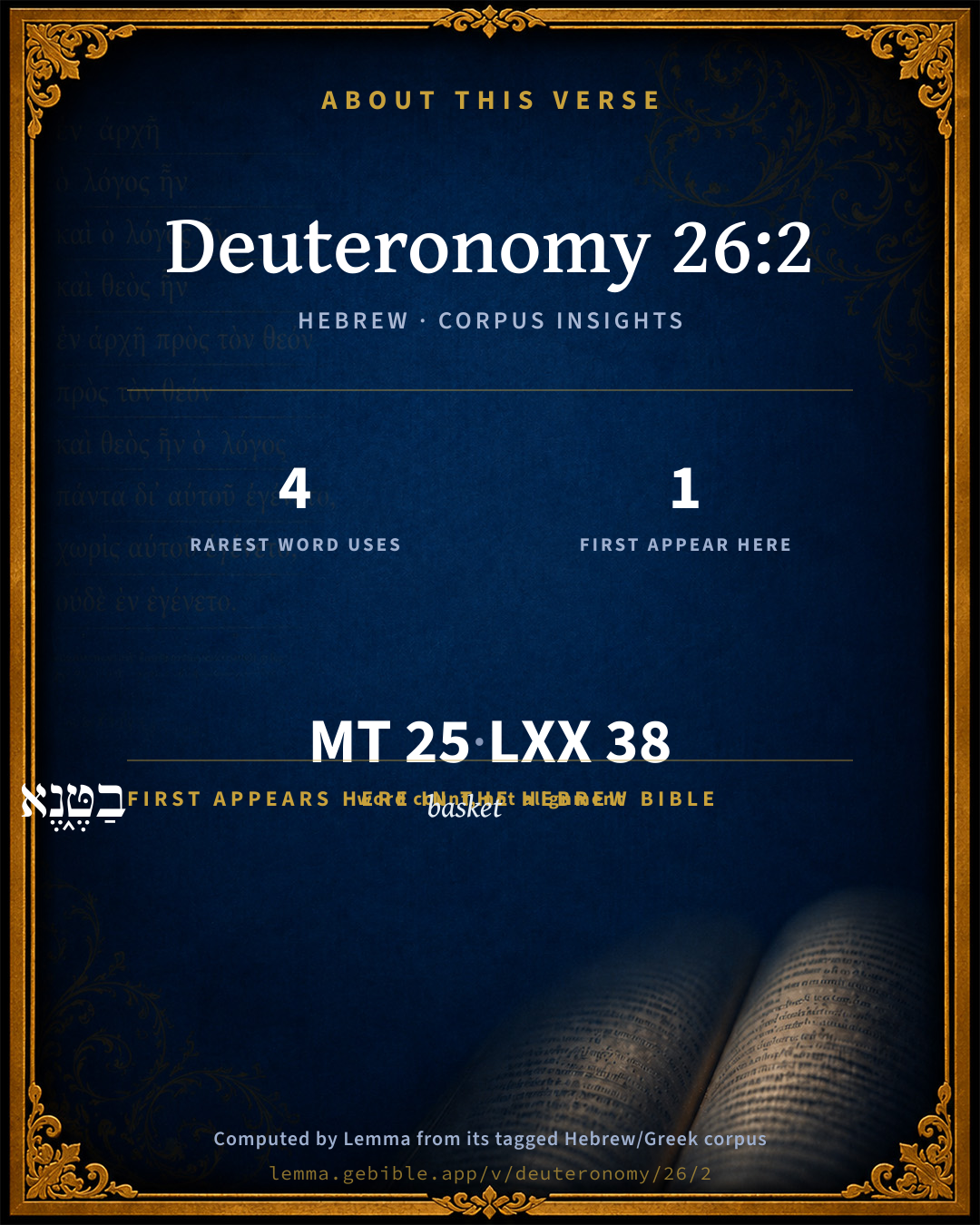
The rarest word here is בַטֶּ֑נֶא basket H2935 — appearing just 4 times in the whole Hebrew Bible.

First appearance in Scripture

This word makes its first canonical appearance in the Hebrew Bible here:

  • בַטֶּ֑נֶא basket H2935

Shared distinctive vocabulary

בַטֶּ֑נֶא basket H2935 occurs in 4 verses of the Hebrew Bible. Also found in:

Grammatical profile

  • 7 verbs
  • 12 nouns
  • 2 prepositions
  • 1 adverb
  • 3 particles

Verb forms

  • וְלָקַחְתָּ֞ Qal · Sequential Perfect
  • תָּבִ֧יא Hiphil · Imperfect
  • נֹתֵ֥ן Qal · Participle Active
  • וְשַׂמְתָּ֣ Qal · Sequential Perfect
  • וְהָֽלַכְתָּ֙ Qal · Sequential Perfect
  • יִבְחַר֙ Qal · Imperfect
  • לְשַׁכֵּ֥ן Piel · Infinitive Construct

Repetition

Words recur within this verse — often emphatic in Hebrew:

  • יְהוָ֧ה LORD H3068 ×2
  • אֱלֹהֶ֛יךָ God H430 ×2
  • אֲשֶׁ֨ר which H834 ×3

Hebrew & Septuagint length

In English translation the verse runs 55 words from the Hebrew and 48 from the Septuagint (LXX English) — closely comparable.

A rough comparison of the two English renderings, which tokenize alike — not a word-level alignment.

Word counts can differ between the Hebrew and the Greek without any difference in meaning — e.g. the Hebrew direct-object marker אֵת has no separate Greek word, and Greek often adds the article ὁ.

In the original languages it is 25 Hebrew tokens and 38 Greek tokens — but the two are counted differently (Hebrew bundles its prefixes and suffixes into one token; the Greek is in lemma form), so that isn’t a like-for-like length.

Cross-references

30

Topical passages linked to Deuteronomy 26:2 in the Treasury of Scripture Knowledge — connected by theme and wording, ordered by reader-vote popularity; previews shown in the World English Bible.

  • Exodus 23:19 The first of the first fruits of your ground you shall bring into the house of Yahweh your God. "You shall not boil a kid in its mother's milk.
  • Exodus 23:16 And the feast of harvest, the first fruits of your labors, which you sow in the field: and the feast of harvest, at the end of the year, when you gather in your labors out of the field.
  • Ezekiel 44:30 The first of all the first fruits of every thing, and every offering of everything, of all your offerings, shall be for the priest: you shall also give to the priests the first of your dough, to cause a blessing to rest on your house.
  • 1 Corinthians 15:20 But now Christ has been raised from the dead. He became the first fruits of those who are asleep.
  • Exodus 34:26 You shall bring the first of the first fruits of your ground to the house of Yahweh your God. You shall not boil a young goat in its mother's milk."
  • Deuteronomy 16:10 You shall keep the feast of weeks to Yahweh your God with a tribute of a freewill-offering of your hand, which you shall give, according as Yahweh your God blesses you:
  • Ezekiel 20:40 For in my holy mountain, in the mountain of the height of Israel, says the Lord Yahweh, there shall all the house of Israel, all of them, serve me in the land: there will I accept them, and there will I require your offerings, and the first fruits of your offerings, with all your holy things.
  • Ezekiel 48:14 They shall sell none of it, nor exchange it, nor shall the first fruits of the land be alienated; for it is holy to Yahweh.
  • Romans 8:23 Not only so, but ourselves also, who have the first fruits of the Spirit, even we ourselves groan within ourselves, waiting for adoption, the redemption of our body.
  • Romans 11:16 If the first fruit is holy, so is the lump. If the root is holy, so are the branches.
  • 1 Corinthians 16:2 On the first day of the week, let each one of you save, as he may prosper, that no collections be made when I come.
  • James 1:18 Of his own will he brought us forth by the word of truth, that we should be a kind of first fruits of his creatures.
  • Exodus 22:29 "You shall not delay to offer from your harvest and from the outflow of your presses. "You shall give the firstborn of your sons to me.
  • Leviticus 2:12 As an offering of firstfruits you shall offer them to Yahweh: but they shall not come up for a sweet savor on the altar.
  • Leviticus 2:14 "'If you offer a meal offering of first fruits to Yahweh, you shall offer for the meal offering of your first fruits grain in the ear parched with fire, bruised grain of the fresh ear.
  • Numbers 18:12–13 All the best of the oil, and all the best of the vintage, and of the grain, the first fruits of them which they give to Yahweh, to you have I given them.
  • Deuteronomy 12:5–6 But to the place which Yahweh your God shall choose out of all your tribes, to put his name there, even to his habitation shall you seek, and there you shall come;
  • Deuteronomy 18:4 The first fruits of your grain, of your new wine, and of your oil, and the first of the fleece of your sheep, shall you give him.
  • Joshua 18:1 The whole congregation of the children of Israel assembled themselves together at Shiloh, and set up the tent of meeting there: and the land was subdued before them.
  • 2 Kings 4:42 There came a man from Baal Shalishah, and brought the man of God bread of the first fruits, twenty loaves of barley, and fresh ears of grain in his sack. He said, Give to the people, that they may eat.
  • 2 Chronicles 31:5 As soon as the commandment came abroad, the children of Israel gave in abundance the first fruits of grain, new wine, and oil, and honey, and of all the increase of the field; and the tithe of all things brought they in abundantly.
  • Nehemiah 10:35–37 and to bring the first fruits of our ground, and the first fruits of all fruit of all manner of trees, year by year, to the house of Yahweh;
  • Nehemiah 12:44 On that day were men appointed over the chambers for the treasures, for the heave-offerings, for the first fruits, and for the tithes, to gather into them, according to the fields of the cities, the portions appointed by the law for the priests and Levites: for Judah rejoiced for the priests and for the Levites who waited.
  • Nehemiah 13:31 and for the wood-offering, at times appointed, and for the first fruits. Remember me, my God, for good.
  • Proverbs 3:9–10 Honor Yahweh with your substance, With the first fruits of all your increase:
  • Jeremiah 2:3 Israel [was] holiness to Yahweh, the first fruits of his increase: all who devour him shall be held guilty; evil shall come on them, says Yahweh.
  • Romans 16:5 Greet the assembly that is in their house. Greet Epaenetus, my beloved, who is the first fruits of Achaia to Christ.
  • Revelation 14:4 These are those who were not defiled with women, for they are virgins. These are those who follow the Lamb wherever he goes. These were redeemed by Jesus from among men, the first fruits to God and to the Lamb.
  • 2 Chronicles 6:6 but I have chosen Jerusalem, that my name might be there; and have chosen David to be over my people Israel.
  • 1 Corinthians 15:23 But each in his own order: Christ the first fruits, then those who are Christ's, at his coming.

Cross-references courtesy of OpenBible.info (CC BY 4.0).

Hebrew and Greek witnesses Masoretic Hebrew ↔ Greek Septuagint

The same verse in the two great witnesses to the Old Testament, shown verse-for-verse.

These are two independent witnesses, not word-aligned to each other, and the Septuagint is shown in lemma (dictionary) form.

Hebrew Deuteronomy 26:2 Masoretic · Westminster Leningrad Codex

וְלָקַחְתָּ֞ מֵרֵאשִׁ֣ית כָּל פְּרִ֣י הָאֲדָמָ֗ה אֲשֶׁ֨ר תָּבִ֧יא מֵֽאַרְצְךָ֛ אֲשֶׁ֨ר יְהוָ֧ה אֱלֹהֶ֛יךָ נֹתֵ֥ן לָ֖ךְ וְשַׂמְתָּ֣ בַטֶּ֑נֶא וְהָֽלַכְתָּ֙ אֶל הַמָּק֔וֹם אֲשֶׁ֤ר יִבְחַר֙ יְהוָ֣ה אֱלֹהֶ֔יךָ לְשַׁכֵּ֥ן שְׁמ֖וֹ שָֽׁם

that you shall take of the first of all the fruit of the ground, which you shall bring in from your land that Yahweh your God gives you; and you shall put it in a basket, and shall go to the place which Yahweh your God shall choose, to cause his name to dwell there.

World English Bible · Public Domain

Greek LXX Deuteronomy 26:2 Septuagint · lemma form

καί λαμβάνω ἀπό ὁ ἀπαρχή ὁ καρπός ὁ γῆ σύ ὅς κύριος ὁ θεός σύ δίδωμι σύ καί ἐνβάλλω εἰς κάρταλλος καί πορεύομαι εἰς ὁ τόπος ὅς ἄν ἐκλέγω κύριος ὁ θεός σύ ἐπικαλέω ὁ ὄνομα αὐτός ἐκεῖ

that you shall take of the first of the fruits of your land, which the Lord your God gives you, and you shall put them into a basket, and you shall go to the place which the Lord your God shall choose to have his name called there.

LXX2012 (modern English Septuagint) · Public Domain

On this verse, The Cambridge Bible for Schools and Colleges discusses the Septuagint’s reading. Read the note in Commentary ↓

Hebrew: Westminster Leningrad Codex (CC BY 4.0). Greek: Septuagint (public domain); English from LXX2012 (modern English Septuagint) (Public Domain). How the Septuagint differs from the Hebrew →

Targum (Aramaic paraphrase)

2

The Targum is the ancient Jewish Aramaic paraphrase of the Hebrew Scriptures — an interpretive translation, not the Hebrew text itself. Onkelos (literal) and Pseudo-Jonathan (expansive) render the Torah, and Jonathan the Prophets. Coverage is partial: where no permissively-licensed English translation exists for a verse, only the Aramaic is shown. This is verse-level text, not a word-by-word alignment to the Hebrew.

  1. Targum Onkelos Torah (Genesis–Deuteronomy)
    וְתִסַב מֵרֵישׁ כָּל אִבָּא דְאַרְעָא דִי תָעֵל מֵאַרְעָךְ דִי יְיָ אֱלָהָךְ יָהֵב לָךְ וּתְשַׁוֵי בְסַלָא וּתְהַךְ לְאַתְרָא דִי יִתִּרְעֵי יְיָ אֱלָהָךְ לְאַשְׁרָאָה שְׁכִנְתֵּהּ תַּמָן

    (no public-domain English translation for this verse)

    Targum Onkelos — Aramaic: “Onkelos Genesis” (public domain); “Onkelos Exodus” (public domain); “Onkelos Leviticus” (public domain); “Onkelos Numbers” (public domain); “Onkelos Deuteronomy” (public domain). English: “Sefaria Community Translation” (CC0 1.0 (public-domain dedication)); “J.W. Etheridge. The Targums of Onkelos and Jonathan Ben Uzziel on the Pentateuch. London: Longmans, Green, 1862” (public domain). Text via Sefaria.

  2. Targum Pseudo-Jonathan Torah (Genesis–Deuteronomy)
    וְתִסְבוּן מִן שֵׁירוֹי בִּכּוּרַיָא דְמִתְבַּשְׁלִין מִן שֵׁירוּיָא בְּכָל אִבָּא דְאַרְעָא דְתָעֵיל מֵאַרְעָךְ דַיְיָ אֱלָהָכוֹן יָהֵיב לְכוֹן וּתְשַׁווּן בְּסַלָא וּתְהָכוּן לְאַתְרָא דְיִתְרְעֵי יְיָ אֱלָהָכוֹן לְאַשְׁרָאָה שְׁכִינְתֵּיהּ תַמָן

    you shall take of the earliest first fruits which are ripe at the beginning of all the produce of the ground which thou ingatherest from the land which the Lord your God hath given you, and put them into a basket, and go unto the place which the Lord your God will choose that His Shekinah may dwell there.

    Targum Pseudo-Jonathan — Aramaic: “Targum Jonathan on Genesis” (public domain); “Targum Jonathan on Exodus” (public domain); “Targum Jonathan on Leviticus” (public domain); “Targum Jonathan on Numbers” (public domain); “Targum Jonathan on Deuteronomy” (public domain). English: “The Targum of Jonathan ben Uzziel, trans. J. W. Etheridge, London, 1862” (public domain). Text via Sefaria.

Commentary

Notes on Deuteronomy 26:2 from classic Christian and Jewish commentators (each source and its license shown beneath its notes). The classic Christian expositions comment on the surrounding passage and are grouped to its opening verse, so a note may address several verses; the Jewish commentaries on the Tanakh (Rashi and others) are per-verse, so they appear only where the commentator wrote on this verse.

Lemma curates 59 commentaries, every one of them public domain or Creative Commons licensed, each selected and text-cleaned for this edition rather than reprinted as found. About our sources →

Trapp's Complete Commentary

John Trapp

Deu 26:2 That thou shalt take of the first of all the fruit of the earth, which thou shalt bring of thy land that the LORD thy God giveth thee, and shalt put [it] in a basket, and shalt go unto the place which the LORD thy God shall choose to place his name there.

Ver. 2. Thou shalt take of the first, &c.] In token of homage, or as a chief rent due to God the true proprietary, of whom they held all.

John Trapp, A Commentary or Exposition upon All the Books of the Old and New Testament (1647–1656) — public domain. Text from a community e-Sword module.

Geneva Bible (1599)

Geneva Bible translators

To be called upon, served and worshipped spiritually, Deut. 12:5.

By this ceremony they acknowledged that they received the land of Canaan as a free gift of God.

Geneva Bible (1599) marginal notes — public domain. Text via Bolls.life.

Adam Clarke's Commentary

Verse 2. Thou shalt take of the first of all the fruit, &c.] This was intended to keep them in continual remembrance of the kindness of God, in preserving them through so many difficulties and literally fulfilling the promises he had made to them. God being the author of all their blessings, the first-fruits of the land were consecrated to him, as the author of every good and perfect gift.

Adam Clarke's Commentary on the Bible (1810–1826) — public domain. Text from a community e-Sword/MySword module.

The Cambridge Bible for Schools and Colleges

gen. ed. J. J. S. Perowne

2. of the first] Heb. of the reshîth. See introd. note; and observe that the Heb. particle for of implies that only some of the reshîth is signified.

all the fruit] Sam., LXX omit all; Deu_18:4 : of corn, wine, oil and fleece.

thou shalt bring in] Heb. tabi’; cp. tebu’ah, income, Deu_14:22; Deu_14:28, Deu_16:15, Deu_22:9.

that the Lord thy God is to give thee] Redundant after Deu_26:1. The two vv. are obviously expanded.

basket] Heb. ṭene’, only here, Deu_26:4, and Deu_28:5; Deu_28:17 (cp. Phoen. tana, ‘to erect,’ perhaps ‘present,’ hardly from nathan, ‘to give’). Baldensperger (PEFQ, 1904, 136) compares the modern ṭabaḳ, a round tray or basket.

unto the place, etc.] See on Deu_12:5.

The Cambridge Bible for Schools and Colleges (gen. ed. J. J. S. Perowne; Cambridge University Press, 1878–1918) — public domain. Text from a community e-Sword module.

John Gill's Exposition

That thou shalt take of the first of all the fruit of the earth,.... This oblation of firstfruits was different front the sheaf of the firstfruits brought at barley harvest in the time of the passover, and from the two wave loaves of wheaten flour, at wheat harvest, at Pentecost; and from the cake of the first of their dough; see Lev 23:10. They were of one sort only, these of various kinds; though, as Jarchi observes, not all firstfruits, or the first of all sorts of fruits, were to be brought; for all were not bound to firstfruits, but the seven kinds only, called here the fruit of the earth, and are particularly mentioned in Deu 8:8; and their manner of observing, selecting, and gathering their firstfruits, as the same writer notes, was this;

"a man goes into his field, and sees a mature fig, he binds a rush about it for a sign, and says, lo, this is firstfruits: and so, if he sees a bunch of grapes, or a pomegranate, more mature than the rest, he does the same,''as is observed in the Misnah (z):

which thou shalt bring of thy land which the Lord thy God giveth thee; and the land being given them, and such a fruitful one as it was, they needed not to grudge bringing the firstfruits of it to the Lord. The quantity they were to bring is not fixed; this was left to their generosity; but, according to tradition, they were to bring the sixtieth part; so says Maimonides (a),"the firstfruits have no measure (no fixed measure) from the law; but from the words of the wise men, a man ought to separate one out of sixty:"

and shalt put it in a basket; for the more convenient carriage of them and for the more decent oblation and waving of them together, The rich brought their firstfruits in baskets of silver and of gold, the poor in wicker baskets of willows barked (b). The firstfruits of the seven several kinds were all put together in one basket, not into separate ones, or into as many as there were kinds; but then, as the last mentioned writer observes (c),"they did not bring them mixed, but the barley (was put) beneath, or lowermost, and the wheat over that; and the olives above that, and the dates over them, and the pomegranates over them, and the figs uppermost in the vessel; and there was some one thing which separated between every kind, as leaves, and the like; and they put about the figs clusters of grapes without:"

and shalt go unto the place which the Lord thy God shall choose to place his name there; which, as the event showed, was the city of Jerusalem; hither from all parts of the country were the firstfruits to be brought. All which may teach us, that we are to honour God with the firstfruits of our increase; that we are to be thankful in every thing, and for everything we have; and that our mercies should be acknowledged publicly in the place of public worship; and that all our sacrifices of praise should be offered in faith, which may be signified by the basket in which the firstfruits were brought, without which we cannot please God; and this being bore on the shoulder all the while, may denote reverence of God, and a sense of former state and condition, as this might put the Israelites in mind of their carrying loads in Egypt.

(z) Misn. Biccurim, c. 3. sect. 1. (a) Maimon. Hilchot Biccurim, c. 2. sect. 17. (b) Misn. Biccurim, c. 3. sect. 8. (c) Hilchot Biccurim, c. 3. sect. 7.

John Gill's Exposition of the Whole Bible (1746–1763) — public domain (CC PDM 1.0). Text via the HelloAO Bible API.

Albert Barnes' Notes on the Bible

On the subject of firstfruits see the notes at Lev 23:9 ff. The firstfruits here in question are to be distinguished alike from those offered in acknowledgment of the blessings of harvest (compare Exo 22:29) at the Feasts of Passover and Pentecost, and also from the offerings prescribed in Num 18:8 ff. The latter consisted of preparations from the produce of the earth, such as oil, flour, wine, etc.; while those here meant are the raw produce: the former were national and public offerings, those of this chapter were private and personal. The whole of the firstfruits belonged to the officiating priest.

Albert Barnes' Notes on the Bible (1834–1885) — public domain. Text from a community e-Sword/MySword module.

Matthew Poole's English Annotations

This seems to be required of each particular master of a family, either upon his first settlement, or once every year at one of their three feasts, when they were obliged to go up to Jerusalem, as here they are.

Of all the fruit of the earth; either of their corn, or of the fruit of trees.

Matthew Poole's English Annotations on the Holy Bible (1683–1685) — public domain. Text from a community e-Sword/MySword module.

Whedon's Commentary on the Bible

Daniel D. Whedon

2. First of all the fruit — The presentation of firstfruits was virtually an acknowledgment that all earthly possessions belonged to God. Comp. on this verse Lev_23:10-14.

Daniel D. Whedon (gen. ed.), Commentary on the Old and New Testaments (1874–1909) — public domain. Text from a community e-Sword module.

The Pulpit Commentary

The first of all the fruit of the earth. (On the law of the firstfruits, see Num_18:12; Deu_18:4) A basket; anf, a basket of wickerwork.

The Pulpit Commentary (1880–1919), ed. H.D.M. Spence-Jones & Joseph S. Exell — public domain. Text from a community e-Sword module.

John Wesley's Explanatory Notes

Thou shalt take - This seems to be required of each master of a family, either upon his first settlement, or once every year at one of their three feasts, when they were obliged to go up to Jerusalem.

John Wesley, Explanatory Notes Upon the Whole Bible (1754–1765) — public domain. Text via the GEBible commentary corpus.

Rashi

Rabbi Shlomo Yitzchaki (Rashi)

מראשית [THEN THOU SHALT TAKE] OF THE FIRST [OF ALL THE FRUIT OF THE GROUND] — of the first fruits, but not all the first fruits, for not all fruits are subject to the duty of bringing to the Temple their first-fruits, only the seven chief kinds of products of Israel alone, for there is mentioned here ארץ, “the land” (אשר תביא מארצך) and it states there (Deuteronomy 8:8) “a land (ארץ) of wheat, and barley, etc.”, (thus suggesting an analogy — that the fruits of the land referred to here are those enumerated there). What is it that Scripture is speaking of there? Of the seven products through which the land of Israel is distinguished! So, too, here it speaks only of the distinguished products of the land of Israel which are seven species only (Sifrei Devarim 297:4; Menachot 84b).

זית שמן mentioned as one of these distinguished products is the Agari olive, in which the oil is gathered in one place.

ודבש HONEY is honey of dates (not of bees).

מראשית OF ITS FIRST FRUITS — but not all the first fruits (not even of the seven species mentioned above) but when a man goes into his field and sees for the first time that year a fig that has ripened he binds a piece of straw round it as an indication and says “Lo, this is בכורים" (and it suffices) (Sifrei Devarim 297:7; Mishnah Bikkurim 3:1).

Rashi on the Tanakh — English translations: “The Judaica Press complete Tanach with Rashi, translated by A. J. Rosenberg” (CC BY 4.0); “Pentateuch with Rashi's commentary by M. Rosenbaum and A.M. Silbermann, 1929-1934” (public domain); “The Metsudah Tanach series, Lakewood, N.J” (CC BY 4.0); and “The Book of Joshua, Metsudah Publications, 1997” (CC BY 4.0). Text via Sefaria.

Ramban (Nachmanides)

Rabbi Moshe ben Nachman (Ramban / Nachmanides)

THEN THOU SHALT TAKE OF THE FIRST OF ALL THE FRUIT OF THE GROUND, WHICH THOU SHALT BRING IN FROM THY LAND. [The meaning thereof is] that you shall take of the first of all the fruit which you will bring into the house from your Land, which the Eternal your G-d gives you. He commands that one should set aside that fruit in the field and designate it as first-fruit and then bring it into his house and put it in a vessel fit to be taken to the Sanctuary [in Jerusalem]. Now, Scripture did not prescribe an amount for the first-fruits, instead, even one grain [or berry] of that species exempts the entire field, similar to the law of terumah (the heave-offering) where one grain exempts the whole pile of grain.

AND THOU SHALT GO UNTO THE PLACE WHICH THE ETERNAL THY G-D SHALL CHOOSE. In line with the plain meaning of Scripture he admonishes against bringing first-fruit in [any] one of the cities [except for Jerusalem] after the Sanctuary was chosen [i.e., after Jerusalem was designated by the prophets and the ark of G-d was brought there], for just as He warned against slaughtering offerings outside [of the Sanctuary Court], so he warned with reference to the first-fruits. But the obligation of bringing first-fruits became binding immediately after they conquered and divided the Land, (above 12:9), because the structure of the House of G-d was not of stone as it had been at Shiloh; instead, it was made of the boards and curtains from the Tabernacle in the wilderness. Therefore during the fifty-seven years when the ark of G-d was first in Nob and later in Gibeon, it was permissible to bring offerings to G-d on the bamoth, “high places,” or private altars. See also further, Note 6. in accordance with the words of Rashi. And in the Sifre it is stated: 298. “And thou shalt go unto the place which the Eternal thy G-d shall choose to cause His Name to dwell there — this refers to Shiloh and ‘the Eternal House’ were permitted after its destruction. [in Jerusalem].” Perhaps the Rabbis [in the Sifre] meant to say that the bamoth (“high places”) were forbidden during both periods [i.e., Shiloh and Jerusalem]. However, during [the periods of] Nob and Gibeon [when high places were permitted] first-fruits could also be brought [only there in Nob and Gibeon], but they could not be offered at a private bamah, for Scripture refers [here in the chapter on first-fruits] to the altar [and he shall set it down before ‘the altar’ of the Eternal thy G-d indicating that only the public altar is suitable for first-fruits].. See further Vol. III, p. 123, Note 122 and Vol. IV, p. 180, Note 138. But since it is written, The choisest first-fruit of thy Land thou shalt bring into the House of the Eternal thy G-d, they perhaps did not bring first-fruits when it [the House of G-d] was in a tent and in a tabernacle but only in Shiloh where there was a stone building and in the Eternal House, were permitted after its destruction. [thus excluding the period of Nob and Gibeon].

Ramban (Nachmanides) on the Tanakh — English translation: “Commentary on the Torah by Ramban (Nachmanides). Translated and annotated by Charles B. Chavel. New York, Shilo Pub. House, 1971-1976” (CC BY 4.0). Text via Sefaria.

Lesson kit

Teaching starters — assembled from the data on this page, not authored interpretation. Every prompt links to the verse data it draws on. Edit before teaching.

Deuteronomy, in the Pentateuch, opens this verse with 25 words (20 distinct Hebrew lemmas). Its most distinctive word is ṭeneʼ (“basket”). A historical commentator’s framing appears above. Read the whole chapter for the surrounding context.

Discussion questions

  1. What does “basket” (ṭeneʼ) contribute to the verse as a whole?
  2. This is the first place “basket” appears in Scripture (first appears here). What does its debut here establish?
  3. How does Deuteronomy 26:4, which shares the word «basket», read alongside this verse?
  4. What does the repetition of “LORD” (2× in this one verse) do in this verse?
  5. These translations render this verse differently. What is at stake in choosing one wording over another?
  6. «וְלָקַחְתָּ֞» is a Qal Sequential Perfect verb. How does that grammatical form shape the action described?
  7. Compare how Trapp's Complete Commentary and Geneva Bible (1599) read this verse. Where do they agree or differ?

Things to notice

Reading settings

Reading text

Shown beneath each verse's original-language words.

Old Testament
Old Testament edition

Read the OT as the Masoretic Hebrew (MT) or the Greek Septuagint (LXX).

English shown for the Greek Septuagint (in the Hebrew ↔ Greek comparison).

Comparing translations? Open the Compare panel on any verse page to stack up to four side by side.