
Jeremiah 28:16

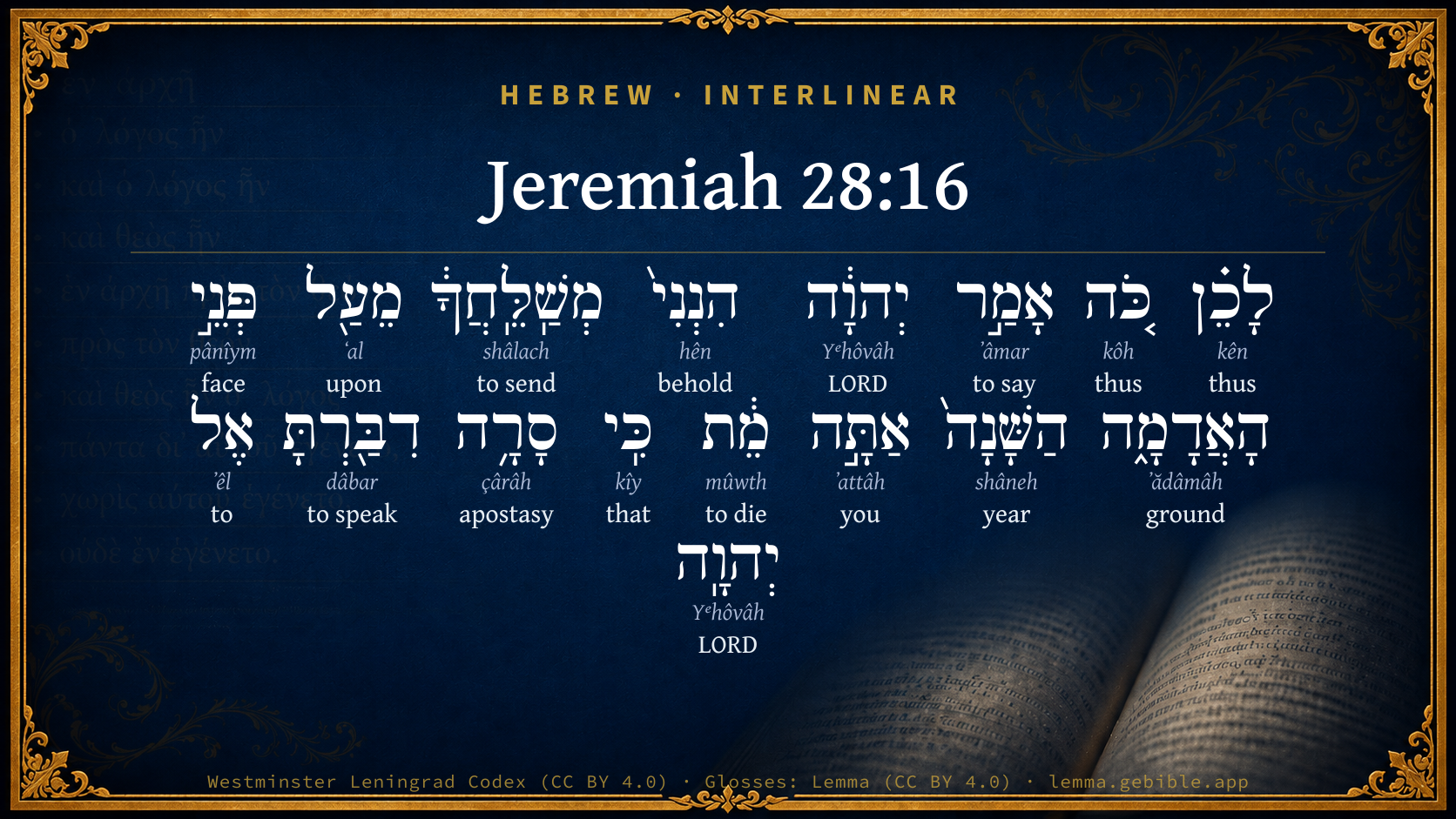
Hebrew (Westminster Leningrad Codex) Jeremiah 28:16 appears in the Hebrew Old Testament. The text above is from the Westminster Leningrad Codex. Each word links to its Strong’s number, a concise gloss, and parsing drawn from the Open Scriptures Hebrew Bible morphology. Click any word for its full Brown-Driver-Briggs (BDB) entry.
Download image
Cite this verse

Jeremiah 28:16 (World English Bible). Public Domain. Lemma interlinear Bible study tool, https://lemma.gebible.app/v/jeremiah/28/16.

Show BibTeX & RIS
BibTeX
RIS
English Translation
Therefore thus says Yahweh, Behold, I will send you away from off the surface of the earth: this year you shall die, because you have spoken rebellion against Yahweh.
World English Bible · Public Domain
Download a study sheet

One document with this verse’s original text, its word-by-word gloss line, the meaning frame, cross-references with their text, attributed commentary, and full source and license credits — printable, and it pastes into notes with its structure intact.

This verse Autodidact and up

Study sheet (.html) Plain text (.txt)

A passage Seminary Student

Up to 50 verses in one chapter. A passage sheet keeps up to 6 commentary sources and 12 cross-references per verse, in the order this page ranks them, and says so on the sheet whenever that leaves anything out. Ask for a single verse and you get the Autodidact verse sheet above.

Everything on this page stays free to read, with no account — the sheet is a download of what is already on screen, not access to it.

Want to remove ads? Support Godless Engineer
Compare translations 3

The same verse in 3 English versions, stacked beneath the original-language interlinear above. Click any original word for its lexicon entry.

Each is an independent rendering of the whole verse — the interlinear is not word-aligned to these translations.

Highlighted words mark where these versions differ — a whole-verse word diff, not a word-by-word alignment.

  • World English Bible Public Domain
    Therefore thus says Yahweh, Behold, I will send you away from off the surface of the earth: this year you shall die, because you have spoken rebellion against Yahweh.
  • King James Version Public Domain
    Therefore thus saith the LORD; Behold, I will cast thee from off the face of the earth: this year thou shalt die, because thou hast taught rebellion against the LORD.
  • unfoldingWord Literal Text CC BY-SA 4.0
    Therefore, thus says Yahweh: ‘Behold, I am sending you away from upon the face of the ground. This year you dying, for you have spoken rebellion against Yahweh.’”

unfoldingWord Literal Text — © unfoldingWord, licensed CC BY-SA 4.0. Word-aligned USFM3 via Door43 (git.door43.org/unfoldingWord/en_ult).

Versions to compare (up to 4)

3 of 4 selected

Show all 18 translations

Every available English version of this verse, each an independent rendering of the whole verse.

  • World English Bible Public Domain
    Therefore thus says Yahweh, Behold, I will send you away from off the surface of the earth: this year you shall die, because you have spoken rebellion against Yahweh.
  • Berean Standard Bible Public Domain
    Therefore this is what the LORD says: ‘I am about to remove you from the face of the earth. You will die this year because you have preached rebellion against the LORD.’”
  • Majority Standard Bible Public Domain
    Therefore this is what the LORD says: ‘I am about to remove you from the face of the earth. You will die this year because you have preached rebellion against the LORD.’”
  • King James Version Public Domain
    Therefore thus saith the LORD; Behold, I will cast thee from off the face of the earth: this year thou shalt die, because thou hast taught rebellion against the LORD.
  • American Standard Version (1901) Public Domain
    Therefore thus saith Jehovah, Behold, I will send thee away from off the face of the earth: this year thou shalt die, because thou hast spoken rebellion against Jehovah.
  • Revised Version (1885) Public Domain
    Therefore thus saith the LORD, Behold, I will send thee away from off the face of the earth: this year thou shalt die, because thou hast spoken rebellion against the LORD.
  • Geneva Bible (1599) Public Domain
    Therefore thus saith the Lord, Beholde, I will cast thee from of the earth: this yeere thou shalt die, because thou hast spoken rebelliously against the Lord.
  • Douay-Rheims (1899) Public Domain
    Therefore thus saith the Lord: Behold I will send thee away from off the face of the earth: this year shalt thou die: for thou hast spoken against the Lord.
  • Young's Literal Translation Public Domain
    Therefore thus said Jehovah, Lo, I am casting thee from off the face of the ground; this year thou diest, for apostacy thou hast spoken concerning Jehovah.'
  • Literal Standard Version CC BY-SA 4.0
    Therefore, thus said YHWH: Behold, I am casting you from off the face of the ground; you die this year, for you have spoken apostasy concerning YHWH.”
  • Unlocked Literal Bible CC BY-SA 4.0
    So Yahweh says this: Look, I am about to send you out from the earth. You will die this year, since you proclaimed rebellion against Yahweh.”
  • unfoldingWord Literal Text CC BY-SA 4.0
    Therefore, thus says Yahweh: ‘Behold, I am sending you away from upon the face of the ground. This year you dying, for you have spoken rebellion against Yahweh.’”
  • Darby Bible Public Domain
    Therefore thus saith Jehovah: Behold, I will cast thee from off the face of the earth: this year thou shalt die, for thou hast spoken revolt against Jehovah.
  • World Messianic Bible Public Domain
    Therefore the LORD says, ‘Behold, I will send you away from off the surface of the earth. This year you will die, because you have spoken rebellion against the LORD.’”
  • Webster's Bible Public Domain
    Therefore thus saith the LORD; Behold, I will cast thee from off the face of the earth: this year thou shalt die, because thou hast taught rebellion against the LORD.
  • Free Bible Version CC BY-SA 4.0
    So this is what the Lord says: I'm going to get rid of you from the earth. You will die this year because you have promoted rebellion against the Lord.”
  • Bible in Basic English Public Domain
    For this reason the Lord has said, See, I will send you away from off the face of the earth: this year death will overtake you, because you have said words against the Lord.
  • JPS Tanakh (1917) Public Domain
    'Therefore thus saith the LORD: Behold, I will send thee away from off the face of the earth; this year thou shalt die, because thou hast spoken perversion against the LORD.'

Literal Standard Version (2020), Covenant Press — licensed CC BY-SA 4.0. Text via the HelloAO Bible API (eBible.org). Unlocked Literal Bible (unfoldingWord) — licensed CC BY-SA 4.0. Text via the HelloAO Bible API (eBible.org). unfoldingWord Literal Text — © unfoldingWord, licensed CC BY-SA 4.0. Word-aligned USFM3 via Door43 (git.door43.org/unfoldingWord/en_ult). Free Bible Version, Dr. Jonathan Gallagher — licensed CC BY-SA 4.0. Text via the HelloAO Bible API (eBible.org).

Word by word

More ways to search: Search by grammar → Find every occurrence → Compare this word →

Practice this passage: Drill this verse → Learn its vocabulary →

סָרָ֥ה
çârâh
H5627
“apostasy”
Noun, Common, Feminine, Singular, Absolute
Part of Speech
Noun
Type
Common
Gender
Feminine
Number
Singular
State
Absolute
Full BDB Definition

Origin: from H5493

TWOT: 1480a

apostasy, defection, turning aside, withdrawal - defection (of moral or legal offenses) - apostasy - withdrawal (negated)
  1. לָכֵ֗ן kên H3651 “to/for · thus” Preposition + Adverb
  2. כֹּ֚ה kôh H3541 “thus” Adverb
  3. אָמַ֣ר ʼâmar H559 “to say” Verb, Qal, Perfect, 3rd Person, Masculine, Singular
  4. יְהוָ֔ה Yᵉhôvâh H3068 “LORD” Noun, Proper
  5. הִנְנִי֙ hên H2005 “behold · me” Particle, Demonstrative + Suffix, Personal, 1st Person, Common, Singular
  6. מְשַֽׁלֵּֽחֲךָ֔ shâlach H7971 “sending · you” Verb, Piel, Participle Active, Masculine, Singular, Construct + Suffix, Personal, 2nd Person, Masculine, Singular
  7. מֵעַ֖ל ʻal H5921 “from · upon” Preposition + Preposition
  8. פְּנֵ֣י pânîym H6440 “face(s) of” Noun, Common, Both, Plural, Construct
  9. הָאֲדָמָ֑ה ʼădâmâh H127 “the · ground” Particle, Definite Article + Noun, Common, Feminine, Singular, Absolute
  10. הַשָּׁנָה֙ shâneh H8141 “the · year” Particle, Definite Article + Noun, Common, Feminine, Singular, Absolute
  11. אַתָּ֣ה ʼattâh H859 “you” Pronoun, Personal, 2nd Person, Masculine, Singular
  12. מֵ֔ת mûwth H4191 “dying” Verb, Qal, Participle Active, Masculine, Singular, Absolute
  13. כִּֽי kîy H3588 “that” Conjunction
  14. דִבַּ֖רְתָּ dâbar H1696 “to speak” Verb, Piel, Perfect, 2nd Person, Masculine, Singular
  15. אֶל ʼêl H413 “to” Preposition
  16. יְהוָֽה Yᵉhôvâh H3068 “LORD” Noun, Proper

About this verse

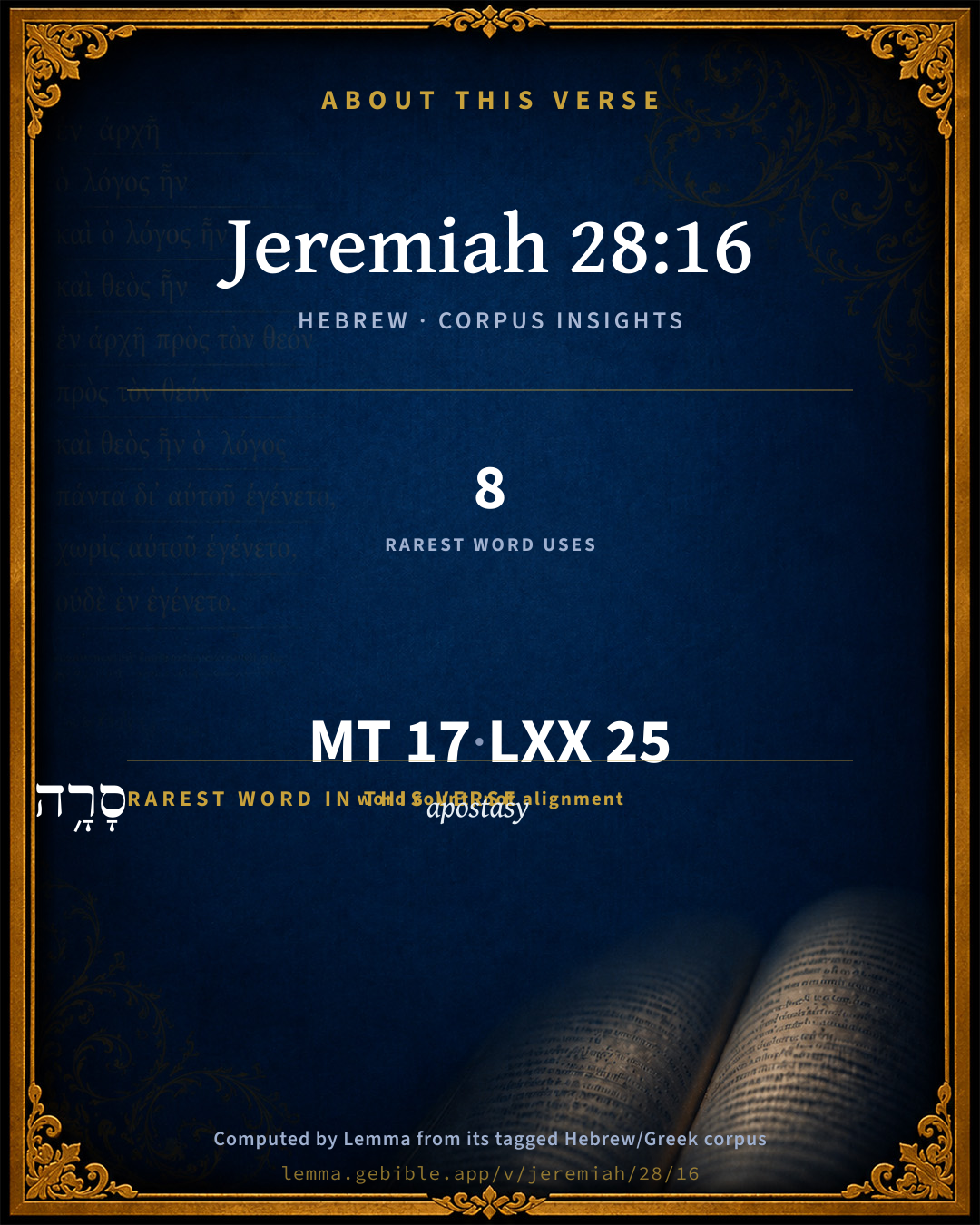
These counts appear in no published source. They are computed here, from the morphology-tagged text and Lemma’s own curated glosses. What Lemma adds →

17
words
16
distinct lemmas
Prophets
section

Notable vocabulary

The rarest word here is סָרָ֥ה apostasy H5627 — appearing just 8 times in the whole Hebrew Bible.

Shared distinctive vocabulary

סָרָ֥ה apostasy H5627 occurs in 8 verses of the Hebrew Bible. Also found in:

Grammatical profile

  • 4 verbs
  • 6 nouns
  • 1 pronoun
  • 2 prepositions
  • 1 conjunction
  • 2 adverbs
  • 1 particle

Verb forms

  • אָמַ֣ר Qal · Perfect
  • מְשַֽׁלֵּֽחֲךָ֔ Piel · Participle Active
  • מֵ֔ת Qal · Participle Active
  • דִבַּ֖רְתָּ Piel · Perfect

Repetition

A word recurs within this verse — often emphatic in Hebrew:

  • יְהוָ֔ה LORD H3068 ×2

Hebrew & Septuagint length

In the original languages it is 17 Hebrew tokens and 25 Greek tokens — but the two are counted differently (Hebrew bundles its prefixes and suffixes into one token; the Greek is in lemma form), so that isn’t a like-for-like length.

Cross-references

14

Topical passages linked to Jeremiah 28:16 in the Treasury of Scripture Knowledge — connected by theme and wording, ordered by reader-vote popularity; previews shown in the World English Bible.

  • Jeremiah 29:32 therefore thus says Yahweh, Behold, I will punish Shemaiah the Nehelamite, and his seed; he shall not have a man to dwell among this people, neither shall he see the good that I will do to my people, says Yahweh, because he has spoken rebellion against Yahweh.
  • Genesis 7:4 In seven days, I will cause it to rain on the earth for forty days and forty nights. Every living thing that I have made, I will destroy from the surface of the ground."
  • Exodus 32:12 Why should the Egyptians speak, saying, 'He brought them forth for evil, to kill them in the mountains, and to consume them from the surface of the earth?' Turn from your fierce wrath, and repent of this evil against your people.
  • Deuteronomy 6:15 for Yahweh your God in the midst of you is a jealous God; lest the anger of Yahweh your God be kindled against you, and he destroy you from off the face of the earth.
  • 1 Kings 13:34 This thing became sin to the house of Jeroboam, even to cut it off, and to destroy it from off the surface of the earth.
  • Jeremiah 20:6 You, Pashhur, and all who dwell in your house shall go into captivity; and you shall come to Babylon, and there you shall die, and there shall you be buried, you, and all your friends, to whom you have prophesied falsely.
  • Numbers 14:37 even those men who did bring up an evil report of the land, died by the plague before Yahweh.
  • Numbers 16:28–35 Moses said, Hereby you shall know that Yahweh has sent me to do all these works; for [I have] not [done them] of my own mind.
  • Numbers 29:32 On the seventh day seven bulls, two rams, fourteen he-lambs a year old without blemish;
  • Deuteronomy 13:5–11 That prophet, or that dreamer of dreams, shall be put to death, because he has spoken rebellion against Yahweh your God, who brought you out of the land of Egypt, and redeemed you out of the house of bondage, to draw you aside out of the way which Yahweh your God commanded you to walk in. So shall you put away the evil from the midst of you.
  • Jeremiah 28:3 Within two full years will I bring again into this place all the vessels of Yahweh's house, that Nebuchadnezzar king of Babylon took away from this place, and carried to Babylon:
  • Ezekiel 13:11–12 tell those who daub it with whitewash, that it shall fall: there shall be an overflowing shower; and you, great hailstones, shall fall; and a stormy wind shall tear it.
  • Amos 9:8 Behold, the eyes of the Lord Yahweh are on the sinful kingdom, and I will destroy it from off the surface of the earth; except that I will not utterly destroy the house of Jacob," says Yahweh.
  • Acts 13:8–11 But Elymas the sorcerer (for so is his name by interpretation) withstood them, seeking to turn aside the proconsul from the faith.

Cross-references courtesy of OpenBible.info (CC BY 4.0).

Hebrew and Greek witnesses Masoretic Hebrew ↔ Greek Septuagint

The same verse in the two great witnesses to the Old Testament, shown verse-for-verse.

These are two independent witnesses, not word-aligned to each other, and the Septuagint is shown in lemma (dictionary) form.

Hebrew Jeremiah 28:16 Masoretic · Westminster Leningrad Codex

לָכֵ֗ן כֹּ֚ה אָמַ֣ר יְהוָ֔ה הִנְנִי֙ מְשַֽׁלֵּֽחֲךָ֔ מֵעַ֖ל פְּנֵ֣י הָאֲדָמָ֑ה הַשָּׁנָה֙ אַתָּ֣ה מֵ֔ת כִּֽי סָרָ֥ה דִבַּ֖רְתָּ אֶל יְהוָֽה

Therefore thus says Yahweh, Behold, I will send you away from off the surface of the earth: this year you shall die, because you have spoken rebellion against Yahweh.

World English Bible · Public Domain

Greek LXX Structure differs

In the Septuagint, Jeremiah is about an eighth shorter than the Hebrew and arranges its material differently — the Oracles Against the Nations (Hebrew chapters 46–51) appear in the middle of the Greek book, after 25:13. Because the chapter and verse boundaries do not line up, a verse-for-verse comparison with the Hebrew is not shown.

A verse-for-verse comparison isn’t shown here because the chapters and verses don’t line up. Switch to the LXX edition with the MT / LXX toggle above to read the Greek directly.

On this verse, The Cambridge Bible for Schools and Colleges discusses the Septuagint’s reading. Read the note in Commentary ↓

Hebrew: Westminster Leningrad Codex (CC BY 4.0). Greek: Septuagint (public domain); English from a public-domain English Septuagint. How the Septuagint differs from the Hebrew →

Targum (Aramaic paraphrase)

1

The Targum is the ancient Jewish Aramaic paraphrase of the Hebrew Scriptures — an interpretive translation, not the Hebrew text itself. Onkelos (literal) and Pseudo-Jonathan (expansive) render the Torah, and Jonathan the Prophets. Coverage is partial: where no permissively-licensed English translation exists for a verse, only the Aramaic is shown. This is verse-level text, not a word-by-word alignment to the Hebrew.

  1. Targum Jonathan Prophets (Joshua–Malachi)
    בְּכֵן כִּדְנַן אֲמַר יְיָ הָא אֲנָא מַגְלְיָךְ מֵעַל אַפֵּי אַרְעָא בְּשַׁתָּא הָדָא אַתְּ מָאִית וּלְשַׁתָּא אוֹחֲרַנְתָּא אַתְּ מִתְקַבֵּר אֲרֵי סַטְיָא מַלֵילְתָּא קֳדָם יְיָ:

    (no public-domain English translation for this verse)

    Targum Jonathan — Aramaic: “Mikraot Gedolot” (public domain). English: “Sefaria Community Translation” (CC0 1.0 (public-domain dedication)); “London "Chaldee Paraphrase," 1871” (public domain). Text via Sefaria.

Commentary

Notes on Jeremiah 28:16 from classic Christian and Jewish commentators (each source and its license shown beneath its notes). The classic Christian expositions comment on the surrounding passage and are grouped to its opening verse, so a note may address several verses; the Jewish commentaries on the Tanakh (Rashi and others) are per-verse, so they appear only where the commentator wrote on this verse.

Lemma curates 59 commentaries, every one of them public domain or Creative Commons licensed, each selected and text-cleaned for this edition rather than reprinted as found. About our sources →

Trapp's Complete Commentary

John Trapp

Jer 28:16 Therefore thus saith the LORD; Behold, I will cast thee from off the face of the earth: this year thou shalt die, because thou hast taught rebellion against the LORD.

Ver. 16. Behold, I will cast thee.] I will shortly lay thee low enough together with thy lordly looks, as D. Taylor, martyr, once told Gardiner, Bishop of Winchester, who reviled him and threatened him.

This year shalt thou die.] Than which thou hadst better do anything.

John Trapp, A Commentary or Exposition upon All the Books of the Old and New Testament (1647–1656) — public domain. Text from a community e-Sword module.

The Biblical Illustrator

Joseph S. Exell

Jer_28:16

This year thou shalt die.

Thoughts on death

1. Let men live ever so many years, some one year will be the year of their death.

2. Every year is a year of death to many; there never was a year since the abbreviation of human life, since the extensive propagation and dispersion of mankind over all countries on the face of the earth, which has not been a year of death to tens of thousands,

3. Last year was a year of death to very many.

4. This year, very probably, will be a year of death to some of us. This or the other tree may be cut down; this or the other branch may be lopt off, and fall to the ground. Let us see then that we be ready, that if cut down, it may be in mercy, not in wrath; that if plucked up by the root and transplanted, it may be to be transplanted in a far better soil, where the air is more genial, where the fruits are always ripe.

5. No one of us knows but God may be saying to him or her, This year thou shalt die. Futurity is wisely hid from man; we know not the year or day of our death we need therefore constantly to watch.

6. It may be in mercy or in wrath that God is saying to this or the other one, This year thou shalt die. It was in wrath that this was said to Hananiah.

7. The year of ones death is a most eventful year to him. This dissolves our connection with the present world; it issues us into the world of spirits. If we are the Lords people, it associates us with God, Christ, angels, and the spirits of just men made perfect in the state of glory and blessedness.

8. There is no outliving the appointed year of ones death. No distinction of rank, no worldly pre-eminence, no degree of riches, influence, or power, no plea of necessity, no supposed usefulness in civil or sacred society, can prevent death.

9. The year of ones death may come very unexpectedly. (Anon.)

Solemn thoughts

I. This sentence is doubtless expressive of the decision of God concerning many this year.

1. The page of history affords no record of a single year in which death desisted from his work of destruction.

2. The last year of many is now commended.

3. Various are the means by Which Gods design will be executed.

II. No individual can be certain that this does not express Gods decision concerning himself.

1. Utterly impossible for us to know who are, or are not, included in Gods appointments.

2. The circumstances of some render it most probable that this year will be their last.

3. Doubtless those who think least of death, and confidently reckon on future years, will find this sentence fulfilled.

III. It is the duty and interest of all to use wisely the gracious hours they enjoy.

1. What is it to die? To pass from this state of being into the immediate presence of our Maker and Judge.

2. Am I prepared to die?

3. Begin the year with earnest preparation. (J. Bunter.)

A sermon on the New Year

It is highly probable, that if some prophet, like Jeremiah, should open to us the book of the Divine decrees, one or other of us would there see our sentence, and the time of its execution fixed, Thus saith the Lord, This year thou shalt die. There some of us would find it written, This year thou shalt enjoy a series of prosperity, to try if the goodness of God will lead thee to repentance. Others might read this melancholy line, This year shall be to thee a series of afflictions: this year thou shalt lose thy dearest earthly support and comfort; this year thou shalt pine away with sickness, or agonise with torturing pain, to try if the kind severities of a Fathers rod will reduce thee to thy duty. Others, I hope, would road the gracious decree, This year, thy stubborn spirit, after long resistance, shall be sweetly constrained to bow to the despised Gospel of Christ. This year shalt thou be born a child of God, and an heir of happiness, which the revolution of years shall never, never, terminate. Others perhaps would read this tremendous doom, This year My Spirit so long resisted, shall cease to strive with thee; this year I will give thee up to thine own hearts lusts, and swear in My wrath thou shalt not enter into My rest. Others would probably find the doom of the false prophet Hananiah pronounced against them: Thus saith the Lord, Behold, I will cast thee from off the face of the earth: this year thou shalt die.

I. This year you may die.

1. Your life is the greatest uncertainty in the world.

2. Thousands have died since the last New Years Day; and this year will be of the same kind with the last; the duration of mortals; a time to die.

3. Thousands of others will die: it is certain they will, and why may not you?

4. Though you are young; for the regions of the dead have been crowded with persons of your age; and no age is the least security against the stroke of death.

5. Though you are now in health and your constitution seems to promise a long life; for thousands of such will be hurried into the eternal world this year, as they have been in years past.

6. Though you are full of business, though you have projected many schemes, which it may be the work of years to execute, and which afford you many bright and flattering prospects.

7. Though you have not yet finished your education, nor fixed in life, but are preparing to appear in the world, and perhaps elated with the prospect of the figure you will make in it.

8. Though you are not prepared for it.

9. Though you deliberately delay your preparation, and put it off to some future time.

10. Though you are unwilling to admit the thought. Death does not slacken his pace towards you, because you hate him, and are afraid of his approach.

11. Though you may strongly hope the contrary, and flatter yourself with the expectation of a length of years.

II. What if you should? If you should die this year, then all your doubts, all the anxieties of blended hopes and fears about your state and character will terminate for ever in full conviction. If you are impenitent sinners, all the artifices of self-flattery will be able to make you hope better things no longer; but the dreadful discovery will flash upon you with the resistless blaze of intuitive evidence. You will see, you will feel yourselves such. This year you may die: and should you die this year, you will be for ever cut off from all the pleasures of life. Then an everlasting farewell to all the mirth, the tempting amusements and vain delights of youth. Farewell to all the pleasures you derive from the senses, and all the gratifications of appetite. Then farewell to all the pompous but empty pleasures of riches and honours. The pleasures both of enjoyment and expectation from this quarter will fail for ever. But this is not all If you should die this year, you will have no pleasures, no enjoyments to substitute for those you will lose. Your capacity and eager thirst for happiness will continue, nay, will grow more strong and violent in that improved adult state of your nature. And yet you will have no good, real or imaginary, to satisfy it; and consequently the capacity of happiness will become a capacity of misery; and the privation of pleasure will be positive pain. If you die this year, you will not only be cut off from all the flattering prospects of this life, but from all hope entirely, and for ever. If you die in your sins, you will be fixed in an unchangeable state of misery; a state that will admit of no expectation but that of uniform, or rather ever-growing misery; a state that excludes all hopes of making a figure, except as the monuments of the vindictive justice of God, and the deadly effects of sin.

III. Is it possible to escape this impending danger?

1. Your case is not yet desperate, unless you choose to make it so; that is, unless you choose to persist in carelessness and impenitence, as you have hitherto done.

2. You all know that prayer, reading, and hearing the Word of God, meditation upon Divine things, free conference with such as have been taught by experience to direct you in this difficult work; you all know, I say, that these are the means instituted for your conversion: and if you had right views of things, and a just temper towards them, you would hardly need instruction or the least persuasion to make use of them. (S. Davies, D. D.)

.

The Biblical Illustrator, edited by Joseph S. Exell (c. 1880s–1900s) — public domain. Text from a community e-Sword module.

Jamieson, Fausset & Brown

Robert Jamieson, A. R. Fausset & David Brown

this year . . . die--The prediction was uttered in the fifth month (Jer 28:1); Hananiah's death took place in the seventh month, that is, within two months after the prediction, answering with awful significance to the two years in which Hananiah had foretold that the yoke imposed by Babylon would end.

rebellion--opposition to God's plain direction, that all should submit to Babylon (Jer 29:32).

Next: Jeremiah Chapter 29

Jamieson, Fausset & Brown — Commentary Critical and Explanatory on the Whole Bible (1871) — public domain (CC PDM 1.0). Text via the HelloAO Bible API.

Adam Clarke's Commentary

Verse 16. This year thou shalt die] By this shall the people know who is the true prophet. Thou hast taught rebellion against the Lord, and God will cut thee off; and this shall take place, not within seventy years, or two years, but in this very year, and within two months from this time.

Adam Clarke's Commentary on the Bible (1810–1826) — public domain. Text from a community e-Sword/MySword module.

John Calvin's Commentaries

Here is added the punishment which confirmed the prophecy of Jeremiah; for it was God’s purpose to have regard to the ignorance of many who would have otherwise stumbled, or made their ignorance a pretext, for they could not determine which of the two had been sent by God, Hananiah or Jeremiah. It was then God’s design, in his paternal indulgence, to stretch forth his hand to them, and also in an especial manner to render inexcusable the unbelieving who had already given themselves up, as it were, to the devil; for the greater part were not moved by an event, so memorable; for it follows immediately, —

John Calvin's Commentaries (1540-1563) — public domain. Text from the Calvin Translation Society English edition (1840s-50s) via the Christian Classics Ethereal Library (ccel.org). Calvin's coverage is partial (roughly two-thirds of the Bible); uncommented books and verses are honest gaps, never fabricated. The 19th-century editor's footnotes and remarks are omitted so the notes are faithfully Calvin's own voice.

Ellicott's Commentary for English Readers

(16) I will cast thee . . .—Literally, I send thee. The verb is the same as in the preceding verse, and is repeated with an emphatic irony.

This year thou shalt die . . .—The punishment is announced, with time given for repentance. In part, perhaps, the threat may have tended to work out its own fulfilment through the gnawing consciousness of shame and confusion in the detection of the false prophet’s assumptions. He knew that the Lord had not sent him. Seven months passed, and then the stroke fell. It is one of the instances of the prophet’s work, as “rooting out” and “pulling down” (Jer_1:10), and has its parallels in the punishment of Ananias, in Act_5:4-5, and of Elymas, in Act_13:11.

A Bible Commentary for English Readers, edited by Charles John Ellicott (1878–1897) — public domain. Text from a community e-Sword module.

The Cambridge Bible for Schools and Colleges

gen. ed. J. J. S. Perowne

16. because thou hast spoken rebellion against the Lord] LXX omit. The words seem to have been introduced from Deu_13:5, where, however, as Gi. points out, unlike the present passage, idolatry is spoken of.

The Cambridge Bible for Schools and Colleges (gen. ed. J. J. S. Perowne; Cambridge University Press, 1878–1918) — public domain. Text from a community e-Sword module.

John Gill's Exposition

Therefore thus saith the Lord,.... Because of this heinous offence, in lying in the name of the Lord, and deceiving the people:

behold, I will cast thee from off the face of the earth; with the utmost indignation and abhorrence, as not worthy to live upon it: it signifies that he should die, and that not a natural, but violent death, by the immediate hand of God, by some judgment upon him; and so be by force taken off the earth, and buried in it, and be no more seen on it:

this year thou shalt die; within the present year, reckoning from this time; so that, had he died any time within twelve months from hence, it would have been sufficient to have verified the prophecy:

because thou hast taught rebellion against the Lord; to despise his word by his prophet; to contradict his will; to refuse subjection to the king of Babylon; to neglect his instructions, directions, and exhortations; and to believe a lie.

John Gill's Exposition of the Whole Bible (1746–1763) — public domain (CC PDM 1.0). Text via the HelloAO Bible API.

Albert Barnes' Notes on the Bible

I will cast thee - Rather, I send thee away. God had not sent Hananiah to prophesy, but He does now send him away to die.

Taught rebellion - As Nebuchadnezzar was Yahweh’s servant, to teach rebellion against him was to teach rebellion against his Master.

Albert Barnes' Notes on the Bible (1834–1885) — public domain. Text from a community e-Sword/MySword module.

Matthew Poole's English Annotations

And because by this his doctrine he had made God a liar, contradicting his will revealed by Jeremiah, and by it taught people to hold out against Nebuchadnezzar, and not quietly to yield to him.

Matthew Poole's English Annotations on the Holy Bible (1683–1685) — public domain. Text from a community e-Sword/MySword module.

Whedon's Commentary on the Bible

Daniel D. Whedon

16, 17. This year thou shalt die — A fearful pledge and earnest of the fulfilment of Jeremiah’s prophecies. Two months later, namely, in the seventh month, these words of prophetic judgment on one who claimed to speak in the name of Jehovah were fulfilled.

Daniel D. Whedon (gen. ed.), Commentary on the Old and New Testaments (1874–1909) — public domain. Text from a community e-Sword module.

The Pulpit Commentary

I will east thee; rather, I song thee away. Possibly, as Hitzig suggests, there is an allusion to the preceding verse, in which the same verb occurs. Thou hast taught rebellion; literally, thou hast spoken turning aside. To "speak turning aside (or, "rebellion")" is a phrase of Deuteronomy, (Deu_13:6) where it is used, as here, of opposition, not to Jehovah, but to revealed truth.

"This year thou shalt die.

It is a great mercy that God has hidden from us the date of our death. If this were known all life would be deranged; some would grow reckless, some negligent of their highest duty till death was near, some despondent and unfit for all work, some overclouded with grief for the approaching separation from loved friends. We may be thankful, therefore, that God keeps the secret to him-soil "Our times are in his hand." Still, it may be profitable for us to question ourselves how we should act if such a revelation were made if an angel came to us with the message, "This year thou shalt die." What would be the effect of such a message?

I IT WOULD URGE US TO PUT OUR TEMPORAL AFFAIRS IN READINESS FOR DEATH. We should wish to "put our house in order," to see that all was left right and straight for those who come after us, to do all in our power to provide for those who are dependent on us. But none of us knows but that he may die this year. We should not, therefore, delay in providing for those who will be left. It is foolish for a man not to make his will till he knows he is dying. Cruel injustice has often been done through the postponement of this duty until too late.

II IT WOULD URGE US TO BE READY FOR ANOTHER WORLD. It would matter little what happened to us for the few months that remained of our earthly course. This life would then seem a poor shadow, its treasures not worth a thought. All anxiety would be fixed on "that undiscovered country." But we do not know but that we shall die this year; and we do know that life is fast fleeting. Should we not be ready in any case? Should we not feel as pilgrims and strangers, and seek for better treasures than those of earth, which all lie a prey to thief and moth and rust? Besides, spiritual preparation for death is not the simple, mechanical thing it appears to be in conventional language. Do we know we shall ever be able to fit ourselves for another world if we postpone all considerations of this momentous subject? It should be remembered, too, that he who is not fit to die is not fit to live; that spiritual condition which is real preparedness for heaven is just the condition for serving God here; if we are rightly living now we are fit to die then and only then.

III IT WOULD URGE US TO A DILIGENT COMPLETION OF OUR LIFE"S WORK. It would be a call to earnest effort to redeem the short remainder of our days. There would be much that we should desire to see finished. It would be sad to let the task fall from our hands unaccomplished. But the same appeal is made to all of us. Life is short, and the work of life is great. There is much for the longest life to do. In any case there is no time for idle postponement of service. Every day has its duty; neglect this, and you can never return to it without neglecting the duty of the morrow. Let us all "work while it is day," seeing that "the night cometh, when no man can work". (Joh_9:4)

IV IT SHOULD NOT TROUBLE THE CHRISTIAN WITH ANY FEAR. To him death has lost its sting. The natural human shrinking from it may remain, but this should be overwhelmed by the thought of the home beyond. For him to die is to end "the heartache, and the thousand natural shocks that flesh is heir to," and to enter the rest, the safety, the joy of heaven. But to the spiritual man it is more than this. All his better days he has been seeking to be nearer to God; for God he has been panting and yearning. Death will be the fruition of this his heart"s hunger; it will make him "forever with the Lord." Earthly ties will still be strong, but he will feel that all is well that is God"s will. If God"s will be that he live, he will rejoice in the privilege of service; if it be that he die, he will feel this as "gain," so that, "whether he live or die, he is the Lord"s." "Lord it belongs not to my care Whether I die or live; To love and serve thee is my share, And this thy grace must give.

The Pulpit Commentary (1880–1919), ed. H.D.M. Spence-Jones & Joseph S. Exell — public domain. Text from a community e-Sword module.

Rashi

Rabbi Shlomo Yitzchaki (Rashi)

this year you shall die And next year you shall be buried.

Rashi on the Tanakh — English translations: “The Judaica Press complete Tanach with Rashi, translated by A. J. Rosenberg” (CC BY 4.0); “Pentateuch with Rashi's commentary by M. Rosenbaum and A.M. Silbermann, 1929-1934” (public domain); “The Metsudah Tanach series, Lakewood, N.J” (CC BY 4.0); and “The Book of Joshua, Metsudah Publications, 1997” (CC BY 4.0). Text via Sefaria.

Lesson kit

Teaching starters — assembled from the data on this page, not authored interpretation. Every prompt links to the verse data it draws on. Edit before teaching.

Jeremiah, in the Prophets, opens this verse with 17 words (16 distinct Hebrew lemmas). Its most distinctive word is çârâh (“apostasy”). A historical commentator’s framing appears above. Read the whole chapter for the surrounding context.

Discussion questions

  1. How does “apostasy” (çârâh) shape what this verse is saying?
  2. Deuteronomy 13:5 shares the word «apostasy» with this verse. How do the two illuminate each other?
  3. “LORD” occurs 2× in this one verse. What is the effect of the repetition?
  4. The translations on this page render this verse differently — a whole-verse word diff, not a word-by-word alignment. What might account for the different wordings?
  5. The verb «אָמַ֣ר» is Qal Perfect. How does its form color the action?
  6. Reading how Trapp's Complete Commentary and The Biblical Illustrator read this verse, where do the two commentators agree and where do they part?

Things to notice

Reading settings

Reading text

Shown beneath each verse's original-language words.

Old Testament
Old Testament edition

Read the OT as the Masoretic Hebrew (MT) or the Greek Septuagint (LXX).

English shown for the Greek Septuagint (in the Hebrew ↔ Greek comparison).

Comparing translations? Open the Compare panel on any verse page to stack up to four side by side.