
Numbers 16:31

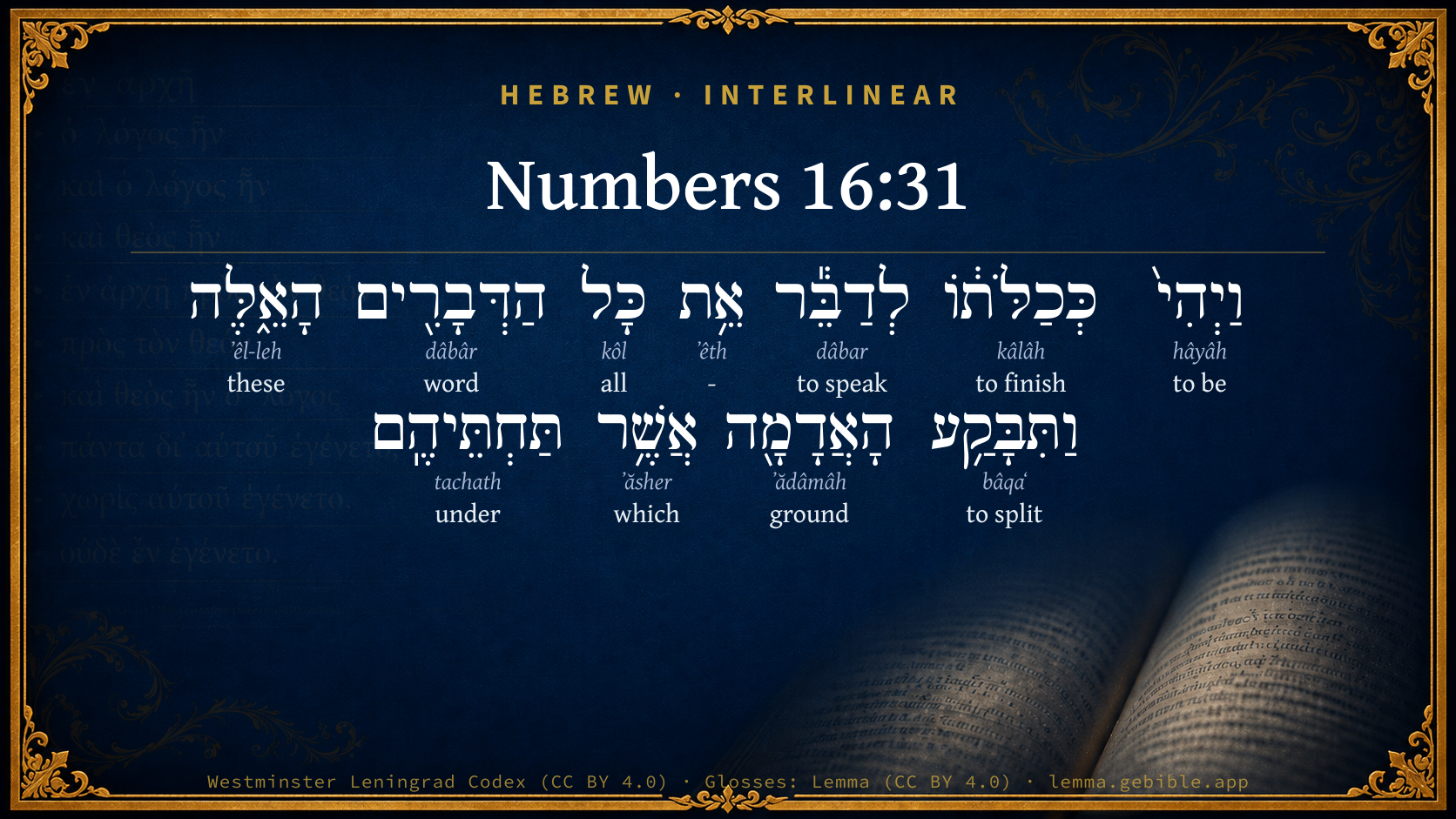
Hebrew (Westminster Leningrad Codex) Numbers 16:31 appears in the Hebrew Old Testament. The text above is from the Westminster Leningrad Codex. Each word links to its Strong’s number, a concise gloss, and parsing drawn from the Open Scriptures Hebrew Bible morphology. Click any word for its full Brown-Driver-Briggs (BDB) entry.
Download image
Cite this verse

Numbers 16:31 (World English Bible). Public Domain. Lemma interlinear Bible study tool, https://lemma.gebible.app/v/numbers/16/31.

Show BibTeX & RIS
BibTeX
RIS
English Translation
It happened, as he made an end of speaking all these words, that the ground split apart that was under them;
World English Bible · Public Domain
Download a study sheet

One document with this verse’s original text, its word-by-word gloss line, the meaning frame, cross-references with their text, attributed commentary, and full source and license credits — printable, and it pastes into notes with its structure intact.

This verse Autodidact and up

Study sheet (.html) Plain text (.txt)

A passage Seminary Student

Up to 50 verses in one chapter. A passage sheet keeps up to 6 commentary sources and 12 cross-references per verse, in the order this page ranks them, and says so on the sheet whenever that leaves anything out. Ask for a single verse and you get the Autodidact verse sheet above.

Everything on this page stays free to read, with no account — the sheet is a download of what is already on screen, not access to it.

Want to remove ads? Support Godless Engineer
Compare translations 3

The same verse in 3 English versions, stacked beneath the original-language interlinear above. Click any original word for its lexicon entry.

Each is an independent rendering of the whole verse — the interlinear is not word-aligned to these translations.

Highlighted words mark where these versions differ — a whole-verse word diff, not a word-by-word alignment.

  • World English Bible Public Domain
    It happened, as he made an end of speaking all these words, that the ground split apart that was under them;
  • King James Version Public Domain
    And it came to pass, as he had made an end of speaking all these words, that the ground clave asunder that was under them:
  • unfoldingWord Literal Text CC BY-SA 4.0
    And it happened, when he finished to speak all these words, that the ground that under them was split open,

unfoldingWord Literal Text — © unfoldingWord, licensed CC BY-SA 4.0. Word-aligned USFM3 via Door43 (git.door43.org/unfoldingWord/en_ult).

Versions to compare (up to 4)

3 of 4 selected

Show all 18 translations

Every available English version of this verse, each an independent rendering of the whole verse.

  • World English Bible Public Domain
    It happened, as he made an end of speaking all these words, that the ground split apart that was under them;
  • Berean Standard Bible Public Domain
    As soon as Moses had finished saying all this, the ground beneath them split open,
  • Majority Standard Bible Public Domain
    As soon as Moses had finished saying all this, the ground beneath them split open,
  • King James Version Public Domain
    And it came to pass, as he had made an end of speaking all these words, that the ground clave asunder that was under them:
  • American Standard Version (1901) Public Domain
    And it came to pass, as he made an end of speaking all these words, that the ground clave asunder that was under them;
  • Revised Version (1885) Public Domain
    And it came to pass, as he made an end of speaking all these words, that the ground clave asunder that was under them:
  • Geneva Bible (1599) Public Domain
    And assoone as he had made an ende of speaking all these wordes, euen the ground claue asunder that was vnder them,
  • Douay-Rheims (1899) Public Domain
    And immediately as he had made an end of speaking, the earth broke asunder under their feet:
  • Young's Literal Translation Public Domain
    And it cometh to pass at his finishing speaking all these words, that the ground which `is' under them cleaveth,
  • Literal Standard Version CC BY-SA 4.0
    And it comes to pass at his finishing speaking all these words, that the ground which [is] under them cleaves,
  • Unlocked Literal Bible CC BY-SA 4.0
    As soon as Moses finished speaking all these words, the ground opened under those men.
  • unfoldingWord Literal Text CC BY-SA 4.0
    And it happened, when he finished to speak all these words, that the ground that under them was split open,
  • Darby Bible Public Domain
    And it came to pass when he had ended speaking all these words, that the ground clave apart that was under them.
  • World Messianic Bible Public Domain
    As he finished speaking all these words, the ground that was under them split apart.
  • Webster's Bible Public Domain
    And it came to pass, as he had made an end of speaking all these words, that the ground cleaved asunder that was under them:
  • Free Bible Version CC BY-SA 4.0
    Immediately after Moses had finished saying all this, the ground under the rebels split apart,
  • Bible in Basic English Public Domain
    And while these words were on his lips, the earth under them was parted in two;
  • JPS Tanakh (1917) Public Domain
    And it came to pass, as he made an end of speaking all these words, that the ground did cleave asunder that was under them.

Literal Standard Version (2020), Covenant Press — licensed CC BY-SA 4.0. Text via the HelloAO Bible API (eBible.org). Unlocked Literal Bible (unfoldingWord) — licensed CC BY-SA 4.0. Text via the HelloAO Bible API (eBible.org). unfoldingWord Literal Text — © unfoldingWord, licensed CC BY-SA 4.0. Word-aligned USFM3 via Door43 (git.door43.org/unfoldingWord/en_ult). Free Bible Version, Dr. Jonathan Gallagher — licensed CC BY-SA 4.0. Text via the HelloAO Bible API (eBible.org).

Word by word

More ways to search: Search by grammar → Find every occurrence → Compare this word →

Practice this passage: Drill this verse → Learn its vocabulary →

וַתִּבָּקַ֥ע
bâqaʻ
H1234
“and · to split”
Conjunction + Verb, Niphal, Sequential Imperfect, 3rd Person, Feminine, Singular
Part of Speech
Conjunction + Verb
Stem
Niphal
Form
Sequential Imperfect
Person
3rd Person
Gender
Feminine
Number
Singular
Full BDB Definition

Origin: a primitive root

TWOT: 271

to split, cleave, break open, divide, break through, rip up, break up, tear - (Qal) - to cleave, cleave open - to break through, break into - (Niphal) - to be cleft, be rent open, be split open - to be broken into - (Piel) - to cleave, cut to pieces, rend open - to break through, break down - (Pual) - to be ripped open, be torn open - to be rent - to be broken into - (Hiphil) - to break into - to break through - (Hophal) to be broken into - (Hithpael) to burst (themselves) open, cleave asunder
  1. וַיְהִי֙ hâyâh H1961 “and · to be” Conjunction + Verb, Qal, Sequential Imperfect, 3rd Person, Masculine, Singular
  2. כְּכַלֹּת֔וֹ kâlâh H3615 “like/as · to finish · him” Preposition + Verb, Piel, Infinitive Construct + Suffix, Personal, 3rd Person, Masculine, Singular
  3. לְדַבֵּ֕ר dâbar H1696 “to speak” Preposition + Verb, Piel, Infinitive Construct
  4. אֵ֥ת ʼêth H853 “-” Particle, Direct Object
  5. כָּל kôl H3605 “all of” Noun, Common, Masculine, Singular, Construct
  6. הַדְּבָרִ֖ים dâbâr H1697 “the · words” Particle, Definite Article + Noun, Common, Masculine, Plural, Absolute
  7. הָאֵ֑לֶּה ʼêl-leh H428 “the · these” Particle, Definite Article + Pronoun, Demonstrative, Common, Plural
  8. הָאֲדָמָ֖ה ʼădâmâh H127 “the · ground” Particle, Definite Article + Noun, Common, Feminine, Singular, Absolute
  9. אֲשֶׁ֥ר ʼăsher H834 “which” Particle, Relative
  10. תַּחְתֵּיהֶֽם tachath H8478 “under · them” Preposition + Suffix, Personal, 3rd Person, Masculine, Plural

About this verse

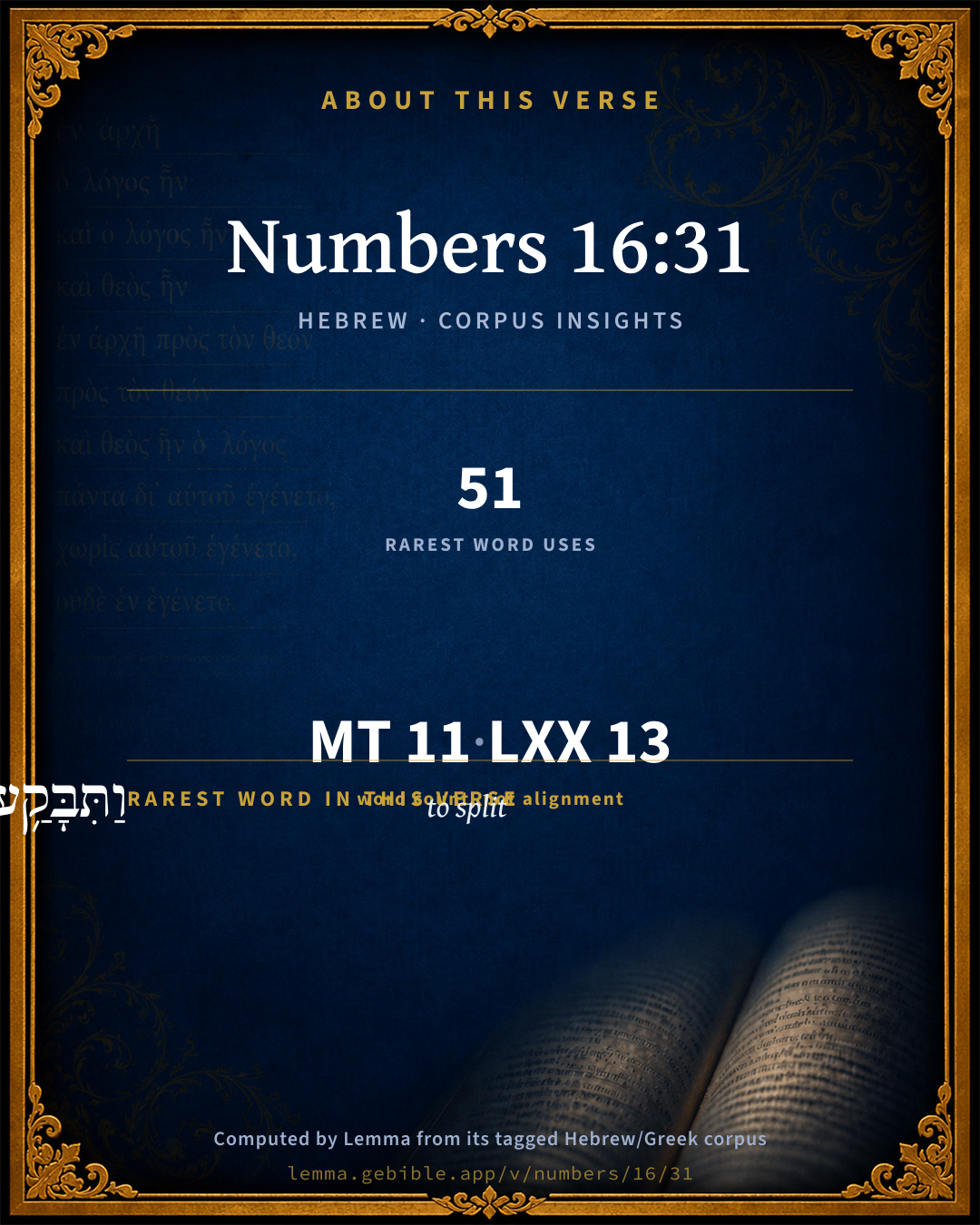
These counts appear in no published source. They are computed here, from the morphology-tagged text and Lemma’s own curated glosses. What Lemma adds →

11
words
11
distinct lemmas
Pentateuch
section

Shared distinctive vocabulary

וַתִּבָּקַ֥ע to split H1234 occurs in 50 verses of the Hebrew Bible. Also found in:

Grammatical profile

  • 4 verbs
  • 3 nouns
  • 1 pronoun
  • 1 preposition
  • 2 particles

Verb forms

  • וַיְהִי֙ Qal · Sequential Imperfect
  • כְּכַלֹּת֔וֹ Piel · Infinitive Construct
  • לְדַבֵּ֕ר Piel · Infinitive Construct
  • וַתִּבָּקַ֥ע Niphal · Sequential Imperfect

Hebrew & Septuagint length

In English translation the verse runs 21 words from the Hebrew and 14 from the Septuagint (LXX English) — the Septuagint runs noticeably shorter here. See the side-by-side →

A rough comparison of the two English renderings, which tokenize alike — not a word-level alignment.

Word counts can differ between the Hebrew and the Greek without any difference in meaning — e.g. the Hebrew direct-object marker אֵת has no separate Greek word, and Greek often adds the article ὁ.

In the original languages it is 11 Hebrew tokens and 13 Greek tokens — but the two are counted differently (Hebrew bundles its prefixes and suffixes into one token; the Greek is in lemma form), so that isn’t a like-for-like length.

Cross-references

4

Topical passages linked to Numbers 16:31 in the Treasury of Scripture Knowledge — connected by theme and wording, ordered by reader-vote popularity; previews shown in the World English Bible.

  • Numbers 27:3 Our father died in the wilderness, and he was not among the company of those who gathered themselves together against Yahweh in the company of Korah: but he died in his own sin; and he had no sons.
  • Deuteronomy 11:6 and what he did to Dathan and Abiram, the sons of Eliab, the son of Reuben; how the earth opened its mouth, and swallowed them up, and their households, and their tents, and every living thing that followed them, in the midst of all Israel:
  • Psalms 106:17–18 The earth opened and swallowed up Dathan, And covered the company of Abiram.
  • Numbers 26:10–11 and the earth opened its mouth, and swallowed them up together with Korah, when that company died; what time the fire devoured two hundred fifty men, and they became a sign.

Cross-references courtesy of OpenBible.info (CC BY 4.0).

Hebrew and Greek witnesses Masoretic Hebrew ↔ Greek Septuagint

The same verse in the two great witnesses to the Old Testament, shown verse-for-verse.

Here the Septuagint runs noticeably shorter than the Hebrew — LXX2012 (modern English Septuagint) 14 words vs World English Bible 21. A rough length comparison of the two English translations, not a word-level alignment — read both below.

These are two independent witnesses, not word-aligned to each other, and the Septuagint is shown in lemma (dictionary) form.

Hebrew Numbers 16:31 Masoretic · Westminster Leningrad Codex

וַיְהִי֙ כְּכַלֹּת֔וֹ לְדַבֵּ֕ר אֵ֥ת כָּל הַדְּבָרִ֖ים הָאֵ֑לֶּה וַתִּבָּקַ֥ע הָאֲדָמָ֖ה אֲשֶׁ֥ר תַּחְתֵּיהֶֽם

It happened, as he made an end of speaking all these words, that the ground split apart that was under them;

World English Bible · Public Domain

Greek LXX Numbers 16:31 Septuagint · lemma form

ὡς δέ παύω λαλέω πᾶς ὁ λόγος οὗτος ῥήγνυμι ὁ γῆ ὑποκάτω αὐτός

And when he ceased speaking all these words, the ground clave asunder beneath them.

LXX2012 (modern English Septuagint) · Public Domain

Hebrew: Westminster Leningrad Codex (CC BY 4.0). Greek: Septuagint (public domain); English from LXX2012 (modern English Septuagint) (Public Domain). How the Septuagint differs from the Hebrew →

Targum (Aramaic paraphrase)

2

The Targum is the ancient Jewish Aramaic paraphrase of the Hebrew Scriptures — an interpretive translation, not the Hebrew text itself. Onkelos (literal) and Pseudo-Jonathan (expansive) render the Torah, and Jonathan the Prophets. Coverage is partial: where no permissively-licensed English translation exists for a verse, only the Aramaic is shown. This is verse-level text, not a word-by-word alignment to the Hebrew.

  1. Targum Onkelos Torah (Genesis–Deuteronomy)
    וַהֲוָה כַּד שֵׁיצֵי לְמַלָלָא יָת כָּל פִּתְגָמַיָא הָאִלֵין וְאִתְבְּזָעַת אַרְעָא דִי תְּחוֹתֵיהוֹן

    (no public-domain English translation for this verse)

    Targum Onkelos — Aramaic: “Onkelos Genesis” (public domain); “Onkelos Exodus” (public domain); “Onkelos Leviticus” (public domain); “Onkelos Numbers” (public domain); “Onkelos Deuteronomy” (public domain). English: “Sefaria Community Translation” (CC0 1.0 (public-domain dedication)); “J.W. Etheridge. The Targums of Onkelos and Jonathan Ben Uzziel on the Pentateuch. London: Longmans, Green, 1862” (public domain). Text via Sefaria.

  2. Targum Pseudo-Jonathan Torah (Genesis–Deuteronomy)
    וַהֲוָה כְדִי פָסַק לְמַלָלָא יַת כָּל פִּתְגָמַיָא הָאִלֵין וְאִתְבְּזָעַת אַרְעָא דִתְחוֹתֵיהוֹן

    And it came to pass, when he had finished speaking these words, the earth beneath them clave asunder;

    Targum Pseudo-Jonathan — Aramaic: “Targum Jonathan on Genesis” (public domain); “Targum Jonathan on Exodus” (public domain); “Targum Jonathan on Leviticus” (public domain); “Targum Jonathan on Numbers” (public domain); “Targum Jonathan on Deuteronomy” (public domain). English: “The Targum of Jonathan ben Uzziel, trans. J. W. Etheridge, London, 1862” (public domain). Text via Sefaria.

Commentary

Notes on Numbers 16:31 from classic Christian and Jewish commentators (each source and its license shown beneath its notes). The classic Christian expositions comment on the surrounding passage and are grouped to its opening verse, so a note may address several verses; the Jewish commentaries on the Tanakh (Rashi and others) are per-verse, so they appear only where the commentator wrote on this verse.

Lemma curates 59 commentaries, every one of them public domain or Creative Commons licensed, each selected and text-cleaned for this edition rather than reprinted as found. About our sources →

Trapp's Complete Commentary

John Trapp

Num 16:31 And it came to pass, as he had made an end of speaking all these words, that the ground clave asunder that [was] under them:

Ver. 31. As he had made an end of speaking.] Dictum factum; so it is still. {Joh 20:23} Vengeance is every whit as ready in God’s hands, as in his ministers’ mouths. {2Co 10:6}

John Trapp, A Commentary or Exposition upon All the Books of the Old and New Testament (1647–1656) — public domain. Text from a community e-Sword module.

Tyndale Open Study Notes

Tyndale Open Resources

16:31-33 Korah’s sons did not die at this time (26:10-11). In fact, his descendants eventually became gatekeepers and musicians in the Temple (1 Chr 9:19, 31; 26:19; 2 Chr 20:19; cp. the titles of Pss 42; 45–49; 84–85; 87–88).

Tyndale Open Study Notes — © Tyndale Open Resources, licensed CC BY-SA 4.0. Text via the HelloAO Bible API.

John Gill's Exposition

And it came to pass, as he had made an end of speaking all these things,.... As soon as he had finished his discourse, which was addressed to the congregation, and, according to Josephus (u), after a long prayer to God, which that writer gives at large; immediately so it was:

that the ground clave asunder that was under them; on which they stood, not from any natural cause, as by subterranean volcano, forcibly making their way and bursting the earth, and so getting vent, which has been thought to be the cause of earthquakes; but this was by the immediate hand and almighty power of God, and came to pass just as Moses suggested it would, and as soon as he had uttered his words, which made it the more observable.

(u) Antiqu. l. 4. c. 3. Sect. 2.

John Gill's Exposition of the Whole Bible (1746–1763) — public domain (CC PDM 1.0). Text via the HelloAO Bible API.

Whedon's Commentary on the Bible

Daniel D. Whedon

31. The ground clave asunder — There may have been a natural cause for this event; but its occurrence according to prediction in vindication of God’s appointed priesthood and in vengeance upon his foes betokens the supernatural.

Daniel D. Whedon (gen. ed.), Commentary on the Old and New Testaments (1874–1909) — public domain. Text from a community e-Sword module.

The Pulpit Commentary

The ground clave asunder that was under them. As it sometimes does during an earthquake. In this case, however, the event was predicted, and wholly supernatural. The sequence of the narrative would lead us to suppose that the earth opened beneath the tents of Dathan and Abiram in the camp of Reuben. It is difficult to think of the gulf as extending so far as to involve the tent of Korah in the Kohathite lines in the same destruction, while there is nothing to suggest the idea that the earth opened in more than one place. It is true that the camps of the Reubenites and of the Kohathites were more or less contiguous; but when it is remembered that there were 46, 500 adult males in the former, and 8600 males in the latter, and that a broad space must have been left between the two lines of encampment, it is obviously improbable that Korah"s tent was in a practical sense "near" to those of Dathan and Abiram, unless indeed he had purposely removed it in order to be under the protection of his Reubenite partisans. It is very observable that not a word is said here as to the fate of Korah himself. It is implied in verse 40 that he had perished, and it is apparently asserted in Num_26:10 that he was swallowed up with Dathan and Abiram (see the note there). On the other hand, Deu_11:6 Psa_106:17 speak of the engulfing of the other two without any mention of Korah himself sharing their fate; and while "all the men that appertained unto Korah" perished, his own sons did not. (Num_26:11) On these grounds it is held by most commentators that Korah died by fire among those who offered incense (verse 35). This, however, is untenable, because "the two hundred and fifty men who offered incense" are distinctly mentioned as having been his partisans (verse 2), and are always counted exclusive of Korah himself. On the whole, while it is certain that the narrative is very obscure, and the question very doubtful, it seems most agreeable to all the testimonies of Holy Scripture to conclude

1. That Korah had left his own place, and had some sort of dwelling (mischan) either in common with Dathan and Abiram, or hard by their tents.

2. That the earth opened and swallowed up the mishcan, of Korah, and the tents of Dathan and Abiram.

3. That Korah"s men (see next verse) and their property were swallowed up with his mishcan, and (as far as we can tell) Korah himself also. If this be correct, then the much disputed heading of the chapter in the A.V will be right after all.

Vers. 31-33. The destructiveness of sin.

Some things are very much dreaded because so destructive. E.g., locusts, war, pestilence. But there is nothing so destructive as sin. As "no man liveth," so no man sinneth, "to himself." Of Korah, as of Achan or of other transgressors, it may be said, "That man perished not alone in his iniquity". (Jos_22:20) The destructive effects of sin are twofold

I PERSONAL,

II SOCIAL.

I PERSONAL: on the sinner himself, as in the case of Korah the Kohathite, honoured as one of the ministers of God"s ark. Illustration Infection, taken unawares, may not be suspected by friends, hardly by the victim; but its effects (fever, eruption, &c.) will be seen by and by. Sin cannot always be kept secret. ; (Isa_59:12 Jam_1:15) "Evil shall slay the wicked." If the consequences are not as fatal as in Korah"s case, moral destruction is going on. As Alpine granite may be reduced by frost and damp to a kind of mould, so sin some sins especially seems to break up the moral nature and reduce it to ruins. From the personal consequences of sin the destroyer we can only be delivered by Christ the Savior. (Tit_2:14)

II SOCIAL: on others. In the case of Korah and his conspirators, sin was fatal to their families. So perhaps in the case of Achan; (Jos_7:24-26 Jos_22:20) if not, how terrible for them to see the husband, the father, killed, and to know that he had caused the loss of thirty-six men at Ai! "Curses, like chickens, always come home to roost." We cannot sin with impunity to our family any more than Adam did. Sin propagates sin. It involves others, directly or indirectly, in its fatal consequences. Illustration King Saul, and the catastrophe to both family and nation at Gilboa. Unrighteous statesmen. Men of high social position who are immoral or infidel. Each sinner a center of contagion. (Ecc_9:18) The fate of the children of Korah"s company a warning to sinful parents. The children of the godless may be expected to become the parents of godless children, and thus the evil may be perpetuated from generation to generation. Mournful epitaph for a sinner"s grave: "That man perished not alone in his iniquity." "But where sin abounded, grace did much more abound. P. (Rom_5:20, 21 8:2, 3)

The Pulpit Commentary (1880–1919), ed. H.D.M. Spence-Jones & Joseph S. Exell — public domain. Text from a community e-Sword module.

Keil & Delitzsch

C. F. Keil & F. Delitzsch

And immediately the earth clave asunder, and swallowed them up, with their families and all their possessions, and closed above them, so that they perished without a trace from the congregation. אתם refers to the three ringleaders. "Their houses;" i.e., their families, not their tents, as in Num 18:31; Exo 12:3. "All the men belonging to Korah" were his servants; for, according to Num 26:11, his sons did not perish with him, but perpetuated his family (Num 26:58), to which the celebrated Korahite singers of David's time belonged (Ch1 6:18-22; Ch1 9:19).

Keil & Delitzsch — Biblical Commentary on the Old Testament (1861–1891) — public domain (CC PDM 1.0). Text via the HelloAO Bible API. (Old Testament only.)

unfoldingWord translationNotes

Door43 World Missions Community

The earth opened its mouth and swallowed them

Moses speaks of the earth as if it were alive, and the hole that the people fell into as if it were the earth's mouth. AT: "The earth opened up like a large mouth, and they fell into it and were buried in it" or "There was a giant hole in the ground, and they fell into it and were buried in it" (See: Metaphor)

translationWords

word

earth

possess

unfoldingWord translationNotes — © Distant Shores Media and the Door43 World Missions Community, licensed CC BY-SA 4.0. Source: git.door43.org/Door43/en_tn.

Lesson kit

Teaching starters — assembled from the data on this page, not authored interpretation. Every prompt links to the verse data it draws on. Edit before teaching.

Numbers, in the Pentateuch, opens this verse with 11 words (11 distinct Hebrew lemmas). Its most distinctive word is bâqaʻ (“to split”). The Greek Septuagint runs shorter here. A historical commentator’s framing appears above. Read the whole chapter for the surrounding context.

Discussion questions

  1. How does “to split” (bâqaʻ) shape what this verse is saying?
  2. How does Genesis 7:11, which shares the word «to split», read alongside this verse?
  3. The Septuagint runs shorter here than the Hebrew. What might account for the difference?
  4. These translations render this verse differently; the difference is in the English rendering, not the original. What questions does that raise?
  5. «וַיְהִי֙» is a Qal Sequential Imperfect verb. How does that grammatical form shape the action described?
  6. Compare how Trapp's Complete Commentary and Tyndale Open Study Notes read this verse. Where do they agree or differ?

Things to notice

Reading settings

Reading text

Shown beneath each verse's original-language words.

Old Testament
Old Testament edition

Read the OT as the Masoretic Hebrew (MT) or the Greek Septuagint (LXX).

English shown for the Greek Septuagint (in the Hebrew ↔ Greek comparison).

Comparing translations? Open the Compare panel on any verse page to stack up to four side by side.