
Ezekiel 36:17

Hebrew (Westminster Leningrad Codex) Ezekiel 36:17 appears in the Hebrew Old Testament. The text above is from the Westminster Leningrad Codex. Each word links to its Strong’s number, a concise gloss, and parsing drawn from the Open Scriptures Hebrew Bible morphology. Click any word for its full Brown-Driver-Briggs (BDB) entry.
Download image
Cite this verse

Ezekiel 36:17 (World English Bible). Public Domain. Lemma interlinear Bible study tool, https://lemma.gebible.app/v/ezekiel/36/17.

Show BibTeX & RIS
BibTeX
RIS
English Translation
Son of man, when the house of Israel lived in their own land, they defiled it by their way and by their doings: their way before me was as the uncleanness of a woman in her impurity.
World English Bible · Public Domain
Download a study sheet

One document with this verse’s original text, its word-by-word gloss line, the meaning frame, cross-references with their text, attributed commentary, and full source and license credits — printable, and it pastes into notes with its structure intact.

This verse Autodidact and up

Study sheet (.html) Plain text (.txt)

A passage Seminary Student

Up to 50 verses in one chapter. A passage sheet keeps up to 6 commentary sources and 12 cross-references per verse, in the order this page ranks them, and says so on the sheet whenever that leaves anything out. Ask for a single verse and you get the Autodidact verse sheet above.

Everything on this page stays free to read, with no account — the sheet is a download of what is already on screen, not access to it.

Want to remove ads? Support Godless Engineer
Compare translations 3

The same verse in 3 English versions, stacked beneath the original-language interlinear above. Click any original word for its lexicon entry.

Each is an independent rendering of the whole verse — the interlinear is not word-aligned to these translations.

Highlighted words mark where these versions differ — a whole-verse word diff, not a word-by-word alignment.

  • World English Bible Public Domain
    Son of man, when the house of Israel lived in their own land, they defiled it by their way and by their doings: their way before me was as the uncleanness of a woman in her impurity.
  • King James Version Public Domain
    Son of man, when the house of Israel dwelt in their own land, they defiled it by their own way and by their doings: their way was before me as the uncleanness of a removed woman.
  • unfoldingWord Literal Text CC BY-SA 4.0
    “Son of man, when the house of Israel inhabited their land, they defiled it with their ways and their deeds. Their ways were like the unclean menstruation of a woman before me.

unfoldingWord Literal Text — © unfoldingWord, licensed CC BY-SA 4.0. Word-aligned USFM3 via Door43 (git.door43.org/unfoldingWord/en_ult).

Versions to compare (up to 4)

3 of 4 selected

Show all 18 translations

Every available English version of this verse, each an independent rendering of the whole verse.

  • World English Bible Public Domain
    Son of man, when the house of Israel lived in their own land, they defiled it by their way and by their doings: their way before me was as the uncleanness of a woman in her impurity.
  • Berean Standard Bible Public Domain
    “Son of man, when the people of Israel lived in their land, they defiled it by their own ways and deeds. Their behavior before Me was like the uncleanness of a woman’s impurity.
  • Majority Standard Bible Public Domain
    “Son of man, when the people of Israel lived in their land, they defiled it by their own ways and deeds. Their behavior before Me was like the uncleanness of a woman’s impurity.
  • King James Version Public Domain
    Son of man, when the house of Israel dwelt in their own land, they defiled it by their own way and by their doings: their way was before me as the uncleanness of a removed woman.
  • American Standard Version (1901) Public Domain
    Son of man, when the house of Israel dwelt in their own land, they defiled it by their way and by their doings: their way before me was as the uncleanness of a woman in her impurity.
  • Revised Version (1885) Public Domain
    Son of man, when the house of Israel dwelt in their own land, they defiled it by their way and by their doings: their way before me was as the uncleanness of a woman in her separation.
  • Geneva Bible (1599) Public Domain
    Sonne of man, when the house of Israel dwelt in their owne lande, they defiled it by their owne wayes, and by their deedes: their way was before me as the filthinesse of the menstruous.
  • Douay-Rheims (1899) Public Domain
    Son of man, when the house of Israel dwelt in their own land, they defiled it with their ways, and with their doings: their way was before me like the uncleanness of a menstruous woman.
  • Young's Literal Translation Public Domain
    `Son of man, The house of Israel are dwelling on their land, And they defile it by their way and by their doings, As the uncleanness of a separated one hath their way been before Me.
  • Literal Standard Version CC BY-SA 4.0
    “Son of man, || The house of Israel are dwelling on their land, || And they defile it by their way and by their doings, || Their way has been as the uncleanness of a separated one before Me.
  • Unlocked Literal Bible CC BY-SA 4.0
    “Son of man, when the house of Israel inhabited their land, they defiled it with their ways and their deeds. Their ways were like the unclean menstruation of a woman before me.
  • unfoldingWord Literal Text CC BY-SA 4.0
    “Son of man, when the house of Israel inhabited their land, they defiled it with their ways and their deeds. Their ways were like the unclean menstruation of a woman before me.
  • Darby Bible Public Domain
    Son of man, when the house of Israel dwelt in their own land, they defiled it by their way and by their doings: their way was before me as the uncleanness of a woman in her separation.
  • World Messianic Bible Public Domain
    “Son of man, when the house of Israel lived in their own land, they defiled it by their ways and by their deeds. Their way before me was as the uncleanness of a woman in her impurity.
  • Webster's Bible Public Domain
    Son of man, when the house of Israel dwelt in their own land, they defiled it by their own way and by their doings: their way was before me as the uncleanness of a removed woman.
  • Free Bible Version CC BY-SA 4.0
    “Son of man, when the people of Israel were living in their country, they made it unclean by the way they behaved, by what they did. The way they were behaving in my presence was like the ceremonial uncleanness of a woman's period.
  • Bible in Basic English Public Domain
    Son of man, when the children of Israel were living in their land, they made it unclean by their way and their acts: their way before me was as when a woman is unclean at the time when she is kept separate.
  • JPS Tanakh (1917) Public Domain
    'Son of man, when the house of Israel dwelt in their own land, they defiled it by their way and by their doings; their way before Me was as the uncleanness of a woman in her impurity.

Literal Standard Version (2020), Covenant Press — licensed CC BY-SA 4.0. Text via the HelloAO Bible API (eBible.org). Unlocked Literal Bible (unfoldingWord) — licensed CC BY-SA 4.0. Text via the HelloAO Bible API (eBible.org). unfoldingWord Literal Text — © unfoldingWord, licensed CC BY-SA 4.0. Word-aligned USFM3 via Door43 (git.door43.org/unfoldingWord/en_ult). Free Bible Version, Dr. Jonathan Gallagher — licensed CC BY-SA 4.0. Text via the HelloAO Bible API (eBible.org).

Word by word

More ways to search: Search by grammar → Find every occurrence → Compare this word →

Practice this passage: Drill this verse → Learn its vocabulary →

וּבַעֲלִֽילוֹתָ֑ם
ʻălîylâh
H5949
“and · in/at · deeds · their”
Conjunction + Preposition + Noun, Common, Feminine, Plural, Construct + Suffix, Personal, 3rd Person, Masculine, Plural
Part of Speech
Conjunction + Preposition + Noun
Type
Common
Gender
Feminine
Number
Plural
State
Construct
Full BDB Definition

Origin: from H5953 in the sense of effecting

TWOT: 1627c

wantonness, deed, doing - wantonness - deed - practices, evil deeds
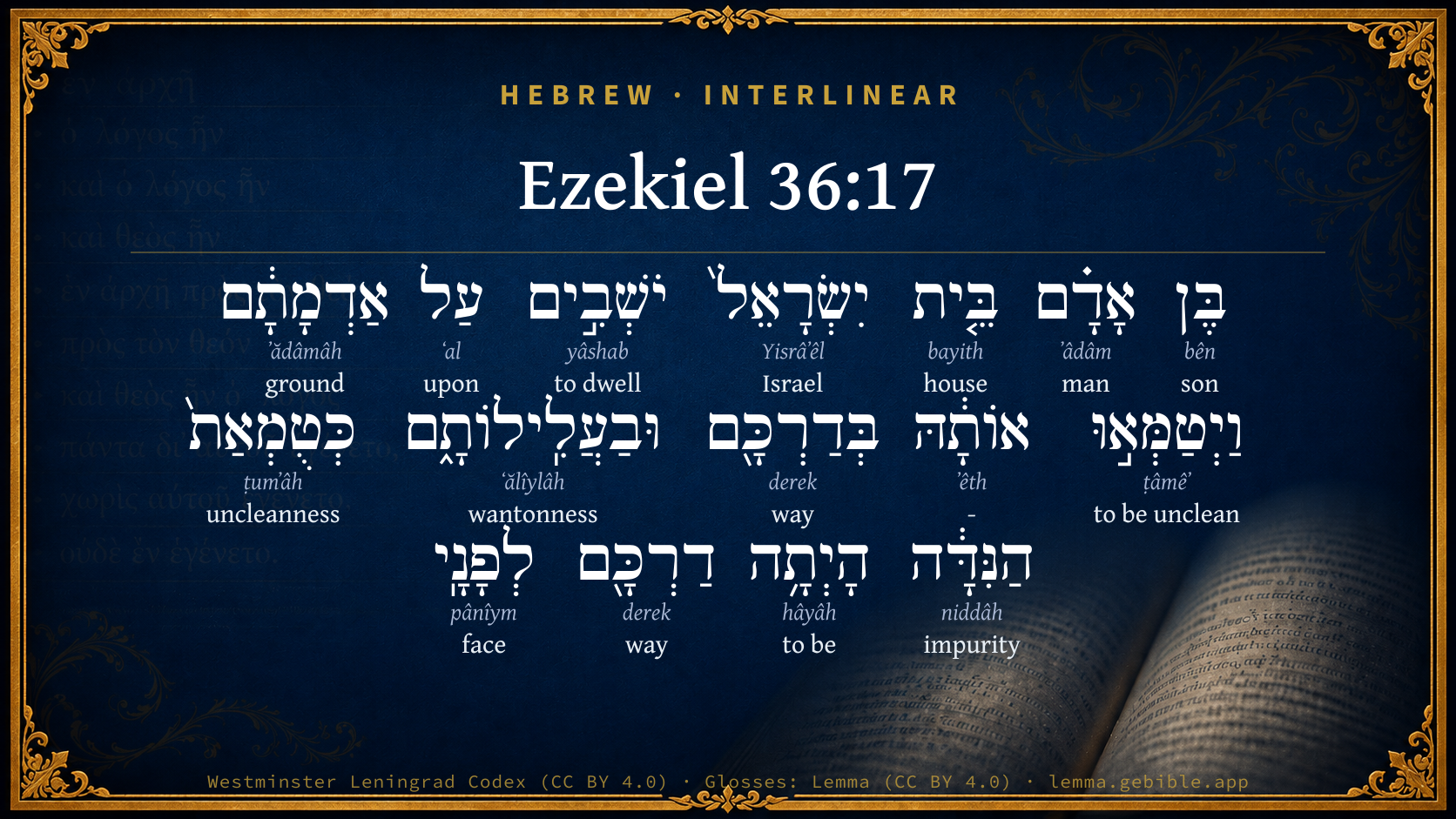
  1. בֶּן bên H1121 “son of” Noun, Common, Masculine, Singular, Construct
  2. אָדָ֗ם ʼâdâm H120 “man” Noun, Common, Masculine, Singular, Absolute
  3. בֵּ֤ית bayith H1004 “house of” Noun, Common, Masculine, Singular, Construct
  4. יִשְׂרָאֵל֙ Yisrâʼêl H3478 “Israel” Noun, Proper
  5. יֹשְׁבִ֣ים yâshab H3427 “dwelling” Verb, Qal, Participle Active, Masculine, Plural, Absolute
  6. עַל ʻal H5921 “upon” Preposition
  7. אַדְמָתָ֔ם ʼădâmâh H127 “ground · their” Noun, Common, Feminine, Singular, Construct + Suffix, Personal, 3rd Person, Masculine, Plural
  8. וַיְטַמְּא֣וּ ṭâmêʼ H2930 “and · to be unclean” Conjunction + Verb, Piel, Sequential Imperfect, 3rd Person, Masculine, Plural
  9. אוֹתָ֔הּ ʼêth H853 “- · her” Particle, Direct Object + Suffix, Personal, 3rd Person, Feminine, Singular
  10. בְּדַרְכָּ֖ם derek H1870 “in/at · way · their” Preposition + Noun, Common, Both, Singular, Construct + Suffix, Personal, 3rd Person, Masculine, Plural
  11. כְּטֻמְאַת֙ ṭumʼâh H2932 “like/as · uncleanness of” Preposition + Noun, Common, Feminine, Singular, Construct
  12. הַנִּדָּ֔ה niddâh H5079 “the · impurity” Particle, Definite Article + Noun, Common, Feminine, Singular, Absolute
  13. הָיְתָ֥ה hâyâh H1961 “to be” Verb, Qal, Perfect, 3rd Person, Feminine, Singular
  14. דַרְכָּ֖ם derek H1870 “way · their” Noun, Common, Both, Singular, Construct + Suffix, Personal, 3rd Person, Masculine, Plural
  15. לְפָנָֽי pânîym H6440 “to/for · face(s) · my” Preposition + Noun, Common, Both, Plural, Construct + Suffix, Personal, 1st Person, Common, Singular

About this verse

These counts appear in no published source. They are computed here, from the morphology-tagged text and Lemma’s own curated glosses. What Lemma adds →

16
words
15
distinct lemmas
Prophets
section

Notable vocabulary

The rarest word here is וּבַעֲלִֽילוֹתָ֑ם wantonness H5949 — appearing just 24 times in the whole Hebrew Bible.

Shared distinctive vocabulary

וּבַעֲלִֽילוֹתָ֑ם wantonness H5949 occurs in 24 verses of the Hebrew Bible. Also found in:

Grammatical profile

  • 3 verbs
  • 11 nouns
  • 1 preposition
  • 1 particle

Verb forms

  • יֹשְׁבִ֣ים Qal · Participle Active
  • וַיְטַמְּא֣וּ Piel · Sequential Imperfect
  • הָיְתָ֥ה Qal · Perfect

Repetition

A word recurs within this verse — often emphatic in Hebrew:

  • בְּדַרְכָּ֖ם way H1870 ×2

Hebrew & Septuagint length

In English translation the verse runs 37 words from the Hebrew and 38 from the Septuagint (LXX English) — closely comparable.

A rough comparison of the two English renderings, which tokenize alike — not a word-level alignment.

Word counts can differ between the Hebrew and the Greek without any difference in meaning — e.g. the Hebrew direct-object marker אֵת has no separate Greek word, and Greek often adds the article ὁ.

Cross-references

11

Topical passages linked to Ezekiel 36:17 in the Treasury of Scripture Knowledge — connected by theme and wording, ordered by reader-vote popularity; previews shown in the World English Bible.

  • Jeremiah 2:7 I brought you into a plentiful land, to eat the fruit of it and the goodness of it; but when you entered, you defiled my land, and made my heritage an abomination.
  • Numbers 35:33–34 So you shall not pollute the land in which you are: for blood, it pollutes the land; and no expiation can be made for the land for the blood that is shed therein, but by the blood of him who shed it.
  • Micah 2:10 Arise, and depart! For this is not your resting place, Because of uncleanness that destroys, Even with a grievous destruction.
  • Leviticus 15:19–33 "'If a woman has a discharge, and her discharge in her flesh is blood, she shall be in her impurity seven days: and whoever touches her shall be unclean until the evening.
  • Isaiah 24:5 The earth also is polluted under the inhabitants of it; because they have transgressed the laws, violated the statutes, broken the everlasting covenant.
  • Jeremiah 16:18 First I will recompense their iniquity and their sin double, because they have polluted my land with the carcasses of their detestable things, and have filled my inheritance with their abominations.
  • Leviticus 18:24–28 "'Don't defile yourselves in any of these things: for in all these the nations which I am casting out before you were defiled.
  • Psalms 106:37–38 Yes, they sacrificed their sons and their daughters to demons.
  • Isaiah 64:6 For we are all become as one who is unclean, and all our righteousness are as a polluted garment: and we all do fade as a leaf; and our iniquities, like the wind, take us away.
  • Jeremiah 3:1–2 They say, If a man put away his wife, and she go from him, and become another man's, will he return to her again? Won't that land be greatly polluted? But you have played the prostitute with many lovers; yet return again to me, says Yahweh.
  • Jeremiah 3:9 It happened through the lightness of her prostitution, that the land was polluted, and she committed adultery with stones and with stocks.

Cross-references courtesy of OpenBible.info (CC BY 4.0).

Hebrew and Greek witnesses Masoretic Hebrew ↔ Greek Septuagint

The same verse in the two great witnesses to the Old Testament, shown verse-for-verse.

These are two independent witnesses, not word-aligned to each other, and the Septuagint is shown in lemma (dictionary) form.

Hebrew Ezekiel 36:17 Masoretic · Westminster Leningrad Codex

בֶּן אָדָ֗ם בֵּ֤ית יִשְׂרָאֵל֙ יֹשְׁבִ֣ים עַל אַדְמָתָ֔ם וַיְטַמְּא֣וּ אוֹתָ֔הּ בְּדַרְכָּ֖ם וּבַעֲלִֽילוֹתָ֑ם כְּטֻמְאַת֙ הַנִּדָּ֔ה הָיְתָ֥ה דַרְכָּ֖ם לְפָנָֽי

Son of man, when the house of Israel lived in their own land, they defiled it by their way and by their doings: their way before me was as the uncleanness of a woman in her impurity.

World English Bible · Public Domain

Greek LXX Ezekiel 36:17 Septuagint · lemma form

υἱός ἄνθρωπος οἶκος ἰσραήλ καταοἰκέω ἐπί ὁ γῆ αὐτός καί μιαίνω αὐτός ἐν ὁ ὁδός αὐτός καί ἐν ὁ εἴδωλον αὐτός καί ἐν ὁ ἀκαθαρσία αὐτός κατά ὁ ἀκαθαρσία ὁ ἀπο καταἧμαι γίγνομαι ὁ ὁδός αὐτός πρό πρόσωπον ἐγώ

Son of man, the house of Israel lived upon their land, and defiled it by their way, and with their idols, and with their uncleannesses; and their way was before me like the uncleanness of a removed woman.

LXX2012 (modern English Septuagint) · Public Domain

Hebrew: Westminster Leningrad Codex (CC BY 4.0). Greek: Septuagint (public domain); English from LXX2012 (modern English Septuagint) (Public Domain). How the Septuagint differs from the Hebrew →

Targum (Aramaic paraphrase)

1

The Targum is the ancient Jewish Aramaic paraphrase of the Hebrew Scriptures — an interpretive translation, not the Hebrew text itself. Onkelos (literal) and Pseudo-Jonathan (expansive) render the Torah, and Jonathan the Prophets. Coverage is partial: where no permissively-licensed English translation exists for a verse, only the Aramaic is shown. This is verse-level text, not a word-by-word alignment to the Hebrew.

  1. Targum Jonathan Prophets (Joshua–Malachi)
    בַּר אָדָם בֵּית יִשְׂרָאֵל יָתְבִין עַל אַרְעֲהוֹן וּסְאִיבוּ יָתָהּ בְּאוֹרְחָתְהוֹן וּבְעוֹבָדֵיהוֹן כְּסוֹאֲבַת אִתְּתָא טוּמְאָה הֲוַת אוֹרְחַתְהוֹן קֳדָמָי:

    (no public-domain English translation for this verse)

    Targum Jonathan — Aramaic: “Mikraot Gedolot” (public domain). English: “Sefaria Community Translation” (CC0 1.0 (public-domain dedication)); “London "Chaldee Paraphrase," 1871” (public domain). Text via Sefaria.

Commentary

Notes on Ezekiel 36:17 from classic Christian and Jewish commentators (each source and its license shown beneath its notes). The classic Christian expositions comment on the surrounding passage and are grouped to its opening verse, so a note may address several verses; the Jewish commentaries on the Tanakh (Rashi and others) are per-verse, so they appear only where the commentator wrote on this verse.

Lemma curates 59 commentaries, every one of them public domain or Creative Commons licensed, each selected and text-cleaned for this edition rather than reprinted as found. About our sources →

Ellicott's Commentary for English Readers

(17) They defiled it.—In Eze_36:17-20 the sin of Israel in the past is set forth as the reason of their present condition. “The land” is always regarded in Scripture as peculiarly consecrated to God, and defiled by the sin of the people. (Comp. Lev_18:28; Num_35:34.) The comparison is with a woman who has been set apart for uncleanness (Lev_15:19), who until her purification was not allowed to come into the sanctuary.

A Bible Commentary for English Readers, edited by Charles John Ellicott (1878–1897) — public domain. Text from a community e-Sword module.

Trapp's Complete Commentary

John Trapp

Eze 36:17 Son of man, when the house of Israel dwelt in their own land, they defiled it by their own way and by their doings: their way was before me as the uncleanness of a removed woman.

Ver. 17. When the house of Israel.] Ubique Scriptura vindicat gloriam Dei, maxime autem hoc loco. {a} This place of Scripture doth singularly set forth the glory of God’s grace, while it showeth that man’s destruction is wholly of himself, his help only of God.

As the uncleanness.] As a menstruous clout, abhorred by all.

{a} Oecolamp.

John Trapp, A Commentary or Exposition upon All the Books of the Old and New Testament (1647–1656) — public domain. Text from a community e-Sword module.

Joseph Benson's Commentary

Eze 36:17-19. When the house of Israel dwelt in their own land — In fulness of bread, ease, and security, as they did in days past; they defiled it — Rendered it abominable before God, and uncomfortable to themselves; by their own way and by their doings — By the way of their own choice, their wicked way, forsaking my law, despising my counsel, deserting my worship and temple; and by their unholy conversation and unrighteous practices. Their way was before me as the uncleanness of a removed woman — As a woman under a legal pollution was forbidden to come within the courts of the temple, or to attend upon God’s worship there; so the defilements which the Jews had contracted by their idolatries, adulteries, murders, and other heinous sins, rendered them unfit to be acknowledged as God’s people, or to offer up any religious service to him. Wherefore I poured my fury upon them — These and their other sins were the true causes of the desolation of their country, and of all the miseries which they underwent, and not any thing in the land itself, as the heathen said, Eze 36:13. According to their doings I judged them — God frequently repeats that his judgments upon the Jews were no more than what their own ways or doings obliged him to inflict. There was in his dealings with them no arbitrary exercise of sovereignty, but they were dealt with according to their own conduct. And thus God deals with mankind in general: his actions, in regard to them, are not founded in an arbitrary exercise of his absolute sovereignty over them, but in impartial justice, wisdom, and goodness, and he judges them according to their own ways, and not according to the dictates of an arbitrary will.

Joseph Benson's Commentary on the Old and New Testaments (1811–1818) — public domain. Text from a community e-Sword module.

Tyndale Open Study Notes

Tyndale Open Resources

36:17 Covenant curses had come to Israel because God’s people had defiled . . . their own land by their sinful behavior. • A menstrual cloth became polluted by contact with a woman’s monthly flow of blood. This natural process was not sinful, but it was defiling in the same way that any loss of bodily life-fluids such as blood, sweat (see study note on 44:17-19), or semen made people ceremonially unclean (see Lev 15).

Tyndale Open Study Notes — © Tyndale Open Resources, licensed CC BY-SA 4.0. Text via the HelloAO Bible API.

Jamieson, Fausset & Brown

Robert Jamieson, A. R. Fausset & David Brown

removed woman-- (Lev 15:19, &c.).

Jamieson, Fausset & Brown — Commentary Critical and Explanatory on the Whole Bible (1871) — public domain (CC PDM 1.0). Text via the HelloAO Bible API.

Adam Clarke's Commentary

Verse 17. When the house of Israel dwelt in their own land] Had they continued faithful to me, they had never been removed from it: but they polluted it with their crimes; and I abhorred the land on that account, and gave both them and it up to the destroyers.

Adam Clarke's Commentary on the Bible (1810–1826) — public domain. Text from a community e-Sword/MySword module.

The Cambridge Bible for Schools and Colleges

gen. ed. J. J. S. Perowne

16–23. Israel’s past history and the principles which it illustrates

17. When in their own land the people defiled it with their doings. The land was “holy” being sanctified by Jehovah’s presence in it. The sins of the people, idolatry and bloodshed, desecrated it and made it unclean. Holy embraces “clean” under it, as the general does a particular, Jer_2:7; Lev_18:25. Ezek., however, seems to call all sins “uncleanness.” This way of speaking and thinking could hardly have arisen except under the influence of a law of ceremonial defilements (which were real defilements) and purifications.

uncleanness of a removed] the uncleanness of a woman’s impurity. Lev_15:19. The comparison expresses the extreme of loathing, ch. Eze_7:20.

The Cambridge Bible for Schools and Colleges (gen. ed. J. J. S. Perowne; Cambridge University Press, 1878–1918) — public domain. Text from a community e-Sword module.

John Gill's Exposition

Son of man, when the house of Israel dwelt in their own land,.... The land of Canaan, which the Lord their God gave unto them; a land abounding with all good things, where they dwelt in great ease, plenty, and prosperity; and which also was a holy land, peculiarly chosen of God for his worship and service:

they defiled it by their own way and by their doings: by their sinful ways and evil works: sin is of a defiling nature; it defiles the bodies and souls of men; it defiles their own, and it defiles others; it defiles a land, and the inhabitants of it, and makes them loathsome and abominable to a pure and holy God:

their way was before me, as the uncleanness of a removed woman: of a menstruous woman in the time of her separation; when she was debarred the company of her husband, and might not enter into the sanctuary of the Lord: this shows what an evil thing sin is, what an uncleanness it is in the sight of God, how abhorrent sinful ways are to him; and though he was the husband of these people, yet, because of their sins, he separated from them, and removed them from and out of their land, as not fit to be in his presence, nor to live there.

John Gill's Exposition of the Whole Bible (1746–1763) — public domain (CC PDM 1.0). Text via the HelloAO Bible API.

Matthew Poole's English Annotations

In their own land; in fullness, case, and security, as in days past they did.

They defiled it; brought in much sin and great guilt upon the land, i.e. on themselves who dwelt there, and sinned greatly.

By their own way; leaving my law, despising my counsel, forsaking my worship and temple.

By their doings; by their carriage and practices in their whole conversation.

As the uncleanness, & c.; or as one excommunicate, and cut off from the congregation, because of some great sin. Or, since idolatry is so often compared to fornication and whoredom, possibly it may be here the filthiness of spiritual whoredom. I hated and loathed the filthiness of their ways, as I would the impurity of a whorish woman prostituting herself for gain. The word may include the reward of a whore, as it doth Eze 16:33.

Matthew Poole's English Annotations on the Holy Bible (1683–1685) — public domain. Text from a community e-Sword/MySword module.

The Pulpit Commentary

Their way was before me. Their ways and doings, i.e. their violent deeds and idolatrous practices (ver. 18), were as morally loathsome in Jehovah"s sight as the uncleanness of a woman in her separation was materially disgusting. The comparison may have been derived from Isa_64:6, but was as likely to have been original, seeing Ezekiel was a priest-prophet, to whom the details of the Levitical Law must have been familiar. (comp. Eze_18:6; Lev_15:19)

The Pulpit Commentary (1880–1919), ed. H.D.M. Spence-Jones & Joseph S. Exell — public domain. Text from a community e-Sword module.

Rashi

Rabbi Shlomo Yitzchaki (Rashi)

Son of man! The house of Israel, as long as they lived, etc., like the uncleanness of a woman in the period of her separation Scripture likened them to a woman in the period of her separation, whose husband looks forward to when she will become clean, and longs to return to her.

Rashi on the Tanakh — English translations: “The Judaica Press complete Tanach with Rashi, translated by A. J. Rosenberg” (CC BY 4.0); “Pentateuch with Rashi's commentary by M. Rosenbaum and A.M. Silbermann, 1929-1934” (public domain); “The Metsudah Tanach series, Lakewood, N.J” (CC BY 4.0); and “The Book of Joshua, Metsudah Publications, 1997” (CC BY 4.0). Text via Sefaria.

Lesson kit

Teaching starters — assembled from the data on this page, not authored interpretation. Every prompt links to the verse data it draws on. Edit before teaching.

Ezekiel, in the Prophets, opens this verse with 16 words (15 distinct Hebrew lemmas). Its most distinctive word is ʻălîylâh (“wantonness”). A historical commentator’s framing appears above. Read the whole chapter for the surrounding context.

Discussion questions

  1. The word ʻălîylâh carries the sense “wantonness.” How does it shape the verse?
  2. Deuteronomy 22:14 shares the word «wantonness» with this verse. How do the two illuminate each other?
  3. “way” occurs 2× in this one verse. What is the effect of the repetition?
  4. These translations render this verse differently. What is at stake in choosing one wording over another?
  5. The verb «יֹשְׁבִ֣ים» is Qal Participle Active. How does its form color the action?
  6. Reading how Ellicott's Commentary for English Readers and Trapp's Complete Commentary read this verse, where do the two commentators agree and where do they part?

Things to notice

Reading settings

Reading text

Shown beneath each verse's original-language words.

Old Testament
Old Testament edition

Read the OT as the Masoretic Hebrew (MT) or the Greek Septuagint (LXX).

English shown for the Greek Septuagint (in the Hebrew ↔ Greek comparison).

Comparing translations? Open the Compare panel on any verse page to stack up to four side by side.