
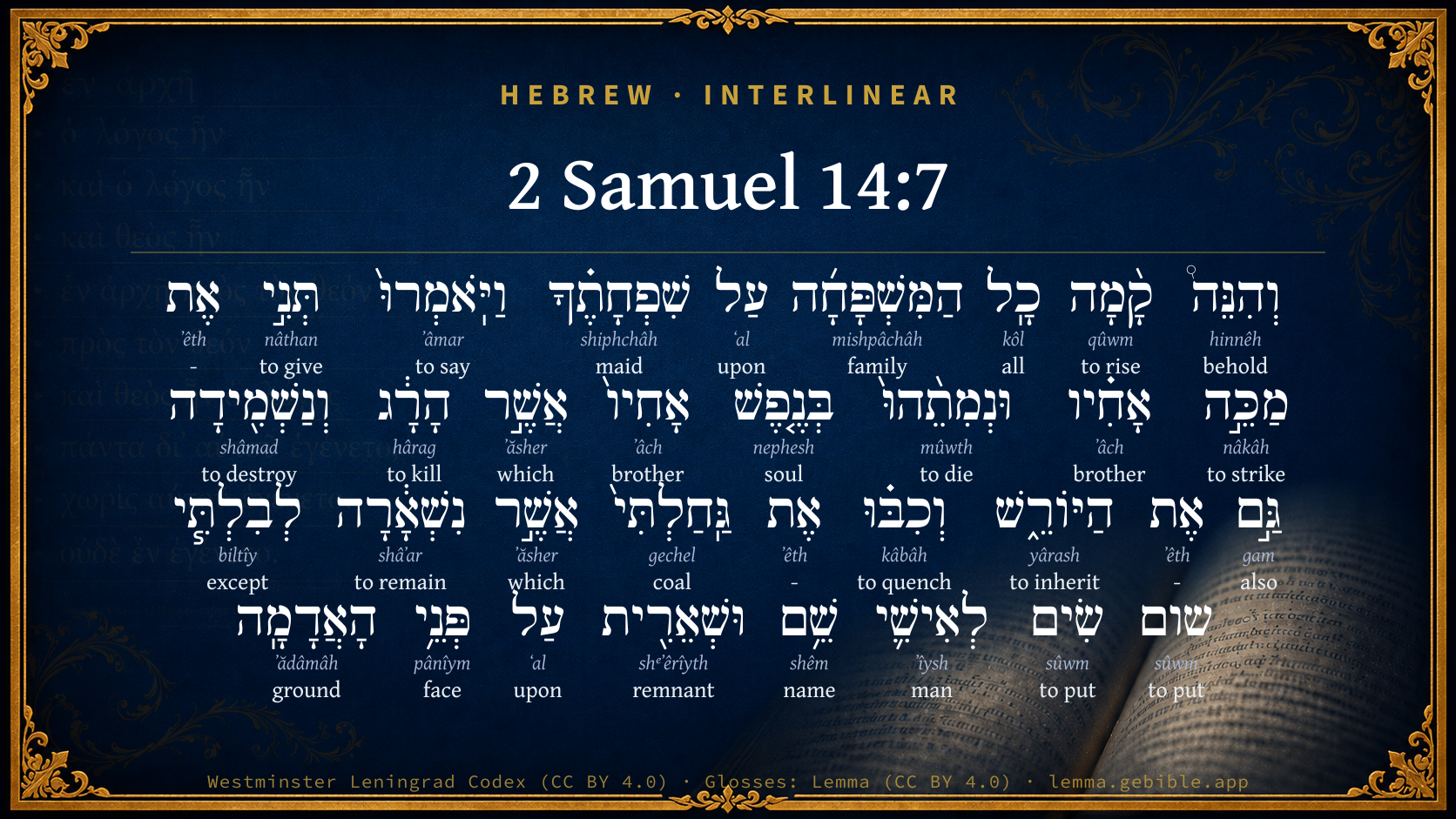
2 Samuel 14:7

Hebrew (Westminster Leningrad Codex) 2 Samuel 14:7 appears in the Hebrew Old Testament. The text above is from the Westminster Leningrad Codex. Each word links to its Strong’s number, a concise gloss, and parsing drawn from the Open Scriptures Hebrew Bible morphology. Click any word for its full Brown-Driver-Briggs (BDB) entry.
Download image
Cite this verse

2 Samuel 14:7 (World English Bible). Public Domain. Lemma interlinear Bible study tool, https://lemma.gebible.app/v/2-samuel/14/7.

Show BibTeX & RIS
BibTeX
RIS
English Translation
Behold, the whole family is risen against your handmaid, and they say, Deliver him who struck his brother, that we may kill him for the life of his brother whom he killed, and so destroy the heir also. Thus will they quench my coal which is left, and will leave to my husband neither name nor remainder on the surface of the earth.
World English Bible · Public Domain
Download a study sheet

One document with this verse’s original text, its word-by-word gloss line, the meaning frame, cross-references with their text, attributed commentary, and full source and license credits — printable, and it pastes into notes with its structure intact.

This verse Autodidact and up

Study sheet (.html) Plain text (.txt)

A passage Seminary Student

Up to 50 verses in one chapter. A passage sheet keeps up to 6 commentary sources and 12 cross-references per verse, in the order this page ranks them, and says so on the sheet whenever that leaves anything out. Ask for a single verse and you get the Autodidact verse sheet above.

Everything on this page stays free to read, with no account — the sheet is a download of what is already on screen, not access to it.

Want to remove ads? Support Godless Engineer
Compare translations 3

The same verse in 3 English versions, stacked beneath the original-language interlinear above. Click any original word for its lexicon entry.

Each is an independent rendering of the whole verse — the interlinear is not word-aligned to these translations.

Highlighted words mark where these versions differ — a whole-verse word diff, not a word-by-word alignment.

  • World English Bible Public Domain
    Behold, the whole family is risen against your handmaid, and they say, Deliver him who struck his brother, that we may kill him for the life of his brother whom he killed, and so destroy the heir also. Thus will they quench my coal which is left, and will leave to my husband neither name nor remainder on the surface of the earth.
  • King James Version Public Domain
    And, behold, the whole family is risen against thine handmaid, and they said, Deliver him that smote his brother, that we may kill him, for the life of his brother whom he slew; and we will destroy the heir also: and so they shall quench my coal which is left, and shall not leave to my husband neither name nor remainder upon the earth.
  • unfoldingWord Literal Text CC BY-SA 4.0
    And behold, all of the clan has arisen against your maidservant, and they have said, ‘Give the one having struck his brother, and we will kill him for the life of his brother whom he slew, and let us destroy the heir also.’ And they would quench my coal that remains, without leaving to my husband a name or remnant on the face of the ground.”

unfoldingWord Literal Text — © unfoldingWord, licensed CC BY-SA 4.0. Word-aligned USFM3 via Door43 (git.door43.org/unfoldingWord/en_ult).

Versions to compare (up to 4)

3 of 4 selected

Show all 18 translations

Every available English version of this verse, each an independent rendering of the whole verse.

  • World English Bible Public Domain
    Behold, the whole family is risen against your handmaid, and they say, Deliver him who struck his brother, that we may kill him for the life of his brother whom he killed, and so destroy the heir also. Thus will they quench my coal which is left, and will leave to my husband neither name nor remainder on the surface of the earth.
  • Berean Standard Bible Public Domain
    Now the whole clan has risen up against your maidservant and said, ‘Hand over the one who struck down his brother, that we may put him to death for the life of the brother whom he killed. Then we will cut off the heir as well!’ So they would extinguish my one remaining ember by not preserving my husband’s name or posterity on the earth.”
  • Majority Standard Bible Public Domain
    Now the whole clan has risen up against your maidservant and said, ‘Hand over the one who struck down his brother, that we may put him to death for the life of the brother whom he killed. Then we will cut off the heir as well!’ So they would extinguish my one remaining ember by not preserving my husband’s name or posterity on the earth.”
  • King James Version Public Domain
    And, behold, the whole family is risen against thine handmaid, and they said, Deliver him that smote his brother, that we may kill him, for the life of his brother whom he slew; and we will destroy the heir also: and so they shall quench my coal which is left, and shall not leave to my husband neither name nor remainder upon the earth.
  • American Standard Version (1901) Public Domain
    And, behold, the whole family is risen against thy handmaid, and they say, Deliver him that smote his brother, that we may kill him for the life of his brother whom he slew, and so destroy the heir also. Thus will they quench my coal which is left, and will leave to my husband neither name nor remainder upon the face of the earth.
  • Revised Version (1885) Public Domain
    And, behold, the whole family is risen against thine handmaid, and they said, Deliver him that smote his brother, that we may kill him for the life of his brother whom he slew, and so destroy the heir also: thus shall they quench my coal which is left, and shall leave to my husband neither name nor remainder upon the face of the earth.
  • Geneva Bible (1599) Public Domain
    And beholde, the whole familie is risen against thine handmayde, and they sayde, Deliuer him that smote his brother, that we may kill him for the soule of his brother whome hee slewe, that we may destroy the heire also: so they shall quenche my sparkle which is left, and shall not leaue to mine husband neither name nor posteritie vpon the earth.
  • Douay-Rheims (1899) Public Domain
    And behold the whole kindred rising against thy handmaid, saith: Deliver him that hath slain his brother, that we may kill him for the life of his brother, whom he slew, and that we may destroy the heir: and they seek to quench my spark which is left, and will leave my husband no name, nor remainder upon the earth.
  • Young's Literal Translation Public Domain
    and lo, the whole family hath risen against thy maid-servant, and say, Give up him who smiteth his brother, and we put him to death for the life of his brother whom he hath slain, and we destroy also the heir; and they have quenched my coal which is left -- so as not to set to my husband a name and remnant on the face of the ground.'
  • Literal Standard Version CC BY-SA 4.0
    and behold, the whole family has risen against your maidservant, and say, Give up him who strikes his brother, and we put him to death for the life of his brother whom he has slain, and we also destroy the heir; and they have quenched my coal which is left—so as not to set a name and remnant on the face of the ground for my husband.”
  • Unlocked Literal Bible CC BY-SA 4.0
    Now the whole clan has risen against your servant, and they say, 'Give into our hand the man who struck his brother, so that we may put him to death, to pay for the life of his brother whom he killed.' So they would also destroy the heir. Thus they will put out the burning coal that I have left, and they will leave for my husband neither name nor descendant on the surface of the earth.”
  • unfoldingWord Literal Text CC BY-SA 4.0
    And behold, all of the clan has arisen against your maidservant, and they have said, ‘Give the one having struck his brother, and we will kill him for the life of his brother whom he slew, and let us destroy the heir also.’ And they would quench my coal that remains, without leaving to my husband a name or remnant on the face of the ground.”
  • Darby Bible Public Domain
    And behold, the whole family is risen against thy bondmaid, and they say, Deliver him that smote his brother, that we may put him to death, for the life of his brother whom he killed; and we will destroy the heir also: so they will quench my coal which is left, and will not leave to my husband a name or remnant on the earth.
  • World Messianic Bible Public Domain
    Behold, the whole family has risen against your servant, and they say, ‘Deliver him who struck his brother, that we may kill him for the life of his brother whom he killed, and so destroy the heir also.’ Thus they would quench my coal which is left, and would leave to my husband neither name nor remainder on the surface of the earth.”
  • Webster's Bible Public Domain
    And behold, the whole family hath risen against thy handmaid, and they said, Deliver him that smote his brother, that we may kill him, for the life of his brother whom he slew; and we will destroy the heir also: and so they will quench my coal which is left, and will not leave to my husband neither name nor remainder upon the earth.
  • Free Bible Version CC BY-SA 4.0
    Now the whole family is against me. They're saying, ‘Hand over your son who killed his brother so we can put him to death for murdering his brother. That way he won't inherit anything either!’ By doing this they would snuff out the last ember of hope I have to carry on my husband's name and family in the world.”
  • Bible in Basic English Public Domain
    And now all the family is turned against me, your servant, saying, Give up him who was the cause of his brother's death, so that we may put him to death in payment for the life of his brother, whose life he took; and we will put an end to the one who will get the heritage: so they will put out my last burning coal, and my husband will have no name or offspring on the face of the earth.
  • JPS Tanakh (1917) Public Domain
    And, behold, the whole family is risen against thy handmaid, and they said: Deliver him that smote his brother, that we may kill him for the life of his brother whom he slew, and so destroy the heir also. Thus will they quench my coal which is left, and will leave to my husband neither name nor remainder upon the face of the earth.'

Literal Standard Version (2020), Covenant Press — licensed CC BY-SA 4.0. Text via the HelloAO Bible API (eBible.org). Unlocked Literal Bible (unfoldingWord) — licensed CC BY-SA 4.0. Text via the HelloAO Bible API (eBible.org). unfoldingWord Literal Text — © unfoldingWord, licensed CC BY-SA 4.0. Word-aligned USFM3 via Door43 (git.door43.org/unfoldingWord/en_ult). Free Bible Version, Dr. Jonathan Gallagher — licensed CC BY-SA 4.0. Text via the HelloAO Bible API (eBible.org).

Word by word

More ways to search: Search by grammar → Find every occurrence → Compare this word →

Practice this passage: Drill this verse → Learn its vocabulary →

גַּֽחַלְתִּי֙
gechel
H1513
“coal · my”
Noun, Common, Both, Singular, Construct + Suffix, Personal, 1st Person, Common, Singular
Part of Speech
Noun
Type
Common
Gender
Both
Number
Singular
State
Construct
Full BDB Definition

Origin: from an unused root

TWOT: 341a

coal, burning coal, coals of fire, hot coals
  1. וְהִנֵּה֩ hinnêh H2009 “and · behold” Conjunction + Particle, Demonstrative
  2. קָ֨מָה qûwm H6965 “to rise” Verb, Qal, Perfect, 3rd Person, Feminine, Singular
  3. כָֽל kôl H3605 “all of” Noun, Common, Masculine, Singular, Construct
  4. הַמִּשְׁפָּחָ֜ה mishpâchâh H4940 “the · family” Particle, Definite Article + Noun, Common, Feminine, Singular, Absolute
  5. עַל ʻal H5921 “upon” Preposition
  6. שִׁפְחָתֶ֗ךָ shiphchâh H8198 “maid · your” Noun, Common, Feminine, Singular, Construct + Suffix, Personal, 2nd Person, Masculine, Singular
  7. וַיֹּֽאמְרוּ֙ ʼâmar H559 “and · to say” Conjunction + Verb, Qal, Sequential Imperfect, 3rd Person, Masculine, Plural
  8. תְּנִ֣י nâthan H5414 “give” Verb, Qal, Imperative, 2nd Person, Feminine, Singular
  9. אֶת ʼêth H853 “-” Particle, Direct Object
  10. מַכֵּ֣ה nâkâh H5221 “striking” Verb, Hiphil, Participle Active, Masculine, Singular, Construct
  11. אָחִ֗יו ʼâch H251 “brother · his” Noun, Common, Masculine, Singular, Construct + Suffix, Personal, 3rd Person, Masculine, Singular
  12. וּנְמִתֵ֨הוּ֙ mûwth H4191 “and · to die · him” Conjunction + Verb, Hiphil, Imperfect, 1st Person, Common, Plural + Suffix, Personal, 3rd Person, Masculine, Singular
  13. בְּנֶ֤פֶשׁ nephesh H5315 “in/at · soul of” Preposition + Noun, Common, Both, Singular, Construct
  14. אָחִיו֙ ʼâch H251 “brother · his” Noun, Common, Masculine, Singular, Construct + Suffix, Personal, 3rd Person, Masculine, Singular
  15. אֲשֶׁ֣ר ʼăsher H834 “which” Particle, Relative
  16. הָרָ֔ג hârag H2026 “to kill” Verb, Qal, Perfect, 3rd Person, Masculine, Singular
  17. וְנַשְׁמִ֖ידָה shâmad H8045 “and · to destroy” Conjunction + Verb, Hiphil, Cohortative, 1st Person, Common, Plural
  18. גַּ֣ם gam H1571 “also” Particle, Accusative
  19. אֶת ʼêth H853 “-” Particle, Direct Object
  20. הַיּוֹרֵ֑שׁ yârash H3423 “the · inheriting” Particle, Definite Article + Verb, Qal, Participle Active, Masculine, Singular, Absolute
  21. וְכִבּ֗וּ kâbâh H3518 “and · to quench” Conjunction + Verb, Piel, Sequential Perfect, 3rd Person, Common, Plural
  22. אֶת ʼêth H853 “-” Particle, Direct Object
  23. אֲשֶׁ֣ר ʼăsher H834 “which” Particle, Relative
  24. נִשְׁאָ֔רָה shâʼar H7604 “to remain” Verb, Niphal, Perfect, 3rd Person, Feminine, Singular
  25. לְבִלְתִּ֧י biltîy H1115 “to/for · except” Preposition + Conjunction
  26. שום sûwm H7760 “to put” Verb, Qal, Infinitive Construct
  27. שִׂים sûwm H7760 “to put” Verb, Qal, Infinitive Construct
  28. לְאִישִׁ֛י ʼîysh H376 “to/for · man · my” Preposition + Noun, Common, Masculine, Singular, Construct + Suffix, Personal, 1st Person, Common, Singular
  29. שֵׁ֥ם shêm H8034 “name” Noun, Common, Masculine, Singular, Absolute
  30. וּשְׁאֵרִ֖ית shᵉʼêrîyth H7611 “and · remnant” Conjunction + Noun, Common, Feminine, Singular, Absolute
  31. עַל ʻal H5921 “upon” Preposition
  32. פְּנֵ֥י pânîym H6440 “face(s) of” Noun, Common, Both, Plural, Construct
  33. הָאֲדָמָֽה ʼădâmâh H127 “the · ground” Particle, Definite Article + Noun, Common, Feminine, Singular, Absolute

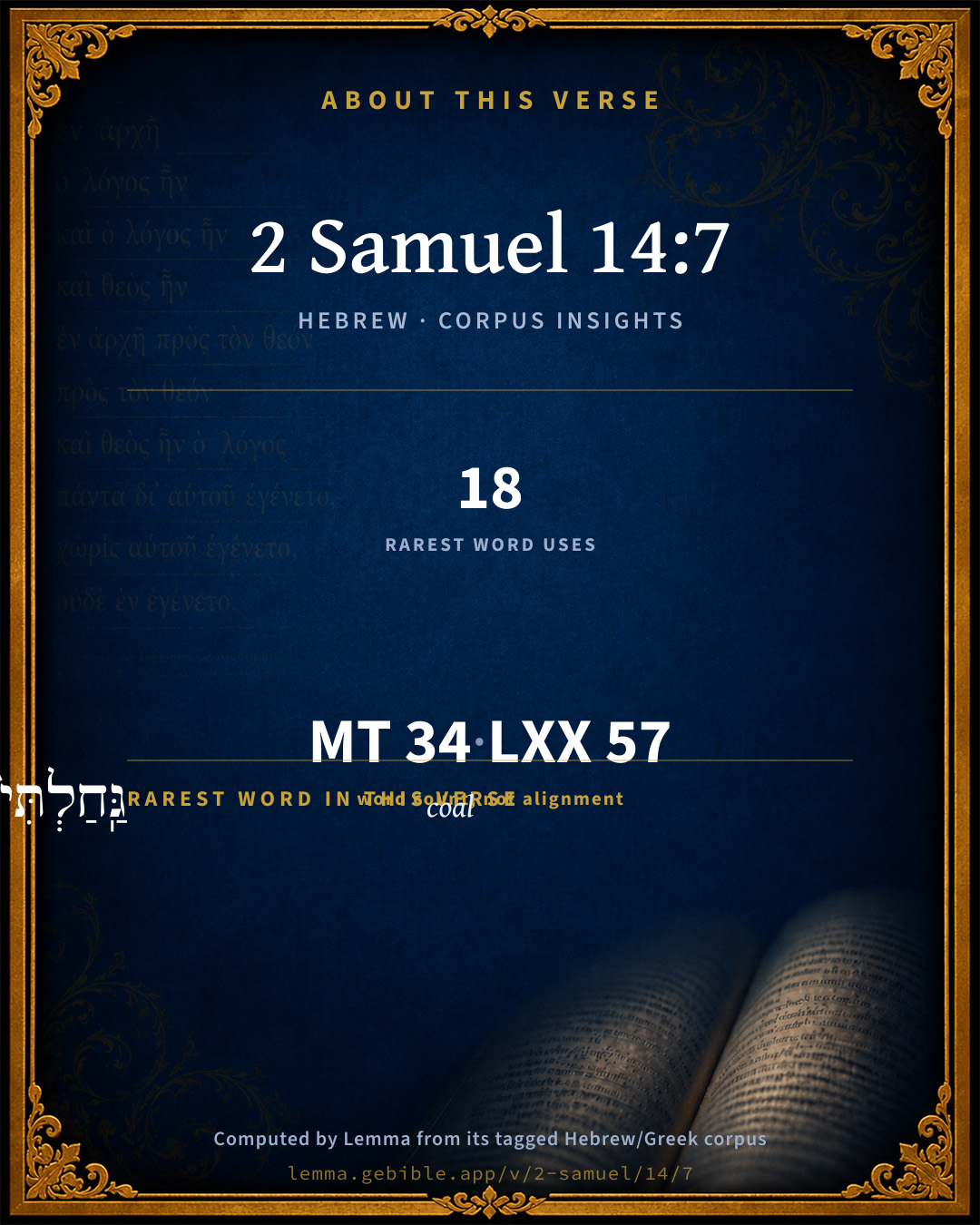
About this verse

These counts appear in no published source. They are computed here, from the morphology-tagged text and Lemma’s own curated glosses. What Lemma adds →

34
words
28
distinct lemmas
Historical
section

Notable vocabulary

The rarest word here is גַּֽחַלְתִּי֙ coal H1513 — appearing just 18 times in the whole Hebrew Bible.

Shared distinctive vocabulary

גַּֽחַלְתִּי֙ coal H1513 occurs in 18 verses of the Hebrew Bible. Also found in:

Grammatical profile

  • 12 verbs
  • 12 nouns
  • 2 prepositions
  • 1 conjunction
  • 7 particles

Verb forms

  • קָ֨מָה Qal · Perfect
  • וַיֹּֽאמְרוּ֙ Qal · Sequential Imperfect
  • תְּנִ֣י Qal · Imperative
  • מַכֵּ֣ה Hiphil · Participle Active
  • וּנְמִתֵ֨הוּ֙ Hiphil · Imperfect
  • הָרָ֔ג Qal · Perfect
  • וְנַשְׁמִ֖ידָה Hiphil · Cohortative
  • הַיּוֹרֵ֑שׁ Qal · Participle Active
  • וְכִבּ֗וּ Piel · Sequential Perfect
  • נִשְׁאָ֔רָה Niphal · Perfect
  • שום Qal · Infinitive Construct
  • שִׂים Qal · Infinitive Construct

Repetition

Words recur within this verse — often emphatic in Hebrew:

  • עַל upon H5921 ×2
  • אָחִ֗יו brother H251 ×2
  • שום to put H7760 ×2
  • אֲשֶׁ֣ר which H834 ×2

Hebrew & Septuagint length

In English translation the verse runs 63 words from the Hebrew and 70 from the Septuagint (LXX English) — closely comparable.

A rough comparison of the two English renderings, which tokenize alike — not a word-level alignment.

Word counts can differ between the Hebrew and the Greek without any difference in meaning — e.g. the Hebrew direct-object marker אֵת has no separate Greek word, and Greek often adds the article ὁ.

In the original languages it is 34 Hebrew tokens and 57 Greek tokens — but the two are counted differently (Hebrew bundles its prefixes and suffixes into one token; the Greek is in lemma form), so that isn’t a like-for-like length.

Cross-references

7

Topical passages linked to 2 Samuel 14:7 in the Treasury of Scripture Knowledge — connected by theme and wording, ordered by reader-vote popularity; previews shown in the World English Bible.

  • Numbers 35:19 The avenger of blood shall himself put the murderer to death: when he meets him, he shall put him to death.
  • Matthew 21:38 But the farmers, when they saw the son, said among themselves, 'This is the heir. Come, let's kill him, and seize his inheritance.'
  • Genesis 4:14 Behold, you have driven me out this day from the surface of the ground. I will be hidden from your face, and I will be a fugitive and a wanderer in the earth. It will happen that whoever finds me will kill me."
  • Genesis 27:45 until your brother's anger turn away from you, and he forgets what you have done to him. Then I will send, and get you from there. Why should I be bereaved of you both in one day?"
  • Deuteronomy 19:12–13 then the elders of his city shall send and bring him there, and deliver him into the hand of the avenger of blood, that he may die.
  • Deuteronomy 25:6 It shall be, that the firstborn whom she bears shall succeed in the name of his brother who is dead, that his name not be blotted out of Israel.
  • 2 Samuel 12:17 The elders of his house arose, [and stood] beside him, to raise him up from the earth: but he would not, neither did he eat bread with them.

Cross-references courtesy of OpenBible.info (CC BY 4.0).

Hebrew and Greek witnesses Masoretic Hebrew ↔ Greek Septuagint

The same verse in the two great witnesses to the Old Testament, shown verse-for-verse.

These are two independent witnesses, not word-aligned to each other, and the Septuagint is shown in lemma (dictionary) form.

Hebrew 2 Samuel 14:7 Masoretic · Westminster Leningrad Codex

וְהִנֵּה֩ קָ֨מָה כָֽל הַמִּשְׁפָּחָ֜ה עַל שִׁפְחָתֶ֗ךָ וַיֹּֽאמְרוּ֙ תְּנִ֣י אֶת מַכֵּ֣ה אָחִ֗יו וּנְמִתֵ֨הוּ֙ בְּנֶ֤פֶשׁ אָחִיו֙ אֲשֶׁ֣ר הָרָ֔ג וְנַשְׁמִ֖ידָה גַּ֣ם אֶת הַיּוֹרֵ֑שׁ וְכִבּ֗וּ אֶת גַּֽחַלְתִּי֙ אֲשֶׁ֣ר נִשְׁאָ֔רָה לְבִלְתִּ֧י שום שִׂים לְאִישִׁ֛י שֵׁ֥ם וּשְׁאֵרִ֖ית עַל פְּנֵ֥י הָאֲדָמָֽה

Behold, the whole family is risen against your handmaid, and they say, Deliver him who struck his brother, that we may kill him for the life of his brother whom he killed, and so destroy the heir also. Thus will they quench my coal which is left, and will leave to my husband neither name nor remainder on the surface of the earth.

World English Bible · Public Domain

Greek LXX 2 Samuel 14:7 Septuagint · lemma form

καί ὁράω ἐπι ἀναἵστημι ὅλος ὁ πατριά πρός ὁ δούλη σύ καί εἶπον δίδωμι ὁ παίζω ὁ ἀδελφός αὐτός καί θανατόω αὐτός ἀντί ὁ ψυχή ὁ ἀδελφός αὐτός ὅς ἀποκτείνω καί ἐκαἴρω καί γέ ὁ κληρονόμος σύ καί σβέννυμι ὁ ἄνθραξ ἐγώ ὁ καταλείπω ὥστε μή τίθημι ὁ ἀνήρ ἐγώ κατάλειμμα καί ὄνομα ἐπί πρόσωπον ὁ γῆ

And behold the whole family rose up against your handmaid, and they said, Give up the one that struck his brother, and we will put him to death for the life of his brother, whom he killed, and we will take away even your heir: so they will quench my coal that is left, so as not to leave my husband remnant or name on the face of the earth.

LXX2012 (modern English Septuagint) · Public Domain

On this verse, Haydock's Catholic Bible Commentary discusses the Septuagint’s reading. Read the note in Commentary ↓

Hebrew: Westminster Leningrad Codex (CC BY 4.0). Greek: Septuagint (public domain); English from LXX2012 (modern English Septuagint) (Public Domain). How the Septuagint differs from the Hebrew →

Targum (Aramaic paraphrase)

1

The Targum is the ancient Jewish Aramaic paraphrase of the Hebrew Scriptures — an interpretive translation, not the Hebrew text itself. Onkelos (literal) and Pseudo-Jonathan (expansive) render the Torah, and Jonathan the Prophets. Coverage is partial: where no permissively-licensed English translation exists for a verse, only the Aramaic is shown. This is verse-level text, not a word-by-word alignment to the Hebrew.

  1. Targum Jonathan Prophets (Joshua–Malachi)
    וְהָא קָמַת כָּל זַרְעִיתָא עַל אַמְתָךְ וַאֲמַרוּ הָבִי וְנִקְטוֹל יַת דִקְטַל אֲחוֹהִי וְנִקְטְלִינֵיהּ בְּחוֹבַת נַפְשָׁא דַאֲחוֹהִי דִקְטַל וּנְשֵׁיצֵי אַף יַת יָרוֹתָא וּבְעוֹ לְמִקְטַל יַת חַד יְחִידִי דְאִשְׁתְּאַר בְּדִיל דְלָא לְשַׁוָאָה לְבַעֲלֵי שׁוּם וּשְׁאָר עַל אַפֵּי אַרְעָא:

    (no public-domain English translation for this verse)

    Targum Jonathan — Aramaic: “Mikraot Gedolot” (public domain). English: “Sefaria Community Translation” (CC0 1.0 (public-domain dedication)); “London "Chaldee Paraphrase," 1871” (public domain). Text via Sefaria.

Commentary

Notes on 2 Samuel 14:7 from classic Christian and Jewish commentators (each source and its license shown beneath its notes). The classic Christian expositions comment on the surrounding passage and are grouped to its opening verse, so a note may address several verses; the Jewish commentaries on the Tanakh (Rashi and others) are per-verse, so they appear only where the commentator wrote on this verse.

Lemma curates 59 commentaries, every one of them public domain or Creative Commons licensed, each selected and text-cleaned for this edition rather than reprinted as found. About our sources →

Trapp's Complete Commentary

John Trapp

2Sa 14:7 And, behold, the whole family is risen against thine handmaid, and they said, Deliver him that smote his brother, that we may kill him, for the life of his brother whom he slew; and we will destroy the heir also: and so they shall quench my coal which is left, and shall not leave to my husband [neither] name nor remainder upon the earth.

Ver. 7. And we will destroy the heir also.] That the inheritance may be ours. They pretend zeal for justice: but self swayed them.

And so they shall quench my coal which is left.] Which though it cast not much heat, yet if utterly extinct, I am lost. An elegant metaphor used also by Plato, Lucretius, and other heathen authors.

John Trapp, A Commentary or Exposition upon All the Books of the Old and New Testament (1647–1656) — public domain. Text from a community e-Sword module.

Joseph Benson's Commentary

2Sa 14:7. Deliver him, that we may kill him — Put him to death, as the law requires, Num 35:18-19. We will destroy the heir also — Take away his life, although he be the heir, or the only one remaining of the family. And so they shall quench my coal which is left — Deprive me of the little comfort of my life which remains, and ruin the only hope of my family. Shall leave to my husband neither name nor remainder — Shall utterly extinguish my husband’s memory. The reader will easily observe that there is a great difference between the supposed case of this widow and that of David, however plausible their likeness may appear. For her son, she pretended, was slain in a scuffle with his brother, and his death, therefore, was not a premeditated murder, as was the death of Amnon. It also happened in the field, where there were no witnesses, whether he was killed wilfully: whereas all the king’s sons saw Amnon designedly and barbarously murdered. And in the last particular the difference is as great as in either of the others. For David’s family was not in danger of being extinguished, if Absalom had been lost also; David having many children, and also many wives by whom he might have more.

Joseph Benson's Commentary on the Old and New Testaments (1811–1818) — public domain. Text from a community e-Sword module.

Geneva Bible (1599)

Geneva Bible translators

Because he hath slain his brother he ought to be slain according to the Law, Gen. 9:6; Exod. 21:12.

Geneva Bible (1599) marginal notes — public domain. Text via Bolls.life.

Jamieson, Fausset & Brown

Robert Jamieson, A. R. Fausset & David Brown

they shall quench my coal which is left--The life of man is compared in Scripture to a light. To quench the light of Israel (Sa2 21:17) is to destroy the king's life; to ordain a lamp for any one (Psa 132:17) is to grant him posterity; to quench a coal signifies here the extinction of this woman's only remaining hope that the name and family of her husband would be preserved. The figure is a beautiful one; a coal live, but lying under a heap of embers--all that she had to rekindle her fire--to light her lamp in Israel.

Jamieson, Fausset & Brown — Commentary Critical and Explanatory on the Whole Bible (1871) — public domain (CC PDM 1.0). Text via the HelloAO Bible API.

Adam Clarke's Commentary

Verse 7. The whole family is risen] They took on them the part of the avenger of blood; the nearest akin to the murdered person having a right to slay the murderer.

They shall quench my coal which is left] A man and his descendants or successors are often termed in Scripture a lamp or light. So, 2Sa 21:17, the men of David said, when they sware that he should no more go out with them to battle, That thou QUENCH not the LIGHT of Israel. See also Ps 132:17. And to raise up a lamp to a person signifies his having a posterity to continue his name and family upon the earth: thus, quench my coal that is left means destroying all hope of posterity, and extinguishing the family from among the people. The heathens made use of the same similitude. The few persons who survived the deluge of Deucalion are termed ζωπυρα living coals, because by them the vital flame of the human race was to be rekindled on the earth.

Adam Clarke's Commentary on the Bible (1810–1826) — public domain. Text from a community e-Sword/MySword module.

Ellicott's Commentary for English Readers

(7) We will destroy the heir also.—The woman puts this into the mouth of the family, because this would be the result of what they proposed. The effect of the parable is greatly heightened by this, and there is no doubt intended a covert allusion to Absalom as the heir of David.

A Bible Commentary for English Readers, edited by Charles John Ellicott (1878–1897) — public domain. Text from a community e-Sword module.

The Cambridge Bible for Schools and Colleges

gen. ed. J. J. S. Perowne

7. the whole family, &c.] The whole clan demanded blood-revenge, according to the primitive custom, sanctioned and regulated by the Mosaic Law. See Num_35:19; Deu_19:12-13.

and we will destroy the heir also] The woman puts these words that we may kill him … and destroy the heir also into the mouth of her kinsmen, in order to make their conduct appear in the worst possible light, as actuated not so much by a wish to observe the law as by covetousness and a desire to share the inheritance among themselves. Cp. Mat_21:38.

they shall quench my coal which is left] The surviving son, who is the last hope for the continuance of his family, is compared to the live coal still left among the embers, by which the fire almost extinct may be rekindled.

The Cambridge Bible for Schools and Colleges (gen. ed. J. J. S. Perowne; Cambridge University Press, 1878–1918) — public domain. Text from a community e-Sword module.

John Gill's Exposition

And, behold, the whole family is risen against thine handmaid,.... Who had sheltered her son, that slew his brother, from the avenger of blood; and not only the next akin, the avenger of blood, but even all the kindred and relations of the deceased, those of her husband's family rose up as one man, demanding justice:

and they said, deliver him that smote his brother, that we may kill him for the life of his brother whom he slew; pretending great regard to the deceased, and a zeal for justice, when the main thing aimed at was to get the inheritance into their own hands, as appears by what follows:

and we will destroy the heir also; and hereby she would insinuate to the king, that the reason why the rest of the king's sons spake against Absalom to him, and stirred him up to punish him with death, was because he was heir to the crown, and they thought by removing him to make way for themselves:

and so they shall quench my coal that is left; she had but one son, as she represents her case, who was like a coal left among ashes, in the ruins of her family; the only one to support her, keep alive her family, and bear up and continue her husband's name; and, as the Targum,"they seek to kill the only one that is left;''

and so the family be extinct:

and shall not leave to my husband neither name nor remainder upon the earth; should he be delivered up to them and slain; but herein the fable or apologue differed greatly from the case it was intended to represent; for had Absalom been put to death, as the law required, David had sons enough to inherit his throne, and keep up his name.

John Gill's Exposition of the Whole Bible (1746–1763) — public domain (CC PDM 1.0). Text via the HelloAO Bible API.

Albert Barnes' Notes on the Bible

The whole family ... - This indicates that all the king’s sons, and the whole court, were against Absalom, and that the knowledge of this was what hindered David from yielding to his affection and recalling him.

Albert Barnes' Notes on the Bible (1834–1885) — public domain. Text from a community e-Sword/MySword module.

Haydock's Catholic Bible Commentary

Heir. She expresses their sentiments more than their words. (Calmet) --- Some of the relations might desire to obtain the inheritance. (Menochius) --- See Numbers xxxv. 18. --- Spark. Posterity is often denoted by a lamp, chap. xxi. 17. Hebrew and Septuagint, "my coal," reserved to enkindle my fire, (Calmet) or to perpetuate our name in Israel, (Haydock) or that of his father, to whose title the son succeeded. The mother could claim no inheritance. (Menochius)

George Leo Haydock (1774–1849), Haydock's Catholic Family Bible and Commentary, 1859 edition — public domain. Excludes Psalms (Douay-Rheims chapter numbering differs from Protestant) and Deuterocanonical books (Catholic canon only).

Matthew Poole's English Annotations

That we may kill him; according to the law, Num 35:19; Deu 19:12.

We will destroy the heir also; so they plainly discover that their prosecution of him was not so much from love of justice, as from a covetous desire to deprive him of the inheritance, and to transfer it to themselves; which self-interest might justly render their testimony suspected. Or perhaps these words are not spoken as the expresswords of the prosecutors, (who can hardly be thought so directly to express a sinister design,) but as the woman’s inference or comment upon what they were doing, (for this would be indeed the result of it, though they did not say so in express words,) thereby to represent her case as the more deserving pity.

My coal which is left; the poor remainder of my light and comfort, by whom alone my hopes may be revived and repaired.

To my husband; she names him rather than herself, because children bear the names of their fathers, not of their mothers.

Matthew Poole's English Annotations on the Holy Bible (1683–1685) — public domain. Text from a community e-Sword/MySword module.

Whedon's Commentary on the Bible

Daniel D. Whedon

7. Quench my coal — Extinguish the last living ember that gives light and joy to my house. A beautiful image to indicate the extinction of descendants. As a live coal hid in the ashes is the means of kindling future fires and light, so a widow’s only son is her only means of perpetuating her husband’s name.

Daniel D. Whedon (gen. ed.), Commentary on the Old and New Testaments (1874–1909) — public domain. Text from a community e-Sword module.

The Pulpit Commentary

The whole family. This does not mean the kinsfolk, in whom such a disregard of the mother"s feelings would have been cruel, but one of the great divisions of the tribe (see note on the mishpachah, in 1Sa_20:6, and comp. (1Sa_10:21) In ver. 15 she rightly calls them "the people." We have thus a glimpse of the ordinary method of administering the criminal law, and find that each portion of a tribe exercised justice within its own district, being summoned to a general convention by its hereditary chief; and in this case the widow represents it as determined to punish the crime of fratricide with inflexible severity, and we may assume that such was the usual practice. The mother sets before David the other side of the matter her own loneliness, the wiping out of the father"s house, the utter ruin of her home if the last live coal on her hearth be extinguished. And in this way she moves his generous sympathies even to the point of overriding the legal rights of the mishpachah. In modern communities there is always some formal power of softening or entirely remitting penalties required by the letter of the law, and of taking into consideration matters of equity and even of feeling, Which the judge must put aside; and in monarchies this is always the high prerogative of the crown. And we will destroy the heir also. The Syriac has the third person, "And they will destroy even the heir, and quench my coal that is left." This is more natural, but there is greater pungency in the widow putting into the mouth of the heads of the clan, not words which they had actually spoken, but words which showed what would be the real effect of their determination. There is great force and beauty also in the description of her son as the last live coal left to keep the family hearth burning. In another but allied sense David is called "the lamp of Israel". (2Sa_21:17, marg.)

The Pulpit Commentary (1880–1919), ed. H.D.M. Spence-Jones & Joseph S. Exell — public domain. Text from a community e-Sword module.

unfoldingWord translationNotes

Door43 World Missions Community

the whole clan

"my entire family"

your servant

To show respect for the king the woman refers to herself as "your servant."

put him to death

This is an idiom which means to kill. AT: "kill him" (See: Idiom)

they would also destroy the heir

If they put the guilty brother to death there would not be a son left to inherit the family's possessions. The full meaning of this statement can be made clear. AT: "if they did this, they would be destroying our family's heir" (See: Assumed Knowledge and Implicit Information)

Thus they will put out the burning coal that I have left

Here the woman refers to her only living son as if he were a burning piece of coal. She speaks of the men killing her son as stopping the coal's burning. AT: "In this way they will kill the only child I have left" (See: Metaphor)

they will leave for my husband neither name nor descendant

This can be stated in positive form. AT: "they will not leave for my husband name or descendant" (See: Double Negatives)

neither name nor descendant

This refers to a son to carry on the family's name into the next generation. AT: "no son to preserve our family's name" (See: Metonymy)

on the surface of the earth

"on the earth." This descriptive phrase emphasizes that the family line would not continue on earth after the husband died. "The surface of the earth" refers to the ground on which people walk.

translationWords

raise

hand

life

name

descend

unfoldingWord translationNotes — © Distant Shores Media and the Door43 World Missions Community, licensed CC BY-SA 4.0. Source: git.door43.org/Door43/en_tn.

Lesson kit

Teaching starters — assembled from the data on this page, not authored interpretation. Every prompt links to the verse data it draws on. Edit before teaching.

2 Samuel, in the Historical, opens this verse with 34 words (28 distinct Hebrew lemmas). Its most distinctive word is gechel (“coal”). A historical commentator’s framing appears above. Read the whole chapter for the surrounding context.

Discussion questions

  1. What does “coal” (gechel) contribute to the verse as a whole?
  2. How does Leviticus 16:12, which shares the word «coal», read alongside this verse?
  3. What does the repetition of “upon” (2× in this one verse) do in this verse?
  4. These translations render this verse differently. What is at stake in choosing one wording over another?
  5. «קָ֨מָה» is a Qal Perfect verb. How does that grammatical form shape the action described?
  6. Compare how Trapp's Complete Commentary and Joseph Benson's Commentary read this verse. Where do they agree or differ?

Things to notice

Reading settings

Reading text

Shown beneath each verse's original-language words.

Old Testament
Old Testament edition

Read the OT as the Masoretic Hebrew (MT) or the Greek Septuagint (LXX).

English shown for the Greek Septuagint (in the Hebrew ↔ Greek comparison).

Comparing translations? Open the Compare panel on any verse page to stack up to four side by side.