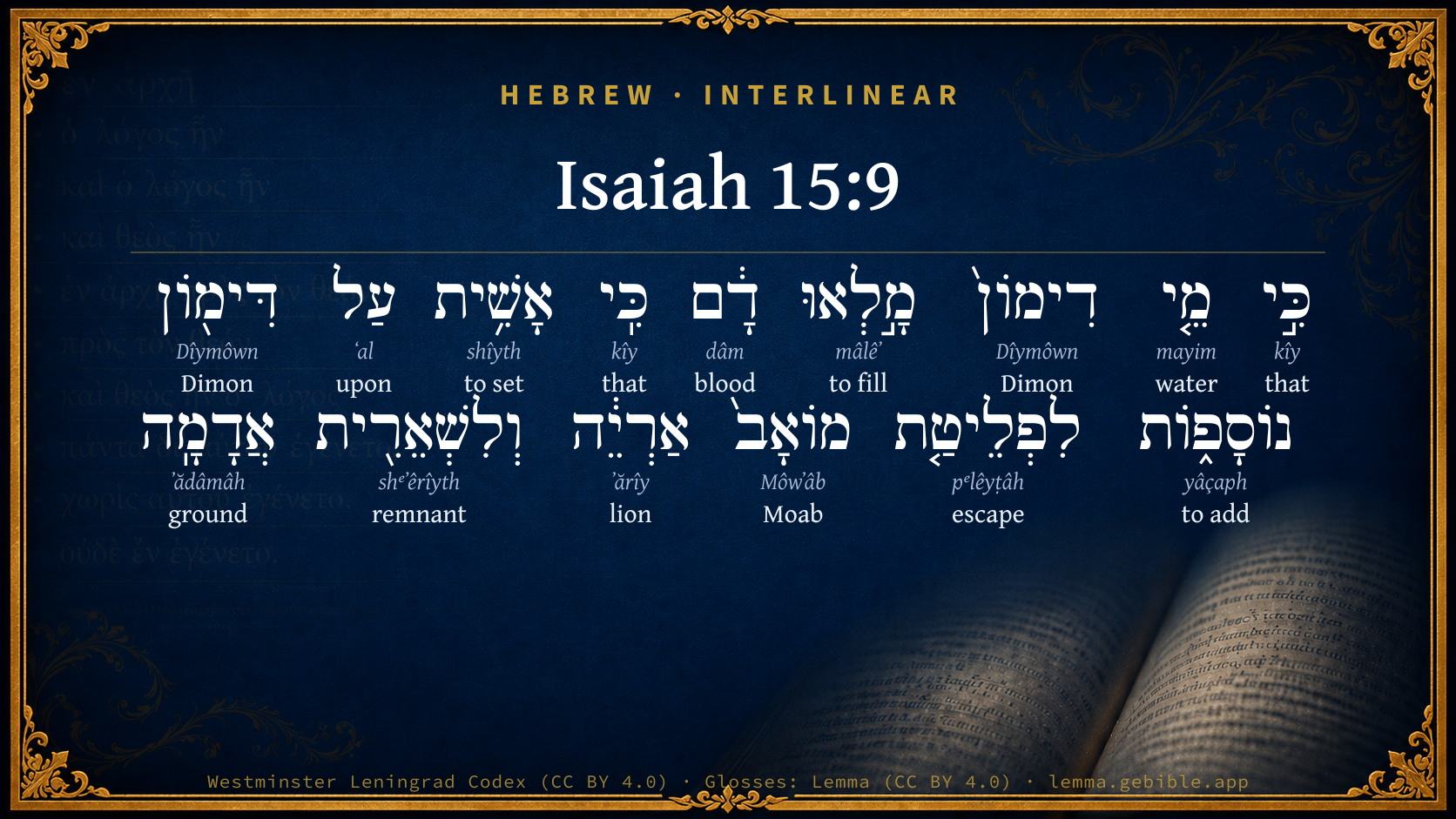
Isaiah 15:9

Hebrew (Westminster Leningrad Codex) Isaiah 15:9 appears in the Hebrew Old Testament. The text above is from the Westminster Leningrad Codex. Each word links to its Strong’s number, a concise gloss, and parsing drawn from the Open Scriptures Hebrew Bible morphology. Click any word for its full Brown-Driver-Briggs (BDB) entry.
Download image
Cite this verse

Isaiah 15:9 (World English Bible). Public Domain. Lemma interlinear Bible study tool, https://lemma.gebible.app/v/isaiah/15/9.

Show BibTeX & RIS
BibTeX
RIS
English Translation
For the waters of Dimon are full of blood; for I will bring yet more on Dimon, a lion on them of Moab that escape, and on the remnant of the land.
World English Bible · Public Domain
Highlights
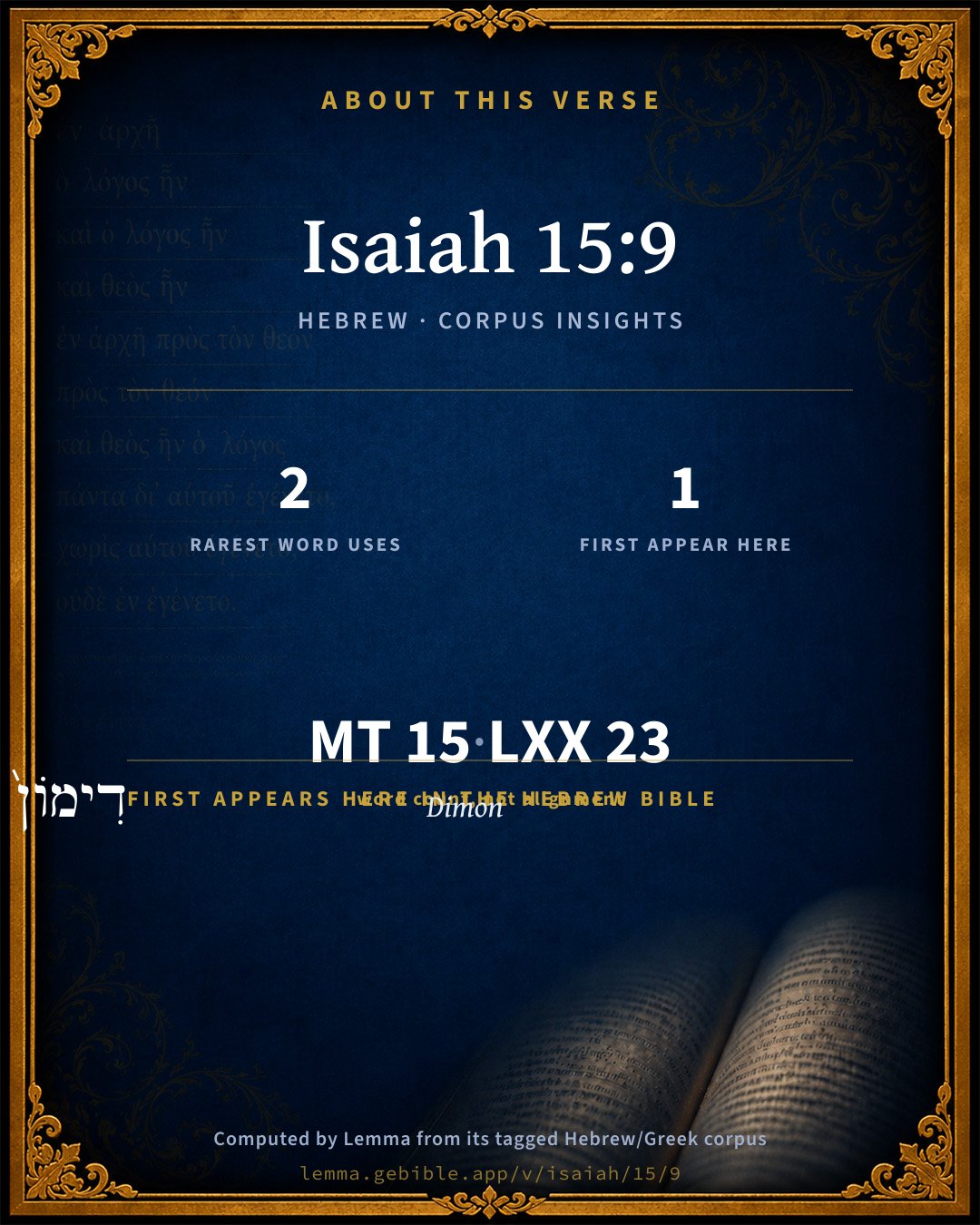
  • 1 first appearance in the Hebrew Bible
Full analysis ↓
Download a study sheet

One document with this verse’s original text, its word-by-word gloss line, the meaning frame, cross-references with their text, attributed commentary, and full source and license credits — printable, and it pastes into notes with its structure intact.

This verse Autodidact and up

Study sheet (.html) Plain text (.txt)

A passage Seminary Student

Up to 50 verses in one chapter. A passage sheet keeps up to 6 commentary sources and 12 cross-references per verse, in the order this page ranks them, and says so on the sheet whenever that leaves anything out. Ask for a single verse and you get the Autodidact verse sheet above.

Everything on this page stays free to read, with no account — the sheet is a download of what is already on screen, not access to it.

Want to remove ads? Support Godless Engineer
Compare translations 3

The same verse in 3 English versions, stacked beneath the original-language interlinear above. Click any original word for its lexicon entry.

Each is an independent rendering of the whole verse — the interlinear is not word-aligned to these translations.

Highlighted words mark where these versions differ — a whole-verse word diff, not a word-by-word alignment.

  • World English Bible Public Domain
    For the waters of Dimon are full of blood; for I will bring yet more on Dimon, a lion on them of Moab that escape, and on the remnant of the land.
  • King James Version Public Domain
    For the waters of Dimon shall be full of blood: for I will bring more upon Dimon, lions upon him that escapeth of Moab, and upon the remnant of the land.
  • unfoldingWord Literal Text CC BY-SA 4.0
    For the waters of Dimon are full of blood, but I will put additions on Dimon: a lion for the escape of Moab and for the remnant of the land.

unfoldingWord Literal Text — © unfoldingWord, licensed CC BY-SA 4.0. Word-aligned USFM3 via Door43 (git.door43.org/unfoldingWord/en_ult).

Versions to compare (up to 4)

3 of 4 selected

Show all 18 translations

Every available English version of this verse, each an independent rendering of the whole verse.

  • World English Bible Public Domain
    For the waters of Dimon are full of blood; for I will bring yet more on Dimon, a lion on them of Moab that escape, and on the remnant of the land.
  • Berean Standard Bible Public Domain
    The waters of Dimon are full of blood, but I will bring more upon Dimon—a lion upon the fugitives of Moab and upon the remnant of the land.
  • Majority Standard Bible Public Domain
    The waters of Dimon are full of blood, but I will bring more upon Dimon—a lion upon the fugitives of Moab and upon the remnant of the land.
  • King James Version Public Domain
    For the waters of Dimon shall be full of blood: for I will bring more upon Dimon, lions upon him that escapeth of Moab, and upon the remnant of the land.
  • American Standard Version (1901) Public Domain
    For the waters of Dimon are full of blood; for I will bring yet more upon Dimon, a lion upon them of Moab that escape, and upon the remnant of the land.
  • Revised Version (1885) Public Domain
    For the waters of Dimon are full of blood: for I will bring yet more upon Dimon, a lion upon him that escapeth of Moab, and upon the remnant of the land.
  • Geneva Bible (1599) Public Domain
    Because the waters of Dimon shall be full of blood: for I will bring more vpon Dimon, euen lyons vpon him that escapeth of Moab, and to the remnant of the land.
  • Douay-Rheims (1899) Public Domain
    For the waters of Dibon are filled with blood: for I will bring more upon Dibon: the lion upon them that shall flee of Moab, and upon the remnant of the land.
  • Young's Literal Translation Public Domain
    For the waters of Dimon have been full of blood, For I set on Dimon additions, For the escaped of Moab a lion, And for the remnant of Adamah!
  • Literal Standard Version CC BY-SA 4.0
    For the waters of Dimon have been full of blood, || For I set additions on Dimon, || A lion for the escaped of Moab, || And for the remnant of Adamah!
  • Unlocked Literal Bible CC BY-SA 4.0
    For the waters of Dimon are full of blood; but I will bring even more upon Dimon. A lion will attack those who escape from Moab and also those remaining in the land.
  • unfoldingWord Literal Text CC BY-SA 4.0
    For the waters of Dimon are full of blood, but I will put additions on Dimon: a lion for the escape of Moab and for the remnant of the land.
  • Darby Bible Public Domain
    For the waters of Dimon are full of blood, for I will lay yet more upon Dimon: a lion upon them that are escaped of Moab, and upon that which remaineth of the land.
  • World Messianic Bible Public Domain
    For the waters of Dimon are full of blood; for I will bring yet more on Dimon, a lion on those of Moab who escape, and on the remnant of the land.
  • Webster's Bible Public Domain
    For the waters of Dimon shall be full of blood: for I will bring more upon Dimon, lions upon him that escapeth of Moab, and upon the remnant of the land.
  • Free Bible Version CC BY-SA 4.0
    River Dimon is full of blood, but I will bring more upon the town of Dimon—a lion to attack the Moabite refugees and those who are left in the country.
  • Bible in Basic English Public Domain
    For the waters of Dimon are full of blood: and I'm sending even more on Moab, a lion on those of Moab who go in flight, and on the rest of the land.
  • JPS Tanakh (1917) Public Domain
    For the waters of Dimon are full of blood; for I will bring yet more upon Dimon, a lion upon him that escapeth of Moab, and upon the remnant of the land.

Literal Standard Version (2020), Covenant Press — licensed CC BY-SA 4.0. Text via the HelloAO Bible API (eBible.org). Unlocked Literal Bible (unfoldingWord) — licensed CC BY-SA 4.0. Text via the HelloAO Bible API (eBible.org). unfoldingWord Literal Text — © unfoldingWord, licensed CC BY-SA 4.0. Word-aligned USFM3 via Door43 (git.door43.org/unfoldingWord/en_ult). Free Bible Version, Dr. Jonathan Gallagher — licensed CC BY-SA 4.0. Text via the HelloAO Bible API (eBible.org).

Word by word

More ways to search: Search by grammar → Find every occurrence → Compare this word →

Practice this passage: Drill this verse → Learn its vocabulary →

דִימוֹן֙
Dîymôwn
H1775
“Dimon”
Noun, Proper
Part of Speech
Noun
Type
Proper
Full BDB Definition

Origin: perhaps for H1769

TWOT: None

Dimon = "river bed" or " silence" - a town in Moab
  1. כִּ֣י kîy H3588 “that” Conjunction
  2. מֵ֤י mayim H4325 “water(s) of” Noun, Common, Masculine, Plural, Construct
  3. מָ֣לְאוּ mâlêʼ H4390 “to fill” Verb, Qal, Perfect, 3rd Person, Common, Plural
  4. דָ֔ם dâm H1818 “blood” Noun, Common, Masculine, Singular, Absolute
  5. כִּֽי kîy H3588 “that” Conjunction
  6. אָשִׁ֥ית shîyth H7896 “to set” Verb, Qal, Imperfect, 1st Person, Common, Singular
  7. עַל ʻal H5921 “upon” Preposition
  8. דִּימ֖וֹן Dîymôwn H1775 “Dimon” Noun, Proper
  9. נוֹסָפ֑וֹת yâçaph H3254 “adding” Verb, Niphal, Participle Active, Feminine, Plural, Absolute
  10. לִפְלֵיטַ֤ת pᵉlêyṭâh H6413 “to/for · escape of” Preposition + Noun, Common, Feminine, Singular, Construct
  11. מוֹאָב֙ Môwʼâb H4124 “Moab” Noun, Proper
  12. אַרְיֵ֔ה ʼărîy H738 “lion” Noun, Common, Masculine, Singular, Absolute
  13. וְלִשְׁאֵרִ֖ית shᵉʼêrîyth H7611 “and · to/for · remnant of” Conjunction + Preposition + Noun, Common, Feminine, Singular, Construct
  14. אֲדָמָֽה ʼădâmâh H127 “ground” Noun, Common, Feminine, Singular, Absolute

About this verse

These counts appear in no published source. They are computed here, from the morphology-tagged text and Lemma’s own curated glosses. What Lemma adds →

15
words
13
distinct lemmas
Prophets
section

Notable vocabulary

The rarest word here is דִימוֹן֙ Dimon H1775 — appearing just 2 times in the whole Hebrew Bible.

First appearance in Scripture

This word makes its first canonical appearance in the Hebrew Bible here:

  • דִימוֹן֙ Dimon H1775

Grammatical profile

  • 3 verbs
  • 9 nouns
  • 1 preposition
  • 2 conjunctions

Verb forms

  • מָ֣לְאוּ Qal · Perfect
  • אָשִׁ֥ית Qal · Imperfect
  • נוֹסָפ֑וֹת Niphal · Participle Active

Repetition

Words recur within this verse — often emphatic in Hebrew:

  • דִימוֹן֙ Dimon H1775 ×2
  • כִּ֣י that H3588 ×2

Hebrew & Septuagint length

In English translation the verse runs 32 words from the Hebrew and 33 from the Septuagint (LXX English) — closely comparable.

A rough comparison of the two English renderings, which tokenize alike — not a word-level alignment.

Word counts can differ between the Hebrew and the Greek without any difference in meaning — e.g. the Hebrew direct-object marker אֵת has no separate Greek word, and Greek often adds the article ὁ.

In the original languages it is 15 Hebrew tokens and 23 Greek tokens — but the two are counted differently (Hebrew bundles its prefixes and suffixes into one token; the Greek is in lemma form), so that isn’t a like-for-like length.

Cross-references

9

Topical passages linked to Isaiah 15:9 in the Treasury of Scripture Knowledge — connected by theme and wording, ordered by reader-vote popularity; previews shown in the World English Bible.

  • 2 Kings 17:25 So it was, at the beginning of their dwelling there, that they didn't fear Yahweh: therefore Yahweh sent lions among them, which killed some of them.
  • Leviticus 26:18 "'If you in spite of these things will not listen to me, then I will chastise you seven times more for your sins.
  • Leviticus 26:21–22 "'If you walk contrary to me, and won't listen to me, then I will bring seven times more plagues on you according to your sins.
  • Leviticus 26:24 then I will also walk contrary to you; and I will strike you, even I, seven times for your sins.
  • Leviticus 26:28 then I will walk contrary to you in wrath; and I also will chastise you seven times for your sins.
  • Jeremiah 15:3 I will appoint over them four kinds, says Yahweh: the sword to kill, and the dogs to tear, and the birds of the sky, and the animals of the earth, to devour and to destroy.
  • Jeremiah 48:43–45 Fear, and the pit, and the snare, are on you, inhabitant of Moab, says Yahweh.
  • Jeremiah 50:17 Israel is a hunted sheep; the lions have driven him away: first, the king of Assyria devoured him; and now at last Nebuchadrezzar king of Babylon has broken his bones.
  • Amos 5:19 As if a man fled from a lion, And a bear met him; Or he went into the house and leaned his hand on the wall, And a snake bit him.

Cross-references courtesy of OpenBible.info (CC BY 4.0).

Hebrew and Greek witnesses Masoretic Hebrew ↔ Greek Septuagint

The same verse in the two great witnesses to the Old Testament, shown verse-for-verse.

These are two independent witnesses, not word-aligned to each other, and the Septuagint is shown in lemma (dictionary) form.

Hebrew Isaiah 15:9 Masoretic · Westminster Leningrad Codex

כִּ֣י מֵ֤י דִימוֹן֙ מָ֣לְאוּ דָ֔ם כִּֽי אָשִׁ֥ית עַל דִּימ֖וֹן נוֹסָפ֑וֹת לִפְלֵיטַ֤ת מוֹאָב֙ אַרְיֵ֔ה וְלִשְׁאֵרִ֖ית אֲדָמָֽה

For the waters of Dimon are full of blood; for I will bring yet more on Dimon, a lion on them of Moab that escape, and on the remnant of the land.

World English Bible · Public Domain

Greek LXX Isaiah 15:9 Septuagint · lemma form

ὁ δέ ὕδωρ ὁ ρεμμων πίμπλημι αἷμα ἐπιἄγω γάρ ἐπί ρεμμων ἄραψ καί αἴρω ὁ σπέρμα μωαβ καί αριηλ καί ὁ κατάλοιπος αδαμα

And the water of Dimon shall be filled with blood: for I will bring Arabians upon Dimon, and I will take away the seed of Moab, and Ariel, and the remnant of Adama.

LXX2012 (modern English Septuagint) · Public Domain

On this verse, Adam Clarke's Commentary discusses the Septuagint’s reading. Read the note in Commentary ↓

Hebrew: Westminster Leningrad Codex (CC BY 4.0). Greek: Septuagint (public domain); English from LXX2012 (modern English Septuagint) (Public Domain). How the Septuagint differs from the Hebrew →

Targum (Aramaic paraphrase)

1

The Targum is the ancient Jewish Aramaic paraphrase of the Hebrew Scriptures — an interpretive translation, not the Hebrew text itself. Onkelos (literal) and Pseudo-Jonathan (expansive) render the Torah, and Jonathan the Prophets. Coverage is partial: where no permissively-licensed English translation exists for a verse, only the Aramaic is shown. This is verse-level text, not a word-by-word alignment to the Hebrew.

  1. Targum Jonathan Prophets (Joshua–Malachi)
    אֲרֵי מֵי דִימוֹן אִתְמְלִיאוּ דַם קְטוֹלִין אֲרֵי אֱמַנֵי עַל דִימוֹן כְּנִישַׁת מַשִׁירְיָן לְשֵׁיזָבַת מוֹאָב מֶלֶךְ בְּמַשִׁרְיָתֵיהּ יִסַק וּלְמִבָּז שְׁאָרָא דְאַרְעֲהוֹן:

    For the waters of Dimon shall be full of blood: for I will appoint upon Dimon an assembly of armies. Upon the escaped of Moab, a king with his army shall ascend; yea, to spoil the remainder of their land.

    Targum Jonathan — Aramaic: “Mikraot Gedolot” (public domain). English: “Sefaria Community Translation” (CC0 1.0 (public-domain dedication)); “London "Chaldee Paraphrase," 1871” (public domain). Text via Sefaria.

Commentary

Notes on Isaiah 15:9 from classic Christian and Jewish commentators (each source and its license shown beneath its notes). The classic Christian expositions comment on the surrounding passage and are grouped to its opening verse, so a note may address several verses; the Jewish commentaries on the Tanakh (Rashi and others) are per-verse, so they appear only where the commentator wrote on this verse.

Lemma curates 59 commentaries, every one of them public domain or Creative Commons licensed, each selected and text-cleaned for this edition rather than reprinted as found. About our sources →

Trapp's Complete Commentary

John Trapp

Isa 15:9 For the waters of Dimon shall be full of blood: for I will bring more upon Dimon, lions upon him that escapeth of Moab, and upon the remnant of the land.

Ver. 9. For the waters of Dimon shall be full of blood.] Non tingentur solum, sed etiam inundabunt and the bloody enemy shall haply be heard to cry out, as once Hannibal did when he saw a pit full of man’s blood, O formosum spectaculum! O brave sight! The very name Dimon signifieth bloody, so called, as some think, on this occasion instead of Dibon, the old name. {Isa 15:2}

I will bring more upon Dimon, lions upon him that escapeth of Moab.] Heb., I will put additions upon Dimon, {a} i.e., additions of evils, viz., lions, and other like fierce and cruel creatures, which shall prey upon the Moabites there. {Isa 35:9 2Ki 17:25} Some say by lion is here meant Nebuchadnezzar, {Jer 4:7} fitly compared to a lion for his strength and swiftness. Certain it is that God hath in store plenty of plagues for evildoers; and if they escape one mischief, they shall fall into another; their preservation is but a reservation, except they repent.

{a} Additamenta plagarum. - Haymo.

John Trapp, A Commentary or Exposition upon All the Books of the Old and New Testament (1647–1656) — public domain. Text from a community e-Sword module.

Joseph Benson's Commentary

Isa 15:9. For the waters of Dimon — This seems to be the same place with Dibon, mentioned Isa 15:2; shall be full of blood — This is a third evil, and cause of lamentation; the great slaughter which the enemy should make of the people. For I will bring more upon Dimon — Hebrew, I will place, or lay upon Dimon, נוכפות, accessions, or additions, that is, I will increase those waters by the torrents that shall flow into them from the blood of the slain. The expression is strong and elegant. Bishop Lowth, however, interprets the clause, “Yet will I bring more evils upon Dimon,” that is, though the waters are full of blood, yet will I bring upon them further and greater evils. Lions upon him that escapeth of Moab, &c. — This is the fourth evil, the completion of all the rest, and the severest cause of their lamentation, that God would not even spare a remnant hereafter to restore and renew their fallen state; but would pursue them with his judgments to the last extremity, and send upon them, and on their desolate country, lions and other wild beasts, entirely to destroy all that remained. Vitringa, however, thinks that Nebuchadnezzar is pointed out in this clause; who, after the Moabites, reduced extremely low by the Assyrians, began to recruit themselves, should give the remnant of the nation to destruction, and complete the judgment which the Assyrian had begun: see Jer 4:7; Jer 5:6; Jer 48:40. The Chaldee paraphrast must have so understood it, translating the word, which we render lion, by king: A king with his army to destroy the Moabites.

Joseph Benson's Commentary on the Old and New Testaments (1811–1818) — public domain. Text from a community e-Sword module.

Tyndale Open Study Notes

Tyndale Open Resources

15:9 Dibon: The Masoretic Text reads Dimon, which is a play on the word translated blood (Hebrew dam). • blood: Apparently many people from Moab had already been killed, but their judgment had only begun.

Tyndale Open Study Notes — © Tyndale Open Resources, licensed CC BY-SA 4.0. Text via the HelloAO Bible API.

Geneva Bible (1599)

Geneva Bible translators

So that by no means they should escape the hand of God: thus will God punish the enemies of his Church.

Of them that are slain.

Geneva Bible (1599) marginal notes — public domain. Text via Bolls.life.

Jamieson, Fausset & Brown

Robert Jamieson, A. R. Fausset & David Brown

Dimon--same as Dibon (Isa 15:2). Its waters are the Arnon.

full of blood--The slain of Moab shall be so many.

bring more--fresh calamities, namely, the "lions" afterwards mentioned (Kg2 17:25; Jer 5:6; Jer 15:3). VITRINGA understands Nebuchadnezzar as meant by "the lion"; but it is plural, "lions." The "more," or in Hebrew, "additions," he explains of the addition made to the waters of Dimon by the streams of blood of the slain.

Next: Isaiah Chapter 16

Jamieson, Fausset & Brown — Commentary Critical and Explanatory on the Whole Bible (1871) — public domain (CC PDM 1.0). Text via the HelloAO Bible API.

Adam Clarke's Commentary

Verse 9. The waters of Dimon] Some have Dibon, others have Ribon and Rimon. St. Jerome observes that the same town was called both Dibon and Dimon. The reading is therefore indifferent.

Upon him that escapeth of Moab, c. - "Upon the escaped of Moab, and Ariel, and the remnant of Admah."] The Septuagint for עריה aryeh read אריאל ariel. Ar Moab was called also Ariel or Areopolis, Hieron. and Theodoret. See Cellarius. They make אדמה Admah also a proper name. Michaelis thinks that the Moabites might be called the remnant of Admah, as sprung from Lot and his daughters, escaped from the destruction of that and the other cities or, metaphorically, as the Jews are called princes of Sodom, and people of Gomorrah, Isa 1:10. Bibliotheque Orient. Part v., p. 195. The reading of this verse is very doubtful; and the sense, in every way in which it can be read, very obscure. - L. Calmet thinks there may be a reference to 1Ch 11:22, where it is said, "Benaiah slew two lion-like men of Moab," or the two Ariels of Moab, and would therefore translate, "I will bring down the remnant of Moab like Ariel, (which Benaiah smote,) and them that are escaped like Adamah." They shall be exterminated, as were the inhabitants of those two cities. Ariel was a double city - the river Arnon dividing it in two. This is the two Ariels of Moab - not two lion-like men, much less two lions. See Calmet on this place.

Adam Clarke's Commentary on the Bible (1810–1826) — public domain. Text from a community e-Sword/MySword module.

The Cambridge Bible for Schools and Colleges

gen. ed. J. J. S. Perowne

9. the waters of Dimon] Dimon is generally supposed to be another form of Dibon, chosen for the sake of an alliteration with the word for “blood” (dâm). The conjecture may be taken for what it is worth; it has the authority of Jerome, who says, “usque hodie indifferenter et Dimon et Dibon hoc oppidulum dicitur,” and we know of no other place Dimon.

I will bring more (lit. “additional [evils]”) upon Dimon] This is the first strictly prophetic utterance in the passage; the speaker is Jehovah.

lions upon … Moab] Better: upon the fugitives of Moab (sc. I will bring) a lion. The “lion” is undoubtedly a symbol for a terrible conqueror, though it is difficult to say who is meant. It can hardly be Jeroboam II., who has already done his worst, and it is still less likely that Judah is meant. The peculiar prophetic form of the latter part of the verse has suggested to some commentators that it may have been inserted by Isaiah in the original oracle. In that case the “lion” would almost of necessity denote the Assyrians.

The Cambridge Bible for Schools and Colleges (gen. ed. J. J. S. Perowne; Cambridge University Press, 1878–1918) — public domain. Text from a community e-Sword module.

John Gill's Exposition

For the waters of Dimon shall be full of blood,.... Of the slain, as the Targum adds. This was a river in the land of Moab, as say Jarchi and Kimchi; it had its name from the blood of the slain, Some take it to be the name of a city, and the same with Dibon, Isa 15:2 but, because of the abundance of blood shed in it, got this new name; and the Vulgate Latin version here calls it Dibon; and the Syriac version Ribon; and the Arabic version Remmon:

for I will bring more upon Dimon; or "additions" (r), not merely add blood to the waters of the river, as Jarchi and Kimchi; but bring additional evils and plagues, as Aben Ezra. The Targum interprets it,

"the congregation of an army;''

but what these additions were are explained in the next clause:

lions upon him that escapeth of Moab, and upon the remnant of the land; or a "lion" (s); the meaning is, that such who escaped the sword should be destroyed by lions, or other beasts of prey, which was one of the Lord's four judgments, Eze 14:21. The Targum is,

"a king shall ascend with his army, and so spoil the remainder of their land;''

and Aben Ezra interprets it of the king of Assyria; and Jarchi of Nebuchadnezzar, who is called a lion, Jer 4:7 and the sense is thought to be this, that whom Sennacherib king of Assyria should leave, Nebuchadnezzar should destroy. The Septuagint and Arabic versions render the last clause, "the remnant of Adama", a city of Moab; so Cocceius.

(r) "addita", Pagninus, Montanus; "additiones", Vatablus; "additamenta", Junius & Tremellius, Piscator. (s) "leonem", Pagninus, Montanus, &c.

Next: Isaiah Chapter 16

John Gill's Exposition of the Whole Bible (1746–1763) — public domain (CC PDM 1.0). Text via the HelloAO Bible API.

Albert Barnes' Notes on the Bible

For the waters of Dimon - Probably the same as “Dibon” Isa 15:2. Eusobius says it was a large town on the northern bank of the river Arnon. Jerome says that the letters “m and b” are often interchanged in oriental dialects (see the note at Isa 15:2).

Shall be full of blood - That is, the number of the slain of Moab shall be so great, that the blood shall color the waters of the river - a very common occurrence in times of great slaughter. Perhaps by the “waters” of Dimon the prophet does not mean the river Arnon, but the small rivulets or streams that might flow into it near to the city of Dibon. Probably there were winter brooks there, which do not run at all seasons. The Chaldee renders it, ‘The waters of Dimon shall be full of blood, because I will place upon Dimon an assembly of armies.’

For I will bring more upon Dimon - Hebrew, ‘I will bring additions;’ that is, I will bring upon it additional calamities. Jerome says, that by those additional calamities, the prophet refers to the “lions” which are immediately after mentioned. “Lions upon him that escapeth of Moab.” Wild beasts upon those who escaped from the slaughter, and who took refuge in the wilderness, or on the mountains. The Chaldee renders it, ‘A king shall ascend with an army, and shall destroy the remainder of their land.’ Aben Ezra interprets it of the king of Assyria; and Jarchi of Nebuchadnezzar, who is called a lion in Jer 4:7. Vitringa also supposes that Nebnchadnezzar is meant. But it is more probable that the prophet refers to wild beasts, which are often referred to in the Scriptures as objects of dread, and as bringing calamities upon nations (see Lev 26:22; Jer 5:6; Jer 15:3; 2Ki 18:25).

Upon the remnant of the land - Upon all those who escaped the desolation of the war. The Septuagint and the Arabic render this, ‘Upon the remnant of Adama,’ understanding the word rendered ‘land’ (ארמה 'ădâmâh), as the name of a city. But it more probably means the land.

Albert Barnes' Notes on the Bible (1834–1885) — public domain. Text from a community e-Sword/MySword module.

Haydock's Catholic Bible Commentary

Dibon. Septuagint, &c., read, "Dimon," which signifies, "blood." I will give it a better claim to this appellation. --- Lion. Nabuchodonosor. (Calmet) --- Septuagint, "I will bring the Arabs up on Dimon, and will take away the seed of Moab, and Ariel, and the remnant of Adama." (Haydock)

George Leo Haydock (1774–1849), Haydock's Catholic Family Bible and Commentary, 1859 edition — public domain. Excludes Psalms (Douay-Rheims chapter numbering differs from Protestant) and Deuterocanonical books (Catholic canon only).

Matthew Poole's English Annotations

Dimon: this seems to be the same place with Dibon, mentioned Isa 15:2, here called Dimon for the great bloodshed in it, as it here follows; such changes of a letter being not unusual in proper names, as in Merodach for Berodach, Isa 39:1. More; either,

1. More than upon other parts of the country, that being one of their high places, Isa 15:2; or rather,

2. More than hath been already mentioned.

Lions upon him that escapeth of Moab; God shall send lions to find out those that escape the fury of men.

Matthew Poole's English Annotations on the Holy Bible (1683–1685) — public domain. Text from a community e-Sword/MySword module.

The Pulpit Commentary

The waters of Dimon. It is thought that "Dimon" is here put for "Dibon," in order to assimilate the sound to that of dam, blood. St. Jerome says that in his day the place was called indifferently by either name. If we accept this view, "the waters of Dimon" will probably be those of the Amen, near which Dibon was situated (see the comment on ver. 2). I will bring more; literally, I will bring additions; i.e. additional calamities, which will cause the stream of the Aton to flow with blood. Lions; or, a lieu. Perhaps Nebuchadnezzar, (Jer_4:7) who is said by Josephus to have conquered the Moabites, or possibly Asshur-bani-pal, who overran the country about B.C. 645 (G. Smith, "History of Asshur-bani-pal," p. 259).

The Pulpit Commentary (1880–1919), ed. H.D.M. Spence-Jones & Joseph S. Exell — public domain. Text from a community e-Sword module.

John Wesley's Explanatory Notes

More - More than hath been already mentioned. Lions - God shall send lions to find out those that escape the fury of men.

John Wesley, Explanatory Notes Upon the Whole Bible (1754–1765) — public domain. Text via the GEBible commentary corpus.

J. A. Alexander on Isaiah

Joseph Addison Alexander

The expressions grow still stronger. Not only is the land full of tumult and disorder, fear and flight; it is also stained with carnage and threatened with new evils. “For the waters of Dimon are full of blood; for I will bring upon Dimon additions (i.e., additional evils), on the escaped (literally, the escape) of Moab a lion; and on the remnant of the land (those left in it, or remaining of its population).” By the waters of Dimon or Dibon, most writers understand the Arnon, near the north bank of which the town was built, as the river Kishon is called the waters of Megiddo (Jdg 5:19).

Joseph Addison Alexander, The Prophecies of Isaiah (1846–1847; New York: Scribner, 1870–1878) — public domain. Text from a community e-Sword module.

Rashi

Rabbi Shlomo Yitzchaki (Rashi)

The waters of Dimon The name of the river.

have been filled with blood Like the name of the river. [The name דִּימוֹן resembles דַּם, blood.]

for I will place upon Dimon additions Its name is blood, and I will add the blood of the fallen, to fill it. Jonathan renders, however: כְּנִישַׁת מַשַׁירְיָן, the gathering of the camps, the camps joined together. This is an expression of (infra 21:1) “Join (סְפוּ) year to year”; (Deut. 29:18) “to add (סְפוֹת) the inadvertent sins.”

for the survivors of Moab is the lion The survivors which Sennacherib will leave over, Nebuchadnezzar will carry away in his time, and he will destroy them. And he is called “the lion,” as the matter is stated (Jer. 4:7): “The lion has come up out of his thicket.”

and for the remnant of Israel.

is the land [i.e,] your land.

Rashi on the Tanakh — English translations: “The Judaica Press complete Tanach with Rashi, translated by A. J. Rosenberg” (CC BY 4.0); “Pentateuch with Rashi's commentary by M. Rosenbaum and A.M. Silbermann, 1929-1934” (public domain); “The Metsudah Tanach series, Lakewood, N.J” (CC BY 4.0); and “The Book of Joshua, Metsudah Publications, 1997” (CC BY 4.0). Text via Sefaria.

Ibn Ezra

Rabbi Abraham ibn Ezra

דם Blood. The blood of the slain of Moab.

נוספות Additional evils. Supply רעות evils; comp. מלות עזות═עזות impertinent words (Prov. 18:23).

כי אשית For I will bring. To be repeated before לפלטת: for I will bring against the remnant of Moab a lion, namely the king of Assyria.

Ibn Ezra on the Tanakh — English translations: “Sefaria Community Translation” (CC0 1.0 (public-domain dedication)); “Yalkut, Sifsei Chachomim Chumash, Metsudah Publications, 2009” (CC BY 4.0); and “Commentary of Ibn Ezra on Isaiah - trans. by M. Friedlander, 1873” (public domain). Text via Sefaria.

Lesson kit

Teaching starters — assembled from the data on this page, not authored interpretation. Every prompt links to the verse data it draws on. Edit before teaching.

Isaiah, in the Prophets, opens this verse with 15 words (13 distinct Hebrew lemmas). Its most distinctive word is Dîymôwn (“Dimon”). A historical commentator’s framing appears above. Read the whole chapter for the surrounding context.

Discussion questions

  1. What does “Dimon” (Dîymôwn) contribute to the verse as a whole?
  2. The word “Dimon” first appears here in Scripture. What is being introduced at this debut?
  3. 2 Kings 17:25 shares this passage’s theme. How do the two illuminate each other?
  4. “Dimon” occurs 2× in this one verse. What is the effect of the repetition?
  5. These translations render this verse differently. What is at stake in choosing one wording over another?
  6. The verb «מָ֣לְאוּ» is Qal Perfect. How does its form color the action?
  7. Reading how Trapp's Complete Commentary and Joseph Benson's Commentary read this verse, where do the two commentators agree and where do they part?

Things to notice

Reading settings

Reading text

Shown beneath each verse's original-language words.

Old Testament
Old Testament edition

Read the OT as the Masoretic Hebrew (MT) or the Greek Septuagint (LXX).

English shown for the Greek Septuagint (in the Hebrew ↔ Greek comparison).

Comparing translations? Open the Compare panel on any verse page to stack up to four side by side.