
Isaiah 30:23

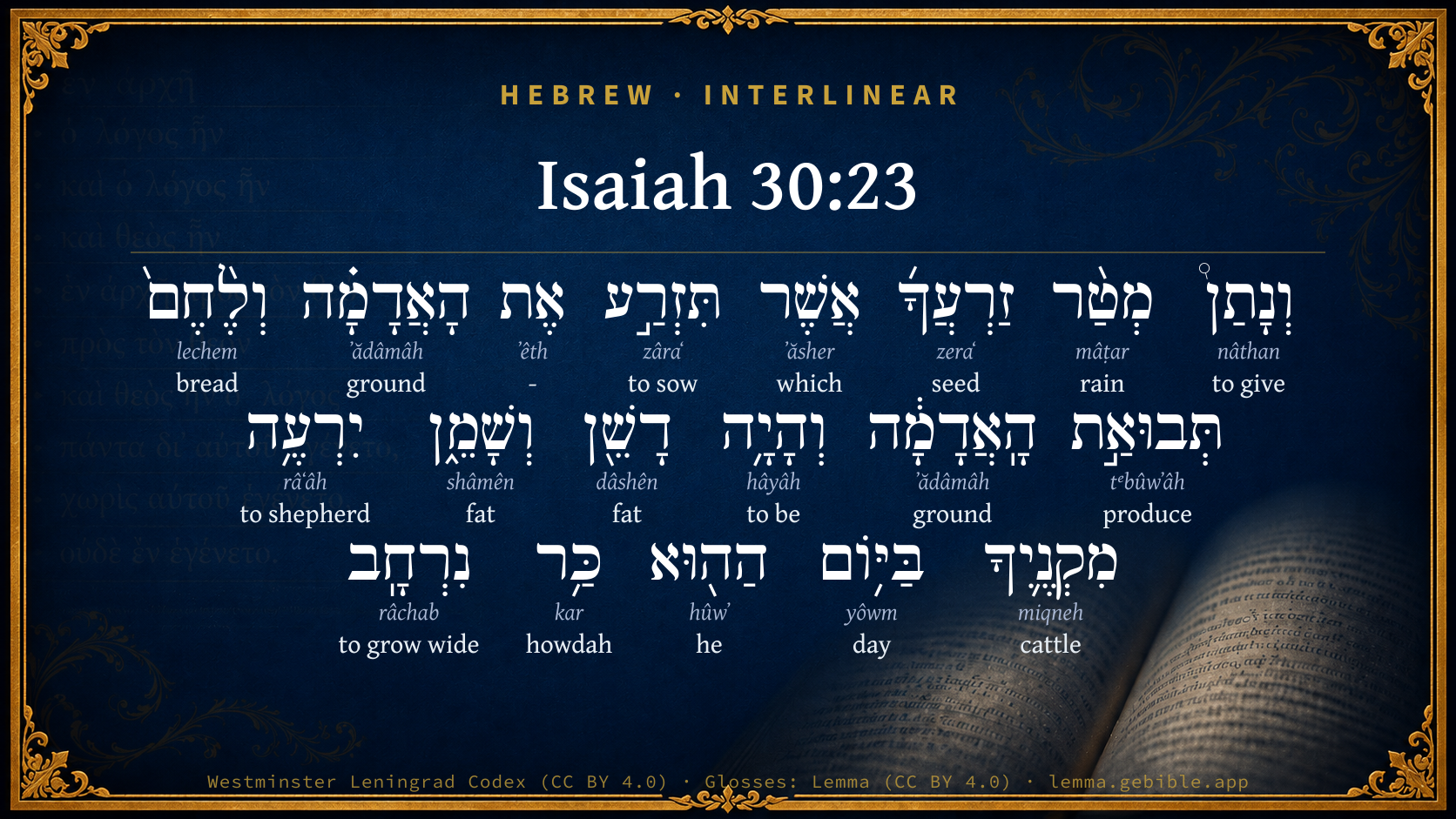
Hebrew (Westminster Leningrad Codex) Isaiah 30:23 appears in the Hebrew Old Testament. The text above is from the Westminster Leningrad Codex. Each word links to its Strong’s number, a concise gloss, and parsing drawn from the Open Scriptures Hebrew Bible morphology. Click any word for its full Brown-Driver-Briggs (BDB) entry.
Download image
Cite this verse

Isaiah 30:23 (World English Bible). Public Domain. Lemma interlinear Bible study tool, https://lemma.gebible.app/v/isaiah/30/23.

Show BibTeX & RIS
BibTeX
RIS
English Translation
He will give the rain for your seed, with which you shall sow the ground; and bread of the increase of the ground, and it shall be fat and plenteous. In that day shall your cattle feed in large pastures;
World English Bible · Public Domain
Download a study sheet

One document with this verse’s original text, its word-by-word gloss line, the meaning frame, cross-references with their text, attributed commentary, and full source and license credits — printable, and it pastes into notes with its structure intact.

This verse Autodidact and up

Study sheet (.html) Plain text (.txt)

A passage Seminary Student

Up to 50 verses in one chapter. A passage sheet keeps up to 6 commentary sources and 12 cross-references per verse, in the order this page ranks them, and says so on the sheet whenever that leaves anything out. Ask for a single verse and you get the Autodidact verse sheet above.

Everything on this page stays free to read, with no account — the sheet is a download of what is already on screen, not access to it.

Want to remove ads? Support Godless Engineer
Compare translations 3

The same verse in 3 English versions, stacked beneath the original-language interlinear above. Click any original word for its lexicon entry.

Each is an independent rendering of the whole verse — the interlinear is not word-aligned to these translations.

Highlighted words mark where these versions differ — a whole-verse word diff, not a word-by-word alignment.

  • World English Bible Public Domain
    He will give the rain for your seed, with which you shall sow the ground; and bread of the increase of the ground, and it shall be fat and plenteous. In that day shall your cattle feed in large pastures;
  • King James Version Public Domain
    Then shall he give the rain of thy seed, that thou shalt sow the ground withal; and bread of the increase of the earth, and it shall be fat and plenteous: in that day shall thy cattle feed in large pastures.
  • unfoldingWord Literal Text CC BY-SA 4.0
    And he will give rain for your seed which you sow the ground, and bread of the produce of the ground, and it will be rich and fat. In that day, your livestock will graze a broadened pasture.

unfoldingWord Literal Text — © unfoldingWord, licensed CC BY-SA 4.0. Word-aligned USFM3 via Door43 (git.door43.org/unfoldingWord/en_ult).

Versions to compare (up to 4)

3 of 4 selected

Show all 18 translations

Every available English version of this verse, each an independent rendering of the whole verse.

  • World English Bible Public Domain
    He will give the rain for your seed, with which you shall sow the ground; and bread of the increase of the ground, and it shall be fat and plenteous. In that day shall your cattle feed in large pastures;
  • Berean Standard Bible Public Domain
    Then He will send rain for the seed that you have sown in the ground, and the food that comes from your land will be rich and plentiful. On that day your cattle will graze in open pastures.
  • Majority Standard Bible Public Domain
    Then He will send rain for the seed that you have sown in the ground, and the food that comes from your land will be rich and plentiful. On that day your cattle will graze in open pastures.
  • King James Version Public Domain
    Then shall he give the rain of thy seed, that thou shalt sow the ground withal; and bread of the increase of the earth, and it shall be fat and plenteous: in that day shall thy cattle feed in large pastures.
  • American Standard Version (1901) Public Domain
    And he will give the rain for thy seed, wherewith thou shalt sow the ground; and bread of the increase of the ground, and it shall be fat and plenteous. In that day shall thy cattle feed in large pastures;
  • Revised Version (1885) Public Domain
    And he shall give the rain of thy seed, that thou shalt sow the ground withal; and bread of the increase of the ground, and it shall be fat and plenteous: in that day shall thy cattle feed in large pastures.
  • Geneva Bible (1599) Public Domain
    Then shall hee giue raine vnto thy seede, when thou shalt sowe the ground, and bread of the increase of the earth, and it shalbe fat and as oyle: in that day shall thy cattell be fed in large pastures.
  • Douay-Rheims (1899) Public Domain
    And rain shall be given to thy seed, wheresoever thou shalt sow in the land: and the bread of the corn of the land shall be most plentiful, and fat. The lamb in that day shall feed at large in thy possession:
  • Young's Literal Translation Public Domain
    And He hath given rain `for' thy seed, With which thou dost sow the ground, And bread, the increase of the ground, And it hath been fat and plenteous, Enjoy do thy cattle in that day an enlarged pasture.
  • Literal Standard Version CC BY-SA 4.0
    And He has given rain [for] your seed, || With which you sow the ground, || And bread, the increase of the ground, || And it has been fat and plentiful, || Your livestock enjoy an enlarged pasture in that day.
  • Unlocked Literal Bible CC BY-SA 4.0
    He will give the rain for your seed when you sow the ground, and bread with abundance from the ground, and the crops will be abundant. In that day your cattle will graze in broad pastures.
  • unfoldingWord Literal Text CC BY-SA 4.0
    And he will give rain for your seed which you sow the ground, and bread of the produce of the ground, and it will be rich and fat. In that day, your livestock will graze a broadened pasture.
  • Darby Bible Public Domain
    And he will give the rain of thy seed with which thou shalt sow the ground; and bread, the produce of the ground, and it shall be fat and rich. In that day shall thy cattle feed in large pastures;
  • World Messianic Bible Public Domain
    He will give the rain for your seed, with which you will sow the ground; and bread of the increase of the ground will be rich and plentiful. In that day, your livestock will feed in large pastures.
  • Webster's Bible Public Domain
    Then shall he give the rain of thy seed, with which thou shalt sow the ground; and bread of the increase of the earth, and it shall be fat and plenteous: in that day shall thy cattle feed in large pastures.
  • Free Bible Version CC BY-SA 4.0
    He will send rain when you sow, and the land will produce great harvests. At that time your cattle will feed in rich pastures.
  • Bible in Basic English Public Domain
    And he will give rain for your seed, so that you may put it in the earth; and you will have bread from the produce of the earth, good and more than enough for your needs: in that day the cattle will get their food in wide grass-lands.
  • JPS Tanakh (1917) Public Domain
    And He will give the rain for thy seed, wherewith thou sowest the ground, and bread of the increase of the ground, and it shall be fat and plenteous; in that day shall thy cattle feed in large pastures.

Literal Standard Version (2020), Covenant Press — licensed CC BY-SA 4.0. Text via the HelloAO Bible API (eBible.org). Unlocked Literal Bible (unfoldingWord) — licensed CC BY-SA 4.0. Text via the HelloAO Bible API (eBible.org). unfoldingWord Literal Text — © unfoldingWord, licensed CC BY-SA 4.0. Word-aligned USFM3 via Door43 (git.door43.org/unfoldingWord/en_ult). Free Bible Version, Dr. Jonathan Gallagher — licensed CC BY-SA 4.0. Text via the HelloAO Bible API (eBible.org).

Word by word

More ways to search: Search by grammar → Find every occurrence → Compare this word →

Practice this passage: Drill this verse → Learn its vocabulary →

דָשֵׁ֖ן
dâshên
H1879
“fat”
Adjective, Adjective, Masculine, Singular, Absolute
Part of Speech
Adjective
Type
Adjective
Gender
Masculine
Number
Singular
State
Absolute
Full BDB Definition

Origin: from H1878

TWOT: 457b

fat (adjective) - vigorous, stalwart ones (substantive)
  1. וְנָתַן֩ nâthan H5414 “and · to give” Conjunction + Verb, Qal, Sequential Perfect, 3rd Person, Masculine, Singular
  2. מְטַ֨ר mâṭar H4306 “rain of” Noun, Common, Masculine, Singular, Construct
  3. זַרְעֲךָ֜ zeraʻ H2233 “seed · your” Noun, Common, Masculine, Singular, Construct + Suffix, Personal, 2nd Person, Masculine, Singular
  4. אֲשֶׁר ʼăsher H834 “which” Particle, Relative
  5. תִּזְרַ֣ע zâraʻ H2232 “to sow” Verb, Qal, Imperfect, 2nd Person, Masculine, Singular
  6. אֶת ʼêth H853 “-” Particle, Direct Object
  7. הָאֲדָמָ֗ה ʼădâmâh H127 “the · ground” Particle, Definite Article + Noun, Common, Feminine, Singular, Absolute
  8. וְלֶ֨חֶם֙ lechem H3899 “and · bread” Conjunction + Noun, Common, Both, Singular, Absolute
  9. תְּבוּאַ֣ת tᵉbûwʼâh H8393 “produce of” Noun, Common, Feminine, Singular, Construct
  10. הָֽאֲדָמָ֔ה ʼădâmâh H127 “the · ground” Particle, Definite Article + Noun, Common, Feminine, Singular, Absolute
  11. וְהָיָ֥ה hâyâh H1961 “and · to be” Conjunction + Verb, Qal, Sequential Perfect, 3rd Person, Masculine, Singular
  12. וְשָׁמֵ֑ן shâmên H8082 “and · fat” Conjunction + Adjective, Adjective, Masculine, Singular, Absolute
  13. יִרְעֶ֥ה râʻâh H7462 “to shepherd” Verb, Qal, Imperfect, 3rd Person, Masculine, Singular
  14. מִקְנֶ֛יךָ miqneh H4735 “cattle · your” Noun, Common, Masculine, Singular, Construct + Suffix, Personal, 2nd Person, Masculine, Singular
  15. בַּיּ֥וֹם yôwm H3117 “in/at the · day” Preposition, Determined + Noun, Common, Masculine, Singular, Absolute
  16. הַה֖וּא hûwʼ H1931 “the · he” Particle, Definite Article + Pronoun, Personal, 3rd Person, Masculine, Singular
  17. כַּ֥ר kar H3733 “howdah” Noun, Common, Masculine, Singular, Absolute
  18. נִרְחָֽב râchab H7337 “growing wide” Verb, Niphal, Participle Active, Masculine, Singular, Absolute

About this verse

These counts appear in no published source. They are computed here, from the morphology-tagged text and Lemma’s own curated glosses. What Lemma adds →

19
words
18
distinct lemmas
Prophets
section

Notable vocabulary

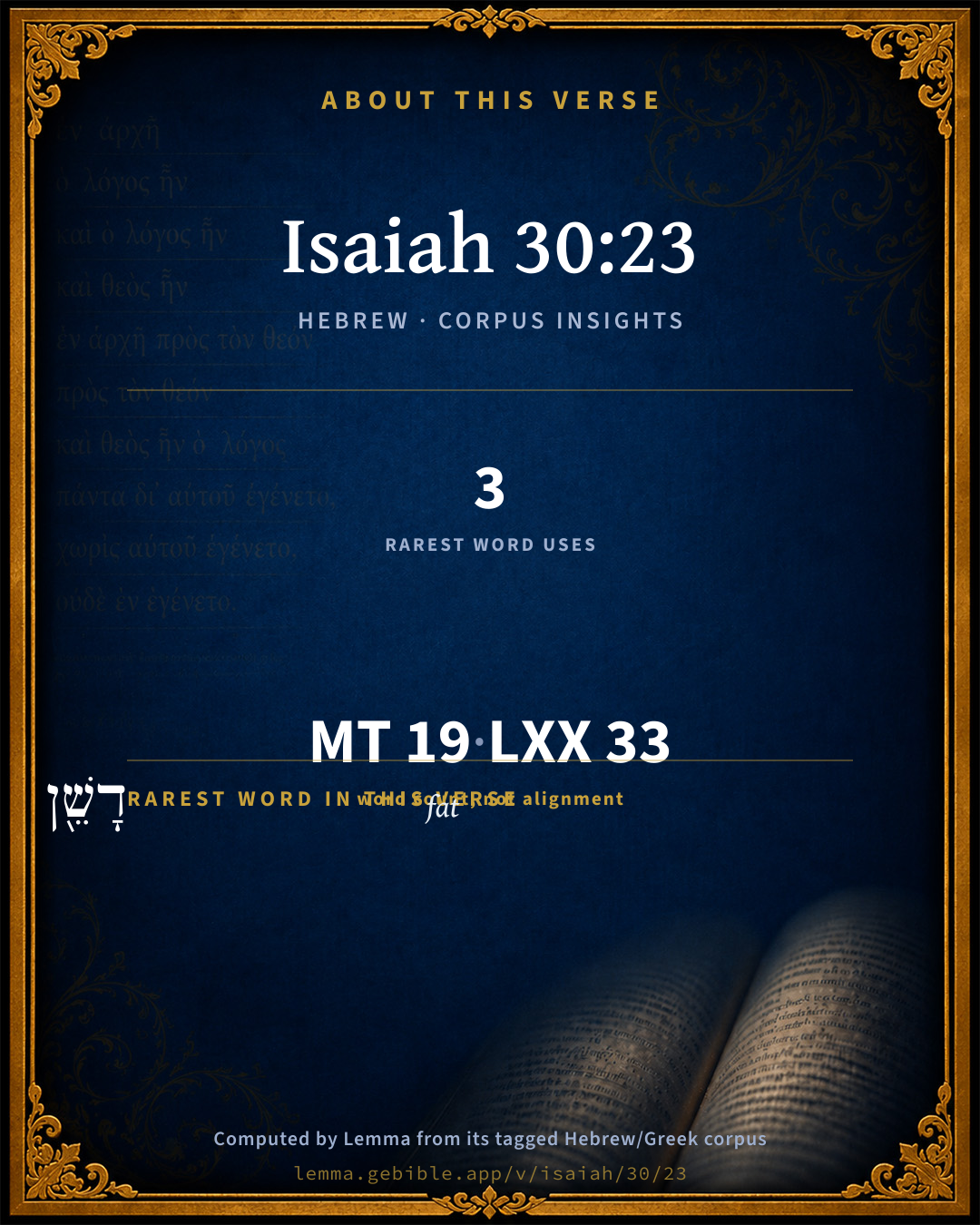
The rarest word here is דָשֵׁ֖ן fat H1879 — appearing just 3 times in the whole Hebrew Bible.

Shared distinctive vocabulary

דָשֵׁ֖ן fat H1879 occurs in 3 verses of the Hebrew Bible. Also found in:

Grammatical profile

  • 5 verbs
  • 9 nouns
  • 2 adjectives
  • 1 pronoun
  • 2 particles

Verb forms

  • וְנָתַן֩ Qal · Sequential Perfect
  • תִּזְרַ֣ע Qal · Imperfect
  • וְהָיָ֥ה Qal · Sequential Perfect
  • יִרְעֶ֥ה Qal · Imperfect
  • נִרְחָֽב Niphal · Participle Active

Repetition

A word recurs within this verse — often emphatic in Hebrew:

  • הָאֲדָמָ֗ה ground H127 ×2

Hebrew & Septuagint length

In English translation the verse runs 40 words from the Hebrew and 39 from the Septuagint (LXX English) — closely comparable.

A rough comparison of the two English renderings, which tokenize alike — not a word-level alignment.

Word counts can differ between the Hebrew and the Greek without any difference in meaning — e.g. the Hebrew direct-object marker אֵת has no separate Greek word, and Greek often adds the article ὁ.

In the original languages it is 19 Hebrew tokens and 33 Greek tokens — but the two are counted differently (Hebrew bundles its prefixes and suffixes into one token; the Greek is in lemma form), so that isn’t a like-for-like length.

Cross-references

26

Topical passages linked to Isaiah 30:23 in the Treasury of Scripture Knowledge — connected by theme and wording, ordered by reader-vote popularity; previews shown in the World English Bible.

  • Zechariah 8:11–12 But now I will not be to the remnant of this people as in the former days," says Yahweh of Hosts.
  • Psalms 65:9–13 You visit the earth, and water it. You greatly enrich it. The river of God is full of water. You provide them grain, for so you have ordained it.
  • Isaiah 32:20 Blessed are you who sow beside all waters, who send forth the feet of the ox and the donkey.
  • Genesis 41:18 and, behold, there came up out of the river seven cattle, fat-fleshed and well-favored. They fed in the reed-grass,
  • Psalms 36:8 They shall be abundantly satisfied with the abundance of your house. You will make them drink of the river of your pleasures.
  • Psalms 104:13–14 He waters the mountains from his chambers. The earth is filled with the fruit of your works.
  • Psalms 144:12–14 Then our sons will be like well-nurtured plants, Our daughters like pillars carved to adorn a palace.
  • Isaiah 58:11 and Yahweh will guide you continually, and satisfy your soul in dry places, and make strong your bones; and you shall be like a watered garden, and like a spring of water, whose waters don't fail.
  • Joel 2:21–26 Land, don't be afraid. Be glad and rejoice, for Yahweh has done great things.
  • Amos 4:7–8 "I also have withheld the rain from you, When there were yet three months to the harvest; And I caused it to rain on one city, And caused it not to rain on another city. One place was rained on, And the piece where it didn't rain withered.
  • Zechariah 10:1 Ask of Yahweh rain in the spring time, Yahweh who makes storm clouds, And he gives rain showers to everyone for the plants in the field.
  • Malachi 3:10 Bring the whole tithe into the store-house, that there may be food in my house, and test me now in this," says Yahweh of hosts, "if I will not open you the windows of heaven, and pour you out a blessing, that there shall not be room enough for.
  • 1 Timothy 4:8 For bodily exercise has some value, but godliness has value for all things, having the promise of the life which is now, and of that which is to come.
  • Genesis 41:26 The seven good cattle are seven years; and the seven good heads of grain are seven years. The dream is one.
  • Psalms 107:35–38 He turns a desert into a pool of water, And a dry land into water springs.
  • Isaiah 4:2 In that day, Yahweh's branch will be beautiful and glorious, and the fruit of the land will be the beauty and glory of the survivors of Israel.
  • Isaiah 5:6 I will lay it a wasteland. It won't be pruned nor hoed, But it will grow briers and thorns. I will also command the clouds that they rain no rain on it."
  • Isaiah 44:2–4 Thus says Yahweh who made you, and formed you from the womb, who will help you: Don't be afraid, Jacob my servant; and you, Jeshurun, whom I have chosen.
  • Isaiah 55:10–11 For as the rain comes down and the snow from the sky, and doesn't return there, but waters the earth, and makes it bring forth and bud, and gives seed to the sower and bread to the eater;
  • Jeremiah 14:22 Are there any among the vanities of the nations that can cause rain? or can the sky give showers? Aren't you he, Yahweh our God? therefore we will wait for you; for you have made all these things.
  • Ezekiel 36:25–26 I will sprinkle clean water on you, and you shall be clean: from all your filthiness, and from all your idols, will I cleanse you.
  • Hosea 2:21–23 It will happen in that day, I will respond," says Yahweh, I will respond to the heavens, And they will respond to the earth;
  • Malachi 4:2 But to you who fear my name shall the sun of righteousness arise with healing in its wings. You will go out, and leap like calves of the stall.
  • Matthew 6:33 But seek first God's Kingdom, and his righteousness; and all these things will be given to you as well.
  • Genesis 41:47 In the seven plenteous years the earth brought forth abundantly.
  • Hosea 4:16 For Israel has behaved extremely stubbornly, like a stubborn heifer. Then how will Yahweh feed them like a lamb in a meadow.

Cross-references courtesy of OpenBible.info (CC BY 4.0).

Hebrew and Greek witnesses Masoretic Hebrew ↔ Greek Septuagint

The same verse in the two great witnesses to the Old Testament, shown verse-for-verse.

These are two independent witnesses, not word-aligned to each other, and the Septuagint is shown in lemma (dictionary) form.

Hebrew Isaiah 30:23 Masoretic · Westminster Leningrad Codex

וְנָתַן֩ מְטַ֨ר זַרְעֲךָ֜ אֲשֶׁר תִּזְרַ֣ע אֶת הָאֲדָמָ֗ה וְלֶ֨חֶם֙ תְּבוּאַ֣ת הָֽאֲדָמָ֔ה וְהָיָ֥ה דָשֵׁ֖ן וְשָׁמֵ֑ן יִרְעֶ֥ה מִקְנֶ֛יךָ בַּיּ֥וֹם הַה֖וּא כַּ֥ר נִרְחָֽב

He will give the rain for your seed, with which you shall sow the ground; and bread of the increase of the ground, and it shall be fat and plenteous. In that day shall your cattle feed in large pastures;

World English Bible · Public Domain

Greek LXX Isaiah 30:23 Septuagint · lemma form

τότε εἰμί ὁ ὑετός ὁ σπέρμα ὁ γῆ σύ καί ὁ ἄρτος ὁ γένημα ὁ γῆ σύ εἰμί πλησμονή καί λιπαρός καί βόσκω σύ ὁ κτῆνος ὁ ἡμέρα ἐκεῖνος τόπος πίων καί εὐρύχωρος

Then shall there be rain to the seed of your land; and the bread of the fruit of your land shall be plenteous and rich: and your cattle shall feed in that day in a fertile and spacious place.

LXX2012 (modern English Septuagint) · Public Domain

Hebrew: Westminster Leningrad Codex (CC BY 4.0). Greek: Septuagint (public domain); English from LXX2012 (modern English Septuagint) (Public Domain). How the Septuagint differs from the Hebrew →

Targum (Aramaic paraphrase)

1

The Targum is the ancient Jewish Aramaic paraphrase of the Hebrew Scriptures — an interpretive translation, not the Hebrew text itself. Onkelos (literal) and Pseudo-Jonathan (expansive) render the Torah, and Jonathan the Prophets. Coverage is partial: where no permissively-licensed English translation exists for a verse, only the Aramaic is shown. This is verse-level text, not a word-by-word alignment to the Hebrew.

  1. Targum Jonathan Prophets (Joshua–Malachi)
    וְיִתֵּן מְטַר זַרְעֵךְ דִי תִזְרַע יַת אַרְעָא וְעִבּוּרָא וַעֲלָלָא יִסְגֵי בְאַרְעָא וִיהֵי פַרְנוּס וְטָב וְיִתְפַּרְנְסוּן צַדִיקַיָא מִיגֵיתֵיהוֹן בְּעִדָנָא הַהִיא שְׁמֵן רַכִּיכִין וּפַטִימִין:

    Then shall He give rain for thy seed, with which thou shalt sow the ground, and corn and fruit shall increase in the land, and there shall be sustenance and goodness; and at that time, the just shall be nourished from their cattle, with the marrow of the tender and the fat ones.

    Targum Jonathan — Aramaic: “Mikraot Gedolot” (public domain). English: “Sefaria Community Translation” (CC0 1.0 (public-domain dedication)); “London "Chaldee Paraphrase," 1871” (public domain). Text via Sefaria.

Commentary

Notes on Isaiah 30:23 from classic Christian and Jewish commentators (each source and its license shown beneath its notes). The classic Christian expositions comment on the surrounding passage and are grouped to its opening verse, so a note may address several verses; the Jewish commentaries on the Tanakh (Rashi and others) are per-verse, so they appear only where the commentator wrote on this verse.

Lemma curates 59 commentaries, every one of them public domain or Creative Commons licensed, each selected and text-cleaned for this edition rather than reprinted as found. About our sources →

Trapp's Complete Commentary

John Trapp

Isa 30:23 Then shall he give the rain of thy seed, that thou shalt sow the ground withal; and bread of the increase of the earth, and it shall be fat and plenteous: in that day shall thy cattle feed in large pastures.

Ver. 23. Then shall he give the rain of thy seed.] Or, For thy seed, or to thy seed. A figurative description of God’s superabundant blessings, viz., the spiritual blessing, saith Diodate. This was fulfilled in the letter, under Hezekiah and Ezra: in the figure, under Christ.

In that day shall thy cattle feed.] This branch properly belongeth to the next verse. The Bible was not distinguished into verses till of late years; and it is not done very skilfully in some places, as this for one. Versuum in Scripturis sectiones pio quidem, at tumultuario Roberti Stephani studio excogitatae, imperitissime plerunque, texture dissecant. {a}

{a} Scultet.

John Trapp, A Commentary or Exposition upon All the Books of the Old and New Testament (1647–1656) — public domain. Text from a community e-Sword module.

The Biblical Illustrator

Joseph S. Exell

Isa_30:23

Then shall He give the rain of thy seed

The effusion of the Holy Spirit

These words are, in their literal sense, a promise of a bountiful supply from God of the showers of dew and rain, by which the earth would be made abundantly fruitful.

The promise is given with reference to the casting away of their idols by the Jewish people. But the words are capable of a larger interpretation. The whole chapter looks to blessings greater than any that can be counted by the numbers of time. The plentiful effusion of the Holy Spirit of God, which is so often spoken of under the emblem of rain and dew, is hereby intended. As the rain and dew could elicit no fertility without preparation of the ground, and industrious tilling upon the part of man,--as the concurrence of both these conditions is requisite in order to secure a produce,--so is it true likewise with regard to spiritual husbandry. There must be on the part of man the use of means, as well as the bestowing of His gifts on the part of God. But it may be asked, How is Gods grace to be obtained? Have any means or channels been appointed for its supply?

1. Prayer is one appointed channel.

2. So is hearing the Word of God.

3. The sacraments. (H. J. Hastings, M. A.)

The Biblical Illustrator, edited by Joseph S. Exell (c. 1880s–1900s) — public domain. Text from a community e-Sword module.

Joseph Benson's Commentary

Isa 30:23-24. Then shall he give thee the rain of thy seed — Or rather, to, or for thy seed, namely, when thou hast newly sown it, which was called the former rain; or, such as thy seed requires, which may include both the former and the latter rain. Their sins, the cause of all God’s judgments, being removed by their sincere repentance and God’s gracious pardon, God showers down his blessings upon them. “When he gives them their teachers,” says Henry, “and they give him their hearts, so that they begin to seek the kingdom of God and his righteousness, then all other things are added unto them.” And bread of the increase of the earth — Which shall be the fruit of thy own land and labour. And it shall be fat and plenteous — Excellent for quality, which is called fat, Deu 32:14, and abundant for quantity. This promise, by the special blessing of God, was remarkably fulfilled after the defeat of Sennacherib, (Isa 37:30,) God thus repairing the losses they sustained by that devastation. The oxen likewise, &c., shall eat clean provender — There shall be such plenty of corn that the very beasts, instead of straw, shall eat corn; and that not in the ear, or with the straw, but the pure grain. Vitringa, with some other commentators, thinks it appears plainly, from the next two verses, that the prophet is to be understood in this passage as speaking, not so much literally as figuratively, and that the words contain a splendid promise of pure and abundant spiritual provision, made by the Lord for his people, in the ministry of the word, the spiritual sowing; the effusions of his Spirit, the rain of the seed; and in the due administration of his various ordinances, the large pastures in which his flock feeds.

Joseph Benson's Commentary on the Old and New Testaments (1811–1818) — public domain. Text from a community e-Sword module.

Tyndale Open Study Notes

Tyndale Open Resources

30:23-24 The people of Judah would again enjoy covenant blessings rather than curses (see Lev 26:4).

Tyndale Open Study Notes — © Tyndale Open Resources, licensed CC BY-SA 4.0. Text via the HelloAO Bible API.

Jamieson, Fausset & Brown

Robert Jamieson, A. R. Fausset & David Brown

rain of--rather, "for thy seed." Physical prosperity accompanies national piety; especially under the Old Testament. The early rain fell soon after the seed was sown in October or November; the latter rain in the spring, before the ripening of the corn. Both were needed for a good harvest.

increase--the produce.

fat--bread made of the best wheat flour (compare Gen 49:20; Deu 32:14).

Jamieson, Fausset & Brown — Commentary Critical and Explanatory on the Whole Bible (1871) — public domain (CC PDM 1.0). Text via the HelloAO Bible API.

Ellicott's Commentary for English Readers

(23) Then shall he give the rain . . .—Following in the steps of Joel (Joe_2:21-26), the prophet draws a picture of the outward plenty that should follow on the renewal of the nation’s inner life.

A Bible Commentary for English Readers, edited by Charles John Ellicott (1878–1897) — public domain. Text from a community e-Sword module.

The Cambridge Bible for Schools and Colleges

gen. ed. J. J. S. Perowne

23. the rain of thy seed] the “early rain” falling in the month of October.

bread of the increase of the earth] Perhaps: “bread-corn (Isa_28:28) the produce of the ground.” Cf. ch. Isa_37:30.

23–26. The temporal blessings of the new dispensation.

The Cambridge Bible for Schools and Colleges (gen. ed. J. J. S. Perowne; Cambridge University Press, 1878–1918) — public domain. Text from a community e-Sword module.

John Gill's Exposition

Then shall he give thee rain of thy seed, that thou shalt sow the ground withal,.... Or, "rain to thy seed" (f); that is, when the seed is sown in the earth, the Lord will give the former rain, and cause it to take root, and spring up:

and bread of the increase of the earth; the earth, being watered with rain, should give its increase of corn, of which bread should be made; so that there would be seed to the sower, and bread to the eater, as in Isa 55:10,

and it shall be fat and plenteous; or "fat and fat"; very fat and rich, exceeding good bread, and plenty of it; and after the siege of the city by Sennacherib's army was broke up, and that was destroyed, for years following there was great fruitfulness in the land, as was foretold, Isa 37:30 and this may denote the great fruitfulness of the Gospel, and the excellency of the spiritual food of it, and of the blessings of grace that come by it:

in that day shall thy cattle feed in large pastures; signifying that there should be pastures for cattle in the several parts of the country, and these large ones, where cattle should feed, and enjoy great plenty. This clause belongs to the next verse Isa 30:24, and should of right begin it. The Targum interprets it thus,

"and the righteous shall be nourished with their cattle at that time, with the fat of tender and fat things;''

as the earth would be fruitful, the cattle would be well fed; and so there would be plenty of provision for man and beast.

(f) "sementi tuae", Piscator; "semini tuo", V. L. Tigurine version.

John Gill's Exposition of the Whole Bible (1746–1763) — public domain (CC PDM 1.0). Text via the HelloAO Bible API.

Albert Barnes' Notes on the Bible

Then shall he give the rain of thy seed - That is, he shall send rain on the seed which is sown. You will be allowed to cultivate the soil without molestation, and God will give you fruitful seasons and abundant harvests. This is a poetic description of a happy or golden age, when there would be peace and prosperity (compare the notes at Isa 11:6-7).

And bread of the increase of the earth - And bread which the ground shall produce.

And it shall be fat and plenteous - It shall be rich and abundant; that is, there shall be prosperity and an ample supply for your needs.

Feed in large pastures - This is a description of security when their cattle should be permitted to roam at large, and have abundant pasturage - an image of prosperity that would be very gratifying to a people whose main conception of wealth consisted in abundance of flocks and herds.

Albert Barnes' Notes on the Bible (1834–1885) — public domain. Text from a community e-Sword/MySword module.

Matthew Poole's English Annotations

The rain of thy seed; or rather, as others render it; to or for thy seed, when thou hast newly sown thy seed, which was called the former rain; or such as thy seed requires, which may include both the former and the latter rain. Their sins, the cause of all God’s judgments which had befallen them, being removed by their sincere repentance, and God’s gracious pardon, God showereth down all his blessings upon them.

Bread of the increase of the earth; which shall be the fruit of thy own land and labour; which is a great mercy and comfort.

It shall be fat and plenteous; thy bread shall be excellent for quality, which is called fat. Deu 32:14, and abundant for quantity.

Matthew Poole's English Annotations on the Holy Bible (1683–1685) — public domain. Text from a community e-Sword/MySword module.

The Pulpit Commentary

Then shall he give the rain of thy seed, that thou shalt sow the ground withal; rather, then shall he give rain for thy seed, wherewith thou sowest the ground. God, having forgiven his people, will once more renew the blessings of his ordinary providence, giving them "rain from heaven, and fruitful seasons, filling their hearts with food and gladness". (Act_14:17) Bread of the increase of the earth; rather, bread , the produce of the ground; i.e. ordinary bread, not "bread from heaven," like the manna in the wilderness. Fat and plenteous; literally, rich and fat. Thy cattle. To complete the general prosperity, there should be plentiful pasture for the flocks and herds.

Vers. 23-26. The glories of Christ"s kingdom shown in figure.

Isaiah gives us several descriptions of Christ"s kingdom, all of them more or less allegorical. (see Isa_4:2-6 Isa_11:1-9 Isa_35:1-10 Isa_60:1-22) In the present description all is allegory. The blessings of the kingdom are

I RICH AND ABUNDANT HARVESTS, by which would seem to be signified a great conversion of the nations by the preaching of the gospel, (Mat_9:37, 38 Joh_4:35) together with the display of a great zeal to do abundant good works. (Mat_7:16-20)

II FREQUENT RAIN; i.e. an abundant shedding upon the earth of the dew of God"s blessing; a continued pouring down from him of refreshing, invigorating, healthful, life-giving influences. By these the rich harvests would be produced, the pastures made luxuriant, and God"s creatures upon the earth, both men and animals, rendered happy.

III CONDUITS EVERYWHERE, TO CONVEY THE LIFE-GIVING FLUID FAR AND WIDE. These appear to represent appointed means of grace artificially constructed channels whereby the heavenly influences are ordinarily communicated to the faithful. They flow everywhere, not only in the valleys and plains, but also upon the mountains and high hills the remotest and most inaccessible parts of the kingdom.

IV FLOODS OF LIGHT EVERYWHERE AND AT ALL TIMES; i.e. general illumination and enlightenment the spread of spiritual knowledge and true wisdom through all parts of the Church and all ranks of Christians; the disappearance of spiritual darkness, of ignorance, folly, and blinded consciences. This appears to be mentioned as the crowning glory of all, beyond which description cannot go, and with which therefore the allegorical sketch comes to an end.

The Pulpit Commentary (1880–1919), ed. H.D.M. Spence-Jones & Joseph S. Exell — public domain. Text from a community e-Sword module.

John Wesley's Explanatory Notes

Bread - Which shall be the fruit of thy own land and labour: and excellent for quality, which is called, fat, Deut. xxxii, 14, and abundant for quantity.

John Wesley, Explanatory Notes Upon the Whole Bible (1754–1765) — public domain. Text via the GEBible commentary corpus.

Keil & Delitzsch

C. F. Keil & F. Delitzsch

The promise, after setting forth this act of penitence, rises higher and higher; it would not stop at bread in time of need. "And He gives rain to thy seed, with which thou sowest the land; and bread of the produce of the land, and it is full of sap and fat: in that day your flocks will feed in roomy pastures. And the oxen and the young asses, which work the land, salted mash will they eat, which is winnowed with the winnowing shovel and winnowing fork! And upon every high mountain, and every hill that rises high, there are springs, brooks in the day of the great massacre, when the towers fall." The blessing which the prophet depicts is the reverse of the day of judgment, and stands in the foreground when the judgment is past. The expression "in that day" fixes, as it were, the evening of the day of judgment, which is followed by the depicted morning of blessing. But the great mass of the Jewish nation would be first of all murdered in war; the towers must fall, i.e., (though without any figure, and merely as an exemplifying expression) all the bulwarks of self-confidence, self-help, and pride (Isa 2:15; Mic 5:9-10). In the place of the self-induced calamities of war, there would now come the God-given rich blessings of peace; and in the place of the proud towers, there would come fruitful heights abounding with water. The field would be cultivated again, and produce luxuriant crops of nutritious corn; so that not only the labour of man, but that of the animals also, would receive a rich reward. "Rain to thy seed:" this is the early rain commencing about the middle of October. אשׁר as an accusative, זרע being construed with a double accusative, as in Deu 22:9. מקניך might be the singular, so far as the form is concerned (see Isa 1:30; Isa 5:12; Isa 22:11); but, according to Exo 17:3, it must be taken as a plural, like מוריך. The 'ălâphı̄m are the oxen used in ploughing and threshing; the ‛ăyârı̄m, the asses used for carrying manure, soil, the sheaves, or the grain. Belı̄l châmı̄ts is a mash (composed of oats, barley, and vetches, or things of that kind) made more savoury with salt and sour vegetables;

(Note: Such as Salsola kali, Salsola tragus, Salsola soda, and other plants of the family of the chenopodiaceae.)

that is to say, a farrago (from bâlal, to mix; Comm. on Job, at Job 40:19-24). According to Wetzstein, it is ripe barley (unthreshed during the harvest and threshing time, and the grain itself for the rest of the year) mixed with salt or salt vegetables. In any case, belı̄l is to be understood as referring to the grain; this is evident from the relative clause, "which has been winnowed" (= mezōreh, Ewald, 169, d), or perhaps more correctly, "which he (one) winnows" (part. kal), the participle standing for the third person, with the subject contained within itself (Ewald, 200), i.e., not what was generally given from economy, viz., barley, etc., mixed with chopped straw (tibn), but pure grain (habb mahd, as they say at the present day). Rachath is a winnowing shovel, which is still used, according to Wetzstein, in Merj. Gedur, and Hauran; mizreh, on the other hand, is the winnowing fork with six prongs. Dainty food, such as was only given occasionally to the cattle, as something especially strengthening, would then be their regular food, and would be prepared in the most careful manner. "Who cannot see," exclaims Vitringa, "that this is to be taken spiritually?" He appeals to what Paul says in Co1 9:9, viz., that God does not trouble Himself about oxen. But Paul did not mean this in the same sense as Aristotle, who maintained that the minima were entirely excluded from the providence of God. What the Scriptures say concerning cattle, they do not say for the sake of the cattle, but for the sake of men; though it does not follow that the cattle are to be understood figuratively, as representing men. And this is the case here. What the prophet paints in this idyllic style, in colours furnished by the existing customs,

(Note: Asses particularly, even those of a guest, are generally very much neglected. The host throws them a little grass, and then hangs up the fodder-sack full of chopped straw; and it is a sign of extraordinary hospitality of corn is given to the asses as well as to the horses. - Wetzstein.)

is not indeed intended to be understood in the letter; and yet it is to be taken literally. In the age of glory, even on this side of eternity, a gigantic stride will be taken forward towards the glorification of universal nature, and towards the end of all those sighs which are so discernible now, more especially among domestic animals. The prophecy is therefore to be interpreted according to Rom 8:19.; from which we may clearly see that God does trouble Himself about the sighing of an ox or ass that is overburdened with severe toil, and sometimes left to starve.

Keil & Delitzsch — Biblical Commentary on the Old Testament (1861–1891) — public domain (CC PDM 1.0). Text via the HelloAO Bible API. (Old Testament only.)

J. A. Alexander on Isaiah

Joseph Addison Alexander

“And he shall give the rain of thy seed (i.e., the rain necessary to its growth), with which thou shalt sow the ground, and bread, the produce of the ground, and it shall be fat and rich; thy cattle shall feed that day in an enlarged pasture.” This is a promise of increased prosperity after a season of privation, and was often verified.

Joseph Addison Alexander, The Prophecies of Isaiah (1846–1847; New York: Scribner, 1870–1878) — public domain. Text from a community e-Sword module.

unfoldingWord translationNotes

Door43 World Missions Community

General Information:

Isaiah continues speaking to the people of Judah.

He will give

"Yahweh will give"

bread with abundance from the ground

Here "bread" represents food in general. AT: "he will cause the ground to produce plenty of food for you to eat" (See: Synecdoche)

In that day

"At that time"

that has been winnowed with a shovel and a fork

Shovels and forks were used to throw the grain in the air so the wind would blow away the chaff, leaving only the part that could be eaten. This can be stated in active form. AT: "that you have winnowed with a shovel and a pitchfork" (See: Active or Passive)

translationWords

seed

plant

bread

cow

cow

donkey

winnow

unfoldingWord translationNotes — © Distant Shores Media and the Door43 World Missions Community, licensed CC BY-SA 4.0. Source: git.door43.org/Door43/en_tn.

Rashi

Rabbi Shlomo Yitzchaki (Rashi)

And He shall give I.e., the Holy One, blessed be He, shall give the rain for your seed.

fat (וְשָׁמֵן) an expression of fat. Therefore, its accent is below (on the last syllable) and it is voweled with a kamatz (tzeireh).

a fattened lamb until the lambs will become fat and wide.

lamb (כַּר) a lamb. Alternatively, a wide plain. Comp. (Gen. 12:10) “the plain (כִּכַּר) of the Jordan,” (below 32:15) “Carmel,” meaning a wide plain, full of grain.

Rashi on the Tanakh — English translations: “The Judaica Press complete Tanach with Rashi, translated by A. J. Rosenberg” (CC BY 4.0); “Pentateuch with Rashi's commentary by M. Rosenbaum and A.M. Silbermann, 1929-1934” (public domain); “The Metsudah Tanach series, Lakewood, N.J” (CC BY 4.0); and “The Book of Joshua, Metsudah Publications, 1997” (CC BY 4.0). Text via Sefaria.

Ibn Ezra

Rabbi Abraham ibn Ezra

Then shall he give, etc., that thou shalt sow, after the death of the King of Assyria.

ככר ═ כר (Gen. 13:10), Plain; comp. בבת עין═בת עין the apple of the eye (Lam. 12:18). In that day shall thy cattle feed, etc. Such will be the abundance of corn and fruit.

Ibn Ezra on the Tanakh — English translations: “Sefaria Community Translation” (CC0 1.0 (public-domain dedication)); “Yalkut, Sifsei Chachomim Chumash, Metsudah Publications, 2009” (CC BY 4.0); and “Commentary of Ibn Ezra on Isaiah - trans. by M. Friedlander, 1873” (public domain). Text via Sefaria.

Lesson kit

Teaching starters — assembled from the data on this page, not authored interpretation. Every prompt links to the verse data it draws on. Edit before teaching.

Isaiah, in the Prophets, opens this verse with 19 words (18 distinct Hebrew lemmas). Its most distinctive word is dâshên (“fat”). A historical commentator’s framing appears above. Read the whole chapter for the surrounding context.

Discussion questions

  1. The word dâshên carries the sense “fat.” How does it shape the verse?
  2. How does Psalms 22:29, which shares the word «fat», read alongside this verse?
  3. What does the repetition of “ground” (2× in this one verse) do in this verse?
  4. These translations render this verse differently; the difference is in the English rendering, not the original. What questions does that raise?
  5. «וְנָתַן֩» is a Qal Sequential Perfect verb. How does that grammatical form shape the action described?
  6. Compare how Trapp's Complete Commentary and The Biblical Illustrator read this verse. Where do they agree or differ?

Things to notice

Reading settings

Reading text

Shown beneath each verse's original-language words.

Old Testament
Old Testament edition

Read the OT as the Masoretic Hebrew (MT) or the Greek Septuagint (LXX).

English shown for the Greek Septuagint (in the Hebrew ↔ Greek comparison).

Comparing translations? Open the Compare panel on any verse page to stack up to four side by side.