
Jeremiah 12:14

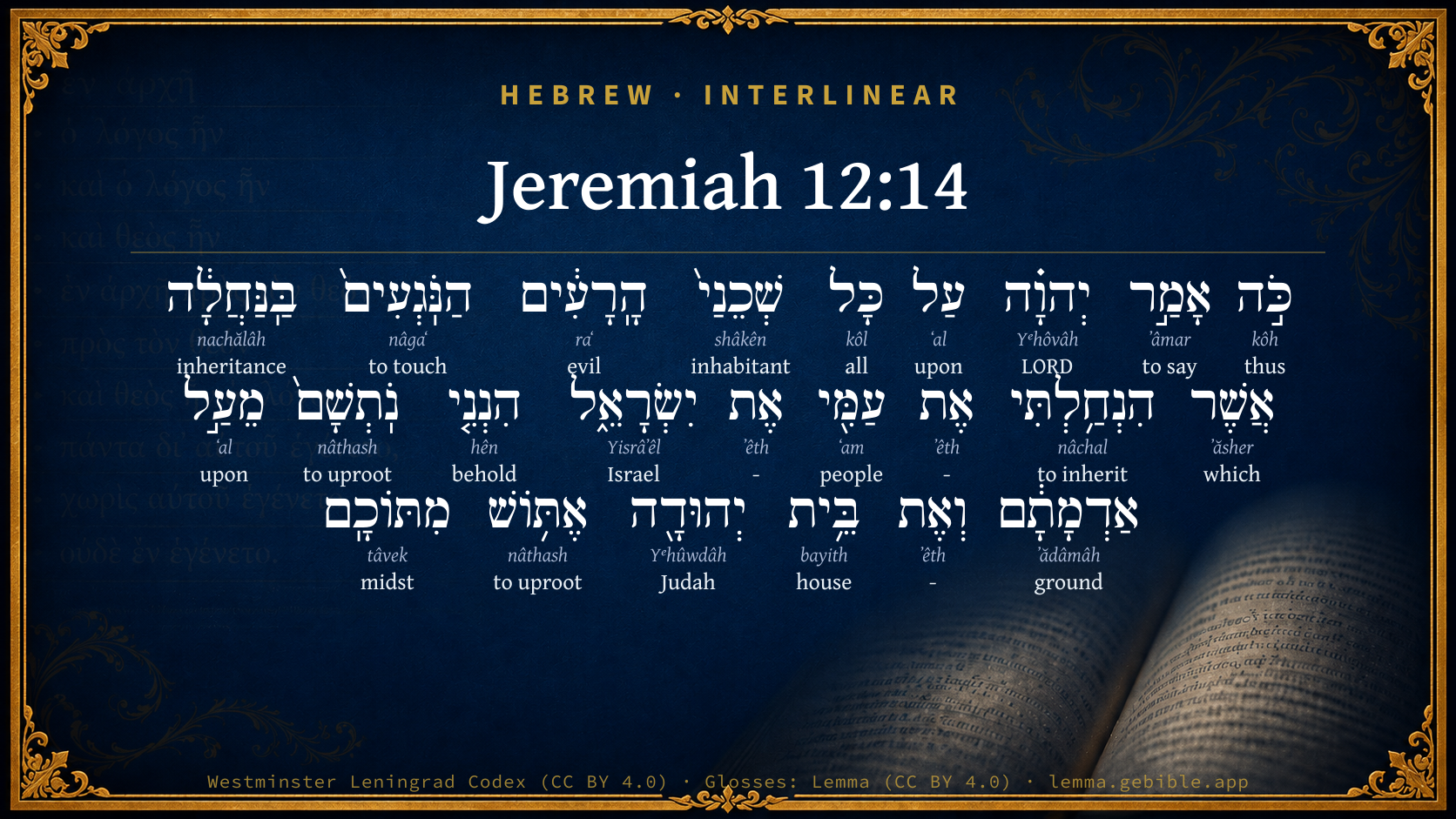
Hebrew (Westminster Leningrad Codex) Jeremiah 12:14 appears in the Hebrew Old Testament. The text above is from the Westminster Leningrad Codex. Each word links to its Strong’s number, a concise gloss, and parsing drawn from the Open Scriptures Hebrew Bible morphology. Click any word for its full Brown-Driver-Briggs (BDB) entry.
Download image
Cite this verse

Jeremiah 12:14 (World English Bible). Public Domain. Lemma interlinear Bible study tool, https://lemma.gebible.app/v/jeremiah/12/14.

Show BibTeX & RIS
BibTeX
RIS
English Translation
Thus says Yahweh against all my evil neighbors, who touch the inheritance which I have caused my people Israel to inherit: behold, I will pluck them up from off their land, and will pluck up the house of Judah from among them.
World English Bible · Public Domain
Download a study sheet

One document with this verse’s original text, its word-by-word gloss line, the meaning frame, cross-references with their text, attributed commentary, and full source and license credits — printable, and it pastes into notes with its structure intact.

This verse Autodidact and up

Study sheet (.html) Plain text (.txt)

A passage Seminary Student

Up to 50 verses in one chapter. A passage sheet keeps up to 6 commentary sources and 12 cross-references per verse, in the order this page ranks them, and says so on the sheet whenever that leaves anything out. Ask for a single verse and you get the Autodidact verse sheet above.

Everything on this page stays free to read, with no account — the sheet is a download of what is already on screen, not access to it.

Want to remove ads? Support Godless Engineer
Compare translations 3

The same verse in 3 English versions, stacked beneath the original-language interlinear above. Click any original word for its lexicon entry.

Each is an independent rendering of the whole verse — the interlinear is not word-aligned to these translations.

Highlighted words mark where these versions differ — a whole-verse word diff, not a word-by-word alignment.

  • World English Bible Public Domain
    Thus says Yahweh against all my evil neighbors, who touch the inheritance which I have caused my people Israel to inherit: behold, I will pluck them up from off their land, and will pluck up the house of Judah from among them.
  • King James Version Public Domain
    Thus saith the LORD against all mine evil neighbours, that touch the inheritance which I have caused my people Israel to inherit; Behold, I will pluck them out of their land, and pluck out the house of Judah from among them.
  • unfoldingWord Literal Text CC BY-SA 4.0
    Thus says Yahweh concerning all my evil neighbors who strike the inheritance that I that I have caused my people Israel to inherit, “Behold, I plucking them up from upon their land, and I will pluck up the house of Judah from their midst.

unfoldingWord Literal Text — © unfoldingWord, licensed CC BY-SA 4.0. Word-aligned USFM3 via Door43 (git.door43.org/unfoldingWord/en_ult).

Versions to compare (up to 4)

3 of 4 selected

Show all 18 translations

Every available English version of this verse, each an independent rendering of the whole verse.

  • World English Bible Public Domain
    Thus says Yahweh against all my evil neighbors, who touch the inheritance which I have caused my people Israel to inherit: behold, I will pluck them up from off their land, and will pluck up the house of Judah from among them.
  • Berean Standard Bible Public Domain
    This is what the LORD says: “As for all My evil neighbors who attack the inheritance that I bequeathed to My people Israel, I am about to uproot them from their land, and I will uproot the house of Judah from among them.
  • Majority Standard Bible Public Domain
    This is what the LORD says: “As for all My evil neighbors who attack the inheritance that I bequeathed to My people Israel, I am about to uproot them from their land, and I will uproot the house of Judah from among them.
  • King James Version Public Domain
    Thus saith the LORD against all mine evil neighbours, that touch the inheritance which I have caused my people Israel to inherit; Behold, I will pluck them out of their land, and pluck out the house of Judah from among them.
  • American Standard Version (1901) Public Domain
    Thus saith Jehovah against all mine evil neighbors, that touch the inheritance which I have caused my people Israel to inherit: behold, I will pluck them up from off their land, and will pluck up the house of Judah from among them.
  • Revised Version (1885) Public Domain
    Thus saith the LORD against all mine evil neighbours, that touch the inheritance which I have caused my people Israel to inherit: Behold, I will pluck them up from off their land, and will pluck up the house of Judah from among them.
  • Geneva Bible (1599) Public Domain
    Thus sayeth the Lord against all mine euill neighbours, that touch the inheritance, which I haue caused my people Israel to inherite, Beholde, I will plucke them out of their lande, and plucke out the house of Iudah from among them.
  • Douay-Rheims (1899) Public Domain
    Thus saith the Lord against all my wicked neighbors, that touch the inheritance that I have shared out to my people Israel: Behold I will pluck them out of their land, and I will pluck the house of Juda out of the midst of them.
  • Young's Literal Translation Public Domain
    Thus said Jehovah concerning all my evil neighbours, who are striking against the inheritance that I caused my people -- Israel -- to inherit: `Lo, I am plucking them from off their ground, And the house of Judah I pluck out of their midst.
  • Literal Standard Version CC BY-SA 4.0
    Thus said YHWH: “Concerning all My evil neighbors, who are striking against the inheritance that I caused My people—Israel—to inherit: Behold, I am plucking them from off their ground, || And I pluck the house of Judah out of their midst.
  • Unlocked Literal Bible CC BY-SA 4.0
    Yahweh says this against all my neighbors, the wicked ones who strike at the possession that I made my people Israel inherit, “See, I am the one who is about to uproot them from their own ground, and I will pull up the house of Judah from among them.
  • unfoldingWord Literal Text CC BY-SA 4.0
    Thus says Yahweh concerning all my evil neighbors who strike the inheritance that I that I have caused my people Israel to inherit, “Behold, I plucking them up from upon their land, and I will pluck up the house of Judah from their midst.
  • Darby Bible Public Domain
    Thus saith Jehovah against all mine evil neighbours, that touch the inheritance which I have caused my people Israel to inherit: Behold, I will pluck them up out of their land, and pluck out the house of Judah from among them.
  • World Messianic Bible Public Domain
    The LORD says, “Concerning all my evil neighbors, who touch the inheritance which I have caused my people Israel to inherit: Behold, I will pluck them up from off their land, and will pluck up the house of Judah from among them.
  • Webster's Bible Public Domain
    Thus saith the LORD against all my evil neighbors, that touch the inheritance which I have caused my people Israel to inherit; Behold, I will pluck them out of their land, and pluck out the house of Judah from among them.
  • Free Bible Version CC BY-SA 4.0
    This is what the Lord says: When it comes to these evil nearby nations who attack the country that I gave to my people Israel, I'm going to uproot them from their land. I'm also going to uproot the people of Judah from among them.
  • Bible in Basic English Public Domain
    This is what the Lord has said against all my evil neighbours, who put their hands on the heritage which I gave my people Israel: See, I will have them uprooted from their land, uprooting the people of Judah from among them.
  • JPS Tanakh (1917) Public Domain
    Thus saith the LORD: As for all Mine evil neighbours, that touch the inheritance which I have caused My people Israel to inherit, behold, I will pluck them up from off their land, and will pluck up the house of Judah from among them.

Literal Standard Version (2020), Covenant Press — licensed CC BY-SA 4.0. Text via the HelloAO Bible API (eBible.org). Unlocked Literal Bible (unfoldingWord) — licensed CC BY-SA 4.0. Text via the HelloAO Bible API (eBible.org). unfoldingWord Literal Text — © unfoldingWord, licensed CC BY-SA 4.0. Word-aligned USFM3 via Door43 (git.door43.org/unfoldingWord/en_ult). Free Bible Version, Dr. Jonathan Gallagher — licensed CC BY-SA 4.0. Text via the HelloAO Bible API (eBible.org).

Word by word

More ways to search: Search by grammar → Find every occurrence → Compare this word →

Practice this passage: Drill this verse → Learn its vocabulary →

שְׁכֵנַי֙
shâkên
H7934
“inhabitant · my”
Adjective, Adjective, Masculine, Plural, Construct + Suffix, Personal, 1st Person, Common, Singular
Part of Speech
Adjective
Type
Adjective
Gender
Masculine
Number
Plural
State
Construct
Full BDB Definition

Origin: from H7931

TWOT: 2387b

inhabitant, neighbour - inhabitant - neighbour
  1. כֹּ֣ה kôh H3541 “thus” Adverb
  2. אָמַ֣ר ʼâmar H559 “to say” Verb, Qal, Perfect, 3rd Person, Masculine, Singular
  3. יְהוָ֗ה Yᵉhôvâh H3068 “LORD” Noun, Proper
  4. עַל ʻal H5921 “upon” Preposition
  5. כָּל kôl H3605 “all of” Noun, Common, Masculine, Singular, Construct
  6. הָֽרָעִ֔ים raʻ H7451 “the · evil” Particle, Definite Article + Adjective, Adjective, Masculine, Plural, Absolute
  7. הַנֹּֽגְעִים֙ nâgaʻ H5060 “the · touching” Particle, Definite Article + Verb, Qal, Participle Active, Masculine, Plural, Absolute
  8. בַּֽנַּחֲלָ֔ה nachălâh H5159 “in/at the · inheritance” Preposition, Determined + Noun, Common, Feminine, Singular, Absolute
  9. אֲשֶׁר ʼăsher H834 “which” Particle, Relative
  10. הִנְחַ֥לְתִּי nâchal H5157 “to inherit” Verb, Hiphil, Perfect, 1st Person, Common, Singular
  11. אֶת ʼêth H853 “-” Particle, Direct Object
  12. עַמִּ֖י ʻam H5971 “people · my” Noun, Common, Masculine, Singular, Construct + Suffix, Personal, 1st Person, Common, Singular
  13. אֶת ʼêth H853 “-” Particle, Direct Object
  14. יִשְׂרָאֵ֑ל Yisrâʼêl H3478 “Israel” Noun, Proper
  15. הִנְנִ֤י hên H2005 “behold · me” Particle, Demonstrative + Suffix, Personal, 1st Person, Common, Singular
  16. נֹֽתְשָׁם֙ nâthash H5428 “uprooting · them” Verb, Qal, Participle Active, Masculine, Singular, Construct + Suffix, Personal, 3rd Person, Masculine, Plural
  17. מֵעַ֣ל ʻal H5921 “from · upon” Preposition + Preposition
  18. אַדְמָתָ֔ם ʼădâmâh H127 “ground · their” Noun, Common, Feminine, Singular, Construct + Suffix, Personal, 3rd Person, Masculine, Plural
  19. וְאֶת ʼêth H853 “and · -” Conjunction + Particle, Direct Object
  20. בֵּ֥ית bayith H1004 “house of” Noun, Common, Masculine, Singular, Construct
  21. יְהוּדָ֖ה Yᵉhûwdâh H3063 “Judah” Noun, Proper
  22. אֶתּ֥וֹשׁ nâthash H5428 “to uproot” Verb, Qal, Imperfect, 1st Person, Common, Singular
  23. מִתּוֹכָֽם tâvek H8432 “from · midst · their” Preposition + Noun, Common, Masculine, Singular, Construct + Suffix, Personal, 3rd Person, Masculine, Plural

About this verse

These counts appear in no published source. They are computed here, from the morphology-tagged text and Lemma’s own curated glosses. What Lemma adds →

24
words
20
distinct lemmas
Prophets
section

Notable vocabulary

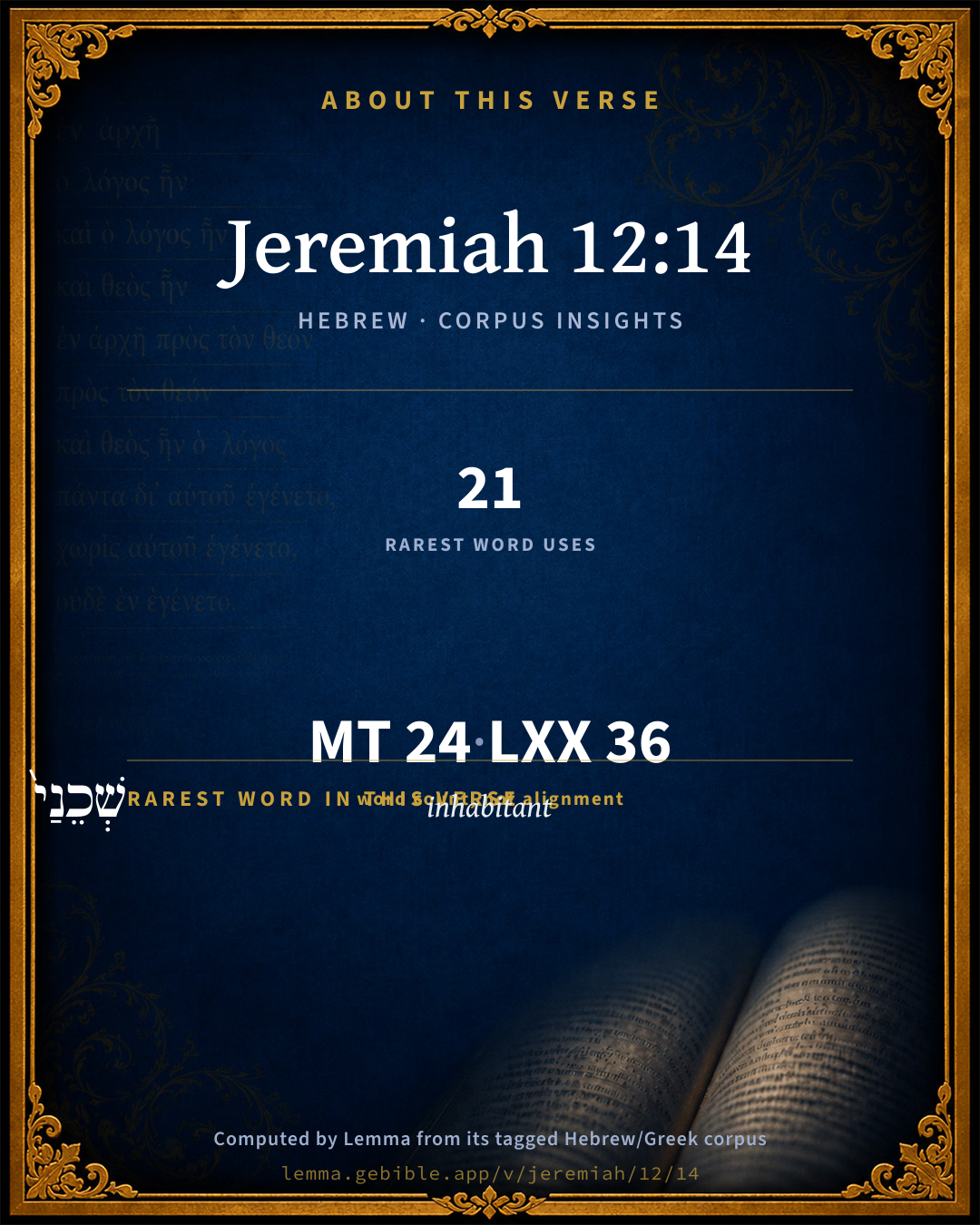
The rarest word here is שְׁכֵנַי֙ inhabitant H7934 — appearing just 21 times in the whole Hebrew Bible.

Shared distinctive vocabulary

שְׁכֵנַי֙ inhabitant H7934 occurs in 20 verses of the Hebrew Bible. Also found in:

Grammatical profile

  • 5 verbs
  • 9 nouns
  • 2 adjectives
  • 2 prepositions
  • 1 adverb
  • 5 particles

Verb forms

  • אָמַ֣ר Qal · Perfect
  • הַנֹּֽגְעִים֙ Qal · Participle Active
  • הִנְחַ֥לְתִּי Hiphil · Perfect
  • נֹֽתְשָׁם֙ Qal · Participle Active
  • אֶתּ֥וֹשׁ Qal · Imperfect

Repetition

Words recur within this verse — often emphatic in Hebrew:

  • עַל upon H5921 ×2
  • נֹֽתְשָׁם֙ to uproot H5428 ×2

Hebrew & Septuagint length

In the original languages it is 24 Hebrew tokens and 36 Greek tokens — but the two are counted differently (Hebrew bundles its prefixes and suffixes into one token; the Greek is in lemma form), so that isn’t a like-for-like length.

Cross-references

28

Topical passages linked to Jeremiah 12:14 in the Treasury of Scripture Knowledge — connected by theme and wording, ordered by reader-vote popularity; previews shown in the World English Bible.

  • Jeremiah 3:18 In those days the house of Judah shall walk with the house of Israel, and they shall come together out of the land of the north to the land that I gave for an inheritance to your fathers.
  • Zechariah 2:8 For thus says Yahweh of hosts: 'For honor he has sent me to the nations which plundered you; for he who touches you touches the apple of his eye.
  • Jeremiah 49:7 Of Edom. Thus says Yahweh of Hosts: Is wisdom no more in Teman? is counsel perished from the prudent? is their wisdom vanished?
  • Zephaniah 2:8–10 I have heard the reproach of Moab, and the insults of the children of Ammon, with which they have reproached my people, and magnified themselves against their border.
  • Zechariah 10:6–12 "I will strengthen the house of Judah, And I will save the house of Joseph, And I will bring them back; For I have mercy on them; And they will be as though I had not cast them off: For I am Yahweh their God, and I will hear them.
  • Deuteronomy 30:3 that then Yahweh your God will turn your captivity, and have compassion on you, and will return and gather you from all the peoples, where Yahweh your God has scattered you.
  • Psalms 106:47 Save us, Yahweh, our God, Gather us from among the nations, To give thanks to your holy name, To triumph in your praise!
  • Isaiah 11:11–16 It shall happen in that day, that the Lord will set his hand again the second time to recover the remnant of his people, who shall remain, from Assyria, and from Egypt, and from Pathros, and from Cush, and from Elam, and from Shinar, and from Hamath, and from the islands of the sea.
  • Jeremiah 2:3 Israel [was] holiness to Yahweh, the first fruits of his increase: all who devour him shall be held guilty; evil shall come on them, says Yahweh.
  • Ezekiel 25:1–17 The word of Yahweh came to me, saying,
  • Zechariah 1:15 I am very angry with the nations that are at ease; for I was but a little displeased, but they added to the calamity."
  • Psalms 105:15 "Don't touch my anointed ones! Do my prophets no harm!"
  • Jeremiah 32:37 Behold, I will gather them out of all the countries, where I have driven them in my anger, and in my wrath, and in great indignation; and I will bring them again to this place, and I will cause them to dwell safely:
  • Jeremiah 48:1–49:1 Of Moab. Thus says Yahweh of Hosts, the God of Israel: Woe to Nebo! for it is laid waste; Kiriathaim is disappointed, it is taken; Misgab is put to shame and broken down.
  • Jeremiah 50:9–17 For, behold, I will stir up and cause to come up against Babylon a company of great nations from the north country; and they shall set themselves in array against her; from there she shall be taken: their arrows shall be as of an expert mighty man; none shall return in vain.
  • Jeremiah 51:33–35 For thus says Yahweh of hosts, the God of Israel: The daughter of Babylon is like a threshing floor at the time when it is trodden; yet a little while, and the time of harvest shall come for her.
  • Ezekiel 28:25 Thus says the Lord Yahweh: When I shall have gathered the house of Israel from the peoples among whom they are scattered, and shall be sanctified in them in the sight of the nations, then shall they dwell in their own land which I gave to my servant Jacob.
  • Ezekiel 34:12–13 As a shepherd seeks out his flock in the day that he is among his sheep that are scattered abroad, so will I seek out my sheep; and I will deliver them out of all places where they have been scattered in the cloudy and dark day.
  • Ezekiel 35:1–15 Moreover the word of Yahweh came to me, saying,
  • Ezekiel 36:24 For I will take you from among the nations, and gather you out of all the countries, and will bring you into your own land.
  • Ezekiel 37:21 Say to them, Thus says the Lord Yahweh: Behold, I will take the children of Israel from among the nations, where they are gone, and will gather them on every side, and bring them into their own land:
  • Ezekiel 39:27–28 when I have brought them back from the peoples, and gathered them out of their enemies' lands, and am sanctified in them in the sight of many nations.
  • Hosea 1:11 The children of Judah and the children of Israel will be gathered together, and they will appoint themselves one head, and will go up from the land; for great will be the day of Jezreel.
  • Amos 1:2–15 He said: "Yahweh will roar from Zion, And utter his voice from Jerusalem; And the pastures of the shepherds will mourn, And the top of Carmel will wither."
  • Amos 9:14–15 I will bring back the captivity of my people Israel, And they will rebuild the ruined cities, and inhabit them; and they will plant vineyards, and drink wine from them. They shall also make gardens, And eat the fruit of them.
  • Obadiah 1:10–16 For the violence done to your brother Jacob, shame will cover you, and you will be cut off forever.
  • Zephaniah 3:19–20 Behold, at that time I will deal with all those who afflict you, and I will save those who are lame, and gather those who were driven away. I will give them praise and honor, whose shame has been in all the earth.
  • Zechariah 12:2–4 "Behold, I will make Jerusalem a cup of reeling to all the surrounding peoples, and on Judah also will it be in the siege against Jerusalem.

Cross-references courtesy of OpenBible.info (CC BY 4.0).

Hebrew and Greek witnesses Masoretic Hebrew ↔ Greek Septuagint

The same verse in the two great witnesses to the Old Testament, shown verse-for-verse.

These are two independent witnesses, not word-aligned to each other, and the Septuagint is shown in lemma (dictionary) form.

Hebrew Jeremiah 12:14 Masoretic · Westminster Leningrad Codex

כֹּ֣ה אָמַ֣ר יְהוָ֗ה עַל כָּל שְׁכֵנַי֙ הָֽרָעִ֔ים הַנֹּֽגְעִים֙ בַּֽנַּחֲלָ֔ה אֲשֶׁר הִנְחַ֥לְתִּי אֶת עַמִּ֖י אֶת יִשְׂרָאֵ֑ל הִנְנִ֤י נֹֽתְשָׁם֙ מֵעַ֣ל אַדְמָתָ֔ם וְאֶת בֵּ֥ית יְהוּדָ֖ה אֶתּ֥וֹשׁ מִתּוֹכָֽם

Thus says Yahweh against all my evil neighbors, who touch the inheritance which I have caused my people Israel to inherit: behold, I will pluck them up from off their land, and will pluck up the house of Judah from among them.

World English Bible · Public Domain

Greek LXX Structure differs

In the Septuagint, Jeremiah is about an eighth shorter than the Hebrew and arranges its material differently — the Oracles Against the Nations (Hebrew chapters 46–51) appear in the middle of the Greek book, after 25:13. Because the chapter and verse boundaries do not line up, a verse-for-verse comparison with the Hebrew is not shown.

A verse-for-verse comparison isn’t shown here because the chapters and verses don’t line up. Switch to the LXX edition with the MT / LXX toggle above to read the Greek directly.

Hebrew: Westminster Leningrad Codex (CC BY 4.0). Greek: Septuagint (public domain); English from a public-domain English Septuagint. How the Septuagint differs from the Hebrew →

Targum (Aramaic paraphrase)

1

The Targum is the ancient Jewish Aramaic paraphrase of the Hebrew Scriptures — an interpretive translation, not the Hebrew text itself. Onkelos (literal) and Pseudo-Jonathan (expansive) render the Torah, and Jonathan the Prophets. Coverage is partial: where no permissively-licensed English translation exists for a verse, only the Aramaic is shown. This is verse-level text, not a word-by-word alignment to the Hebrew.

  1. Targum Jonathan Prophets (Joshua–Malachi)
    כִּדְנַן אֲמַר יְיָ עַל כָּל מָגִירַיָא בִישַׁיָא דִמְנַזְקִין בְּאַחְסַנְתָּא דְאַחְסְנֵית יַת עַמִי יַת יִשְׂרָאֵל הָא אֲנָא מְטַלְטֵיל לְהוֹן מֵעַל אַרְעֲהוֹן וְיַת דְבֵית יְהוּדָה אֱטַלְטֵיל מִבֵּינֵיהוֹן:

    (no public-domain English translation for this verse)

    Targum Jonathan — Aramaic: “Mikraot Gedolot” (public domain). English: “Sefaria Community Translation” (CC0 1.0 (public-domain dedication)); “London "Chaldee Paraphrase," 1871” (public domain). Text via Sefaria.

Commentary

Notes on Jeremiah 12:14 from classic Christian and Jewish commentators (each source and its license shown beneath its notes). The classic Christian expositions comment on the surrounding passage and are grouped to its opening verse, so a note may address several verses; the Jewish commentaries on the Tanakh (Rashi and others) are per-verse, so they appear only where the commentator wrote on this verse.

Lemma curates 59 commentaries, every one of them public domain or Creative Commons licensed, each selected and text-cleaned for this edition rather than reprinted as found. About our sources →

Matthew Henry's Commentary

The prophets sometimes, in God's name, delivered messages both of judgment and mercy to the nations that bordered on the land of Israel: but here is a message to all those in general who had in their turns been one way or other injurious to God's people, had either oppressed them or triumphed in their being oppressed. Observe,

I. What the quarrel was that God had with them. They were his evil neighbours (Jer 12:14), evil neighbours to his church, and what they did against it he took as done against himself, and therefore called them his evil neighbours, that should have been neighbourly to Israel, but were quite otherwise. Note, It is often the lot of good people to live among bad neighbours, that are unkind and provoking to them; and it is bad indeed when they are all so. These evil neighbours were the Moabites, Ammonites Syrians, Edomites, Egyptians, that had been evil neighbours to Israel in helping to debauch them and draw them from God (therefore God calls them his evil neighbours), and now they helped to make them desolate, and joined with the Chaldeans against them. It is just with God to make those the instruments of trouble to us whom we have made instruments of sin. That which God lays to their charge is: They have meddled with the inheritance which I have caused my people Israel to inherit; they unjustly seized that which was none of their own: nay, they sacrilegiously turned that to their own use which was given to God's peculiar people. He that said, Touch not my anointed, said also, "Touch not their inheritance; it is at your peril if you do." Not only the persons but the estates of God's people are under his protection.

II. What course he would take with them. 1. He would break the power they had got over his people, and force them to make restitution: I will pluck out the house of Judah from among them. This would be a great favour to God's people, who had either been taken captive by them, or, when they fled to them for shelter, had been detained and made prisoners; but it would be a great mortification to their enemies, who would be like a lion disappointed of his prey. The house of Judah either cannot or will not make any bold struggles towards their own liberty; but God will with a gracious violence pluck them out, will by his Spirit compel them to come out and by his power compel their task-masters to let them go, as he plucked Israel out of Egypt. 2. He would bring upon them the same calamities that they had been instrumental to bring upon his people: I will pluck them out of their land. Judgment began at the house of God, but it did not end there. Nebuchadnezzar, when he had wasted the land of Israel, turned his hand against their evil neighbours and was a scourge to them.

III. What mercy God had in store for such of them as would join themselves to him and become his people, Jer 12:15, Jer 12:16. They had drawn in God's backsliding people to join with them in the service of idols. If now they would be drawn by a returning people to join with them in the service of the true and living God, they should not only have their enmity to the people of God forgiven them, but the distance which they had been kept at before should be removed, and they should be received to stand upon the same level with the Israel of God. This had its accomplishment in part when, after the return out of captivity, many of the people of the lands that had been evil neighbours to Israel became Jews; and it was to have its accomplishment in the conversion of the Gentiles to the faith of Christ. Let not Israel, though injured by them, be implacable towards them, for God is not: After that I have plucked them out, in justice for their sins and in jealousy for the honour of Israel, I will return, will change my way, and have compassion on them. Though, being heathen, they can lay no claim to the mercies of the covenant, yet they shall have benefit by the compassions of the Creator, who will notwithstanding look upon them as the work of his hands. Note, God's controversies with his creatures, though they cannot be disputed, may be accommodated. Those who (as these) have been not only strangers, but enemies in their minds by wicked works, may be reconciled, Col 1:21. Observe here,

1. What were the terms on which God would show favour to them. It is always provided that they will diligently learn the ways of my people, that is, in general, the ways that they walk in when they conduct themselves as my people (not the crooked ways into which they have turned aside), the ways which my people are directed to take. Note, (1.) There are good ways that are peculiarly the ways of God's people, which however they may differ in the choice of their paths, they are all agreed to walk in. The ways of holiness and heavenly-mindedness, of love and peaceableness, the ways of prayer and sabbath-sanctification, and diligent attendance on instituted ordinances - these, and the like, are the ways of God's people. (2.) Those that would have their lot with God's people, and their last end like theirs, must learn their ways and walk in them, must observe the rule they walk by and conform to that rule they walk by and conform to that rule and go forth by those footsteps. By an intimate conversation with God's people they must learn to do as they do. (3.) It is impossible to learn the ways of God's people as they should be learnt, without a great deal of care and pains. We must diligently observe these ways and diligently obliges ourselves to walk in them, must look diligently (Heb 12:15), and work diligently, Luk 13:24. In particular, they must learn to give honour to God's name by making all their solemn appeals to him. They must learn to say, The Lord liveth (to own him, to adore him, and to abide by his judgment), as they taught my people to swear by Baal. It was bad enough that they did themselves swear by Baal, worse that they taught God's own people, who had been better taught; and yet, if they will at length reform, they shall be accepted. observe, [1.] We must not despair of the conversion of the worst; no, not of those who have been instrumental to pervert and debauch others; even they may be brought to repentance, and, if they be, shall find mercy. [2.] Those whom we have been industrious to draw to that which is evil, when God opens their eyes and ours, we should be as industrious to follow in that which is good. It will be a holy revenge upon ourselves to become pupils to those in the way of duty to whom we have been tutors in the was of sin. [3.] The conversion of the deceived may prove a happy occasion of the conversion even of the deceivers. Thus those who fall together into the ditch are sometimes plucked together out of it.

2. What should be the tokens and fruits of this favour when they return to God and God to them. (1.) They shall be restored to and re-established in their own land (Jer 12:15): I will bring them again every man to his heritage. The same hand that plucked them up shall plant them again. (2.) They shall become entitled to the spiritual privileges of God's Israel: "If they will be towardly, and learn the ways of my people, will conform to the rules and confine themselves to the restraints of my family, then shall they be built in the midst of my people. They shall not only be brought among them, to have a name and a place in the house of the Lord, where there was a court for the Gentiles, but they shall be built among them; they shall unite with them; the former enmities shall be slain; they shall be both edified and settled among them." See Isa 56:5-7. Note, Those that diligently learn the ways of God's people shall enjoy the privileges and comforts of his people.

IV. What should become of those that were still wedded to their own evil ways, yea, though many of those about them turned to the Lord (Jer 12:17): If there will not obey, if any of them continue to stand it out, I will utterly pluck up and destroy that nation, that family, that particular person, saith the Lord. Those that will not be ruled by the grace of God shall be ruined by the justice of God. And, if disobedient nations shall be destroyed, much more disobedient churches from whom better things are expected.

Matthew Henry's Commentary on the Whole Bible (1708–1710) — public domain (CC PDM 1.0). Text via the HelloAO Bible API.

Trapp's Complete Commentary

John Trapp

Jer 12:14 Thus saith the LORD against all mine evil neighbours, that touch the inheritance which I have caused my people Israel to inherit; Behold, I will pluck them out of their land, and pluck out the house of Judah from among them.

Ver. 14. Thus saith the Lord against all mine evil neighbours.] These were the Syrians, Moabites, Ammonites, Edomites, &c. God also hath his evil neighbours, and this may be a comfort to us in like case.

Behold, I will pluck them out, &c., and pluck out the house of Judah.] This was a different plucking.

John Trapp, A Commentary or Exposition upon All the Books of the Old and New Testament (1647–1656) — public domain. Text from a community e-Sword module.

Joseph Benson's Commentary

Jer 12:14-15. Thus saith the Lord, against, or concerning, all mine evil neighbours — By these are meant the Moabites, Ammonites, Idumeans, and Philistines; against whom Jeremiah prophesies, chap. 47., 48., 49.; and Ezekiel, chap. 25. These are called evil neighbours, because of the spite and ill-will which they showed toward the Jews on all occasions: that touch the inheritance, &c. — Who lie near to, and border upon, Judea: Behold, I will pluck them out, &c. — These people were accordingly wasted and spoiled, and part of them carried into captivity by the Babylonians. And pluck out the house of Judah, &c. — Many of the Jews were carried captive, or went for safety into those neighbouring countries, before the general Babylonish captivity, Jer 15:4; Jer 11:11. Of these Jews some were carried captive, together with the natives of those countries, by the Chaldeans afterward: others went down into Egypt. See chap. 43., 44. Here is foretold the restoration of the Jews from their several dispersions. Compare Jer 32:37; Eze 28:25-26. This promise was partly fulfilled in the time succeeding the Babylonish captivity, Psa 147:2; but will be more fully accomplished at the final restoration of that nation, when the fulness of the Gentiles will likewise be brought into the church, which is foretold in the words of the next verse. And after that I have plucked them out — In justice for the punishment of their sins, and in jealousy for the honour of Israel; I will return — Will change my way, and have compassion on them — Though, as being heathen, they can lay no claim to the mercies of the covenant made with Abraham and his seed, yet they shall have benefit by the compassions of the Creator, who will look upon them as the work of his hands. And will bring them again every man to his heritage — Thus, after Jeremiah had threatened severe judgments upon several countries, he concludes with a general promise of their return from their captivity in the latter days; which promise probably relates chiefly to their conversion under the gospel.

Joseph Benson's Commentary on the Old and New Testaments (1811–1818) — public domain. Text from a community e-Sword module.

Whedon's Commentary on the Bible

Daniel D. Whedon

PARDON AND RESTORATION, Jer_12:14-17.

14. Mine evil neighbours — Such as the Philistines, Syrians, Edomites, Ammonites, Moabites, etc.; all who at any time had become the spoilers of God’s heritage.

Daniel D. Whedon (gen. ed.), Commentary on the Old and New Testaments (1874–1909) — public domain. Text from a community e-Sword module.

Tyndale Open Study Notes

Tyndale Open Resources

12:14-17 The Lord explained an important aspect of Jeremiah’s commission (see 1:10).

12:14 No evil nations would receive protection from God’s punishment, not even those nations that God used to punish Judah. He would uproot them. • The Lord would also uproot Judah, but this is a positive reference to deliverance from exile.

Tyndale Open Study Notes — © Tyndale Open Resources, licensed CC BY-SA 4.0. Text via the HelloAO Bible API.

Geneva Bible (1599)

Geneva Bible translators

Meaning, the wicked enemies of his Church, which blasphemed his Name, and whom he would punish after that he hath delivered his people.

Geneva Bible (1599) marginal notes — public domain. Text via Bolls.life.

Jamieson, Fausset & Brown

Robert Jamieson, A. R. Fausset & David Brown

Prophecy as to the surrounding nations, the Syrians, Ammonites, &c., who helped forward Judah's calamity: they shall share her fall; and, on their conversion, they shall share with her in the future restoration. This is a brief anticipation of the predictions in the forty-seventh, forty-eighth, and forty-ninth chapters.

touch-- (Zac 2:8).

pluck them out . . . pluck out . . . Judah--(Compare end of Jer 12:16). During the thirteen years that the Babylonians besieged Tyre, Nebuchadnezzar, after subduing Cœlo-Syria, brought Ammon, Moab, &c., and finally Egypt, into subjection [JOSEPHUS, Antiquities, 10:9.7]. On the restoration of these nations, they were to exchange places with the Jews. The latter were now in the midst of them, but on their restoration they were to be "in the midst of the Jews," that is, as proselytes to the true God (compare Mic 5:7; Zac 14:16). "Pluck them," namely, the Gentile nations: in a bad sense. "Pluck Judah": in a good sense; used to express the force which was needed to snatch Judah from the tyranny of those nations by whom they had been made captives, or to whom they had fled; otherwise they never would have let Judah go. Previously he had been forbidden to pray for the mass of the Jewish people. But here he speaks consolation to the elect remnant among them. Whatever the Jews might be, God keeps His covenant.

Jamieson, Fausset & Brown — Commentary Critical and Explanatory on the Whole Bible (1871) — public domain (CC PDM 1.0). Text via the HelloAO Bible API.

Adam Clarke's Commentary

Verse 14. Against all mine evil neighbours] All the neighbouring nations who have united in desolating Judea shall be desolated in their turn: they also are wicked, and they shall be punished. If I make them executors of my justice, it is to them no proof of my approbation. God often uses one wicked nation to scourge another; and afterwards scourges the scourger by some other scourge. In some places a felon who was condemned to be hanged is made the common hangman for the county; he himself being still under the sentence of death, -

Till soon some trusty brother of the trade

Shall do for him what he has done for others.

Adam Clarke's Commentary on the Bible (1810–1826) — public domain. Text from a community e-Sword/MySword module.

John Calvin's Commentaries

The Prophet now begins to mitigate what might have beyond measure exasperated the minds of the people; and this he did, not so much for the sake of the people in general, as for the sake of the elect, a few of whom still remained. We have indeed seen that it was all over with the body of the people; for it had been said to Jeremiah,

“Pray not for them, for I will not hear them,” (Jeremiah 11:14)

The Prophet then knew the immutable purpose of God as to the mass of the people. Nor did he intend here to soften what might have appeared grievous in what he had taught. But as we have said elsewhere, and indeed often repeated, the prophets used reproofs only as to the whole community, and then spoke as it were apart to the elect; for there ever was a remnant among that people, inasmuch as God never suffered his covenant to be made void. As then the Church was still existing, the Prophet had regard to the hidden seed, and therefore blended consolation with those grievous and dreadful predictions which we have noticed.

This is the reason why he now says that God would be the avenger of that cruelty which their neighbors had exercised towards the Jews. For this temptation might have greatly disturbed the minds of the godly, — “What means this, that God rages so violently against us, while he spares the heathens? Have the Moabites, or the Ammonites, or the Idumeans, deserved nothing? Why then does God bear with them, while he deals so severely with us?” The Prophet then meets this objection, and says, that punishment was nigh those nations, and such as they deserved, and that for the sake of the chosen people. If indeed he had only said that the Moabites and the Idumeans, and the rest, would be summoned before God’s tribunal, that they in their turn might be punished, it would have given no relief to the miserable Jews; for it would have been a very empty consolation to have only so many associates in their misery: but the Prophet also adds, that God would be thus propitious to his elect; for it was a sign of his paternal favor, when he inflicted punishment on all those neighhors by whom they had been so cruelly treated.

He begins by saying, Thus saith Jehovah; and he says, against all my evil neighbors, etc. He speaks here in the person of God, who calls the Moabites and the Idumeans, as well as others, his neighbors, because he had chosen the land of Canaan as an habitation for himself; for it was, as it appears often from the prophets, an evidence above all other things of God’s favor, that he dwelt among that people. He was not indeed confined either to the Temple or to the land of Canaan; but he had taken the people under his safeguard and protection, as though he had his hands extended for the purpose of defending them all. We now see why he calls the nations near to the Jews his evil neighbors: for though the Jews deserved extreme evils, yet that promise remained valid,

“He who touches you, touches the apple of my eye.” (Zechariah 2:8)

Then he adds, who touch my heritage Here he speaks not ironically as before, but regards simply his own election, as though he had said, — “Whatever the Jews may be, I will yet be consistent with myself, and my covenant shall not fall to the ground; for my faithfulness shall surpass their perfidy.” We must yet bear in mind what I have already stated, — that the whole of this is to be confined to the elect, who were few in number and were hid like twenty or a hundred grains in a large heap of chaff As then the Prophet addresses here especially the elect of God, it is no wonder that he calls them God’s heritage, not for the sake of upbraiding them., as he had done before, but because God really loved them and would have them to be saved. There is another thing to be noticed, — that God had in view the Idumeans as well as the Ammonites, Sidonians, and Tyrians, who had unjustly oppressed his people. The Ammonites and the Moabites were by kindred connected, for they both derived their origin from Lot, the nephew of Abraham. As to the Idumeans, they were the descendants of Esau, all of the same family; and they knew that the Jews had been chosen by God. Hence God here shews that he himself was injured, when such wrongs were done to his people.

We hence see why God calls here Israel his heritage; which, he says, by heritage I have possessed Here he takes away from the neighboring nations every handle for evasion; as though he had said, — “Though the Jews have sinned, yet these are not their judges; nor have they any right to punish them for their unfaithfulness: it has been my will to choose them for mine heritage.” We thus see that these words are emphatical, their import being, that God would punish the wrongs done to his people, because his own majesty was insulted, inasmuch as no regard was shewn to his adoption: nor had the heathells any right to inquire whether the Jews were worthy or not; for it had pleased God to take them under his protection.

He then adds, Behold, I will pluck them up from their land, and the house of Judah will I pluck up from the midst of them He mentions here two kinds of plucking up. He says first, that he would by force expel the Idumeans and drive them far into exile; for this is the meaning, when he says, I will pluck them up, as נתש nutash, is to draw out by force. The word is often found in the prophets, especially in reference to the Church,

“I have planted and will pluck up,” (Jeremiah 45:4:)

We have also seen the following,

“I have set thee to plant and to pluck up,” (Jeremiah 1:10)

this was to shew the power of prophetic truth. And he says here, “I will pluck up,” or eradicate them, as some render it; but as this word (eradicabo) is not Latin, let us retain evellam — I will pluck up; only you must understand that what it properly means is, to draw up by the roots, and that by force: I will pluck up, he says, the Idumeans, the Ammonites, the Moabites, and all other neighboring nations, from their land, because they have violated mine heritage, even the people chosen by me: therefore they themselves shall be driven into remote exile and into captivity, according to what is said elsewhere,

“Remember the children of Edom, who said in the day of Jerusalem,” etc., (Psalm 137:7)

and we shall hereafter see that this was fulfined; for the Prophet will presently speak of all these nations, in order that the Jews might perceive that God’s judgment would extend to all parts of the earth. But here the Prophet briefly threatens these nations with vengeance, that he might alleviate the sorrow of the small portion which remained. For as we have said, the body of the people was without hope, as God had given them up, according to what they deserved, to final destruction.

But as God ever reserved a remnant, the Prophet says in this place, The house of Judah will I pluck up from the midst of them: for some had fled to the Moabites and to others, and some had indeed been taken captives and were held in bondage. The Jews, as we know, had been miserably plundered, and some of them had been exposed to sale by these nations. Hence God here promises that he would be at length entreated by his people, so as to gather the remnant from the Moabites as well as from the Idumeans and other heathen nations. This second plucking up is therefore to be taken in a good sense; for the Prophet promises deliverance here to God’s elect: and yet he suitably employs the same word, in order to set forth the cruelty of these nations, who would have never winingly given them up, had not God by force rescued from their tyranny the innocent Israelites — that is, innocent with regard to them. “I will,” he says, “draw them out by force;” as though he had said, — “However obstinate may be the cruelty of all these nations, by whom my people shall be taken captive, I will yet be stronger than they, so that I shall bring forth the captives, though they who consider them as perpetual slaves may resist with all their power.”

And this also have we found in our time; for how hard was our bondage under the Papacy? and was not also its tyranny almost unconquerable? But God put forth his power and drew forth a few from under its cruel domination. In the same manner he promised formerly to the remnant of his people, that he would be so merciful to them as to rescue them from the yoke of tyranny. It follows —

John Calvin's Commentaries (1540-1563) — public domain. Text from the Calvin Translation Society English edition (1840s-50s) via the Christian Classics Ethereal Library (ccel.org). Calvin's coverage is partial (roughly two-thirds of the Bible); uncommented books and verses are honest gaps, never fabricated. The 19th-century editor's footnotes and remarks are omitted so the notes are faithfully Calvin's own voice.

Ellicott's Commentary for English Readers

(14) Thus saith the Lord.—The introduction of a new message from Jehovah, speaking through the prophet, is indicated by the usual formula.

Mine evil neighbours.—These were the neighbouring nations—Edomites, Moabites, Hagarenes—who rejoiced in the fall of Judah, and attacked her in her weakness (2Ki_24:2; Psa_83:6-9; Psa_137:7). In the midst of his burning indignation against the sins of his own people the prophet is still a patriot, and is yet more indignant at those who attack her. For them, too, there shall be a like chastisement (comp. Jer_25:18-26), but not for them so signal a deliverance as that in store for Judah. They should be “plucked out” from their own land, Judah from the land of its exile.

A Bible Commentary for English Readers, edited by Charles John Ellicott (1878–1897) — public domain. Text from a community e-Sword module.

The Cambridge Bible for Schools and Colleges

gen. ed. J. J. S. Perowne

14. and will pluck up … from among them] This clause, occurring in a passage otherwise dealing solely with foreign nations, is suspiciously like a gloss. Gi. for this and metrical reasons omits the clause, omitting also “which I have caused … to inherit.”

14–17. See introd. summary to the section.

The Cambridge Bible for Schools and Colleges (gen. ed. J. J. S. Perowne; Cambridge University Press, 1878–1918) — public domain. Text from a community e-Sword module.

John Gill's Exposition

Thus saith the Lord against all mine evil neighbours,.... Or, "concerning" (h) them; the Egyptians, Philistines, Moabites, Ammonites, Edomites, Tyre, and Sidon; whom the Lord calls his "neighbours", because they were near the land of Canaan, where his people dwelt, to whom he vouchsafed his presence, and where the temple was in which he took up his residence; and his "evil" neighbours, because they often distressed and afflicted his people.

That touch the inheritance which I have caused my people Israel to inherit; meaning not only that they bordered on the land of Canaan, and so might be said to touch it, but that they did hurt unto it; in which sense the word touch is used, Psa 105:15, the land of Canaan was an inheritance which was distributed by lot to the children of Israel, who were a people dear unto the Lord, as this shows; and therefore they that touched them, or their inheritance, as to do them any harm, touched the apple of his eye, and which he resented greatly, Zac 2:8.

Behold, I will pluck them out of their land; cause them to be carried captive into other lands, or be destroyed in their own; see Jeremiah chapters forty six through forty nine: and pluck out the house of Judah from among them; such of the Jews they had formerly carried captive, or who had fled to them upon the Chaldean invasion; these the Lord would cause to come forth from among them, and return them to their own land.

(h) "de omnibus", Junius & Tremellius, Piscator, Cocceius.

John Gill's Exposition of the Whole Bible (1746–1763) — public domain (CC PDM 1.0). Text via the HelloAO Bible API.

Albert Barnes' Notes on the Bible

The prophet addresses the spoilers.

Evil neighbors - The Syrians, Edomites, Moabites, Ammonites, and Philistines, who at all times took advantage of Judah’s weakness. The special mercy to Judah was the prelude to mercy to the whole Gentile world.

Albert Barnes' Notes on the Bible (1834–1885) — public domain. Text from a community e-Sword/MySword module.

Haydock's Catholic Bible Commentary

Land. Nabuchodonosor led the Ammonites, &c., into captivity, five years after the Jews. (Josephus, Antiquities x. 11.) (Calmet) --- After the children are chastised, the rod is burnt. (Worthington)

George Leo Haydock (1774–1849), Haydock's Catholic Family Bible and Commentary, 1859 edition — public domain. Excludes Psalms (Douay-Rheims chapter numbering differs from Protestant) and Deuterocanonical books (Catholic canon only).

Matthew Poole's English Annotations

God will not be angry for ever with his own people, nor suffer the rod of the wicked for ever to rest upon the back of the righteous; for saith he, for those that are nay evil neighbours, the nations bordering upon Judea, which God calls his inheritance, upon which account he calleth them his neighbours, who touched his inheritance, not so much by contiguity of habitation, as by rapacious fingers to do them hurt, insulting over them when the hand of God was upon them, and contributing to their affliction and misery by helping their enemies against them, as did the Edomites, Philistines, Moabites, &c.:

I will also pluck them out of their land, I will bring the sword upon them also, and they shall be led into captivity; and though they may have made some inroads upon my people, and have carried away some of them into captivity, yet I will fetch them out of their captivity.

Matthew Poole's English Annotations on the Holy Bible (1683–1685) — public domain. Text from a community e-Sword/MySword module.

The Pulpit Commentary

Here occurs a transition. The prophet comes forward with a denunciation in the name of Jehovah. All mine evil neighbors; the hostile, peoples, mentioned, in 2Ki 24. My neighbors, because Jehovah "dwelleth in Zion." Pluck them out of their land; viz. by deportation into a foreign land. Judah and the neighboring nations shall share the same fate. This is indicated by the use of the same verb "to pluck out" in the next clause with reference to Judah. (comp. 1Ki_14:15, Hebrew) In the ease of Judah, however, to be "plucked out" is a mercy as well as a judgment, considering who they are "out of" whose "midst" the Jews are "plucked.

Vers. 14-17. General punishment and general restoration.

I PUNISHMENT IS GENERAL. It is not selective, it is impartially administered.

1. The people of God do not escape. If the Christian falls into sin, the Law of God must be vindicated on him at least as rigorously as on the worldly man, Judah had shared the sins of her neighbors; she must also share their punishment. If sin is general, so must be its penalties. No religious position which does not secure us against wickedness will protect us against its consequences.

2. The godless do not escape. The heathen nations are to suffer with Judah. Though they were sometimes the instruments in the hands of God for the chastisement of Judah, they were not on that account exonerated from blame for the bad motives of their conduct. The sin of others is no excuse for us in wronging them. The executioner of the law is himself subject to the law. They who do not admit the authority of God are not the less subject to his authority. Men who refuse to submit to the Law of God will be judged by that Law as certainly as those who have freely gone under its yoke. It is not for us to choose our government in spiritual things, but to submit to the one righteous government which God has set over all men. In the execution of this it will be found that all men have sufficient light to render them accountable for their actions, though the degree of their responsibility will vary with the degree of their knowledge.

II RESTORATION IS GENERAL. This is offered to the heathen nations as well as to Judah. As general punishment must follow general sin, so general restoration will follow general repentance. Here, too, God is impartial.

1. This restoration is not the less perfect for each individual by being general. "Every man" is to come and each to his "own land" and his "own heritage." There are men who seem to fear the broadening of the mercies of God, last they should become less valuable to each recipient, and so they would jealously narrow them to protect their full privileges for a few. Such ideas are not only basely selfish since the holders of them quietly assume that they are among the few they are dishonoring to the grace of God, which is exceeding abundant, with enough for all who need it.

2. The general character of the restoration is its most happy feature. It will mean the abolition of war, rivalry, jealousy, separation, and the enjoyment of peace and brotherhood, the realization of the glory of the unity of the race through harmony in the unity of faith. "Then shall they be built in the midst of my people." Thus through the great restoration, i.e. through the perfected redemption in Christ, we may look for the fulfillment of the great ideal human brotherhood.

3. The conditions of this restoration are the same for all, viz.

a. the compassion of God, and

b. repentance and amendment.

They who taught Judah to serve Baal must learn with Judah to follow the true religion. But if this condition is not fulfilled, the restoration can never be enjoyed.

Vers. 14-17. Mercy and judgment.

In these verses we have one of the "larger words "which make the whole world"s testament of salvation and life. The threatenings are stern and will be executed to the letter; but the promises seem to transcend the immediate occasion. A gate of hope and redemption was herein opened to multitudes who at that date were not included in the covenant of Israel. The conditions upon which their possible comprehension within the future Israel is based are moral and spiritual, and therefore truly universal

I THE GREATEST JUDGMENTS OF GOD UPON THE NEIGHBORS OF ISRAEL BUT CORRESPONDED WITH THEIR CRIMES. That grave evils were inflicted upon the enemies of Israel cannot be denied. Multitudes were put to a painful death. Nations were uprooted, and human life appeared to be looked upon as an insignificant thing. In judging of this, however, it must be remembered that they had clone and were ready to do similar things to Israel and Judah. The moral platform, too, upon which they lived has to be considered. Ages of depravity and barbarism, upon which higher appeals would have been utterly lost, had to be imaginatively impressed and overawed. And there were not wanting testimonies of conscience amongst the enemies of Israel themselves to justify this course. But

II EVEN IN BEING PUNISHED FOR THE SAKE OF ISRAEL, THEIR DESTINY WAS LINKED WITH HERS. If at first their lot would appear to be hard and inconceivably hopeless, yet in the end there can be no question that they were gainers by the association. In common life, with those whom they subdued they received manifold advantages, especially of a spiritual kind, and the choice was set before them of good as well as evil. On the principle, therefore, that it is better for one to suffer even severely at first if afterwards he may retrieve his position and attain to a higher and more desirable one through the initial discipline, it was better for these nations to Be brought to book in this way for Israel"s sake. Enemies to Begin with, they might, and in many cases did, become friends and fellow-heirs of the promise.

III APPARENT LENIENCY TOWARDS ISRAEL IS JUSTIFIED BY ULTERIOR PURPOSES OF UNIVERSAL BLESSING. As compared with her neighbors, it might appear as if one measure were meted out to her and another to them. But this is only contemporary and relative. The punishment inflicted has to be estimated by the spiritual deprivations which accompanied it. The deferring of Israel"s hope must have been a keener sorrow than any mere temporal reverse. It must be remembered that through Israel, the seed of Abraham, all nations were to Be blessed. To avert from her utter extinction was indirectly to ensure the greater benefit to the future. But that to be made to cease as a nation from the face of the earth would have been relatively less painful than many of the dispensations through which she had to pass, cannot but be allowed.

IV IN THE MIDST OF DESERVED JUDGMENT THE FREE MERCY OF GOD IS THE MORE CONSPICUOUS. How unlooked for this promise concerning the future of Israel"s enemies! The silver thread of hope traverses the dark labyrinth of judgment. It is only the wisdom of infinite Love that could so disentangle spiritual possibilities from such stupendous and widespread ruin. How glorious the mercy which can so assert itself! The only phrase that can describe the phenomenon is grace has reigned." The individual sinner, in the midst of his deserved miseries, may take comfort from this. However great the wretchedness and ruin which he has brought upon himself, and however long continued his alienation from God, if he but turn now from his wickedness, a way of escape will be opened up for him through the sacrifice of Christ. M.

Vers. 14-17. The tide that has no ebb, but overflows.

Such is the grace of God.

I IT HAS NO EBB. It seemed to be going back in regard to those to whom the prophet wrote. What terrible calamities were threatened and also came! How dark the face of God seemed towards them! But they were to be restored Ver. 14, "I will pluck out the house of Judah from among ye. And even yet God"s mercies to his ancient people are not done. Another restoration is to be theirs. "The gifts and calling of God are without repentance". (cf. Ro 11) And Israel is but a type of humanity at large. God has not created all men in vain. Man, as such, is precious in his sight; "the dearly beloved of his soul." And notwithstanding the dark records of human history man"s sins and sorrows God"s love is upon him still. He so loved the world," and that love has not ceased. The tide of his grace has not ceased to flow. But there may be barriers in the way of its onward progress. Human sin is such. It is so in nations and in individuals, and not only do men by their sin bar for themselves the inflow of God"s grace, but for those who come after them. And to break through and break down these barriers is a work of time. Ages and generations may elapse. In mountainous regions you may often see a river flowing through what was manifestly once the bed of a vast lake. But after the lapse of long ages the waters rose and burst through the barriers that held them back from the valleys and plains beneath, and from that moment the river has flowed on in the channel in which we now see it. So will it be with God"s grace to mankind at large. Its waters shall rise, and by-and-by the rocky barriers of man"s sins, and all that man"s sin has built up, shall he broken through and broken down, and then "the knowledge of the Lord shall cover the earth as the waters cover the seas." The tide has never gone back; it has been but delayed. Wise and holy fatherly love is at the root of all things, and is the key which unlocks, as none else will, all the problems of life. That love held his people down to the sufferings they had to endure until the evil mind departed from them, and so it holds humanity down and individual souls down to what they have to endure until they be changed in the spirit of their minds. But all this while the tide of his gracious purpose is rising, and soon that which hinders shall be taken out of the way. Judah was to go into captivity, but Judah was to be "plucked out" from thence, and that is but a pattern of God"s dealings with us all.

II But not only has this tide no ebb, IT FLOWS ON EVERMORE. Not only was Judah to be restored, but forgiveness and salvation are offered to her "evil neighbors" (Ver. 14), who had done her harm. God"s purpose in the election of some is not the reprobation of the rest, but the salvation of all. "In thee and in thy seed shall all the nations of the earth be blessed." The "evil neighbors" had corrupted Judah (Ver. 16), and they had persecuted her (Ver. 14); but now the set time to favor them also had come, and salvation is offered to them (Ver. 16). Thus the tide of God"s grace flows on evermore, and where it seemed as if it would never come. From all which we may learn: The redemption of the world is the purpose of God. But every nation and people in their own order. The elect are the firstfruits; those nearest to them come next. If any refuse, their national life is lost (Ver. 17). But the unfaithfulness of man shall not make the faith of God of none effect. Let us take this tide at its flood; it will lead us on to life eternal. It is the "tide in the affairs of men" which calls us to launch forth upon it, that it may bear us to never-ending bliss. C.

The Pulpit Commentary (1880–1919), ed. H.D.M. Spence-Jones & Joseph S. Exell — public domain. Text from a community e-Sword module.

John Wesley's Explanatory Notes

Behold - I will bring the sword upon them also, and they shall be led into captivity; and tho' they may have made inroads upon my people, and carried away some of them, yet I will fetch them out of their captivity.

John Wesley, Explanatory Notes Upon the Whole Bible (1754–1765) — public domain. Text via the GEBible commentary corpus.

Kretzmann's Popular Commentary

Paul E. Kretzmann

The Lord’s Answer

v. 14. Thus saith the Lord against all Mine evil neighbors, that touch the inheritance which I have caused My people Israel to inherit, laying their hands upon the Land of Promise: Behold, I will pluck them out of their land, causing them also to be led away into captivity, and pluck out the house of Judah from among them, restoring them once more to the land promised to their fathers.

v. 15. And it shall come to pass after that I have plucked them out, the heathen nations, I will return and have compassion on them, showing mercy also to these children of the Gentiles, giving evidence of the fact that He is the Savior of all men, and will bring them again, every man to his heritage and every man to his land, the return of the Lord’s own people being assumed as a matter of course, preceding that of the heathen to their country.

v. 16. And it shall come to pass, if they will diligently learn the ways of My people, the true and only religion, to swear by My name, "The Lord liveth," this being one of the chief manifestations of religious life in those days, as they taught My people to swear by Baal, then shall they be built in the midst of My people, being added to the Church of the living God.

v. 17. But it they will not obey, if they refuse to heed God’s message of salvation, I will utterly pluck up and destroy that nation, saith the Lord; for sin is a reproach to any people and will be treated accordingly by the just God. The passage clearly has a Messianic trend, referring to that period of time when people from every nation would find their way into the Church of Christ.

Paul E. Kretzmann, Popular Commentary of the Bible (1921–1924) — public domain. Text from a community e-Sword module.

unfoldingWord translationNotes

Door43 World Missions Community

strike at the possession

"have been trying to take away the land"

made my people Israel inherit

"gave my people Israel as an inheritance"

See

This word is used here to draw someone's attention to what is said next. AT: "Listen" or "Pay attention to what I am about to tell you"

to uproot them from their own ground

God speaks of forcing the people to leave their land as if they were plants that he was pulling out of the ground. See how you translated this concept in Jeremiah 1:10. AT: "to make them leave their own land" (See: Metaphor)

I will pull up the house of Judah from among them

Here Yahweh speaks of causing the people of Judah to leave the lands of the other nations as if they were plants that he was pulling out of the ground. AT: "I will cause the house of Judah to leave their lands as well" (See: Metaphor)

pull up

"uproot"

the house of Judah

The word "house" is a metonym for the family that lives in the house. In this case it refers to the kingdom of Judah, which included the descendants of Judah and Benjamin. See how you translated this in Jeremiah 3:18. AT: "Judah" or "the kingdom of Judah" (See: Metonymy)

I uproot those nations

God speaks of forcing the people to leave their land as if they were plants that he was pulling out of the ground. AT: "I make those nations leave their lands and move to different places" (See: Metaphor)

translationWords

neighbor

evil

possess

people of God

Israel

inherit

kingdom of Judah

nation

compassion

unfoldingWord translationNotes — © Distant Shores Media and the Door43 World Missions Community, licensed CC BY-SA 4.0. Source: git.door43.org/Door43/en_tn.

Rashi

Rabbi Shlomo Yitzchaki (Rashi)

My wicked neighbors Egypt, Ammon and Moab, Tyre and Sidon, who were neighbors of Eretz Israel and were inflicting harm upon them.

Rashi on the Tanakh — English translations: “The Judaica Press complete Tanach with Rashi, translated by A. J. Rosenberg” (CC BY 4.0); “Pentateuch with Rashi's commentary by M. Rosenbaum and A.M. Silbermann, 1929-1934” (public domain); “The Metsudah Tanach series, Lakewood, N.J” (CC BY 4.0); and “The Book of Joshua, Metsudah Publications, 1997” (CC BY 4.0). Text via Sefaria.

Lesson kit

Teaching starters — assembled from the data on this page, not authored interpretation. Every prompt links to the verse data it draws on. Edit before teaching.

Jeremiah, in the Prophets, opens this verse with 24 words (20 distinct Hebrew lemmas). Its most distinctive word is shâkên (“inhabitant”). A historical commentator’s framing appears above. Read the whole chapter for the surrounding context.

Discussion questions

  1. How does “inhabitant” (shâkên) shape what this verse is saying?
  2. How does Exodus 3:22, which shares the word «inhabitant», read alongside this verse?
  3. What does the repetition of “upon” (2× in this one verse) do in this verse?
  4. These translations render this verse differently. What is at stake in choosing one wording over another?
  5. «אָמַ֣ר» is a Qal Perfect verb. How does that grammatical form shape the action described?
  6. Compare how Matthew Henry's Commentary and Trapp's Complete Commentary read this verse. Where do they agree or differ?

Things to notice

Reading settings

Reading text

Shown beneath each verse's original-language words.

Old Testament
Old Testament edition

Read the OT as the Masoretic Hebrew (MT) or the Greek Septuagint (LXX).

English shown for the Greek Septuagint (in the Hebrew ↔ Greek comparison).

Comparing translations? Open the Compare panel on any verse page to stack up to four side by side.