
Jeremiah 16:15

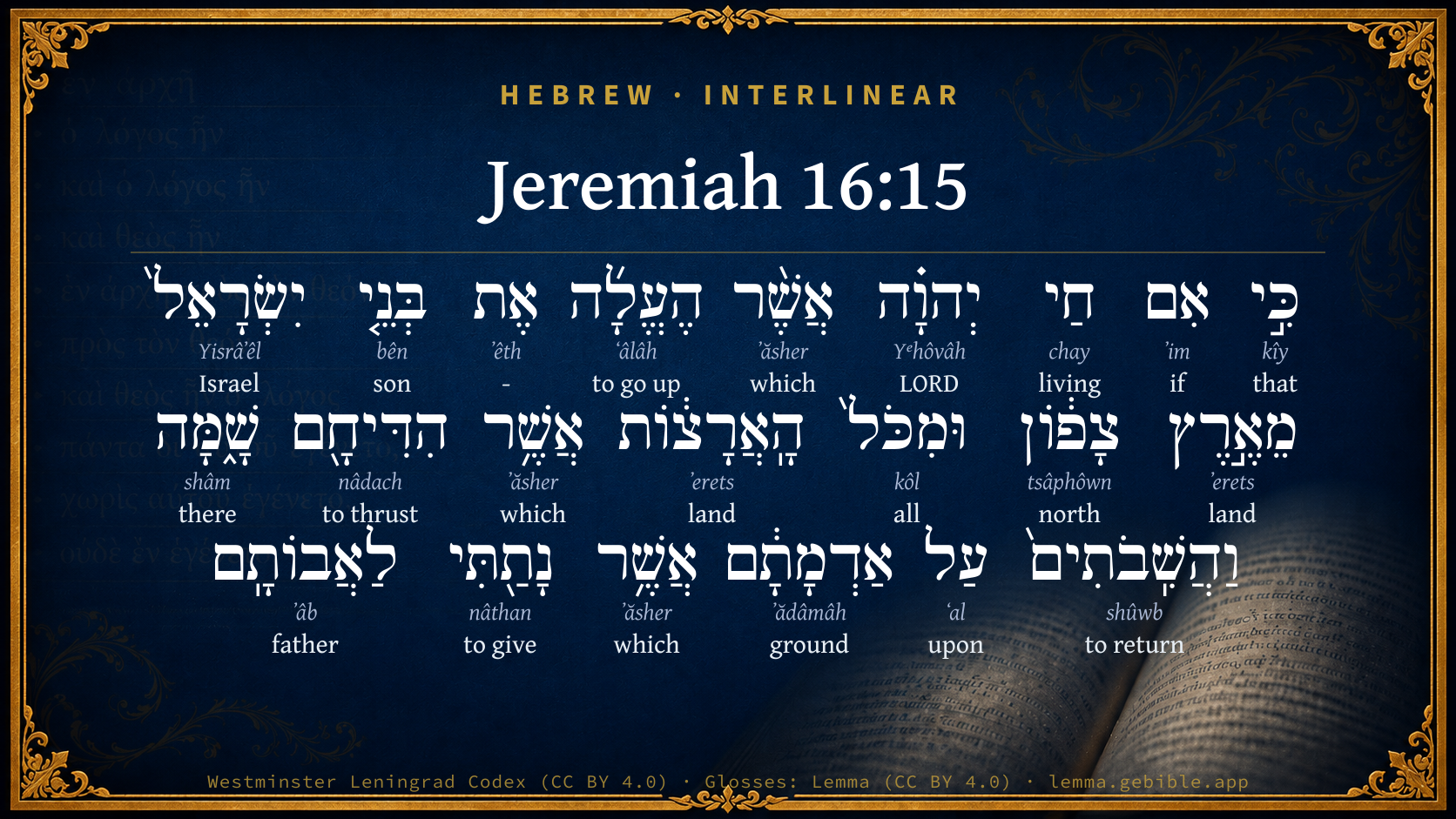
Hebrew (Westminster Leningrad Codex) Jeremiah 16:15 appears in the Hebrew Old Testament. The text above is from the Westminster Leningrad Codex. Each word links to its Strong’s number, a concise gloss, and parsing drawn from the Open Scriptures Hebrew Bible morphology. Click any word for its full Brown-Driver-Briggs (BDB) entry.
Download image
Cite this verse

Jeremiah 16:15 (World English Bible). Public Domain. Lemma interlinear Bible study tool, https://lemma.gebible.app/v/jeremiah/16/15.

Show BibTeX & RIS
BibTeX
RIS
English Translation
but, As Yahweh lives, who brought up the children of Israel from the land of the north, and from all the countries where he had driven them. I will bring them again into their land that I gave to their fathers.
World English Bible · Public Domain
Download a study sheet

One document with this verse’s original text, its word-by-word gloss line, the meaning frame, cross-references with their text, attributed commentary, and full source and license credits — printable, and it pastes into notes with its structure intact.

This verse Autodidact and up

Study sheet (.html) Plain text (.txt)

A passage Seminary Student

Up to 50 verses in one chapter. A passage sheet keeps up to 6 commentary sources and 12 cross-references per verse, in the order this page ranks them, and says so on the sheet whenever that leaves anything out. Ask for a single verse and you get the Autodidact verse sheet above.

Everything on this page stays free to read, with no account — the sheet is a download of what is already on screen, not access to it.

Want to remove ads? Support Godless Engineer
Compare translations 3

The same verse in 3 English versions, stacked beneath the original-language interlinear above. Click any original word for its lexicon entry.

Each is an independent rendering of the whole verse — the interlinear is not word-aligned to these translations.

Highlighted words mark where these versions differ — a whole-verse word diff, not a word-by-word alignment.

  • World English Bible Public Domain
    but, As Yahweh lives, who brought up the children of Israel from the land of the north, and from all the countries where he had driven them. I will bring them again into their land that I gave to their fathers.
  • King James Version Public Domain
    But, The LORD liveth, that brought up the children of Israel from the land of the north, and from all the lands whither he had driven them: and I will bring them again into their land that I gave unto their fathers.
  • unfoldingWord Literal Text CC BY-SA 4.0
    but rather, ‘The life of Yahweh, who brought up the sons of Israel from the land of the north and from all of the lands where he had driven them there.’ For I will bring them back to their land that I gave to their fathers.

unfoldingWord Literal Text — © unfoldingWord, licensed CC BY-SA 4.0. Word-aligned USFM3 via Door43 (git.door43.org/unfoldingWord/en_ult).

Versions to compare (up to 4)

3 of 4 selected

Show all 18 translations

Every available English version of this verse, each an independent rendering of the whole verse.

  • World English Bible Public Domain
    but, As Yahweh lives, who brought up the children of Israel from the land of the north, and from all the countries where he had driven them. I will bring them again into their land that I gave to their fathers.
  • Berean Standard Bible Public Domain
    Instead they will say, ‘As surely as the LORD lives, who brought the Israelites up out of the land of the north and all the other lands to which He had banished them.’ For I will return them to their land that I gave to their forefathers.
  • Majority Standard Bible Public Domain
    Instead they will say, ‘As surely as the LORD lives, who brought the Israelites up out of the land of the north and all the other lands to which He had banished them.’ For I will return them to their land that I gave to their forefathers.
  • King James Version Public Domain
    But, The LORD liveth, that brought up the children of Israel from the land of the north, and from all the lands whither he had driven them: and I will bring them again into their land that I gave unto their fathers.
  • American Standard Version (1901) Public Domain
    but, As Jehovah liveth, that brought up the children of Israel from the land of the north, and from all the countries whither he had driven them. And I will bring them again into their land that I gave unto their fathers.
  • Revised Version (1885) Public Domain
    but, As the LORD liveth, that brought up the children of Israel from the land of the north, and from all the countries whither he had driven them: and I will bring them again into their land that I gave unto their fathers.
  • Geneva Bible (1599) Public Domain
    But the Lord liueth, that brought vp the children of Israel from the lande of the North, and from all the landes where hee had scattered them, and I wil bring them againe into their land that I gaue vnto their fathers.
  • Douay-Rheims (1899) Public Domain
    But, the Lord liveth, that brought the children of Israel out of the land of the north, and out of all the lands to which I cast them out: and I will bring them again into their land, which I gave to their fathers.
  • Young's Literal Translation Public Domain
    But, `Jehovah liveth, who brought up The sons of Israel out of the land of the north, And out of all the lands whither He drove them,' And I have brought them back to their land, That I gave to their fathers.
  • Literal Standard Version CC BY-SA 4.0
    But, YHWH lives, who brought up the sons of Israel out of the land of the north, || And out of all the lands to where He drove them, || And I have brought them back to their land, || That I gave to their fathers.
  • Unlocked Literal Bible CC BY-SA 4.0
    but, 'As Yahweh lives, the one who brought up the people of Israel from the land of the north and from the lands where he had scattered them.' For I will bring them back to the land that I gave to their ancestors.
  • unfoldingWord Literal Text CC BY-SA 4.0
    but rather, ‘The life of Yahweh, who brought up the sons of Israel from the land of the north and from all of the lands where he had driven them there.’ For I will bring them back to their land that I gave to their fathers.
  • Darby Bible Public Domain
    but, [As] Jehovah liveth, who brought up the children of Israel from the land of the north, and from all the lands whither he had driven them. For I will bring them again into their land, which I gave unto their fathers.
  • World Messianic Bible Public Domain
    but, ‘As the LORD lives, who brought up the children of Israel from the land of the north, and from all the countries where he had driven them.’ I will bring them again into their land that I gave to their fathers.
  • Webster's Bible Public Domain
    But, The LORD liveth, that brought the children of Israel from the land of the north, and from all the lands whither he had driven them: and I will bring them again into their land that I gave to their fathers.
  • Free Bible Version CC BY-SA 4.0
    Instead they'll say, “On the Lord's life, who led the Israelites back from the northern country and all the other countries where he had exiled them?” I'm going to bring them back to the country I gave their forefathers.
  • Bible in Basic English Public Domain
    But, By the living Lord, who took the children of Israel up out of the land of the north, and from all the countries where he had sent them: and I will take them back again to their land which I gave to their fathers.
  • JPS Tanakh (1917) Public Domain
    but: 'As the LORD liveth, that brought up the children of Israel from the land of the north, and from all the countries whither He had driven them'; and I will bring them back into their land that I gave unto their fathers.

Literal Standard Version (2020), Covenant Press — licensed CC BY-SA 4.0. Text via the HelloAO Bible API (eBible.org). Unlocked Literal Bible (unfoldingWord) — licensed CC BY-SA 4.0. Text via the HelloAO Bible API (eBible.org). unfoldingWord Literal Text — © unfoldingWord, licensed CC BY-SA 4.0. Word-aligned USFM3 via Door43 (git.door43.org/unfoldingWord/en_ult). Free Bible Version, Dr. Jonathan Gallagher — licensed CC BY-SA 4.0. Text via the HelloAO Bible API (eBible.org).

Word by word

More ways to search: Search by grammar → Find every occurrence → Compare this word →

Practice this passage: Drill this verse → Learn its vocabulary →

הִדִּיחָ֖ם
nâdach
H5080
“to thrust · them”
Verb, Hiphil, Perfect, 3rd Person, Masculine, Singular + Suffix, Personal, 3rd Person, Masculine, Plural
Part of Speech
Verb
Stem
Hiphil
Form
Perfect
Person
3rd Person
Gender
Masculine
Number
Singular
Full BDB Definition

Origin: a primitive root

TWOT: 1304

to impel, thrust, drive away, banish - (Qal) - to impel - to thrust away, banish - (Niphal) - to be impelled - to be thrust out, be banished - banished, outcast (participle) - to be driven away - to be thrust away, thrust aside - (Pual) to be thrust into - thrust (participle) - (Hiphil) - to thrust, move, impel - to thrust out, banish - to thrust away, thrust aside - (Hophal) to be chased, be hunted - chased, hunted (participle)
  1. כִּ֣י kîy H3588 “that” Conjunction
  2. אִם ʼim H518 “if” Conjunction
  3. חַי chay H2416 “living” Adjective, Adjective, Masculine, Singular, Absolute
  4. יְהוָ֗ה Yᵉhôvâh H3068 “LORD” Noun, Proper
  5. אֲשֶׁ֨ר ʼăsher H834 “which” Particle, Relative
  6. הֶעֱלָ֜ה ʻâlâh H5927 “to go up” Verb, Hiphil, Perfect, 3rd Person, Masculine, Singular
  7. אֶת ʼêth H853 “-” Particle, Direct Object
  8. בְּנֵ֤י bên H1121 “sons of” Noun, Common, Masculine, Plural, Construct
  9. יִשְׂרָאֵל֙ Yisrâʼêl H3478 “Israel” Noun, Proper
  10. מֵאֶ֣רֶץ ʼerets H776 “from · land of” Preposition + Noun, Common, Both, Singular, Construct
  11. צָפ֔וֹן tsâphôwn H6828 “north” Noun, Common, Feminine, Singular, Absolute
  12. וּמִכֹּל֙ kôl H3605 “and · from · all of” Conjunction + Preposition + Noun, Common, Masculine, Singular, Construct
  13. הָֽאֲרָצ֔וֹת ʼerets H776 “the · lands” Particle, Definite Article + Noun, Common, Both, Plural, Absolute
  14. אֲשֶׁ֥ר ʼăsher H834 “which” Particle, Relative
  15. שָׁ֑מָּה shâm H8033 “there · toward” Adverb + Suffix, Demonstrative
  16. וַהֲשִֽׁבֹתִים֙ shûwb H7725 “and · to return · them” Conjunction + Verb, Hiphil, Sequential Perfect, 1st Person, Common, Singular + Suffix, Personal, 3rd Person, Masculine, Plural
  17. עַל ʻal H5921 “upon” Preposition
  18. אַדְמָתָ֔ם ʼădâmâh H127 “ground · their” Noun, Common, Feminine, Singular, Construct + Suffix, Personal, 3rd Person, Masculine, Plural
  19. אֲשֶׁ֥ר ʼăsher H834 “which” Particle, Relative
  20. נָתַ֖תִּי nâthan H5414 “to give” Verb, Qal, Perfect, 1st Person, Common, Singular
  21. לַאֲבוֹתָֽם ʼâb H1 “to/for · fathers · their” Preposition + Noun, Common, Masculine, Plural, Construct + Suffix, Personal, 3rd Person, Masculine, Plural

About this verse

These counts appear in no published source. They are computed here, from the morphology-tagged text and Lemma’s own curated glosses. What Lemma adds →

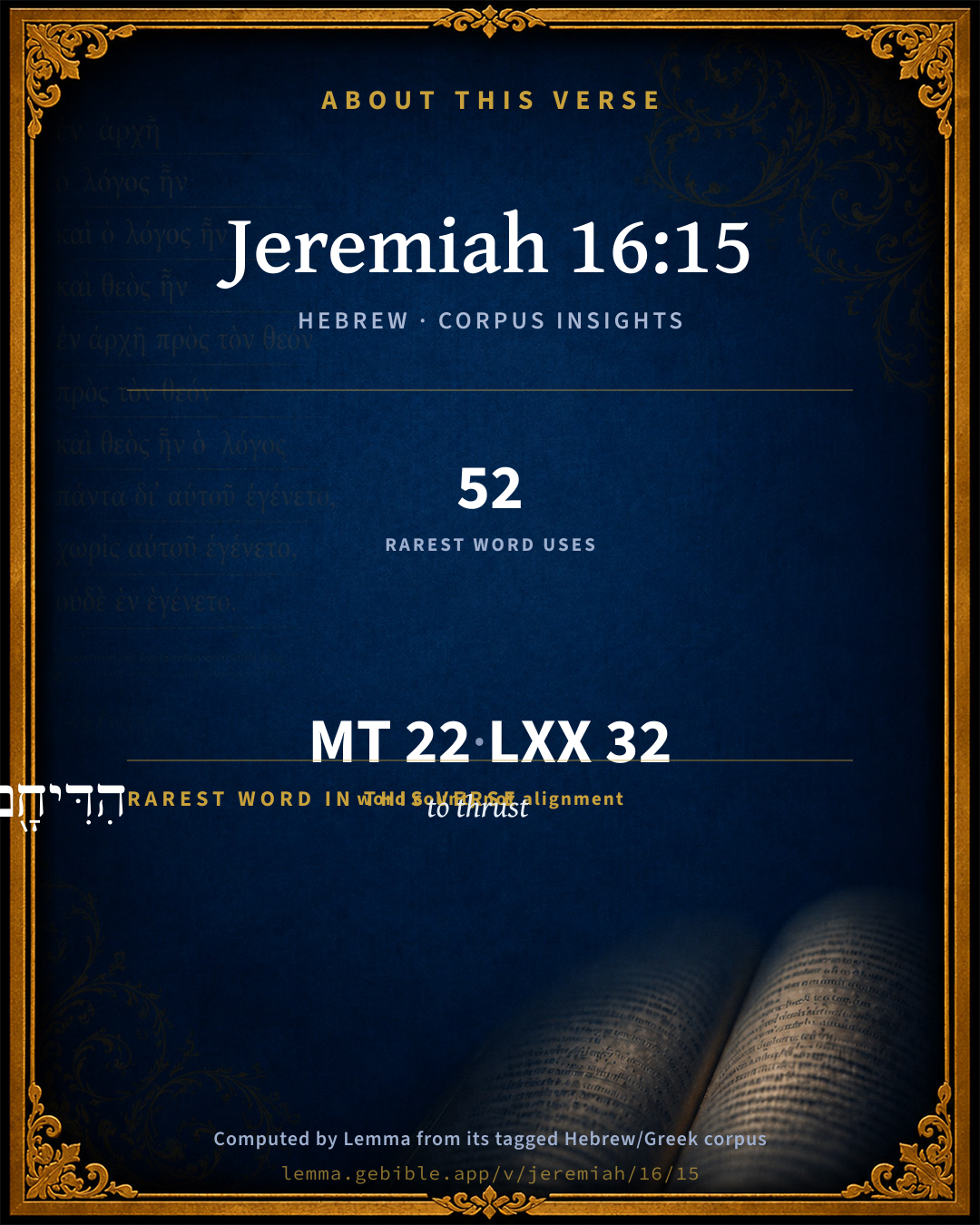
22
words
19
distinct lemmas
Prophets
section

Shared distinctive vocabulary

הִדִּיחָ֖ם to thrust H5080 occurs in 51 verses of the Hebrew Bible. Also found in:

Grammatical profile

  • 4 verbs
  • 9 nouns
  • 1 adjective
  • 1 preposition
  • 2 conjunctions
  • 1 adverb
  • 4 particles

Verb forms

  • הֶעֱלָ֜ה Hiphil · Perfect
  • הִדִּיחָ֖ם Hiphil · Perfect
  • וַהֲשִֽׁבֹתִים֙ Hiphil · Sequential Perfect
  • נָתַ֖תִּי Qal · Perfect

Repetition

Words recur within this verse — often emphatic in Hebrew:

  • מֵאֶ֣רֶץ land H776 ×2
  • אֲשֶׁ֨ר which H834 ×3

Hebrew & Septuagint length

In the original languages it is 22 Hebrew tokens and 32 Greek tokens — but the two are counted differently (Hebrew bundles its prefixes and suffixes into one token; the Greek is in lemma form), so that isn’t a like-for-like length.

Cross-references

19

Topical passages linked to Jeremiah 16:15 in the Treasury of Scripture Knowledge — connected by theme and wording, ordered by reader-vote popularity; previews shown in the World English Bible.

  • Jeremiah 3:18 In those days the house of Judah shall walk with the house of Israel, and they shall come together out of the land of the north to the land that I gave for an inheritance to your fathers.
  • Jeremiah 24:6 For I will set my eyes on them for good, and I will bring them again to this land: and I will build them, and not pull them down; and I will plant them, and not pluck them up.
  • Jeremiah 32:37 Behold, I will gather them out of all the countries, where I have driven them in my anger, and in my wrath, and in great indignation; and I will bring them again to this place, and I will cause them to dwell safely:
  • Psalms 106:47 Save us, Yahweh, our God, Gather us from among the nations, To give thanks to your holy name, To triumph in your praise!
  • Isaiah 11:11–16 It shall happen in that day, that the Lord will set his hand again the second time to recover the remnant of his people, who shall remain, from Assyria, and from Egypt, and from Pathros, and from Cush, and from Elam, and from Shinar, and from Hamath, and from the islands of the sea.
  • Ezekiel 36:24 For I will take you from among the nations, and gather you out of all the countries, and will bring you into your own land.
  • Ezekiel 39:28 They shall know that I am Yahweh their God, in that I caused them to go into captivity among the nations, and have gathered them to their own land; and I will leave none of them any more there;
  • Amos 9:14 I will bring back the captivity of my people Israel, And they will rebuild the ruined cities, and inhabit them; and they will plant vineyards, and drink wine from them. They shall also make gardens, And eat the fruit of them.
  • Deuteronomy 30:3–5 that then Yahweh your God will turn your captivity, and have compassion on you, and will return and gather you from all the peoples, where Yahweh your God has scattered you.
  • Isaiah 14:1 For Yahweh will have compassion on Jacob, and will yet choose Israel, and set them in their own land: and the foreigner shall join himself with them, and they shall cleave to the house of Jacob.
  • Jeremiah 30:3 For, behold, the days come, says Yahweh, that I will turn again the captivity of my people Israel and Judah, says Yahweh; and I will cause them to return to the land that I gave to their fathers, and they shall possess it.
  • Jeremiah 30:10 Therefore don't you be afraid, O Jacob my servant, says Yahweh; neither be dismayed, Israel: for, behold, I will save you from afar, and your seed from the land of their captivity; and Jacob shall return, and shall be quiet and at ease, and none shall make him afraid.
  • Jeremiah 31:8 Behold, I will bring them from the north country, and gather them from the uttermost parts of the earth, [and] with them the blind and the lame, the woman with child and her who travails with child together: a great company shall they return here.
  • Ezekiel 34:12–14 As a shepherd seeks out his flock in the day that he is among his sheep that are scattered abroad, so will I seek out my sheep; and I will deliver them out of all places where they have been scattered in the cloudy and dark day.
  • Ezekiel 37:21–22 Say to them, Thus says the Lord Yahweh: Behold, I will take the children of Israel from among the nations, where they are gone, and will gather them on every side, and bring them into their own land:
  • Isaiah 13:5–6 They come from a far country, from the uttermost part of heaven, even Yahweh, and the weapons of his indignation, to destroy the whole land.
  • Isaiah 27:12–13 It shall happen in that day, that Yahweh will beat off [his fruit] from the flood of the River to the brook of Egypt; and you shall be gathered one by one, you children of Israel.
  • Jeremiah 23:8 but, As Yahweh lives, who brought up and who led the seed of the house of Israel out of the north country, and from all the countries where I had driven them. They shall dwell in their own land.
  • Jeremiah 50:19 I will bring Israel again to his pasture, and he shall feed on Carmel and Bashan, and his soul shall be satisfied on the hills of Ephraim and in Gilead.

Cross-references courtesy of OpenBible.info (CC BY 4.0).

Hebrew and Greek witnesses Masoretic Hebrew ↔ Greek Septuagint

The same verse in the two great witnesses to the Old Testament, shown verse-for-verse.

These are two independent witnesses, not word-aligned to each other, and the Septuagint is shown in lemma (dictionary) form.

Hebrew Jeremiah 16:15 Masoretic · Westminster Leningrad Codex

כִּ֣י אִם חַי יְהוָ֗ה אֲשֶׁ֨ר הֶעֱלָ֜ה אֶת בְּנֵ֤י יִשְׂרָאֵל֙ מֵאֶ֣רֶץ צָפ֔וֹן וּמִכֹּל֙ הָֽאֲרָצ֔וֹת אֲשֶׁ֥ר הִדִּיחָ֖ם שָׁ֑מָּה וַהֲשִֽׁבֹתִים֙ עַל אַדְמָתָ֔ם אֲשֶׁ֥ר נָתַ֖תִּי לַאֲבוֹתָֽם

but, As Yahweh lives, who brought up the children of Israel from the land of the north, and from all the countries where he had driven them. I will bring them again into their land that I gave to their fathers.

World English Bible · Public Domain

Greek LXX Structure differs

In the Septuagint, Jeremiah is about an eighth shorter than the Hebrew and arranges its material differently — the Oracles Against the Nations (Hebrew chapters 46–51) appear in the middle of the Greek book, after 25:13. Because the chapter and verse boundaries do not line up, a verse-for-verse comparison with the Hebrew is not shown.

A verse-for-verse comparison isn’t shown here because the chapters and verses don’t line up. Switch to the LXX edition with the MT / LXX toggle above to read the Greek directly.

Hebrew: Westminster Leningrad Codex (CC BY 4.0). Greek: Septuagint (public domain); English from a public-domain English Septuagint. How the Septuagint differs from the Hebrew →

Targum (Aramaic paraphrase)

1

The Targum is the ancient Jewish Aramaic paraphrase of the Hebrew Scriptures — an interpretive translation, not the Hebrew text itself. Onkelos (literal) and Pseudo-Jonathan (expansive) render the Torah, and Jonathan the Prophets. Coverage is partial: where no permissively-licensed English translation exists for a verse, only the Aramaic is shown. This is verse-level text, not a word-by-word alignment to the Hebrew.

  1. Targum Jonathan Prophets (Joshua–Malachi)
    אֱלָהֵן יְהוֹן מִשְׁתְּעָן בִּגְבוּרְתָּא דַייָ דְאַסִיק יַת בְּנֵי יִשְׂרָאֵל מֵאַרְעָא צִפּוּנָא וּמִכָּל מְדִינָתָא דְאַגְלֵינוּן לְתַמָן וַאֲתֵיבִינוּן לְאַרְעֲהוֹן דִיהָבֵית לַאֲבָהַתְהוֹן:

    (no public-domain English translation for this verse)

    Targum Jonathan — Aramaic: “Mikraot Gedolot” (public domain). English: “Sefaria Community Translation” (CC0 1.0 (public-domain dedication)); “London "Chaldee Paraphrase," 1871” (public domain). Text via Sefaria.

Commentary

Notes on Jeremiah 16:15 from classic Christian and Jewish commentators (each source and its license shown beneath its notes). The classic Christian expositions comment on the surrounding passage and are grouped to its opening verse, so a note may address several verses; the Jewish commentaries on the Tanakh (Rashi and others) are per-verse, so they appear only where the commentator wrote on this verse.

Lemma curates 59 commentaries, every one of them public domain or Creative Commons licensed, each selected and text-cleaned for this edition rather than reprinted as found. About our sources →

Trapp's Complete Commentary

John Trapp

Jer 16:15 But, The LORD liveth, that brought up the children of Israel from the land of the north, and from all the lands whither he had driven them: and I will bring them again into their land that I gave unto their fathers.

Ver. 15. But the Lord liveth, &c.] Or, "Let the Lord live, and let the God of our salvation be exalted." {Psa 18:46} {See Trapp on "Psa 18:46"} How much more, then, should our redemption from sin, death, and hell by Jesus Christ obscure all temporal deliverance! See for this Jer 23:7-8 cf. Jer 3:16.

John Trapp, A Commentary or Exposition upon All the Books of the Old and New Testament (1647–1656) — public domain. Text from a community e-Sword module.

Geneva Bible (1599)

Geneva Bible translators

Signifying, the benefit of their deliverance out of Babylon should be so great, that it should abolish the remembrance of their deliverance from Egypt: but he hath here chiefly respect to the spiritual deliverance under Christ.

Geneva Bible (1599) marginal notes — public domain. Text via Bolls.life.

Jamieson, Fausset & Brown

Robert Jamieson, A. R. Fausset & David Brown

the north--Chaldea. But while the return from Babylon is primarily meant, the return hereafter is the full and final accomplishment contemplated, as "from all the lands" proves. "Israel" was not, save in a very limited sense, "gathered from all the lands" at the return from Babylon (see on Jer 24:6; Jer 30:3; Jer 32:15).

Jamieson, Fausset & Brown — Commentary Critical and Explanatory on the Whole Bible (1871) — public domain (CC PDM 1.0). Text via the HelloAO Bible API.

Adam Clarke's Commentary

Verse 15. The land of the north] Chaldea: and their deliverance thence will be as remarkable as the deliverance of their fathers from the land of Egypt.

Adam Clarke's Commentary on the Bible (1810–1826) — public domain. Text from a community e-Sword/MySword module.

John Calvin's Commentaries

But, it will be rather said, Live does Jehovah, for he has brought his people from the land of the north; and for this reason, because there will be less hope remaining for you, when the Chaldeans shall subdue and scatter you like a body torn asunder, and when the name of Israel shall be extinguished, when the worship of God shall be subverted and the Temple destroyed. When therefore all things shall appear to be past remedy, this captivity shall be much more dreadful than that by which your fathers had been oppressed. Therefore, when God restores you, it will be a miracle much more remarkable. And that the Prophet took occasion to give thom some hope of God’s favor, may be gathered from the end of the verse, when he says, And I will make them to return to their own land: but the copulative ought to be rendered as a conditional particle, as though he had said, When I shall restore them to their own land which I gave to their fathers It now follows —

John Calvin's Commentaries (1540-1563) — public domain. Text from the Calvin Translation Society English edition (1840s-50s) via the Christian Classics Ethereal Library (ccel.org). Calvin's coverage is partial (roughly two-thirds of the Bible); uncommented books and verses are honest gaps, never fabricated. The 19th-century editor's footnotes and remarks are omitted so the notes are faithfully Calvin's own voice.

John Gill's Exposition

Behold, I will send for many fishers, saith the Lord, and they shall fish them,.... Which some understand of the Egyptians, who lived much on fish, and were much employed in catching them, to which the allusion is thought to be; but rather the Chaldeans are intended, whom God, by the secret instinct of his providence, brought up against the Jews; who besieged Jerusalem, and enclosed them in it, and took them as fishes in a net; see Hab 1:14, though some interpret this, and what follows, of the deliverance of the Jews by the Medes and Persians under Cyrus, who searched for them in all places, and sent them into their own land; or of Zerubbabel, and others with him, who used all means to persuade the Jews in the captivity to go with them, and build the house of the Lord in Jerusalem; and there are not wanting others, who by the "fishers" think the apostles are meant; who were fishers by occupation, and whom Christ made fishers of men, and sent forth to cast and spread the net of the Gospel in the several parts of Judea, for the conversion of some of that people; see Mat 4:18,

and after will l send for many hunters, and they shall hunt them from every mountain, and from every hill, and out of the holes of the rocks; either the same persons, the Chaldeans, are meant here, as before; who, as they should slay those they took in Jerusalem with the edge of the sword, as fishes taken in a net are killed, or presently die, which is the sense of the Targum, and other Jewish commentators; so those that escaped and fled to mountains, hills, and holes of the rocks, to hide themselves, should be pursued by them, and be found out, taken, and carried captive: or, the Romans (e). So Nimrod, the beginning of whose kingdom was Babel, being a tyrant and an oppressor, is called a mighty hunter, Gen 10:8.

(e) Vid. Joseph de Bello Jud. l. 7. c. 9. sect. 4.

John Gill's Exposition of the Whole Bible (1746–1763) — public domain (CC PDM 1.0). Text via the HelloAO Bible API.

Haydock's Catholic Bible Commentary

Fathers. He joins consolation with distressing predictions, and alludes to the redemption of mankind, of which the return of the Jews was the most striking pledge.

George Leo Haydock (1774–1849), Haydock's Catholic Family Bible and Commentary, 1859 edition — public domain. Excludes Psalms (Douay-Rheims chapter numbering differs from Protestant) and Deuterocanonical books (Catholic canon only).

Matthew Poole's English Annotations

Which he saith should be so grateful a mercy to them, that either in regard of the newness of this deliverance, or in regard of the great misery they should be in during the captivity of Babylon, when they should be delivered from it, they should not so much remember their deliverance front the house of bondage in Egypt, and magnify God for that salvation, as this new deliverance of them out of this captivity; for he would certainly bring them again into the land of Canaan, a land which he had given unto their fathers.

Matthew Poole's English Annotations on the Holy Bible (1683–1685) — public domain. Text from a community e-Sword/MySword module.

Lesson kit

Teaching starters — assembled from the data on this page, not authored interpretation. Every prompt links to the verse data it draws on. Edit before teaching.

Jeremiah, in the Prophets, opens this verse with 22 words (19 distinct Hebrew lemmas). Its most distinctive word is nâdach (“to thrust”). A historical commentator’s framing appears above. Read the whole chapter for the surrounding context.

Discussion questions

  1. What does “to thrust” (nâdach) contribute to the verse as a whole?
  2. Deuteronomy 4:19 shares the word «to thrust» with this verse. How do the two illuminate each other?
  3. “land” occurs 2× in this one verse. What is the effect of the repetition?
  4. The translations on this page render this verse differently — a whole-verse word diff, not a word-by-word alignment. What might account for the different wordings?
  5. The verb «הֶעֱלָ֜ה» is Hiphil Perfect. How does its form color the action?
  6. Reading how Trapp's Complete Commentary and Geneva Bible (1599) read this verse, where do the two commentators agree and where do they part?

Things to notice

Reading settings

Reading text

Shown beneath each verse's original-language words.

Old Testament
Old Testament edition

Read the OT as the Masoretic Hebrew (MT) or the Greek Septuagint (LXX).

English shown for the Greek Septuagint (in the Hebrew ↔ Greek comparison).

Comparing translations? Open the Compare panel on any verse page to stack up to four side by side.