
Jeremiah 7:20

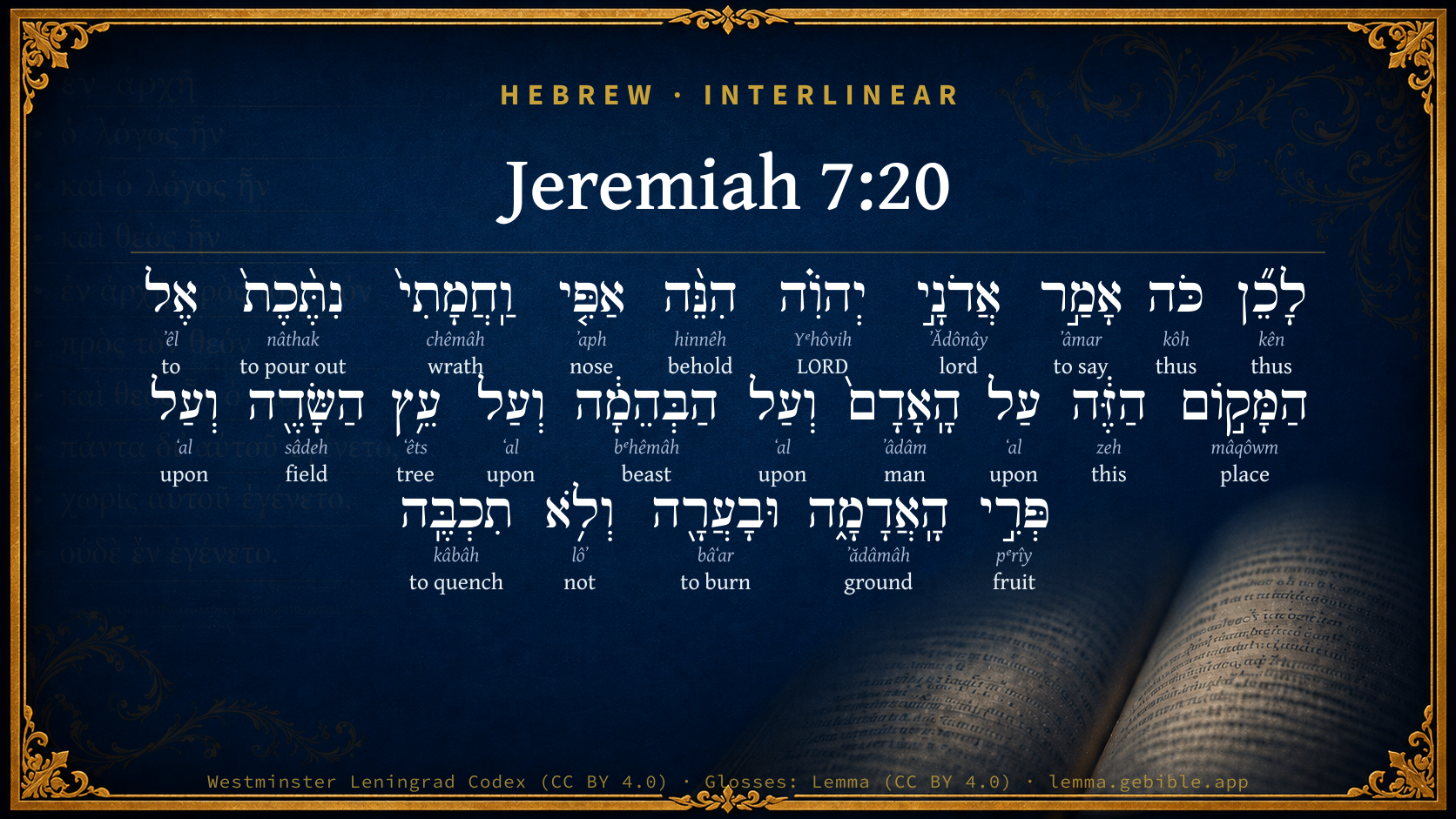
Hebrew (Westminster Leningrad Codex) Jeremiah 7:20 appears in the Hebrew Old Testament. The text above is from the Westminster Leningrad Codex. Each word links to its Strong’s number, a concise gloss, and parsing drawn from the Open Scriptures Hebrew Bible morphology. Click any word for its full Brown-Driver-Briggs (BDB) entry.
Download image
Cite this verse

Jeremiah 7:20 (World English Bible). Public Domain. Lemma interlinear Bible study tool, https://lemma.gebible.app/v/jeremiah/7/20.

Show BibTeX & RIS
BibTeX
RIS
English Translation
Therefore thus says the Lord Yahweh: Behold, my anger and my wrath shall be poured out on this place, on man, and on animal, and on the trees of the field, and on the fruit of the ground; and it shall burn, and shall not be quenched.
World English Bible · Public Domain
Download a study sheet

One document with this verse’s original text, its word-by-word gloss line, the meaning frame, cross-references with their text, attributed commentary, and full source and license credits — printable, and it pastes into notes with its structure intact.

This verse Autodidact and up

Study sheet (.html) Plain text (.txt)

A passage Seminary Student

Up to 50 verses in one chapter. A passage sheet keeps up to 6 commentary sources and 12 cross-references per verse, in the order this page ranks them, and says so on the sheet whenever that leaves anything out. Ask for a single verse and you get the Autodidact verse sheet above.

Everything on this page stays free to read, with no account — the sheet is a download of what is already on screen, not access to it.

Want to remove ads? Support Godless Engineer
Compare translations 3

The same verse in 3 English versions, stacked beneath the original-language interlinear above. Click any original word for its lexicon entry.

Each is an independent rendering of the whole verse — the interlinear is not word-aligned to these translations.

Highlighted words mark where these versions differ — a whole-verse word diff, not a word-by-word alignment.

  • World English Bible Public Domain
    Therefore thus says the Lord Yahweh: Behold, my anger and my wrath shall be poured out on this place, on man, and on animal, and on the trees of the field, and on the fruit of the ground; and it shall burn, and shall not be quenched.
  • King James Version Public Domain
    Therefore thus saith the Lord GOD; Behold, mine anger and my fury shall be poured out upon this place, upon man, and upon beast, and upon the trees of the field, and upon the fruit of the ground; and it shall burn, and shall not be quenched.
  • unfoldingWord Literal Text CC BY-SA 4.0
    Therefore thus says the Lord Yahweh, ‘Behold, my nose and my wrath will be poured out on this place, on man and on beast, and on the tree of the field and on the fruit of the ground; and it will burn and will not be quenched.’

unfoldingWord Literal Text — © unfoldingWord, licensed CC BY-SA 4.0. Word-aligned USFM3 via Door43 (git.door43.org/unfoldingWord/en_ult).

Versions to compare (up to 4)

3 of 4 selected

Show all 18 translations

Every available English version of this verse, each an independent rendering of the whole verse.

  • World English Bible Public Domain
    Therefore thus says the Lord Yahweh: Behold, my anger and my wrath shall be poured out on this place, on man, and on animal, and on the trees of the field, and on the fruit of the ground; and it shall burn, and shall not be quenched.
  • Berean Standard Bible Public Domain
    Therefore this is what the Lord GOD says: Behold, My anger and My fury will be poured out on this place, on man and beast, on the trees of the field and the produce of the land, and it will burn and not be extinguished.
  • Majority Standard Bible Public Domain
    Therefore this is what the Lord GOD says: Behold, My anger and My fury will be poured out on this place, on man and beast, on the trees of the field and the produce of the land, and it will burn and not be extinguished.
  • King James Version Public Domain
    Therefore thus saith the Lord GOD; Behold, mine anger and my fury shall be poured out upon this place, upon man, and upon beast, and upon the trees of the field, and upon the fruit of the ground; and it shall burn, and shall not be quenched.
  • American Standard Version (1901) Public Domain
    Therefore thus saith the Lord Jehovah: Behold, mine anger and my wrath shall be poured out upon this place, upon man, and upon beast, and upon the trees of the field, and upon the fruit of the ground; and it shall burn, and shall not be quenched.
  • Revised Version (1885) Public Domain
    Therefore thus saith the Lord GOD: Behold, mine anger and my fury shall be poured out upon this place, upon man, and upon beast, and upon the trees of the field, and upon the fruit of the ground; and it shall burn, and shall not be quenched.
  • Geneva Bible (1599) Public Domain
    Therefore thus sayeth the Lord God, Beholde, mine anger and my wrath shall be powred vpon this place, vpon man and vpon beast, and vpon the tree of the fielde, and vpon the fruite of the grounde, and it shall burne and not bee quenched.
  • Douay-Rheims (1899) Public Domain
    Therefore thus saith the Lord God: Behold my wrath and my indignation was enkindled against this place, upon men and upon beasts, and upon the trees of the field, and upon the fruits of the land, and it shall burn, and shall not be quenched.
  • Young's Literal Translation Public Domain
    Therefore, thus said the Lord Jehovah, Lo, Mine anger and My fury is poured out on this place, On man, and beast, and on tree of the field, And on fruit of the ground, And it hath burned, and it is not quenched.
  • Literal Standard Version CC BY-SA 4.0
    Therefore, thus said Lord YHWH: “Behold, My anger and My fury is poured out on this place, || On man, and beast, and on tree of the field, || And on fruit of the ground, || And it has burned, and it is not quenched.”
  • Unlocked Literal Bible CC BY-SA 4.0
    Therefore the Lord Yahweh says this, 'See, my anger and wrath will gush out onto this place, on both man and beast, on the tree in the fields and the fruit on the ground. It will burn and never be extinguished.'
  • unfoldingWord Literal Text CC BY-SA 4.0
    Therefore thus says the Lord Yahweh, ‘Behold, my nose and my wrath will be poured out on this place, on man and on beast, and on the tree of the field and on the fruit of the ground; and it will burn and will not be quenched.’
  • Darby Bible Public Domain
    Therefore thus saith the Lord Jehovah: Behold, mine anger and my fury shall be poured out upon this place; upon man, and upon beast, and upon the trees of the field, and upon the fruit of the ground; and it shall burn, and shall not be quenched.
  • World Messianic Bible Public Domain
    Therefore the Lord GOD says: “Behold, my anger and my wrath will be poured out on this place, on man, on animal, on the trees of the field, and on the fruit of the ground; and it will burn and will not be quenched.”
  • Webster's Bible Public Domain
    Therefore thus saith the Lord GOD; Behold, my anger and my fury shall be poured out upon this place, upon man, and upon beast, and upon the trees of the field, and upon the fruit of the ground; and it shall burn, and shall not be quenched.
  • Free Bible Version CC BY-SA 4.0
    So this is what the Lord God says: Watch! My furious anger will be poured out on this country, on people and animals, on the orchards and the crops in the field. It will burn and nobody will be able to put it out.
  • Bible in Basic English Public Domain
    So this is what the Lord God has said: See, my wrath and my passion will be let loose on this place, on man and beast, and on the trees of the field, and on the produce of the earth; it will be burning and will not be put out.
  • JPS Tanakh (1917) Public Domain
    Therefore thus saith the Lord GOD: Behold, Mine anger and My fury shall be poured out upon this place, upon man, and upon beast, and upon the trees of the field, and upon the fruit of the land; and it shall burn, and shall not be quenched.

Literal Standard Version (2020), Covenant Press — licensed CC BY-SA 4.0. Text via the HelloAO Bible API (eBible.org). Unlocked Literal Bible (unfoldingWord) — licensed CC BY-SA 4.0. Text via the HelloAO Bible API (eBible.org). unfoldingWord Literal Text — © unfoldingWord, licensed CC BY-SA 4.0. Word-aligned USFM3 via Door43 (git.door43.org/unfoldingWord/en_ult). Free Bible Version, Dr. Jonathan Gallagher — licensed CC BY-SA 4.0. Text via the HelloAO Bible API (eBible.org).

Word by word

More ways to search: Search by grammar → Find every occurrence → Compare this word →

Practice this passage: Drill this verse → Learn its vocabulary →

נִתֶּ֨כֶת֙
nâthak
H5413
“poured out”
Verb, Niphal, Participle Passive, Feminine, Singular, Absolute
Part of Speech
Verb
Stem
Niphal
Form
Participle Passive
Gender
Feminine
Number
Singular
State
Absolute
Full BDB Definition

Origin: a primitive root

TWOT: 1442

to pour out or forth, drop (or rain), be poured, be poured out, be melted, be molten - (Qal) to pour forth - (Niphal) to be poured, be poured out - (Hiphil) to pour out, melt - (Hophal) to be melted
  1. לָכֵ֞ן kên H3651 “to/for · thus” Preposition + Adverb
  2. כֹּה kôh H3541 “thus” Adverb
  3. אָמַ֣ר ʼâmar H559 “to say” Verb, Qal, Perfect, 3rd Person, Masculine, Singular
  4. אֲדֹנָ֣י ʼĂdônây H136 “Lord · my” Noun, Common, Masculine, Plural, Construct + Suffix, Personal, 1st Person, Common, Singular
  5. יְהֹוִ֗ה Yᵉhôvih H3069 “LORD” Noun, Proper
  6. הִנֵּ֨ה hinnêh H2009 “behold” Particle, Demonstrative
  7. אַפִּ֤י ʼaph H639 “nose · my” Noun, Common, Masculine, Singular, Construct + Suffix, Personal, 1st Person, Common, Singular
  8. וַֽחֲמָתִי֙ chêmâh H2534 “and · wrath · my” Conjunction + Noun, Common, Feminine, Singular, Construct + Suffix, Personal, 1st Person, Common, Singular
  9. אֶל ʼêl H413 “to” Preposition
  10. הַמָּק֣וֹם mâqôwm H4725 “the · place” Particle, Definite Article + Noun, Common, Masculine, Singular, Absolute
  11. הַזֶּ֔ה zeh H2088 “the · this” Particle, Definite Article + Pronoun, Demonstrative, Masculine, Singular
  12. עַל ʻal H5921 “upon” Preposition
  13. הָֽאָדָם֙ ʼâdâm H120 “the · man” Particle, Definite Article + Noun, Common, Masculine, Singular, Absolute
  14. וְעַל ʻal H5921 “and · upon” Conjunction + Preposition
  15. הַבְּהֵמָ֔ה bᵉhêmâh H929 “the · beast” Particle, Definite Article + Noun, Common, Feminine, Singular, Absolute
  16. וְעַל ʻal H5921 “and · upon” Conjunction + Preposition
  17. עֵ֥ץ ʻêts H6086 “tree of” Noun, Common, Masculine, Singular, Construct
  18. הַשָּׂדֶ֖ה sâdeh H7704 “the · field” Particle, Definite Article + Noun, Common, Masculine, Singular, Absolute
  19. וְעַל ʻal H5921 “and · upon” Conjunction + Preposition
  20. פְּרִ֣י pᵉrîy H6529 “fruit of” Noun, Common, Masculine, Singular, Construct
  21. הָֽאֲדָמָ֑ה ʼădâmâh H127 “the · ground” Particle, Definite Article + Noun, Common, Feminine, Singular, Absolute
  22. וּבָעֲרָ֖ה bâʻar H1197 “and · to burn” Conjunction + Verb, Qal, Sequential Perfect, 3rd Person, Feminine, Singular
  23. וְלֹ֥א lôʼ H3808 “and · not” Conjunction + Particle, Negative
  24. תִכְבֶּֽה kâbâh H3518 “to quench” Verb, Qal, Imperfect, 3rd Person, Feminine, Singular

About this verse

These counts appear in no published source. They are computed here, from the morphology-tagged text and Lemma’s own curated glosses. What Lemma adds →

25
words
22
distinct lemmas
Prophets
section

Notable vocabulary

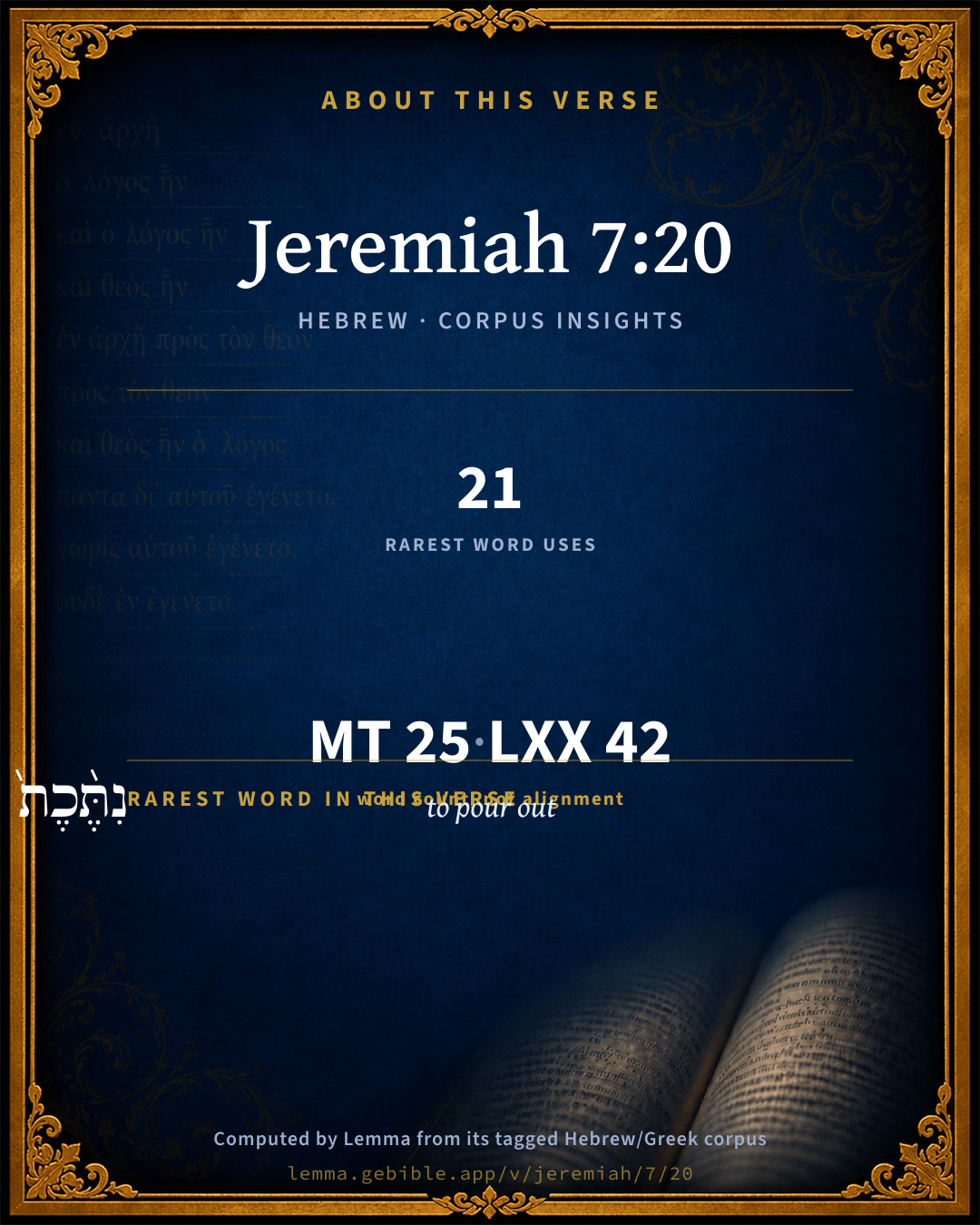
The rarest word here is נִתֶּ֨כֶת֙ to pour out H5413 — appearing just 21 times in the whole Hebrew Bible.

Shared distinctive vocabulary

נִתֶּ֨כֶת֙ to pour out H5413 occurs in 19 verses of the Hebrew Bible. Also found in:

Grammatical profile

  • 4 verbs
  • 11 nouns
  • 1 pronoun
  • 5 prepositions
  • 2 adverbs
  • 2 particles

Verb forms

  • אָמַ֣ר Qal · Perfect
  • נִתֶּ֨כֶת֙ Niphal · Participle Passive
  • וּבָעֲרָ֖ה Qal · Sequential Perfect
  • תִכְבֶּֽה Qal · Imperfect

Repetition

A word recurs within this verse — often emphatic in Hebrew:

Hebrew & Septuagint length

In the original languages it is 25 Hebrew tokens and 42 Greek tokens — but the two are counted differently (Hebrew bundles its prefixes and suffixes into one token; the Greek is in lemma form), so that isn’t a like-for-like length.

Cross-references

20

Topical passages linked to Jeremiah 7:20 in the Treasury of Scripture Knowledge — connected by theme and wording, ordered by reader-vote popularity; previews shown in the World English Bible.

  • Jeremiah 42:18 For thus says Yahweh of Hosts, the God of Israel: As my anger and my wrath has been poured forth on the inhabitants of Jerusalem, so shall my wrath be poured forth on you, when you shall enter into Egypt; and you shall be an object of horror, and an astonishment, and a curse, and a reproach; and you shall see this place no more.
  • Isaiah 42:25 Therefore he poured on him the fierceness of his anger, and the strength of battle; and it set him on fire round about, yet he didn't know; and it burned him, yet he didn't lay it to heart.
  • Jeremiah 17:27 But if you will not listen to me to make the Sabbath day holy, and not to bear a burden and enter in at the gates of Jerusalem on the Sabbath day; then will I kindle a fire in the gates of it, and it shall devour the palaces of Jerusalem, and it shall not be quenched.
  • Lamentations 2:3–5 He has cut off in fierce anger all the horn of Israel; He has drawn back his right hand from before the enemy: He has burned up Jacob like a flaming fire, which devours round about.
  • Jeremiah 44:6 Therefore my wrath and my anger was poured forth, and was kindled in the cities of Judah and in the streets of Jerusalem; and they are wasted and desolate, as it is this day.
  • Lamentations 4:11 Yahweh has accomplished his wrath, he has poured out his fierce anger; He has kindled a fire in Zion, which has devoured the foundations of it.
  • Ezekiel 22:22 As silver is melted in the midst of the furnace, so shall you be melted in the midst of it; and you shall know that I, Yahweh, have poured out my wrath on you.
  • Nahum 1:6 Who can stand before his indignation? Who can endure the fierceness of his anger? His wrath is poured out like fire, and the rocks are broken apart by him.
  • 2 Kings 22:17 Because they have forsaken me, and have burned incense to other gods, that they might provoke me to anger with all the work of their hands, therefore my wrath shall be kindled against this place, and it shall not be quenched.
  • Isaiah 66:24 They shall go forth, and look on the dead bodies of the men who have transgressed against me: for their worm shall not die, neither shall their fire be quenched; and they shall be an abhorring to all flesh.
  • Jeremiah 4:23–26 I saw the earth, and, behold, it was waste and void; and the heavens, and they had no light.
  • Revelation 16:1–21 I heard a loud voice out of the temple, saying to the seven angels, "Go and pour out the seven bowls of the wrath of God on the earth!"
  • Jeremiah 9:10–11 For the mountains will I take up a weeping and wailing, and for the pastures of the wilderness a lamentation, because they are burned up, so that none passes through; neither can men hear the voice of the cattle; both the birds of the sky and the animals are fled, they are gone.
  • Jeremiah 12:4 How long shall the land mourn, and the herbs of the whole country wither? for the wickedness of those who dwell therein, the animals are consumed, and the birds; because they said, He shall not see our latter end.
  • Jeremiah 14:16 The people to whom they prophesy shall be cast out in the streets of Jerusalem because of the famine and the sword; and they shall have none to bury them-them, their wives, nor their sons, nor their daughters: for I will pour their wickedness on them.
  • Ezekiel 20:47–48 and tell the forest of the South, Hear the word of Yahweh: Thus says the Lord Yahweh, Behold, I will kindle a fire in you, and it shall devour every green tree in you, and every dry tree: the flaming flame shall not be quenched, and all faces from the south to the north shall be burnt thereby.
  • Daniel 9:11 Yes, all Israel have transgressed your law, even turning aside, that they should not obey your voice: therefore has the curse been poured out on us, and the oath that is written in the law of Moses the servant of God; for we have sinned against him.
  • Malachi 4:1 "For, behold, the day comes, it burns as a furnace; and all the proud, and all who work wickedness, will be stubble; and the day that comes will burn them up," says Yahweh of Hosts, "that it shall leave them neither root nor branch.
  • Mark 9:43–48 If your hand causes you to stumble, cut it off. It is better for you to enter into life maimed, rather than having your two hands to go into Gehenna, into the unquenchable fire,
  • Revelation 14:10 he also will drink of the wine of the wrath of God, which is prepared unmixed in the cup of his anger. He will be tormented with fire and sulfur in the presence of the holy angels, and in the presence of the Lamb.

Cross-references courtesy of OpenBible.info (CC BY 4.0).

Hebrew and Greek witnesses Masoretic Hebrew ↔ Greek Septuagint

The same verse in the two great witnesses to the Old Testament, shown verse-for-verse.

These are two independent witnesses, not word-aligned to each other, and the Septuagint is shown in lemma (dictionary) form.

Hebrew Jeremiah 7:20 Masoretic · Westminster Leningrad Codex

לָכֵ֞ן כֹּה אָמַ֣ר אֲדֹנָ֣י יְהֹוִ֗ה הִנֵּ֨ה אַפִּ֤י וַֽחֲמָתִי֙ נִתֶּ֨כֶת֙ אֶל הַמָּק֣וֹם הַזֶּ֔ה עַל הָֽאָדָם֙ וְעַל הַבְּהֵמָ֔ה וְעַל עֵ֥ץ הַשָּׂדֶ֖ה וְעַל פְּרִ֣י הָֽאֲדָמָ֑ה וּבָעֲרָ֖ה וְלֹ֥א תִכְבֶּֽה

Therefore thus says the Lord Yahweh: Behold, my anger and my wrath shall be poured out on this place, on man, and on animal, and on the trees of the field, and on the fruit of the ground; and it shall burn, and shall not be quenched.

World English Bible · Public Domain

Greek LXX Structure differs

In the Septuagint, Jeremiah is about an eighth shorter than the Hebrew and arranges its material differently — the Oracles Against the Nations (Hebrew chapters 46–51) appear in the middle of the Greek book, after 25:13. Because the chapter and verse boundaries do not line up, a verse-for-verse comparison with the Hebrew is not shown.

A verse-for-verse comparison isn’t shown here because the chapters and verses don’t line up. Switch to the LXX edition with the MT / LXX toggle above to read the Greek directly.

Hebrew: Westminster Leningrad Codex (CC BY 4.0). Greek: Septuagint (public domain); English from a public-domain English Septuagint. How the Septuagint differs from the Hebrew →

Targum (Aramaic paraphrase)

1

The Targum is the ancient Jewish Aramaic paraphrase of the Hebrew Scriptures — an interpretive translation, not the Hebrew text itself. Onkelos (literal) and Pseudo-Jonathan (expansive) render the Torah, and Jonathan the Prophets. Coverage is partial: where no permissively-licensed English translation exists for a verse, only the Aramaic is shown. This is verse-level text, not a word-by-word alignment to the Hebrew.

  1. Targum Jonathan Prophets (Joshua–Malachi)
    בְּכֵן כִּדְנַן אֲמַר יְיָ אֱלֹהִים הָא רוּגְזִי וַחֲמָתִי חָל בְּאַתְרָא הָדֵין עַל אֱנָשָׁא וְעַל בְּעִירָא וְעַל אִילַן חַקְלָא וְעַל אִבָּא דְאַרְעָא וִישֵׁיצֵי וְלָא יְהֵי חָיָס:

    (no public-domain English translation for this verse)

    Targum Jonathan — Aramaic: “Mikraot Gedolot” (public domain). English: “Sefaria Community Translation” (CC0 1.0 (public-domain dedication)); “London "Chaldee Paraphrase," 1871” (public domain). Text via Sefaria.

Commentary

Notes on Jeremiah 7:20 from classic Christian and Jewish commentators (each source and its license shown beneath its notes). The classic Christian expositions comment on the surrounding passage and are grouped to its opening verse, so a note may address several verses; the Jewish commentaries on the Tanakh (Rashi and others) are per-verse, so they appear only where the commentator wrote on this verse.

Lemma curates 59 commentaries, every one of them public domain or Creative Commons licensed, each selected and text-cleaned for this edition rather than reprinted as found. About our sources →

Trapp's Complete Commentary

John Trapp

Jer 7:20 Therefore thus saith the Lord GOD; Behold, mine anger and my fury shall be poured out upon this place, upon man, and upon beast, and upon the trees of the field, and upon the fruit of the ground; and it shall burn, and shall not be quenched.

Ver. 20. Mine anger and mine fury.] A very dreadful doom, denounced against these daring monsters. Those that provoke God to anger shall soon have enough of it. It is a fearful thing to fall into the punishing hands of the living God {Heb 10:31} Oh keep out of them!

John Trapp, A Commentary or Exposition upon All the Books of the Old and New Testament (1647–1656) — public domain. Text from a community e-Sword module.

Joseph Benson's Commentary

Jer 7:20. Therefore thus saith the Lord — And what he saith he will not unsay, nor can all the world withstand its execution. Hear it therefore and tremble. Behold, mine anger and my fury shall be poured out upon this place — As the flood of waters was poured upon the old world, or the shower of fire and brimstone upon Sodom; since they will provoke me, let them feel the effects of their conduct. They shall soon find, 1st, That there is no escaping this deluge of wrath, either by fleeing from it, or fencing against it. It shall be poured out on this place — Though it be a holy place, the Lord’s house. It shall reach both man and beast — Like the plagues of Egypt; and, like some of them, shall destroy the trees of the field and the fruit of the ground — Which they had designed and prepared for Baal, and of which they had made cakes to the queen of heaven. They shall find, 2d, That there is no extinguishing it: it shall burn and shall not be quenched — Prayers and tears, forms and ceremonies of worship, and ritual observances of whatever kind, shall then avail nothing, to prevent that total destruction which it shall produce.

Joseph Benson's Commentary on the Old and New Testaments (1811–1818) — public domain. Text from a community e-Sword module.

Tyndale Open Study Notes

Tyndale Open Resources

7:20-23 The people’s offerings and sacrifices meant nothing to the Lord if disobedience ruled in their hearts. Their sacrifices did not manipulate God into doing something he would rather not do. Rather, they embodied the people’s trust in God’s gracious forgiveness. When the people tried to use the sacrificial system to manipulate God while living self-serving lives, it only infuriated him (Isa 1:10-16; Amos 5:21-27). Obedience to God allows for a personal relationship between God and his people that provides the basis for a wonderful future (Hos 6:6).

Tyndale Open Study Notes — © Tyndale Open Resources, licensed CC BY-SA 4.0. Text via the HelloAO Bible API.

Jamieson, Fausset & Brown

Robert Jamieson, A. R. Fausset & David Brown

beast . . . trees . . . ground--Why doth God vent His fury on these? On account of man, for whom these were created, that the sad spectacle may strike terror into him (Rom 8:20-22).

Jamieson, Fausset & Brown — Commentary Critical and Explanatory on the Whole Bible (1871) — public domain (CC PDM 1.0). Text via the HelloAO Bible API.

John Calvin's Commentaries

Jeremiah proceeds still with the same subject, and explains more at large what we have noticed in the preceding lecture, that the ruin of Mount Sion and of the Temple was nigh at hand, according to what God had before done to Shiloh, where the Ark had long been kept. But that his threatening might have more weight, he introduced God as the speaker, —

Behold, he says, my wrath, even mine indignation, has been poured down on this place He refers to the metaphor he had before used; and hence is confirmed what I then said, — that God spoke not of prophetic teaching, but of the punishments which he had already inflicted and was prepared to inflict. On this account he says, that his wrath, or vengeance (the cause is put for the effect) had been poured down on the city Jerusalem, so as to bring destruction on the cattle as well as men, and also on the fruit of the land. It is indeed certain that brute animals, as well as trees and the productions of the earth, were innocent; but as the whole world was created for man and for his benefit, it is nothing strange that God’s vengeance should extend to innocent animals and to things not endued with reason: for God does not inflict punishment on brute animals and on the fruits of the earth, except for the purpose of shewing, by extending the symptoms of his wrath to all the elements, how much displeased he is with men. The whole world, we know, bears at this day in some measure the punishment which Adam deserved: and hence Paul says, that all the elements labor in pain, aspiring after a deliverance; and he says also, that all creatures have been subjected to corruption, though not willingly, that is, not through their own fault, but through the sin and transgression of man. (Romans 8:20-22.) It is no wonder, then, that God, wishing to terrify men, should daily set before their eyes the various forms of his vengeance as manifested towards animals, as well as trees and the fruits of the earth.

The meaning then is, — that God was so angry, that he purposed to destroy, not only the Jews, but the land itself, in order that posterity might know how grievously they had sinned, against whom God’s just vengeance had thus kindled. There is therefore no need for us curiously to inquire why God shewed his displeasure towards trees and brute animals: for it is enough for us to know that God does not in a strict sense punish brute animals and trees, but that this is done on account of man, that such a sad spectacle may fill them with fear. He afterwards adds —

John Calvin's Commentaries (1540-1563) — public domain. Text from the Calvin Translation Society English edition (1840s-50s) via the Christian Classics Ethereal Library (ccel.org). Calvin's coverage is partial (roughly two-thirds of the Bible); uncommented books and verses are honest gaps, never fabricated. The 19th-century editor's footnotes and remarks are omitted so the notes are faithfully Calvin's own voice.

Ellicott's Commentary for English Readers

(20) Shall be poured out.—The word is used in Exo_9:33 of the plague of rain; here, of the great shower of the fire of the wrath of Jehovah (comp. Nah_1:6). It is significant that it had been used by Josiah on hearing of the judgments denounced in the new-found copy of the Law (2Ch_34:21).

A Bible Commentary for English Readers, edited by Charles John Ellicott (1878–1897) — public domain. Text from a community e-Sword module.

John Gill's Exposition

Therefore thus saith the Lord God,.... Since these are their thoughts, and this the fruit of their doings:

behold, my anger and my fury shall be poured out upon this place; like fire, to consume and destroy it; meaning Jerusalem, which was burned with fire; as an emblem of God's wrath, and an instance of his vengeance upon it, for sins; which came down in great abundance, like a storm or tempest:

upon man and upon beast; upon beasts for the sake of man, they being his property, and for his use; otherwise they are innocent, and do not deserve the wrath of God, nor are they sensible of it:

and upon the trees of the field, and upon the fruit of your ground; which should be blighted by nipping winds, or cut down and trampled upon by the Chaldean army:

and it shall burn, and shall not be quenched; that is, the wrath of God shall burn like fire, and shall not cease until it has executed the whole will of God in the punishment of his people.

John Gill's Exposition of the Whole Bible (1746–1763) — public domain (CC PDM 1.0). Text via the HelloAO Bible API.

Albert Barnes' Notes on the Bible

Upon man, and upon beast - All creation in some mysterious way shares in man’s fall and restoration Rom 8:19-22.

Albert Barnes' Notes on the Bible (1834–1885) — public domain. Text from a community e-Sword/MySword module.

Matthew Poole's English Annotations

Mine anger; put for his revenge, by a metonymy of the cause for the effect.

My fury: this expresseth his anger boiled up to the height, Jer 4:4.

Poured out; a metaphor taken from violent rains; see Jer 6:11; and may in particular allude to those showers of fire that were poured out upon Sodom, Gen 19:24.

Upon the trees of the field, and upon the fruit of the ground: these particulars are enumerated to express an utter desolation and ruin; see Jer 4:25; and it is threatened against those creatures which are innocent, because they were made for the use of man, partly that it might show how greatly God is offended, and that it should work upon them not only a greater fear of his judgments, but a greater shame for their sin, that they should occasion such sufferings upon the innocent creature, Rom 8:20,22.

Shall not be quenched: he follows the threatening with showing the irresistibleness of it; his resolution is not to be revoked, Jer 4:4; and this is suitable to the charge he gave the prophet, Jer 7:16.

Matthew Poole's English Annotations on the Holy Bible (1683–1685) — public domain. Text from a community e-Sword/MySword module.

The Pulpit Commentary

Upon man, and upon beast. That all creation shares in the curse of man is repeatedly affirmed in the Old Testament as well as the New. Inferentially, this doctrine appears from the narrative of the Fall, and still more clearly from Isaiah"s description of Paradise regained. (Isa 11) Hosea speaks of sufferings of the animals arising out of the guilt of Israel, (Hos_4:3) and a consciousness of the "solidarity" of all living creatures is ascribed to a Ninevite king in the Book of Jonah. (Jon_3:7, Jon_3:8) In general, the origin of this community of suffering is left mysterious, but in Gen_6:12 it is expressly stated as the cause of the Deluge, that "all flesh i.e. both man and beast. had corrupted its way upon the earth;" i.e. apparently, that contact with man had led to a corruption of the original innocence of the lower animals. It is a common experience that intercourse between Christianized (not to say civilized) man and the domestic animals produces a sometimes pathetic change in the psychic phenomena of the latter. Is the reverse process utterly inconceivable?

The innocent victims of sin.

I THERE ARE MANY SUCH. All forms of life are mentioned here human, animal, plant from the stateliest trees down to the lowliest herb and all shall suffer because of the sin of but a portion of them. How many, even of men, were innocent! And the young children what had they done? Yet none were to escape, though it was but a portion of the men of the day who had done such wrong.

II HENCE SOME SAY, "THE WAY OF THE LORD Is NOT EQUAL." But:

1. The summing up of all life in one head, constituting it a corporate unity, giving a solidarity to all life, especially to all human life, is the Divine order.

2. And though sin and sorrow come by means of it, yet a far larger balance of good is produced by it. What do we not owe to our all being members one of another? True, evil comes, but good yet more. Were we all isolated, separated, independent, there would be no guarantee for our good even then, but there would be certainty of infinite loss. If the sins of the fathers are visited on the children unto the third and fourth generation, the mercy of the Lord is unto thousands of generations "of them that love him and keep his commandments" (Exo_20:6)

3. And though because of it "n Adam all died," yet because of it also in Christ shall all be made alive. This interlinking, of one with all and all with one is, therefore, a matter for great thankfulness, and, though attended with present evils, not at all of complaint.

III AND THE THOUGHT OF THESE INNOCENT VICTIMS OF SIN IS MOST SALUTARY.

1. It often holds back from sin. This is one way in which God "out of the mouth of babes and sucklings has ordained strength." How often fathers and mothers will, for the sake of their children, that they might not be harmed, keep back from sin, to which but for such motive they might have yielded!

2. It deepens repentance for sin. (Cf. 2Sa_24:17)

3. It makes sin more hateful to us. What must that be which destroys not us only, but our children, innocent of all sin? And it may be that the thus furnishing of additional safeguards against sin, and of additional motives to obedience, was one reason in the Divine mind for constituting us all "members one of another.

IV AND THE THOUGHT OF THE INNOCENT "VICTIM OF SIN, OUR LORD JESUS, IS THE MOST SALUTARY OF ALL. For he transforms us from victims into victors victors over the condemning, the attractive, the defiling, the enslaving power of sin. And it is as we "look unto" him, as our souls habitually trust him to do all this for us, that we cease to be victims of sin, and become victors over it. Let us give glory to him by accepting his off, red grace. C.

The Pulpit Commentary (1880–1919), ed. H.D.M. Spence-Jones & Joseph S. Exell — public domain. Text from a community e-Sword module.

John Wesley's Explanatory Notes

Shall not be quenched - He follows the threatening with shewing his resolution is not to be revoked.

John Wesley, Explanatory Notes Upon the Whole Bible (1754–1765) — public domain. Text via the GEBible commentary corpus.

Rashi

Rabbi Shlomo Yitzchaki (Rashi)

reaches Heb. נתכת, falls and reaches. Comp. (Exodus 9:33) “and rain did not reach (נתּך) the earth”; did not reach.

Rashi on the Tanakh — English translations: “The Judaica Press complete Tanach with Rashi, translated by A. J. Rosenberg” (CC BY 4.0); “Pentateuch with Rashi's commentary by M. Rosenbaum and A.M. Silbermann, 1929-1934” (public domain); “The Metsudah Tanach series, Lakewood, N.J” (CC BY 4.0); and “The Book of Joshua, Metsudah Publications, 1997” (CC BY 4.0). Text via Sefaria.

Lesson kit

Teaching starters — assembled from the data on this page, not authored interpretation. Every prompt links to the verse data it draws on. Edit before teaching.

Jeremiah, in the Prophets, opens this verse with 25 words (22 distinct Hebrew lemmas). Its most distinctive word is nâthak (“to pour out”). A historical commentator’s framing appears above. Read the whole chapter for the surrounding context.

Discussion questions

  1. What does “to pour out” (nâthak) contribute to the verse as a whole?
  2. Exodus 9:33 shares the word «to pour out» with this verse. How do the two illuminate each other?
  3. “upon” occurs 4× in this one verse. What is the effect of the repetition?
  4. These translations render this verse differently; the difference is in the English rendering, not the original. What questions does that raise?
  5. The verb «אָמַ֣ר» is Qal Perfect. How does its form color the action?
  6. Reading how Trapp's Complete Commentary and Joseph Benson's Commentary read this verse, where do the two commentators agree and where do they part?

Things to notice

Reading settings

Reading text

Shown beneath each verse's original-language words.

Old Testament
Old Testament edition

Read the OT as the Masoretic Hebrew (MT) or the Greek Septuagint (LXX).

English shown for the Greek Septuagint (in the Hebrew ↔ Greek comparison).

Comparing translations? Open the Compare panel on any verse page to stack up to four side by side.