Isaiah 30:24

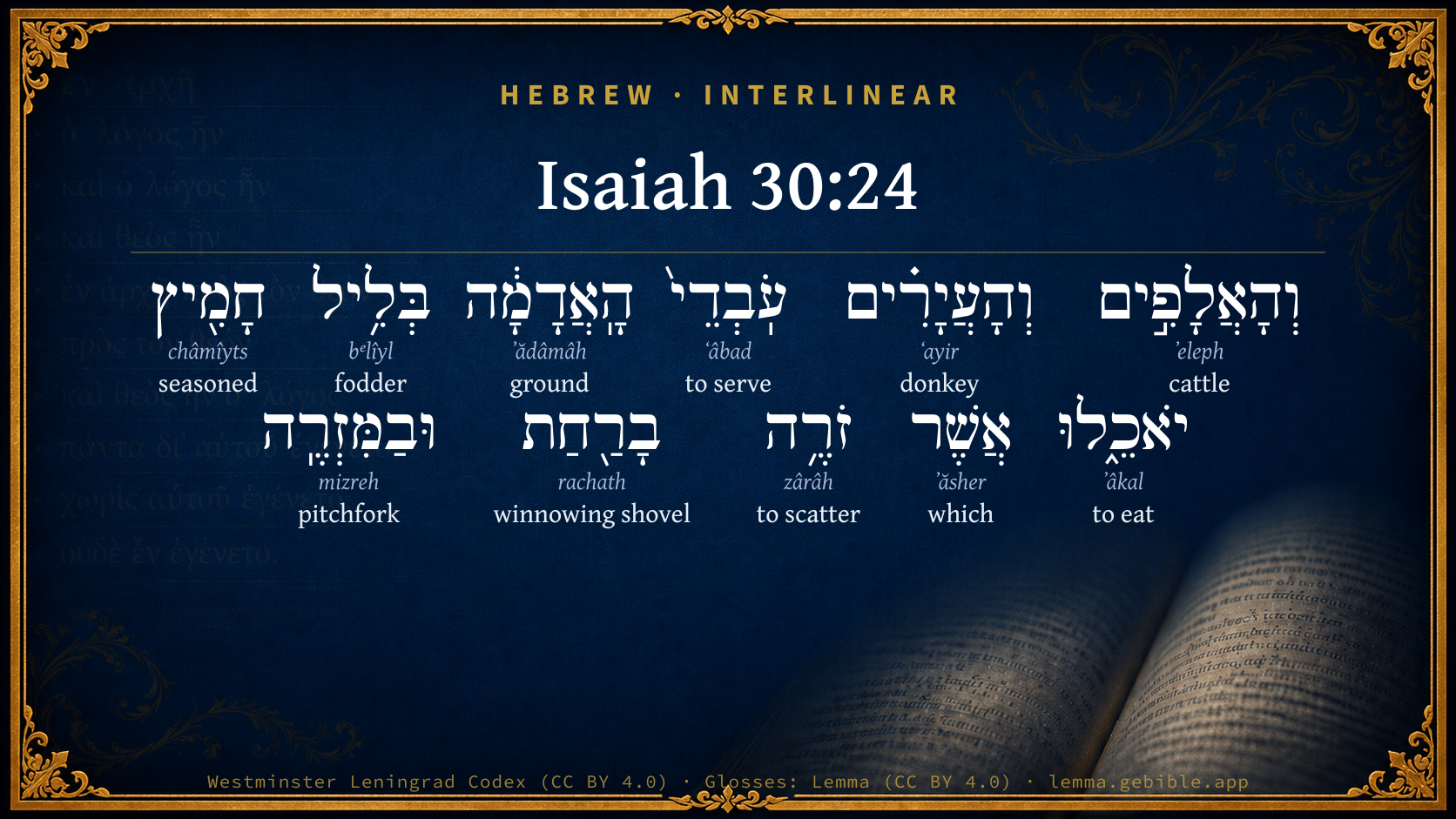
Hebrew (Westminster Leningrad Codex) Isaiah 30:24 appears in the Hebrew Old Testament. The text above is from the Westminster Leningrad Codex. Each word links to its Strong’s number, a concise gloss, and parsing drawn from the Open Scriptures Hebrew Bible morphology. Click any word for its full Brown-Driver-Briggs (BDB) entry.
Download image
Cite this verse

Isaiah 30:24 (World English Bible). Public Domain. Lemma interlinear Bible study tool, https://lemma.gebible.app/v/isaiah/30/24.

Show BibTeX & RIS
BibTeX
RIS
English Translation
the oxen likewise and the young donkeys that till the ground shall eat savory provender, which has been winnowed with the shovel and with the fork.
World English Bible · Public Domain
Highlights Full analysis ↓
Download a study sheet

One document with this verse’s original text, its word-by-word gloss line, the meaning frame, cross-references with their text, attributed commentary, and full source and license credits — printable, and it pastes into notes with its structure intact.

This verse Autodidact and up

Study sheet (.html) Plain text (.txt)

A passage Seminary Student

Up to 50 verses in one chapter. A passage sheet keeps up to 6 commentary sources and 12 cross-references per verse, in the order this page ranks them, and says so on the sheet whenever that leaves anything out. Ask for a single verse and you get the Autodidact verse sheet above.

Everything on this page stays free to read, with no account — the sheet is a download of what is already on screen, not access to it.

Want to remove ads? Support Godless Engineer
Compare translations 3

The same verse in 3 English versions, stacked beneath the original-language interlinear above. Click any original word for its lexicon entry.

Each is an independent rendering of the whole verse — the interlinear is not word-aligned to these translations.

Highlighted words mark where these versions differ — a whole-verse word diff, not a word-by-word alignment.

  • World English Bible Public Domain
    the oxen likewise and the young donkeys that till the ground shall eat savory provender, which has been winnowed with the shovel and with the fork.
  • King James Version Public Domain
    The oxen likewise and the young asses that ear the ground shall eat clean provender, which hath been winnowed with the shovel and with the fan.
  • unfoldingWord Literal Text CC BY-SA 4.0
    And the oxen and the donkeys, the workers of the ground, will eat salty fodder that one is winnowing with a shovel and with a pitchfork.

unfoldingWord Literal Text — © unfoldingWord, licensed CC BY-SA 4.0. Word-aligned USFM3 via Door43 (git.door43.org/unfoldingWord/en_ult).

Versions to compare (up to 4)

3 of 4 selected

Show all 18 translations

Every available English version of this verse, each an independent rendering of the whole verse.

  • World English Bible Public Domain
    the oxen likewise and the young donkeys that till the ground shall eat savory provender, which has been winnowed with the shovel and with the fork.
  • Berean Standard Bible Public Domain
    The oxen and donkeys that work the ground will eat salted fodder, winnowed with shovel and pitchfork.
  • Majority Standard Bible Public Domain
    The oxen and donkeys that work the ground will eat salted fodder, winnowed with shovel and pitchfork.
  • King James Version Public Domain
    The oxen likewise and the young asses that ear the ground shall eat clean provender, which hath been winnowed with the shovel and with the fan.
  • American Standard Version (1901) Public Domain
    the oxen likewise and the young asses that till the ground shall eat savory provender, which hath been winnowed with the shovel and with the fork.
  • Revised Version (1885) Public Domain
    the oxen likewise and the young asses that till the ground shall eat savoury provender, which hath been winnowed with the shovel and with the fan.
  • Geneva Bible (1599) Public Domain
    The oxen also and the yong asses, that till the ground, shall eate cleane prouender, which is winowed with the shoouel and with the fanne.
  • Douay-Rheims (1899) Public Domain
    And thy oxen, and the ass colts that till the ground, shall eat mingled pro vender as it was winnowed in the floor.
  • Young's Literal Translation Public Domain
    And the oxen and the young asses serving the ground, Fermented provender do eat, That one is winnowing with shovel and fan.
  • Literal Standard Version CC BY-SA 4.0
    And the oxen and the young donkeys serving the ground, || Eat fermented provender, || That one is winnowing with shovel and fan.
  • Unlocked Literal Bible CC BY-SA 4.0
    The oxen and the donkeys, who plow the ground, will eat seasoned feed that has been winnowed with a shovel and a fork.
  • unfoldingWord Literal Text CC BY-SA 4.0
    And the oxen and the donkeys, the workers of the ground, will eat salty fodder that one is winnowing with a shovel and with a pitchfork.
  • Darby Bible Public Domain
    and the oxen and the asses that till the ground shall eat salted provender, which hath been winnowed with the shovel and with the fan.
  • World Messianic Bible Public Domain
    The oxen likewise and the young donkeys that till the ground will eat savory feed, which has been winnowed with the shovel and with the fork.
  • Webster's Bible Public Domain
    The oxen likewise and the young asses that plow the ground shall eat clean provender, which hath been winnowed with the shovel and with the fan.
  • Free Bible Version CC BY-SA 4.0
    The oxen and donkeys that help cultivate the earth will eat good greens and grain, spread with fork and shovel.
  • Bible in Basic English Public Domain
    And the oxen and the young asses which are used for ploughing, will have salted grain which has been made free from the waste with fork and basket.
  • JPS Tanakh (1917) Public Domain
    The oxen likewise and the young asses that till the ground shall eat savoury provender, which hath been winnowed with the shovel and with the fan.

Literal Standard Version (2020), Covenant Press — licensed CC BY-SA 4.0. Text via the HelloAO Bible API (eBible.org). Unlocked Literal Bible (unfoldingWord) — licensed CC BY-SA 4.0. Text via the HelloAO Bible API (eBible.org). unfoldingWord Literal Text — © unfoldingWord, licensed CC BY-SA 4.0. Word-aligned USFM3 via Door43 (git.door43.org/unfoldingWord/en_ult). Free Bible Version, Dr. Jonathan Gallagher — licensed CC BY-SA 4.0. Text via the HelloAO Bible API (eBible.org).

Word by word

More ways to search: Search by grammar → Find every occurrence → Compare this word →

Practice this passage: Drill this verse → Learn its vocabulary →

חָמִ֖יץ
châmîyts
H2548
“seasoned”
Adjective, Adjective, Masculine, Singular, Absolute
Part of Speech
Adjective
Type
Adjective
Gender
Masculine
Number
Singular
State
Absolute
Full BDB Definition

Origin: from H2556

TWOT: 679c

seasoned
  1. וְהָאֲלָפִ֣ים ʼeleph H504 “and · the · cattle” Conjunction + Particle, Definite Article + Noun, Common, Masculine, Plural, Absolute
  2. וְהָעֲיָרִ֗ים ʻayir H5895 “and · the · donkeys” Conjunction + Particle, Definite Article + Noun, Common, Masculine, Plural, Absolute
  3. עֹֽבְדֵי֙ ʻâbad H5647 “serving” Verb, Qal, Participle Active, Masculine, Plural, Construct
  4. הָֽאֲדָמָ֔ה ʼădâmâh H127 “the · ground” Particle, Definite Article + Noun, Common, Feminine, Singular, Absolute
  5. בְּלִ֥יל bᵉlîyl H1098 “fodder of” Noun, Common, Masculine, Singular, Construct
  6. יֹאכֵ֑לוּ ʼâkal H398 “to eat” Verb, Qal, Imperfect, 3rd Person, Masculine, Plural
  7. אֲשֶׁר ʼăsher H834 “which” Particle, Relative
  8. זֹרֶ֥ה zârâh H2219 “scattering” Verb, Qal, Participle Active, Masculine, Singular, Absolute
  9. בָרַ֖חַת rachath H7371 “in/at the · winnowing shovel” Preposition, Determined + Noun, Common, Feminine, Singular, Absolute
  10. וּבַמִּזְרֶֽה mizreh H4214 “and · in/at the · pitchfork” Conjunction + Preposition, Determined + Noun, Common, Masculine, Singular, Absolute

About this verse

These counts appear in no published source. They are computed here, from the morphology-tagged text and Lemma’s own curated glosses. What Lemma adds →

11
words
11
distinct lemmas
Prophets
section

Notable vocabulary

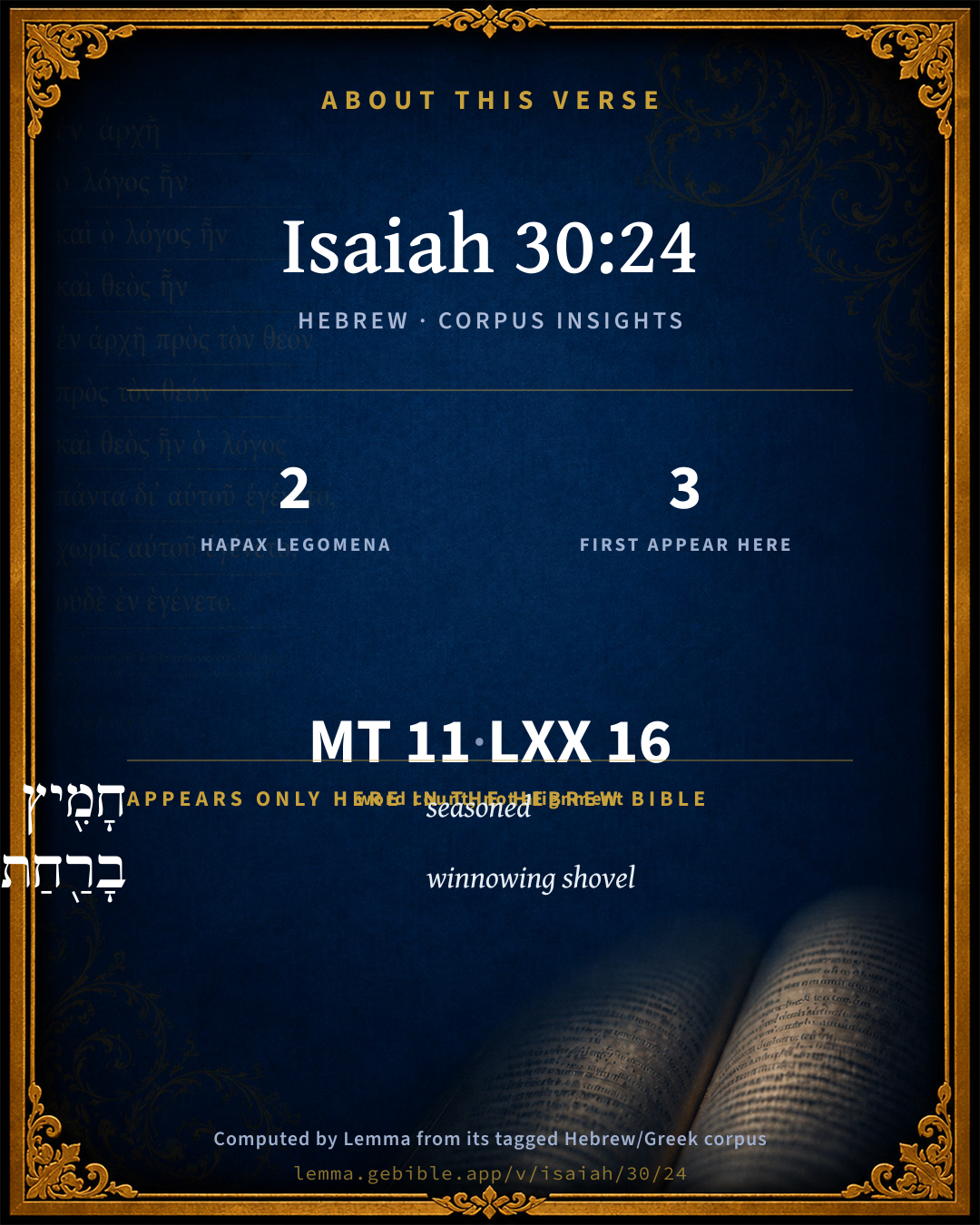
2 hapax legomena — words that appear only here in the entire Hebrew Bible:

  • חָמִ֖יץ seasoned H2548
  • בָרַ֖חַת winnowing shovel H7371

First appearance in Scripture

These words make their first canonical appearance in the Hebrew Bible here:

  • חָמִ֖יץ seasoned H2548
  • בָרַ֖חַת winnowing shovel H7371
  • וּבַמִּזְרֶֽה pitchfork H4214

Shared distinctive vocabulary

וּבַמִּזְרֶֽה pitchfork H4214 occurs in 2 verses of the Hebrew Bible. Also found in:

Grammatical profile

  • 3 verbs
  • 6 nouns
  • 1 adjective
  • 1 particle

Verb forms

  • עֹֽבְדֵי֙ Qal · Participle Active
  • יֹאכֵ֑לוּ Qal · Imperfect
  • זֹרֶ֥ה Qal · Participle Active

Hebrew & Septuagint length

In English translation the verse runs 26 words from the Hebrew and 16 from the Septuagint (LXX English) — the Septuagint runs noticeably shorter here. See the side-by-side →

A rough comparison of the two English renderings, which tokenize alike — not a word-level alignment.

Word counts can differ between the Hebrew and the Greek without any difference in meaning — e.g. the Hebrew direct-object marker אֵת has no separate Greek word, and Greek often adds the article ὁ.

In the original languages it is 11 Hebrew tokens and 16 Greek tokens — but the two are counted differently (Hebrew bundles its prefixes and suffixes into one token; the Greek is in lemma form), so that isn’t a like-for-like length.

Cross-references

8

Topical passages linked to Isaiah 30:24 in the Treasury of Scripture Knowledge — connected by theme and wording, ordered by reader-vote popularity; previews shown in the World English Bible.

  • Genesis 45:6 For these two years the famine has been in the land, and there are yet five years, in which there will be neither plowing nor harvest.
  • Deuteronomy 25:4 You shall not muzzle the ox when he treads out [the grain].
  • Exodus 34:21 Six days you shall work, but on the seventh day you shall rest: in plowing time and in harvest you shall rest.
  • Deuteronomy 21:4 and the elders of that city shall bring down the heifer to a valley with running water, which is neither plowed nor sown, and shall break the heifer's neck there in the valley.
  • 1 Samuel 8:12 and he will appoint them to him for captains of thousands, and captains of fifties; and [he will set some] to plow his ground, and to reap his harvest, and to make his instruments of war, and the instruments of his chariots.
  • Matthew 3:12 His winnowing fork is in his hand, and he will thoroughly cleanse his threshing floor. He will gather his wheat into the barn, but the chaff he will burn up with unquenchable fire."
  • Luke 3:17 whose fan is in his hand, and he will thoroughly cleanse his threshing floor, and will gather the wheat into his barn; but he will burn up the chaff with unquenchable fire."
  • 1 Corinthians 9:9–10 For it is written in the law of Moses, "You shall not muzzle an ox while it treads out the grain." Is it for the oxen that God cares,

Cross-references courtesy of OpenBible.info (CC BY 4.0).

Hebrew and Greek witnesses Masoretic Hebrew ↔ Greek Septuagint

The same verse in the two great witnesses to the Old Testament, shown verse-for-verse.

Here the Septuagint runs noticeably shorter than the Hebrew — LXX2012 (modern English Septuagint) 16 words vs World English Bible 26. A rough length comparison of the two English translations, not a word-level alignment — read both below.

These are two independent witnesses, not word-aligned to each other, and the Septuagint is shown in lemma (dictionary) form.

Hebrew Isaiah 30:24 Masoretic · Westminster Leningrad Codex

וְהָאֲלָפִ֣ים וְהָעֲיָרִ֗ים עֹֽבְדֵי֙ הָֽאֲדָמָ֔ה בְּלִ֥יל חָמִ֖יץ יֹאכֵ֑לוּ אֲשֶׁר זֹרֶ֥ה בָרַ֖חַת וּבַמִּזְרֶֽה

the oxen likewise and the young donkeys that till the ground shall eat savory provender, which has been winnowed with the shovel and with the fork.

World English Bible · Public Domain

Greek LXX Isaiah 30:24 Septuagint · lemma form

ὁ ταῦρος σύ καί ὁ βοῦς ὁ ἐργάζομαι ὁ γῆ ἐσθίω ἄχυρον ἀναποιέω ἐν κριθή λικμάω

Your bulls and your oxen that till the ground, shall eat chaff mixed with winnowed barley.

LXX2012 (modern English Septuagint) · Public Domain

On this verse, John Gill's Exposition discusses the Septuagint’s reading. Read the note in Commentary ↓

Hebrew: Westminster Leningrad Codex (CC BY 4.0). Greek: Septuagint (public domain); English from LXX2012 (modern English Septuagint) (Public Domain). How the Septuagint differs from the Hebrew →

Targum (Aramaic paraphrase)

1

The Targum is the ancient Jewish Aramaic paraphrase of the Hebrew Scriptures — an interpretive translation, not the Hebrew text itself. Onkelos (literal) and Pseudo-Jonathan (expansive) render the Torah, and Jonathan the Prophets. Coverage is partial: where no permissively-licensed English translation exists for a verse, only the Aramaic is shown. This is verse-level text, not a word-by-word alignment to the Hebrew.

  1. Targum Jonathan Prophets (Joshua–Malachi)
    וְתוֹרַיָא וַחֲמָרַיָא דִי מְפַלְחִין בְּהוֹן יַת אַרְעָא בְּלִיל מְפַטֵם יֵכְלוּן דִי דְרָא בְרִיחֲתָא וּבִמְדֵירָא:

    And the oxen and the asses, with which they plough the ground, shall eat fattening meslin, which has been winnowed with the shovel and with the fan.

    Targum Jonathan — Aramaic: “Mikraot Gedolot” (public domain). English: “Sefaria Community Translation” (CC0 1.0 (public-domain dedication)); “London "Chaldee Paraphrase," 1871” (public domain). Text via Sefaria.

Commentary

Notes on Isaiah 30:24 from classic Christian and Jewish commentators (each source and its license shown beneath its notes). The classic Christian expositions comment on the surrounding passage and are grouped to its opening verse, so a note may address several verses; the Jewish commentaries on the Tanakh (Rashi and others) are per-verse, so they appear only where the commentator wrote on this verse.

Lemma curates 59 commentaries, every one of them public domain or Creative Commons licensed, each selected and text-cleaned for this edition rather than reprinted as found. About our sources →

Trapp's Complete Commentary

John Trapp

Isa 30:24 The oxen likewise and the young asses that ear the ground shall eat clean provender, which hath been winnowed with the shovel and with the fan.

Ver. 24. Shall eat clean provender.] Such plenty there shall be of corn that the cattle shall have of the best threshed out and winnowed. The Vulgate hath it, commistum migma, whereby is understood diversity of grains mingled together, as in horse bread.

John Trapp, A Commentary or Exposition upon All the Books of the Old and New Testament (1647–1656) — public domain. Text from a community e-Sword module.

Jamieson, Fausset & Brown

Robert Jamieson, A. R. Fausset & David Brown

ear--that is, till. Asses were employed in tillage, as well as oxen (Deu 22:10).

clean--rather, salted provender [GESENIUS]. The Arab proverb is, "Sweet provender is as bread to camels--salted provender as confectionery." The very cattle shall share the coming felicity. Or else, well-fermented maslin, that is, provender formed of a mixture of various substances: grain, beans, vetches, hay, and salt.

winnowed--not as it is usually given to cattle before it is separated from the chaff; the grain shall be so abundant that it shall be given winnowed.

shovel--by which the grain was thrown up in the wind to separate it from the chaff.

fan--an instrument for winnowing.

Jamieson, Fausset & Brown — Commentary Critical and Explanatory on the Whole Bible (1871) — public domain (CC PDM 1.0). Text via the HelloAO Bible API.

Ellicott's Commentary for English Readers

(24) The oxen likewise and the young asses . . .—It is, perhaps, hardly necessary to remind the reader that the verb “ear” means “plough.”

Clean provender.—Literally, salted. The epithet describes what in modern phrase would be the favourite “mash” of the highest class of cattle-feeding, corn mixed with salt or alkaline herbs; and this was to be made, not, as commonly, of inferior barley and chopped straw, but of the finest winnowed grain. That this should be given not to oxen and horses only, but to the lowlier asses, made up the ne plus ultra of plenty.

A Bible Commentary for English Readers, edited by Charles John Ellicott (1878–1897) — public domain. Text from a community e-Sword module.

The Cambridge Bible for Schools and Colleges

gen. ed. J. J. S. Perowne

24. Comp. Paul’s “Doth God take care for oxen?” (1Co_9:9).

that ear] (the obsolete English word for “plough”), strictly till, R.V.

clean provender] salted fodder, i.e. the best fodder (Job_6:5) mixed with grains of salt. The devotion of cattle to salt in any form is well known. Gesenius quotes an Arabic proverb which says that “sweet fodder is the camel’s bread, salted fodder is his comfit.” The word for “fodder” (bìlîl) is usually explained as “mixture” (farrago) of corn with beans, vetches, &c. According to Wetzstein (in Delitzsch’s Comm. on this verse) it means “ripe barley.” In Syriac it denotes “fresh corn.”

winnowed with the shovel and with the fan] i.e. prepared with the utmost care. The modern Arabic equivalent of the word rendered “fan” denotes a six-pronged fork (Wetzstein, in Delitzsch’s Isaiah , 2 nd ed.). As to the process see on ch. Isa_17:13.

The Cambridge Bible for Schools and Colleges (gen. ed. J. J. S. Perowne; Cambridge University Press, 1878–1918) — public domain. Text from a community e-Sword module.

John Gill's Exposition

The oxen likewise and the young asses that ear the ground,.... Or till it; for though these might not be joined together in a yoke, yet they were made use of separately in ploughing land, Deu 22:10,

shall eat clean provender; the word for "provender" signifies a mixture, such as cattle eat, especially horses, as beans, oats, barley, and fitches, and of which there should be such plenty, that the cattle should eat of it; not of the chaff and husks of these, nor these in their husk and straw, but as cleansed from them, as follows:

which hath been winnowed with the shovel and with the fan: with the former of which the corn was raised up and shook, and with the latter fanned. Now this is expressive of great plenty, that cattle should feed on winnowed corn. The Septuagint indeed render it,

"they shall eat chaff mixed with winnowed barley;''

but if they were to eat chaff with it, there would be no need to winnow it. This may be mystically understood of apostles, and of apostolical men, as Jerom; and of all Gospel preachers, especially in the latter day, who labour in the word and doctrine, and feed upon the pure food of the Gospel themselves, and bring it to others; see Co1 9:9, Ti1 5:17.

John Gill's Exposition of the Whole Bible (1746–1763) — public domain (CC PDM 1.0). Text via the HelloAO Bible API.

Albert Barnes' Notes on the Bible

The young donkeys that ear the ground - Hebrew, ‘Labouring,’ or ‘cultivating the ground,’ that is, plowing it. The Old English word “ear” (from the Latin aro) meant to till, to cultivate. The word is now obselete, but this is the sense which it has in the Bible Gen 45:6; Exo 34:21; Deu 21:4; 1Sa 8:12.

Shall eat clean provender - Margin, ‘Leavened,’ or ‘savory.’ The word rendered ‘provender’ (בליל belı̂yl) is a verbal from בלל bâlal, “to mix, mingle, confuse;” and denotes provender that is made by “mixing” various substances, “maslin” or “farago,” a mixture of barley, oats, vetches, and beans, which seem to have been sown together, and reaped at the same time Job 6:5; Job 24:6. The word rendered ‘clean,’ (חמיץ châmiyts) is not quite so plain in its signification. Kimchi explains it by נקי nâqiy, “pure, clean.” Gesenius renders it ‘salted,’ and supposes that it refers to fodder that was mixed with salted hay. The Septuagint renders it, ‘Provender mixed with winnowed barley.’ But the real notion of the word is that which is “fermented,” from חמיץ châmēts, “to be sour;” to be leavened. Lowth renders it, ‘well fermented.’ Noyes, ‘well seasoned.’ The idea seems to be that of a provender made of a mixture of various substances - as of grain, beans, vetches, herbs, hay, and probably salt, which, when mixed, “would” ferment, and which was regarded as nutritious and wholesome for cattle. A similar compound is used by the Arabs still (see Bochart, i. 2, 7; and Faber, and Harmer’s “Observations,” i. 409).

Which hath been winnowed - That is, which is the pure grain, which is not fed to them as it is sometimes, before it is separated from the chaff. Grain shall be so abundant in that time of prosperity that even the cattle may be fed with grain prepared as it is usually for man.

With the shovel - The large shovel by which the grain in the chaff was thrown up in the wind that the grain might be separated from the chaff.

The fan - This word properly means that by which anything is “scattered” - a shovel by which the grain is thrown or tossed into the wind. ‘Those who form their opinion of the latter article by an English fan, will entertain a very erroneous notion. That of the East is made of the fibrous part of the palmirah or cocoa-tree leaves, and measures about a yard each way.’ (Roberts).

Albert Barnes' Notes on the Bible (1834–1885) — public domain. Text from a community e-Sword/MySword module.

Haydock's Catholic Bible Commentary

CHAPTER XXX.

Floor. They shall not have straw only, but wheat, &c., to denote abundance.

George Leo Haydock (1774–1849), Haydock's Catholic Family Bible and Commentary, 1859 edition — public domain. Excludes Psalms (Douay-Rheims chapter numbering differs from Protestant) and Deuterocanonical books (Catholic canon only).

Matthew Poole's English Annotations

Clean provender; or, as learned Mr. Gataker renders it, threshed, which agrees well with the following clause, corn being first threshed, and then winnowed. The sense is, there should be such plenty of corn, that their very beasts, instead of straw, should eat corn; and that not in the ear, or with the straw, but the pure grain.

Matthew Poole's English Annotations on the Holy Bible (1683–1685) — public domain. Text from a community e-Sword/MySword module.

The Pulpit Commentary

The oxen likewise and the young asses that ear the ground; rather, theft till or cultivate the ground. The Hebrew word is generic, and does not apply to "eating" (i.e. ploughing) only. Shall eat clean provender. Delitzsch says that blil khamitz is "a mash, composed of oats, barley, and vetches, made more savory with salt and sour vegetables." Mr. Cheyne translates, "Shall eat mixed provender with salt." The general idea is clearly that they shall have for their ordinary food that superior kind of provender which, according to existing practices, was reserved for rare occasions. Winnowed with the shovel. Anciently, winnowing was chiefly effected by tossing the grain into the air with shovels in a draughty place (see Wilkinson," Ancient Egyptians," vol. 4. pp. 86, 89, 90). The fan was scarcely in use so early as Isaiah"s time. He means by mizreh probably a second instrument for tossing the grain Delitzsch translates, "winnowing fork."

The Pulpit Commentary (1880–1919), ed. H.D.M. Spence-Jones & Joseph S. Exell — public domain. Text from a community e-Sword module.

John Wesley's Explanatory Notes

Clean provender - There should be such plenty of corn, that the very beasts, instead of straw, should eat corn; and that not in the ear, or with the straw, but the pure grain.

John Wesley, Explanatory Notes Upon the Whole Bible (1754–1765) — public domain. Text via the GEBible commentary corpus.

J. A. Alexander on Isaiah

Joseph Addison Alexander

“And the oxen and the asses working the ground shall eat salted provender which has been winnowed (literally, which one winnows) with the sieve and fan.” The meaning is that the domesticated animals shall fare as well as men in other times. The word ‘ear’, used in the English Version, is an obsolete derivative of the Latin aro ‘to plough’. The word translated ‘provender’ is commonly supposed to denote here a mixture of different kinds of grain, and the one joined with it a seasoning of salt or acid herbs, peculiarly grateful to the stomachs of cattle.

Joseph Addison Alexander, The Prophecies of Isaiah (1846–1847; New York: Scribner, 1870–1878) — public domain. Text from a community e-Sword module.

Rashi

Rabbi Shlomo Yitzchaki (Rashi)

And the oxen. (אֲלָפִים) oxen.

enriched provender (בְּלִיל חָמִיץ) comp. (Job 6:5) “On his provender (בְּלִילוֹ).” Stubble and straw, strengthened and enriched with the grain within them, they shall eat.

which was winnowed The grain is winnowed twice, once with a shovel and once with a fan, in order to clean the grain. Therefore, the straw will be mixed with grain that was winnowed with a fan near the stubble.

shovel (רַחַת) paile (pelle) in O.F.

(fan, [מִזְרֶה] van in O.F.) And the Midrash Aggadah states that בְּלִיל is an expression of mixing, that the food will be mixed into the straw. (I.e., the grain will be so plentiful that it will be mixed into the straw eaten by the cattle and donkeys.)

Rashi on the Tanakh — English translations: “The Judaica Press complete Tanach with Rashi, translated by A. J. Rosenberg” (CC BY 4.0); “Pentateuch with Rashi's commentary by M. Rosenbaum and A.M. Silbermann, 1929-1934” (public domain); “The Metsudah Tanach series, Lakewood, N.J” (CC BY 4.0); and “The Book of Joshua, Metsudah Publications, 1997” (CC BY 4.0). Text via Sefaria.

Ibn Ezra

Rabbi Abraham ibn Ezra

The oxen and young asses that ear the ground, that are employed in ploughing the fields. אלפים Oxen. Comp. אלפיך thine oxen (Deut. 7:13).

בליל Provender. Comp. Job 6:5.

חמיץ═חמץ Leaven.

אשד זרה Which he winnows. Supply אתי it.

ברחת With the shovel. Derived from רוח wind. It is an instrument used for the same purpose as מזרה the fan.

Ibn Ezra on the Tanakh — English translations: “Sefaria Community Translation” (CC0 1.0 (public-domain dedication)); “Yalkut, Sifsei Chachomim Chumash, Metsudah Publications, 2009” (CC BY 4.0); and “Commentary of Ibn Ezra on Isaiah - trans. by M. Friedlander, 1873” (public domain). Text via Sefaria.

Lesson kit

Teaching starters — assembled from the data on this page, not authored interpretation. Every prompt links to the verse data it draws on. Edit before teaching.

Isaiah, in the Prophets, opens this verse with 11 words (11 distinct Hebrew lemmas). Its most distinctive word is châmîyts (“seasoned”). The Greek Septuagint runs shorter here. A historical commentator’s framing appears above. Read the whole chapter for the surrounding context.

Discussion questions

  1. The word châmîyts carries the sense “seasoned.” How does it shape the verse?
  2. This verse holds 2 words here found nowhere else in the Hebrew Bible. What might the rare words draw attention to?
  3. 3 words here appear for the first time in Scripture. What is being introduced at this debut?
  4. Jeremiah 15:7 shares the word «pitchfork» with this verse. How do the two illuminate each other?
  5. Compared with the Hebrew, the Septuagint runs shorter here. What questions does that raise?
  6. These translations render this verse differently; the difference is in the English rendering, not the original. What questions does that raise?
  7. The verb «עֹֽבְדֵי֙» is Qal Participle Active. How does its form color the action?
  8. Reading how Trapp's Complete Commentary and Jamieson, Fausset & Brown read this verse, where do the two commentators agree and where do they part?

Things to notice

Reading settings

Reading text

Shown beneath each verse's original-language words.

Old Testament
Old Testament edition

Read the OT as the Masoretic Hebrew (MT) or the Greek Septuagint (LXX).

English shown for the Greek Septuagint (in the Hebrew ↔ Greek comparison).

Comparing translations? Open the Compare panel on any verse page to stack up to four side by side.