Jeremiah 14:4

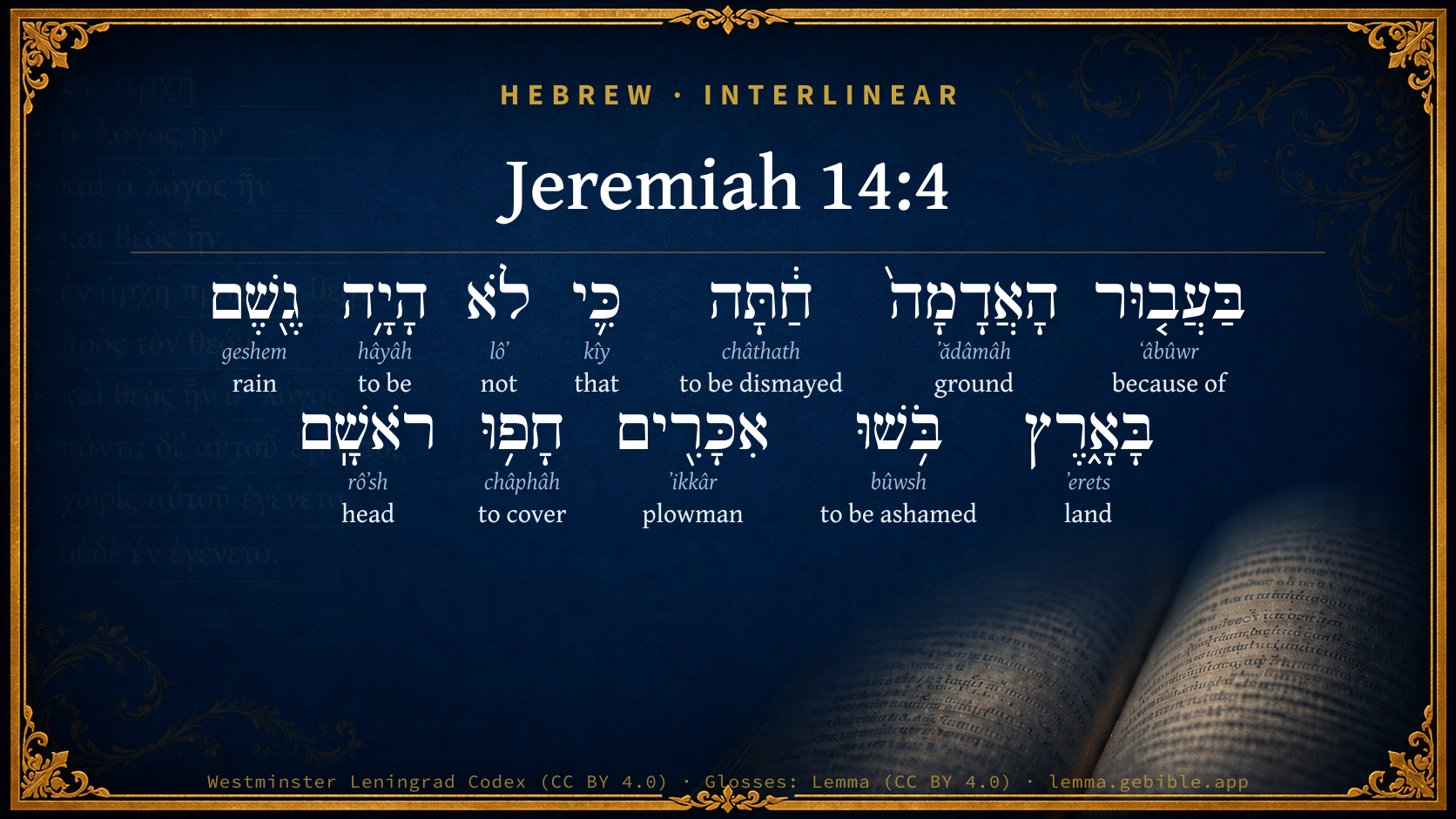
Hebrew (Westminster Leningrad Codex) Jeremiah 14:4 appears in the Hebrew Old Testament. The text above is from the Westminster Leningrad Codex. Each word links to its Strong’s number, a concise gloss, and parsing drawn from the Open Scriptures Hebrew Bible morphology. Click any word for its full Brown-Driver-Briggs (BDB) entry.
Download image
Cite this verse

Jeremiah 14:4 (World English Bible). Public Domain. Lemma interlinear Bible study tool, https://lemma.gebible.app/v/jeremiah/14/4.

Show BibTeX & RIS
BibTeX
RIS
English Translation
Because of the ground which is cracked, because no rain has been in the land, the plowmen are disappointed, they cover their heads.
World English Bible · Public Domain
Download a study sheet

One document with this verse’s original text, its word-by-word gloss line, the meaning frame, cross-references with their text, attributed commentary, and full source and license credits — printable, and it pastes into notes with its structure intact.

This verse Autodidact and up

Study sheet (.html) Plain text (.txt)

A passage Seminary Student

Up to 50 verses in one chapter. A passage sheet keeps up to 6 commentary sources and 12 cross-references per verse, in the order this page ranks them, and says so on the sheet whenever that leaves anything out. Ask for a single verse and you get the Autodidact verse sheet above.

Everything on this page stays free to read, with no account — the sheet is a download of what is already on screen, not access to it.

Want to remove ads? Support Godless Engineer
Compare translations 3

The same verse in 3 English versions, stacked beneath the original-language interlinear above. Click any original word for its lexicon entry.

Each is an independent rendering of the whole verse — the interlinear is not word-aligned to these translations.

Highlighted words mark where these versions differ — a whole-verse word diff, not a word-by-word alignment.

  • World English Bible Public Domain
    Because of the ground which is cracked, because no rain has been in the land, the plowmen are disappointed, they cover their heads.
  • King James Version Public Domain
    Because the ground is chapt, for there was no rain in the earth, the plowmen were ashamed, they covered their heads.
  • unfoldingWord Literal Text CC BY-SA 4.0
    Because the ground is dismayed, since there is not rain in the land, the farmers are ashamed; they cover their head.

unfoldingWord Literal Text — © unfoldingWord, licensed CC BY-SA 4.0. Word-aligned USFM3 via Door43 (git.door43.org/unfoldingWord/en_ult).

Versions to compare (up to 4)

3 of 4 selected

Show all 18 translations

Every available English version of this verse, each an independent rendering of the whole verse.

  • World English Bible Public Domain
    Because of the ground which is cracked, because no rain has been in the land, the plowmen are disappointed, they cover their heads.
  • Berean Standard Bible Public Domain
    The ground is cracked because no rain has fallen on the land. The farmers are ashamed; they cover their heads.
  • Majority Standard Bible Public Domain
    The ground is cracked because no rain has fallen on the land. The farmers are ashamed; they cover their heads.
  • King James Version Public Domain
    Because the ground is chapt, for there was no rain in the earth, the plowmen were ashamed, they covered their heads.
  • American Standard Version (1901) Public Domain
    Because of the ground which is cracked, for that no rain hath been in the land, the plowmen are put to shame, they cover their heads.
  • Revised Version (1885) Public Domain
    Because of the ground which is chapt, for that no rain hath been in the land, the plowmen are ashamed, they cover their heads.
  • Geneva Bible (1599) Public Domain
    For the grounde was destroyed, because there was no rayne in the earth: the plowmen were ashamed, and couered their heads.
  • Douay-Rheims (1899) Public Domain
    For the destruction of the land, because there came no rain upon the earth, the husbandmen were confounded, they covered their heads.
  • Young's Literal Translation Public Domain
    Because the ground hath been broken, For there hath been no rain in the land, Ashamed have been husbandmen, They have covered their head.
  • Literal Standard Version CC BY-SA 4.0
    Because the ground has been broken, || For there has been no rain in the land, || Farmers have been ashamed, || They have covered their head.
  • Unlocked Literal Bible CC BY-SA 4.0
    Because of this the ground is cracked, for there is no rain in the land. The plowmen are ashamed and cover their heads.
  • unfoldingWord Literal Text CC BY-SA 4.0
    Because the ground is dismayed, since there is not rain in the land, the farmers are ashamed; they cover their head.
  • Darby Bible Public Domain
    Because the ground is chapt, for there hath been no rain on the earth, the ploughmen are ashamed, they cover their heads.
  • World Messianic Bible Public Domain
    Because of the ground which is cracked, because no rain has been in the land, the plowmen are disappointed. They cover their heads.
  • Webster's Bible Public Domain
    Because the ground is chapt, for there was no rain on the earth, the plowmen were ashamed, they covered their heads.
  • Free Bible Version CC BY-SA 4.0
    The ground has dried up because there hasn't been any rain in the land. The farmers are ashamed; they cover their heads.
  • Bible in Basic English Public Domain
    Those who do work on the land are in fear, for there has been no rain on the land, and the farmers are shamed, covering their heads.
  • JPS Tanakh (1917) Public Domain
    Because of the ground which is cracked, for there hath been no rain in the land, the plowmen are ashamed, they cover their heads.

Literal Standard Version (2020), Covenant Press — licensed CC BY-SA 4.0. Text via the HelloAO Bible API (eBible.org). Unlocked Literal Bible (unfoldingWord) — licensed CC BY-SA 4.0. Text via the HelloAO Bible API (eBible.org). unfoldingWord Literal Text — © unfoldingWord, licensed CC BY-SA 4.0. Word-aligned USFM3 via Door43 (git.door43.org/unfoldingWord/en_ult). Free Bible Version, Dr. Jonathan Gallagher — licensed CC BY-SA 4.0. Text via the HelloAO Bible API (eBible.org).

Word by word

More ways to search: Search by grammar → Find every occurrence → Compare this word →

Practice this passage: Drill this verse → Learn its vocabulary →

אִכָּרִ֖ים
ʼikkâr
H406
“plowmen”
Noun, Common, Masculine, Plural, Absolute
Part of Speech
Noun
Type
Common
Gender
Masculine
Number
Plural
State
Absolute
Full BDB Definition

Origin: from an unused root meaning to dig

TWOT: 88a

plowman, husbandman, farmer - working the land, yet not owning any of it
  1. בַּעֲב֤וּר ʻâbûwr H5668 “in/at · because of of” Preposition + Noun, Common, Masculine, Singular, Construct
  2. הָאֲדָמָה֙ ʼădâmâh H127 “the · ground” Particle, Definite Article + Noun, Common, Feminine, Singular, Absolute
  3. חַ֔תָּה châthath H2865 “to be dismayed” Verb, Qal, Perfect, 3rd Person, Feminine, Singular
  4. כִּ֛י kîy H3588 “that” Conjunction
  5. לֹא lôʼ H3808 “not” Particle, Negative
  6. הָיָ֥ה hâyâh H1961 “to be” Verb, Qal, Perfect, 3rd Person, Masculine, Singular
  7. גֶ֖שֶׁם geshem H1653 “rain” Noun, Common, Masculine, Singular, Absolute
  8. בָּאָ֑רֶץ ʼerets H776 “in/at the · land” Preposition, Determined + Noun, Common, Both, Singular, Absolute
  9. בֹּ֥שׁוּ bûwsh H954 “to be ashamed” Verb, Qal, Perfect, 3rd Person, Common, Plural
  10. חָפ֥וּ châphâh H2645 “to cover” Verb, Qal, Perfect, 3rd Person, Common, Plural
  11. רֹאשָֽׁם rôʼsh H7218 “head · their” Noun, Common, Masculine, Singular, Construct + Suffix, Personal, 3rd Person, Masculine, Plural

About this verse

These counts appear in no published source. They are computed here, from the morphology-tagged text and Lemma’s own curated glosses. What Lemma adds →

12
words
12
distinct lemmas
Prophets
section

Notable vocabulary

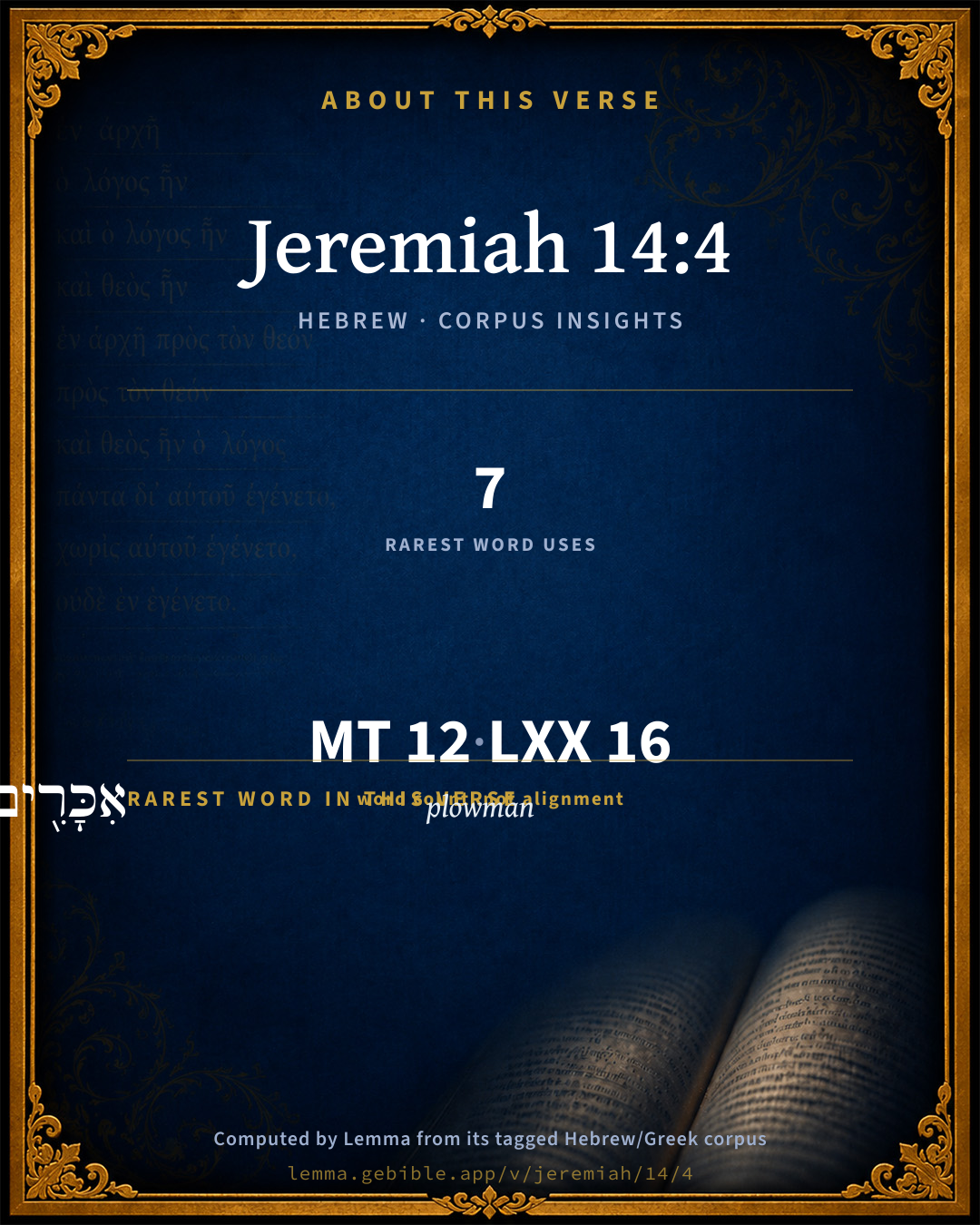
The rarest word here is אִכָּרִ֖ים plowman H406 — appearing just 7 times in the whole Hebrew Bible.

Shared distinctive vocabulary

אִכָּרִ֖ים plowman H406 occurs in 7 verses of the Hebrew Bible. Also found in:

Grammatical profile

  • 4 verbs
  • 6 nouns
  • 1 conjunction
  • 1 particle

Verb forms

  • חַ֔תָּה Qal · Perfect
  • הָיָ֥ה Qal · Perfect
  • בֹּ֥שׁוּ Qal · Perfect
  • חָפ֥וּ Qal · Perfect

Hebrew & Septuagint length

In the original languages it is 12 Hebrew tokens and 16 Greek tokens — but the two are counted differently (Hebrew bundles its prefixes and suffixes into one token; the Greek is in lemma form), so that isn’t a like-for-like length.

Cross-references

7

Topical passages linked to Jeremiah 14:4 in the Treasury of Scripture Knowledge — connected by theme and wording, ordered by reader-vote popularity; previews shown in the World English Bible.

  • Joel 1:11 Be confounded, you farmers! Wail, you vineyard keepers; For the wheat and for the barley; For the harvest of the field has perished.
  • Joel 1:19–20 Yahweh, I cry to you, For the fire has devoured the pastures of the wilderness, And the flame has burned all the trees of the field.
  • Jeremiah 3:3 Therefore the showers have been withheld, and there has been no latter rain; yet you have a prostitute's forehead, you refused to be ashamed.
  • Leviticus 26:19–20 I will break the pride of your power, and I will make your sky like iron, and your soil like brass;
  • Deuteronomy 29:23 [and that] the whole land of it is sulfur, and salt, [and] a burning, [that] it is not sown, nor bears, nor any grass grows therein, like the overthrow of Sodom and Gomorrah, Admah and Zeboiim, which Yahweh overthrew in his anger, and in his wrath:
  • Joel 1:17 The seeds rot under their clods. The granaries are laid desolate. The barns are broken down, for the grain has withered.
  • Deuteronomy 28:23–24 Your sky that is over your head shall be brass, and the earth that is under you shall be iron.

Cross-references courtesy of OpenBible.info (CC BY 4.0).

Hebrew and Greek witnesses Masoretic Hebrew ↔ Greek Septuagint

The same verse in the two great witnesses to the Old Testament, shown verse-for-verse.

These are two independent witnesses, not word-aligned to each other, and the Septuagint is shown in lemma (dictionary) form.

Hebrew Jeremiah 14:4 Masoretic · Westminster Leningrad Codex

בַּעֲב֤וּר הָאֲדָמָה֙ חַ֔תָּה כִּ֛י לֹא הָיָ֥ה גֶ֖שֶׁם בָּאָ֑רֶץ בֹּ֥שׁוּ אִכָּרִ֖ים חָפ֥וּ רֹאשָֽׁם

Because of the ground which is cracked, because no rain has been in the land, the plowmen are disappointed, they cover their heads.

World English Bible · Public Domain

Greek LXX Structure differs

In the Septuagint, Jeremiah is about an eighth shorter than the Hebrew and arranges its material differently — the Oracles Against the Nations (Hebrew chapters 46–51) appear in the middle of the Greek book, after 25:13. Because the chapter and verse boundaries do not line up, a verse-for-verse comparison with the Hebrew is not shown.

A verse-for-verse comparison isn’t shown here because the chapters and verses don’t line up. Switch to the LXX edition with the MT / LXX toggle above to read the Greek directly.

On this verse, The Cambridge Bible for Schools and Colleges discusses the Septuagint’s reading. Read the note in Commentary ↓

Hebrew: Westminster Leningrad Codex (CC BY 4.0). Greek: Septuagint (public domain); English from a public-domain English Septuagint. How the Septuagint differs from the Hebrew →

Targum (Aramaic paraphrase)

1

The Targum is the ancient Jewish Aramaic paraphrase of the Hebrew Scriptures — an interpretive translation, not the Hebrew text itself. Onkelos (literal) and Pseudo-Jonathan (expansive) render the Torah, and Jonathan the Prophets. Coverage is partial: where no permissively-licensed English translation exists for a verse, only the Aramaic is shown. This is verse-level text, not a word-by-word alignment to the Hebrew.

  1. Targum Jonathan Prophets (Joshua–Malachi)
    בְּדִיל חוֹבֵי יַתְבֵי אַרְעָא אִתְבָרוּ אֲרֵי לָא הֲוָה מִטְרָא בְּאַרְעָא בְּהִיתוּ אִכָּרַיָא וַחֲפוֹ רֵישֵׁיהוֹן:

    (no public-domain English translation for this verse)

    Targum Jonathan — Aramaic: “Mikraot Gedolot” (public domain). English: “Sefaria Community Translation” (CC0 1.0 (public-domain dedication)); “London "Chaldee Paraphrase," 1871” (public domain). Text via Sefaria.

Commentary

Notes on Jeremiah 14:4 from classic Christian and Jewish commentators (each source and its license shown beneath its notes). The classic Christian expositions comment on the surrounding passage and are grouped to its opening verse, so a note may address several verses; the Jewish commentaries on the Tanakh (Rashi and others) are per-verse, so they appear only where the commentator wrote on this verse.

Lemma curates 59 commentaries, every one of them public domain or Creative Commons licensed, each selected and text-cleaned for this edition rather than reprinted as found. About our sources →

Trapp's Complete Commentary

John Trapp

Jer 14:4 Because the ground is chapt, for there was no rain in the earth, the plowmen were ashamed, they covered their heads.

Ver. 4. Because the ground is chapt.] As our hearts also are and will be, when the heaven doth not hear the earth. {as Hos 2:21} It hath been before observed, that in the use of the ordinances, if we open our shells (our souls), the heaven will drop the fruitful dew of grace to the making of pearls of good works and solid virtue.

John Trapp, A Commentary or Exposition upon All the Books of the Old and New Testament (1647–1656) — public domain. Text from a community e-Sword module.

Tyndale Open Study Notes

Tyndale Open Resources

14:4-6 Both people and animals were helpless in the drought. • The farmers would cover their heads with coarse burlap to express shame, humiliation, and mourning.

Tyndale Open Study Notes — © Tyndale Open Resources, licensed CC BY-SA 4.0. Text via the HelloAO Bible API.

Adam Clarke's Commentary

Verse 4. The ground is chapt] The cracks in the earth before the descent of the rains are in some places a cubit wide, and deep enough to receive the greater part of a human body.

Adam Clarke's Commentary on the Bible (1810–1826) — public domain. Text from a community e-Sword/MySword module.

John Calvin's Commentaries

The Prophet had said, that though the whole common people were sent to the waters, yet none would be found. He now adds the same firing respecting the husbandmen. Ashamed, he says, shall be the husbandmen, for the ground shall be turned into dust, and God will pound it small. When the heavens supply moisture, the earth retains thus its solid character; but in a great heat we see the earth dissolving into dust, as though it was pounded in a mortar.

So he says, On account of the chapt ground, because there is no rain, ashamed shall be the husbandmen, and they shall cover their heads; for sorrow shall not only seize on them, but also fin them with such shame as to make them to shun the light and the sight of men. These things were intended for the same purpose, even to make the Jews to know that they were not by chance deprived of water, but because God had cursed their land, so that it yielded them no water even for the common wants of nature. It follows —

John Calvin's Commentaries (1540-1563) — public domain. Text from the Calvin Translation Society English edition (1840s-50s) via the Christian Classics Ethereal Library (ccel.org). Calvin's coverage is partial (roughly two-thirds of the Bible); uncommented books and verses are honest gaps, never fabricated. The 19th-century editor's footnotes and remarks are omitted so the notes are faithfully Calvin's own voice.

Ellicott's Commentary for English Readers

(4) The ground is chapt.—The word is so vivid as describing the long fissures of the soil in a time of drought that one admits with reluctance that no such meaning is found in the Hebrew word, which simply means is struck with terror. The translators apparently followed Luther, who gives lechzet—“languishes for thirst,” “gapes open with exhaustion,” and so applied to the earth, “is cracked or chapt.”

As the “gates” in Jer_14:2 stood for the people of the city, so the “ground” stands here as in visible sympathy with the tillers of the soil, the “plowmen” of the next clause.

They covered their heads.—There is a singular, almost awful, pathos in the iteration of this description. Cities and country alike are plunged into the utter blackness of despair.

A Bible Commentary for English Readers, edited by Charles John Ellicott (1878–1897) — public domain. Text from a community e-Sword module.

The Cambridge Bible for Schools and Colleges

gen. ed. J. J. S. Perowne

4. Because of the ground, etc.] rather, according to Du.’s excellent emendation, with a slight change in MT., virtually supported by LXX, The tillers of the ground are dismayed. This enables us to restore (with mg.) to the verb rendered “chapt,” but elsewhere used only of persons, its right sense, thus at the same time re-establishing parallelism of clauses.

The Cambridge Bible for Schools and Colleges (gen. ed. J. J. S. Perowne; Cambridge University Press, 1878–1918) — public domain. Text from a community e-Sword module.

John Gill's Exposition

Because the ground is chapt,.... Through the violent heat of the sun, and want of rain; or, is broken (y); and crumbles into dust. The Targum is,

"because of sins, the inhabitants of the earth are broken:''

for there was no rain in the earth; this was the reason of the dearth, and of the famine, and why there was no water in the pits, and the ground was parched. It is to be understood of the land of Judea only, not of the whole earth:

the ploughmen were ashamed; because they could not work the earth with their plough; were obliged to sit still, could do no work, or go on with their husbandry; nothing could be done for want of rain: they covered their heads; as before; See Gill on Jer 14:3.

(y) "confracta", Schmidt; "attritam", Junius & Tremellius, Piscator.

John Gill's Exposition of the Whole Bible (1746–1763) — public domain (CC PDM 1.0). Text via the HelloAO Bible API.

Albert Barnes' Notes on the Bible

Is chapt - Rather, is dismayed. “The ground” is used metaphorically for the people who until the ground.

In the earth - i. e., “in the land.”

Albert Barnes' Notes on the Bible (1834–1885) — public domain. Text from a community e-Sword/MySword module.

Matthew Poole's English Annotations

The Hebrew word signifieth more largely than chapt, broken, spoiled, turned into dust, as is usual in great droughts. The word also which we translate ploughmen, doth not strictly signify ploughmen, but husbandmen: there having been no rain upon the earth, it brought forth little or no grass for those that employed themselves in breeding or feeding cattle; and it was so hard, and so much wanted moisture, that they could not plough nor sow, but were like men ashamed and confounded, who knew not what to do.

Matthew Poole's English Annotations on the Holy Bible (1683–1685) — public domain. Text from a community e-Sword/MySword module.

Whedon's Commentary on the Bible

Daniel D. Whedon

4. Chapped — Rather, dismayed, or confounded. The Hebrew, more frequently than western languages, speaks of inanimate things as animate.

The earth — Rather, the land.

Daniel D. Whedon (gen. ed.), Commentary on the Old and New Testaments (1874–1909) — public domain. Text from a community e-Sword module.

The Pulpit Commentary

The ground is chapt. Perhaps: but it is more obvious to render, is dismayed, according to the usual meaning of the word. Words which properly belong to human beings are often, by a "poetic fallacy," applied to inanimate objects (as in Ver. 2). In the earth; rather, in the land.

The Pulpit Commentary (1880–1919), ed. H.D.M. Spence-Jones & Joseph S. Exell — public domain. Text from a community e-Sword module.

unfoldingWord translationNotes

Door43 World Missions Community

General Information:

Yahweh, through the prophet Jeremiah, has continued to tell the people about the drought.

The plowmen are ashamed and cover their heads

In biblical times, people would wear a headcovering to show that they were ashamed. (See: Symbolic Action)

the doe leaves her young in the fields and abandons them

These two phrase have the same meaning and emphasize that the doe leaves her young deer because she cannot provide for them. A doe is a female deer. AT: "the deer leaves her young in the field" (See: Parallelism)

for there is no grass

This means that there is no grass for the deer to eat. AT: "for there is no grass for them to eat" (See: Assumed Knowledge and Implicit Information)

they pant in the wind like jackals

This speaks of the donkeys panting because they are thirsty by saying that they pant like jackals. Jackals are fiece wild dog which pant a lot. AT: "they pant in the wind like thirsty jackals" (See: Simile)

Their eyes fail to work, for there is no vegetation

"They become blind because there is no grass to eat"

translationWords

donkey

works

unfoldingWord translationNotes — © Distant Shores Media and the Door43 World Missions Community, licensed CC BY-SA 4.0. Source: git.door43.org/Door43/en_tn.

Rashi

Rabbi Shlomo Yitzchaki (Rashi)

farmers bubirs [?] in O.F.

Rashi on the Tanakh — English translations: “The Judaica Press complete Tanach with Rashi, translated by A. J. Rosenberg” (CC BY 4.0); “Pentateuch with Rashi's commentary by M. Rosenbaum and A.M. Silbermann, 1929-1934” (public domain); “The Metsudah Tanach series, Lakewood, N.J” (CC BY 4.0); and “The Book of Joshua, Metsudah Publications, 1997” (CC BY 4.0). Text via Sefaria.

Lesson kit

Teaching starters — assembled from the data on this page, not authored interpretation. Every prompt links to the verse data it draws on. Edit before teaching.

Jeremiah, in the Prophets, opens this verse with 12 words (12 distinct Hebrew lemmas). Its most distinctive word is ʼikkâr (“plowman”). A historical commentator’s framing appears above. Read the whole chapter for the surrounding context.

Discussion questions

  1. What does “plowman” (ʼikkâr) contribute to the verse as a whole?
  2. 2 Chronicles 26:10 shares the word «plowman» with this verse. How do the two illuminate each other?
  3. The translations on this page render this verse differently — a whole-verse word diff, not a word-by-word alignment. What might account for the different wordings?
  4. The verb «חַ֔תָּה» is Qal Perfect. How does its form color the action?
  5. Reading how Trapp's Complete Commentary and Tyndale Open Study Notes read this verse, where do the two commentators agree and where do they part?

Things to notice

Reading settings

Reading text

Shown beneath each verse's original-language words.

Old Testament
Old Testament edition

Read the OT as the Masoretic Hebrew (MT) or the Greek Septuagint (LXX).

English shown for the Greek Septuagint (in the Hebrew ↔ Greek comparison).

Comparing translations? Open the Compare panel on any verse page to stack up to four side by side.