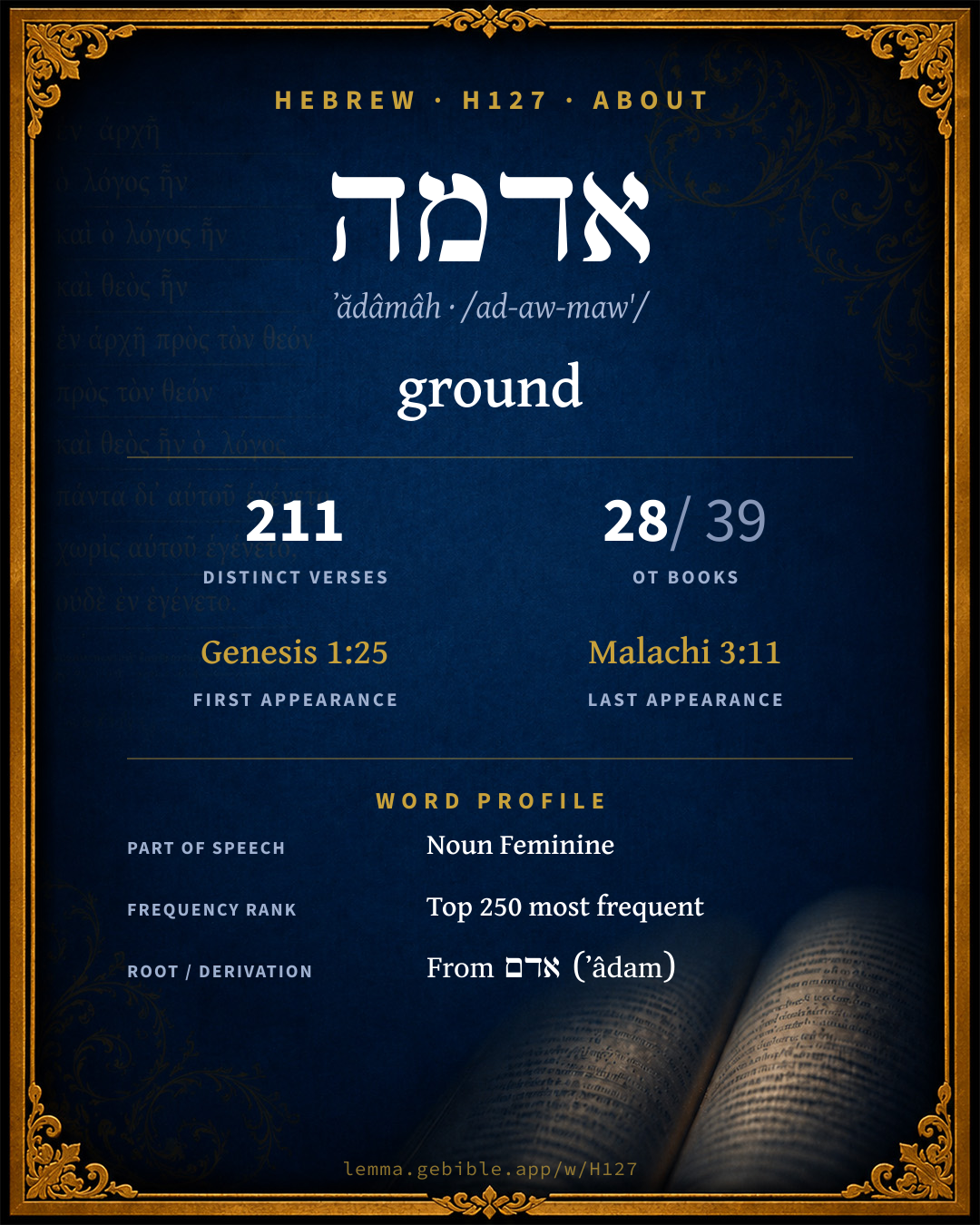
אֲדָמָה
ground
‘ground’ is one of 8 main senses fuller range ↓
Full lexicon entry — Brown-Driver-Briggs (BDB)
From Brown-Driver-Briggs (BDB)
Where this word appears
See every Absolute-state word in the Hebrew Bible →
Grammar key — what these labels mean
Part of speech
- Noun
- A naming word — a person, place, thing, or idea.
Noun type
- Common
- A common noun — a general class of person, place, or thing (“king,” “city,” “water”), not a specific name.
State
- Absolute
- The independent form of a noun, not bound to a following word.
- Construct
- A noun bound to a following noun in a possessive / “of” relationship (the construct chain).
Gender
- Feminine
- Grammatically feminine.
Number
- Singular
- One.
- Plural
- More than one (in Hebrew, generally three or more).
Every verse where H127 appears in the Book of Nehemiah — 4 distinct verses. Click any verse to open its interlinear word-by-word view. Verse text shown in the World English Bible for context — . Each verse’s Hebrew form is shown with its reference; the English is not keyword-highlighted, since the data carries no word-level English alignment. Use “Compare translations” on any verse to read it across multiple English versions. This concordance covers the Hebrew Bible; Septuagint (Greek Old Testament) occurrences are not indexed here.
Nehemiah
- Nehemiah 9:1 וַ/אֲדָמָ֖ה conj + n c fs Now in the twenty-fourth day of this month the children of Israel were assembled with fasting, and with sackcloth, and earth on them.
- Nehemiah 9:25 וַ/אֲדָמָ֣ה conj + n c fs They took fortified cities, and a fat land, and possessed houses full of all good things, cisterns hewn out, vineyards, and olive groves, and fruit trees in abundance: so they ate, and were filled, and became fat, and delighted themselves in your great goodness.
- Nehemiah 10:35 אַדְמָתֵ֗/נוּ n c fs cs + sfx pers 1cp and to bring the first fruits of our ground, and the first fruits of all fruit of all manner of trees, year by year, to the house of Yahweh;
- Nehemiah 10:37 אַדְמָתֵ֖/נוּ n c fs cs + sfx pers 1cp and that we should bring the first fruits of our dough, and our heave-offerings, and the fruit of all manner of trees, the new wine and the oil, to the priests, to the chambers of the house of our God; and the tithes of our ground to the Levites; for they, the Levites, take the tithes in all the cities of our tillage.
About this entry
At a glance — auto-summarized from this page’s data, not written by a person. Every figure links to its source below. This summary describes the numbers; it doesn’t interpret them.
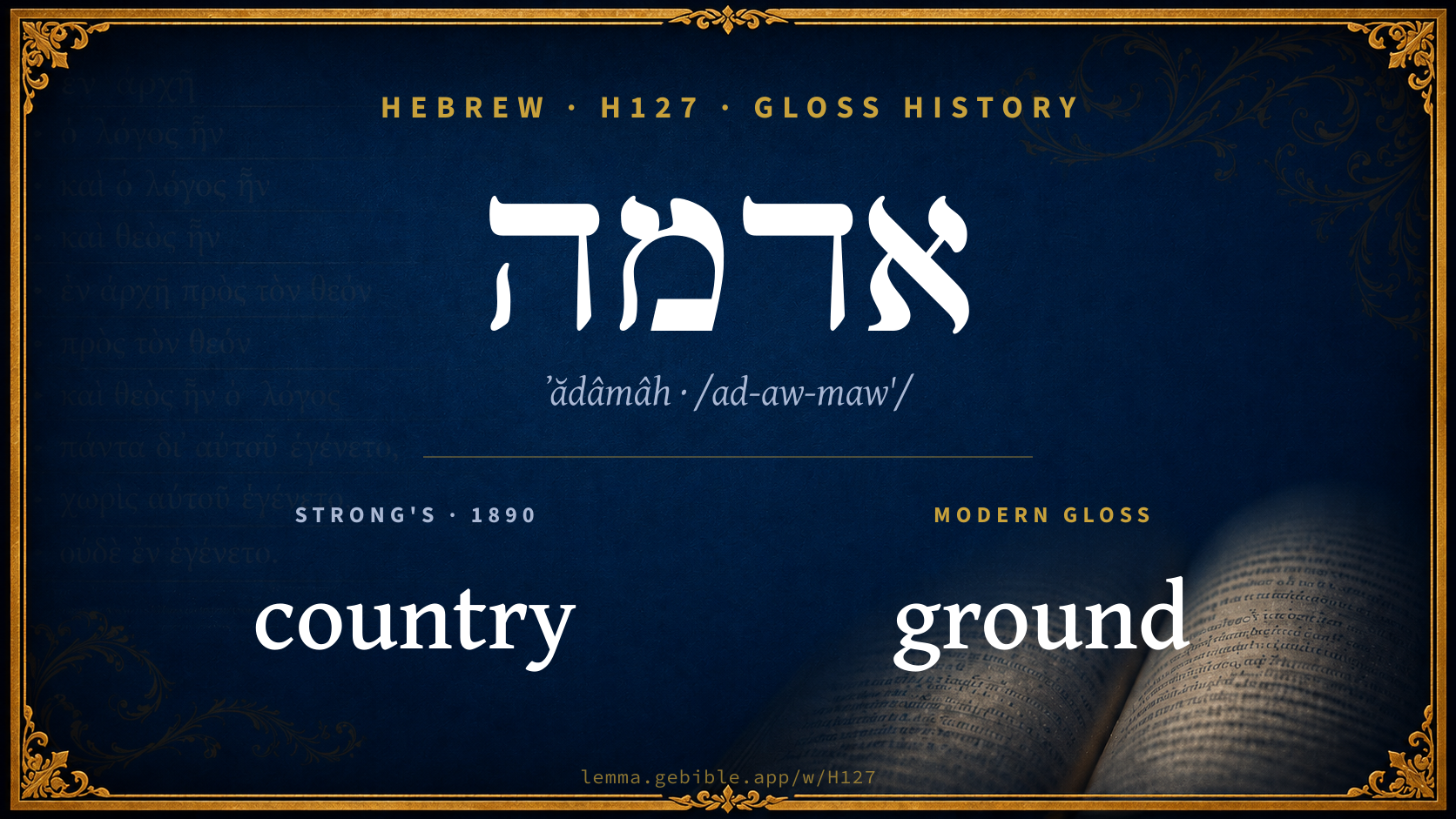
At its core, אדמה (ʼădâmâh) means “ground.” Its English rendering has broadened — “land” classically, “ground” (unfoldingWord Literal Text) in modern versions; see the renderings breakdown. Spanning 211 verses in 28 books, it ranks among the common words of the Hebrew Bible. It first appears in Genesis 1:25. Not a single-sense word: explore its full sense range. Each statement above links to its evidence; the full detail follows below.
Gloss history
Strong's 1890 vs modern scholarship
About this word
Strong's H127 catalogs a Hebrew word from the Hebrew Old Testament.
These counts are not copied from any lexicon or concordance. They are computed here, from the morphology-tagged Hebrew Old Testament. What Lemma adds →
- 211
- distinct verses
- The word appears in 211 distinct verses.
- 28 / 39
- OT books
- The word appears in 28 of 39 Old Testament books.
- #210
- by frequency
- Top 250 most frequent Hebrew words (rank 210 of 8,640 Hebrew words by occurrence).
View all 211 occurrences in the concordance →
Most concentrated in
- Genesis 37 verses 18%
- Deuteronomy 35 verses 17%
- Ezekiel 27 verses 13%
By section of the Old Testament
By traditional corpus
Conventional, traditional groupings — biblical authorship is debated, so this is a traditional corpus grouping, not an authorship claim. Each share is this word’s portion of its verses in that division of the Hebrew canon. Each figure is a share of the word’s 211 distinct verses.
- Prophets (Nevi'im) 99 verses · 47%
- Torah (Pentateuch) 88 verses · 42%
- Writings (Ketuvim) 24 verses · 11%
How translations render this word
Counts come from each version’s own published word-to-Strong’s tagging or interlinear alignment — an approximate guide to how each version renders this word, not a word-level alignment the data otherwise carries. Because each total is that version’s own tagged count, the per-version totals vary from one another and need not match the appearance or distinct-verse counts above. These counts may also differ from a printed concordance because Lemma counts each distinctly tagged rendering and does not collapse phrase taggings into a single head-word total. This is a fixed set of word-tagged versions (KJV, ASV, BSB, ULT) and does not change with the reading translation you choose elsewhere. Each version’s license is shown beside its name below (and on Sources).
- King James Version: Land 88×, Earth 52×, Ground 41×
- American Standard Version: Land 68×, Ground 58×, Earth 32×
- Berean Standard Bible: Land 106×, Ground 38×, Earth 34×
- unfoldingWord Literal Text: Ground 91×, Land 90×, Earth 18×
King James Version Public Domain
Renders H127 across 222 tagged occurrences — most commonly:
Plus 19 renderings that appear only once — usually multi-word phrases or single function words the recovered tagging swept in, not distinct renderings. Not rendered by a distinct English word in 3 further occurrences.
American Standard Version Public Domain
Renders H127 across 221 tagged occurrences — most commonly:
Plus 38 renderings that appear only once — usually multi-word phrases or single function words the recovered tagging swept in, not distinct renderings.
Berean Standard Bible Public Domain
Renders H127 across 220 tagged occurrences — most commonly:
Plus 10 renderings that appear only once — usually multi-word phrases or single function words the recovered tagging swept in, not distinct renderings. Not rendered by a distinct English word in 5 further occurrences.
unfoldingWord Literal Text CC BY-SA 4.0
Renders H127 across 230 tagged occurrences — most commonly:
Plus 5 renderings that appear only once — usually multi-word phrases or single function words the recovered tagging swept in, not distinct renderings.
7 senses and sub-senses in the full BDB
What do BDB’s symbols mean?
BDB uses these scholarly abbreviations:
| Symbol | Meaning |
|---|---|
| 𝔊 | the Septuagint (the ancient Greek translation, LXX) |
| 𝔙 | the Vulgate (the Latin translation) |
| 𝔖 | the Syriac version (the Peshitta) |
| 𝔗 | the Targum (the Aramaic translation) |
| ψ | the Psalms |
| √ | root (the underlying root or stem) |
| ‖ | parallel passage (a synonymous or contrasted parallel) |
| † | the dagger: every passage where the word occurs is cited |
The 7 senses and sub-senses the full Brown-Driver-Briggs lexicon distinguishes for this word, in lexicon order (not ranked by frequency), with BDB’s own verbatim wording and sub-sense lettering. Shown in Hebrew script with BDB’s own scholarly abbreviations. The condensed entry is in the Lexicon Entry tab. See also the Forms in the corpus table below.
- 1. ground (as tilled, yielding sustenance) Gn 2:5, 9; 3:17, 23; 4:2, 3, 12; 5:29; 8:21; 19:25; 47:23 Ex 34:26 (all J); Ex 23:19 (E) Dt 7:13; 11:17; 26:2, 10, 15; 28:4, 11, 18, 33, 42, 51; 30:9; 2 S 9:10 Is 1:7; 28:24; 30:23(×2), 24 Je 7:20; 14:4; 25:33 Hg 1:11 Mal 3:11 ψ 83:11; 105:35 Pr 12:11 28:19 1 Ch 27:26 Ne 10:36, 38 cf. fig. Jb 5:6 (‖ עפר); personif. 31:38 Jo 1:10; also אִישׁ הָא׳ Gn 9:20 (J) tiller, husbandman; meton. אֹהֵב א׳ 2 Ch 26:10 i.e. lover of husbandry (or do these point to earlier meaning tillage? cf. DlPr 105) אִישׁ עֹבֵד א׳ Zc 13:5. e.g. Genesis 2:5
- 2. piece of ground, landed property Gn 47:18, 19(×3), 20, 22(×2), 23, 26 (all J) ψ 49:12 (pl.) e.g. Genesis 47:18
- 3. earth as material substance; of wh. man is made Gn 2:7 (עָפָר מִן־הָא׳); so animals v 19 (מִן־הָא׳); altar Ex 20:24; earthen vessels חַרְשֵׂי א׳ Is 45:9, on head, sign of woe 1 S 4:12 2 S 1:2; 15:32; of contrition Ne 9:1 (cf. אֵפֶר, עָפָר); מַעֲבֵה הָא׳ 1 K 7:46 cf. 2 Ch 4:17 (firmness of earth, firm earth, clay-ground, for casting-moulds; or clay-moulds (Be)? or is this n.pr.? Klo proposes בַּמְּעָרָה הָאֲדֻמָּה in the red cave); mule-loads of 2 K 5:17; in it lie the dead מִיְּשֵׁנֵי אַדְמַת־עָפָר Dn 12:2 cf. Gn 3:19, 23 ψ 146:4. e.g. Genesis 2:7
- 4. ground as earth’s visible surface; רֶמֶס הָא׳ Gn 1:25; 6:20 (both P) Ho 2:20 cf. Gn 7:8; 9:2 (J?) Lv 20:25 (P) Dt 4:18 Ez 38:20; also Gn 4:10 (J) Is 24:21 Am 3:5 Zp 1:2, 3; as wet with dew 2 S 17:12; rain 1 K 17:14; 18:1; cf. personif. פָּֽצְתָה הָא׳ אֶת־פִּיהָ Nu 16:30 (P) (‖ ארץ v 32), vid. v 31 Gn 4:11; of partic. place, spot א׳ קֹדֶשׁ Ex 3:5 especially as abode of man Ex 10:6 Dt 4:10, 40; 12:1 1 S 20:31 2 S 14:7; oft.פְּנֵי הָא׳ Gn 2:6; 4:14; 6:1, 7; 7:4, 23; 8:8, 13 Ex 32:12; 33:16 Nu 12:3 Dt 6:15; 7:6 (all J, D) 1 S 20:15 + 9 textual e.g. Genesis 1:25
- 5. land, territory, country (= ארץ Gn 47:19 (J) Lv 20:24 (J?—‖ ארץ) cstr. bef. n.pr. א׳ מִצְרַיִם Gn 47:20, 26; א׳ יְהוּדָה Is 19:17; א׳ יִשְׂרָאֵל Ez 11:17 + 16 textual Ez; espe. of land as promised or given by י׳ to his people = Canaan Gn 28:15 Ex 20:12 Nu 11:12; 32:11 (all J?) Dt 5:16 + 16 textual Dt, Jos; 1 K 8:34, 40 +, Je 16:15; 24:10; 25:5; 35:15 Ez 28:25 2 Ch 6:25, 31; 7:20; 33:8; cf. also Dt 12:19; 21:23; 29:27 2 K 17:23 Is 6:11; 7:16; 14:1 +, Ez 34:13, 27 +, Ne 9:25 (א׳ שְׁמֵנָה),—in all c. 41 textual + Jo 2:21 (personif.); א׳ הַקֹּדֶשׁ Zc 2:16 (cf. sub 4 supr. hence also as Yahweh’s land Dt 32:43 Is 14:2 Zc 9:16 2 Ch 7:20. e.g. Genesis 47:19
- 6. whole earth, inhabited earth (seld.; cf. also פְּנֵי הָא׳ sub 4 supr.) Gn 12:3; 28:14 (both J cf. אֶרֶץ 18:18; 22:18; 26:4) Dt 14:2 Am 3:2 Is 24:21. e.g. Genesis 12:3
- 7. n.pr.loc. city in Naphtali (as built cf. אָדָם 4? = ed-Dâme?) W. of L. Gennes. Jos 19:36 v. Di. e.g. Joshua 19:36
Senses from the full Brown-Driver-Briggs lexicon (Brown, Driver, Briggs; Oxford 1906 — public domain), digitized via Sefaria, supplemented by the OpenScriptures HebrewLexicon (CC BY 4.0). Full attribution on Sources.
Word origin
n.f. ground, land (as tilled, Ger. bebaut? DlPr 105, but Fleisch. (MerxArchiv I, 236 f) comp. Ar. أَدَمَة skin, as smoothly covering & close-fitting; √דם cf. Ar. دَمَّ smear (spread over surface); cf. also NöZMG 1886, 737)—א׳ Gn 1:25 +; cstr. אַדְמַת Gn 47:20 +; sf. אַדְמָתִי Jb 31:38 + 2 textual etc.; pl. אֲדָמוֹת ψ 49:12—
— Brown-Driver-Briggs (Oxford 1906, public domain), digitized via Sefaria, supplemented by the OpenScriptures HebrewLexicon (CC BY 4.0). See Sources.
Derived from אדם (ʼâdam) (H119) — to be red.
Jastrow Dictionary
A second Hebrew/Aramaic lexicon for comparison, covering Aramaic and post-biblical (Talmudic, Targumic, Midrashic) usage that the biblical-Hebrew BDB does not. Matched by lemma rather than by Strong’s number, so a lemma may carry more than one Jastrow headword (shown separately below), and the entries cover usage well beyond the Bible.
אֲדָמָה
- , cmp. foreg.; thick and moist) [earth], clay. Gen. R. s. 14 the potter takes sand (עפר) which is male (masc. gender) and clay (אדמה) which is female (fem. gender).—Sabb. VIII, 5 א׳ כחותם וכ׳ as much clay as is required for a seal on bag-knots. [For the meaning of the phonetic equivalents of our w. in other Semit. tongues, v. Ges. H. Dict. s. v.]
A Dictionary of the Targumim, the Talmud Babli and Yerushalmi, and the Midrashic Literature (Marcus Jastrow; London, Luzac, 1903) — Public Domain. Digitized via Sefaria. Digitized via Sefaria. Full attribution on Sources.
Forms in the corpus
The 81 distinct written forms H127 takes in the Hebrew Bible, most frequent first — each parse links to that state’s occurrences in the concordance. Hebrew forms include their vowel points and cantillation, so a single lemma takes many written forms.
The 60 most common forms are shown; 21 rarer forms follow in the full concordance.
Same root — word family
Other BDB entries built from the same root as H127, grouped by Strong’s listed origin. These share a root / origin per the lexicon — not necessarily a shared meaning. Each links to that word’s own entry.
Derives from
Shares the same root
- אדם ʼâdâm H120 man
- אדם ʼâdôm H122 red
- אדם ʼôdem H124 ruby
- אדמדם ʼădamdâm H125 reddish
- אדמני ʼadmônîy H132 red
Proper names from this root
People and places named from this root — a name, not an additional meaning of the word.
Compare all same-root words → Showing 4 of 10 — not the complete family. 3 of the same-root words are proper names (people or places). They share a root, not necessarily a meaning.
Septuagint verse parallels
This word appears in 203 verses that also exist in the Greek Old Testament (Septuagint), out of the 211 Hebrew verses it occurs in. You can read those verses in Greek by switching the Old Testament edition to the Septuagint.
Read these verses in the Septuagint
- Genesis 1:25
- Exodus 3:5
- Leviticus 20:24
- Numbers 11:12
- Deuteronomy 4:10
- Joshua 23:13
- 1 Samuel 4:12
- 2 Samuel 1:2
- 1 Kings 7:46
- 2 Kings 5:17
- 1 Chronicles 27:26
- 2 Chronicles 4:17
This is a verse-level parallel only — the same verses exist in both the Hebrew and Greek Old Testaments. No word-level Hebrew↔Greek correspondence is claimed: the data carries no such alignment, so no Greek word is shown as this Hebrew word’s translation. Coverage is not total — the Septuagint omits the deuterocanon and renumbers the Psalms, so some Hebrew verses have no direct Greek parallel.