Exodus 23:19

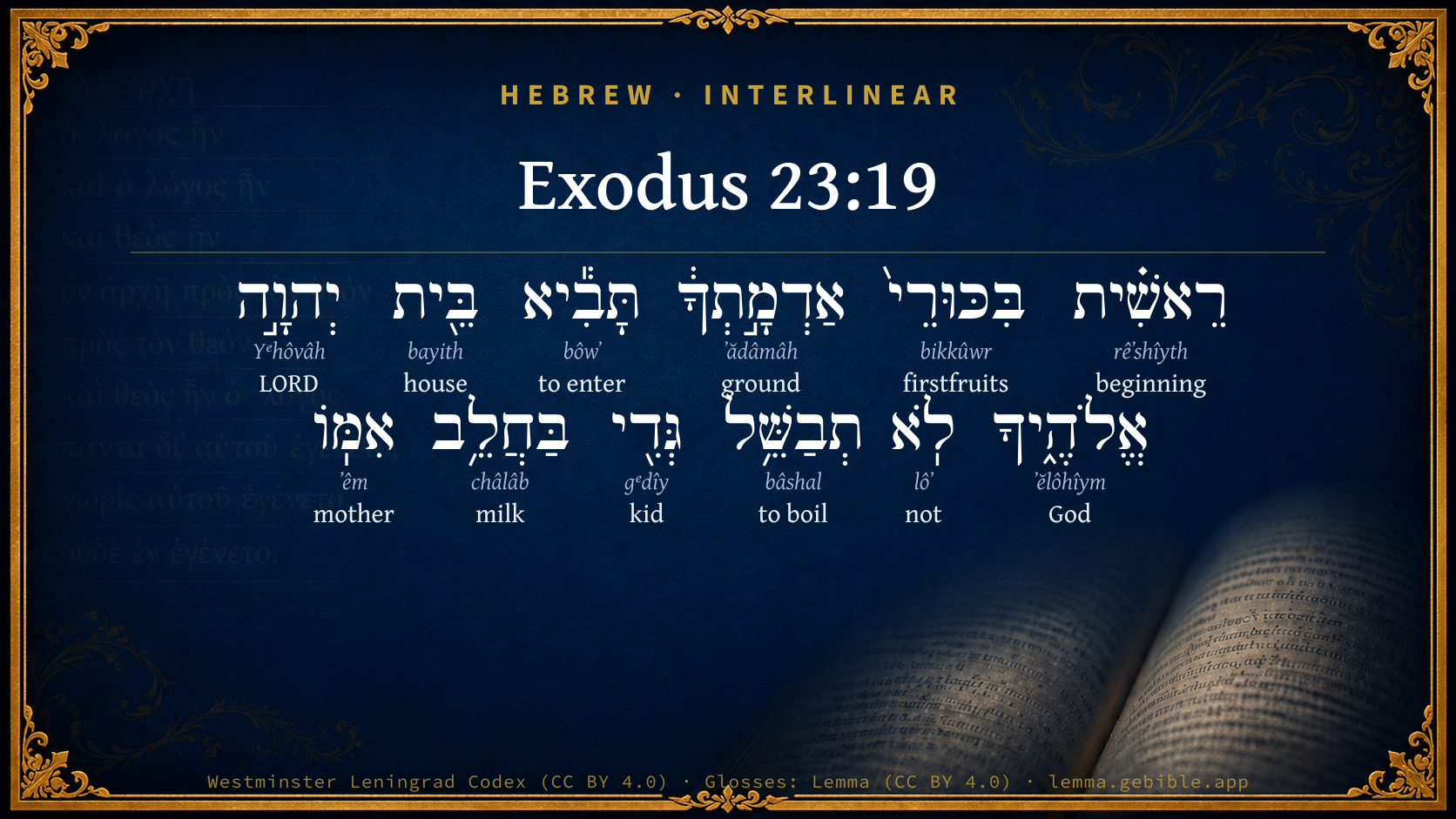
Hebrew (Westminster Leningrad Codex) Exodus 23:19 appears in the Hebrew Old Testament. The text above is from the Westminster Leningrad Codex. Each word links to its Strong’s number, a concise gloss, and parsing drawn from the Open Scriptures Hebrew Bible morphology. Click any word for its full Brown-Driver-Briggs (BDB) entry.
Download image
Cite this verse

Exodus 23:19 (World English Bible). Public Domain. Lemma interlinear Bible study tool, https://lemma.gebible.app/v/exodus/23/19.

Show BibTeX & RIS
BibTeX
RIS
English Translation
The first of the first fruits of your ground you shall bring into the house of Yahweh your God. "You shall not boil a kid in its mother's milk.
World English Bible · Public Domain
Download a study sheet

One document with this verse’s original text, its word-by-word gloss line, the meaning frame, cross-references with their text, attributed commentary, and full source and license credits — printable, and it pastes into notes with its structure intact.

This verse Autodidact and up

Study sheet (.html) Plain text (.txt)

A passage Seminary Student

Up to 50 verses in one chapter. A passage sheet keeps up to 6 commentary sources and 12 cross-references per verse, in the order this page ranks them, and says so on the sheet whenever that leaves anything out. Ask for a single verse and you get the Autodidact verse sheet above.

Everything on this page stays free to read, with no account — the sheet is a download of what is already on screen, not access to it.

Want to remove ads? Support Godless Engineer
Compare translations 3

The same verse in 3 English versions, stacked beneath the original-language interlinear above. Click any original word for its lexicon entry.

Each is an independent rendering of the whole verse — the interlinear is not word-aligned to these translations.

Highlighted words mark where these versions differ — a whole-verse word diff, not a word-by-word alignment.

  • World English Bible Public Domain
    The first of the first fruits of your ground you shall bring into the house of Yahweh your God. "You shall not boil a kid in its mother's milk.
  • King James Version Public Domain
    The first of the firstfruits of thy land thou shalt bring into the house of the LORD thy God. Thou shalt not seethe a kid in his mother's milk.
  • unfoldingWord Literal Text CC BY-SA 4.0
    You shall bring the first of the firstfruits of your ground to the house of Yahweh your God. You shall not boil a young goat in the milk of its mother.

unfoldingWord Literal Text — © unfoldingWord, licensed CC BY-SA 4.0. Word-aligned USFM3 via Door43 (git.door43.org/unfoldingWord/en_ult).

Versions to compare (up to 4)

3 of 4 selected

Show all 18 translations

Every available English version of this verse, each an independent rendering of the whole verse.

  • World English Bible Public Domain
    The first of the first fruits of your ground you shall bring into the house of Yahweh your God. "You shall not boil a kid in its mother's milk.
  • Berean Standard Bible Public Domain
    Bring the best of the firstfruits of your soil to the house of the LORD your God. You must not cook a young goat in its mother’s milk.
  • Majority Standard Bible Public Domain
    Bring the best of the firstfruits of your soil to the house of the LORD your God. You must not cook a young goat in its mother’s milk.
  • King James Version Public Domain
    The first of the firstfruits of thy land thou shalt bring into the house of the LORD thy God. Thou shalt not seethe a kid in his mother's milk.
  • American Standard Version (1901) Public Domain
    The first of the first-fruits of thy ground thou shalt bring into the house of Jehovah thy God. Thou shalt not boil a kid in it mother's milk.
  • Revised Version (1885) Public Domain
    The first of the firstfruits of thy ground thou shalt bring into the house of the LORD thy God. Thou shalt not seethe a kid in its mother’s milk.
  • Geneva Bible (1599) Public Domain
    The first of the first fruites of thy lande thou shalt bring into the house of the Lord thy God: yet shalt thou not seeth a kid in his mothers milke.
  • Douay-Rheims (1899) Public Domain
    Thou shalt carry the firstfruits of the corn of thy ground to the house of the Lord thy God. Thou shalt not boil a kid in the milk of his dam.
  • Young's Literal Translation Public Domain
    the beginning of the first-fruits of thy ground thou dost bring into the house of Jehovah thy God; thou dost not boil a kid in its mother's milk.
  • Literal Standard Version CC BY-SA 4.0
    the beginning of the first-fruits of your ground you bring into the house of your God YHWH; you do not boil a kid in its mother’s milk.
  • Unlocked Literal Bible CC BY-SA 4.0
    You must bring the choicest firstfruits from your land into my house, the house of Yahweh your God. You must not boil a young goat in its mother's milk.
  • unfoldingWord Literal Text CC BY-SA 4.0
    You shall bring the first of the firstfruits of your ground to the house of Yahweh your God. You shall not boil a young goat in the milk of its mother.
  • Darby Bible Public Domain
    The first of the first-fruits of thy land thou shalt bring into the house of Jehovah thy God. Thou shalt not boil a kid in its mother's milk.
  • World Messianic Bible Public Domain
    You shall bring the first of the first fruits of your ground into the house of the LORD your God. “You shall not boil a young goat in its mother’s milk.
  • Webster's Bible Public Domain
    The first of the first-fruits of thy land thou shalt bring into the house of the LORD thy God. Thou shalt not seethe a kid in his mother's milk.
  • Free Bible Version CC BY-SA 4.0
    Bring the best firstfruits of your crops to the house of the Lord your God. Don't cook a young goat in its mother's milk.
  • Bible in Basic English Public Domain
    The best of the first-fruits of your land are to be taken into the house of the Lord your God. The young goat is not to be cooked in its mother's milk.
  • JPS Tanakh (1917) Public Domain
    The choicest first-fruits of thy land thou shalt bring into the house of the LORD thy God. Thou shalt not seethe a kid in its mother's milk.

Literal Standard Version (2020), Covenant Press — licensed CC BY-SA 4.0. Text via the HelloAO Bible API (eBible.org). Unlocked Literal Bible (unfoldingWord) — licensed CC BY-SA 4.0. Text via the HelloAO Bible API (eBible.org). unfoldingWord Literal Text — © unfoldingWord, licensed CC BY-SA 4.0. Word-aligned USFM3 via Door43 (git.door43.org/unfoldingWord/en_ult). Free Bible Version, Dr. Jonathan Gallagher — licensed CC BY-SA 4.0. Text via the HelloAO Bible API (eBible.org).

Word by word

More ways to search: Search by grammar → Find every occurrence → Compare this word →

Practice this passage: Drill this verse → Learn its vocabulary →

גְּדִ֖י
gᵉdîy
H1423
“kid”
Noun, Common, Masculine, Singular, Absolute
Part of Speech
Noun
Type
Common
Gender
Masculine
Number
Singular
State
Absolute
Full BDB Definition

Origin: from the same as H1415

TWOT: 314b

kid, young male goat
  1. רֵאשִׁ֗ית rêʼshîyth H7225 “beginning of” Noun, Common, Feminine, Singular, Construct
  2. בִּכּוּרֵי֙ bikkûwr H1061 “firstfruits of” Noun, Common, Both, Plural, Construct
  3. אַדְמָ֣תְךָ֔ ʼădâmâh H127 “ground · your” Noun, Common, Feminine, Singular, Construct + Suffix, Personal, 2nd Person, Masculine, Singular
  4. תָּבִ֕יא bôwʼ H935 “to enter” Verb, Hiphil, Imperfect, 2nd Person, Masculine, Singular
  5. בֵּ֖ית bayith H1004 “house of” Noun, Common, Masculine, Singular, Construct
  6. יְהוָ֣ה Yᵉhôvâh H3068 “LORD” Noun, Proper
  7. אֱלֹהֶ֑יךָ ʼĕlôhîym H430 “God(s) · your” Noun, Common, Masculine, Plural, Construct + Suffix, Personal, 2nd Person, Masculine, Singular
  8. לֹֽא lôʼ H3808 “not” Particle, Negative
  9. תְבַשֵּׁ֥ל bâshal H1310 “to boil” Verb, Piel, Imperfect, 2nd Person, Masculine, Singular
  10. בַּחֲלֵ֥ב châlâb H2461 “in/at · milk of” Preposition + Noun, Common, Masculine, Singular, Construct
  11. אִמּֽוֹ ʼêm H517 “mother · his” Noun, Common, Feminine, Singular, Construct + Suffix, Personal, 3rd Person, Masculine, Singular

About this verse

These counts appear in no published source. They are computed here, from the morphology-tagged text and Lemma’s own curated glosses. What Lemma adds →

12
words
12
distinct lemmas
Pentateuch
section

Notable vocabulary

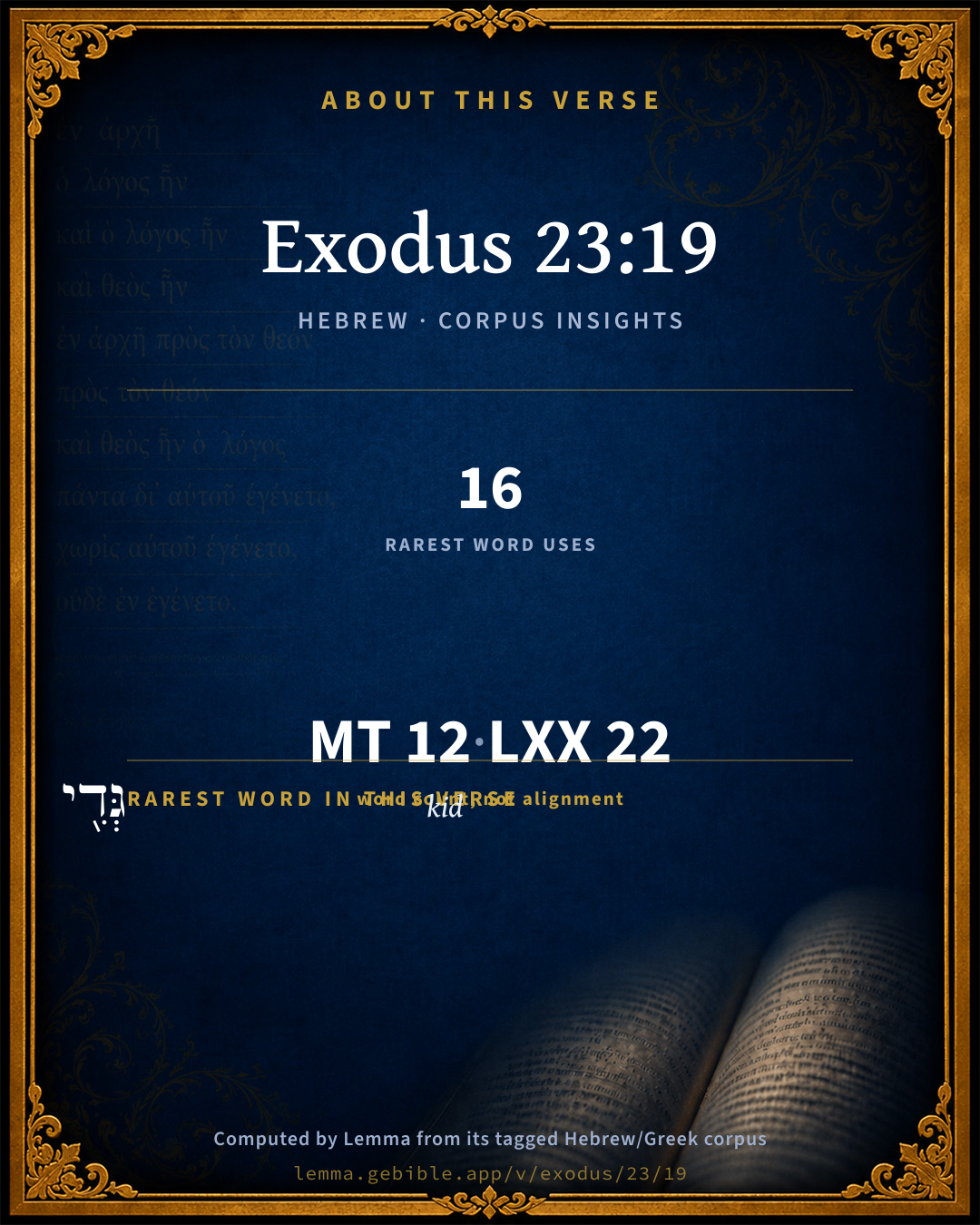
The rarest word here is גְּדִ֖י kid H1423 — appearing just 16 times in the whole Hebrew Bible.

Shared distinctive vocabulary

גְּדִ֖י kid H1423 occurs in 16 verses of the Hebrew Bible. Also found in:

Grammatical profile

  • 2 verbs
  • 9 nouns
  • 1 particle

Verb forms

  • תָּבִ֕יא Hiphil · Imperfect
  • תְבַשֵּׁ֥ל Piel · Imperfect

Hebrew & Septuagint length

In English translation the verse runs 29 words from the Hebrew and 30 from the Septuagint (LXX English) — closely comparable.

A rough comparison of the two English renderings, which tokenize alike — not a word-level alignment.

Word counts can differ between the Hebrew and the Greek without any difference in meaning — e.g. the Hebrew direct-object marker אֵת has no separate Greek word, and Greek often adds the article ὁ.

In the original languages it is 12 Hebrew tokens and 22 Greek tokens — but the two are counted differently (Hebrew bundles its prefixes and suffixes into one token; the Greek is in lemma form), so that isn’t a like-for-like length.

Cross-references

13

Topical passages linked to Exodus 23:19 in the Treasury of Scripture Knowledge — connected by theme and wording, ordered by reader-vote popularity; previews shown in the World English Bible.

  • Exodus 34:26 You shall bring the first of the first fruits of your ground to the house of Yahweh your God. You shall not boil a young goat in its mother's milk."
  • Deuteronomy 14:21 You shall not eat of anything that dies of itself: you may give it to the foreigner living among you who is within your gates, that he may eat it; or you may sell it to a foreigner: for you are a holy people to Yahweh your God. You shall not boil a kid in its mother's milk.
  • Deuteronomy 26:10 Now, behold, I have brought the first of the fruit of the ground, which you, Yahweh, have given me. You shall set it down before Yahweh your God, and worship before Yahweh your God:
  • Exodus 22:29 "You shall not delay to offer from your harvest and from the outflow of your presses. "You shall give the firstborn of your sons to me.
  • Nehemiah 10:35 and to bring the first fruits of our ground, and the first fruits of all fruit of all manner of trees, year by year, to the house of Yahweh;
  • Numbers 18:12–13 All the best of the oil, and all the best of the vintage, and of the grain, the first fruits of them which they give to Yahweh, to you have I given them.
  • Deuteronomy 26:2 that you shall take of the first of all the fruit of the ground, which you shall bring in from your land that Yahweh your God gives you; and you shall put it in a basket, and shall go to the place which Yahweh your God shall choose, to cause his name to dwell there.
  • Proverbs 12:10 A righteous man regards the life of his animal, But the tender mercies of the wicked are cruel.
  • Jeremiah 10:3 For the customs of the peoples are vanity; for one cuts a tree out of the forest, the work of the hands of the workman with the axe.
  • 1 Corinthians 15:20 But now Christ has been raised from the dead. He became the first fruits of those who are asleep.
  • Revelation 14:4 These are those who were not defiled with women, for they are virgins. These are those who follow the Lamb wherever he goes. These were redeemed by Jesus from among men, the first fruits to God and to the Lamb.
  • Leviticus 23:10–17 "Speak to the children of Israel, and tell them, 'When you have come into the land which I give to you, and shall reap its the harvest, then you shall bring the sheaf of the first fruits of your harvest to the priest:
  • Deuteronomy 12:5–7 But to the place which Yahweh your God shall choose out of all your tribes, to put his name there, even to his habitation shall you seek, and there you shall come;

Cross-references courtesy of OpenBible.info (CC BY 4.0).

Hebrew and Greek witnesses Masoretic Hebrew ↔ Greek Septuagint

The same verse in the two great witnesses to the Old Testament, shown verse-for-verse.

These are two independent witnesses, not word-aligned to each other, and the Septuagint is shown in lemma (dictionary) form.

Hebrew Exodus 23:19 Masoretic · Westminster Leningrad Codex

רֵאשִׁ֗ית בִּכּוּרֵי֙ אַדְמָ֣תְךָ֔ תָּבִ֕יא בֵּ֖ית יְהוָ֣ה אֱלֹהֶ֑יךָ לֹֽא תְבַשֵּׁ֥ל גְּדִ֖י בַּחֲלֵ֥ב אִמּֽוֹ

The first of the first fruits of your ground you shall bring into the house of Yahweh your God. "You shall not boil a kid in its mother's milk.

World English Bible · Public Domain

Greek LXX Exodus 23:19 Septuagint · lemma form

ὁ ἀπαρχή ὁ πρωτογένημα ὁ γῆ σύ εἰςφέρω εἰς ὁ οἶκος κύριος ὁ θεός σύ οὐ ἕψω ἀρνός ἐν γάλα μήτηρ αὐτός

You shall bring the first-offerings of the first fruits of your land into the house of the Lord your God. You shall not seethe a lamb in its mother's milk.

LXX2012 (modern English Septuagint) · Public Domain

On this verse, The Cambridge Bible for Schools and Colleges discusses the Septuagint’s reading. Read the note in Commentary ↓

Hebrew: Westminster Leningrad Codex (CC BY 4.0). Greek: Septuagint (public domain); English from LXX2012 (modern English Septuagint) (Public Domain). How the Septuagint differs from the Hebrew →

Targum (Aramaic paraphrase)

2

The Targum is the ancient Jewish Aramaic paraphrase of the Hebrew Scriptures — an interpretive translation, not the Hebrew text itself. Onkelos (literal) and Pseudo-Jonathan (expansive) render the Torah, and Jonathan the Prophets. Coverage is partial: where no permissively-licensed English translation exists for a verse, only the Aramaic is shown. This is verse-level text, not a word-by-word alignment to the Hebrew.

  1. Targum Onkelos Torah (Genesis–Deuteronomy)
    רֵישׁ בִּכּוּרֵי אַרְעָךְ תַּיְתִי לְבֵית מִקְדְשָׁא דַיְיָ אֱלָהָךְ לָא תֵיכְלוּן בְּשַׂר בַּחֲלָב:

    (no public-domain English translation for this verse)

    Targum Onkelos — Aramaic: “Onkelos Genesis” (public domain); “Onkelos Exodus” (public domain); “Onkelos Leviticus” (public domain); “Onkelos Numbers” (public domain); “Onkelos Deuteronomy” (public domain). English: “Sefaria Community Translation” (CC0 1.0 (public-domain dedication)); “J.W. Etheridge. The Targums of Onkelos and Jonathan Ben Uzziel on the Pentateuch. London: Longmans, Green, 1862” (public domain). Text via Sefaria.

  2. Targum Pseudo-Jonathan Torah (Genesis–Deuteronomy)
    שֵׁירוּי בִּיכוּרֵי פֵּירֵי אַרְעָךְ תַּיְתֵי לְבֵית מַקְדְּשָׁא דַיְיָ אֱלָהָךְ עַמִּי בֵּית יִשְרָאֵל לֵית אַתּוּן רְשָׁאִין לָא לִמְבַשְׁלָא וְלָא לְמֵיכוּל בְּשַר וַחֲלַב מְעַרְבִין כַּחֲדָא דְלָא יִתְקַף רוּגְזִי וְאִיבְשֵׁיל עִיבּוּרֵיכוֹן דְּגָנָא וְקַשָׁא תְּרֵיהוֹן כַּחֲדָא

    The first of the choice fruits of thy ground thou shalt bring to the sanctuary of the Lord thy God. My people of the house of Israel, you are not permitted to dress or to eat of flesh and milk mingled together, lest I be greatly displeased; and I prepare you the wheat and the straw together for your food.

    Targum Pseudo-Jonathan — Aramaic: “Targum Jonathan on Genesis” (public domain); “Targum Jonathan on Exodus” (public domain); “Targum Jonathan on Leviticus” (public domain); “Targum Jonathan on Numbers” (public domain); “Targum Jonathan on Deuteronomy” (public domain). English: “The Targum of Jonathan ben Uzziel, trans. J. W. Etheridge, London, 1862” (public domain). Text via Sefaria.

Commentary

Notes on Exodus 23:19 from classic Christian and Jewish commentators (each source and its license shown beneath its notes). The classic Christian expositions comment on the surrounding passage and are grouped to its opening verse, so a note may address several verses; the Jewish commentaries on the Tanakh (Rashi and others) are per-verse, so they appear only where the commentator wrote on this verse.

Lemma curates 59 commentaries, every one of them public domain or Creative Commons licensed, each selected and text-cleaned for this edition rather than reprinted as found. About our sources →

Ellicott's Commentary for English Readers

(19) The first of the firstfruits—i.e., the very first that ripen. There was a natural tendency to “delay” the offering (Exo_22:29) until a considerable part of the harvest had been got in. True gratitude makes a return for benefits received as soon as it, can. “Bis dat qui cito dat.”

The house of the Lord. Comp. Exo_34:26 and Deu_23:18. It is known to Moses that the “place which God will choose to put his name there” is to be a “house,” or “temple.”

Thou shalt not seethe a kid.—A fanciful exegesis connects the four precepts of Exo_23:18-19 with the three feasts—the two of Exo_23:18 with the Paschal festival, that concerning firstfruits in Exo_23:19 with the feast of ingathering, and this concerning kids with the feast of tabernacles. To support this theory it is suggested that the command has reference to a superstitious practice customary at the close of the harvest—a kid being then boiled in its mother’s milk with magic rites, and the milk used to sprinkle plantations, fields, and gardens, in order to render them more productive the next year. But Deu_14:21, which attaches the precept to a list of unclean meats, is sufficient to show that the kid spoken of was boiled to be eaten. The best explanation of the passage is that of Bochart (Hierozoic. pt. 1, bk. 2, Exo. 52), that there was a sort of cruelty in making the milk of the mother, intended for the kid’s sustenance, the means of its destruction.

A Bible Commentary for English Readers, edited by Charles John Ellicott (1878–1897) — public domain. Text from a community e-Sword module.

Trapp's Complete Commentary

John Trapp

Exo 23:19 The first of the firstfruits of thy land thou shalt bring into the house of the LORD thy God. Thou shalt not seethe a kid in his mother’s milk.

Ver. 19. The first of the firstfruits.] The best of the best is not to be held too good for God. His "soul hath desired the first ripe fruits." {Mic 7:1}

Thou shalt not seethe a kid.] Hereby seemeth to be forbidden either cruelty, or curiosity to please the palate. See my "Commonplace of Abstinence." The Jews at this day, in reference to this law, may not eat flesh and cheese or milk meats together.

John Trapp, A Commentary or Exposition upon All the Books of the Old and New Testament (1647–1656) — public domain. Text from a community e-Sword module.

The Biblical Illustrator

Joseph S. Exell

Exo_23:19

Thou shalt not seethe a kid.

Cherish the finer instinct

The prohibition suggests the duty of cherishing the finer instincts of our nature. The act here forbidden could hardly be called cruelty, the kid being dead, but it was unnatural. It is beautiful to see the ancient Law inculcating this rare and delicate fineness of feeling. The lesson is that everything is to be avoided which would tend to blunt our moral sensibilities. (J. Orr.)

The Biblical Illustrator, edited by Joseph S. Exell (c. 1880s–1900s) — public domain. Text from a community e-Sword module.

Joseph Benson's Commentary

Exo 23:19. Thou shalt not seethe a kid in his mother’s milk — It is remarkable that this command, extraordinary as it is, is repeated Exo 34:26, and Deu 14:21, and that, as here, in connection with the offering of the first-fruits. Hence it has been conjectured that it has a reference to the payment of these fruits, and to some superstitious practices which the Pagans used on these occasions, who were wont, it seems, when they had gathered in all the fruits of the earth, to boil a kid in its mother’s milk, and “to sprinkle the trees, and fields, and gardens, with the broth in a magical manner, to make them more fruitful the following year.” See Dr. Cudworth, On the Lord’s Supper, page 14. Some, however, with an appearance of probability, take this for a prohibition against offering any animal in sacrifice when it was milky and unformed, or before it was eight days old, till which time it was to be left with its dam, Exo 22:30. And others, again, consider the precept as being chiefly intended, like many other of God’s laws, to prevent cruelty toward the creatures, and to inculcate a mild and tender disposition.

Joseph Benson's Commentary on the Old and New Testaments (1811–1818) — public domain. Text from a community e-Sword module.

Tyndale Open Study Notes

Tyndale Open Resources

23:19 The significance of the command not to cook a young goat in its mother’s milk is unknown. Its inclusion at this point suggests that it may have been a pagan religious practice.

Tyndale Open Study Notes — © Tyndale Open Resources, licensed CC BY-SA 4.0. Text via the HelloAO Bible API.

Geneva Bible (1599)

Geneva Bible translators

Meaning, that no fruits should be taken before just time: and hereby are bridled all cruel and wanton appetites.

Geneva Bible (1599) marginal notes — public domain. Text via Bolls.life.

Jamieson, Fausset & Brown

Robert Jamieson, A. R. Fausset & David Brown

Thou shalt not seethe a kid in his mother's milk--A prohibition against imitating the superstitious rites of the idolaters in Egypt, who, at the end of their harvest, seethed a kid in its mother's milk and sprinkled the broth as a magical charm on their gardens and fields, to render them more productive the following season. [See on Deu 14:21].

Jamieson, Fausset & Brown — Commentary Critical and Explanatory on the Whole Bible (1871) — public domain (CC PDM 1.0). Text via the HelloAO Bible API.

Adam Clarke's Commentary

Verse 19. Thou shalt not seethe a kid in his mother's milk.] This passage has greatly perplexed commentators; but Dr. Cudworth is supposed to have given it its true meaning by quoting a MS. comment of a Karaite Jew, which he met with, on this passage. "It was a custom of the ancient heathens, when they had gathered in all their fruits, to take a kid and boil it in the milk of its dam; and then, in a magical way, to go about and besprinkle with it all their trees and fields, gardens and orchards; thinking by these means to make them fruitful, that they might bring forth more abundantly in the following year." - Cudworth on the Lord's Supper, 4to.

I give this comment as I find it, and add that Spenser has shown that the Zabii used this kind of magical milk to sprinkle their trees and fields, in order to make them fruitful. Others understand it of eating flesh and milk together; others of a lamb or a kid while it is sucking its mother, and that the paschal lamb is here intended, which it was not lawful to offer while sucking.

After all the learned labour which critics have bestowed on this passage, and by which the obscurity in some cases is become more intense, the simple object of the precept seems to be this: "Thou shalt do nothing that may have any tendency to blunt thy moral feelings, or teach thee hardness of heart." Even human nature shudders at the thought of causing the mother to lend her milk to seethe the flesh of her young one! We need go no farther for the delicate, tender, humane, and impressive meaning of this precept.

Adam Clarke's Commentary on the Bible (1810–1826) — public domain. Text from a community e-Sword/MySword module.

The Cambridge Bible for Schools and Colleges

gen. ed. J. J. S. Perowne

19a. Firstfruits to be brought to Jehovah’s house.

the first of the firstripe fruits] ‘Firstripe fruits’ (bikkurim) seems to be used here in the wider sense noticed on v. 16; and it is said either (Ges.) that the earliest, or (Kn., Ke.) that the first (i.e. the choicest, best: rçshîth as Amo_6:1; Amo_6:6), of these are to be presented to Jehovah: comp. esp. Eze_44:30. The rend. the best, (even) the firstripe fruits, of thy ground (Di., Benzinger, EB. iv. 4910, Nowack, Arch. ii. 256, Bä.) is less natural. As regards the relation of this law to that in v. 16, v. 16 alludes only to the bikkurim to be presented at the Feast of Weeks; the present law is wider, and would include for instance the firstfruits of the grape and olive harvest, which fell later in the year (according to the Mishna, bikkurim were offered on ‘seven kinds,’ viz. wheat, barley, vines, figtrees, pomegranates, oil, and honey: see Gray, Numbers., p. 228). It seems to be a parallel to the law in Exo_22:29; the two laws probably belonged originally to two distinct collections, and both were preserved on account of the difference in their form.

The amount of firstfruits to be offered is not prescribed; and is evidently left to the free will of the individual offerer (cf. v. 15b; Deu_16:17).

the house of Jehovah] The expression might denote the hêkal, or temple, at Shiloh (Jdg_18:31, 1Sa_1:7; 1Sa_1:24; 1Sa_3:15), or the Temple of Solomon (1Ki_8:10, and often): it might also, presumably, denote the local sanctuary nearest to the offerer’s own home; for these, or at least the principal ones, had almost certainly ‘houses’ or shrines (cf. 1Ki_12:31, 2Ki_17:32, Amo_7:13; Amo_9:1). The Tent of meeting might also perhaps be spoken of generally as the ‘house,’ or abode, of Jehovah; but the term is not a very natural one to apply to it; and where it does apparently denote the Tent of meeting (Jos_6:2 [but ‘the house of’ omitted in LXX., as in v. 19 in the Heb.], Exo_9:23 end), or the tent erected for the ark by David (2Sa_12:20; cf. 2Sa_6:17), is open to the suspicion of having been used by the writers on account of their familiarity with the Temple of Solomon (in 2Sa_7:6 a ‘tent’ denied to be a ‘house’). The present law must have been formulated it seems natural to think, without any reference to the Tent of meeting.

19b. A kid not to be boiled in its mother’s milk. Repeated verbatim, in the || Exo_34:26 b, and Deu_14:21 b. The law, to judge from its position beside ritual injunctions, will have had not, as might have been supposed, a humanitarian, but a religious motive. Di. and most suppose then it is aimed against some superstitious custom—perhaps (Maimonides; Spencer, Legg. Hebr. (1686), II. viii.; al.) that of using milk thus prepared as a charm for rendering fields and orchards more productive. Frazer (‘Folk-lore in the OT.,’ in Anthropological Essays presented to E. B. Tylor, Oxford, 1907, p. 151 ff.) quotes examples shewing that among many pastoral tribes in Africa there is a strong aversion to boiling milk, lest (on the principle of ‘sympathetic magic’) it should injure or even kill the cow which yielded it: but this case is not quite the same as the one here. Ibn Ezra (11 cent.) ad loc., and Burckhardt (Bedouins, i. 63), both mention boiling a lamb or kid in milk as an Arab custom.

The Cambridge Bible for Schools and Colleges (gen. ed. J. J. S. Perowne; Cambridge University Press, 1878–1918) — public domain. Text from a community e-Sword module.

John Gill's Exposition

Beware of him,.... Of his face or countenance; observe his looks towards you in a providential way, whether frowning or smiling; observe his directions and instructions, laws and commands:

and obey his voice; hearken to what he says, and cheerfully, readily, and punctually do as he orders:

provoke him not; by unbelief, by murmurings and complaints, by unbecoming words and actions, by transgressing his commands, and acting contrary to his will:

for he will not pardon your transgressions: or suffer them to pass unchastised and uncorrected, but will, as he did, take vengeance on their inventions, and on them because of them, though he forgave their iniquities; for that he was such an Angel as could forgive sin, which none but God can do, is evident; because it would be absurd to say he will not pardon, if he could not pardon their transgressions, see Mat 9:6,

for my name is in him; the Father is in the Son, and the Son in the Father; the nature and perfections of God are in the Word and Son of God, and so his name Jehovah, which is peculiar to him; Christ is Jehovah our righteousness: or "though my name is in him" (m); as Abendana and others, his name the Lord God, gracious and merciful, pardoning iniquity, transgression and sin, as afterwards proclaimed in him; and yet, notwithstanding this, he would not clear the guilty, or suffer the Israelites to go unpunished, if they offended him: the Targum of Onkelos is,"or in my name is his word,''he is my ambassador and speaks in my name.

(m) "quamvis nomen menum", Drusius.

John Gill's Exposition of the Whole Bible (1746–1763) — public domain (CC PDM 1.0). Text via the HelloAO Bible API.

Albert Barnes' Notes on the Bible

The first of the firstfruits of thy land - The “best,” or “chief” of the firstfruits, that is, the two wave loaves described Lev 23:17. As the preceding precept appears to refer to the Passover, so it is likely that this refers to Pentecost. They are called in Leviticus, “the firstfruits unto the Load;” and it is reasonable that they should here be designated the “chief” of the firstfruits. If, with some, we suppose the precept to relate to the offerings of firstfruits in general, the command is a repetition of Exo 22:29.

Thou shalt not seethe a kid in his mother’s milk - This precept is repeated. See the marginal references. If we connect the first of the two preceding precepts with the Passover, and the second with Pentecost, it seems reasonable to connect this with the Feast of Tabernacles. The only explanation which accords with this connection is one which refers to a superstitious custom connected with the harvest; in which a kid was seethed in its mother’s milk to propitiate in some way the deities, and the milk was sprinkled on the fruit trees, fields and gardens, as a charm to improve the crops of the coming year. Others take it to be a prohibition of a custom of great antiquity among the Arabs, of preparing a gross sort of food by stewing a kid in milk, with the addition of certain ingredients of a stimulating nature: and others take it in connection with the prohibitions to slaughter a cow and a calf, or a ewe and her lamb, on the same day Lev 22:28, or to take a bird along with her young in the nest Deu 22:6. It is thus understood as a protest against cruelty and outraging the order of nature.

Albert Barnes' Notes on the Bible (1834–1885) — public domain. Text from a community e-Sword/MySword module.

Haydock's Catholic Bible Commentary

Dam. The paschal victim must not be so young as to be still suckled. The Samaritan subjoins, "Because that would be like immolating an animal found dead, and the God of Jacob hates it." (Calmet) --- Some imagine that this law alludes to a superstitious custom of the pagans, (Spencer, Rit. ii. 8,) or it forbids eating animals while they are, as it were, all milk, not eight days old. (Rivet)

George Leo Haydock (1774–1849), Haydock's Catholic Family Bible and Commentary, 1859 edition — public domain. Excludes Psalms (Douay-Rheims chapter numbering differs from Protestant) and Deuterocanonical books (Catholic canon only).

Matthew Poole's English Annotations

This seems to be a general rule, extending to all the fruits which the earth first produced; in every kind of which the very first are here enjoined to be offered unto God, before they should presume to eat any of them. It may seem to be repeated here, where the year of rest is mentioned to leach them the first-fruits were to be given to God of all that the earth produced, not only by their labour and seed, as might be thought from Exo 23:16, but also of its own accord, as is here implied.

He names one kind, under which he understands a lamb, or a calf, &c., according to the use of Scripture style. This law many understand literally, and that it is forbidden to them, because the idolaters had such a custom, whereof yet there seems to be no sufficient proof; nor, if there were, doth it seem to be a rite of that importance or probability to entice the Israelites to imitate it, that there needed a particular law against this, more than against a hundred such ridiculous usages which were among the heathen, and are not taken notice of in the book of God’s laws. The words may be rendered thus,

Thou shalt not seethe, or roast, (for the word bashal signifies to roast as well as to boil, as it is evident from Deu 16:7)

a kid, being, or whilst it is (which is to be understood, there being nothing more common than an ellipsis of the verb substantive)

in his mother’s milk; which it may be said to be, either,

1. Whilst it sucks its mother’s milk; and so it may admit of a twofold interpretation:

(1.) That this is to be understood of the passover, of which most conceive he had now spoken, Exo 23:18, in which they used either a lamb or a kid, Exo 12:5, and then the word bashal must be rendered roast.

(2.) That this speaks not of sacrifice to God, wherein sucking creatures were allowed, Exo 22:30; Lev 22:27; 1Sa 7:9, but of man’s use; and so God ordained this, partly because this was unwholesome food, and principally to restrain cruelty, even towards brute creatures, and luxury in the use of them. Or rather,

2. Whilst it is very tender and young, rather of a milky than of a fleshy substance, like that young kid of which Juvenal thus speaks, Qui plus lactis habet quam sanguinis, i.e. which hath more milk than blood in it. And it may he said to be in its mother’s milk, by a usual hypallage, when its mother’s milk is in it, i.e. whilst the milk it sucks as it were, remains in it undigested and unconverted into flesh, even as a man is oft said to be in the Spirit, when indeed the Spirit is in him. And what is here indefinitely prohibited, is elsewhere particularly explained, and the time defined, to wit, that it be not offered to God before it was eight days old. And this interpretation may receive light and strength from hence, that the law of the firstfruits, which both here and Exo 34:26 goes immediately before this law, doth in Exo 22:30 immediately go before that law of not offering them before the eighth day, which implies, that both of them speak concerning the same thing, to wit, the first-fruits or first-born of the cattle, which were not to be offered to God while they were in their mother’s milk, saith this place, or till they were eight days old, saith that place. And consequently, if they might not be offered to God, they might not be used by men for food.

Matthew Poole's English Annotations on the Holy Bible (1683–1685) — public domain. Text from a community e-Sword/MySword module.

Whedon's Commentary on the Bible

Daniel D. Whedon

19. House of the Lord thy God — Observe that here, in this oldest Sinaitic legislation, one common sanctuary is contemplated for all the people.

Seethe a kid in his mother’s milk — Compare chap. 34:26, and Deu_14:21. The boiling of a young kid in the milk of its own mother would seem an outrage upon the laws of nature, in violating the sacred relationship of parent and offspring. Some writers have, not without reason, supposed that a contemporary superstitious practice of this kind existed among the heathen, and led to the enactment of this law. Thomson says that the Arabs are nowgiven to the practice of stewing a young kid in milk, mixed with onions and hot spices, and they call it “kid in his mother’s milk.” He observes, as the opinion of the Jews, “that it is unnatural and barbarous to cook a poor kid in that from which it derives its life. Many of the Mosaic precepts are evidently designed to cultivate gentle and humane feelings; but the ‘kid in his mother’s milk’ is a gross, unwholesome dish, calculated also to kindle up animal and ferocious passions.” — The Land and the Book, vol. i, p. 135.

Daniel D. Whedon (gen. ed.), Commentary on the Old and New Testaments (1874–1909) — public domain. Text from a community e-Sword module.

The Pulpit Commentary

Law of first-fruits. The first of the first-fruits may mean either "the best of the first-fruits", (see Num_18:12) or "the very first of each kind that is ripe" (ib, verse 13). On the tendency to delay, and not bring the very first, see the comment on Exo_22:29. The house of the Lord. Generally, in the Pentateuch we have the periphrasis" the place which the Lord thy God shall choose to put his name there"; (Deu_12:5, Deu_12:11, 14 16:16 26:2, etc.) but here, and in Exo_34:26, and again in Deu_23:18, this "place" is plainly declared to be a "house" or "temple.

Law against seething a kid in the mother"s milk. The outline of law put before the Israelites in the "Book of the Covenant" terminated with this remarkable prohibition. Its importance is shown

1. By its place here; and

2. By its being thrice repeated in the law of Moses. (see Exo_34:16; Deu_14:21) Various explanations have been given of it; but none is saris-factory, except that which views it as "a protest against cruelty, and outraging the order of nature," more especially that peculiarly sacred portion of nature"s order, the tender relation between parent and child, mother and suckling. No doubt the practice existed. Kids were thought to be most palatable when boiled in milk; and the mother"s milk was frequently the readiest to obtain. But in this way the mother was made a sort of accomplice in the death of her child, which men were induced to kill on account of the flavour that her milk gave it. Reason has nothing to say against such a mode of preparing food, but feeling revolts from it; and the general sense of civilised mankind reechoes the precept, which is capable of a wide applicationThou shalt not seethe a kind in his mother"s milk.

The Pulpit Commentary (1880–1919), ed. H.D.M. Spence-Jones & Joseph S. Exell — public domain. Text from a community e-Sword module.

John Wesley's Explanatory Notes

Some of the Gentiles, at the end of their harvest, seethed a kid in it's dam's milk, and sprinkled that milk-pottage in a magical way upon their gardens and fields, to make them fruitful. But Israel must abhor such foolish customs. Is not this rather forbidden, as having some appearance of cruelty?

John Wesley, Explanatory Notes Upon the Whole Bible (1754–1765) — public domain. Text via the GEBible commentary corpus.

Rashi

Rabbi Shlomo Yitzchaki (Rashi)

ראשית בכורי אדמתך THE FIRST OF THE FIRST-FRUITS OF THY GROUND [THOU SHALT BRING etc.] — Even in the seventh year the offering of the first fruits is obligatory in some cases, therefore here also (where Scripture mainly deals with the laws of the Sabbatical year) it is stated: “the first of the first-fruits of thy land [shalt thou bring, etc.]”. How was the procedure at the setting apart of the first fruits? A man goes into his field and sees a fig which was the first to ripen; he ties a piece of reed-grass round it to distinguish it and so marks its sacred character (Mishnah Bikkurim 3:1). The law of the first fruits applies only to the seven kinds of produce that are mentioned in Scripture: (Deuteronomy 8:8) “a land of wheat and barley etc.”, for which Palestine is praised in that verse (Mishnah Bikkurim 3:1).

לא תבשל גדי THOU SHALT NOT COOK A KID — A calf and a lamb also are comprehended under the term גדי, for גדי means nothing more than a young tender animal, as you may gather from the fact that you will find in several passages in the Torah that the term גדי is used and that the writer felt it necessary specially to explain it by adding after it the word עזים, as, e. g., (Genesis 38:17) “I will send forth a גדי of the goats”; (Genesis 38: 20) “the גדי of the goats”; (Genesis 27:9) “two kids of the goats (גדיי עזים)”. This fact serves to show you that wherever גדי is mentioned without further description the term implies also a calf and a lamb. — In three different passages the law לא תבשל גדי is written: once for the purpose of prohibiting the eating of meat-food with milk-food, once to prohibit us from deriving any other benefit (besides eating) from such mixture, and once to prohibit the boiling of meat with milk (Mekhilta; Chullin 115b).

Rashi on the Tanakh — English translations: “The Judaica Press complete Tanach with Rashi, translated by A. J. Rosenberg” (CC BY 4.0); “Pentateuch with Rashi's commentary by M. Rosenbaum and A.M. Silbermann, 1929-1934” (public domain); “The Metsudah Tanach series, Lakewood, N.J” (CC BY 4.0); and “The Book of Joshua, Metsudah Publications, 1997” (CC BY 4.0). Text via Sefaria.

Lesson kit

Teaching starters — assembled from the data on this page, not authored interpretation. Every prompt links to the verse data it draws on. Edit before teaching.

Exodus, in the Pentateuch, opens this verse with 12 words (12 distinct Hebrew lemmas). Its most distinctive word is gᵉdîy (“kid”). A historical commentator’s framing appears above. Read the whole chapter for the surrounding context.

Discussion questions

  1. What does “kid” (gᵉdîy) contribute to the verse as a whole?
  2. How does Genesis 27:9, which shares the word «kid», read alongside this verse?
  3. The translations on this page render this verse differently — a whole-verse word diff, not a word-by-word alignment. What might account for the different wordings?
  4. «תָּבִ֕יא» is a Hiphil Imperfect verb. How does that grammatical form shape the action described?
  5. Compare how Ellicott's Commentary for English Readers and Trapp's Complete Commentary read this verse. Where do they agree or differ?

Things to notice

Reading settings

Reading text

Shown beneath each verse's original-language words.

Old Testament
Old Testament edition

Read the OT as the Masoretic Hebrew (MT) or the Greek Septuagint (LXX).

English shown for the Greek Septuagint (in the Hebrew ↔ Greek comparison).

Comparing translations? Open the Compare panel on any verse page to stack up to four side by side.