
Deuteronomy 31:20

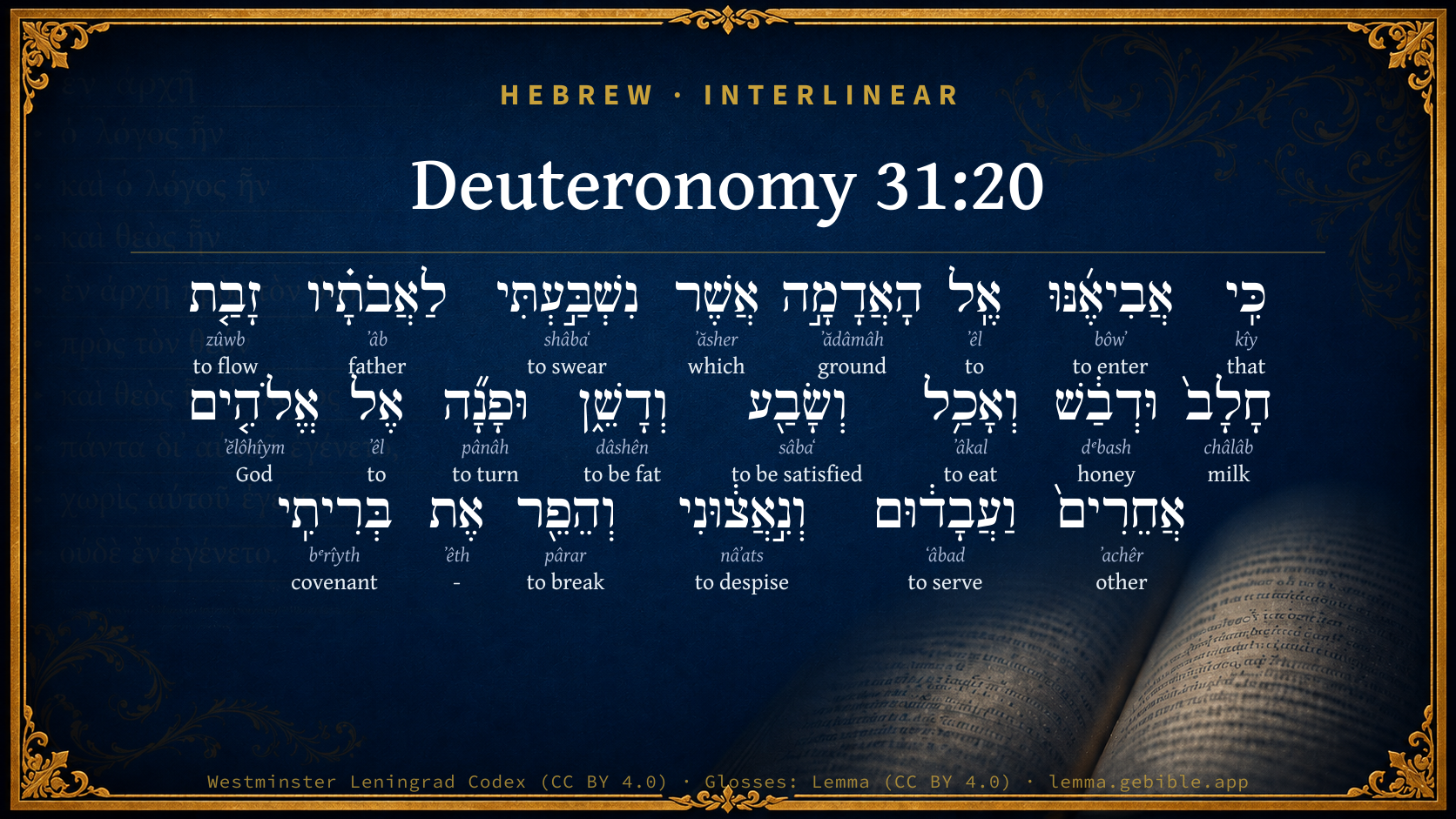
Hebrew (Westminster Leningrad Codex) Deuteronomy 31:20 appears in the Hebrew Old Testament. The text above is from the Westminster Leningrad Codex. Each word links to its Strong’s number, a concise gloss, and parsing drawn from the Open Scriptures Hebrew Bible morphology. Click any word for its full Brown-Driver-Briggs (BDB) entry.
Download image
Cite this verse

Deuteronomy 31:20 (World English Bible). Public Domain. Lemma interlinear Bible study tool, https://lemma.gebible.app/v/deuteronomy/31/20.

Show BibTeX & RIS
BibTeX
RIS
English Translation
For when I shall have brought them into the land which I swore to their fathers, flowing with milk and honey, and they shall have eaten and filled themselves, and grown fat; then will they turn to other gods, and serve them, and despise me, and break my covenant.
World English Bible · Public Domain
Download a study sheet

One document with this verse’s original text, its word-by-word gloss line, the meaning frame, cross-references with their text, attributed commentary, and full source and license credits — printable, and it pastes into notes with its structure intact.

This verse Autodidact and up

Study sheet (.html) Plain text (.txt)

A passage Seminary Student

Up to 50 verses in one chapter. A passage sheet keeps up to 6 commentary sources and 12 cross-references per verse, in the order this page ranks them, and says so on the sheet whenever that leaves anything out. Ask for a single verse and you get the Autodidact verse sheet above.

Everything on this page stays free to read, with no account — the sheet is a download of what is already on screen, not access to it.

Want to remove ads? Support Godless Engineer
Compare translations 3

The same verse in 3 English versions, stacked beneath the original-language interlinear above. Click any original word for its lexicon entry.

Each is an independent rendering of the whole verse — the interlinear is not word-aligned to these translations.

Highlighted words mark where these versions differ — a whole-verse word diff, not a word-by-word alignment.

  • World English Bible Public Domain
    For when I shall have brought them into the land which I swore to their fathers, flowing with milk and honey, and they shall have eaten and filled themselves, and grown fat; then will they turn to other gods, and serve them, and despise me, and break my covenant.
  • King James Version Public Domain
    For when I shall have brought them into the land which I sware unto their fathers, that floweth with milk and honey; and they shall have eaten and filled themselves, and waxen fat; then will they turn unto other gods, and serve them, and provoke me, and break my covenant.
  • unfoldingWord Literal Text CC BY-SA 4.0
    When I bring him to the land that I swore to his fathers, flowing with milk and honey, and he eats and becomes satisfied and fat, then he will turn to other gods, and they will serve them and they will despise me and he will break my covenant.

unfoldingWord Literal Text — © unfoldingWord, licensed CC BY-SA 4.0. Word-aligned USFM3 via Door43 (git.door43.org/unfoldingWord/en_ult).

Versions to compare (up to 4)

3 of 4 selected

Show all 18 translations

Every available English version of this verse, each an independent rendering of the whole verse.

  • World English Bible Public Domain
    For when I shall have brought them into the land which I swore to their fathers, flowing with milk and honey, and they shall have eaten and filled themselves, and grown fat; then will they turn to other gods, and serve them, and despise me, and break my covenant.
  • Berean Standard Bible Public Domain
    When I have brought them into the land that I swore to give their fathers, a land flowing with milk and honey, they will eat their fill and prosper. Then they will turn to other gods and worship them, and they will reject Me and break My covenant.
  • Majority Standard Bible Public Domain
    When I have brought them into the land that I swore to give their fathers, a land flowing with milk and honey, they will eat their fill and prosper. Then they will turn to other gods and worship them, and they will reject Me and break My covenant.
  • King James Version Public Domain
    For when I shall have brought them into the land which I sware unto their fathers, that floweth with milk and honey; and they shall have eaten and filled themselves, and waxen fat; then will they turn unto other gods, and serve them, and provoke me, and break my covenant.
  • American Standard Version (1901) Public Domain
    For when I shall have brought them into the land which I sware unto their fathers, flowing with milk and honey, and they shall have eaten and filled themselves, and waxed fat; then will they turn unto other gods, and serve them, and despise me, and break my covenant.
  • Revised Version (1885) Public Domain
    For when I shall have brought them into the land which I sware unto their fathers, flowing with milk and honey; and they shall have eaten and filled themselves, and waxen fat; then will they turn unto other gods, and serve them, and despise me, and break my covenant.
  • Geneva Bible (1599) Public Domain
    For I will bring them into the land (which I sware vnto their fathers) that floweth with milke and honie, and they shall eate, and fil them selues, and waxe fat: then shall they turne vnto other gods, and serue them, and contemne me, and breake my couenant.
  • Douay-Rheims (1899) Public Domain
    For I will bring them into the land, for which I swore to their fathers, that floweth with milk and honey. And when they have eaten, and are full and fat, they will turn away after strange gods, and will serve them: and will despise me, and make void my covenant.
  • Young's Literal Translation Public Domain
    and I bring them in unto the ground which I have sworn to their fathers -- flowing with milk and honey, and they have eaten, and been satisfied, and been fat, and have turned unto other gods, and they have served them, and despised Me, and broken My covenant.
  • Literal Standard Version CC BY-SA 4.0
    When I bring them to the ground flowing with milk and honey, which I have sworn to their fathers, and they have eaten, and been satisfied, and been fat, and have turned to other gods, and they have served them, and despised Me, and broken My covenant,
  • Unlocked Literal Bible CC BY-SA 4.0
    For when I will have brought them into the land that I swore to give to their ancestors, a land flowing with milk and honey, and when they have eaten and become satisfied and fat, then they will turn to other gods and they will serve them and they will despise me and they will break my covenant.
  • unfoldingWord Literal Text CC BY-SA 4.0
    When I bring him to the land that I swore to his fathers, flowing with milk and honey, and he eats and becomes satisfied and fat, then he will turn to other gods, and they will serve them and they will despise me and he will break my covenant.
  • Darby Bible Public Domain
    For I shall bring them into the land which I swore unto their fathers, which floweth with milk and honey; and they will eat and fill themselves, and wax fat, and will turn unto other gods, and serve them, and despise me, and break my covenant.
  • World Messianic Bible Public Domain
    For when I have brought them into the land which I swore to their fathers, flowing with milk and honey, and they have eaten and filled themselves, and grown fat, then they will turn to other gods, and serve them, and despise me, and break my covenant.
  • Webster's Bible Public Domain
    For when I shall have brought them into the land which I swore to their fathers, that floweth with milk and honey; and they shall have eaten and filled themselves, and waxed fat; then will they turn to other gods, and serve them, and provoke me, and break my covenant.
  • Free Bible Version CC BY-SA 4.0
    Once I've led them into the country that I promised to give their forefathers, a land flowing with milk and honey, they will have plenty to eat and will do well. Then they will go and worship other gods, and they will abandon me and break my agreement.
  • Bible in Basic English Public Domain
    For when I have taken them into the land named in my oath to their fathers, a land flowing with milk and honey, and they have made themselves full of food and are fat, then they will be turned to other gods and will give them worship, no longer honouring me or keeping my agreement.
  • JPS Tanakh (1917) Public Domain
    For when I shall have brought them into the land which I swore unto their fathers, flowing with milk and honey; and they shall have eaten their fill, and waxen fat; and turned unto other gods, and served them, and despised Me, and broken My covenant;

Literal Standard Version (2020), Covenant Press — licensed CC BY-SA 4.0. Text via the HelloAO Bible API (eBible.org). Unlocked Literal Bible (unfoldingWord) — licensed CC BY-SA 4.0. Text via the HelloAO Bible API (eBible.org). unfoldingWord Literal Text — © unfoldingWord, licensed CC BY-SA 4.0. Word-aligned USFM3 via Door43 (git.door43.org/unfoldingWord/en_ult). Free Bible Version, Dr. Jonathan Gallagher — licensed CC BY-SA 4.0. Text via the HelloAO Bible API (eBible.org).

Word by word

More ways to search: Search by grammar → Find every occurrence → Compare this word →

Practice this passage: Drill this verse → Learn its vocabulary →

וְדָשֵׁ֑ן
dâshên
H1878
“and · to be fat”
Conjunction + Verb, Qal, Sequential Perfect, 3rd Person, Masculine, Singular
Part of Speech
Conjunction + Verb
Stem
Qal
Form
Sequential Perfect
Person
3rd Person
Gender
Masculine
Number
Singular
Full BDB Definition

Origin: a primitive root

TWOT: 457

to be fat, grow fat, become fat, become prosperous, anoint - (Qal) of prosperity (figuratively) - (Piel) - to make fat, anoint - to find fat (of offering - acceptable) - to take away ashes (from altar) - (Pual) to be made fat - (Hothpael) to fatten oneself (of Jehovah's sword)
  1. כִּֽי kîy H3588 “that” Conjunction
  2. אֲבִיאֶ֜נּוּ bôwʼ H935 “to enter · him” Verb, Hiphil, Imperfect, 1st Person, Common, Singular + Suffix, Personal, 3rd Person, Masculine, Singular
  3. אֶֽל ʼêl H413 “to” Preposition
  4. הָאֲדָמָ֣ה ʼădâmâh H127 “the · ground” Particle, Definite Article + Noun, Common, Feminine, Singular, Absolute
  5. אֲשֶׁר ʼăsher H834 “which” Particle, Relative
  6. נִשְׁבַּ֣עְתִּי shâbaʻ H7650 “to swear” Verb, Niphal, Perfect, 1st Person, Common, Singular
  7. לַאֲבֹתָ֗יו ʼâb H1 “to/for · fathers · his” Preposition + Noun, Common, Masculine, Plural, Construct + Suffix, Personal, 3rd Person, Masculine, Singular
  8. זָבַ֤ת zûwb H2100 “flowing” Verb, Qal, Participle Active, Feminine, Singular, Construct
  9. חָלָב֙ châlâb H2461 “milk” Noun, Common, Masculine, Singular, Absolute
  10. וּדְבַ֔שׁ dᵉbash H1706 “and · honey” Conjunction + Noun, Common, Masculine, Singular, Absolute
  11. וְאָכַ֥ל ʼâkal H398 “and · to eat” Conjunction + Verb, Qal, Sequential Perfect, 3rd Person, Masculine, Singular
  12. וְשָׂבַ֖ע sâbaʻ H7646 “and · to be satisfied” Conjunction + Verb, Qal, Sequential Perfect, 3rd Person, Masculine, Singular
  13. וּפָנָ֞ה pânâh H6437 “and · to turn” Conjunction + Verb, Qal, Sequential Perfect, 3rd Person, Masculine, Singular
  14. אֶל ʼêl H413 “to” Preposition
  15. אֱלֹהִ֤ים ʼĕlôhîym H430 “God(s)” Noun, Common, Masculine, Plural, Absolute
  16. אֲחֵרִים֙ ʼachêr H312 “other” Adjective, Adjective, Masculine, Plural, Absolute
  17. וַעֲבָד֔וּם ʻâbad H5647 “and · to serve · them” Conjunction + Verb, Qal, Sequential Perfect, 3rd Person, Common, Plural + Suffix, Personal, 3rd Person, Masculine, Plural
  18. וְנִ֣אֲצ֔וּנִי nâʼats H5006 “and · to despise · me” Conjunction + Verb, Piel, Sequential Perfect, 3rd Person, Common, Plural + Suffix, Personal, 1st Person, Common, Singular
  19. וְהֵפֵ֖ר pârar H6565 “and · to break” Conjunction + Verb, Hiphil, Sequential Perfect, 3rd Person, Masculine, Singular
  20. אֶת ʼêth H853 “-” Particle, Direct Object
  21. בְּרִיתִֽי bᵉrîyth H1285 “covenant · my” Noun, Common, Feminine, Singular, Construct + Suffix, Personal, 1st Person, Common, Singular

About this verse

These counts appear in no published source. They are computed here, from the morphology-tagged text and Lemma’s own curated glosses. What Lemma adds →

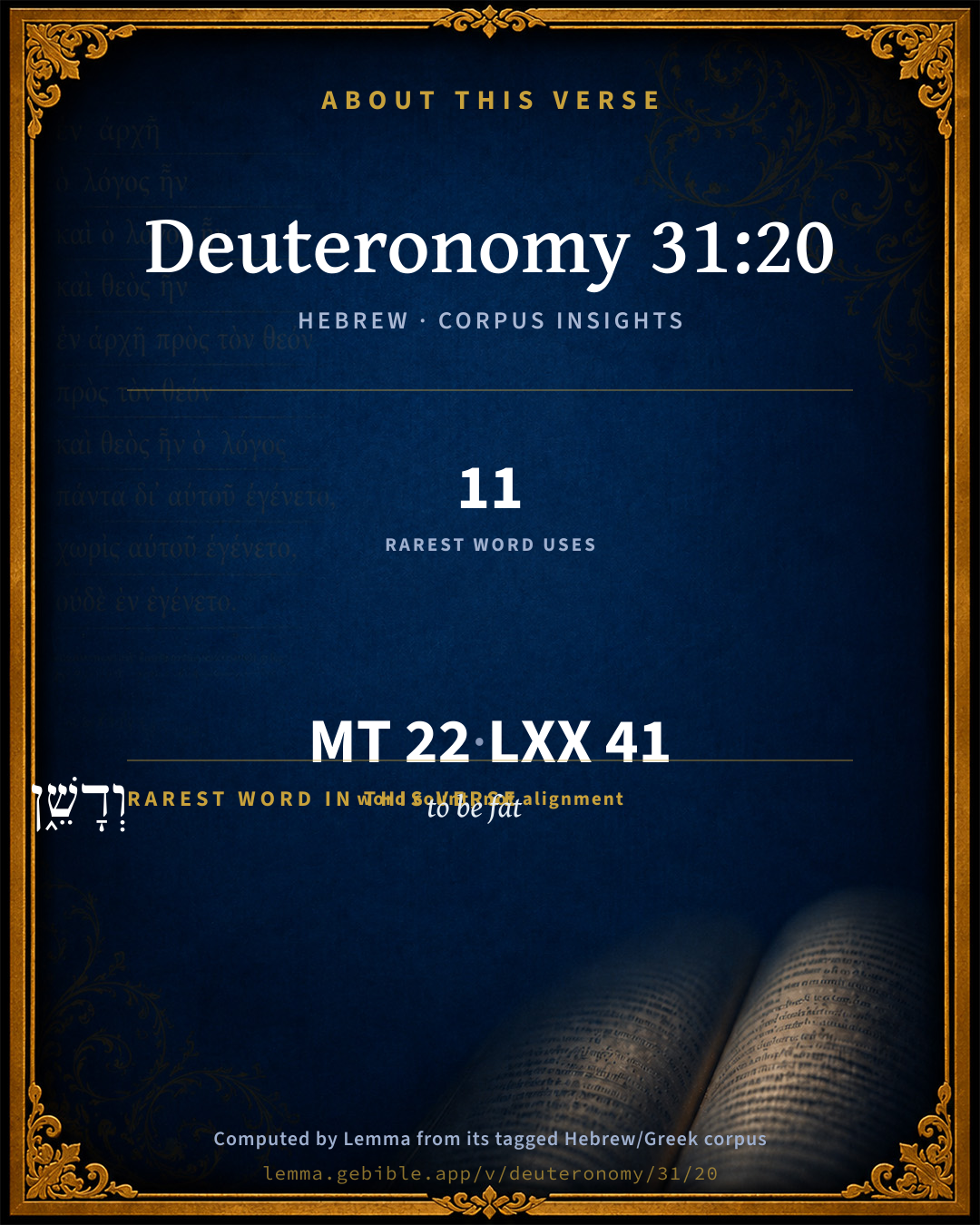
22
words
21
distinct lemmas
Pentateuch
section

Notable vocabulary

The rarest word here is וְדָשֵׁ֑ן to be fat H1878 — appearing just 11 times in the whole Hebrew Bible.

Shared distinctive vocabulary

וְדָשֵׁ֑ן to be fat H1878 occurs in 11 verses of the Hebrew Bible. Also found in:

Grammatical profile

  • 10 verbs
  • 6 nouns
  • 1 adjective
  • 2 prepositions
  • 1 conjunction
  • 2 particles

Verb forms

  • אֲבִיאֶ֜נּוּ Hiphil · Imperfect
  • נִשְׁבַּ֣עְתִּי Niphal · Perfect
  • זָבַ֤ת Qal · Participle Active
  • וְאָכַ֥ל Qal · Sequential Perfect
  • וְשָׂבַ֖ע Qal · Sequential Perfect
  • וְדָשֵׁ֑ן Qal · Sequential Perfect
  • וּפָנָ֞ה Qal · Sequential Perfect
  • וַעֲבָד֔וּם Qal · Sequential Perfect
  • וְנִ֣אֲצ֔וּנִי Piel · Sequential Perfect
  • וְהֵפֵ֖ר Hiphil · Sequential Perfect

Repetition

A word recurs within this verse — often emphatic in Hebrew:

  • אֶֽל to H413 ×2

Hebrew & Septuagint length

In English translation the verse runs 49 words from the Hebrew and 56 from the Septuagint (LXX English) — closely comparable.

A rough comparison of the two English renderings, which tokenize alike — not a word-level alignment.

Word counts can differ between the Hebrew and the Greek without any difference in meaning — e.g. the Hebrew direct-object marker אֵת has no separate Greek word, and Greek often adds the article ὁ.

In the original languages it is 22 Hebrew tokens and 41 Greek tokens — but the two are counted differently (Hebrew bundles its prefixes and suffixes into one token; the Greek is in lemma form), so that isn’t a like-for-like length.

Cross-references

18

Topical passages linked to Deuteronomy 31:20 in the Treasury of Scripture Knowledge — connected by theme and wording, ordered by reader-vote popularity; previews shown in the World English Bible.

  • Hosea 13:6 According to their pasture, so were they filled; They were filled, and their heart was exalted. Therefore they have forgotten me.
  • Deuteronomy 6:10–12 It shall be, when Yahweh your God shall bring you into the land which he swore to your fathers, to Abraham, to Isaac, and to Jacob, to give you, great and goodly cities, which you didn't build,
  • Nehemiah 9:25–26 They took fortified cities, and a fat land, and possessed houses full of all good things, cisterns hewn out, vineyards, and olive groves, and fruit trees in abundance: so they ate, and were filled, and became fat, and delighted themselves in your great goodness.
  • Exodus 3:8 I have come down to deliver them out of the hand of the Egyptians, and to bring them up out of that land to a good and large land, to a land flowing with milk and honey; to the place of the Canaanite, the Hittite, the Amorite, the Perizzite, the Hivite, and the Jebusite.
  • Jeremiah 5:28 They are grew fat, they shine: yes, they overpass in deeds of wickedness; they don't plead the cause, the cause of the fatherless, that they may prosper; and the right of the needy they don't judge.
  • Ezekiel 34:16 I will seek that which was lost, and will bring back that which was driven away, and will bind up that which was broken, and will strengthen that which was sick: but the fat and the strong I will destroy; I will feed them in justice.
  • Ezekiel 34:20 Therefore thus says the Lord Yahweh to them: Behold, I, even I, will judge between the fat sheep and the lean sheep.
  • Exodus 3:17 and I have said, I will bring you up out of the affliction of Egypt to the land of the Canaanite, the Hittite, the Amorite, the Perizzite, the Hivite, and the Jebusite, to a land flowing with milk and honey."'
  • Deuteronomy 7:1 When Yahweh your God shall bring you into the land where you go to possess it, and shall cast out many nations before you, the Hittite, and the Girgashite, and the Amorite, and the Canaanite, and the Perizzite, and the Hivite, and the Jebusite, seven nations greater and mightier than you;
  • Deuteronomy 8:7 For Yahweh your God brings you into a good land, a land of brooks of water, of springs and springs, flowing forth in valleys and hills;
  • Deuteronomy 8:10–14 You shall eat and be full, and you shall bless Yahweh your God for the good land which he has given you.
  • Deuteronomy 31:16–17 Yahweh said to Moses, Behold, you shall sleep with your fathers; and this people will rise up, and play the prostitute after the strange gods of the land, where they go to be among them, and will forsake me, and break my covenant which I have made with them.
  • Deuteronomy 32:15–17 But Jeshurun grew fat, and kicked: You have grown fat, you are grown thick, you are become sleek; Then he forsook God who made him, Lightly esteemed the Rock of his salvation.
  • Nehemiah 9:35 For they have not served you in their kingdom, and in your great goodness that you gave them, and in the large and fat land which you gave before them, neither turned they from their wicked works.
  • Psalms 17:10 They close up their callous hearts. With their mouth they speak proudly.
  • Psalms 73:7 Their eyes bulge with fat. Their minds pass the limits of conceit.
  • Psalms 119:70 Their heart is as callous as the fat, But I delight in your law.
  • Jeremiah 50:11 Because you are glad, because you rejoice, O you who plunder my heritage, because you are wanton as a heifer that treads out [the grain], and neigh as strong horses;

Cross-references courtesy of OpenBible.info (CC BY 4.0).

Hebrew and Greek witnesses Masoretic Hebrew ↔ Greek Septuagint

The same verse in the two great witnesses to the Old Testament, shown verse-for-verse.

These are two independent witnesses, not word-aligned to each other, and the Septuagint is shown in lemma (dictionary) form.

Hebrew Deuteronomy 31:20 Masoretic · Westminster Leningrad Codex

כִּֽי אֲבִיאֶ֜נּוּ אֶֽל הָאֲדָמָ֣ה אֲשֶׁר נִשְׁבַּ֣עְתִּי לַאֲבֹתָ֗יו זָבַ֤ת חָלָב֙ וּדְבַ֔שׁ וְאָכַ֥ל וְשָׂבַ֖ע וְדָשֵׁ֑ן וּפָנָ֞ה אֶל אֱלֹהִ֤ים אֲחֵרִים֙ וַעֲבָד֔וּם וְנִ֣אֲצ֔וּנִי וְהֵפֵ֖ר אֶת בְּרִיתִֽי

For when I shall have brought them into the land which I swore to their fathers, flowing with milk and honey, and they shall have eaten and filled themselves, and grown fat; then will they turn to other gods, and serve them, and despise me, and break my covenant.

World English Bible · Public Domain

Greek LXX Deuteronomy 31:20 Septuagint · lemma form

εἰςἄγω γάρ αὐτός εἰς ὁ γῆ ὁ ἀγαθός ὅς ὄμνυμι ὁ πατήρ αὐτός δίδωμι αὐτός γῆ ῥέω γάλα καί μέλι καί ἐσθίω καί ἐνπίμπλημι κορέω καί ἐπιστρέφω ἐπί θεός ἀλλότριος καί λατρεύω αὐτός καί παραὀξύνω ἐγώ καί διασκεδάζω ὁ διαθήκη ἐγώ

For I will bring them into the good land, which I swore to their fathers, to give to them a land flowing with milk and honey: and they shall eat and be filled and satisfy themselves; then will they turn aside after other gods, and serve them, and they will provoke me, and break my covenant.

LXX2012 (modern English Septuagint) · Public Domain

On this verse, Haydock's Catholic Bible Commentary discusses the Septuagint’s reading. Read the note in Commentary ↓

Hebrew: Westminster Leningrad Codex (CC BY 4.0). Greek: Septuagint (public domain); English from LXX2012 (modern English Septuagint) (Public Domain). How the Septuagint differs from the Hebrew →

Targum (Aramaic paraphrase)

2

The Targum is the ancient Jewish Aramaic paraphrase of the Hebrew Scriptures — an interpretive translation, not the Hebrew text itself. Onkelos (literal) and Pseudo-Jonathan (expansive) render the Torah, and Jonathan the Prophets. Coverage is partial: where no permissively-licensed English translation exists for a verse, only the Aramaic is shown. This is verse-level text, not a word-by-word alignment to the Hebrew.

  1. Targum Onkelos Torah (Genesis–Deuteronomy)
    אֲרֵי אָעֵלִנוּן לְאַרְעָא דִי קַיֵמִית לַאֲבָהָתְהוֹן עָבְדָא חֲלַב וּדְבַשׁ וְיֵיכְלוּן וְיִשְׂבְּעוּן וְיִתְפַּנְקוּן וְיִתְפְּנוּן בָּתַר טַּעֲוַת עַמְמַיָא וְיִפְלְחֻנוּן וְיִרְגְזוּן קֳדָמַי וְיַשְׁנוּן יָת קְיָמִי

    (no public-domain English translation for this verse)

    Targum Onkelos — Aramaic: “Onkelos Genesis” (public domain); “Onkelos Exodus” (public domain); “Onkelos Leviticus” (public domain); “Onkelos Numbers” (public domain); “Onkelos Deuteronomy” (public domain). English: “Sefaria Community Translation” (CC0 1.0 (public-domain dedication)); “J.W. Etheridge. The Targums of Onkelos and Jonathan Ben Uzziel on the Pentateuch. London: Longmans, Green, 1862” (public domain). Text via Sefaria.

  2. Targum Pseudo-Jonathan Torah (Genesis–Deuteronomy)
    אֲרוּם אֵיעֲלִינוּן לְאַרְעָא דְקַיֵימִית לְאַבְהַתְהוֹן עַבְדָא חֲלַב וּדְבַשׁ וְיֵיכְלוּן וְיִשְבְּעוּן וִידַהֲנוּן וְיִתְפְּנוּן לְטַעֲוַות עַמְמַיָא וְיִפְלְחוּנוּן וְיִרְגְזוּן קָדָמַי וְיִשְׁנוּן יַת קְיָימִי

    For I will bring them into the land which I promised to their fathers, (a land) producing milk and honey, and they will eat and be satisfied: but (after that they have) waxen fat they will turn away to the idols of the Gentiles and worship them; so will they provoke Me to anger, and abolish My covenant.

    Targum Pseudo-Jonathan — Aramaic: “Targum Jonathan on Genesis” (public domain); “Targum Jonathan on Exodus” (public domain); “Targum Jonathan on Leviticus” (public domain); “Targum Jonathan on Numbers” (public domain); “Targum Jonathan on Deuteronomy” (public domain). English: “The Targum of Jonathan ben Uzziel, trans. J. W. Etheridge, London, 1862” (public domain). Text via Sefaria.

Commentary

Notes on Deuteronomy 31:20 from classic Christian and Jewish commentators (each source and its license shown beneath its notes). The classic Christian expositions comment on the surrounding passage and are grouped to its opening verse, so a note may address several verses; the Jewish commentaries on the Tanakh (Rashi and others) are per-verse, so they appear only where the commentator wrote on this verse.

Lemma curates 59 commentaries, every one of them public domain or Creative Commons licensed, each selected and text-cleaned for this edition rather than reprinted as found. About our sources →

John Gill's Exposition

And it shall come to pass, when many evils and troubles are befallen them,.... As did in the times of the judges, in the Babylonish captivity, and do now in their present exile:

that this song shall testify against them as a witness; which so clearly points at their sins, with all their aggravated circumstances, and describes so fully their calamities, distresses, and punishment for them:

for it shall not be forgotten out of the mouths of their seed; which shows that it respects time to come, their later posterity, whose memory of this song would be conjured up by the evils that should come upon them for their sins; nor is it forgotten by them to this day, who acknowledge there are some things in it now fulfilled or fulfilling in them:

for I know their imagination which they go about even now: or are "making" (c); forming and framing within themselves, there being a secret inclination in their minds to idolatry, which were working and contriving schemes to bring it about, and set it up; and this, God, the searcher of hearts, knew full well, and that in process of time this evil imagination would break forth into act, in an open and flagrant manner:

before I have brought thee into the land which I sware; to their fathers, to give it to them for an inheritance, as is suggested in Deu 31:20.

(c) "faciens", Montanus; "quam facit", Pagninus.

John Gill's Exposition of the Whole Bible (1746–1763) — public domain (CC PDM 1.0). Text via the HelloAO Bible API.

Trapp's Complete Commentary

John Trapp

Deu 31:20 For when I shall have brought them into the land which I sware unto their fathers, that floweth with milk and honey; and they shall have eaten and filled themselves, and waxen fat; then will they turn unto other gods, and serve them, and provoke me, and break my covenant.

Ver. 20. Then they will turn to other gods.] A bee is quickly drowned if she gets into a pot of honey. "Prosperity slayeth the foolish."

John Trapp, A Commentary or Exposition upon All the Books of the Old and New Testament (1647–1656) — public domain. Text from a community e-Sword module.

Tyndale Open Study Notes

Tyndale Open Resources

31:20 land flowing with milk and honey: See study note on 6:3. • become fat: Fatness did not imply obesity or self-indulgence but blessing and prosperity. • despise me: Israel would disregard the Lord and treat him lightly by falsely assuming that their prosperity had come through their own efforts or through the false gods of the land.

Tyndale Open Study Notes — © Tyndale Open Resources, licensed CC BY-SA 4.0. Text via the HelloAO Bible API.

Geneva Bible (1599)

Geneva Bible translators

For this is the nature of flesh, no longer to obey God, than it is under the rod.

Geneva Bible (1599) marginal notes — public domain. Text via Bolls.life.

The Cambridge Bible for Schools and Colleges

gen. ed. J. J. S. Perowne

20. For I shall bring it into the land which I sware unto its fathers] Deu_6:10, but also in E. On flowing with milk and honey, see Deu_6:3.

and it shall eat and be satisfied and grow fat] Cp. Deu_6:11, Deu_8:12, Deu_32:15. Here even the deuteronomic phrases receive a peculiar form. And it will turn, as in Deu_31:18; despise me, not elsewhere in Deut., but in JE, Num_14:11; Num_14:23; Num_16:30, and in the Song, ch. Deu_32:19; break my covenant, as in Deu_31:17. The only plur. vbs are serve, despise.

The Cambridge Bible for Schools and Colleges (gen. ed. J. J. S. Perowne; Cambridge University Press, 1878–1918) — public domain. Text from a community e-Sword module.

Haydock's Catholic Bible Commentary

CHAPTER XXXI.

Despise, (detrahent,) "detract," (Haydock) and represent me as an unjust and weak God. Hebrew, "they will despise, or blaspheme," &c. Septuagint, "they will irritate me." (Calmet)

George Leo Haydock (1774–1849), Haydock's Catholic Family Bible and Commentary, 1859 edition — public domain. Excludes Psalms (Douay-Rheims chapter numbering differs from Protestant) and Deuterocanonical books (Catholic canon only).

Rashi

Rabbi Shlomo Yitzchaki (Rashi)

ונאצוני means AND THEY WILL PROVOKE ME TO ANGER. So, too, every form of the root נאץ denotes anger.

Rashi on the Tanakh — English translations: “The Judaica Press complete Tanach with Rashi, translated by A. J. Rosenberg” (CC BY 4.0); “Pentateuch with Rashi's commentary by M. Rosenbaum and A.M. Silbermann, 1929-1934” (public domain); “The Metsudah Tanach series, Lakewood, N.J” (CC BY 4.0); and “The Book of Joshua, Metsudah Publications, 1997” (CC BY 4.0). Text via Sefaria.

Lesson kit

Teaching starters — assembled from the data on this page, not authored interpretation. Every prompt links to the verse data it draws on. Edit before teaching.

Deuteronomy, in the Pentateuch, opens this verse with 22 words (21 distinct Hebrew lemmas). Its most distinctive word is dâshên (“to be fat”). A historical commentator’s framing appears above. Read the whole chapter for the surrounding context.

Discussion questions

  1. How does “to be fat” (dâshên) shape what this verse is saying?
  2. How does Exodus 27:3, which shares the word «to be fat», read alongside this verse?
  3. What does the repetition of “to” (2× in this one verse) do in this verse?
  4. These translations render this verse differently. What is at stake in choosing one wording over another?
  5. «אֲבִיאֶ֜נּוּ» is a Hiphil Imperfect verb. How does that grammatical form shape the action described?
  6. Compare how John Gill's Exposition and Trapp's Complete Commentary read this verse. Where do they agree or differ?

Things to notice

Reading settings

Reading text

Shown beneath each verse's original-language words.

Old Testament
Old Testament edition

Read the OT as the Masoretic Hebrew (MT) or the Greek Septuagint (LXX).

English shown for the Greek Septuagint (in the Hebrew ↔ Greek comparison).

Comparing translations? Open the Compare panel on any verse page to stack up to four side by side.