
Ezekiel 36:6

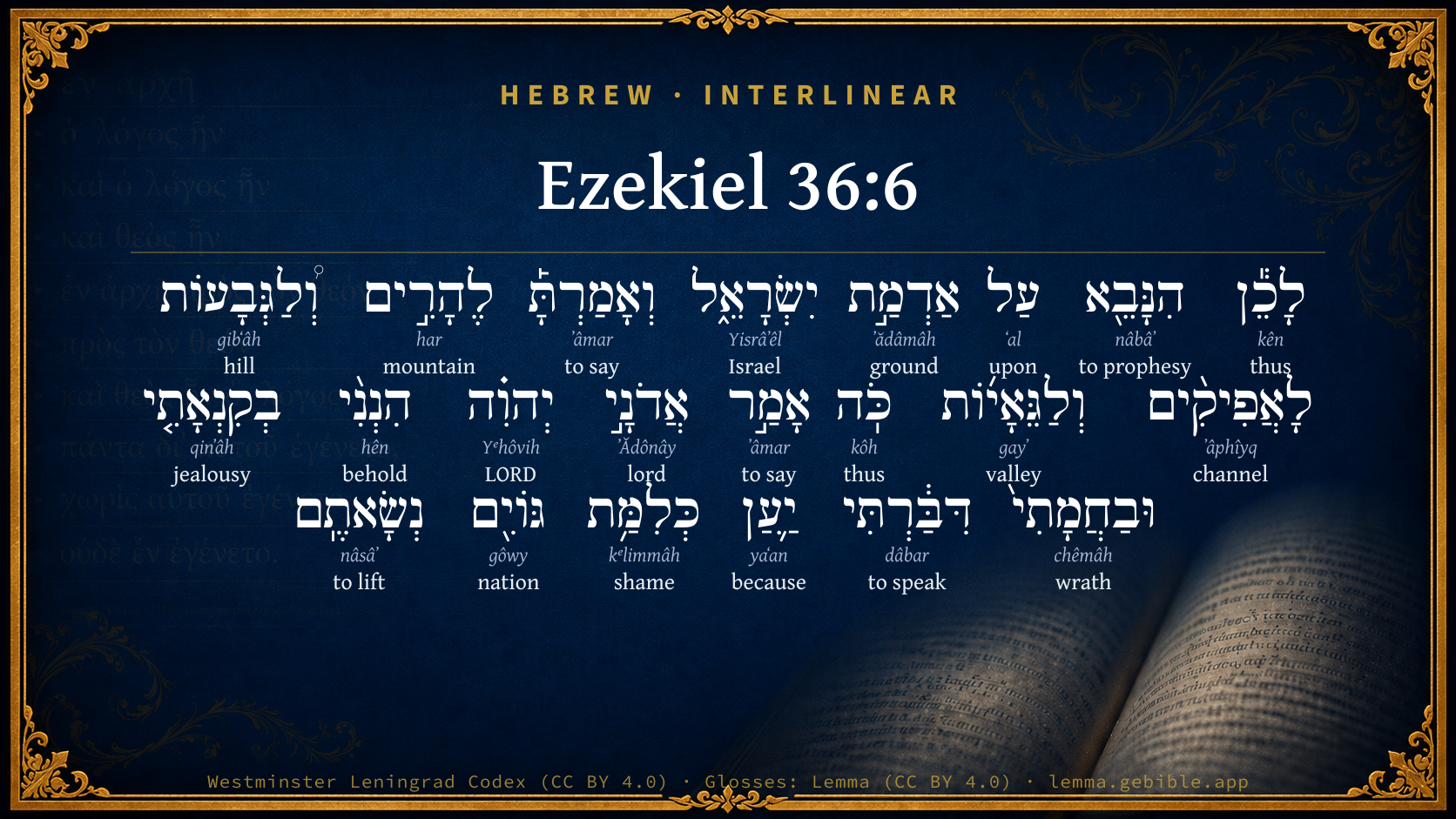
Hebrew (Westminster Leningrad Codex) Ezekiel 36:6 appears in the Hebrew Old Testament. The text above is from the Westminster Leningrad Codex. Each word links to its Strong’s number, a concise gloss, and parsing drawn from the Open Scriptures Hebrew Bible morphology. Click any word for its full Brown-Driver-Briggs (BDB) entry.
Download image
Cite this verse

Ezekiel 36:6 (World English Bible). Public Domain. Lemma interlinear Bible study tool, https://lemma.gebible.app/v/ezekiel/36/6.

Show BibTeX & RIS
BibTeX
RIS
English Translation
Therefore prophesy concerning the land of Israel, and tell the mountains and to the hills, to the watercourses and to the valleys, Thus says the Lord Yahweh: Behold, I have spoken in my jealousy and in my wrath, because you have borne the shame of the nations:
World English Bible · Public Domain
Download a study sheet

One document with this verse’s original text, its word-by-word gloss line, the meaning frame, cross-references with their text, attributed commentary, and full source and license credits — printable, and it pastes into notes with its structure intact.

This verse Autodidact and up

Study sheet (.html) Plain text (.txt)

A passage Seminary Student

Up to 50 verses in one chapter. A passage sheet keeps up to 6 commentary sources and 12 cross-references per verse, in the order this page ranks them, and says so on the sheet whenever that leaves anything out. Ask for a single verse and you get the Autodidact verse sheet above.

Everything on this page stays free to read, with no account — the sheet is a download of what is already on screen, not access to it.

Want to remove ads? Support Godless Engineer
Compare translations 3

The same verse in 3 English versions, stacked beneath the original-language interlinear above. Click any original word for its lexicon entry.

Each is an independent rendering of the whole verse — the interlinear is not word-aligned to these translations.

Highlighted words mark where these versions differ — a whole-verse word diff, not a word-by-word alignment.

  • World English Bible Public Domain
    Therefore prophesy concerning the land of Israel, and tell the mountains and to the hills, to the watercourses and to the valleys, Thus says the Lord Yahweh: Behold, I have spoken in my jealousy and in my wrath, because you have borne the shame of the nations:
  • King James Version Public Domain
    Prophesy therefore concerning the land of Israel, and say unto the mountains, and to the hills, to the rivers, and to the valleys, Thus saith the Lord GOD; Behold, I have spoken in my jealousy and in my fury, because ye have borne the shame of the heathen:
  • unfoldingWord Literal Text CC BY-SA 4.0
    Therefore, prophesy to the land of Israel and say to the mountains and to the high hills, to the streambeds and to the valleys, ‘the Lord Yahweh says this: Behold! In my fury and in my anger I am declaring this because you have borne the insults of nations.

unfoldingWord Literal Text — © unfoldingWord, licensed CC BY-SA 4.0. Word-aligned USFM3 via Door43 (git.door43.org/unfoldingWord/en_ult).

Versions to compare (up to 4)

3 of 4 selected

Show all 18 translations

Every available English version of this verse, each an independent rendering of the whole verse.

  • World English Bible Public Domain
    Therefore prophesy concerning the land of Israel, and tell the mountains and to the hills, to the watercourses and to the valleys, Thus says the Lord Yahweh: Behold, I have spoken in my jealousy and in my wrath, because you have borne the shame of the nations:
  • Berean Standard Bible Public Domain
    Therefore, prophesy concerning the land of Israel and tell the mountains and hills, the ravines and valleys, that this is what the Lord GOD says: Behold, I have spoken in My burning zeal because you have endured the reproach of the nations.
  • Majority Standard Bible Public Domain
    Therefore, prophesy concerning the land of Israel and tell the mountains and hills, the ravines and valleys, that this is what the Lord GOD says: Behold, I have spoken in My burning zeal because you have endured the reproach of the nations.
  • King James Version Public Domain
    Prophesy therefore concerning the land of Israel, and say unto the mountains, and to the hills, to the rivers, and to the valleys, Thus saith the Lord GOD; Behold, I have spoken in my jealousy and in my fury, because ye have borne the shame of the heathen:
  • American Standard Version (1901) Public Domain
    Therefore prophesy concerning the land of Israel, and say unto the mountains and to the hills, to the watercourses and to the valleys, Thus saith the Lord Jehovah: Behold, I have spoken in my jealousy and in my wrath, because ye have borne the shame of the nations:
  • Revised Version (1885) Public Domain
    Therefore prophesy concerning the land of Israel, and say unto the mountains and to the hills, to the watercourses and to the valleys, Thus saith the Lord GOD: Behold, I have spoken in my jealousy and in my fury, because ye have borne the shame of the heathen:
  • Geneva Bible (1599) Public Domain
    Prophesie therfore vpon the land of Israel, and say vnto the mountaines, and to the hilles, to the riuers, and to the valleys, Thus sayth the Lord God, Behold, I haue spoken in mine indignation, and in my wrath, because yee haue suffered the shame of the heathen,
  • Douay-Rheims (1899) Public Domain
    Prophesy therefore concerning the land of Israel, and say to the mountains, and to the hills, to the ridges, and to the valleys: Thus saith the Lord God: Behold I have spoken in my zeal, and in my indignation, because you have borne the shame of the Gentiles.
  • Young's Literal Translation Public Domain
    Therefore, prophesy concerning the ground of Israel, And thou hast said to mountains, and to hills, To streams, and to valleys, Thus said the Lord Jehovah: Lo, I, in My jealousy, and in My fury, I have spoken, Because the shame of nations ye have borne.
  • Literal Standard Version CC BY-SA 4.0
    Therefore, prophesy concerning the ground of Israel, || And you have said to mountains, and to hills, || To streams, and to valleys, || Thus said Lord YHWH: Behold, I, in My jealousy and in My fury, have spoken, || Because you have borne the shame of nations.
  • Unlocked Literal Bible CC BY-SA 4.0
    Therefore, prophesy to the land of Israel and say to the mountains and to the high hills, to the streambeds and to the valleys, 'the Lord Yahweh says this: Behold! In my fury and in my anger I am declaring this because you have borne the insults of nations.
  • unfoldingWord Literal Text CC BY-SA 4.0
    Therefore, prophesy to the land of Israel and say to the mountains and to the high hills, to the streambeds and to the valleys, ‘the Lord Yahweh says this: Behold! In my fury and in my anger I am declaring this because you have borne the insults of nations.
  • Darby Bible Public Domain
    Prophesy therefore concerning the land of Israel, and say to the mountains and to the hills, to the water-courses and to the valleys, Thus saith the Lord Jehovah: Behold, I have spoken in my jealousy and in my fury, because ye have borne the ignominy of the nations;
  • World Messianic Bible Public Domain
    Therefore prophesy concerning Eretz-Israel, and tell the mountains, the hills, the watercourses and the valleys, ‘The Lord GOD says: “Behold, I have spoken in my jealousy and in my wrath, because you have borne the shame of the nations.”
  • Webster's Bible Public Domain
    Prophesy therefore concerning the land of Israel, and say to the mountains, and to the hills, to the rivers, and to the valleys, Thus saith the Lord GOD; Behold, I have spoken in my jealousy and in my fury, because ye have borne the shame of the heathen:
  • Free Bible Version CC BY-SA 4.0
    So prophesy concerning the country of Israel and tell the mountains and hills, the ravines and valleys, that this is what the Lord God says: Just watch, for I have spoken passionately about this because you have had to put up with this mockery from other nations.
  • Bible in Basic English Public Domain
    For this cause be a prophet about the land of Israel, and say to the mountains and to the hills, to the streams and to the valleys, This is what the Lord has said: Truly, in my bitter feeling and in my wrath I have said these things, because you have undergone the shame of the nations:
  • JPS Tanakh (1917) Public Domain
    therefore prophesy concerning the land of Israel, and say unto the mountains and to the hills, to the streams and to the valleys: Thus saith the Lord GOD: Behold, I have spoken in My jealousy and in My fury, because ye have borne the shame of the nations;

Literal Standard Version (2020), Covenant Press — licensed CC BY-SA 4.0. Text via the HelloAO Bible API (eBible.org). Unlocked Literal Bible (unfoldingWord) — licensed CC BY-SA 4.0. Text via the HelloAO Bible API (eBible.org). unfoldingWord Literal Text — © unfoldingWord, licensed CC BY-SA 4.0. Word-aligned USFM3 via Door43 (git.door43.org/unfoldingWord/en_ult). Free Bible Version, Dr. Jonathan Gallagher — licensed CC BY-SA 4.0. Text via the HelloAO Bible API (eBible.org).

Word by word

More ways to search: Search by grammar → Find every occurrence → Compare this word →

Practice this passage: Drill this verse → Learn its vocabulary →

לָאֲפִיקִ֨ים
ʼâphîyq
H650
“to/for the · channels”
Preposition, Determined + Noun, Common, Masculine, Plural, Absolute
Part of Speech
Preposition + Noun
Type
Common
Gender
Masculine
Number
Plural
State
Absolute
Full BDB Definition

Origin: from H622

TWOT: 149a

channel - ravine - of hollow bones (figuratively)
  1. לָכֵ֕ן kên H3651 “to/for · thus” Preposition + Adverb
  2. הִנָּבֵ֖א nâbâʼ H5012 “prophesy” Verb, Niphal, Imperative, 2nd Person, Masculine, Singular
  3. עַל ʻal H5921 “upon” Preposition
  4. אַדְמַ֣ת ʼădâmâh H127 “ground of” Noun, Common, Feminine, Singular, Construct
  5. יִשְׂרָאֵ֑ל Yisrâʼêl H3478 “Israel” Noun, Proper
  6. וְאָמַרְתָּ֡ ʼâmar H559 “and · to say” Conjunction + Verb, Qal, Sequential Perfect, 2nd Person, Masculine, Singular
  7. לֶהָרִ֣ים har H2022 “to/for the · mountains” Preposition, Determined + Noun, Common, Masculine, Plural, Absolute
  8. וְ֠לַגְּבָעוֹת gibʻâh H1389 “and · to/for the · hills” Conjunction + Preposition, Determined + Noun, Common, Feminine, Plural, Absolute
  9. וְלַגֵּאָי֜וֹת gayʼ H1516 “and · to/for the · valleys” Conjunction + Preposition, Determined + Noun, Common, Both, Plural, Absolute
  10. כֹּֽה kôh H3541 “thus” Adverb
  11. אָמַ֣ר ʼâmar H559 “to say” Verb, Qal, Perfect, 3rd Person, Masculine, Singular
  12. אֲדֹנָ֣י ʼĂdônây H136 “Lord · my” Noun, Common, Masculine, Plural, Construct + Suffix, Personal, 1st Person, Common, Singular
  13. יְהוִ֗ה Yᵉhôvih H3069 “LORD” Noun, Proper
  14. הִנְנִ֨י hên H2005 “behold · me” Particle, Demonstrative + Suffix, Personal, 1st Person, Common, Singular
  15. בְקִנְאָתִ֤י qinʼâh H7068 “in/at · jealousy · my” Preposition + Noun, Common, Feminine, Singular, Construct + Suffix, Personal, 1st Person, Common, Singular
  16. וּבַחֲמָתִי֙ chêmâh H2534 “and · in/at · wrath · my” Conjunction + Preposition + Noun, Common, Feminine, Singular, Construct + Suffix, Personal, 1st Person, Common, Singular
  17. דִּבַּ֔רְתִּי dâbar H1696 “to speak” Verb, Piel, Perfect, 1st Person, Common, Singular
  18. יַ֛עַן yaʻan H3282 “because” Conjunction
  19. כְּלִמַּ֥ת kᵉlimmâh H3639 “shame of” Noun, Common, Feminine, Singular, Construct
  20. גּוֹיִ֖ם gôwy H1471 “nations” Noun, Common, Masculine, Plural, Absolute
  21. נְשָׂאתֶֽם nâsâʼ H5375 “to lift” Verb, Qal, Perfect, 2nd Person, Masculine, Plural

About this verse

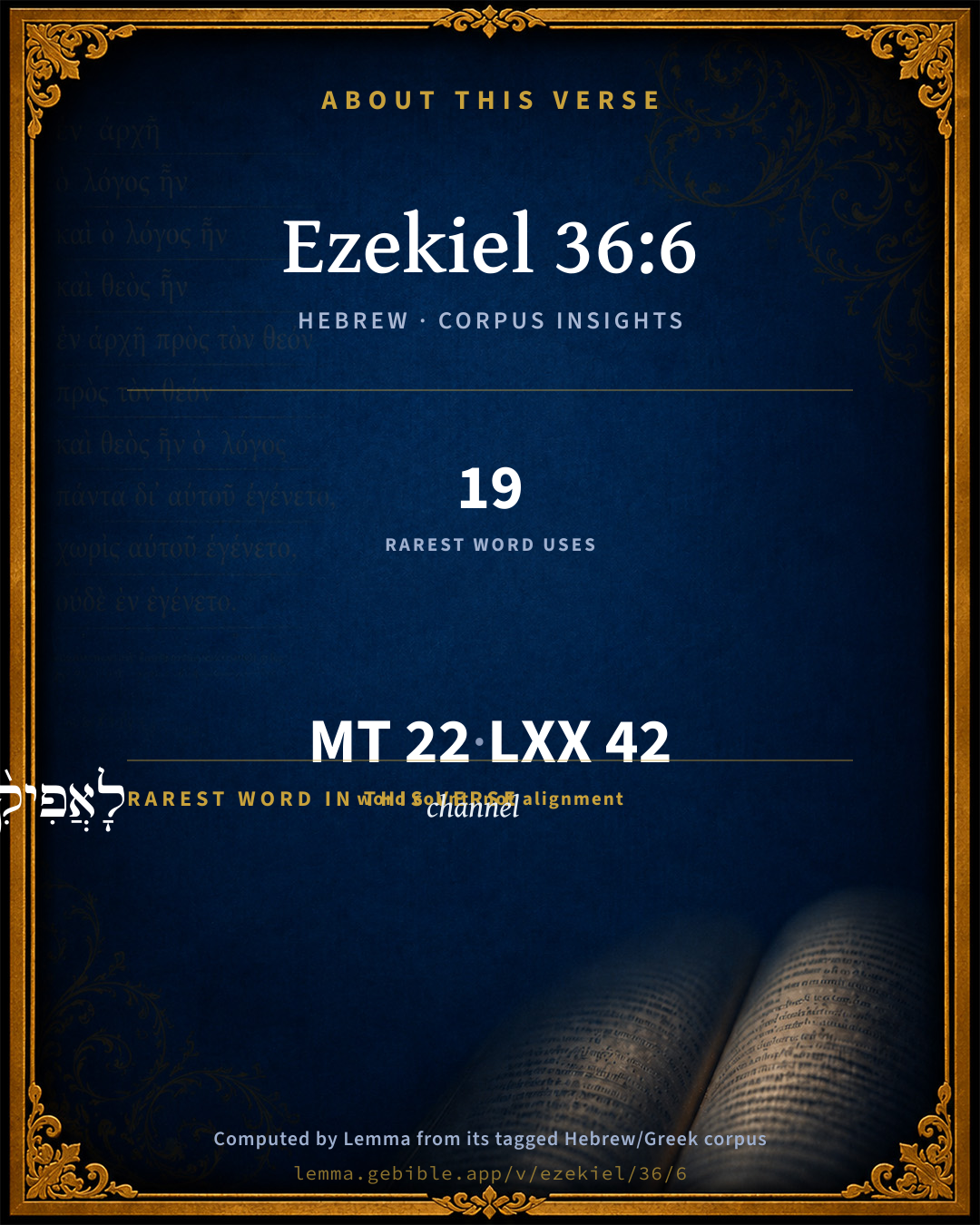
These counts appear in no published source. They are computed here, from the morphology-tagged text and Lemma’s own curated glosses. What Lemma adds →

22
words
21
distinct lemmas
Prophets
section

Notable vocabulary

The rarest word here is לָאֲפִיקִ֨ים channel H650 — appearing just 19 times in the whole Hebrew Bible.

Shared distinctive vocabulary

לָאֲפִיקִ֨ים channel H650 occurs in 19 verses of the Hebrew Bible. Also found in:

Grammatical profile

  • 5 verbs
  • 12 nouns
  • 1 preposition
  • 1 conjunction
  • 2 adverbs
  • 1 particle

Verb forms

  • הִנָּבֵ֖א Niphal · Imperative
  • וְאָמַרְתָּ֡ Qal · Sequential Perfect
  • אָמַ֣ר Qal · Perfect
  • דִּבַּ֔רְתִּי Piel · Perfect
  • נְשָׂאתֶֽם Qal · Perfect

Repetition

A word recurs within this verse — often emphatic in Hebrew:

  • וְאָמַרְתָּ֡ to say H559 ×2

Hebrew & Septuagint length

In English translation the verse runs 47 words from the Hebrew and 48 from the Septuagint (LXX English) — closely comparable.

A rough comparison of the two English renderings, which tokenize alike — not a word-level alignment.

Word counts can differ between the Hebrew and the Greek without any difference in meaning — e.g. the Hebrew direct-object marker אֵת has no separate Greek word, and Greek often adds the article ὁ.

In the original languages it is 22 Hebrew tokens and 42 Greek tokens — but the two are counted differently (Hebrew bundles its prefixes and suffixes into one token; the Greek is in lemma form), so that isn’t a like-for-like length.

Cross-references

7

Topical passages linked to Ezekiel 36:6 in the Treasury of Scripture Knowledge — connected by theme and wording, ordered by reader-vote popularity; previews shown in the World English Bible.

  • Psalms 123:3–4 Have mercy on us, Yahweh, have mercy on us, For we have endured much contempt.
  • Ezekiel 34:29 I will raise up to them a plantation for renown, and they shall be no more consumed with famine in the land, neither bear the shame of the nations any more.
  • Psalms 74:10 How long, God, shall the adversary reproach? Shall the enemy blaspheme your name forever?
  • Psalms 74:23 Don't forget the voice of your adversaries. The tumult of those who rise up against you ascends continually.
  • Psalms 74:18 Remember this, that the enemy has mocked you, Yahweh. Foolish people have blasphemed your name.
  • Ezekiel 36:4–5 therefore, you mountains of Israel, hear the word of the Lord Yahweh: Thus says the Lord Yahweh to the mountains and to the hills, to the watercourses and to the valleys, to the desolate wastes and to the cities that are forsaken, which are become a prey and derision to the residue of the nations that are round about;
  • Ezekiel 36:15 neither will I let you hear any more the shame of the nations, neither shall you bear the reproach of the peoples any more, neither shall you cause your nation to stumble any more, says the Lord Yahweh.

Cross-references courtesy of OpenBible.info (CC BY 4.0).

Hebrew and Greek witnesses Masoretic Hebrew ↔ Greek Septuagint

The same verse in the two great witnesses to the Old Testament, shown verse-for-verse.

These are two independent witnesses, not word-aligned to each other, and the Septuagint is shown in lemma (dictionary) form.

Hebrew Ezekiel 36:6 Masoretic · Westminster Leningrad Codex

לָכֵ֕ן הִנָּבֵ֖א עַל אַדְמַ֣ת יִשְׂרָאֵ֑ל וְאָמַרְתָּ֡ לֶהָרִ֣ים וְ֠לַגְּבָעוֹת לָאֲפִיקִ֨ים וְלַגֵּאָי֜וֹת כֹּֽה אָמַ֣ר אֲדֹנָ֣י יְהוִ֗ה הִנְנִ֨י בְקִנְאָתִ֤י וּבַחֲמָתִי֙ דִּבַּ֔רְתִּי יַ֛עַן כְּלִמַּ֥ת גּוֹיִ֖ם נְשָׂאתֶֽם

Therefore prophesy concerning the land of Israel, and tell the mountains and to the hills, to the watercourses and to the valleys, Thus says the Lord Yahweh: Behold, I have spoken in my jealousy and in my wrath, because you have borne the shame of the nations:

World English Bible · Public Domain

Greek LXX Ezekiel 36:6 Septuagint · lemma form

διά οὗτος προφητεύω ἐπί ὁ γῆ ὁ ἰσραήλ καί εἶπον ὁ ὄρος καί ὁ βουνός καί ὁ φάραγξ καί ὁ νάπη ὅδε λέγω κύριος ἰδού ἐγώ ἐν ὁ ζῆλος ἐγώ καί ἐν ὁ θυμός ἐγώ λαλέω ἀντί ὁ ὀνειδισμός ἔθνος φέρω σύ

therefore prophesy concerning the land of Israel, and say to the mountains, and to the hills, and to the valleys, and to the forests, Thus says the Lord; Behold, I have spoken in my jealousy and in my wrath, because you⌃ have borne the reproaches of the heathen:

LXX2012 (modern English Septuagint) · Public Domain

Hebrew: Westminster Leningrad Codex (CC BY 4.0). Greek: Septuagint (public domain); English from LXX2012 (modern English Septuagint) (Public Domain). How the Septuagint differs from the Hebrew →

Targum (Aramaic paraphrase)

1

The Targum is the ancient Jewish Aramaic paraphrase of the Hebrew Scriptures — an interpretive translation, not the Hebrew text itself. Onkelos (literal) and Pseudo-Jonathan (expansive) render the Torah, and Jonathan the Prophets. Coverage is partial: where no permissively-licensed English translation exists for a verse, only the Aramaic is shown. This is verse-level text, not a word-by-word alignment to the Hebrew.

  1. Targum Jonathan Prophets (Joshua–Malachi)
    בְּכֵן אִתְנַבַּי עַל אַרְעָא דְיִשְׂרָאֵל וְתֵימַר לְטוּרַיָא וּלְרָמָתָא לְפַצִידַיָא וּלְחֵילַיָא כִּדְנַן אֲמַר יְיָ אֱלֹהִים הָא אֲנָא בְרוּגְזִי וּבְחֵימְתִי גְזָרֵית בְּמֵימְרִי חֲלַף דְאִתְכְּנָעוּת עַמְמַיָא קַבֵּילְתּוּן:

    (no public-domain English translation for this verse)

    Targum Jonathan — Aramaic: “Mikraot Gedolot” (public domain). English: “Sefaria Community Translation” (CC0 1.0 (public-domain dedication)); “London "Chaldee Paraphrase," 1871” (public domain). Text via Sefaria.

Commentary

Notes on Ezekiel 36:6 from classic Christian and Jewish commentators (each source and its license shown beneath its notes). The classic Christian expositions comment on the surrounding passage and are grouped to its opening verse, so a note may address several verses; the Jewish commentaries on the Tanakh (Rashi and others) are per-verse, so they appear only where the commentator wrote on this verse.

Lemma curates 59 commentaries, every one of them public domain or Creative Commons licensed, each selected and text-cleaned for this edition rather than reprinted as found. About our sources →

Trapp's Complete Commentary

John Trapp

Eze 36:6 Prophesy therefore concerning the land of Israel, and say unto the mountains, and to the hills, to the rivers, and to the valleys, Thus saith the Lord GOD; Behold, I have spoken in my jealousy and in my fury, because ye have borne the shame of the heathen:

Ver. 6. Say unto the mountains and to the hills.] To those lifeless creatures he directeth his speech, to show that every creature groaneth and waiteth for the redemption of our bodies. It fareth the better also in this life present, for the elect’s sake, as it was once cursed for man’s sin, and hath lain bedridden, as it were, ever since.

Because ye have borne the shame of the heathen.] This the Lord could not bear with any patience.

John Trapp, A Commentary or Exposition upon All the Books of the Old and New Testament (1647–1656) — public domain. Text from a community e-Sword module.

Tyndale Open Study Notes

Tyndale Open Resources

36:6-7 The period of enduring the shame of mockery and plundering would now be over for Israel, and Israel’s enemies would soon endure their own shame by being mocked and plundered.

Tyndale Open Study Notes — © Tyndale Open Resources, licensed CC BY-SA 4.0. Text via the HelloAO Bible API.

Geneva Bible (1599)

Geneva Bible translators

Because you have been a laughingstock unto them.

Geneva Bible (1599) marginal notes — public domain. Text via Bolls.life.

Jamieson, Fausset & Brown

Robert Jamieson, A. R. Fausset & David Brown

the shame of the heathen--namely, the shame with which the heathen cover you (Psa 123:3-4).

Jamieson, Fausset & Brown — Commentary Critical and Explanatory on the Whole Bible (1871) — public domain (CC PDM 1.0). Text via the HelloAO Bible API.

The Cambridge Bible for Schools and Colleges

gen. ed. J. J. S. Perowne

6. borne the shame of the heathen] The shame cast on them by the heathen, cf. Eze_36:15, Eze_34:29.

The Cambridge Bible for Schools and Colleges (gen. ed. J. J. S. Perowne; Cambridge University Press, 1878–1918) — public domain. Text from a community e-Sword module.

John Gill's Exposition

Prophesy therefore concerning the land of Israel,.... And the inhabitants of it, for their comfort, in this their time of distress:

and say unto the mountains, and to the hills, to the rivers, and to the valleys, thus saith the Lord God, I have spoken in my jealousy and in my fury; with great zeal for his honour, and the interest of his people; and with indignation at his and their enemies:

because ye have borne the shame of the Heathen; their calumnies and lies, their reproaches and scoffs, their injuries and abuses; all which were resented by the Lord, and therefore he determines to punish for them.

John Gill's Exposition of the Whole Bible (1746–1763) — public domain (CC PDM 1.0). Text via the HelloAO Bible API.

Albert Barnes' Notes on the Bible

The shame of the pagan - The taunts which the pagan heaped upon them.

Albert Barnes' Notes on the Bible (1834–1885) — public domain. Text from a community e-Sword/MySword module.

Matthew Poole's English Annotations

Say unto the mountains: see Eze 36:4.

In my fury: see Eze 36:5, where is no difference in the thing expressed, though a little difference in the expressing of it; there it was

the fire of my jealousy, here

in my jealousy and in my fury. Have borne the shame of the heathen; which in Eze 36:5 is, being a

derision to the residue of the heathen; these loaded them with reproaches, and exposed them to contempt, and Israel could not prevent it, they were forced to bear it.

Matthew Poole's English Annotations on the Holy Bible (1683–1685) — public domain. Text from a community e-Sword/MySword module.

Whedon's Commentary on the Bible

Daniel D. Whedon

6, 7. He who is a jealous God (Eze_36:5) affirms with uplifted hand (Eze_20:5-6) that his people shall bear no longer this shame and reproach which has been heaped upon them (Eze_36:2-3; Eze_36:15; Eze_34:29); but this very shame shall soon fall upon their enemies, who shall be overtaken by a just retribution. (Compare Eze_16:52.)

Daniel D. Whedon (gen. ed.), Commentary on the Old and New Testaments (1874–1909) — public domain. Text from a community e-Sword module.

The Pulpit Commentary

Vers. 6, 7. Because ye have borne the shame of the heathen (i.e. the shame cast upon you by the heathen, see Eze_34:29) surely the heathen that are about you, they shall bear their shame. Not the shame which should be cast upon them by Israel, which would be retaliation, but their own shame the shame due to them in virtue of the Divine law of retribution, (Eze_16:52) their own curses come home to roost, Ezekiel seeming to distinguish between retaliation and retribution. "The law of retribution is demanded by the absolute righteousness of God. The judicial visitations of God cannot possibly be one-sided. Punishment can so much the less strike Israel alone, as precisely in its punishment the deep degradation of heathendom, its apostasy from God and its pride, has set itself forth in the most striking way" (Havernick). The certainty that this law would operate in the case of the heathen no less than in that of Israel, the prophet expresses by representing Jehovah as having lifted up his hand, or sworn that it should be so. (comp. Eze_20:5, Eze_20:6, Eze_20:15, Eze_20:23, Eze_20:28; Exo_6:8; Num_14:30; Deu_32:40; and Virgil, "AEneid," 12:195, "Teaditque ad sidera dextram

The Pulpit Commentary (1880–1919), ed. H.D.M. Spence-Jones & Joseph S. Exell — public domain. Text from a community e-Sword module.

Lesson kit

Teaching starters — assembled from the data on this page, not authored interpretation. Every prompt links to the verse data it draws on. Edit before teaching.

Ezekiel, in the Prophets, opens this verse with 22 words (21 distinct Hebrew lemmas). Its most distinctive word is ʼâphîyq (“channel”). A historical commentator’s framing appears above. Read the whole chapter for the surrounding context.

Discussion questions

  1. How does “channel” (ʼâphîyq) shape what this verse is saying?
  2. 2 Samuel 22:16 shares the word «channel» with this verse. How do the two illuminate each other?
  3. “to say” occurs 2× in this one verse. What is the effect of the repetition?
  4. These translations render this verse differently; the difference is in the English rendering, not the original. What questions does that raise?
  5. The verb «הִנָּבֵ֖א» is Niphal Imperative. How does its form color the action?
  6. Reading how Trapp's Complete Commentary and Tyndale Open Study Notes read this verse, where do the two commentators agree and where do they part?

Things to notice

Reading settings

Reading text

Shown beneath each verse's original-language words.

Old Testament
Old Testament edition

Read the OT as the Masoretic Hebrew (MT) or the Greek Septuagint (LXX).

English shown for the Greek Septuagint (in the Hebrew ↔ Greek comparison).

Comparing translations? Open the Compare panel on any verse page to stack up to four side by side.