Psalms 49:11

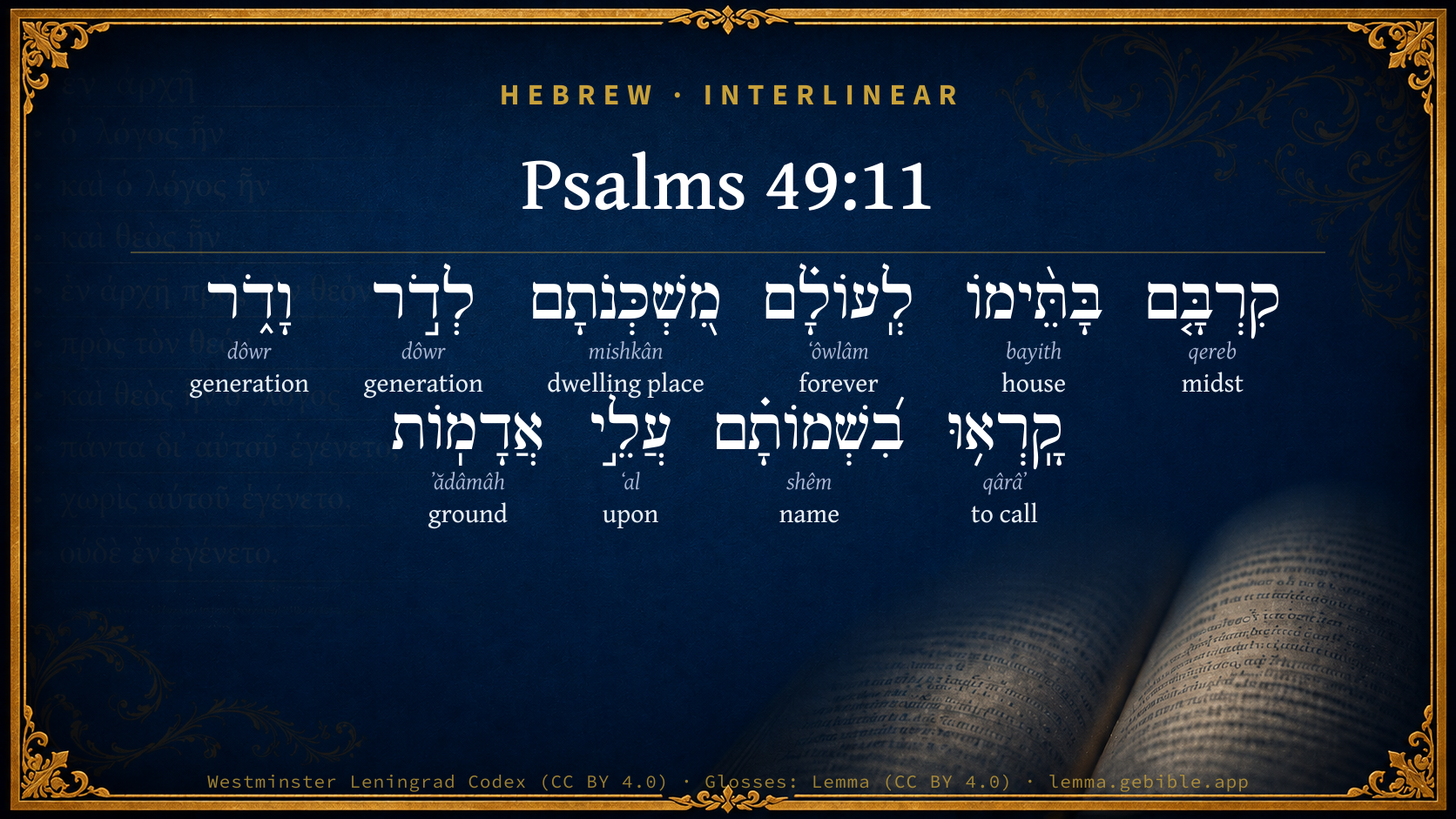
Hebrew (Westminster Leningrad Codex) Psalms 49:11 appears in the Hebrew Old Testament. The text above is from the Westminster Leningrad Codex. Each word links to its Strong’s number, a concise gloss, and parsing drawn from the Open Scriptures Hebrew Bible morphology. Click any word for its full Brown-Driver-Briggs (BDB) entry.
Download image
Cite this verse

Psalms 49:11 (World English Bible). Public Domain. Lemma interlinear Bible study tool, https://lemma.gebible.app/v/psalms/49/11.

Show BibTeX & RIS
BibTeX
RIS
English Translation
Their inward thought is that their houses will endure forever, And their dwelling places to all generations. They name their lands after themselves.
World English Bible · Public Domain
Download a study sheet

One document with this verse’s original text, its word-by-word gloss line, the meaning frame, cross-references with their text, attributed commentary, and full source and license credits — printable, and it pastes into notes with its structure intact.

This verse Autodidact and up

Study sheet (.html) Plain text (.txt)

A passage Seminary Student

Up to 50 verses in one chapter. A passage sheet keeps up to 6 commentary sources and 12 cross-references per verse, in the order this page ranks them, and says so on the sheet whenever that leaves anything out. Ask for a single verse and you get the Autodidact verse sheet above.

Everything on this page stays free to read, with no account — the sheet is a download of what is already on screen, not access to it.

Want to remove ads? Support Godless Engineer
Compare translations 3

The same verse in 3 English versions, stacked beneath the original-language interlinear above. Click any original word for its lexicon entry.

Each is an independent rendering of the whole verse — the interlinear is not word-aligned to these translations.

Highlighted words mark where these versions differ — a whole-verse word diff, not a word-by-word alignment.

  • World English Bible Public Domain
    Their inward thought is that their houses will endure forever, And their dwelling places to all generations. They name their lands after themselves.
  • King James Version Public Domain
    Their inward thought is, that their houses shall continue for ever, and their dwelling places to all generations; they call their lands after their own names.
  • unfoldingWord Literal Text CC BY-SA 4.0
    Inside of them, their houses forever, their dwellings to generation and generation. They call over lands by their names.

unfoldingWord Literal Text — © unfoldingWord, licensed CC BY-SA 4.0. Word-aligned USFM3 via Door43 (git.door43.org/unfoldingWord/en_ult).

Versions to compare (up to 4)

3 of 4 selected

Show all 18 translations

Every available English version of this verse, each an independent rendering of the whole verse.

  • World English Bible Public Domain
    Their inward thought is that their houses will endure forever, And their dwelling places to all generations. They name their lands after themselves.
  • Berean Standard Bible Public Domain
    Their graves are their eternal homes—their dwellings for endless generations—even though their lands were their namesakes.
  • Majority Standard Bible Public Domain
    Their graves are their eternal homes—their dwellings for endless generations—even though their lands were their namesakes.
  • King James Version Public Domain
    Their inward thought is, that their houses shall continue for ever, and their dwelling places to all generations; they call their lands after their own names.
  • American Standard Version (1901) Public Domain
    Their inward thought is, `that' their houses `shall continue' for ever, `And' their dwelling-places to all generations; They call their lands after their own names.
  • Revised Version (1885) Public Domain
    Their inward thought is, that their houses shall continue for ever, and their dwelling places to all generations; they call their lands after their own names.
  • Geneva Bible (1599) Public Domain
    Yet they thinke, their houses, and their habitations shall continue for euer, euen from generation to generation, and call their lands by their names.
  • Douay-Rheims (1899) Public Domain
    He shall not see destruction, when he shall see the wise dying: the senseless and the fool shall perish together: And they shall leave their riches to strangers:
  • Young's Literal Translation Public Domain
    Their heart `is': Their houses `are' to the age, Their tabernacles to all generations. They proclaimed their names over the lands.
  • Literal Standard Version CC BY-SA 4.0
    Their heart [is that] their houses [are] for all time, || Their dwelling places from generation to generation. They proclaimed their names over the lands.
  • Unlocked Literal Bible CC BY-SA 4.0
    Their inner thought is that their families will continue forever, and the places where they live, to all generations; they call their lands after their own names.
  • unfoldingWord Literal Text CC BY-SA 4.0
    Inside of them, their houses forever, their dwellings to generation and generation. They call over lands by their names.
  • Darby Bible Public Domain
    Their inward thought is, that their houses are for ever,their dwelling-places from generation to generation: they call the lands after their own names.
  • World Messianic Bible Public Domain
    Their inward thought is that their houses will endure forever, and their dwelling places to all generations. They name their lands after themselves.
  • Webster's Bible Public Domain
    \\49:10\\For he seeth that wise men die, likewise the fool and the brutish person perish, and leave their wealth to others.
  • Free Bible Version CC BY-SA 4.0
    They think their homes will last forever, that where they live will continue for all generations.
  • Bible in Basic English Public Domain
    The place of the dead is their house for ever, and their resting-place through all generations; those who come after them give their names to their lands.
  • JPS Tanakh (1917) Public Domain
    (49-12) Their inward thought is, that their houses shall continue for ever, and their dwelling-places to all generations; they call their lands after their own names.

Literal Standard Version (2020), Covenant Press — licensed CC BY-SA 4.0. Text via the HelloAO Bible API (eBible.org). Unlocked Literal Bible (unfoldingWord) — licensed CC BY-SA 4.0. Text via the HelloAO Bible API (eBible.org). unfoldingWord Literal Text — © unfoldingWord, licensed CC BY-SA 4.0. Word-aligned USFM3 via Door43 (git.door43.org/unfoldingWord/en_ult). Free Bible Version, Dr. Jonathan Gallagher — licensed CC BY-SA 4.0. Text via the HelloAO Bible API (eBible.org).

Word by word

More ways to search: Search by grammar → Find every occurrence → Compare this word →

Practice this passage: Drill this verse → Learn its vocabulary →

מִ֭שְׁכְּנֹתָם
mishkân
H4908
“dwelling places · their”
Noun, Common, Masculine, Plural, Construct + Suffix, Personal, 3rd Person, Masculine, Plural
Part of Speech
Noun
Type
Common
Gender
Masculine
Number
Plural
State
Construct
Full BDB Definition

Origin: from H7931

TWOT: 2387c

dwelling place, tabernacle - dwelling-place - dwellings
  1. קִרְבָּ֤ם qereb H7130 “midst · their” Noun, Common, Masculine, Singular, Construct + Suffix, Personal, 3rd Person, Masculine, Plural
  2. בָּתֵּ֨ימוֹ bayith H1004 “houses · their” Noun, Common, Masculine, Plural, Construct + Suffix, Personal, 3rd Person, Masculine, Plural
  3. לְֽעוֹלָ֗ם ʻôwlâm H5769 “to/for · forever” Preposition + Noun, Common, Masculine, Singular, Absolute
  4. לְדֹ֣ר dôwr H1755 “to/for · generation” Preposition + Noun, Common, Masculine, Singular, Absolute
  5. וָדֹ֑ר dôwr H1755 “and · generation” Conjunction + Noun, Common, Masculine, Singular, Absolute
  6. קָֽרְא֥וּ qârâʼ H7121 “to call” Verb, Qal, Perfect, 3rd Person, Common, Plural
  7. בִ֝שְׁמוֹתָ֗ם shêm H8034 “in/at · names · their” Preposition + Noun, Common, Masculine, Plural, Construct + Suffix, Personal, 3rd Person, Masculine, Plural
  8. עֲלֵ֣י ʻal H5921 “upon” Preposition
  9. אֲדָמֽוֹת ʼădâmâh H127 “lands” Noun, Common, Feminine, Plural, Absolute

About this verse

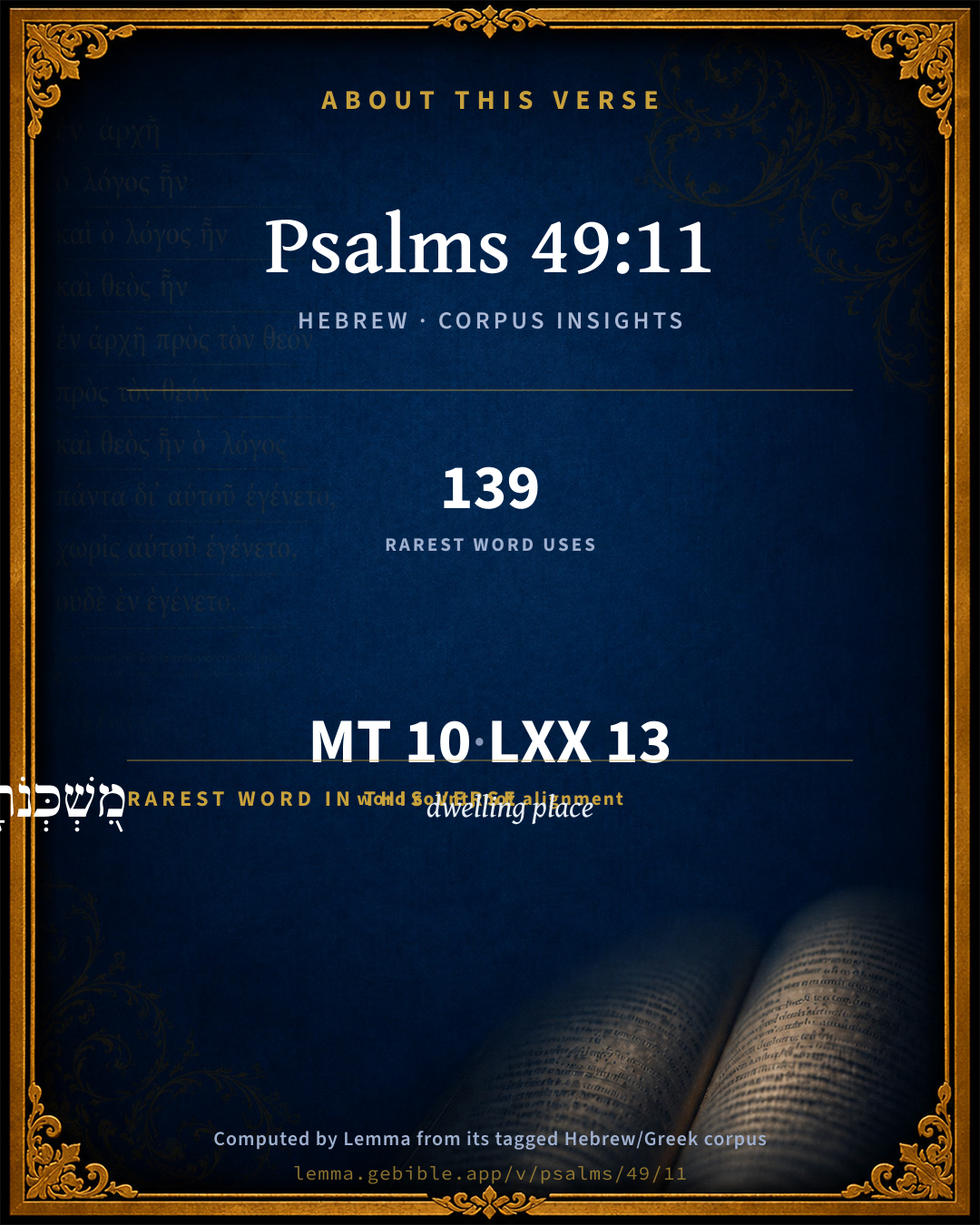
These counts appear in no published source. They are computed here, from the morphology-tagged text and Lemma’s own curated glosses. What Lemma adds →

10
words
9
distinct lemmas
Wisdom
section

Grammatical profile

  • 1 verb
  • 8 nouns
  • 1 preposition

Verb forms

  • קָֽרְא֥וּ Qal · Perfect

Repetition

A word recurs within this verse — often emphatic in Hebrew:

  • לְדֹ֣ר generation H1755 ×2

Hebrew & Septuagint length

In English translation the verse runs 23 words from the Hebrew and 23 from the Septuagint (LXX English) — the same length.

A rough comparison of the two English renderings, which tokenize alike — not a word-level alignment.

Word counts can differ between the Hebrew and the Greek without any difference in meaning — e.g. the Hebrew direct-object marker אֵת has no separate Greek word, and Greek often adds the article ὁ.

In the original languages it is 10 Hebrew tokens and 13 Greek tokens — but the two are counted differently (Hebrew bundles its prefixes and suffixes into one token; the Greek is in lemma form), so that isn’t a like-for-like length.

Cross-references

10

Topical passages linked to Psalms 49:11 in the Treasury of Scripture Knowledge — connected by theme and wording, ordered by reader-vote popularity; previews shown in the World English Bible.

  • Genesis 4:17 Cain knew his wife. She conceived, and gave birth to Enoch. He built a city, and called the name of the city, after the name of his son, Enoch.
  • Psalms 5:9 For there is no faithfulness in their mouth. Their heart is destruction. Their throat is an open tomb. They flatter with their tongue.
  • Psalms 64:6 They plot injustice, saying, "We have made a perfect plan!" Surely man's mind and heart are cunning.
  • 2 Samuel 18:18 Now Absalom in his lifetime had taken and reared up for himself the pillar, which is in the king's dale; for he said, I have no son to keep my name in memory: and he called the pillar after his own name; and it is called Absalom's monument, to this day.
  • Psalms 10:6 He says in his heart, "I shall not be shaken; For generations I shall have no trouble."
  • Ezekiel 38:10 Thus says the Lord Yahweh: It shall happen in that day, that things shall come into your mind, and you shall devise an evil device:
  • 1 Samuel 15:12 Samuel rose early to meet Saul in the morning; and it was told Samuel, saying, Saul came to Carmel, and, behold, he set him up a monument, and turned, and passed on, and went down to Gilgal.
  • Luke 11:39 The Lord said to him, "Now you Pharisees cleanse the outside of the cup and of the platter, but your inward part is full of extortion and wickedness.
  • Acts 8:22 Repent therefore of this, your wickedness, and ask God if perhaps the thought of your heart may be forgiven you.
  • Deuteronomy 3:14 Jair the son of Manasseh took all the region of Argob, to the border of the Geshurites and the Maacathites, and called them, even Bashan, after his own name, Havvoth Jair, to this day.)

Cross-references courtesy of OpenBible.info (CC BY 4.0).

Hebrew and Greek witnesses Masoretic Hebrew ↔ Greek Septuagint

The same verse in the two great witnesses to the Old Testament, shown verse-for-verse.

You’re reading Greek Psalm 48 (Hebrew Psalm 49). The Septuagint counts the superscription, so verse numbers can differ from the Hebrew — chapter-level alignment, not verse-by-verse. Numbering follows Rahlfs.

These are two independent witnesses, not word-aligned to each other, and the Septuagint is shown in lemma (dictionary) form.

Hebrew Psalms 49:11 Masoretic · Westminster Leningrad Codex

קִרְבָּ֤ם בָּתֵּ֨ימוֹ לְֽעוֹלָ֗ם מִ֭שְׁכְּנֹתָם לְדֹ֣ר וָדֹ֑ר קָֽרְא֥וּ בִ֝שְׁמוֹתָ֗ם עֲלֵ֣י אֲדָמֽוֹת

Their inward thought is that their houses will endure forever, And their dwelling places to all generations. They name their lands after themselves.

World English Bible · Public Domain

Greek LXX Greek Psalm 48:11 Septuagint · lemma form

ἐπί ὁ αὐτός ἄφρων καί ἄνους ἀποὀλλύω καί καταλείπω ἀλλότριος ὁ πλοῦτος αὐτός

And their sepulchres are their houses for ever, even their tabernacles to all generations: they have called their lands after their own names.

LXX2012 (modern English Septuagint) · Public Domain

On this verse, Adam Clarke's Commentary discusses the Septuagint’s reading. Read the note in Commentary ↓

Hebrew: Westminster Leningrad Codex (CC BY 4.0). Greek: Septuagint (public domain); English from LXX2012 (modern English Septuagint) (Public Domain). How the Septuagint differs from the Hebrew →

Commentary

Notes on Psalms 49:11 from classic Christian and Jewish commentators (each source and its license shown beneath its notes). The classic Christian expositions comment on the surrounding passage and are grouped to its opening verse, so a note may address several verses; the Jewish commentaries on the Tanakh (Rashi and others) are per-verse, so they appear only where the commentator wrote on this verse.

Lemma curates 59 commentaries, every one of them public domain or Creative Commons licensed, each selected and text-cleaned for this edition rather than reprinted as found. About our sources →

Trapp's Complete Commentary

John Trapp

Psa 49:11 Their inward thought [is, that] their houses [shall continue] for ever, [and] their dwelling places to all generations; they call [their] lands after their own names.

Ver. 11. Their inward thought is, that their houses, &c.] Some join this verse to the former, and read the words thus: Whereas each of them seeth that wise men die, likewise the fool, &c., yet their inward thought is, &c., they have a secret fond conceit of their own immortality, they would fain believe that they shall dwell here for ever. The Hebrew runneth thus, Their inwards are their houses for ever; as if their houses were got within them, as the Pharisee’s goods were, Luk 11:14, τα ενοντα. So here, Internum vel interiora; not the thoughts only, but the very inmost of the thoughts of wicked worldlings, the most retired thoughts and recesses of their souls, are about these earthly things; these lie nearest to their hearts; as Queen Mary said when she died, Open me, and you shall find Calais at my heart. It was a pitiful case, that a rotten town lay where Christ should, and yet it is ordinary.

They call their lands after their own names] So to make them famous, and to immortalize them at once. Thus Cain called his newly built city Enoch, after the name of his son, whom he would thereby have to be called Lord Enoch of Enoch. This is the ambition still of many, that take little care to know that their names are written in heaven; but strive to propagate them, as they are able, upon earth, Nimrod by his tower, Absalom by his pillar, Alexander by his Alexandria, Adrian by his Adrianople, &c. But the name of the wicked shall rot, Pro 10:7, and those that depart from God shall be written in the earth, Jer 17:13, &c.

John Trapp, A Commentary or Exposition upon All the Books of the Old and New Testament (1647–1656) — public domain. Text from a community e-Sword module.

The Treasury of David

Charles H. Spurgeon

Ver. 11. Their inward thought is, their houses shall continue for ever, and their dwelling places to all generations. He is very foolish who is more a fool in his inmost thought than he dare to be in his speech. Such rotten fruit, rotten at the core, are worldlings. Down deep in their hearts, though they dare not say so, they fancy that earthly goods are real and enduring. Foolish dreamers! The frequent dilapidation of their castles and manor houses should teach them better, but still they cherish the delusion. They cannot tell the mirage from the true streams of water; they fancy rainbows to be stable, and clouds to be the everlasting hills. They call their lands after their own names. Common enough is this practice. His grounds are made to bear the groundling's name, he might as well write it on the water. Men have even called countries by their own names, but what are they the better for the idle compliment, even if men perpetuate their nomenclature?

Ver. 11. Their inward thought is, that their houses shall continue for ever. This is the interpretation of our actions, when we do not make God our portion, but trust in the abundance of our riches; this is our inward thought, the saying of our heart, Ye are my god. We do in effect say, Thou art my confidence, my hope, and my joy, and will stand by me when all things cease and fail, and wilt not suffer me to want, or to be wrong, as long as you last: these are the secret speeches of our hearts. Christians! many may (orator like), declaim against the vanity of the creature, and speak as basely of money as others do, and say, We know it is but a little refined earth; but their hearts close with it, they are loathe to part with it for God's sake, or upon God's declared will. As he that speaketh good words of God, is not said to trust in God; so speaking bad words of worldly riches doth not exempt us from trusting them. There is a difference between declaiming as an orator, and acting like a Christian. Thomas Manton.

Ver. 11. Their inward thought. If good thoughts be thy deep thoughts, if, as we say, the best be at the bottom, thy thoughts are then right, and thou art righteous; for as the deep thoughts of worldlings are worldly thoughts, and the deep thoughts of wicked men are wicked thoughts, so the deep thoughts of good men are good thoughts. It is a notable observation of the Holy Ghost's concerning worldly men, that their inward thought is that their houses shall continue for ever, etc. Why? is there any thought that is not an inward thought? No, but the meaning is, though they have some floating thoughts of their mortality, and the vanity and transitoriness of all worldly things, swimming, as it were, on the top; yet they do not suffer such thoughts to sink into their hearts, or to go to the bottom; but the thoughts that lodge there are such as his, who is said by our Saviour to have thought within himself, "Soul, thou hast much goods laid up for many years; take thine ease, eat, drink, and be merry." Lu 12:19. Note the phrase, "he thought within himself." There are other kinds of thoughts that sometimes knock at the door of the worldling's heart, nay, sometimes look in at his windows, as Paul's sermon began to press in upon Felix his heart, and to set him trembling; but there are other thoughts within, which if they cannot keep good thoughts quite out, they will keep them off from making any due or deep impression upon the heart. Now, these thoughts that nestle themselves as it were at the very heart roots, to keep others out from reaching thither, these deep thoughts are they which the Scriptures call the inward thoughts, according to that of the psalmist Ps 64:6, "The inward thought of every one of them and the heart, is deep." Faithful Teat in "Right Thoughts the Righteous man's Evidence, " 1666.

Ver. 11. They call their lands after their own names. God makes fools of them, for how few have you that go beyond the third generation? How few houses have you that the child or the grandchild can say, "This was my grandfather's and my great grandfather's"? How few houses have you that those that are now in them can say, "My ancestor dwelt here, and these were his lands"? Go over a whole country, few can say so. Men when they build, together with building in the earth they build castles in the air; they have conceits. Now I build for my child, and for my child's child. God crosses them. Either they have no posterity, or by a thousand things that fall out in the world, it falls out otherwise. The time is short, and the fashion of this world passeth away; that is, the buildings pass away, the owning passeth away, all things here pass away; and, therefore, buy as if you possessed not, buy, so as we neglect not the best possession in heaven, and so possess these things, as being not possessed and commanded of them. Richard Sibbes.

Ver. 11. Mr. A was a wealthy farmer in Massachusetts, about sixty years of age, and it had been his ruling, and almost only passion in life to acquire property. His neighbour B owned a small farm, which came too near the centre of A's extended domain, was quite a blot in his prospect, destroyed the regularity of his lands, and on the whole it was really necessary, in his opinion, that he should add it to his other property. B became embarrassed, and was sued; judgments were obtained, and executions issued. A now thought he should obtain the land, but one execution after another was arranged, and finally the debt was paid off without selling the land. When A heard of the payment of the last execution, which put an end to his hopes of obtaining the land, he exclaimed, "Well, B is an old man, and cannot live long, and when he dies I can buy the lot." B was fifty-eight, A was sixty! Reader, do you ever expect to die? K. Arvine's Cyclopaedia of Moral and Religious Anecdotes.

Ver. 11. I have purchased, saith one, such lands, and I have got so good a title to them, that certainly they will remain mine and my heirs for ever; never considering how all things here below are subject to ebbings and flowings, to turns and vicissitudes every day. Joseph Caryl.

Ver. 11. The fleeting nature of all earthly possessions is well illustrated in the life of William Beckford, and the unenduring character of gorgeous fabrics in the ruin of his famous Babel, Fonthill Abbey. Byron sang of Beckford's palace in Spain, in language most applicable to Fonthill:

"There, too, thou Vathek! England's wealthiest son

Once formed thy Paradise, as not aware

When wanton wealth her mightiest deeds hath done,

Meek Peace voluptuous lures was ever wont to shun.

Here didst thou dwell; here schemes of pleasure plan,

Beneath yon mountain's ever beauteous brow.

But now, as if a thing unblessed by man,

Thy fairy dwelling is as lone as thou!

Here giant weeds a passage scarce allow,

To halls deserted, portals gaping wide;

Fresh lessons to the thinking bosom, how

Vain are the pleasures on earth supplied,

Swept into wrecks anon by Time's ungentle tide!" C. H. S.

Ver. 11-12. "They call their GROUNDS after their names. But the GROUNDLING, in the midst of splendour, endureth not." In Ps 49:11, we have (twmra), "grounds." In Ps 49:12, it is (Mra), "groundling, "with a designed iteration and play upon the word; for want of an attention to which the passage has not been fully understood. John Mason Good.

None.

Psalms 49:12*

Ver. 11-12. See Psalms on "Ps 49:11" for further information.

Charles H. Spurgeon's The Treasury of David (1869–1885) — public domain. Psalms only. Text from a community e-Sword/MySword module.

Joseph Benson's Commentary

Psa 49:11. Their inward thought — Which they are ashamed to express, but which is yet their secret hope; is, that their houses — Either their families, or rather their mansion-houses, as it is explained in the next clause; shall continue for ever — To them and theirs in succeeding generations; they imagine, and secretly please themselves in this fancy, that when they can stay no longer in the world, their goodly houses which they have built shall stand for ever, and the places of their abode continue in their family from age to age. They call their lands after their own name — Though they cannot be immortal themselves, yet they hope their names, which they put upon their lands, shall never die. “Various are the contrivances,” says Dr. Horne, “of vain men, to have their names written on earth, and to procure, after their deaths, an imaginary immortality, for themselves and their families, in the memory and conversation of posterity; which is not often obtained; and, if obtained, is of no value; when, with less trouble, they might have had their names written in heaven, and have secured to themselves a blessed immortality in the glorious kingdom of their Redeemer.”

Joseph Benson's Commentary on the Old and New Testaments (1811–1818) — public domain. Text from a community e-Sword module.

J. A. Alexander on Psalms

Joseph Addison Alexander

12. (Psa 49:11). Their inward thought (is that) their houses (shall continue) for ever, their dwellings to generation and generation: they call their lands by their own names. This is substantially the common version, which is here retained because it yields a good sense, and is as probable as any other explanation of this very obscure verse. The first word in Hebrew strictly means the inside of anything, and especially of man, i.e. his mind or heart, particularly as distinguished from his words or outward conduct. See above, on Psa 5:10 (9), and below, on Psa 44:7 (6). The plural form at the end of the sentence occurs nowhere else, but corresponds to our word grounds, when applied to cultivated lands. As the singular, however, though it commonly means ground, seems occasionally to denote a land or country, some understand the clause to mean that they (i.e. men indefinitely) proclaim (or celebrate) their names over lands, i.e. throughout various countries. Another possible, though not a probable construction, makes the last two words mean upon earth, the form of the Hebrew noun being assimilated to that of the particle before it. Amidst these various constructions the essential meaning still remains unchanged, to wit, that the rich fools of the foregoing context imagine their prosperity to be perpetual.

Joseph Addison Alexander, The Psalms Translated and Explained (1850) — public domain. Text from a community e-Sword module.

Tyndale Open Study Notes

Tyndale Open Resources

49:11-12 The teacher brings wisdom through irony. Everyone dies, and even those with estates named after them will be forgotten.

Tyndale Open Study Notes — © Tyndale Open Resources, licensed CC BY-SA 4.0. Text via the HelloAO Bible API.

Geneva Bible (1599)

Geneva Bible translators

Or, labor that their name may be famous in earth.

Geneva Bible (1599) marginal notes — public domain. Text via Bolls.life.

Jamieson, Fausset & Brown

Robert Jamieson, A. R. Fausset & David Brown

Still infatuated and flattered with hopes of perpetuity, they call their lands, or "celebrate their names on account of (their) lands."

Jamieson, Fausset & Brown — Commentary Critical and Explanatory on the Whole Bible (1871) — public domain (CC PDM 1.0). Text via the HelloAO Bible API.

Adam Clarke's Commentary

Verse 11. Their inward thought is, that their houses shall continue for ever] Thus, by interpolation, we have endeavoured to patch up a sense to this clause. Instead of קרבם kirbam, their inward part, the Septuagint appear to have used a copy in which the second and third letters have been transposed קברם kibram, their sepulchres; for they translate: Και οἱ ταφοι αυτων οικιαι αυτων εις τον αιωνα· "For their graves are their dwellings for ever." So six or seven feet long, and two or three wide, is sufficient to hold the greatest conqueror in the universe! What a small house for the quondam possessor of numerous palaces and potent kingdoms!

They call their lands after their own names.] There would have been no evil in this if it had not been done on an infidel principle. They expected no state but the present; and if they could not continue themselves, yet they took as much pains as possible to perpetuate their memorial.

Adam Clarke's Commentary on the Bible (1810–1826) — public domain. Text from a community e-Sword/MySword module.

Ellicott's Commentary for English Readers

(11) Their inward thought is, that their houses shall continue for ever.—These eleven words represent three in the Hebrew, and, as the text stands, give its sense, which is intelligible and consistent:

“They believe their houses will last for ever,

Their dwelling places from generation to generation;

They call the lands by their own names.”

The reading followed by the LXX., Chaldee, and Syriac, kibram for kirbam gives a different thought—

“Their graves are their homes,

Their dwelling places for ever.”

(Comp. “his long home,” Ecc_12:5.)

The last clause, which literally runs, they call in their names upon lands, is by some explained (see Isa_44:5) to mean, “they are celebrated in their lands,” which suits the text followed by the LXX.

A Bible Commentary for English Readers, edited by Charles John Ellicott (1878–1897) — public domain. Text from a community e-Sword module.

The Cambridge Bible for Schools and Colleges

gen. ed. J. J. S. Perowne

11. Their inward thought is &c.] If they do reflect that they must die, they comfort themselves with the delusion that their houses will last for ever, and their names be perpetuated in the names of their estates, which like builders of cities or conquerors (2Sa_12:28) they have named after themselves. But the rendering their inward thought is questionable; and the LXX, Vulg., Syr., and Targ., all point to a different reading, involving simply a transposition of letters (qbrm for qrbm), which gives the sense:

Graves are their houses for ever;

The dwelling-places for all generations

Of those who called lands after their own names.

This reading suits the context best. They must surrender their wealth, and a narrow grave will be the only possession left to the man who called a vast estate by his own name. The first line recalls the name ‘eternal house’ applied to the grave in Ecc_12:5, and in inscriptions: cp. ‘eternal place,’ Tob_3:6 : and Isaiah calls Shebna’s pretentious sepulchre a ‘dwelling-place’ (Isa_22:16). Is there an ironical allusion in the last line to the vast estates of Isaiah’s day (Isa_5:8)?

The Cambridge Bible for Schools and Colleges (gen. ed. J. J. S. Perowne; Cambridge University Press, 1878–1918) — public domain. Text from a community e-Sword module.

John Gill's Exposition

Their inward thought is, that their houses shall continue for ever,.... This is the thought of their hearts, what they secretly imagine, and conclude within themselves; either that their families, which may be meant by their houses, see Sa2 3:1; shall continue in succeeding ages, to the end of the world, to inherit their possessions, and perpetuate their name; though often so it is, that great families become extinct, and the seed of the wicked is cut off: or that their magnificent buildings, which they have erected to dwell in, and for their honour and glory, shall abide for ever; though in a little time, so it is by one means or another, like the buildings of the temple, not one stone is left upon another. Or the words may be rendered, "in the midst of them" (their heirs to whom they leave their wealth) "their houses shall remain for ever", so Aben Ezra; that is, so they fancy they will; but this is not always true, for fine houses and large estates belonging to them often pass into other hands and families. The word rendered "their inward part", by a transposition of two letters in it may be read "their graves", as Aben Ezra, Kimchi, and Ben Melech observe; and to this sense the Targum, Septuagint, Vulgate Latin, Syriac, and Arabic versions render the words: and then the meaning is, that of all the houses they have built or been possessed of, they have only one left, and that is the grave; in which they shall dwell until the resurrection, and therefore is called "a long home", Ecc 12:5; see Job 17:13;

and their dwelling places to all generations; which signify the same as before;

they call their lands after their own names; as Egypt was called Mizraim, Ethiopia was called Cush, and Palestine Canaan, from men who were the first possessors of them, Gen 10:6. Or "they proclaim their names throughout the land" (x); they seek to get a name, and spread and continue it in all part of the world; being unconcerned about their names being written in heaven, or about having a house not made with hands eternal there.

(x) So Piscator, Gejerus, Michaelis.

John Gill's Exposition of the Whole Bible (1746–1763) — public domain (CC PDM 1.0). Text via the HelloAO Bible API.

Albert Barnes' Notes on the Bible

Their inward thought is - Their secret expectation and feeling is that they have secured permanency for their wealth in their own families, though they themselves may pass away. The essential thought in this verse is, that the rich people referred to in the foregoing verses imagine that their possessions will be perpetuated in their own families. The word rendered “inward thought” - קרב qereb - means properly “the midst, the middle, inner part;” and hence it comes to mean the heart, or the mind, as the seat of thought and affection: Psa 5:9; Psa 64:6. It means here, their hope, their calculation, their secret expectation; and the whole verse is designed to show the value or importance which they attach to wealth as being, in their apprehension, suited to build up their families forever.

That their houses shall continue “for ever - Either the dwellings which they rear, or - more probably - their families.

And their dwelling-places to all generations - Margin, as in Hebrew, “to generation and generation.” That is, forever. They expect that their possessions will always remain in the family, and be transmitted from one generation to another.

They call their lands after their own names - They give their own names to the farms or grounds which they own, in the hope that, though they must themselves pass away, their “names” may be handed down to future times. This practice, which is not uncommon in the world, shows how intense is the desire of people not to be forgotten; and at the same time illustrates the main thought in the psalm - the importance attached to wealth by its possessor, as if it could carry his “name” down to future times, when he shall have passed away. In this respect, too, wealth is commonly as powerless as it is in saving its possessor from the grave. It is not very far into future times that mere wealth can carry the name of a man after he is dead. lands and tenements pass into other hands, and the future owner soon ceases to have any concern about the “name” of the former occupier, and the world cares nothing about it. A man must have some other claim to be remembered than the mere fact of his having been rich, or he will be soon forgotten. Compare the notes at Isa 22:15-19.

Albert Barnes' Notes on the Bible (1834–1885) — public domain. Text from a community e-Sword/MySword module.

Matthew Poole's English Annotations

Their inward thought is; though they are ashamed to express it, yet it is their secret opinion, and hope, and wish.

Their houses; either,

1. Their posterity, oft called men’s houses 2Sa 7:11, &c.; Psa 113:9; 115:12. Or,

2. Their mansion houses, as it is explained in the next clause, which also serve for this purpose, to preserve a man name for ever.

Shall continue for ever; not to them in their own persons, but to them and theirs in succeeding generations, as it follows.

They call their lands after their own names; fondly dreaming by this means to immortalize their names and memories.

Matthew Poole's English Annotations on the Holy Bible (1683–1685) — public domain. Text from a community e-Sword/MySword module.

Whedon's Commentary on the Bible

Daniel D. Whedon

11. Unable to redeem themselves from death, (Psa_49:6-8,) these worldlings bend their thoughts to schemes whereby they vainly hope to perpetuate an ideal immortality, as if they could secure a posthumous enjoyment of their earthly grandeur. The futility of this scheme is the psalmist’s second ground of argument.

Their inward thought—The thought of their inmost being, (קרב, kereb,) the product of their profoundest faculty of reason and sensibility. The original is abrupt, but the sense is clear and pungent.

Here we have the true measurement of their moral manhood; the highest reach and deepest soundings of their soul-life, and their spirit-life.

Daniel D. Whedon (gen. ed.), Commentary on the Old and New Testaments (1874–1909) — public domain. Text from a community e-Sword module.

The Pulpit Commentary

Their inward thought is, that their houses shall continue for ever, and their dwelling-places to all generations. Still, though they know this, the rich and worldly have an idea an "inward thought which they cherish, that they can m a certain sense escape death by founding families and leaving to their children substantial houses, which will keep up the family reputation, and accumulating landed estates, to which they may affix their name, so keeping their memories alive to future ages. They call their lands after their own names. (see Gen_10:2, Gen_10:4, Gen_10:6, Gen_10:22, Gen_10:23, Gen_10:29, etc.; and compare the Greek traditions with respect to Hellen, Ion, Achaeus, Pelops, Cadmus, etc.) To call cities after their own names, or the names of their sons, was a still commoner practice of great men in the olden times. (Gen_4:17 Gen_11:31 Exo_1:11; "Records of the Past," vol. 1. p. 14; vol. 3. pp. 45, 92, 112; vol. 7. pp. 32, 39, etc.)

The Pulpit Commentary (1880–1919), ed. H.D.M. Spence-Jones & Joseph S. Exell — public domain. Text from a community e-Sword module.

John Wesley's Explanatory Notes

Thought - Tho' they are ashamed to express, yet it is their secret hope. Houses - Either their posterity, often called mens houses: or their mansion-houses, as it is explained in the next clause. For ever - To them and theirs in succeeding generations. Call - Fondly dreaming by this means to immortalize their memories.

John Wesley, Explanatory Notes Upon the Whole Bible (1754–1765) — public domain. Text via the GEBible commentary corpus.

unfoldingWord translationNotes

Door43 World Missions Community

Their inner thought

"Their belief"

the places where they live, to all generations

The verb may be supplied from the previous phrase. AT: "the places where they live will continue to all generations" (See: Ellipsis)

they call their lands after their own names

"they name their lands after themselves." This phrase expresses ownership. AT: "they own their own lands" (See: Idiom)

translationWords

family

generation

call

name

unfoldingWord translationNotes — © Distant Shores Media and the Door43 World Missions Community, licensed CC BY-SA 4.0. Source: git.door43.org/Door43/en_tn.

Rashi

Rabbi Shlomo Yitzchaki (Rashi)

For he sees that wise men die and are not saved from death. So, perforce, he stops wearying himself and toiling for his brother’s ransom.

their possessions Heb. חילם, their money. Death is mentioned in reference to the wise men, because in this world they die only in the body, whereas concerning the fool and the boorish man, perishing is mentioned, because both body and soul perish.

Rashi on the Tanakh — English translations: “The Judaica Press complete Tanach with Rashi, translated by A. J. Rosenberg” (CC BY 4.0); “Pentateuch with Rashi's commentary by M. Rosenbaum and A.M. Silbermann, 1929-1934” (public domain); “The Metsudah Tanach series, Lakewood, N.J” (CC BY 4.0); and “The Book of Joshua, Metsudah Publications, 1997” (CC BY 4.0). Text via Sefaria.

Lesson kit

Teaching starters — assembled from the data on this page, not authored interpretation. Every prompt links to the verse data it draws on. Edit before teaching.

Psalms, in the Wisdom, opens this verse with 10 words (9 distinct Hebrew lemmas). Its most distinctive word is mishkân (“dwelling place”). A historical commentator’s framing appears above. Read the whole chapter for the surrounding context.

Discussion questions

  1. How does “dwelling place” (mishkân) shape what this verse is saying?
  2. How does Genesis 4:17, which shares this passage’s theme, read alongside this verse?
  3. What does the repetition of “generation” (2× in this one verse) do in this verse?
  4. The translations on this page render this verse differently — a whole-verse word diff, not a word-by-word alignment. What might account for the different wordings?
  5. «קָֽרְא֥וּ» is a Qal Perfect verb. How does that grammatical form shape the action described?
  6. Compare how Trapp's Complete Commentary and The Treasury of David read this verse. Where do they agree or differ?

Things to notice

Reading settings

Reading text

Shown beneath each verse's original-language words.

Old Testament
Old Testament edition

Read the OT as the Masoretic Hebrew (MT) or the Greek Septuagint (LXX).

English shown for the Greek Septuagint (in the Hebrew ↔ Greek comparison).

Comparing translations? Open the Compare panel on any verse page to stack up to four side by side.