Exodus 34:26

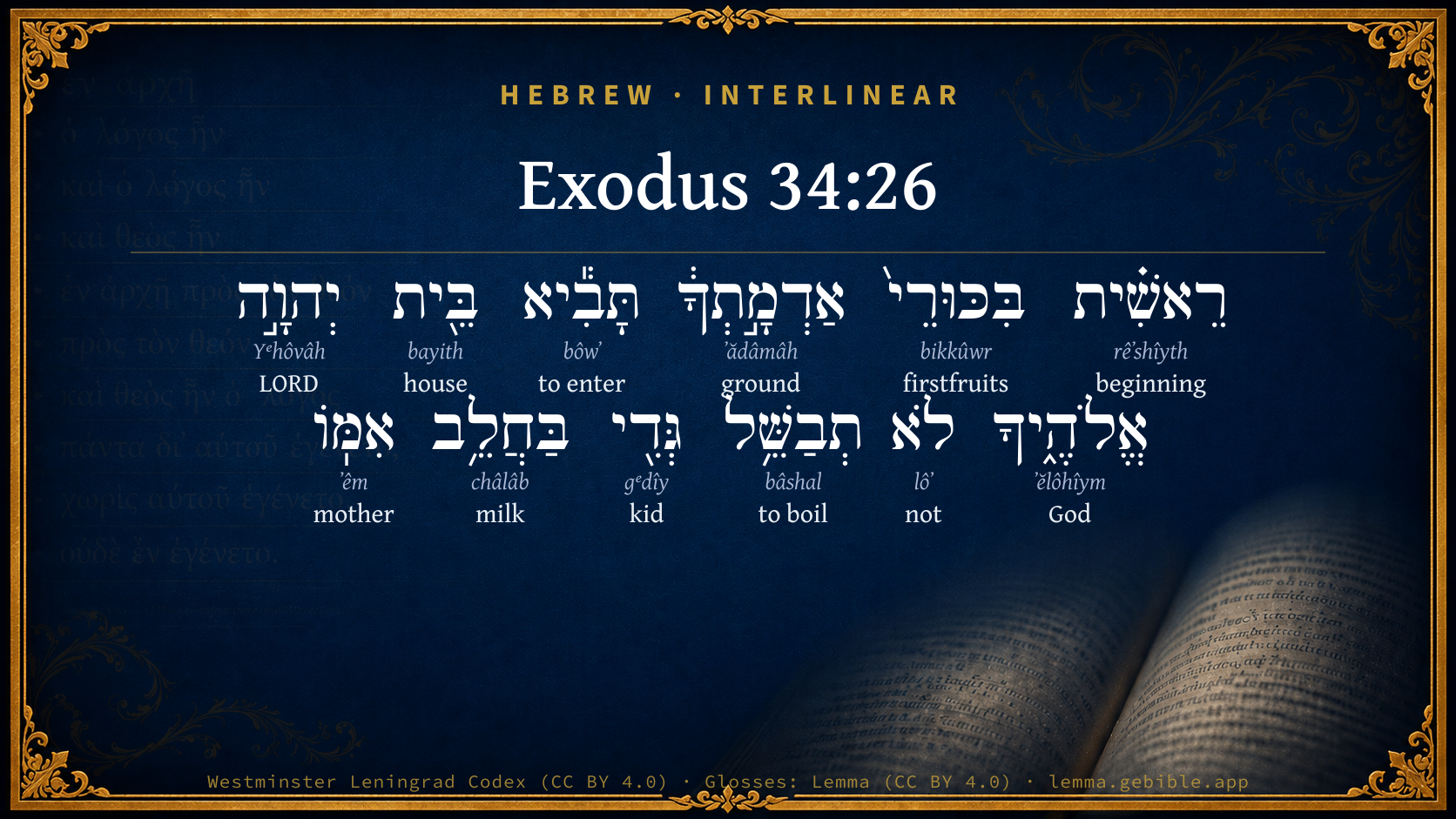
Hebrew (Westminster Leningrad Codex) Exodus 34:26 appears in the Hebrew Old Testament. The text above is from the Westminster Leningrad Codex. Each word links to its Strong’s number, a concise gloss, and parsing drawn from the Open Scriptures Hebrew Bible morphology. Click any word for its full Brown-Driver-Briggs (BDB) entry.
Download image
Cite this verse

Exodus 34:26 (World English Bible). Public Domain. Lemma interlinear Bible study tool, https://lemma.gebible.app/v/exodus/34/26.

Show BibTeX & RIS
BibTeX
RIS
English Translation
You shall bring the first of the first fruits of your ground to the house of Yahweh your God. You shall not boil a young goat in its mother's milk."
World English Bible · Public Domain
Download a study sheet

One document with this verse’s original text, its word-by-word gloss line, the meaning frame, cross-references with their text, attributed commentary, and full source and license credits — printable, and it pastes into notes with its structure intact.

This verse Autodidact and up

Study sheet (.html) Plain text (.txt)

A passage Seminary Student

Up to 50 verses in one chapter. A passage sheet keeps up to 6 commentary sources and 12 cross-references per verse, in the order this page ranks them, and says so on the sheet whenever that leaves anything out. Ask for a single verse and you get the Autodidact verse sheet above.

Everything on this page stays free to read, with no account — the sheet is a download of what is already on screen, not access to it.

Want to remove ads? Support Godless Engineer
Compare translations 3

The same verse in 3 English versions, stacked beneath the original-language interlinear above. Click any original word for its lexicon entry.

Each is an independent rendering of the whole verse — the interlinear is not word-aligned to these translations.

Highlighted words mark where these versions differ — a whole-verse word diff, not a word-by-word alignment.

  • World English Bible Public Domain
    You shall bring the first of the first fruits of your ground to the house of Yahweh your God. You shall not boil a young goat in its mother's milk."
  • King James Version Public Domain
    The first of the firstfruits of thy land thou shalt bring unto the house of the LORD thy God. Thou shalt not seethe a kid in his mother's milk.
  • unfoldingWord Literal Text CC BY-SA 4.0
    You shall bring the first of the first fruits of your ground to the house of Yahweh your God. You shall not boil a young goat in the milk of its mother.”

unfoldingWord Literal Text — © unfoldingWord, licensed CC BY-SA 4.0. Word-aligned USFM3 via Door43 (git.door43.org/unfoldingWord/en_ult).

Versions to compare (up to 4)

3 of 4 selected

Show all 18 translations

Every available English version of this verse, each an independent rendering of the whole verse.

  • World English Bible Public Domain
    You shall bring the first of the first fruits of your ground to the house of Yahweh your God. You shall not boil a young goat in its mother's milk."
  • Berean Standard Bible Public Domain
    Bring the best of the firstfruits of your soil to the house of the LORD your God. You must not cook a young goat in its mother’s milk.”
  • Majority Standard Bible Public Domain
    Bring the best of the firstfruits of your soil to the house of the LORD your God. You must not cook a young goat in its mother’s milk.”
  • King James Version Public Domain
    The first of the firstfruits of thy land thou shalt bring unto the house of the LORD thy God. Thou shalt not seethe a kid in his mother's milk.
  • American Standard Version (1901) Public Domain
    The first of the first-fruits of thy ground thou shalt bring unto the house of Jehovah thy God. Thou shalt not boil a kid in its mother's milk.
  • Revised Version (1885) Public Domain
    The first of the firstfruits of thy ground thou shalt bring unto the house of the LORD thy God. Thou shalt not seethe a kid in its mother’s milk.
  • Geneva Bible (1599) Public Domain
    The first ripe fruites of thy land thou shalt bring vnto the house of the Lord thy God: yet shalt thou not seethe a kid in his mothers milke.
  • Douay-Rheims (1899) Public Domain
    The first of the fruits of thy ground thou shalt offer in the house of the Lord thy God. Thou shalt not boil a kid in the milk of his dam.
  • Young's Literal Translation Public Domain
    the first of the first-fruits of the land thou dost bring into the house of Jehovah thy God; thou dost not boil a kid in its mother's milk.'
  • Literal Standard Version CC BY-SA 4.0
    You bring the first of the first-fruits of the land into the house of your God YHWH. You do not boil a kid in its mother’s milk.”
  • Unlocked Literal Bible CC BY-SA 4.0
    You must bring the best of the firstfruits from your fields to my house. You must not boil a young goat in its mother's milk.”
  • unfoldingWord Literal Text CC BY-SA 4.0
    You shall bring the first of the first fruits of your ground to the house of Yahweh your God. You shall not boil a young goat in the milk of its mother.”
  • Darby Bible Public Domain
    -- The first of the first-fruits of thy land shalt thou bring into the house of Jehovah thy God. Thou shalt not boil a kid in its mother's milk.
  • World Messianic Bible Public Domain
    “You shall bring the first of the first fruits of your ground to the house of the LORD your God. “You shall not boil a young goat in its mother’s milk.”
  • Webster's Bible Public Domain
    The first of the first-fruits of thy land thou shalt bring to the house of the LORD thy God. Thou shalt not seethe a kid in his mother's milk.
  • Free Bible Version CC BY-SA 4.0
    When you harvest your crops, bring the firstfruits to the house of the Lord your God. Don't cook a young goat in milk from its mother.”
  • Bible in Basic English Public Domain
    Take the first-fruits of your land as an offering to the house of the Lord your God. Let not the young goat be cooked in its mother's milk
  • JPS Tanakh (1917) Public Domain
    The choicest first-fruits of thy land thou shalt bring unto the house of the LORD thy God. Thou shalt not seethe a kid in its mother's milk.'

Literal Standard Version (2020), Covenant Press — licensed CC BY-SA 4.0. Text via the HelloAO Bible API (eBible.org). Unlocked Literal Bible (unfoldingWord) — licensed CC BY-SA 4.0. Text via the HelloAO Bible API (eBible.org). unfoldingWord Literal Text — © unfoldingWord, licensed CC BY-SA 4.0. Word-aligned USFM3 via Door43 (git.door43.org/unfoldingWord/en_ult). Free Bible Version, Dr. Jonathan Gallagher — licensed CC BY-SA 4.0. Text via the HelloAO Bible API (eBible.org).

Word by word

More ways to search: Search by grammar → Find every occurrence → Compare this word →

Practice this passage: Drill this verse → Learn its vocabulary →

גְּדִ֖י
gᵉdîy
H1423
“kid”
Noun, Common, Masculine, Singular, Absolute
Part of Speech
Noun
Type
Common
Gender
Masculine
Number
Singular
State
Absolute
Full BDB Definition

Origin: from the same as H1415

TWOT: 314b

kid, young male goat
  1. רֵאשִׁ֗ית rêʼshîyth H7225 “beginning of” Noun, Common, Feminine, Singular, Construct
  2. בִּכּוּרֵי֙ bikkûwr H1061 “firstfruits of” Noun, Common, Both, Plural, Construct
  3. אַדְמָ֣תְךָ֔ ʼădâmâh H127 “ground · your” Noun, Common, Feminine, Singular, Construct + Suffix, Personal, 2nd Person, Masculine, Singular
  4. תָּבִ֕יא bôwʼ H935 “to enter” Verb, Hiphil, Imperfect, 2nd Person, Masculine, Singular
  5. בֵּ֖ית bayith H1004 “house of” Noun, Common, Masculine, Singular, Construct
  6. יְהוָ֣ה Yᵉhôvâh H3068 “LORD” Noun, Proper
  7. אֱלֹהֶ֑יךָ ʼĕlôhîym H430 “God(s) · your” Noun, Common, Masculine, Plural, Construct + Suffix, Personal, 2nd Person, Masculine, Singular
  8. לֹא lôʼ H3808 “not” Particle, Negative
  9. תְבַשֵּׁ֥ל bâshal H1310 “to boil” Verb, Piel, Imperfect, 2nd Person, Masculine, Singular
  10. בַּחֲלֵ֥ב châlâb H2461 “in/at · milk of” Preposition + Noun, Common, Masculine, Singular, Construct
  11. אִמּֽוֹ ʼêm H517 “mother · his” Noun, Common, Feminine, Singular, Construct + Suffix, Personal, 3rd Person, Masculine, Singular

About this verse

These counts appear in no published source. They are computed here, from the morphology-tagged text and Lemma’s own curated glosses. What Lemma adds →

12
words
12
distinct lemmas
Pentateuch
section

Notable vocabulary

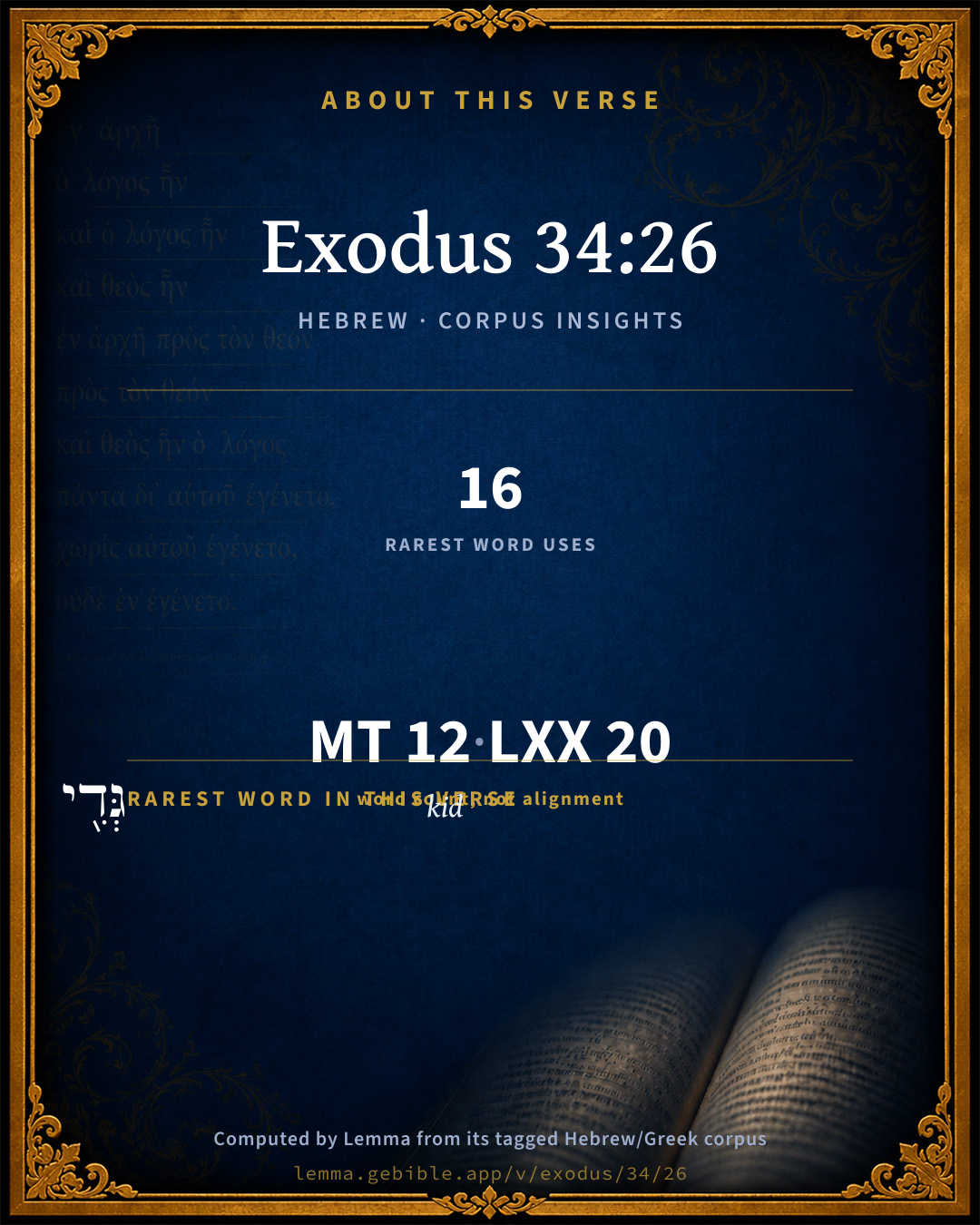
The rarest word here is גְּדִ֖י kid H1423 — appearing just 16 times in the whole Hebrew Bible.

Shared distinctive vocabulary

גְּדִ֖י kid H1423 occurs in 16 verses of the Hebrew Bible. Also found in:

Grammatical profile

  • 2 verbs
  • 9 nouns
  • 1 particle

Verb forms

  • תָּבִ֕יא Hiphil · Imperfect
  • תְבַשֵּׁ֥ל Piel · Imperfect

Hebrew & Septuagint length

In English translation the verse runs 30 words from the Hebrew and 27 from the Septuagint (LXX English) — closely comparable.

A rough comparison of the two English renderings, which tokenize alike — not a word-level alignment.

Word counts can differ between the Hebrew and the Greek without any difference in meaning — e.g. the Hebrew direct-object marker אֵת has no separate Greek word, and Greek often adds the article ὁ.

In the original languages it is 12 Hebrew tokens and 20 Greek tokens — but the two are counted differently (Hebrew bundles its prefixes and suffixes into one token; the Greek is in lemma form), so that isn’t a like-for-like length.

Cross-references

8

Topical passages linked to Exodus 34:26 in the Treasury of Scripture Knowledge — connected by theme and wording, ordered by reader-vote popularity; previews shown in the World English Bible.

  • Exodus 23:19 The first of the first fruits of your ground you shall bring into the house of Yahweh your God. "You shall not boil a kid in its mother's milk.
  • Deuteronomy 14:21 You shall not eat of anything that dies of itself: you may give it to the foreigner living among you who is within your gates, that he may eat it; or you may sell it to a foreigner: for you are a holy people to Yahweh your God. You shall not boil a kid in its mother's milk.
  • Deuteronomy 26:2 that you shall take of the first of all the fruit of the ground, which you shall bring in from your land that Yahweh your God gives you; and you shall put it in a basket, and shall go to the place which Yahweh your God shall choose, to cause his name to dwell there.
  • Deuteronomy 26:10 Now, behold, I have brought the first of the fruit of the ground, which you, Yahweh, have given me. You shall set it down before Yahweh your God, and worship before Yahweh your God:
  • Proverbs 3:9–10 Honor Yahweh with your substance, With the first fruits of all your increase:
  • Matthew 6:33 But seek first God's Kingdom, and his righteousness; and all these things will be given to you as well.
  • 1 Corinthians 15:20 But now Christ has been raised from the dead. He became the first fruits of those who are asleep.
  • James 1:18 Of his own will he brought us forth by the word of truth, that we should be a kind of first fruits of his creatures.

Cross-references courtesy of OpenBible.info (CC BY 4.0).

Hebrew and Greek witnesses Masoretic Hebrew ↔ Greek Septuagint

The same verse in the two great witnesses to the Old Testament, shown verse-for-verse.

These are two independent witnesses, not word-aligned to each other, and the Septuagint is shown in lemma (dictionary) form.

Hebrew Exodus 34:26 Masoretic · Westminster Leningrad Codex

רֵאשִׁ֗ית בִּכּוּרֵי֙ אַדְמָ֣תְךָ֔ תָּבִ֕יא בֵּ֖ית יְהוָ֣ה אֱלֹהֶ֑יךָ לֹא תְבַשֵּׁ֥ל גְּדִ֖י בַּחֲלֵ֥ב אִמּֽוֹ

You shall bring the first of the first fruits of your ground to the house of Yahweh your God. You shall not boil a young goat in its mother's milk."

World English Bible · Public Domain

Greek LXX Exodus 34:26 Septuagint · lemma form

ὁ πρωτογένημα ὁ γῆ σύ τίθημι εἰς ὁ οἶκος κύριος ὁ θεός σύ οὐ προςφέρω ἀρνός ἐν γάλα μήτηρ αὐτός

The first fruits of your land shall you put into the house of the Lord your God: you shall not boil a lamb in his mother's milk.

LXX2012 (modern English Septuagint) · Public Domain

Hebrew: Westminster Leningrad Codex (CC BY 4.0). Greek: Septuagint (public domain); English from LXX2012 (modern English Septuagint) (Public Domain). How the Septuagint differs from the Hebrew →

Targum (Aramaic paraphrase)

2

The Targum is the ancient Jewish Aramaic paraphrase of the Hebrew Scriptures — an interpretive translation, not the Hebrew text itself. Onkelos (literal) and Pseudo-Jonathan (expansive) render the Torah, and Jonathan the Prophets. Coverage is partial: where no permissively-licensed English translation exists for a verse, only the Aramaic is shown. This is verse-level text, not a word-by-word alignment to the Hebrew.

  1. Targum Onkelos Torah (Genesis–Deuteronomy)
    רֵישׁ בִּכּוּרֵי אַרְעָךְ תַּיְתֵי לְבֵית מַקְדְשָׁא דַיְיָ אֱלָהָךְ לָא תֵיכְלוּן בְּשַׂר בַּחֲלָב:

    (no public-domain English translation for this verse)

    Targum Onkelos — Aramaic: “Onkelos Genesis” (public domain); “Onkelos Exodus” (public domain); “Onkelos Leviticus” (public domain); “Onkelos Numbers” (public domain); “Onkelos Deuteronomy” (public domain). English: “Sefaria Community Translation” (CC0 1.0 (public-domain dedication)); “J.W. Etheridge. The Targums of Onkelos and Jonathan Ben Uzziel on the Pentateuch. London: Longmans, Green, 1862” (public domain). Text via Sefaria.

  2. Targum Pseudo-Jonathan Torah (Genesis–Deuteronomy)
    שֵׁירוּי בּוּכְרַת פֵּרֵי אַרְעֲכוֹן תַּיְיתוּן לְבֵית מוּקְדְּשָׁא דַיְיָ אֱלָהָכוֹן לֵית אַתּוּן רְשָּׁאִין לָא לִמְבַשְׁלָא וְלָא לְמֵיכוּל בְּשַר וַחֲלַב תְּרֵיהוֹן מְעַרְבִין כַּחֲדָא דְּלָא יִתְקוֹף רוּגְזִי בְּכוֹן וְאֵירְשִׁין פֵּרֵי אֵילָנֵיכוֹן עִם בּוּסְרָא בְּלִבְלוּבֵיהוֹן וְטַרְפֵיהוֹן כַּחֲדָא

    The best of the firstfruits of your land ye shall bring to the sanctuary of the Lord your God. You are not allowed to boil or to eat flesh and milk mixed together, lest My displeasure be kindled against you, and the fruit of your trees, with the grapes in their branches and their leaves, be laid waste together.

    Targum Pseudo-Jonathan — Aramaic: “Targum Jonathan on Genesis” (public domain); “Targum Jonathan on Exodus” (public domain); “Targum Jonathan on Leviticus” (public domain); “Targum Jonathan on Numbers” (public domain); “Targum Jonathan on Deuteronomy” (public domain). English: “The Targum of Jonathan ben Uzziel, trans. J. W. Etheridge, London, 1862” (public domain). Text via Sefaria.

Commentary

Notes on Exodus 34:26 from classic Christian and Jewish commentators (each source and its license shown beneath its notes). The classic Christian expositions comment on the surrounding passage and are grouped to its opening verse, so a note may address several verses; the Jewish commentaries on the Tanakh (Rashi and others) are per-verse, so they appear only where the commentator wrote on this verse.

Lemma curates 59 commentaries, every one of them public domain or Creative Commons licensed, each selected and text-cleaned for this edition rather than reprinted as found. About our sources →

Trapp's Complete Commentary

John Trapp

Exo 34:26 The first of the firstfruits of thy land thou shalt bring unto the house of the LORD thy God. Thou shalt not seethe a kid in his mother’s milk.

Ver. 26. In his mother’s milk.] See on Exo 23:19.

John Trapp, A Commentary or Exposition upon All the Books of the Old and New Testament (1647–1656) — public domain. Text from a community e-Sword module.

Geneva Bible (1599)

Geneva Bible translators

Read Exod. 23:1; Deut. 14:21.

Geneva Bible (1599) marginal notes — public domain. Text via Bolls.life.

Adam Clarke's Commentary

Verse 26. Thou shalt not seethe a kid in his mother's milk.] See this amply considered Ex 23:19. See Clarke on Ex 23:19.

Adam Clarke's Commentary on the Bible (1810–1826) — public domain. Text from a community e-Sword/MySword module.

Ellicott's Commentary for English Readers

(26) The first of the firstfruits.—Comp. Exo_23:19.

Thou shalt not seethe a kid.—See Note 3 on Exo_23:19.

A Bible Commentary for English Readers, edited by Charles John Ellicott (1878–1897) — public domain. Text from a community e-Sword module.

The Cambridge Bible for Schools and Colleges

gen. ed. J. J. S. Perowne

26. See on Exo_23:19.

The Cambridge Bible for Schools and Colleges (gen. ed. J. J. S. Perowne; Cambridge University Press, 1878–1918) — public domain. Text from a community e-Sword module.

John Gill's Exposition

And it came to pass, when Moses came down Mount Sinai,.... Which was on the day of atonement, according to Jarchi, that is, the tenth of Tisri, or September; and so the Jewish chronologers (q) fix his descent on this day:

with the two tables of testimony in Moses's hand; the two tables he carried up, on which God had wrote the law, called "the testimony", being a testification and declaration of his will to the children of Israel:

when he came down from the mount, that Moses wist not that the skin of his face shone, while he talked with him: the Targum of Jonathan is,"Moses knew not that the splendour of the form of his face was become illustrious, which he had from the brightness of the glory of the Shechinah of the Lord, at the time he talked with him.''And this the apostle calls "the glory of his countenance", Co2 3:7 the glory of the Lord as it passed before him, when in the cleft of the rock, and that degree of it he was admitted to the sight of, while conversing with God, during his stay on the mount forty days and forty nights, left a shining glory on his countenance; which while he was with God he could not be at all sensible of, the glory of God so infinitely surpassing that; and when he came down the mount, as he could not see his own face without a glass, so though the rays of light and glory that darted from his face were so bright and strong, that they might have been observed by him, yet his mind was so intent on what he had seen and heard, that he took no notice of them. The Vulgate Latin version renders it very wrongly, "that his face was horned", which has given occasion to painters to represent him in a ridiculous manner, as having horns coming out of his forehead; though the word has the signification of an horn, and the meaning of that version, as of others, may only be, that the skin of his face "darted out rays" (r) like horns, such as the rays of the sun appear to be like to the eye, see Hab 3:4 hence Jupiter Ammon, the same with the sun, is described as having horns (s); and so Bacchus, who is supposed to be the same with Moses, is represented as having a horned face (t). Now this glory was left on the countenance of Moses, to show that he had had communion with God, and that the law he brought with him was from him; and to signify the glory of it, and to command awe and reverence, and make men afraid to break it.

(q) Seder Olam Rabba, c. 6. p. 19. (r) "radios ejacularetur", Tigurine version; "in modum cornu radiaret", Munster, Fagius, "vel rediasset", Vatablus; "splendere instar cornu", Drusius; so Karnon * in the Arabic language signifies the rays of the sun. * Golius, col. 1896. Castel. col. 3455. (s) Vid. Diodor. Sicul. l. 3. p. 201. Macrob. Saturnal. l. 1. c. 21. (t) Diodor. Sicul. l. 4. p. 212. so Orpheus calls Bacchus, Hymn. p. 126. and Horace ascribes to him, "cornu decorum", Carmin. l. 2. Ode 19.

John Gill's Exposition of the Whole Bible (1746–1763) — public domain (CC PDM 1.0). Text via the HelloAO Bible API.

Haydock's Catholic Bible Commentary

Dam. Chaldean, "thou shalt not eat flesh with milk." See chap. xxiii. 19.

George Leo Haydock (1774–1849), Haydock's Catholic Family Bible and Commentary, 1859 edition — public domain. Excludes Psalms (Douay-Rheims chapter numbering differs from Protestant) and Deuterocanonical books (Catholic canon only).

Matthew Poole's English Annotations

First of the first-fruits; thou shalt not delay to do this, but shalt bring the very first of them. Or, the first-fruits, even the first-fruits of thy land; which limitation seems here conveniently added, because they were not bound to bring thither all their first-fruits, to wit, those of their own bodies, their children.

Matthew Poole's English Annotations on the Holy Bible (1683–1685) — public domain. Text from a community e-Sword/MySword module.

The Pulpit Commentary

Repeated from Exo_23:19. It is remarkable that both legislations terminate with the same, somewhat strange, proviso. There must have been an intention of impressing strongly upon the people the principle of tenderness involved in it. (See the comment on Exo_23:19)

The Pulpit Commentary (1880–1919), ed. H.D.M. Spence-Jones & Joseph S. Exell — public domain. Text from a community e-Sword module.

Rashi

Rabbi Shlomo Yitzchaki (Rashi)

ראשית בכורי אדמתך THE FIRST OF THE FIRST-FRUITS OF THY GROUND [THOU SHALT BRING INTO THE HOUSE OF THE LORD THY GOD] — but only from the seven kinds of produce which are mentioned as an excellency of thy land (Deuteronomy 8:8) “a land of wheat and barley and vines etc (Mishnah Bikkurim 1:3). The דבש mentioned in this verse is date honey (not that of bees).

לא תבשל גדי THOU SHALT NOT SEETHE A KID [IN ITS MOTHER’S MILK] — This is a prohibition to mix meat with milk. This is written three times in the Torah: once to prohibit the eating of such mixture, once to prohibit us from deriving any other benefit (besides eating) from it and once to prohibit the cooking of it (Chullin 115b; cf. Rashi on Exodus 23:19).

גדי A KID — Any tender young animal is comprehended under the term גדי, a calf and a lamb also. From the fact that the writer felt it necessary to state specifically in several passages “a kid of the goat” you may learn that the term גדי without further definition implies any suckling (young animal) (Chullin 113a; cf. Rashi on Exodus 23:19).

בחלב אמו IN THE MOTHER’S MILK — A fowl is therefore really excluded from this law since it has no milk; for the prohibition regarding it (using it with milk) is not a Biblical law but only an enactment of the Soferim (Chullin 113a).

Rashi on the Tanakh — English translations: “The Judaica Press complete Tanach with Rashi, translated by A. J. Rosenberg” (CC BY 4.0); “Pentateuch with Rashi's commentary by M. Rosenbaum and A.M. Silbermann, 1929-1934” (public domain); “The Metsudah Tanach series, Lakewood, N.J” (CC BY 4.0); and “The Book of Joshua, Metsudah Publications, 1997” (CC BY 4.0). Text via Sefaria.

Ramban (Nachmanides)

Rabbi Moshe ben Nachman (Ramban / Nachmanides)

THE CHOICEST FIRST-FRUITS OF THY LAND THOU SHALT BRING INTO THE HOUSE OF THE ETERNAL THY G-D. Because He mentioned that they should bring the first-ripe fruits of all that is in their land to the house of G-d, He placed next to it, Thou shalt not seethe a kid in its mother’s milk. For at the time of bringing the first-fruits of the earth they would also take along all firstlings of cattle, goats and sheep, and at that season the goats have grown up and begin giving milk. Thus they would often bring up the mother with its firstborn whilst it was still a suckling, in order that it should not die. Now those who came to celebrate the festival would enjoy eating the firstlings amongst all tasty foods, together with the priests. That is why He mentioned the prohibition [against seething the kid in its mother’s milk] together with the precept of the first-fruits. In the Book of Deuteronomy, however, He mentioned this commandment together with the laws of prohibited foods, after He cited the laws of unclean cattle, fish, and unclean fowl, and carrion, for that is the fitting place to mention it, since it is a prohibition concerning eating, and not merely a prohibition against seething it alone, as those wanting in faith and devoid of knowledge think.

Ramban (Nachmanides) on the Tanakh — English translation: “Commentary on the Torah by Ramban (Nachmanides). Translated and annotated by Charles B. Chavel. New York, Shilo Pub. House, 1971-1976” (CC BY 4.0). Text via Sefaria.

Lesson kit

Teaching starters — assembled from the data on this page, not authored interpretation. Every prompt links to the verse data it draws on. Edit before teaching.

Exodus, in the Pentateuch, opens this verse with 12 words (12 distinct Hebrew lemmas). Its most distinctive word is gᵉdîy (“kid”). A historical commentator’s framing appears above. Read the whole chapter for the surrounding context.

Discussion questions

  1. What does “kid” (gᵉdîy) contribute to the verse as a whole?
  2. How does Genesis 27:9, which shares the word «kid», read alongside this verse?
  3. These translations render this verse differently. What is at stake in choosing one wording over another?
  4. «תָּבִ֕יא» is a Hiphil Imperfect verb. How does that grammatical form shape the action described?
  5. Compare how Trapp's Complete Commentary and Geneva Bible (1599) read this verse. Where do they agree or differ?

Things to notice

Reading settings

Reading text

Shown beneath each verse's original-language words.

Old Testament
Old Testament edition

Read the OT as the Masoretic Hebrew (MT) or the Greek Septuagint (LXX).

English shown for the Greek Septuagint (in the Hebrew ↔ Greek comparison).

Comparing translations? Open the Compare panel on any verse page to stack up to four side by side.