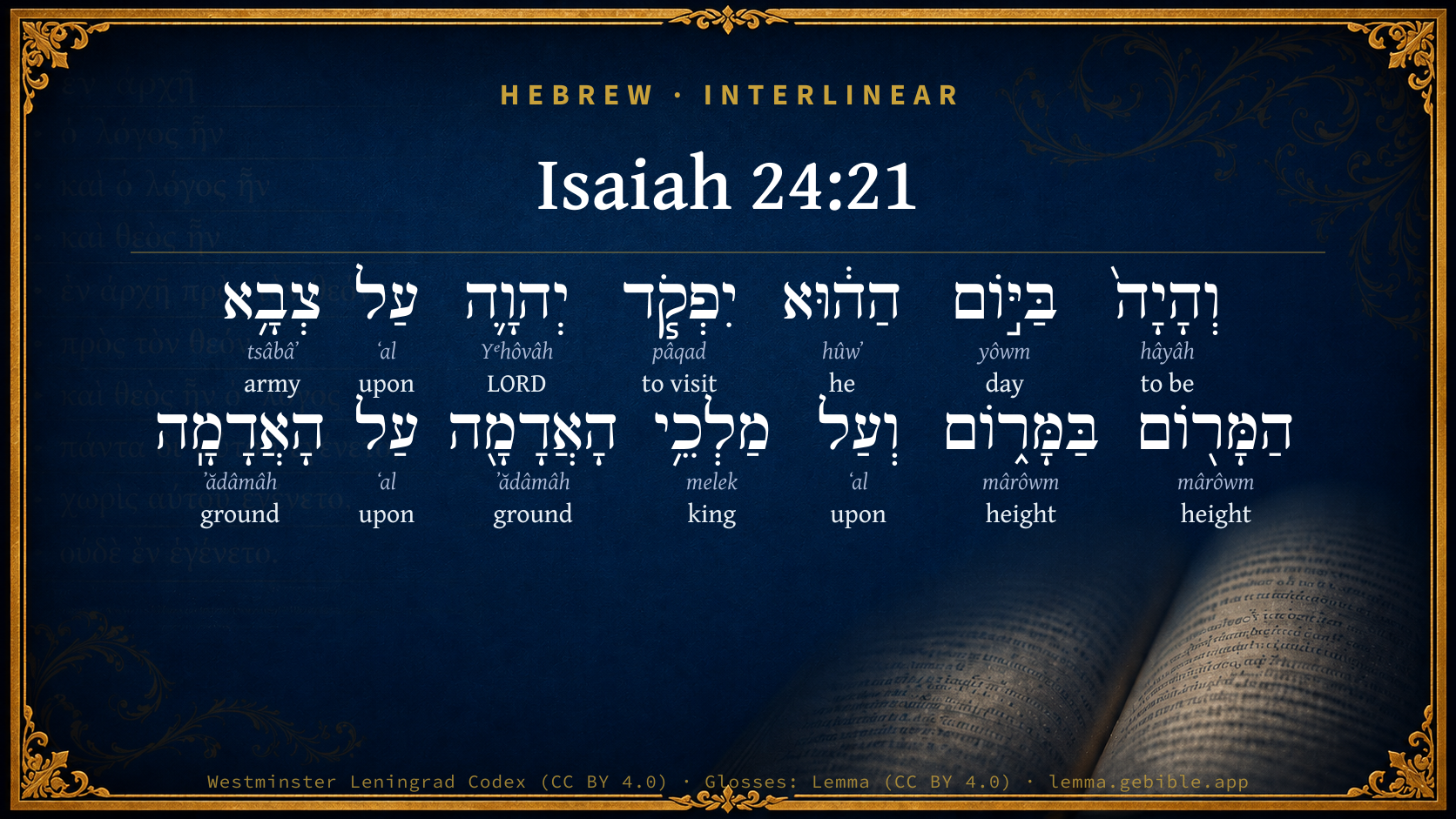
Isaiah 24:21

Hebrew (Westminster Leningrad Codex) Isaiah 24:21 appears in the Hebrew Old Testament. The text above is from the Westminster Leningrad Codex. Each word links to its Strong’s number, a concise gloss, and parsing drawn from the Open Scriptures Hebrew Bible morphology. Click any word for its full Brown-Driver-Briggs (BDB) entry.
Download image
Cite this verse

Isaiah 24:21 (World English Bible). Public Domain. Lemma interlinear Bible study tool, https://lemma.gebible.app/v/isaiah/24/21.

Show BibTeX & RIS
BibTeX
RIS
English Translation
It shall happen in that day, that Yahweh will punish the host of the high ones on high, and the kings of the earth on the earth.
World English Bible · Public Domain
Download a study sheet

One document with this verse’s original text, its word-by-word gloss line, the meaning frame, cross-references with their text, attributed commentary, and full source and license credits — printable, and it pastes into notes with its structure intact.

This verse Autodidact and up

Study sheet (.html) Plain text (.txt)

A passage Seminary Student

Up to 50 verses in one chapter. A passage sheet keeps up to 6 commentary sources and 12 cross-references per verse, in the order this page ranks them, and says so on the sheet whenever that leaves anything out. Ask for a single verse and you get the Autodidact verse sheet above.

Everything on this page stays free to read, with no account — the sheet is a download of what is already on screen, not access to it.

Want to remove ads? Support Godless Engineer
Compare translations 3

The same verse in 3 English versions, stacked beneath the original-language interlinear above. Click any original word for its lexicon entry.

Each is an independent rendering of the whole verse — the interlinear is not word-aligned to these translations.

Highlighted words mark where these versions differ — a whole-verse word diff, not a word-by-word alignment.

  • World English Bible Public Domain
    It shall happen in that day, that Yahweh will punish the host of the high ones on high, and the kings of the earth on the earth.
  • King James Version Public Domain
    And it shall come to pass in that day, that the LORD shall punish the host of the high ones that are on high, and the kings of the earth upon the earth.
  • unfoldingWord Literal Text CC BY-SA 4.0
    And it will happen in that day, Yahweh will visit upon the army of the height in the height and upon the kings of the ground on the ground.

unfoldingWord Literal Text — © unfoldingWord, licensed CC BY-SA 4.0. Word-aligned USFM3 via Door43 (git.door43.org/unfoldingWord/en_ult).

Versions to compare (up to 4)

3 of 4 selected

Show all 18 translations

Every available English version of this verse, each an independent rendering of the whole verse.

  • World English Bible Public Domain
    It shall happen in that day, that Yahweh will punish the host of the high ones on high, and the kings of the earth on the earth.
  • Berean Standard Bible Public Domain
    In that day the LORD will punish the host of heaven above and the kings of the earth below.
  • Majority Standard Bible Public Domain
    In that day the LORD will punish the host of heaven above and the kings of the earth below.
  • King James Version Public Domain
    And it shall come to pass in that day, that the LORD shall punish the host of the high ones that are on high, and the kings of the earth upon the earth.
  • American Standard Version (1901) Public Domain
    And it shall come to pass in that day, that Jehovah will punish the host of the high ones on high, and the kings of the earth upon the earth.
  • Revised Version (1885) Public Domain
    And it shall come to pass in that day, that the LORD shall punish the host of the high ones on high, and the kings of the earth upon the earth.
  • Geneva Bible (1599) Public Domain
    And in that day shall the Lord visite the hoste aboue that is on hie, euen the Kinges of the world that are vpon the earth.
  • Douay-Rheims (1899) Public Domain
    And it shall come to pass, that in that day the Lord shall visit upon the host of heaven on high, and upon the kings of the earth, on the earth.
  • Young's Literal Translation Public Domain
    And it hath come to pass, in that day, Jehovah layeth a charge on the host of the high place in the high place, And on the kings of the land on the land.
  • Literal Standard Version CC BY-SA 4.0
    And it has come to pass in that day, || YHWH lays a charge on the host of the high place in the high place, || And on the kings of the earth on the earth.
  • Unlocked Literal Bible CC BY-SA 4.0
    On that day Yahweh will punish the host of the heaven in the heavens, and the kings of the earth on the earth.
  • unfoldingWord Literal Text CC BY-SA 4.0
    And it will happen in that day, Yahweh will visit upon the army of the height in the height and upon the kings of the ground on the ground.
  • Darby Bible Public Domain
    And it shall come to pass in that day, [that] Jehovah will punish the host of the high ones on high, and the kings of the earth upon the earth.
  • World Messianic Bible Public Domain
    It will happen in that day that the LORD will punish the army of the high ones on high, and the kings of the earth on the earth.
  • Webster's Bible Public Domain
    And it shall come to pass in that day, that the LORD shall punish the host of the high ones that are on high, and the kings of the earth upon the earth.
  • Free Bible Version CC BY-SA 4.0
    At that time the Lord will punish all the high heavenly beings and the kings of the earth.
  • Bible in Basic English Public Domain
    And in that day the Lord will send punishment on the army of the high ones on high, and on the kings of the earth on the earth.
  • JPS Tanakh (1917) Public Domain
    And it shall come to pass in that day, that the LORD will punish the host of the high heaven on high, and the kings of the earth upon the earth.

Literal Standard Version (2020), Covenant Press — licensed CC BY-SA 4.0. Text via the HelloAO Bible API (eBible.org). Unlocked Literal Bible (unfoldingWord) — licensed CC BY-SA 4.0. Text via the HelloAO Bible API (eBible.org). unfoldingWord Literal Text — © unfoldingWord, licensed CC BY-SA 4.0. Word-aligned USFM3 via Door43 (git.door43.org/unfoldingWord/en_ult). Free Bible Version, Dr. Jonathan Gallagher — licensed CC BY-SA 4.0. Text via the HelloAO Bible API (eBible.org).

Word by word

More ways to search: Search by grammar → Find every occurrence → Compare this word →

Practice this passage: Drill this verse → Learn its vocabulary →

הַמָּר֖וֹם
mârôwm
H4791
“the · height”
Particle, Definite Article + Noun, Common, Masculine, Singular, Absolute
Part of Speech
Particle + Noun
Type
Common
Gender
Masculine
Number
Singular
State
Absolute
Full BDB Definition

Origin: from H7311

TWOT: 2133h

height - height, elevation, elevated place - in a high place (adverb) - height - proudly (adverb) - of nobles (figuratively)
  1. וְהָיָה֙ hâyâh H1961 “and · to be” Conjunction + Verb, Qal, Sequential Perfect, 3rd Person, Masculine, Singular
  2. בַּיּ֣וֹם yôwm H3117 “in/at the · day” Preposition, Determined + Noun, Common, Masculine, Singular, Absolute
  3. הַה֔וּא hûwʼ H1931 “the · he” Particle, Definite Article + Pronoun, Personal, 3rd Person, Masculine, Singular
  4. יִפְקֹ֧ד pâqad H6485 “to visit” Verb, Qal, Imperfect, 3rd Person, Masculine, Singular
  5. יְהוָ֛ה Yᵉhôvâh H3068 “LORD” Noun, Proper
  6. עַל ʻal H5921 “upon” Preposition
  7. צְבָ֥א tsâbâʼ H6635 “army of” Noun, Common, Both, Singular, Construct
  8. בַּמָּר֑וֹם mârôwm H4791 “in/at the · height” Preposition, Determined + Noun, Common, Masculine, Singular, Absolute
  9. וְעַל ʻal H5921 “and · upon” Conjunction + Preposition
  10. מַלְכֵ֥י melek H4428 “kings of” Noun, Common, Masculine, Plural, Construct
  11. הָאֲדָמָ֖ה ʼădâmâh H127 “the · ground” Particle, Definite Article + Noun, Common, Feminine, Singular, Absolute
  12. עַל ʻal H5921 “upon” Preposition
  13. הָאֲדָמָֽה ʼădâmâh H127 “the · ground” Particle, Definite Article + Noun, Common, Feminine, Singular, Absolute

About this verse

These counts appear in no published source. They are computed here, from the morphology-tagged text and Lemma’s own curated glosses. What Lemma adds →

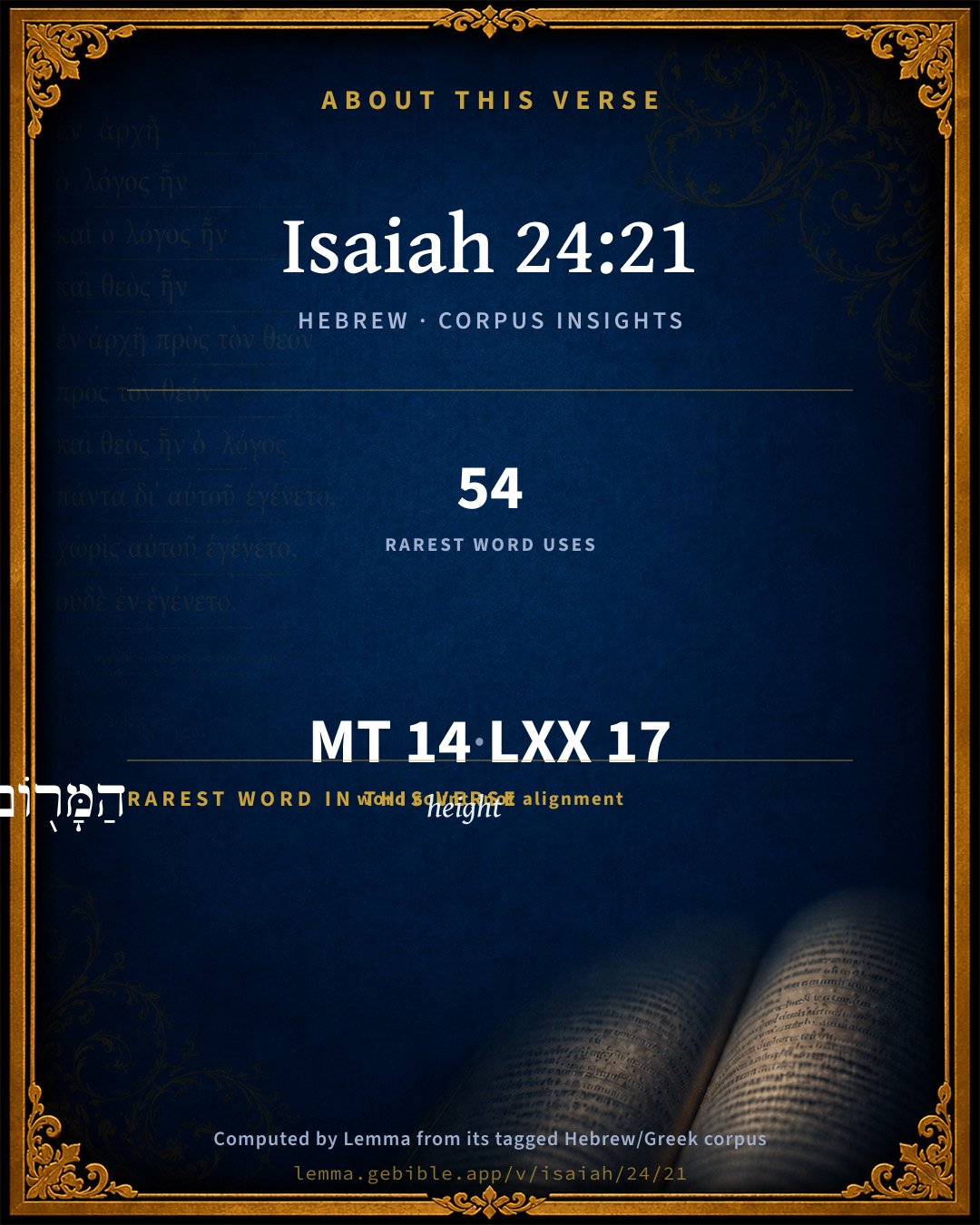
14
words
10
distinct lemmas
Prophets
section

Shared distinctive vocabulary

הַמָּר֖וֹם height H4791 occurs in 52 verses of the Hebrew Bible. Also found in:

Grammatical profile

  • 2 verbs
  • 8 nouns
  • 1 pronoun
  • 3 prepositions

Verb forms

  • וְהָיָה֙ Qal · Sequential Perfect
  • יִפְקֹ֧ד Qal · Imperfect

Repetition

Words recur within this verse — often emphatic in Hebrew:

  • עַל upon H5921 ×3
  • הַמָּר֖וֹם height H4791 ×2
  • הָאֲדָמָ֖ה ground H127 ×2

Hebrew & Septuagint length

In English translation the verse runs 27 words from the Hebrew and 18 from the Septuagint (LXX English) — the Septuagint runs noticeably shorter here. See the side-by-side →

A rough comparison of the two English renderings, which tokenize alike — not a word-level alignment.

Word counts can differ between the Hebrew and the Greek without any difference in meaning — e.g. the Hebrew direct-object marker אֵת has no separate Greek word, and Greek often adds the article ὁ.

In the original languages it is 14 Hebrew tokens and 17 Greek tokens — but the two are counted differently (Hebrew bundles its prefixes and suffixes into one token; the Greek is in lemma form), so that isn’t a like-for-like length.

Cross-references

16

Topical passages linked to Isaiah 24:21 in the Treasury of Scripture Knowledge — connected by theme and wording, ordered by reader-vote popularity; previews shown in the World English Bible.

  • Psalms 76:12 He will cut off the spirit of princes. He is feared by the kings of the earth.
  • Zechariah 14:12–19 This will be the plague with which Yahweh will strike all the peoples who have warred against Jerusalem: their flesh will consume away while they stand on their feet, and their eyes will consume away in their sockets, and their tongue will consume away in their mouth.
  • Isaiah 34:2–17 For Yahweh has indignation against all the nations, and wrath against all their host: he has utterly destroyed them, he has delivered them to the slaughter.
  • Psalms 149:6–9 May the high praises of God be in their mouths, And a two-edged sword in their hand;
  • Isaiah 10:12 Therefore it shall happen that, when the Lord has performed his whole work on Mount Zion and on Jerusalem, I will punish the fruit of the stout heart of the king of Assyria, and the glory of his high looks.
  • Isaiah 10:25–27 For yet a very little while, and the indignation [against you] shall be accomplished, and my anger [shall be directed] to his destruction.
  • Isaiah 14:1–2 For Yahweh will have compassion on Jacob, and will yet choose Israel, and set them in their own land: and the foreigner shall join himself with them, and they shall cleave to the house of Jacob.
  • Isaiah 25:10–12 For in this mountain will the hand of Yahweh rest; and Moab shall be trodden down in his place, even as straw is trodden down in the water of the dung-hill.
  • Ezekiel 38:1–23 The word of Yahweh came to me, saying,
  • Joel 3:19 Egypt will be a desolation, And Edom will be a desolate wilderness, For the violence done to the children of Judah, Because they have shed innocent blood in their land.
  • Revelation 6:14–17 The sky was removed like a scroll when it is rolled up. Every mountain and island were moved out of their places.
  • Revelation 17:14 These will war against the Lamb, and the Lamb will overcome them, for he is Lord of lords, and King of kings. They also will overcome who are with him, called and chosen and faithful."
  • Revelation 18:9 The kings of the earth, who committed sexual immorality and lived wantonly with her, will weep and wail over her, when they look at the smoke of her burning,
  • Revelation 19:18–21 that you may eat the flesh of kings, the flesh of captains, the flesh of mighty men, and the flesh of horses and of those who sit on them, and the flesh of all men, both free and slave, and small and great."
  • Joel 3:9–17 Proclaim this among the nations: Prepare war. Stir up the mighty men. Let all the warriors draw near. Let them come up.
  • Haggai 2:21–22 "Speak to Zerubbabel, governor of Judah, saying, 'I will shake the heavens and the earth.

Cross-references courtesy of OpenBible.info (CC BY 4.0).

Hebrew and Greek witnesses Masoretic Hebrew ↔ Greek Septuagint

The same verse in the two great witnesses to the Old Testament, shown verse-for-verse.

Here the Septuagint runs noticeably shorter than the Hebrew — LXX2012 (modern English Septuagint) 18 words vs World English Bible 27. A rough length comparison of the two English translations, not a word-level alignment — read both below.

These are two independent witnesses, not word-aligned to each other, and the Septuagint is shown in lemma (dictionary) form.

Hebrew Isaiah 24:21 Masoretic · Westminster Leningrad Codex

וְהָיָה֙ בַּיּ֣וֹם הַה֔וּא יִפְקֹ֧ד יְהוָ֛ה עַל צְבָ֥א הַמָּר֖וֹם בַּמָּר֑וֹם וְעַל מַלְכֵ֥י הָאֲדָמָ֖ה עַל הָאֲדָמָֽה

It shall happen in that day, that Yahweh will punish the host of the high ones on high, and the kings of the earth on the earth.

World English Bible · Public Domain

Greek LXX Isaiah 24:21 Septuagint · lemma form

καί ἐπιἄγω ὁ θεός ἐπί ὁ κόσμος ὁ οὐρανός ὁ χείρ καί ἐπί ὁ βασιλεύς ὁ γῆ

And God shall bring his hand upon the host of heaven, and upon the kings of the earth.

LXX2012 (modern English Septuagint) · Public Domain

On this verse, Ellicott's Commentary for English Readers discusses the Septuagint’s reading. Read the note in Commentary ↓

Hebrew: Westminster Leningrad Codex (CC BY 4.0). Greek: Septuagint (public domain); English from LXX2012 (modern English Septuagint) (Public Domain). How the Septuagint differs from the Hebrew →

Targum (Aramaic paraphrase)

1

The Targum is the ancient Jewish Aramaic paraphrase of the Hebrew Scriptures — an interpretive translation, not the Hebrew text itself. Onkelos (literal) and Pseudo-Jonathan (expansive) render the Torah, and Jonathan the Prophets. Coverage is partial: where no permissively-licensed English translation exists for a verse, only the Aramaic is shown. This is verse-level text, not a word-by-word alignment to the Hebrew.

  1. Targum Jonathan Prophets (Joshua–Malachi)
    וִיהֵי בְּעִדָנָא הַהִיא יַסְעַר יְיָ עַל חַלְוָתָא תוּקְפָא דְיָתְבִין בְּתוּקְפָא וְעַל מַלְכֵי בְּנֵי אֱנָשָׁא דְדָיְרִין עַל אַרְעָא:

    And it shall come to pass at that time, that the Lord shall punish the mighty host that is dwelling in power, and the kings, the sons of men, who are dwelling upon the earth.

    Targum Jonathan — Aramaic: “Mikraot Gedolot” (public domain). English: “Sefaria Community Translation” (CC0 1.0 (public-domain dedication)); “London "Chaldee Paraphrase," 1871” (public domain). Text via Sefaria.

Commentary

Notes on Isaiah 24:21 from classic Christian and Jewish commentators (each source and its license shown beneath its notes). The classic Christian expositions comment on the surrounding passage and are grouped to its opening verse, so a note may address several verses; the Jewish commentaries on the Tanakh (Rashi and others) are per-verse, so they appear only where the commentator wrote on this verse.

Lemma curates 59 commentaries, every one of them public domain or Creative Commons licensed, each selected and text-cleaned for this edition rather than reprinted as found. About our sources →

Trapp's Complete Commentary

John Trapp

Isa 24:21 And it shall come to pass in that day, [that] the LORD shall punish the host of the high ones [that are] on high, and the kings of the earth upon the earth.

Ver. 21. The Lord shall punish the host of the high ones that are on high.] Altitudinis in excelso. Hereby he may mean the Jews, God’s "firstborn, and therefore higher than the kings of the earth," {Psa 89:27} though now for most part degenerated, and therefore in the next words also heavily threatened, for versum vicesimum primum secundus explicat, saith Scultetus.

John Trapp, A Commentary or Exposition upon All the Books of the Old and New Testament (1647–1656) — public domain. Text from a community e-Sword module.

Joseph Benson's Commentary

Isa 24:21-22. It shall come to pass in that day — At or soon after the time when God shall execute the above-mentioned judgment on the apostate Jews; that the Lord shall punish the host of the high ones — The proud and potent enemies of his people, who possess the high places of the earth; and the kings of the earth — The great monarchs of the world, who now scorn and trample on his people. Some think the idolatrous persecuting Roman empire is here intended, but what follows seems to require that we should understand these verses as a further prediction of the ruin of the Jewish constitution in church and state. Bishop Lowth translates them, Jehovah shall summon on high the host that is on high; and on earth the kings of the earth; which he interprets of “the ecclesiastical and civil polity of the Jews, which were to be destroyed;” the host of the high ones meaning the chief priests, with the high-priest at their head, or their ecclesiastical government, and the kings of the earth their civil power; the name of king being frequently given in Scripture unto inferior rulers. And they shall be gathered together — By God’s special providence, in order to their punishment. And thus the unbelieving Jews were generally gathered together at Jerusalem, to their solemn feasts, when Titus came and besieged and destroyed them; and shall be shut up in prison — As malefactors, which are taken in several places, are usually brought to one common prison. After many days they shall be visited — After the apostate Jews shall have been shut up in unbelief, and in great tribulations for many ages together, they shall be convinced of their sin in crucifying the Messiah, and brought home to God and Christ by true repentance. “The nation,” says Bishop Lowth, “shall continue in a state of depression and dereliction for a long time. The image seems to be taken from the practice of the great monarchs of that time, who, when they had thrown their wretched captives into a dungeon, never gave themselves the trouble of inquiring about them, but let them lie a long time in that miserable condition, wholly destitute of relief, and disregarded. God shall at length revisit and restore his people in the last age: and then the kingdom of God shall be established in such perfection, as wholly to obscure and eclipse the glory of the temporary, typical, preparative kingdom now subsisting,” as is signified in the next verse.

Joseph Benson's Commentary on the Old and New Testaments (1811–1818) — public domain. Text from a community e-Sword module.

Scofield Reference Notes

C. I. Scofield

in that day

(Day of Jehovah)

(Isa 2:10-22); (Isa 4:1-6); (Isa 11:10-13); (Isa 13:9-16); (Isa 24:21-23); (Isa 26:20); (Isa 26:21-63); (Isa 26:1-6); (Isa 66:15-24). (Rev 19:11-21).

The Scofield Reference Bible (1917 edition), notes by C. I. Scofield — public domain. Text from a community e-Sword module.

Tyndale Open Study Notes

Tyndale Open Resources

24:21 The phrase translated gods (Hebrew tseba’ hammarom, “armed host of the heavens”) might refer to pagan gods represented by the stars. It might also refer to the angels or even demons (Rev 12:4, 9). Judgment will extend to all parts of creation (Isa 13:13; 34:5; see Eph 6:11-12).

Tyndale Open Study Notes — © Tyndale Open Resources, licensed CC BY-SA 4.0. Text via the HelloAO Bible API.

Geneva Bible (1599)

Geneva Bible translators

There is no power so high or mighty, but God will visit him with his rods.

Geneva Bible (1599) marginal notes — public domain. Text via Bolls.life.

Jamieson, Fausset & Brown

Robert Jamieson, A. R. Fausset & David Brown

host of . . . high ones--the heavenly host, that is, either the visible host of heaven (the present economy of nature, affected by the sun, moon, and stars, the objects of idolatry, being abolished, Isa 65:17; Isa 60:19, simultaneously with the corrupt polity of men); or rather, "the invisible rulers of the darkness of this world," as the antithesis to "kings of the earth" shows. Angels, moreover, preside, as it were, over kingdoms of the world (Dan 10:13, Dan 10:20-21).

Jamieson, Fausset & Brown — Commentary Critical and Explanatory on the Whole Bible (1871) — public domain (CC PDM 1.0). Text via the HelloAO Bible API.

Adam Clarke's Commentary

Verse 21. On high - upon the earth.] That is, the ecclesiastical and civil polity of the Jews, which shall be destroyed. The nation shall continue in a state of depression and dereliction for a long time. The image seems to be taken from the practice of the great monarchs of that time; who, when they had thrown their wretched captives into a dungeon, never gave themselves the trouble of inquiring about them; but let them lie a long time in that miserable condition, wholly destitute of relief, and disregarded. God shall at length revisit and restore his people in the last age: and then the kingdom of God shall be established in such perfection, as wholly to obscure and eclipse the glory of the temporary, typical, preparative kingdom now subsisting.

Adam Clarke's Commentary on the Bible (1810–1826) — public domain. Text from a community e-Sword/MySword module.

Ellicott's Commentary for English Readers

(21) The Lord shall punish the host of the high ones that are on high . . .—The prophet’s utterance becomes more and more apocalyptic. He sees more than the condemnation of the kings of earth. Jehovah visits also the “principalities and powers in heavenly places” (Eph_3:10) or “on high” (Eph_6:12). Perhaps identifying these spiritual evil powers with the gods whom the nations worshipped, and these again with the stars in the firmament, Isaiah foresees a time when their long-protracted rebellion shall come to an end, and all authority and power be put down under the might of Jehovah (1Co_15:25). The antithetical parallelism of the two clauses is decisive against the interpretation which sees in the “high ones on high” only the representatives of earthly kingdoms, though we may admit that from the prophet’s stand-point each rebel nation is thought of as swayed by a rebel spirit. (Comp. Dan_10:20; Sir_17:14; and the LXX. of Deu_32:8 : “He set the bounds of the nations according to the number of the angels of God.”) The same thought is found in a Rabbinic proverb, “God never destroys a nation without having first of all destroyed its prince” (Delitzsch, but without a reference).

A Bible Commentary for English Readers, edited by Charles John Ellicott (1878–1897) — public domain. Text from a community e-Sword module.

The Cambridge Bible for Schools and Colleges

gen. ed. J. J. S. Perowne

21. the host of the high ones that are on high] Lit. the host of the height in the height. The “host of the height” is equivalent to the “host of heaven” (Jer_33:22; 1Ki_22:19; Neh_9:6); but (as these passages shew) the expression may be used either of the stars or of the angels. It is impossible to say which sense is intended here, or whether both are combined. That celestial beings of some kind are meant appears clearly from the emphatic contrast with the “kings of the earth” in the second half of the verse. The heavenly bodies, conceived by the ancients as animated, and as influencing the destinies of men, were objects of false worship, and so might be represented as part of the evil system of things which has to be overthrown. On the other hand the idea of patron angels of the various nationalities appears in the later literature (Dan_10:13; Dan_10:20-21; Dan_12:1; Sir_17:17) and these, as mysteriously related to the earthly sovereignties, might also be thought of. (On a similar conception in Psalms 58, 82, see Cheyne’s Bampton Lectures, pp. 120, 337.)

21–23. The judgment on the powers of evil, and the enthronement of Jehovah on Mount Zion.

The Cambridge Bible for Schools and Colleges (gen. ed. J. J. S. Perowne; Cambridge University Press, 1878–1918) — public domain. Text from a community e-Sword module.

John Gill's Exposition

And they shall be gathered together,.... First to the battle of the great day of God Almighty at Armageddon, Rev 16:14 and there being overcome and taken, they shall be gathered together

as prisoners are gathered in the pit, and shall be shut up in the prison; in the prison or the grave, and in hell; as captives are, till such time as something is determined and ordered what to be done with them:

and after many days shall they be visited; or punished, that is, after the thousand years are ended, when the wicked dead will be all raised; after the battle of Gog and Magog, when Satan, the beast, and false prophet, and all their adherents, shall be cast into the lake which burns with fire and brimstone, Rev 19:20.

John Gill's Exposition of the Whole Bible (1746–1763) — public domain (CC PDM 1.0). Text via the HelloAO Bible API.

Albert Barnes' Notes on the Bible

In that day - In the time of the captivity at Babylon.

Shall punish - Hebrew as the Margin, ‘Shall visit upon’ (see the note at Isa 10:12).

The host of the high ones - There have been various interpretations of this expression. Jerome understands it of the host of heaven, and thinks it refers to the fact that in the day of judgment God will judge not only earthly things but celestial, and especially the sun and moon and stars, as having ‘been the objects of idolatrous worship (see Deu 4:19; Dan 8:10; Dan 11:13). Compare Psa 18:17; Jer 25:30, where the words ‘on high’ are used to denote heaven. Aben Ezra supposes that by the phrase is meant angels, who preside over the governors and kings of the earth, in accordance with the ancient opinion that each kingdom was under the tutelage of guardian angels. To this Rosenmuller seems to assent, and to suppose that the beings thus referred to were evil spirits or demons to whom the kingdoms of the world were subject. Others, among whom is Grotius, have supposed that the reference is to the images of the sun, moon, and stars, which were erected in high places, and worshipped by the Assyrians. But probably the reference is to those who occupied places of power and trust in the ecclesiastical arrangement of Judea, the high priest and priests, who exercised a vast dominion over the nation, and who, in many respects, were regarded as elevated even over the kings and princes of the land. The comparison of rulers with the sun, moon, and stars, is common in the Scriptures; and this comparison was supposed especially to befit ecclesiastical rulers, who were regarded as in a particular manner the lights of the nation.

Upon the earth - Beneath, or inferior to those who had places of the highest trust and honor. The ecclesiastical rulers are represented as occupying the superior rank; the princes and rulers in a civil sense as in a condition of less honor and responsibility. This was probably the usual mode in which the ecclesiastical and civil offices were estimated in Judea.

Albert Barnes' Notes on the Bible (1834–1885) — public domain. Text from a community e-Sword/MySword module.

Haydock's Catholic Bible Commentary

High. The stars, which in many places of the Scripture are so called. Some commentators explain that these words here signify the demons of the air. (Challoner) --- The apostate angels will be judged, 1 Corinthians vi. 6., and Matthew xxiv. 29.

George Leo Haydock (1774–1849), Haydock's Catholic Family Bible and Commentary, 1859 edition — public domain. Excludes Psalms (Douay-Rheims chapter numbering differs from Protestant) and Deuterocanonical books (Catholic canon only).

Matthew Poole's English Annotations

In that day; either when God shall punish the apostatical Jews, or about or after that time, or in a time known to God; for this phrase is oft used indefinitely, and without any respect to the time designed in the foregoing passages.

The high ones that are on high; the proud and potent enemies of God, and of his people, who possess the high places of the earth.

The kings of the earth; either,

1. The great monarchs of the world, who now scorn and trample upon God’s people; or,

2. The princes and rulers of Israel or Judah; for the name of king is frequently given in Scripture unto mean and inferior rulers, as Jdg 1:7; 1Ki 20:1,12; Psa 119:46, and elsewhere.

Matthew Poole's English Annotations on the Holy Bible (1683–1685) — public domain. Text from a community e-Sword/MySword module.

Whedon's Commentary on the Bible

Daniel D. Whedon

21-23. In these verses the view is also apocalyptic, but the visitation is of punishment to the host of the high ones… on high. Rather more than possibly, this means, fallen angels, acting as guardians to evil powers on earth. The scene is too much lifted from earth to merely mean men, wicked men, distinguished for high position and pride. Alluding to the practice of conquerors with their captives, these are imprisoned — reserved for judgment.

Shall they be visited — But probably for inevitable punishment. Whether wicked angels or wicked men are intended here, the same principle applies: wickedness cannot go unpunished. The vision is of scenes in the heavens antecedent to the day of Messiah’s glory and power. In the presence of such a day all previous light is dim. The apocalyptist of the Old Testament sees here all providential government condensed into one fact, namely: Jehovah enthroned in a new Jerusalem, the Messianic day, with his people surrounding him, before the light and glory of which the white moon turns red, and the glowing sun becomes pale, each being as an unperceived lamp at noonday.

The contest of ages has revealed God’s majesty, justice, and mercy; his Church planted on Zion is jubilant, and a new glory covers her.

Daniel D. Whedon (gen. ed.), Commentary on the Old and New Testaments (1874–1909) — public domain. Text from a community e-Sword module.

The Pulpit Commentary

Vers. 21-23. THE SUPRAMUNDANE JUDGMENT, AND FINAL ESTABLISHMENT OF GOD"S KINGDOM. Upon the destruction of the world there is to supervene a visitation of those who have been specially instrumental in producing the great wickedness that has brought the world to an end. These most guilty ones are classified under two heads: they consist of

(1) the host of the high ones that are on high (literally, "the host of the height in the height"); and

(2) the kings of the earth upon the earth. These are to be "gathered together in the pit," and "shut up in the prison," and finally, after a long imprisonment, punished (vers. 21, 22). Then the visible reign of the Lord of hosts is to be established "in Mount Zion and in Jerusalem," and he is to rule in the presence of his "ancients" in glory (ver. 23).

In that day. About that time in connection with the series of events just related. The Lord shall punish the host of the high ones. It is generally allowed that these high ones, set m contrast as they are with the "kings of the earth," must belong to the class of supramundane intelligences, spiritual beings of a high order. Some have inclined to identify them with the "patron-spirits of nations," spoken of by Daniel; (Dan_10:13, Dan_10:20, Dan_10:21) but those "patron-spirits" are among the elect and unfallen angels; they protect nations, but do not lead them into sin or wickedness; they have no need to be "visited," and will certainly not be "shut up in prison" with the wicked kings of the earth. The spirits here spoken of must belong to the class of fallen spirits they must be included among those "principalities and powers," of whom St. Paul speaks, (Eph_6:12) whom he calls "the rulers of the darkness of this world," and to whom he ascribes "spiritual wickedness in high places." The punishment of such spirits is, perhaps, shadowed forth in the eighty-second psalm; it was distinctly taught in the Book of Enoch; and it is glanced at by St. Jude in his Epistle (ver. 6). And the kings. Kings, especially kings in the Oriental sense, have an enormous influence over the nations which they govern, and therefore a heavy responsibility. The kings of the nations are viewed here as having brought about the general corruption and wickedness which has necessitated the destruction of the earth.

Vers. 21, 22. A sorer punishment reserved for the authors and instigators of evil than for others.

The kings of the earth to a large extent lead their subjects into sin. Jeroboam, the son of Nebat, by the setting up of the golden calves at Dan and Bethel, "made Israel to sin," and was the original and main cause of that lapse into idolatry which brought down destruction upon the Israelite nation. Ahab, by his marriage with Jezebel, and introduction of the Baal-worship, intensified the evil, and hastened the final overthrow. Manasseh "seduced Judah to do more evil than did the nations whom the Lord destroyed before the children of Israel", (2Ki_21:9) and brought upon Judah a fate similar to that which had befallen the sister kingdom. (2Ki_24:3, 2Ki_24:4) The blood-thirstiness and cruelty of the heathen nations were encouraged by their kings, who were forever engaging in unjust wars, and looking for success to the terror they inspired by the fierceness of their soldiers, who were instructed to be savage and unsparing. Hence, when the day of reckoning came, it was just that the kings should be reserved for special retribution, and punished with special severity. We must not too closely press the details of the prophetical announcement. "The pit," "the prison," are wonted phrases in the imagery of Divine retributive justice. What is intended to be taught is that exact justice will be meted out; wherever lies the main guilt of the evil done under the sun, there will be the main severity of punishment. Where kings have been in fault, kings will suffer; where nobles and prime ministers, on them will fall the heaviest woe; where leaders sprung from the ranks, theirs will be the sorest suffering. "God is not mocked." God will know who are the really guilty ones, and will execute his special vengeance upon them, however exalted they be. Nor will he spare the instigators of evil who belong to the spiritual world. Fallen spirits are ever tempting men to sin, suggesting lines of sin, egging their victims on, aiding them so far as they are permitted, and conducting them to depths of sin and wickedness whereof they would have had no conception had they been left to themselves. It is just that these spirits, who are the primary movers in the widespread conspiracy of crime, should suffer the most. St. Jude tells us of those evil angels who are reserved in everlasting chains under darkness unto the judgment of the great day". (Jud_1:6) St. John saw in the Apocalyptic vision that "the devil who deceived the nations" was at length "cast into the lake of fire and brimstone, where the beast and the false prophet are," and was "tormented day and night forever and ever". (Rev_20:10) These, too, have their deserts. Inexorable justice requires for so much sin so much suffering. The law is absolute, imperative, universal. And the whole redounds to the honor and glory of the great Ruler of the universe. "For we are unto God a sweet savor of Christ in them that are saved, and in them that perish: to the one we are the savor of death unto death; and to the other we are the savor of life unto. (2Co_2:15, 2Co_2:16) The thought is overwhelming, and the apostle with reason exclaims, "And who is sufficient for these things?"

The Pulpit Commentary (1880–1919), ed. H.D.M. Spence-Jones & Joseph S. Exell — public domain. Text from a community e-Sword module.

Keil & Delitzsch

C. F. Keil & F. Delitzsch

But if the old earth passes away in this manner out of the system of the universe, the punishment of God must fall at the same time both upon the princes of heaven and upon the princes of earth (the prophet does not arrange what belongs to the end of all things in a "chronotactic" manner). They are the secrets of two worlds, that are here unveiled to the apocalyptic seer of the Old Testament. "And it cometh to pass in that day, Jehovah will visit the army of the high place in the high place, and the kings of the earth on the earth. And they are imprisoned, as one imprisons captives in the pit, and shut up in prison; and in the course of many days they are visited. And the moon blushes, and the sun turns pale: for Jehovah of hosts reigns royally upon Mount Zion and in Jerusalem, and before His elders is glory." With this doubly expressed antithesis of mârōm and 'adâmâh (cf., Isa 23:17) before us, brought out as it is as sharply as possible, we cannot understand "the army of the high place" as referring to certain earthly powers (as the Targum, Luther, Calvin, and Hvernick do). Moreover, the expression itself is also opposed to such an interpretation; for, as Isa 24:18 clearly shows, in which mimmârom is equivalent to misshâmaim (cf., Isa 33:5; Isa 37:23; Isa 40:26), מרום צבא is synonymous with השּׁמים צבא; and this invariably signifies either the starry host (Isa 40:26) or the angelic host (Kg1 22:19; Psa 148:2), and occasionally the two combined, without any distinction (Neh 9:6). As the moon and sun are mentioned, it might be supposed that by the "host on high" we are to understand the angelic host, as Abravanel, Umbreit, and others really do: "the stars, that have been made into idols, the shining kings of the sky, fall from their altars, and the kings of the earth from their thrones." But the very antithesis in the word "kings" (malchē) leads us to conjecture that "the host on high" refers to personal powers; and the view referred to founders on the more minute description of the visitation (pâkad ‛al, as in Isa 27:1, Isa 27:3, cf., Isa 26:21), "they are imprisoned," etc.; for this must also be referred to the heavenly host. The objection might indeed be urged, that the imprisonment only relates to the kings, and that the visitation of the heavenly host finds its full expression in the shaming of the moon and sun (Isa 24:23); but the fact that the moon and sun are thrown into the shade by the revelation of the glory of Jehovah, cannot be regarded as a judgment inflicted upon them. Hence the commentators are now pretty well agreed, that "the host on high" signifies here the angelic army. But it is self-evident, that a visitation of the angelic army cannot be merely a relative and partial one. And it is not sufficient to understand the passage as meaning the wicked angels, to the exclusion of the good. Both the context and the parallelism show that the reference must be to a penal visitation in the spiritual world, which stands in the closest connection with the history of man, and in fact with the history of the nations. Consequently the host on high will refer to the angels of the nations and kingdoms; and the prophecy here presupposes what is affirmed in Deu 32:8 (lxx), and sustained in the book of Daniel, when it speaks of a sar of Persia, Javan, and even the people of Israel. In accordance with this exposition, there is a rabbinical saying, to the effect that "God never destroys a nation without having first of all destroyed its prince," i.e., the angel who, by whatever means he first obtained possession of the nation, whether by the will of God or against His will, has exerted an ungodly influence upon it. Just as, according to the scriptural view, both good and evil angels attach themselves to particular men, and an elevated state of mind may sometimes afford a glimpse of this encircling company and this conflict of spirits; so do angels contend for the rule over nations and kingdoms, either to guide them in the way of God or to lead them astray from God; and therefore the judgment upon the nations which the prophet here foretells will be a judgment upon angels also. The kingdom of spirits has its own history running parallel to the destinies of men. What is recorded in Gen 6 was a seduction of men by angels, and one of later occurrence than the temptation by Satan in paradise; and the seduction of nations and kingdoms by the host of heaven, which is here presupposed by the prophecy of Isaiah, is later than either.

Keil & Delitzsch — Biblical Commentary on the Old Testament (1861–1891) — public domain (CC PDM 1.0). Text via the HelloAO Bible API. (Old Testament only.)

J. A. Alexander on Isaiah

Joseph Addison Alexander

“And it shall be in that day (that) Jehovah shall visit (for the purpose of inflicting punishment) upon the host of the high place in the high place and upon the kings of the earth upon the earth.” Interpreters have commonly assumed that the host of the high place is the same with the host of heaven, and must therefore mean either stars or angels or both. It may be doubted however whether there is any reference to the host of heaven at all. High is a relative expression, and although applied to heaven in v. 18, is applied to earth or to human society in v. 4. The former sense may seem to be here required by the antithesis; but it is not clear that any antithesis was intended, which is the less probable because earth is not the customary opposite of heaven. The sense may simply be that God will judge the high or lofty host viz. the kings of the land upon the land. But even if there be an antithesis, and even if the host of heaven in the usual sense of the expression be alluded to, the analogy of this whole context would seem to indicate that this is merely a strong figure for different ranks or degrees of dignity on earth.

Joseph Addison Alexander, The Prophecies of Isaiah (1846–1847; New York: Scribner, 1870–1878) — public domain. Text from a community e-Sword module.

unfoldingWord translationNotes

Door43 World Missions Community

On that day

"At that time"

the host of the heaven

A host is an army. Here "the host of the heaven" refers to the many powerful spirits in the heavens. It can be stated clearly that they are evil. AT: "the powerful beings" or "the evil spiritual beings" (See: Assumed Knowledge and Implicit Information)

in the heavens

"in the sky"

They will be gathered together, prisoners in a pit, and will be shut up in a prison

Here "pit" refers to a dark room or hole in a prison. This can be stated in active form. AT: "Yahweh will gather them together as his prisoners and lock them in the dungeon of a prison" (See: Active or Passive)

they will be punished

This can be stated in active form. AT: "Yahweh will punish them" (See: Active or Passive)

Then the moon will be ashamed, and the sun disgraced

The sun and the moon are described as a person who is ashamed of being in front of someone with greater power. In the presence of Yahweh, the light of the moon and sun will seem less bright. (See: Personification)

translationWords

Yahweh

punish

king

pit

prison

shame

Yahweh of hosts

reign

Zion

Jerusalem

elder

glory

unfoldingWord translationNotes — © Distant Shores Media and the Door43 World Missions Community, licensed CC BY-SA 4.0. Source: git.door43.org/Door43/en_tn.

Rashi

Rabbi Shlomo Yitzchaki (Rashi)

the host of heaven He shall cast down the heavenly princes of the nations first.

Rashi on the Tanakh — English translations: “The Judaica Press complete Tanach with Rashi, translated by A. J. Rosenberg” (CC BY 4.0); “Pentateuch with Rashi's commentary by M. Rosenbaum and A.M. Silbermann, 1929-1934” (public domain); “The Metsudah Tanach series, Lakewood, N.J” (CC BY 4.0); and “The Book of Joshua, Metsudah Publications, 1997” (CC BY 4.0). Text via Sefaria.

Ibn Ezra

Rabbi Abraham ibn Ezra

Many refer this prediction to an eclipse of the sun and moon; but more correctly it is referred to the angels, that are ready to assist or to attack a nation. Comp. Dan. 10:13, 20. These words are therefore followed by: the kings of the earth on the earth; for the reign of the kings is in connexion with the reign of the angels.

Ibn Ezra on the Tanakh — English translations: “Sefaria Community Translation” (CC0 1.0 (public-domain dedication)); “Yalkut, Sifsei Chachomim Chumash, Metsudah Publications, 2009” (CC BY 4.0); and “Commentary of Ibn Ezra on Isaiah - trans. by M. Friedlander, 1873” (public domain). Text via Sefaria.

Lesson kit

Teaching starters — assembled from the data on this page, not authored interpretation. Every prompt links to the verse data it draws on. Edit before teaching.

Isaiah, in the Prophets, opens this verse with 14 words (10 distinct Hebrew lemmas). Its most distinctive word is mârôwm (“height”). The Greek Septuagint runs shorter here. A historical commentator’s framing appears above. Read the whole chapter for the surrounding context.

Discussion questions

  1. What does “height” (mârôwm) contribute to the verse as a whole?
  2. Judges 5:18 shares the word «height» with this verse. How do the two illuminate each other?
  3. “upon” occurs 3× in this one verse. What is the effect of the repetition?
  4. Compared with the Hebrew, the Septuagint runs shorter here. What questions does that raise?
  5. The translations on this page render this verse differently — a whole-verse word diff, not a word-by-word alignment. What might account for the different wordings?
  6. The verb «וְהָיָה֙» is Qal Sequential Perfect. How does its form color the action?
  7. Reading how Trapp's Complete Commentary and Joseph Benson's Commentary read this verse, where do the two commentators agree and where do they part?

Things to notice

Reading settings

Reading text

Shown beneath each verse's original-language words.

Old Testament
Old Testament edition

Read the OT as the Masoretic Hebrew (MT) or the Greek Septuagint (LXX).

English shown for the Greek Septuagint (in the Hebrew ↔ Greek comparison).

Comparing translations? Open the Compare panel on any verse page to stack up to four side by side.