
1 Kings 14:15

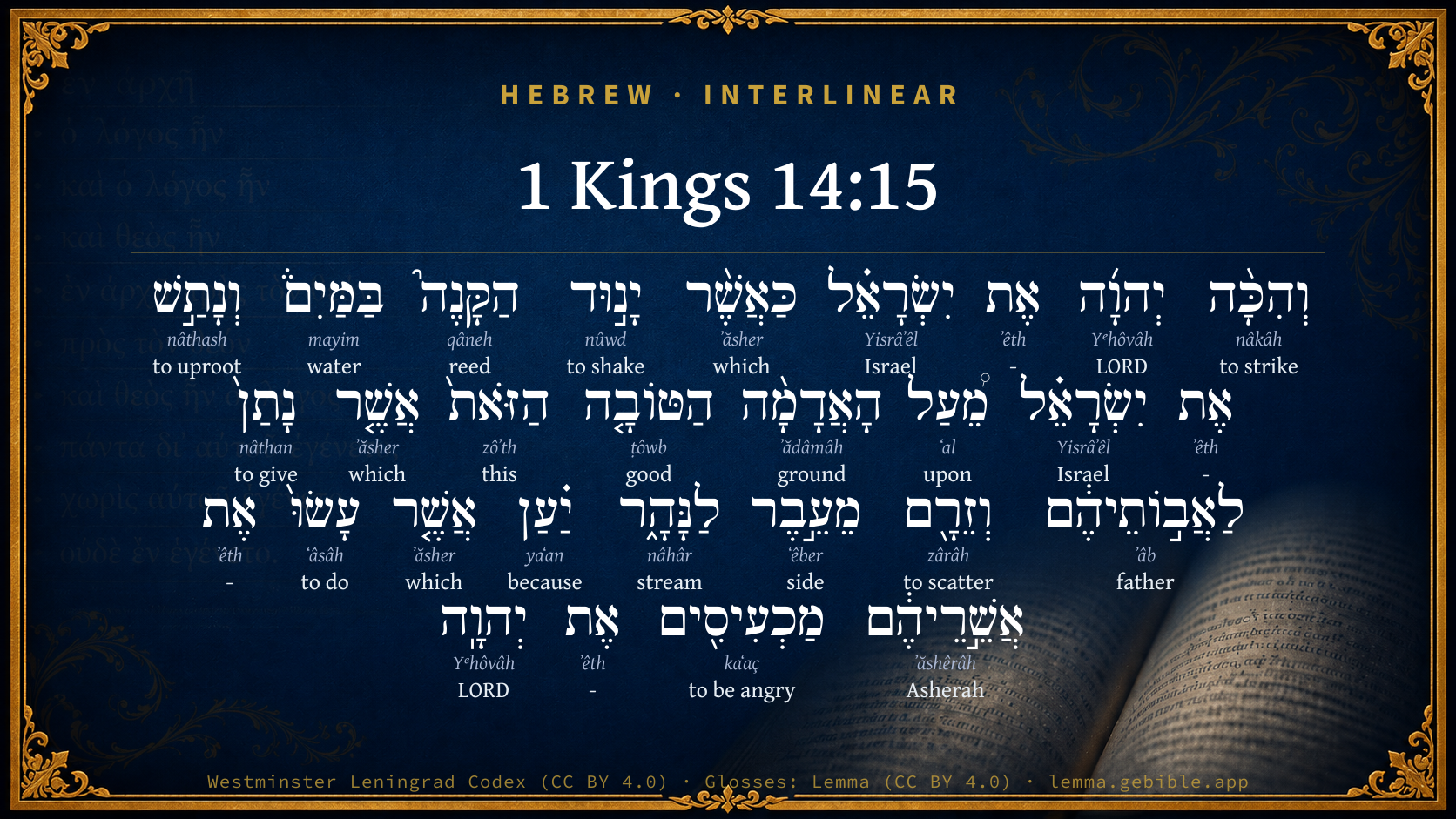
Hebrew (Westminster Leningrad Codex) 1 Kings 14:15 appears in the Hebrew Old Testament. The text above is from the Westminster Leningrad Codex. Each word links to its Strong’s number, a concise gloss, and parsing drawn from the Open Scriptures Hebrew Bible morphology. Click any word for its full Brown-Driver-Briggs (BDB) entry.
Download image
Cite this verse

1 Kings 14:15 (World English Bible). Public Domain. Lemma interlinear Bible study tool, https://lemma.gebible.app/v/1-kings/14/15.

Show BibTeX & RIS
BibTeX
RIS
English Translation
For Yahweh will strike Israel, as a reed is shaken in the water; and he will root up Israel out of this good land which he gave to their fathers, and will scatter them beyond the River, because they have made their Asherim, provoking Yahweh to anger.
World English Bible · Public Domain
Download a study sheet

One document with this verse’s original text, its word-by-word gloss line, the meaning frame, cross-references with their text, attributed commentary, and full source and license credits — printable, and it pastes into notes with its structure intact.

This verse Autodidact and up

Study sheet (.html) Plain text (.txt)

A passage Seminary Student

Up to 50 verses in one chapter. A passage sheet keeps up to 6 commentary sources and 12 cross-references per verse, in the order this page ranks them, and says so on the sheet whenever that leaves anything out. Ask for a single verse and you get the Autodidact verse sheet above.

Everything on this page stays free to read, with no account — the sheet is a download of what is already on screen, not access to it.

Want to remove ads? Support Godless Engineer
Compare translations 3

The same verse in 3 English versions, stacked beneath the original-language interlinear above. Click any original word for its lexicon entry.

Each is an independent rendering of the whole verse — the interlinear is not word-aligned to these translations.

Highlighted words mark where these versions differ — a whole-verse word diff, not a word-by-word alignment.

  • World English Bible Public Domain
    For Yahweh will strike Israel, as a reed is shaken in the water; and he will root up Israel out of this good land which he gave to their fathers, and will scatter them beyond the River, because they have made their Asherim, provoking Yahweh to anger.
  • King James Version Public Domain
    For the LORD shall smite Israel, as a reed is shaken in the water, and he shall root up Israel out of this good land, which he gave to their fathers, and shall scatter them beyond the river, because they have made their groves, provoking the LORD to anger.
  • unfoldingWord Literal Text CC BY-SA 4.0
    And Yahweh will strike Israel, just as a reed sways in the waters, and he will uproot Israel from upon this good ground that he gave to their fathers. And he will scatter them beyond the River because they made their Asherahs, provoking Yahweh.

unfoldingWord Literal Text — © unfoldingWord, licensed CC BY-SA 4.0. Word-aligned USFM3 via Door43 (git.door43.org/unfoldingWord/en_ult).

Versions to compare (up to 4)

3 of 4 selected

Show all 18 translations

Every available English version of this verse, each an independent rendering of the whole verse.

  • World English Bible Public Domain
    For Yahweh will strike Israel, as a reed is shaken in the water; and he will root up Israel out of this good land which he gave to their fathers, and will scatter them beyond the River, because they have made their Asherim, provoking Yahweh to anger.
  • Berean Standard Bible Public Domain
    For the LORD will strike Israel as a reed is shaken in the water. He will uproot Israel from this good land that He gave their fathers, and He will scatter them beyond the Euphrates, because they have made their Asherah poles, provoking the LORD to anger.
  • Majority Standard Bible Public Domain
    For the LORD will strike Israel as a reed is shaken in the water. He will uproot Israel from this good land that He gave their fathers, and He will scatter them beyond the Euphrates, because they have made their Asherah poles, provoking the LORD to anger.
  • King James Version Public Domain
    For the LORD shall smite Israel, as a reed is shaken in the water, and he shall root up Israel out of this good land, which he gave to their fathers, and shall scatter them beyond the river, because they have made their groves, provoking the LORD to anger.
  • American Standard Version (1901) Public Domain
    For Jehovah will smite Israel, as a reed is shaken in the water; and he will root up Israel out of this good land which he gave to their fathers, and will scatter them beyond the River, because they have made their Asherim, provoking Jehovah to anger.
  • Revised Version (1885) Public Domain
    For the LORD shall smite Israel, as a reed is shaken in the water; and he shall root up Israel out of this good land, which he gave to their fathers, and shall scatter them beyond the River; because they have made their Asherim, provoking the LORD to anger.
  • Geneva Bible (1599) Public Domain
    For the Lord shall smite Israel, as when a reede is shaken in the water, and hee shall weede Israel out of his good lad, which he gaue to their fathers, and shall scatter them beyond the Riuer, because they haue made them groues, prouoking the Lord to anger.
  • Douay-Rheims (1899) Public Domain
    And the Lord God shall strike Israel as a reed is shaken in the water: and he shall root up Israel out of this good land, which he gave to their fathers, and shall scatter them beyond the river: because they have made to themselves groves, to provoke the Lord.
  • Young's Literal Translation Public Domain
    And Jehovah hath smitten Israel as the reed is moved by the waters, and hath plucked Israel from off this good ground that He gave to their fathers, and scattered them beyond the River, because that they made their shrines, provoking Jehovah to anger;
  • Literal Standard Version CC BY-SA 4.0
    And YHWH has struck Israel as the reed is moved by the waters, and has plucked Israel from off this good ground that He gave to their fathers, and scattered them beyond the River, because that they made their Asherim, provoking YHWH to anger;
  • Unlocked Literal Bible CC BY-SA 4.0
    For Yahweh will attack Israel as a reed is shaken in the water, and he will root up Israel out of this good land that he gave to their ancestors. He will scatter them beyond the Euphrates River, because they have made their Asherah poles and provoked Yahweh to anger.
  • unfoldingWord Literal Text CC BY-SA 4.0
    And Yahweh will strike Israel, just as a reed sways in the waters, and he will uproot Israel from upon this good ground that he gave to their fathers. And he will scatter them beyond the River because they made their Asherahs, provoking Yahweh.
  • Darby Bible Public Domain
    And Jehovah will smite Israel, as a reed is shaken in the water, and he will root up Israel out of this good land which he gave to their fathers, and will scatter them beyond the river, because they have made their Asherahs, provoking Jehovah to anger.
  • World Messianic Bible Public Domain
    For the LORD will strike Israel, as a reed is shaken in the water; and he will root up Israel out of this good land which he gave to their fathers, and will scatter them beyond the River, because they have made their Asherah poles, provoking the LORD to anger.
  • Webster's Bible Public Domain
    For the LORD will smite Israel, as a reed is shaken in the water, and he will root up Israel out of this good land, which he gave to their fathers, and will scatter them beyond the river, because they have made their groves, provoking the LORD to anger.
  • Free Bible Version CC BY-SA 4.0
    The Lord will strike Israel like a reed jerked to and fro by the water. He will pull up Israel by the roots from this good land that he gave their forefathers and scatter them beyond the Euphrates, because they have made their pagan Asherah poles, making the Lord angry.
  • Bible in Basic English Public Domain
    And even now the hand of the Lord has come down on Israel, shaking it like a river-grass in the water; and, uprooting Israel from this good land, which he gave to their fathers, he will send them this way and that on the other side of the River; because they have made for themselves images, moving the Lord to wrath.
  • JPS Tanakh (1917) Public Domain
    for the LORD will smite Israel, as a reed is shaken in the water; and He will root up Israel out of this good land, which He gave to their fathers, and will scatter them beyond the River; because they have made their Asherim, provoking the LORD.

Literal Standard Version (2020), Covenant Press — licensed CC BY-SA 4.0. Text via the HelloAO Bible API (eBible.org). Unlocked Literal Bible (unfoldingWord) — licensed CC BY-SA 4.0. Text via the HelloAO Bible API (eBible.org). unfoldingWord Literal Text — © unfoldingWord, licensed CC BY-SA 4.0. Word-aligned USFM3 via Door43 (git.door43.org/unfoldingWord/en_ult). Free Bible Version, Dr. Jonathan Gallagher — licensed CC BY-SA 4.0. Text via the HelloAO Bible API (eBible.org).

Word by word

More ways to search: Search by grammar → Find every occurrence → Compare this word →

Practice this passage: Drill this verse → Learn its vocabulary →

וְנָתַ֣שׁ
nâthash
H5428
“and · to uproot”
Conjunction + Verb, Qal, Perfect, 3rd Person, Masculine, Singular
Part of Speech
Conjunction + Verb
Stem
Qal
Form
Perfect
Person
3rd Person
Gender
Masculine
Number
Singular
Full BDB Definition

Origin: a primitive root

TWOT: 1451

to pull up, expel, root out, pluck up - (Qal) to pull or pluck up - (Niphal) to be plucked up - (Hophal) to be plucked up
  1. וְהִכָּ֨ה nâkâh H5221 “and · to strike” Conjunction + Verb, Hiphil, Sequential Perfect, 3rd Person, Masculine, Singular
  2. יְהוָ֜ה Yᵉhôvâh H3068 “LORD” Noun, Proper
  3. אֶת ʼêth H853 “-” Particle, Direct Object
  4. יִשְׂרָאֵ֗ל Yisrâʼêl H3478 “Israel” Noun, Proper
  5. כַּאֲשֶׁ֨ר ʼăsher H834 “like/as · which” Preposition + Particle, Relative
  6. יָנ֣וּד nûwd H5110 “to shake” Verb, Qal, Imperfect, 3rd Person, Masculine, Singular
  7. הַקָּנֶה֮ qâneh H7070 “the · reed” Particle, Definite Article + Noun, Common, Masculine, Singular, Absolute
  8. בַּמַּיִם֒ mayim H4325 “in/at the · water(s)” Preposition, Determined + Noun, Common, Masculine, Plural, Absolute
  9. אֶת ʼêth H853 “-” Particle, Direct Object
  10. יִשְׂרָאֵ֗ל Yisrâʼêl H3478 “Israel” Noun, Proper
  11. מֵ֠עַל ʻal H5921 “from · upon” Preposition + Preposition
  12. הָאֲדָמָ֨ה ʼădâmâh H127 “the · ground” Particle, Definite Article + Noun, Common, Feminine, Singular, Absolute
  13. הַטּוֹבָ֤ה ṭôwb H2896 “the · good” Particle, Definite Article + Adjective, Adjective, Feminine, Singular, Absolute
  14. הַזֹּאת֙ zôʼth H2063 “the · this” Particle, Definite Article + Pronoun, Demonstrative, Feminine, Singular
  15. אֲשֶׁ֤ר ʼăsher H834 “which” Particle, Relative
  16. נָתַן֙ nâthan H5414 “to give” Verb, Qal, Perfect, 3rd Person, Masculine, Singular
  17. לַאֲב֣וֹתֵיהֶ֔ם ʼâb H1 “to/for · fathers · their” Preposition + Noun, Common, Masculine, Plural, Construct + Suffix, Personal, 3rd Person, Masculine, Plural
  18. וְזֵרָ֖ם zârâh H2219 “and · to scatter · them” Conjunction + Verb, Piel, Perfect, 3rd Person, Masculine, Singular + Suffix, Personal, 3rd Person, Masculine, Plural
  19. מֵעֵ֣בֶר ʻêber H5676 “from · side” Preposition + Noun, Common, Masculine, Singular, Absolute
  20. לַנָּהָ֑ר nâhâr H5104 “to/for the · stream” Preposition, Determined + Noun, Common, Masculine, Singular, Absolute
  21. יַ֗עַן yaʻan H3282 “because” Conjunction
  22. אֲשֶׁ֤ר ʼăsher H834 “which” Particle, Relative
  23. עָשׂוּ֙ ʻâsâh H6213 “to do” Verb, Qal, Perfect, 3rd Person, Common, Plural
  24. אֶת ʼêth H853 “-” Particle, Direct Object
  25. אֲשֵׁ֣רֵיהֶ֔ם ʼăshêrâh H842 “Asherah · their” Noun, Proper + Suffix, Personal, 3rd Person, Masculine, Plural
  26. מַכְעִיסִ֖ים kaʻaç H3707 “being angry” Verb, Hiphil, Participle Active, Masculine, Plural, Absolute
  27. אֶת ʼêth H853 “-” Particle, Direct Object
  28. יְהוָֽה Yᵉhôvâh H3068 “LORD” Noun, Proper

About this verse

These counts appear in no published source. They are computed here, from the morphology-tagged text and Lemma’s own curated glosses. What Lemma adds →

29
words
22
distinct lemmas
Historical
section

Notable vocabulary

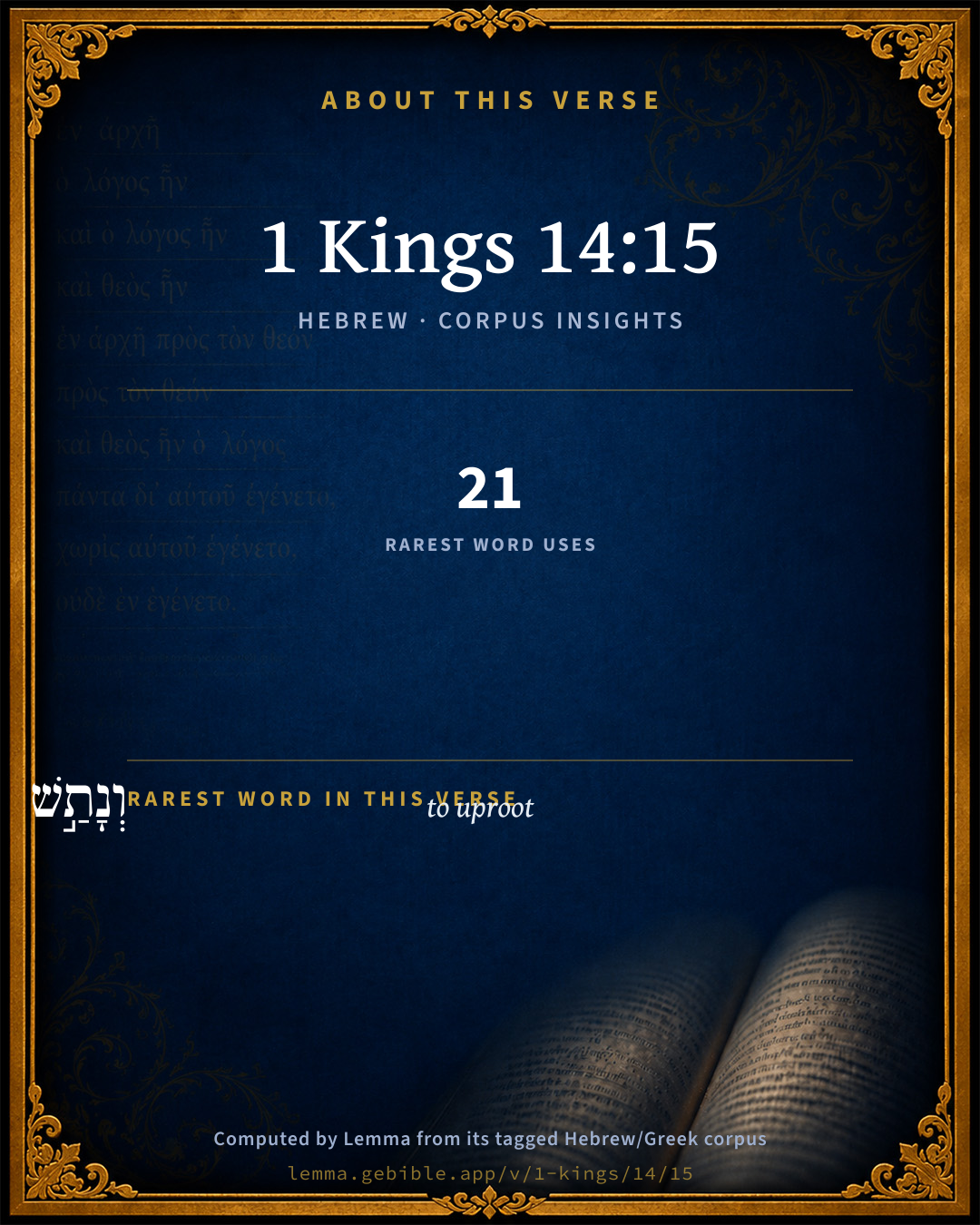
The rarest word here is וְנָתַ֣שׁ to uproot H5428 — appearing just 21 times in the whole Hebrew Bible.

Shared distinctive vocabulary

וְנָתַ֣שׁ to uproot H5428 occurs in 19 verses of the Hebrew Bible. Also found in:

Grammatical profile

  • 7 verbs
  • 11 nouns
  • 1 adjective
  • 1 pronoun
  • 1 preposition
  • 1 conjunction
  • 7 particles

Verb forms

  • וְהִכָּ֨ה Hiphil · Sequential Perfect
  • יָנ֣וּד Qal · Imperfect
  • וְנָתַ֣שׁ Qal · Perfect
  • נָתַן֙ Qal · Perfect
  • וְזֵרָ֖ם Piel · Perfect
  • עָשׂוּ֙ Qal · Perfect
  • מַכְעִיסִ֖ים Hiphil · Participle Active

Repetition

Words recur within this verse — often emphatic in Hebrew:

  • יְהוָ֜ה LORD H3068 ×2
  • יִשְׂרָאֵ֗ל Israel H3478 ×2
  • כַּאֲשֶׁ֨ר which H834 ×3

Cross-references

26

Topical passages linked to 1 Kings 14:15 in the Treasury of Scripture Knowledge — connected by theme and wording, ordered by reader-vote popularity; previews shown in the World English Bible.

  • Joshua 23:15–16 It shall happen, that as all the good things are come on you of which Yahweh your God spoke to you, so will Yahweh bring on you all the evil things, until he have destroyed you from off this good land which Yahweh your God has given you.
  • Psalms 52:5 God will likewise destroy you forever. He will take you up, and pluck you out of your tent, And root you out of the land of the living. Selah.
  • 2 Kings 15:29 In the days of Pekah king of Israel came Tiglath Pileser king of Assyria, and took Ijon, and Abel Beth Maacah, and Janoah, and Kedesh, and Hazor, and Gilead, and Galilee, all the land of Naphtali; and he carried them captive to Assyria.
  • Exodus 34:13–14 but you shall break down their altars, and dash in pieces their pillars, and you shall cut down their Asherim;
  • Deuteronomy 12:3–4 and you shall break down their altars, and dash in pieces their pillars, and burn their Asherim with fire; and you shall cut down the engraved images of their gods; and you shall destroy their name out of that place.
  • Proverbs 2:22 But the wicked will be cut off from the land. The treacherous will be rooted out of it.
  • Leviticus 26:32–34 I will bring the land into desolation; and your enemies that dwell therein will be astonished at it.
  • Leviticus 26:43 The land also will be left by them, and will enjoy its sabbaths while it lies desolate without them: and they will accept the punishment of their iniquity; because, even because they rejected my ordinances, and their soul abhorred my statutes.
  • Deuteronomy 4:26–27 I call heaven and earth to witness against you this day, that you shall soon utterly perish from off the land whereunto you go over the Jordan to possess it; you shall not prolong your days on it, but shall utterly be destroyed.
  • Deuteronomy 28:36 Yahweh will bring you, and your king whom you shall set over you, to a nation that you have not known, you nor your fathers; and there shall you serve other gods, wood and stone.
  • Deuteronomy 28:63–68 It shall happen that as Yahweh rejoiced over you to do you good, and to multiply you, so Yahweh will rejoice over you to cause you to perish, and to destroy you; and you shall be plucked from off the land where you go in to possess it.
  • Deuteronomy 29:24–28 even all the nations shall say, Why has Yahweh done thus to this land? what means the heat of this great anger?
  • 1 Samuel 12:25 But if you shall still do wickedly, you shall be consumed, both you and your king."
  • 1 Kings 14:9 but have done evil above all who were before you, and have gone and made you other gods, and molten images, to provoke me to anger, and have cast me behind your back:
  • 1 Kings 14:23–24 For they also built them high places, and pillars, and Asherim, on every high hill, and under every green tree;
  • 2 Kings 17:6–7 In the ninth year of Hoshea the king of Assyria took Samaria, and carried Israel away to Assyria, and placed them in Halah, and on the Habor, the river of Gozan, and in the cities of the Medes.
  • 2 Kings 17:23 until Yahweh removed Israel out of his sight, as he spoke by all his servants the prophets. So Israel was carried away out of their own land to Assyria to this day.
  • 2 Kings 18:11–12 The king of Assyria carried Israel away to Assyria, and put them in Halah, and on the Habor, the river of Gozan, and in the cities of the Medes,
  • Isaiah 1:28–29 But the destruction of transgressors and sinners shall be together, And those who forsake Yahweh shall be consumed.
  • Amos 2:9 Yet I destroyed the Amorite before them, Whose height was like the height of the cedars, And he was strong as the oaks; Yet I destroyed his fruit from above, and his roots from beneath.
  • Amos 5:27 Therefore will I cause you to go into captivity beyond Damascus," says Yahweh, whose name is the God of hosts.
  • Zephaniah 2:4 For Gaza will be forsaken, and Ashkelon a desolation. They will drive out Ashdod at noonday, and Ekron will be rooted up.
  • Matthew 11:7 As these went their way, Jesus began to say to the multitudes concerning John, "What did you go out into the wilderness to see? A reed shaken by the wind?
  • Matthew 15:13 But he answered, "Every plant which my heavenly Father didn't plant will be uprooted.
  • Luke 7:24 When John's messengers had departed, he began to tell the multitudes about John, "What did you go out into the wilderness to see? A reed shaken by the wind?
  • Acts 7:43 You took up the tent of Moloch, The star of your god Rephan, The figures which you made to worship. I will carry you away beyond Babylon.'

Cross-references courtesy of OpenBible.info (CC BY 4.0).

Hebrew and Greek witnesses Masoretic Hebrew ↔ Greek Septuagint

The same verse in the two great witnesses to the Old Testament, shown verse-for-verse.

These are two independent witnesses, not word-aligned to each other, and the Septuagint is shown in lemma (dictionary) form.

Hebrew 1 Kings 14:15 Masoretic · Westminster Leningrad Codex

וְהִכָּ֨ה יְהוָ֜ה אֶת יִשְׂרָאֵ֗ל כַּאֲשֶׁ֨ר יָנ֣וּד הַקָּנֶה֮ בַּמַּיִם֒ וְנָתַ֣שׁ אֶת יִשְׂרָאֵ֗ל מֵ֠עַל הָאֲדָמָ֨ה הַטּוֹבָ֤ה הַזֹּאת֙ אֲשֶׁ֤ר נָתַן֙ לַאֲב֣וֹתֵיהֶ֔ם וְזֵרָ֖ם מֵעֵ֣בֶר לַנָּהָ֑ר יַ֗עַן אֲשֶׁ֤ר עָשׂוּ֙ אֶת אֲשֵׁ֣רֵיהֶ֔ם מַכְעִיסִ֖ים אֶת יְהוָֽה

For Yahweh will strike Israel, as a reed is shaken in the water; and he will root up Israel out of this good land which he gave to their fathers, and will scatter them beyond the River, because they have made their Asherim, provoking Yahweh to anger.

World English Bible · Public Domain

On this verse, Ellicott's Commentary for English Readers discusses the Septuagint’s reading. Read the note in Commentary ↓

Hebrew: Westminster Leningrad Codex (CC BY 4.0). Greek: Septuagint (public domain); English from a public-domain English Septuagint. How the Septuagint differs from the Hebrew →

Targum (Aramaic paraphrase)

1

The Targum is the ancient Jewish Aramaic paraphrase of the Hebrew Scriptures — an interpretive translation, not the Hebrew text itself. Onkelos (literal) and Pseudo-Jonathan (expansive) render the Torah, and Jonathan the Prophets. Coverage is partial: where no permissively-licensed English translation exists for a verse, only the Aramaic is shown. This is verse-level text, not a word-by-word alignment to the Hebrew.

  1. Targum Jonathan Prophets (Joshua–Malachi)
    וְיִמְחֵי יְיָ יַת יִשְׂרָאֵל כְּמָא דְנָאֵיד קַנְיָא בְּמַיָא וִיעַקֵר יַת יִשְׂרָאֵל מֵעַל אַרְעָא טַבְתָא הָדָא דִיהַב לַאֲבָהַתְהוֹן וַיַגְלִינוּן מֵעִיבַּר פְרָת חֲלַף דַעֲבַדוּ יַת אֲשֵׁרֵיהוֹן מַרְגְזִין קֳדָם יְיָ:

    (no public-domain English translation for this verse)

    Targum Jonathan — Aramaic: “Mikraot Gedolot” (public domain). English: “Sefaria Community Translation” (CC0 1.0 (public-domain dedication)); “London "Chaldee Paraphrase," 1871” (public domain). Text via Sefaria.

Commentary

Notes on 1 Kings 14:15 from classic Christian and Jewish commentators (each source and its license shown beneath its notes). The classic Christian expositions comment on the surrounding passage and are grouped to its opening verse, so a note may address several verses; the Jewish commentaries on the Tanakh (Rashi and others) are per-verse, so they appear only where the commentator wrote on this verse.

Lemma curates 59 commentaries, every one of them public domain or Creative Commons licensed, each selected and text-cleaned for this edition rather than reprinted as found. About our sources →

Trapp's Complete Commentary

John Trapp

1Ki 14:15 For the LORD shall smite Israel, as a reed is shaken in the water, and he shall root up Israel out of this good land, which he gave to their fathers, and shall scatter them beyond the river, because they have made their groves, provoking the LORD to anger.

Ver. 15. As a reed is shaken in the water.] That never resteth, being in continual motion by wind and water, see 1Sa 25:29; the soul of a wicked man is "in a sling," violently tossed with infinite turmoils and restless.

John Trapp, A Commentary or Exposition upon All the Books of the Old and New Testament (1647–1656) — public domain. Text from a community e-Sword module.

Joseph Benson's Commentary

1Ki 14:15-16. For the Lord shall smite Israel — For consenting to that idolatrous worship which Jeroboam set up. As a reed is shaken in the water — Hither and thither, with every wind. So shall the kingdom and people of Israel be always in an unquiet and unsettled state, tossed to and fro by foreign invasions and civil wars; by opposite kings and factions, and by the dissensions of the people. The emblem expresses very forcibly the ease with which God could punish the Israelites and overturn their state, notwithstanding all their greatness, even as easily as a reed is shaken with the wind. He shall root up Israel out of this good land — Which God began to do first by Tiglath-Pileser, king of Assyria, 2Ki 15:29; and then finished it by Shalmaneser, 2Ki 17:5-6, &c. And shall scatter them beyond the river — That is, Euphrates, so called by way of eminence, they being carried, as the forenamed places tell us, into the country of the Medes. Because they have made their groves — For the worship of their idols. God having before condemned the making and worshipping of the calves, by which they pretended to worship the true God; he now takes notice that they were not contented with the calves, but (as it is in the nature of idolatry, and all sin, to proceed from evil to worse) were many of them fallen into a worse kind of idolatry, even their worship of the heathenish Baals, which they commonly exercised in groves. Who made Israel to sin — By his invention, and making the occasion of their sin, the calves; by his example, encouraging those and only those that worshipped the calves; and by his authority requiring and compelling them to do it. This is mentioned as a monstrous aggravation of his wickedness, that he was not content to sin himself, but was a great author of drawing others into sin, and of corrupting and undoing the whole kingdom; which therefore God would never forgive him, but upon all occasions mentions him with this eternal brand of infamy upon him.

Joseph Benson's Commentary on the Old and New Testaments (1811–1818) — public domain. Text from a community e-Sword module.

Tyndale Open Study Notes

Tyndale Open Resources

14:15 Asherah was thought to be the consort of El, the elder god of ancient Canaan. Asherah worship included fertility rites at sacred trees or poles; it became a chronic sin for God’s people (15:13; 16:33; 18:19; Deut 16:21; Judg 3:7).

Tyndale Open Study Notes — © Tyndale Open Resources, licensed CC BY-SA 4.0. Text via the HelloAO Bible API.

Geneva Bible (1599)

Geneva Bible translators

Meaning, Euphrates.

Geneva Bible (1599) marginal notes — public domain. Text via Bolls.life.

Adam Clarke's Commentary

Verse 15. For the Lord shall smite Israel] See this prophecy fulfilled, 1Kg 15:28-30, when Baasha destroyed all the house and posterity of Jeroboam.

Adam Clarke's Commentary on the Bible (1810–1826) — public domain. Text from a community e-Sword/MySword module.

Ellicott's Commentary for English Readers

(15) And he shall root up Israel.—The first prophecy of future captivity, and that “beyond the river” (Euphrates), is here pronounced against the kingdom of Israel, on account of their share in the idolatry of Jeroboam, and in the worse abominations of the “groves.” Of all such utterances we must remember the express declaration of Jer_18:7-8 : “At what instant I shall speak concerning a nation . . . to pluck up, and to pull down, and to destroy; if that nation . . . turn from their evil, I will repent of the evil that I thought to do unto them.” The prophecy uttered does not foreclose the probation of future ages. This is, after all, only one illustration of the great truth that—however impossible it is for us to comprehend the mystery—the foreknowledge of God does not preclude the freedom and responsibility of man.

The metaphor is of the reed shaken to and fro in the river, till at last it is rooted up, swept down the stream, and cast up on some distant shore.

Their groves.—The word rendered “grove” is properly Asherah, an idol: apparently the straight stem of a tree, surmounted by an emblem of the goddess represented (whence, perhaps, the wrong translation which, from the LXX. and Vulgate, has made its way into our version). (See Exo_34:13; Deu_7:5; Deu_12:2; Jdg_3:7; Jdg_6:25; Jdg_6:28, &c.) It is thought to have been an image of some deity like Astarte; and Gesenius infers from the derivation of the name that it was dedicated to her, as the goddess of good fortune. But the worship dates from a far earlier time than the introduction of the worship of the Tyrian Astarte, and the word itself is etymologically distinct from Ashtoreth or Ashtaroth. It is notable that in 2Ki_23:15 Josiah is said not only to have destroyed the altar and high places at Bethel, but to have “burned the Asherah;” whence it may probably be concluded that (as is perhaps implied in this passage) the old worship of the Asherah, with all its superstitious and profligate accompaniments, grew up under the very shadow of the newer idolatry. From the worship of images as emblems to superstitious veneration of the images themselves, and thence to worship of many gods, the transition is unhappily only too easy.

A Bible Commentary for English Readers, edited by Charles John Ellicott (1878–1897) — public domain. Text from a community e-Sword module.

The Cambridge Bible for Schools and Colleges

gen. ed. J. J. S. Perowne

15. as a reed is shaken] For this figure of entire instability, cf. Mat_11:7 ‘a reed shaken with the wind’. And here the root is planted amid the water, which will make it more tottering still.

beyond the river] i.e. The River, par excellence, the Euphrates.

their groves] R.V. their Ashêrim. This is a plural form of the word Ashêrah, which is the name of a goddess worshipped with rites similar to those of Baal-worship. The plural probably denotes the wooden images of the goddess, which are mentioned as early as Exo_34:13, and the worship of which was common in the time of the Judges (cf. 1Ki_3:7), and then for some interval laid aside, but revived under the kings.

The Cambridge Bible for Schools and Colleges (gen. ed. J. J. S. Perowne; Cambridge University Press, 1878–1918) — public domain. Text from a community e-Sword module.

John Gill's Exposition

And he shall give Israel up,.... Into the hands of their enemies:

because of the sins of Jeroboam, who did sin, and who made Israel to sin; by his devices and stratagems, by his example and edicts, and by the methods he took to prevent Israel from worshipping in the manner and place he directed to.

John Gill's Exposition of the Whole Bible (1746–1763) — public domain (CC PDM 1.0). Text via the HelloAO Bible API.

Albert Barnes' Notes on the Bible

The general prophecy of Moses Deu 29:28, that the disobedient Israelites would be rooted up out of their land, and cast into another land, is here for the first time repeated, and is definitively applied to the ten tribes, which are to be removed “beyond the river” (the Euphrates, 1Ki 4:21, 1Ki 4:24), and “scattered.” On the fulfillment of this prophecy, and especially on the “scattering” of the ten tribes, see 2Ki 17:6 note.

Groves - See Exo 34:13 note. The grove or, “asherah”-) worship, adopted from the Canaanite nations, appears to have died away after the fierce onslaught which Gideon made upon it Jdg 6:25-31. It now revived, and became one of the most popular of the idolatries both in Israel and Judah (1Ki 14:23, and compare the marginal references).

Albert Barnes' Notes on the Bible (1834–1885) — public domain. Text from a community e-Sword/MySword module.

Haydock's Catholic Bible Commentary

Water. The kingdom of Israel was continually agitated with wars. --- River Euphrates, by degrees. The kings of Assyria verified these predictions; and we know not what is become of these ten tribes. (Calmet) --- To provoke. These people did not perhaps design (Haydock) to make God their enemy, no more than their king did, ver. 9. But their actions had that effect. Such expressions denote not the final cause, but the sequel of other facts, without direct intention. (Worthington) --- Yet these sins might probably be called sins of malice. (Haydock) --- They were all involved in ruin, and because they had been accomplices in wickedness. (Menochius)

George Leo Haydock (1774–1849), Haydock's Catholic Family Bible and Commentary, 1859 edition — public domain. Excludes Psalms (Douay-Rheims chapter numbering differs from Protestant) and Deuterocanonical books (Catholic canon only).

Matthew Poole's English Annotations

The Lord shall smite Israel, because they obeyed Jeroboam’s wicked command of worshipping the calves, and that willingly, Hos 5:11.

As a reed is shaken in the water; easily and variously, hither and thither, with every wind; so shall the kingdom and people of Israel be always in an unquiet and unsettled posture, tossed to and fro by foreign invasions and civil wars, by opposite kings and factions, and by the dissensions of the people. See 2Ki 17:18.

Beyond the river, to wit, Euphrates, oft so called by way of eminency, as Gen 15:18; 31:21; 1Ki 4:21,24. This was accomplished in part, 2Ki 15:29, and more fully 2Ki 17:6.

Because they have made their groves, for the worship of their idols, Exo 34:13; Deu 16:21. God having before condemned the making and worshipping of the calves, by which they designed or pretended to worship the true God; he now takes notice that they were not contented with the calves, but (as it is the nature of idolatry, and all sin, to proceed from evil to worse) were many of them fallen into another and a worse kind of idolatry, even their worship of the heathenish Baals, which they commonly exercised in groves. See Poole "1Ki 18:19".

Matthew Poole's English Annotations on the Holy Bible (1683–1685) — public domain. Text from a community e-Sword/MySword module.

Whedon's Commentary on the Bible

Daniel D. Whedon

15. Smite Israel… root up Israel… scatter them beyond the river — Here is the first positive announcement of the Assyrian and Babylonian exiles as a punishment of Israel’s sins. Already, in earlier times, had a rooting up and scattering of the people been threatened in case of disobedience, (Deu_28:63; Deu_29:27; Jos_23:16,) but Ahijah is the first of that long line of prophets that hold up exile beyond the river Euphrates as a certainly coming woe.

Groves — Thus our version, after the Septuagint and Vulgate, renders אשׁרה. Other versions render it, a wooden pillar or a tree. The word, however, is the proper name of a heathen goddess, Asherah. Compare Jdg_3:7; and 1Ki_18:19. It is another form for Ashtoreth, the goddess of the Zidonians. Asherah was their female, as Baal was their male divinity. In the plural, as here, and often elsewhere, it seems to be used in the more general sense of idols, or images of false gods, and may well be rendered simply idols; that is, the image-pillars of Asherah.

Daniel D. Whedon (gen. ed.), Commentary on the Old and New Testaments (1874–1909) — public domain. Text from a community e-Sword module.

The Pulpit Commentary

For Heb. And. The prophet now proceeds to state the share of the people in the punishment. They had acquiesced in the wicked innovations of Jeroboam and had joined in the worship of the calves the Lord shall smite Israel, as a reed hn,q; kanna, canna, cane is shaken The construction is pregnant, viz., "shall smite Israel so that it shall be shaken as a reed," etc. (cf. Luk_7:24) "The image is very striking, for Israel was brought so low that every political influence bore it along" (Thenius) in the water, and he shall root up same word as in Deu_29:28; Jer_24:6 Israel out of this good land, which he gave to their fathers, and shall scatter them beyond the river i.e., the Euphrates; see on 1Ki_4:24. This is the first clear prophecy of the captivity foreshadowed by Moses, (Deu_4:27 Deu_28:25, Deu_28:36, Deu_28:63, Deu_28:64) and by Solomon. (1Ki_8:46-50) For its fulfilment, (see 2Ki_17:6 2Ki_18:11, etc.) because they have made their groves Heb. their Asherahs, i.e., images of Astarte. The translation "grove" after the LXX alsov, Vulg. lucus, is now abandoned. It is clear some sort of idol is intended by the term. This is evident from ver. 23, where it is said the Asherahs (A.V groves) were built "under every green tree" (cf.; 2Ki_17:10) from; 1Ki_15:13 (where see note) from 2Ki_23:6, which tells how Josiah "brought out the Asherahs out of the house of the Lord," and from the connexion in which the word is found with "molten images, carved images," etc. (ver. 23; 2Ch_33:19 2Ch_34:3, 2Ch_34:4; cf. also Jud_1:3:7; 1Ki_18:19) They were doubtless effigies of Ashtoreth, made of wood (Deu_7:5; cf. 2Ki_23:6), planted erect in the ground, (Deu_16:21) and were consecrated to her impure and revolting worship. It is clear from this passage that the frightful impurities of the Canaanitish races had subsisted in the new kingdom by the side of the new sacra. They had probably revived under Jeroboam"s rule, having apparently been in abeyance since the time of Gideon, provoking the Lord to anger. 1Ki_14:22 1Ki_15:30 1Ki_21:22; 2Ki_17:11, 17 22:17; Deu_4:25 Deu_32:16, Jud_1:2:12; Psa_78:58.

Vers. 15-16.

The Future of Israel.

The vision of the Shilonite concerning the house of Israel, now before us, seems to have come upon him suddenly. We think the exclamation, "But what? Even now!" was the half-involuntary expression of the surprise of this new revelation. This utterance should, then, have stood at the beginning of verse 15 rather than at the end of the verse preceding. The connecting particle "For," with which verse 15 now opens, favours this view. The new vision describes the then future calamities of Israel, together with their provoking causes.

I HE WAS HENCEFORTH TO BE TROUBLED IN HIS OWN LAND. He is there to stagger and tremble under the stroke of God

1. As a reed is shaken in the water.

(1) The reed is a figure of frailty. Rabshakeh, in describing the inability of the Egyptians to support Hezekiah against the Assyrians, compares them to a bruised reed. (2Ki_18:21; Isa_36:6; see also Eze_39:6) Contrariwise, our Lord, asserting the stability and vigour of John Baptist, said that he was no "reed shaken with the wind". (Mat_11:7) In derision of the royalty of Jesus the soldiers put a reed in His hand for a sceptre. (Mat_27:29) Subsequent history bore emphatic testimony to the instability and feebleness of Ephraim.

(2) The reed is "shaken in the water." This element is at once a symbol of trouble and of people (see Psa_69:17; Rev_17:15) So disquiet, arising from popular tumults and civil war, is suggested. And did not this become fact? The frequent changes of dynasty kept the nation in perpetual broils. These evils were aggravated by wars with their brethren of Judah.

2. As a reed shaken by the wind.

(1) This is not asserted, but implied, since reeds shake in water when moved by winds. And foreign influences had much to do with the troubles of Israel.

(2) Foreign idolatries introduced by Solomon"s wives were at the root of the troubles.

(3) The wars between Israel and Judah brought foreign armies upon the scene Egyptians, Syrians, and Assyrians. By these rough winds the troubles were aggravated.

II THEN TO BE SCATTERED IN THE LANDS OF STRANGERS.

1. A captivity of Israel is foretold.

(1) The settlement of the people in Canaan is frequently described in Scripture under the figure of the planting of a vine there (see Psa_64:2 Psa_80:8; Jer_2:21 Jer_11:17)

(2) This is now to be reversed. "He shall root up Israel out of this good land which he gave to their fathers." Suppose the vine had feeling; what a painful process!

2. Also the region of their dispersion.

(1) "I will scatter them beyond the river" i.e. , the Euphrates, for thus, by emphasis, this river is ever distinguished in Scripture. (see Gen_15:18; compare Deu_11:24 with 1Ki_4:21 and Psa_72:8)

(2) This river also stands for the Assyrians, through whose territory it flowed. Their armies invading Israel are likened to the Euphrates rising and overflowing its western bank. (see Isa_8:7)

(3) How literally was all this accomplished. (see 2Ki_15:29 2Ki_17:6, 2Ki_17:18)

III THESE VISITATIONS WERE TO EXPRESS THE ANGER OF GOD.

1. First provoked by their Canaanitish idolatries.

(1) These are represented here by "their groves." The word Asherah (tr hry occurs thirty-nine times, and is everywhere translated groves, yet it may well be doubted whether this is its meaning. For take the next occurrence after that in our text, viz., ver. 28 of this chapter: How could a grove be built under a green tree? How could a grove be made in the house of the Lord? (See 2Ki_21:7 2Ki_23:6, 2Ki_23:18)

(2) These Asheroth, or Asherim, appear to have been images made of wood, cased in metal, perhaps fashioned like goats, which were worshipped with abominable rites. They were popular Canaanitish divinities, and for this reason to be execrated by Israelites. (see Exodus Deu_16:21)

(3) But for all this they fell into the snare of worshipping together with the Baalim, or Bulls, and other Canaanitish idols (Jud_1:3:7 6:25; 1Ki_18:19)

2. Then by their complicity in the sin of Jeroboam.

(1) This addition to their earlier idolatries filled up the measure of their iniquity. For it completely alienated them from the worship of Jehovah in His temple.

(2) They forsook the Lord, so He threatens to "give up Israel for the sin of Jeroboam," as He had also given up the house of Jeroboam to judgment.

J.A.M.

The Pulpit Commentary (1880–1919), ed. H.D.M. Spence-Jones & Joseph S. Exell — public domain. Text from a community e-Sword module.

John Wesley's Explanatory Notes

Is shaken - Hither and thither, with every wind. So shall the kingdom and people of Israel be always in an unquiet and unsettled posture, tossed to and fro by foreign invasions and civil wars; by opposite kings and factions, and by the dissensions of the people. The river - Euphrates, so called by way of eminency, this was accomplished in part 2 Kings xv, 29, and more fully, 2 Kings xvii, 6. Groves - For the worship of their idols, God having before condemned the making and worshipping of the calves, by which they pretended to worship the true God; he now takes notice that they were not contented with the calves, but (as it is in the nature of idolatry, and all sin, to proceed from evil to worse) were many of them fallen into a worse kind of idolatry, even their worship of the heathenish Baals, which they commonly exercised in groves.

John Wesley, Explanatory Notes Upon the Whole Bible (1754–1765) — public domain. Text via the GEBible commentary corpus.

Lesson kit

Teaching starters — assembled from the data on this page, not authored interpretation. Every prompt links to the verse data it draws on. Edit before teaching.

1 Kings, in the Historical, opens this verse with 29 words (22 distinct Hebrew lemmas). Its most distinctive word is nâthash (“to uproot”). A historical commentator’s framing appears above. Read the whole chapter for the surrounding context.

Discussion questions

  1. What does “to uproot” (nâthash) contribute to the verse as a whole?
  2. Deuteronomy 29:28 shares the word «to uproot» with this verse. How do the two illuminate each other?
  3. “LORD” occurs 2× in this one verse. What is the effect of the repetition?
  4. These translations render this verse differently. What is at stake in choosing one wording over another?
  5. The verb «וְהִכָּ֨ה» is Hiphil Sequential Perfect. How does its form color the action?
  6. Reading how Trapp's Complete Commentary and Joseph Benson's Commentary read this verse, where do the two commentators agree and where do they part?

Things to notice

Reading settings

Reading text

Shown beneath each verse's original-language words.

Old Testament
Old Testament edition

Read the OT as the Masoretic Hebrew (MT) or the Greek Septuagint (LXX).

English shown for the Greek Septuagint (in the Hebrew ↔ Greek comparison).

Comparing translations? Open the Compare panel on any verse page to stack up to four side by side.