
Deuteronomy 32:47

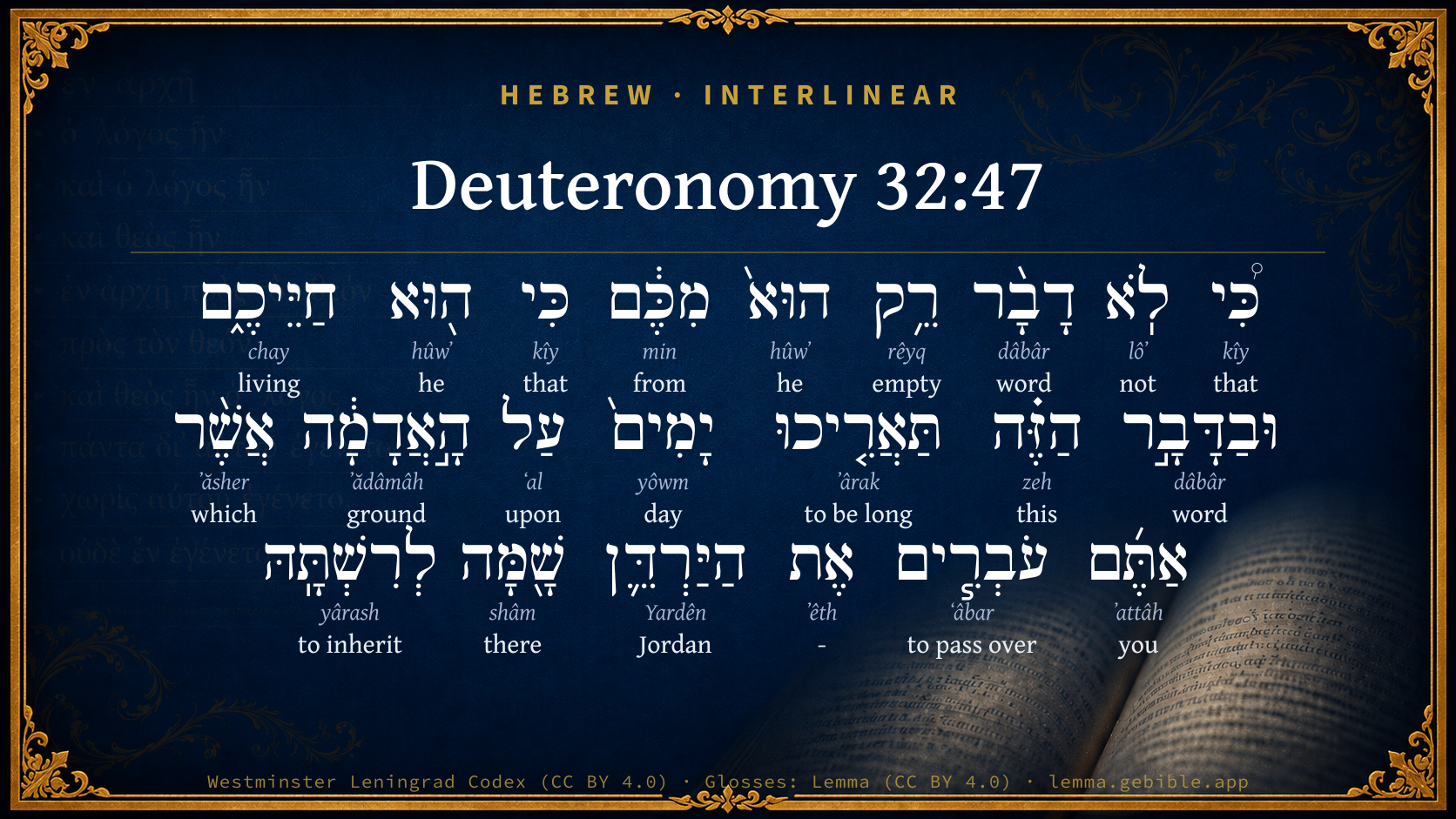
Hebrew (Westminster Leningrad Codex) Deuteronomy 32:47 appears in the Hebrew Old Testament. The text above is from the Westminster Leningrad Codex. Each word links to its Strong’s number, a concise gloss, and parsing drawn from the Open Scriptures Hebrew Bible morphology. Click any word for its full Brown-Driver-Briggs (BDB) entry.
Download image
Cite this verse

Deuteronomy 32:47 (World English Bible). Public Domain. Lemma interlinear Bible study tool, https://lemma.gebible.app/v/deuteronomy/32/47.

Show BibTeX & RIS
BibTeX
RIS
English Translation
For it is no vain thing for you; because it is your life, and through this thing you shall prolong your days in the land, where you go over the Jordan to possess it.
World English Bible · Public Domain
Download a study sheet

One document with this verse’s original text, its word-by-word gloss line, the meaning frame, cross-references with their text, attributed commentary, and full source and license credits — printable, and it pastes into notes with its structure intact.

This verse Autodidact and up

Study sheet (.html) Plain text (.txt)

A passage Seminary Student

Up to 50 verses in one chapter. A passage sheet keeps up to 6 commentary sources and 12 cross-references per verse, in the order this page ranks them, and says so on the sheet whenever that leaves anything out. Ask for a single verse and you get the Autodidact verse sheet above.

Everything on this page stays free to read, with no account — the sheet is a download of what is already on screen, not access to it.

Want to remove ads? Support Godless Engineer
Compare translations 3

The same verse in 3 English versions, stacked beneath the original-language interlinear above. Click any original word for its lexicon entry.

Each is an independent rendering of the whole verse — the interlinear is not word-aligned to these translations.

Highlighted words mark where these versions differ — a whole-verse word diff, not a word-by-word alignment.

  • World English Bible Public Domain
    For it is no vain thing for you; because it is your life, and through this thing you shall prolong your days in the land, where you go over the Jordan to possess it.
  • King James Version Public Domain
    For it is not a vain thing for you; because it is your life: and through this thing ye shall prolong your days in the land, whither ye go over Jordan to possess it.
  • unfoldingWord Literal Text CC BY-SA 4.0
    For it no empty thing for you, because it your life, and through this thing you may prolong days in the land to which you are crossing over the Jordan to possess it.”

unfoldingWord Literal Text — © unfoldingWord, licensed CC BY-SA 4.0. Word-aligned USFM3 via Door43 (git.door43.org/unfoldingWord/en_ult).

Versions to compare (up to 4)

3 of 4 selected

Show all 18 translations

Every available English version of this verse, each an independent rendering of the whole verse.

  • World English Bible Public Domain
    For it is no vain thing for you; because it is your life, and through this thing you shall prolong your days in the land, where you go over the Jordan to possess it.
  • Berean Standard Bible Public Domain
    For they are not idle words to you, because they are your life, and by them you will live long in the land that you are crossing the Jordan to possess.”
  • Majority Standard Bible Public Domain
    For they are not idle words to you, because they are your life, and by them you will live long in the land that you are crossing the Jordan to possess.”
  • King James Version Public Domain
    For it is not a vain thing for you; because it is your life: and through this thing ye shall prolong your days in the land, whither ye go over Jordan to possess it.
  • American Standard Version (1901) Public Domain
    For it is no vain thing for you; because it is your life, and through this thing ye shall prolong your days in the land, whither ye go over the Jordan to possess it.
  • Revised Version (1885) Public Domain
    For it is no vain thing for you; because it is your life, and through this thing ye shall prolong your days upon the land, whither ye go over Jordan to possess it.
  • Geneva Bible (1599) Public Domain
    For it is no vaine worde concerning you, but it is your life, and by this worde ye shall prolong your dayes in the land, whither yee go ouer Iorden to possesse it.
  • Douay-Rheims (1899) Public Domain
    For they are not commanded you in vain, but that every one should live in them, and that doing them you may continue a long time in the land whither you are going over the Jordan to possess it.
  • Young's Literal Translation Public Domain
    for it `is' not a vain thing for you, for it `is' your life, and by this thing ye prolong days on the ground whither ye are passing over the Jordan to possess it.'
  • Literal Standard Version CC BY-SA 4.0
    for it [is] not a vain thing for you, for it [is] your life, and by this thing you prolong days on the ground to where you are passing over the Jordan to possess it.”
  • Unlocked Literal Bible CC BY-SA 4.0
    For this is no trivial matter for you, because it is your life, and through this thing you will prolong your days in the land that you are going over the Jordan to possess.”
  • unfoldingWord Literal Text CC BY-SA 4.0
    For it no empty thing for you, because it your life, and through this thing you may prolong days in the land to which you are crossing over the Jordan to possess it.”
  • Darby Bible Public Domain
    For it is no vain word for you, but it is your life, and through this word ye shall prolong your days on the land whereunto ye pass over the Jordan to possess it.
  • World Messianic Bible Public Domain
    For it is no vain thing for you, because it is your life, and through this thing you shall prolong your days in the land, where you go over the Jordan to possess it.”
  • Webster's Bible Public Domain
    For it is not a vain thing for you: because it is your life; and through this thing ye shall prolong your days in the land whither ye go over Jordan to possess it.
  • Free Bible Version CC BY-SA 4.0
    Don't treat these words as trivial because they are your life, and by them you will have long lives in the country that you will own after crossing the Jordan.”
  • Bible in Basic English Public Domain
    And this is no small thing for you, but it is your life, and through this you may make your days long in the land which you are going over Jordan to take for your heritage.
  • JPS Tanakh (1917) Public Domain
    For it is no vain thing for you; because it is your life, and through this thing ye shall prolong your days upon the land, whither ye go over the Jordan to possess it.'

Literal Standard Version (2020), Covenant Press — licensed CC BY-SA 4.0. Text via the HelloAO Bible API (eBible.org). Unlocked Literal Bible (unfoldingWord) — licensed CC BY-SA 4.0. Text via the HelloAO Bible API (eBible.org). unfoldingWord Literal Text — © unfoldingWord, licensed CC BY-SA 4.0. Word-aligned USFM3 via Door43 (git.door43.org/unfoldingWord/en_ult). Free Bible Version, Dr. Jonathan Gallagher — licensed CC BY-SA 4.0. Text via the HelloAO Bible API (eBible.org).

Word by word

More ways to search: Search by grammar → Find every occurrence → Compare this word →

Practice this passage: Drill this verse → Learn its vocabulary →

רֵ֥ק
rêyq
H7386
“empty”
Adjective, Adjective, Masculine, Singular, Absolute
Part of Speech
Adjective
Type
Adjective
Gender
Masculine
Number
Singular
State
Absolute
Full BDB Definition

Origin: from H7324

TWOT: 2161a

empty, vain - empty (of vessels) - empty, idle, worthless (ethically)
  1. כִּ֠י kîy H3588 “that” Conjunction
  2. לֹֽא lôʼ H3808 “not” Particle, Negative
  3. דָבָ֨ר dâbâr H1697 “word” Noun, Common, Masculine, Singular, Absolute
  4. הוּא֙ hûwʼ H1931 “he” Pronoun, Personal, 3rd Person, Masculine, Singular
  5. מִכֶּ֔ם min H4480 “from · you” Preposition + Suffix, Personal, 2nd Person, Masculine, Plural
  6. כִּי kîy H3588 “that” Conjunction
  7. ה֖וּא hûwʼ H1931 “he” Pronoun, Personal, 3rd Person, Masculine, Singular
  8. חַיֵּיכֶ֑ם chay H2416 “living things · your” Noun, Common, Masculine, Plural, Construct + Suffix, Personal, 2nd Person, Masculine, Plural
  9. וּבַדָּבָ֣ר dâbâr H1697 “and · in/at the · word” Conjunction + Preposition, Determined + Noun, Common, Masculine, Singular, Absolute
  10. הַזֶּ֗ה zeh H2088 “the · this” Particle, Definite Article + Pronoun, Demonstrative, Masculine, Singular
  11. תַּאֲרִ֤יכוּ ʼârak H748 “to be long” Verb, Hiphil, Imperfect, 2nd Person, Masculine, Plural
  12. יָמִים֙ yôwm H3117 “days” Noun, Common, Masculine, Plural, Absolute
  13. עַל ʻal H5921 “upon” Preposition
  14. הָ֣אֲדָמָ֔ה ʼădâmâh H127 “the · ground” Particle, Definite Article + Noun, Common, Feminine, Singular, Absolute
  15. אֲשֶׁ֨ר ʼăsher H834 “which” Particle, Relative
  16. אַתֶּ֜ם ʼattâh H859 “you” Pronoun, Personal, 2nd Person, Masculine, Plural
  17. עֹבְרִ֧ים ʻâbar H5674 “passing over” Verb, Qal, Participle Active, Masculine, Plural, Absolute
  18. אֶת ʼêth H853 “-” Particle, Direct Object
  19. הַיַּרְדֵּ֛ן Yardên H3383 “the · Jordan” Particle, Definite Article + Noun, Proper
  20. שָׁ֖מָּה shâm H8033 “there · toward” Adverb + Suffix, Demonstrative
  21. לְרִשְׁתָּֽהּ yârash H3423 “to inherit · her” Preposition + Verb, Qal, Infinitive Construct + Suffix, Personal, 3rd Person, Feminine, Singular

About this verse

These counts appear in no published source. They are computed here, from the morphology-tagged text and Lemma’s own curated glosses. What Lemma adds →

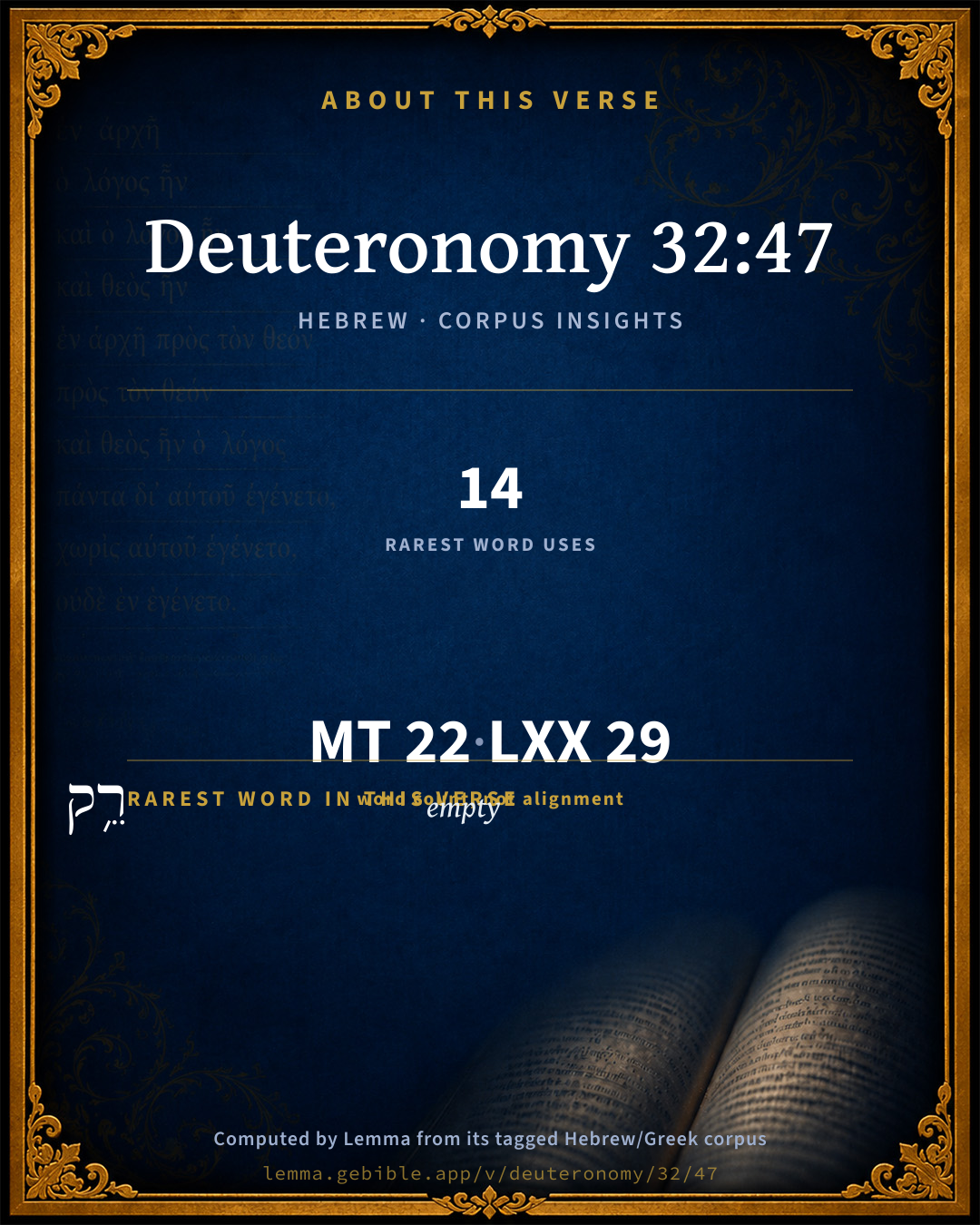
22
words
19
distinct lemmas
Pentateuch
section

Notable vocabulary

The rarest word here is רֵ֥ק empty H7386 — appearing just 14 times in the whole Hebrew Bible.

Shared distinctive vocabulary

רֵ֥ק empty H7386 occurs in 14 verses of the Hebrew Bible. Also found in:

Grammatical profile

  • 3 verbs
  • 6 nouns
  • 1 adjective
  • 4 pronouns
  • 2 prepositions
  • 2 conjunctions
  • 1 adverb
  • 3 particles

Verb forms

  • תַּאֲרִ֤יכוּ Hiphil · Imperfect
  • עֹבְרִ֧ים Qal · Participle Active
  • לְרִשְׁתָּֽהּ Qal · Infinitive Construct

Repetition

Words recur within this verse — often emphatic in Hebrew:

  • דָבָ֨ר word H1697 ×2
  • כִּ֠י that H3588 ×2
  • הוּא֙ he H1931 ×2

Hebrew & Septuagint length

In English translation the verse runs 34 words from the Hebrew and 34 from the Septuagint (LXX English) — the same length.

A rough comparison of the two English renderings, which tokenize alike — not a word-level alignment.

Word counts can differ between the Hebrew and the Greek without any difference in meaning — e.g. the Hebrew direct-object marker אֵת has no separate Greek word, and Greek often adds the article ὁ.

In the original languages it is 22 Hebrew tokens and 29 Greek tokens — but the two are counted differently (Hebrew bundles its prefixes and suffixes into one token; the Greek is in lemma form), so that isn’t a like-for-like length.

Cross-references

15

Topical passages linked to Deuteronomy 32:47 in the Treasury of Scripture Knowledge — connected by theme and wording, ordered by reader-vote popularity; previews shown in the World English Bible.

  • Leviticus 18:5 You shall therefore keep my statutes and my ordinances; which if a man does, he shall live in them: I am Yahweh.
  • Proverbs 4:22 For they are life to those who find them, And health to their whole body.
  • 2 Peter 1:16 For we did not follow cunningly devised fables, when we made known to you the power and coming of our Lord Jesus Christ, but we were eyewitnesses of his majesty.
  • Proverbs 3:22 So they will be life to your soul, And grace for your neck.
  • 1 Peter 3:10–12 For, "He who would love life, And see good days, Let him keep his tongue from evil, And his lips from speaking deceit.
  • Deuteronomy 30:19–20 I call heaven and earth to witness against you this day, that I have set before you life and death, the blessing and the curse: therefore choose life, that you may live, you and your seed;
  • Proverbs 3:1–2 My son, don't forget my teaching; But let your heart keep my commandments:
  • Proverbs 3:18 She is a tree of life to those who lay hold of her. Happy is everyone who retains her.
  • 2 Peter 1:3 seeing that his divine power has granted to us all things that pertain to life and godliness, through the knowledge of him who called us by his own glory and virtue;
  • Isaiah 45:19 I have not spoken in secret, in a place of the land of darkness; I didn't say to the seed of Jacob, Seek you me in vain: I, Yahweh, speak righteousness, I declare things that are right.
  • Matthew 6:33 But seek first God's Kingdom, and his righteousness; and all these things will be given to you as well.
  • Romans 10:5–6 For Moses writes about the righteousness of the law, "The one who does them will live by them."
  • 1 Timothy 4:8 For bodily exercise has some value, but godliness has value for all things, having the promise of the life which is now, and of that which is to come.
  • 1 Timothy 6:6–8 But godliness with contentment is great gain.
  • Revelation 22:14 Blessed are those who do his commandments, that they may have the right to the tree of life, and may enter in by the gates into the city.

Cross-references courtesy of OpenBible.info (CC BY 4.0).

Hebrew and Greek witnesses Masoretic Hebrew ↔ Greek Septuagint

The same verse in the two great witnesses to the Old Testament, shown verse-for-verse.

These are two independent witnesses, not word-aligned to each other, and the Septuagint is shown in lemma (dictionary) form.

Hebrew Deuteronomy 32:47 Masoretic · Westminster Leningrad Codex

כִּ֠י לֹֽא דָבָ֨ר רֵ֥ק הוּא֙ מִכֶּ֔ם כִּי ה֖וּא חַיֵּיכֶ֑ם וּבַדָּבָ֣ר הַזֶּ֗ה תַּאֲרִ֤יכוּ יָמִים֙ עַל הָ֣אֲדָמָ֔ה אֲשֶׁ֨ר אַתֶּ֜ם עֹבְרִ֧ים אֶת הַיַּרְדֵּ֛ן שָׁ֖מָּה לְרִשְׁתָּֽהּ

For it is no vain thing for you; because it is your life, and through this thing you shall prolong your days in the land, where you go over the Jordan to possess it.

World English Bible · Public Domain

Greek LXX Deuteronomy 32:47 Septuagint · lemma form

ὅτι οὐ λόγος κενός οὗτος σύ ὅτι οὗτος ὁ ζωή σύ καί ἕνεκεν ὁ λόγος οὗτος μακροημερεύω ἐπί ὁ γῆ εἰς ὅς σύ διαβαίνω ὁ ἰορδάνης ἐκεῖ κληρονομέω αὐτός

For this is no vain word to you; for it is your life, and because of this word you⌃ shall live long upon the land, into which you⌃ go over Jordan to inherit it.

LXX2012 (modern English Septuagint) · Public Domain

Hebrew: Westminster Leningrad Codex (CC BY 4.0). Greek: Septuagint (public domain); English from LXX2012 (modern English Septuagint) (Public Domain). How the Septuagint differs from the Hebrew →

Targum (Aramaic paraphrase)

2

The Targum is the ancient Jewish Aramaic paraphrase of the Hebrew Scriptures — an interpretive translation, not the Hebrew text itself. Onkelos (literal) and Pseudo-Jonathan (expansive) render the Torah, and Jonathan the Prophets. Coverage is partial: where no permissively-licensed English translation exists for a verse, only the Aramaic is shown. This is verse-level text, not a word-by-word alignment to the Hebrew.

  1. Targum Onkelos Torah (Genesis–Deuteronomy)
    אֲרֵי לָא פִתְגָם רֵקָא הוּא מִנְכוֹן אֲרֵי הוּא חַיֵיכוֹן וּבְפִתְגָמָא הָדֵין תּוֹרְכוּן יוֹמִין עַל אַרְעָא דִי אַתּוּן עָבְרִין יָת יַרְדְנָא תַּמָן לְמֵירְתַהּ

    (no public-domain English translation for this verse)

    Targum Onkelos — Aramaic: “Onkelos Genesis” (public domain); “Onkelos Exodus” (public domain); “Onkelos Leviticus” (public domain); “Onkelos Numbers” (public domain); “Onkelos Deuteronomy” (public domain). English: “Sefaria Community Translation” (CC0 1.0 (public-domain dedication)); “J.W. Etheridge. The Targums of Onkelos and Jonathan Ben Uzziel on the Pentateuch. London: Longmans, Green, 1862” (public domain). Text via Sefaria.

  2. Targum Pseudo-Jonathan Torah (Genesis–Deuteronomy)
    אֲרוּם לֵית פִּתְגָם רֵיקָם בְּאוֹרַיְיתָא אֱלָהֵן לִדְעַבְרִין עֲלָהּ אֲרוּם הוּא חַיֵיכוֹן וּבְפִתְגָמֵי הָדֵין תּוֹרְכוּן יוֹמִין עַל אַרְעָא דְאַתּוּן עָבְרִין יַת יוֹרְדְנָא תַמָן לְמֵירְתָהּ

    For there is no vain word in the law, unless to them who transgress it; for it is your life, and by this word you will prolong days upon the land that you pass over Jordan to inherit.

    Targum Pseudo-Jonathan — Aramaic: “Targum Jonathan on Genesis” (public domain); “Targum Jonathan on Exodus” (public domain); “Targum Jonathan on Leviticus” (public domain); “Targum Jonathan on Numbers” (public domain); “Targum Jonathan on Deuteronomy” (public domain). English: “The Targum of Jonathan ben Uzziel, trans. J. W. Etheridge, London, 1862” (public domain). Text via Sefaria.

Commentary

Notes on Deuteronomy 32:47 from classic Christian and Jewish commentators (each source and its license shown beneath its notes). The classic Christian expositions comment on the surrounding passage and are grouped to its opening verse, so a note may address several verses; the Jewish commentaries on the Tanakh (Rashi and others) are per-verse, so they appear only where the commentator wrote on this verse.

Lemma curates 59 commentaries, every one of them public domain or Creative Commons licensed, each selected and text-cleaned for this edition rather than reprinted as found. About our sources →

Trapp's Complete Commentary

John Trapp

Deu 32:47 For it [is] not a vain thing for you; because it [is] your life: and through this thing ye shall prolong [your] days in the land, whither ye go over Jordan to possess it.

Ver. 47. For it is not a vain thing.] God’s favour is no empty favour, it is not like the winter sun, that casts a goodly countenance when it shines, but gives little comfort and heat.

For it is not a vain thing for you.] You shall not lose your labour; it is sure you have lost many a worse in pursuing after lying vanities, toilsome toys.

John Trapp, A Commentary or Exposition upon All the Books of the Old and New Testament (1647–1656) — public domain. Text from a community e-Sword module.

The Biblical Illustrator

Joseph S. Exell

Deu_32:47

For it is not a vain thing for you; because it is your life.

Religion a necessity

Religion is not a luxury, but a necessity of our being. It is not a vain service, because it is our life. Immersed as men are in the world, and conversant with material interests, it is difficult for them to feel this reality and absolute necessity of religion for their best life. There has been too much colour given to the presumption that religion was not deeply grounded and inlaid in our nature, but was a gift from without, a factitious culture and experience superinduced upon it, not the true working of the utmost being with all its powers. For religion has been offered to man too much as a strange, unnatural, and special thing, not as the real light of life. It has been enveloped in mystery, surrounded by a formidable array of pains and penalties, inculcated as supernatural, not only in the sanction and revelation of its truths, but in their incorporation and assimilation to the soul. The first thing to be done, therefore, is to create in men a belief that religion is not a manufactured want, but a natural necessity of our being; that, instead of its being an innate grace of temperament and constitution which, like genius, some have and others have not, and many do without, it is the bread of life for all.

I. The nature of man bears unequivocal testimony to the necessity of religion. In scepticism, said Goethe, is no good thing. Religion is a later development, as wisdom in general is, but just as normal as any other manifestation of our nature, art, or invention, or calling of life. All the elements are in man. Thus he naturally believes. He may not always believe alike,--sometimes in Moses, in Mahomet, or in Christ,--but uniformly he has faith in something. Thus, too, he naturally makes distinctions of right and wrong; his decisions on these points may not always be coincident in every nature, and under different systems of culture. In Sparta one set of things, in England another, is wrong or right. But that does not militate against the fact of a moral sense, for no people has yet been found sunk so low that they do not make the distinction somewhere. So in regard to the future, hope, aspiration, anticipation, work in all human bosoms in different degrees of intensity, and towards varying ends and objects in the boundless future, but always, everywhere, towards some ends, towards some high ideals, throned and veiled by the cloud curtain of the future.

II. The condition of man corroborates the view drawn from his nature; for his condition is his nature in progression, ill continuity. If we go over the catalogue of items of this condition, from the time he lies helpless in the cradle till he lies helpless again in the coffin, we trace an unbroken line of religious wants. It is a great and continual hunger. For at every point, at every time, under every combination of surrounding circumstances, we detect the demand for that peculiar quantity and unknown value without which we cannot work the equation of life aright, or solve with certainty its great problem. Human life, for instance, is a condition of formation, growth, education, and yet we see at once that, if this process is not carried on according to the primal principles which are involved in the plan of the Chief Husbandman, we shall have crude windfalls and stunted growths, not the golden fruit. Human life is a state of exposure to great and trying temptations, plucking at our virtue, and dragging down our aims and acts, until we go the way of all the earth. The commanding truths and the vivid sentiments and the impressive promises of religion can alone disperse this unhallowed brood, and exorcise the evil spirits from possessing mind and heart.

III. The destiny of man strengthens all the previous arguments for the reality and necessity of religion. If man is created in the image of the Everlasting God, and called to the inheritance of a conscious being through all the unending ages of the future,--if, even in this morning of his days, he is filled with aspirations, dim it may be, but vast, grand, and exalting, for sweeter joys, for purer delights, a serener happiness, a more thrilling, inward, and abiding bliss, than the rarest moments of this life have given; if such is the realm of being to which man is on his way, and to whose celestial city he is already lifting up his eyes, what, we ask, shall best fit him for such a sublime career? What is adequate to prepare him to live forever? Only what is of the same kind with itself can meet the wants of an immortal spirit, namely, an immortal religion, an immortal Saviour, an eternal God. Power, and fame, and learning even, and some of the lower of mans attainments, even in the moral and intellectual sphere, are but freezing comforters to the bereaved, sick, and dying. But in these critical seasons of our being, when man is driven in from the outworks to the centre and substance of his nature, religion utters her grand tones of courage, promise, and eternity, and vindicates herself as the souls supreme necessity, the one thing needful which, once possessed, can never be taken away, but will grow dearer and brighter and diviner forever. (A. A. Livermore.)

Religion-a reality

The Christian dispensation is one which requires much faith to receive it. We walk not by sight, but by faith alone; and it is little marvel that when ungodly men see the righteous afflicted, and discover that their comfort lies in matters which only faith can apprehend, they should cry out, It is a vain thing, and should turn aside from the ordinances of God. Besides, to confess the truth, there have been so many counterfeits of true religion, that it is not remarkable that unconverted men should consider even the genuine article to be but a vain thing.

I. The true religion of Christ, which consists in a vital faith in His person, His blood, and His righteousness, and which produces obedience to His commands and a love to God, is not a fiction.

1. The objects of true religion are, to those who believe in Jesus, no fiction.

(1) God the Father.

(2) Christ Jesus.

(3) The Holy Spirit.

2. The experience which true religion brings is no fiction.

(1) Repentance.

(2) Joy and peace in believing.

3. There is a reality in the privileges of religion.

(1) Prayer,

(2) Communion with Christ.

(3) Christian love towards one another.

4. The religion of Christ is evidently not a vain thing if you look at its effects.

5. To the man who really possesses it, it is his life. His religion is not like a mans regimentals, which he can take off and go in undress; it is inside of him; it is woven right through and through him.

II. It is no trifle.

1. It deals with your souls.

2. It connects you with God.

3. Those who have ever known anything of it tell you it is no childs play.

4. Sinners, when they are in their senses, find it no trifle.

5. True ministers of God feel it to be no trifle.

III. It is no folly. If you would accomplish the proudest feat of human intellect, it is to attain to the knowledge of Christ crucified. Here the man whose mind makes him elephantine may find depth in which he may swim. Here the most recondite learning shall find itself exhausted. Here the most brilliant imagination shall find its highest flights exceeded, Here the man who understands history may crown his knowledge by the history of God in the world; here men who would know the secret, the greatest secret which heaven and earth and hell can tell, may find it out, for the secret of the Lord is with them that fear Him, and He will show them His covenant. All the learning of man is doubtless folly to the angels, but the foolishness of God in the Gospel is wisdom to cherubim and seraphim, and by the Church shall be made known to them in ages to come the manifold wisdom of God,

IV. It is no speculation. People sometimes ask us what we think about the heathen, whether they will be saved or not, Well, sirs, there is room for difference of opinion there; but I should like to know what you think about yourselves--will you be saved or not?--for after, all,. that is a question of a deal more importance to you. Now, the religion of Christ is not a thing that puts a man into a salvable state, but it saves him. It is not a religion which offers him something which perhaps may save him; no, it saves him out and out, on the spot. It is not a thing which says to a man, Now, I have set you a-going, yon must keep on yourself. No, it goes the whole way through, and saves him from beginning to end. He that says Alpha never stops till He can say Omega over every soul. (C. H. Spurgeon.)

Religion not a vain thing

I. The object to which Moses refers.

1. Personal religion.

(1) Imperative in its nature.

(2) Comprehensive in its requirements.

(3) Universal in its extent.

(4) Perpetual and eternal in its obligation.

Set your hearts to consider the nature of this law. Set your hearts to pray for that grace which will enable you to love the law of the Lord. Set your hearts to expect the accomplishment of that promise (Deu_30:6).

2. Family religion.

(1) Parental duty must be regulated by the law of God.

(2) Parental duty is authorised by the command of God.

II. The affirmation which He makes concerning it.

1. It is not

(1) an empty, airy, unsubstantial thing;

(2) not a vain, deceitful thing;

(3) not a foolish, senseless thing;

(4) not a fruitless, unproductive thing.

2. It is your life. To the Jews especially it--

(1) was the means of prolonging their life;

(2) added to the happiness of their life.

(3) promoted the utility of their life;

(4) prepared them for eternal life.

Concluding inferences--

1. Religion consists in setting your heart to know and to keep the commandments of God.

2. Religion is not a vain thing. Thousands deceive themselves. Some treat it with sovereign contempt. Others profess to know it, but their conduct belies their profession.

3. Religion is your life. Then seek to know, love, and serve God. (Sketches of Four Hundred Sermons.)

The Biblical Illustrator, edited by Joseph S. Exell (c. 1880s–1900s) — public domain. Text from a community e-Sword module.

Tyndale Open Study Notes

Tyndale Open Resources

32:47 they are your life: Obeying the Lord’s words brings life (see 8:3; 30:20). • long life: This promise does not guarantee individual longevity and certainly not immortality; it is about Israel’s long tenure in the Land of Promise.

Tyndale Open Study Notes — © Tyndale Open Resources, licensed CC BY-SA 4.0. Text via the HelloAO Bible API.

Geneva Bible (1599)

Geneva Bible translators

For I will perform my promise unto you, Isa. 55:10.

Geneva Bible (1599) marginal notes — public domain. Text via Bolls.life.

Adam Clarke's Commentary

Verse 47. Through this thing ye shall prolong your days] Instead of being cut off, as God here threatens, ye shall be preserved and rendered prosperous in the land which, when they passed over Jordan, they should possess.

Adam Clarke's Commentary on the Bible (1810–1826) — public domain. Text from a community e-Sword/MySword module.

Ellicott's Commentary for English Readers

(47) For it is not a vain thing for you.—Not too light a thing for you, not unworthy of your attention.

It is your life.—For the last time in this book the people are assured that the very end of their existence in Canaan was the observance of the law of Jehovah as the law of the land.

A Bible Commentary for English Readers, edited by Charles John Ellicott (1878–1897) — public domain. Text from a community e-Sword module.

The Cambridge Bible for Schools and Colleges

gen. ed. J. J. S. Perowne

47. vain] Or, empty, without profit.

it is your life] As in Deu_30:20.

prolong your days … whither ye go over, etc.] For these formulas see on Deu_4:26.

The Cambridge Bible for Schools and Colleges (gen. ed. J. J. S. Perowne; Cambridge University Press, 1878–1918) — public domain. Text from a community e-Sword module.

John Gill's Exposition

Get thee up into this mountain Abarim,.... Which was near in sight, and pointed at; it was a range of mountains, of which see Num 21:11,

unto Mount Nebo; which was one of the mountains of Abarim, and had its name either from its height, or a city of this name, to which it was near, see Num 32:38; Jerom says (b), in his lays it was shown six miles from Heshbon to the east; it should be read, to the west:

which is in the land of Moab; it formerly belonged to it, but was taken from he Moabites by Sihon, and now possessed by Israel:

that is over against Jericho; which lay on the other side of Jordan, in the land of Canaan:

and behold the land of Canaan, which I give unto the children of Israel for a possession; which he might take a view of from the high mountain of Nebo, especially his sight being strengthened by the Lord, as no doubt it was; and this would give him a pleasure to behold, though he might not go into it, and confirm his faith that Israel would possess it, as well as be an emblem to him of the heavenly Canaan he was going to inherit.

(b) De loc. Heb. fol. 93. N.

John Gill's Exposition of the Whole Bible (1746–1763) — public domain (CC PDM 1.0). Text via the HelloAO Bible API.

Haydock's Catholic Bible Commentary

Live. Hebrew, "it is your life." They were to cherish the law as their own lives; for their prosperity and length of days depended on their observance of it.

George Leo Haydock (1774–1849), Haydock's Catholic Family Bible and Commentary, 1859 edition — public domain. Excludes Psalms (Douay-Rheims chapter numbering differs from Protestant) and Deuterocanonical books (Catholic canon only).

Matthew Poole's English Annotations

It is not an unprofitable or contemptible work I advise you to, but well worthy of your most serious care, oft to remember and diligently to consider it.

Matthew Poole's English Annotations on the Holy Bible (1683–1685) — public domain. Text from a community e-Sword/MySword module.

The Pulpit Commentary

It is not a vain thing for you; because it is your life; these are not mere empty words; they are of vital import. (cf. Deu_30:20)

Your life.

The doing or not doing of God"s will, the obeying or not obeying of God"s Word, is a matter of life and death to us. This is the simple and solemn and uniform testimony of Scripture from its first page to its last. The gospel, with its revelation of "life and immortality," only heightens the solemnity of the alternative. Instead of bare "life," it is now "eternal life" which is proposed for our acceptance, and which is lost or forfeited by sin. If "life" is the promise, the counter-alternative is death, and "death" accordingly is denounced against the sinner in gospel, as in Law. "The wages of sin are death". (Rom_6:23) Eternity is a factor to be taken into account here, as well as in the case of life." Death, indeed, is not nonexistence, but it is the loss of all that makes existence a boon; the extinction in the soul of holiness, happiness, and love. Whatever the final state of the lost may be, whether one of active torment or not, it will be true death. The man loses his "soul his "life (Mat_16:26; Luk_9:25) Oh that men were wise, that they understood these things, and acted on their choice as wise men should! J.O.

The Pulpit Commentary (1880–1919), ed. H.D.M. Spence-Jones & Joseph S. Exell — public domain. Text from a community e-Sword module.

John Wesley's Explanatory Notes

Not vain - It is not an unprofitable or contemptible work I advise you to, but well worthy of your most serious care.

John Wesley, Explanatory Notes Upon the Whole Bible (1754–1765) — public domain. Text via the GEBible commentary corpus.

Rashi

Rabbi Shlomo Yitzchaki (Rashi)

כי לא דבר רק הוא מכם FOR IT IS NOT A VAIN THING FOR YOU — it is not for nothing that you are to occupy yourselves laboriously with it. because much reward depends on it, כי הוא חייכם FOR IT IS YOUR LIFE (life is the reward). Another explanation: There is not one empty (ריק i.e., apparently superfluous) word in the Torah that, if you properly expound it, has not a grant of reward attached to it for doing so. You can know this, for so did our Rabbis say: It states (Genesis 36:22) “And Lotan’s sister was Timna”; (Genesis 36:32) “and Timna was concubine [to Eliphaz, Esau’s son]”. Why is this stated? Because she (Timna) said, “If I am unworthy to become his (Elphaz's) wife, would that I would become his concubine!”. And why all this (why does Scripture enter into all these details of her birth and marriage; of what interest is it to us)? To tell you in what distinction Abraham was held — that rulers and kings (Lotan was one of the chieftains of Seir, cf. Genesis 36:20—21) were eager to connect themselves by marriage to his descendants (Sifrei Devarim 336:1; cf. Rashi on Genesis 36:12).

Rashi on the Tanakh — English translations: “The Judaica Press complete Tanach with Rashi, translated by A. J. Rosenberg” (CC BY 4.0); “Pentateuch with Rashi's commentary by M. Rosenbaum and A.M. Silbermann, 1929-1934” (public domain); “The Metsudah Tanach series, Lakewood, N.J” (CC BY 4.0); and “The Book of Joshua, Metsudah Publications, 1997” (CC BY 4.0). Text via Sefaria.

Lesson kit

Teaching starters — assembled from the data on this page, not authored interpretation. Every prompt links to the verse data it draws on. Edit before teaching.

Deuteronomy, in the Pentateuch, opens this verse with 22 words (19 distinct Hebrew lemmas). Its most distinctive word is rêyq (“empty”). A historical commentator’s framing appears above. Read the whole chapter for the surrounding context.

Discussion questions

  1. What does “empty” (rêyq) contribute to the verse as a whole?
  2. How does Genesis 37:24, which shares the word «empty», read alongside this verse?
  3. What does the repetition of “word” (2× in this one verse) do in this verse?
  4. These translations render this verse differently; the difference is in the English rendering, not the original. What questions does that raise?
  5. «תַּאֲרִ֤יכוּ» is a Hiphil Imperfect verb. How does that grammatical form shape the action described?
  6. Compare how Trapp's Complete Commentary and The Biblical Illustrator read this verse. Where do they agree or differ?

Things to notice

Reading settings

Reading text

Shown beneath each verse's original-language words.

Old Testament
Old Testament edition

Read the OT as the Masoretic Hebrew (MT) or the Greek Septuagint (LXX).

English shown for the Greek Septuagint (in the Hebrew ↔ Greek comparison).

Comparing translations? Open the Compare panel on any verse page to stack up to four side by side.