Jeremiah 52:27

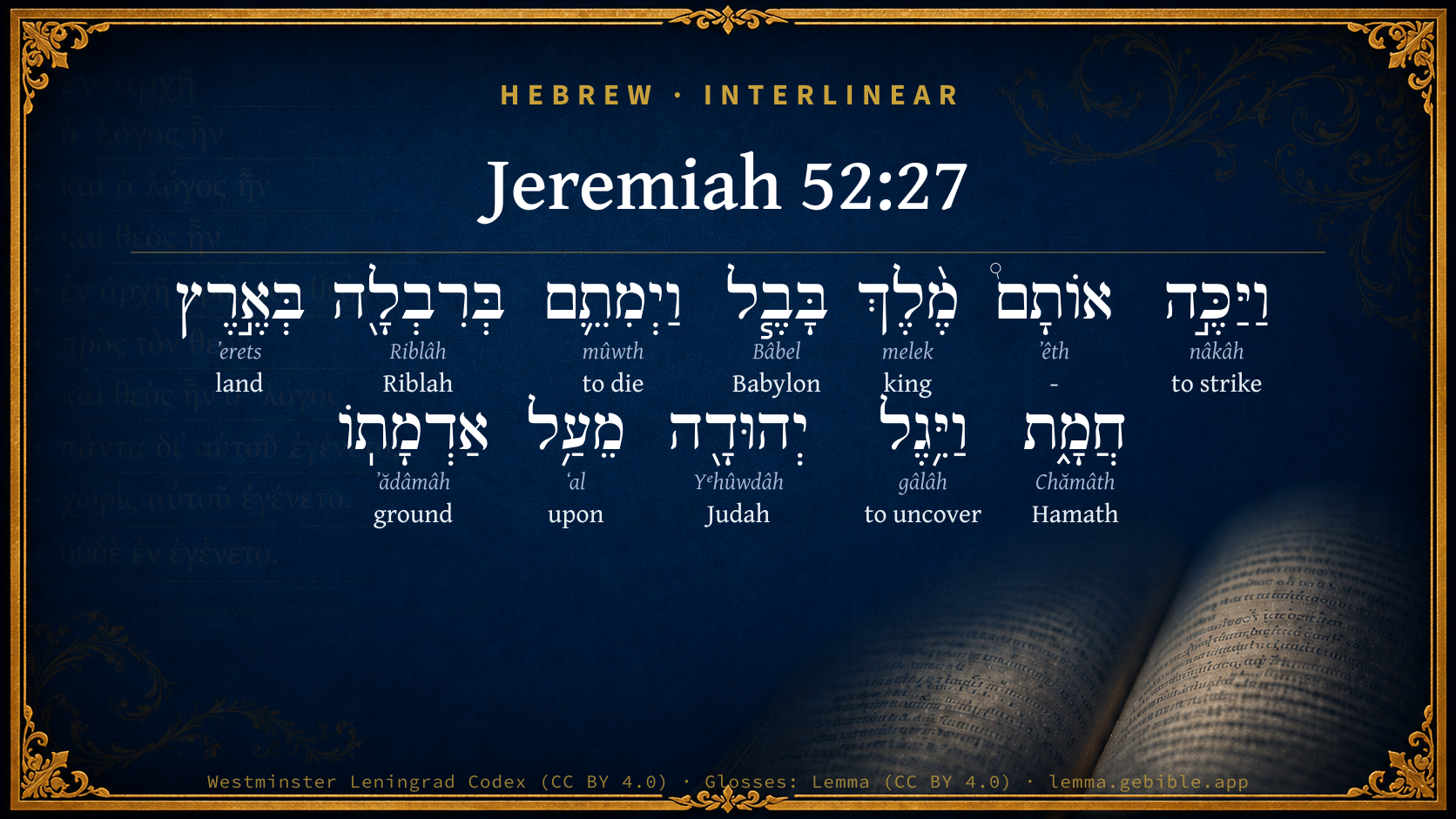
Hebrew (Westminster Leningrad Codex) Jeremiah 52:27 appears in the Hebrew Old Testament. The text above is from the Westminster Leningrad Codex. Each word links to its Strong’s number, a concise gloss, and parsing drawn from the Open Scriptures Hebrew Bible morphology. Click any word for its full Brown-Driver-Briggs (BDB) entry.
Download image
Cite this verse

Jeremiah 52:27 (World English Bible). Public Domain. Lemma interlinear Bible study tool, https://lemma.gebible.app/v/jeremiah/52/27.

Show BibTeX & RIS
BibTeX
RIS
English Translation
The king of Babylon struck them, and put them to death at Riblah in the land of Hamath. So Judah was carried away captive out of his land.
World English Bible · Public Domain
Download a study sheet

One document with this verse’s original text, its word-by-word gloss line, the meaning frame, cross-references with their text, attributed commentary, and full source and license credits — printable, and it pastes into notes with its structure intact.

This verse Autodidact and up

Study sheet (.html) Plain text (.txt)

A passage Seminary Student

Up to 50 verses in one chapter. A passage sheet keeps up to 6 commentary sources and 12 cross-references per verse, in the order this page ranks them, and says so on the sheet whenever that leaves anything out. Ask for a single verse and you get the Autodidact verse sheet above.

Everything on this page stays free to read, with no account — the sheet is a download of what is already on screen, not access to it.

Want to remove ads? Support Godless Engineer
Compare translations 3

The same verse in 3 English versions, stacked beneath the original-language interlinear above. Click any original word for its lexicon entry.

Each is an independent rendering of the whole verse — the interlinear is not word-aligned to these translations.

Highlighted words mark where these versions differ — a whole-verse word diff, not a word-by-word alignment.

  • World English Bible Public Domain
    The king of Babylon struck them, and put them to death at Riblah in the land of Hamath. So Judah was carried away captive out of his land.
  • King James Version Public Domain
    And the king of Babylon smote them, and put them to death in Riblah in the land of Hamath. Thus Judah was carried away captive out of his own land.
  • unfoldingWord Literal Text CC BY-SA 4.0
    The king of Babylon put them to death at Riblah in the land of Hamath. In this way, Judah went out of its land into exile.

unfoldingWord Literal Text — © unfoldingWord, licensed CC BY-SA 4.0. Word-aligned USFM3 via Door43 (git.door43.org/unfoldingWord/en_ult).

Versions to compare (up to 4)

3 of 4 selected

Show all 18 translations

Every available English version of this verse, each an independent rendering of the whole verse.

  • World English Bible Public Domain
    The king of Babylon struck them, and put them to death at Riblah in the land of Hamath. So Judah was carried away captive out of his land.
  • Berean Standard Bible Public Domain
    There at Riblah in the land of Hamath, the king of Babylon struck them down and put them to death. So Judah was taken into exile, away from its own land.
  • Majority Standard Bible Public Domain
    There at Riblah in the land of Hamath, the king of Babylon struck them down and put them to death. So Judah was taken into exile, away from its own land.
  • King James Version Public Domain
    And the king of Babylon smote them, and put them to death in Riblah in the land of Hamath. Thus Judah was carried away captive out of his own land.
  • American Standard Version (1901) Public Domain
    And the king of Babylon smote them, and put them to death at Riblah in the land of Hamath. So Judah was carried away captive out of his land.
  • Revised Version (1885) Public Domain
    And the king of Babylon smote them, and put them to death at Riblah in the land of Hamath. So Judah was carried away captive out of his land.
  • Geneva Bible (1599) Public Domain
    And the king of Babel smote them, and slewe them in Riblah, in the lande of Hamath: thus Iudah was caried away captiue out of his owne land.
  • Douay-Rheims (1899) Public Domain
    And the king of Babylon struck them, and put them to death in Reblatha, in the land of Emath: and Juda was carried away captive out of his land.
  • Young's Literal Translation Public Domain
    and the king of Babylon smiteth them, and putteth them to death in Riblah, in the land of Hamath, and he removeth Judah from off its own ground.
  • Literal Standard Version CC BY-SA 4.0
    and the king of Babylon strikes them, and puts them to death in Riblah, in the land of Hamath, and he removes Judah from off its own ground.
  • Unlocked Literal Bible CC BY-SA 4.0
    The king of Babylon put them to death at Riblah in the land of Hamath. In this way, Judah went out of its land into exile.
  • unfoldingWord Literal Text CC BY-SA 4.0
    The king of Babylon put them to death at Riblah in the land of Hamath. In this way, Judah went out of its land into exile.
  • Darby Bible Public Domain
    and the king of Babylon smote them, and put them to death at Riblah in the land of Hamath. Thus Judah was carried away captive out of his land.
  • World Messianic Bible Public Domain
    The king of Babylon struck them, and put them to death at Riblah in the land of Hamath. So Judah was carried away captive out of his land.
  • Webster's Bible Public Domain
    And the king of Babylon smote them, and put them to death in Riblah, in the land of Hamath. Thus Judah was carried away captive out of his own land.
  • Free Bible Version CC BY-SA 4.0
    The king of Babylon had them executed at Riblah in the land of Hamath. So the people of Judah had to leave their land.
  • Bible in Basic English Public Domain
    And the king of Babylon put them to death at Riblah in the land of Hamath. So Judah was taken prisoner away from his land.
  • JPS Tanakh (1917) Public Domain
    And the king of Babylon smote them, and put them to death at Riblah in the land of Hamath. So Judah was carried away captive out of his land.

Literal Standard Version (2020), Covenant Press — licensed CC BY-SA 4.0. Text via the HelloAO Bible API (eBible.org). Unlocked Literal Bible (unfoldingWord) — licensed CC BY-SA 4.0. Text via the HelloAO Bible API (eBible.org). unfoldingWord Literal Text — © unfoldingWord, licensed CC BY-SA 4.0. Word-aligned USFM3 via Door43 (git.door43.org/unfoldingWord/en_ult). Free Bible Version, Dr. Jonathan Gallagher — licensed CC BY-SA 4.0. Text via the HelloAO Bible API (eBible.org).

Word by word

More ways to search: Search by grammar → Find every occurrence → Compare this word →

Practice this passage: Drill this verse → Learn its vocabulary →

בְּרִבְלָ֖ה
Riblâh
H7247
“in/at · Riblah”
Preposition + Noun, Proper
Part of Speech
Preposition + Noun
Type
Proper
Full BDB Definition

Origin: from an unused root meaning to be fruitful

TWOT: None

Riblah = "fertility" - a place on the eastern boundary of Israel - a town in the land of Hamath on the great road between Babylon and Palestine
  1. וַיַּכֶּ֣ה nâkâh H5221 “and · to strike” Conjunction + Verb, Hiphil, Sequential Imperfect, 3rd Person, Masculine, Singular
  2. אוֹתָם֩ ʼêth H853 “- · them” Particle, Direct Object + Suffix, Personal, 3rd Person, Masculine, Plural
  3. מֶ֨לֶךְ melek H4428 “king of” Noun, Common, Masculine, Singular, Construct
  4. בָּבֶ֧ל Bâbel H894 “Babylon” Noun, Proper
  5. וַיְמִתֵ֛ם mûwth H4191 “and · to die · them” Conjunction + Verb, Hiphil, Sequential Imperfect, 3rd Person, Masculine, Singular + Suffix, Personal, 3rd Person, Masculine, Plural
  6. בְּאֶ֣רֶץ ʼerets H776 “in/at · land of” Preposition + Noun, Common, Both, Singular, Construct
  7. חֲמָ֑ת Chămâth H2574 “Hamath” Noun, Proper
  8. וַיִּ֥גֶל gâlâh H1540 “and · to uncover” Conjunction + Verb, Qal, Sequential Imperfect, 3rd Person, Masculine, Singular
  9. יְהוּדָ֖ה Yᵉhûwdâh H3063 “Judah” Noun, Proper
  10. מֵעַ֥ל ʻal H5921 “from · upon” Preposition + Preposition
  11. אַדְמָתֽוֹ ʼădâmâh H127 “ground · his” Noun, Common, Feminine, Singular, Construct + Suffix, Personal, 3rd Person, Masculine, Singular

About this verse

These counts appear in no published source. They are computed here, from the morphology-tagged text and Lemma’s own curated glosses. What Lemma adds →

12
words
12
distinct lemmas
Prophets
section

Notable vocabulary

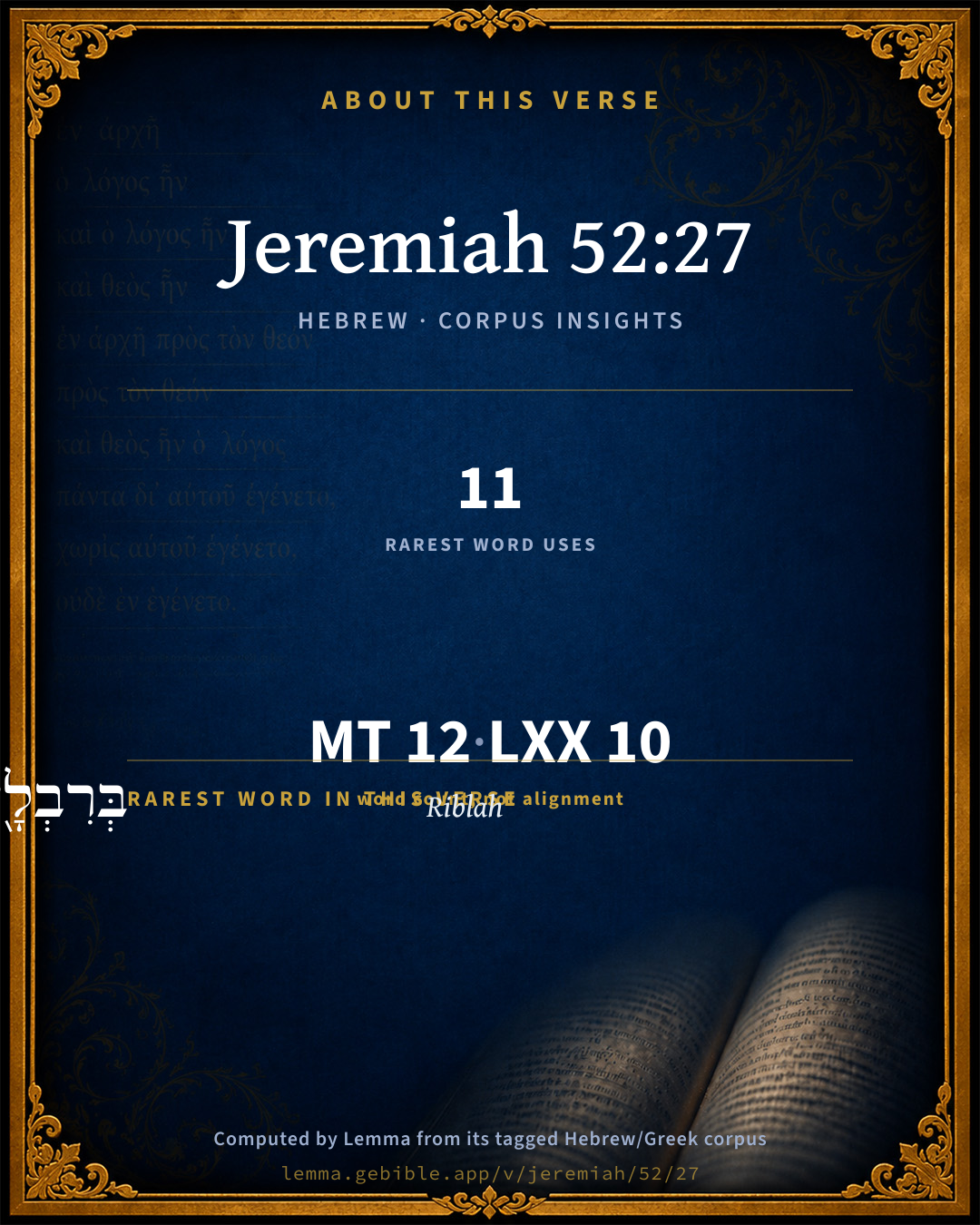
The rarest word here is בְּרִבְלָ֖ה Riblah H7247 — appearing just 11 times in the whole Hebrew Bible.

Shared distinctive vocabulary

בְּרִבְלָ֖ה Riblah H7247 occurs in 11 verses of the Hebrew Bible. Also found in:

Grammatical profile

  • 3 verbs
  • 7 nouns
  • 1 preposition
  • 1 particle

Verb forms

  • וַיַּכֶּ֣ה Hiphil · Sequential Imperfect
  • וַיְמִתֵ֛ם Hiphil · Sequential Imperfect
  • וַיִּ֥גֶל Qal · Sequential Imperfect

Hebrew & Septuagint length

In the original languages it is 12 Hebrew tokens and 10 Greek tokens — but the two are counted differently (Hebrew bundles its prefixes and suffixes into one token; the Greek is in lemma form), so that isn’t a like-for-like length.

Cross-references

24

Topical passages linked to Jeremiah 52:27 in the Treasury of Scripture Knowledge — connected by theme and wording, ordered by reader-vote popularity; previews shown in the World English Bible.

  • Isaiah 6:11–12 Then I said, "Lord, how long?" He answered, "Until cities are waste without inhabitant, And houses without man, And the land becomes utterly waste,
  • Isaiah 27:10 For the fortified city is solitary, a habitation deserted and forsaken, like the wilderness: there shall the calf feed, and there shall he lie down, and consume the branches of it.
  • Isaiah 32:13–14 On the land of my people shall come up thorns and briers; yes, on all the houses of joy in the joyous city.
  • Jeremiah 25:9–11 behold, I will send and take all the families of the north, says Yahweh, and [I will send] to Nebuchadrezzar the king of Babylon, my servant, and will bring them against this land, and against the inhabitants of it, and against all these nations round about; and I will utterly destroy them, and make them an astonishment, and a hissing, and perpetual desolations.
  • Ezekiel 8:11–18 There stood before them seventy men of the elders of the house of Israel; and in the midst of them stood Jaazaniah the son of Shaphan, every man with his censer in his hand; and the odor of the cloud of incense went up.
  • Ezekiel 33:28 I will make the land a desolation and an astonishment; and the pride of her power shall cease; and the mountains of Israel shall be desolate, so that none shall pass through.
  • Micah 4:10 Be in pain, and labor to bring forth, daughter of Zion, Like a woman in travail; For now you will go forth out of the city, And will dwell in the field, And will come even to Babylon. There you will be rescued. There Yahweh will redeem you from the hand of your enemies.
  • Leviticus 26:33–35 I will scatter you among the nations, and I will draw out the sword after you: and your land will be a desolation, and your cities shall be a waste.
  • Numbers 34:8–11 from Mount Hor you shall mark out to the entrance of Hamath; and the goings out of the border shall be at Zedad;
  • Deuteronomy 4:26 I call heaven and earth to witness against you this day, that you shall soon utterly perish from off the land whereunto you go over the Jordan to possess it; you shall not prolong your days on it, but shall utterly be destroyed.
  • Deuteronomy 28:36 Yahweh will bring you, and your king whom you shall set over you, to a nation that you have not known, you nor your fathers; and there shall you serve other gods, wood and stone.
  • Deuteronomy 28:64 Yahweh will scatter you among all peoples, from the one end of the earth even to the other end of the earth; and there you shall serve other gods, which you have not known, you nor your fathers, even wood and stone.
  • 2 Samuel 8:9 When Toi king of Hamath heard that David had struck all the host of Hadadezer,
  • 2 Kings 17:20 Yahweh rejected all the seed of Israel, and afflicted them, and delivered them into the hand of spoilers, until he had cast them out of his sight.
  • 2 Kings 17:23 until Yahweh removed Israel out of his sight, as he spoke by all his servants the prophets. So Israel was carried away out of their own land to Assyria to this day.
  • 2 Kings 23:27 Yahweh said, I will remove Judah also out of my sight, as I have removed Israel, and I will cast off this city which I have chosen, even Jerusalem, and the house of which I said, My name shall be there.
  • 2 Kings 25:20–21 Nebuzaradan the captain of the guard took them, and brought them to the king of Babylon to Riblah.
  • Isaiah 24:3 The earth shall be utterly emptied, and utterly laid waste; for Yahweh has spoken this word.
  • Jeremiah 6:13–15 For from the least of them even to the greatest of them everyone is given to covetousness; and from the prophet even to the priest everyone deals falsely.
  • Jeremiah 20:4 For thus says Yahweh, Behold, I will make you a terror to yourself, and to all your friends; and they shall fall by the sword of their enemies, and your eyes shall see it; and I will give all Judah into the hand of the king of Babylon, and he shall carry them captive to Babylon, and shall kill them with the sword.
  • Jeremiah 24:9–10 I will even give them up to be tossed back and forth among all the kingdoms of the earth for evil; to be a reproach and a proverb, a taunt and a curse, in all places where I shall drive them.
  • Jeremiah 39:10 But Nebuzaradan the captain of the guard left of the poor of the people, who had nothing, in the land of Judah, and gave them vineyards and fields at the same time.
  • Jeremiah 52:9 Then they took the king, and carried him up to the king of Babylon to Riblah in the land of Hamath; and he gave judgment on him.
  • Ezekiel 11:1–11 Moreover the Spirit lifted me up, and brought me to the east gate of Yahweh's house, which looks eastward: and see, at the door of the gate twenty-five men; and I saw in the midst of them Jaazaniah the son of Azzur, and Pelatiah the son of Benaiah, princes of the people.

Cross-references courtesy of OpenBible.info (CC BY 4.0).

Hebrew and Greek witnesses Masoretic Hebrew ↔ Greek Septuagint

The same verse in the two great witnesses to the Old Testament, shown verse-for-verse.

These are two independent witnesses, not word-aligned to each other, and the Septuagint is shown in lemma (dictionary) form.

Hebrew Jeremiah 52:27 Masoretic · Westminster Leningrad Codex

וַיַּכֶּ֣ה אוֹתָם֩ מֶ֨לֶךְ בָּבֶ֧ל וַיְמִתֵ֛ם בְּרִבְלָ֖ה בְּאֶ֣רֶץ חֲמָ֑ת וַיִּ֥גֶל יְהוּדָ֖ה מֵעַ֥ל אַדְמָתֽוֹ

The king of Babylon struck them, and put them to death at Riblah in the land of Hamath. So Judah was carried away captive out of his land.

World English Bible · Public Domain

Greek LXX Structure differs

In the Septuagint, Jeremiah is about an eighth shorter than the Hebrew and arranges its material differently — the Oracles Against the Nations (Hebrew chapters 46–51) appear in the middle of the Greek book, after 25:13. Because the chapter and verse boundaries do not line up, a verse-for-verse comparison with the Hebrew is not shown.

A verse-for-verse comparison isn’t shown here because the chapters and verses don’t line up. Switch to the LXX edition with the MT / LXX toggle above to read the Greek directly.

Hebrew: Westminster Leningrad Codex (CC BY 4.0). Greek: Septuagint (public domain); English from a public-domain English Septuagint. How the Septuagint differs from the Hebrew →

Targum (Aramaic paraphrase)

1

The Targum is the ancient Jewish Aramaic paraphrase of the Hebrew Scriptures — an interpretive translation, not the Hebrew text itself. Onkelos (literal) and Pseudo-Jonathan (expansive) render the Torah, and Jonathan the Prophets. Coverage is partial: where no permissively-licensed English translation exists for a verse, only the Aramaic is shown. This is verse-level text, not a word-by-word alignment to the Hebrew.

  1. Targum Jonathan Prophets (Joshua–Malachi)
    וּמְחָא יַתְהוֹן מַלְכָּא דְבָבֶל וְקַטְלִינוּן בְּרִבְלָה בְּאַרְעָא דַחֲמָת וְאִתְגְלִיאוּ דְבֵית יְהוּדָה מֵעַל אַרְעֲהוֹן:

    (no public-domain English translation for this verse)

    Targum Jonathan — Aramaic: “Mikraot Gedolot” (public domain). English: “Sefaria Community Translation” (CC0 1.0 (public-domain dedication)); “London "Chaldee Paraphrase," 1871” (public domain). Text via Sefaria.

Commentary

Notes on Jeremiah 52:27 from classic Christian and Jewish commentators (each source and its license shown beneath its notes). The classic Christian expositions comment on the surrounding passage and are grouped to its opening verse, so a note may address several verses; the Jewish commentaries on the Tanakh (Rashi and others) are per-verse, so they appear only where the commentator wrote on this verse.

Lemma curates 59 commentaries, every one of them public domain or Creative Commons licensed, each selected and text-cleaned for this edition rather than reprinted as found. About our sources →

John Gill's Exposition

This is the people whom Nebuchadnezzar carried away captive in the seventh year,.... That is, of his reign: in Kg2 24:12; it is said to be in the eighth year of his reign; it being at the latter end of the seventh, and the beginning of the eighth, as Kimchi observes; this was the captivity of Jeconiah: the number of the captives then were

three thousand Jews, and three and twenty; but in Kg2 24:14; they are said to be ten thousand; which may be reconciled thus, there were three thousand twenty and three of the tribe of Judah, here called Jews; and the rest were of the tribe of Benjamin, and of the ten tribes that were mixed among them; see Kg2 24:16.

John Gill's Exposition of the Whole Bible (1746–1763) — public domain (CC PDM 1.0). Text via the HelloAO Bible API.

Matthew Poole's English Annotations

See 2Ki 25:20,21.

Matthew Poole's English Annotations on the Holy Bible (1683–1685) — public domain. Text from a community e-Sword/MySword module.

Lesson kit

Teaching starters — assembled from the data on this page, not authored interpretation. Every prompt links to the verse data it draws on. Edit before teaching.

Jeremiah, in the Prophets, opens this verse with 12 words (12 distinct Hebrew lemmas). Its most distinctive word is Riblâh (“Riblah”). A historical commentator’s framing appears above. Read the whole chapter for the surrounding context.

Discussion questions

  1. The word Riblâh carries the sense “Riblah.” How does it shape the verse?
  2. How does Numbers 34:11, which shares the word «Riblah», read alongside this verse?
  3. These translations render this verse differently. What is at stake in choosing one wording over another?
  4. «וַיַּכֶּ֣ה» is a Hiphil Sequential Imperfect verb. How does that grammatical form shape the action described?
  5. Compare how John Gill's Exposition and Matthew Poole's English Annotations read this verse. Where do they agree or differ?

Things to notice

Reading settings

Reading text

Shown beneath each verse's original-language words.

Old Testament
Old Testament edition

Read the OT as the Masoretic Hebrew (MT) or the Greek Septuagint (LXX).

English shown for the Greek Septuagint (in the Hebrew ↔ Greek comparison).

Comparing translations? Open the Compare panel on any verse page to stack up to four side by side.