
Ezekiel 39:26

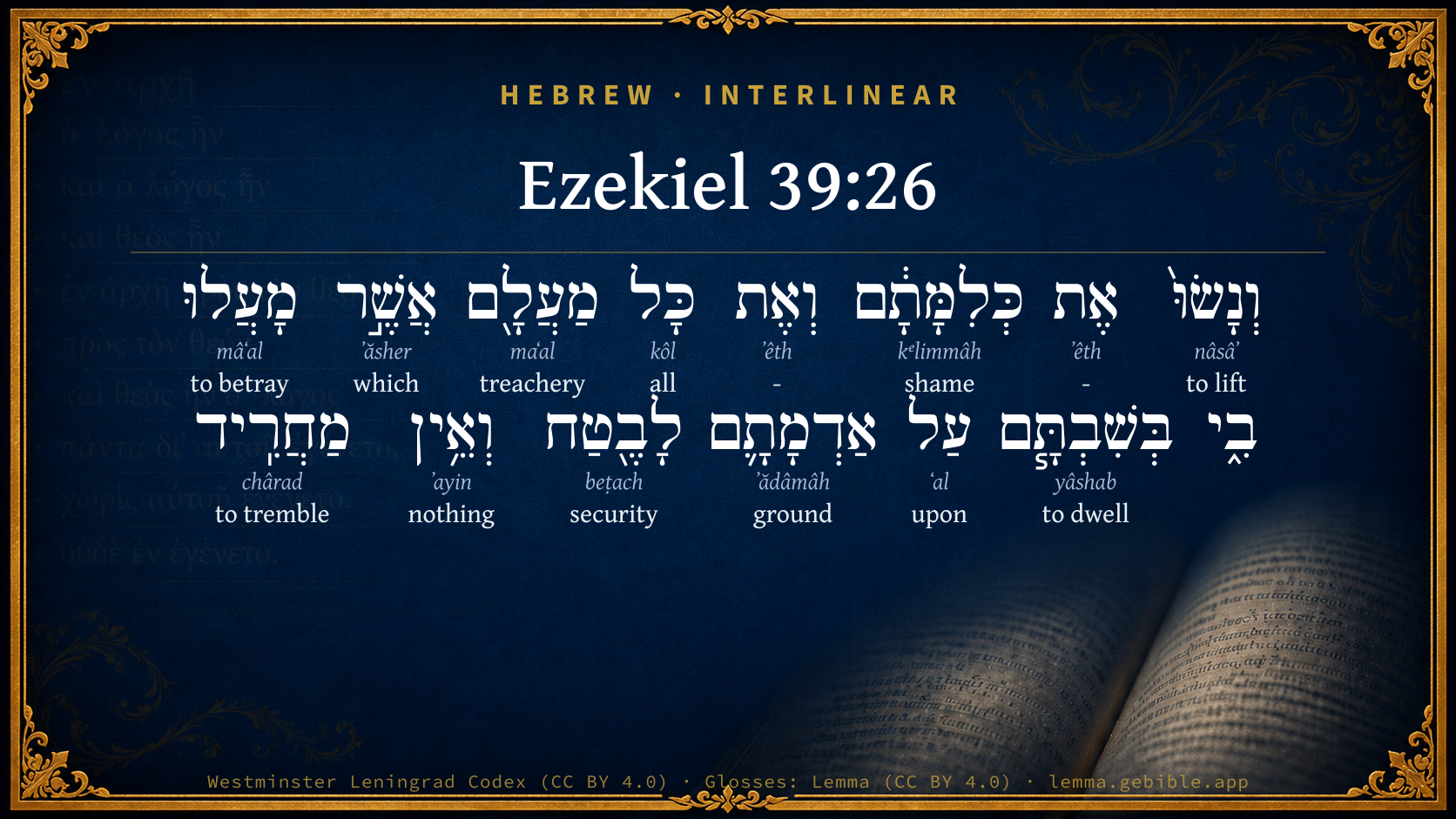
Hebrew (Westminster Leningrad Codex) Ezekiel 39:26 appears in the Hebrew Old Testament. The text above is from the Westminster Leningrad Codex. Each word links to its Strong’s number, a concise gloss, and parsing drawn from the Open Scriptures Hebrew Bible morphology. Click any word for its full Brown-Driver-Briggs (BDB) entry.
Download image
Cite this verse

Ezekiel 39:26 (World English Bible). Public Domain. Lemma interlinear Bible study tool, https://lemma.gebible.app/v/ezekiel/39/26.

Show BibTeX & RIS
BibTeX
RIS
English Translation
They shall bear their shame, and all their trespasses by which they have trespassed against me, when they shall dwell securely in their land, and none shall make them afraid;
World English Bible · Public Domain
Download a study sheet

One document with this verse’s original text, its word-by-word gloss line, the meaning frame, cross-references with their text, attributed commentary, and full source and license credits — printable, and it pastes into notes with its structure intact.

This verse Autodidact and up

Study sheet (.html) Plain text (.txt)

A passage Seminary Student

Up to 50 verses in one chapter. A passage sheet keeps up to 6 commentary sources and 12 cross-references per verse, in the order this page ranks them, and says so on the sheet whenever that leaves anything out. Ask for a single verse and you get the Autodidact verse sheet above.

Everything on this page stays free to read, with no account — the sheet is a download of what is already on screen, not access to it.

Want to remove ads? Support Godless Engineer
Compare translations 3

The same verse in 3 English versions, stacked beneath the original-language interlinear above. Click any original word for its lexicon entry.

Each is an independent rendering of the whole verse — the interlinear is not word-aligned to these translations.

Highlighted words mark where these versions differ — a whole-verse word diff, not a word-by-word alignment.

  • World English Bible Public Domain
    They shall bear their shame, and all their trespasses by which they have trespassed against me, when they shall dwell securely in their land, and none shall make them afraid;
  • King James Version Public Domain
    After that they have borne their shame, and all their trespasses whereby they have trespassed against me, when they dwelt safely in their land, and none made them afraid.
  • unfoldingWord Literal Text CC BY-SA 4.0
    Then they will bear their shame and all the treason in which they betrayed me. They will forget all this when they rest in their land in safety, with no one to terrify them.

unfoldingWord Literal Text — © unfoldingWord, licensed CC BY-SA 4.0. Word-aligned USFM3 via Door43 (git.door43.org/unfoldingWord/en_ult).

Versions to compare (up to 4)

3 of 4 selected

Show all 18 translations

Every available English version of this verse, each an independent rendering of the whole verse.

  • World English Bible Public Domain
    They shall bear their shame, and all their trespasses by which they have trespassed against me, when they shall dwell securely in their land, and none shall make them afraid;
  • Berean Standard Bible Public Domain
    They will forget their disgrace and all the treachery they committed against Me, when they dwell securely in their land, with no one to frighten them.
  • Majority Standard Bible Public Domain
    They will forget their disgrace and all the treachery they committed against Me, when they dwell securely in their land, with no one to frighten them.
  • King James Version Public Domain
    After that they have borne their shame, and all their trespasses whereby they have trespassed against me, when they dwelt safely in their land, and none made them afraid.
  • American Standard Version (1901) Public Domain
    And they shall bear their shame, and all their trespasses whereby they have trespassed against me, when they shall dwell securely in their land, and none shall make them afraid;
  • Revised Version (1885) Public Domain
    And they shall bear their shame, and all their trespasses whereby they have trespassed against me, when they shall dwell securely in their land, and none shall make them afraid;
  • Geneva Bible (1599) Public Domain
    After that they haue borne their shame, and all their transgression, whereby they haue transgressed against me, whe they dwelt safely in their land, and without feare of any.
  • Douay-Rheims (1899) Public Domain
    And they shall bear their confusion, and all the transgressions wherewith they have transgressed against me, when they shall dwell in their land securely fearing no man:
  • Young's Literal Translation Public Domain
    And they have forgotten their shame, And all their trespass that they trespassed against Me, In their dwelling on their land confidently and none troubling.
  • Literal Standard Version CC BY-SA 4.0
    And they have forgotten their shame, || And all their trespass that they trespassed against Me, || In their dwelling on their land confidently and none troubling.
  • Unlocked Literal Bible CC BY-SA 4.0
    Then they will bear their shame and all the treason in which they betrayed me. They will forget all this when they rest in their land in safety, with no one to terrify them.
  • unfoldingWord Literal Text CC BY-SA 4.0
    Then they will bear their shame and all the treason in which they betrayed me. They will forget all this when they rest in their land in safety, with no one to terrify them.
  • Darby Bible Public Domain
    and they shall bear their confusion, and all their unfaithfulness in which they have acted unfaithfully against me, when they shall dwell safely in their land, and none shall make them afraid;
  • World Messianic Bible Public Domain
    They will forget their shame and all their trespasses by which they have trespassed against me, when they dwell securely in their land. No one will make them afraid
  • Webster's Bible Public Domain
    After they have borne their shame, and all their trespasses by which they have trespassed against me, when they dwelt safely in their land, and none made them afraid.
  • Free Bible Version CC BY-SA 4.0
    They will forget their shameful actions and all the ways they were unfaithful to me once they live in safety in their country, with no one to threaten them.
  • Bible in Basic English Public Domain
    And they will be conscious of their shame and of all the wrong which they have done against me, when they are living in their land with no sense of danger and with no one to be a cause of fear to them;
  • JPS Tanakh (1917) Public Domain
    And they shall bear their shame, and all their breach of faith which they have committed against Me, when they shall dwell safely in their land, and none shall make them afraid;

Literal Standard Version (2020), Covenant Press — licensed CC BY-SA 4.0. Text via the HelloAO Bible API (eBible.org). Unlocked Literal Bible (unfoldingWord) — licensed CC BY-SA 4.0. Text via the HelloAO Bible API (eBible.org). unfoldingWord Literal Text — © unfoldingWord, licensed CC BY-SA 4.0. Word-aligned USFM3 via Door43 (git.door43.org/unfoldingWord/en_ult). Free Bible Version, Dr. Jonathan Gallagher — licensed CC BY-SA 4.0. Text via the HelloAO Bible API (eBible.org).

Word by word

More ways to search: Search by grammar → Find every occurrence → Compare this word →

Practice this passage: Drill this verse → Learn its vocabulary →

מַעֲלָ֖ם
maʻal
H4604
“treachery · their”
Noun, Common, Masculine, Singular, Construct + Suffix, Personal, 3rd Person, Masculine, Plural
Part of Speech
Noun
Type
Common
Gender
Masculine
Number
Singular
State
Construct
Full BDB Definition

Origin: from H4603

TWOT: 1230a

unfaithful or treacherous act, trespass - against man - against God
  1. וְנָשׂוּ֙ nâsâʼ H5375 “and · to lift” Conjunction + Verb, Qal, Sequential Perfect, 3rd Person, Common, Plural
  2. אֶת ʼêth H853 “-” Particle, Direct Object
  3. כְּלִמָּתָ֔ם kᵉlimmâh H3639 “shame · their” Noun, Common, Feminine, Singular, Construct + Suffix, Personal, 3rd Person, Masculine, Plural
  4. וְאֶת ʼêth H853 “and · -” Conjunction + Particle, Direct Object
  5. כָּל kôl H3605 “all of” Noun, Common, Masculine, Singular, Construct
  6. אֲשֶׁ֣ר ʼăsher H834 “which” Particle, Relative
  7. מָעֲלוּ mâʻal H4603 “to betray” Verb, Qal, Perfect, 3rd Person, Common, Plural
  8. בְּשִׁבְתָּ֧ם yâshab H3427 “in/at · to dwell · them” Preposition + Verb, Qal, Infinitive Construct + Suffix, Personal, 3rd Person, Masculine, Plural
  9. עַל ʻal H5921 “upon” Preposition
  10. אַדְמָתָ֛ם ʼădâmâh H127 “ground · their” Noun, Common, Feminine, Singular, Construct + Suffix, Personal, 3rd Person, Masculine, Plural
  11. לָבֶ֖טַח beṭach H983 “to/for · security” Preposition + Noun, Common, Masculine, Singular, Absolute
  12. וְאֵ֥ין ʼayin H369 “and · nothing” Conjunction + Particle, Negative
  13. מַחֲרִֽיד chârad H2729 “trembling” Verb, Hiphil, Participle Active, Masculine, Singular, Absolute

About this verse

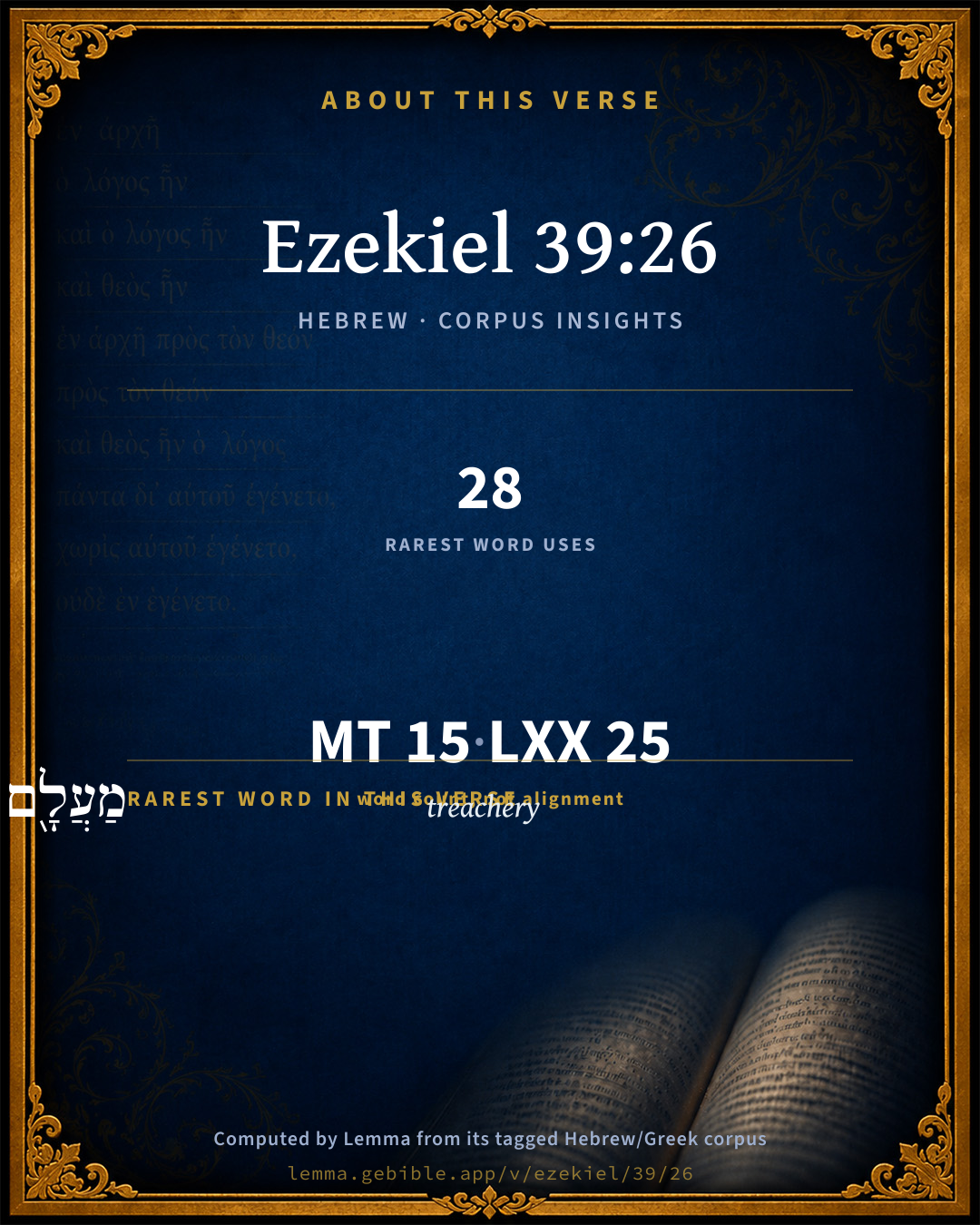
These counts appear in no published source. They are computed here, from the morphology-tagged text and Lemma’s own curated glosses. What Lemma adds →

15
words
13
distinct lemmas
Prophets
section

Shared distinctive vocabulary

מַעֲלָ֖ם treachery H4604 occurs in 28 verses of the Hebrew Bible. Also found in:

Grammatical profile

  • 4 verbs
  • 5 nouns
  • 2 prepositions
  • 4 particles

Verb forms

  • וְנָשׂוּ֙ Qal · Sequential Perfect
  • מָעֲלוּ Qal · Perfect
  • בְּשִׁבְתָּ֧ם Qal · Infinitive Construct
  • מַחֲרִֽיד Hiphil · Participle Active

Hebrew & Septuagint length

In English translation the verse runs 30 words from the Hebrew and 28 from the Septuagint (LXX English) — closely comparable.

A rough comparison of the two English renderings, which tokenize alike — not a word-level alignment.

Word counts can differ between the Hebrew and the Greek without any difference in meaning — e.g. the Hebrew direct-object marker אֵת has no separate Greek word, and Greek often adds the article ὁ.

In the original languages it is 15 Hebrew tokens and 25 Greek tokens — but the two are counted differently (Hebrew bundles its prefixes and suffixes into one token; the Greek is in lemma form), so that isn’t a like-for-like length.

Cross-references

17

Topical passages linked to Ezekiel 39:26 in the Treasury of Scripture Knowledge — connected by theme and wording, ordered by reader-vote popularity; previews shown in the World English Bible.

  • 1 Kings 4:25 Judah and Israel lived safely, every man under his vine and under his fig tree, from Dan even to Beersheba, all the days of Solomon.
  • Micah 4:4 But they will sit every man under his vine and under his fig tree; And no one will make them afraid: For the mouth of Yahweh of Hosts has spoken.
  • Ezekiel 16:63 that you may remember, and be confounded, and never open your mouth any more, because of your shame, when I have forgiven you all that you have done, says the Lord Yahweh.
  • Leviticus 26:5–6 Your threshing shall reach to the vintage, and the vintage shall reach to the sowing time; and you shall eat your bread to the full, and dwell in your land safely.
  • Deuteronomy 28:47–48 Because you didn't serve Yahweh your God with joyfulness, and with gladness of heart, by reason of the abundance of all things;
  • Deuteronomy 32:14–15 Butter of the herd, and milk of the flock, With fat of lambs, Rams of the breed of Bashan, and goats, With the finest of the wheat; Of the blood of the grape you drank wine.
  • Psalms 99:8 You answered them, Yahweh our God. You are a God who forgave them, Although you took vengeance for their doings.
  • Isaiah 17:2 The cities of Aroer are forsaken; they shall be for flocks, which shall lie down, and none shall make them afraid.
  • Jeremiah 3:24–25 But the shameful thing has devoured the labor of our fathers from our youth, their flocks and their herds, their sons and their daughters.
  • Jeremiah 30:11 For I am with you, says Yahweh, to save you: for I will make a full end of all the nations where I have scattered you, but I will not make a full end of you; but I will correct you in measure, and will in no way leave you unpunished.
  • Ezekiel 16:52 You also, bear you your own shame, in that you have given judgment for your sisters; through your sins that you have committed more abominable than they, they are more righteous that you: yes, be also confounded, and bear your shame, in that you have justified your sisters.
  • Ezekiel 16:57–58 before your wickedness was uncovered, as at the time of the reproach of the daughters of Syria, and of all who are round about her, the daughters of the Philistines, who do despite to you round about.
  • Ezekiel 32:25 They have set her a bed in the midst of the slain with all her multitude; her graves are round about her; all of them uncircumcised, slain by the sword; for their terror was caused in the land of the living, and they have borne their shame with those who go down to the pit: he is put in the midst of those who are slain.
  • Ezekiel 32:30 There are the princes of the north, all of them, and all the Sidonians, who are gone down with the slain; in the terror which they caused by their might they are put to shame; and they lie uncircumcised with those who are slain by the sword, and bear their shame with those who go down to the pit.
  • Ezekiel 34:25 I will make with them a covenant of peace, and will cause evil animals to cease out of the land; and they shall dwell securely in the wilderness, and sleep in the woods.
  • Ezekiel 34:27–28 The tree of the field shall yield its fruit, and the earth shall yield its increase, and they shall be secure in their land; and they shall know that I am Yahweh, when I have broken the bars of their yoke, and have delivered them out of the hand of those who made slaves of them.
  • Daniel 9:16 Lord, according to all your righteousness, let your anger and please let your wrath be turned away from your city Jerusalem, your holy mountain; because for our sins, and for the iniquities of our fathers, Jerusalem and your people are become a reproach to all who are round about us.

Cross-references courtesy of OpenBible.info (CC BY 4.0).

Hebrew and Greek witnesses Masoretic Hebrew ↔ Greek Septuagint

The same verse in the two great witnesses to the Old Testament, shown verse-for-verse.

These are two independent witnesses, not word-aligned to each other, and the Septuagint is shown in lemma (dictionary) form.

Hebrew Ezekiel 39:26 Masoretic · Westminster Leningrad Codex

וְנָשׂוּ֙ אֶת כְּלִמָּתָ֔ם וְאֶת כָּל מַעֲלָ֖ם אֲשֶׁ֣ר מָעֲלוּ בִ֑י בְּשִׁבְתָּ֧ם עַל אַדְמָתָ֛ם לָבֶ֖טַח וְאֵ֥ין מַחֲרִֽיד

They shall bear their shame, and all their trespasses by which they have trespassed against me, when they shall dwell securely in their land, and none shall make them afraid;

World English Bible · Public Domain

Greek LXX Ezekiel 39:26 Septuagint · lemma form

καί λαμβάνω ὁ ἀτιμία ἑαυτοῦ καί ὁ ἀδικία ὅς ἀδικέω ἐν ὁ καταοἰκίζω αὐτός ἐπί ὁ γῆ αὐτός ἐπί εἰρήνη καί οὐ εἰμί ὁ ἐκφοβέω

And they shall bear their reproach, and the iniquity which they committed when they lived upon their land in peace. Yet there shall be none to terrify them

LXX2012 (modern English Septuagint) · Public Domain

Hebrew: Westminster Leningrad Codex (CC BY 4.0). Greek: Septuagint (public domain); English from LXX2012 (modern English Septuagint) (Public Domain). How the Septuagint differs from the Hebrew →

Targum (Aramaic paraphrase)

1

The Targum is the ancient Jewish Aramaic paraphrase of the Hebrew Scriptures — an interpretive translation, not the Hebrew text itself. Onkelos (literal) and Pseudo-Jonathan (expansive) render the Torah, and Jonathan the Prophets. Coverage is partial: where no permissively-licensed English translation exists for a verse, only the Aramaic is shown. This is verse-level text, not a word-by-word alignment to the Hebrew.

  1. Targum Jonathan Prophets (Joshua–Malachi)
    וִיקַבְּלוּן יַת אִתְכְּנָעוּתְהוֹן וְיַת כָּל שִׁקְרֵיהוֹן דְשַׁקָרוּ בְּמֵימְרִי בְּמֵיתַבְהוֹן עַל אַרְעֲהוֹן לְרוֹחֲצָן וְלֵית דְמָנִיד:

    (no public-domain English translation for this verse)

    Targum Jonathan — Aramaic: “Mikraot Gedolot” (public domain). English: “Sefaria Community Translation” (CC0 1.0 (public-domain dedication)); “London "Chaldee Paraphrase," 1871” (public domain). Text via Sefaria.

Commentary

Notes on Ezekiel 39:26 from classic Christian and Jewish commentators (each source and its license shown beneath its notes). The classic Christian expositions comment on the surrounding passage and are grouped to its opening verse, so a note may address several verses; the Jewish commentaries on the Tanakh (Rashi and others) are per-verse, so they appear only where the commentator wrote on this verse.

Lemma curates 59 commentaries, every one of them public domain or Creative Commons licensed, each selected and text-cleaned for this edition rather than reprinted as found. About our sources →

Trapp's Complete Commentary

John Trapp

Eze 39:26 After that they have borne their shame, and all their trespasses whereby they have trespassed against me, when they dwelt safely in their land, and none made [them] afraid.

Ver. 26. After that they have borne their shame.] Are become soundly ashamed of their sinful practices: Hoc enim ingenium est verae fidei, saith Oecolampadius, for this is the nature of true faith, to blush and bleed for sins past.

When they dwelt safely in their land.] And so settled on their lease through carnal security.

John Trapp, A Commentary or Exposition upon All the Books of the Old and New Testament (1647–1656) — public domain. Text from a community e-Sword module.

Jamieson, Fausset & Brown

Robert Jamieson, A. R. Fausset & David Brown

After that they have borne their shame--the punishment of their sin: after they have become sensible of their guilt, and ashamed of it (Eze 20:43; Eze 36:31).

Jamieson, Fausset & Brown — Commentary Critical and Explanatory on the Whole Bible (1871) — public domain (CC PDM 1.0). Text via the HelloAO Bible API.

Adam Clarke's Commentary

Verse 26. After that they have borne their shame] After they shall have borne the punishment due to a line of conduct which is their shame and reproach, viz. idolatry.

Adam Clarke's Commentary on the Bible (1810–1826) — public domain. Text from a community e-Sword/MySword module.

The Cambridge Bible for Schools and Colleges

gen. ed. J. J. S. Perowne

26. after that … borne] Rather: And they shall bear their shame. The phrase “bear shame” is not used in the sense of bearing the outward disgrace (Eze_32:24-25; Eze_32:30, Eze_34:29, Eze_36:7), but in the sense of bearing the inward feeling of unworthiness, which the undeserved goodness of Jehovah creates (Eze_16:52; Eze_16:54). The word “bear” is written defectively and by a change of a “tittle” might mean “forget.” While “forget their shame” however might well be said, shame meaning reproach (Isa_54:4), “forget their trespasses,” implying complete obliteration of the unhappy past, is so powerful an idea that it causes surprise. Either idea is beautiful; whether the idea be that the redeemed people sit in abashed gladness, the memory of former evil adding depth to the gladness, or whether it be that the assurance that Jehovah is their God (Eze_39:22) is so exalted that the memory of former sad days is wholly wiped out by it.

when they dwelt … afraid] when they dwell with confidence … and none maketh them afraid. Reference is to the time of restoration.

The Cambridge Bible for Schools and Colleges (gen. ed. J. J. S. Perowne; Cambridge University Press, 1878–1918) — public domain. Text from a community e-Sword module.

John Gill's Exposition

After that they have borne their shame,.... And disgrace, among the nations where they are scattered; being captives, exiles, in distress and affliction, and under the manifest tokens of the divine wrath and vengeance: it may be rendered, "and they shall bear their shame" (m); that is, as Jarchi glosses it,

"when I shall do good to them, and not render to them according to their wickedness, then they shall bear their shame, and be confounded, and not able to lift up their face;''

as penitent persons, under a sense of divine wrath, blush, and are ashamed to look up to God; see Ezr 9:6. Menachem interprets the word in the sense of atonement and forgiveness, as it is used in Psa 32:11, as if the meaning was, then they shall have their sins, which caused shame, forgiven them. Kimchi's gloss is,

"they shall carry in their mouths, and make mention of their shame they had in captivity.''

And all their transgressions whereby they have transgressed against me; that is, the punishment of all their trespasses in their captivity, or the shame of them, being now brought to repentance; and which will be aggravated to them, when they remember that these were committed by their forefathers, and since approved of by them.

When they dwelt safely in their land, and none made them afraid; as they did in the times of Christ; they were in entire peace, and no enemy disturbed them; and were in the possession of their own land, and enjoyed the blessings of it, and had their religious as well as civil liberties; and yet rejected the Messiah, his doctrine, ordinances, and salvation by him.

(m) "et portabunt", Pagninus, Montanus, V. L. Grotius; "et ferent ignominiam suam", Starckius.

John Gill's Exposition of the Whole Bible (1746–1763) — public domain (CC PDM 1.0). Text via the HelloAO Bible API.

Matthew Poole's English Annotations

After they have long suffered, and now shall suffer no longer; for it is enough my people know, and the heathen know, that I am the Lord.

Borne their shame; reproach for their sins cast on them by the heathen, with great reflections on their God: this was part of the punishment of them all, and the greatest grief to the best among them, that their God was reproached.

Their trespasses; the punishment of those trespasses whereby they sinned against God, which this prophet plainly and frequently chargeth them with.

When they dwelt safely; and this done amidst that prosperity and safety which should have obliged them to love and obedience; but when they were safe at home, they sinned as if danger would never overtake them.

None made them afraid; no enemy to endanger and alarm them. Strange ingratitude, to east off the fear of God, and his law, when he had set them free from the fear of enemies!

Matthew Poole's English Annotations on the Holy Bible (1683–1685) — public domain. Text from a community e-Sword/MySword module.

Whedon's Commentary on the Bible

Daniel D. Whedon

26. After that they have borne their shame — Rather, with R.V., “And they shall bear their shame,” in the rare sense of being ashamed because of their unworthiness of God’s great mercies (Eze_16:54; Eze_16:61), or, with a very slight change of text, “they shall forget their shame” (Hitzig; compare Isa_54:4), which gives a sense peculiarly appropriate here.

Daniel D. Whedon (gen. ed.), Commentary on the Old and New Testaments (1874–1909) — public domain. Text from a community e-Sword module.

The Pulpit Commentary

After they have borne their shame. (comp. Eze_16:52, 54 32:24, 30 34:29 36:6) The captivity of Israel would not be brought back until her people had been thoroughly chastised for their iniquities, and that chastisement had wrought in them a spirit of penitence and a disposition towards obedience. Then should Jehovah interpose for their deliver-ante by gathering them out of their enemies" lands and leading them back to their own land; and these two experiences, the Captivity and the Restoration, the driving out and the bringing in, should complete their conversion to Jehovah, and secure their perpetual enjoyment of Jehovah"s favor.

The Pulpit Commentary (1880–1919), ed. H.D.M. Spence-Jones & Joseph S. Exell — public domain. Text from a community e-Sword module.

John Wesley's Explanatory Notes

Their shame - Reproach for their sins.

John Wesley, Explanatory Notes Upon the Whole Bible (1754–1765) — public domain. Text via the GEBible commentary corpus.

Rashi

Rabbi Shlomo Yitzchaki (Rashi)

And they shall bear their disgrace When I do good to them and I do not recompense them according to their evil, they will bear the disgrace and be ashamed to lift up their faces. Menahem, however, explained וְנָשּׂוּי like (Ps. 32:1): “Praiseworthy is he whose transgression is forgiven (נְשּׂוּי),” an expression of atonement.

Rashi on the Tanakh — English translations: “The Judaica Press complete Tanach with Rashi, translated by A. J. Rosenberg” (CC BY 4.0); “Pentateuch with Rashi's commentary by M. Rosenbaum and A.M. Silbermann, 1929-1934” (public domain); “The Metsudah Tanach series, Lakewood, N.J” (CC BY 4.0); and “The Book of Joshua, Metsudah Publications, 1997” (CC BY 4.0). Text via Sefaria.

Lesson kit

Teaching starters — assembled from the data on this page, not authored interpretation. Every prompt links to the verse data it draws on. Edit before teaching.

Ezekiel, in the Prophets, opens this verse with 15 words (13 distinct Hebrew lemmas). Its most distinctive word is maʻal (“treachery”). A historical commentator’s framing appears above. Read the whole chapter for the surrounding context.

Discussion questions

  1. What does “treachery” (maʻal) contribute to the verse as a whole?
  2. How does Leviticus 5:15, which shares the word «treachery», read alongside this verse?
  3. These translations render this verse differently; the difference is in the English rendering, not the original. What questions does that raise?
  4. «וְנָשׂוּ֙» is a Qal Sequential Perfect verb. How does that grammatical form shape the action described?
  5. Compare how Trapp's Complete Commentary and Jamieson, Fausset & Brown read this verse. Where do they agree or differ?

Things to notice

Reading settings

Reading text

Shown beneath each verse's original-language words.

Old Testament
Old Testament edition

Read the OT as the Masoretic Hebrew (MT) or the Greek Septuagint (LXX).

English shown for the Greek Septuagint (in the Hebrew ↔ Greek comparison).

Comparing translations? Open the Compare panel on any verse page to stack up to four side by side.