
Isaiah 14:2

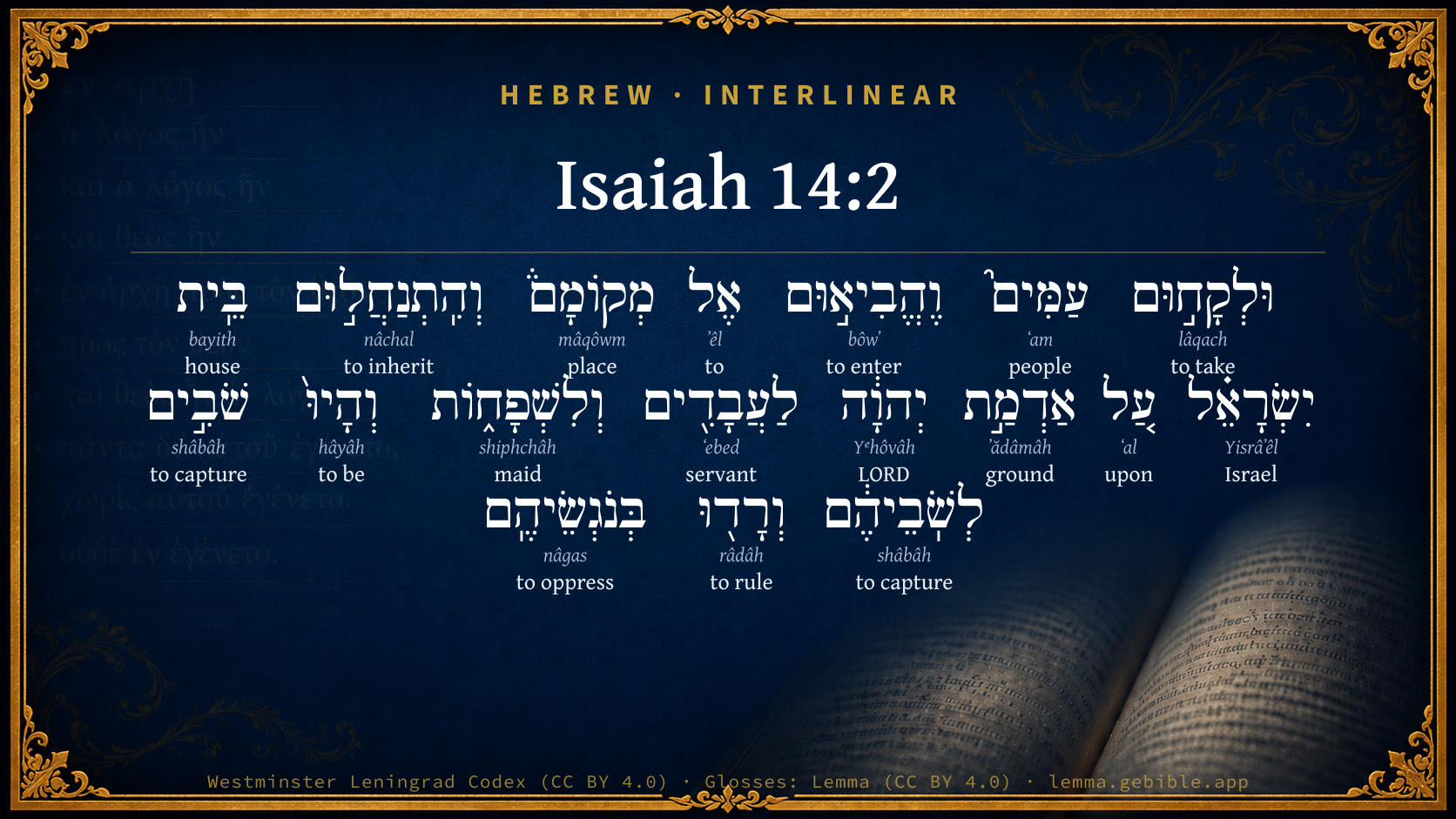
Hebrew (Westminster Leningrad Codex) Isaiah 14:2 appears in the Hebrew Old Testament. The text above is from the Westminster Leningrad Codex. Each word links to its Strong’s number, a concise gloss, and parsing drawn from the Open Scriptures Hebrew Bible morphology. Click any word for its full Brown-Driver-Briggs (BDB) entry.
Download image
Cite this verse

Isaiah 14:2 (World English Bible). Public Domain. Lemma interlinear Bible study tool, https://lemma.gebible.app/v/isaiah/14/2.

Show BibTeX & RIS
BibTeX
RIS
English Translation
The peoples shall take them, and bring them to their place; and the house of Israel shall possess them in the land of Yahweh for servants and for handmaids: and they shall take them captive whose captives they were; and they shall rule over their oppressors.
World English Bible · Public Domain
Download a study sheet

One document with this verse’s original text, its word-by-word gloss line, the meaning frame, cross-references with their text, attributed commentary, and full source and license credits — printable, and it pastes into notes with its structure intact.

This verse Autodidact and up

Study sheet (.html) Plain text (.txt)

A passage Seminary Student

Up to 50 verses in one chapter. A passage sheet keeps up to 6 commentary sources and 12 cross-references per verse, in the order this page ranks them, and says so on the sheet whenever that leaves anything out. Ask for a single verse and you get the Autodidact verse sheet above.

Everything on this page stays free to read, with no account — the sheet is a download of what is already on screen, not access to it.

Want to remove ads? Support Godless Engineer
Compare translations 3

The same verse in 3 English versions, stacked beneath the original-language interlinear above. Click any original word for its lexicon entry.

Each is an independent rendering of the whole verse — the interlinear is not word-aligned to these translations.

Highlighted words mark where these versions differ — a whole-verse word diff, not a word-by-word alignment.

  • World English Bible Public Domain
    The peoples shall take them, and bring them to their place; and the house of Israel shall possess them in the land of Yahweh for servants and for handmaids: and they shall take them captive whose captives they were; and they shall rule over their oppressors.
  • King James Version Public Domain
    And the people shall take them, and bring them to their place: and the house of Israel shall possess them in the land of the LORD for servants and handmaids: and they shall take them captives, whose captives they were; and they shall rule over their oppressors.
  • unfoldingWord Literal Text CC BY-SA 4.0
    And peoples will take them and bring them to their place, and the house of Israel will possess them on the land of Yahweh as male servants and as female servants. And they will be captors of their captors, and they will rule over their oppressors.

unfoldingWord Literal Text — © unfoldingWord, licensed CC BY-SA 4.0. Word-aligned USFM3 via Door43 (git.door43.org/unfoldingWord/en_ult).

Versions to compare (up to 4)

3 of 4 selected

Show all 18 translations

Every available English version of this verse, each an independent rendering of the whole verse.

  • World English Bible Public Domain
    The peoples shall take them, and bring them to their place; and the house of Israel shall possess them in the land of Yahweh for servants and for handmaids: and they shall take them captive whose captives they were; and they shall rule over their oppressors.
  • Berean Standard Bible Public Domain
    The nations will escort Israel and bring it to its homeland. Then the house of Israel will possess the nations as menservants and maidservants in the LORD’s land. They will make captives of their captors and rule over their oppressors.
  • Majority Standard Bible Public Domain
    The nations will escort Israel and bring it to its homeland. Then the house of Israel will possess the nations as menservants and maidservants in the LORD’s land. They will make captives of their captors and rule over their oppressors.
  • King James Version Public Domain
    And the people shall take them, and bring them to their place: and the house of Israel shall possess them in the land of the LORD for servants and handmaids: and they shall take them captives, whose captives they were; and they shall rule over their oppressors.
  • American Standard Version (1901) Public Domain
    And the peoples shall take them, and bring them to their place; and the house of Israel shall possess them in the land of Jehovah for servants and for handmaids: and they shall take them captive whose captives they were; and they shall rule over their oppressors.
  • Revised Version (1885) Public Domain
    And the peoples shall take them, and bring them to their place: and the house of Israel shall possess them in the land of the LORD for servants and for handmaids: and they shall take them captive, whose captives they were; and they shall rule over their oppressors.
  • Geneva Bible (1599) Public Domain
    And the people shall receiue them and bring them to their owne place, and the house of Israel shall possesse them in the land of the Lord, for seruants and handmaids: and they shall take them prisoners, whose captiues they were, and haue rule ouer their oppressours.
  • Douay-Rheims (1899) Public Domain
    And the people shall take them, and bring them into their place: and the house of Israel shall possess them in the land of the Lord for servants and handmaids: and they shall make them captives that had taken them, and shall subdue their oppressors.
  • Young's Literal Translation Public Domain
    And peoples have taken them, And have brought them in unto their place, And the house of Israel have inherited them, On the land of Jehovah, For men-servants and for maid-servants, And they have been captors of their captors, And have ruled over their exactors.
  • Literal Standard Version CC BY-SA 4.0
    And peoples have taken them, || And have brought them to their place, || And the house of Israel has inherited them, || On the land of YHWH, || For menservants and for maidservants, || And they have been captors of their captors, || And have ruled over their exactors.
  • Unlocked Literal Bible CC BY-SA 4.0
    The nations will bring them to their own place. Then the house of Israel will take them in the land of Yahweh as male and female servants. They will take captive those who had captured them, and they will rule over their oppressors.
  • unfoldingWord Literal Text CC BY-SA 4.0
    And peoples will take them and bring them to their place, and the house of Israel will possess them on the land of Yahweh as male servants and as female servants. And they will be captors of their captors, and they will rule over their oppressors.
  • Darby Bible Public Domain
    And the peoples shall take them and bring them to their place; and the house of Israel shall possess them in the land of Jehovah for servants and handmaids; and they shall take them captive whose captives they were, and they shall rule over their oppressors.
  • World Messianic Bible Public Domain
    The peoples will take them, and bring them to their place. The house of Israel will possess them in the LORD’s land for servants and for handmaids. They will take as captives those whose captives they were; and they shall rule over their oppressors.
  • Webster's Bible Public Domain
    And the people shall take them, and bring them to their place: and the house of Israel shall possess them in the land of the LORD for servants and handmaids: and they shall take them captives, whose captives they were; and they shall rule over their oppressors.
  • Free Bible Version CC BY-SA 4.0
    Nations will go with them and escort them to their own land. The foreigners who stay in the Lord's land will serve the Israelites. In this way the captors become their captives, and they rule over their former oppressors.
  • Bible in Basic English Public Domain
    And the people will take them with them to their place: and the children of Israel will give them a heritage in the Lord's land as men-servants and women-servants, making them prisoners whose prisoners they were; and they will be rulers over their masters.
  • JPS Tanakh (1917) Public Domain
    And the peoples shall take them, and bring them to their place; and the house of Israel shall possess them in the land of the LORD for servants and for handmaids; and they shall take them captive, whose captives they were; and they shall rule over their oppressors.

Literal Standard Version (2020), Covenant Press — licensed CC BY-SA 4.0. Text via the HelloAO Bible API (eBible.org). Unlocked Literal Bible (unfoldingWord) — licensed CC BY-SA 4.0. Text via the HelloAO Bible API (eBible.org). unfoldingWord Literal Text — © unfoldingWord, licensed CC BY-SA 4.0. Word-aligned USFM3 via Door43 (git.door43.org/unfoldingWord/en_ult). Free Bible Version, Dr. Jonathan Gallagher — licensed CC BY-SA 4.0. Text via the HelloAO Bible API (eBible.org).

Word by word

More ways to search: Search by grammar → Find every occurrence → Compare this word →

Practice this passage: Drill this verse → Learn its vocabulary →

בְּנֹגְשֵׂיהֶֽם
nâgas
H5065
“in/at · oppressing · them”
Preposition + Verb, Qal, Participle Active, Masculine, Plural, Construct + Suffix, Personal, 3rd Person, Masculine, Plural
Part of Speech
Preposition + Verb
Stem
Qal
Form
Participle Active
Gender
Masculine
Number
Plural
State
Construct
Full BDB Definition

Origin: a primitive root

TWOT: 1296

to press, drive, oppress, exact, exert demanding pressure - (Qal) - to press, drive - to exact - driver, taskmaster, ruler, oppressor, tyrant, lord, exactor of tribute (participle) - (Niphal) to be hard pressed
  1. וּלְקָח֣וּם lâqach H3947 “and · to take · them” Conjunction + Verb, Qal, Sequential Perfect, 3rd Person, Common, Plural + Suffix, Personal, 3rd Person, Masculine, Plural
  2. עַמִּים֮ ʻam H5971 “peoples” Noun, Common, Masculine, Plural, Absolute
  3. וֶהֱבִיא֣וּם bôwʼ H935 “and · to enter · them” Conjunction + Verb, Hiphil, Sequential Perfect, 3rd Person, Common, Plural + Suffix, Personal, 3rd Person, Masculine, Plural
  4. אֶל ʼêl H413 “to” Preposition
  5. מְקוֹמָם֒ mâqôwm H4725 “place · their” Noun, Common, Masculine, Singular, Construct + Suffix, Personal, 3rd Person, Masculine, Plural
  6. וְהִֽתְנַחֲל֣וּם nâchal H5157 “and · to inherit · them” Conjunction + Verb, Hithpael, Sequential Perfect, 3rd Person, Common, Plural + Suffix, Personal, 3rd Person, Masculine, Plural
  7. בֵּֽית bayith H1004 “house of” Noun, Common, Masculine, Singular, Construct
  8. יִשְׂרָאֵ֗ל Yisrâʼêl H3478 “Israel” Noun, Proper
  9. עַ֚ל ʻal H5921 “upon” Preposition
  10. אַדְמַ֣ת ʼădâmâh H127 “ground of” Noun, Common, Feminine, Singular, Construct
  11. יְהוָ֔ה Yᵉhôvâh H3068 “LORD” Noun, Proper
  12. לַעֲבָדִ֖ים ʻebed H5650 “to/for · servants” Preposition + Noun, Common, Masculine, Plural, Absolute
  13. וְלִשְׁפָח֑וֹת shiphchâh H8198 “and · to/for · maids” Conjunction + Preposition + Noun, Common, Feminine, Plural, Absolute
  14. וְהָיוּ֙ hâyâh H1961 “and · to be” Conjunction + Verb, Qal, Sequential Perfect, 3rd Person, Common, Plural
  15. שֹׁבִ֣ים shâbâh H7617 “capturing” Verb, Qal, Participle Active, Masculine, Plural, Absolute
  16. לְשֹֽׁבֵיהֶ֔ם shâbâh H7617 “to/for · capturing · them” Preposition + Verb, Qal, Participle Active, Masculine, Plural, Construct + Suffix, Personal, 3rd Person, Masculine, Plural
  17. וְרָד֖וּ râdâh H7287 “and · to rule” Conjunction + Verb, Qal, Sequential Perfect, 3rd Person, Common, Plural

About this verse

These counts appear in no published source. They are computed here, from the morphology-tagged text and Lemma’s own curated glosses. What Lemma adds →

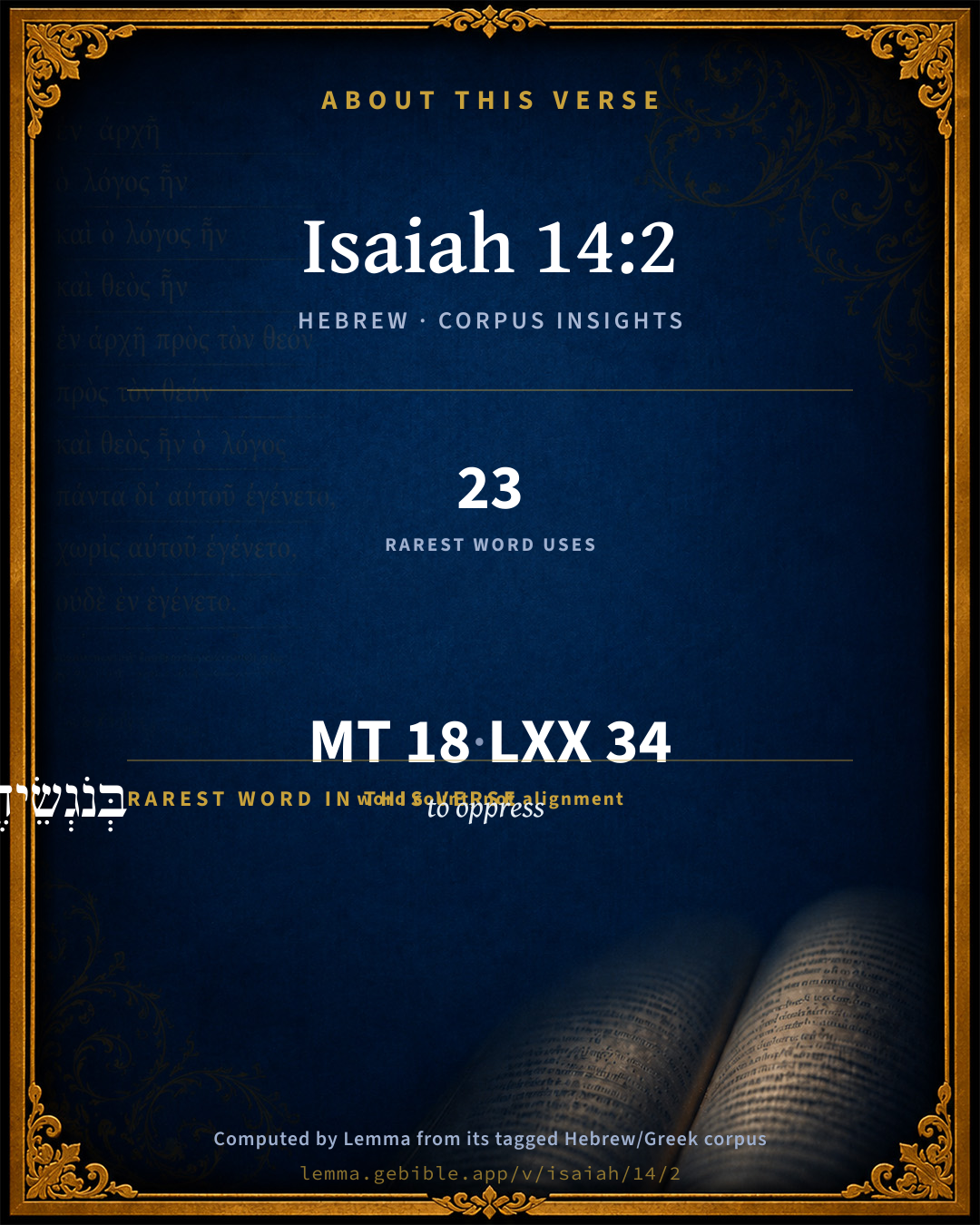
18
words
17
distinct lemmas
Prophets
section

Notable vocabulary

The rarest word here is בְּנֹגְשֵׂיהֶֽם to oppress H5065 — appearing just 23 times in the whole Hebrew Bible.

Shared distinctive vocabulary

בְּנֹגְשֵׂיהֶֽם to oppress H5065 occurs in 23 verses of the Hebrew Bible. Also found in:

Grammatical profile

  • 8 verbs
  • 8 nouns
  • 2 prepositions

Verb forms

  • וּלְקָח֣וּם Qal · Sequential Perfect
  • וֶהֱבִיא֣וּם Hiphil · Sequential Perfect
  • וְהִֽתְנַחֲל֣וּם Hithpael · Sequential Perfect
  • וְהָיוּ֙ Qal · Sequential Perfect
  • שֹׁבִ֣ים Qal · Participle Active
  • לְשֹֽׁבֵיהֶ֔ם Qal · Participle Active
  • וְרָד֖וּ Qal · Sequential Perfect
  • בְּנֹגְשֵׂיהֶֽם Qal · Participle Active

Repetition

A word recurs within this verse — often emphatic in Hebrew:

  • שֹׁבִ֣ים to capture H7617 ×2

Hebrew & Septuagint length

In English translation the verse runs 46 words from the Hebrew and 52 from the Septuagint (LXX English) — closely comparable.

A rough comparison of the two English renderings, which tokenize alike — not a word-level alignment.

Word counts can differ between the Hebrew and the Greek without any difference in meaning — e.g. the Hebrew direct-object marker אֵת has no separate Greek word, and Greek often adds the article ὁ.

In the original languages it is 18 Hebrew tokens and 34 Greek tokens — but the two are counted differently (Hebrew bundles its prefixes and suffixes into one token; the Greek is in lemma form), so that isn’t a like-for-like length.

Cross-references

19

Topical passages linked to Isaiah 14:2 in the Treasury of Scripture Knowledge — connected by theme and wording, ordered by reader-vote popularity; previews shown in the World English Bible.

  • Isaiah 61:5 Strangers shall stand and feed your flocks, and foreigners shall be your plowmen and your vine-dressers.
  • Isaiah 60:14 The sons of those who afflicted you shall come bending to you; and all those who despised you shall bow themselves down at the soles of your feet; and they shall call you The city of Yahweh, The Zion of the Holy One of Israel.
  • Jeremiah 30:16 Therefore all those who devour you shall be devoured; and all your adversaries, everyone of them, shall go into captivity; and those who despoil you shall be a spoil, and all who prey on you will I give for a prey.
  • Isaiah 60:9–12 Surely the isles shall wait for me, and the ships of Tarshish first, to bring your sons from far, their silver and their gold with them, for the name of Yahweh your God, and for the Holy One of Israel, because he has glorified you.
  • Daniel 7:25–27 He shall speak words against the Most High, and shall wear out the saints of the Most High; and he shall think to change the times and the law; and they shall be given into his hand until a time and times and half a time.
  • Isaiah 49:23 Kings shall be your nursing fathers, and their queens your nursing mothers: they shall bow down to you with their faces to the earth, and lick the dust of your feet; and you shall know that I am Yahweh; and those who wait for me shall not be disappointed.
  • Daniel 7:18 But the saints of the Most High shall receive the kingdom, and possess the kingdom forever, even forever and ever.
  • Revelation 18:20–24 Rejoice over her, O heaven, you saints, apostles, and prophets; for God has judged your judgment on her."
  • Psalms 68:18 You have ascended on high. You have led away captives. You have received gifts among men, Yes, among the rebellious also, that Yah God might dwell there.
  • Isaiah 18:7 In that time shall a present be brought to Yahweh of Hosts [from] a people tall and smooth, even from a people awesome from their beginning onward, a nation that measures out and treads down, whose land the rivers divide, to the place of the name of Yahweh of Hosts, Mount Zion.
  • Zechariah 14:2–3 For I will gather all nations against Jerusalem to battle; and the city will be taken, the houses rifled, and the women ravished. half of the city will go out into captivity, and the rest of the people will not be cut off from the city.
  • Romans 15:27 Yes, it has been their good pleasure, and they are their debtors. For if the Gentiles have been made partakers of their spiritual things, they owe it to them also to serve them in fleshly things.
  • Revelation 3:9 Behold, I give of the synagogue of Satan, of those who say they are Jews, and they are not, but lie. Behold, I will make them to come and worship before your feet, and to know that I have loved you.
  • Revelation 11:11–18 After the three and a half days, the breath of life from God entered into them, and they stood on their feet. Great fear fell on those who saw them.
  • Ezra 2:65 besides their men-servants and their maid-servants, of whom there were seven thousand three hundred thirty-seven: and they had two hundred singing men and singing women.
  • 2 Corinthians 8:4–5 begging us with much entreaty to receive this grace and the fellowship in the service to the saints.
  • 2 Corinthians 10:5 throwing down imaginations and every high thing that is exalted against the knowledge of God, and bringing every thought into captivity to the obedience of Christ;
  • Galatians 5:13 For you, brothers, were called for freedom. Only don't use your freedom for gain to the flesh, but through love be servants to one another.
  • Ephesians 4:8 Therefore he says, "When he ascended on high, he led captivity captive, and gave gifts to men."

Cross-references courtesy of OpenBible.info (CC BY 4.0).

Hebrew and Greek witnesses Masoretic Hebrew ↔ Greek Septuagint

The same verse in the two great witnesses to the Old Testament, shown verse-for-verse.

These are two independent witnesses, not word-aligned to each other, and the Septuagint is shown in lemma (dictionary) form.

Hebrew Isaiah 14:2 Masoretic · Westminster Leningrad Codex

וּלְקָח֣וּם עַמִּים֮ וֶהֱבִיא֣וּם אֶל מְקוֹמָם֒ וְהִֽתְנַחֲל֣וּם בֵּֽית יִשְׂרָאֵ֗ל עַ֚ל אַדְמַ֣ת יְהוָ֔ה לַעֲבָדִ֖ים וְלִשְׁפָח֑וֹת וְהָיוּ֙ שֹׁבִ֣ים לְשֹֽׁבֵיהֶ֔ם וְרָד֖וּ בְּנֹגְשֵׂיהֶֽם

The peoples shall take them, and bring them to their place; and the house of Israel shall possess them in the land of Yahweh for servants and for handmaids: and they shall take them captive whose captives they were; and they shall rule over their oppressors.

World English Bible · Public Domain

Greek LXX Isaiah 14:2 Septuagint · lemma form

καί λαμβάνω αὐτός ἔθνος καί εἰςἄγω εἰς ὁ τόπος αὐτός καί κατακληρονομέω καί πληθύνω ἐπί ὁ γῆ ὁ θεός εἰς δοῦλος καί δούλη καί εἰμί αἰχμάλωτος ὁ αἰχμαλωτεύω αὐτός καί κυριεύω ὁ κυριεύω αὐτός

And the Gentiles shall take them, and bring them into their place: and they shall inherit them, and they shall be multiplied upon the land for servants and handmaidens: and they that took them captives shall become captives to them; and they that had lordship over them shall be under their rule.

LXX2012 (modern English Septuagint) · Public Domain

Hebrew: Westminster Leningrad Codex (CC BY 4.0). Greek: Septuagint (public domain); English from LXX2012 (modern English Septuagint) (Public Domain). How the Septuagint differs from the Hebrew →

Targum (Aramaic paraphrase)

1

The Targum is the ancient Jewish Aramaic paraphrase of the Hebrew Scriptures — an interpretive translation, not the Hebrew text itself. Onkelos (literal) and Pseudo-Jonathan (expansive) render the Torah, and Jonathan the Prophets. Coverage is partial: where no permissively-licensed English translation exists for a verse, only the Aramaic is shown. This is verse-level text, not a word-by-word alignment to the Hebrew.

  1. Targum Jonathan Prophets (Joshua–Malachi)
    וְיַדְבְּרִינוּן עַמְמִין וְיוֹבְלוּנוּן לְאַרְעֲהוֹן וְיַחְסְנוּן בֵּית יִשְׂרָאֵל עַל אֲרַע שְׁכִנְתָּא דַייָ לְעַבְדִין וּלְאַמְהָן וִיהוֹן שָׁבִין לְשׁוֹבֵיהוֹן וְיִפְלְחוּן בִּמְשַׁעְבְּדֵיהוֹן:

    And the nations shall take them, and shall bring them to their land; and the house of Israel shall possess them in the land of the Shekinah of the Lord for servants and handmaids: and they shall take them, captives, whose captives they were; those who had made them their servants shall now serve them.

    Targum Jonathan — Aramaic: “Mikraot Gedolot” (public domain). English: “Sefaria Community Translation” (CC0 1.0 (public-domain dedication)); “London "Chaldee Paraphrase," 1871” (public domain). Text via Sefaria.

Commentary

Notes on Isaiah 14:2 from classic Christian and Jewish commentators (each source and its license shown beneath its notes). The classic Christian expositions comment on the surrounding passage and are grouped to its opening verse, so a note may address several verses; the Jewish commentaries on the Tanakh (Rashi and others) are per-verse, so they appear only where the commentator wrote on this verse.

Lemma curates 59 commentaries, every one of them public domain or Creative Commons licensed, each selected and text-cleaned for this edition rather than reprinted as found. About our sources →

Trapp's Complete Commentary

John Trapp

Isa 14:2 And the people shall take them, and bring them to their place: and the house of Israel shall possess them in the land of the LORD for servants and handmaids: and they shall take them captives, whose captives they were; and they shall rule over their oppressors.

Ver. 2. For servants and for handmaids.] Their converts shall be willing to lay their hands under their feet, as we say, and glad to do them any service, like as Cyprian was for Caecilius, whom he called novae vitae parentem, parent of new life, and Latimer for Bilney, whom he called Blessed Bilney. See Isa 49:23.

John Trapp, A Commentary or Exposition upon All the Books of the Old and New Testament (1647–1656) — public domain. Text from a community e-Sword module.

Joseph Benson's Commentary

Isa 14:2. And the people shall take them, &c. — They shall provide them with all necessary accommodations for their journey: see Ezr 4:1. And Israel shall possess them for servants — Those of the Chaldeans who left their own country for the sake of religion, and went along with the Jews into Judea, would probably be content to live among them in an inferior condition, and give them the benefit of their service. Or, the meaning may be, that many of the Jewish people should be in such circumstances as to be able to procure servants in the land where they were captives, and to take them with them into their own land as their servants. So that the people of the country where they had been captives, became captives or servants to the Jews, in their own land; who might therefore be said strictly to rule over those who had oppressed them. But, without question, these words have a further meaning in them, and point at those times under the gospel, when the apostles, and other ministers of Christ, who were of the Jewish nation, should conquer a great part of the Gentile world, and subject them to the worship of the true God, obedience to the Jewish Messiah, and the laws of Christianity.

Joseph Benson's Commentary on the Old and New Testaments (1811–1818) — public domain. Text from a community e-Sword module.

Tyndale Open Study Notes

Tyndale Open Resources

14:2 Just as Israel was subject to the Lord, so the nations of the world would submit themselves to the Lord through Israel (45:14; 49:7, 23; 60:12, 14; 66:23). • The oppressed nation of Israel will rule over its enemies, assuming a position of power and favor with God.

Tyndale Open Study Notes — © Tyndale Open Resources, licensed CC BY-SA 4.0. Text via the HelloAO Bible API.

Geneva Bible (1599)

Geneva Bible translators

Signifying, that the Jews should be superiors to the Gentiles, and that they should be brought under the service of Christ by the preaching of the Apostles, whereby all are brought to the subjection of Christ, 2 Cor. 10:5.

Geneva Bible (1599) marginal notes — public domain. Text via Bolls.life.

Jamieson, Fausset & Brown

Robert Jamieson, A. R. Fausset & David Brown

the people--of Babylon, primarily. Of the whole Gentile world ultimately (Isa 49:22; Isa 66:20; Isa 60:9).

their place--Judea (Ezr 1:1-6).

possess--receive in possession.

captives--not by physical, but by moral might; the force of love, and regard to Israel's God (Isa 60:14).

Jamieson, Fausset & Brown — Commentary Critical and Explanatory on the Whole Bible (1871) — public domain (CC PDM 1.0). Text via the HelloAO Bible API.

Adam Clarke's Commentary

Verse 2. For servants and handmaids] For thrallis and thrallesses. - OLD BIBLE. Male and female slaves.

Adam Clarke's Commentary on the Bible (1810–1826) — public domain. Text from a community e-Sword/MySword module.

Ellicott's Commentary for English Readers

(2) The people shall take them . . .—Literally, the peoples. In Ezr_1:1-4; Ezr_6:7-8, we have what answered, in a measure, to the picture thus drawn; but here, as elsewhere, the words paint an ideal to which there has been as yet no historical reality fully corresponding. No period of later Jewish history has beheld the people ruling over a conquered race; and if we claim a real fulfilment of the last clause of the verse, it is only in the sense in which the Latin poet said that Grœcia capta ferum victorem cepit (Horat. Ep. II. i. 156). The triumph of Israel has, so far, been found in that of its leading ideas, and in the victory of the faith of Christ. In Isa_56:3 the proselyte appears as admitted on terms of equality, here on those of subjugation.

A Bible Commentary for English Readers, edited by Charles John Ellicott (1878–1897) — public domain. Text from a community e-Sword module.

The Cambridge Bible for Schools and Colleges

gen. ed. J. J. S. Perowne

2. And the people] And peoples (ch. Isa_49:22 f.).

shall possess them] Lit. “serve themselves heirs to them” (Lev_25:46). For the idea cf. ch. Isa_60:10; Isa_60:14, Isa_61:5.

they shall take them captives, whose captives they were] Jdg_5:12.

The Cambridge Bible for Schools and Colleges (gen. ed. J. J. S. Perowne; Cambridge University Press, 1878–1918) — public domain. Text from a community e-Sword module.

John Gill's Exposition

And the people shall take them, and bring them to their place,.... That is, the people among whom the Jews dwelt in Babylon, who had a kindness for them, and especially such of them as were proselyted to their religion should attend them in their journey home, and supply them with all necessaries for provision and carriage, as they were allowed to do by the edict of Cyrus, Ezr 1:4 and this will have a further accomplishment in the latter day, when the Gentiles shall bring their sons and daughters in their arms, and on their shoulders, and on horses, and in chariots, to Jerusalem, Isa 49:21 which last passage Kimchi refers to, as explanative of this:

and the house of Israel shall possess them in the land of the Lord, for servants and handmaids; by the "land of the Lord" is meant the land of Israel, which was peculiarly his; for though the whole earth is his, yet he chose this above all others for the place of his worship, under the former dispensation; and where his son, in the fulness of time, should appear in human nature, preach the Gospel, perform miracles, and work out the salvation of his people; and where his feet shall stand at the latter day, when he comes to judge the world; this is the same with Immanuel's land, Isa 8:8 hither many of the Chaldeans coming along with the Jews, and having embraced their religion, chose rather to be servants and handmaids to them, than to return to their own land, and who were a kind of inheritance or possession to the Jews; though some think that these were such as they bought of the Babylonians, that came with them to be their servants, and not they themselves. It may be understood of Gentile converts in Gospel times, who would willingly and cheerfully engage in the service of the church of God, and by love serve his people, and one another. Kimchi explains this clause by Isa 61:5,

and they shall take them captives, whose captives they were; and they shall rule over their oppressors: that is, the Babylonians, who had carried the Jews captive, should be taken captives by them, and made slaves of; which might be true of those they bought of them, when they returned to their own land; or, as some think, this had its accomplishment in the times of the Maccabees, when they conquered many people, who before had carried them captive, and oppressed them; and in a spiritual and mystical sense has been fulfilled in the times of the Gospel, through the spread of it in the Gentile world, by the ministry of the apostles, who were Jews; by which means many of the nations of the world were brought to the obedience of Christ and his church.

John Gill's Exposition of the Whole Bible (1746–1763) — public domain (CC PDM 1.0). Text via the HelloAO Bible API.

Albert Barnes' Notes on the Bible

And the people shall take them - That is, the people in Babylon.

And bring them to their place - That is, they shall attend them to the land of Judea, and aid in restoring them to their own country. There is reference here, doubtless, to the fact that Cyrus would assist them (compare Ezr 1:1-11), and that many of the inhabitants of Chaldea who would become proselytes, would be willing to accompany them to their own land.

And the house of Israel shall possess them in the land of the Lord - Not in a foreign land, and among strangers and foes, but in their own land, and among the institutions of their own religion. They would be willing to return with them, and occupy a humble place among them, as servants, for the sake of enjoying the privileges of the true religion. It was a matter of course among the Hebrews, that proselytes would be regarded as occupying a less elevated place in society than native-born Jews.

And they shall take them captive ... - That is, they shall induce them to become proselytes; to be willing to accompany them to their own homes, and to become their servants there. It does not mean that they would subdue them by force; but they would be able, by their influence there, to disarm their opposition; and to induce them to become the friends of their religion.

And they shall rule over their oppressors - This is one instance where the people of God would show that they could disarm their oppressors by a mild and winning demeanour, and in which they would be able to induce others to join with them. Such would be the force of their example and conduct, of their conversation and of their deportment, even in the midst of proud and haughty Babylon, that their oppressors would be won to embrace the religion of their captives. If, in proud and haughty Babylon, those who loved the Lord could thus do good; if, when they were “captives,” they could have such an influence over their haughty masters, where is there a place in which the friends of God may not be useful by their example, their conversation, and their prayers?

Albert Barnes' Notes on the Bible (1834–1885) — public domain. Text from a community e-Sword/MySword module.

Haydock's Catholic Bible Commentary

Place. Cyrus probably granted an escort, as Artaxerxes did, 2 Esdras ii. 7. --- Servants. They had purchased many slaves, (1 Esdras ii. 65.) as some were very rich in captivity, and were treated like other subjects. --- Oppressors. Stragglers of the army of Cambyses, &c., though this was chiefly verified under the Machabees, Jeremias xxv. 14., and xxx. 16. (Calmet)

George Leo Haydock (1774–1849), Haydock's Catholic Family Bible and Commentary, 1859 edition — public domain. Excludes Psalms (Douay-Rheims chapter numbering differs from Protestant) and Deuterocanonical books (Catholic canon only).

Matthew Poole's English Annotations

Which they might do literally, and sometimes did, after their return into their own land, either by their power with the Persian monarchs, as in the days of Cyrus and Darius, and especially of Ahasuerus; or by their own prowess, as in the time of the Maccabees. But this was more evidently and eminently verified in a spiritual sense, in the days of the gospel, when the apostles and other ministers, who were of the Jewish nation, conquered a great part of the Gentile world to the worship and obedience of their Messiah.

Matthew Poole's English Annotations on the Holy Bible (1683–1685) — public domain. Text from a community e-Sword/MySword module.

Whedon's Commentary on the Bible

Daniel D. Whedon

2. And the people — Literally, peoples; they of Babylon; heathen turned friends; Cyrus and authorities under him.

Bring them to their place — They shall attend them to the land of Judea.

The house of Israel — The Jews.

Possess them — As converts from heathenism.

In the land of the Lord — In the low sense, this means in Judea. But the prophecy sweeps, as usual, into the times of the Messiah, the spiritual realm of the Church.

Take them captives — Into the true religion.

Shall rule over their oppressors — Under laws and truths of the Messiah’s kingdom. There are here predicted exchanged conditions, external and internal. The chosen people and the other peoples change places, the Jews to their own land, with heathen in a willing sense subject to them; but the full accomplishment of the prophecy is to be fulfilled when the Church of Christ shall become prevalent in the earth.

Daniel D. Whedon (gen. ed.), Commentary on the Old and New Testaments (1874–1909) — public domain. Text from a community e-Sword module.

The Pulpit Commentary

And the people shall take them; rather, peoples shall take them. The heathen nations among whom they have dwelt shall rejoice at the restoration of Israel to their own land, and even escort them in a friendly spirit to their borders. (comp. Ezr_1:4, 6 Neh_2:7-9) Some shall go so far as voluntarily to become their bondservants in Palestine. They shall take them captive, whose captives they were. This can scarcely have been intended literally. The Jews were at no time a conquering people, nor one that set itself to "take captives." The true meaning is that Jewish ideas shall penetrate and subdue the nations generally, and among them those with whom Israel had dwelt as captives. The Jews did become very powerful and numerous both in Assyria and Babylonia about the first century after Christ, and Christian Churches were early formed in Mesopotamia, Adiabene, and even Babylon.

The Pulpit Commentary (1880–1919), ed. H.D.M. Spence-Jones & Joseph S. Exell — public domain. Text from a community e-Sword module.

John Wesley's Explanatory Notes

Rule - Which they literally did, after their return into their own land. But this was more eminently verified in a spiritual sense, in the days of the gospel.

John Wesley, Explanatory Notes Upon the Whole Bible (1754–1765) — public domain. Text via the GEBible commentary corpus.

J. A. Alexander on Isaiah

Joseph Addison Alexander

“And nations shall take them and bring them to their place, and the house of Israel shall take possession of them on Jehovah’s land for male and female servants, and (thus) they (the Israelites) shall be the captors of their captors, and rule over their oppressors.” The first clause is rendered somewhat obscure by the reference of the pronoun ‘them’ to different subjects, first the Jews and then the Gentiles. Most interpreters are agreed that it relates to the part taken by the Gentiles in the restoration of the Jews. To a Hebrew reader the word would convey the idea, not of bare possession merely, but of permanent possession, rendered perpetual by hereditary succession. The word is used in this sense, and with special reference to slaves or servants in Lev 25:46. The simple meaning of this promise seems to be that the church or chosen people and the other nations should change places, the oppressed becoming the oppressor, and the slave the master. This of course admits both an external and internal fulfillment. In a lower sense and on a smaller scale it was accomplished in the restoration of the Jews from exile; but its full accomplishment is yet to come.

Joseph Addison Alexander, The Prophecies of Isaiah (1846–1847; New York: Scribner, 1870–1878) — public domain. Text from a community e-Sword module.

Rashi

Rabbi Shlomo Yitzchaki (Rashi)

shall inherit they shall inherit from them, and similarly, “and you shall hold onto them as an inheritance” (Lev. 25:46).

and rule Heb. וְרָדוּ, an expression of ruling and dominating, as (Lev. 25: 46): “You shall not rule over him (תִרְדֶה).”

Rashi on the Tanakh — English translations: “The Judaica Press complete Tanach with Rashi, translated by A. J. Rosenberg” (CC BY 4.0); “Pentateuch with Rashi's commentary by M. Rosenbaum and A.M. Silbermann, 1929-1934” (public domain); “The Metsudah Tanach series, Lakewood, N.J” (CC BY 4.0); and “The Book of Joshua, Metsudah Publications, 1997” (CC BY 4.0). Text via Sefaria.

Ibn Ezra

Rabbi Abraham ibn Ezra

And the people shall take them, etc. When people will see how Cyrus honours Israel, they will like to be servants to the Israelites.

Ibn Ezra on the Tanakh — English translations: “Sefaria Community Translation” (CC0 1.0 (public-domain dedication)); “Yalkut, Sifsei Chachomim Chumash, Metsudah Publications, 2009” (CC BY 4.0); and “Commentary of Ibn Ezra on Isaiah - trans. by M. Friedlander, 1873” (public domain). Text via Sefaria.

Lesson kit

Teaching starters — assembled from the data on this page, not authored interpretation. Every prompt links to the verse data it draws on. Edit before teaching.

Isaiah, in the Prophets, opens this verse with 18 words (17 distinct Hebrew lemmas). Its most distinctive word is nâgas (“to oppress”). A historical commentator’s framing appears above. Read the whole chapter for the surrounding context.

Discussion questions

  1. What does “to oppress” (nâgas) contribute to the verse as a whole?
  2. Exodus 3:7 shares the word «to oppress» with this verse. How do the two illuminate each other?
  3. “to capture” occurs 2× in this one verse. What is the effect of the repetition?
  4. These translations render this verse differently; the difference is in the English rendering, not the original. What questions does that raise?
  5. The verb «וּלְקָח֣וּם» is Qal Sequential Perfect. How does its form color the action?
  6. Reading how Trapp's Complete Commentary and Joseph Benson's Commentary read this verse, where do the two commentators agree and where do they part?

Things to notice

Reading settings

Reading text

Shown beneath each verse's original-language words.

Old Testament
Old Testament edition

Read the OT as the Masoretic Hebrew (MT) or the Greek Septuagint (LXX).

English shown for the Greek Septuagint (in the Hebrew ↔ Greek comparison).

Comparing translations? Open the Compare panel on any verse page to stack up to four side by side.