
Jeremiah 8:2

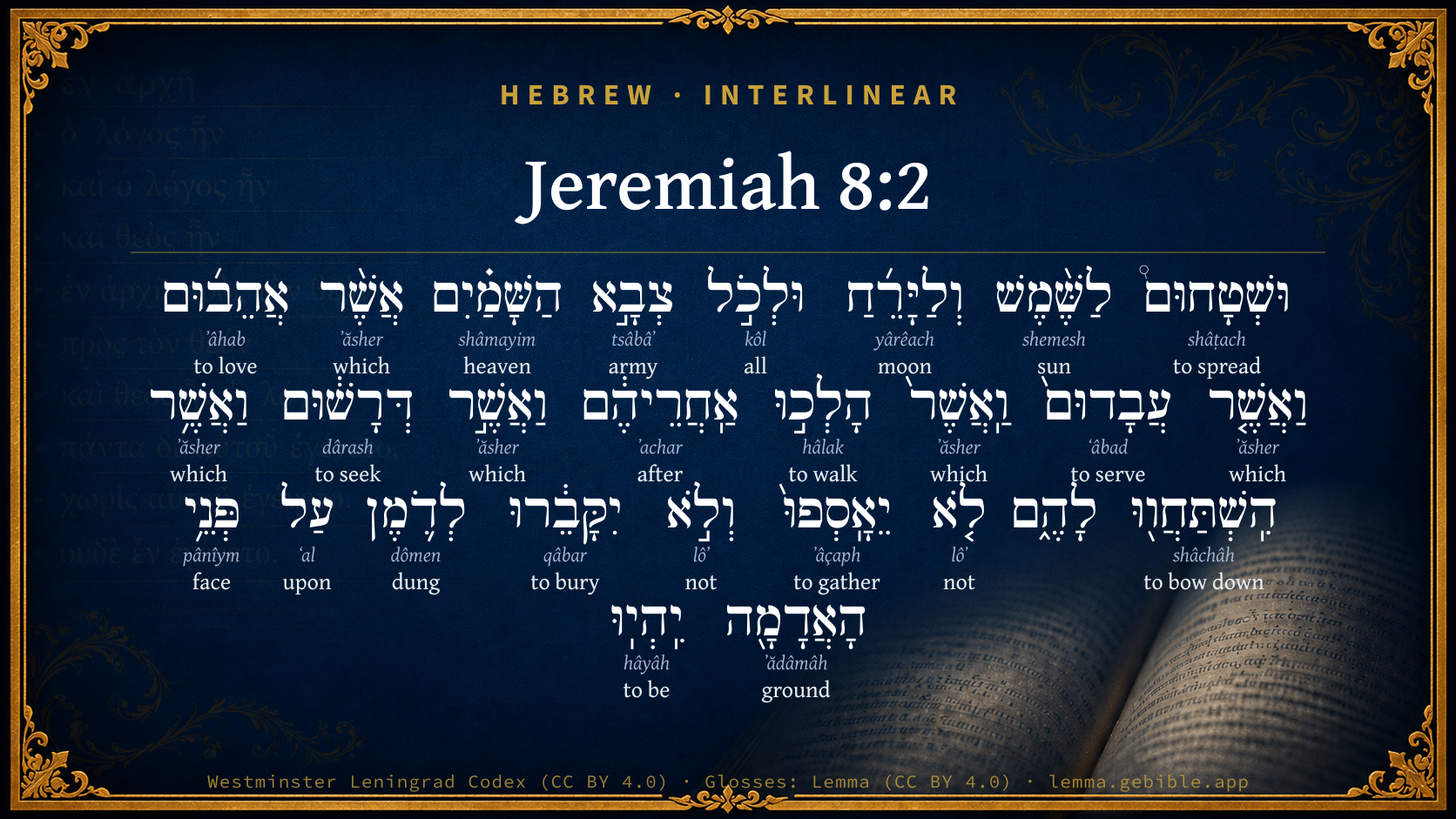
Hebrew (Westminster Leningrad Codex) Jeremiah 8:2 appears in the Hebrew Old Testament. The text above is from the Westminster Leningrad Codex. Each word links to its Strong’s number, a concise gloss, and parsing drawn from the Open Scriptures Hebrew Bible morphology. Click any word for its full Brown-Driver-Briggs (BDB) entry.
Download image
Cite this verse

Jeremiah 8:2 (World English Bible). Public Domain. Lemma interlinear Bible study tool, https://lemma.gebible.app/v/jeremiah/8/2.

Show BibTeX & RIS
BibTeX
RIS
English Translation
and they shall spread them before the sun, and the moon, and all the host of the sky, which they have loved, and which they have served, and after which they have walked, and which they have sought, and which they have worshiped: they shall not be gathered, nor be buried, they shall be for dung on the surface of the earth.
World English Bible · Public Domain
Download a study sheet

One document with this verse’s original text, its word-by-word gloss line, the meaning frame, cross-references with their text, attributed commentary, and full source and license credits — printable, and it pastes into notes with its structure intact.

This verse Autodidact and up

Study sheet (.html) Plain text (.txt)

A passage Seminary Student

Up to 50 verses in one chapter. A passage sheet keeps up to 6 commentary sources and 12 cross-references per verse, in the order this page ranks them, and says so on the sheet whenever that leaves anything out. Ask for a single verse and you get the Autodidact verse sheet above.

Everything on this page stays free to read, with no account — the sheet is a download of what is already on screen, not access to it.

Want to remove ads? Support Godless Engineer
Compare translations 3

The same verse in 3 English versions, stacked beneath the original-language interlinear above. Click any original word for its lexicon entry.

Each is an independent rendering of the whole verse — the interlinear is not word-aligned to these translations.

Highlighted words mark where these versions differ — a whole-verse word diff, not a word-by-word alignment.

  • World English Bible Public Domain
    and they shall spread them before the sun, and the moon, and all the host of the sky, which they have loved, and which they have served, and after which they have walked, and which they have sought, and which they have worshiped: they shall not be gathered, nor be buried, they shall be for dung on the surface of the earth.
  • King James Version Public Domain
    And they shall spread them before the sun, and the moon, and all the host of heaven, whom they have loved, and whom they have served, and after whom they have walked, and whom they have sought, and whom they have worshipped: they shall not be gathered, nor be buried; they shall be for dung upon the face of the earth.
  • unfoldingWord Literal Text CC BY-SA 4.0
    And they will spread them out to the sun and to the moon and to all of the host of the heavens, which they loved and which they served, and that they walked after, and that they sought, and that they bowed down to. They will not be gathered, and they will not be buried. They will be for dung on the face of the land.

unfoldingWord Literal Text — © unfoldingWord, licensed CC BY-SA 4.0. Word-aligned USFM3 via Door43 (git.door43.org/unfoldingWord/en_ult).

Versions to compare (up to 4)

3 of 4 selected

Show all 18 translations

Every available English version of this verse, each an independent rendering of the whole verse.

  • World English Bible Public Domain
    and they shall spread them before the sun, and the moon, and all the host of the sky, which they have loved, and which they have served, and after which they have walked, and which they have sought, and which they have worshiped: they shall not be gathered, nor be buried, they shall be for dung on the surface of the earth.
  • Berean Standard Bible Public Domain
    They will be exposed to the sun and moon, and to all the host of heaven which they have loved, served, followed, consulted, and worshiped. Their bones will not be gathered up or buried, but will become like dung lying on the ground.
  • Majority Standard Bible Public Domain
    They will be exposed to the sun and moon, and to all the host of heaven which they have loved, served, followed, consulted, and worshiped. Their bones will not be gathered up or buried, but will become like dung lying on the ground.
  • King James Version Public Domain
    And they shall spread them before the sun, and the moon, and all the host of heaven, whom they have loved, and whom they have served, and after whom they have walked, and whom they have sought, and whom they have worshipped: they shall not be gathered, nor be buried; they shall be for dung upon the face of the earth.
  • American Standard Version (1901) Public Domain
    and they shall spread them before the sun, and the moon, and all the host of heaven, which they have loved, and which they have served, and after which they have walked, and which they have sought, and which they have worshipped: they shall not be gathered, nor be buried, they shall be for dung upon the face of the earth.
  • Revised Version (1885) Public Domain
    and they shall spread them before the sun, and the moon, and all the host of heaven, whom they have loved, and whom they have served, and after whom they have walked, and whom they have sought, and whom they have worshipped: they shall not be gathered, nor be buried; they shall be for dung upon the face of the earth.
  • Geneva Bible (1599) Public Domain
    And they shall spread them before the sunne and the moone, and all the host of heauen, whom they haue loued, and whome they haue serued, and whome they haue followed, and whome they haue sought, and whome they haue worshipped: they shall not be gathered nor be buried, but shall be as doung vpon the earth.
  • Douay-Rheims (1899) Public Domain
    And they shall spread them abroad to the sun, and the moon, and all the host of heaven, whom they have loved, and whom they have served, and after whom they have walked, and whom they have sought, and adored: they shall not be gathered, and they shall not be buried: they shall be as dung upon the face of the earth.
  • Young's Literal Translation Public Domain
    And have spread them to sun, and to moon, And to all the host of the heavens, that they have loved, And that they have served, And that they have walked after, And that they have sought, And to which they have bowed themselves, They are not gathered, nor buried, They are for dung on the face of the ground.
  • Literal Standard Version CC BY-SA 4.0
    And have spread them to sun, and to moon, || And to all the host of the heavens, that they have loved, || And that they have served, || And that they have walked after, || And that they have sought, || And to which they have bowed themselves, || They are not gathered, nor buried, || They are for dung on the face of the ground.
  • Unlocked Literal Bible CC BY-SA 4.0
    Then they will spread them out in the light of the sun and moon and all the stars of the skies; these things in the sky that they have followed and served, that they have walked after and sought, and that they have worshiped. The bones will not be gathered or buried again. They will be like dung on the surface of the earth.
  • unfoldingWord Literal Text CC BY-SA 4.0
    And they will spread them out to the sun and to the moon and to all of the host of the heavens, which they loved and which they served, and that they walked after, and that they sought, and that they bowed down to. They will not be gathered, and they will not be buried. They will be for dung on the face of the land.
  • Darby Bible Public Domain
    and they shall spread them out to the sun and to the moon and to all the host of the heavens, which they have loved, and which they have served, and after which they have walked, and which they have sought, and which they have worshipped: they shall not be gathered, nor be buried; they shall be for dung upon the face of the ground.
  • World Messianic Bible Public Domain
    They will spread them before the sun, the moon, and all the army of the sky, which they have loved, which they have served, after which they have walked, which they have sought, and which they have worshiped. They will not be gathered or be buried. They will be like dung on the surface of the earth.
  • Webster's Bible Public Domain
    And they shall spread them before the sun, and the moon, and all the host of heaven, whom they have loved, and whom they have served, and after whom they have walked, and whom they have sought, and whom they have worshiped: they shall not be gathered, nor be buried; they shall be for dung upon the face of the earth.
  • Free Bible Version CC BY-SA 4.0
    They will lie exposed to the sun and moon, and to all the stars which they loved, which they served, which they followed, which they consulted, and which they worshiped. Their bones will not be collected or reburied, but will be left like manure lying on the ground.
  • Bible in Basic English Public Domain
    And they will put them out before the sun and the moon and all the stars of heaven, whose lovers and servants they have been, after whom they have gone, to whom they have made prayers, and to whom they have given worship: they will not be put together or placed in the earth; they will be waste on the face of the earth.
  • JPS Tanakh (1917) Public Domain
    and they shall spread them before the sun, and the moon, and all the host of heaven, whom they have loved, and whom they have served, and after whom they have walked, and whom they have sought, and whom they have worshipped; they shall not be gathered, nor be buried, they shall be for dung upon the face of the earth.

Literal Standard Version (2020), Covenant Press — licensed CC BY-SA 4.0. Text via the HelloAO Bible API (eBible.org). Unlocked Literal Bible (unfoldingWord) — licensed CC BY-SA 4.0. Text via the HelloAO Bible API (eBible.org). unfoldingWord Literal Text — © unfoldingWord, licensed CC BY-SA 4.0. Word-aligned USFM3 via Door43 (git.door43.org/unfoldingWord/en_ult). Free Bible Version, Dr. Jonathan Gallagher — licensed CC BY-SA 4.0. Text via the HelloAO Bible API (eBible.org).

Word by word

More ways to search: Search by grammar → Find every occurrence → Compare this word →

Practice this passage: Drill this verse → Learn its vocabulary →

וּשְׁטָחוּם֩
shâṭach
H7849
“and · to spread · them”
Conjunction + Verb, Qal, Sequential Perfect, 3rd Person, Common, Plural + Suffix, Personal, 3rd Person, Masculine, Plural
Part of Speech
Conjunction + Verb
Stem
Qal
Form
Sequential Perfect
Person
3rd Person
Gender
Common
Number
Plural
Full BDB Definition

Origin: a primitive root

TWOT: 2372

to spread, spread abroad, stretch out - (Qal) - to spread - spreading, expanding (participle) - (Piel) to spread out
  1. לַשֶּׁ֨מֶשׁ shemesh H8121 “to/for the · sun” Preposition, Determined + Noun, Common, Both, Singular, Absolute
  2. וְלַיָּרֵ֜חַ yârêach H3394 “and · to/for the · moon” Conjunction + Preposition, Determined + Noun, Common, Masculine, Singular, Absolute
  3. וּלְכֹ֣ל kôl H3605 “and · to/for · all of” Conjunction + Preposition + Noun, Common, Masculine, Singular, Construct
  4. צְבָ֣א tsâbâʼ H6635 “army of” Noun, Common, Both, Singular, Construct
  5. הַשָּׁמַ֗יִם shâmayim H8064 “the · heaven(s)” Particle, Definite Article + Noun, Common, Masculine, Plural, Absolute
  6. אֲשֶׁ֨ר ʼăsher H834 “which” Particle, Relative
  7. אֲהֵב֜וּם ʼâhab H157 “to love · them” Verb, Qal, Perfect, 3rd Person, Common, Plural + Suffix, Personal, 3rd Person, Masculine, Plural
  8. וַאֲשֶׁ֤ר ʼăsher H834 “and · which” Conjunction + Particle, Relative
  9. עֲבָדוּם֙ ʻâbad H5647 “to serve · them” Verb, Qal, Perfect, 3rd Person, Common, Plural + Suffix, Personal, 3rd Person, Masculine, Plural
  10. וַֽאֲשֶׁר֙ ʼăsher H834 “and · which” Conjunction + Particle, Relative
  11. הָלְכ֣וּ hâlak H1980 “to walk” Verb, Qal, Perfect, 3rd Person, Common, Plural
  12. אַֽחֲרֵיהֶ֔ם ʼachar H310 “after · them” Preposition + Suffix, Personal, 3rd Person, Masculine, Plural
  13. וַאֲשֶׁ֣ר ʼăsher H834 “and · which” Conjunction + Particle, Relative
  14. דְּרָשׁ֔וּם dârash H1875 “to seek · them” Verb, Qal, Perfect, 3rd Person, Common, Plural + Suffix, Personal, 3rd Person, Masculine, Plural
  15. וַאֲשֶׁ֥ר ʼăsher H834 “and · which” Conjunction + Particle, Relative
  16. הִֽשְׁתַּחֲו֖וּ shâchâh H7812 “to bow down” Verb, Hishtaphel, Perfect, 3rd Person, Common, Plural
  17. לֹ֤א lôʼ H3808 “not” Particle, Negative
  18. יֵאָֽסְפוּ֙ ʼâçaph H622 “to gather” Verb, Niphal, Imperfect, 3rd Person, Masculine, Plural
  19. וְלֹ֣א lôʼ H3808 “and · not” Conjunction + Particle, Negative
  20. יִקָּבֵ֔רוּ qâbar H6912 “to bury” Verb, Niphal, Imperfect, 3rd Person, Masculine, Plural
  21. לְדֹ֛מֶן dômen H1828 “to/for · dung” Preposition + Noun, Common, Masculine, Singular, Absolute
  22. עַל ʻal H5921 “upon” Preposition
  23. פְּנֵ֥י pânîym H6440 “face(s) of” Noun, Common, Both, Plural, Construct
  24. הָאֲדָמָ֖ה ʼădâmâh H127 “the · ground” Particle, Definite Article + Noun, Common, Feminine, Singular, Absolute
  25. יִֽהְיֽוּ hâyâh H1961 “to be” Verb, Qal, Imperfect, 3rd Person, Masculine, Plural

About this verse

These counts appear in no published source. They are computed here, from the morphology-tagged text and Lemma’s own curated glosses. What Lemma adds →

27
words
21
distinct lemmas
Prophets
section

Notable vocabulary

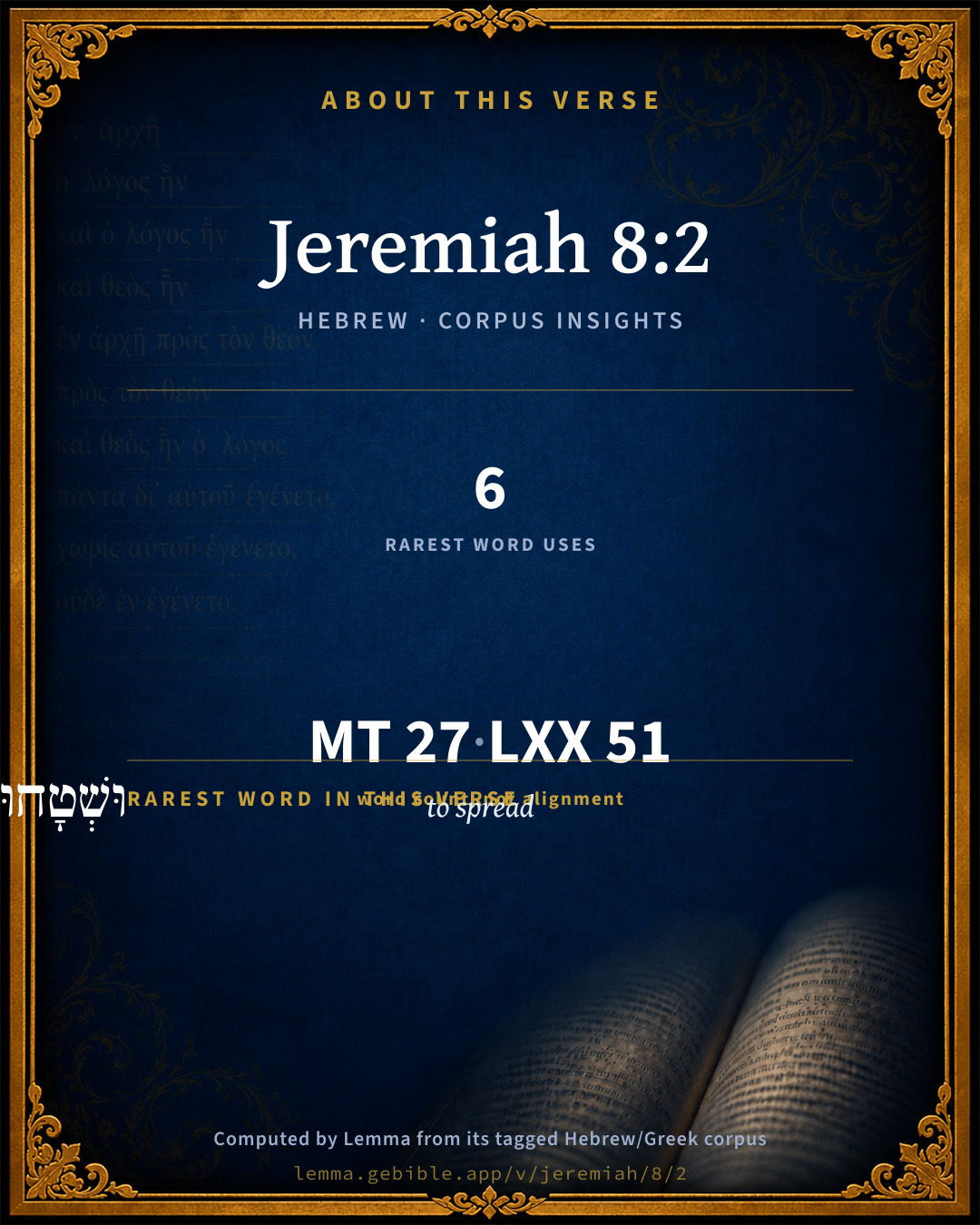
The rarest word here is וּשְׁטָחוּם֩ to spread H7849 — appearing just 6 times in the whole Hebrew Bible.

Shared distinctive vocabulary

וּשְׁטָחוּם֩ to spread H7849 occurs in 5 verses of the Hebrew Bible. Also found in:

Grammatical profile

  • 9 verbs
  • 8 nouns
  • 3 prepositions
  • 7 particles

Verb forms

  • וּשְׁטָחוּם֩ Qal · Sequential Perfect
  • אֲהֵב֜וּם Qal · Perfect
  • עֲבָדוּם֙ Qal · Perfect
  • הָלְכ֣וּ Qal · Perfect
  • דְּרָשׁ֔וּם Qal · Perfect
  • הִֽשְׁתַּחֲו֖וּ Hishtaphel · Perfect
  • יֵאָֽסְפוּ֙ Niphal · Imperfect
  • יִקָּבֵ֔רוּ Niphal · Imperfect
  • יִֽהְיֽוּ Qal · Imperfect

Repetition

Words recur within this verse — often emphatic in Hebrew:

  • אֲשֶׁ֨ר which H834 ×5
  • לֹ֤א not H3808 ×2

Hebrew & Septuagint length

In the original languages it is 27 Hebrew tokens and 51 Greek tokens — but the two are counted differently (Hebrew bundles its prefixes and suffixes into one token; the Greek is in lemma form), so that isn’t a like-for-like length.

Cross-references

20

Topical passages linked to Jeremiah 8:2 in the Treasury of Scripture Knowledge — connected by theme and wording, ordered by reader-vote popularity; previews shown in the World English Bible.

  • Deuteronomy 4:19 and lest you lift up your eyes to the sky, and when you see the sun and the moon and the stars, even all the host of the sky, you are drawn away and worship them, and serve them, which Yahweh your God has allotted to all the peoples under the whole sky.
  • 2 Kings 23:5 He put down the idolatrous priests, whom the kings of Judah had ordained to burn incense in the high places in the cities of Judah, and in the places round about Jerusalem; those also who burned incense to Baal, to the sun, and to the moon, and to the planets, and to all the host of the sky.
  • Jeremiah 9:22 Speak, Thus says Yahweh, The dead bodies of men shall fall as dung on the open field, and as the handful after the harvester; and none shall gather [them].
  • Zephaniah 1:5 those who worship the host of the sky on the housetops, those who worship and swear by Yahweh and also swear by Malcam,
  • Acts 7:42 But God turned, and gave them up to serve the host of the sky, as it is written in the book of the prophets, 'Did you offer to me slain animals and sacrifices Forty years in the wilderness, O house of Israel?
  • 2 Kings 21:3 For he built again the high places which Hezekiah his father had destroyed; and he reared up altars for Baal, and made an Asherah, as did Ahab king of Israel, and worshiped all the host of the sky, and served them.
  • Psalms 83:10 Who perished at Endor, Who became as dung for the earth.
  • Jeremiah 16:4 They shall die grievous deaths: they shall not be lamented, neither shall they be buried; they shall be as dung on the surface of the ground; and they shall be consumed by the sword, and by famine; and their dead bodies shall be food for the birds of the sky, and for the animals of the earth.
  • Jeremiah 19:13 and the houses of Jerusalem, and the houses of the kings of Judah, which are defiled, shall be as the place of Topheth, even all the houses on whose roofs they have burned incense to all the host of the sky, and have poured out drink-offerings to other gods.
  • Jeremiah 22:19 He shall be buried with the burial of a donkey, drawn and cast forth beyond the gates of Jerusalem.
  • Jeremiah 36:30 Therefore thus says Yahweh concerning Jehoiakim king of Judah: He shall have none to sit on the throne of David; and his dead body shall be cast out in the day to the heat, and in the night to the frost.
  • Ezekiel 8:16 He brought me into the inner court of Yahweh's house; and see, at the door of the temple of Yahweh, between the porch and the altar, were about twenty-five men, with their backs toward the temple of Yahweh, and their faces toward the east; and they were worshipping the sun toward the east.
  • Deuteronomy 17:3 and has gone and served other gods, and worshiped them, or the sun, or the moon, or any of the host of the sky, which I have not commanded;
  • 2 Kings 9:36–37 Therefore they came back, and told him. He said, This is the word of Yahweh, which he spoke by his servant Elijah the Tishbite, saying, In the portion of Jezreel shall the dogs eat the flesh of Jezebel;
  • 2 Kings 17:16 They forsook all the commandments of Yahweh their God, and made them molten images, even two calves, and made an Asherah, and worshiped all the host of the sky, and served Baal.
  • 2 Kings 21:5 He built altars for all the host of the sky in the two courts of the house of Yahweh.
  • 2 Chronicles 33:3–5 For he built again the high places which Hezekiah his father had broken down; and he reared up altars for the Baals, and made Asheroth, and worshiped all the host of the sky, and served them.
  • Ecclesiastes 6:3 If a man fathers a hundred children, and lives many years, so that the days of his years are many, but his soul is not filled with good, and moreover he has no burial; I say, that an untimely birth is better than he:
  • Jeremiah 44:17–19 But we will certainly perform every word that is gone forth out of our mouth, to burn incense to the queen of the sky, and to pour out drink-offerings to her, as we have done, we and our fathers, our kings and our princes, in the cities of Judah, and in the streets of Jerusalem; for then had we plenty of food, and were well, and saw no evil.
  • Zephaniah 1:17 I will bring distress on men, that they will walk like blind men, because they have sinned against Yahweh, and their blood will be poured out like dust, and their flesh like dung.

Cross-references courtesy of OpenBible.info (CC BY 4.0).

Hebrew and Greek witnesses Masoretic Hebrew ↔ Greek Septuagint

The same verse in the two great witnesses to the Old Testament, shown verse-for-verse.

These are two independent witnesses, not word-aligned to each other, and the Septuagint is shown in lemma (dictionary) form.

Hebrew Jeremiah 8:2 Masoretic · Westminster Leningrad Codex

וּשְׁטָחוּם֩ לַשֶּׁ֨מֶשׁ וְלַיָּרֵ֜חַ וּלְכֹ֣ל צְבָ֣א הַשָּׁמַ֗יִם אֲשֶׁ֨ר אֲהֵב֜וּם וַאֲשֶׁ֤ר עֲבָדוּם֙ וַֽאֲשֶׁר֙ הָלְכ֣וּ אַֽחֲרֵיהֶ֔ם וַאֲשֶׁ֣ר דְּרָשׁ֔וּם וַאֲשֶׁ֥ר הִֽשְׁתַּחֲו֖וּ לָהֶ֑ם לֹ֤א יֵאָֽסְפוּ֙ וְלֹ֣א יִקָּבֵ֔רוּ לְדֹ֛מֶן עַל פְּנֵ֥י הָאֲדָמָ֖ה יִֽהְיֽוּ

and they shall spread them before the sun, and the moon, and all the host of the sky, which they have loved, and which they have served, and after which they have walked, and which they have sought, and which they have worshiped: they shall not be gathered, nor be buried, they shall be for dung on the surface of the earth.

World English Bible · Public Domain

Greek LXX Structure differs

In the Septuagint, Jeremiah is about an eighth shorter than the Hebrew and arranges its material differently — the Oracles Against the Nations (Hebrew chapters 46–51) appear in the middle of the Greek book, after 25:13. Because the chapter and verse boundaries do not line up, a verse-for-verse comparison with the Hebrew is not shown.

A verse-for-verse comparison isn’t shown here because the chapters and verses don’t line up. Switch to the LXX edition with the MT / LXX toggle above to read the Greek directly.

Hebrew: Westminster Leningrad Codex (CC BY 4.0). Greek: Septuagint (public domain); English from a public-domain English Septuagint. How the Septuagint differs from the Hebrew →

Targum (Aramaic paraphrase)

1

The Targum is the ancient Jewish Aramaic paraphrase of the Hebrew Scriptures — an interpretive translation, not the Hebrew text itself. Onkelos (literal) and Pseudo-Jonathan (expansive) render the Torah, and Jonathan the Prophets. Coverage is partial: where no permissively-licensed English translation exists for a verse, only the Aramaic is shown. This is verse-level text, not a word-by-word alignment to the Hebrew.

  1. Targum Jonathan Prophets (Joshua–Malachi)
    וְיִשְׁטִחוּנוּן לִקָבֵיל שִׁמְשָׁא וְסִיהֲרָא וּלְכֹל חֵילֵי שְׁמַיָא דְרַחֲמוּנוּן וְדִפְלָחוּנוּן וְדִטְעוֹ בַתְרֵיהוֹן וְדִתְבָעוּנוּן וְדִסְגִידוּ לְהוֹן לָא יִתְכַּנְשׁוּן וְלָא יִתְקַבְּרוּן לְזֵיבַל מְבַדֵר עַל אַפֵּי אַרְעָא יְהוֹן:

    (no public-domain English translation for this verse)

    Targum Jonathan — Aramaic: “Mikraot Gedolot” (public domain). English: “Sefaria Community Translation” (CC0 1.0 (public-domain dedication)); “London "Chaldee Paraphrase," 1871” (public domain). Text via Sefaria.

Commentary

Notes on Jeremiah 8:2 from classic Christian and Jewish commentators (each source and its license shown beneath its notes). The classic Christian expositions comment on the surrounding passage and are grouped to its opening verse, so a note may address several verses; the Jewish commentaries on the Tanakh (Rashi and others) are per-verse, so they appear only where the commentator wrote on this verse.

Lemma curates 59 commentaries, every one of them public domain or Creative Commons licensed, each selected and text-cleaned for this edition rather than reprinted as found. About our sources →

Trapp's Complete Commentary

John Trapp

Jer 8:2 And they shall spread them before the sun, and the moon, and all the host of heaven, whom they have loved, and whom they have served, and after whom they have walked, and whom they have sought, and whom they have worshipped: they shall not be gathered, nor be buried; they shall be for dung upon the face of the earth.

Ver. 2. And they shall spread them before the sun.] Whom these idolaters had worshipped while they were alive, and thought they could never do enough for, as is hinted by those many expressions in the text.

Whom they have loved, and whom they have served, &c.] Innuitur poena talionis, saith Piscator. Their dead bodies shall lie unburied in the sight of these their deities, who could do them no good either alive or dead.

John Trapp, A Commentary or Exposition upon All the Books of the Old and New Testament (1647–1656) — public domain. Text from a community e-Sword module.

Jamieson, Fausset & Brown

Robert Jamieson, A. R. Fausset & David Brown

spread . . . before the sun, &c.--retribution in kind. The very objects which received their idolatries shall unconcernedly witness their dishonor.

lover . . . served . . . after . . . walked . . . sought . . . worshipped--Words are accumulated, as if enough could not be said fully to express the mad fervor of their idolatry to the heavenly host (Kg2 23:5).

nor . . . buried-- (Jer 22:19).

dung-- (Jer 9:22; Psa 83:10).

Jamieson, Fausset & Brown — Commentary Critical and Explanatory on the Whole Bible (1871) — public domain (CC PDM 1.0). Text via the HelloAO Bible API.

John Calvin's Commentaries

It was, because they served the sun, and the moon, and the stars It was God’s just vengeance, that their bones should be taken from their graves, in order that the sun and moon and all the stars might be witnesses of his judgment. By these words Jeremiah indirectly reprobates the senselessness of the people for thinking that they performed an acceptable service to the sun and moon. He therefore says, that all the stars and the planets would become as it were spectators of the vengeance which God would execute; as though he had said, that the whole celestial host would approve of that punishment; for nothing is more detestable to creatures, than when the glory of their Maker is ascribed to them. It is indeed true that the sun, moon, and stars are without sense or reason; but the Prophet here attributes reason to them, in order that he might shake off from the Jews that stupidity in which they hardened themselves, while they thought that they were rendering to the sun an acceptable service. At the same time he alludes, as it appears also from other places, to the punishment inflicted on adulterers: for when a harlot is drawn out and led forth in contempt and disgrace in the presence of her adulterers, it is deemed a most just punishment. And thus as the Jews had as it were committed adultery with the sun and the moon and the stars, so the Prophet says here, that their disgrace and baseness would be made manifest in the sight of the sun, and the moon, and the stars.

He says, which they have loved He no doubt alludes to the blind ardor by which idolaters were possessed, when they zealously pursued their illicit devotions; for it was a species of an unbridled and mad passion, as it appears from other places; for no fornicator burns with a more impetuous lust after a woman, than idolaters do, when Satan dazzles their eyes and fascinates their hearts. Of this impure love then does the Prophet now speak; and at the same time, he indirectly condemns the Jews for having alienated themselves without a cause from God, who was their legitimate husband. There is indeed nothing less tolerable than for men thus perfidiously to forsake God, when he has invited them to himself, and contracted as it were with them a holy and an inviolable marriage.

He afterwards adds, whom they have served This was still more base; they devoted themselves to the work of serving the sun, the moon, and the stars. He mentions in the third place, that they walked after them. God had shewn them the right way, and had commanded them to follow him: but they forsook God, says the Prophet, and followed the stars of heaven. He states in the fourth place, that they sought them. By this he refers to their perverseness. Some render the word “consulted,” of which I do not approve, for it is strained and far-fetched. The Prophet, I doubt not, denotes here the persevering attention of the Jews to the objects of their worship; for they followed their idols not by a sudden and momentary impulse, but they resolutely devoted themselves to them and became as it were fixed in their wicked purpose. And he says in the last place, that they prostrated themselves before them. This was the way in which they served them. It is an evidence of reverence when men prostrate themselves before their idols; and thus they serve them, for it is an act of worship. The Prophet might indeed have sufficiently expressed in one sentence the impiety of the people; but he joins together several sentences for the sake of amplification, in order that he might render more evident the ingratitude of the people in seeking for themselves unknown gods, and in setting up false and fictitious modes of worship, rather than to render obedience to the only true God and to acquiesce in his law, which is a certain rule, and never leads any astray.

He afterwards adds, They shall not be gathered, nor be buried; for dung shall they be on the face or surface of the land He confirms what he had said of the punishment before mentioned, — that they had acted disdainfully towards God, and had prostrated themselves before their idols, so after death they would be made base and detestable, so that the mind would revolt at such a hateful sight. This is the meaning. It follows —

John Calvin's Commentaries (1540-1563) — public domain. Text from the Calvin Translation Society English edition (1840s-50s) via the Christian Classics Ethereal Library (ccel.org). Calvin's coverage is partial (roughly two-thirds of the Bible); uncommented books and verses are honest gaps, never fabricated. The 19th-century editor's footnotes and remarks are omitted so the notes are faithfully Calvin's own voice.

Ellicott's Commentary for English Readers

(2) Whom they have loved . . .—Here, again, there is a peculiar characteristic emphasis in the piling up, one upon another, of verbs more or less synonymous. So far as there is a traceable order, it is from the first inward impulse prompting to idolatry to the full development of that feeling in ritual. The sun, moon, and stars shall look, not on crowds of adoring worshippers, but on the carcases of those whose love and worship, transferred from Jehovah to the host of heaven, have brought on them that terrible doom.

A Bible Commentary for English Readers, edited by Charles John Ellicott (1878–1897) — public domain. Text from a community e-Sword module.

The Cambridge Bible for Schools and Colleges

gen. ed. J. J. S. Perowne

2. host of heaven] Such worship was frequent, as we see from 2Ki_17:16; 2Ki_21:3; Zep_1:5, in the time of the later kings. Cp. Jer_19:13; Eze_8:16.

The Cambridge Bible for Schools and Colleges (gen. ed. J. J. S. Perowne; Cambridge University Press, 1878–1918) — public domain. Text from a community e-Sword module.

John Gill's Exposition

And they shall spread them before the sun and the moon, and all the host of heaven,.... The stars. This shows, not only that they should be publicly exposed; but, as it refers to their idolatrous worship of the sun, moon, and stars, that these deities will not be able to help them; as they could not prevent their dead bodies being dug up, so neither could they order or cause them to be gathered together, and buried again:

whom they have loved; whereas they ought to have loved the Lord their God, and him only: it means an idolatrous love of and affection for them; and not the love of them, as creatures for use and delight; otherwise the light of the sun, moon, and stars, is sweet, and their influence great; and a pleasant thing it is to behold them, and especially the former of them, the fountain of light and heat: and whom they have served; more and besides the Creator of them, whom they should have served, the Lord of hosts, and him only:

and after whom they have walked; not in a natural and literal sense, but in a religious one, as is after explained:

and whom they have sought; for advice and counsel, and by making their prayers and supplications to them:

and whom they have worshipped; by bowing the knee, or kissing the hand; by offering sacrifices, and burning incense, and putting up petitions to them; by trusting in them, and expecting good things from them; see Kg2 21:3,

they shall not be gathered, nor be buried: meaning not the men that should die in those times, but the bones that should be brought out of the graves; these, having been scattered about, should not be collected together again, and replaced in their sepulchres:

they shall be for dung upon the face of the earth; that is, they should lie and rot upon the face of the earth, and crumble into dust, and become dung for it; see Psa 83:10.

John Gill's Exposition of the Whole Bible (1746–1763) — public domain (CC PDM 1.0). Text via the HelloAO Bible API.

Albert Barnes' Notes on the Bible

Loved ... served ... walked ... sought ... worshipped - There is great force in the piled-up verbs by which their worship of the heavenly bodies is described. The prophet beginning with the heart’s “love” describes that worship) in the various stages of its development, and then contrasts its fulness with the miserable reward which ensues.

Albert Barnes' Notes on the Bible (1834–1885) — public domain. Text from a community e-Sword/MySword module.

Matthew Poole's English Annotations

They shall spread them before the sun; not gather them together into charnel-houses, as we usually do out of humanity, but scatter them about as it were to be turned into dust and dung.

And the moon, and all the host of heaven, viz. all the rest of the stars, to show that they should not lie out in the day time only, but night also, before the moon and stars, Jer 36:30. Their carcasses shall be cast to their idols, Lev 26:30; 2Ki 23:14,20; a kind of lex talionis, that as they had served and worshipped these creatures, God doth, as it were, appoint them as spectators and witnesses of his vengeance, and what contempt he pours upon them, their carcasses being brought before their idols, which will be so shameful, as if one should draw forth the adulteress with the adulterer into open view, and expose them together; and it also insinuates the inability that is in these dumb idols to help them in their misery.

Whom they have loved: this and the following term serve to express the greatness and variety of their affection and zeal in their worshipping of them, Deu 4:19; 2Ki 23:5; Jer 7:18; he multiplies words, as it were implying that there can hardly be words enough to express their folly and madness, the Gentiles worshipping these creatures, not only for their beauty and lustre, but, according to their ancient philosophy, apprehending them to have been living creatures, and that all events were ordered by them.

They shall be for dung upon the face of the earth; on the superficies of it; there shall be no care taken of them, but they shall lie in the open country in the air, till they rot into dung, or dry into dust, as in the beginning of the verse; see Psa 83:10; Jer 9:22; they shall be ignominious even after death.

Matthew Poole's English Annotations on the Holy Bible (1683–1685) — public domain. Text from a community e-Sword/MySword module.

Whedon's Commentary on the Bible

Daniel D. Whedon

2. They shall spread them before the sun, etc. — Observe the cumulative force of the verbs used to express their worship of the heavenly bodies. The passage is an excellent illustration of the genius of the Hebrew language as to emphasis. But the stars looked coldly down on the discomfiture of their worshippers.

2.

The Growing Wickedness of the Leaders and Teachers. — Jer_8:4 to Jer_9:24.

Daniel D. Whedon (gen. ed.), Commentary on the Old and New Testaments (1874–1909) — public domain. Text from a community e-Sword module.

The Pulpit Commentary

And they shall spread them, etc. Not as an act of solemn mockery, for the agents are idolaters themselves, but God so overrules the passions of his unconscious instruments that no more effective ceremonial could have been devised. Whom they have loved, etc. The prophet is designedly diffuse in his description. With all their misspent zeal, these unhappy idolaters cannot even find tombs.

HOMILIES BY S. CONWAY Ver. 2. Befooled indeed.

This is what we say when We see men giving heed to the plausible statements of gross impostors, and, in consequence, lavishing their time, energy, and wealth in the hope of large recompense; but who, when the time comes that the hoped-for gain should be theirs, find themselves deceived, defrauded, helpless, and utterly ruined men. These are they who are the prey of bubble companies, lying advertisements, and the other ten thousand frauds into which unwary persons are beguiled. But is not this what we may say when we read of those told of in our text? Was there ever more flagrant, piteous, and awful instance of men being made fools of indeed? For

I LOOK AT THESE UTTERLY DECEIVED ONES.

1. They were worshippers of the gods of the heathen. The sun, the moon, and all the host of heaven: these were the objects of their worship. Reference is continually made to them and to their worship. (2Ki_23:5 2Ki_21:3, etc.)

2. And they were most earnest worshippers. Note the piling up of expressions to indicate this.

(1) They have loved" them. Here is the root of all real worship. The object must be loved, and these people were drawn to and attracted by these false gods.

(2) They served" them. This follows as a sure consequence. It is not said they believed in them; but that matters not: it there be that in the object of our worship which makes us like it love is almost too sacred a word as applied to false gods we shall serve it readily enough.

(3) And then they walked after" them. That which lured them at the first drew them more and more, and so it became the habit of their lives.

(4) And they sought" them. When they found the worship of some of these gods was pleasant, they sought out more of them; or it may mean that they got at last to have a real faith in them, and hence "consulted them as oracles, appealed to them as judges, implored their favor, and prayed to them as benefactors.

(5) And they worshipped" them. See them at their worship on Mount Carmel, on the day when Elijah challenged their priests to put to the test his God and theirs. None could doubt the sincerity of their worship or the earnestness with which they cried all that morning long, "O Baal, hear us!" And those to whom Jeremiah wrote were such thorough worshippers of these gods. They withheld no proof of their devotedness.

3. But yet they were utterly deceived and disappointed. See in text and in immediate context how these gods dealt with them. Ardent votaries as they had been, those whom they worshipped let all the hideous woes come upon them which are told of here: death, desolation, degradation, and despair. That was what their gods did for them. They had spent their all on these pretended physicians, and were nothing bettered, but made worse indeed.

II ENDEAVOR TO EXPLAIN BOTH THEIR INFATUATION AND THEIR DISAPPOINTMENT.

1. As to their infatuation. It can hardly be possible for any reader of the history of these people to avoid asking the question, "Wherefore was it that they were so given to idolatry?" Their whole national history showed that nothing but sorrow and shame had come from idolatry, and yet here they were forever, not merely falling into it, but deliberately and persistently going after it. What could be the reason?

(1) Partly, no doubt, the example of the great and mighty nations around them. We must remember what an infinitesimally small kingdom that of Judah was about the size of an ordinary English county, and how insignificant they were; how the influence, therefore, of the great empires which pressed them on either side could not but be felt. And this was all on the side of idolatry. Idolatry had done them no harm; the gods they worshipped had, so it would seem, lifted them up to greatness and power surpassed by none, All seemed to say to the poor, weak, little kingdom of Judah, "You had far better do as we do and trust our gods rather than your own.

(2) The spirituality of the worship God required, and the absence of all such demand on the part of idolatry, was another argument for idolatry and against the worship of God. No graven image, no representation of God, nothing that would help the senses to conceive of God as like to themselves, was granted to the Jews; God was a Spirit, and he was to be worshipped in spirit and in truth. No statue, no image, no painting, no symbol even, was to represent him. It was not allowed that the Jew should be able to place in his house or carry about with him, as other nations did, any material emblem of his God. (cf. Deu_4:15 Isa_40:18) But spiritual worship of this kind has ever been found far more difficult to maintain: it demands a condition of heart and mind so purified that to the gross and sensual such worship is impossible, and to the ordinary mind it is far from easy. The anthropomorphisms of the Old Testament, and the Incarnation itself, are condescensions of God to the confessed feebleness and incapacity of man for such pure worship. But, on the other hand, idolatry, abounding with "chambers of imagery," lending itself to all the clamor of the senses, what wonder that it was preferred?

(3) Add on to this the fact that strict obedience to the Levitical Law involved such isolation from all other people, such scrupulous care, such heavy sacrifices of time, wealth, ease, and the good will of men; in short, was altogether, as St. Peter afterwards said, (Act_15:10) a yoke which neither our fathers nor we were able to bear;" whilst idolatry wooed them with its sensuous, brilliant, luxurious, and easy rites; and again we ask, what wonder that idolatry was preferred?

(4) And present earthly good seemed to be associated with it, and absent from the worship of God. (cf. Jer_44:15-19, "For then had we plenty of victuals, and were well, and saw no evil. But since we left off,... we have wanted all things And

(5) lastly, the license allowed by the lax moral code of idolatry, and its positive sanction of gross licentiousness; this, contrasted with the stern frown of the true Jewish faith upon all such sin, was more than sufficient to attract in crowds a people so debased as the Jews had now become. Then, as still, the most powerful and the most depraved passions of human nature were not only permitted free indulgence by idolatry, but actually patronized, protected, and prescribed. All ancient history attests this, and the result on the heathen world, not only history but God"s providence and his Word alike (Romans 1) have plainly declared.

2. As to their disappointment. Idolatry, however for the moment it may seem to have brought good along with it (cf. supra), resulted at last in such unparalleled woe as the prophets, one and all, continually declared must come from it. But whilst no idolatrous nation has ever stood permanently in its greatness let the decayed and perished empires of antiquity witness there can be little question that sentence against the evil work was executed more speedily, more sternly, and more notoriously against the Jews than against any other idolatrous nation whatsoever. It cost them more than any other people, and they have not paid "the uttermost farthing" even yet. The rabbis say that in every one of the innumerable cups of affliction which Israel in the course of the long ages has had to drink, there has been mingled some of the dust of that golden idol-calf which Moses ground to powder beneath Mount Sinai. We are told how, when he had done this, he cast the powder into the stream from whence the camp drew its water, and made all the people drink of it. Now, wherefore was sorer Judgment meted out to Israel than to others because of their idolatry?

(1) Because they were the beloved of the Lord. A man may see a strange child doing a disgraceful action and may take comparatively little notice; but if it be his own son, whom he loves, will he not feel and resent it then as otherwise he never would?

(2) And "chiefly because to them were committed the oracles of God." They were to be the channel along which the truth of revelation was to flow to mankind at large, and if that channel were not kept free from pollution, neither could the living waters which flowed along it. Hence the prompt and stern measures which were ever taken to preserve Israel in the faith of God, or to restore them if they had wandered. It could not be, therefore, that Israel should permanently and entirely lapse into idolatry. The well-being of the world hinged on their handing down pure and uncorrupt the oracles of God and the faith of their forefathers, and because "God so loved the world," the cup of idolatry was ever made bitter and nauseous to his people, so that they might hate to drink of it.

III THY TO TURN THIS WHOLE SUBJECT TO GOOD ACCOUNT.

1. The votaries of the world may in these verses behold their own portraiture and read their sure reward. For

(1) they do after this manner give themselves to the world. They love," "serve," "walk after," "seek," and "worship" it.

(2) And their infatuation is explained by like reasons.

(3) And their reward will be to be utterly deceived and disappointed. God will say to each one of them, "Thou fool!". (Luk_12:20)

2. The worshippers of God may profitably contemplate a model which too many of them too seldom follow, of earnest devotedness in their worship. "The children of this world are wiser in their generation than the children of light." Would that the devotedness of the world to its god were equaled by the devotedness of the Church to theirs!

3. Every one may beheld, in the tremendous and deadly attraction of the world, fresh, urgent, and constant need of being "kept by the power of God" in the love of God. Well may each day begin with this prayerLord, I my vows to thee renew: Scatter my sins like morning dew, Guard my first springs of thought and will, And with thyself my spirit fill. C.

The Pulpit Commentary (1880–1919), ed. H.D.M. Spence-Jones & Joseph S. Exell — public domain. Text from a community e-Sword module.

Rashi

Rabbi Shlomo Yitzchaki (Rashi)

And spread them before the sun And the Chaldeans shall dwell when they besiege the city, in the graves of the princes, that were as beautiful as palaces.

for dung For fertilizer.

Rashi on the Tanakh — English translations: “The Judaica Press complete Tanach with Rashi, translated by A. J. Rosenberg” (CC BY 4.0); “Pentateuch with Rashi's commentary by M. Rosenbaum and A.M. Silbermann, 1929-1934” (public domain); “The Metsudah Tanach series, Lakewood, N.J” (CC BY 4.0); and “The Book of Joshua, Metsudah Publications, 1997” (CC BY 4.0). Text via Sefaria.

Lesson kit

Teaching starters — assembled from the data on this page, not authored interpretation. Every prompt links to the verse data it draws on. Edit before teaching.

Jeremiah, in the Prophets, opens this verse with 27 words (21 distinct Hebrew lemmas). Its most distinctive word is shâṭach (“to spread”). A historical commentator’s framing appears above. Read the whole chapter for the surrounding context.

Discussion questions

  1. How does “to spread” (shâṭach) shape what this verse is saying?
  2. How does Numbers 11:32, which shares the word «to spread», read alongside this verse?
  3. What does the repetition of “which” (5× in this one verse) do in this verse?
  4. These translations render this verse differently. What is at stake in choosing one wording over another?
  5. «וּשְׁטָחוּם֩» is a Qal Sequential Perfect verb. How does that grammatical form shape the action described?
  6. Compare how Trapp's Complete Commentary and Jamieson, Fausset & Brown read this verse. Where do they agree or differ?

Things to notice

Reading settings

Reading text

Shown beneath each verse's original-language words.

Old Testament
Old Testament edition

Read the OT as the Masoretic Hebrew (MT) or the Greek Septuagint (LXX).

English shown for the Greek Septuagint (in the Hebrew ↔ Greek comparison).

Comparing translations? Open the Compare panel on any verse page to stack up to four side by side.