Ezekiel 7:2

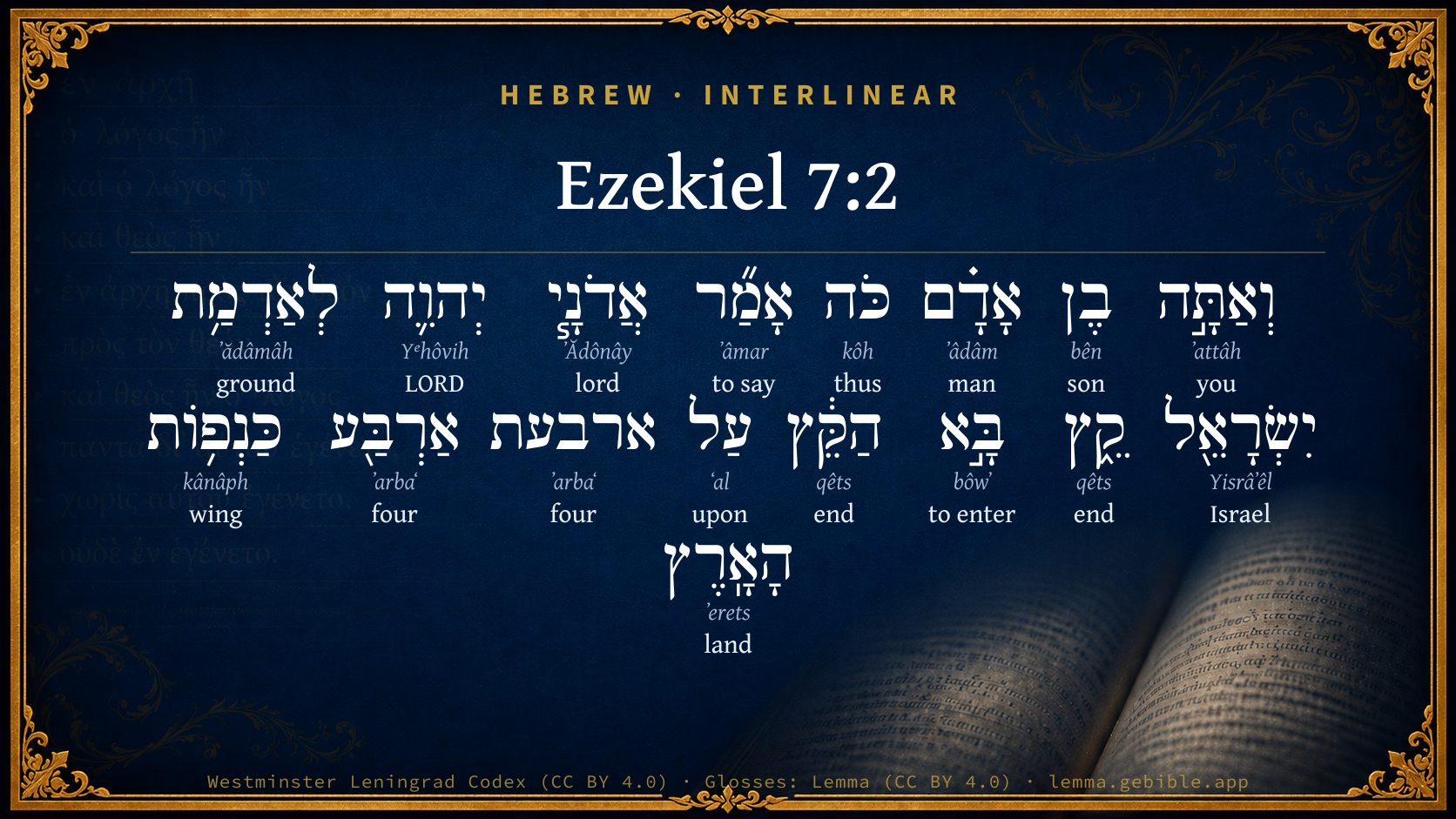
Hebrew (Westminster Leningrad Codex) Ezekiel 7:2 appears in the Hebrew Old Testament. The text above is from the Westminster Leningrad Codex. Each word links to its Strong’s number, a concise gloss, and parsing drawn from the Open Scriptures Hebrew Bible morphology. Click any word for its full Brown-Driver-Briggs (BDB) entry.
Download image
Cite this verse

Ezekiel 7:2 (World English Bible). Public Domain. Lemma interlinear Bible study tool, https://lemma.gebible.app/v/ezekiel/7/2.

Show BibTeX & RIS
BibTeX
RIS
English Translation
You, son of man, thus says the Lord Yahweh to the land of Israel, An end: the end is come on the four corners of the land.
World English Bible · Public Domain
Download a study sheet

One document with this verse’s original text, its word-by-word gloss line, the meaning frame, cross-references with their text, attributed commentary, and full source and license credits — printable, and it pastes into notes with its structure intact.

This verse Autodidact and up

Study sheet (.html) Plain text (.txt)

A passage Seminary Student

Up to 50 verses in one chapter. A passage sheet keeps up to 6 commentary sources and 12 cross-references per verse, in the order this page ranks them, and says so on the sheet whenever that leaves anything out. Ask for a single verse and you get the Autodidact verse sheet above.

Everything on this page stays free to read, with no account — the sheet is a download of what is already on screen, not access to it.

Want to remove ads? Support Godless Engineer
Compare translations 3

The same verse in 3 English versions, stacked beneath the original-language interlinear above. Click any original word for its lexicon entry.

Each is an independent rendering of the whole verse — the interlinear is not word-aligned to these translations.

Highlighted words mark where these versions differ — a whole-verse word diff, not a word-by-word alignment.

  • World English Bible Public Domain
    You, son of man, thus says the Lord Yahweh to the land of Israel, An end: the end is come on the four corners of the land.
  • King James Version Public Domain
    Also, thou son of man, thus saith the Lord GOD unto the land of Israel; An end, the end is come upon the four corners of the land.
  • unfoldingWord Literal Text CC BY-SA 4.0
    “You, son of man—the Lord Yahweh says this to the land of Israel.” ‘An end! An end has come to the four borders of the land.

unfoldingWord Literal Text — © unfoldingWord, licensed CC BY-SA 4.0. Word-aligned USFM3 via Door43 (git.door43.org/unfoldingWord/en_ult).

Versions to compare (up to 4)

3 of 4 selected

Show all 18 translations

Every available English version of this verse, each an independent rendering of the whole verse.

  • World English Bible Public Domain
    You, son of man, thus says the Lord Yahweh to the land of Israel, An end: the end is come on the four corners of the land.
  • Berean Standard Bible Public Domain
    “O son of man, this is what the Lord GOD says to the land of Israel: ‘The end! The end has come upon the four corners of the land.
  • Majority Standard Bible Public Domain
    “O son of man, this is what the Lord GOD says to the land of Israel: ‘The end! The end has come upon the four corners of the land.
  • King James Version Public Domain
    Also, thou son of man, thus saith the Lord GOD unto the land of Israel; An end, the end is come upon the four corners of the land.
  • American Standard Version (1901) Public Domain
    And thou, son of man, thus saith the Lord Jehovah unto the land of Israel, An end: the end is come upon the four corners of the land.
  • Revised Version (1885) Public Domain
    And thou, son of man, thus saith the Lord GOD unto the land of Israel, An end: the end is come upon the four corners of the land.
  • Geneva Bible (1599) Public Domain
    Also thou sonne of man, thus saith the Lord God, An ende is come vnto the lande of Israel: the ende is come vpon the foure corners of the lande.
  • Douay-Rheims (1899) Public Domain
    And thou son of man, thus saith the Lord God to the land of Israel: The end is come, the end is come upon the four quarters of the land.
  • Young's Literal Translation Public Domain
    An end, come hath the end on the four corners of the land.
  • Literal Standard Version CC BY-SA 4.0
    An end, the end has come on the four corners of the land.
  • Unlocked Literal Bible CC BY-SA 4.0
    “You, son of man—the Lord Yahweh says this to the land of Israel.” 'An end! An end has come to the four borders of the land.
  • unfoldingWord Literal Text CC BY-SA 4.0
    “You, son of man—the Lord Yahweh says this to the land of Israel.” ‘An end! An end has come to the four borders of the land.
  • Darby Bible Public Domain
    And thou, son of man, thus saith the Lord Jehovah unto the land of Israel: An end, the end is come upon the four corners of the land.
  • World Messianic Bible Public Domain
    “You, son of man, the Lord GOD says to Eretz-Israel, ‘An end! The end has come on the four corners of the land.
  • Webster's Bible Public Domain
    Also, thou son of man, thus saith the Lord GOD to the land of Israel; An end, the end is come upon the four corners of the land.
  • Free Bible Version CC BY-SA 4.0
    “Son of man, this is what the Lord God says to the people living in Israel: The end is here! The end has arrived throughout the country.
  • Bible in Basic English Public Domain
    And you, son of man, say, This is what the Lord has said to the land of Israel: An end has come, the end has come on the four quarters of the land.
  • JPS Tanakh (1917) Public Domain
    'And thou, son of man, thus saith the Lord GOD concerning the land of Israel: An end! the end is come upon the four corners of the land.

Literal Standard Version (2020), Covenant Press — licensed CC BY-SA 4.0. Text via the HelloAO Bible API (eBible.org). Unlocked Literal Bible (unfoldingWord) — licensed CC BY-SA 4.0. Text via the HelloAO Bible API (eBible.org). unfoldingWord Literal Text — © unfoldingWord, licensed CC BY-SA 4.0. Word-aligned USFM3 via Door43 (git.door43.org/unfoldingWord/en_ult). Free Bible Version, Dr. Jonathan Gallagher — licensed CC BY-SA 4.0. Text via the HelloAO Bible API (eBible.org).

Word by word

More ways to search: Search by grammar → Find every occurrence → Compare this word →

Practice this passage: Drill this verse → Learn its vocabulary →

קֵ֑ץ
qêts
H7093
“end”
Noun, Common, Masculine, Singular, Absolute
Part of Speech
Noun
Type
Common
Gender
Masculine
Number
Singular
State
Absolute
Full BDB Definition

Origin: contracted from H7112 , an extremity

TWOT: 2060a

end - end, at the end of (of time) - end (of space)
  1. וְאַתָּ֣ה ʼattâh H859 “and · you” Conjunction + Pronoun, Personal, 2nd Person, Masculine, Singular
  2. בֶן bên H1121 “son of” Noun, Common, Masculine, Singular, Construct
  3. אָדָ֗ם ʼâdâm H120 “man” Noun, Common, Masculine, Singular, Absolute
  4. כֹּה kôh H3541 “thus” Adverb
  5. אָמַ֞ר ʼâmar H559 “to say” Verb, Qal, Perfect, 3rd Person, Masculine, Singular
  6. אֲדֹנָ֧י ʼĂdônây H136 “Lord · my” Noun, Common, Masculine, Plural, Construct + Suffix, Personal, 1st Person, Common, Singular
  7. יְהוִ֛ה Yᵉhôvih H3069 “LORD” Noun, Proper
  8. לְאַדְמַ֥ת ʼădâmâh H127 “to/for · ground of” Preposition + Noun, Common, Feminine, Singular, Construct
  9. יִשְׂרָאֵ֖ל Yisrâʼêl H3478 “Israel” Noun, Proper
  10. בָּ֣א bôwʼ H935 “to enter” Verb, Qal, Perfect, 3rd Person, Masculine, Singular
  11. הַקֵּ֔ץ qêts H7093 “the · end” Particle, Definite Article + Noun, Common, Masculine, Singular, Absolute
  12. עַל ʻal H5921 “upon” Preposition
  13. ארבעת ʼarbaʻ H702 “four” Adjective, Cardinal number, Masculine, Singular, Construct
  14. אַרְבַּ֖ע ʼarbaʻ H702 “four” Adjective, Cardinal number, Feminine, Singular, Absolute
  15. כַּנְפ֥וֹת kânâph H3671 “wings of” Noun, Common, Feminine, Plural, Construct
  16. הָאָֽרֶץ ʼerets H776 “the · land” Particle, Definite Article + Noun, Common, Both, Singular, Absolute

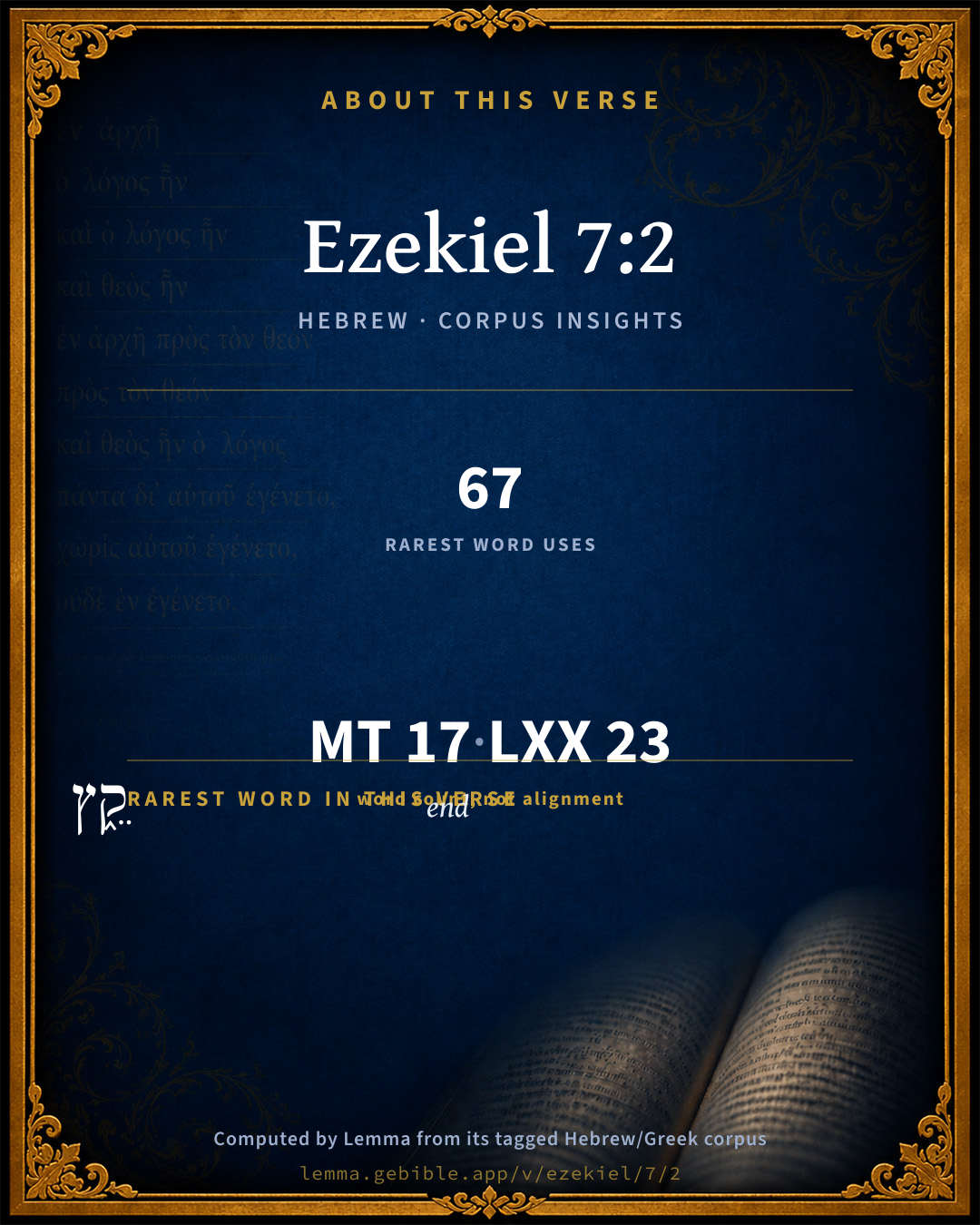
About this verse

These counts appear in no published source. They are computed here, from the morphology-tagged text and Lemma’s own curated glosses. What Lemma adds →

17
words
15
distinct lemmas
Prophets
section

Grammatical profile

  • 2 verbs
  • 10 nouns
  • 2 adjectives
  • 1 pronoun
  • 1 preposition
  • 1 adverb

Verb forms

  • אָמַ֞ר Qal · Perfect
  • בָּ֣א Qal · Perfect

Repetition

Words recur within this verse — often emphatic in Hebrew:

  • קֵ֑ץ end H7093 ×2
  • ארבעת four H702 ×2

Hebrew & Septuagint length

In English translation the verse runs 27 words from the Hebrew and 24 from the Septuagint (LXX English) — closely comparable.

A rough comparison of the two English renderings, which tokenize alike — not a word-level alignment.

Word counts can differ between the Hebrew and the Greek without any difference in meaning — e.g. the Hebrew direct-object marker אֵת has no separate Greek word, and Greek often adds the article ὁ.

In the original languages it is 17 Hebrew tokens and 23 Greek tokens — but the two are counted differently (Hebrew bundles its prefixes and suffixes into one token; the Greek is in lemma form), so that isn’t a like-for-like length.

Cross-references

18

Topical passages linked to Ezekiel 7:2 in the Treasury of Scripture Knowledge — connected by theme and wording, ordered by reader-vote popularity; previews shown in the World English Bible.

  • Amos 8:2 He said, "Amos, what do you see?" I said, "A basket of summer fruit." Then Yahweh said to me, "The end has come on my people Israel. I will not again pass by them any more.
  • Ezekiel 7:3 Now is the end on you, and I will send my anger on you, and will judge you according to your ways; and I will bring on you all your abominations.
  • Amos 8:10 I will turn your feasts into mourning, And all your songs into lamentation; And I will make you wear sackcloth on all your bodies, And baldness on every head. I will make it like the mourning for an only son, And the end of it like a bitter day.
  • 1 Peter 4:7 But the end of all things is near. Therefore be of sound mind, self-controlled, and sober in prayer.
  • Lamentations 4:18 They hunt our steps, so that we can't go in our streets: Our end is near, our days are fulfilled; for our end is come.
  • Ezekiel 7:5–6 Thus says the Lord Yahweh: An evil, an only evil; behold, it comes.
  • Ezekiel 11:13 It happened, when I prophesied, that Pelatiah the son of Benaiah died. Then fell I down on my face, and cried with a loud voice, and said, Ah Lord Yahweh! will you make a full end of the remnant of Israel?
  • Genesis 6:13 God said to Noah, "The end of all flesh has come before me, for the earth is filled with violence through them. Behold, I will destroy them with the earth.
  • Deuteronomy 32:20 He said, I will hide my face from them, I will see what their end shall be: For they are a very perverse generation, Children in whom is no faithfulness.
  • 2 Chronicles 34:7 He broke down the altars, and beat the Asherim and the engraved images into powder, and hewed down all the sun-images throughout all the land of Israel, and returned to Jerusalem.
  • Jeremiah 5:31 the prophets prophesy falsely, and the priests bear rule by their means; and my people love to have it so: and what will you do in the end of it?
  • Jeremiah 51:13 You who dwell on many waters, abundant in treasures, your end is come, the measure of your covetousness.
  • Lamentations 1:9 Her filthiness was in her skirts; she didn't remember her latter end; Therefore is she come down wonderfully; she has no comforter: See, Yahweh, my affliction; for the enemy has magnified himself.
  • Ezekiel 12:22 Son of man, what is this proverb that you have in the land of Israel, saying, The days are prolonged, and every vision fails?
  • Ezekiel 21:2 Son of man, set your face toward Jerusalem, and drop [your word] toward the sanctuaries, and prophesy against the land of Israel;
  • Ezekiel 40:2 In the visions of God brought he me into the land of Israel, and set me down on a very high mountain, whereon was as it were the frame of a city on the south.
  • Matthew 24:6 You will hear of wars and rumors of wars. See that you aren't troubled, for all this must happen, but the end is not yet.
  • Matthew 24:13–14 But he who endures to the end, the same will be saved.

Cross-references courtesy of OpenBible.info (CC BY 4.0).

Hebrew and Greek witnesses Masoretic Hebrew ↔ Greek Septuagint

The same verse in the two great witnesses to the Old Testament, shown verse-for-verse.

These are two independent witnesses, not word-aligned to each other, and the Septuagint is shown in lemma (dictionary) form.

Hebrew Ezekiel 7:2 Masoretic · Westminster Leningrad Codex

וְאַתָּ֣ה בֶן אָדָ֗ם כֹּה אָמַ֞ר אֲדֹנָ֧י יְהוִ֛ה לְאַדְמַ֥ת יִשְׂרָאֵ֖ל קֵ֑ץ בָּ֣א הַקֵּ֔ץ עַל ארבעת אַרְבַּ֖ע כַּנְפ֥וֹת הָאָֽרֶץ

You, son of man, thus says the Lord Yahweh to the land of Israel, An end: the end is come on the four corners of the land.

World English Bible · Public Domain

Greek LXX Ezekiel 7:2 Septuagint · lemma form

καί σύ υἱός ἄνθρωπος εἶπον ὅδε λέγω κύριος ὁ γῆ ὁ ἰσραήλ πέρας ἥκω ὁ πέρας ἥκω ἐπί ὁ τέσσαρες πτέρυξ ὁ γῆ

Thus says the Lord; An end is come to the land of Israel, the end is come on the four corners of the land.

LXX2012 (modern English Septuagint) · Public Domain

Hebrew: Westminster Leningrad Codex (CC BY 4.0). Greek: Septuagint (public domain); English from LXX2012 (modern English Septuagint) (Public Domain). How the Septuagint differs from the Hebrew →

Targum (Aramaic paraphrase)

1

The Targum is the ancient Jewish Aramaic paraphrase of the Hebrew Scriptures — an interpretive translation, not the Hebrew text itself. Onkelos (literal) and Pseudo-Jonathan (expansive) render the Torah, and Jonathan the Prophets. Coverage is partial: where no permissively-licensed English translation exists for a verse, only the Aramaic is shown. This is verse-level text, not a word-by-word alignment to the Hebrew.

  1. Targum Jonathan Prophets (Joshua–Malachi)
    וְאַתְּ בַּר אָדָם כִּדְנַן אֲמַר יְיָ אֱלֹהִים לְאַרְעָא דְיִשְׂרָאֵל קִצָא מְטָא מְטַת פּוּרְעֲנוּת קִצָא לְמֵיתֵי עַל אַרְבַּע רוּחֵי אַרְעָא:

    (no public-domain English translation for this verse)

    Targum Jonathan — Aramaic: “Mikraot Gedolot” (public domain). English: “Sefaria Community Translation” (CC0 1.0 (public-domain dedication)); “London "Chaldee Paraphrase," 1871” (public domain). Text via Sefaria.

Commentary

Notes on Ezekiel 7:2 from classic Christian and Jewish commentators (each source and its license shown beneath its notes). The classic Christian expositions comment on the surrounding passage and are grouped to its opening verse, so a note may address several verses; the Jewish commentaries on the Tanakh (Rashi and others) are per-verse, so they appear only where the commentator wrote on this verse.

Lemma curates 59 commentaries, every one of them public domain or Creative Commons licensed, each selected and text-cleaned for this edition rather than reprinted as found. About our sources →

The Cambridge Bible for Schools and Colleges

gen. ed. J. J. S. Perowne

2. Eze_7:2 might read: unto the land of Israel an end! the end is come upon, &c. Cf. Amo_8:2.

The Cambridge Bible for Schools and Colleges (gen. ed. J. J. S. Perowne; Cambridge University Press, 1878–1918) — public domain. Text from a community e-Sword module.

Trapp's Complete Commentary

John Trapp

Eze 7:2 Also, thou son of man, thus saith the Lord GOD unto the land of Israel; An end, the end is come upon the four corners of the land.

Ver. 2. An end, the end is come.] Exitium et excidium. Great kingdoms have their times and their turns, their rise and their ruin. The wicked’s happiness will take its end, surely and swiftly.

Upon the four corners of the land.] Heb., The four wings, called also the "four winds." {Mat 24:31} They had defiled the land from corner to corner; {as Ezr 9:11} God therefore now would sweep it all over with the besom of utter destruction.

John Trapp, A Commentary or Exposition upon All the Books of the Old and New Testament (1647–1656) — public domain. Text from a community e-Sword module.

Joseph Benson's Commentary

Eze 7:2-4. Thus saith the Lord unto the land of Israel — Unto the inhabitants of the land. Israel is often put for Judah, after the captivity of the ten tribes; those that were left of these tribes joining themselves to the tribe of Judah. The whole country of Judea is here comprehended. An end — An end of God’s patience, of the peace and welfare of the people, and of the plenty, beauty, and desirableness of the land itself; is come — Or is near at hand; even that dreadful end threatened by Moses and the prophets, as the certain punishment of idolatry and other violations of God’s law: upon the four corners of the land — Upon all parts of it. Now is the end come upon thee — There shall be no more delays. I will judge thee according to thy ways — I will punish thee according to thy deserts. Thine abominations shall be in the midst of thee — The punishment of thy sins shall be upon thee everywhere throughout thy land.

Joseph Benson's Commentary on the Old and New Testaments (1811–1818) — public domain. Text from a community e-Sword module.

Adam Clarke's Commentary

Verse 2. An end, the end is come] Instead of קץ בא הקץ kets ba hakkets, one MS. of Kennicott's, one of De Rossi's, and one of my own, read קץ בא בא הקץ kets ba, ba hakkets, "The end cometh, come is the end." This reading is supported by all the ancient Versions, and is undoubtedly genuine. The end COMETH: the termination of the Jewish state is coming, and while I am speaking, it is come. The destruction is at the door. The later hand, who put the vowel points to the ancient MS. that has the above reading, did not put the points to the flrst בא ba, but struck his pen gently across it, and by a mark in the margin intimated that it should be blotted out. All my ancient MSS. were without the points originally; but they have been added by modern hands, with a different ink; and they have in multitudes of instances corrected, or rather changed, important readings, to make them quadrate with the masora. But the original reading, in almost every case, is discernible.

The end is come upon the four corners of the land.] This is not a partial calamity; it shall cover and sweep the whole land. The cup of your iniquity is full, and my forbearing is at an end. This whole chapter is poetical.

Adam Clarke's Commentary on the Bible (1810–1826) — public domain. Text from a community e-Sword/MySword module.

Ellicott's Commentary for English Readers

(2) The four corners.—A frequent Scriptural phrase for every part. (Comp. Isa_11:12; Rev_7:1.) The origin of the expression is to be sought, not in any supposed popular belief that the earth was square, but in the fact that so many common things had just four sides or four corners (see Exo_25:12; Exo_27:2; Job_1:19; Act_10:11, &c), that the phrase came naturally to be a common expression of universality. “An end, the end,” is a repetition for the sake of emphasis. It occurs again in Eze_7:6, and, in varied words, also in Eze_7:10; Eze_7:12; Eze_7:26.

Eze_7:3-4 are repeated almost exactly in Eze_7:8-9. The frequent repetitions of this chapter are designed, and give great force to the denunciation of woe. “Thine abominations are in the midst of thee,” in the sense of calling down punishment upon them, as appears from the parallel in Eze_7:9.

A Bible Commentary for English Readers, edited by Charles John Ellicott (1878–1897) — public domain. Text from a community e-Sword module.

John Gill's Exposition

Now is the end come upon thee,.... This is repeated for the confirmation of it, and for the sake of application of it to the people of Israel, of whom he had before spoken in the third person; but now in the second, in order to arouse them, and excite attention:

and I will send mine anger upon thee; the token of it, the punishment of their sins:

and I will judge thee according to thy ways; pass sentence, and execute it, as their evil ways and practices deserved:

and I will recompense, or "put upon thee" (f),

all thine abominations; cause them to bear as a burden the just punishment of their detestable iniquities; which would be more than they would be able to bear, though not more than they deserved.

(f) "ponam super te", Pagninus; "dabo super te", Montanus; "reponam super te", Junius & Tremellius, Polanus.

John Gill's Exposition of the Whole Bible (1746–1763) — public domain (CC PDM 1.0). Text via the HelloAO Bible API.

Haydock's Catholic Bible Commentary

Israel, or Judea, in all its parts. (Worthington) --- In five or six years’ time all shall be destroyed.

George Leo Haydock (1774–1849), Haydock's Catholic Family Bible and Commentary, 1859 edition — public domain. Excludes Psalms (Douay-Rheims chapter numbering differs from Protestant) and Deuterocanonical books (Catholic canon only).

Matthew Poole's English Annotations

Unto the land; the inhabitants who had sinned, and also to the land wherein they sinned.

An end, end of God’s patience, of the peace and welfare of the people, and of the plenty, beauty, and desirableness of the land itself, is come, or is near at hand.

The end; that dreadful end I threatened against you, and which you will find in the execution of the menaces pronounced against you by the former and latter prophets.

Upon the four corners; it is an overflowing misery, that spreads over all the land.

Matthew Poole's English Annotations on the Holy Bible (1683–1685) — public domain. Text from a community e-Sword/MySword module.

Whedon's Commentary on the Bible

Daniel D. Whedon

2, 3. The time for repentance is quickly passing or is already past. The end is at hand. Jehovah’s righteous anger will be followed quickly with judgment, and the sins of the people will be their rod of punishment; “I will put upon thee all thine abominations.”

Daniel D. Whedon (gen. ed.), Commentary on the Old and New Testaments (1874–1909) — public domain. Text from a community e-Sword module.

The Pulpit Commentary

An end, etc. The iteration of the word once more gives emphasis. The words read like an echo of Amo_8:2. The four corners (Hebrew, "wings") were probably, as with us, the north, east, south, and west. The phrase had been used before in Isa_11:12, and the thought meets us again, in the form of the "four winds," in Dan_11:4; Zec_2:6; Mat_24:31; Mar_13:27. The "end" in this case is either that of the siege of Jerusalem, or that of the existence of Israel as a nation. It was now drawing nigh was, as we say, within measurable distance.

HOMILETICS.

The end is come.

I THE END THAT SURELY COMES. Time is broken into periods; and every period, long or short, has its certain end. The tale of life is written in many chapters, each with its own appropriate conclusion; in some cases the conclusion is violent, abrupt, and startling. We are surprised out of an old settled course. The mill stops suddenly, and then the silence is alarming. There are the greater epochs of life, when a whole volume of experience is closed, and another must be opened, till at length we reach Finis. But every day has its sunset. Every year runs out to December and dies its wintry death, in spite of all the festivities of Christmas. Youth is fleeting; its sweet springtime fast melts, its blossoms fade and fall. Life itself runs out and reaches an end. As each period goes it vanishes, never to return. Thus Christina Rossetti writes

Come, gone, gone forever; Gone as an unreturning truer; Gone as to death the merriest liver; Gone as the year at the dying fall, Tomorrow, today, yesterday, never: Gone once for all.

1. There is an end to the day of work. "The night cometh, wherein no man can work." The opportunity will pass. Let us make the most of our strength and time while we have them.

2. There is an end to the freedom of sin. The orgies of mad self-indulgence will not last forever. They burn themselves out in folly and shame. Then comes the end, and after that the reckoning.

3. There is an end to the discipline of sorrow. The pain will not last forever. The doubt and mystery and darkness are not eternal. The Christian pilgrimage is long and weary, but it is not an infinite, endless course. The wilderness is wide, and the goal far off. But the way will end at last in the heavenly city, the home of the soul.

II THE END THAT SHOULD COME. There are some things which we should do welt to end, yet still they are with us.

1. An end should come to our life of sin. The old sin has been our companion for years, a bad companion, corrupt and corrupting. It is time we and it parted. It is time we turned over a new leaf and began a better way. The old self has lived too long. Let it die and be buried.

2. An end should come to our indecision. "How long halt ye between two opinions?" This hesitation has lasted too long. "Choose you this day whom ye will serve.

3. An end should come to the gloom of doubt, the coldness of half-hearted service, the lethargy and paralysis of an unspiritual religion. "The night is far spent; the day is at hand;" "Awake, thou that sleepest!

III THE END THAT MAY COME. We contemplate possible endings which we would fain avert, but which seem to be approaching.

1. Some of these endings are within our power, and should be kept off. We should guard against an end to our early faith and zeal. Ephraim"s goodness, which was like the morning cloud, was soon dissipated. Of some it must be said the end has come to their fervent devotion and self-sacrificing service. Once they were bright lights of the Church, but they have waned, and are approaching spiritual night.

2. Some of these endings are beyond our control. The home circle may be broken, the dear countenances of the loved may smile upon us no more. For the old fulness of friendship we may have left only blankness and vacancy, and a bitter sense of loss. The very freshness of our soul may be lost too, and thee we look back to the old sweet years, and wonder how we could have taken them so quietly.

IV THE END THAT WILL FEVER COME.

1. There will never be an end to the righteous Law of God. Right and truth are eternal. We can never outlive their claims. If we continue forever in opposition to them, their pains and penalties must be always ours.

2. The love of God will never end. Modes of Divine operations may change as circumstances alter, and new dispensations may succeed to old dispensations new covenants taking the place of old covenants. But God does not change. There is no end to him. He abideth faithful. In the wreck of the universe the Rock of Ages remains unshaken. Love in his essence, God never wearies in helping and blessing. There is no end to his grace. "The mercy of the Lord endureth forever." Whenever the helpless, penitent prodigal returns, he will find his Father waiting to welcome him.

3. The eternal life can have no end. The body dies. Happily there will be an end to that. But the life in God abides forever. In that life many things thought to be ended here on earth will be recovered and will revive. Thus our past experience is not utterly lost. It lives in memory and in what it has made us. A German poet writes

Yesterday I loved; Today I suffer; Tomorrow I die. But I shall gladly, Today and tomorrow Think on yesterday.

The Pulpit Commentary (1880–1919), ed. H.D.M. Spence-Jones & Joseph S. Exell — public domain. Text from a community e-Sword module.

Rashi

Rabbi Shlomo Yitzchaki (Rashi)

The end has come Because I had said (Deut. 4:25): “and you will have grown old (וְנוֹשַּׁנְתֶּם) in the land, and you will practice corruption, etc., so that you will be lost.” [The word] וְנוֹשַּׁנְתֶּם has the numerical value of 852, but they stayed there for [only] 850 years: 440 from the time they entered it until the Temple was built, and [then] the Temple stood 410 years.

Rashi on the Tanakh — English translations: “The Judaica Press complete Tanach with Rashi, translated by A. J. Rosenberg” (CC BY 4.0); “Pentateuch with Rashi's commentary by M. Rosenbaum and A.M. Silbermann, 1929-1934” (public domain); “The Metsudah Tanach series, Lakewood, N.J” (CC BY 4.0); and “The Book of Joshua, Metsudah Publications, 1997” (CC BY 4.0). Text via Sefaria.

Lesson kit

Teaching starters — assembled from the data on this page, not authored interpretation. Every prompt links to the verse data it draws on. Edit before teaching.

Ezekiel, in the Prophets, opens this verse with 17 words (15 distinct Hebrew lemmas). Its most distinctive word is qêts (“end”). A historical commentator’s framing appears above. Read the whole chapter for the surrounding context.

Discussion questions

  1. The word qêts carries the sense “end.” How does it shape the verse?
  2. Amos 8:2 shares this passage’s theme. How do the two illuminate each other?
  3. “end” occurs 2× in this one verse. What is the effect of the repetition?
  4. These translations render this verse differently; the difference is in the English rendering, not the original. What questions does that raise?
  5. The verb «אָמַ֞ר» is Qal Perfect. How does its form color the action?
  6. Reading how The Cambridge Bible for Schools and Colleges and Trapp's Complete Commentary read this verse, where do the two commentators agree and where do they part?

Things to notice

Reading settings

Reading text

Shown beneath each verse's original-language words.

Old Testament
Old Testament edition

Read the OT as the Masoretic Hebrew (MT) or the Greek Septuagint (LXX).

English shown for the Greek Septuagint (in the Hebrew ↔ Greek comparison).

Comparing translations? Open the Compare panel on any verse page to stack up to four side by side.