
Psalms 83:10

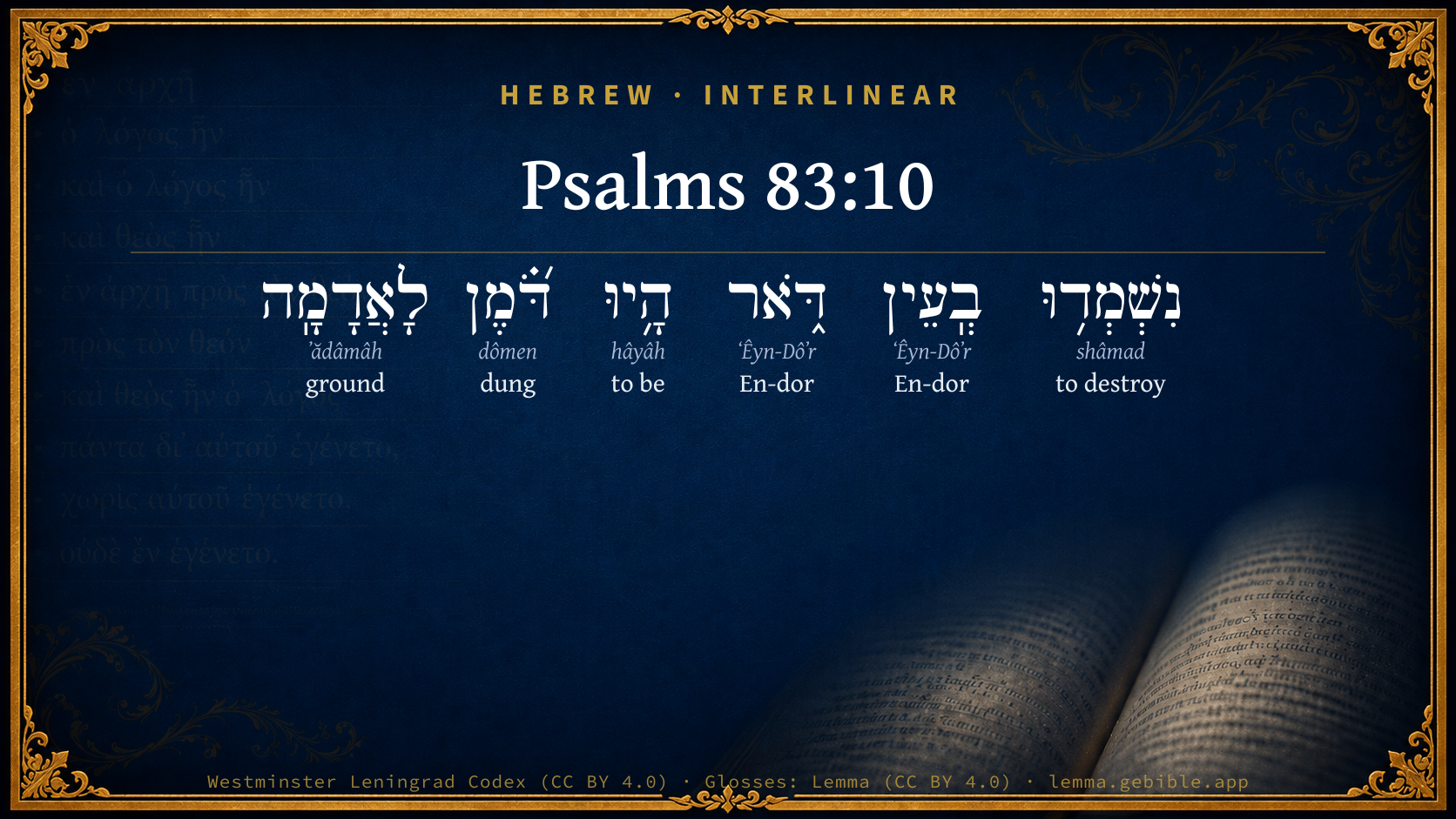
Hebrew (Westminster Leningrad Codex) Psalms 83:10 appears in the Hebrew Old Testament. The text above is from the Westminster Leningrad Codex. Each word links to its Strong’s number, a concise gloss, and parsing drawn from the Open Scriptures Hebrew Bible morphology. Click any word for its full Brown-Driver-Briggs (BDB) entry.
Download image
Cite this verse

Psalms 83:10 (World English Bible). Public Domain. Lemma interlinear Bible study tool, https://lemma.gebible.app/v/psalms/83/10.

Show BibTeX & RIS
BibTeX
RIS
English Translation
Who perished at Endor, Who became as dung for the earth.
World English Bible · Public Domain
Download a study sheet

One document with this verse’s original text, its word-by-word gloss line, the meaning frame, cross-references with their text, attributed commentary, and full source and license credits — printable, and it pastes into notes with its structure intact.

This verse Autodidact and up

Study sheet (.html) Plain text (.txt)

A passage Seminary Student

Up to 50 verses in one chapter. A passage sheet keeps up to 6 commentary sources and 12 cross-references per verse, in the order this page ranks them, and says so on the sheet whenever that leaves anything out. Ask for a single verse and you get the Autodidact verse sheet above.

Everything on this page stays free to read, with no account — the sheet is a download of what is already on screen, not access to it.

Want to remove ads? Support Godless Engineer
Compare translations 3

The same verse in 3 English versions, stacked beneath the original-language interlinear above. Click any original word for its lexicon entry.

Each is an independent rendering of the whole verse — the interlinear is not word-aligned to these translations.

Highlighted words mark where these versions differ — a whole-verse word diff, not a word-by-word alignment.

  • World English Bible Public Domain
    Who perished at Endor, Who became as dung for the earth.
  • King James Version Public Domain
    Which perished at Endor: they became as dung for the earth.
  • unfoldingWord Literal Text CC BY-SA 4.0
    They were destroyed at En Dor; they became dung for the ground.

unfoldingWord Literal Text — © unfoldingWord, licensed CC BY-SA 4.0. Word-aligned USFM3 via Door43 (git.door43.org/unfoldingWord/en_ult).

Versions to compare (up to 4)

3 of 4 selected

Show all 18 translations

Every available English version of this verse, each an independent rendering of the whole verse.

  • World English Bible Public Domain
    Who perished at Endor, Who became as dung for the earth.
  • Berean Standard Bible Public Domain
    who perished at Endor and became like dung on the ground.
  • Majority Standard Bible Public Domain
    who perished at Endor and became like dung on the ground.
  • King James Version Public Domain
    Which perished at Endor: they became as dung for the earth.
  • American Standard Version (1901) Public Domain
    Who perished at Endor, Who became as dung for the earth.
  • Revised Version (1885) Public Domain
    Which perished at En-dor; they became as dung for the earth.
  • Geneva Bible (1599) Public Domain
    They perished at En-dor, and were dung for the earth.
  • Douay-Rheims (1899) Public Domain
    Do to them as thou didst to Madian and to Sisara: as to Jabin at the brook of Cisson.
  • Young's Literal Translation Public Domain
    They were destroyed at Endor, They were dung for the ground!
  • Literal Standard Version CC BY-SA 4.0
    They were destroyed at Endor, || They were dung for the ground!
  • Unlocked Literal Bible CC BY-SA 4.0
    They perished at Endor and became like manure for the earth.
  • unfoldingWord Literal Text CC BY-SA 4.0
    They were destroyed at En Dor; they became dung for the ground.
  • Darby Bible Public Domain
    Who were destroyed at Endor; they became as dung for the ground.
  • World Messianic Bible Public Domain
    who perished at Endor, who became as dung for the earth.
  • Webster's Bible Public Domain
    \\83:9\\Do to them as to the Midianites; as to Sisera, as to Jabin, at the brook of Kison:
  • Free Bible Version CC BY-SA 4.0
    They were destroyed at Endor and became like manure to fertilize the ground.
  • Bible in Basic English Public Domain
    Who came to destruction at En-dor; their bodies became dust and waste.
  • JPS Tanakh (1917) Public Domain
    (83-11) Who were destroyed at En-dor; they became as dung for the earth.

Literal Standard Version (2020), Covenant Press — licensed CC BY-SA 4.0. Text via the HelloAO Bible API (eBible.org). Unlocked Literal Bible (unfoldingWord) — licensed CC BY-SA 4.0. Text via the HelloAO Bible API (eBible.org). unfoldingWord Literal Text — © unfoldingWord, licensed CC BY-SA 4.0. Word-aligned USFM3 via Door43 (git.door43.org/unfoldingWord/en_ult). Free Bible Version, Dr. Jonathan Gallagher — licensed CC BY-SA 4.0. Text via the HelloAO Bible API (eBible.org).

Word by word

More ways to search: Search by grammar → Find every occurrence → Compare this word →

Practice this passage: Drill this verse → Learn its vocabulary →

About this verse

These counts appear in no published source. They are computed here, from the morphology-tagged text and Lemma’s own curated glosses. What Lemma adds →

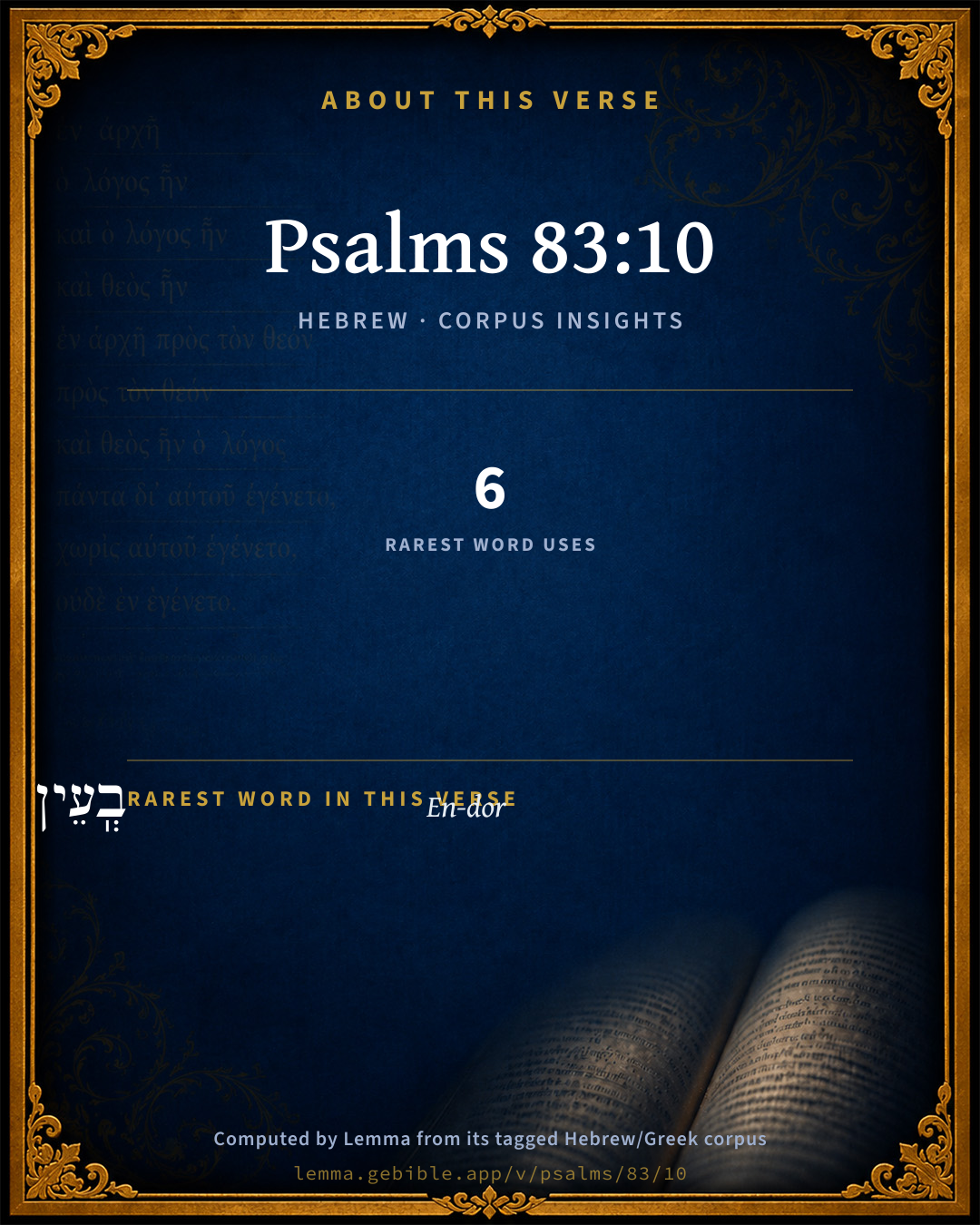
6
words
5
distinct lemmas
Wisdom
section

Notable vocabulary

The rarest word here is בְֽעֵין En-dor H5874 — appearing just 6 times in the whole Hebrew Bible.

Shared distinctive vocabulary

בְֽעֵין En-dor H5874 occurs in 3 verses of the Hebrew Bible. Also found in:

Grammatical profile

  • 2 verbs
  • 4 nouns

Verb forms

  • נִשְׁמְד֥וּ Niphal · Perfect
  • הָ֥יוּ Qal · Perfect

Repetition

A word recurs within this verse — often emphatic in Hebrew:

  • בְֽעֵין En-dor H5874 ×2

Hebrew & Septuagint length

In English translation the verse runs 11 words from the Hebrew and 13 from the Septuagint (LXX English) — closely comparable.

A rough comparison of the two English renderings, which tokenize alike — not a word-level alignment.

Word counts can differ between the Hebrew and the Greek without any difference in meaning — e.g. the Hebrew direct-object marker אֵת has no separate Greek word, and Greek often adds the article ὁ.

Cross-references

6

Topical passages linked to Psalms 83:10 in the Treasury of Scripture Knowledge — connected by theme and wording, ordered by reader-vote popularity; previews shown in the World English Bible.

  • Zephaniah 1:17 I will bring distress on men, that they will walk like blind men, because they have sinned against Yahweh, and their blood will be poured out like dust, and their flesh like dung.
  • Joshua 17:11 Manasseh had in Issachar and in Asher Beth-shean and its towns, and Ibleam and its towns, and the inhabitants of Dor and its towns, and the inhabitants of En-dor and its towns, and the inhabitants of Taanach and its towns, and the inhabitants of Megiddo and its towns, even the three heights.
  • 1 Samuel 28:7 Then said Saul to his servants, Seek me a woman who has a familiar spirit, that I may go to her, and inquire of her. His servants said to him, Behold, there is a woman who has a familiar spirit at En-dor.
  • 2 Kings 9:37 and the body of Jezebel shall be as dung on the face of the field in the portion of Jezreel, so that they shall not say, This is Jezebel.
  • Jeremiah 8:2 and they shall spread them before the sun, and the moon, and all the host of the sky, which they have loved, and which they have served, and after which they have walked, and which they have sought, and which they have worshiped: they shall not be gathered, nor be buried, they shall be for dung on the surface of the earth.
  • Jeremiah 16:4 They shall die grievous deaths: they shall not be lamented, neither shall they be buried; they shall be as dung on the surface of the ground; and they shall be consumed by the sword, and by famine; and their dead bodies shall be food for the birds of the sky, and for the animals of the earth.

Cross-references courtesy of OpenBible.info (CC BY 4.0).

Hebrew and Greek witnesses Masoretic Hebrew ↔ Greek Septuagint

The same verse in the two great witnesses to the Old Testament, shown verse-for-verse.

You’re reading Greek Psalm 82 (Hebrew Psalm 83). The Septuagint counts the superscription, so verse numbers can differ from the Hebrew — chapter-level alignment, not verse-by-verse. Numbering follows Rahlfs.

These are two independent witnesses, not word-aligned to each other, and the Septuagint is shown in lemma (dictionary) form.

Hebrew Psalms 83:10 Masoretic · Westminster Leningrad Codex

נִשְׁמְד֥וּ בְֽעֵין דֹּ֑אר הָ֥יוּ דֹּ֝֗מֶן לָאֲדָמָֽה

Who perished at Endor, Who became as dung for the earth.

World English Bible · Public Domain

Greek LXX Greek Psalm 82:10 Septuagint · lemma form

ποιέω αὐτός ὡς ὁ μαδιαμ καί ὁ σισαρα ὡς ὁ ιαβιν ἐν ὁ χειμάρρους κισων

They were utterly destroyed at Aendor: they became as dung for the earth.

LXX2012 (modern English Septuagint) · Public Domain

Hebrew: Westminster Leningrad Codex (CC BY 4.0). Greek: Septuagint (public domain); English from LXX2012 (modern English Septuagint) (Public Domain). How the Septuagint differs from the Hebrew →

Commentary

Notes on Psalms 83:10 from classic Christian and Jewish commentators (each source and its license shown beneath its notes). The classic Christian expositions comment on the surrounding passage and are grouped to its opening verse, so a note may address several verses; the Jewish commentaries on the Tanakh (Rashi and others) are per-verse, so they appear only where the commentator wrote on this verse.

Lemma curates 59 commentaries, every one of them public domain or Creative Commons licensed, each selected and text-cleaned for this edition rather than reprinted as found. About our sources →

Trapp's Complete Commentary

John Trapp

Psa 83:10 [Which] perished at Endor: they became [as] dung for the earth.

Ver. 10. Which perished at Endor] A place in the tribe of Manasseh near unto that ancient river, the river Kison, Jos 17:11 1Sa 28:7

They became as dunq] They lay unburied, rotted above ground, and were spread as compost upon soil.

John Trapp, A Commentary or Exposition upon All the Books of the Old and New Testament (1647–1656) — public domain. Text from a community e-Sword module.

Joseph Benson's Commentary

Psa 83:10-12. Which perished at En-dor — Either, 1st, The Midianites; or rather, Jabin and Sisera, who were overthrown at Taanach and Megiddo, (Jdg 5:19,) nigh unto which places was this En-dor, as appears from Jos 17:11. They became as dung upon the earth — They were trodden under foot, and their carcasses left unburied. Who said, Let us take to ourselves the houses of God — The houses and lands of the Israelites, which their God, as they say, gave them in Canaan; but to which they have no rightful title. This was formerly objected by the Ammonites, as we see Jdg 11:13, and the Ammonites were a chief party in this war. So they seem to call them houses of God by way of irony and derision.

Joseph Benson's Commentary on the Old and New Testaments (1811–1818) — public domain. Text from a community e-Sword module.

J. A. Alexander on Psalms

Joseph Addison Alexander

11. (Psa 83:10). They were destroyed at Endor, they were dung to the earth. This refers to the second of the battles mentioned in the preceding verse. Endor is not expressly named in the history, but is known to have been in the vicinity of Tabor, which is repeatedly there mentioned (Jdg 4:6; Jdg 4:12; Jdg 4:14). The last clause derives illustration from the extraordinary fruitfulness of certain battle-fields in modern times, particularly that of Waterloo. Compare 2Ki 9:37, Jer 9:22.

Joseph Addison Alexander, The Psalms Translated and Explained (1850) — public domain. Text from a community e-Sword module.

Geneva Bible (1599)

Geneva Bible translators

Trodden under feet as mire.

Geneva Bible (1599) marginal notes — public domain. Text via Bolls.life.

Adam Clarke's Commentary

Verse 10. Perished at En-dor] This refers to the defeat of the Midianites by Gideon, who were encamped in the valley of Jezreel, at the foot of Mount Gilboa, and near to Tabor, Jdg 6:33; Jdg 7:1, and consequently in the environs of En-dor. There Gideon attacked and defeated them; and, in various places during their flight, they were destroyed, and left to rot upon the earth. Jdg 7:22-25.

Adam Clarke's Commentary on the Bible (1810–1826) — public domain. Text from a community e-Sword/MySword module.

Ellicott's Commentary for English Readers

(10) En-dor.—This place, for which see 1 Samuel 28, is not mentioned in Judges 4, but is in the battle-field not far from the Taanach and Megiddo of Deborah’s song. (Robinson, iii. 224)

A Bible Commentary for English Readers, edited by Charles John Ellicott (1878–1897) — public domain. Text from a community e-Sword module.

The Cambridge Bible for Schools and Colleges

gen. ed. J. J. S. Perowne

10. En-dor is not mentioned in the narrative of Judges, but it was situated in the same valley as Taanach and Megiddo, which are named in Jdg_5:19, and is mentioned along with them in Jos_17:11.

as dung] Omit as. A contemptuous expression for the fate of un-buried corpses. Cp 2Ki_9:37; Jer_8:2; &c.

The Cambridge Bible for Schools and Colleges (gen. ed. J. J. S. Perowne; Cambridge University Press, 1878–1918) — public domain. Text from a community e-Sword module.

John Gill's Exposition

Which perished at Endor,.... Aben Ezra and Kimchi understand this of the Midianites; but rather it is to be understood of Jabin and Sisera, and the army under them, who perished at this place, which is mentioned along with Taanach and Megiddo, Jos 17:11, which are the very places where the battle was fought between Jabin and Israel, Jdg 5:19 according to Jerom (i), it was four miles from Mount Tabor to the south, and was a large village in his days, and was near to Nain, the place where Christ raised the widow's son from the dead, Luk 7:11.

they became as dung for the earth; being unburied, they lay and rotted on the earth, and became dung for it; see Jer 8:2, or were trodden under foot, as dung upon the earth; so the Targum,

"they became as dung trodden to the earth.''

(i) De locis Hebraicis, fol. 88. L. and 91. E.

John Gill's Exposition of the Whole Bible (1746–1763) — public domain (CC PDM 1.0). Text via the HelloAO Bible API.

Albert Barnes' Notes on the Bible

Which perished at En-dor - Endor is not particularly mentioned in the history of the transaction in the book of Judges, but it is known that Endor was in the vicinity of Mount Tabor, and there is no improbability in the tradition which has fixed the site of the battle at or near Endor. The word or name “En-dor” means properly fount of the dwelling (or, habitation), and was probably given at first to a spring or fountain near to which some distinguished or well-known person dwelt. It is mentioned in Jos 17:11; 1Sa 28:7.

They became as dung for the earth - The land was enriched or made fertile by their flesh, their blood, and their bones, as the field of Waterloo was by that of the slain, or as fields of battle commonly are.

Albert Barnes' Notes on the Bible (1834–1885) — public domain. Text from a community e-Sword/MySword module.

Matthew Poole's English Annotations

Which perished at En-dor: either,

1. The Midianites. Or rather,

2. Jabin and Sisera, who were overthrown near Taanach and Megiddo, Jdg 5:19, nigh unto which places was this En-dor, as appears from Jos 17:11.

They became as dung for the earth; they were trodden under foot, and their carcasses left unburied. Compare 2Ki 9:37; Jer 8:2; 16:4.

Matthew Poole's English Annotations on the Holy Bible (1683–1685) — public domain. Text from a community e-Sword/MySword module.

The Treasury of David

Charles H. Spurgeon

Ver. 10. Which perished at Endor. There was the centre of the carnage, where the heaps of the slain lay thickest.

They became as dung for the earth, manuring it with man; making the earth, like Saturn, feed on its own children. War is cruel, butt in this case it avengements were most just, those who would not give Israel a place above ground are themselves denied a hiding place under the ground; they counted God's people to be as dung, and they became dung themselves. Asaph would have the same fate befell other enemies of Israel; and his prayer was a prophecy, for so it happened to them.

Ver. 10. They became as dung for the earth. The land was enriched or made fertile by their flesh, their blood, and their bones. Albert Barnes.

Ver. 10. They became as dung for the earth. In the year 1830, it is estimated that more than a million bushels of "human and inhuman bones" were imported from the continent of Europe into the port of Hull. The neighbourhood of Leipsic, Austerlitz, Waterloo, etc., where the principal battles were fought some fifteen or twenty years before, were swept alike of the bones of the hero, and the horse which he rode. Thus collected from every quarter, they were shipped to Hull, and thence forwarded to the Yorkshire bone grinders, who, by steam engines and powerful machinery, reduced them to a granulary state. In this condition they were sent chiefly to Doncaster, one of the largest agricultural markets of the country, and were there sold to the farmers to manure their lands. The oily substance gradually evolving as the bone calcines, makes better manure than almost any other substanceparticularly human bones. K. Arvine.

None.

Psalms 83:11*

Charles H. Spurgeon's The Treasury of David (1869–1885) — public domain. Psalms only. Text from a community e-Sword/MySword module.

Whedon's Commentary on the Bible

Daniel D. Whedon

10. Which perished at Endor—The battle, which began at Kishon, reached its crisis at Endor, eight miles east, where the flight began.

Daniel D. Whedon (gen. ed.), Commentary on the Old and New Testaments (1874–1909) — public domain. Text from a community e-Sword module.

The Pulpit Commentary

Which perished at Endor. "Endor" is not mentioned in the narrative of Judges; but it was certainly in the neighbourhood of Taanah and Megiddo, which are mentioned. (Jud_1:5:19; see Jos_17:11) They became as dung for the earth; i.e. their carcases manured the soil. (comp. 2Ki_9:37 Zep_1:17)

The Pulpit Commentary (1880–1919), ed. H.D.M. Spence-Jones & Joseph S. Exell — public domain. Text from a community e-Sword module.

Rashi

Rabbi Shlomo Yitzchaki (Rashi)

Do to them as [to] Midian through Gideon.

as [to] Sisera through Barak.

Rashi on the Tanakh — English translations: “The Judaica Press complete Tanach with Rashi, translated by A. J. Rosenberg” (CC BY 4.0); “Pentateuch with Rashi's commentary by M. Rosenbaum and A.M. Silbermann, 1929-1934” (public domain); “The Metsudah Tanach series, Lakewood, N.J” (CC BY 4.0); and “The Book of Joshua, Metsudah Publications, 1997” (CC BY 4.0). Text via Sefaria.

Lesson kit

Teaching starters — assembled from the data on this page, not authored interpretation. Every prompt links to the verse data it draws on. Edit before teaching.

Psalms, in the Wisdom, opens this verse with 6 words (5 distinct Hebrew lemmas). Its most distinctive word is ʻÊyn-Dôʼr (“En-dor”). A historical commentator’s framing appears above. Read the whole chapter for the surrounding context.

Discussion questions

  1. What does “En-dor” (ʻÊyn-Dôʼr) contribute to the verse as a whole?
  2. Joshua 17:11 shares the word «En-dor» with this verse. How do the two illuminate each other?
  3. “En-dor” occurs 2× in this one verse. What is the effect of the repetition?
  4. These translations render this verse differently; the difference is in the English rendering, not the original. What questions does that raise?
  5. The verb «נִשְׁמְד֥וּ» is Niphal Perfect. How does its form color the action?
  6. Reading how Trapp's Complete Commentary and Joseph Benson's Commentary read this verse, where do the two commentators agree and where do they part?

Things to notice

  • These translations choose different wording for 9 words in this verse.
  • “En-dor” occurs 2× in this single verse.
  • 5 distinct Hebrew lemmas span 6 words in this verse.

Reading settings

Reading text

Shown beneath each verse's original-language words.

Old Testament
Old Testament edition

Read the OT as the Masoretic Hebrew (MT) or the Greek Septuagint (LXX).

English shown for the Greek Septuagint (in the Hebrew ↔ Greek comparison).

Comparing translations? Open the Compare panel on any verse page to stack up to four side by side.