
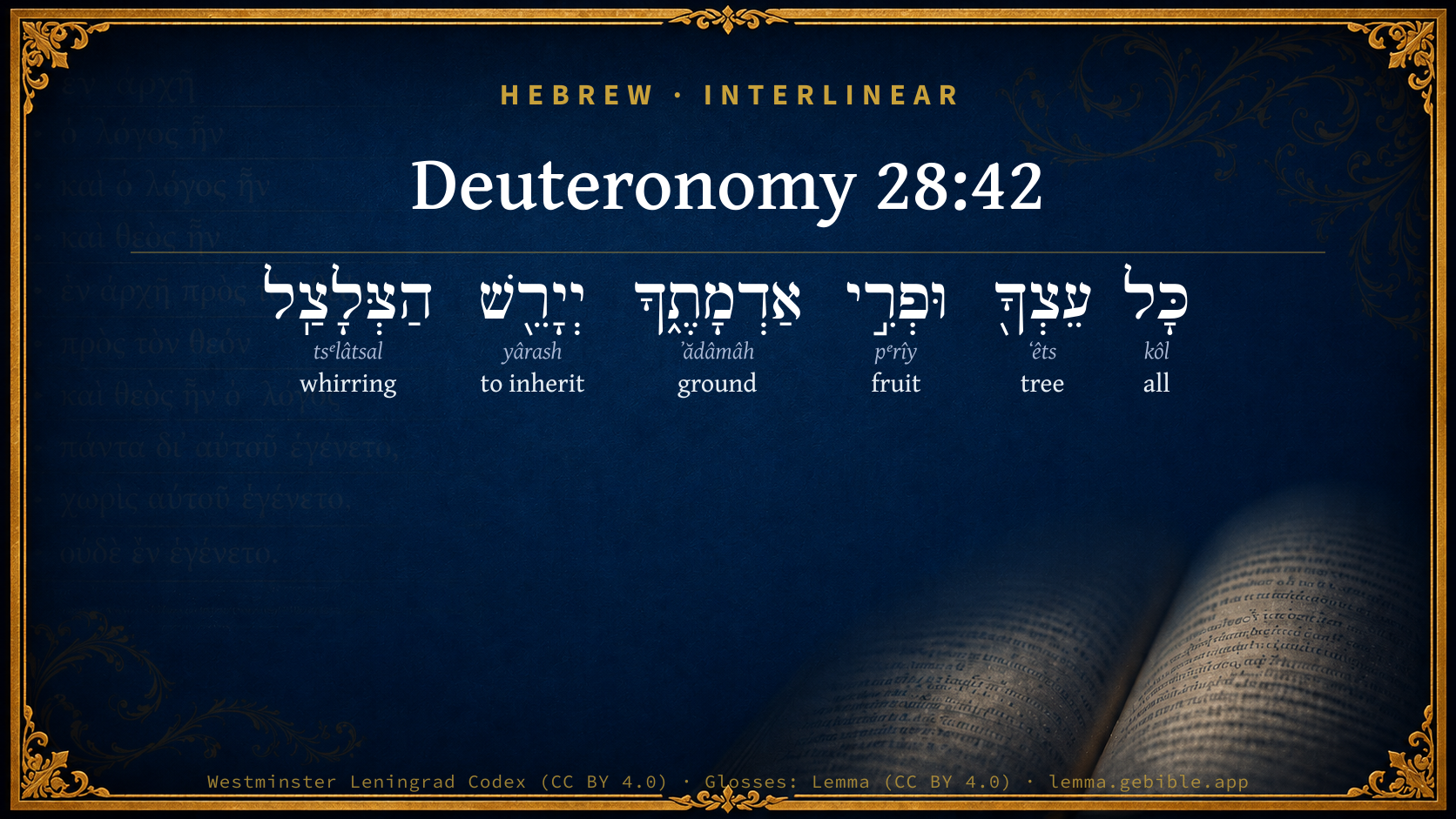
Deuteronomy 28:42

Hebrew (Westminster Leningrad Codex) Deuteronomy 28:42 appears in the Hebrew Old Testament. The text above is from the Westminster Leningrad Codex. Each word links to its Strong’s number, a concise gloss, and parsing drawn from the Open Scriptures Hebrew Bible morphology. Click any word for its full Brown-Driver-Briggs (BDB) entry.
Download image
Cite this verse

Deuteronomy 28:42 (World English Bible). Public Domain. Lemma interlinear Bible study tool, https://lemma.gebible.app/v/deuteronomy/28/42.

Show BibTeX & RIS
BibTeX
RIS
English Translation
All your trees and the fruit of your ground shall the locust possess.
World English Bible · Public Domain
Highlights
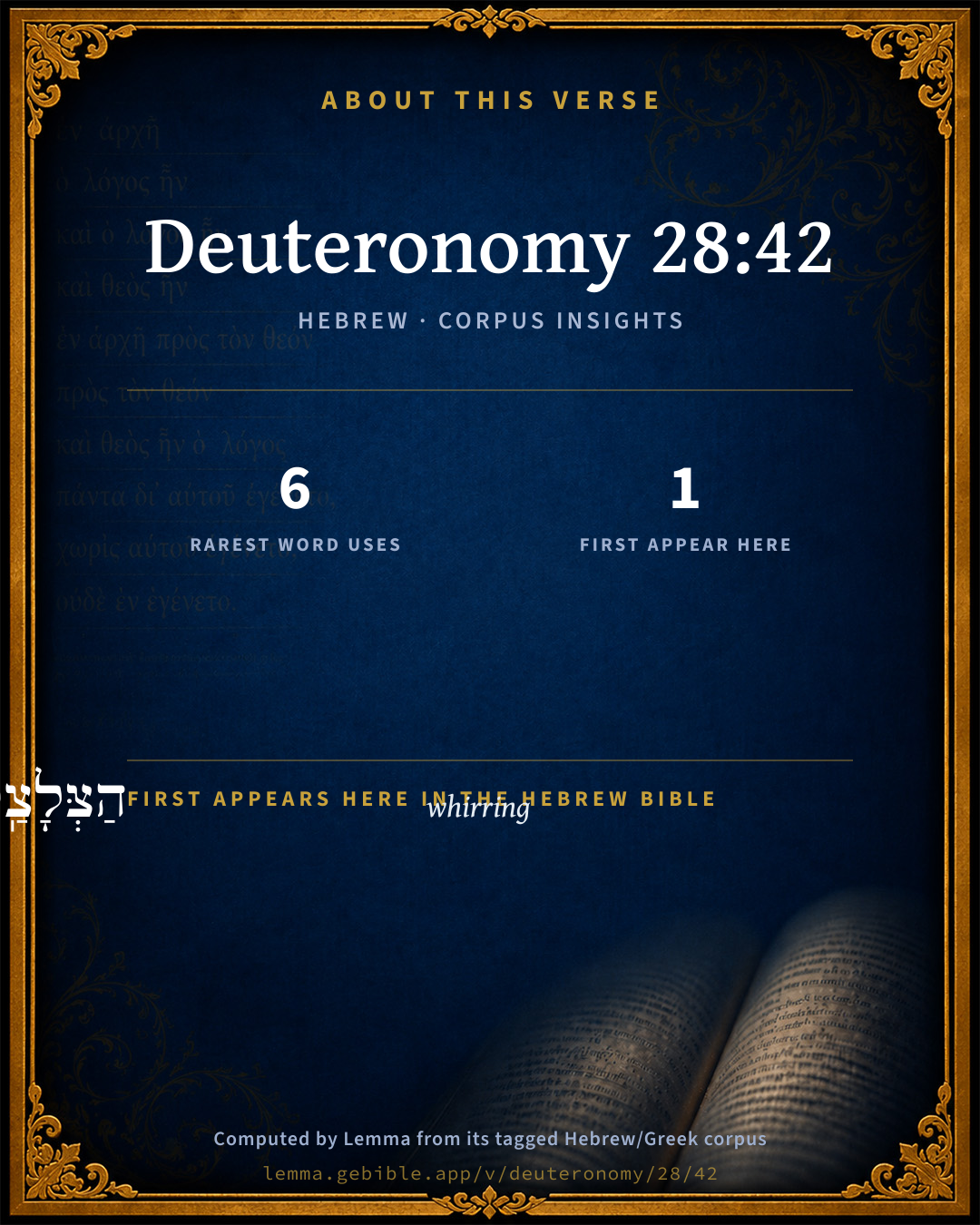
  • 1 first appearance in the Hebrew Bible
Full analysis ↓
Download a study sheet

One document with this verse’s original text, its word-by-word gloss line, the meaning frame, cross-references with their text, attributed commentary, and full source and license credits — printable, and it pastes into notes with its structure intact.

This verse Autodidact and up

Study sheet (.html) Plain text (.txt)

A passage Seminary Student

Up to 50 verses in one chapter. A passage sheet keeps up to 6 commentary sources and 12 cross-references per verse, in the order this page ranks them, and says so on the sheet whenever that leaves anything out. Ask for a single verse and you get the Autodidact verse sheet above.

Everything on this page stays free to read, with no account — the sheet is a download of what is already on screen, not access to it.

Want to remove ads? Support Godless Engineer
Compare translations 3

The same verse in 3 English versions, stacked beneath the original-language interlinear above. Click any original word for its lexicon entry.

Each is an independent rendering of the whole verse — the interlinear is not word-aligned to these translations.

Highlighted words mark where these versions differ — a whole-verse word diff, not a word-by-word alignment.

  • World English Bible Public Domain
    All your trees and the fruit of your ground shall the locust possess.
  • King James Version Public Domain
    All thy trees and fruit of thy land shall the locust consume.
  • unfoldingWord Literal Text CC BY-SA 4.0
    All your trees and the fruit of your ground—the crickets will take possession.

unfoldingWord Literal Text — © unfoldingWord, licensed CC BY-SA 4.0. Word-aligned USFM3 via Door43 (git.door43.org/unfoldingWord/en_ult).

Versions to compare (up to 4)

3 of 4 selected

Show all 18 translations

Every available English version of this verse, each an independent rendering of the whole verse.

  • World English Bible Public Domain
    All your trees and the fruit of your ground shall the locust possess.
  • Berean Standard Bible Public Domain
    Swarms of locusts will consume all your trees and the produce of your land.
  • Majority Standard Bible Public Domain
    Swarms of locusts will consume all your trees and the produce of your land.
  • King James Version Public Domain
    All thy trees and fruit of thy land shall the locust consume.
  • American Standard Version (1901) Public Domain
    All thy trees and the fruit of thy ground shall the locust possess.
  • Revised Version (1885) Public Domain
    All thy trees and the fruit of thy ground shall the locust possess.
  • Geneva Bible (1599) Public Domain
    All thy trees and fruite of thy land shall the grashopper consume.
  • Douay-Rheims (1899) Public Domain
    The blast shall consume all the trees and the fruits of thy ground.
  • Young's Literal Translation Public Domain
    all thy trees and the fruit of thy ground doth the locust possess;
  • Literal Standard Version CC BY-SA 4.0
    the locust possesses all your trees and the fruit of your ground;
  • Unlocked Literal Bible CC BY-SA 4.0
    All your trees and the fruit of your ground—the locusts will take them over.
  • unfoldingWord Literal Text CC BY-SA 4.0
    All your trees and the fruit of your ground—the crickets will take possession.
  • Darby Bible Public Domain
    All thy trees and the fruit of thy ground shall the locust possess.
  • World Messianic Bible Public Domain
    Locusts will consume all of your trees and the fruit of your ground.
  • Webster's Bible Public Domain
    All thy trees and fruit of thy land shall the locust consume.
  • Free Bible Version CC BY-SA 4.0
    Locust swarms will destroy all your trees and crops.
  • Bible in Basic English Public Domain
    All your trees and the fruit of your land will be the locust's.
  • JPS Tanakh (1917) Public Domain
    All thy trees and the fruit of thy land shall the locust possess.

Literal Standard Version (2020), Covenant Press — licensed CC BY-SA 4.0. Text via the HelloAO Bible API (eBible.org). Unlocked Literal Bible (unfoldingWord) — licensed CC BY-SA 4.0. Text via the HelloAO Bible API (eBible.org). unfoldingWord Literal Text — © unfoldingWord, licensed CC BY-SA 4.0. Word-aligned USFM3 via Door43 (git.door43.org/unfoldingWord/en_ult). Free Bible Version, Dr. Jonathan Gallagher — licensed CC BY-SA 4.0. Text via the HelloAO Bible API (eBible.org).

Word by word

More ways to search: Search by grammar → Find every occurrence → Compare this word →

Practice this passage: Drill this verse → Learn its vocabulary →

About this verse

These counts appear in no published source. They are computed here, from the morphology-tagged text and Lemma’s own curated glosses. What Lemma adds →

6
words
6
distinct lemmas
Pentateuch
section

Notable vocabulary

The rarest word here is הַצְּלָצַֽל whirring H6767 — appearing just 6 times in the whole Hebrew Bible.

First appearance in Scripture

This word makes its first canonical appearance in the Hebrew Bible here:

  • הַצְּלָצַֽל whirring H6767

Shared distinctive vocabulary

הַצְּלָצַֽל whirring H6767 occurs in 5 verses of the Hebrew Bible. Also found in:

Grammatical profile

  • 1 verb
  • 5 nouns

Verb forms

  • יְיָרֵ֖שׁ Piel · Imperfect

Hebrew & Septuagint length

In English translation the verse runs 13 words from the Hebrew and 13 from the Septuagint (LXX English) — the same length.

A rough comparison of the two English renderings, which tokenize alike — not a word-level alignment.

Word counts can differ between the Hebrew and the Greek without any difference in meaning — e.g. the Hebrew direct-object marker אֵת has no separate Greek word, and Greek often adds the article ὁ.

Cross-references

2

Topical passages linked to Deuteronomy 28:42 in the Treasury of Scripture Knowledge — connected by theme and wording, ordered by reader-vote popularity; previews shown in the World English Bible.

  • Amos 7:1–2 Thus the Lord Yahweh showed me: and, behold, he formed locusts in the beginning of the shooting up of the latter growth; and, behold, it was the latter growth after the king's harvest.
  • Deuteronomy 28:38–39 You shall carry much seed out into the field, and shall gather little in; for the locust shall consume it.

Cross-references courtesy of OpenBible.info (CC BY 4.0).

Hebrew and Greek witnesses Masoretic Hebrew ↔ Greek Septuagint

The same verse in the two great witnesses to the Old Testament, shown verse-for-verse.

These are two independent witnesses, not word-aligned to each other, and the Septuagint is shown in lemma (dictionary) form.

Hebrew Deuteronomy 28:42 Masoretic · Westminster Leningrad Codex

כָּל עֵצְךָ֖ וּפְרִ֣י אַדְמָתֶ֑ךָ יְיָרֵ֖שׁ הַצְּלָצַֽל

All your trees and the fruit of your ground shall the locust possess.

World English Bible · Public Domain

Greek LXX Deuteronomy 28:42 Septuagint · lemma form

πᾶς ὁ ξύλινος σύ καί ὁ γένημα ὁ γῆ σύ ἐκ ἀναἁλίσκω ὁ ἐρυσίβη

All your trees and the fruits of your land shall the blight consume.

LXX2012 (modern English Septuagint) · Public Domain

Hebrew: Westminster Leningrad Codex (CC BY 4.0). Greek: Septuagint (public domain); English from LXX2012 (modern English Septuagint) (Public Domain). How the Septuagint differs from the Hebrew →

Targum (Aramaic paraphrase)

2

The Targum is the ancient Jewish Aramaic paraphrase of the Hebrew Scriptures — an interpretive translation, not the Hebrew text itself. Onkelos (literal) and Pseudo-Jonathan (expansive) render the Torah, and Jonathan the Prophets. Coverage is partial: where no permissively-licensed English translation exists for a verse, only the Aramaic is shown. This is verse-level text, not a word-by-word alignment to the Hebrew.

  1. Targum Onkelos Torah (Genesis–Deuteronomy)
    כָּל אִילָנָךְ וְאִבָּא דְאַרְעָךְ יַחְסְנִנֵהּ סַקָאָה

    (no public-domain English translation for this verse)

    Targum Onkelos — Aramaic: “Onkelos Genesis” (public domain); “Onkelos Exodus” (public domain); “Onkelos Leviticus” (public domain); “Onkelos Numbers” (public domain); “Onkelos Deuteronomy” (public domain). English: “Sefaria Community Translation” (CC0 1.0 (public-domain dedication)); “J.W. Etheridge. The Targums of Onkelos and Jonathan Ben Uzziel on the Pentateuch. London: Longmans, Green, 1862” (public domain). Text via Sefaria.

  2. Targum Pseudo-Jonathan Torah (Genesis–Deuteronomy)
    כָּל אִילָנֵיכוֹן וּפֵירֵי אַרְעֲכוֹן יְשֵׁצֵי חֲלָנוּנָא

    All the trees and fruits of your land the locusts will destroy.

    Targum Pseudo-Jonathan — Aramaic: “Targum Jonathan on Genesis” (public domain); “Targum Jonathan on Exodus” (public domain); “Targum Jonathan on Leviticus” (public domain); “Targum Jonathan on Numbers” (public domain); “Targum Jonathan on Deuteronomy” (public domain). English: “The Targum of Jonathan ben Uzziel, trans. J. W. Etheridge, London, 1862” (public domain). Text via Sefaria.

Commentary

Notes on Deuteronomy 28:42 from classic Christian and Jewish commentators (each source and its license shown beneath its notes). The classic Christian expositions comment on the surrounding passage and are grouped to its opening verse, so a note may address several verses; the Jewish commentaries on the Tanakh (Rashi and others) are per-verse, so they appear only where the commentator wrote on this verse.

Lemma curates 59 commentaries, every one of them public domain or Creative Commons licensed, each selected and text-cleaned for this edition rather than reprinted as found. About our sources →

Trapp's Complete Commentary

John Trapp

Deu 28:42 All thy trees and fruit of thy land shall the locust consume.

Ver. 42. The locusts.] All sorts of vermin.

John Trapp, A Commentary or Exposition upon All the Books of the Old and New Testament (1647–1656) — public domain. Text from a community e-Sword module.

Geneva Bible (1599)

Geneva Bible translators

Under one kind he containeth all the vermin, which destroy the fruits of the land: and this is an evident token of God’s curse.

Geneva Bible (1599) marginal notes — public domain. Text via Bolls.life.

The Cambridge Bible for Schools and Colleges

gen. ed. J. J. S. Perowne

42. locust] Heb. ṣelaṣal, from the rustling of its wings.

The Cambridge Bible for Schools and Colleges (gen. ed. J. J. S. Perowne; Cambridge University Press, 1878–1918) — public domain. Text from a community e-Sword module.

John Gill's Exposition

And they shall be upon thee for a sign and for a wonder,.... That is, those curses before pronounced, Deu 27:15, and what follow, should rest and remain upon them, continue with them, and be very visible on them; so as to be observed by others, as a sign of the wrath and displeasure of God, and of the fulfilment of prophecy, and of the truth of divine revelation: and so "for a wonder": as it is most astonishing to observe how exactly all the curses threatened them have fallen upon them and have abode with them, as they did in their former captivities, and more especially do in the present one: and, what is the greater wonder, that notwithstanding these dreadful calamities, and so long continued, enough to have crushed any people from being a people, yet they have continued, and still do continue, a distinct people; which is a standing miracle, and one would think sufficient to convince the most hardened and obstinate deist of the truth and authority of the sacred Scriptures; in which stand so many glaring prophecies that have been fulfilled, and are continually fulfilling in this people:

and upon thy seed for ever; this shows that these curses, said to be upon them, not only refer to those that came upon them at and in the Babylonish captivity, but to those that came upon them at their destruction by the Romans, and which have continued on them nineteen hundred years; and how much longer they will continue none can say: it will be their case, until new heavens and a new earth are created, or there will be a new state of things, at least with them; when they shall be converted to the Lord, and all Israel saved; see Isa 65:17; and it may be observed, that the ten tribes carried captive never returned.

John Gill's Exposition of the Whole Bible (1746–1763) — public domain (CC PDM 1.0). Text via the HelloAO Bible API.

Haydock's Catholic Bible Commentary

Blast. This is a different word from that mentioned, ver. 22. Tselatsal may here probably denote a grasshopper, which delights in the shade, and has a shrill note. In hot countries it does great hurt to trees, &c. (Calmet)

George Leo Haydock (1774–1849), Haydock's Catholic Family Bible and Commentary, 1859 edition — public domain. Excludes Psalms (Douay-Rheims chapter numbering differs from Protestant) and Deuterocanonical books (Catholic canon only).

The Pulpit Commentary

Consume; literally, take possession of. The name given here to the ravaging insect is not the same as in ver. 38; but there can be no doubt it is the locust that is intended.

The Pulpit Commentary (1880–1919), ed. H.D.M. Spence-Jones & Joseph S. Exell — public domain. Text from a community e-Sword module.

unfoldingWord translationNotes

Door43 World Missions Community

General Information:

Moses speaks to the Israelites as if they were one man, so the words "you" and "your" here are singular. (See: Forms of You)

The foreigner who is ... He will ... to him

This does not mean a specific foreigner but it refers to foreigners in general. AT: "The foreigners who are ... They will ... to them" (See: Generic Noun Phrases)

rise up above you higher and higher; you yourself will come down lower and lower

This idiom means foreigners will have more power, money, and honor than the Israelites. (See: Idiom)

he will be the head, and you will be the tail

This means foreigners will have more power and authority than the Israelites. See how you translated a similar phrase in Deuteronomy 28:13. (See: Metaphor)

translationWords

fruit

locust

alien

raise

head

unfoldingWord translationNotes — © Distant Shores Media and the Door43 World Missions Community, licensed CC BY-SA 4.0. Source: git.door43.org/Door43/en_tn.

Rashi

Rabbi Shlomo Yitzchaki (Rashi)

יירש הצלצל means, the locust will make it (the tree) bare (lit., will impoverish it) of its fruits.

יירש means, it will impoverish.

צלצל is a species of locust. — One cannot explain יְָירֵשׁ as meaning "inheriting" ("taking possesion of", as the Targum does), for if so it ought to have written יִירַשׁ (cf. Genesis 21:10). Nor can it have the meaning of “driving out” and “expelling”, for then it ought to have written יוריש.

Rashi on the Tanakh — English translations: “The Judaica Press complete Tanach with Rashi, translated by A. J. Rosenberg” (CC BY 4.0); “Pentateuch with Rashi's commentary by M. Rosenbaum and A.M. Silbermann, 1929-1934” (public domain); “The Metsudah Tanach series, Lakewood, N.J” (CC BY 4.0); and “The Book of Joshua, Metsudah Publications, 1997” (CC BY 4.0). Text via Sefaria.

Ramban (Nachmanides)

Rabbi Moshe ben Nachman (Ramban / Nachmanides)

HA’TZLATZAL.’ In the opinion of Rashi this is one of the species of the locust. But if so, it would have been proper for him [Moses] to connect it with the verses where he speaks of the locust and the worm! It appears more likely that the word tz’latzal is a term for “a hostile army.” He is thus stating, Thou shalt beget sons and daughters, but they shall not be thine to work for you and be a nourisher of thine old age, for they shall go into captivity before the enemy. And he states, All thy trees and the fruit of thy soil which will not bear fruits for you, as he mentioned — the enemy coming upon you will take possession, for in the year during which the enemy will come upon you, [the trees and fields] will yield them their produce and they will eat it. Now, an army is called tz’latzal [from the term tzeltzal — “cymbal”] because of the noise of war in the camp which they cause and the voice of the horn, the thunder of the captains, and the shouting., Verse 25. [The word tz’latzal is thus] from the word ‘tziltzelei shama’ (loud-sounding cymbals) and ‘tziltzelei t’ruah’ (clanging cymbals); and with rattles ‘uv’tzeltzelim’ (and with cymbals). Similarly, the expression, Ah, land of ‘tziltzal’ of wings means a land [i.e., a people] that causes “the sound of its wings” be heard as it goes to far off places as the vulture swoopeth down. And in the Gemara we find: “[The Mishnah states: ‘If a man took illegal possession of a field] and masikin took it from him.’ The scholar that reads the word as masikin is not in error, for it is written yeyaresh ha’tzlatzal which we translate [in Onkelos’ rendition] ‘yachs’nine saka’ah’ (the ‘locust’ will take possession). And the scholar that reads the word as matzikin is also not in error, for it is written in the siege ‘uvmatzok’ (and in the straitness),” for the word [saka’ah which is the Aramaic equivalent of the Hebrew tz’latzal] was to the Sages the term for those who bring people in the siege and in the straitness [and is thus also an expression for a hostile army, and not as Rashi says that it is a species of the locust].Know that the admonitions concerning scantiness, discomfiture, rebuke, pestilence, Verse 21. trees, and the fruit of the soil and all the other admonitions will all endure until He will cause you to vanish from the Land whither thou goest in to possess it. But after the exile [will have taken place] he does not imprecate them except by saying, and there shalt thou serve other gods, wood and stone. At times, however, he reverts to reprove them while still in the Land, as he said, The Eternal will bring thee, and thy king whom thou shalt set over thee, unto a nation that thou hast not known, thou nor thy fathers; and there thou shalt serve other gods, this being a reference to the exile in which we were expatriated to Rome because of the journey there of King Agrippa [the last king during the period of the Second Temple who made a covenant with Rome]. Afterwards he [Moses] reverts and says, Thou shalt carry much seed out into the field etc. Now, these admonitions [apply] while they are in the Land, for so he states afterwards, and ye shall be plucked from off the Land which is a reference to the exile. In my opinion this, too, is part of Moses’ intimations. He states, The Eternal will bring thee, and thy king whom thou shalt set over thee, unto a nation that thou hast not known which alludes to King Agrippa’s journey to Rome. It is also possible that he alludes to another king, preceding Agrippa, namely Aristobulus whom the Roman general [Pompey] captured and brought there [to Rome] in fetters of brass. They [the captives] became a proverb, and a byword among all the peoples who were so amazed at their historic strength [and nevertheless such a calamity befell them that the viewers said], How are the mighty fallen, and their weapons of war perished! Afterwards Agrippa [II] came once again with the emissary of the king of Rome into the Land and captured very large cities in the land of Judea. Then was fulfilled what he [Moses] said, And thou shalt serve thine enemy whom the Eternal shall send against thee, in hunger, and in thirst etc. It further states, The Eternal will bring a nation against thee from afar, for, Vespasian and his son Titus came with a very large Roman army into the Land and captured all the fortified cities of Judea, and oppressed them greatly, as is known from the [history] books that they also captured the walls of Jerusalem and there remained only the Sanctuary and the wall of the Court. They [the besieged] ate the flesh of their sons and their daughters. And when the Sanctuary was also captured, then was fulfilled and ye shall be plucked from off the Land. Then the Romans returned to their country taking with them the exile of Jerusalem, as did the many [foreign] peoples, too, who were with them [i.e., the Romans] — from Greece, Egypt, Syria and many other peoples [who had joined the Romans in the destruction of Jerusalem and who took Israelite captives with them]. Then was fulfilled the verse, And the Eternal shall scatter thee among all peoples etc. The verses after that, all refer to their punishment in exile. So also, And thy life shall hang in doubt before thee applies to our fear in exile under peoples who constantly promulgate decrees against us. The correct interpretation is that this verse alludes to those generations that existed at the time of the destruction of the Second Temple, for the Romans were then scheming to destroy the Jews completely. Therefore he says afterwards, And the Eternal shall bring thee back into Egypt in ships, (Opening) to Esther Rabbathi. which happened when [the Romans] finished removing them from the Land. And our Rabbis have said: (Opening) to Esther Rabbathi. “Why [was it decreed that they be brought back into] Egypt? Because it is offensive and evil for a servant when he returns to his first master.” If so, he mentioned Egypt as a reproof. However, once we have been exiled to the countries of our enemies, the work of our hands has not been accursed. Neither have our oxen and the breeds of our flock, our vineyards and our olive orchards and that which we have sown in the field [been adversely affected]. Rather in the countries [of our exile] we are like the rest of the peoples who inhabit whatever country, or even better than them, for His mercies are upon us, because our habitations in exile are by [virtue of] the promise He made to us, And yet for all that, when they are in the land of their enemies, I will not reject them, neither will I abhor them, to destroy them utterly, and to break My covenant with them; for I am the Eternal their G-d. I have already explained in Seder Im Bechukothai, Verse 16 (at the end). the secret of this covenant [mentioned here], and that it refers to the present time of our exile at the hand of the “fourth beast,” and afterwards He assured us of being [completely] redeemed therefrom.Now, we have examined the punishments for idolatry which are mentioned in the Torah in many places, among them what is stated at the beginning [of this book]: When thou shalt beget children, and children’s children, and ye shall have been long in the Land, and shall deal corruptly, and make a graven image etc., this being a warning to Israel lest they worship idols after being in the Land for many years and having grown old in it. The punishment for that is, I call heaven and earth to witness etc., Verse 26. until And the Eternal shall scatter you among the peoples, and ye shall be left few in number., Verse 27. And there it is stated, And there ye shall serve gods, the work of men’s hands, Verse 28. and he promised, But from thence ye will seek the Eternal thy G-d, and thou shalt find Him etc., Verse 29. This has been fulfilled with them [in the Babylonian exile] as I have already mentioned and explained., Verse 16 (at the end). And in another chapter he said, And it shall be, when the Eternal thy G-d shall bring thee into the Land which He swore unto thy fathers etc.;, 6:10. Ye shall not go after other gods of the peoples that are round about you., Verse 14. And the punishment is, for a jealous G-d, even the Eternal thy G-d, is in the midst of thee; lest the anger of the Eternal thy G-d be kindled against thee, and He destroy thee from off the face of the earth., Verse 15. This is a warning to those who enter the Land lest they immediately become attached to idolatry and forget the G-d Who brought them forth from Egypt and walk after the idols. This Israel never did, nor did this punishment ever take place. The language of the verse implies this — that it is a warning, not a suggestion of something destined to be, as he said, lest the anger of the Eternal thy G-d be kindled against thee, Verse 15. that is to say, you should be fearful of this. In a third chapter he stated Beware lest thou forget the Eternal thy G-d, in not keeping His commandments, and His ordinances, and His statutes etc., 8:11. and he said, and thy heart be lifted up, and thou forget the Eternal thy G-d, Who brought thee forth out of the land of Egypt etc.; Who led thee through the great and dreadful wilderness etc., Verses 14-15. and so throughout the section. And thou say in thy heart: ‘My power and the might of my hand hath gotten me this wealth.’ But thou shalt remember the Eternal thy G-d, for it is He that giveth thee power to get wealth., Verses 17-18. And here [i.e., in this third chapter] he said, And it shall be, if thou shalt forget the Eternal thy G-d, and walk after other gods, and serve them, and worship them, I forewarn you this day etc., Verse 19. This is also a warning to those entering the Land lest they forget the Glorious Name and deny that it was He Who brought them forth from the land of Egypt and [lest they claim that] He did nothing for them, but that they did everything by their own power because they were strong and therefore they will worship the idols as they please. The punishment for this would be complete destruction: As the nations that the Eternal causeth to perish before you, so shall ye perish. The language of the verse indicates that he is warning them lest they do so when they enter the Land before they grow old in it, before they destroy all the peoples of the Land. Therefore he said, As the nations that the Eternal causeth to perish before you, so shall ye perish, which applied to the time when the peoples [of the Land] were destroyed, and he warned them that G-d would turn His hand from the destruction of these peoples and He would destroy Israel like them. This, too, Israel never did, and nothing like it came upon them. The fourth time he warned and explained, saying, And it shall come to pass, if thou wilt not hearken unto the voice of the Eternal thy G-d, to observe to do all His commandments and His statutes etc. that all these curses shall come upon thee etc. and all the words of the covenant [which follow], and in the end there is the great promise: And it shall come to pass, when all these things are come upon thee etc., and thou shalt bethink thyself etc., and shalt return unto the Eternal thy G-d etc., that then the Eternal thy G-d will restore thy captivity, and have compassion upon thee, and so on to the conclusion of the section. Now, this is the warning and allusion to this our [present] exile and to the perfect redemption by which we will be redeemed therefrom. And the fifth chapter is a warning by way of a prophecy to be fulfilled: And the Eternal said unto Moses: ‘Behold, thou art about to sleep with thy fathers, and this people will rise up …, 31:16. [Now therefore write ye this Song for you …] that this Song shall testify before them as a witness, for it shall not be forgotten out of the mouths of their seed etc.’, Verses 19 and 21. This warning has been wholly fulfilled in its literal sense and wider meaning.

Ramban (Nachmanides) on the Tanakh — English translation: “Commentary on the Torah by Ramban (Nachmanides). Translated and annotated by Charles B. Chavel. New York, Shilo Pub. House, 1971-1976” (CC BY 4.0). Text via Sefaria.

Lesson kit

Teaching starters — assembled from the data on this page, not authored interpretation. Every prompt links to the verse data it draws on. Edit before teaching.

Deuteronomy, in the Pentateuch, opens this verse with 6 words (6 distinct Hebrew lemmas). Its most distinctive word is tsᵉlâtsal (“whirring”). A historical commentator’s framing appears above. Read the whole chapter for the surrounding context.

Discussion questions

  1. The word tsᵉlâtsal carries the sense “whirring.” How does it shape the verse?
  2. This is the first place “whirring” appears in Scripture (first appears here). What does its debut here establish?
  3. How does 2 Samuel 6:5, which shares the word «whirring», read alongside this verse?
  4. These translations render this verse differently. What is at stake in choosing one wording over another?
  5. «יְיָרֵ֖שׁ» is a Piel Imperfect verb. How does that grammatical form shape the action described?
  6. Compare how Trapp's Complete Commentary and Geneva Bible (1599) read this verse. Where do they agree or differ?

Things to notice

Reading settings

Reading text

Shown beneath each verse's original-language words.

Old Testament
Old Testament edition

Read the OT as the Masoretic Hebrew (MT) or the Greek Septuagint (LXX).

English shown for the Greek Septuagint (in the Hebrew ↔ Greek comparison).

Comparing translations? Open the Compare panel on any verse page to stack up to four side by side.