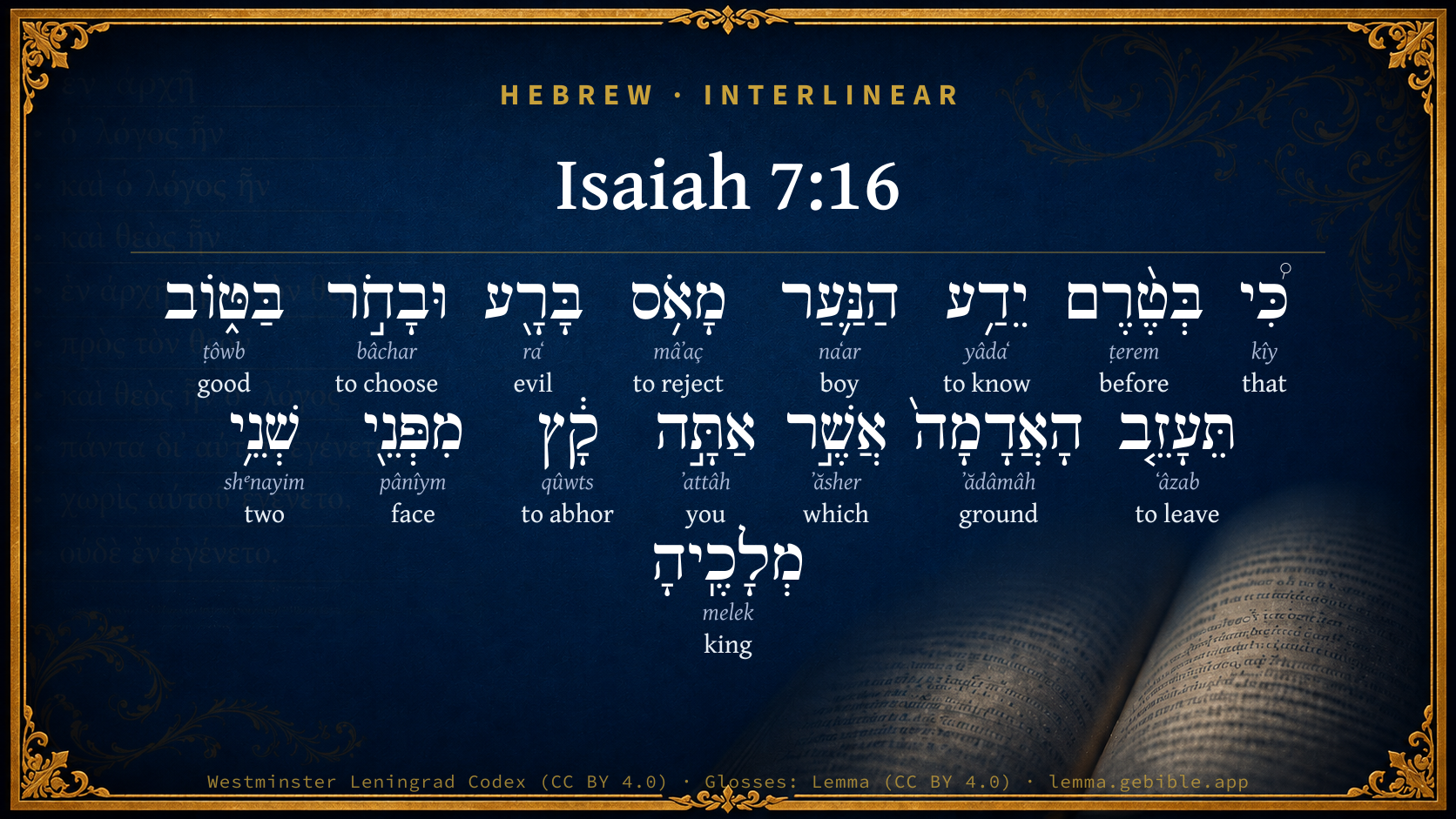
Isaiah 7:16

Hebrew (Westminster Leningrad Codex) Isaiah 7:16 appears in the Hebrew Old Testament. The text above is from the Westminster Leningrad Codex. Each word links to its Strong’s number, a concise gloss, and parsing drawn from the Open Scriptures Hebrew Bible morphology. Click any word for its full Brown-Driver-Briggs (BDB) entry.
Download image
Cite this verse

Isaiah 7:16 (World English Bible). Public Domain. Lemma interlinear Bible study tool, https://lemma.gebible.app/v/isaiah/7/16.

Show BibTeX & RIS
BibTeX
RIS
English Translation
For before the child knows to refuse the evil, and choose the good, the land whose two kings you abhor shall be forsaken.
World English Bible · Public Domain
Download a study sheet

One document with this verse’s original text, its word-by-word gloss line, the meaning frame, cross-references with their text, attributed commentary, and full source and license credits — printable, and it pastes into notes with its structure intact.

This verse Autodidact and up

Study sheet (.html) Plain text (.txt)

A passage Seminary Student

Up to 50 verses in one chapter. A passage sheet keeps up to 6 commentary sources and 12 cross-references per verse, in the order this page ranks them, and says so on the sheet whenever that leaves anything out. Ask for a single verse and you get the Autodidact verse sheet above.

Everything on this page stays free to read, with no account — the sheet is a download of what is already on screen, not access to it.

Want to remove ads? Support Godless Engineer
Compare translations 3

The same verse in 3 English versions, stacked beneath the original-language interlinear above. Click any original word for its lexicon entry.

Each is an independent rendering of the whole verse — the interlinear is not word-aligned to these translations.

Highlighted words mark where these versions differ — a whole-verse word diff, not a word-by-word alignment.

  • World English Bible Public Domain
    For before the child knows to refuse the evil, and choose the good, the land whose two kings you abhor shall be forsaken.
  • King James Version Public Domain
    For before the child shall know to refuse the evil, and choose the good, the land that thou abhorrest shall be forsaken of both her kings.
  • unfoldingWord Literal Text CC BY-SA 4.0
    For before the boy knows to reject evil and to choose good, the land will be forsaken that you are dreading from the faces of the two kings of it.

unfoldingWord Literal Text — © unfoldingWord, licensed CC BY-SA 4.0. Word-aligned USFM3 via Door43 (git.door43.org/unfoldingWord/en_ult).

Versions to compare (up to 4)

3 of 4 selected

Show all 18 translations

Every available English version of this verse, each an independent rendering of the whole verse.

  • World English Bible Public Domain
    For before the child knows to refuse the evil, and choose the good, the land whose two kings you abhor shall be forsaken.
  • Berean Standard Bible Public Domain
    For before the boy knows enough to reject evil and choose good, the land of the two kings you dread will be laid waste.
  • Majority Standard Bible Public Domain
    For before the boy knows enough to reject evil and choose good, the land of the two kings you dread will be laid waste.
  • King James Version Public Domain
    For before the child shall know to refuse the evil, and choose the good, the land that thou abhorrest shall be forsaken of both her kings.
  • American Standard Version (1901) Public Domain
    For before the child shall know to refuse the evil, and choose the good, the land whose two kings thou abhorrest shall be forsaken.
  • Revised Version (1885) Public Domain
    For before the child shall know to refuse the evil, and choose the good, the land whose two kings thou abhorrest shall be forsaken.
  • Geneva Bible (1599) Public Domain
    For afore the childe shall haue knowledge to eschew the euill, and to chuse the good, the land, that thou abhorrest, shalbe forsaken of both her Kings.
  • Douay-Rheims (1899) Public Domain
    For before the child know to refuse the evil, and to choose the good, the land which thou abhorrest shall be forsaken of the face of her two kings.
  • Young's Literal Translation Public Domain
    For before the youth doth know To refuse evil, and to fix on good, Forsaken is the land thou art vexed with, because of her two kings.
  • Literal Standard Version CC BY-SA 4.0
    For before the youth knows || To refuse evil, and to fix on good, || The land you are distressed with is forsaken, because of her two kings.
  • Unlocked Literal Bible CC BY-SA 4.0
    For before the child knows to refuse the evil and choose the good, the land whose two kings you dread will be desolate.
  • unfoldingWord Literal Text CC BY-SA 4.0
    For before the boy knows to reject evil and to choose good, the land will be forsaken that you are dreading from the faces of the two kings of it.
  • Darby Bible Public Domain
    For before the child knoweth to refuse the evil and to choose the good, the land whose two kings thou fearest shall be forsaken.
  • World Messianic Bible Public Domain
    For before the child knows to refuse the evil and choose the good, the land whose two kings you abhor shall be forsaken.
  • Webster's Bible Public Domain
    For before the child shall know to refuse the evil, and choose the good, the land that thou abhorrest shall be forsaken by both her kings.
  • Free Bible Version CC BY-SA 4.0
    For before the boy knows to refuse evil and choose the good, the land of the two kings you're afraid of will be deserted.
  • Bible in Basic English Public Domain
    For before the child is old enough to make a decision between evil and good, the land whose two kings you are now fearing will have become waste.
  • JPS Tanakh (1917) Public Domain
    Yea, before the child shall know to refuse the evil, and choose the good, the land whose two kings thou hast a horror of shall be forsaken.

Literal Standard Version (2020), Covenant Press — licensed CC BY-SA 4.0. Text via the HelloAO Bible API (eBible.org). Unlocked Literal Bible (unfoldingWord) — licensed CC BY-SA 4.0. Text via the HelloAO Bible API (eBible.org). unfoldingWord Literal Text — © unfoldingWord, licensed CC BY-SA 4.0. Word-aligned USFM3 via Door43 (git.door43.org/unfoldingWord/en_ult). Free Bible Version, Dr. Jonathan Gallagher — licensed CC BY-SA 4.0. Text via the HelloAO Bible API (eBible.org).

Word by word

More ways to search: Search by grammar → Find every occurrence → Compare this word →

Practice this passage: Drill this verse → Learn its vocabulary →

קָ֔ץ
qûwts
H6973
“abhoring”
Verb, Qal, Participle Active, Masculine, Singular, Absolute
Part of Speech
Verb
Stem
Qal
Form
Participle Active
Gender
Masculine
Number
Singular
State
Absolute
Full BDB Definition

Origin: a primitive root [identical with H6972 through the idea of severing oneself from (compare H6962 )]

TWOT: 2002

to be grieved, loathe, abhor, feel a loathing or abhorrence or sickening dread - (Qal) - to feel a loathing at, abhor - to feel a sickening dread - (Hiphil) - to cause sickening dread - to cause loathing
  1. כִּ֠י kîy H3588 “that” Conjunction
  2. בְּטֶ֨רֶם ṭerem H2962 “in/at · before” Preposition + Adverb
  3. יֵדַ֥ע yâdaʻ H3045 “to know” Verb, Qal, Imperfect, 3rd Person, Masculine, Singular
  4. הַנַּ֛עַר naʻar H5288 “the · boy” Particle, Definite Article + Noun, Common, Masculine, Singular, Absolute
  5. מָאֹ֥ס mâʼaç H3988 “to reject” Verb, Qal, Infinitive Absolute
  6. בָּרָ֖ע raʻ H7451 “in/at the · evil” Preposition, Determined + Adjective, Adjective, Masculine, Singular, Absolute
  7. וּבָחֹ֣ר bâchar H977 “and · to choose” Conjunction + Verb, Qal, Infinitive Absolute
  8. בַּטּ֑וֹב ṭôwb H2896 “in/at the · good” Preposition, Determined + Adjective, Adjective, Masculine, Singular, Absolute
  9. תֵּעָזֵ֤ב ʻâzab H5800 “to leave” Verb, Niphal, Imperfect, 3rd Person, Feminine, Singular
  10. הָאֲדָמָה֙ ʼădâmâh H127 “the · ground” Particle, Definite Article + Noun, Common, Feminine, Singular, Absolute
  11. אֲשֶׁ֣ר ʼăsher H834 “which” Particle, Relative
  12. אַתָּ֣ה ʼattâh H859 “you” Pronoun, Personal, 2nd Person, Masculine, Singular
  13. מִפְּנֵ֖י pânîym H6440 “from · face(s) of” Preposition + Noun, Common, Both, Plural, Construct
  14. שְׁנֵ֥י shᵉnayim H8147 “two” Adjective, Cardinal number, Masculine, Dual, Construct
  15. מְלָכֶֽיהָ melek H4428 “kings · her” Noun, Common, Masculine, Plural, Construct + Suffix, Personal, 3rd Person, Feminine, Singular

About this verse

These counts appear in no published source. They are computed here, from the morphology-tagged text and Lemma’s own curated glosses. What Lemma adds →

16
words
16
distinct lemmas
Prophets
section

Notable vocabulary

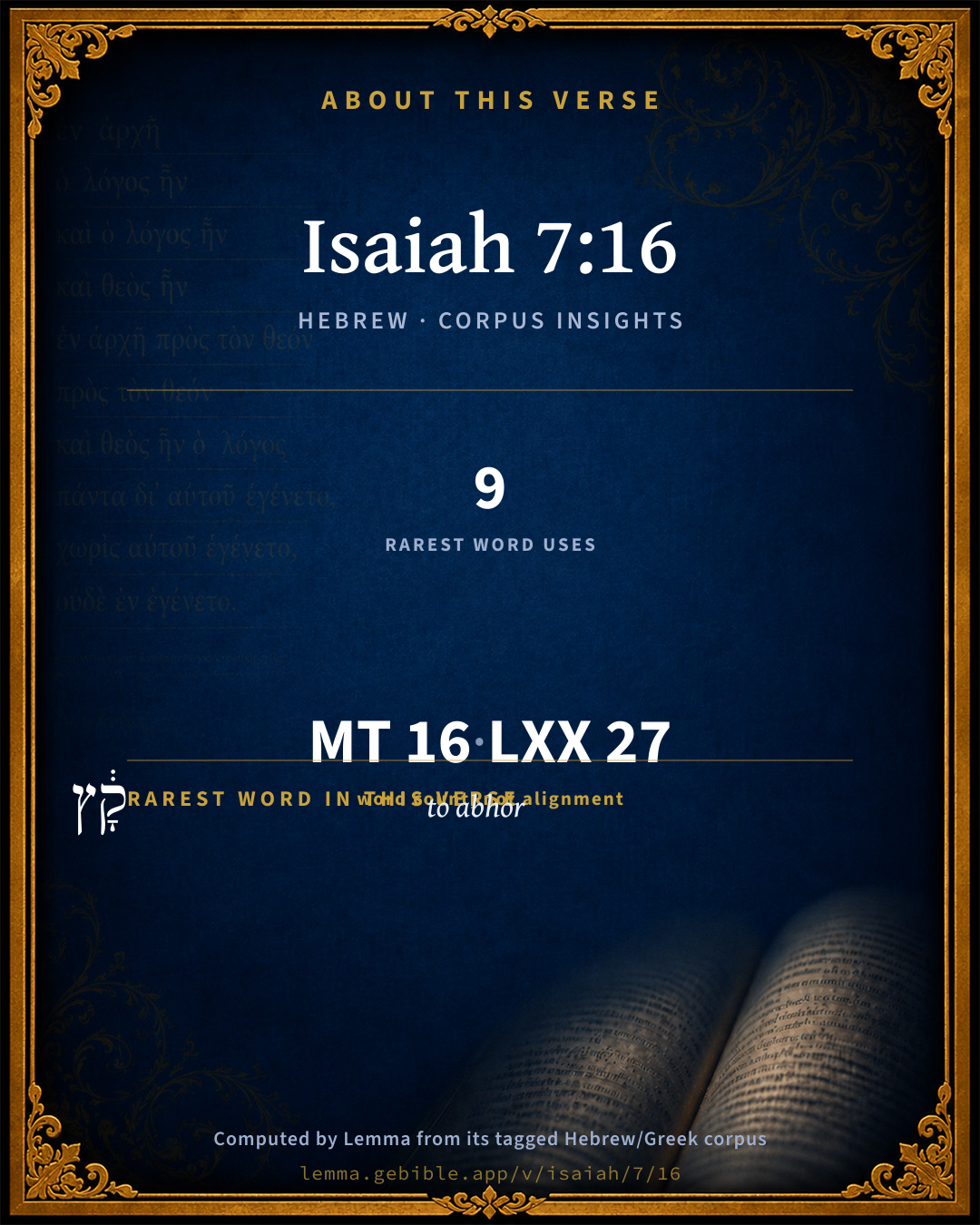
The rarest word here is קָ֔ץ to abhor H6973 — appearing just 9 times in the whole Hebrew Bible.

Shared distinctive vocabulary

קָ֔ץ to abhor H6973 occurs in 9 verses of the Hebrew Bible. Also found in:

Grammatical profile

  • 5 verbs
  • 4 nouns
  • 3 adjectives
  • 1 pronoun
  • 1 conjunction
  • 1 adverb
  • 1 particle

Verb forms

  • יֵדַ֥ע Qal · Imperfect
  • מָאֹ֥ס Qal · Infinitive Absolute
  • וּבָחֹ֣ר Qal · Infinitive Absolute
  • תֵּעָזֵ֤ב Niphal · Imperfect
  • קָ֔ץ Qal · Participle Active

Hebrew & Septuagint length

In English translation the verse runs 23 words from the Hebrew and 32 from the Septuagint (LXX English) — closely comparable.

A rough comparison of the two English renderings, which tokenize alike — not a word-level alignment.

Word counts can differ between the Hebrew and the Greek without any difference in meaning — e.g. the Hebrew direct-object marker אֵת has no separate Greek word, and Greek often adds the article ὁ.

In the original languages it is 16 Hebrew tokens and 27 Greek tokens — but the two are counted differently (Hebrew bundles its prefixes and suffixes into one token; the Greek is in lemma form), so that isn’t a like-for-like length.

Cross-references

9

Topical passages linked to Isaiah 7:16 in the Treasury of Scripture Knowledge — connected by theme and wording, ordered by reader-vote popularity; previews shown in the World English Bible.

  • Isaiah 8:4 For before the child shall have knowledge to cry, My father, and, My mother, the riches of Damascus and the spoil of Samaria shall be carried away before the king of Assyria.
  • Deuteronomy 1:39 Moreover your little ones, whom you said should be a prey, and your children, who this day have no knowledge of good or evil, they shall go in there, and to them will I give it, and they shall possess it.
  • 2 Kings 15:29–30 In the days of Pekah king of Israel came Tiglath Pileser king of Assyria, and took Ijon, and Abel Beth Maacah, and Janoah, and Kedesh, and Hazor, and Gilead, and Galilee, all the land of Naphtali; and he carried them captive to Assyria.
  • 2 Kings 16:9 The king of Assyria listened to him; and the king of Assyria went up against Damascus, and took it, and carried [the people of] it captive to Kir, and killed Rezin.
  • Isaiah 9:11 Therefore Yahweh will set up on high against him the adversaries of Rezin, and will stir up his enemies,
  • Isaiah 17:1–3 The burden of Damascus. Behold, Damascus is taken away from being a city, and it shall be a ruinous heap.
  • Hosea 5:9 Ephraim will become a desolation in the day of rebuke. Among the tribes of Israel, I have made known that which will surely be.
  • Amos 1:3–5 Thus says Yahweh: "For three transgressions of Damascus, yes, for four, I will not turn away its punishment; Because they have threshed Gilead with threshing instruments of iron;
  • Jonah 4:11 Shouldn't I be concerned for Nineveh, that great city, in which are more than one hundred twenty thousand persons who can't discern between their right hand and their left hand; and also much cattle?"

Cross-references courtesy of OpenBible.info (CC BY 4.0).

Hebrew and Greek witnesses Masoretic Hebrew ↔ Greek Septuagint

The same verse in the two great witnesses to the Old Testament, shown verse-for-verse.

These are two independent witnesses, not word-aligned to each other, and the Septuagint is shown in lemma (dictionary) form.

Hebrew Isaiah 7:16 Masoretic · Westminster Leningrad Codex

כִּ֠י בְּטֶ֨רֶם יֵדַ֥ע הַנַּ֛עַר מָאֹ֥ס בָּרָ֖ע וּבָחֹ֣ר בַּטּ֑וֹב תֵּעָזֵ֤ב הָאֲדָמָה֙ אֲשֶׁ֣ר אַתָּ֣ה קָ֔ץ מִפְּנֵ֖י שְׁנֵ֥י מְלָכֶֽיהָ

For before the child knows to refuse the evil, and choose the good, the land whose two kings you abhor shall be forsaken.

World English Bible · Public Domain

Greek LXX Isaiah 7:16 Septuagint · lemma form

διότι πρίν ἤ γιγνώσκω ὁ παιδίον ἀγαθός ἤ κακός ἀπειθής πονηρία ὁ ἐκλέγω ὁ ἀγαθός καί καταλείπω ὁ γῆ ὅς σύ φοβέω ἀπό πρόσωπον ὁ δύο βασιλεύς

For before the child shall know good or evil, he refuses evil, to choose the good; and the land shall be forsaken which you are afraid of because of the two kings.

LXX2012 (modern English Septuagint) · Public Domain

Hebrew: Westminster Leningrad Codex (CC BY 4.0). Greek: Septuagint (public domain); English from LXX2012 (modern English Septuagint) (Public Domain). How the Septuagint differs from the Hebrew →

Targum (Aramaic paraphrase)

1

The Targum is the ancient Jewish Aramaic paraphrase of the Hebrew Scriptures — an interpretive translation, not the Hebrew text itself. Onkelos (literal) and Pseudo-Jonathan (expansive) render the Torah, and Jonathan the Prophets. Coverage is partial: where no permissively-licensed English translation exists for a verse, only the Aramaic is shown. This is verse-level text, not a word-by-word alignment to the Hebrew.

  1. Targum Jonathan Prophets (Joshua–Malachi)
    אֲרֵי עַד לָא יְדַע עוּלֵימָא לְרָחָקָא בִישָׁא וּלְקָרָבָא טָבָא תִּתְרְטִישׁ אַרְעָא דִי אַתְּ מְעִיק מִן קֳדָם תְּרֵין מַלְכָּהָא:

    But before a child shall know to reject the evil and to choose the good, the land shall be laid desolate, on account of which thou art in a strait, because of these two kings.

    Targum Jonathan — Aramaic: “Mikraot Gedolot” (public domain). English: “Sefaria Community Translation” (CC0 1.0 (public-domain dedication)); “London "Chaldee Paraphrase," 1871” (public domain). Text via Sefaria.

Commentary

Notes on Isaiah 7:16 from classic Christian and Jewish commentators (each source and its license shown beneath its notes). The classic Christian expositions comment on the surrounding passage and are grouped to its opening verse, so a note may address several verses; the Jewish commentaries on the Tanakh (Rashi and others) are per-verse, so they appear only where the commentator wrote on this verse.

Lemma curates 59 commentaries, every one of them public domain or Creative Commons licensed, each selected and text-cleaned for this edition rather than reprinted as found. About our sources →

Jamieson, Fausset & Brown

Robert Jamieson, A. R. Fausset & David Brown

For--The deliverance implied in the name "Immanuel," and the cessation of distress as to food (Isa 7:14-15), shall last only till the child grows to know good and evil;

for . . . the land that . . . abhorrest . . . forsaken of . . . kings--rather, desolate shall be the land, before whose two kings thou art alarmed [HENGSTENBERG and GESENIUS].

the land--namely, Syria and Samaria regarded as one (Kg2 16:9; Kg2 15:30), just two years after this prophecy, as it foretells. HORSLEY takes it, "The land (Judah and Samaria) of (the former of) which thou art the plague (literally, 'thorn') shall be forsaken," &c.; a prediction thus, that Judah and Israel (appropriately regarded as one "land") should cease to be kingdoms (Luk 2:1; Gen 49:10) before Immanuel came.

Though temporary deliverance (Isa 7:16; Isa 8:4) was to be given then, and final deliverance through Messiah, sore punishment shall follow the former. After subduing Syria and Israel, the Assyrians shall encounter Egypt (Kg2 23:29), and Judah shall be the battlefield of both (Isa 7:18), and be made tributary to that very Assyria (Ch2 28:20; Kg2 16:7-8) now about to be called in as an ally (Isa 39:1-6). Egypt, too, should prove a fatal ally (Isa 36:6; Isa 31:1, &c.).

Jamieson, Fausset & Brown — Commentary Critical and Explanatory on the Whole Bible (1871) — public domain (CC PDM 1.0). Text via the HelloAO Bible API.

Trapp's Complete Commentary

John Trapp

Isa 7:16 For before the child shall know to refuse the evil, and choose the good, the land that thou abhorrest shall be forsaken of both her kings.

Ver. 16. For before the child.] Hannagnar, this child Shear-jashub here present, {Isa 7:3} the proper sign of this present deliverance {as Isa 8:4-7} made so by occasion of the mention of Immanuel, that was to be born, many years after, of a virgin.

The land that thou abhorrest.] Or, By which thou art vexed. {as Isa 7:6} Confer Exo 1:12 Num 22:3. So the Danes were abhorred by the English, the French by the Sicilians, as appeared by those bloody vespers.

Shall be left of both her kings.] Who shall be cut off by a seasonable vengeance. See this fulfilled {2Ki 15:30; 2Ki 16:9} within a year or two of this prophecy.

John Trapp, A Commentary or Exposition upon All the Books of the Old and New Testament (1647–1656) — public domain. Text from a community e-Sword module.

Albert Barnes' Notes on the Bible

The land that thou abhorrest - The land concerning which thou art so much “alarmed or distressed;” that is, the united land of Syria and Ephraim. It is mentioned here as ‘the land,’ or as one land, because they were united then in a firm alliance, so as to constitute, in fact, or for the purposes of invasion and conquest, one people or nation. The phrase, ‘which thou abhorrest,’ means properly, which thou loathest, the primary idea of the word - קוץ qûts - being to feel a nausea, or to vomit. It then means to fear, or to feel alarm; and this, probably, is the meaning here. Abaz, however, evidently looked upon the nations of Syria and Samaria with disgust, as well as with alarm. This is the construction which is given of this passage by the Vulgate, Calvin, Grotius, Junins, Gataker, and Piscator, as well as by our common version. Another construction, however, has been given of the passage by Vitringa, JohnD. Michaelis, Lowth, Gesenius, Rosenmuller, Hengstenberg, and Hendewerk. According to this, the meaning is not that the “land” should be the object of abhorrence, but that the kings themselves were the objects of dislike or dread; and not merely that the two kings should be removed, but that the land itself was threatened with desolation. This construction is free from the objections of an exegetical kind to which the other is open, and agrees better with the idiom of the Hebrew. According to this, the correct translation would be:

For before the child shall learn to refuse the

Evil and to choose the good,

Desolate shall be the land, before whose two

Kings thou art in terror.’

Of both her kings - Ahaz took the silver and gold that was found in the temple, and sent it as a present to the king of Assyria. Induced by this, the king of Assyria marched against Damascus and killed Rezin, 2Ki 16:9. This occurred but a short time after the threatened invasion of the land by Rezin and Remaliah, in the “third” year of the reign of Ahaz, and, consequently, about one year after this prophecy was delivered. Pekah, the son of Remaliah, was slain by Hoshea, the son of Elah, who conspired against him, killed him, and reigned in his stead. This occurred in the fourth year of the reign of Ahaz, for Pekah reigned twenty years. Ahaz began to reign in the seventeenth year of the reign of Pekah, and as Pekah was slain after he had reigned twenty years, it follows that he was slain in the fourth year of the reign of Ahaz - perhaps not more than two yearn after this prophecy was delivered; see 2Ki 15:27, 2Ki 15:30; 2Ki 16:1. We have thus arrived at a knowledge of the time intended by Isaiah in Isa 7:16. The whole space of time was not, probably, more than two years.

Opinions on the Intrepretation of Isaiah 7:14-16

A great variety of opinions have been entertained by interpreters in regard to this passage Isa 7:14-16. It may be useful, therefore, to state briefly what those opinions have been, and then what seems to be the true meaning.

(i) The first opinion is that which supposes that by the ‘virgin’ the wife of Ahaz is referred to, and that by the child which should be born, the prophet refers to Hezekiah. This is the opinion of the modern Jewish commentators generally. This interpretation prevailed among the Jews in the time of Justin. But this was easily shown by Jerome to be false. Ahaz reigned in Jerusalem but sixteen years 2Ki 17:2, and Hezekiah was twenty-five years old when he began to reign 2Ki 18:2, and of course was not less than nine years old when this prophecy was delivered. Kimchi and Abarbanel then resorted to the supposition that Ahaz had a second wife, and that this refers to a child that was to be born of her. This supposition cannot be proved to be false, though it is evidently a mere supposition. It has been adopted by the Jews, because they were pressed by the passage by the early Christians, as constituting an argument for the divinity of Christ. The ancient Jews, it is believed, referred it mainly to the Messiah.

(ii) Others have supposed, that the prophet designated some virgin who was then present when the king and Isaiah held their conference, and that the meaning is, ‘as surely as this virgin shall conceive, and bear a son, so surely shall the land be forsaken of its kings.’ Thus Isenbiehl, Bauer, Cube, and Steudel held, as quoted by Hengstenberg, “Christol.” i. p. 341.

(iii) Others suppose that the ‘virgin’ was not an actual, but only an ideal virgin. Thus Michaelis expresses it: ‘By the time when one who is yet a virgin can bring forth (that is, in nine months), all will be happily changed, and the present impending danger so completely passed away, that if you were yourself to name the child, you would call him Immanuel.’ Thus Eichhorn, Paulus, Hensler, and Ammon understand it; see “Hengstenberg.”

(iv) Others suppose that the ‘virgin’ was the prophet’s wife. Thus Aben Ezra, Jarchi, Faber, and Gesenius. Against this supposition there is only one objection which has been urged that is of real force, and that is, that the prophet already had a son, and of course his wife could not be spoken of as a virgin. But this objection is entirely removed by the supposition, which is by no means improbable, that the former wife of the prophet was dead, and that he was about to be united in marriage to another who was a virgin.

In regard to the prophecy itself, there have been three opinions:

(i) That it refers “exclusively” to some event in the time of the prophet; to the birth of a child then, either of the wife of Ahaz, or of the prophet, or of some other unmarried female. This would, of course, exclude all reference to the Messiah. This was formerly my opinion; and this opinion I expressed and endeavored to maintain, in the first composition of these notes. But a more careful examination of the passage has convinced me of its error, and satisfied me that the passage has reference to the Messtah. The reasons for this opinion I shall soon state.

(ii) The second opinion is, that it has “exclusive and immediate” reference to the Messiah; that it does not refer at all to any event which was “then” to occur, and that to Ahaz the future birth of a Messiah from a virgin, was to be regarded as a pledge of the divine protection, and an assurance of the safety of Jerusalem. Some of the objections to this view I shall soon state.

(iii) The third opinion, therefore, is that which “blends” these two, and which regards the prophet as speaking of the birth of a child which would soon take place of someone who was then a virgin - an event which could be known only to God, and which would, therefore, constitute a sign, or demonstration to Ahaz of the truth of what Isaiah said; but that the prophet intentionally so used language which would “also” mark a more important event, and direct the minds of the king and people onward to the future birth of one who should more fully answer to all that is here said of the child that would be born, and to whom the name Immanuel would be more appropriately given. This, I shall endeavor to show, must be the correct interpretation. In exhibiting the reasons for this opinion, we may, first, state the evidence that the prediction refers to some child that would be born “soon” as a pledge that the land would be forsaken of its kings; and secondly, the evidence that it refers also to the Messiah in a higher and fuller sense.

I. Evidence That the Prophecy Refers to Some Event Which Was Soon to Occur - To the Birth of a Child of Some One Who Was Then a Virgin, or Unmarried

(i) It is the “obvious” interpretation. It is that which would strike the great mass of people accustomed to interpret language on the principles of common sense. If the passage stood by itself; if the seventh and eighth chapters were “all” that we had; if there were no allusion to the passage in the New Testament; and if we were to sit down and merely look at the circumstances, and contemplate the narrative, the unhesitating opinion of the great mass of people would be, that it “must” have such a reference. This is a good rule of interpretation. That which strikes the mass of people; which appears to people of sound sense as the meaning of a passage on a simple perusal of it, is likely to be the true meaning of a writing.

(ii) Such an interpretation is demanded by the circumstances of the case. The immediate point of the inquiry was not about the “ultimate and final” safety of the kingdom - which would be demonstrated indeed by the announcement that the Messiah would appear - but it was about a present matter; about impending danger. An alliance was formed between Syria and Samaria. An invasion was threatened. The march of the allied armies had commenced. Jerusalem was in consternation, and Ahaz had gone forth to see if there were any means of defense. In this state of alarm, and at this juncture, Isaiah went to assure him that there was no cause for fear. It was not to assure him that the nation should be ultimately and finally safe - which might be proved by the fact that the Messiah would come, and that, therefore, God would preserve the nation; but the pledge was, that he had no reason to fear “this” invasion, and that within a short space of time the land would ‘be forsaken of both its kings.’ How could the fact that the Messiah would come more than seven hundred years afterward, prove this? Might not Jerusalem be taken and subdued, as it was afterward by the Chaldeans, and yet it be true that the Messiah would come, and that God would manifest himself as the protector of his people? Though, therefore, the assurance that the Messiah would come would be a general proof and pledge that the nation would be preserved and ultimately safe, yet it would not be a pledge of the “specific and immediate” thing which occupied the attention of the prophet, and of Ahaz. It would not, therefore, be a ‘sign’ such as the prophet offered to give, or a proof of the fulfillment of the specific prediction under consideration. This argument I regard as unanswerable. It is so obvious, and so strong, that all the attempts to answer it, by those who suppose there was an immediate and exclusive reference to the Messiah, have been entire failures.

(iii) It is a circumstance of some importance that Isaiah regarded himself and his children as ‘signs’ to the people of his time; see Isa 8:18. In accordance with this view, it seems he had named one child Shear-Jashub, Isa 7:3; and in accordance with the same view, he afterward named another Maher-shalal-hash-baz - both of which names are significant. This would seem to imply that he meant here to refer to a similar fact, and to the birth of a son that should be a sign also to the people of his time.

(iv) An unanswerable reason for thinking that it refers to some event which was soon to occur, and to the birth of a child “before” the land should be forsaken of the two kings, is the record contained in Isa 8:1-4. That record is evidently connected with this account, and is intended to be a public assurance of the fulfillment of what is here predicted respecting the deliverance of the land from the threatened invasion. In that passage, the prophet is directed to take a great roll Isa 7:1, and make a record concerning the son that was to be born; he calls public witnesses, people of character and well-known reputation, in attestation of the transaction Isa 7:2; he approaches the prophetess Isa 7:3; and it is expressly declared Isa 7:4 that before the child should have ‘knowledge to say, My father, and my mother,’ that is, be able to discern between good and evil Isa 7:16, ‘the riches of Damascus and the spoil of Samaria’ should be ‘taken away before the king of Assyria.’ This is so evidently a completion of the prophecy in Isa. vii., and a solemn fulfilling of it in a manner that should be satisfactory to Ahaz and the people, that it is impossible, it seems to me, to regard it any otherwise than as a real transaction. Hengstenberg, and those who suppose the prophecy to refer “immediately and exclusively” to the Messiah, are obliged to maintain that that was a ‘symbolical transaction’ - an opinion which might, with the same propriety, be held of any historical statement in the Bible; since there is nowhere to be found a more simple and unvarnished account of mere matter of historical fact than that. The statement, therefore, in Isa. 8, is conclusive demonstration, I think, that there was a reference in Isa 7:14-16, to a child of the prophet that would be soon born, and that would be a “pledge” of the divine protection, and a “proof or sign” to Ahaz that his land would be safe.

It is no objection to this that Isaiah then had a son Isa 7:3, and that, therefore, the mother of that son could not be a virgin. There is no improbability in the supposition that the mother of that son was deceased, and that Isaiah was about again to be married. Such an event is not so uncommon as to make it a matter of ridicule (see Hengstenberg, p. 342); or to render the supposition wholly incredible.

Nor is it any objection that another name was given to the child that was born to Isaiah; Isa 8:1, Isa 8:3. Nothing was more common than to give two names to children. It might have been true that the name usually given to him was Maher-shalal-hash-baz; and still true that the circumstances of his birth were such an evidence of the divine protection, and such an emblem of the divine guardianship, as to make proper the name Immanuel; see the note at Isa 7:14. It may be observed, also, that on the supposition of the strict and exclusive Messianic interpretation, the same objection might be made, and the same difficulty would lie. It was no more true of Jesus of Nazareth than of the child of Isaiah, that he was commonly called Immanuel. He had another name also, and was called by that other name. Indeed, there is not the slightest evidence that the Lord Jesus was “ever” designated by the name Immanuel as a proper name. All that the passage means is, that such should be the circumstances of the birth of the child as to render the name Immanuel proper; not that it would be applied to him in fact as the usual appellation.

Nor is it any objection to this view, that the mind of the prophet is evidently directed onward “to” the Messiah; and that the prophecy terminates Isa 8:8; Isa 9:1-7 with a reference to him. That this is so, I admit; but nothing is more common in Isaiah than for him to commence a prophecy with reference to some remarkable deliverance which was soon to occur, and to terminate it by a statement of events connected with a higher deliverance under the Messiah. By the laws of “prophetic suggestion,” the mind of the prophet seized upon resemblances and analogies; was carried on to future times, which were suggested by something that he was saying or contemplating as about to occur, until the mind was absorbed, and the primary object forgotten in the contemplation of the more remote and glorious event; see the Introduction to Isaiah, Section 7. III. (3.)

II. Evidence That the Prophecy Refers to the Messiah

(i) The passage in Mat 1:22-23, is an evidence that “he” regarded this as having a reference to the Messiah, and that it had a complete fulfillment in him. This quotation of it also shows that that was the common interpretation of the passage in his time, or he would not thus have introduced it. It cannot be “proved,” indeed, that Matthew means to affirm that this was the primary and original meaning of the prophecy, or that the prophet had a direct and exclusive reference to the Messiah; but it proves that in his apprehension the words had a “fulness” of meaning, and an adaptedness to the actual circumstances of the birth of the Messiah, which would accurately and appropriately express that event; see the notes at the passage in Matthew. The prophecy was not completely “fulfilled, filled up, fully and adequately met,” until applied to the Messiah. That event was so remarkable; the birth of Jesus was so strictly of a virgin, and his nature so exalted, that it might be said to be a “complete and entire” fulfillment of it. The language of Isaiah, indeed, was applicable to the event referred to immediately in the time of Ahaz, and expressed that with clearness; but it more appropriately and fully expressed the event referred to by Matthew, and thus shows that the prophet designedly made use of language which would be appropriate to a future and most glorious event.

(ii) An argument of no slight importance on this subject may be drawn from the fact, that this has been the common interpretation in the Christian church. I know that this argument is not conclusive; nor should it be pressed beyond its due and proper weight. It is of force only because the united and almost uniform impression of mankind, for many generations, in regard to the meaning of a written document, is not to be rejected without great and unanswerable arguments. I know that erroneous interpretations of many passages have prevailed in the church; and that the interpretation of many passages of Scripture which have prevailed from age to age, have been such as have been adapted to bring the whole subject of scriptural exegesis into contempt. But we should be slow to reject that which has had in its favor the suffrages of the unlearned, as well as the learned, in the interpretation of the Bible. The interpretation which refers this passage to the Messiah has been the prevailing one in all ages. It was followed by all the fathers and other Christian expositors until the middle of the eighteenth century (“Hengstenberg”); and is the prevailing interpretation at the present time. Among those who have defended it, it is sufficient to mention the names of Lowth, Koppe, Rosenmuller, and Hengstenberg, in addition to those names which are found in the well-known English commentaries. It has been opposed by the modern Jews, and by German neologists; but has “not” been regarded as false by the great mass of pious and humble Christians. The argument here is simply that which would be applied in the interpretation of a passage in Homer or Virgil; that where the great mass of readers of all classes have concurred in any interpretation, there is “presumptive evidence” that it is correct - evidence, it is true, which may be set aside by argument, but which is to be admitted to be of some account in making up the mind as to the meaning of the passage in question.

(iii) The reference to the Messiah in the prophecy accords with the “general strain and manner” of Isaiah. It is in accordance with his custom, at the mention of some occurrence or deliverance which is soon to take place, to suffer the mind to fix ultimately on the more remote event of the “same general character,” or lying, so to speak, “in the same range of vision” and of thought; see the Introduction, Section 7. It is also the custom of Isaiah to hold up to prominent view the idea that the nation would not be ultimately destroyed until the great Deliverer should come; that it was safe amidst all revolutions; that vitality would remain like that of a tree in the depth of winter, when all the leaves are stripped off Isa 6:13; and that all their enemies would be destroyed, and the true people of God be ultimately secure and safe under their great Deliverer; see the notes at Isa. 34; Isa 35:1-10.

It is true, that this argument will not be “very” striking except to one who has attentively studied this prophecy; but it is believed, that no one can profoundly and carefully examine the manner of Isaiah, without being struck with it as a very important feature of his mode of communicating truth. In accordance with this, the prophecy before us means, that the nation was safe from this invasion. Ahaz feared the extinction of his kingdom, and the “permanent” annexation of Jerusalem to Syria and Samaria. Isaiah told him that that could not occur; and proffered a demonstration, that in “a very few years” the land would be forsaken of both its kings. “On another ground also it could not be.” The people of God were safe. His kingdom could not be permanently destroyed. It must continue until the Messiah should come, and the eye of the prophet, in accordance with his usual custom, glanced to that future event, and he became “totally” absorbed in its contemplation, and the prophecy is finished Isa 9:1-7 by a description of the characteristics of the light that he saw in future times rising in dark Galilee Isa 9:1-2, and of the child that should be born of a virgin then.

In accordance with the same view, we may remark, as Lowth has done, that to a people accustomed to look for a great Deliverer; that had fixed their hopes on one who was to sit on the throne of David, the “language” which Isaiah used here would naturally suggest the idea of a Messiah. It was so animated, so ill adapted to describe his own son, and so suited to convey the idea of a most remarkable and unusual occurrence, that it could scarcely have been otherwise than that they should have thought of the Messiah. This is true in a special manner of the language in Isa 9:1-7.

(iv) An argument for the Messianic interpretation may be derived from the public expectation which was excited by some such prophecy as this. There is a striking similarity between it and one which is uttered by Micah, who was contemporary with Isaiah. Which was penned “first” it would not be easy to show; but they have internal evidence that they both had their origin in an expectation that the Messiah would be born of a virgin; compare the note at Isa 2:2. In Mic 5:2-3, the following prediction occurs: ‘But thou, Bethlehem Ephratah, though thou be little among the thousands of Judah, yet out of thee shall he come forth unto me that is to be ruler over Israel; whose goings forth have been from of old, from the days of eternity. Therefore, will he give them up, until the time when she which travaileth hath brought forth.’ That this passage refers to the birth of the Messiah, is demonstrable from Mat 2:6.

Nothing can be clearer than that this is a prediction respecting the place of his birth. The Sanhedrim, when questioned by Herod respecting the place of his birth, answered without the slightest hesitation, and referred to this place in Micah for proof. The expression, ‘she which travaileth,’ or, ‘she that bears shall bear’ - ילדה יולדה yôlēdâh yālâdâh, “she bearing shall bear” - refers evidently to some prediction of such a birth; and the word ‘she that bears’ (יולדה yôlēdâh) seems to have been used somewhat in the sense of a proper name, to designate one who was well known, and of whom there had been a definite prediction. Rosenmuller remarks, ‘She is not indeed expressly called a virgin, but that she is so is self-evident, since she shall bear the hero of divine origin (from everlasting), and consequently not begotten by a mortal. The predictions throw light on each other; Micah discloses the divine origin of the person predicted, Isaiah the wonderful manner of his birth.’ - “Ros.,” as quoted by Hengstenberg. In his first edition, Rosenmuller remarks on Mic 5:2 : ‘The phrase, “she who shall bear shall bear,” denotes the “virgin” from whom, in a miraculous manner, the people of that time hoped that the Messiah would be born.’ If Micah refers to a well-known existing prophecy, it must evidently be this in Isaiah, since no other similar prophecy occurs in the Old Testament; and if he wrote subsequently to Isaiah, the prediction in Micah must be regarded as a proof that this was the prevailing interpretation of his time.

That this was the prevailing interpretation of those times, is confirmed by the traces of the belief which are to be found extensively in ancient nations, that some remarkable person would appear, who should be born in this manner. The idea of a Deliverer, to be born of a “virgin,” is one that somehow had obtained an extensive prevalence in Oriental nations, and traces of it may be found almost everywhere among them. In the Hindoo Mythology it is said, respecting “Budhu,” that be was born of “Maya,” a goddess of the imagination - a virgin. Among the Chinese, there is an image of a beautiful woman with a child in her arms, which child, they say, was born of a virgin. The passsge in Virgil is well known:

Jam redit et Virgo, redeunt Saturnia regna:

Jam nova progenies coelo demittitur alto.

Tu modo mascenti puero, quo ferrea primum

Desinet, ac toto surget gens aurea mundo.

Casta fare Lucina: tuus jam regnat Apollo.

Eclog. iv. 4ff.

Comes the last age, by Cumae’s maid foretold;

Afresh the mighty line of years unrolled.

The Virgin now, now Saturn’s sway returns;

Now the blest globe a heaven-sprung child adorns,

Whose genial power shall whelm earth’s iron race,

And plant once more the golden in its place. -

Thou chaste Lucina, but that child sustain,

And lo! disclosed thine own Apollo’s reign.

Wrangham

This passage, though applied by Virgil to a different subject, has been usually regarded as having been suggested by that in Isaiah. The coincidence of thought is remarkable on any supposition; and there is no improbability in the supposition that the expectation of a great Deliverer to be born of a virgin had prevailed extensively, and that Virgil made it up in this beautiful manner and applied it to a prince in his own time. On the prevalent expectation of such a Deliverer, see the note at Mat 2:2.

(v) But the great and the unanswerable argument for the Messianic interpretation is derived from the conclusion of the prophecy in Isa 8:8, and especially in Isa 9:1-7. The prophecy in Isa 9:1-7 is evidently connected with this; and yet “cannot” be applied to a son of Isaiah, or to any other child that should be then born. If there is any passage in the Old Testament that “must” be applied to the Messiah, that is one; see the notes on the passage. And if so, it proves, that though the prophet at first had his eye on an event which was soon to occur, and which would be to Ahaz full demonstration that the land would be safe from the impending invasion, yet that he employed language which would describe also a future glorious event, and which would be a fuller demonstration that God would protect the people. He became fully absorbed in that event, and his language at last referred to that alone. The child then about to be born would, in most of the circumstances of his birth, be an apt emblem of him who should be born in future times, since both would be a demonstration of the divine power and protection. To both, the name Immanuel, though not the common name by which either would be designated, might be appropriately given. Both would be born of a virgin - the former, of one who was then a virgin, and the birth of whose child could be known only to God - the latter, of one who should be appropriately called “the” virgin, and who should remain so at the time of his birth. This seems to me to be the meaning of this difficult prophecy. The considerations in favor of referring it to the birth of a child in the time of Isaiah, and which should be a pledge to him of the safety of his kingdom “then,” seem to me to be unanswerable. And the considerations in favor of an ultimate reference to the Messiah - a reference which becomes in the issue total and absorbing - are equally unanswerable; and if so, then the twofold reference is clear.

Albert Barnes' Notes on the Bible (1834–1885) — public domain. Text from a community e-Sword/MySword module.

Joseph Benson's Commentary

Isa 7:16. For before the child, &c. — “The learned Vitringa,” says Dr. Dodd, “seems to have proved beyond any doubt, that the child spoken of in this verse can be no other than he who is spoken of in the preceding verses. The connecting particle for, and the repetition of the words, refusing the evil and choosing the good, evidently demonstrate,” he thinks, “that the IMMANUEL is here meant, and that, in order to enter into the immediate design of the prophet, we are to consider that, rapt, as it were, into future times, he proposes the Immanuel, as a sign of salvation to the people of God, as if present, Behold a virgin conceives; as if he understood him to be at this time conceived in the womb of the virgin, and shortly to be born: and he says, that more time shall not elapse from his birth to his capability of discerning between good and evil, than from hence to the desertion of the land of the two kings,” or the time specified, Isa 8:4. Archbishop Usher, however, Poole, Henry, Dr. Kennicott, and some other celebrated writers, conceive that we have a two-fold prophecy in this passage, the former part, contained in Isa 7:14-15, referring to the Messiah, and the latter, contained in this verse, to Shear-jashub, the son of Isaiah. “That the 16th verse,” says Dr. Kennicott, “contains a distinct prophecy, appears from hence: 1st, The words preceding have been proved to be confined to the Messiah, whose birth was then distant above seven hundred years; whereas the words here are confined to some child who was not to arrive at years of discretion before the kings, then advancing against Jerusalem, should be themselves cut off. 2d, Some end was undoubtedly to be answered by the presence of Isaiah’s son, whom God commanded him to take with him when he went to visit Ahaz; and yet no use at all appears to have been made of this son, unless he be referred to in this sentence; and, 3d, These prophecies are manifestly distinguished by being addressed to different persons. The first was addressed to the house of David, for the consolation of the pious in general; as it assured them, not only of the preservation of that house, but of God’s fidelity to his great promise: whereas the second promise is addressed to the king in particular, as it foretold the speedy destruction of the two kings, his enemies.” Dr. Doddridge, who also thinks that this verse refers to Shear-jashub, judging with Dr. Kennicott, that Isaiah “was ordered to take him in his hand for no other imaginable reason, but that something remarkable was to be said of him,” defines the general sense of these verses from the 13th to be this: “You have affronted God by refusing a sign now; yet his transcendent mercy will make your present forfeited deliverance, (by the death of these confederate kings, which shall happen before, הנער, this child in my hand is grown up to the exercise of reason,) a sign of a much nobler deliverance by the Messiah; who shall be born of an immaculate virgin, and shall condescend to pass through the tender scenes of infancy, as other children do.” In the latter part of the verse, the land that thou abhorrest, means the countries of Syria and Israel, which Ahaz abhorred for their cruel designs and practices against him. Shall be forsaken of both her kings — So far shall Rezin and Pekah be from conquering thy land, that they shall lose their own lands, and their lives too: which they did within two years after this time, being both slain by the king of Assyria, 2Ki 15:29-30; and 2Ki 16:9.

Joseph Benson's Commentary on the Old and New Testaments (1811–1818) — public domain. Text from a community e-Sword module.

Keil & Delitzsch

C. F. Keil & F. Delitzsch

"For before the boy shall understand to refuse the evil, and choose the good, the land will be desolate, of whose two kings thou art afraid. Jehovah will bring upon thee, and upon thy people, and upon thy father's house, days such as have not come since the day when Ephraim broke away from Judah - the king of Asshur." The land of the two kings, Syria and Israel, was first of all laid waste by the Assyrians, whom Ahaz called to his assistance. Tiglath-pileser conquered Damascus and a portion of the kingdom of Israel, and led a large part of the inhabitants of the two countries into captivity (Kg2 15:29; Kg2 16:9). Judah was then also laid waste by the Assyrians, as a punishment for having refused the help of Jehovah, and preferred the help of man. Days of adversity would come upon the royal house and people of Judah, such as ('asher, quales, as in Exo 10:6) had not come upon them since the calamitous day (l'miyyōm, inde a die; in other places we find l'min-hayyom, Exo 9:18; Deu 4:32; Deu 9:7, etc.) of the falling away of the ten tribes. The appeal to Asshur laid the foundation for the overthrow of the kingdom of Judah, quite as much as for that of the kingdom of Israel. Ahaz became the tributary vassal of the king of Assyria in consequence; and although Hezekiah was set free from Asshur through the miraculous assistance of Jehovah, what Nebuchadnezzar afterwards performed was only the accomplishment of the frustrated attempt of Sennacherib. It is with piercing force that the words "the king of Assyria" ('eth melek Asshur) are introduced at the close of the two verses. The particle 'eth is used frequently where an indefinite object is followed by the more precise and definite one (Gen 6:10; Gen 26:34). The point of the v. would be broken by eliminating the words as a gloss, as Knobel proposes. The very king to whom Ahaz had appealed in his terror, would bring Judah to the brink of destruction. The absence of any link of connection between Isa 7:16 and Isa 7:17 is also very effective. The hopes raised in the mind of Ahaz by Isa 7:16 are suddenly turned into bitter disappointment. In the face of such catastrophes as these, Isaiah predicts the birth of Immanuel. His eating only thickened milk and honey, at a time when he knew very well what was good and what was not, would arise from the desolation of the whole of the ancient territory of the Davidic kingdom that had preceded the riper years of his youth, when he would certainly have chosen other kinds of food, if they could possibly have been found. Consequently the birth of Immanuel apparently falls between the time then present and the Assyrian calamities, and his earliest childhood appears to run parallel to the Assyrian oppression. In any case, their consequences would be still felt at the time of his riper youth. In what way the truth of the prophecy was maintained notwithstanding, we shall see presently. What follows in Isa 7:18-25, is only a further expansion of Isa 7:17. The promising side of the "sign" remains in the background, because this was not for Ahaz. When Ewald expresses the opinion that a promising strophe has fallen out after Isa 7:17, he completely mistakes the circumstances under which the prophet uttered these predictions. In the presence of Ahaz he must keep silence as to the promises. But he pours out with all the greater fluency his threatening of judgment.

Keil & Delitzsch — Biblical Commentary on the Old Testament (1861–1891) — public domain (CC PDM 1.0). Text via the HelloAO Bible API. (Old Testament only.)

Geneva Bible (1599)

Geneva Bible translators

Not meaning Christ, but any child: for before a child can come to the years of discretion, the kings of Samaria and Syria shall be destroyed.

Geneva Bible (1599) marginal notes — public domain. Text via Bolls.life.

Ellicott's Commentary for English Readers

(16) For before the child shall know . . .—The words imply the age of approaching manhood, and predict the downfall of Pekah and Rezin, as the longer period of Isa_7:8 predicted the entire downfall and annihilation of one of the two kingdoms which they represented. The words “good and evil” are better taken of moral choice (Gen_3:5; Deu_1:39) rather than (with some critics, who appeal to 2Sa_19:35) of the child’s discernment of food as pleasant or the reverse. (See Gen_2:9; 1Ki_3:9.)

The land that thou abhorrest.—The words imply the “horror” of fear as well as of dislike. The prediction was fulfilled in the siege of Samaria by Salmaneser, and its capture by Sargon (1Ki_16:9; 1Ki_17:6), a fulfilment all the more remarkable in that it was preceded by what seemed an almost decisive victory over Judah (2Ch_28:5-15), of which the prophet makes no mention.

A Bible Commentary for English Readers, edited by Charles John Ellicott (1878–1897) — public domain. Text from a community e-Sword module.

The Cambridge Bible for Schools and Colleges

gen. ed. J. J. S. Perowne

16. The “for” seems to go back to Isa_7:14 : he shall be called “God with us,” because whilst he is yet in infancy a signal deliverance shall be wrought.

the land that thou abhorrest … kings] Render: the land before whose two kings thou cowerest shall be deserted. The two “tails of smoking firebrands” shall have burned out. Ephraim and Syria are treated as one territory, ruled by the two allied kings.

17 gives the other aspect, the threatening aspect, of the sign Immanuel, interpreting Isa_7:15. A calamity involving the king, the dynasty, and the nation, is the retribution appointed for the unbelief of Ahaz.

from the day … Judah] The revolt of the ten tribes under Jeroboam was the heaviest disaster that had ever befallen the house of David. The last words, the king of Assyria, may as many think be a gloss, but they are at least a correct gloss.

The Cambridge Bible for Schools and Colleges (gen. ed. J. J. S. Perowne; Cambridge University Press, 1878–1918) — public domain. Text from a community e-Sword module.

John Gill's Exposition

For before the child shall know to refuse the evil, and choose the good,.... This may be understood of Isaiah's child, Shearjashub, he had along with him, he was bid to take with him; and who therefore must be supposed to bear some part, or answer some end or other, in this prophecy; which it is very probable may be this, viz. to assure Ahaz and the house of David that the land which was abhorred by them should be forsaken of both its kings, before the child that was with him was grown to years of discretion; though it may be understood of any child, and so of the Messiah; and the sense be, that before any child, or new born babe, such an one as is promised, Isa 7:14, arrives to years of discretion, even in the space of a few years, this remarkable deliverance should be wrought, and the Jews freed from all fears of being destroyed by these princes:

the land that thou abhorrest shall be forsaken of both her kings; meaning not the land of Judea, now distressed by them, which they should leave; for that could not be said to be abhorred by Ahaz, or the house of David; but the land of Israel and Syria, called one land, because of the confederacy between the kings of them, Rezin and Remaliah's son, which Ahaz and his nobles abhorred, because of their joining together against them; and so it was, that in a very little time both these kings were cut off; Pekah the son of Remaliah was slain by Hoshea the son of Elah, who reigned in his stead, Kg2 15:30 and Rezin was slain by the king of Assyria, Kg2 16:9.

John Gill's Exposition of the Whole Bible (1746–1763) — public domain (CC PDM 1.0). Text via the HelloAO Bible API.

Haydock's Catholic Bible Commentary

Good. Being arrived at the age of discretion, Achaz engaged the Assyrians to invade Damascus. Its citizens and four tribes were carried into captivity the year following. Phacee only survived another year, the year of the world 3265. This was a pledge, that what regarded the son of the virgin would also be accomplished. (Calmet) --- Land of the enemy. (Calmet) (4 Kings xvi.) (Menochius)

George Leo Haydock (1774–1849), Haydock's Catholic Family Bible and Commentary, 1859 edition — public domain. Excludes Psalms (Douay-Rheims chapter numbering differs from Protestant) and Deuterocanonical books (Catholic canon only).

Matthew Poole's English Annotations

For; or, yea; for so this particle is used by way of amplification or addition, Isa 32:13; Jer 14:5,18. So the sense is, Not only this land of thine shall be preserved until the virgin’s Son be born, but thine enemy’s land shall be sorely scourged, and these two kings destroyed, within a very little time.

The child, Heb. this child; not the virgin’s Son, but the prophet’s child, Shear-jashub, whom in all probability the prophet, to prevent mistakes, pointed at, and who was brought hither by God’s special command, Isa 7:3, and that for this very use; for otherwise his presence was wholly insignificant.

The land; the lands, to wit, of Syria and Israel, as is evident from the next words. It is an enallage of the singular for the plural.

That thou abhorrest, for its cruel designs and practices against time. Or, which vexeth or molesteth thee, as this word is used, Exo 1:12; Num 22:3, &c.

Shall be forsaken of both her kings; so far shall Pekah and Rezin be from conquering thy land, that they shall lose their own lands, and their lives too; which they did within two years after this time, being both slain by the king of Assyria, 2Ki 15:29,30; 16:9.

Matthew Poole's English Annotations on the Holy Bible (1683–1685) — public domain. Text from a community e-Sword/MySword module.

Whedon's Commentary on the Bible

Daniel D. Whedon

16. Before the child — The Incarnate ideally present. In briefer time than his growth requires.

Land that thou abhorrest — The combined territory of both Israel and Syria. Both are spoken of as one “land” because they were one against Judah.

Both her kings — Rezin, king of Syria, was slain by the king of Assyria about one year after the date of this prophecy. Pekah, king of Israel, was slain by Hoshea, who usurped the kingdom perhaps two years after this utterance. The immediate fulfilment of these predictions was cheering voucher for the fulfilment of Isaiah’s prediction of the future Incarnate. In the thou of this verse, Isaiah has already slightly recommenced address to Ahaz on this message of mercy; he will now pour forth upon a message of woe — woe to come from the very power on which he was relying, the king of Assyria.

Daniel D. Whedon (gen. ed.), Commentary on the Old and New Testaments (1874–1909) — public domain. Text from a community e-Sword module.

The Pulpit Commentary

The land, etc. Translate, The land shall be desolate, before whose two kings thou art afraid. The "land" must certainly be that of the two confederate kings, Rezin and Pekah, the Syro-Ephraim-itic land, or Syria and Samaria. "Desolate" may be used physically or politically. A land is "desolate" politically when it loses the last vestige of independence.

The culture of conscience.

"Before the child shall know to refuse the evil, and choose the good." Some take this expression as referring to pleasant or unpleasant food; but it probably is used in a general moral sense. Compare the tree of the knowledge of good and evil, in Gen_2:9 Gen_3:5. For the expression as used in reference to children, see Deu_1:39. Isaiah evidently intends, by a figure of speech, to indicate two or three years, the time when a child may be regarded as getting out of his infancy of ignorance and innocence. Without discussing philosophically the nature of conscience, or the sense in which man has innate ideas, and keeping quite within the sphere of observation and experience in family life, we may say, with Reid, "Conscience, like all other powers, comes to maturity by insensible degrees, and may be more aided in its strength and vigor by proper culture." The following, line of thought is given barely and suggestively, because its detailed treatment must depend on the philosophical and theological standpoint of the preacher.

I WE BEGIN LIFE WITH DESIRES. AS soon as Eve was made she looked longingly on the beautiful fruits of the garden. The infants are crying for something, if it be only the light. Man wants. He is not sufficient to himself. And the wants are ever growing.

II WE FIND THE SUPPLY OF SOME DESIRES BRINGS PLEASURE, and of some brings pain. So we begin to distinguish things by their attendant consequences in our feeling.

III WE CALL THE PAINFUL EVIL, AND THE PLEASANT GOOD; and so establish for ourselves a standard which will test more than we at first imagine.

IV PRESENTLY WE FIND THAT WE CONFUSE THINGS, AND CALL THINGS PLEASANT WHOSE CONSEQUENCES ARE EVIL. So we discover that our discernment needs educating; and

V WE ARE BROUGHT TO SEEK A STANDARD BY WHICH TO JUDGE THINGS; that is away from, and beyond ourselves; and we learn to find the only sure educating force in the revealed will of God. Man knows with certainty what is evil and what is good, when he recognizes that God has set him in this world of sensible relations, and, pointing to some things, has said, Thou mayest;" and to other things, "Thou shalt not." Conscience is truly cultured only when it clearly witnesses to that of which God has, in his revelation, expressed his approval. R.T.

The Pulpit Commentary (1880–1919), ed. H.D.M. Spence-Jones & Joseph S. Exell — public domain. Text from a community e-Sword module.

John Wesley's Explanatory Notes

Yea - Not only this land shall be preserved until the virgin's son shall be born, but thine enemies land shall be sorely scourged, and these two kings destroyed within a very little time. This child - Shear-Jashub, whom in all probability the prophet pointed at, and who was brought hither by God's special command, ver. 3. for this very use. The land - The lands of Syria and Israel. Forsaken - So far shall Pekah and Rezin be from conquering thy land, that they shall lose their own lands, and their lives too; which they did within two years after this time, being both slain by the king of Assyria.

John Wesley, Explanatory Notes Upon the Whole Bible (1754–1765) — public domain. Text via the GEBible commentary corpus.

J. A. Alexander on Isaiah

Joseph Addison Alexander

The desolation shall be temporary, “for before the child shall know (how) to reject the evil and to choose the good, the land, of whose two kings thou art afraid (or by whose two kings thou art distressed), shall be forsaken,” (i.e., left by its inhabitants and given up to desolation), in which sense the same verb is used elsewhere by Isaiah. (Isa 17:2; Isa 27:10; Isa 62:12; Isa 6:12). The land here meant is Syria and Israel, spoken of as one because confederate against Judah. The wasting of these kingdoms and the deportation of their people by Tiglath-pileser (2Ki 15:29; 2Ki 16:9) is here predicted, which of course implies the previous deliverance of Judah and the brief duration of its own calamity, so that this verse assigns a reason for the representation in the one preceding. The true connection of these verses has been well explained to be this, that Judah shall lie waste for a short time, and only for a short time, for before that short time is expired, its invaders shall themselves be invaded and destroyed. A child is born - he learns to distinguish good and evil - but before the child is able to distinguish good and evil, something happens. If these three clauses, thus succeeding one another, do not speak of the same child, it is impossible for language to be so employed as to identify the subject without actually saying that it is the same.

Joseph Addison Alexander, The Prophecies of Isaiah (1846–1847; New York: Scribner, 1870–1878) — public domain. Text from a community e-Sword module.

unfoldingWord translationNotes

Door43 World Missions Community

General Information:

Isaiah continues to describe the sign that God will give the house of David.

refuse the evil and choose the good

Here "the evil" and "the good" refer to evil and good things in general. See how you translated this in Isaiah 7:15. AT: "refuse to do evil deeds and choose to do good deeds" (See: Nominal Adjectives)

you dread

"you fear." Here "you" is singular and refers to Ahaz. (See: Forms of You)

your people

This refers to the people of Judah.

Ephraim seceded from Judah

Here "Ephriam" and "Judah" refer to the people who lived in those regions. AT: "the people of Ephraim separated from the people of Judah" (See: Metonymy)

translationWords

children

evil

good

desolate

Yahweh

people group

ancestor

house

Ephraim

Judah

Assyria

unfoldingWord translationNotes — © Distant Shores Media and the Door43 World Missions Community, licensed CC BY-SA 4.0. Source: git.door43.org/Door43/en_tn.

Rashi

Rabbi Shlomo Yitzchaki (Rashi)

For, when the lad does not yet know to reject bad and choose good the land shall be abandoned by its inhabitants, [i.e.,] the land of Rezin and the land of Pekah.

you dread and fear its two kings, Rezin and Pekah, for in that year the king of Assyria marched on Damascus since Ahaz hired him, as it is stated in the Book of II Kings (16:9): “And seized it and exiled its inhabitants to Kir, and he slew Rezin,” and in that very year (ibid. 15:30), “Hoshea the son of Elah revolted against Pekah the son of Remaliah, and he struck him and slew him...in the twentieth year of Jotham,” which was the fourth year of Ahaz.

Rashi on the Tanakh — English translations: “The Judaica Press complete Tanach with Rashi, translated by A. J. Rosenberg” (CC BY 4.0); “Pentateuch with Rashi's commentary by M. Rosenbaum and A.M. Silbermann, 1929-1934” (public domain); “The Metsudah Tanach series, Lakewood, N.J” (CC BY 4.0); and “The Book of Joshua, Metsudah Publications, 1997” (CC BY 4.0). Text via Sefaria.

Ibn Ezra

Rabbi Abraham ibn Ezra

For before the child shall know, etc. Some assume that such is the case at the age of twenty years, because of the words of Moses, From twenty years old, etc. (Exod. 30:14); if so, this prophecy must have been delivered after the second year of the reign of Ahaz. But it is possible that an earlier age than twenty is meant.

Ibn Ezra on the Tanakh — English translations: “Sefaria Community Translation” (CC0 1.0 (public-domain dedication)); “Yalkut, Sifsei Chachomim Chumash, Metsudah Publications, 2009” (CC BY 4.0); and “Commentary of Ibn Ezra on Isaiah - trans. by M. Friedlander, 1873” (public domain). Text via Sefaria.

Lesson kit

Teaching starters — assembled from the data on this page, not authored interpretation. Every prompt links to the verse data it draws on. Edit before teaching.

Isaiah, in the Prophets, opens this verse with 16 words (16 distinct Hebrew lemmas). Its most distinctive word is qûwts (“to abhor”). A historical commentator’s framing appears above. Read the whole chapter for the surrounding context.

Discussion questions

  1. The word qûwts carries the sense “to abhor.” How does it shape the verse?
  2. How does Genesis 27:46, which shares the word «to abhor», read alongside this verse?
  3. These translations render this verse differently. What is at stake in choosing one wording over another?
  4. «יֵדַ֥ע» is a Qal Imperfect verb. How does that grammatical form shape the action described?
  5. Compare how Jamieson, Fausset & Brown and Trapp's Complete Commentary read this verse. Where do they agree or differ?

Things to notice

Reading settings

Reading text

Shown beneath each verse's original-language words.

Old Testament
Old Testament edition

Read the OT as the Masoretic Hebrew (MT) or the Greek Septuagint (LXX).

English shown for the Greek Septuagint (in the Hebrew ↔ Greek comparison).

Comparing translations? Open the Compare panel on any verse page to stack up to four side by side.