
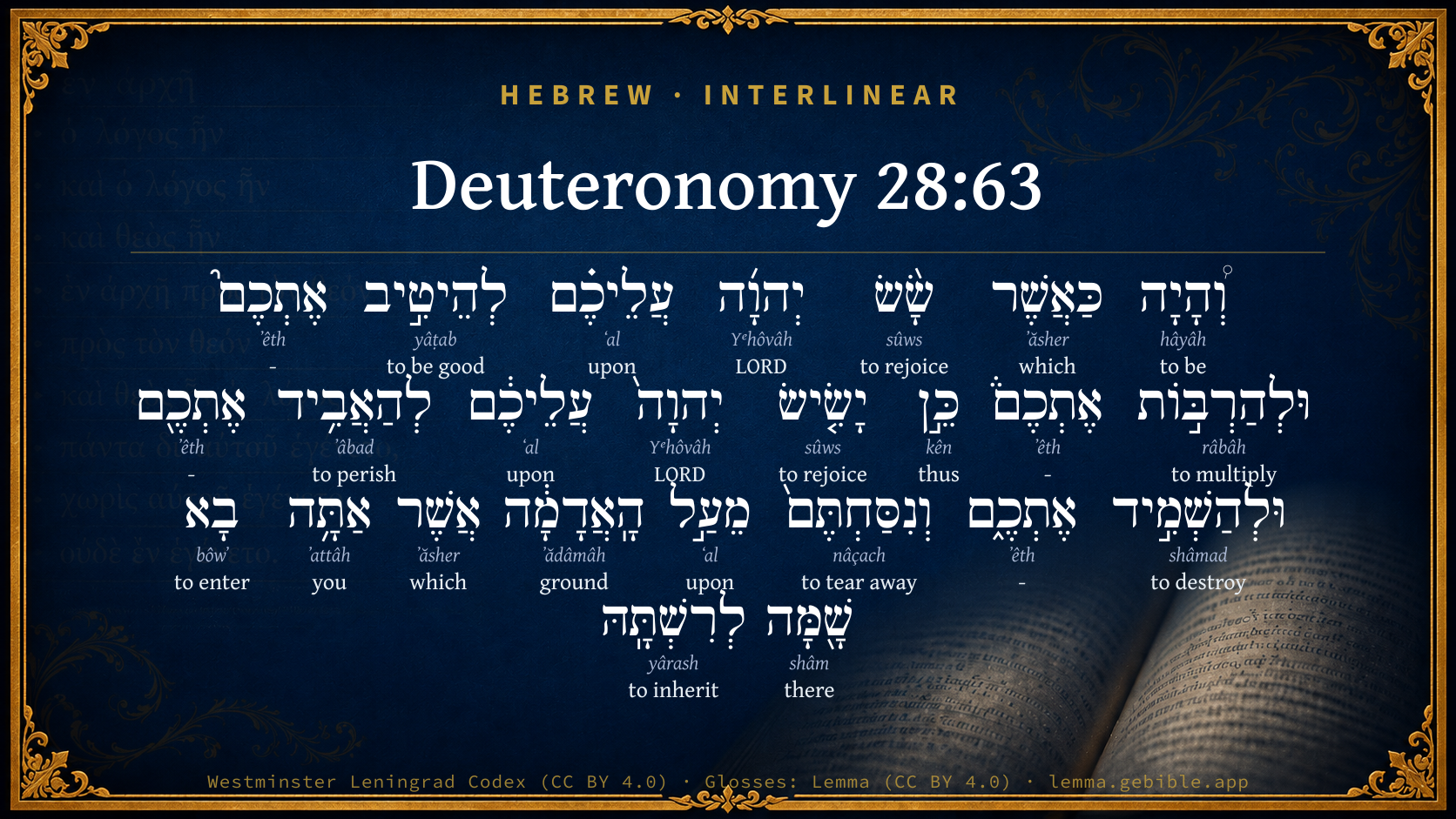
Deuteronomy 28:63

Hebrew (Westminster Leningrad Codex) Deuteronomy 28:63 appears in the Hebrew Old Testament. The text above is from the Westminster Leningrad Codex. Each word links to its Strong’s number, a concise gloss, and parsing drawn from the Open Scriptures Hebrew Bible morphology. Click any word for its full Brown-Driver-Briggs (BDB) entry.
Download image
Cite this verse

Deuteronomy 28:63 (World English Bible). Public Domain. Lemma interlinear Bible study tool, https://lemma.gebible.app/v/deuteronomy/28/63.

Show BibTeX & RIS
BibTeX
RIS
English Translation
It shall happen that as Yahweh rejoiced over you to do you good, and to multiply you, so Yahweh will rejoice over you to cause you to perish, and to destroy you; and you shall be plucked from off the land where you go in to possess it.
World English Bible · Public Domain
Highlights
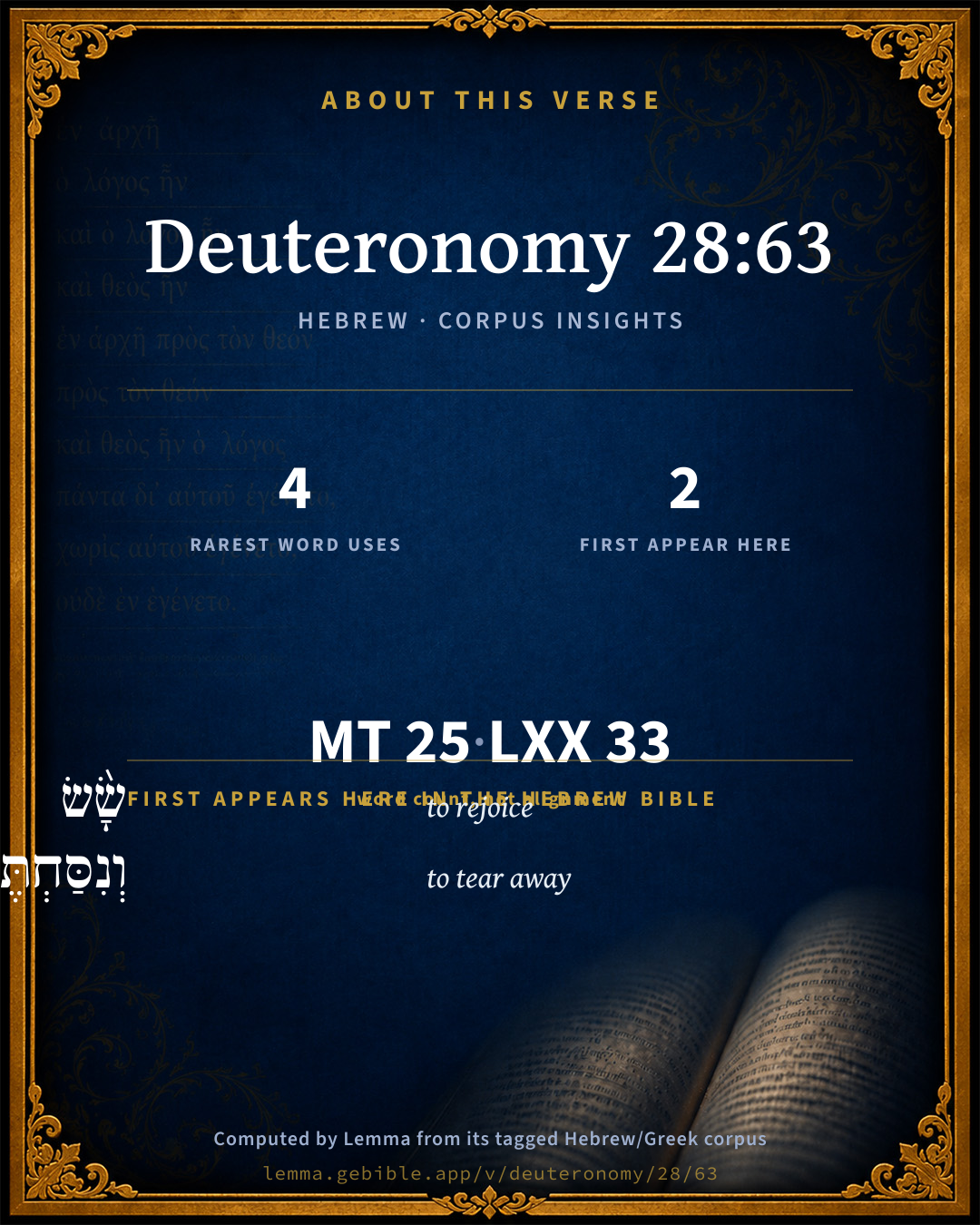
  • 2 first appearances in the Hebrew Bible
Full analysis ↓
Download a study sheet

One document with this verse’s original text, its word-by-word gloss line, the meaning frame, cross-references with their text, attributed commentary, and full source and license credits — printable, and it pastes into notes with its structure intact.

This verse Autodidact and up

Study sheet (.html) Plain text (.txt)

A passage Seminary Student

Up to 50 verses in one chapter. A passage sheet keeps up to 6 commentary sources and 12 cross-references per verse, in the order this page ranks them, and says so on the sheet whenever that leaves anything out. Ask for a single verse and you get the Autodidact verse sheet above.

Everything on this page stays free to read, with no account — the sheet is a download of what is already on screen, not access to it.

Want to remove ads? Support Godless Engineer
Compare translations 3

The same verse in 3 English versions, stacked beneath the original-language interlinear above. Click any original word for its lexicon entry.

Each is an independent rendering of the whole verse — the interlinear is not word-aligned to these translations.

Highlighted words mark where these versions differ — a whole-verse word diff, not a word-by-word alignment.

  • World English Bible Public Domain
    It shall happen that as Yahweh rejoiced over you to do you good, and to multiply you, so Yahweh will rejoice over you to cause you to perish, and to destroy you; and you shall be plucked from off the land where you go in to possess it.
  • King James Version Public Domain
    And it shall come to pass, that as the LORD rejoiced over you to do you good, and to multiply you; so the LORD will rejoice over you to destroy you, and to bring you to nought; and ye shall be plucked from off the land whither thou goest to possess it.
  • unfoldingWord Literal Text CC BY-SA 4.0
    And it will happen, as Yahweh rejoiced over you in doing you good, and in multiplying you, so Yahweh will rejoice over you in causing you to perish and in destroying you. And you will be torn away from the land which you are going into to possess it.

unfoldingWord Literal Text — © unfoldingWord, licensed CC BY-SA 4.0. Word-aligned USFM3 via Door43 (git.door43.org/unfoldingWord/en_ult).

Versions to compare (up to 4)

3 of 4 selected

Show all 18 translations

Every available English version of this verse, each an independent rendering of the whole verse.

  • World English Bible Public Domain
    It shall happen that as Yahweh rejoiced over you to do you good, and to multiply you, so Yahweh will rejoice over you to cause you to perish, and to destroy you; and you shall be plucked from off the land where you go in to possess it.
  • Berean Standard Bible Public Domain
    Just as it pleased the LORD to make you prosper and multiply, so also it will please Him to annihilate you and destroy you. And you will be uprooted from the land you are entering to possess.
  • Majority Standard Bible Public Domain
    Just as it pleased the LORD to make you prosper and multiply, so also it will please Him to annihilate you and destroy you. And you will be uprooted from the land you are entering to possess.
  • King James Version Public Domain
    And it shall come to pass, that as the LORD rejoiced over you to do you good, and to multiply you; so the LORD will rejoice over you to destroy you, and to bring you to nought; and ye shall be plucked from off the land whither thou goest to possess it.
  • American Standard Version (1901) Public Domain
    And it shall come to pass, that, as Jehovah rejoiced over you to do you good, and to multiply you, so Jehovah will rejoice over you to cause you to perish, and to destroy you; and ye shall be plucked from off the land whither thou goest in to possess it.
  • Revised Version (1885) Public Domain
    And it shall come to pass, that as the LORD rejoiced over you to do you good, and to multiply you; so the LORD will rejoice over you to cause you to perish, and to destroy you; and ye shall be plucked from off the land whither thou goest in to possess it.
  • Geneva Bible (1599) Public Domain
    And as the Lord hath reioyced ouer you, to doe you good, and to multiply you, so he will reioyce ouer you, to destroy you, and bring you to nought, and ye shalbe rooted out of the land, whither thou goest to possesse it.
  • Douay-Rheims (1899) Public Domain
    And as the Lord rejoiced upon you before doing good to you, and multiplying you: so he shall rejoice destroying and bringing you to nought, so that you shall be taken away from the land which thou shalt go in to possess.
  • Young's Literal Translation Public Domain
    `And it hath been, as Jehovah hath rejoiced over you to do you good, and to multiply you, so doth Jehovah rejoice over you to destroy you, and to lay you waste; and ye have been pulled away from off the ground whither thou art going in to possess it;
  • Literal Standard Version CC BY-SA 4.0
    And it has been, as YHWH has rejoiced over you to do you good and to multiply you, so YHWH rejoices over you to destroy you and to lay you waste; and you have been pulled away from off the ground to where you are going in to possess it;
  • Unlocked Literal Bible CC BY-SA 4.0
    As Yahweh once rejoiced over you in doing you good, and in multiplying you, so he will rejoice over you in making you perish and in destroying you. You will be plucked off the land that you are going into to possess.
  • unfoldingWord Literal Text CC BY-SA 4.0
    And it will happen, as Yahweh rejoiced over you in doing you good, and in multiplying you, so Yahweh will rejoice over you in causing you to perish and in destroying you. And you will be torn away from the land which you are going into to possess it.
  • Darby Bible Public Domain
    And it shall come to pass, that as Jehovah rejoiced over you to do you good and to multiply you, so Jehovah will rejoice over you to cause you to perish, and to destroy you; and ye shall be plucked from off the land whereunto thou goest to possess it.
  • World Messianic Bible Public Domain
    It will happen that as the LORD rejoiced over you to do you good, and to multiply you, so the LORD will rejoice over you to cause you to perish and to destroy you. You will be plucked from the land that you are going in to possess.
  • Webster's Bible Public Domain
    And it shall come to pass, that as the LORD rejoiced over you to do you good, and to multiply you; so the LORD will rejoice over you to destroy you, and to bring you to naught; and ye shall be plucked from off the land whither thou goest to possess it.
  • Free Bible Version CC BY-SA 4.0
    In the same way as he wanted to make you prosperous and increase in number, so now he will wipe you out and destroy you. You will be uprooted from the country you are going in to own.
  • Bible in Basic English Public Domain
    And as the Lord took delight in doing you good and increasing you, so the Lord will take pleasure in cutting you off and causing your destruction, and you will be uprooted from the land which you are about to take as your heritage.
  • JPS Tanakh (1917) Public Domain
    And it shall come to pass, that as the LORD rejoiced over you to do you good, and to multiply you; so the LORD will rejoice over you to cause you to perish, and to destroy you; and ye shall be plucked from off the land whither thou goest in to possess it.

Literal Standard Version (2020), Covenant Press — licensed CC BY-SA 4.0. Text via the HelloAO Bible API (eBible.org). Unlocked Literal Bible (unfoldingWord) — licensed CC BY-SA 4.0. Text via the HelloAO Bible API (eBible.org). unfoldingWord Literal Text — © unfoldingWord, licensed CC BY-SA 4.0. Word-aligned USFM3 via Door43 (git.door43.org/unfoldingWord/en_ult). Free Bible Version, Dr. Jonathan Gallagher — licensed CC BY-SA 4.0. Text via the HelloAO Bible API (eBible.org).

Word by word

More ways to search: Search by grammar → Find every occurrence → Compare this word →

Practice this passage: Drill this verse → Learn its vocabulary →

וְנִסַּחְתֶּם֙
nâçach
H5255
“and · to tear away”
Conjunction + Verb, Niphal, Sequential Perfect, 2nd Person, Masculine, Plural
Part of Speech
Conjunction + Verb
Stem
Niphal
Form
Sequential Perfect
Person
2nd Person
Gender
Masculine
Number
Plural
Full BDB Definition

Origin: a primitive root

TWOT: 1374

to pull or tear away - (Qal) to tear away, tear down - (Niphal) to be torn away
  1. וְ֠הָיָה hâyâh H1961 “and · to be” Conjunction + Verb, Qal, Sequential Perfect, 3rd Person, Masculine, Singular
  2. כַּאֲשֶׁר ʼăsher H834 “like/as · which” Preposition + Particle, Relative
  3. שָׂ֨שׂ sûws H7797 “to rejoice” Verb, Qal, Perfect, 3rd Person, Masculine, Singular
  4. יְהוָ֜ה Yᵉhôvâh H3068 “LORD” Noun, Proper
  5. עֲלֵיכֶ֗ם ʻal H5921 “upon · you” Preposition + Suffix, Personal, 2nd Person, Masculine, Plural
  6. לְהֵיטִ֣יב yâṭab H3190 “to be good” Preposition + Verb, Hiphil, Infinitive Construct
  7. אֶתְכֶם֮ ʼêth H853 “- · you” Particle, Direct Object + Suffix, Personal, 2nd Person, Masculine, Plural
  8. וּלְהַרְבּ֣וֹת râbâh H7235 “and · to multiply” Conjunction + Preposition + Verb, Hiphil, Infinitive Construct
  9. אֶתְכֶם֒ ʼêth H853 “- · you” Particle, Direct Object + Suffix, Personal, 2nd Person, Masculine, Plural
  10. כֵּ֣ן kên H3651 “thus” Particle, Demonstrative
  11. יָשִׂ֤ישׂ sûws H7797 “to rejoice” Verb, Qal, Imperfect, 3rd Person, Masculine, Singular
  12. יְהוָה֙ Yᵉhôvâh H3068 “LORD” Noun, Proper
  13. עֲלֵיכֶ֔ם ʻal H5921 “upon · you” Preposition + Suffix, Personal, 2nd Person, Masculine, Plural
  14. לְהַאֲבִ֥יד ʼâbad H6 “to perish” Preposition + Verb, Hiphil, Infinitive Construct
  15. אֶתְכֶ֖ם ʼêth H853 “- · you” Particle, Direct Object + Suffix, Personal, 2nd Person, Masculine, Plural
  16. וּלְהַשְׁמִ֣יד shâmad H8045 “and · to destroy” Conjunction + Preposition + Verb, Hiphil, Infinitive Construct
  17. אֶתְכֶ֑ם ʼêth H853 “- · you” Particle, Direct Object + Suffix, Personal, 2nd Person, Masculine, Plural
  18. מֵעַ֣ל ʻal H5921 “from · upon” Preposition + Preposition
  19. הָֽאֲדָמָ֔ה ʼădâmâh H127 “the · ground” Particle, Definite Article + Noun, Common, Feminine, Singular, Absolute
  20. אֲשֶׁר ʼăsher H834 “which” Particle, Relative
  21. אַתָּ֥ה ʼattâh H859 “you” Pronoun, Personal, 2nd Person, Masculine, Singular
  22. בָא bôwʼ H935 “entering” Verb, Qal, Participle Active, Masculine, Singular, Absolute
  23. שָׁ֖מָּה shâm H8033 “there · toward” Adverb + Suffix, Demonstrative
  24. לְרִשְׁתָּֽהּ yârash H3423 “to inherit · her” Preposition + Verb, Qal, Infinitive Construct + Suffix, Personal, 3rd Person, Feminine, Singular

About this verse

These counts appear in no published source. They are computed here, from the morphology-tagged text and Lemma’s own curated glosses. What Lemma adds →

25
words
17
distinct lemmas
Pentateuch
section

Notable vocabulary

The rarest word here is וְנִסַּחְתֶּם֙ to tear away H5255 — appearing just 4 times in the whole Hebrew Bible.

First appearance in Scripture

These words make their first canonical appearance in the Hebrew Bible here:

  • שָׂ֨שׂ to rejoice H7797
  • וְנִסַּחְתֶּם֙ to tear away H5255

Shared distinctive vocabulary

וְנִסַּחְתֶּם֙ to tear away H5255 occurs in 4 verses of the Hebrew Bible. Also found in:

Grammatical profile

  • 10 verbs
  • 3 nouns
  • 1 pronoun
  • 3 prepositions
  • 1 adverb
  • 7 particles

Verb forms

  • וְ֠הָיָה Qal · Sequential Perfect
  • שָׂ֨שׂ Qal · Perfect
  • לְהֵיטִ֣יב Hiphil · Infinitive Construct
  • וּלְהַרְבּ֣וֹת Hiphil · Infinitive Construct
  • יָשִׂ֤ישׂ Qal · Imperfect
  • לְהַאֲבִ֥יד Hiphil · Infinitive Construct
  • וּלְהַשְׁמִ֣יד Hiphil · Infinitive Construct
  • וְנִסַּחְתֶּם֙ Niphal · Sequential Perfect
  • בָא Qal · Participle Active
  • לְרִשְׁתָּֽהּ Qal · Infinitive Construct

Repetition

Words recur within this verse — often emphatic in Hebrew:

  • עֲלֵיכֶ֗ם upon H5921 ×3
  • שָׂ֨שׂ to rejoice H7797 ×2
  • יְהוָ֜ה LORD H3068 ×2
  • כַּאֲשֶׁר which H834 ×2

Hebrew & Septuagint length

In English translation the verse runs 48 words from the Hebrew and 47 from the Septuagint (LXX English) — closely comparable.

A rough comparison of the two English renderings, which tokenize alike — not a word-level alignment.

Word counts can differ between the Hebrew and the Greek without any difference in meaning — e.g. the Hebrew direct-object marker אֵת has no separate Greek word, and Greek often adds the article ὁ.

In the original languages it is 25 Hebrew tokens and 33 Greek tokens — but the two are counted differently (Hebrew bundles its prefixes and suffixes into one token; the Greek is in lemma form), so that isn’t a like-for-like length.

Cross-references

17

Topical passages linked to Deuteronomy 28:63 in the Treasury of Scripture Knowledge — connected by theme and wording, ordered by reader-vote popularity; previews shown in the World English Bible.

  • Proverbs 1:26 I also will laugh at your disaster. I will mock when calamity overtakes you;
  • Isaiah 1:24 Therefore the Lord, Yahweh of Hosts, The Mighty One of Israel, says: "Ah, I will get relief from my adversaries, And avenge myself of my enemies;
  • Ezekiel 5:13 Thus shall my anger be accomplished, and I will cause my wrath toward them to rest, and I shall be comforted; and they shall know that I, Yahweh, have spoken in my zeal, when I have accomplished my wrath on them.
  • Jeremiah 18:7 At what instant I shall speak concerning a nation, and concerning a kingdom, to pluck up and to break down and to destroy it;
  • Jeremiah 45:4 Thus shall you tell him, Thus says Yahweh: Behold, that which I have built will I break down, and that which I have planted I will pluck up; and this in the whole land.
  • Ezekiel 33:11 Tell them, As I live, says the Lord Yahweh, I have no pleasure in the death of the wicked; but that the wicked turn from his way and live: turn you, turn you from your evil ways; for why will you die, house of Israel?
  • Jeremiah 31:40 The whole valley of the dead bodies and of the ashes, and all the fields to the brook Kidron, to the corner of the horse gate toward the east, shall be holy to Yahweh; it shall not be plucked up, nor thrown down any more forever.
  • Jeremiah 32:41 Yes, I will rejoice over them to do them good, and I will plant them in this land assuredly with my whole heart and with my whole soul.
  • Deuteronomy 7:22 Yahweh your God will cast out those nations before you by little and little: you may not consume them at once, lest the animals of the field increase on you.
  • Deuteronomy 30:9 Yahweh your God will make you plenteous in all the work of your hand, in the fruit of your body, and in the fruit of your cattle, and in the fruit of your ground, for good: for Yahweh will again rejoice over you for good, as he rejoiced over your fathers;
  • Isaiah 62:5 For as a young man marries a virgin, so shall your sons marry you; and as the bridegroom rejoices over the bride, so shall your God rejoice over you.
  • Jeremiah 12:14–15 Thus says Yahweh against all my evil neighbors, who touch the inheritance which I have caused my people Israel to inherit: behold, I will pluck them up from off their land, and will pluck up the house of Judah from among them.
  • Jeremiah 24:6 For I will set my eyes on them for good, and I will bring them again to this land: and I will build them, and not pull them down; and I will plant them, and not pluck them up.
  • Jeremiah 31:28 It shall happen that, like as I have watched over them to pluck up and to break down and to overthrow and to destroy and to afflict, so will I watch over them to build and to plant, says Yahweh.
  • Jeremiah 42:10 If you will still abide in this land, then will I build you, and not pull you down, and I will plant you, and not pluck you up; for I repent me of the evil that I have done to you.
  • Daniel 7:8 I considered the horns, and, behold, there came up among them another horn, a little one, before which three of the first horns were plucked up by the roots: and, behold, in this horn were eyes like the eyes of a man, and a mouth speaking great things.
  • Zephaniah 3:17 Yahweh, your God, is in the midst of you, a mighty one who will save. He will rejoice over you with joy. He will rest in his love. He will rejoice over you with singing.

Cross-references courtesy of OpenBible.info (CC BY 4.0).

Hebrew and Greek witnesses Masoretic Hebrew ↔ Greek Septuagint

The same verse in the two great witnesses to the Old Testament, shown verse-for-verse.

These are two independent witnesses, not word-aligned to each other, and the Septuagint is shown in lemma (dictionary) form.

Hebrew Deuteronomy 28:63 Masoretic · Westminster Leningrad Codex

וְ֠הָיָה כַּאֲשֶׁר שָׂ֨שׂ יְהוָ֜ה עֲלֵיכֶ֗ם לְהֵיטִ֣יב אֶתְכֶם֮ וּלְהַרְבּ֣וֹת אֶתְכֶם֒ כֵּ֣ן יָשִׂ֤ישׂ יְהוָה֙ עֲלֵיכֶ֔ם לְהַאֲבִ֥יד אֶתְכֶ֖ם וּלְהַשְׁמִ֣יד אֶתְכֶ֑ם וְנִסַּחְתֶּם֙ מֵעַ֣ל הָֽאֲדָמָ֔ה אֲשֶׁר אַתָּ֥ה בָא שָׁ֖מָּה לְרִשְׁתָּֽהּ

It shall happen that as Yahweh rejoiced over you to do you good, and to multiply you, so Yahweh will rejoice over you to cause you to perish, and to destroy you; and you shall be plucked from off the land where you go in to possess it.

World English Bible · Public Domain

Greek LXX Deuteronomy 28:63 Septuagint · lemma form

καί εἰμί ὅς τρόπος εὐφραίνω κύριος ἐπί σύ εὖ ποιέω σύ καί πληθύνω σύ οὕτως εὐφραίνω κύριος ἐπί σύ ἐκὀλεθρεύω σύ καί ἐκαἴρω ἀπό ὁ γῆ εἰς ὅς σύ εἰςπορεύομαι ἐκεῖ κληρονομέω αὐτός

And it shall come to pass that as the Lord rejoiced over you to do you good, and to multiply you, so the Lord will rejoice over you to destroy you; and you⌃ shall be quickly removed from the land, into which you⌃ go to inherit it.

LXX2012 (modern English Septuagint) · Public Domain

Hebrew: Westminster Leningrad Codex (CC BY 4.0). Greek: Septuagint (public domain); English from LXX2012 (modern English Septuagint) (Public Domain). How the Septuagint differs from the Hebrew →

Targum (Aramaic paraphrase)

2

The Targum is the ancient Jewish Aramaic paraphrase of the Hebrew Scriptures — an interpretive translation, not the Hebrew text itself. Onkelos (literal) and Pseudo-Jonathan (expansive) render the Torah, and Jonathan the Prophets. Coverage is partial: where no permissively-licensed English translation exists for a verse, only the Aramaic is shown. This is verse-level text, not a word-by-word alignment to the Hebrew.

  1. Targum Onkelos Torah (Genesis–Deuteronomy)
    וִיהֵי כְּמָא דְחַדֵי יְיָ עֲלֵיכוֹן לְאוֹטָבָא יָתְכוֹן וּלְאַסְגָאָה יָתְכוֹן כֵּן יֶחֱדֵי יְיָ עֲלֵיכוֹן לְאוֹבָדָא יָתְכוֹן וּלְשֵׁצָאָה יָתְכוֹן וְתִטַלְטְלוּן מֵעַל אַרְעָא דְאַתְּ עָלֵל לְתַמָן לְמֵירְתַהּ

    (no public-domain English translation for this verse)

    Targum Onkelos — Aramaic: “Onkelos Genesis” (public domain); “Onkelos Exodus” (public domain); “Onkelos Leviticus” (public domain); “Onkelos Numbers” (public domain); “Onkelos Deuteronomy” (public domain). English: “Sefaria Community Translation” (CC0 1.0 (public-domain dedication)); “J.W. Etheridge. The Targums of Onkelos and Jonathan Ben Uzziel on the Pentateuch. London: Longmans, Green, 1862” (public domain). Text via Sefaria.

  2. Targum Pseudo-Jonathan Torah (Genesis–Deuteronomy)
    וִיהֵי הֵיכְמָא דְחָדֵי מֵימְרָא דַיְיָ עֲלֵיכוֹן לְאוֹטָבוּתְכוֹן וּלְאַסְגָאָה יַתְכוֹן הֵיכְדֵין יֶחְדֵי מֵימְרָא דַיְיָ עֲלֵיכוֹן עַמְמִין נוּכְרָאִין לְהוֹבְדָא יַתְכוֹן וּלְמֵשַׁצְיָא יַתְכוֹן וְתִיתְעַקְרוּן מֵעִילַוֵי אַרְעָא דְאַתּוּן עַלְלִין לְתַמָן לְמֵירְתָהּ

    And as the Word of the Lord rejoiced over you to do you good, and to multiply you, so will He rejoice (in sending) against you strange nations to destroy and make you desolate, and you shall be uprooted from the land which you are going to possess.

    Targum Pseudo-Jonathan — Aramaic: “Targum Jonathan on Genesis” (public domain); “Targum Jonathan on Exodus” (public domain); “Targum Jonathan on Leviticus” (public domain); “Targum Jonathan on Numbers” (public domain); “Targum Jonathan on Deuteronomy” (public domain). English: “The Targum of Jonathan ben Uzziel, trans. J. W. Etheridge, London, 1862” (public domain). Text via Sefaria.

Commentary

Notes on Deuteronomy 28:63 from classic Christian and Jewish commentators (each source and its license shown beneath its notes). The classic Christian expositions comment on the surrounding passage and are grouped to its opening verse, so a note may address several verses; the Jewish commentaries on the Tanakh (Rashi and others) are per-verse, so they appear only where the commentator wrote on this verse.

Lemma curates 59 commentaries, every one of them public domain or Creative Commons licensed, each selected and text-cleaned for this edition rather than reprinted as found. About our sources →

Trapp's Complete Commentary

John Trapp

Deu 28:63 And it shall come to pass, [that] as the LORD rejoiced over you to do you good, and to multiply you; so the LORD will rejoice over you to destroy you, and to bring you to nought; and ye shall be plucked from off the land whither thou goest to possess it.

Ver. 63. So the Lord will rejoice over you.] See here the venomous nature of sin, so far forth offensive to Almighty God, as to cause him, who otherwise afflicts not willingly, {Lam 3:33} but delights in mercy, {Mic 7:18} to rejoice in the ruin of his creatures, as here, to laugh at their destruction, and mock when their fear cometh, {Pro 1:26} to take as much pleasure therein as a man would do in a cup of generous wine, {Rev 16:19} and to be as much eased thereby, as one over-gorged would be in ridding his stomach of that which oppressed it. {Rev 3:16}

John Trapp, A Commentary or Exposition upon All the Books of the Old and New Testament (1647–1656) — public domain. Text from a community e-Sword module.

Joseph Benson's Commentary

Deu 28:63. The Lord will rejoice over you, to destroy you — His just indignation against you will be so great, that it will be a pleasure to him to take vengeance on you. For though he doth not delight in the death of a sinner in itself, yet he doth delight in glorifying his justice upon incorrigible transgressors, seeing the exercise of all his attributes must needs please him, else he were not perfectly happy. And ye shall be plucked from off the land, &c. — This was fulfilled when the king of Assyria carried the ten tribes into captivity, and planted other nations in their stead; and when the king of Babylon carried away the other two tribes; and especially when the Romans took away their place and nation, not to mention other captivities and transportations of them. “Afterward, when the Emperor Adrian had subdued the rebellious Jews, he published an edict, forbidding them, upon pain of death, to set foot in Jerusalem, or even to approach the country round about. Tertullian and Jerome say, they were prohibited from entering Judea. From that time to this their country hath been in the possession of foreign lords and masters, few of the Jews dwelling in it, and those only of a low, servile condition.”

Joseph Benson's Commentary on the Old and New Testaments (1811–1818) — public domain. Text from a community e-Sword module.

Jamieson, Fausset & Brown

Robert Jamieson, A. R. Fausset & David Brown

ye shall be plucked from off the land--Hadrian issued a proclamation, forbidding any Jews to reside in Judea, or even to approach its confines.

Jamieson, Fausset & Brown — Commentary Critical and Explanatory on the Whole Bible (1871) — public domain (CC PDM 1.0). Text via the HelloAO Bible API.

Ellicott's Commentary for English Readers

(63) As the Lord rejoiced over you.—See on Deu_30:9.

A Bible Commentary for English Readers, edited by Charles John Ellicott (1878–1897) — public domain. Text from a community e-Sword module.

The Cambridge Bible for Schools and Colleges

gen. ed. J. J. S. Perowne

63. rejoiced over you, etc.] Cp. Deu_8:16, Deu_30:9. Rejoice or exult, found only in exilic or post-exilic passages.

to multiply you] See on Deu_1:10, Deu_7:13.

rejoice … to destroy you] This rhetorical figure is characteristic of the deuteronomic style. Contrast Hos_11:8 f.

The Cambridge Bible for Schools and Colleges (gen. ed. J. J. S. Perowne; Cambridge University Press, 1878–1918) — public domain. Text from a community e-Sword module.

John Gill's Exposition

In the morning thou shalt say, would God it were even,.... Wishing they might get through the day well, fearing their life would be taken away before night, or some sad calamity befall them before the day was past:

and at even thou shall say, would God it were morning; dreading what would happen to them in the night, that some messenger of death would be sent to dispatch them, or they should be haled out of bed to a court of inquisition, and cast into a dungeon:

for the fear of thine heart wherewith thou shalt fear, and for the sight of thine eyes which, thou shalt see; often beholding such dreadful sights, as their countrymen put upon the rack, and cruelly tortured, and then burnt alive; and so their hearts would fear and tremble, lest they should be the next that would be taken up and used in this manner; besides other severities and hard usages, with which their brethren were treated, and they in continual fear of.

John Gill's Exposition of the Whole Bible (1746–1763) — public domain (CC PDM 1.0). Text via the HelloAO Bible API.

Matthew Poole's English Annotations

Rejoice over you to destroy you; his just indignation against you will be so great, that it will be a pleasure to him to take vengeance on you. For though he doth not delight in the death of a sinner in itself, yet he doth doubtless delight in the glorifying of his justice upon incorrigible sinners, seeing the exercise of all his attributes must needs please him, else he were not perfectly happy.

The land whither thou goest to possess it; which was no ordinary land, but a most pleasant land, a land of promise, a token of God’s favour, and a pledge of their eternal inheritance, which was a great aggravation of their loss of it.

Matthew Poole's English Annotations on the Holy Bible (1683–1685) — public domain. Text from a community e-Sword/MySword module.

The Pulpit Commentary

cf. Deu_30:9; Jer_32:41. He, whose joy it had been to do them good, should rejoice over their destruction. (of Pro_1:26)

God rejoicing in judgment.

The language in this verse is bold, almost beyond example. It jars with our conceptions of the Divine Being to think of him as "rejoicing" in the destruction of even the most obdurate of sinners, he declares that he has no pleasure in the death of him that dieth. (Eze_18:32) Christ predicted Jerusalem"s fall, but "wept over it". (Luk_19:41) The language is best interpreted, not of actual joy felt by God in the execution of his judgments, but anthropo-pathically of the certainty, rapidity, and unsparingness with which, like waves chasing each other to the shore, strokes of judgment would descend, as if God took pleasure in inflicting them. The figure is derived from God"s joy in the communication of blessings. As God"s joy in this case a real joy was shown in the number and accumulation ofthe blessings, so would it be with the judgments he would appear to rejoice in the sending of these also. We do not, however, ignore the fact that God must approve of, yea, rest with satisfaction in, every exercise of his perfections, even in the infliction of judgment. The verse, in any view of it, is a very terrible one in its bearings on the prospects of the wicked. J.O.

The Pulpit Commentary (1880–1919), ed. H.D.M. Spence-Jones & Joseph S. Exell — public domain. Text from a community e-Sword module.

John Wesley's Explanatory Notes

To destroy you - His just indignation against you will be so great, that it will be a pleasure to him to take vengeance on you. For though he doth not delight in the death of a sinner in itself, yet he doth delight in glorifying his justice upon incorrigible sinners, seeing the exercise of all his attributes must needs please him, else he were not perfectly happy.

John Wesley, Explanatory Notes Upon the Whole Bible (1754–1765) — public domain. Text via the GEBible commentary corpus.

unfoldingWord translationNotes

Door43 World Missions Community

Yahweh once rejoiced over you ... multiplying you ... rejoice over you in making you perish and in destroying you. You will be plucked

Moses is speaking to the Israelites as a group, so all instances of "you" are plural. (See: Forms of You)

Yahweh once rejoiced over you in doing you good, and in multiplying you

"Yahweh once enjoyed doing you good and causing you to become many"

he will rejoice over you in making you perish

"he will enjoy making you die"

You will be plucked off the land that you are going into to possess

Moses uses a metaphor to speak of the people as though they were fruit that Yahweh would take off a bush. This can be stated in active form. AT: "He will remove you from the land which you are entering to possess" (See: Metaphor and Active or Passive)

you are going ... scatter you ... you will worship ... you have not known ... you nor your ancestors

Moses speaks to the Israelites as if they were one man, so the words "you" and "your" here are singular. (See: Forms of You)

from the one end of the earth to the other end of the earth

These two extremes together mean everywhere on earth. AT: "throughout the earth" or "all over the earth" (See: Merism)

translationWords

joy

perish

possess

earth

worship

false god

know

unfoldingWord translationNotes — © Distant Shores Media and the Door43 World Missions Community, licensed CC BY-SA 4.0. Source: git.door43.org/Door43/en_tn.

Rashi

Rabbi Shlomo Yitzchaki (Rashi)

'כן ישיש ה SO WILL THE LORD MAKE your enemies REJOICE עליכם OVER YOU, להאביד וגו׳ TO DESTROY [YOU] (Megillah 10b).

ונסחתם is an expression denoting “uprooting”. Similar is, (Proverbs 15:25) “The Lord will uproot (יסח) the house of the haughty”.

Rashi on the Tanakh — English translations: “The Judaica Press complete Tanach with Rashi, translated by A. J. Rosenberg” (CC BY 4.0); “Pentateuch with Rashi's commentary by M. Rosenbaum and A.M. Silbermann, 1929-1934” (public domain); “The Metsudah Tanach series, Lakewood, N.J” (CC BY 4.0); and “The Book of Joshua, Metsudah Publications, 1997” (CC BY 4.0). Text via Sefaria.

Lesson kit

Teaching starters — assembled from the data on this page, not authored interpretation. Every prompt links to the verse data it draws on. Edit before teaching.

Deuteronomy, in the Pentateuch, opens this verse with 25 words (17 distinct Hebrew lemmas). Its most distinctive word is nâçach (“to tear away”). A historical commentator’s framing appears above. Read the whole chapter for the surrounding context.

Discussion questions

  1. What does “to tear away” (nâçach) contribute to the verse as a whole?
  2. 2 words here appear for the first time in Scripture. What is being introduced at this debut?
  3. Psalms 52:5 shares the word «to tear away» with this verse. How do the two illuminate each other?
  4. “upon” occurs 3× in this one verse. What is the effect of the repetition?
  5. These translations render this verse differently. What is at stake in choosing one wording over another?
  6. The verb «וְ֠הָיָה» is Qal Sequential Perfect. How does its form color the action?
  7. Reading how Trapp's Complete Commentary and Joseph Benson's Commentary read this verse, where do the two commentators agree and where do they part?

Things to notice

Reading settings

Reading text

Shown beneath each verse's original-language words.

Old Testament
Old Testament edition

Read the OT as the Masoretic Hebrew (MT) or the Greek Septuagint (LXX).

English shown for the Greek Septuagint (in the Hebrew ↔ Greek comparison).

Comparing translations? Open the Compare panel on any verse page to stack up to four side by side.