Nehemiah 10:35

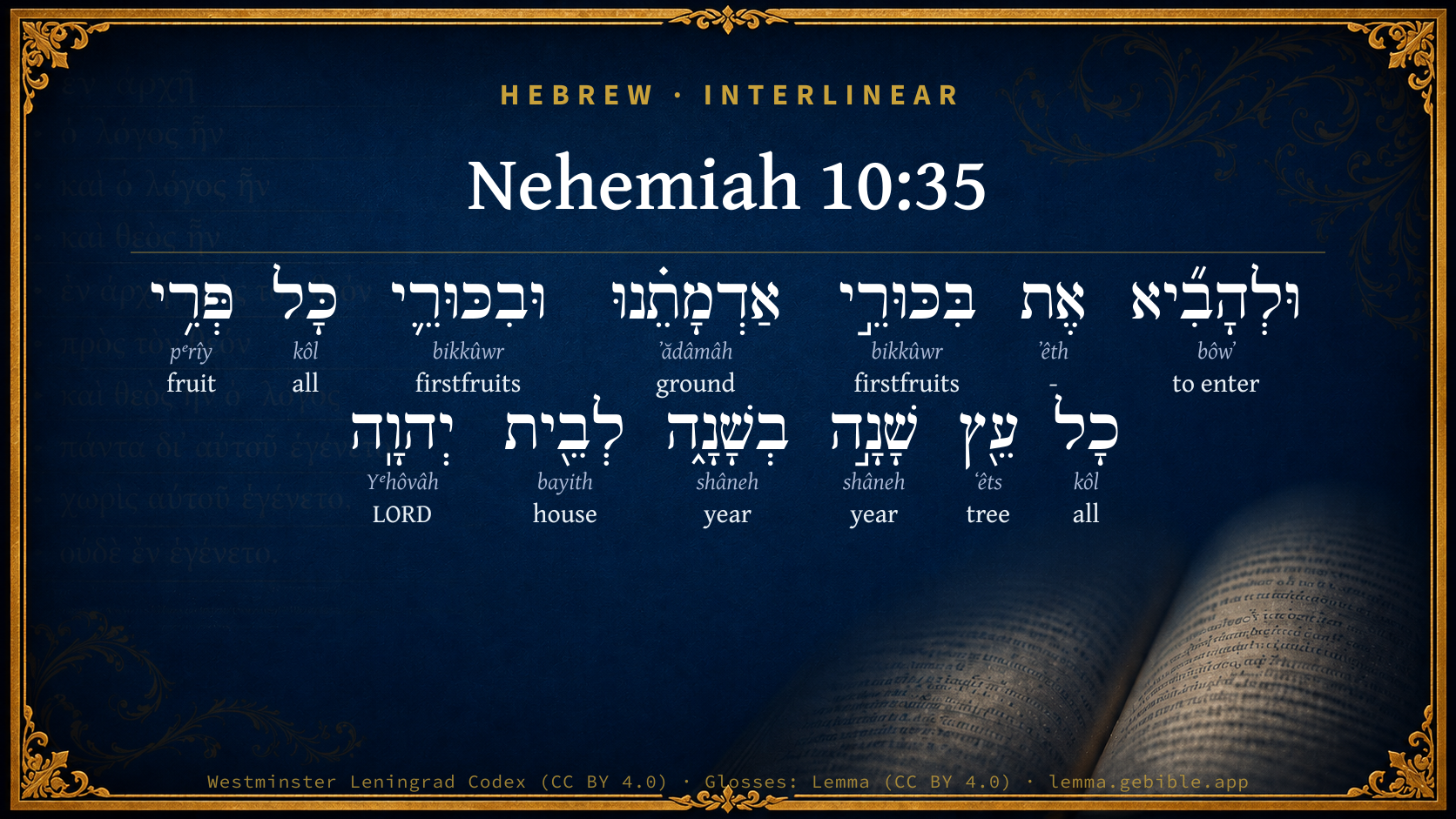
Hebrew (Westminster Leningrad Codex) Nehemiah 10:35 appears in the Hebrew Old Testament. The text above is from the Westminster Leningrad Codex. Each word links to its Strong’s number, a concise gloss, and parsing drawn from the Open Scriptures Hebrew Bible morphology. Click any word for its full Brown-Driver-Briggs (BDB) entry.
Download image
Cite this verse

Nehemiah 10:35 (World English Bible). Public Domain. Lemma interlinear Bible study tool, https://lemma.gebible.app/v/nehemiah/10/35.

Show BibTeX & RIS
BibTeX
RIS
English Translation
and to bring the first fruits of our ground, and the first fruits of all fruit of all manner of trees, year by year, to the house of Yahweh;
World English Bible · Public Domain
Download a study sheet

One document with this verse’s original text, its word-by-word gloss line, the meaning frame, cross-references with their text, attributed commentary, and full source and license credits — printable, and it pastes into notes with its structure intact.

This verse Autodidact and up

Study sheet (.html) Plain text (.txt)

A passage Seminary Student

Up to 50 verses in one chapter. A passage sheet keeps up to 6 commentary sources and 12 cross-references per verse, in the order this page ranks them, and says so on the sheet whenever that leaves anything out. Ask for a single verse and you get the Autodidact verse sheet above.

Everything on this page stays free to read, with no account — the sheet is a download of what is already on screen, not access to it.

Want to remove ads? Support Godless Engineer
Compare translations 3

The same verse in 3 English versions, stacked beneath the original-language interlinear above. Click any original word for its lexicon entry.

Each is an independent rendering of the whole verse — the interlinear is not word-aligned to these translations.

Highlighted words mark where these versions differ — a whole-verse word diff, not a word-by-word alignment.

  • World English Bible Public Domain
    and to bring the first fruits of our ground, and the first fruits of all fruit of all manner of trees, year by year, to the house of Yahweh;
  • King James Version Public Domain
    And to bring the firstfruits of our ground, and the firstfruits of all fruit of all trees, year by year, unto the house of the LORD:
  • unfoldingWord Literal Text CC BY-SA 4.0
    and to bring the firstfruits of our soil and the firstfruits of all the fruit of every tree, year by year, to the house of Yahweh;

unfoldingWord Literal Text — © unfoldingWord, licensed CC BY-SA 4.0. Word-aligned USFM3 via Door43 (git.door43.org/unfoldingWord/en_ult).

Versions to compare (up to 4)

3 of 4 selected

Show all 18 translations

Every available English version of this verse, each an independent rendering of the whole verse.

  • World English Bible Public Domain
    and to bring the first fruits of our ground, and the first fruits of all fruit of all manner of trees, year by year, to the house of Yahweh;
  • Berean Standard Bible Public Domain
    We will also bring the firstfruits of our land and of every fruit tree to the house of the LORD year by year.
  • Majority Standard Bible Public Domain
    We will also bring the firstfruits of our land and of every fruit tree to the house of the LORD year by year.
  • King James Version Public Domain
    And to bring the firstfruits of our ground, and the firstfruits of all fruit of all trees, year by year, unto the house of the LORD:
  • American Standard Version (1901) Public Domain
    and to bring the first-fruits of our ground, and the first-fruits of all fruit of all manner of trees, year by year, unto the house of Jehovah;
  • Revised Version (1885) Public Domain
    and to bring the firstfruits of our ground, and the firstfruits of all fruit of all manner of trees, year by year, unto the house of the LORD:
  • Geneva Bible (1599) Public Domain
    And to bring the first fruites of our land, and the first of all the fruites of all trees, yeere by yeere, into the house of the Lord,
  • Douay-Rheims (1899) Public Domain
    And that we would bring the first- fruits of our land, and the firstfruits of all fruit of every tree, from year to year, in the house of our Lord.
  • Young's Literal Translation Public Domain
    and to bring in the first fruits of our ground, and the first fruits of all fruit of every tree, year by year, to the house of Jehovah,
  • Literal Standard Version CC BY-SA 4.0
    and to bring in the first-fruits of our ground, and the first-fruits of all fruit of every tree, year by year, to the house of YHWH,
  • Unlocked Literal Bible CC BY-SA 4.0
    We promised to bring to the house of Yahweh the firstfruits grown from our soil, and the firstfruits of every tree each year.
  • unfoldingWord Literal Text CC BY-SA 4.0
    and to bring the firstfruits of our soil and the firstfruits of all the fruit of every tree, year by year, to the house of Yahweh;
  • Darby Bible Public Domain
    and to bring the first-fruits of our land, and the first-fruits of all fruit of all trees, year by year to the house of Jehovah,
  • World Messianic Bible Public Domain
    and to bring the first fruits of our ground and the first fruits of all fruit of all kinds of trees, year by year, to the LORD’s house;
  • Webster's Bible Public Domain
    And to bring the first-fruits of our ground, and the first-fruits of all fruit of all trees, year by year, to the house of the LORD:
  • Free Bible Version CC BY-SA 4.0
    We also promise to bring the first part of the produce from our fields and from every fruit tree to the Lord's Temple every year.
  • Bible in Basic English Public Domain
    And to take the first-fruits of our land, and the first-fruits of every sort of tree, year by year, into the house of the Lord;
  • JPS Tanakh (1917) Public Domain
    (10-36) and to bring the first-fruits of our land, and the first-fruits of all fruit of all manner of trees, year by year, unto the house of the LORD;

Literal Standard Version (2020), Covenant Press — licensed CC BY-SA 4.0. Text via the HelloAO Bible API (eBible.org). Unlocked Literal Bible (unfoldingWord) — licensed CC BY-SA 4.0. Text via the HelloAO Bible API (eBible.org). unfoldingWord Literal Text — © unfoldingWord, licensed CC BY-SA 4.0. Word-aligned USFM3 via Door43 (git.door43.org/unfoldingWord/en_ult). Free Bible Version, Dr. Jonathan Gallagher — licensed CC BY-SA 4.0. Text via the HelloAO Bible API (eBible.org).

Word by word

More ways to search: Search by grammar → Find every occurrence → Compare this word →

Practice this passage: Drill this verse → Learn its vocabulary →

בִּכּוּרֵ֣י
bikkûwr
H1061
“firstfruits of”
Noun, Common, Both, Plural, Construct
Part of Speech
Noun
Type
Common
Gender
Both
Number
Plural
State
Construct
Full BDB Definition

Origin: from H1069

TWOT: 244e

first-fruits - the first of the crops and fruit that ripened, was gathered, and offered to God according to the ritual of Pentecost - the bread made of the new grain offered at Pentecost - the day of the first-fruits (Pentecost)
  1. וּלְהָבִ֞יא bôwʼ H935 “and · to enter” Conjunction + Preposition + Verb, Hiphil, Infinitive Construct
  2. אֶת ʼêth H853 “-” Particle, Direct Object
  3. אַדְמָתֵ֗נוּ ʼădâmâh H127 “ground · our” Noun, Common, Feminine, Singular, Construct + Suffix, Personal, 1st Person, Common, Plural
  4. וּבִכּוּרֵ֛י bikkûwr H1061 “and · firstfruits of” Conjunction + Noun, Common, Both, Plural, Construct
  5. כָּל kôl H3605 “all of” Noun, Common, Masculine, Singular, Construct
  6. פְּרִ֥י pᵉrîy H6529 “fruit of” Noun, Common, Masculine, Singular, Construct
  7. כָל kôl H3605 “all of” Noun, Common, Masculine, Singular, Construct
  8. עֵ֖ץ ʻêts H6086 “tree” Noun, Common, Masculine, Singular, Absolute
  9. שָׁנָ֣ה shâneh H8141 “year” Noun, Common, Feminine, Singular, Absolute
  10. בְשָׁנָ֑ה shâneh H8141 “in/at · year” Preposition + Noun, Common, Feminine, Singular, Absolute
  11. לְבֵ֖ית bayith H1004 “to/for · house of” Preposition + Noun, Common, Masculine, Singular, Construct
  12. יְהוָֽה Yᵉhôvâh H3068 “LORD” Noun, Proper

About this verse

These counts appear in no published source. They are computed here, from the morphology-tagged text and Lemma’s own curated glosses. What Lemma adds →

13
words
10
distinct lemmas
Historical
section

Notable vocabulary

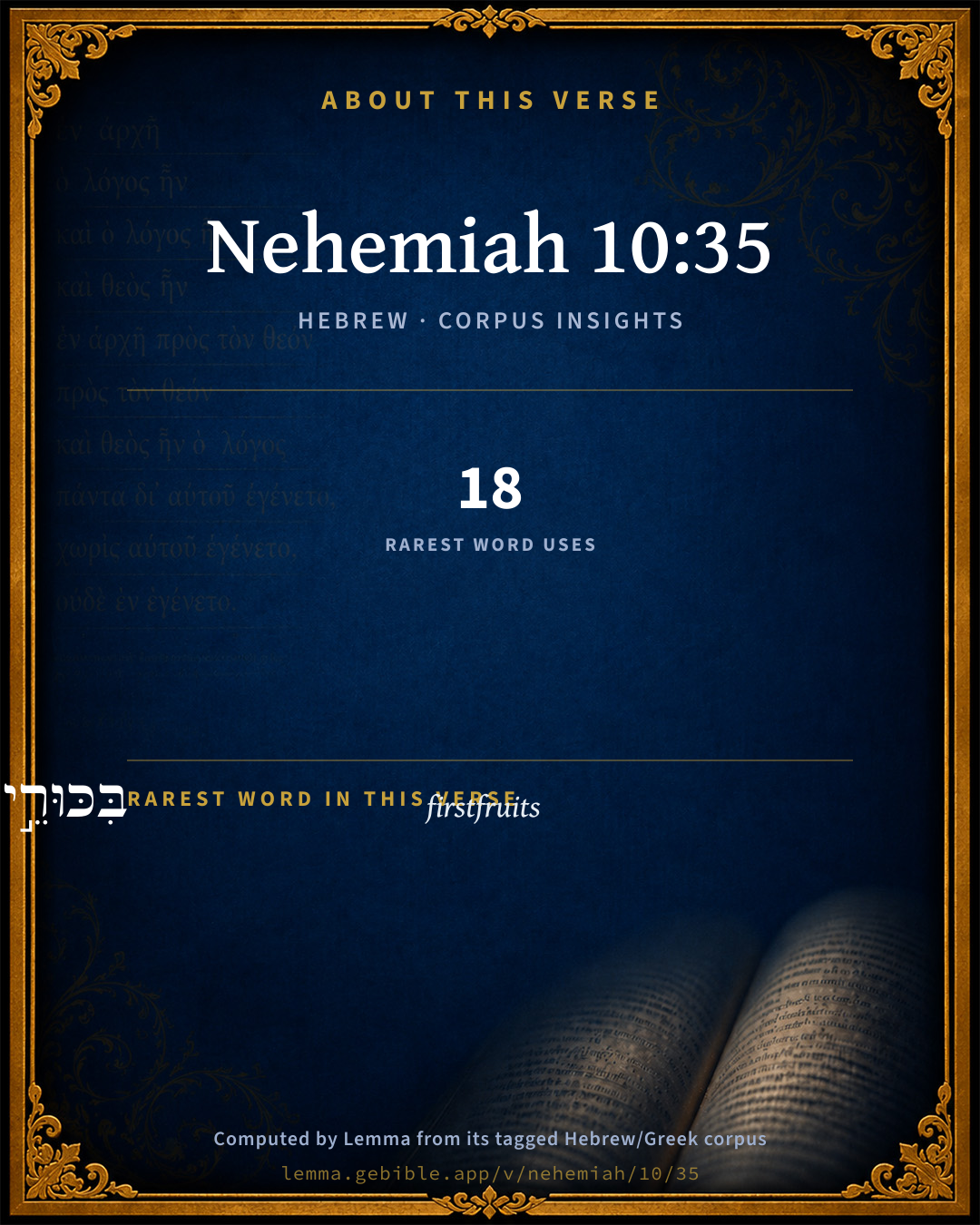
The rarest word here is בִּכּוּרֵ֣י firstfruits H1061 — appearing just 18 times in the whole Hebrew Bible.

Shared distinctive vocabulary

בִּכּוּרֵ֣י firstfruits H1061 occurs in 16 verses of the Hebrew Bible. Also found in:

Grammatical profile

  • 1 verb
  • 11 nouns
  • 1 particle

Verb forms

  • וּלְהָבִ֞יא Hiphil · Infinitive Construct

Repetition

Words recur within this verse — often emphatic in Hebrew:

  • בִּכּוּרֵ֣י firstfruits H1061 ×2
  • כָּל all H3605 ×2
  • שָׁנָ֣ה year H8141 ×2

Cross-references

9

Topical passages linked to Nehemiah 10:35 in the Treasury of Scripture Knowledge — connected by theme and wording, ordered by reader-vote popularity; previews shown in the World English Bible.

  • Deuteronomy 26:2 that you shall take of the first of all the fruit of the ground, which you shall bring in from your land that Yahweh your God gives you; and you shall put it in a basket, and shall go to the place which Yahweh your God shall choose, to cause his name to dwell there.
  • Exodus 23:19 The first of the first fruits of your ground you shall bring into the house of Yahweh your God. "You shall not boil a kid in its mother's milk.
  • Exodus 34:26 You shall bring the first of the first fruits of your ground to the house of Yahweh your God. You shall not boil a young goat in its mother's milk."
  • Numbers 18:12 All the best of the oil, and all the best of the vintage, and of the grain, the first fruits of them which they give to Yahweh, to you have I given them.
  • Leviticus 19:23–26 "'When you come into the land, and have planted all kinds of trees for food, then you shall count their fruit as forbidden. Three years shall they be forbidden to you. It shall not be eaten.
  • 2 Chronicles 31:3–10 [He appointed] also the king's portion of his substance for the burnt-offerings, [to wit], for the morning and evening burnt offerings, and the burnt offerings for the Sabbaths, and for the new moons, and for the set feasts, as it is written in the law of Yahweh.
  • Proverbs 3:9–10 Honor Yahweh with your substance, With the first fruits of all your increase:
  • Malachi 3:8–12 Will a man rob God? Yet you rob me! But you say, 'How have we robbed you?' In tithes and offerings.
  • Numbers 18:2 Your brothers also, the tribe of Levi, the tribe of your father, bring you near with you, that they may be joined to you, and minister to you: but you and your sons with you shall be before the tent of the testimony.

Cross-references courtesy of OpenBible.info (CC BY 4.0).

Hebrew and Greek witnesses Masoretic Hebrew ↔ Greek Septuagint

The same verse in the two great witnesses to the Old Testament, shown verse-for-verse.

These are two independent witnesses, not word-aligned to each other, and the Septuagint is shown in lemma (dictionary) form.

Hebrew Nehemiah 10:35 Masoretic · Westminster Leningrad Codex

וּלְהָבִ֞יא אֶת בִּכּוּרֵ֣י אַדְמָתֵ֗נוּ וּבִכּוּרֵ֛י כָּל פְּרִ֥י כָל עֵ֖ץ שָׁנָ֣ה בְשָׁנָ֑ה לְבֵ֖ית יְהוָֽה

and to bring the first fruits of our ground, and the first fruits of all fruit of all manner of trees, year by year, to the house of Yahweh;

World English Bible · Public Domain

Greek LXX Structure differs

The Septuagint has no separate book of Nehemiah. Its Greek text is the second half of Esdras B (2 Esdras), chapters 11–23; Ezra is the first half (1–10).

A verse-for-verse comparison isn’t shown here because the chapters and verses don’t line up. Switch to the LXX edition with the MT / LXX toggle above to read the Greek directly.

Hebrew: Westminster Leningrad Codex (CC BY 4.0). Greek: Septuagint (public domain); English from a public-domain English Septuagint. How the Septuagint differs from the Hebrew →

Commentary

Notes on Nehemiah 10:35 from classic Christian and Jewish commentators (each source and its license shown beneath its notes). The classic Christian expositions comment on the surrounding passage and are grouped to its opening verse, so a note may address several verses; the Jewish commentaries on the Tanakh (Rashi and others) are per-verse, so they appear only where the commentator wrote on this verse.

Lemma curates 59 commentaries, every one of them public domain or Creative Commons licensed, each selected and text-cleaned for this edition rather than reprinted as found. About our sources →

Trapp's Complete Commentary

John Trapp

Neh 10:35 And to bring the firstfruits of our ground, and the firstfruits of all fruit of all trees, year by year, unto the house of the LORD:

Ver. 35. And to bring the firstfruits of our ground] Heb. The firstborn. These firstfruits were the fiftieth part; and if any would be more liberal in paying, the fortieth; or, being poorer, the sixtieth part.

And the firstfruits of all fruit of all trees] God required to be honoured with the firstlings of all; to show how he sets by our young services. We prize nettle buds when they first put forth; so doth God remember and regard the kindness of our youth, Jer 2:1.

John Trapp, A Commentary or Exposition upon All the Books of the Old and New Testament (1647–1656) — public domain. Text from a community e-Sword module.

The Biblical Illustrator

Joseph S. Exell

Neh_10:35

And to bring the first-fruits of our ground.

A fruit-service

We notice in this text--

I. Willinghood. And to bring. It was no tax. Love is its own tax-levier, and it ever gathers the richest, the ripest, and the best fruit. When a Church or a community is filled with love you need have no fear for revenue.

II. Precedence First-fruits. In all things Christ must have the pre-eminence. He must be Alpha.

III. Universal lordship. First-fruits of all trees. He is Lord of all. So it is with the fruit of our souls. Jesus claims tribute from all provinces of our nature. He is not satisfied with actions. He claims the captivity of our thoughts. He wants not only the first-fruits of our emotions, of penitence, but also of our gratitude, our adoration, our trust, and our love. Let us see that His flag is waving over every province of our nature, and that we give to Him the first-fruits of conscience and meditation, of imagination and memory, of ardent love and submissive will.

IV. Annual offering. Year by year. We should lose the consciousness of advancing time if it were not for our birthdays. We should miss much of occasions for gratitude if it were not for Iced-time and harvest, summer and winter. The living earth reminds us of the living God, who supplies all we need. (W. M. Statham.)

The Biblical Illustrator, edited by Joseph S. Exell (c. 1880s–1900s) — public domain. Text from a community e-Sword module.

Joseph Benson's Commentary

Neh 10:35. And to bring in the first-fruits — That is, they took an oath to do it; for this is to be understood, and not that they cast lots about it, as they did about the wood-offering mentioned in the foregoing verse. All the particulars of the first-fruits are exactly and distinctly mentioned, that none might pretend ignorance when they withheld any part of the priests’ dues, which, at that time especially, the people were very prone to do, through poverty, or covetousness, or profaneness, and that the priests’ rights might be firmly assured to them. Thus encouragement was given to the priests to mind their duty, and care was taken that they should be under no temptation to neglect it, in order to make the necessary provision for their families. Then the work of the house of God is likely to go on, when those who serve at the altar live comfortably upon the altar.

Joseph Benson's Commentary on the Old and New Testaments (1811–1818) — public domain. Text from a community e-Sword module.

Tyndale Open Study Notes

Tyndale Open Resources

10:35-37 Offerings from the community provided food for the priests and Levites, who had no allocations of agricultural land and no means of providing for themselves. These provisions came from the first part of every harvest (see Exod 23:19; 34:26; Num 18:12-13; Deut 26:1-11), the redemption money of five shekels paid for the oldest sons and the firstborn of all the herds and flocks (see Exod 13:13; 34:20; Num 18:15-17), as well as a tenth of everything (see Num 18:21-24; Deut 14:22-29).

Tyndale Open Study Notes — © Tyndale Open Resources, licensed CC BY-SA 4.0. Text via the HelloAO Bible API.

Ellicott's Commentary for English Readers

(35) And to bring.—Following “we made ordinances” (Neh_10:32). The various firstfruits are specified according to the Mosaic law, which made this expression of natural piety an obligation; and the minuteness of the specification implies that neglect had crept in.

A Bible Commentary for English Readers, edited by Charles John Ellicott (1878–1897) — public domain. Text from a community e-Sword module.

The Cambridge Bible for Schools and Colleges

gen. ed. J. J. S. Perowne

35–39. First-fruits and tithe

35. the firstfruits of our ground] Cf. Exo_23:19; Exo_34:26. ‘The first of the firstfruits of the ground thou shalt bring into the house of the Lord thy God;’ so also in greater detail Deu_26:2-10. Cf. Pro_3:9; Eze_44:30.

of all trees] R.V. of all manner of trees. See Num_18:12-13, ‘all the best of the oil and all the best of the vintage, and of the corn, the firstfruits of them which they give unto the Lord, to thee have I given them. The first ripe fruits of all that is in their land, which they bring unto the Lord shall be thine,’ cf. 2Ch_31:5, Lev_19:23.

The Cambridge Bible for Schools and Colleges (gen. ed. J. J. S. Perowne; Cambridge University Press, 1878–1918) — public domain. Text from a community e-Sword module.

John Gill's Exposition

Also the firstborn of our sons and of our cattle,.... Such as were unclean, as Aben Ezra notes, as the ass, &c. and are distinguished from clean ones mentioned in the following clause; now both these, their sons, and this sort of cattle, were to be redeemed by a price paid to the priests: as it is written in the law, Exo 13:2,

and the firstlings of our herds, and of our flocks; clean cattle, which were to be offered, Num 18:17,

to bring to the house of our God, unto the priests that minister in the house of our God; a price for the one sort, and the other for sacrifice.

John Gill's Exposition of the Whole Bible (1746–1763) — public domain (CC PDM 1.0). Text via the HelloAO Bible API.

Haydock's Catholic Bible Commentary

Every tree, of seven species; the pear, apple, fig, apricot, olive, palm, and vine trees; besides wheat, legumes, &c. (Calmet) --- For three years the fruit was deemed unclean, Leviticus xix. 23. (Menochius)

George Leo Haydock (1774–1849), Haydock's Catholic Family Bible and Commentary, 1859 edition — public domain. Excludes Psalms (Douay-Rheims chapter numbering differs from Protestant) and Deuterocanonical books (Catholic canon only).

Matthew Poole's English Annotations

The first-fruits of our ground, i.e. of the fruits of our ground. All the particulars of the first-fruits are exactly and distinctly mentioned, that none might pretend ignorance when they withheld any part of the priests’ dues; which at that time especially the people were very prone to do, through poverty, or covetousness, or profaneness; and that the priests’ rights might be firmly assured to them.

Matthew Poole's English Annotations on the Holy Bible (1683–1685) — public domain. Text from a community e-Sword/MySword module.

Whedon's Commentary on the Bible

Daniel D. Whedon

35. To bring the firstfruits — Compare marginal references. The true Israelite sought to dedicate the first and best of all things to his God.

Daniel D. Whedon (gen. ed.), Commentary on the Old and New Testaments (1874–1909) — public domain. Text from a community e-Sword module.

The Pulpit Commentary

And to bring the first-fruits ... unto the house of the Lord. The idea of offering "first-fruits" may be ascribed to natural piety. They were well known to the Greeks and Romans (aparcai , primi-tiae). But in the Mosaic law they were commanded, (Exo_22:29 Exo_23:19 Lev_23:10, Lev_23:17, etc.) and thenceforth became a matter of religious obligation. The present passage furnishes, however, distinct evidence that the obligation had now for some time been disregarded. The first-fruits of all fruit. First-fruits were required not merely of wheat and other grain, bat also expressly of wine and oil, the produce of the vine and olive, and by implication of all other fruit trees. (see Num_18:12 Deu_18:4, etc.)

The Pulpit Commentary (1880–1919), ed. H.D.M. Spence-Jones & Joseph S. Exell — public domain. Text from a community e-Sword module.

Rashi

Rabbi Shlomo Yitzchaki (Rashi)

we cast how much each one should bring.

the wood offering an offering of wood for the arrangement on the altar.

to the House of our forefathers which is the House of the sanctity of our forefathers.

Rashi on the Tanakh — English translations: “The Judaica Press complete Tanach with Rashi, translated by A. J. Rosenberg” (CC BY 4.0); “Pentateuch with Rashi's commentary by M. Rosenbaum and A.M. Silbermann, 1929-1934” (public domain); “The Metsudah Tanach series, Lakewood, N.J” (CC BY 4.0); and “The Book of Joshua, Metsudah Publications, 1997” (CC BY 4.0). Text via Sefaria.

Lesson kit

Teaching starters — assembled from the data on this page, not authored interpretation. Every prompt links to the verse data it draws on. Edit before teaching.

Nehemiah, in the Historical, opens this verse with 13 words (10 distinct Hebrew lemmas). Its most distinctive word is bikkûwr (“firstfruits”). A historical commentator’s framing appears above. Read the whole chapter for the surrounding context.

Discussion questions

  1. How does “firstfruits” (bikkûwr) shape what this verse is saying?
  2. Exodus 23:16 shares the word «firstfruits» with this verse. How do the two illuminate each other?
  3. “firstfruits” occurs 2× in this one verse. What is the effect of the repetition?
  4. These translations render this verse differently; the difference is in the English rendering, not the original. What questions does that raise?
  5. The verb «וּלְהָבִ֞יא» is Hiphil Infinitive Construct. How does its form color the action?
  6. Reading how Trapp's Complete Commentary and The Biblical Illustrator read this verse, where do the two commentators agree and where do they part?

Things to notice

Reading settings

Reading text

Shown beneath each verse's original-language words.

Old Testament
Old Testament edition

Read the OT as the Masoretic Hebrew (MT) or the Greek Septuagint (LXX).

English shown for the Greek Septuagint (in the Hebrew ↔ Greek comparison).

Comparing translations? Open the Compare panel on any verse page to stack up to four side by side.