Amos 3:2

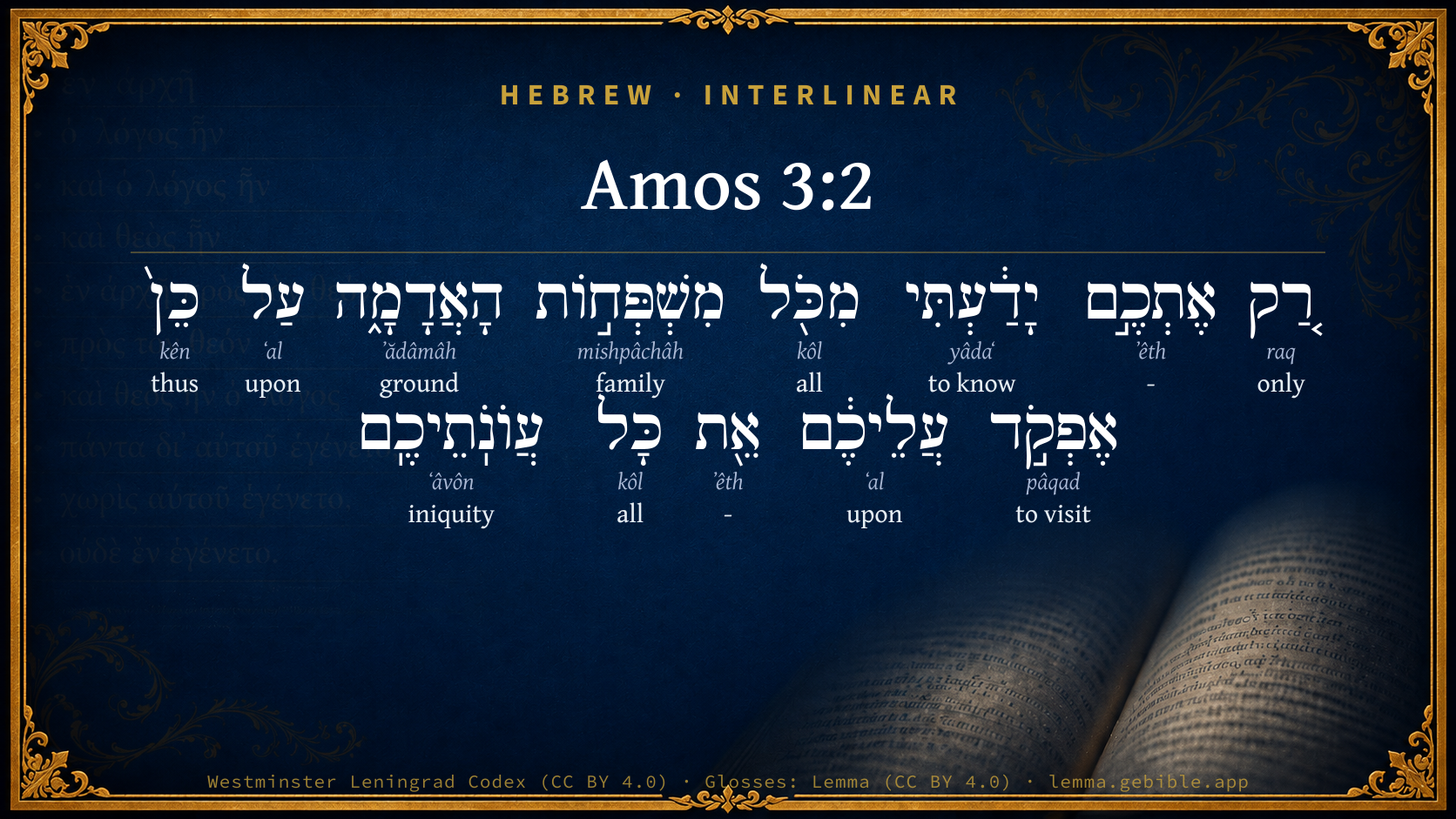
Hebrew (Westminster Leningrad Codex) Amos 3:2 appears in the Hebrew Old Testament. The text above is from the Westminster Leningrad Codex. Each word links to its Strong’s number, a concise gloss, and parsing drawn from the Open Scriptures Hebrew Bible morphology. Click any word for its full Brown-Driver-Briggs (BDB) entry.
Download image
Cite this verse

Amos 3:2 (World English Bible). Public Domain. Lemma interlinear Bible study tool, https://lemma.gebible.app/v/amos/3/2.

Show BibTeX & RIS
BibTeX
RIS
English Translation
"You only have I chosen of all the families of the earth. Therefore I will punish you for all of your sins."
World English Bible · Public Domain
Download a study sheet

One document with this verse’s original text, its word-by-word gloss line, the meaning frame, cross-references with their text, attributed commentary, and full source and license credits — printable, and it pastes into notes with its structure intact.

This verse Autodidact and up

Study sheet (.html) Plain text (.txt)

A passage Seminary Student

Up to 50 verses in one chapter. A passage sheet keeps up to 6 commentary sources and 12 cross-references per verse, in the order this page ranks them, and says so on the sheet whenever that leaves anything out. Ask for a single verse and you get the Autodidact verse sheet above.

Everything on this page stays free to read, with no account — the sheet is a download of what is already on screen, not access to it.

Want to remove ads? Support Godless Engineer
Compare translations 3

The same verse in 3 English versions, stacked beneath the original-language interlinear above. Click any original word for its lexicon entry.

Each is an independent rendering of the whole verse — the interlinear is not word-aligned to these translations.

Highlighted words mark where these versions differ — a whole-verse word diff, not a word-by-word alignment.

  • World English Bible Public Domain
    "You only have I chosen of all the families of the earth. Therefore I will punish you for all of your sins."
  • King James Version Public Domain
    You only have I known of all the families of the earth: therefore I will punish you for all your iniquities.
  • unfoldingWord Literal Text CC BY-SA 4.0
    “I have chosen only you from all the families of the earth. Therefore I will punish you for all your sins.”

unfoldingWord Literal Text — © unfoldingWord, licensed CC BY-SA 4.0. Word-aligned USFM3 via Door43 (git.door43.org/unfoldingWord/en_ult).

Versions to compare (up to 4)

3 of 4 selected

Show all 18 translations

Every available English version of this verse, each an independent rendering of the whole verse.

  • World English Bible Public Domain
    "You only have I chosen of all the families of the earth. Therefore I will punish you for all of your sins."
  • Berean Standard Bible Public Domain
    “Only you have I known from all the families of the earth; therefore I will punish you for all your iniquities.”
  • Majority Standard Bible Public Domain
    “Only you have I known from all the families of the earth; therefore I will punish you for all your iniquities.”
  • King James Version Public Domain
    You only have I known of all the families of the earth: therefore I will punish you for all your iniquities.
  • American Standard Version (1901) Public Domain
    You only have I known of all the families of the earth: therefore I will visit upon you all your iniquities.
  • Revised Version (1885) Public Domain
    You only have I known of all the families of the earth: therefore I will visit upon you all your iniquities.
  • Geneva Bible (1599) Public Domain
    You onely haue I knowen of all the families of the earth: therefore I will visite you for all your iniquities.
  • Douay-Rheims (1899) Public Domain
    You only have I known of all the families of the earth: therefore will I visit upon you all your iniquities.
  • Young's Literal Translation Public Domain
    Only you I have known of all families of the land, Therefore I charge on you all your iniquities.
  • Literal Standard Version CC BY-SA 4.0
    “Only you have I known of all families of the earth, || Therefore I charge on you all your iniquities.”
  • Unlocked Literal Bible CC BY-SA 4.0
    “I have chosen only you from all the families of the earth. Therefore I will punish you for all your sins.”
  • unfoldingWord Literal Text CC BY-SA 4.0
    “I have chosen only you from all the families of the earth. Therefore I will punish you for all your sins.”
  • Darby Bible Public Domain
    You only have I known of all the families of the earth; therefore will I visit upon you all your iniquities.
  • World Messianic Bible Public Domain
    “I have only chosen you of all the families of the earth. Therefore I will punish you for all of your sins.”
  • Webster's Bible Public Domain
    You only have I known of all the families of the earth: therefore I will punish you for all your iniquities.
  • Free Bible Version CC BY-SA 4.0
    I chose a special relationship with you alone out of all the families of the earth, and so I will punish you for your wrongdoing.
  • Bible in Basic English Public Domain
    You only of all the families of the earth have I taken care of: for this reason I will send punishment on you for all your sins.
  • JPS Tanakh (1917) Public Domain
    You only have I known of all the families of the earth; therefore I will visit upon you all your iniquities.

Literal Standard Version (2020), Covenant Press — licensed CC BY-SA 4.0. Text via the HelloAO Bible API (eBible.org). Unlocked Literal Bible (unfoldingWord) — licensed CC BY-SA 4.0. Text via the HelloAO Bible API (eBible.org). unfoldingWord Literal Text — © unfoldingWord, licensed CC BY-SA 4.0. Word-aligned USFM3 via Door43 (git.door43.org/unfoldingWord/en_ult). Free Bible Version, Dr. Jonathan Gallagher — licensed CC BY-SA 4.0. Text via the HelloAO Bible API (eBible.org).

Word by word

More ways to search: Search by grammar → Find every occurrence → Compare this word →

Practice this passage: Drill this verse → Learn its vocabulary →

רַ֚ק
raq
H7535
“only”
Particle, Accusative
Part of Speech
Particle
Type
Accusative
Full BDB Definition

Origin: the same as H7534 as a noun

TWOT: 2218a

only, altogether, surely - only - only, nought but, altogether (in limitation) - save, except (after a negative) - only, altogether, surely (with an affirmative) - if only, provided only (prefixed for emphasis) - only, exclusively (for emphasis)
  1. אֶתְכֶ֣ם ʼêth H853 “- · you” Particle, Direct Object + Suffix, Personal, 2nd Person, Masculine, Plural
  2. יָדַ֔עְתִּי yâdaʻ H3045 “to know” Verb, Qal, Perfect, 1st Person, Common, Singular
  3. מִכֹּ֖ל kôl H3605 “from · all of” Preposition + Noun, Common, Masculine, Singular, Construct
  4. מִשְׁפְּח֣וֹת mishpâchâh H4940 “families of” Noun, Common, Feminine, Plural, Construct
  5. הָאֲדָמָ֑ה ʼădâmâh H127 “the · ground” Particle, Definite Article + Noun, Common, Feminine, Singular, Absolute
  6. עַל ʻal H5921 “upon” Preposition
  7. כֵּן֙ kên H3651 “thus” Particle, Demonstrative
  8. אֶפְקֹ֣ד pâqad H6485 “to visit” Verb, Qal, Imperfect, 1st Person, Common, Singular
  9. עֲלֵיכֶ֔ם ʻal H5921 “upon · you” Preposition + Suffix, Personal, 2nd Person, Masculine, Plural
  10. אֵ֖ת ʼêth H853 “-” Particle, Direct Object
  11. כָּל kôl H3605 “all of” Noun, Common, Masculine, Singular, Construct
  12. עֲוֺנֹֽתֵיכֶֽם ʻâvôn H5771 “iniquities · your” Noun, Common, Both, Plural, Construct + Suffix, Personal, 2nd Person, Masculine, Plural

About this verse

These counts appear in no published source. They are computed here, from the morphology-tagged text and Lemma’s own curated glosses. What Lemma adds →

13
words
10
distinct lemmas
Prophets
section

Grammatical profile

  • 2 verbs
  • 5 nouns
  • 2 prepositions
  • 4 particles

Verb forms

  • יָדַ֔עְתִּי Qal · Perfect
  • אֶפְקֹ֣ד Qal · Imperfect

Repetition

Words recur within this verse — often emphatic in Hebrew:

  • מִכֹּ֖ל all H3605 ×2
  • עַל upon H5921 ×2

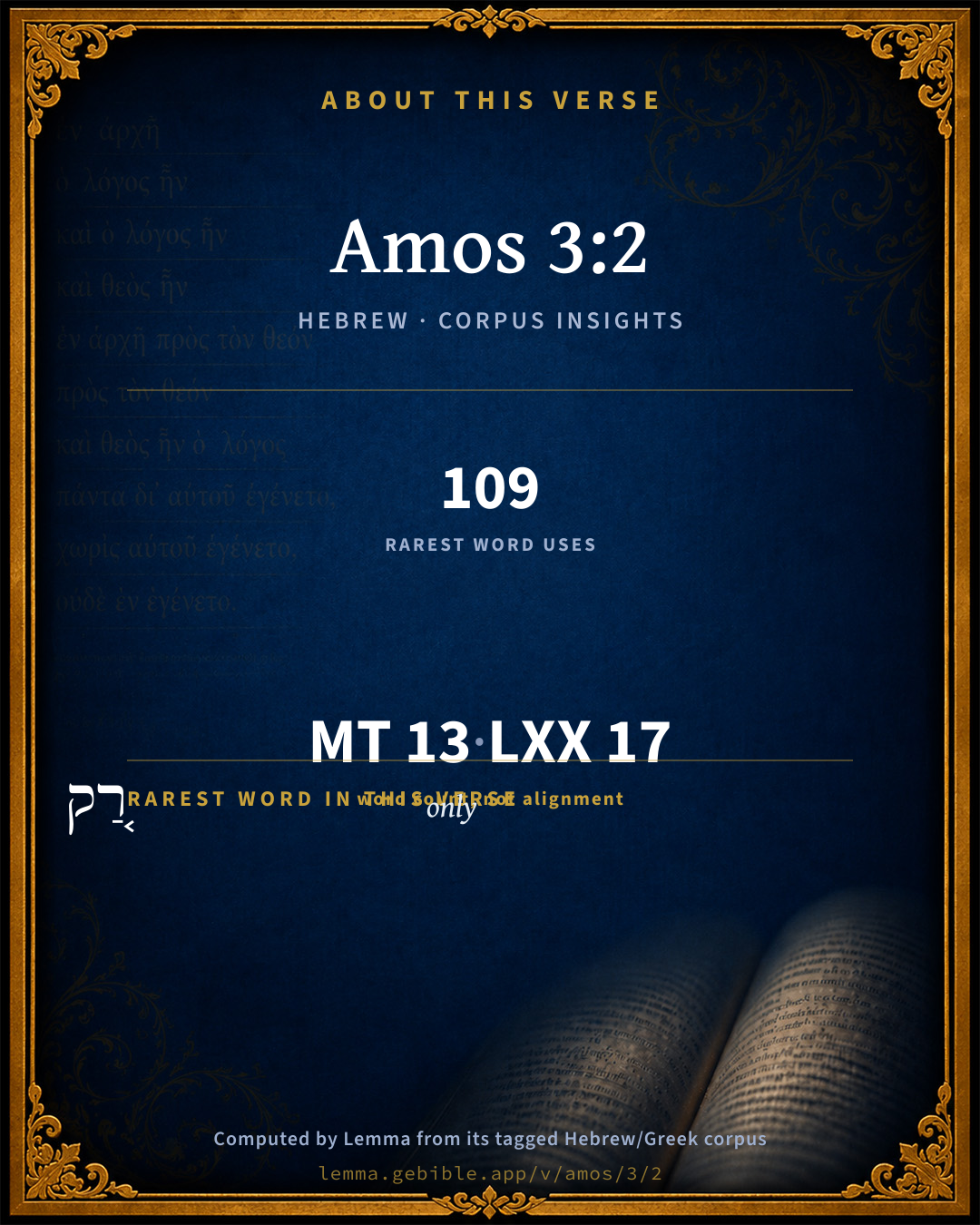
Hebrew & Septuagint length

In English translation the verse runs 22 words from the Hebrew and 24 from the Septuagint (LXX English) — closely comparable.

A rough comparison of the two English renderings, which tokenize alike — not a word-level alignment.

Word counts can differ between the Hebrew and the Greek without any difference in meaning — e.g. the Hebrew direct-object marker אֵת has no separate Greek word, and Greek often adds the article ὁ.

In the original languages it is 13 Hebrew tokens and 17 Greek tokens — but the two are counted differently (Hebrew bundles its prefixes and suffixes into one token; the Greek is in lemma form), so that isn’t a like-for-like length.

Cross-references

27

Topical passages linked to Amos 3:2 in the Treasury of Scripture Knowledge — connected by theme and wording, ordered by reader-vote popularity; previews shown in the World English Bible.

  • Deuteronomy 7:6 For you are a holy people to Yahweh your God: Yahweh your God has chosen you to be a people for his own possession, above all peoples who are on the face of the earth.
  • Exodus 19:5–6 Now therefore, if you will indeed obey my voice, and keep my covenant, then you shall be my own possession from among all peoples; for all the earth is mine;
  • Deuteronomy 10:15 Only Yahweh had a delight in your fathers to love them, and he chose their seed after them, even you above all peoples, as at this day.
  • 1 Peter 4:17 For the time has come for judgment to begin at the house of God. If it begins first with us, what will happen to those who don't obey the Gospel of God?
  • Zechariah 14:17–18 It will be, that whoever of all the families of the earth doesn't go up to Jerusalem to worship the King, Yahweh of Hosts, on them there will be no rain.
  • Deuteronomy 32:9 For Yahweh's portion is his people; Jacob is the lot of his inheritance.
  • Jeremiah 14:10 Thus says Yahweh to this people, Even so have they loved to wander; they have not refrained their feet: therefore Yahweh does not accept them; now will he remember their iniquity, and visit their sins.
  • Genesis 10:32 These are the families of the sons of Noah, after their generations, in their nations. Of these were the nations divided in the earth after the flood.
  • Deuteronomy 26:18 and Yahweh has declared you this day to be a people for his own possession, as he has promised you, and that you should keep all his commandments;
  • Psalms 147:19 He shows his word to Jacob; His statutes and his ordinances to Israel.
  • Jeremiah 1:15 For, behold, I will call all the families of the kingdoms of the north, says Yahweh; and they shall come, and they shall set everyone his throne at the entrance of the gates of Jerusalem, and against all the walls of it round about, and against all the cities of Judah.
  • Jeremiah 9:25 Behold, the days come, says Yahweh, that I will punish all those who are circumcised in [their] uncircumcision:
  • Jeremiah 10:25 Pour out your wrath on the nations that don't know you, and on the families that don't call on your name: for they have devoured Jacob, yes, they have devoured him and consumed him, and have laid waste his habitation.
  • Jeremiah 11:22 therefore thus says Yahweh of hosts, Behold, I will punish them: the young men shall die by the sword; their sons and their daughters shall die by famine;
  • Jeremiah 13:21 What will you say, when he shall set over you as head those whom you have yourself taught to be friends to you? shall not sorrows take hold of you, as of a woman in travail?
  • Ezekiel 9:6 kill utterly the old man, the young man and the virgin, and little children and women; but don't come near any man on whom is the mark: and begin at my sanctuary. Then they began at the old men that were before the house.
  • Ezekiel 20:36–38 Like as I entered into judgment with your fathers in the wilderness of the land of Egypt, so will I enter into judgment with you, says the Lord Yahweh.
  • Daniel 9:12 He has confirmed his words, which he spoke against us, and against our judges who judged us, by bringing on us a great evil; for under the whole sky has not been done as has been done on Jerusalem.
  • Hosea 2:13 I will visit on her the days of the Baals, To which she burned incense, When she decked herself with her earrings and her jewels, And went after her lovers, And forgot me," says Yahweh.
  • Hosea 8:13 As for the sacrifices of my offerings, they sacrifice flesh and eat it; But Yahweh doesn't accept them. Now he will remember their iniquity, And punish their sins. They will return to Egypt.
  • Hosea 9:9 They have deeply corrupted themselves, As in the days of Gibeah. He will remember their iniquity. He will punish them for their sins.
  • Nahum 3:4 because of the multitude of the prostitution of the alluring prostitute, the mistress of witchcraft, who sells nations through her prostitution, and families through her witchcraft.
  • Matthew 11:20–24 Then he began to denounce the cities in which most of his mighty works had been done, because they didn't repent.
  • Romans 2:9 oppression and anguish, on every soul of man who works evil, on the Jew first, and also on the Greek.
  • Isaiah 63:19 We are become as they over whom you never bear rule, as those who were not called by your name.
  • Luke 12:47–48 That servant, who knew his lord's will, and didn't prepare, nor do what he wanted, will be beaten with many stripes,
  • Acts 17:26 He made from one blood every nation of men to dwell on all the surface of the earth, having determined appointed seasons, and the boundaries of their dwellings,

Cross-references courtesy of OpenBible.info (CC BY 4.0).

Hebrew and Greek witnesses Masoretic Hebrew ↔ Greek Septuagint

The same verse in the two great witnesses to the Old Testament, shown verse-for-verse.

These are two independent witnesses, not word-aligned to each other, and the Septuagint is shown in lemma (dictionary) form.

Hebrew Amos 3:2 Masoretic · Westminster Leningrad Codex

רַ֚ק אֶתְכֶ֣ם יָדַ֔עְתִּי מִכֹּ֖ל מִשְׁפְּח֣וֹת הָאֲדָמָ֑ה עַל כֵּן֙ אֶפְקֹ֣ד עֲלֵיכֶ֔ם אֵ֖ת כָּל עֲוֺנֹֽתֵיכֶֽם

"You only have I chosen of all the families of the earth. Therefore I will punish you for all of your sins."

World English Bible · Public Domain

Greek LXX Amos 3:2 Septuagint · lemma form

πλήν σύ γιγνώσκω ἐκ πᾶς φυλή ὁ γῆ διά οὗτος ἐκδικέω ἐπί σύ πᾶς ὁ ἁμαρτία σύ

You especially have I known out of all the families of the earth: therefore will I take vengeance upon you for all your sins.

LXX2012 (modern English Septuagint) · Public Domain

Hebrew: Westminster Leningrad Codex (CC BY 4.0). Greek: Septuagint (public domain); English from LXX2012 (modern English Septuagint) (Public Domain). How the Septuagint differs from the Hebrew →

Targum (Aramaic paraphrase)

1

The Targum is the ancient Jewish Aramaic paraphrase of the Hebrew Scriptures — an interpretive translation, not the Hebrew text itself. Onkelos (literal) and Pseudo-Jonathan (expansive) render the Torah, and Jonathan the Prophets. Coverage is partial: where no permissively-licensed English translation exists for a verse, only the Aramaic is shown. This is verse-level text, not a word-by-word alignment to the Hebrew.

  1. Targum Jonathan Prophets (Joshua–Malachi)
    לְחוֹד בְּכוֹן אִתְרְעֵיתִי מִכָּל זַרְעֲיַת אַרְעָא עַל כֵּן אַסְעַר עֲלֵיכוֹן יַת כָּל חוֹבֵיכוֹן:

    (no public-domain English translation for this verse)

    Targum Jonathan — Aramaic: “Mikraot Gedolot” (public domain). English: “Sefaria Community Translation” (CC0 1.0 (public-domain dedication)); “London "Chaldee Paraphrase," 1871” (public domain). Text via Sefaria.

Commentary

Notes on Amos 3:2 from classic Christian and Jewish commentators (each source and its license shown beneath its notes). The classic Christian expositions comment on the surrounding passage and are grouped to its opening verse, so a note may address several verses; the Jewish commentaries on the Tanakh (Rashi and others) are per-verse, so they appear only where the commentator wrote on this verse.

Lemma curates 59 commentaries, every one of them public domain or Creative Commons licensed, each selected and text-cleaned for this edition rather than reprinted as found. About our sources →

Trapp's Complete Commentary

John Trapp

Amo 3:2 You only have I known of all the families of the earth: therefore I will punish you for all your iniquities.

Ver. 2. You only have I known] That is, owned and honoured, called and culled, chosen and accepted to be my people, when I had all the world before me to choose in, Deu 10:14-15, and nothing to move me thereto but mine own mere grace, even the good pleasure of my will (ευδοκια).

Therefore I will punish you for all your iniquities] Not passing by the least without a sensible check: the least, I say, that is allowed and wallowed in; and that because of the disloyalty and treachery that is therein. Other mens’ sins are rebellions against God; but the saints’ sins are treacheries, because against the covenant. Let such, therefore, look to themselves, and walk accurately, or they shall be sure to rue it, ακριβως, Eph 5:15. God will be sure to plough his own ground, whatsoever becomes of the waste; and to weed his own garden, though the rest of the world should be let alone to grow wild. His own he will not fail to punish. 1. In case of scandal, as David. 2. For sins unrepented of, though not scandalous. Oh the bloody welts that God hath left upon the backs of his own dear children for such sins! Bastards may escape scot-free, but sons shall pay for it. Ingentia beneficia, fiagitia, supplicia. The punishing angel is bidden begin at God’s sanctuary, Eze 9:6. He will be sanctified in all that draw near unto him, Lev 10:3. Sanctified I say, either actively or passively; either in the sincerity of men’s conversation or in the severity of their visitation; at which time his articles of inquiry will be very strict and critical against his own professed people, who are therefore worse than others (and shall therefore speed worse), because they ought to be better.

John Trapp, A Commentary or Exposition upon All the Books of the Old and New Testament (1647–1656) — public domain. Text from a community e-Sword module.

The Pulpit Commentary

Have I known; i.e. loved, acknowledged, chosen. So in Hos_13:5 God says. "I knew thee in the wilderness;" and St. Paul, (2Ti_2:19) "The Lord knoweth them that are his". (comp. Nah_1:7) The peculiar relation in which God allowed Israel to stand to him is much dwelt upon. (see Deu_4:8, 20 14:2; 2Sa_7:23; 1Ch_17:21) Therefore I will punish you; literally, visit upon you. They must not presume upon their privileges; the retention of God"s favour depended upon obedience to his Word: (Exo_19:5) the nearer they were brought to God, the greater their guilt if they fell from him. Unlike the nations denounced in the former chapters, Israel had sinned against light and knowledge and love, therefore the sentence on her must be heavier. (comp. Eze_9:6; 1Pe_4:17)

The inevitable punishment of Christian sin.

only have I known of all the families of the earth, therefore I will punish you for all your iniquities." These words are at once an accusation, a condemnation, and a sentence. What God had done for Israel in vain was a ground and the measure of what he now must do against them. Blessing abused is but the faggot feeding the fire of merited curse. They had given themselves up to wickedness, and the fire tongue of a lofty privilege sits above every sin, revealing its demon face.

I THERE IS A GRACIOUS SENSE IN WHICH GOD KNOWS MEN. "I know my sheep;" "I never knew you." These sentences mean salvation and condemnation respectively. For God to know men is with them a question of life and death. This knowledge may be:

1. National. It was so with Israel. "You only have I known." This meant that God loved them, (Deu_10:15) chose them, (Deu_7:6) formally acknowledged them as his people, (Deu_14:2) and gave them privileges not necessarily saving in every Case of light (Psa_147:19; Rom_3:2) and help, (Psa_136:10-24) and fellowship (Exo_20:24; Num_14:14; Deu_4:7) and promise, (Rom_9:4, Rom_9:5) answering to this visible relation. This knowledge may also be:

2. Personal. Then it means, in addition to what has been mentioned, the forth-putting of Divine energy in them, making them new creatures m Christ, and so "partakers of the Divine nature" (Gal_6:15; 2Pe_1:4) God brings them into his family (Gal_3:26) by this spiritual birth, (Joh_1:13) calls them sons, (1Jn_3:1) makes them coheirs with Christ, (Rom_8:17) and gives them all family privileges and graces, chiefest of these the spirit of adoption, by which we cry, "Abba, Father". (Gal_4:6) Man, in fact, is by nature an alien and a stranger, and for God to know him is to substitute a gracious for his natural relation.

II THIS KNOWLEDGE IS A SPECIAL, NOT A GENERAL, AFFECTION. "You only." There are gifts of God that are indiscriminate (Job_25:3; Mat_5:45) Man gets them as man, and irrespective of personal character. But spiritual gifts are necessarily confined to the spiritual circle. It is evident as regards God"s gracious knowledge of men.

1. That it rests on a minority of the race. Israel at best was little among the nations of the earth. In comparison with the Chaldeae, Medo-Persian, Greek, or Roman empires, it was scarcely worthy of being named; and a dozen peoples bordered Palestine from time to time, any one of which, in the natural course, would have wiped it off the earth. Yet, passing by the many and the mighty, God says to single, feeble Israel, "You only have I known of all the families of the earth". (Deu_4:32-38) And this action is of a piece with other Divine action for similar purposes. The saints are now, and have always been, a "little flock." It is the few who go in at the "strait gate" of the kingdom. Even the nominally Christian peoples are less than a third of the population of the earth. If out of the number of these were taken the actual Christians, the true believers in Christ, the saintly company would assume smaller dimensions still. This state of matters will no doubt be reversed before the dispensation ends. Christ "in all things shall have the pre-eminence," and the minority which his followers compose will, during the millennial era, be converted into a vast majority. (Isa_11:9) Meantime God looks on a small circle of transfigured souls, and says, "You only have I known.

2. It does not follow human probabilities. If any single nation was to be made the repository of revealed truth, and the teacher of the other nations, we should have expected one or other of the four universal empires to be chosen for the purpose, rather than a second or third rate power, located in a circumscribed and excentric spot. Then the typical Jew was, like his ancestor Jacob, a sordid fellow, deficient in the more heroic qualities, and, from the standpoint of the natural, decidedly inferior to his brother the Edomite, or almost any neighbour you would select. The greater readiness with which the Gentiles received the gospel, when it came to them, would seem, moreover, to indicate that they would have responded more worthily to the Divine Old Testament culture than Israel did, if it had pleased God to bring it to bear. It is the same with individuals. Not only does God pass by the rich and great for the humble poor (Jam_2:5; 1Co_1:26-28) but he passes by the wise and prudent, and gives the light of his salvation to babes. (Mat_11:25) It is not the great geniuses of society, but the commonplace average men, who form the circle of the saints. The reasons for this are adequate, but God keeps them to himself. Obvious to reason in many cases, they are not revealed, because in many others they would be above it, and God acts without reasons given, that "no flesh may glory in his presence.

III IT DOES NOT INEVITABLY PREVENT SIN IN THE OBJECT OF IT. The life of the Hebrews was as a whole above the moral level of the heathen life around them. But still it was far from pure. If we subtracted from Jewish history all that arises out of sin, and the punishment of it, comparatively little would remain. So little congenial to human nature is God"s service, and so congenial the service of sin, that Israel was perpetually turning aside after the idols of the heathen, whilst in no instance did the heathen ever turn from their idols to God. (Jer_2:11) And not only does outward religious privilege fail to put an end to the sinful life, it is to some extent the same with inward religious principle. The saint remains a sinner all his days. Grace, like the house of David, is getting stronger with him, and corruption, like the house of Saul, is getting weaker through life. But it is still with him as with the apostle, striving after perfection, yet burdened with a feeling of the surviving power of sin. (Php_3:12; Rom_7:24)

IV IT DOES MAKE THE PUNISHMENT OF SIN ON EARTH CERTAIN. "Therefore will I punish you." Sin inside the kingdom necessitates punishment, and will be visited with it promptly.

1. Because it is guiltiest as against God. More has been done to prevent it than in other cases. It is sin against light (Jam_4:17; Luk_12:47, Luk_12:48) against love, (2Co_5:14) against favours, (Psa_103:2) against restraining grace. (1Jn_3:9) In proportion to the strength and number of deterrent influences against which sin is committed must be the strength of our sinful bent, and so the guilt of our wrong doing.

2. Because it is most hurtful as against his cause. The sin of the wicked is natural. It is to be expected from one who consults lust and serves the devil. It is done, moreover, from the standpoint of opposition to God, and responsibility for it is thus kept outside the spiritual circle. God and his cause are not dishonoured in the eyes of men by what is formally done against them. It is sin by the professedly righteous that brings righteousness into disrepute. Religion is charged with all the evil that is done in its name. The more closely identified wrong doing is with the Christian name, the more hurtful is it to the Christian cause. Therefore Christian sin, in addition to the general reasons, involves punishment for reasons peculiar to itself. If God would have his Church a tree for the healing of the nations, he must lop off every unsound and rotten branch.

3. Because it is most incompatible with the destiny of the person sinning. The sin of the wicked need not necessarily be punished here. It will be amply visited on him throughout eternity. It is quite in the line of the man"s life course that he should suffer the vengeance of eternal fire. But the sin of the righteous presents a different aspect. Its commission is the contradiction of his gracious nature, and its future punishment would be the contradiction of his exalted destiny. It is vital to his well being that the judgment, inevitable somewhere, should fall here. (Psa_89:30-33) Only thus can his happy immortality be safeguarded. The present destruction of his flesh conditions the saving of his spirit in the day of the Lord Jesus. (1Co_5:5)

HOMILIES BY D. THOMAS Vers. 2, 3.

A specially blest people.

only have I known of all the families of the earth: therefore I will punish you for all your iniquities. Can two walk together, except they be agreed?" "You only have I known," says God, "of all the families of the earth." What does this mean? It does not mean that he was ignorant of all other people. God knows everything connected with each individual of all generations. Nor does it mean that he had not been kind to other people. "His tender mercies are over all the works of his hands." But by the expression, "I have known," he means, "I have bestowed on you privileges which I have bestowed on no other people". (see Rom_9:4, Rom_9:5) Now, it is a fact that some men are far more highly favoured by Heaven than others. Some have more health, some more riches, some more intellect, some more friendships, some more means of spiritual improvement. We offer three remarks about specially favoured people.

I THEY ARE OFTENTIMES THE GREATEST SINNERS. Who of all the people on the face of the earth were greater sinners than the Israelites? Yet they were specially favoured of Heaven. There was not a crime they did not commit; and they filled up the measure of their iniquity by crucifying the Son of God. England is a specially favoured land, but where is there more moral corruption? The fountain of moral iniquity is as deep, as full, as noxious, as active, here as in the darkest and most corrupt parts of the earth. It is true that civilization has so decorated it that its loathsomeness is to some extent concealed; but here it is. The corpse is painted, but it is still a putrid mass.

II THEY ARE EXPOSED TO SPECIAL PUNISHMENT. "Therefore will I punish you for all your iniquities." Men are not to be envied simply because they are endowed with special favours. Those very endowments, unless they are faithfully used, only augment responsibility, deepen guilt, and ensure a more terrible retribution. Where much has been given, much will be required. "It will be more tolerable for Sodom and Gomorrah in the day of judgment," etc. "Therefore will I punish you." I who know all your sins, I who abhor all your sins, I who have power to punish you, will execute vengeance.

III THEY SHOULD, LIKE ALL PEOPLE, PLACE THEMSELVES IN HARMONY WITH GOD. "Can two walk together, except they be agreed?

1. Agreement with God is essential to the well being of all intelligent existences. No spirit in the universe can be happy without thorough harmony with the will and mind of God. Heaven is happy because of this harmony; hell is miserable because of antagonism to the Divine mind.

2. The condition of all sinners is that of hostility to the will of God. Indeed, enmity to God is the essence of sin. What, then, is the conclusion? Reconciliation. "We beseech you on behalf of Christ, be ye reconciled unto. D.T. (2Co_5:20)

The Pulpit Commentary (1880–1919), ed. H.D.M. Spence-Jones & Joseph S. Exell — public domain. Text from a community e-Sword module.

Tyndale Open Study Notes

Tyndale Open Resources

3:2 The word translated been intimate indicates personal and experiential knowledge that often extends beyond mere intellectual awareness. It can indicate formal recognition and acknowledgment (Exod 1:8; 5:2), personal experience (Gen 2:17), or sexual relations (Gen 4:1). This word is frequently used of God’s relationship with Israel (Hos 5:3) and of Israel’s ideal relationship with God (Hos 2:20). Because of Israel’s privileged status, God would hold them accountable for all their sins, not just some of them. God holds people accountable in terms of what has been given them (Luke 12:47-48).

Tyndale Open Study Notes — © Tyndale Open Resources, licensed CC BY-SA 4.0. Text via the HelloAO Bible API.

Geneva Bible (1599)

Geneva Bible translators

I have only chosen you to be mine among all other people, and yet you have forsaken me.

Geneva Bible (1599) marginal notes — public domain. Text via Bolls.life.

Jamieson, Fausset & Brown

Robert Jamieson, A. R. Fausset & David Brown

You only have I known--that is, acknowledged as My people, and treated with peculiar favor (Exo 19:5; Deu 4:20). Compare the use of "know," Psa 1:6; Psa 144:3; Joh 10:14; Ti2 2:19.

therefore I will punish--the greater the privileges, the heavier the punishment for the abuse of them; for to the other offenses there is added, in this case, ingratitude. When God's people do not glorify Him, He glorifies Himself by punishing them.

Jamieson, Fausset & Brown — Commentary Critical and Explanatory on the Whole Bible (1871) — public domain (CC PDM 1.0). Text via the HelloAO Bible API.

Adam Clarke's Commentary

Verse 2. You only have I known] I have taken no other people to be my own people. I have approved of you, loved you, fed, sustained, and defended you; but because you have forsaken me, have become idolatrous and polluted, therefore will I punish you. And the punishment shall be in proportion to the privileges you have enjoyed, and the grace you have abused.

Adam Clarke's Commentary on the Bible (1810–1826) — public domain. Text from a community e-Sword/MySword module.

John Calvin's Commentaries

The Prophet afterwards declares what he had in charge, Only you have I known of all the families of the earth: I will therefore visit you for your iniquities. Many think that he still concedes to the Israelites what they were wont to boast of, — that they were separated from the common class of men, because the Lord had adopted them: but it seems rather to be a reproach cast on them. God then brings forward here his benefits, of which we noticed yesterday a similar instance, that he might enhance the more the sin of the people, in returning the worst recompense to God, by whom they had been so liberally and so kindly treated: “I,” he says, “have loved you only.” It is indeed true, that the Israelites, as we have in other places often observed, gloried in their privileges; but the Prophet seems not to have this in view. God then expostulates with them for being so ungrateful: You only, he says, have I known. It is indeed certain that God’s care is extended to the whole human race, yea even to oxen and asses, and to the very sparrows. Even the young of ravens cry to him, and the smallest bird is fed by him. We hence see that God’s providence extends to all mortal beings; but yet not in an equal degree. God has ever known all men so as to give what is needful to preserve life. God has, therefore, made his sun to rise on all the human race, and has also made the earth to produce food. Then as to the necessaries of life, he performs the office of a Father towards all men. But he has known his chosen people, because he has separated them from other nations, that they might be like his own family. Israel, then, is said to be known, because God favored them alone with a gratuitous adoption, and designed them to be a peculiar people to himself. This is the knowledge of which the Prophet now speaks.

But by saying that they only, רק, rek, had been known, he shows that they had been chosen through God’s singular favor, for there was no difference between the seed of Abraham and other nations, when regarded in themselves, otherwise this exception would have been superfluous. For if there had been any superiority or merit in the people of Israel, this objection might have readily been made, “We have indeed been chosen, but not without cause, for God had respect to our worthiness.” But as they in nothing differed from other nations, and as the condition of all was alike by nature, the Lord upbraids them with this, that he had known them only; as though he said “How has it happened, that ye are my peculiar possession and heritage? Has it been by your merit? Has it been because I was more bound to you than to other nations? Ye cannot allege these things. It has therefore been my gratuitous adoption. Ye are then the more bound to me, and less excusable is your ingratitude for rendering to me so unjust a recompense.” So also Paul says, ‘Who makes thee to differ?’ (1 Corinthians 4:7) He wished to show that every excellency in men ought to be ascribed to God. For the same purpose it is said here, you only have I loved and known of all the families of the earth: “What were you? Ye were even the children of Adam, as all other nations; the same has been the beginning of all. There is then no reason for you to say, that I was attached to you by any prepossession; I freely chose you and chose you alone.” All this tends to amplify grace; and ingratitude on their part does hereby appear more evident. For had God spoken these words of his general benefits, the guilt of his chosen people would not have been so great: but when he says that they only had been chosen, when others were passed by, their impiety seemed doubtless more base and wicked in not acknowledging God in their turn, so as to devote themselves wholly to Him, to whom they owed every thing.

And the bounty of God shines forth also in this respect, that he had known the Israelites alone, though there were many other nations. Had God owed any thing to men, he would not have kept it from them; this is certain. But since he repudiated all other nations, it follows, that they were justly rejected, when he made no account of them. Whence then was it that he chose the Israelites? We here see how highly is God’s grace exalted by this comparison of one people with all other nations. And the same thing also appears from these words, of all the families of the earth; as though God had said, “There were many nations in the world, the number of men was very great; but I regarded them all as nothing, that I might take you under my protection; and thus I was content with a small number, when all men were mine; and this I have done through mere favor, for there was nothing in you by which ye excelled others, nor could they allege that they were unjustly rejected. Since then I preferred you of my own will, it is evident that I was under no obligation to you.” We now then understand the design of the Prophet’s words.

He then subjoins, I will therefore visit upon you your iniquities. God declares here, that the Israelites would have to suffer a heavier judgment, because they acknowledged not their obligations to God, but seemed willfully to despise his favor and to scorn him, the author of so many blessings. Since then the Israelites were bound by so many and so singular benefits, and they at the same time were as wicked as other nations the Prophet shows, that they deserved a heavier punishment, and that God’s judgment, such as they deserved, was nigh at hand. This is the substance of the whole. It now follows —

John Calvin's Commentaries (1540-1563) — public domain. Text from the Calvin Translation Society English edition (1840s-50s) via the Christian Classics Ethereal Library (ccel.org). Calvin's coverage is partial (roughly two-thirds of the Bible); uncommented books and verses are honest gaps, never fabricated. The 19th-century editor's footnotes and remarks are omitted so the notes are faithfully Calvin's own voice.

Ellicott's Commentary for English Readers

(2) Known.—The knowledge of God is love. There was special knowledge and intimacy between God and Israel. Upon such knowledge followed advantages and privileges innumerable.

Therefore I will . . .—This may mean, in proportion to your privileges will be your doom—but more probably that this intimacy of knowledge is the ground of gracious chastisement. For nation or man to be allowed to go on in sin without rebuke is the greatest curse that can befall it or him.

A Bible Commentary for English Readers, edited by Charles John Ellicott (1878–1897) — public domain. Text from a community e-Sword module.

The Cambridge Bible for Schools and Colleges

gen. ed. J. J. S. Perowne

2. You only &c.] The pron. is emphatic by its position, in the Heb., as in the English.

known] i.e. known favourably, noticed, regarded: so Gen_18:19, “I have known him to the end that he may command his children and his household after him that they may keep the way of Jehovah,” &c.; Hos_13:5, “I did know thee in the wilderness, in the land of great drought”; Psa_1:6; Psa_37:18, and elsewhere. Israel was the only nation whom Jehovah ‘knew’ in this special sense, and visited with the tokens of His friendship.

families of the earth] Gen_12:3; Gen_28:14.

therefore I will punish you &c.] The Israelites argued, from the privileges bestowed upon them, that they were the recipients of God’s favour, irrespectively of their deeds: Amos retorts that, so far from this being the case, their privileges augment their responsibilities: instead of proving Himself their saviour, whether they are obedient to His will or not, He will, if they are disobedient, visit their iniquities upon them. So in Jeremiah 7 the men of Judah point to the material Temple in their midst as the palladium of their security; but the prophet retorts in a similar strain, that, if they desire to merit Jehovah’s protection, and wish Jerusalem to escape the fate of Shiloh, they must ‘amend their ways,’ and practise more consistently than they have done hitherto the ordinances of civil righteousness (Jer_7:3-15).

punish you for] R.V. more lit., visit upon you, as the same phrase is often rendered, Amo_3:14; Exo_20:5; Jer_5:9; Jer_5:29; Jer_23:2 (but punish, Jer_11:22, Jer_25:12, Jer_29:32, &c.). The expression is particularly frequent in Jeremiah.

iniquities] the conventional, and sufficient rendering of ‘âwôn. Etymologically, however, as Arabic shews (where the corresponding verb ghawâ means to err, or go astray), the idea expressed by it is that of deviation from the right track, error: so the corresponding verb, 2Sa_7:14; 2Sa_24:17; 1Ki_8:47 al. Comp. the writer’s Notes on the Hebrew Text of Samuel, on 1Sa_20:30.

The Cambridge Bible for Schools and Colleges (gen. ed. J. J. S. Perowne; Cambridge University Press, 1878–1918) — public domain. Text from a community e-Sword module.

John Gill's Exposition

You only have I known of all the families of the earth,.... All the families or nations of the earth, and all the inhabitants of it, are known by the Lord, as he is the omniscient God; but none had been known by him as a family, or a nation, with that love and affection as this family had been, or distinguished by his favours and blessings as they, not only temporal, but spiritual; besides the land of Canaan, and all the good things in it, they had the law of the Lord, his word, worship, and ordinances, among them; he chose them for himself above all people, and gave peculiar marks of his affection to them, and special instances of his goodness, and of his care over them, and concern for them; see Deu 4:6;

therefore I will punish you for all your iniquities; or "visit upon you" (c); or "against you"; in a way of chastisement and correction; they were a family he had highly favoured, and yet departed from him; children he had brought up in a tender manner, and brought out of a most miserable condition, and yet rebelled against him; he had followed and loaded them with his benefits, and they had proved ungrateful to him; he had given them a revelation of his mind and will, and they had rejected it, and therefore knowing, and not doing it, were worthy of more stripes; their sins were more aggravated than others, being against goodness and mercy, light and knowledge; and therefore the Lord was determined to make an example of them; see Pe1 4:17.

(c) "visitabo super vos", V. L. Pagninus, Montanus; "visito", i.e. "visitare soleo", Mercerus; "super vobis", Cocceius; "contra vos", Piscator.

John Gill's Exposition of the Whole Bible (1746–1763) — public domain (CC PDM 1.0). Text via the HelloAO Bible API.

Albert Barnes' Notes on the Bible

You only have I known of all the families of the earth; therefore I will punish you for all your iniquities - Such is the one law of God. The nearer anyone is brought unto God, the worse is his fall, and, his trial over, the more heavily is he punished. Nearness to God is a priceless, but an awesome gift. The most intense blessing becomes, by the abuse of free will, the most dreadful woe. For the nearer God places anyone to His own light, the more malignant is the choice of darkness instead of light. The more clearly anyone knows the relation to God, in which God has placed him, the more terrible is his rejection of God. The more God reveals to any, what He is, His essential perfections, His holiness and love, the more utter, tearful malignity it is, to have been brought face to face with God, and to have in deed said to Him, “On Thy terms I will have none of Thee.” The angels who sinned against fullest light, had no redemption or repentance; but became devils. “He took not on Him the nature of angels” Heb 2:16. “The angels which kept not their first estate, but left their own habitations, He hath reserved in everlasting chains under darkness unto the judgment of the great Day” Jud 1:6.

Of the former people, when their first day of grace was past, Daniel says; “under the whole heaven hath not been done, as hath been done upon Jerusalem” Dan 9:12. Begin,” God saith in Ezekiel’s “at My sanctuary. Then they began at the ancient men which were before the house” Eze 9:6. So our Lord lays down the rule of judgment and punishment hereafter” Luk 12:47-48 “the servant which knew his Lord’s will, and prepared not” himself, “neither did according to His will, shall be beaten with many” stripes. “But he that knew not, and did commit things worthy of stripes, shall be beaten with few stripes. For unto whomsoever much has been given, of him shall much be required, and to whom people have committed much, of him they will ask the more. The time is come,” says Peter, “that judgment must begin at the house of God” 1Pe 4:17.

You only I have known - Such care had God had of Israel, so had He known them, and made Himself known to them, as if He had, in comparison, disregarded all besides, as He remained unknown by them. Knowledge, among people, is mutual, and so it seemed as if God knew not those, of whom He was not known. Knowledge, with God, is love, and so He seemed not to have known those, to whom, although “He left not Himself without witness” Act 14:17, He had shown no such love (see the note at Hos 13:5). Whence our Lord shall say to the wicked, “I never knew you” Mat 7:23; and contrariwise, He says, “I am the good Shepherd and know My sheep, and am known of Mine” (Joh 10:14; see 2Ti 2:19). : “Myriads of cities and lands are there under the whole heaven, and in them countless multitudes; but you alone have I chosen out of all, made Myself known and visible among you by many miracles, chosen you out of a bitter unbearable bondage, trained you by My law to be well-pleasing to Me, fenced you with protection, brought you into the land promised to your fathers, enlightened you with prophecies.” : “Not, I deem, as though in the time of Israel and of the Old Testament, there were not, in the whole world, some good people and predestinated; but because God did not then choose any nation or whole people, save the children of Israel. For it was meet that that people, of which God willed to be Incarnate, should be distinguished by some special grace.”

Therefore I will punish you - o: “To depise God and to neglect the Lord’s Will procureth destruction to those who have known Him or been known of Him, and been spiritually made His own.” “I made you My own people, friends, sons. As a Father, I cherished, protected, exalted, you. Ye would not have Me as a Father, ye shall have Me as a Judge.” Rup.: “As Israel has, in its elect, been glorious above all, so, in the reprobate, has it been made viler than all, both before God and before people.” How much more Christians, and, among Christians, priests! It has of old been believed, that the deepest damnation will be that of ungodly priests.

Yet since almost all punishment in this life is remedial, the saying admits another meaning that God would leave no sin unchastened in those whom He had made His own. Both are true meanings, fulfilled at different times. God chastens in proportion to His love, in the Day of grace. He punishes, in proportion to the grace and love despised and trampled upon without repentance in eternity. Here , “the most merciful Physician, cutting away the cancrous flesh, spareth not, that He may spare; He pitieth not, that He may the more pity. For ‘whom the Lord loveth He chasteneth, and scourgeth every son whom He receiveth.’” Hence, the prayer , “Burn, cut, here; and spare forever.” Contrariwise , “we should esteem any sinner the more miserable, when we see him left in his sin, unscourged. Whence it is said, “The turning away of the simple shall slay them, and the prosperity of fools shall destroy them” Pro 1:32. For whoso “turneth away” from God and is “prosperous,” is the nearer to perdition, the more he is removed from the severity of discipline.” : “This is the terrible, this the extreme case, when we are no longer chastened for sins, when we are no more corrected for offending. For when we have exceeded the measure of sinning, God, in displeasure, turneth away from us His displeasure.” : “When you see a sinner, affluent, powerful, enjoying heath, with wife and circle of children, and that saying is fulfilled, ‘They are not in trouble’ Psa 73:5 as other ‘men, neither are they plagued like’ other ‘men,’ in him is the threat of the prophet fulfilled, ‘I will not visit. ‘“

Albert Barnes' Notes on the Bible (1834–1885) — public domain. Text from a community e-Sword/MySword module.

Haydock's Catholic Bible Commentary

Known, with love, (Haydock) and favoured with the law, &c. Above all, styling you my people, Exodus xix. 6., and Ezechiel xx. 5. (Calmet) --- Visit. That is, punish. (Challoner) --- I will treat you like my children, that I may spare you in eternity. (Calmet)

George Leo Haydock (1774–1849), Haydock's Catholic Family Bible and Commentary, 1859 edition — public domain. Excludes Psalms (Douay-Rheims chapter numbering differs from Protestant) and Deuterocanonical books (Catholic canon only).

Matthew Poole's English Annotations

You only have I known; chosen, made near to myself adopted to be my peculiar ones, to be sons and daughters to me; to you only have I revealed my whole will, and given you my law for your rule and direction, and my promises for your encouragement, and required you to have no other gods before me. Of all the families of the earth: this possibly may intimate God’s choosing them when they were but a small family, as in Abraham’s day, and when other families were as considerable as that of Abraham was; the growth of which into a mighty nation was from the favour and blessing of God, performing his promises to their forefathers; and this will aggravate their apostacy from God, which in the next words he threatens to punish.

Therefore: here is an elliptic speech, for God doth not punish his peculiar people because they are so near and dear to him, but for that, being so, they had forgotten their duty and obligations to God, and had abused all these his mercies.

I will punish you; my hand shall punish certainly, whoever are the means, and whatever is the manner, of which you shall hear more, but I will certainly visit for it. For all your iniquities; all your idolatries, and sins against the precepts of the first table, and all your injustices, and sins against the second table; all your desertings of the law of piety and justice; none of their works shall ever be forgotten, Amo 8:7.

Matthew Poole's English Annotations on the Holy Bible (1683–1685) — public domain. Text from a community e-Sword/MySword module.

John Wesley's Explanatory Notes

Know - Chosen, adopted to be my peculiar ones. Therefore - Because you have all these obligations and abused all these mercies.

John Wesley, Explanatory Notes Upon the Whole Bible (1754–1765) — public domain. Text via the GEBible commentary corpus.

Scofield Reference Notes

C. I. Scofield

therefore

It is noteworthy that Jehovah’s controversy with the Gentile cities which hated Israel is brief: "I will send a fire." But Israel had been brought into the place of privilege and so of responsibility, and the Lord’s indictment is detailed and unsparing. Cf. Mat 11:23; Luk 12:47; Luk 12:48.

The Scofield Reference Bible (1917 edition), notes by C. I. Scofield — public domain. Text from a community e-Sword module.

Rashi

Rabbi Shlomo Yitzchaki (Rashi)

Only you did I love Heb. יָדַעְתִּי, lit., I knew. I loved you, but you rebelled against Me; therefore,... But our Sages expounded on it in a different manner in Tractate Avodah Zarah (4a).

Rashi on the Tanakh — English translations: “The Judaica Press complete Tanach with Rashi, translated by A. J. Rosenberg” (CC BY 4.0); “Pentateuch with Rashi's commentary by M. Rosenbaum and A.M. Silbermann, 1929-1934” (public domain); “The Metsudah Tanach series, Lakewood, N.J” (CC BY 4.0); and “The Book of Joshua, Metsudah Publications, 1997” (CC BY 4.0). Text via Sefaria.

Lesson kit

Teaching starters — assembled from the data on this page, not authored interpretation. Every prompt links to the verse data it draws on. Edit before teaching.

Amos, in the Prophets, opens this verse with 13 words (10 distinct Hebrew lemmas). Its most distinctive word is raq (“only”). A historical commentator’s framing appears above. Read the whole chapter for the surrounding context.

Discussion questions

  1. The word raq carries the sense “only.” How does it shape the verse?
  2. How does Deuteronomy 7:6, which shares this passage’s theme, read alongside this verse?
  3. What does the repetition of “all” (2× in this one verse) do in this verse?
  4. These translations render this verse differently. What is at stake in choosing one wording over another?
  5. «יָדַ֔עְתִּי» is a Qal Perfect verb. How does that grammatical form shape the action described?
  6. Compare how Trapp's Complete Commentary and The Pulpit Commentary read this verse. Where do they agree or differ?

Things to notice

Reading settings

Reading text

Shown beneath each verse's original-language words.

Old Testament
Old Testament edition

Read the OT as the Masoretic Hebrew (MT) or the Greek Septuagint (LXX).

English shown for the Greek Septuagint (in the Hebrew ↔ Greek comparison).

Comparing translations? Open the Compare panel on any verse page to stack up to four side by side.