
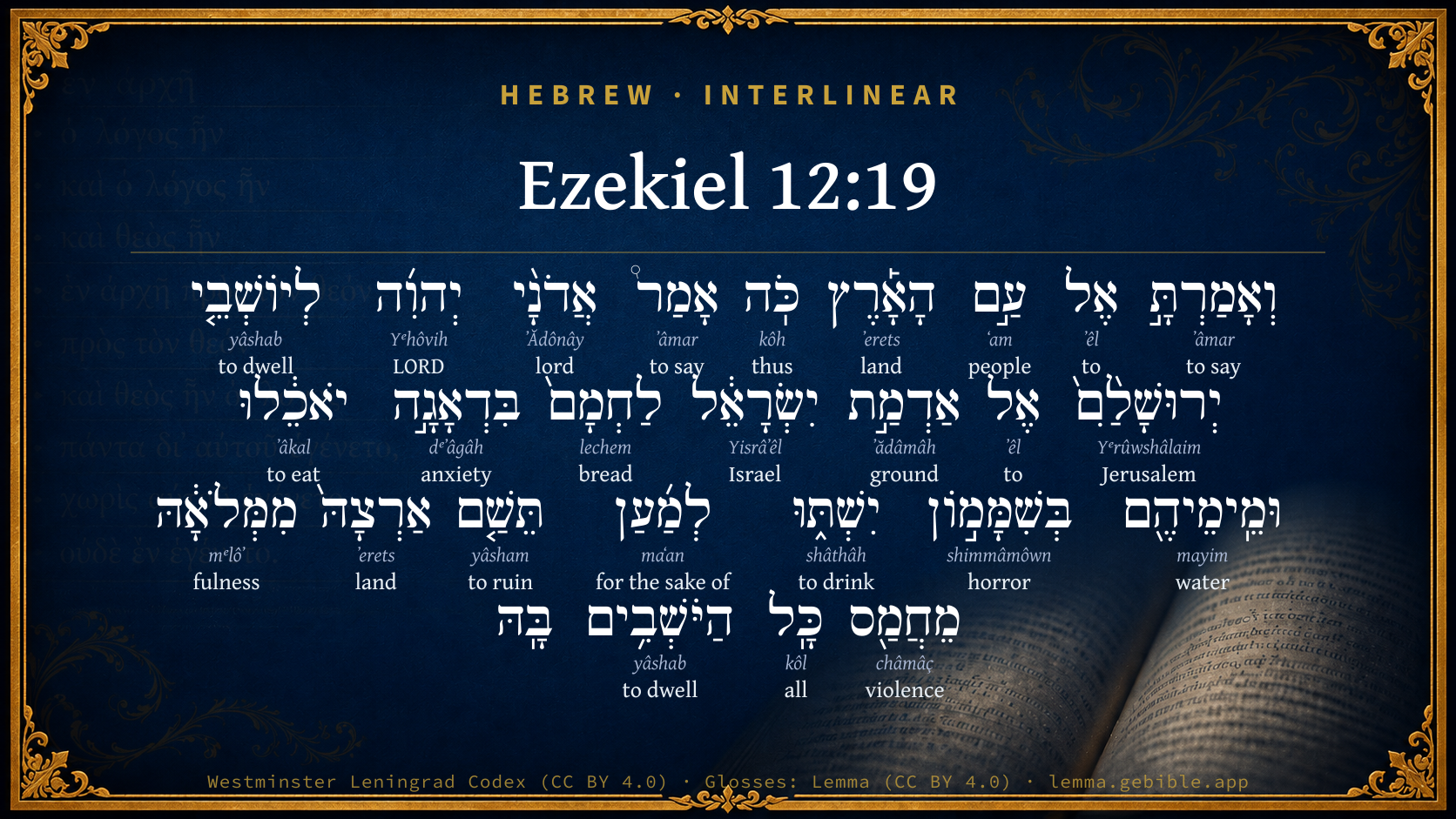
Ezekiel 12:19

Hebrew (Westminster Leningrad Codex) Ezekiel 12:19 appears in the Hebrew Old Testament. The text above is from the Westminster Leningrad Codex. Each word links to its Strong’s number, a concise gloss, and parsing drawn from the Open Scriptures Hebrew Bible morphology. Click any word for its full Brown-Driver-Briggs (BDB) entry.
Download image
Cite this verse

Ezekiel 12:19 (World English Bible). Public Domain. Lemma interlinear Bible study tool, https://lemma.gebible.app/v/ezekiel/12/19.

Show BibTeX & RIS
BibTeX
RIS
English Translation
and tell the people of the land, Thus says the Lord Yahweh concerning the inhabitants of Jerusalem, and the land of Israel: They shall eat their bread with fearfulness, and drink their water in dismay, that her land may be desolate, [and despoiled] of all that is therein, because of the violence of all those who dwell therein.
World English Bible · Public Domain
Download a study sheet

One document with this verse’s original text, its word-by-word gloss line, the meaning frame, cross-references with their text, attributed commentary, and full source and license credits — printable, and it pastes into notes with its structure intact.

This verse Autodidact and up

Study sheet (.html) Plain text (.txt)

A passage Seminary Student

Up to 50 verses in one chapter. A passage sheet keeps up to 6 commentary sources and 12 cross-references per verse, in the order this page ranks them, and says so on the sheet whenever that leaves anything out. Ask for a single verse and you get the Autodidact verse sheet above.

Everything on this page stays free to read, with no account — the sheet is a download of what is already on screen, not access to it.

Want to remove ads? Support Godless Engineer
Compare translations 3

The same verse in 3 English versions, stacked beneath the original-language interlinear above. Click any original word for its lexicon entry.

Each is an independent rendering of the whole verse — the interlinear is not word-aligned to these translations.

Highlighted words mark where these versions differ — a whole-verse word diff, not a word-by-word alignment.

  • World English Bible Public Domain
    and tell the people of the land, Thus says the Lord Yahweh concerning the inhabitants of Jerusalem, and the land of Israel: They shall eat their bread with fearfulness, and drink their water in dismay, that her land may be desolate, [and despoiled] of all that is therein, because of the violence of all those who dwell therein.
  • King James Version Public Domain
    And say unto the people of the land, Thus saith the Lord GOD of the inhabitants of Jerusalem, and of the land of Israel; They shall eat their bread with carefulness, and drink their water with astonishment, that her land may be desolate from all that is therein, because of the violence of all them that dwell therein.
  • unfoldingWord Literal Text CC BY-SA 4.0
    Then say to the people of the land, ‘The Lord Yahweh says this concerning the inhabitants of Jerusalem, and the land of Israel, “They will eat their bread with trembling and drink their water while shaking, since the land will be despoiled of its fullness because of the violence of all those who live there.

unfoldingWord Literal Text — © unfoldingWord, licensed CC BY-SA 4.0. Word-aligned USFM3 via Door43 (git.door43.org/unfoldingWord/en_ult).

Versions to compare (up to 4)

3 of 4 selected

Show all 18 translations

Every available English version of this verse, each an independent rendering of the whole verse.

  • World English Bible Public Domain
    and tell the people of the land, Thus says the Lord Yahweh concerning the inhabitants of Jerusalem, and the land of Israel: They shall eat their bread with fearfulness, and drink their water in dismay, that her land may be desolate, [and despoiled] of all that is therein, because of the violence of all those who dwell therein.
  • Berean Standard Bible Public Domain
    Then tell the people of the land that this is what the Lord GOD says about those living in Jerusalem and in the land of Israel: ‘They will eat their bread with anxiety and drink their water in dread, for their land will be stripped of everything in it because of the violence of all who dwell in it.
  • Majority Standard Bible Public Domain
    Then tell the people of the land that this is what the Lord GOD says about those living in Jerusalem and in the land of Israel: ‘They will eat their bread with anxiety and drink their water in dread, for their land will be stripped of everything in it because of the violence of all who dwell in it.
  • King James Version Public Domain
    And say unto the people of the land, Thus saith the Lord GOD of the inhabitants of Jerusalem, and of the land of Israel; They shall eat their bread with carefulness, and drink their water with astonishment, that her land may be desolate from all that is therein, because of the violence of all them that dwell therein.
  • American Standard Version (1901) Public Domain
    and say unto the people of the land, Thus saith the Lord Jehovah concerning the inhabitants of Jerusalem, and the land of Israel: They shall eat their bread with fearfulness, and drink their water in dismay, that her land may be desolate, `and despoiled' of all that is therein, because of the violence of all them that dwell therein.
  • Revised Version (1885) Public Domain
    and say unto the people of the land, Thus saith the Lord GOD concerning the inhabitants of Jerusalem, and the land of Israel: They shall eat their bread with carefulness, and drink their water with astonishment, that her land may be desolate from all that is therein, because of the violence of all them that dwell therein.
  • Geneva Bible (1599) Public Domain
    And say vnto the people of the land, Thus saith the Lord God of the inhabitants of Ierusalem, and of the lande of Israel, They shall eate their bread with carefulnes, and drinke their water with desolation: for the lande shall bee desolate from her abundance because of the crueltie of them that dwell therein.
  • Douay-Rheims (1899) Public Domain
    And say to the people of the land: Thus saith the Lord God to them that dwell in Jerusalem in the land of Israel: They shall eat their bread in care, and drink their water in desolation: that the land may become desolate from the multitude that is therein, for the iniquity of all that dwell therein.
  • Young's Literal Translation Public Domain
    and thou hast said unto the people of the land, Thus said the Lord Jehovah concerning the inhabitants of Jerusalem, concerning the land of Israel: Their bread with fear they do eat, and their water with astonishment drink, because its land is desolate, because of its fulness, because of the violence of all who are dwelling in it.
  • Literal Standard Version CC BY-SA 4.0
    and you have said to the people of the land, Thus said Lord YHWH concerning the inhabitants of Jerusalem, concerning the land of Israel: They eat their bread with fear, and drink their water with astonishment, because its land is desolate, because of its fullness, because of the violence of all who are dwelling in it.
  • Unlocked Literal Bible CC BY-SA 4.0
    Then say to the people of the land, 'The Lord Yahweh says this concerning the inhabitants of Jerusalem, and the land of Israel, “They will eat their bread with trembling and drink their water while shaking, since the land will be despoiled of its fullness because of the violence of all those who live there.
  • unfoldingWord Literal Text CC BY-SA 4.0
    Then say to the people of the land, ‘The Lord Yahweh says this concerning the inhabitants of Jerusalem, and the land of Israel, “They will eat their bread with trembling and drink their water while shaking, since the land will be despoiled of its fullness because of the violence of all those who live there.
  • Darby Bible Public Domain
    and say unto the people of the land, Thus saith the Lord Jehovah concerning the inhabitants of Jerusalem, in the land of Israel: They shall eat their bread with anxiety, and drink their water with astonishment, because her land shall be left desolate of all that is in it, for the violence of all them that dwell therein.
  • World Messianic Bible Public Domain
    Tell the people of the land, ‘The Lord GOD says concerning the inhabitants of Jerusalem and Eretz-Israel: “They will eat their bread with fearfulness and drink their water in dismay, that her land may be desolate, and all that is therein, because of the violence of all those who dwell therein.
  • Webster's Bible Public Domain
    And say to the people of the land, Thus saith the Lord GOD of the inhabitants of Jerusalem, and of the land of Israel; They shall eat their bread with solicitude, and drink their water with astonishment, that her land may be desolate from all that is therein, because of the violence of all them that dwell therein.
  • Free Bible Version CC BY-SA 4.0
    Then explain to the people of this country that this is what the Lord God says to those living in Jerusalem and in the country of Israel: They will be worried as eat their bread and they will be in despair as they drink their water, for their land will be stripped bare because of the violent crimes committed by everyone who lives there.
  • Bible in Basic English Public Domain
    And say to the people of the land, This is what the Lord has said about the people of Jerusalem and the land of Israel: They will take their food with care and their drink with wonder, so that all the wealth of their land may be taken from it because of the violent ways of the people living in it.
  • JPS Tanakh (1917) Public Domain
    and say unto the people of the land: Thus saith the Lord GOD concerning the inhabitants of Jerusalem in the land of Israel. They shall eat their bread with anxiety, and drink their water with appalment, that her land may be desolate from all that is therein, because of the violence of all them that dwell therein.

Literal Standard Version (2020), Covenant Press — licensed CC BY-SA 4.0. Text via the HelloAO Bible API (eBible.org). Unlocked Literal Bible (unfoldingWord) — licensed CC BY-SA 4.0. Text via the HelloAO Bible API (eBible.org). unfoldingWord Literal Text — © unfoldingWord, licensed CC BY-SA 4.0. Word-aligned USFM3 via Door43 (git.door43.org/unfoldingWord/en_ult). Free Bible Version, Dr. Jonathan Gallagher — licensed CC BY-SA 4.0. Text via the HelloAO Bible API (eBible.org).

Word by word

More ways to search: Search by grammar → Find every occurrence → Compare this word →

Practice this passage: Drill this verse → Learn its vocabulary →

בְּשִׁמָּמ֣וֹן
shimmâmôwn
H8078
“in/at · horror”
Preposition + Noun, Common, Masculine, Singular, Absolute
Part of Speech
Preposition + Noun
Type
Common
Gender
Masculine
Number
Singular
State
Absolute
Full BDB Definition

Origin: from H8074

TWOT: 2409e

horror, dismay, appalment
  1. וְאָמַרְתָּ֣ ʼâmar H559 “and · to say” Conjunction + Verb, Qal, Sequential Perfect, 2nd Person, Masculine, Singular
  2. אֶל ʼêl H413 “to” Preposition
  3. עַ֣ם ʻam H5971 “people of” Noun, Common, Masculine, Singular, Construct
  4. הָאָ֡רֶץ ʼerets H776 “the · land” Particle, Definite Article + Noun, Common, Both, Singular, Absolute
  5. כֹּֽה kôh H3541 “thus” Adverb
  6. אָמַר֩ ʼâmar H559 “to say” Verb, Qal, Perfect, 3rd Person, Masculine, Singular
  7. אֲדֹנָ֨י ʼĂdônây H136 “Lord · my” Noun, Common, Masculine, Plural, Construct + Suffix, Personal, 1st Person, Common, Singular
  8. יְהוִ֜ה Yᵉhôvih H3069 “LORD” Noun, Proper
  9. לְיוֹשְׁבֵ֤י yâshab H3427 “to/for · dwelling” Preposition + Verb, Qal, Participle Active, Masculine, Plural, Construct
  10. יְרוּשָׁלִַ֨ם֙ Yᵉrûwshâlaim H3389 “Jerusalem” Noun, Proper
  11. אֶל ʼêl H413 “to” Preposition
  12. אַדְמַ֣ת ʼădâmâh H127 “ground of” Noun, Common, Feminine, Singular, Construct
  13. יִשְׂרָאֵ֔ל Yisrâʼêl H3478 “Israel” Noun, Proper
  14. לַחְמָם֙ lechem H3899 “bread · their” Noun, Common, Both, Singular, Construct + Suffix, Personal, 3rd Person, Masculine, Plural
  15. בִּדְאָגָ֣ה dᵉʼâgâh H1674 “in/at · anxiety” Preposition + Noun, Common, Feminine, Singular, Absolute
  16. יֹאכֵ֔לוּ ʼâkal H398 “to eat” Verb, Qal, Imperfect, 3rd Person, Masculine, Plural
  17. וּמֵֽימֵיהֶ֖ם mayim H4325 “and · water(s) · their” Conjunction + Noun, Common, Masculine, Plural, Construct + Suffix, Personal, 3rd Person, Masculine, Plural
  18. יִשְׁתּ֑וּ shâthâh H8354 “to drink” Verb, Qal, Imperfect, 3rd Person, Masculine, Plural
  19. לְמַ֜עַן maʻan H4616 “for the sake of” Preposition
  20. תֵּשַׁ֤ם yâsham H3456 “to ruin” Verb, Qal, Imperfect, 3rd Person, Feminine, Singular
  21. אַרְצָהּ֙ ʼerets H776 “land · her” Noun, Common, Both, Singular, Construct + Suffix, Personal, 3rd Person, Feminine, Singular
  22. מִמְּלֹאָ֔הּ mᵉlôʼ H4393 “from · fulness · her” Preposition + Noun, Common, Masculine, Singular, Construct + Suffix, Personal, 3rd Person, Feminine, Singular
  23. מֵחֲמַ֖ס châmâç H2555 “from · violence of” Preposition + Noun, Common, Masculine, Singular, Construct
  24. כָּֽל kôl H3605 “all of” Noun, Common, Masculine, Singular, Construct
  25. הַיֹּשְׁבִ֥ים yâshab H3427 “the · dwelling” Particle, Definite Article + Verb, Qal, Participle Active, Masculine, Plural, Absolute

About this verse

These counts appear in no published source. They are computed here, from the morphology-tagged text and Lemma’s own curated glosses. What Lemma adds →

27
words
22
distinct lemmas
Prophets
section

Notable vocabulary

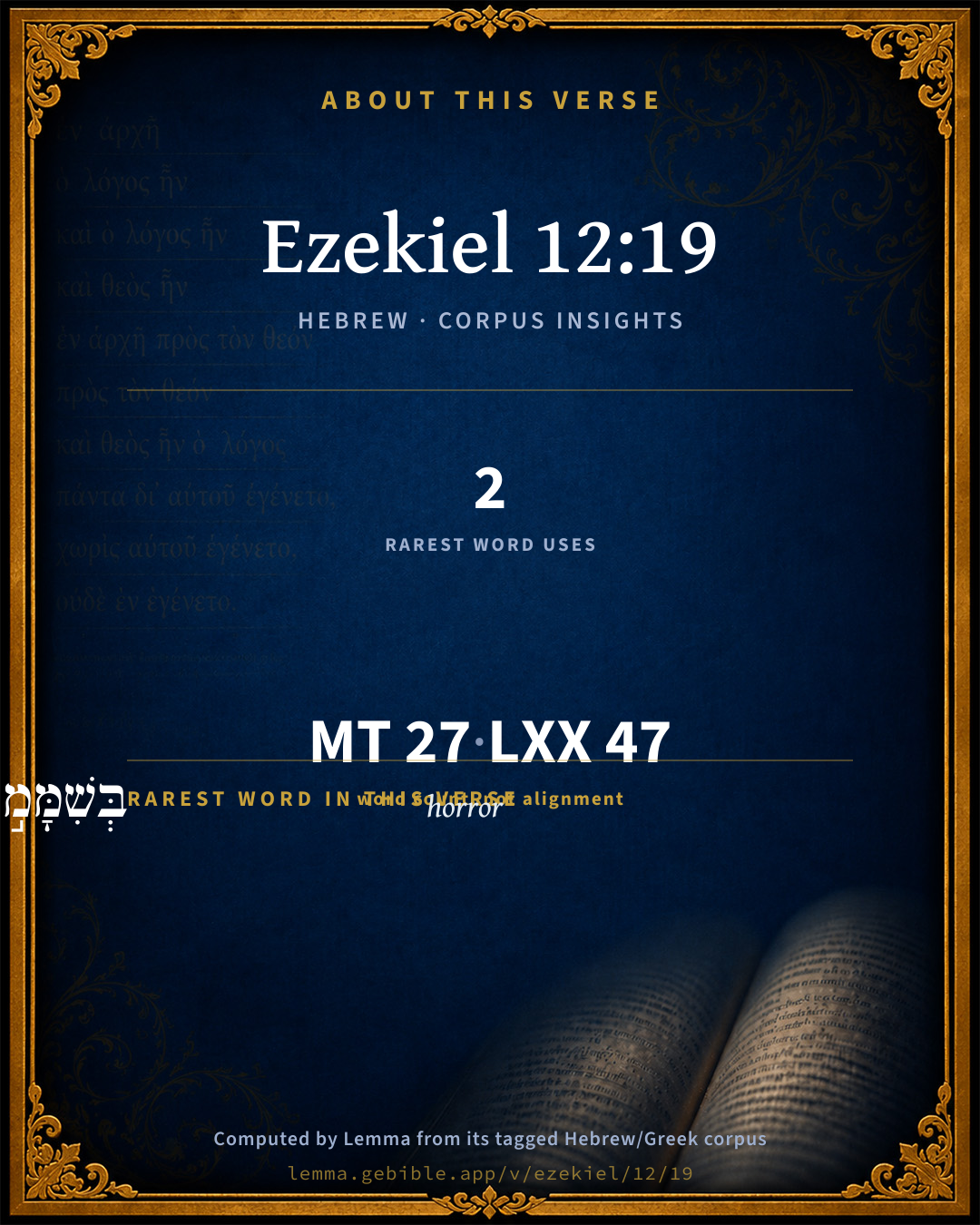
The rarest word here is בְּשִׁמָּמ֣וֹן horror H8078 — appearing just 2 times in the whole Hebrew Bible.

Shared distinctive vocabulary

בְּשִׁמָּמ֣וֹן horror H8078 occurs in 2 verses of the Hebrew Bible. Also found in:

Grammatical profile

  • 7 verbs
  • 15 nouns
  • 4 prepositions
  • 1 adverb

Verb forms

  • וְאָמַרְתָּ֣ Qal · Sequential Perfect
  • אָמַר֩ Qal · Perfect
  • לְיוֹשְׁבֵ֤י Qal · Participle Active
  • יֹאכֵ֔לוּ Qal · Imperfect
  • יִשְׁתּ֑וּ Qal · Imperfect
  • תֵּשַׁ֤ם Qal · Imperfect
  • הַיֹּשְׁבִ֥ים Qal · Participle Active

Repetition

Words recur within this verse — often emphatic in Hebrew:

  • וְאָמַרְתָּ֣ to say H559 ×2
  • הָאָ֡רֶץ land H776 ×2
  • לְיוֹשְׁבֵ֤י to dwell H3427 ×2
  • אֶל to H413 ×2

Hebrew & Septuagint length

In English translation the verse runs 58 words from the Hebrew and 57 from the Septuagint (LXX English) — closely comparable.

A rough comparison of the two English renderings, which tokenize alike — not a word-level alignment.

Word counts can differ between the Hebrew and the Greek without any difference in meaning — e.g. the Hebrew direct-object marker אֵת has no separate Greek word, and Greek often adds the article ὁ.

In the original languages it is 27 Hebrew tokens and 47 Greek tokens — but the two are counted differently (Hebrew bundles its prefixes and suffixes into one token; the Greek is in lemma form), so that isn’t a like-for-like length.

Cross-references

23

Topical passages linked to Ezekiel 12:19 in the Treasury of Scripture Knowledge — connected by theme and wording, ordered by reader-vote popularity; previews shown in the World English Bible.

  • Zechariah 7:14 "but I will scatter them with a whirlwind among all the nations which they have not known. Thus the land was desolate after them, so that no man passed through nor returned: for they made the pleasant land desolate."
  • Ezekiel 6:6–7 In all your dwelling-places the cities shall be laid waste, and the high places shall be desolate; that your altars may be laid waste and made desolate, and your idols may be broken and cease, and your sun-images may be hewn down, and your works may be abolished.
  • Ezekiel 6:14 I will stretch out my hand on them, and make the land desolate and waste, from the wilderness toward Diblah, throughout all their habitations: and they shall know that I am Yahweh.
  • Micah 7:13 Yet the land will be desolate because of those who dwell therein, For the fruit of their doings.
  • Jeremiah 10:22 The voice of news, behold, it comes, and a great commotion out of the north country, to make the cities of Judah a desolation, a dwelling-place of jackals.
  • Ezekiel 7:23 Make the chain; for the land is full of bloody crimes, and the city is full of violence.
  • 1 Corinthians 10:28 But if anyone says to you, "This was offered to idols," don't eat it for the sake of the one who told you, and for the sake of conscience. For "the earth is the Lord's, and all its fullness."
  • Genesis 6:11–13 The earth was corrupt before God, and the earth was filled with violence.
  • 1 Kings 17:10–12 So he arose and went to Zarephath; and when he came to the gate of the city, behold, a widow was there gathering sticks: and he called to her, and said, Please get me a little water in a vessel, that I may drink.
  • Psalms 24:1 The earth is Yahweh's, with its fullness; The world, and those who dwell therein.
  • Psalms 107:34 And a fruitful land into a salt waste, For the wickedness of those who dwell in it.
  • Isaiah 6:11 Then I said, "Lord, how long?" He answered, "Until cities are waste without inhabitant, And houses without man, And the land becomes utterly waste,
  • Jeremiah 4:27 For thus says Yahweh, The whole land shall be a desolation; yet will I not make a full end.
  • Jeremiah 6:7 As a well casts forth its waters, so she casts forth her wickedness: violence and destruction is heard in her; before me continually is sickness and wounds.
  • Jeremiah 9:10–11 For the mountains will I take up a weeping and wailing, and for the pastures of the wilderness a lamentation, because they are burned up, so that none passes through; neither can men hear the voice of the cattle; both the birds of the sky and the animals are fled, they are gone.
  • Jeremiah 18:16 to make their land an astonishment, and a perpetual hissing; everyone who passes thereby shall be astonished, and shake his head.
  • Jeremiah 32:28 Therefore thus says Yahweh: Behold, I will give this city into the hand of the Chaldeans, and into the hand of Nebuchadrezzar king of Babylon, and he shall take it:
  • Jeremiah 33:10 Thus says Yahweh: Yet again there shall be heard in this place, about which you say, It is waste, without man and without animal, even in the cities of Judah, and in the streets of Jerusalem, that are desolate, without man and without inhabitant and without animal,
  • Jeremiah 33:12 Thus says Yahweh of Hosts: Yet again shall there be in this place, which is waste, without man and without animal, and in all the cities of it, a habitation of shepherds causing their flocks to lie down.
  • Ezekiel 4:16 Moreover he said to me, Son of man, behold, I will break the staff of bread in Jerusalem: and they shall eat bread by weight, and with fearfulness; and they shall drink water by measure, and in dismay:
  • Ezekiel 36:3 therefore prophesy, and say, Thus says the Lord Yahweh: Because, even because they have made you desolate, and swallowed you up on every side, that you might be a possession to the residue of the nations, and you are taken up in the lips of talkers, and the evil report of the people;
  • Micah 3:10–12 They build up Zion with blood, And Jerusalem with iniquity.
  • 1 Corinthians 10:26 for "the earth is the Lord's, and its fullness."

Cross-references courtesy of OpenBible.info (CC BY 4.0).

Hebrew and Greek witnesses Masoretic Hebrew ↔ Greek Septuagint

The same verse in the two great witnesses to the Old Testament, shown verse-for-verse.

These are two independent witnesses, not word-aligned to each other, and the Septuagint is shown in lemma (dictionary) form.

Hebrew Ezekiel 12:19 Masoretic · Westminster Leningrad Codex

וְאָמַרְתָּ֣ אֶל עַ֣ם הָאָ֡רֶץ כֹּֽה אָמַר֩ אֲדֹנָ֨י יְהוִ֜ה לְיוֹשְׁבֵ֤י יְרוּשָׁלִַ֨ם֙ אֶל אַדְמַ֣ת יִשְׂרָאֵ֔ל לַחְמָם֙ בִּדְאָגָ֣ה יֹאכֵ֔לוּ וּמֵֽימֵיהֶ֖ם בְּשִׁמָּמ֣וֹן יִשְׁתּ֑וּ לְמַ֜עַן תֵּשַׁ֤ם אַרְצָהּ֙ מִמְּלֹאָ֔הּ מֵחֲמַ֖ס כָּֽל הַיֹּשְׁבִ֥ים בָּֽהּ

and tell the people of the land, Thus says the Lord Yahweh concerning the inhabitants of Jerusalem, and the land of Israel: They shall eat their bread with fearfulness, and drink their water in dismay, that her land may be desolate, [and despoiled] of all that is therein, because of the violence of all those who dwell therein.

World English Bible · Public Domain

Greek LXX Ezekiel 12:19 Septuagint · lemma form

καί εἶπον πρός ὁ λαός ὁ γῆ ὅδε λέγω κύριος ὁ καταοἰκέω ἰερουσαλήμ ἐπί ὁ γῆ ὁ ἰσραήλ ὁ ἄρτος αὐτός μετά ἔνδεια ἐσθίω καί ὁ ὕδωρ αὐτός μετά ἀφανισμός πίνω ὅπως ἀπο ἀναἵζω ὁ γῆ σύν πλήρωμα αὐτός ἐν ἀσέβεια γάρ πᾶς ὁ καταοἰκέω ἐν αὐτός

And you shall say to the people of the land, Thus says the Lord to the inhabitants of Jerusalem, on the land of Israel; They shall eat their bread in scarcity, and shall drink their water in desolation, that the land may be desolate with all that it contains: for all that dwell in it are ungodly.

LXX2012 (modern English Septuagint) · Public Domain

Hebrew: Westminster Leningrad Codex (CC BY 4.0). Greek: Septuagint (public domain); English from LXX2012 (modern English Septuagint) (Public Domain). How the Septuagint differs from the Hebrew →

Targum (Aramaic paraphrase)

1

The Targum is the ancient Jewish Aramaic paraphrase of the Hebrew Scriptures — an interpretive translation, not the Hebrew text itself. Onkelos (literal) and Pseudo-Jonathan (expansive) render the Torah, and Jonathan the Prophets. Coverage is partial: where no permissively-licensed English translation exists for a verse, only the Aramaic is shown. This is verse-level text, not a word-by-word alignment to the Hebrew.

  1. Targum Jonathan Prophets (Joshua–Malachi)
    וְתֵימַר לְעַמָא דְאַרְעָא כִּדְנַן אֲמַר יְיָ אֱלֹהִים לְיַתְבֵי יְרוּשְׁלֵם עַל אַרְעָא דְיִשְׂרָאֵל מֵיכַלְהוֹן בְּזִיעַ יֵיכְלוּן וּמִשְׁתְּהוֹן בְּאִשְׁתְּמָמוּ יִשְׁתּוּן בְּדִיל דְתִצְדֵי אַרְעָא מִמְלוֹאָהּ מֵחֲטוֹף כָּל דְיַתְבִין בָּהּ:

    (no public-domain English translation for this verse)

    Targum Jonathan — Aramaic: “Mikraot Gedolot” (public domain). English: “Sefaria Community Translation” (CC0 1.0 (public-domain dedication)); “London "Chaldee Paraphrase," 1871” (public domain). Text via Sefaria.

Commentary

Notes on Ezekiel 12:19 from classic Christian and Jewish commentators (each source and its license shown beneath its notes). The classic Christian expositions comment on the surrounding passage and are grouped to its opening verse, so a note may address several verses; the Jewish commentaries on the Tanakh (Rashi and others) are per-verse, so they appear only where the commentator wrote on this verse.

Lemma curates 59 commentaries, every one of them public domain or Creative Commons licensed, each selected and text-cleaned for this edition rather than reprinted as found. About our sources →

Trapp's Complete Commentary

John Trapp

Eze 12:19 And say unto the people of the land, Thus saith the Lord GOD of the inhabitants of Jerusalem, [and] of the land of Israel; They shall eat their bread with carefulness, and drink their water with astonishment, that her land may be desolate from all that is therein, because of the violence of all them that dwell therein.

Ver. 19. They shall eat their bread with carefulness.] Better fast than feed on such bread. Men may sooner by their carking care add a furlong to their grief, than a cubit to their comfort, saith one.

Because of the violence.] The Jews were ever, and are still, a covetous and cruel people.

John Trapp, A Commentary or Exposition upon All the Books of the Old and New Testament (1647–1656) — public domain. Text from a community e-Sword module.

Jamieson, Fausset & Brown

Robert Jamieson, A. R. Fausset & David Brown

people of the land--the Jews "in the land" of Chaldea who thought themselves miserable as being exiles and envied the Jews left in Jerusalem as fortunate.

land of Israel--contrasted with "the people in the land" of Chaldea. So far from being fortunate as the exiles in Chaldea regarded them, the Jews in Jerusalem are truly miserable, for the worst is before them, whereas the exiles have escaped the miseries of the coming siege.

land . . . desolate from all that is therein--literally "that the land (namely, Judea) may be despoiled of the fulness thereof"; emptied of the inhabitants and abundance of flocks and corn with which it was filled.

because of . . . violence-- (Psa 107:34).

Jamieson, Fausset & Brown — Commentary Critical and Explanatory on the Whole Bible (1871) — public domain (CC PDM 1.0). Text via the HelloAO Bible API.

Ellicott's Commentary for English Readers

(19) Unto the people of the land,—i.e., of the land of Chaldæa: Ezekiel’s fellow-captives. All these prophecies, though concerning Jerusalem and its people, were immediately addressed to the exiles, and their teaching was primarily for them. It is not unlikely, however, as St. Jerome says, that all these prophecies of Ezekiel were sent to Jerusalem, and the corresponding utterances of Jeremiah, made in Jerusalem, were sent to Chaldæa.

From all that is therein.—The margin, which is the literal rendering, explains this: “The land shall be stripped of its richness and excellence, of all that makes it desirable.”

A Bible Commentary for English Readers, edited by Charles John Ellicott (1878–1897) — public domain. Text from a community e-Sword module.

The Cambridge Bible for Schools and Colleges

gen. ed. J. J. S. Perowne

19. Jerusalem and of the land] Rather: Jerusalem in (lit. upon) the land.

because of the violence] The punishment of violence is violence. The internal wrong and oppression shall be avenged by a crushing violence and destruction from without. Amo_3:9-11. The phrase “desolate from all that is therein,” lit. from its fulness, means desolate and emptied of its fulness.

The Cambridge Bible for Schools and Colleges (gen. ed. J. J. S. Perowne; Cambridge University Press, 1878–1918) — public domain. Text from a community e-Sword module.

John Gill's Exposition

Tell them therefore,.... Plainly and boldly, with the greatest assurance and confidence, as from God himself:

thus saith the Lord God, I will make this proverb to cease; by quickly accomplishing the things which they, by this proverb, represented as at a great distance, and what would never be brought about:

and they shall no more use it as a proverb in Israel; when the things predicted shall take place:

but say unto them, the days are at hand, and the effect of every vision; the time is hastening on, and will quickly come, when every prophecy shall be fulfilled: it was in the sixth year of Jehoiachin's captivity that these prophecies were delivered out; and in the ninth year Nebuchadnezzar came with his army, and besieged Jerusalem; so that the days were at hand; in three years' time there began an accomplishment of the above predictions, which were scoffed at in the proverb used.

John Gill's Exposition of the Whole Bible (1746–1763) — public domain (CC PDM 1.0). Text via the HelloAO Bible API.

Albert Barnes' Notes on the Bible

The people of the land - Chaldaea.

Of the inhabitants - In respect to “the inhabitants.”

Desolate from, all that is therein - i. e., stripped of all its inhabitants and of all its wealth.

At one and the same time, Jeremiah was prophesying in Jerusalem, and Ezekiel in Chaldaea; the prophecies of the former were sent to the exiles, and those of Ezekiel to the dwellers at Jerusalem, that the guiding hand of One God in different places might be made clear (Jerome).

Albert Barnes' Notes on the Bible (1834–1885) — public domain. Text from a community e-Sword/MySword module.

Matthew Poole's English Annotations

Explain the meaning of this unusual and uncomfortable manner of eating and drinking

unto the people; the common sort of people, distinguished from rulers, of the land of Chaldea, in which the Jews were captives. Tell thy fellow captives who grudge and repent their coming hither, where they have much sorrow, yet some safety, plenty, and rest.

Of the inhabitants of Jerusalem, who are not yet captivated; their sorrows are coming, and their state will be worse than yours.

Of the land of Israel; nor will it be better with, those that dwell in the countries round about Jerusalem, they will flee for refuge into Jerusalem, and there perish. Eat their bread with carefulness; their very comforts shall be uncomfortable to them.

Her land; Jerusalem’s land, so called because it was the head city thereof.

May be desolate; because that it is already, or shortly shall be, waste, emptied, though it was full of inhabitants, wealth, and plenty.

Violence; injustice, oppression, and tyranny of the Jews toward one another, Jer 6:7; 20:8; Eze 7:23; and this grown an epidemical sin, Eze 22:9,12, from highest to lowest.

Matthew Poole's English Annotations on the Holy Bible (1683–1685) — public domain. Text from a community e-Sword/MySword module.

John Wesley's Explanatory Notes

The people - Thy fellow captives. And of the land - Those that dwell in the countries round about Jerusalem. Her land - Jerusalem's land, so called because it was the head city thereof. Desolate - Because it shortly shall be laid waste, emptied of inhabitants, wealth and plenty. Violence - Injustice, oppression and tyranny of the Jews toward one another.

John Wesley, Explanatory Notes Upon the Whole Bible (1754–1765) — public domain. Text via the GEBible commentary corpus.

unfoldingWord translationNotes

Door43 World Missions Community

the land will be despoiled of its fullness

The word "fullness" refers to everything in the land. The word "despoiled" means that people will empty the land of everything in it. This can be stated in active form. AT: "others will empty the land of everything in it" (See: Active or Passive)

the cities that were inhabited will be desolate

This can be stated in active form. AT: "the cities where people lived will be desolate" (See: Active or Passive)

translationWords

Lord Yahweh

Jerusalem

Israel

bread

desolate

waste

know

Yahweh

unfoldingWord translationNotes — © Distant Shores Media and the Door43 World Missions Community, licensed CC BY-SA 4.0. Source: git.door43.org/Door43/en_tn.

Rashi

Rabbi Shlomo Yitzchaki (Rashi)

of its fullness Of its wealth.

because of the violence of all who dwell therein Because of the iniquity of the violence of its dwellers.

Rashi on the Tanakh — English translations: “The Judaica Press complete Tanach with Rashi, translated by A. J. Rosenberg” (CC BY 4.0); “Pentateuch with Rashi's commentary by M. Rosenbaum and A.M. Silbermann, 1929-1934” (public domain); “The Metsudah Tanach series, Lakewood, N.J” (CC BY 4.0); and “The Book of Joshua, Metsudah Publications, 1997” (CC BY 4.0). Text via Sefaria.

Lesson kit

Teaching starters — assembled from the data on this page, not authored interpretation. Every prompt links to the verse data it draws on. Edit before teaching.

Ezekiel, in the Prophets, opens this verse with 27 words (22 distinct Hebrew lemmas). Its most distinctive word is shimmâmôwn (“horror”). A historical commentator’s framing appears above. Read the whole chapter for the surrounding context.

Discussion questions

  1. The word shimmâmôwn carries the sense “horror.” How does it shape the verse?
  2. Ezekiel 4:16 shares the word «horror» with this verse. How do the two illuminate each other?
  3. “to say” occurs 2× in this one verse. What is the effect of the repetition?
  4. These translations render this verse differently. What is at stake in choosing one wording over another?
  5. The verb «וְאָמַרְתָּ֣» is Qal Sequential Perfect. How does its form color the action?
  6. Reading how Trapp's Complete Commentary and Jamieson, Fausset & Brown read this verse, where do the two commentators agree and where do they part?

Things to notice

Reading settings

Reading text

Shown beneath each verse's original-language words.

Old Testament
Old Testament edition

Read the OT as the Masoretic Hebrew (MT) or the Greek Septuagint (LXX).

English shown for the Greek Septuagint (in the Hebrew ↔ Greek comparison).

Comparing translations? Open the Compare panel on any verse page to stack up to four side by side.