
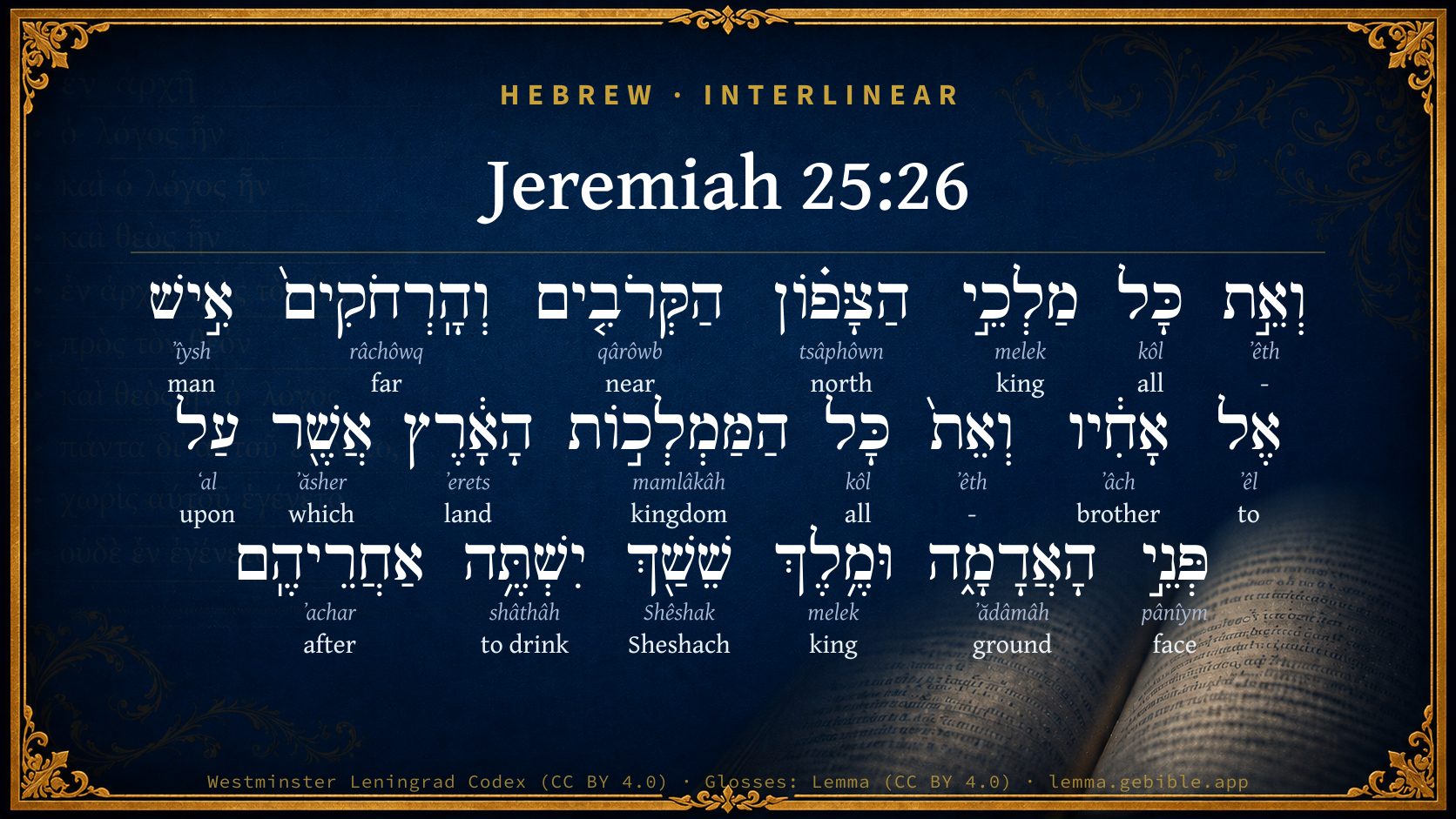
Jeremiah 25:26

Hebrew (Westminster Leningrad Codex) Jeremiah 25:26 appears in the Hebrew Old Testament. The text above is from the Westminster Leningrad Codex. Each word links to its Strong’s number, a concise gloss, and parsing drawn from the Open Scriptures Hebrew Bible morphology. Click any word for its full Brown-Driver-Briggs (BDB) entry.
Download image
Cite this verse

Jeremiah 25:26 (World English Bible). Public Domain. Lemma interlinear Bible study tool, https://lemma.gebible.app/v/jeremiah/25/26.

Show BibTeX & RIS
BibTeX
RIS
English Translation
and all the kings of the north, far and near, one with another; and all the kingdoms of the world, which are on the surface of the earth: and the king of Sheshach shall drink after them.
World English Bible · Public Domain
Highlights
  • 1 first appearance in the Hebrew Bible
Full analysis ↓
Download a study sheet

One document with this verse’s original text, its word-by-word gloss line, the meaning frame, cross-references with their text, attributed commentary, and full source and license credits — printable, and it pastes into notes with its structure intact.

This verse Autodidact and up

Study sheet (.html) Plain text (.txt)

A passage Seminary Student

Up to 50 verses in one chapter. A passage sheet keeps up to 6 commentary sources and 12 cross-references per verse, in the order this page ranks them, and says so on the sheet whenever that leaves anything out. Ask for a single verse and you get the Autodidact verse sheet above.

Everything on this page stays free to read, with no account — the sheet is a download of what is already on screen, not access to it.

Want to remove ads? Support Godless Engineer
Compare translations 3

The same verse in 3 English versions, stacked beneath the original-language interlinear above. Click any original word for its lexicon entry.

Each is an independent rendering of the whole verse — the interlinear is not word-aligned to these translations.

Highlighted words mark where these versions differ — a whole-verse word diff, not a word-by-word alignment.

  • World English Bible Public Domain
    and all the kings of the north, far and near, one with another; and all the kingdoms of the world, which are on the surface of the earth: and the king of Sheshach shall drink after them.
  • King James Version Public Domain
    And all the kings of the north, far and near, one with another, and all the kingdoms of the world, which are upon the face of the earth: and the king of Sheshach shall drink after them.
  • unfoldingWord Literal Text CC BY-SA 4.0
    and all of the kings of the north, the near and the far, a man to his brother, and all of the kingdoms of the world that on the face of the earth. And the king of Sheshach shall drink after them.

unfoldingWord Literal Text — © unfoldingWord, licensed CC BY-SA 4.0. Word-aligned USFM3 via Door43 (git.door43.org/unfoldingWord/en_ult).

Versions to compare (up to 4)

3 of 4 selected

Show all 18 translations

Every available English version of this verse, each an independent rendering of the whole verse.

  • World English Bible Public Domain
    and all the kings of the north, far and near, one with another; and all the kingdoms of the world, which are on the surface of the earth: and the king of Sheshach shall drink after them.
  • Berean Standard Bible Public Domain
    all the kings of the north, both near and far, one after another—all the kingdoms on the face of the earth. And after all of them, the king of Sheshach will drink it too.
  • Majority Standard Bible Public Domain
    all the kings of the north, both near and far, one after another—all the kingdoms on the face of the earth. And after all of them, the king of Sheshach will drink it too.
  • King James Version Public Domain
    And all the kings of the north, far and near, one with another, and all the kingdoms of the world, which are upon the face of the earth: and the king of Sheshach shall drink after them.
  • American Standard Version (1901) Public Domain
    and all the kings of the north, far and near, one with another; and all the kingdoms of the world, which are upon the face of the earth: and the king of Sheshach shall drink after them.
  • Revised Version (1885) Public Domain
    and all the kings of the north, far and near, one with another; and all the kingdoms of the world, which are upon the face of the earth: and the king of Sheshach shall drink after them.
  • Geneva Bible (1599) Public Domain
    And all the Kings of the North, farre and neere one to another, and all the kingdomes of the worlde, which are vpon the earth, and the king of Sheshach shall drinke after them.
  • Douay-Rheims (1899) Public Domain
    And all the kings of the north far and near, every one against his brother: and all the kingdoms of the earth, which are upon the face thereof: and the king of Sesac shall drink after them.
  • Young's Literal Translation Public Domain
    And all the kings of the north, The near and the far off, one unto another, And all the kingdoms of the earth, That `are' on the face of the ground, And king Sheshach drinketh after them.
  • Literal Standard Version CC BY-SA 4.0
    And all the kings of the north, || The near and the far off to one another, || And all the kingdoms of the earth, || That [are] on the face of the ground, || And King Sheshach drinks after them.
  • Unlocked Literal Bible CC BY-SA 4.0
    all the kings of the north, the ones close by and the ones far away—everyone with his brother and all the kingdoms of the world that are on the surface of the earth, all of them had to drink the cup from Yahweh's hand. Finally, the king of Babylon will also drink from that cup.
  • unfoldingWord Literal Text CC BY-SA 4.0
    and all of the kings of the north, the near and the far, a man to his brother, and all of the kingdoms of the world that on the face of the earth. And the king of Sheshach shall drink after them.
  • Darby Bible Public Domain
    and all the kings of the north, far and near, one with another; and all the kingdoms of the world, which are upon the face of the earth; and the king of Sheshach shall drink after them.
  • World Messianic Bible Public Domain
    and all the kings of the north, far and near, one with another; and all the kingdoms of the world, which are on the surface of the earth. The king of Sheshach will drink after them.
  • Webster's Bible Public Domain
    And all the kings of the north, far and near, one with another, and all the kingdoms of the world, which are upon the face of the earth: and the king of Sheshach shall drink after them.
  • Free Bible Version CC BY-SA 4.0
    to all the kings of the north; in fact to all the kingdoms on earth whether close or far away, one after another. After all of them, the king of Babylon will drink it too.
  • Bible in Basic English Public Domain
    And all the kings of the north, far and near, one with another; and all the kingdoms of the world on the face of the earth.
  • JPS Tanakh (1917) Public Domain
    and all the kings of the north, far and near, one with another; and all the kingdoms of the world, which are upon the face of the earth. — And the king of Sheshach shall drink after them.

Literal Standard Version (2020), Covenant Press — licensed CC BY-SA 4.0. Text via the HelloAO Bible API (eBible.org). Unlocked Literal Bible (unfoldingWord) — licensed CC BY-SA 4.0. Text via the HelloAO Bible API (eBible.org). unfoldingWord Literal Text — © unfoldingWord, licensed CC BY-SA 4.0. Word-aligned USFM3 via Door43 (git.door43.org/unfoldingWord/en_ult). Free Bible Version, Dr. Jonathan Gallagher — licensed CC BY-SA 4.0. Text via the HelloAO Bible API (eBible.org).

Word by word

More ways to search: Search by grammar → Find every occurrence → Compare this word →

Practice this passage: Drill this verse → Learn its vocabulary →

שֵׁשַׁ֖ךְ
Shêshak
H8347
“Sheshach”
Noun, Proper
Part of Speech
Noun
Type
Proper
Full BDB Definition

Origin: of foreign derivation

TWOT: 2475

Sheshach = "thy fine linen" - another name for Babylon apparently taken from the goddess 'Shach'
  1. וְאֵ֣ת ʼêth H853 “and · -” Conjunction + Particle, Direct Object
  2. כָּל kôl H3605 “all of” Noun, Common, Masculine, Singular, Construct
  3. מַלְכֵ֣י melek H4428 “kings of” Noun, Common, Masculine, Plural, Construct
  4. הַצָּפ֗וֹן tsâphôwn H6828 “the · north” Particle, Definite Article + Noun, Common, Feminine, Singular, Absolute
  5. הַקְּרֹבִ֤ים qârôwb H7138 “the · near” Particle, Definite Article + Adjective, Adjective, Masculine, Plural, Absolute
  6. וְהָֽרְחֹקִים֙ râchôwq H7350 “and · the · far” Conjunction + Particle, Definite Article + Adjective, Adjective, Masculine, Plural, Absolute
  7. אִ֣ישׁ ʼîysh H376 “man” Noun, Common, Masculine, Singular, Absolute
  8. אֶל ʼêl H413 “to” Preposition
  9. אָחִ֔יו ʼâch H251 “brother · his” Noun, Common, Masculine, Singular, Construct + Suffix, Personal, 3rd Person, Masculine, Singular
  10. וְאֵת֙ ʼêth H853 “and · -” Conjunction + Particle, Direct Object
  11. כָּל kôl H3605 “all of” Noun, Common, Masculine, Singular, Construct
  12. הַמַּמְלְכ֣וֹת mamlâkâh H4467 “the · kingdoms of” Particle, Definite Article + Noun, Common, Feminine, Plural, Construct
  13. הָאָ֔רֶץ ʼerets H776 “the · land” Particle, Definite Article + Noun, Common, Both, Singular, Absolute
  14. אֲשֶׁ֖ר ʼăsher H834 “which” Particle, Relative
  15. עַל ʻal H5921 “upon” Preposition
  16. פְּנֵ֣י pânîym H6440 “face(s) of” Noun, Common, Both, Plural, Construct
  17. הָאֲדָמָ֑ה ʼădâmâh H127 “the · ground” Particle, Definite Article + Noun, Common, Feminine, Singular, Absolute
  18. וּמֶ֥לֶךְ melek H4428 “and · king of” Conjunction + Noun, Common, Masculine, Singular, Construct
  19. יִשְׁתֶּ֥ה shâthâh H8354 “to drink” Verb, Qal, Imperfect, 3rd Person, Masculine, Singular
  20. אַחֲרֵיהֶֽם ʼachar H310 “after · them” Preposition + Suffix, Personal, 3rd Person, Masculine, Plural

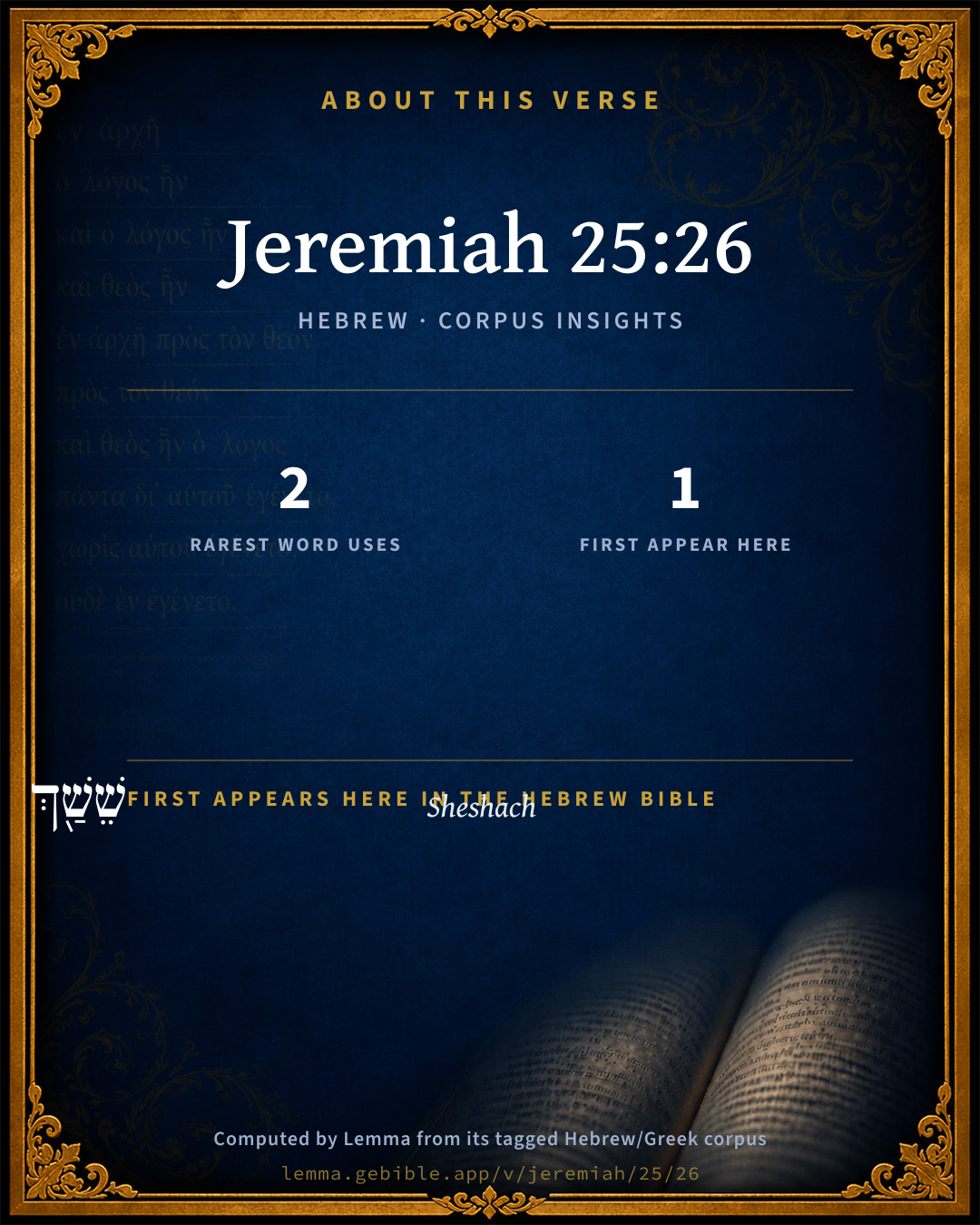
About this verse

These counts appear in no published source. They are computed here, from the morphology-tagged text and Lemma’s own curated glosses. What Lemma adds →

21
words
18
distinct lemmas
Prophets
section

Notable vocabulary

The rarest word here is שֵׁשַׁ֖ךְ Sheshach H8347 — appearing just 2 times in the whole Hebrew Bible.

First appearance in Scripture

This word makes its first canonical appearance in the Hebrew Bible here:

  • שֵׁשַׁ֖ךְ Sheshach H8347

Shared distinctive vocabulary

שֵׁשַׁ֖ךְ Sheshach H8347 occurs in 2 verses of the Hebrew Bible. Also found in:

Grammatical profile

  • 1 verb
  • 12 nouns
  • 2 adjectives
  • 3 prepositions
  • 3 particles

Verb forms

  • יִשְׁתֶּ֥ה Qal · Imperfect

Repetition

Words recur within this verse — often emphatic in Hebrew:

  • כָּל all H3605 ×2
  • מַלְכֵ֣י king H4428 ×2

Cross-references

10

Topical passages linked to Jeremiah 25:26 in the Treasury of Scripture Knowledge — connected by theme and wording, ordered by reader-vote popularity; previews shown in the World English Bible.

  • Jeremiah 51:41 How is Sheshach taken! and the praise of the whole earth seized! how is Babylon become a desolation among the nations!
  • Jeremiah 25:9 behold, I will send and take all the families of the north, says Yahweh, and [I will send] to Nebuchadrezzar the king of Babylon, my servant, and will bring them against this land, and against the inhabitants of it, and against all these nations round about; and I will utterly destroy them, and make them an astonishment, and a hissing, and perpetual desolations.
  • Isaiah 13:1–14 The burden of Babylon, which Isaiah the son of Amoz did see.
  • Isaiah 47:1–15 Come down, and sit in the dust, virgin daughter of Babylon; sit on the ground without a throne, daughter of the Chaldeans: for you shall no more be called tender and delicate.
  • Jeremiah 25:12 It shall happen, when seventy years are accomplished, that I will punish the king of Babylon, and that nation, says Yahweh, for their iniquity, and the land of the Chaldeans; and I will make it desolate forever.
  • Jeremiah 50:1–46 The word that Yahweh spoke concerning Babylon, concerning the land of the Chaldeans, by Jeremiah the prophet.
  • Ezekiel 32:30 There are the princes of the north, all of them, and all the Sidonians, who are gone down with the slain; in the terror which they caused by their might they are put to shame; and they lie uncircumcised with those who are slain by the sword, and bear their shame with those who go down to the pit.
  • Daniel 5:1–31 Belshazzar the king made a great feast to a thousand of his lords, and drank wine before the thousand.
  • Habakkuk 2:16 You are filled with shame, and not glory. You will also drink, and be exposed! The cup of Yahweh's right hand will come around to you, and disgrace will cover your glory.
  • Revelation 18:1–24 After these things, I saw another angel coming down out of the sky, having great authority. The earth was illuminated with his glory.

Cross-references courtesy of OpenBible.info (CC BY 4.0).

Hebrew and Greek witnesses Masoretic Hebrew ↔ Greek Septuagint

The same verse in the two great witnesses to the Old Testament, shown verse-for-verse.

These are two independent witnesses, not word-aligned to each other, and the Septuagint is shown in lemma (dictionary) form.

Hebrew Jeremiah 25:26 Masoretic · Westminster Leningrad Codex

וְאֵ֣ת כָּל מַלְכֵ֣י הַצָּפ֗וֹן הַקְּרֹבִ֤ים וְהָֽרְחֹקִים֙ אִ֣ישׁ אֶל אָחִ֔יו וְאֵת֙ כָּל הַמַּמְלְכ֣וֹת הָאָ֔רֶץ אֲשֶׁ֖ר עַל פְּנֵ֣י הָאֲדָמָ֑ה וּמֶ֥לֶךְ שֵׁשַׁ֖ךְ יִשְׁתֶּ֥ה אַחֲרֵיהֶֽם

and all the kings of the north, far and near, one with another; and all the kingdoms of the world, which are on the surface of the earth: and the king of Sheshach shall drink after them.

World English Bible · Public Domain

Greek LXX Structure differs

In the Septuagint, Jeremiah is about an eighth shorter than the Hebrew and arranges its material differently — the Oracles Against the Nations (Hebrew chapters 46–51) appear in the middle of the Greek book, after 25:13. Because the chapter and verse boundaries do not line up, a verse-for-verse comparison with the Hebrew is not shown.

A verse-for-verse comparison isn’t shown here because the chapters and verses don’t line up. Switch to the LXX edition with the MT / LXX toggle above to read the Greek directly.

On this verse, Ellicott's Commentary for English Readers discusses the Septuagint’s reading. Read the note in Commentary ↓

Hebrew: Westminster Leningrad Codex (CC BY 4.0). Greek: Septuagint (public domain); English from a public-domain English Septuagint. How the Septuagint differs from the Hebrew →

Targum (Aramaic paraphrase)

1

The Targum is the ancient Jewish Aramaic paraphrase of the Hebrew Scriptures — an interpretive translation, not the Hebrew text itself. Onkelos (literal) and Pseudo-Jonathan (expansive) render the Torah, and Jonathan the Prophets. Coverage is partial: where no permissively-licensed English translation exists for a verse, only the Aramaic is shown. This is verse-level text, not a word-by-word alignment to the Hebrew.

  1. Targum Jonathan Prophets (Joshua–Malachi)
    וְיַת כָּל מַלְכֵי צִפּוּנָא דְקָרִיבִין וּדְרָחִיקִין גְבַר לַאֲחוֹהִי וְיַת כָּל מַלְכְּוַת עַמְמַיָא דְעַל אַפֵּי אַרְעָא וּמַלְכָּא דְבָבֶל יִשְׁתֵּי בַּתְרֵיהוֹן:

    (no public-domain English translation for this verse)

    Targum Jonathan — Aramaic: “Mikraot Gedolot” (public domain). English: “Sefaria Community Translation” (CC0 1.0 (public-domain dedication)); “London "Chaldee Paraphrase," 1871” (public domain). Text via Sefaria.

Commentary

Notes on Jeremiah 25:26 from classic Christian and Jewish commentators (each source and its license shown beneath its notes). The classic Christian expositions comment on the surrounding passage and are grouped to its opening verse, so a note may address several verses; the Jewish commentaries on the Tanakh (Rashi and others) are per-verse, so they appear only where the commentator wrote on this verse.

Lemma curates 59 commentaries, every one of them public domain or Creative Commons licensed, each selected and text-cleaned for this edition rather than reprinted as found. About our sources →

Trapp's Complete Commentary

John Trapp

Jer 25:26 And all the kings of the north, far and near, one with another, and all the kingdoms of the world, which [are] upon the face of the earth: and the king of Sheshach shall drink after them.

Ver. 26. And all the kingdoms.] See on Jer 25:16.

And the king of Sheshak,] i.e., Belshazzar, that bezzling king of Babylon, while he is quaffing in the vessels of God’s house to the honour of Shat, {a} the Babylonian goddess; whence those feast days were called σακεαι ημεραι, being like the Roman Saturnalia. Antichrist also, who hath troubled all the kingdoms of the earth, shall himself perish, together with his Babylon the great, which hath made the nations drunk with the wine of her fornications.

{a} Shesac, id est poculum laetitiae aut vanitatis, vel sericum tuum.

John Trapp, A Commentary or Exposition upon All the Books of the Old and New Testament (1647–1656) — public domain. Text from a community e-Sword module.

Geneva Bible (1599)

Geneva Bible translators

That is, of Babylon, as Jer. 51:41.

Geneva Bible (1599) marginal notes — public domain. Text via Bolls.life.

Jamieson, Fausset & Brown

Robert Jamieson, A. R. Fausset & David Brown

Sheshach--Babylon; as the parallelism in Jer 51:41 proves. In the Cabalistic system (called Athbash, the first Hebrew letter in the alphabet being expressed by the last) Sheshach would exactly answer to Babel. Jeremiah may have used this system (as perhaps in Jer 51:41) for concealment at the time of this prediction, in the fourth year of Jehoiakim, while Nebuchadnezzar was before Jerusalem. In Jer 51:41 there can be no concealment, as Babylon is expressly mentioned. MICHAELIS more simply explains the term "brazen-gated" (compare Isa 45:2); others, "the house of a prince." Rather, it comes from the Babylonian goddess, Shach, by reduplication of the first letter; from her Misael was named Meshach by the Babylonians. The term Shace was applied to a festival at Babylon, alluded to in Jer 51:39, Jer 51:57; Isa 21:5. It was during this feast that Cyrus took Babylon [HERODOTUS, 1]. Thus Jeremiah mystically denotes the time of its capture by this term [GLASSIUS].

Jamieson, Fausset & Brown — Commentary Critical and Explanatory on the Whole Bible (1871) — public domain (CC PDM 1.0). Text via the HelloAO Bible API.

Adam Clarke's Commentary

Verse 26. The kings of the north, far and near] The first may mean Syria; the latter, the Hyrcanians and Bactrians.

And the king of Sheshach shall drink after them.] Sheshach was an ancient king of Babylon, who was deified after his death. Here it means either Babylon, or Nebuchadnezzar the king of it. After it has been the occasion of ruin to so many other nations, Babylon itself shall be destroyed by the Medo-Persians.

Adam Clarke's Commentary on the Bible (1810–1826) — public domain. Text from a community e-Sword/MySword module.

John Calvin's Commentaries

The Prophet speaks now of the kings of the north who bordered on the king of Babylon; for as to Judea, Babylon was northward. He calls all those who were towards Chaldea the kings of the north. He then says, Whether near or remote, every one shall be against his brother, and, in short, all the kingdoms of the earth on the face of the earth There is no doubt, as we shall see, but that the Prophet put in the last place the Chaldeans and their king. It is hence probable that what he here predicts was to be accomplished by the hand and power of the king of Babylon, who executed God’s vengeance on all these nations. God, then, chose for himself the king of Chaldea as a scourge, and guided him by his hand in punishing all the lands mentioned here.

I have already reminded you that this was not predicted for the sake of the Jews, that they might derive any alleviation to their grief from the circumstance of having associates, because the condition of others was nothing better; but that God’s design was another, that is, that in so great a confusion of all things, when heaven and earth, as they say, were blended together, they might know that nothing happens through the blind will of fortune. For God had already testified by the mouth of his servant what he would do, and from this prophecy it was easy to conclude that all these changes and violent commotions were the effects of God’s judgment.

The Prophet, after having shewn that the most grievous calamities were nigh all the nations who were neighbors to the Jews, and whose fame had reached them, says, in the last place, that the king of Sheshach would drink after them Hitherto the Prophet seems to have exempted the king of Babylon from all trouble and danger; for he has mentioned all the nations, and has spoken not only of those who were nigh the Jews, but also of the Persians, the Medes, and others. What, then, could have been the design of all this, if the king of Babylon had been passed by? It might have been asked, how can it be right and consistent that this tyrant should escape punishment, though he was of all the most cruel and the most wicked? Hence the Prophet now says, that the king of Babylon, how much soever his violence prevailed among all nations, and raged unpunished, would yet in his time be brought to a reckoning. The meaning then is, that God would defer the punishment of the Chaldeans until he employed them in destroying all the nations of which Jeremiah has hitherto spoken.

Respecting the king of Babylon being called the king of Sheshach, a question has been raised, and some think that some unknown king is intended; for we know that the word is a proper name, as it appears from some passages of Scripture. (1 Kings 11:40; 2 Chronicles 12:2.) But this opinion is not well founded; for the Prophet no doubt speaks here of some remarkable king; and there is also no doubt but that he reminded them of some most important event, so that there was no reason why delay should depress the minds of the faithful, though they saw that this Sheshach was not immediately punished with the rest. Others conjecture that Sheshach was a renowned city in Chaldea. But there is no necessity for us to adopt such light and frivolous conjectures. I have no doubt but that the opinion which the Chaldee paraphraser has followed is the true one, that is, that Sheshach was Babylon. For the sort of alphabet which the Jews at this day call אתבש, atbash, is no new invention; it appears from Jerome it had been long known; he, indeed, derived from great antiquity the practice, so to speak, of counting the letters backwards. They put, the last letter, ת, in the place of א, the first, and then ש in the place of ב, and כ being in the middle of the letters was put for ל; and so they called Babel Sheshach. And to designate Babylon by an obscure name was suitable to the design of the Prophet. But every doubt is removed by another passage in this Prophet,

“How is Sheshach demolished! how fallen is the glory (or praise) of the whole earth! how overthrown is Babylon!” (Jeremiah 51:40.)

There, no doubt, the Prophet explains himself; there is therefore no need to seek any other interpretation. It is a common thing, as we know, with the prophets to repeat the same thing in other words; as he had mentioned Sheshach in the first clause, to prevent any doubt he afterwards mentioned Babylon.

But here a question arises; why did not the Prophet openly and plainly denounce ruin on the king as well as on the Chaldean nation? Many think that this was done prudently, that he might not create an ill-will towards his own people; and Jerome brings forward a passage from Paul, but absurdly, where he says,

“Until a defection shall come,” (2 Thessalonians 2:3)

but he did not understand that passage, for he thought that Paul spoke of the Roman empire. One error brings another; he supposed that Paul was cautious that he might not excite the fury of the Roman Emperor against the Church; but it was no such thing. Now, they who reject the opinion, which is the most correct, that Sheshach was Babylon, make use of this argument, — that the Prophet was not afraid to speak of Babylon, because he had declared openly of it what he had to say, as we have already seen in other places, and as it will appear more clearly hereafter. But I do not allow that the Prophet was afraid to speak of Babylon, for we find that he boldly obeyed God, so that he stood firm, as we may say, in the midst of many deaths; but I think that he concealed the name for another reason, even that the Jews might know that they had no cause to be in a hurry, though the punishment of Babylon had been predicted, for the prophecy was, as it were, buried, inasmuch as the Prophet withheld the very name of Babylon. It was not, then, his purpose to provide for the peace of the Church, nor was he afraid of the Chaldeans, lest he should kindle their fury against God’s people; he had no such thing in view, but wished rather to restrain too much haste.

And this appears from the context; Drink, he says, shall the king of Sheshath after them; that is, all these nations must drink before God shall touch the king of Babylon. He will not, then, be an idle spectator of all these calamities, but his severity will proceed through all lands until it reaches its summit; and then, he says, this king shall drink after the rest. Now, it might have seemed a poor consolation that God would for so long a time spare the king of Babylon; but all God’s children ought nevertheless to have acquiesced in the admonition given them, that though they were to bear in mind that each of these nations were to be punished by God’s hand, they were yet to believe that the king of Babylon would have his turn, and that they therefore were to restrain themselves, and not to be carried away by too hasty a desire to look for his punishment, but patiently to bear the yoke of tyranny laid on them, until the seasonable time came of which they had been reminded. It follows, —

John Calvin's Commentaries (1540-1563) — public domain. Text from the Calvin Translation Society English edition (1840s-50s) via the Christian Classics Ethereal Library (ccel.org). Calvin's coverage is partial (roughly two-thirds of the Bible); uncommented books and verses are honest gaps, never fabricated. The 19th-century editor's footnotes and remarks are omitted so the notes are faithfully Calvin's own voice.

Ellicott's Commentary for English Readers

(26) The kings of the north.—The term is used generally (the Jews knowing comparatively little of the detailed geography of that region, the Grog, Magog, Meshech, and Tubal of Ezekiel 38, 39), as in Jer_1:14, for the Scythians and other nations lying between the Caspian Sea and the Tigris. In the corresponding passage of Jer_51:27, Ararat, Minni, and Ashkenaz are specially named.

The kingdoms of the world.—The words are, of course, limited by the horizon of the prophet’s vision. As the “world” of the New Testament writers was the Roman Empire, so in the life of Jeremiah it was identical with that of Babylon. (Comp. Dan_2:38; Dan_4:22.)

The king of Sheshach.—The name, which obviously is, from its position, the culminating point of the whole prophecy, is found only here and in Jer_51:41. No city or country bearing this name is mentioned in the Old Testament or in any ancient writer. The traditional Rabbinic explanation is beyond doubt the true one. We have here the earliest known example of the use of a cypher-writing to disguise the meaning of what was written from all but the initiated. The cypher in this instance, known by the significant name of ATBASH (i.e., A taking the place of T, and T of A, B of SH, and SH of B, and so on), consisted in the use of the Hebrew alphabet in an inverted order, thus giving SHeSHaCH as an equivalent for BaBeL. This, then, was the crowning mystery reserved to the last. The Chaldæan kingdom was to do its work as the scourge of God upon the nations; but it was simply an instrument in His hand, as the Assyrians had been in their day (Isa_10:15); and when the work was done, the law of a righteous retribution would be felt by it and by its rulers. It adds to the point of the enigma that the word Sheshach would suggest to an Hebrew, taking its probable etymology, the idea of “crouching” or “sinking.” It may be noted (1) that the use of such a cypher seems to belong to the same mental characteristics as the prominence of the Hebrew alphabet in the acrostic structure of the Lamentations; (2) that the name is omitted by the LXX. both here and in Jer_51:41; and (3) that another instance of the same cypher is found in Jer_51:1. The second fact is presumptive evidence that it was not found in the copy which the Greek translators had before them; and the natural inference from this is that there were two editions of the prophecy even in the prophet’s time—one with and the other without the enigmatic word, the latter being probably the earlier of the two, the former adding, for the comfort of Israel, at once the limits of their exile (Jer_25:14), and this intimation (so veiled that the Chaldæans, if they came across it, would not be likely to understand its meaning) of the way in which it would at last be brought to its close. The use of the cypher has, however, been questioned by some writers, who refer the name to shishaki, a possible form of the name of the moon-god of the Chaldæans (Rawlinson: Herod, i., p. 616). If the existence of any obscure region bearing the name could be proved, it would still be perfectly compatible with the use of the cypher, as veiling its true significance. Other meanings for the word, such as “the warlike city,” “the king’s palace,” have been suggested by recent scholars.

A Bible Commentary for English Readers, edited by Charles John Ellicott (1878–1897) — public domain. Text from a community e-Sword module.

The Cambridge Bible for Schools and Colleges

gen. ed. J. J. S. Perowne

26. of the world] rightly omitted by LXX. It is clear that Jer_25:25-26 bear traces of modification in consonance with later Jewish views as to the end of the dispensation.

which are upon the face of the earth] This would not suggest to the Jewish ear, as it does to us, the thought of absolutely universal dominion on the part of Babylon. This we see from such passages as Dan_2:38; Dan_4:22, where the sense intended to be conveyed cannot be in accordance with the sense of the words taken literally.

Sheshach, etc.] This clause also is absent from LXX, and doubtless is a later insertion. Sheshach=Babel (Babylon) in accordance with a system of cypher writing. It took different forms, of which this (called Atbash) consists in substituting the last letter of the Hebrew alphabet for the first, the last but one for the second and so on. ShShCh will on this principle take the places of BBL. Cp. Jer_51:41, where Sheshach and Babylon occur in parallel clauses. See also in Jer_51:1, where the Hebrew (Le B Ka Ma Y) becomes, when thus transmuted, CaSDIM = Chaldaeans, the actual rendering of the Septuagint. They omit Sheshach in Jer_51:41. The word to the Hebrew ear suggested sinking, humiliation, and thus alluded to Babylon’s eventual punishment, which, however, is foreign to the thought of the passage.

shall drink after them] The turn of Babylon itself shall come to perish.

The Cambridge Bible for Schools and Colleges (gen. ed. J. J. S. Perowne; Cambridge University Press, 1878–1918) — public domain. Text from a community e-Sword module.

John Gill's Exposition

Therefore thou shalt say unto them,.... To the several nations before mentioned, prophesied against:

thus saith the Lord of hosts, the God of Israel; the Lord of armies, above and below, the Sovereign of the whole universe; but in a special and peculiar manner the God of Israel:

drink ye, and be drunken, and spew, and fall, and rise no more; as is sometimes the case of drunken men; they drink till they are quite intoxicated; and become drunk, and then they spew up what they have drunk; and, attempting to walk, fall, and sometimes so as never to rise more; not only break their bones, but their necks, or fall into places where they are suffocated, or in one or other, where they lose their lives. So it is signified, that these nations should drink of the cup of God's wrath and fury; or his judgments should come upon them in such a manner as that they should be obliged to part with all their riches, power, and authority; and should fall and sink into such a ruinous condition, as that they should never be able to the more to a prosperous one:

because of the sword that I will send among you; by which they should be destroyed. The Targum joins this with the preceding clause, thus,

"and ye shall not rise from before those that kill with the sword, whom I send among you.''

John Gill's Exposition of the Whole Bible (1746–1763) — public domain (CC PDM 1.0). Text via the HelloAO Bible API.

Albert Barnes' Notes on the Bible

All the kingdoms of the world ... - In accordance with the usage of Holy Scripture this universality is limited. It is moral and not geographical.

Sheshach - Jerome says that this is the name Babel written in cypher, the letters being transposed. Another example occurs in Jer 51:1, where the words “the heart of my risers up” become the Chaldaeans. The Septuagint omits the clause containing the name.

Albert Barnes' Notes on the Bible (1834–1885) — public domain. Text from a community e-Sword/MySword module.

Matthew Poole's English Annotations

All the kings of the north, far and near; all under the government of the Chaldeans, or (as others) all those princes that have dominions between the north and east.

All the kingdoms of the world, which are upon the face of the earth; that is, in those parts of the world which were at that time known, with whom there was ordinary commerce.

And the king of Sheshach shall drink after them; and the king of Babylon, who was last of all to drink of this cup of the Lord’s fury. That he is here meant is plain from Jer 51:41, where Sheshach is thus interpreted. But why Babylon is called Sheshach is a harder question, and not easily resolved. Those who think the prophet gives Babylon here another name to avoid an odium fresh the king of Babylon, at this time their enemy, neither consider the usual courage of this prophet, nor that he speaks plainly enough, Jer 51:41, where he mentioneth both Babylon and Sheshach, and expoundeth the latter by the former. It is thought that Babylon is called Sheshach from the name of an idol called Shach which they worshipped, to whose honour they yearly kept a festival for five days together, which they called Shace, and they say that during this festival Cyrus took Babylon. But these are all uncertain guesses; it is enough for us to know that by the king of Sheshach is meant the king of Babel, as the prophet expounds himself, Jer 51:41.

Matthew Poole's English Annotations on the Holy Bible (1683–1685) — public domain. Text from a community e-Sword/MySword module.

Whedon's Commentary on the Bible

Daniel D. Whedon

26. Kings of the north — Completing the survey.

Sheshach — See also Jer_51:41. In the opinion of many we have here and in Jer_51:1, an example of that cabalistic figure called the atbash. This consisted in substituting for each letter in a word the letter holding the corresponding place counting from the other end of the alphabet, namely, for א(aleph) ת(tav;) for ב(beth) שׁ(shin,) etc. On this plan Sheshach would answer to Babel, which it certainly means; and in Jer_51:1, the words rendered “in the midst of them that rise up,” literally, heart of the risers up, would answer to Chasdim, (Chaldea,) which also seems to be the sense intended. Jerome, in the fourth century, gives this explanation, which he had probably derived from his rabbinical teachers. If this explanation is correct, it is doubtless true, as Dean Smith says, that this is the “oldest known cipher.”

But even if this view be taken, it will still be questioned whether this device was originated by Jeremiah for some purpose of his own, or whether he simply appropriated what was formed to his hand. For the former no good reason can be given, as there was evidently no concealment by means of this name. Besides, there is some sense of incongruity between the character and work of a prophet feeling almost insupportably the burden of the Lord’s message of judgment, and such an artificial, not to say puerile, expedient as this. But if these words were already in common use there is no reason why Jeremiah may not have employed them, especially if the baldness of his reference to Babylon might thus be in any measure relieved. And yet it is more than possible that the origin of these words is altogether of a different character. For instance, as Professor Rawlinson suggests, this name Sheshach may belong to a Babylonian divinity, and for that reason be taken for the land.

Daniel D. Whedon (gen. ed.), Commentary on the Old and New Testaments (1874–1909) — public domain. Text from a community e-Sword module.

The Pulpit Commentary

The kings of the north. The distant, mysterious north. Far and near, one with another. The Hebrew has, "the near and the far, the one to the other;" i.e. whether near or far in relation to each other, for of course with regard to Judah they were all "the far north." All the kingdoms of the world, etc. This is far from being the only instance in which a special judgment upon a nation or nations is apparently identified with a great final judgment upon the world. (see Isa_2:12 Isa_3:13 Isa_13:9 Isa_24:1-12) The truth is that every great serf-manifestation of the Divine Governor of the world is a fresh act in that great drama of which the universal judgment will be the close. Hence the prophets, whose perspective was necessarily limited, seeing the cud but not all that was to precede it, speak as if the end were nearer at hand than it really was. The king of Sheshach, etc. This clause, however, is omitted in the Septuagint, and is too manifestly the insertion of an unwise copyist or editor. For, though perfectly true that Babylon was to suffer punishment afterwards, it is most inappropriate to mention it here at the end of a list of the nations which Babylon itself was to punish. "Sheshach," it should be explained, is the form assumed by the word "Babylon" in the cypher called Athbash (A=T, B=SH, etc.). It happens to convey a very appropriate meaning, viz. "humiliation". (comp. Isa_47:1) A similar instance of cypher allegory occurs in Jer_51:1. "Sheshach" occurs again in Jer_51:41, where, however, it is omitted by the Septuagint. Dr. Lauth, of Munich, thinks that Sheshach is equivalent to Sisku, the name of a district in Babylonia; but the reading Sisku is uncertain. (See Transactions of the Society of Biblical Archaeology, 1881, p. 48.)

The Pulpit Commentary (1880–1919), ed. H.D.M. Spence-Jones & Joseph S. Exell — public domain. Text from a community e-Sword module.

John Wesley's Explanatory Notes

The north - All under the government of the Chaldeans. Of Sheshach - And the king of Babylon, who was last of all to drink of this cup of the Lord's fury.

John Wesley, Explanatory Notes Upon the Whole Bible (1754–1765) — public domain. Text via the GEBible commentary corpus.

Scofield Reference Notes

C. I. Scofield

Sheshach

A name for Babylon. Jer 51:41.

The Scofield Reference Bible (1917 edition), notes by C. I. Scofield — public domain. Text from a community e-Sword module.

Rashi

Rabbi Shlomo Yitzchaki (Rashi)

Sheshach That is ‘Babylon’ in א"תב"ש.

Rashi on the Tanakh — English translations: “The Judaica Press complete Tanach with Rashi, translated by A. J. Rosenberg” (CC BY 4.0); “Pentateuch with Rashi's commentary by M. Rosenbaum and A.M. Silbermann, 1929-1934” (public domain); “The Metsudah Tanach series, Lakewood, N.J” (CC BY 4.0); and “The Book of Joshua, Metsudah Publications, 1997” (CC BY 4.0). Text via Sefaria.

Lesson kit

Teaching starters — assembled from the data on this page, not authored interpretation. Every prompt links to the verse data it draws on. Edit before teaching.

Jeremiah, in the Prophets, opens this verse with 21 words (18 distinct Hebrew lemmas). Its most distinctive word is Shêshak (“Sheshach”). A historical commentator’s framing appears above. Read the whole chapter for the surrounding context.

Discussion questions

  1. How does “Sheshach” (Shêshak) shape what this verse is saying?
  2. The word “Sheshach” first appears here in Scripture. What is being introduced at this debut?
  3. Jeremiah 51:41 shares the word «Sheshach» with this verse. How do the two illuminate each other?
  4. “all” occurs 2× in this one verse. What is the effect of the repetition?
  5. These translations render this verse differently. What is at stake in choosing one wording over another?
  6. The verb «יִשְׁתֶּ֥ה» is Qal Imperfect. How does its form color the action?
  7. Reading how Trapp's Complete Commentary and Geneva Bible (1599) read this verse, where do the two commentators agree and where do they part?

Things to notice

  • 1 word makes its first canonical appearance in Scripture here.
  • These translations choose different wording for 8 words in this verse.
  • “all” occurs 2× in this single verse.
  • 18 distinct Hebrew lemmas span 21 words in this verse.

Reading settings

Reading text

Shown beneath each verse's original-language words.

Old Testament
Old Testament edition

Read the OT as the Masoretic Hebrew (MT) or the Greek Septuagint (LXX).

English shown for the Greek Septuagint (in the Hebrew ↔ Greek comparison).

Comparing translations? Open the Compare panel on any verse page to stack up to four side by side.