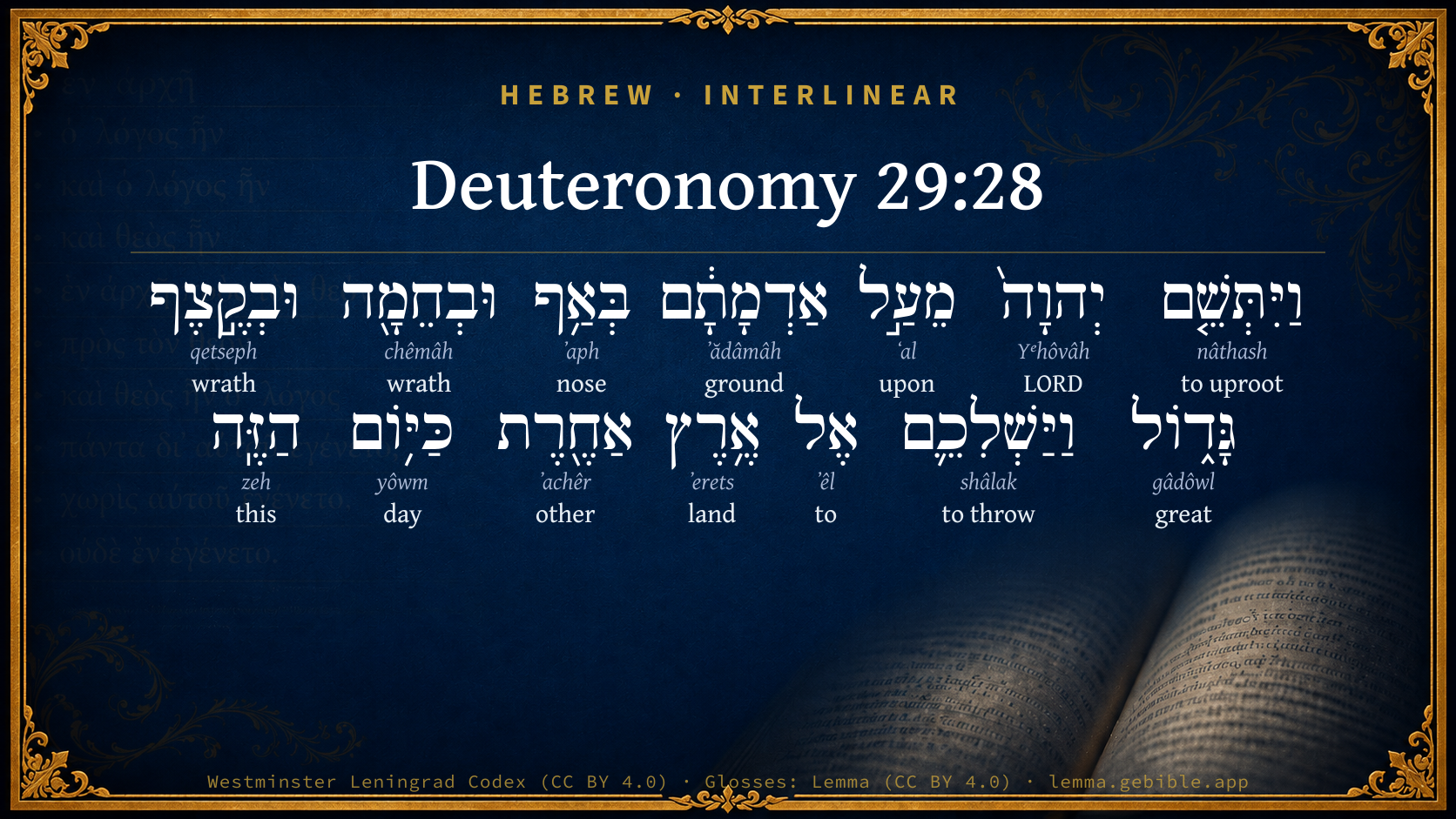
Deuteronomy 29:28

Hebrew (Westminster Leningrad Codex) Deuteronomy 29:28 appears in the Hebrew Old Testament. The text above is from the Westminster Leningrad Codex. Each word links to its Strong’s number, a concise gloss, and parsing drawn from the Open Scriptures Hebrew Bible morphology. Click any word for its full Brown-Driver-Briggs (BDB) entry.
Download image
Cite this verse

Deuteronomy 29:28 (World English Bible). Public Domain. Lemma interlinear Bible study tool, https://lemma.gebible.app/v/deuteronomy/29/28.

Show BibTeX & RIS
BibTeX
RIS
English Translation
and Yahweh rooted them out of their land in anger, and in wrath, and in great indignation, and cast them into another land, as at this day.
World English Bible · Public Domain
Highlights
  • 1 first appearance in the Hebrew Bible
Full analysis ↓
Download a study sheet

One document with this verse’s original text, its word-by-word gloss line, the meaning frame, cross-references with their text, attributed commentary, and full source and license credits — printable, and it pastes into notes with its structure intact.

This verse Autodidact and up

Study sheet (.html) Plain text (.txt)

A passage Seminary Student

Up to 50 verses in one chapter. A passage sheet keeps up to 6 commentary sources and 12 cross-references per verse, in the order this page ranks them, and says so on the sheet whenever that leaves anything out. Ask for a single verse and you get the Autodidact verse sheet above.

Everything on this page stays free to read, with no account — the sheet is a download of what is already on screen, not access to it.

Want to remove ads? Support Godless Engineer
Compare translations 3

The same verse in 3 English versions, stacked beneath the original-language interlinear above. Click any original word for its lexicon entry.

Each is an independent rendering of the whole verse — the interlinear is not word-aligned to these translations.

Highlighted words mark where these versions differ — a whole-verse word diff, not a word-by-word alignment.

  • World English Bible Public Domain
    and Yahweh rooted them out of their land in anger, and in wrath, and in great indignation, and cast them into another land, as at this day.
  • King James Version Public Domain
    And the LORD rooted them out of their land in anger, and in wrath, and in great indignation, and cast them into another land, as it is this day.
  • unfoldingWord Literal Text CC BY-SA 4.0
    and Yahweh has torn them away from their land in nose and in wrath and in great fury and has thrown them into another land, as this day.’

unfoldingWord Literal Text — © unfoldingWord, licensed CC BY-SA 4.0. Word-aligned USFM3 via Door43 (git.door43.org/unfoldingWord/en_ult).

Versions to compare (up to 4)

3 of 4 selected

Show all 18 translations

Every available English version of this verse, each an independent rendering of the whole verse.

  • World English Bible Public Domain
    and Yahweh rooted them out of their land in anger, and in wrath, and in great indignation, and cast them into another land, as at this day.
  • Berean Standard Bible Public Domain
    The LORD uprooted them from their land in His anger, rage, and great wrath, and He cast them into another land, where they are today.’
  • Majority Standard Bible Public Domain
    The LORD uprooted them from their land in His anger, rage, and great wrath, and He cast them into another land, where they are today.’
  • King James Version Public Domain
    And the LORD rooted them out of their land in anger, and in wrath, and in great indignation, and cast them into another land, as it is this day.
  • American Standard Version (1901) Public Domain
    and Jehovah rooted them out of their land in anger, and in wrath, and in great indignation, and cast them into another land, as at this day.
  • Revised Version (1885) Public Domain
    and the LORD rooted them out of their land in anger, and in wrath, and in great indignation, and cast them into another land, as at this day.
  • Geneva Bible (1599) Public Domain
    And ye Lord hath rooted them out of their land in anger, and in wrath, and in great indignation, and hath cast them into another land, as appeareth this day.
  • Douay-Rheims (1899) Public Domain
    And he hath cast them out of their land, in anger and in wrath, and in very great indignation, and hath thrown them into a strange land, as it is seen this day.
  • Young's Literal Translation Public Domain
    and Jehovah doth pluck them from off their ground in anger, and in fury, and in great wrath, and doth cast them unto another land, as `at' this day.
  • Literal Standard Version CC BY-SA 4.0
    and YHWH plucks them from off their ground in anger, and in fury, and in great wrath, and casts them into another land, as [at] this day.
  • Unlocked Literal Bible CC BY-SA 4.0
    Yahweh has uprooted them from their land in anger, in wrath, and in great fury, and has thrown them into another land, as today.'
  • unfoldingWord Literal Text CC BY-SA 4.0
    and Yahweh has torn them away from their land in nose and in wrath and in great fury and has thrown them into another land, as this day.’
  • Darby Bible Public Domain
    and Jehovah rooted them out of their land in anger, and in fury, and in great indignation, and cast them into another land, as [it appears] this day.
  • World Messianic Bible Public Domain
    The LORD rooted them out of their land in anger, in wrath, and in great indignation, and thrust them into another land, as it is today.”
  • Webster's Bible Public Domain
    And the LORD rooted them out of their land in anger and in wrath, and in great indignation, and cast them into another land, as it is this day.
  • Free Bible Version CC BY-SA 4.0
    The Lord uprooted them from their country in his anger, rage, and fury, and he threw them out, leaving them in another land, where they are to this day.”
  • Bible in Basic English Public Domain
    Rooting them out of their land, in the heat of his wrath and passion, and driving them out into another land, as at this day.
  • JPS Tanakh (1917) Public Domain
    (29-27) and the LORD rooted them out of their land in anger, and in wrath, and in great indignation, and cast them into another land, as it is this day'. —

Literal Standard Version (2020), Covenant Press — licensed CC BY-SA 4.0. Text via the HelloAO Bible API (eBible.org). Unlocked Literal Bible (unfoldingWord) — licensed CC BY-SA 4.0. Text via the HelloAO Bible API (eBible.org). unfoldingWord Literal Text — © unfoldingWord, licensed CC BY-SA 4.0. Word-aligned USFM3 via Door43 (git.door43.org/unfoldingWord/en_ult). Free Bible Version, Dr. Jonathan Gallagher — licensed CC BY-SA 4.0. Text via the HelloAO Bible API (eBible.org).

Word by word

More ways to search: Search by grammar → Find every occurrence → Compare this word →

Practice this passage: Drill this verse → Learn its vocabulary →

וַיִּתְּשֵׁ֤ם
nâthash
H5428
“and · to uproot · them”
Conjunction + Verb, Qal, Sequential Imperfect, 3rd Person, Masculine, Singular + Suffix, Personal, 3rd Person, Masculine, Plural
Part of Speech
Conjunction + Verb
Stem
Qal
Form
Sequential Imperfect
Person
3rd Person
Gender
Masculine
Number
Singular
Full BDB Definition

Origin: a primitive root

TWOT: 1451

to pull up, expel, root out, pluck up - (Qal) to pull or pluck up - (Niphal) to be plucked up - (Hophal) to be plucked up
  1. יְהוָה֙ Yᵉhôvâh H3068 “LORD” Noun, Proper
  2. מֵעַ֣ל ʻal H5921 “from · upon” Preposition + Preposition
  3. אַדְמָתָ֔ם ʼădâmâh H127 “ground · their” Noun, Common, Feminine, Singular, Construct + Suffix, Personal, 3rd Person, Masculine, Plural
  4. בְּאַ֥ף ʼaph H639 “in/at · nose” Preposition + Noun, Common, Masculine, Singular, Absolute
  5. וּבְחֵמָ֖ה chêmâh H2534 “and · in/at · wrath” Conjunction + Preposition + Noun, Common, Feminine, Singular, Absolute
  6. וּבְקֶ֣צֶף qetseph H7110 “and · in/at · wrath” Conjunction + Preposition + Noun, Common, Masculine, Singular, Absolute
  7. גָּד֑וֹל gâdôwl H1419 “great” Adjective, Adjective, Masculine, Singular, Absolute
  8. וַיַּשְׁלִכֵ֛ם shâlak H7993 “and · to throw · them” Conjunction + Verb, Hiphil, Sequential Imperfect, 3rd Person, Masculine, Singular + Suffix, Personal, 3rd Person, Masculine, Plural
  9. אֶל ʼêl H413 “to” Preposition
  10. אֶ֥רֶץ ʼerets H776 “land” Noun, Common, Both, Singular, Absolute
  11. אַחֶ֖רֶת ʼachêr H312 “other” Adjective, Adjective, Feminine, Singular, Absolute
  12. כַּיּ֥וֹם yôwm H3117 “like/as the · day” Preposition, Determined + Noun, Common, Masculine, Singular, Absolute
  13. הַזֶּֽה zeh H2088 “the · this” Particle, Definite Article + Pronoun, Demonstrative, Masculine, Singular

About this verse

These counts appear in no published source. They are computed here, from the morphology-tagged text and Lemma’s own curated glosses. What Lemma adds →

14
words
14
distinct lemmas
Pentateuch
section

Notable vocabulary

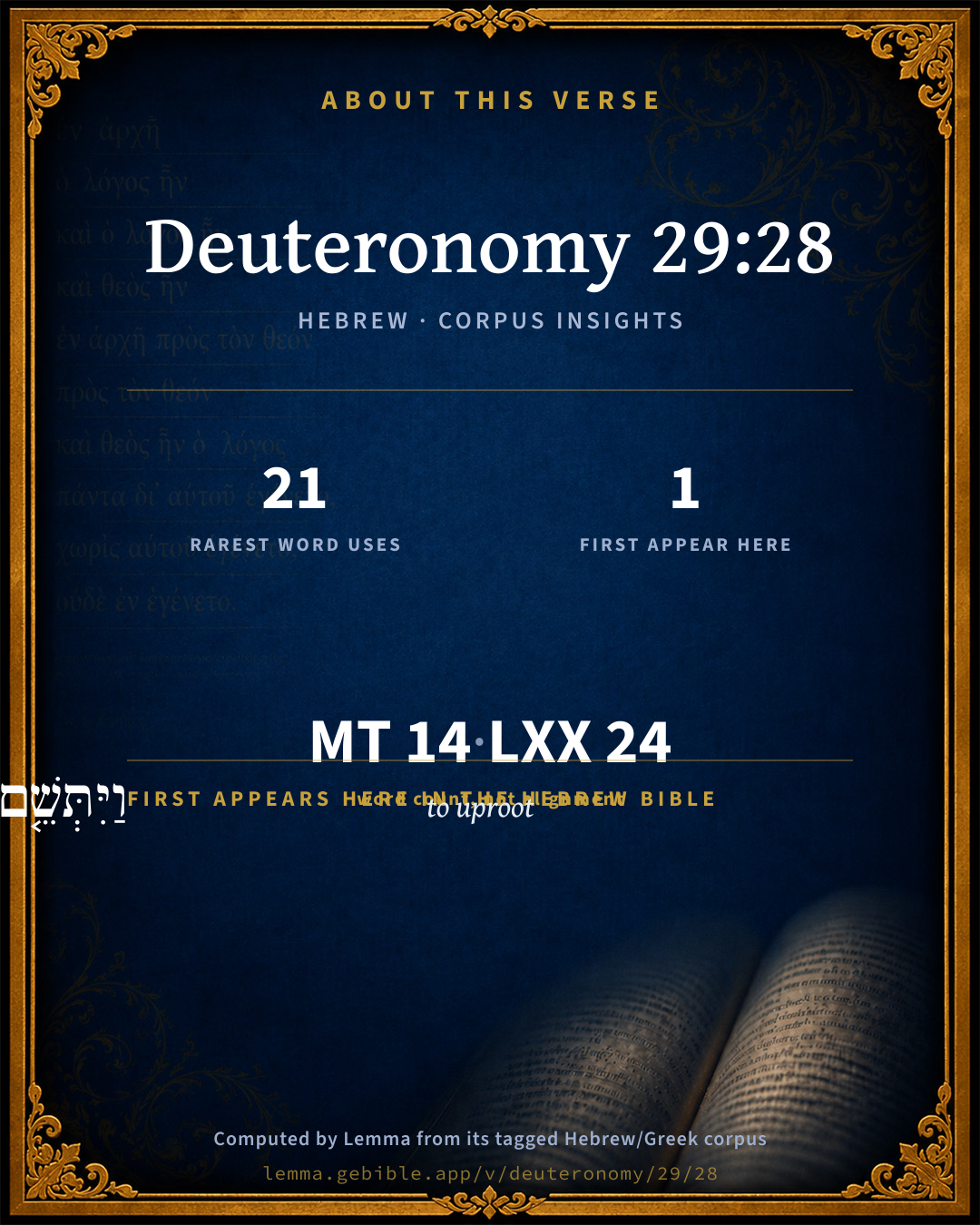
The rarest word here is וַיִּתְּשֵׁ֤ם to uproot H5428 — appearing just 21 times in the whole Hebrew Bible.

First appearance in Scripture

This word makes its first canonical appearance in the Hebrew Bible here:

  • וַיִּתְּשֵׁ֤ם to uproot H5428

Shared distinctive vocabulary

וַיִּתְּשֵׁ֤ם to uproot H5428 occurs in 19 verses of the Hebrew Bible. Also found in:

Grammatical profile

  • 2 verbs
  • 7 nouns
  • 2 adjectives
  • 1 pronoun
  • 2 prepositions

Verb forms

  • וַיִּתְּשֵׁ֤ם Qal · Sequential Imperfect
  • וַיַּשְׁלִכֵ֛ם Hiphil · Sequential Imperfect

Hebrew & Septuagint length

In English translation the verse runs 27 words from the Hebrew and 26 from the Septuagint (LXX English) — closely comparable.

A rough comparison of the two English renderings, which tokenize alike — not a word-level alignment.

Word counts can differ between the Hebrew and the Greek without any difference in meaning — e.g. the Hebrew direct-object marker אֵת has no separate Greek word, and Greek often adds the article ὁ.

In the original languages it is 14 Hebrew tokens and 24 Greek tokens — but the two are counted differently (Hebrew bundles its prefixes and suffixes into one token; the Greek is in lemma form), so that isn’t a like-for-like length.

Cross-references

15

Topical passages linked to Deuteronomy 29:28 in the Treasury of Scripture Knowledge — connected by theme and wording, ordered by reader-vote popularity; previews shown in the World English Bible.

  • 2 Chronicles 7:20 then will I pluck them up by the roots out of my land which I have given them; and this house, which I have made holy for my name, will I cast out of my sight, and I will make it a proverb and a byword among all peoples.
  • 1 Kings 14:15 For Yahweh will strike Israel, as a reed is shaken in the water; and he will root up Israel out of this good land which he gave to their fathers, and will scatter them beyond the River, because they have made their Asherim, provoking Yahweh to anger.
  • Psalms 52:5 God will likewise destroy you forever. He will take you up, and pluck you out of your tent, And root you out of the land of the living. Selah.
  • Proverbs 2:22 But the wicked will be cut off from the land. The treacherous will be rooted out of it.
  • Jeremiah 42:10 If you will still abide in this land, then will I build you, and not pull you down, and I will plant you, and not pluck you up; for I repent me of the evil that I have done to you.
  • Deuteronomy 6:24 Yahweh commanded us to do all these statutes, to fear Yahweh our God, for our good always, that he might preserve us alive, as at this day.
  • Deuteronomy 8:18 But you shall remember Yahweh your God, for it is he who gives you power to get wealth; that he may establish his covenant which he swore to your fathers, as at this day.
  • Deuteronomy 28:25 Yahweh will cause you to be struck before your enemies; you shall go out one way against them, and shall flee seven ways before them: and you shall be tossed back and forth among all the kingdoms of the earth.
  • Deuteronomy 28:36 Yahweh will bring you, and your king whom you shall set over you, to a nation that you have not known, you nor your fathers; and there shall you serve other gods, wood and stone.
  • Deuteronomy 28:64 Yahweh will scatter you among all peoples, from the one end of the earth even to the other end of the earth; and there you shall serve other gods, which you have not known, you nor your fathers, even wood and stone.
  • 2 Kings 17:18 Therefore Yahweh was very angry with Israel, and removed them out of his sight: there was none left but the tribe of Judah only.
  • 2 Kings 17:23 until Yahweh removed Israel out of his sight, as he spoke by all his servants the prophets. So Israel was carried away out of their own land to Assyria to this day.
  • Ezra 9:7 Since the days of our fathers we have been exceeding guilty to this day; and for our iniquities have we, our kings, and our priests, been delivered into the hand of the kings of the lands, to the sword, to captivity, and to plunder, and to confusion of face, as it is this day.
  • Daniel 9:7 Lord, righteousness belongs to you, but to us confusion of face, as at this day; to the men of Judah, and to the inhabitants of Jerusalem, and to all Israel, who are near, and who are far off, through all the countries where you have driven them, because of their trespass that they have trespassed against you.
  • Luke 21:23–24 Woe to those who are pregnant and to those who nurse infants in those days! For there will be great distress in the land, and wrath to this people.

Cross-references courtesy of OpenBible.info (CC BY 4.0).

Hebrew and Greek witnesses Masoretic Hebrew ↔ Greek Septuagint

The same verse in the two great witnesses to the Old Testament, shown verse-for-verse.

These are two independent witnesses, not word-aligned to each other, and the Septuagint is shown in lemma (dictionary) form.

Hebrew Deuteronomy 29:28 Masoretic · Westminster Leningrad Codex

וַיִּתְּשֵׁ֤ם יְהוָה֙ מֵעַ֣ל אַדְמָתָ֔ם בְּאַ֥ף וּבְחֵמָ֖ה וּבְקֶ֣צֶף גָּד֑וֹל וַיַּשְׁלִכֵ֛ם אֶל אֶ֥רֶץ אַחֶ֖רֶת כַּיּ֥וֹם הַזֶּֽה

and Yahweh rooted them out of their land in anger, and in wrath, and in great indignation, and cast them into another land, as at this day.

World English Bible · Public Domain

Greek LXX Deuteronomy 29:28 Septuagint · lemma form

ὁ κρυπτός κύριος ὁ θεός ἐγώ ὁ δέ φανερός ἐγώ καί ὁ τέκνον ἐγώ εἰς ὁ αἰών ποιέω πᾶς ὁ ῥῆμα ὁ νόμος οὗτος

And the Lord removed them from their land in anger, and wrath, and very great indignation, and cast them out into another land as at present.

LXX2012 (modern English Septuagint) · Public Domain

Hebrew: Westminster Leningrad Codex (CC BY 4.0). Greek: Septuagint (public domain); English from LXX2012 (modern English Septuagint) (Public Domain). How the Septuagint differs from the Hebrew →

Targum (Aramaic paraphrase)

2

The Targum is the ancient Jewish Aramaic paraphrase of the Hebrew Scriptures — an interpretive translation, not the Hebrew text itself. Onkelos (literal) and Pseudo-Jonathan (expansive) render the Torah, and Jonathan the Prophets. Coverage is partial: where no permissively-licensed English translation exists for a verse, only the Aramaic is shown. This is verse-level text, not a word-by-word alignment to the Hebrew.

  1. Targum Onkelos Torah (Genesis–Deuteronomy)
    דְמִטַמְרָן קֳדָם יְיָ אֱלָהָנָא וּדְמִגַלְיָן לָנָא וְלִבְנָנָא עַד עֳלָם לְמֶעְבַּד יָת כָּל פִּתְגָמֵי אוֹרַיְתָא הָדָא

    (no public-domain English translation for this verse)

    Targum Onkelos — Aramaic: “Onkelos Genesis” (public domain); “Onkelos Exodus” (public domain); “Onkelos Leviticus” (public domain); “Onkelos Numbers” (public domain); “Onkelos Deuteronomy” (public domain). English: “Sefaria Community Translation” (CC0 1.0 (public-domain dedication)); “J.W. Etheridge. The Targums of Onkelos and Jonathan Ben Uzziel on the Pentateuch. London: Longmans, Green, 1862” (public domain). Text via Sefaria.

  2. Targum Pseudo-Jonathan Torah (Genesis–Deuteronomy)
    טְמִירְתָּא גַלְיַין קֳדָם יְיָ אֱלָהָנָא וְהוּא יִפְרַע מִנְהוֹן וְגַלְיָיתָא יִתְמַסְרָן לָנָא וְלִבְנָנָא עַד עַלְמָא לְמֶעֱבַד לְהוֹן דִינָא מְטוּל לְקַיָימָא יַת כָּל פִּתְגָמֵי אוֹרַיְיתָא הָדָא

    The secret things are manifest before the Lord our God, and He will take vengeance for them; but the things that are revealed are delivered unto us and to our children for ever, to perform by them the thing that is right, for the confirmation of all the words of this law.

    Targum Pseudo-Jonathan — Aramaic: “Targum Jonathan on Genesis” (public domain); “Targum Jonathan on Exodus” (public domain); “Targum Jonathan on Leviticus” (public domain); “Targum Jonathan on Numbers” (public domain); “Targum Jonathan on Deuteronomy” (public domain). English: “The Targum of Jonathan ben Uzziel, trans. J. W. Etheridge, London, 1862” (public domain). Text via Sefaria.

Commentary

Notes on Deuteronomy 29:28 from classic Christian and Jewish commentators (each source and its license shown beneath its notes). The classic Christian expositions comment on the surrounding passage and are grouped to its opening verse, so a note may address several verses; the Jewish commentaries on the Tanakh (Rashi and others) are per-verse, so they appear only where the commentator wrote on this verse.

Lemma curates 59 commentaries, every one of them public domain or Creative Commons licensed, each selected and text-cleaned for this edition rather than reprinted as found. About our sources →

Trapp's Complete Commentary

John Trapp

Deu 29:28 And the LORD rooted them out of their land in anger, and in wrath, and in great indignation, and cast them into another land, as [it is] this day.

Ver. 28. And cast them into another land.] Cast them with a violence, with a vengeance; - in the Hebrew the word cast hath an extraordinary large letter ì; - "sling them out as out of a sling." {1Sa 25:29} {Hebrew Text Note}

John Trapp, A Commentary or Exposition upon All the Books of the Old and New Testament (1647–1656) — public domain. Text from a community e-Sword module.

Ellicott's Commentary for English Readers

(28) And the Lord rooted them out.—Comp. 1Ki_14:15, “He shall root up Israel out of this good land.” The word is not uncommon in Jeremiah.

A Bible Commentary for English Readers, edited by Charles John Ellicott (1878–1897) — public domain. Text from a community e-Sword module.

The Cambridge Bible for Schools and Colleges

gen. ed. J. J. S. Perowne

28. rooted them out] Heb. natash, not elsewhere in the Hex. but common in Jer. e.g. Deu_1:10, Deu_12:15.

in anger, and in fury, and in great wrath] (Driver). So Jer_21:5; Jer_32:37.

cast them into another land] Jer_22:26 : ‘I will cast thee out (another vb.) … into another land.’

as at this day] This can hardly belong to the predicted statement of the contemporaries of the Exile; it must either be the writer’s own and if so betrays his date at that time, or it is an editorial addition. In view of the language of the whole chapter, the former alternative is the more probable.

The Cambridge Bible for Schools and Colleges (gen. ed. J. J. S. Perowne; Cambridge University Press, 1878–1918) — public domain. Text from a community e-Sword module.

John Gill's Exposition

The secret things belong unto the Lord our God,.... Respecting the people of Israel, and the providential dealings of God with them, and especially the final rejection of them; with respect to which, the apostle's exclamation agrees with this, Rom 11:33; and though the Lord had revealed many things which should befall them, there were others still secret with him, and the reasons of others; and particularly the times and seasons of their accomplishment, which he retains in his own power, Act 1:6. There are many secret things in nature, which cannot be found out and accounted for by men, which the Lord only knows; and there are many things in Providence, which are unsearchable, and past finding out by finite minds, especially the true causes and reasons of them; and there are many things relating to God himself, which remain secret with him; notwithstanding the revelation he has made of himself; for not only some of his perfections, as eternity, immensity, &c. are beyond our comprehension; but the mode of subsistence of the three divine Persons in the Godhead, the paternity of the one, the generation of the other, and the procession of the Spirit from them both; the union of the two natures, divine and human, in the person of Christ; the thoughts, purposes, and decrees of God within himself, until brought into execution; and so there are many things relating to his creatures, as the particular persons predestinated unto eternal life, what becomes of such who die in infancy, what will befall us in life, when we shall die, where and in what manner, and also the day and hour of the last judgment. The Jews generally interpret this and what follows of the sins of men, and punishment for them, and, particularly, idolatry; take Aben Ezra's sense instead of many,"he that commits idolatry secretly, his punishment is by the hand of heaven (from God immediately); he that commits it openly, it lies upon us and upon our children to do as is written in the law:"

but those things which are revealed belong to us and to our children for ever; the things of nature and Providence, which are plain and manifest, are for our use and instruction; and especially the word and ordinances of God, which are the revelation of his will, the doctrines and promises contained in the Scriptures, each of the duties of religion, and the commandments of God, such as are of eternal obligation, which may be chiefly designed, because it follows:

that we may do all the words of this law: for the end of this revelation is practice; hearing and reading the word will be of no avail, unless what is heard and read is practised. Some render the words (i),"the secret things of the Lord our God are revealed to us and to our children;''but neither the construction of the words in the original, nor the Hebrew accents, will admit of such a version; otherwise it would furnish out a very great truth: for the secrets of God's love, of his council and covenant, are revealed unto his people, as well as many of his providences, and the mysteries of his grace; see Psa 25:14. There are some extraordinary pricks in the Hebrew text on the words "to us and to our children": which are designed to point out the remarkable and wonderful condescension and goodness of God, in making a revelation of his mind and will, both with respect to doctrine and duty, to the sons of men.

(i) So some in Fagius and Vatablus.

Next: Deuteronomy Chapter 30

John Gill's Exposition of the Whole Bible (1746–1763) — public domain (CC PDM 1.0). Text via the HelloAO Bible API.

Whedon's Commentary on the Bible

Daniel D. Whedon

28. And cast them into another land — “The Hebrew word yashlichem is written with a great lamed and with yod defective. The former letter is the first in the word l’olam, forever; the latter used as a numeral signifies ten. In this mode of writing is supposed to be mystically signified the perpetual rejection of the ten tribes. BUXTORF, Mas. Com., 14.” — Speaker’s Com.

Daniel D. Whedon (gen. ed.), Commentary on the Old and New Testaments (1874–1909) — public domain. Text from a community e-Sword module.

The Pulpit Commentary

And cast them. In the Hebrew the word east them ( has one of its letters, the l, larger than the rest, and another letter, y which should be after the l, is omitted; on which Baal Hatturim noteth, There is a great lamed and a want of yod, to teach that there is no casting away like that of the ten tribes" (Ainsworth). According to Baxtorf, the large lamed represents the first letter of lolam, forever, and the yod, the numeral 10, represents the ten tribes, whose perpetual omission from the nation of Israel is thus indicated ("Tiberias," 1. c. 14, p. 157).

The Pulpit Commentary (1880–1919), ed. H.D.M. Spence-Jones & Joseph S. Exell — public domain. Text from a community e-Sword module.

Rashi

Rabbi Shlomo Yitzchaki (Rashi)

הנסתרת לה' אלהינו THE SECRET THINGS BELONG UNTO THE LORD OUR GOD — And if you say, “But what can we do? Thou threatenest the many (the whole community) with punishment because of the sinful thoughts of one individual, as it is said, (v. 17): “Lest there should be among you a man, [or a woman or a family … whose heart turneth away this day from the Lord …]”, and afterwards it states, (v. 21) “And they will see the plagues of that land”. But surely no man can know the secret thoughts of his fellow! Now, I reply: I do not threaten to punish you because of secret thoughts for these belong to the Lord our God and He will exact punishment from that individual; but those things which are revealed belong to us and to our children that we may put away the evil from our midst; and if we do not execute judgment upon them, the whole community will be punished. — There are dots on the words לנו ולבננו to suggest that even for the revealed sins (those committed openly), He did not punish the community until they had crossed the Jordan — from the moment when they took upon themselves the oath on Mount Gerizim and Mount Ebal and had thus become responsible for one another (Sanhedrin 43b; cf. Sotah 37b).

Rashi on the Tanakh — English translations: “The Judaica Press complete Tanach with Rashi, translated by A. J. Rosenberg” (CC BY 4.0); “Pentateuch with Rashi's commentary by M. Rosenbaum and A.M. Silbermann, 1929-1934” (public domain); “The Metsudah Tanach series, Lakewood, N.J” (CC BY 4.0); and “The Book of Joshua, Metsudah Publications, 1997” (CC BY 4.0). Text via Sefaria.

Ramban (Nachmanides)

Rabbi Moshe ben Nachman (Ramban / Nachmanides)

THE SECRET THINGS BELONG UNTO THE ETERNAL OUR G-D. In the opinion of the commentators the verse states: “It is for the Eternal our G-d to execute judgment upon those who worship idols secretly, for all hidden matters are revealed before Him, but the things that are revealed are upon us and our children that we may do to them all the words of this Law — to smite the idol-worshippers in accordance with the law of the Torah. According to the interpretation of the Rabbis, too, it is so. By way of the simple meaning of Scripture it is my opinion that the secret things are the sins that are hidden from those who commit them, as it is stated, Who can discern errors? Cleanse Thou me from hidden faults. The verse states: “[Our] hidden sins belong to G-d alone; for them we bear no guilt for having transgressed [unknowingly]. But the things that are revealed, namely our conscious sins, belong unto us and to our children forever, that we may do all the words of this Law as an eternal statute. As such we accepted it, obligating the one who was present [when the covenant was made] and the one who was not present. And because he included in the imprecation [the obligation] to perform all the commandments, he excluded from the ban whoever commits a sin unintentionally, so that he should not be afflicted by this curse. The words of Onkelos indicate this, for he rendered it, “The secret things are before the Eternal our G-d,” [thus implying that we will not be punished for sins we have committed unknowingly], but if he agreed with the [aforementioned] interpretation of the commentators [that it is for G-d to punish conscious sins committed secretly] then Onkelos should have said, “The secret things are ‘to’ the Eternal our G-d” [to punish].

Ramban (Nachmanides) on the Tanakh — English translation: “Commentary on the Torah by Ramban (Nachmanides). Translated and annotated by Charles B. Chavel. New York, Shilo Pub. House, 1971-1976” (CC BY 4.0). Text via Sefaria.

Sforno

Rabbi Ovadia Sforno

The hidden matters. Even though I told you that you are all standing before Hashem, and nobody can misunderstand, and that Hashem will punish those who rebel, all of this only applies to the hidden matters.

Sforno on the Tanakh — English translation: “Yalkut, Sifsei Chachomim Chumash, Metsudah Publications, 2009” (CC BY 4.0). Text via Sefaria.

Lesson kit

Teaching starters — assembled from the data on this page, not authored interpretation. Every prompt links to the verse data it draws on. Edit before teaching.

Deuteronomy, in the Pentateuch, opens this verse with 14 words (14 distinct Hebrew lemmas). Its most distinctive word is nâthash (“to uproot”). A historical commentator’s framing appears above. Read the whole chapter for the surrounding context.

Discussion questions

  1. The word nâthash carries the sense “to uproot.” How does it shape the verse?
  2. The word “to uproot” first appears here in Scripture. What is being introduced at this debut?
  3. 1 Kings 14:15 shares the word «to uproot» with this verse. How do the two illuminate each other?
  4. These translations render this verse differently; the difference is in the English rendering, not the original. What questions does that raise?
  5. The verb «וַיִּתְּשֵׁ֤ם» is Qal Sequential Imperfect. How does its form color the action?
  6. Reading how Trapp's Complete Commentary and Ellicott's Commentary for English Readers read this verse, where do the two commentators agree and where do they part?

Things to notice

Reading settings

Reading text

Shown beneath each verse's original-language words.

Old Testament
Old Testament edition

Read the OT as the Masoretic Hebrew (MT) or the Greek Septuagint (LXX).

English shown for the Greek Septuagint (in the Hebrew ↔ Greek comparison).

Comparing translations? Open the Compare panel on any verse page to stack up to four side by side.