
Deuteronomy 28:11

Hebrew (Westminster Leningrad Codex) Deuteronomy 28:11 appears in the Hebrew Old Testament. The text above is from the Westminster Leningrad Codex. Each word links to its Strong’s number, a concise gloss, and parsing drawn from the Open Scriptures Hebrew Bible morphology. Click any word for its full Brown-Driver-Briggs (BDB) entry.
Download image
Cite this verse

Deuteronomy 28:11 (World English Bible). Public Domain. Lemma interlinear Bible study tool, https://lemma.gebible.app/v/deuteronomy/28/11.

Show BibTeX & RIS
BibTeX
RIS
English Translation
Yahweh will make you plenteous for good, in the fruit of your body, and in the fruit of your cattle, and in the fruit of your ground, in the land which Yahweh swore to your fathers to give you.
World English Bible · Public Domain
Download a study sheet

One document with this verse’s original text, its word-by-word gloss line, the meaning frame, cross-references with their text, attributed commentary, and full source and license credits — printable, and it pastes into notes with its structure intact.

This verse Autodidact and up

Study sheet (.html) Plain text (.txt)

A passage Seminary Student

Up to 50 verses in one chapter. A passage sheet keeps up to 6 commentary sources and 12 cross-references per verse, in the order this page ranks them, and says so on the sheet whenever that leaves anything out. Ask for a single verse and you get the Autodidact verse sheet above.

Everything on this page stays free to read, with no account — the sheet is a download of what is already on screen, not access to it.

Want to remove ads? Support Godless Engineer
Compare translations 3

The same verse in 3 English versions, stacked beneath the original-language interlinear above. Click any original word for its lexicon entry.

Each is an independent rendering of the whole verse — the interlinear is not word-aligned to these translations.

Highlighted words mark where these versions differ — a whole-verse word diff, not a word-by-word alignment.

  • World English Bible Public Domain
    Yahweh will make you plenteous for good, in the fruit of your body, and in the fruit of your cattle, and in the fruit of your ground, in the land which Yahweh swore to your fathers to give you.
  • King James Version Public Domain
    And the LORD shall make thee plenteous in goods, in the fruit of thy body, and in the fruit of thy cattle, and in the fruit of thy ground, in the land which the LORD sware unto thy fathers to give thee.
  • unfoldingWord Literal Text CC BY-SA 4.0
    And Yahweh will make you abound in prosperity in the fruit of your womb and in the fruit of your cattle and in the fruit of your ground, in the land that Yahweh swore to your fathers to give to you.

unfoldingWord Literal Text — © unfoldingWord, licensed CC BY-SA 4.0. Word-aligned USFM3 via Door43 (git.door43.org/unfoldingWord/en_ult).

Versions to compare (up to 4)

3 of 4 selected

Show all 18 translations

Every available English version of this verse, each an independent rendering of the whole verse.

  • World English Bible Public Domain
    Yahweh will make you plenteous for good, in the fruit of your body, and in the fruit of your cattle, and in the fruit of your ground, in the land which Yahweh swore to your fathers to give you.
  • Berean Standard Bible Public Domain
    The LORD will make you prosper abundantly—in the fruit of your womb, the offspring of your livestock, and the produce of your land—in the land that the LORD swore to your fathers to give you.
  • Majority Standard Bible Public Domain
    The LORD will make you prosper abundantly—in the fruit of your womb, the offspring of your livestock, and the produce of your land—in the land that the LORD swore to your fathers to give you.
  • King James Version Public Domain
    And the LORD shall make thee plenteous in goods, in the fruit of thy body, and in the fruit of thy cattle, and in the fruit of thy ground, in the land which the LORD sware unto thy fathers to give thee.
  • American Standard Version (1901) Public Domain
    And Jehovah will make thee plenteous for good, in the fruit of thy body, and in the fruit of thy cattle, and in the fruit of thy ground, in the land which Jehovah sware unto thy fathers to give thee.
  • Revised Version (1885) Public Domain
    And the LORD shall make thee plenteous for good, in the fruit of thy body, and in the fruit of thy cattle, and in the fruit of thy ground, in the land which the LORD sware unto thy fathers to give thee.
  • Geneva Bible (1599) Public Domain
    And the Lord shall make thee plenteous in goods, in the fruite of thy body, and in the fruite of thy cattell, and in the fruite of thy grounde, in the land which the Lord sware vnto thy fathers, to giue thee.
  • Douay-Rheims (1899) Public Domain
    The Lord will make thee abound with all goods, with the fruit of thy womb, and the fruit of thy cattle, with the fruit of thy land, which the Lord swore to thy fathers that he would give thee.
  • Young's Literal Translation Public Domain
    `And Jehovah hath made thee abundant in good, in the fruit of the womb, and in the fruit of thy cattle, and in the fruit of thy ground, on the ground which Jehovah hath sworn to thy fathers to give to thee.
  • Literal Standard Version CC BY-SA 4.0
    And YHWH has made you abundant in good, in the fruit of the womb, and in the fruit of your livestock, and in the fruit of your ground, on the ground which YHWH has sworn to your fathers to give to you.
  • Unlocked Literal Bible CC BY-SA 4.0
    Yahweh will make you very prosperous in the fruit of your body, in the fruit of your cattle, in the fruit of your ground, in the land that he swore to your fathers to give you.
  • unfoldingWord Literal Text CC BY-SA 4.0
    And Yahweh will make you abound in prosperity in the fruit of your womb and in the fruit of your cattle and in the fruit of your ground, in the land that Yahweh swore to your fathers to give to you.
  • Darby Bible Public Domain
    And Jehovah will give thee abundance of good, in the fruit of thy body, and in the fruit of thy cattle, and in the fruit of thy ground, in the land that Jehovah swore unto thy fathers to give thee.
  • World Messianic Bible Public Domain
    The LORD will grant you abundant prosperity in the fruit of your body, in the fruit of your livestock, and in the fruit of your ground, in the land which the LORD swore to your fathers to give you.
  • Webster's Bible Public Domain
    And the LORD shall make thee to abound in goods, in the fruit of thy body, and in the fruit of thy cattle, and in the fruit of thy ground, in the land which the LORD swore to thy fathers to give thee.
  • Free Bible Version CC BY-SA 4.0
    The Lord will make you very prosperous. You will have many children, your livestock will produce plenty of young, and your land will grow good harvests—all this in the country the Lord promised your forefathers he would give you.
  • Bible in Basic English Public Domain
    And the Lord will make you fertile in every good thing, in the fruit of your body, and the fruit of your cattle, and the fruit of your fields, in the land which the Lord, by his oath to your fathers, said he would give you.
  • JPS Tanakh (1917) Public Domain
    And the LORD will make thee over-abundant for good, in the fruit of thy body, and in the fruit of thy cattle, and in the fruit of thy land, in the land which the LORD swore unto thy fathers to give thee.

Literal Standard Version (2020), Covenant Press — licensed CC BY-SA 4.0. Text via the HelloAO Bible API (eBible.org). Unlocked Literal Bible (unfoldingWord) — licensed CC BY-SA 4.0. Text via the HelloAO Bible API (eBible.org). unfoldingWord Literal Text — © unfoldingWord, licensed CC BY-SA 4.0. Word-aligned USFM3 via Door43 (git.door43.org/unfoldingWord/en_ult). Free Bible Version, Dr. Jonathan Gallagher — licensed CC BY-SA 4.0. Text via the HelloAO Bible API (eBible.org).

Word by word

More ways to search: Search by grammar → Find every occurrence → Compare this word →

Practice this passage: Drill this verse → Learn its vocabulary →

בִטְנְךָ֛
beṭen
H990
“belly · your”
Noun, Common, Feminine, Singular, Construct + Suffix, Personal, 2nd Person, Masculine, Singular
Part of Speech
Noun
Type
Common
Gender
Feminine
Number
Singular
State
Construct
Full BDB Definition

Origin: from an unused root probably meaning to be hollow

TWOT: 236a

belly, womb, body - belly, abdomen - as seat of hunger - as seat of mental faculties - of depth of Sheol (figuratively) - womb
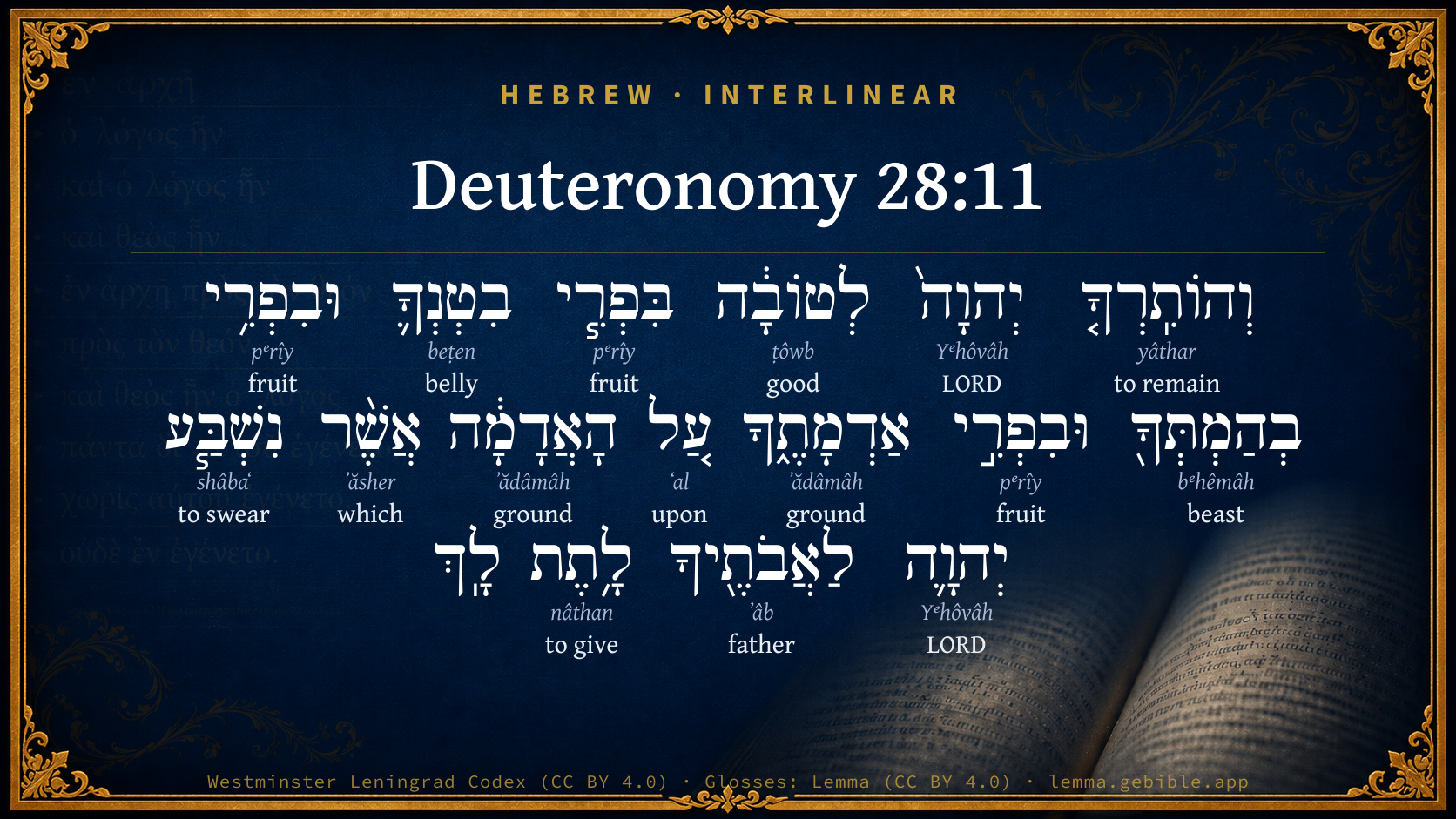
  1. וְהוֹתִֽרְךָ֤ yâthar H3498 “and · to remain · you” Conjunction + Verb, Hiphil, Sequential Perfect, 3rd Person, Masculine, Singular + Suffix, Personal, 2nd Person, Masculine, Singular
  2. יְהוָה֙ Yᵉhôvâh H3068 “LORD” Noun, Proper
  3. לְטוֹבָ֔ה ṭôwb H2896 “to/for · good” Preposition + Adjective, Adjective, Feminine, Singular, Absolute
  4. בִּפְרִ֧י pᵉrîy H6529 “in/at · fruit of” Preposition + Noun, Common, Masculine, Singular, Construct
  5. וּבִפְרִ֥י pᵉrîy H6529 “and · in/at · fruit of” Conjunction + Preposition + Noun, Common, Masculine, Singular, Construct
  6. בְהַמְתְּךָ֖ bᵉhêmâh H929 “beast · your” Noun, Common, Feminine, Singular, Construct + Suffix, Personal, 2nd Person, Masculine, Singular
  7. וּבִפְרִ֣י pᵉrîy H6529 “and · in/at · fruit of” Conjunction + Preposition + Noun, Common, Masculine, Singular, Construct
  8. אַדְמָתֶ֑ךָ ʼădâmâh H127 “ground · your” Noun, Common, Feminine, Singular, Construct + Suffix, Personal, 2nd Person, Masculine, Singular
  9. עַ֚ל ʻal H5921 “upon” Preposition
  10. הָאֲדָמָ֔ה ʼădâmâh H127 “the · ground” Particle, Definite Article + Noun, Common, Feminine, Singular, Absolute
  11. אֲשֶׁ֨ר ʼăsher H834 “which” Particle, Relative
  12. נִשְׁבַּ֧ע shâbaʻ H7650 “to swear” Verb, Niphal, Perfect, 3rd Person, Masculine, Singular
  13. יְהוָ֛ה Yᵉhôvâh H3068 “LORD” Noun, Proper
  14. לַאֲבֹתֶ֖יךָ ʼâb H1 “to/for · fathers · your” Preposition + Noun, Common, Masculine, Plural, Construct + Suffix, Personal, 2nd Person, Masculine, Singular
  15. לָ֥תֶת nâthan H5414 “to give” Preposition + Verb, Qal, Infinitive Construct

About this verse

These counts appear in no published source. They are computed here, from the morphology-tagged text and Lemma’s own curated glosses. What Lemma adds →

17
words
12
distinct lemmas
Pentateuch
section

Grammatical profile

  • 3 verbs
  • 10 nouns
  • 1 adjective
  • 2 prepositions
  • 1 particle

Verb forms

  • וְהוֹתִֽרְךָ֤ Hiphil · Sequential Perfect
  • נִשְׁבַּ֧ע Niphal · Perfect
  • לָ֥תֶת Qal · Infinitive Construct

Repetition

Words recur within this verse — often emphatic in Hebrew:

  • בִּפְרִ֧י fruit H6529 ×3
  • יְהוָה֙ LORD H3068 ×2
  • אַדְמָתֶ֑ךָ ground H127 ×2

Hebrew & Septuagint length

In English translation the verse runs 39 words from the Hebrew and 44 from the Septuagint (LXX English) — closely comparable.

A rough comparison of the two English renderings, which tokenize alike — not a word-level alignment.

Word counts can differ between the Hebrew and the Greek without any difference in meaning — e.g. the Hebrew direct-object marker אֵת has no separate Greek word, and Greek often adds the article ὁ.

Cross-references

6

Topical passages linked to Deuteronomy 28:11 in the Treasury of Scripture Knowledge — connected by theme and wording, ordered by reader-vote popularity; previews shown in the World English Bible.

  • Deuteronomy 30:9 Yahweh your God will make you plenteous in all the work of your hand, in the fruit of your body, and in the fruit of your cattle, and in the fruit of your ground, for good: for Yahweh will again rejoice over you for good, as he rejoiced over your fathers;
  • Proverbs 10:22 Yahweh's blessing brings wealth, And he adds no trouble to it.
  • Leviticus 26:9 "'I will have respect for you, and make you fruitful, and multiply you, and will establish my covenant with you.
  • Deuteronomy 28:4 Blessed shall be the fruit of your body, and the fruit of your ground, and the fruit of your animals, the increase of your cattle, and the young of your flock.
  • Psalms 132:11 Yahweh has sworn to David in truth. He will not turn from it: "I will set the fruit of your body on your throne.
  • Job 19:17 My breath is offensive to my wife. I am loathsome to the children of my own mother.

Cross-references courtesy of OpenBible.info (CC BY 4.0).

Hebrew and Greek witnesses Masoretic Hebrew ↔ Greek Septuagint

The same verse in the two great witnesses to the Old Testament, shown verse-for-verse.

These are two independent witnesses, not word-aligned to each other, and the Septuagint is shown in lemma (dictionary) form.

Hebrew Deuteronomy 28:11 Masoretic · Westminster Leningrad Codex

וְהוֹתִֽרְךָ֤ יְהוָה֙ לְטוֹבָ֔ה בִּפְרִ֧י בִטְנְךָ֛ וּבִפְרִ֥י בְהַמְתְּךָ֖ וּבִפְרִ֣י אַדְמָתֶ֑ךָ עַ֚ל הָאֲדָמָ֔ה אֲשֶׁ֨ר נִשְׁבַּ֧ע יְהוָ֛ה לַאֲבֹתֶ֖יךָ לָ֥תֶת לָֽךְ

Yahweh will make you plenteous for good, in the fruit of your body, and in the fruit of your cattle, and in the fruit of your ground, in the land which Yahweh swore to your fathers to give you.

World English Bible · Public Domain

Greek LXX Deuteronomy 28:11 Septuagint · lemma form

καί πληθύνω σύ κύριος ὁ θεός σύ εἰς ἀγαθός ἐπί ὁ ἔκγονος ὁ κοιλία σύ καί ἐπί ὁ γένημα ὁ γῆ σύ καί ἐπί ὁ ἔκγονος ὁ κτῆνος σύ ἐπί ὁ γῆ ὅς ὄμνυμι κύριος ὁ πατήρ σύ δίδωμι σύ

And the Lord your God shall multiply you for good in the offspring of your body, and in the offspring of your cattle, and in the fruits of your land, on your land which the Lord swore to your fathers to give to you.

LXX2012 (modern English Septuagint) · Public Domain

Hebrew: Westminster Leningrad Codex (CC BY 4.0). Greek: Septuagint (public domain); English from LXX2012 (modern English Septuagint) (Public Domain). How the Septuagint differs from the Hebrew →

Targum (Aramaic paraphrase)

2

The Targum is the ancient Jewish Aramaic paraphrase of the Hebrew Scriptures — an interpretive translation, not the Hebrew text itself. Onkelos (literal) and Pseudo-Jonathan (expansive) render the Torah, and Jonathan the Prophets. Coverage is partial: where no permissively-licensed English translation exists for a verse, only the Aramaic is shown. This is verse-level text, not a word-by-word alignment to the Hebrew.

  1. Targum Onkelos Torah (Genesis–Deuteronomy)
    וְיוֹתְרִנָךְ יְיָ לְטָבָא בְּוַלְדָא דִמְעָךְ וּבְוַלְדָא דִבְעִירָךְ וּבְאִבָּא דְאַרְעָךְ עַל אַרְעָא דִי קַיִים יְיָ לַאֲבָהָתָךְ לְמִתַּן לָךְ

    (no public-domain English translation for this verse)

    Targum Onkelos — Aramaic: “Onkelos Genesis” (public domain); “Onkelos Exodus” (public domain); “Onkelos Leviticus” (public domain); “Onkelos Numbers” (public domain); “Onkelos Deuteronomy” (public domain). English: “Sefaria Community Translation” (CC0 1.0 (public-domain dedication)); “J.W. Etheridge. The Targums of Onkelos and Jonathan Ben Uzziel on the Pentateuch. London: Longmans, Green, 1862” (public domain). Text via Sefaria.

  2. Targum Pseudo-Jonathan Torah (Genesis–Deuteronomy)
    וִישַׁיְירִנְכוֹן מֵימְרָא דַיְיָ לְטָבָא בְּוַולְדָא דִמְעֵיכוֹן וּבְוַולְדָא דִבְעִירֵיכוֹן וּבְאִבָּא דְאַרְעֲכוֹן עַל אַרְעָא דְקַיֵים יְיָ לְאַבְהַתְכוֹן

    And the Word of the Lord will make thee to abound in good, in the offspring of thy womb, and the increase of thy cattle, and in the fruit of thy ground, in the land which the Lord hath promised to thy fathers.

    Targum Pseudo-Jonathan — Aramaic: “Targum Jonathan on Genesis” (public domain); “Targum Jonathan on Exodus” (public domain); “Targum Jonathan on Leviticus” (public domain); “Targum Jonathan on Numbers” (public domain); “Targum Jonathan on Deuteronomy” (public domain). English: “The Targum of Jonathan ben Uzziel, trans. J. W. Etheridge, London, 1862” (public domain). Text via Sefaria.

Commentary

Notes on Deuteronomy 28:11 from classic Christian and Jewish commentators (each source and its license shown beneath its notes). The classic Christian expositions comment on the surrounding passage and are grouped to its opening verse, so a note may address several verses; the Jewish commentaries on the Tanakh (Rashi and others) are per-verse, so they appear only where the commentator wrote on this verse.

Lemma curates 59 commentaries, every one of them public domain or Creative Commons licensed, each selected and text-cleaned for this edition rather than reprinted as found. About our sources →

Joseph Benson's Commentary

Deu 28:11-12. Plenteous in goods — The same things which were said before are repeated, to show that God would repeat and multiply his blessings upon them. His good treasure — The heaven or the air, which is God’s store-house, where he treasures up rain or wind for man’s use.

Joseph Benson's Commentary on the Old and New Testaments (1811–1818) — public domain. Text from a community e-Sword module.

Jamieson, Fausset & Brown

Robert Jamieson, A. R. Fausset & David Brown

the Lord shall make thee plenteous in goods--Beside the natural capabilities of Canaan, its extraordinary fruitfulness was traceable to the special blessing of Heaven.

Jamieson, Fausset & Brown — Commentary Critical and Explanatory on the Whole Bible (1871) — public domain (CC PDM 1.0). Text via the HelloAO Bible API.

Ellicott's Commentary for English Readers

(11) In goods.—Rather, in good or goodness, i.e., in prosperity. “Goodness” in Jer_33:9.

A Bible Commentary for English Readers, edited by Charles John Ellicott (1878–1897) — public domain. Text from a community e-Sword module.

The Cambridge Bible for Schools and Colleges

gen. ed. J. J. S. Perowne

11. make thee plenteous for good] Lit. make thee to have an excess, or surplus, of prosperity—through the fruit of thy body, etc.

The Cambridge Bible for Schools and Colleges (gen. ed. J. J. S. Perowne; Cambridge University Press, 1878–1918) — public domain. Text from a community e-Sword module.

John Gill's Exposition

The Lord shall open unto thee his good treasure,.... The Lord has his treasures of snow and of hail, and of wind, Job 38:22; but here his good treasure, as appears by what follows, is his treasure of rain. In the Targum of Jonathan it is said,

"there are four keys in the hand of the Lord of the whole world, which he does not deliver into the hands of any prince; the keys of life, and of the grave, and of food, and of rain:"

the heaven, to give the rain unto thy land in its season; that is, he will open the heaven, where his good treasure of rain is laid up, and bring it forth or, the land of Canaan for the enriching of it; or will open the windows thereof, and pour down the blessing; see Mal 3:10; and that at the proper time, both in autumn and spring, the one is called the former, and the other the latter rain; the one was in Marchesvan, or October, and the other in Nisan, or March, as the Targum of Jonathan; the former rain for the fitting the earth for seed, or for watering it when sown, and the latter for the plumping of it before harvest:

and to bless all the work of thine hand; in agriculture, for without the blessing of rain, all the labour of the husbandman would be to little purpose:

and thou shall lend unto many nations, and thou shall not borrow; See Gill on Deu 15:16. The connection of these words with what goes before may lead to observe this sense of them, that they should furnish other countries with corn, and not need any of theirs; see Eze 27:17.

John Gill's Exposition of the Whole Bible (1746–1763) — public domain (CC PDM 1.0). Text via the HelloAO Bible API.

Matthew Poole's English Annotations

The same things which were said before are repeated, to show that God would repeat and multiply his blessings upon them.

Matthew Poole's English Annotations on the Holy Bible (1683–1685) — public domain. Text from a community e-Sword/MySword module.

The Pulpit Commentary

The Lord shall make thee plenteous in goods; literally, shall make thee to abound for good; i.e. shall not only give thee abundance, but cause it to redound to thy felicity.

The Pulpit Commentary (1880–1919), ed. H.D.M. Spence-Jones & Joseph S. Exell — public domain. Text from a community e-Sword module.

John Wesley's Explanatory Notes

The same things which were said before are repeated, to shew that God would repeat and multiply his blessings upon them.

John Wesley, Explanatory Notes Upon the Whole Bible (1754–1765) — public domain. Text via the GEBible commentary corpus.

unfoldingWord translationNotes

Door43 World Missions Community

General Information:

Moses speaks to the Israelites as if they were one man, so the words "you" and "your" here are singular. (See: Forms of You)

in the fruit of your body, in the fruit of your cattle, in the fruit of your ground

This is an idiom. See how you translated these words in Deuteronomy 28:4. AT: "with children, animals, and crops" (See: Idiom)

his storehouse of the heavens

Moses speaks of the clouds from which the rain falls as if they were a building where he stores the rain. AT: "the clouds" (See: Metaphor)

at the right time

"when the crops need it"

all the work of your hand

The word "hand" is a synecdoche for the whole person. AT: "all the work that you do" (See: Synecdoche)

translationWords

Yahweh

fruit

body

oath

ancestor

heaven

bless

works

hand

nation

unfoldingWord translationNotes — © Distant Shores Media and the Door43 World Missions Community, licensed CC BY-SA 4.0. Source: git.door43.org/Door43/en_tn.

Lesson kit

Teaching starters — assembled from the data on this page, not authored interpretation. Every prompt links to the verse data it draws on. Edit before teaching.

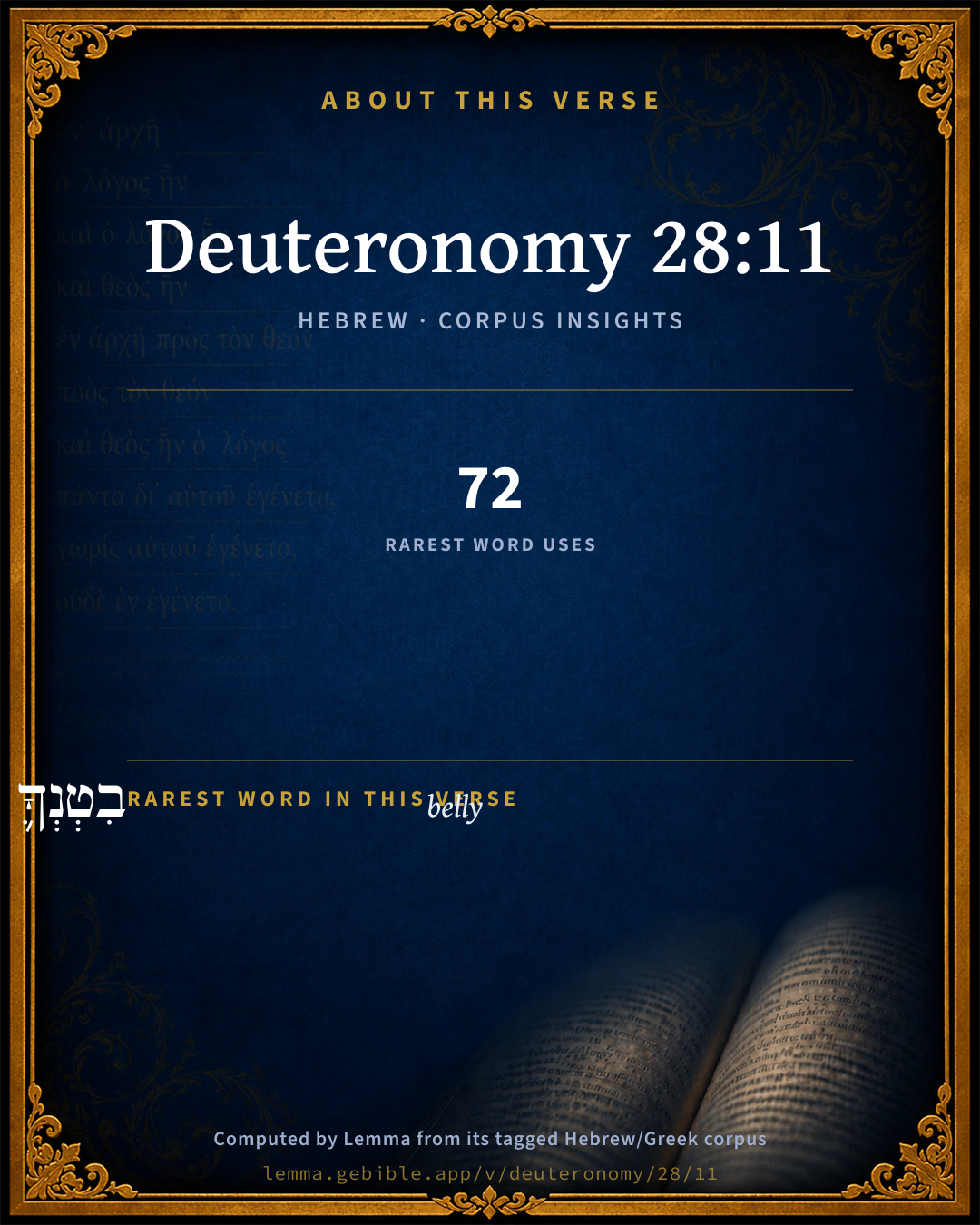
Deuteronomy, in the Pentateuch, opens this verse with 17 words (12 distinct Hebrew lemmas). Its most distinctive word is beṭen (“belly”). A historical commentator’s framing appears above. Read the whole chapter for the surrounding context.

Discussion questions

  1. How does “belly” (beṭen) shape what this verse is saying?
  2. How does Deuteronomy 30:9, which shares this passage’s theme, read alongside this verse?
  3. What does the repetition of “fruit” (3× in this one verse) do in this verse?
  4. These translations render this verse differently; the difference is in the English rendering, not the original. What questions does that raise?
  5. «וְהוֹתִֽרְךָ֤» is a Hiphil Sequential Perfect verb. How does that grammatical form shape the action described?
  6. Compare how Joseph Benson's Commentary and Jamieson, Fausset & Brown read this verse. Where do they agree or differ?

Things to notice

Reading settings

Reading text

Shown beneath each verse's original-language words.

Old Testament
Old Testament edition

Read the OT as the Masoretic Hebrew (MT) or the Greek Septuagint (LXX).

English shown for the Greek Septuagint (in the Hebrew ↔ Greek comparison).

Comparing translations? Open the Compare panel on any verse page to stack up to four side by side.