
Nehemiah 9:25

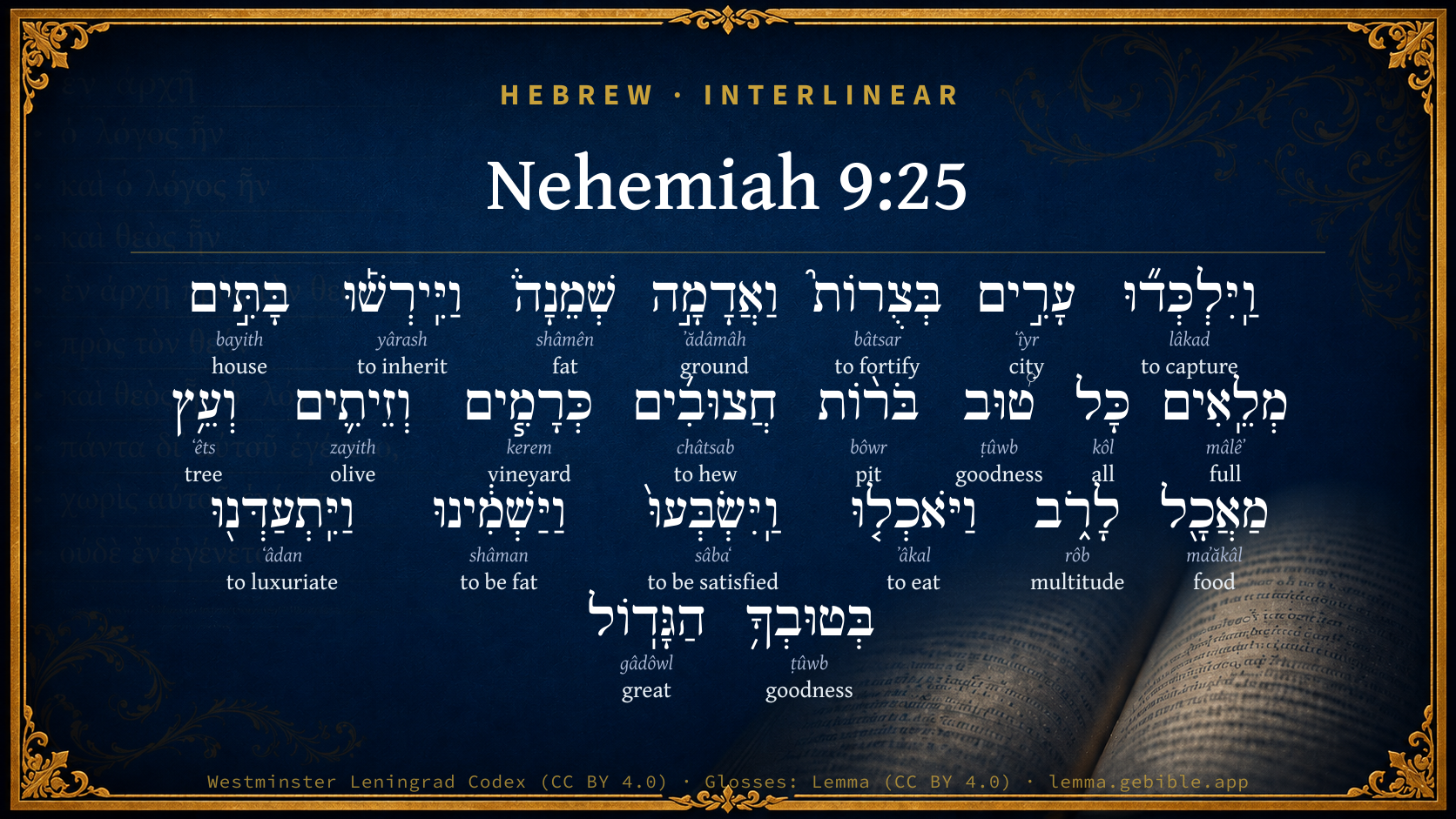
Hebrew (Westminster Leningrad Codex) Nehemiah 9:25 appears in the Hebrew Old Testament. The text above is from the Westminster Leningrad Codex. Each word links to its Strong’s number, a concise gloss, and parsing drawn from the Open Scriptures Hebrew Bible morphology. Click any word for its full Brown-Driver-Briggs (BDB) entry.
Download image
Cite this verse

Nehemiah 9:25 (World English Bible). Public Domain. Lemma interlinear Bible study tool, https://lemma.gebible.app/v/nehemiah/9/25.

Show BibTeX & RIS
BibTeX
RIS
English Translation
They took fortified cities, and a fat land, and possessed houses full of all good things, cisterns hewn out, vineyards, and olive groves, and fruit trees in abundance: so they ate, and were filled, and became fat, and delighted themselves in your great goodness.
World English Bible · Public Domain
Highlights
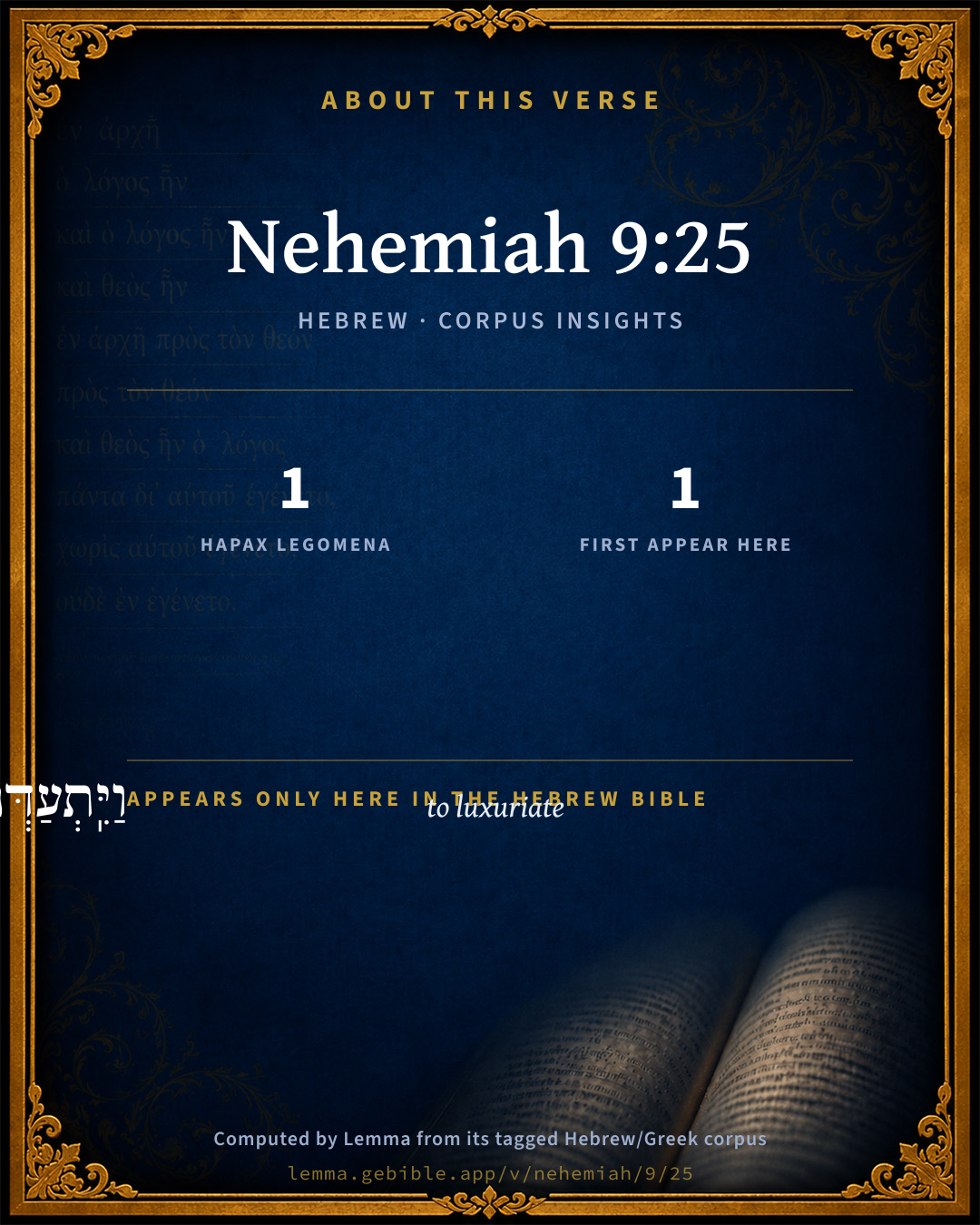
  • 1 hapax legomenon — only here in the Hebrew Bible
  • 1 first appearance in the Hebrew Bible
Full analysis ↓
Download a study sheet

One document with this verse’s original text, its word-by-word gloss line, the meaning frame, cross-references with their text, attributed commentary, and full source and license credits — printable, and it pastes into notes with its structure intact.

This verse Autodidact and up

Study sheet (.html) Plain text (.txt)

A passage Seminary Student

Up to 50 verses in one chapter. A passage sheet keeps up to 6 commentary sources and 12 cross-references per verse, in the order this page ranks them, and says so on the sheet whenever that leaves anything out. Ask for a single verse and you get the Autodidact verse sheet above.

Everything on this page stays free to read, with no account — the sheet is a download of what is already on screen, not access to it.

Want to remove ads? Support Godless Engineer
Compare translations 3

The same verse in 3 English versions, stacked beneath the original-language interlinear above. Click any original word for its lexicon entry.

Each is an independent rendering of the whole verse — the interlinear is not word-aligned to these translations.

Highlighted words mark where these versions differ — a whole-verse word diff, not a word-by-word alignment.

  • World English Bible Public Domain
    They took fortified cities, and a fat land, and possessed houses full of all good things, cisterns hewn out, vineyards, and olive groves, and fruit trees in abundance: so they ate, and were filled, and became fat, and delighted themselves in your great goodness.
  • King James Version Public Domain
    And they took strong cities, and a fat land, and possessed houses full of all goods, wells digged, vineyards, and oliveyards, and fruit trees in abundance: so they did eat, and were filled, and became fat, and delighted themselves in thy great goodness.
  • unfoldingWord Literal Text CC BY-SA 4.0
    And they captured fortified cities and fat ground. And they possessed houses full of all good things, hewn cisterns, vineyards, and olive orchards, and food trees in abundance. And they ate and were satisfied and grew fat and reveled in your great goodness.

unfoldingWord Literal Text — © unfoldingWord, licensed CC BY-SA 4.0. Word-aligned USFM3 via Door43 (git.door43.org/unfoldingWord/en_ult).

Versions to compare (up to 4)

3 of 4 selected

Show all 18 translations

Every available English version of this verse, each an independent rendering of the whole verse.

  • World English Bible Public Domain
    They took fortified cities, and a fat land, and possessed houses full of all good things, cisterns hewn out, vineyards, and olive groves, and fruit trees in abundance: so they ate, and were filled, and became fat, and delighted themselves in your great goodness.
  • Berean Standard Bible Public Domain
    They captured fortified cities and fertile land and took houses full of all goods, wells already dug, vineyards, olive groves, and fruit trees in abundance. So they ate and were filled; they grew fat and delighted in Your great goodness.
  • Majority Standard Bible Public Domain
    They captured fortified cities and fertile land and took houses full of all goods, wells already dug, vineyards, olive groves, and fruit trees in abundance. So they ate and were filled; they grew fat and delighted in Your great goodness.
  • King James Version Public Domain
    And they took strong cities, and a fat land, and possessed houses full of all goods, wells digged, vineyards, and oliveyards, and fruit trees in abundance: so they did eat, and were filled, and became fat, and delighted themselves in thy great goodness.
  • American Standard Version (1901) Public Domain
    And they took fortified cities, and a fat land, and possessed houses full of all good things, cisterns hewn out, vineyards, and oliveyards, and fruit-trees in abundance: so they did eat, and were filled, and became fat, and delighted themselves in thy great goodness.
  • Revised Version (1885) Public Domain
    And they took fenced cities, and a fat land and possessed houses full of good things, cisterns hewn out, vineyards, and oliveyards, and fruit trees in abundance: so they did eat, and were filled, and became fat, and delighted themselves in thy great goodness.
  • Geneva Bible (1599) Public Domain
    And they tooke their strong cities and the fat lande, and possessed houses, full of all goods, cisternes digged out, vineyardes, and oliues, and trees for foode in abundance, and they did eate, and were filled, and became fat, and liued in pleasure through thy great goodnesse.
  • Douay-Rheims (1899) Public Domain
    And they took strong cities and a fat land, and possessed houses full of all goods: cisterns made by others, vine- yards, and oliveyards, and fruit trees in abundance: and they ate, and were filled, and became fat, and abounded with de- light in thy great goodness.
  • Young's Literal Translation Public Domain
    And they capture fenced cities, and fat ground, and possess houses full of all good, digged-wells, vineyards, and olive-yards, and fruit-trees in abundance, and they eat, and are satisfied, and become fat, and delight themselves in Thy great goodness.
  • Literal Standard Version CC BY-SA 4.0
    And they capture fortified cities, and fat ground, || And possess houses full of all good, || Dug-wells, vineyards, and olive-yards, || And fruit-trees in abundance, || And they eat, and are satisfied, || And become fat, || And delight themselves in Your great goodness.
  • Unlocked Literal Bible CC BY-SA 4.0
    They captured the fortified cities and a productive land, and they captured houses full of all good things, cisterns already cut out, vineyards and olive orchards, and fruit trees in abundance. So they ate and were satisfied and grew fat and enjoyed themselves in your great goodness.
  • unfoldingWord Literal Text CC BY-SA 4.0
    And they captured fortified cities and fat ground. And they possessed houses full of all good things, hewn cisterns, vineyards, and olive orchards, and food trees in abundance. And they ate and were satisfied and grew fat and reveled in your great goodness.
  • Darby Bible Public Domain
    And they took strong cities, and a fat land, and possessed houses full of all good things, wells digged, vineyards and olive-gardens, and fruit trees in abundance. And they did eat and were filled, and became fat, and delighted themselves in thy great goodness.
  • World Messianic Bible Public Domain
    They took fortified cities and a rich land, and possessed houses full of all good things, cisterns dug out, vineyards, olive groves, and fruit trees in abundance. So they ate, were filled, became fat, and delighted themselves in your great goodness.
  • Webster's Bible Public Domain
    And they took strong cities, and a fat land, and possessed houses full of all goods, wells digged, vineyards and olive-yards, and fruit trees in abundance: so they ate and were filled, and became fat, and delighted themselves in thy great goodness.
  • Free Bible Version CC BY-SA 4.0
    They captured fortified cities and fertile land. They took over houses full of valuable things, water cisterns, vineyards, olive groves, and many fruit trees. They ate until they were full, and grew fat. They were so happy at how good you were to them.
  • Bible in Basic English Public Domain
    And they took walled towns and a fat land, and became the owners of houses full of all good things, water-holes cut in the rock, vine-gardens and olive-gardens and a wealth of fruit-trees: so they had food enough and became fat, and had joy in the good you gave them.
  • JPS Tanakh (1917) Public Domain
    And they took fortified cities, and a fat land, and possessed houses full of all good things, cisterns hewn out, vineyards, and oliveyards, and fruit-trees in abundance; so they did eat, and were filled, and became fat, and luxuriated in Thy great goodness.

Literal Standard Version (2020), Covenant Press — licensed CC BY-SA 4.0. Text via the HelloAO Bible API (eBible.org). Unlocked Literal Bible (unfoldingWord) — licensed CC BY-SA 4.0. Text via the HelloAO Bible API (eBible.org). unfoldingWord Literal Text — © unfoldingWord, licensed CC BY-SA 4.0. Word-aligned USFM3 via Door43 (git.door43.org/unfoldingWord/en_ult). Free Bible Version, Dr. Jonathan Gallagher — licensed CC BY-SA 4.0. Text via the HelloAO Bible API (eBible.org).

Word by word

More ways to search: Search by grammar → Find every occurrence → Compare this word →

Practice this passage: Drill this verse → Learn its vocabulary →

וַיִּֽתְעַדְּנ֖וּ
ʻâdan
H5727
“and · to luxuriate”
Conjunction + Verb, Hithpael, Sequential Imperfect, 3rd Person, Masculine, Plural
Part of Speech
Conjunction + Verb
Stem
Hithpael
Form
Sequential Imperfect
Person
3rd Person
Gender
Masculine
Number
Plural
Full BDB Definition

Origin: a primitive root

TWOT: 1567

(Hithpael) to luxuriate, delight oneself
  1. וַֽיִּלְכְּד֞וּ lâkad H3920 “and · to capture” Conjunction + Verb, Qal, Sequential Imperfect, 3rd Person, Masculine, Plural
  2. עָרִ֣ים ʻîyr H5892 “cities” Noun, Common, Feminine, Plural, Absolute
  3. בְּצֻרוֹת֮ bâtsar H1219 “fortified” Adjective, Adjective, Feminine, Plural, Absolute
  4. וַאֲדָמָ֣ה ʼădâmâh H127 “and · ground” Conjunction + Noun, Common, Feminine, Singular, Absolute
  5. שְׁמֵנָה֒ shâmên H8082 “fat” Adjective, Adjective, Feminine, Singular, Absolute
  6. וַיִּֽירְשׁ֡וּ yârash H3423 “and · to inherit” Conjunction + Verb, Qal, Sequential Imperfect, 3rd Person, Masculine, Plural
  7. בָּתִּ֣ים bayith H1004 “houses” Noun, Common, Masculine, Plural, Absolute
  8. מְלֵֽאִים mâlêʼ H4392 “full” Adjective, Adjective, Masculine, Plural, Absolute
  9. כָּל kôl H3605 “all of” Noun, Common, Masculine, Singular, Construct
  10. ט֠וּב ṭûwb H2898 “goodness” Noun, Common, Masculine, Singular, Absolute
  11. בֹּר֨וֹת bôwr H953 “pits” Noun, Common, Masculine, Plural, Absolute
  12. חֲצוּבִ֜ים châtsab H2672 “hewn” Verb, Qal, Participle Passive, Masculine, Plural, Absolute
  13. כְּרָמִ֧ים kerem H3754 “vineyards” Noun, Common, Both, Plural, Absolute
  14. וְזֵיתִ֛ים zayith H2132 “and · olives” Conjunction + Noun, Common, Masculine, Plural, Absolute
  15. וְעֵ֥ץ ʻêts H6086 “and · tree of” Conjunction + Noun, Common, Masculine, Singular, Construct
  16. מַאֲכָ֖ל maʼăkâl H3978 “food” Noun, Common, Masculine, Singular, Absolute
  17. לָרֹ֑ב rôb H7230 “to/for · multitude” Preposition + Noun, Common, Both, Singular, Absolute
  18. וַיֹּאכְל֤וּ ʼâkal H398 “and · to eat” Conjunction + Verb, Qal, Sequential Imperfect, 3rd Person, Masculine, Plural
  19. וַֽיִּשְׂבְּעוּ֙ sâbaʻ H7646 “and · to be satisfied” Conjunction + Verb, Qal, Sequential Imperfect, 3rd Person, Masculine, Plural
  20. וַיַּשְׁמִ֔ינוּ shâman H8080 “and · to be fat” Conjunction + Verb, Hiphil, Sequential Imperfect, 3rd Person, Masculine, Plural
  21. בְּטוּבְךָ֥ ṭûwb H2898 “in/at · goodness · your” Preposition + Noun, Common, Masculine, Singular, Construct + Suffix, Personal, 2nd Person, Masculine, Singular
  22. הַגָּדֽוֹל gâdôwl H1419 “the · great” Particle, Definite Article + Adjective, Adjective, Masculine, Singular, Absolute

About this verse

These counts appear in no published source. They are computed here, from the morphology-tagged text and Lemma’s own curated glosses. What Lemma adds →

23
words
22
distinct lemmas
Historical
section

Notable vocabulary

1 hapax legomenon — a word that appears only here in the entire Hebrew Bible:

  • וַיִּֽתְעַדְּנ֖וּ to luxuriate H5727

First appearance in Scripture

This word makes its first canonical appearance in the Hebrew Bible here:

  • וַיִּֽתְעַדְּנ֖וּ to luxuriate H5727

Shared distinctive vocabulary

וַיַּשְׁמִ֔ינוּ to be fat H8080 occurs in 4 verses of the Hebrew Bible. Also found in:

Grammatical profile

  • 7 verbs
  • 12 nouns
  • 4 adjectives

Verb forms

  • וַֽיִּלְכְּד֞וּ Qal · Sequential Imperfect
  • וַיִּֽירְשׁ֡וּ Qal · Sequential Imperfect
  • חֲצוּבִ֜ים Qal · Participle Passive
  • וַיֹּאכְל֤וּ Qal · Sequential Imperfect
  • וַֽיִּשְׂבְּעוּ֙ Qal · Sequential Imperfect
  • וַיַּשְׁמִ֔ינוּ Hiphil · Sequential Imperfect
  • וַיִּֽתְעַדְּנ֖וּ Hithpael · Sequential Imperfect

Repetition

A word recurs within this verse — often emphatic in Hebrew:

  • ט֠וּב goodness H2898 ×2

Cross-references

17

Topical passages linked to Nehemiah 9:25 in the Treasury of Scripture Knowledge — connected by theme and wording, ordered by reader-vote popularity; previews shown in the World English Bible.

  • Deuteronomy 32:15 But Jeshurun grew fat, and kicked: You have grown fat, you are grown thick, you are become sleek; Then he forsook God who made him, Lightly esteemed the Rock of his salvation.
  • Nehemiah 9:35 For they have not served you in their kingdom, and in your great goodness that you gave them, and in the large and fat land which you gave before them, neither turned they from their wicked works.
  • Deuteronomy 3:5 All these were cities fortified with high walls, gates, and bars; besides the unwalled towns a great many.
  • Deuteronomy 6:10–12 It shall be, when Yahweh your God shall bring you into the land which he swore to your fathers, to Abraham, to Isaac, and to Jacob, to give you, great and goodly cities, which you didn't build,
  • Deuteronomy 32:13 He made him ride on the high places of the earth, He ate the increase of the field; He made him to suck honey out of the rock, Oil out of the flinty rock;
  • 1 Kings 8:66 On the eighth day he sent the people away; and they blessed the king, and went to their tents joyful and glad of heart for all the goodness that Yahweh had shown to David his servant, and to Israel his people.
  • Ezekiel 20:6 in that day I swore to them, to bring them forth out of the land of Egypt into a land that I had searched out for them, flowing with milk and honey, which is the glory of all lands.
  • Hosea 3:5 Afterward the children of Israel shall return, and seek Yahweh their God, and David their king, and shall come with trembling to Yahweh and to his blessings in the last days.
  • Romans 2:4 Or do you despise the riches of his goodness, forbearance, and patience, not knowing that the goodness of God leads you to repentance?
  • Numbers 13:27–28 They told him, and said, We came to the land where you sent us; and surely it flows with milk and honey; and this is the fruit of it.
  • Deuteronomy 8:7–10 For Yahweh your God brings you into a good land, a land of brooks of water, of springs and springs, flowing forth in valleys and hills;
  • Deuteronomy 9:1–3 Hear, Israel: you are to pass over the Jordan this day, to go in to dispossess nations greater and mightier than yourself, cities great and fortified up to the sky,
  • Psalms 65:11 You crown the year with your bounty. Your carts overflow with abundance.
  • Isaiah 6:10 Make the heart of this people fat; Make their ears heavy, and shut their eyes; Lest they see with their eyes, And hear with their ears, And understand with their heart, And turn again, and be healed."
  • Jeremiah 5:27–28 As a cage is full of birds, so are their houses full of deceit: therefore they are become great, and grew rich.
  • Jeremiah 31:14 I will satiate the soul of the priests with fatness, and my people shall be satisfied with my goodness, says Yahweh.
  • Hosea 13:6 According to their pasture, so were they filled; They were filled, and their heart was exalted. Therefore they have forgotten me.

Cross-references courtesy of OpenBible.info (CC BY 4.0).

Hebrew and Greek witnesses Masoretic Hebrew ↔ Greek Septuagint

The same verse in the two great witnesses to the Old Testament, shown verse-for-verse.

These are two independent witnesses, not word-aligned to each other, and the Septuagint is shown in lemma (dictionary) form.

Hebrew Nehemiah 9:25 Masoretic · Westminster Leningrad Codex

וַֽיִּלְכְּד֞וּ עָרִ֣ים בְּצֻרוֹת֮ וַאֲדָמָ֣ה שְׁמֵנָה֒ וַיִּֽירְשׁ֡וּ בָּתִּ֣ים מְלֵֽאִים כָּל ט֠וּב בֹּר֨וֹת חֲצוּבִ֜ים כְּרָמִ֧ים וְזֵיתִ֛ים וְעֵ֥ץ מַאֲכָ֖ל לָרֹ֑ב וַיֹּאכְל֤וּ וַֽיִּשְׂבְּעוּ֙ וַיַּשְׁמִ֔ינוּ וַיִּֽתְעַדְּנ֖וּ בְּטוּבְךָ֥ הַגָּדֽוֹל

They took fortified cities, and a fat land, and possessed houses full of all good things, cisterns hewn out, vineyards, and olive groves, and fruit trees in abundance: so they ate, and were filled, and became fat, and delighted themselves in your great goodness.

World English Bible · Public Domain

Greek LXX Structure differs

The Septuagint has no separate book of Nehemiah. Its Greek text is the second half of Esdras B (2 Esdras), chapters 11–23; Ezra is the first half (1–10).

A verse-for-verse comparison isn’t shown here because the chapters and verses don’t line up. Switch to the LXX edition with the MT / LXX toggle above to read the Greek directly.

On this verse, The Cambridge Bible for Schools and Colleges discusses the Septuagint’s reading. Read the note in Commentary ↓

Hebrew: Westminster Leningrad Codex (CC BY 4.0). Greek: Septuagint (public domain); English from a public-domain English Septuagint. How the Septuagint differs from the Hebrew →

Commentary

Notes on Nehemiah 9:25 from classic Christian and Jewish commentators (each source and its license shown beneath its notes). The classic Christian expositions comment on the surrounding passage and are grouped to its opening verse, so a note may address several verses; the Jewish commentaries on the Tanakh (Rashi and others) are per-verse, so they appear only where the commentator wrote on this verse.

Lemma curates 59 commentaries, every one of them public domain or Creative Commons licensed, each selected and text-cleaned for this edition rather than reprinted as found. About our sources →

Trapp's Complete Commentary

John Trapp

Neh 9:25 And they took strong cities, and a fat land, and possessed houses full of all goods, wells digged, vineyards, and oliveyards, and fruit trees in abundance: so they did eat, and were filled, and became fat, and delighted themselves in thy great goodness.

Ver. 25. And they took strong cities] With no great ado: like as towns are said to come in to Timotheus’ (the Athenian general’s) toils while he slept. This he ascribed to his own prowess and policy (Plut. in Sulla), often interlacing this proud speech, Herein fortune had no part; and from thenceforth never prospered in anything he undertook.

And a fat land] Flowing with plenty of dainties; though Strabo spitefully slandered it as craggy and barren.

And possessed houses full of all goods] Of all pleasant and precious substance; for the Canaanites were great merchants, Isa 23:8 Hos 12:7 Eze 17:4.

Wells digged] A great commodity in that hot country.

Vineyards, and oliveyards] A singular help to housekeeping.

So they did eat, and were filled] They had enough of everything, and did eat while eating was good; as they say Queen Elizabeth did seldom eat but one dish, rose ever with an appetite, and lived about seventy years. King Edward VI was wont to call her his sweet sister Temperance.

And delighted themselves in thy great goodness] They lived in God’s good land, but not by God’s good laws; the refreshing they found by his best creatures was none other but such as his, who "warmeth himself, and saith, Aha, I am warm, I have seen the fire," Isa 44:16.

John Trapp, A Commentary or Exposition upon All the Books of the Old and New Testament (1647–1656) — public domain. Text from a community e-Sword module.

Joseph Benson's Commentary

Neh 9:25-26. And delighted them in thy great goodness — In all those comforts and blessings which, by thy great goodness, they obtained and enjoyed. Nevertheless they cast thy law behind their backs — They neglected and despised thy laws, would not regard nor observe them; whereas they ought to have had them continually before their eyes, to direct and govern them in all their ways. The good things they enjoyed in the land which God had given them, made them wanton and forgetful of God and his commandments. And slew thy prophets — Of which see the margin.

Joseph Benson's Commentary on the Old and New Testaments (1811–1818) — public domain. Text from a community e-Sword module.

Tyndale Open Study Notes

Tyndale Open Resources

9:25 Cp. Deut 6:10-11; 8:6-10. • they were full and grew fat: Prosperity proved to include spiritual danger (see Deut 8:11-20).

Tyndale Open Study Notes — © Tyndale Open Resources, licensed CC BY-SA 4.0. Text via the HelloAO Bible API.

Adam Clarke's Commentary

Verse 25. Became fat, and delighted themselves] They became effeminate, fell under the power of luxury, got totally corrupted in their manners, sinned against all the mercies of God, and then were destroyed by his judgments. We have an old nervous saying, "War begets poverty, poverty begets peace, peace begets affluence, affluence begets luxury and corruption of manners; and hence civil broils, foreign wars, and desolations." A sensible Roman historian has said the same: "Imperium facile iis artibus retinetur, quibus initio partum est: verum ubi pro LABORE, DESIDIA; pro continentia et aequitate, LIBIDO atque SUPERBIA invasere: fortuna simul cum moribus IMMUTATUR."

Adam Clarke's Commentary on the Bible (1810–1826) — public domain. Text from a community e-Sword/MySword module.

The Cambridge Bible for Schools and Colleges

gen. ed. J. J. S. Perowne

25. strong cities] R.V. fenced cities. Cf. Deu_9:1; Jos_14:12, e.g. Jericho, Ai, and Hebron, but it was a long time before all the cities were reduced. Thus Jerusalem held out until David’s reign. (Cf. Jdg_1:8; Jdg_1:21.)

a fat land] i.e. fat soil, ‘adamah.’ In Num_13:20 the country (‘erec̣’) is spoken of as ‘fat’ or ‘lean.’ Cf. Deu_8:7-9 for a fuller description of the land’s fatness.

full of all goods] R.V. full of all good things.

wells digged] R.V. cisterns hewn out.

The description is almost literally borrowed from Deu_6:10-11, ‘great and goodly cities, which thou buildedst not, and houses full of all good things, which thou filledst not, and cisterns hewn out, which thou hewedst not, vineyards and olive-yards, which thou plantedst not, and thou shalt eat and be full; then beware lest thou forget the Lord.’ A poetical description of the material blessings, into the inheritance of which the Israelites passed, is given in Deu_32:13-14.

became fat] Cf. Deu_32:15, ‘Jeshurun waxed fat and kicked,’ of the ill effects of luxury and prosperity.

delighted themselves] The Hebrew word occurs only here in the O. T. = ‘they luxuriated.’ It is from the same root as ‘Eden.’ LXX. ἐνετρύφησαν.

The Cambridge Bible for Schools and Colleges (gen. ed. J. J. S. Perowne; Cambridge University Press, 1878–1918) — public domain. Text from a community e-Sword module.

John Gill's Exposition

And they took strong cities,.... Such as, in an hyperbolical way, are said to be walled up to heaven, Deu 1:28

and a fat land; of a good and fruitful soil, abounding with all good things, Deu 8:7

and possessed houses full of all goods; ready built and furnished for them, both with good provisions and good furniture:

wells digged; to supply them with water:

vineyards, and olive yards, and fruit trees in abundance; which they planted not:

and they did eat, and were filled, and became fat; in body, though in mind became wanton and wicked; they made their hearts fat, or stupid, as Aben Ezra interprets it, see Deu 32:15

and delighted themselves in thy great goodness; not in praising the Lord for it, and using it to his honour and glory, but indulged themselves to luxury and intemperance; though it may be understood of a lawful pleasure in the enjoyment of the great affluence they were brought into, which last agrees with what follows.

John Gill's Exposition of the Whole Bible (1746–1763) — public domain (CC PDM 1.0). Text via the HelloAO Bible API.

Albert Barnes' Notes on the Bible

Became fat. - i. e., “grew proud,” or “wanton” - a phrase only occurring here, in the margin reference, and in Jer 5:28.

Delighted themselves - Rather, “luxuriated.” The word in the original does not occur elsewhere; but cognate terms make the sense clear.

Albert Barnes' Notes on the Bible (1834–1885) — public domain. Text from a community e-Sword/MySword module.

Haydock's Catholic Bible Commentary

Goodness. Prosperity was their ruin, (Haydock) as Moses had foretold, Deuteronomy xxxii. 15. (Calmet) --- "Empire is easily retained by the same arts by which it was procured: but when idleness takes the place of industry, when lust and pride banish continence and equity, fortune is changed with manners." (Sallust; Grotius)

George Leo Haydock (1774–1849), Haydock's Catholic Family Bible and Commentary, 1859 edition — public domain. Excludes Psalms (Douay-Rheims chapter numbering differs from Protestant) and Deuterocanonical books (Catholic canon only).

Matthew Poole's English Annotations

i.e. In all these comforts and blessings, which by thy great goodness they obtained and enjoyed.

Matthew Poole's English Annotations on the Holy Bible (1683–1685) — public domain. Text from a community e-Sword/MySword module.

The Pulpit Commentary

They took strong cities. As Jericho, Ai, Libnah, Lachish, Hazer, Hebron, etc. A fat land. Compare Num_14:7, 8 Deu_8:7-9 2Ki_18:32. Houses full of all goods. See Deu_6:11. Fruit trees in abundance. The fruit trees of Palestine are, besides the vine and the olive, the fig tree, the carob or locust tree (ceratonia siliqua), the quince, the apple, the almond, the walnut, the peach, the apricot, the mulberry, the sycamore fig, the prickly pear, the pomegranate, and the orange. Date-palms also were anciently abundant in the valley of the Jordan. They... became fat, Compare Deu_32:15 and Jer_5:28, the only other places where the expression here used occurs. The comparison will show that dispraise is intended grew wanton and self-indulgent." Delighted themselves. Rather, "luxuriated" (etrufhsan , LXX).

They... slew thy prophets. Compare Mat_23:37 Luk_11:47. Jewish tradition states that Isaiah, Jeremiah, and Ezekiel were murdered. Many prophets were slain by Jezebel, with Ahab"s sanction. (1Ki_18:4) Zechariah, the son of Jehoiada, was put to death by Joash. (2Ch_24:22)

The Pulpit Commentary (1880–1919), ed. H.D.M. Spence-Jones & Joseph S. Exell — public domain. Text from a community e-Sword module.

unfoldingWord translationNotes

Door43 World Missions Community

Connecting Statement:

In these verses, the Levites continue to praise Yahweh in the presence of the people of Israel.

They captured

The Israelites at the time of Moses captured

a productive land

"a fertile land"

cisterns

holes in the ground where people store water

grew fat

This might be a metaphor for "stopped thinking about Yahweh" or "became complacent." (See: Metaphor)

translationWords

good

vineyard

olive

fruit

unfoldingWord translationNotes — © Distant Shores Media and the Door43 World Missions Community, licensed CC BY-SA 4.0. Source: git.door43.org/Door43/en_tn.

Lesson kit

Teaching starters — assembled from the data on this page, not authored interpretation. Every prompt links to the verse data it draws on. Edit before teaching.

Nehemiah, in the Historical, opens this verse with 23 words (22 distinct Hebrew lemmas). Its most distinctive word is ʻâdan (“to luxuriate”). A historical commentator’s framing appears above. Read the whole chapter for the surrounding context.

Discussion questions

  1. The word ʻâdan carries the sense “to luxuriate.” How does it shape the verse?
  2. 1 word here appears nowhere else in the Hebrew Bible. Why might the author reach for such rare wording?
  3. This is the first place “to luxuriate” appears in Scripture (first appears here). What does its debut here establish?
  4. How does Deuteronomy 32:15, which shares the word «to be fat», read alongside this verse?
  5. What does the repetition of “goodness” (2× in this one verse) do in this verse?
  6. The translations on this page render this verse differently — a whole-verse word diff, not a word-by-word alignment. What might account for the different wordings?
  7. «וַֽיִּלְכְּד֞וּ» is a Qal Sequential Imperfect verb. How does that grammatical form shape the action described?
  8. Compare how Trapp's Complete Commentary and Joseph Benson's Commentary read this verse. Where do they agree or differ?

Things to notice

  • 1 word in this verse appears nowhere else in the Hebrew Bible.
  • 1 word makes its first canonical appearance in Scripture here.
  • These translations choose different wording for 30 words in this verse.
  • “goodness” occurs 2× in this single verse.
  • 22 distinct Hebrew lemmas span 23 words in this verse.

Reading settings

Reading text

Shown beneath each verse's original-language words.

Old Testament
Old Testament edition

Read the OT as the Masoretic Hebrew (MT) or the Greek Septuagint (LXX).

English shown for the Greek Septuagint (in the Hebrew ↔ Greek comparison).

Comparing translations? Open the Compare panel on any verse page to stack up to four side by side.