
Numbers 16:30

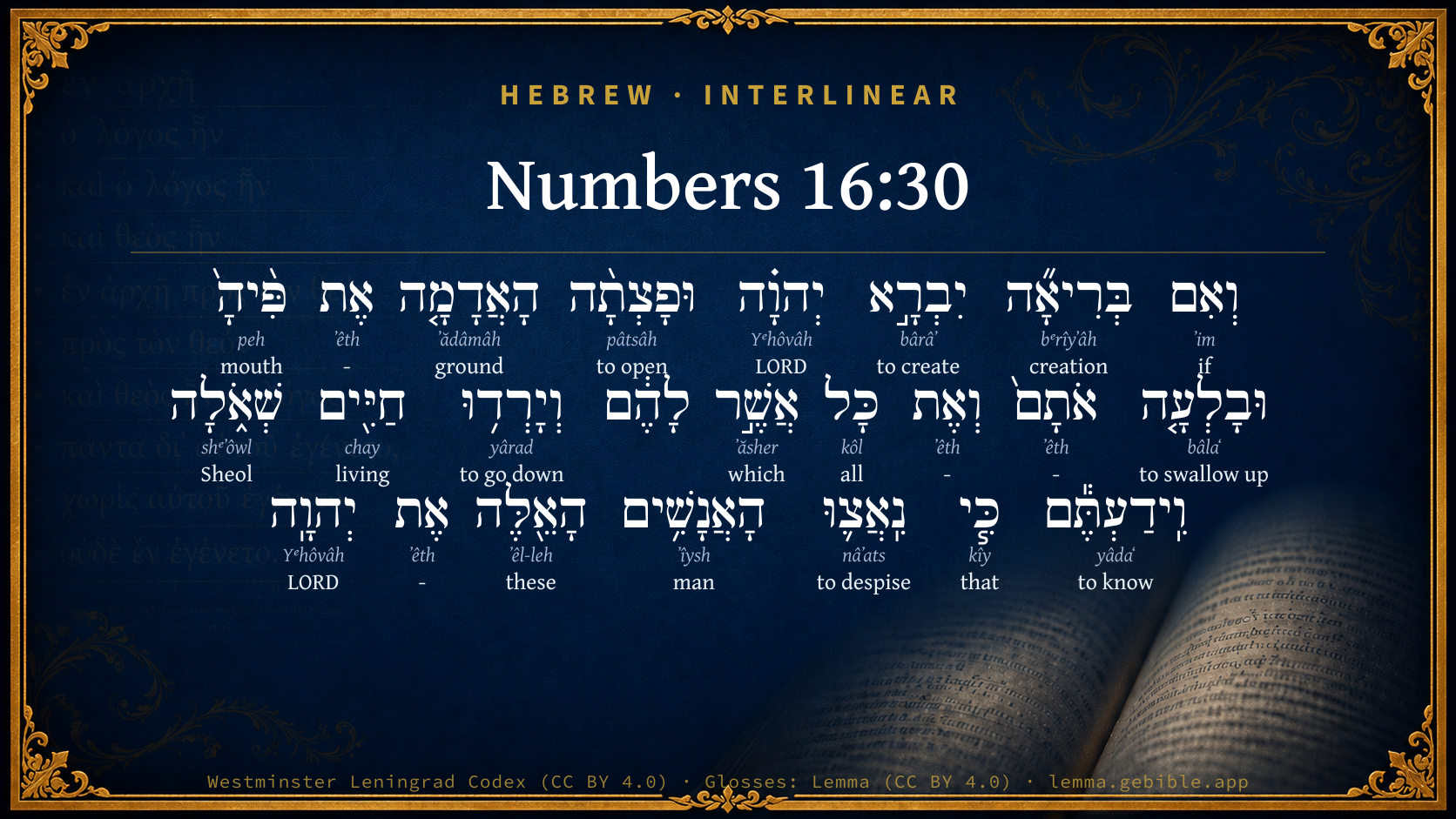
Hebrew (Westminster Leningrad Codex) Numbers 16:30 appears in the Hebrew Old Testament. The text above is from the Westminster Leningrad Codex. Each word links to its Strong’s number, a concise gloss, and parsing drawn from the Open Scriptures Hebrew Bible morphology. Click any word for its full Brown-Driver-Briggs (BDB) entry.
Download image
Cite this verse

Numbers 16:30 (World English Bible). Public Domain. Lemma interlinear Bible study tool, https://lemma.gebible.app/v/numbers/16/30.

Show BibTeX & RIS
BibTeX
RIS
English Translation
But if Yahweh make a new thing, and the ground open its mouth, and swallow them up, with all that appertain to them, and they go down alive into Sheol; then you shall understand that these men have despised Yahweh.
World English Bible · Public Domain
Highlights
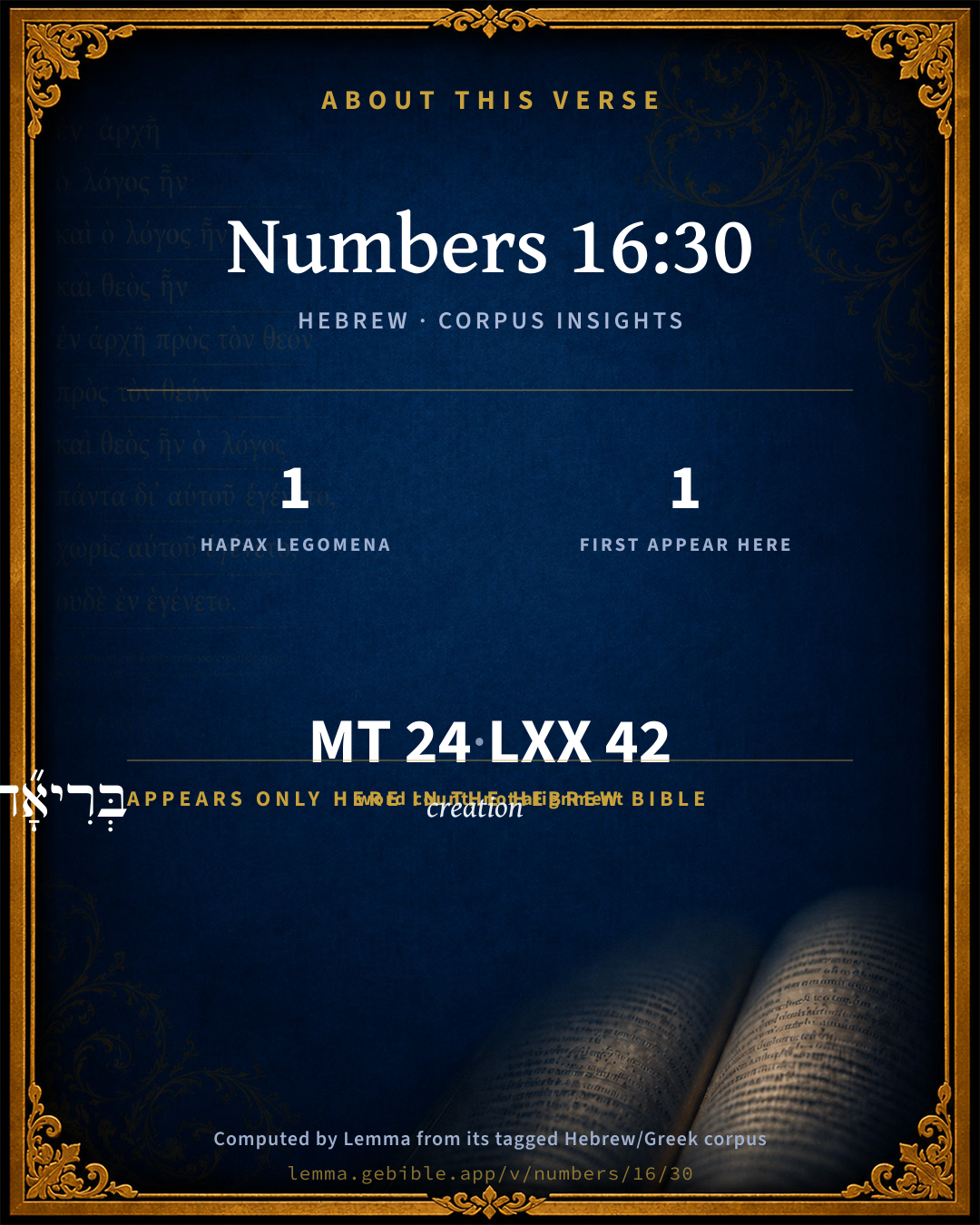
  • 1 hapax legomenon — only here in the Hebrew Bible
  • 1 first appearance in the Hebrew Bible
Full analysis ↓
Download a study sheet

One document with this verse’s original text, its word-by-word gloss line, the meaning frame, cross-references with their text, attributed commentary, and full source and license credits — printable, and it pastes into notes with its structure intact.

This verse Autodidact and up

Study sheet (.html) Plain text (.txt)

A passage Seminary Student

Up to 50 verses in one chapter. A passage sheet keeps up to 6 commentary sources and 12 cross-references per verse, in the order this page ranks them, and says so on the sheet whenever that leaves anything out. Ask for a single verse and you get the Autodidact verse sheet above.

Everything on this page stays free to read, with no account — the sheet is a download of what is already on screen, not access to it.

Want to remove ads? Support Godless Engineer
Compare translations 3

The same verse in 3 English versions, stacked beneath the original-language interlinear above. Click any original word for its lexicon entry.

Each is an independent rendering of the whole verse — the interlinear is not word-aligned to these translations.

Highlighted words mark where these versions differ — a whole-verse word diff, not a word-by-word alignment.

  • World English Bible Public Domain
    But if Yahweh make a new thing, and the ground open its mouth, and swallow them up, with all that appertain to them, and they go down alive into Sheol; then you shall understand that these men have despised Yahweh.
  • King James Version Public Domain
    But if the LORD make a new thing, and the earth open her mouth, and swallow them up, with all that appertain unto them, and they go down quick into the pit; then ye shall understand that these men have provoked the LORD.
  • unfoldingWord Literal Text CC BY-SA 4.0
    But if Yahweh creates a creation, and the ground opens its mouth and swallows them and all that to them, and they go down living to Sheol, then you will know that these men spurned Yahweh.”

unfoldingWord Literal Text — © unfoldingWord, licensed CC BY-SA 4.0. Word-aligned USFM3 via Door43 (git.door43.org/unfoldingWord/en_ult).

Versions to compare (up to 4)

3 of 4 selected

Show all 18 translations

Every available English version of this verse, each an independent rendering of the whole verse.

  • World English Bible Public Domain
    But if Yahweh make a new thing, and the ground open its mouth, and swallow them up, with all that appertain to them, and they go down alive into Sheol; then you shall understand that these men have despised Yahweh.
  • Berean Standard Bible Public Domain
    But if the LORD brings about something unprecedented, and the earth opens its mouth and swallows them and all that belongs to them so that they go down alive into Sheol, then you will know that these men have treated the LORD with contempt.”
  • Majority Standard Bible Public Domain
    But if the LORD brings about something unprecedented, and the earth opens its mouth and swallows them and all that belongs to them so that they go down alive into Sheol, then you will know that these men have treated the LORD with contempt.”
  • King James Version Public Domain
    But if the LORD make a new thing, and the earth open her mouth, and swallow them up, with all that appertain unto them, and they go down quick into the pit; then ye shall understand that these men have provoked the LORD.
  • American Standard Version (1901) Public Domain
    But if Jehovah make a new thing, and the ground open its mouth, and swallow them up, with all that appertain unto them, and they go down alive into Sheol; then ye shall understand that these men have despised Jehovah.
  • Revised Version (1885) Public Domain
    But if the LORD make a new thing, and the ground open her mouth, and swallow them up, with all that appertain unto them, and they go down alive into the pit; then ye shall understand that these men have despised the LORD.
  • Geneva Bible (1599) Public Domain
    But if the Lord make a newe thing, and the earth open her mouth, and swallowe them vp with all that they haue, and they goe downe quicke into ye pit, then ye shall vnderstand that these men haue prouoked the Lord.
  • Douay-Rheims (1899) Public Domain
    But if the Lord do a new thing, and the earth opening her mouth swallow them down, and all things that belong to them, and they go down alive into hell, you shall know that they have blasphemed the Lord.
  • Young's Literal Translation Public Domain
    and if a strange thing Jehovah do, and the ground hath opened her mouth and swallowed them, and all that they have, and they have gone down alive to Sheol -- then ye have known that these men have despised Jehovah.'
  • Literal Standard Version CC BY-SA 4.0
    but if YHWH does a strange thing, and the ground has opened her mouth and swallowed them and all that they have, and they have gone down alive to Sheol, then you have known that these men have despised YHWH.”
  • Unlocked Literal Bible CC BY-SA 4.0
    But if Yahweh creates something new, and the earth opens its mouth and swallows them, with everything that they possess, and they go down alive into Sheol, then you must understand that these men have despised Yahweh.”
  • unfoldingWord Literal Text CC BY-SA 4.0
    But if Yahweh creates a creation, and the ground opens its mouth and swallows them and all that to them, and they go down living to Sheol, then you will know that these men spurned Yahweh.”
  • Darby Bible Public Domain
    but if Jehovah make a new thing, and the ground open its mouth, and swallow them up, and all that they have, and they go down alive into Sheol, then ye shall know that these men have despised Jehovah.
  • World Messianic Bible Public Domain
    But if the LORD makes a new thing, and the ground opens its mouth, and swallows them up with all that belong to them, and they go down alive into Sheol, then you shall understand that these men have despised the LORD.”
  • Webster's Bible Public Domain
    But if the LORD shall make a new thing, and the earth shall open her mouth, and swallow them up, with all that appertain to them, and they go down quick into the pit; then ye shall understand that these men have provoked the LORD.
  • Free Bible Version CC BY-SA 4.0
    But if the Lord does something totally different, and the earth opens up and swallows them down along with everything that belongs to them so that they go down alive into Sheol, then you will know that these men have acted with contempt to the Lord.”
  • Bible in Basic English Public Domain
    But if the Lord does something new, opening the earth to take them in, with everything which is theirs, and they go down living into the underworld, then it will be clear to you that the Lord has not been honoured by these men.
  • JPS Tanakh (1917) Public Domain
    But if the LORD make a new thing, and the ground open her mouth, and swallow them up, with all that appertain unto them, and they go down alive into the pit, then ye shall understand that these men have despised the LORD.'

Literal Standard Version (2020), Covenant Press — licensed CC BY-SA 4.0. Text via the HelloAO Bible API (eBible.org). Unlocked Literal Bible (unfoldingWord) — licensed CC BY-SA 4.0. Text via the HelloAO Bible API (eBible.org). unfoldingWord Literal Text — © unfoldingWord, licensed CC BY-SA 4.0. Word-aligned USFM3 via Door43 (git.door43.org/unfoldingWord/en_ult). Free Bible Version, Dr. Jonathan Gallagher — licensed CC BY-SA 4.0. Text via the HelloAO Bible API (eBible.org).

Word by word

More ways to search: Search by grammar → Find every occurrence → Compare this word →

Practice this passage: Drill this verse → Learn its vocabulary →

בְּרִיאָ֞ה
bᵉrîyʼâh
H1278
“creation”
Noun, Common, Feminine, Singular, Absolute
Part of Speech
Noun
Type
Common
Gender
Feminine
Number
Singular
State
Absolute
Full BDB Definition

Origin: from H1254

TWOT: 278a

a creation, created thing, new thing, marvel
  1. וְאִם ʼim H518 “and · if” Conjunction + Conjunction
  2. יִבְרָ֣א bârâʼ H1254 “to create” Verb, Qal, Imperfect, 3rd Person, Masculine, Singular
  3. יְהוָ֗ה Yᵉhôvâh H3068 “LORD” Noun, Proper
  4. וּפָצְתָ֨ה pâtsâh H6475 “and · to open” Conjunction + Verb, Qal, Sequential Perfect, 3rd Person, Feminine, Singular
  5. הָאֲדָמָ֤ה ʼădâmâh H127 “the · ground” Particle, Definite Article + Noun, Common, Feminine, Singular, Absolute
  6. אֶת ʼêth H853 “-” Particle, Direct Object
  7. פִּ֨יהָ֙ peh H6310 “mouth · her” Noun, Common, Masculine, Singular, Construct + Suffix, Personal, 3rd Person, Feminine, Singular
  8. וּבָלְעָ֤ה bâlaʻ H1104 “and · to swallow up” Conjunction + Verb, Qal, Sequential Perfect, 3rd Person, Feminine, Singular
  9. אֹתָם֙ ʼêth H853 “- · them” Particle, Direct Object + Suffix, Personal, 3rd Person, Masculine, Plural
  10. וְאֶת ʼêth H853 “and · -” Conjunction + Particle, Direct Object
  11. כָּל kôl H3605 “all of” Noun, Common, Masculine, Singular, Construct
  12. אֲשֶׁ֣ר ʼăsher H834 “which” Particle, Relative
  13. וְיָרְד֥וּ yârad H3381 “and · to go down” Conjunction + Verb, Qal, Sequential Perfect, 3rd Person, Common, Plural
  14. חַיִּ֖ים chay H2416 “living” Adjective, Adjective, Masculine, Plural, Absolute
  15. שְׁאֹ֑לָה shᵉʼôwl H7585 “Sheol · toward” Noun, Proper + Suffix, Demonstrative
  16. וִֽידַעְתֶּ֕ם yâdaʻ H3045 “and · to know” Conjunction + Verb, Qal, Sequential Perfect, 2nd Person, Masculine, Plural
  17. כִּ֧י kîy H3588 “that” Conjunction
  18. נִֽאֲצ֛וּ nâʼats H5006 “to despise” Verb, Piel, Perfect, 3rd Person, Common, Plural
  19. הָאֲנָשִׁ֥ים ʼîysh H376 “the · men” Particle, Definite Article + Noun, Common, Masculine, Plural, Absolute
  20. הָאֵ֖לֶּה ʼêl-leh H428 “the · these” Particle, Definite Article + Pronoun, Demonstrative, Common, Plural
  21. אֶת ʼêth H853 “-” Particle, Direct Object
  22. יְהוָֽה Yᵉhôvâh H3068 “LORD” Noun, Proper

About this verse

These counts appear in no published source. They are computed here, from the morphology-tagged text and Lemma’s own curated glosses. What Lemma adds →

24
words
19
distinct lemmas
Pentateuch
section

Notable vocabulary

1 hapax legomenon — a word that appears only here in the entire Hebrew Bible:

  • בְּרִיאָ֞ה creation H1278

First appearance in Scripture

This word makes its first canonical appearance in the Hebrew Bible here:

  • בְּרִיאָ֞ה creation H1278

Shared distinctive vocabulary

וּפָצְתָ֨ה to open H6475 occurs in 15 verses of the Hebrew Bible. Also found in:

Grammatical profile

  • 6 verbs
  • 8 nouns
  • 1 adjective
  • 1 pronoun
  • 1 preposition
  • 2 conjunctions
  • 5 particles

Verb forms

  • יִבְרָ֣א Qal · Imperfect
  • וּפָצְתָ֨ה Qal · Sequential Perfect
  • וּבָלְעָ֤ה Qal · Sequential Perfect
  • וְיָרְד֥וּ Qal · Sequential Perfect
  • וִֽידַעְתֶּ֕ם Qal · Sequential Perfect
  • נִֽאֲצ֛וּ Piel · Perfect

Repetition

A word recurs within this verse — often emphatic in Hebrew:

  • יְהוָ֗ה LORD H3068 ×2

Hebrew & Septuagint length

In English translation the verse runs 40 words from the Hebrew and 51 from the Septuagint (LXX English) — closely comparable.

A rough comparison of the two English renderings, which tokenize alike — not a word-level alignment.

Word counts can differ between the Hebrew and the Greek without any difference in meaning — e.g. the Hebrew direct-object marker אֵת has no separate Greek word, and Greek often adds the article ὁ.

In the original languages it is 24 Hebrew tokens and 42 Greek tokens — but the two are counted differently (Hebrew bundles its prefixes and suffixes into one token; the Greek is in lemma form), so that isn’t a like-for-like length.

Cross-references

8

Topical passages linked to Numbers 16:30 in the Treasury of Scripture Knowledge — connected by theme and wording, ordered by reader-vote popularity; previews shown in the World English Bible.

  • Psalms 55:15 Let death come suddenly on them. Let them go down alive into Sheol. For wickedness is in their dwelling, in the midst of them.
  • Numbers 16:33 So they, and all that appertained to them, went down alive into Sheol: and the earth closed on them, and they perished from among the assembly.
  • Job 31:3 Is it not calamity to the unrighteous, And disaster to the workers of iniquity?
  • Isaiah 28:21 For Yahweh will rise up as on Mount Perazim, he will be angry as in the valley of Gibeon; that he may do his work, his strange work, and bring to pass his act, his strange act.
  • Isaiah 43:19 Behold, I will do a new thing; now shall it spring forth; shall you not know it? I will even make a way in the wilderness, and rivers in the desert.
  • Isaiah 45:7 I form the light, and create darkness; I make peace, and create evil. I am Yahweh, who does all these things.
  • Isaiah 45:12 I have made the earth, and created man on it: I, even my hands, have stretched out the heavens; and all their host have I commanded.
  • Jeremiah 31:22 How long will you go here and there, you backsliding daughter? for Yahweh has created a new thing in the earth: a woman shall encompass a man.

Cross-references courtesy of OpenBible.info (CC BY 4.0).

Hebrew and Greek witnesses Masoretic Hebrew ↔ Greek Septuagint

The same verse in the two great witnesses to the Old Testament, shown verse-for-verse.

These are two independent witnesses, not word-aligned to each other, and the Septuagint is shown in lemma (dictionary) form.

Hebrew Numbers 16:30 Masoretic · Westminster Leningrad Codex

וְאִם בְּרִיאָ֞ה יִבְרָ֣א יְהוָ֗ה וּפָצְתָ֨ה הָאֲדָמָ֤ה אֶת פִּ֨יהָ֙ וּבָלְעָ֤ה אֹתָם֙ וְאֶת כָּל אֲשֶׁ֣ר לָהֶ֔ם וְיָרְד֥וּ חַיִּ֖ים שְׁאֹ֑לָה וִֽידַעְתֶּ֕ם כִּ֧י נִֽאֲצ֛וּ הָאֲנָשִׁ֥ים הָאֵ֖לֶּה אֶת יְהוָֽה

But if Yahweh make a new thing, and the ground open its mouth, and swallow them up, with all that appertain to them, and they go down alive into Sheol; then you shall understand that these men have despised Yahweh.

World English Bible · Public Domain

Greek LXX Numbers 16:30 Septuagint · lemma form

ἀλλά ἤ ἐν φάσμα δεικνύω κύριος καί ἀναοἴγω ὁ γῆ ὁ στόμα αὐτός καταπίνω αὐτός καί ὁ οἶκος αὐτός καί ὁ σκηνή αὐτός καί πᾶς ὅσος εἰμί αὐτός καί καταβαίνω ζάω εἰς ᾅδης καί γιγνώσκω ὅτι παραὀξύνω ὁ ἄνθρωπος οὗτος ὁ κύριος

But if the Lord shall show by a wonder, and the earth shall open her mouth and swallow them up, and their houses, and their tents, and all that belongs to them, and they shall go down alive into Hades, then you⌃ shall know that these men have provoked the Lord.

LXX2012 (modern English Septuagint) · Public Domain

On this verse, The Pulpit Commentary discusses the Septuagint’s reading. Read the note in Commentary ↓

Hebrew: Westminster Leningrad Codex (CC BY 4.0). Greek: Septuagint (public domain); English from LXX2012 (modern English Septuagint) (Public Domain). How the Septuagint differs from the Hebrew →

Targum (Aramaic paraphrase)

2

The Targum is the ancient Jewish Aramaic paraphrase of the Hebrew Scriptures — an interpretive translation, not the Hebrew text itself. Onkelos (literal) and Pseudo-Jonathan (expansive) render the Torah, and Jonathan the Prophets. Coverage is partial: where no permissively-licensed English translation exists for a verse, only the Aramaic is shown. This is verse-level text, not a word-by-word alignment to the Hebrew.

  1. Targum Onkelos Torah (Genesis–Deuteronomy)
    וְאִם בְּרִיאָה יִבְרֵי יְיָ וּפְתָחַת אַרְעָא יָת פּוּמַהּ וְתִבְלַע יַתְהוֹן וְיַת כָּל דִי לְהוֹן וְיֶחֱתוּן כַּד חַיִין לִשְׁאוֹל וְתִדְעוּן אֲרֵי אַרְגִיזוּ גוּבְרַיָא הָאִלֵין קֳדָם יְיָ

    (no public-domain English translation for this verse)

    Targum Onkelos — Aramaic: “Onkelos Genesis” (public domain); “Onkelos Exodus” (public domain); “Onkelos Leviticus” (public domain); “Onkelos Numbers” (public domain); “Onkelos Deuteronomy” (public domain). English: “Sefaria Community Translation” (CC0 1.0 (public-domain dedication)); “J.W. Etheridge. The Targums of Onkelos and Jonathan Ben Uzziel on the Pentateuch. London: Longmans, Green, 1862” (public domain). Text via Sefaria.

  2. Targum Pseudo-Jonathan Torah (Genesis–Deuteronomy)
    וְאִין לָא אִתְבָּרִיאַת מִיתוּתָא לְהוֹן מִן יוֹמַת עַלְמָא תִּתְבְּרֵי לְהוֹן כְּדוֹן וְאִין לָא אִתְבְּרֵי פּוּם לְאַרְעָא מִן שֵׁירוּיָא אִתְבְּרֵי לָהּ כְּדוֹן וְתִפְתּוֹחַ אַרְעָא יַת פּוּמָהָא וְתִבְלַע יַתְהוֹן וְיַת כָּל דִלְהוֹן וְיֵחְתוּן כַּד חַיִין לְשֵׁיוּל וְתִנְדְעוּן אֲרוּם אַרְגִיזוּ גוּבְרַיָא הָאִלֵין קֳדָם יְיָ

    But if a death which hath not been created since the days of the world be now created for them, and if a mouth for the earth, which hath not been made from the beginning, be created now, and the earth open her mouth and swallow them and all they have, and they go down alive into Sheol, you will understand that these men have provoked the Lord to anger.

    Targum Pseudo-Jonathan — Aramaic: “Targum Jonathan on Genesis” (public domain); “Targum Jonathan on Exodus” (public domain); “Targum Jonathan on Leviticus” (public domain); “Targum Jonathan on Numbers” (public domain); “Targum Jonathan on Deuteronomy” (public domain). English: “The Targum of Jonathan ben Uzziel, trans. J. W. Etheridge, London, 1862” (public domain). Text via Sefaria.

Commentary

Notes on Numbers 16:30 from classic Christian and Jewish commentators (each source and its license shown beneath its notes). The classic Christian expositions comment on the surrounding passage and are grouped to its opening verse, so a note may address several verses; the Jewish commentaries on the Tanakh (Rashi and others) are per-verse, so they appear only where the commentator wrote on this verse.

Lemma curates 59 commentaries, every one of them public domain or Creative Commons licensed, each selected and text-cleaned for this edition rather than reprinted as found. About our sources →

Trapp's Complete Commentary

John Trapp

Num 16:30 But if the LORD make a new thing, and the earth open her mouth, and swallow them up, with all that [appertain] unto them, and they go down quick into the pit; then ye shall understand that these men have provoked the LORD.

Ver. 30. Quick unto the pit.] Not into hell, as the Papists conclude from this text; for how could their houses and goods go down to hell? {Num 16:32} and who would not hope that some of them were innocent, some penitent? The punishment they suffered in being buried alive was very miserable; and so accounted by the heathens, who served their vestal virgins in this sort that had been deflowered.

John Trapp, A Commentary or Exposition upon All the Books of the Old and New Testament (1647–1656) — public domain. Text from a community e-Sword module.

Geneva Bible (1599)

Geneva Bible translators

Or, hell.

Or, show a strange sight.

Or, deep and dark places of the earth.

Geneva Bible (1599) marginal notes — public domain. Text via Bolls.life.

Adam Clarke's Commentary

Verse 30. If the Lord make a new thing] ואם בריאה יברא יהוה veim beriah yibra Yehovah, and if Jehovah should create a creation, i. e., do such a thing as was never done before.

And they go down quick into the pit] שאלה sheolah, a proof, among many others, that שאל sheol, signifies here a chasm or pit of the earth, and not the place called hell; for it would be absurd to suppose that their houses had gone to hell; and it would be wicked to imagine that their little innocent children had gone thither, though God was pleased to destroy their lives with those of their iniquitous fathers.

Adam Clarke's Commentary on the Bible (1810–1826) — public domain. Text from a community e-Sword/MySword module.

Ellicott's Commentary for English Readers

(30) Make a new thing.—Literally, create a creation—i.e., do something hitherto unknown.

Into the pit.—Literally, into Sheol.

A Bible Commentary for English Readers, edited by Charles John Ellicott (1878–1897) — public domain. Text from a community e-Sword module.

The Cambridge Bible for Schools and Colleges

gen. ed. J. J. S. Perowne

30. into the pit] into Sheol, the place of departed human beings. It was thought of as lying beneath the earth, or deep within it.

We are probably to think of the catastrophe as taking place in the form of an earthquake; or possibly the tradition may have grown up as a popular explanation of some deep fissure or chasm in the rocks.

32b. and all the men … their goods] This half verse is the work of the compiler who combined the narratives. Korah’s company of adherents (‘the men that appertained unto K.’) were not swallowed up in the earth; they died afterwards by fire (Num_16:35).

The Cambridge Bible for Schools and Colleges (gen. ed. J. J. S. Perowne; Cambridge University Press, 1878–1918) — public domain. Text from a community e-Sword module.

John Gill's Exposition

But if the Lord make a new thing,.... Or "create a creation", or "creature" (s), what never was before, or put those persons to a death that none ever in the world died of yet; what that is he means is next expressed:

and the earth open her mouth and swallow them up, with all that appertain unto them; their persons, their wives, children and substance:

and they go down quick into the pit; alive into the grave the opening earth makes for them; this is the new thing created; though the Rabbins say (t), the mouth of the earth, or the opening of the earth, was created from the days of the creation, that is, it was determined or decreed so early that it should be:

then ye shall understated that these men have provoked the Lord; by rising up against Moses and Aaron, and so against the Lord; by falsely accusing his servants, and endeavouring to set the people against them, and so alter the constitution of things in church and state.

(s) "creationem, creaverit", Pagninus, Montanus, Munster, Fagius; "creaturam", Vatablus, Drusius. (t) Pirke Abot, c. 5. sect. 6. Pirke Eliezer, c. 19.

John Gill's Exposition of the Whole Bible (1746–1763) — public domain (CC PDM 1.0). Text via the HelloAO Bible API.

Haydock's Catholic Bible Commentary

Hell. See Psalm liv. 16., and Proverbs i. 12. "They were consigned to the tomb before they were dead," (St. Optatus, B. i.,) while their impenitent souls were buried in hell. The souls of their infant children, which had no share in the rebellion, might be exempted from the latter part of their punishment. (Calmet) --- If some have the rashness to blame the severity of this judgment of God, let them shew the disparity between it and the various other accidents occasioned by earthquakes, &c., which involve millions of such "smiling infants" in destruction; or, if they do not infer from these misfortunes, that the laws of nature are unjust; neither ought they to conclude that the religion, delivered by God to Moses, was an imposture, or that the Jewish legislator was cruel. He continued a silent spectator of this transaction, which he was informed by the Spirit would surely take place, and could not be averted by his intercession, which had before rescued the less guilty multitude, ver. 22. (Haydock) --- "They descend into hell alive; that is, feeling their own perdition, who, imitating Core,....separate from the Church, and presently fall into heresy." (St. Augustine, ep. 93.)

George Leo Haydock (1774–1849), Haydock's Catholic Family Bible and Commentary, 1859 edition — public domain. Excludes Psalms (Douay-Rheims chapter numbering differs from Protestant) and Deuterocanonical books (Catholic canon only).

Matthew Poole's English Annotations

Make a new thing, i.e. do such a work as was never heard before.

Into the pit, i.e. into the grave which God thereby makes. The Hebrew word scheol sometimes signifies hell, and sometimes the grave, as Gen 37:35; Psa 55:15.

Have provoked the Lord by making his words and works to be nothing but my devices and artifices.

Matthew Poole's English Annotations on the Holy Bible (1683–1685) — public domain. Text from a community e-Sword/MySword module.

Whedon's Commentary on the Bible

Daniel D. Whedon

30. Make a new thing — Hebrew, create a creation, that is, do a thing never done before. The crisis was momentous. The expression of Jehovah’s will must be decisive. An earthquake was probably not a new thing in the history of the world. Something different is demanded here.

Go down quick into the pit — A providential calamity which discriminates between the righteous and the wicked and destroys the latter shows that the world is ruled by a power which frowns upon sin.

Quick — R.V., “alive;” an old meaning of the word quick.

Daniel D. Whedon (gen. ed.), Commentary on the Old and New Testaments (1874–1909) — public domain. Text from a community e-Sword module.

The Pulpit Commentary

Make a new thing. "Create a creation." arbyi hayriB. Into the pit. Rather, "into Sheol." hlaov. Septuagint, eiv adou . Sheol is not "the pit," but Hades, the place of departed spirits, (Gen_37:35 Gen_42:38) which is regarded, according to the general instinct of mankind, as being "under the earth". (cf. Php_2:10 Rev_5:13) They were to go down "quick" into Sheol, because they were still alive at the moment that they were lost to sight for ever.

The Pulpit Commentary (1880–1919), ed. H.D.M. Spence-Jones & Joseph S. Exell — public domain. Text from a community e-Sword module.

Rashi

Rabbi Shlomo Yitzchaki (Rashi)

ואם בריאה BUT IF A CREATION — i.e. an entirely new one.

יברא ה׳ THE LORD WILL CREATE, to slay them by a kind of death by which no man has hitherto died — and what is this new creation?

ופצתה האדמה את פיה THAT THE EARTH OPEN WIDE HER MOUTH AND SWALLOW THEM, then וידעתם כי נאצו YE SHALL KNOW THAT THEY HAVE PROVOKED the Holy One, blessed be He, and that I have spoken only by authority of the Almighty. Our Rabbis, however, gave the following explanation: ואם בריאה, if there has been a creation, i.e., if there was already a mouth to the earth from the six days of Creation, well and good! but if not, יברא ה׳ the Lord will create one now (Sanhedrin 110a; Nedarim 39b).

Rashi on the Tanakh — English translations: “The Judaica Press complete Tanach with Rashi, translated by A. J. Rosenberg” (CC BY 4.0); “Pentateuch with Rashi's commentary by M. Rosenbaum and A.M. Silbermann, 1929-1934” (public domain); “The Metsudah Tanach series, Lakewood, N.J” (CC BY 4.0); and “The Book of Joshua, Metsudah Publications, 1997” (CC BY 4.0). Text via Sefaria.

Ramban (Nachmanides)

Rabbi Moshe ben Nachman (Ramban / Nachmanides)

BUT IF THE ETERNAL CREATE ‘B’RIAH.’ Rabbi Abraham ibn Ezra wrote: “Some scholars say that b’riah indicates producing something from nothing. But, [continues Ibn Ezra], many countries have already been rent [by earthquakes], and their inhabitants went down alive into the pit. Rather, the meaning of b’riah is ‘cutting off,’ from [the expression] ‘u’varei’ (and they shall cut) them” [thus meaning here: “if the Eternal will ‘cut them’ down by causing the ground to open up its mouth etc.”].The correct interpretation is that the term b’riah is [indeed] used [in the sense of] bringing forth something from nothing, for we have no other word in the Sacred Language denoting this concept [creatio ex nihilo] except for this one. The explanation of the matter is that splitting open the [crust of the] earth is [indeed] not a new creation, but that the ground should open up its mouth to swallow up [certain people] is a new event which had never occurred previously. For when the earth is split open, as happens many times during an earthquake which is called zalzalah, it remains open and the chasm becomes filled with water, like ponds; but that it should open up and close again immediately — like a person who opens his mouth to swallow and closes it after he has swallowed — this event was a new happening which occurred [only] on that day, as if it were created out of nothing. This is the meaning of the expression, and the earth closed upon them [that it closed up immediately after consuming them, and left no sign that it had opened]. It is for this reason that [when saying that] the ground did cleave asunder, Scripture says: And the earth opened her mouth, and swallowed them up. And according to the opinion of our Rabbis [who say] that the opening of Gehenna came near to this spot — that phenomenon too, was a new event which occurred [only] at that moment.

Ramban (Nachmanides) on the Tanakh — English translation: “Commentary on the Torah by Ramban (Nachmanides). Translated and annotated by Charles B. Chavel. New York, Shilo Pub. House, 1971-1976” (CC BY 4.0). Text via Sefaria.

Lesson kit

Teaching starters — assembled from the data on this page, not authored interpretation. Every prompt links to the verse data it draws on. Edit before teaching.

Numbers, in the Pentateuch, opens this verse with 24 words (19 distinct Hebrew lemmas). Its most distinctive word is bᵉrîyʼâh (“creation”). A historical commentator’s framing appears above. Read the whole chapter for the surrounding context.

Discussion questions

  1. The word bᵉrîyʼâh carries the sense “creation.” How does it shape the verse?
  2. This verse holds 1 word here found nowhere else in the Hebrew Bible. What might the rare word draw attention to?
  3. The word “creation” first appears here in Scripture. What is being introduced at this debut?
  4. Genesis 4:11 shares the word «to open» with this verse. How do the two illuminate each other?
  5. “LORD” occurs 2× in this one verse. What is the effect of the repetition?
  6. These translations render this verse differently. What is at stake in choosing one wording over another?
  7. The verb «יִבְרָ֣א» is Qal Imperfect. How does its form color the action?
  8. Reading how Trapp's Complete Commentary and Geneva Bible (1599) read this verse, where do the two commentators agree and where do they part?

Things to notice

  • 1 word in this verse appears nowhere else in the Hebrew Bible.
  • 1 word makes its first canonical appearance in Scripture here.
  • This verse counts 24 Hebrew ↔ 42 Greek words.
  • These translations choose different wording for 30 words in this verse.
  • “LORD” occurs 2× in this single verse.

Reading settings

Reading text

Shown beneath each verse's original-language words.

Old Testament
Old Testament edition

Read the OT as the Masoretic Hebrew (MT) or the Greek Septuagint (LXX).

English shown for the Greek Septuagint (in the Hebrew ↔ Greek comparison).

Comparing translations? Open the Compare panel on any verse page to stack up to four side by side.