
Hosea 2:18

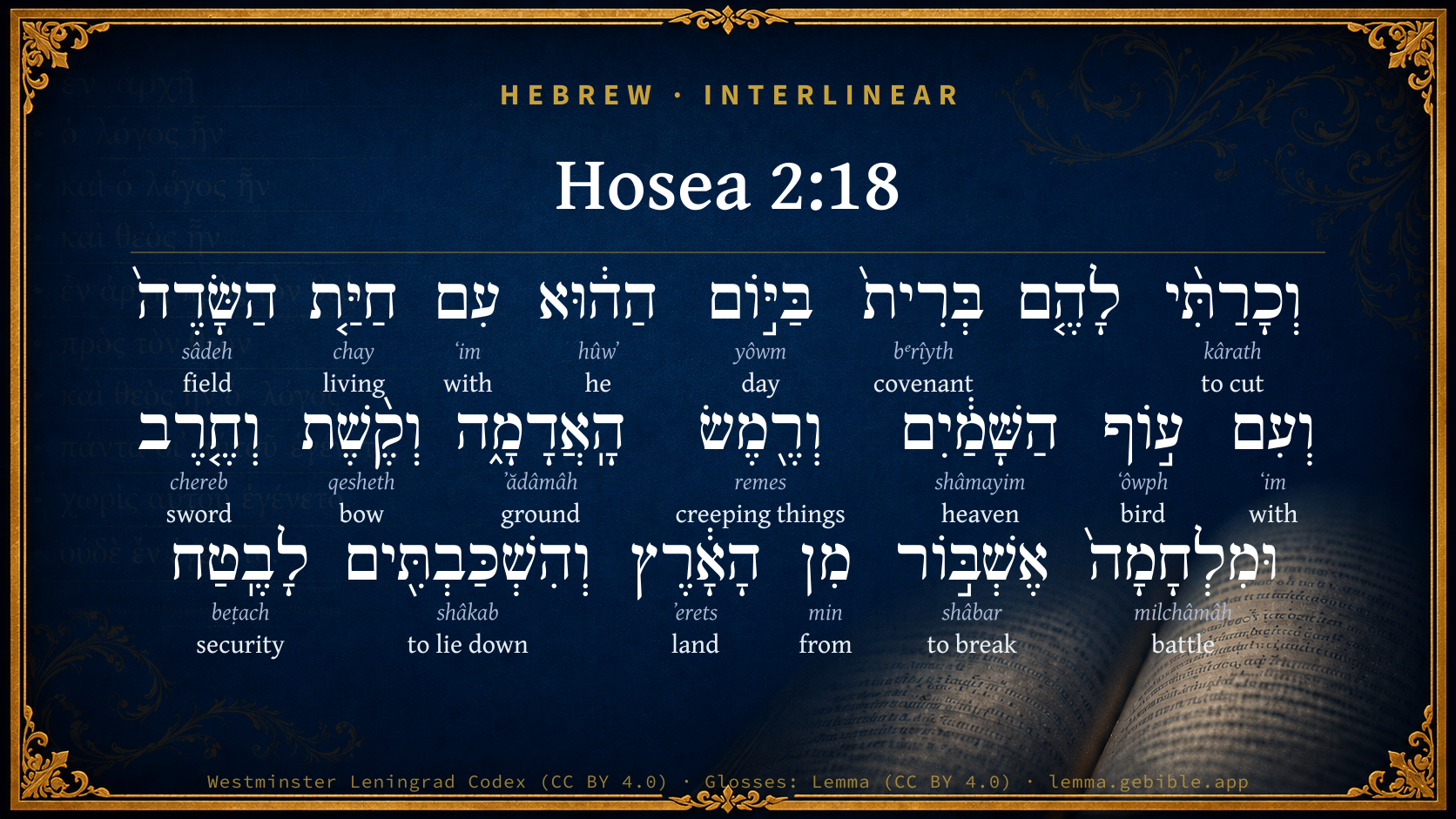
Hebrew (Westminster Leningrad Codex) Hosea 2:18 appears in the Hebrew Old Testament. The text above is from the Westminster Leningrad Codex. Each word links to its Strong’s number, a concise gloss, and parsing drawn from the Open Scriptures Hebrew Bible morphology. Click any word for its full Brown-Driver-Briggs (BDB) entry.
Download image
Cite this verse

Hosea 2:18 (World English Bible). Public Domain. Lemma interlinear Bible study tool, https://lemma.gebible.app/v/hosea/2/18.

Show BibTeX & RIS
BibTeX
RIS
English Translation
In that day I will make a covenant for them with the animals of the field, And with the birds of the sky, And with the creeping things of the ground. I will break the bow, the sword, and the battle out of the land, And will make them lie down safely.
World English Bible · Public Domain
Download a study sheet

One document with this verse’s original text, its word-by-word gloss line, the meaning frame, cross-references with their text, attributed commentary, and full source and license credits — printable, and it pastes into notes with its structure intact.

This verse Autodidact and up

Study sheet (.html) Plain text (.txt)

A passage Seminary Student

Up to 50 verses in one chapter. A passage sheet keeps up to 6 commentary sources and 12 cross-references per verse, in the order this page ranks them, and says so on the sheet whenever that leaves anything out. Ask for a single verse and you get the Autodidact verse sheet above.

Everything on this page stays free to read, with no account — the sheet is a download of what is already on screen, not access to it.

Want to remove ads? Support Godless Engineer
Compare translations 3

The same verse in 3 English versions, stacked beneath the original-language interlinear above. Click any original word for its lexicon entry.

Each is an independent rendering of the whole verse — the interlinear is not word-aligned to these translations.

Highlighted words mark where these versions differ — a whole-verse word diff, not a word-by-word alignment.

  • World English Bible Public Domain
    In that day I will make a covenant for them with the animals of the field, And with the birds of the sky, And with the creeping things of the ground. I will break the bow, the sword, and the battle out of the land, And will make them lie down safely.
  • King James Version Public Domain
    And in that day will I make a covenant for them with the beasts of the field and with the fowls of heaven, and with the creeping things of the ground: and I will break the bow and the sword and the battle out of the earth, and will make them to lie down safely.
  • unfoldingWord Literal Text CC BY-SA 4.0
    And I will cut a covenant for them on that day, with the beasts of the field, and with the birds of the heavens, and the creeping things of the ground. And bow and sword and battle I will break from the land, and I will make them lie down in safety.

unfoldingWord Literal Text — © unfoldingWord, licensed CC BY-SA 4.0. Word-aligned USFM3 via Door43 (git.door43.org/unfoldingWord/en_ult).

Versions to compare (up to 4)

3 of 4 selected

Show all 18 translations

Every available English version of this verse, each an independent rendering of the whole verse.

  • World English Bible Public Domain
    In that day I will make a covenant for them with the animals of the field, And with the birds of the sky, And with the creeping things of the ground. I will break the bow, the sword, and the battle out of the land, And will make them lie down safely.
  • Berean Standard Bible Public Domain
    On that day I will make a covenant for them with the beasts of the field and the birds of the air and the creatures that crawl on the ground. And I will abolish bow and sword and weapons of war in the land, and will make them lie down in safety.
  • Majority Standard Bible Public Domain
    On that day I will make a covenant for them with the beasts of the field and the birds of the air and the creatures that crawl on the ground. And I will abolish bow and sword and battle in the land, and will make them lie down in safety.
  • King James Version Public Domain
    And in that day will I make a covenant for them with the beasts of the field and with the fowls of heaven, and with the creeping things of the ground: and I will break the bow and the sword and the battle out of the earth, and will make them to lie down safely.
  • American Standard Version (1901) Public Domain
    And in that day will I make a covenant for them with the beasts of the field, and with the birds of the heavens, and with the creeping things of the ground: and I will break the bow and the sword and the battle out of the land, and will make them to lie down safely.
  • Revised Version (1885) Public Domain
    And in that day will I make a covenant for them with the beasts of the field, and with the fowls of heaven, and with the creeping things of the ground: and I will break the bow and the sword and the battle out of the land, and will make them to lie down safely.
  • Geneva Bible (1599) Public Domain
    And in that day wil I make a couenant for them, with the wilde beasts, and with the foules of the heauen, and with that that creepeth vpon the earth: and I will breake the bowe, and the sworde and the battell out of the earth, and will make them to sleepe safely.
  • Douay-Rheims (1899) Public Domain
    And in that day I will make a covenant with them, with the beasts of the field, and with the fowls of the air, and with the creeping things of the earth: and I will destroy the bow, and the sword, and war out of the land: and I will make them sleep secure.
  • Young's Literal Translation Public Domain
    And I have made to them a covenant in that day, with the beast of the field, And with the fowl of the heavens, And the creeping thing of the ground, And bow, and sword, and war I break from off the land, And have caused them to lie down confidently.
  • Literal Standard Version CC BY-SA 4.0
    And I have made a covenant for them in that day, || With the beast of the field, || And with the bird of the heavens, || And the creeping thing of the ground, || And bow, and sword, and war I break from off the land, || And have caused them to lie down confidently.
  • Unlocked Literal Bible CC BY-SA 4.0
    “On that day I will make a covenant for them with the beasts in the fields, with the birds in the sky, and with the crawling things on the ground. I will drive away the bow, the sword, and the battle from the land, and I will make you lie down in safety.
  • unfoldingWord Literal Text CC BY-SA 4.0
    And I will cut a covenant for them on that day, with the beasts of the field, and with the birds of the heavens, and the creeping things of the ground. And bow and sword and battle I will break from the land, and I will make them lie down in safety.
  • Darby Bible Public Domain
    And I will make a covenant for them in that day with the beasts of the field, and with the fowl of the heavens, and the creeping things of the ground; and I will break bow and sword and battle out of the land; and I will make them to lie down safely.
  • World Messianic Bible Public Domain
    In that day I will make a covenant for them with the animals of the field, and with the birds of the sky, and with the creeping things of the ground. I will break the bow, the sword, and the battle out of the land, and will make them lie down safely.
  • Webster's Bible Public Domain
    And in that day will I make a covenant for them with the beasts of the field, and with the fowls of heaven, and with the creeping animals of the ground: and I will break the bow and the sword and the battle out of the earth, and will make them to lie down in safety.
  • Free Bible Version CC BY-SA 4.0
    At that time I will make a solemn agreement with the wild animals and the birds of the sky and the creeping things of the ground. I will do away with the bow and the sword; I will abolish war from the land so you can lie down in safety.
  • Bible in Basic English Public Domain
    And in that day I will make an agreement for them with the beasts of the field and the birds of heaven and the things which go low on the earth; I will put an end to the bow and the sword and war in all the land, and will make them take their rest in peace.
  • JPS Tanakh (1917) Public Domain
    (2-20) And in that day will I make a covenant for them with the beasts of the field, and with the fowls of heaven, and with the creeping things of the ground; and I will break the bow and the sword and the battle out of the land, and will make them to lie down safely.

Literal Standard Version (2020), Covenant Press — licensed CC BY-SA 4.0. Text via the HelloAO Bible API (eBible.org). Unlocked Literal Bible (unfoldingWord) — licensed CC BY-SA 4.0. Text via the HelloAO Bible API (eBible.org). unfoldingWord Literal Text — © unfoldingWord, licensed CC BY-SA 4.0. Word-aligned USFM3 via Door43 (git.door43.org/unfoldingWord/en_ult). Free Bible Version, Dr. Jonathan Gallagher — licensed CC BY-SA 4.0. Text via the HelloAO Bible API (eBible.org).

Word by word

More ways to search: Search by grammar → Find every occurrence → Compare this word →

Practice this passage: Drill this verse → Learn its vocabulary →

וְרֶ֖מֶשׂ
remes
H7431
“and · creeping things of”
Conjunction + Noun, Common, Masculine, Singular, Construct
Part of Speech
Conjunction + Noun
Type
Common
Gender
Masculine
Number
Singular
State
Construct
Full BDB Definition

Origin: from H7430

TWOT: 2177a

creeping things, moving things, creeping organism - creeping things - gliding things (of sea animals) - moving things (of all animals)
  1. וְכָרַתִּ֨י kârath H3772 “and · to cut” Conjunction + Verb, Qal, Sequential Perfect, 1st Person, Common, Singular
  2. בְּרִית֙ bᵉrîyth H1285 “covenant” Noun, Common, Feminine, Singular, Absolute
  3. בַּיּ֣וֹם yôwm H3117 “in/at the · day” Preposition, Determined + Noun, Common, Masculine, Singular, Absolute
  4. הַה֔וּא hûwʼ H1931 “the · he” Particle, Definite Article + Pronoun, Personal, 3rd Person, Masculine, Singular
  5. עִם ʻim H5973 “with” Preposition
  6. חַיַּ֤ת chay H2416 “living of” Noun, Common, Feminine, Singular, Construct
  7. הַשָּׂדֶה֙ sâdeh H7704 “the · field” Particle, Definite Article + Noun, Common, Masculine, Singular, Absolute
  8. וְעִם ʻim H5973 “and · with” Conjunction + Preposition
  9. ע֣וֹף ʻôwph H5775 “bird of” Noun, Common, Masculine, Singular, Construct
  10. הַשָּׁמַ֔יִם shâmayim H8064 “the · heaven(s)” Particle, Definite Article + Noun, Common, Masculine, Plural, Absolute
  11. הָֽאֲדָמָ֑ה ʼădâmâh H127 “the · ground” Particle, Definite Article + Noun, Common, Feminine, Singular, Absolute
  12. וְקֶ֨שֶׁת qesheth H7198 “and · bow” Conjunction + Noun, Common, Feminine, Singular, Absolute
  13. וְחֶ֤רֶב chereb H2719 “and · sword” Conjunction + Noun, Common, Feminine, Singular, Absolute
  14. וּמִלְחָמָה֙ milchâmâh H4421 “and · battle” Conjunction + Noun, Common, Feminine, Singular, Absolute
  15. אֶשְׁבּ֣וֹר shâbar H7665 “to break” Verb, Qal, Imperfect, 1st Person, Common, Singular
  16. מִן min H4480 “from” Preposition
  17. הָאָ֔רֶץ ʼerets H776 “the · land” Particle, Definite Article + Noun, Common, Both, Singular, Absolute
  18. וְהִשְׁכַּבְתִּ֖ים shâkab H7901 “and · to lie down · them” Conjunction + Verb, Hiphil, Sequential Perfect, 1st Person, Common, Singular + Suffix, Personal, 3rd Person, Masculine, Plural
  19. לָבֶֽטַח beṭach H983 “to/for · security” Preposition + Noun, Common, Masculine, Singular, Absolute

About this verse

These counts appear in no published source. They are computed here, from the morphology-tagged text and Lemma’s own curated glosses. What Lemma adds →

21
words
19
distinct lemmas
Prophets
section

Notable vocabulary

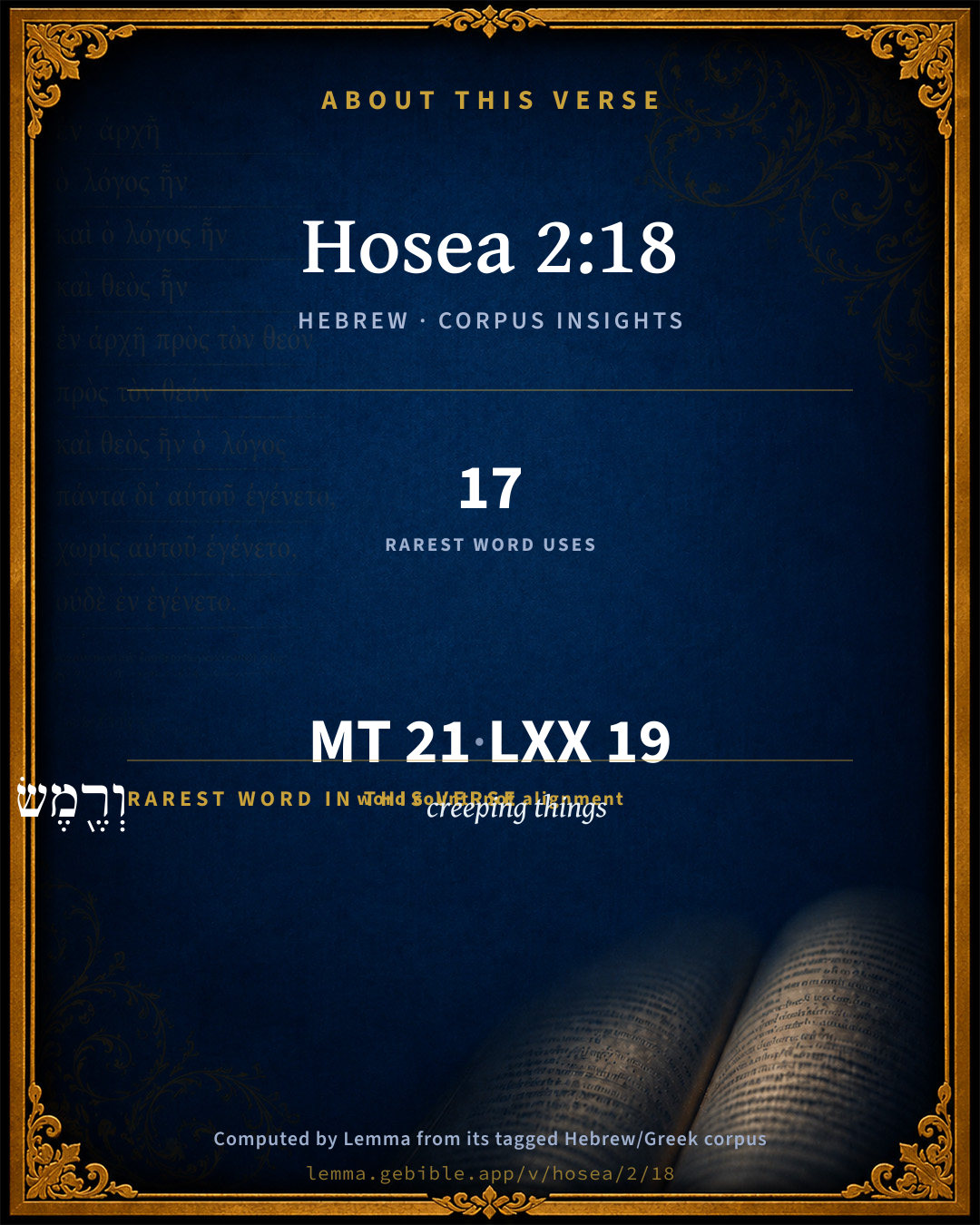
The rarest word here is וְרֶ֖מֶשׂ creeping things H7431 — appearing just 17 times in the whole Hebrew Bible.

Shared distinctive vocabulary

וְרֶ֖מֶשׂ creeping things H7431 occurs in 17 verses of the Hebrew Bible. Also found in:

Grammatical profile

  • 3 verbs
  • 13 nouns
  • 1 pronoun
  • 4 prepositions

Verb forms

  • וְכָרַתִּ֨י Qal · Sequential Perfect
  • אֶשְׁבּ֣וֹר Qal · Imperfect
  • וְהִשְׁכַּבְתִּ֖ים Hiphil · Sequential Perfect

Repetition

A word recurs within this verse — often emphatic in Hebrew:

Hebrew & Septuagint length

In English translation the verse runs 52 words from the Hebrew and 55 from the Septuagint (LXX English) — closely comparable.

A rough comparison of the two English renderings, which tokenize alike — not a word-level alignment.

Word counts can differ between the Hebrew and the Greek without any difference in meaning — e.g. the Hebrew direct-object marker אֵת has no separate Greek word, and Greek often adds the article ὁ.

In the original languages it is 21 Hebrew tokens and 19 Greek tokens — but the two are counted differently (Hebrew bundles its prefixes and suffixes into one token; the Greek is in lemma form), so that isn’t a like-for-like length.

Cross-references

22

Topical passages linked to Hosea 2:18 in the Treasury of Scripture Knowledge — connected by theme and wording, ordered by reader-vote popularity; previews shown in the World English Bible.

  • Ezekiel 34:25 I will make with them a covenant of peace, and will cause evil animals to cease out of the land; and they shall dwell securely in the wilderness, and sleep in the woods.
  • Ezekiel 39:9–10 Those who dwell in the cities of Israel shall go forth, and shall make fires of the weapons and burn them, both the shields and the bucklers, the bows and the arrows, and the war clubs, and the spears, and they shall make fires of them seven years;
  • Psalms 46:9 He makes wars cease to the end of the earth. He breaks the bow, and shatters the spear. He burns the chariots in the fire.
  • Isaiah 11:6–9 The wolf shall dwell with the lamb, and the leopard shall lie down with the kid; and the calf and the young lion and the fattened calf together; and a little child shall lead them.
  • Isaiah 2:4 He will judge between the nations, And will decide concerning many peoples; And they shall beat their swords into plowshares, And their spears into pruning-hooks. Nation shall not lift up sword against nation, Neither shall they learn war any more.
  • Isaiah 65:25 The wolf and the lamb shall feed together, and the lion shall eat straw like the ox; and dust shall be the serpent's food. They shall not hurt nor destroy in all my holy mountain, says Yahweh.
  • Jeremiah 23:6 In his days Judah shall be saved, and Israel shall dwell safely; and this is his name by which he shall be called: Yahweh our righteousness.
  • Job 5:23 For you shall be in league with the stones of the field. The animals of the field shall be at peace with you.
  • Psalms 91:1–13 He who dwells in the secret place of the Most High Will rest in the shadow of the Almighty.
  • Micah 4:3–4 And he will judge between many peoples, And will decide concerning strong nations afar off. They will beat their swords into plowshares, And their spears into pruning hooks. Nation will not lift up sword against nation, Neither will they learn war any more.
  • Zechariah 14:9 Yahweh will be King over all the earth. In that day Yahweh will be one, and his name one.
  • Leviticus 26:5–6 Your threshing shall reach to the vintage, and the vintage shall reach to the sowing time; and you shall eat your bread to the full, and dwell in your land safely.
  • Psalms 23:2 He makes me lie down in green pastures. He leads me beside still waters.
  • Isaiah 2:11 The lofty looks of man will be brought low, The haughtiness of men will be bowed down, And Yahweh alone will be exalted in that day.
  • Isaiah 2:17 The loftiness of man shall be bowed down, And the haughtiness of men shall be brought low; And Yahweh alone shall be exalted in that day.
  • Isaiah 26:1 In that day shall this song be sung in the land of Judah: we have a strong city; salvation will he appoint for walls and bulwarks.
  • Jeremiah 30:10 Therefore don't you be afraid, O Jacob my servant, says Yahweh; neither be dismayed, Israel: for, behold, I will save you from afar, and your seed from the land of their captivity; and Jacob shall return, and shall be quiet and at ease, and none shall make him afraid.
  • Jeremiah 33:16 In those days shall Judah be saved, and Jerusalem shall dwell safely; and this is [the name] by which she shall be called: Yahweh our righteousness.
  • Zechariah 2:11 Many nations shall join themselves to Yahweh in that day, and shall be my people; and I will dwell in the midst of you, and you shall know that Yahweh of Hosts has sent me to you.
  • Zechariah 3:10 In that day,' says Yahweh of hosts, 'you will invite every man his neighbor under the vine and under the fig tree.'"
  • Zechariah 14:4 His feet will stand in that day on the Mount of Olives, which is before Jerusalem on the east; and the Mount of Olives will be split in two, from east to west, making a very great valley. Half of the mountain will move toward the north, and half of it toward the south.
  • Zechariah 9:10 I will cut off the chariot from Ephraim, And the horse from Jerusalem; And the battle bow will be cut off; And he will speak peace to the nations: And his dominion will be from sea to sea, And from the River to the ends of the earth.

Cross-references courtesy of OpenBible.info (CC BY 4.0).

Hebrew and Greek witnesses Masoretic Hebrew ↔ Greek Septuagint

The same verse in the two great witnesses to the Old Testament, shown verse-for-verse.

These are two independent witnesses, not word-aligned to each other, and the Septuagint is shown in lemma (dictionary) form.

Hebrew Hosea 2:18 Masoretic · Westminster Leningrad Codex

וְכָרַתִּ֨י לָהֶ֤ם בְּרִית֙ בַּיּ֣וֹם הַה֔וּא עִם חַיַּ֤ת הַשָּׂדֶה֙ וְעִם ע֣וֹף הַשָּׁמַ֔יִם וְרֶ֖מֶשׂ הָֽאֲדָמָ֑ה וְקֶ֨שֶׁת וְחֶ֤רֶב וּמִלְחָמָה֙ אֶשְׁבּ֣וֹר מִן הָאָ֔רֶץ וְהִשְׁכַּבְתִּ֖ים לָבֶֽטַח

In that day I will make a covenant for them with the animals of the field, And with the birds of the sky, And with the creeping things of the ground. I will break the bow, the sword, and the battle out of the land, And will make them lie down safely.

World English Bible · Public Domain

Greek LXX Hosea 2:18 Septuagint · lemma form

καί εἰμί ἐν ἐκεῖνος ὁ ἡμέρα λέγω κύριος καλέω ἐγώ ὁ ἀνήρ ἐγώ καί οὐ καλέω ἐγώ ἔτι βααλιμ

And I will make for them in that day a covenant with the wild beasts of the field, and with the birds of the sky, and with the reptiles of the earth: and I will break the bow and the sword and the battle from off the earth, and will cause you to dwell safely.

LXX2012 (modern English Septuagint) · Public Domain

Hebrew: Westminster Leningrad Codex (CC BY 4.0). Greek: Septuagint (public domain); English from LXX2012 (modern English Septuagint) (Public Domain). How the Septuagint differs from the Hebrew →

Targum (Aramaic paraphrase)

1

The Targum is the ancient Jewish Aramaic paraphrase of the Hebrew Scriptures — an interpretive translation, not the Hebrew text itself. Onkelos (literal) and Pseudo-Jonathan (expansive) render the Torah, and Jonathan the Prophets. Coverage is partial: where no permissively-licensed English translation exists for a verse, only the Aramaic is shown. This is verse-level text, not a word-by-word alignment to the Hebrew.

  1. Targum Jonathan Prophets (Joshua–Malachi)
    וִיהֵי בְּעִדָנָא הַהִיא אֲמַר יְיָ תִּתְנְהוֹן לְפוּלְחָנִי וְלָא תִפְלְחוּן עוֹד לְטַעֲוַת עַמְמַיָא:

    (no public-domain English translation for this verse)

    Targum Jonathan — Aramaic: “Mikraot Gedolot” (public domain). English: “Sefaria Community Translation” (CC0 1.0 (public-domain dedication)); “London "Chaldee Paraphrase," 1871” (public domain). Text via Sefaria.

Commentary

Notes on Hosea 2:18 from classic Christian and Jewish commentators (each source and its license shown beneath its notes). The classic Christian expositions comment on the surrounding passage and are grouped to its opening verse, so a note may address several verses; the Jewish commentaries on the Tanakh (Rashi and others) are per-verse, so they appear only where the commentator wrote on this verse.

Lemma curates 59 commentaries, every one of them public domain or Creative Commons licensed, each selected and text-cleaned for this edition rather than reprinted as found. About our sources →

Trapp's Complete Commentary

John Trapp

Hos 2:18 And in that day will I make a covenant for them with the beasts of the field, and with the fowls of heaven, and [with] the creeping things of the ground: and I will break the bow and the sword and the battle out of the earth, and will make them to lie down safely.

Ver. 18. And in that day will I make my covenant for them with the beasts, &c.] At the first creation all things were subject to man on this condition that he should be subject to his Maker as his master. Rebellis autem facta est quia homo numini, creatura homini (Augustin). But no sooner did man rebel against God but the creature began to rebel against him. Look how a nobleman’s servants wilt draw in defence of their lord, and soldiers fight for their general: so here, God is Lord of hosts. "They continue this day according to thine ordinance" (and fight in their courses, Jdg 5:20), "for they are all thy servants," Psa 119:91; ready pressed they are to seize a sinner, and to do execution upon him, as a traitor, and rebel to the highest majesty: as the sword that Hector gave Ajax turned into his own bowels, when once he began to abuse it to the hurt of hurtless creatures. Now here God promiseth to abolish that enmity, to make peace, even pacem omnimodam, peace, peace, as the prophet Isaiah hath it, Isa 26:8, a multiplied peace, a perfect, sheer, pure peace with God, with themselves, with all creatures; and to restore them in Christ that dominion they once had over the works of his hands, Psa 8:6 Heb 2:7, yea, power over all nations, Rev 2:26, with a promise that all shall work together for their good, Rom 8:28, and they shall be fully freed, if not from the smart, yet from the hurt of every creature. Compare Eze 34:25 Job 5:23 Isa 11:6-7, where the prophet seemeth to allude to the carriage of the beasts in Noah’s ark, all bloodiness and rapine laid aside. The Jews foolishly argue, from these texts, that Christ is not yet come, because the lion yet rageth, the wolf devoureth, serpents yet sting, and spare not the beast. And some interpreters of ours are of the opinion, that these promises shall be literally fulfilled at the restitution of all things, which they make to be at the time of the call of the Jews. But when I find Nebuchadnezzar and other enemies of the Church to be called lions, leopards, wolves, &c., as Jer 5:6, and elsewhere, I cannot but think that these might be here meant, in part at least, ponentque ferocia Poeni cords volente Deo (Virg.); according to Peter’s vision, Act 10:10-16, and that God will so meeken the spirits of his converts, that they shall not hurt nor destroy in all his holy mountain, Isa 11:9. The literal sense is very good, I grant; but yet it is still to be taken (as all such promises are), 1. with exception of the cross here, 2. with expectation of the full accomplishment hereafter, in the state of perfection.

And I will break the bow, and the sword, and the battle out of the earth] These words seem to be opposed to that threat, Hos 1:5, "I will break the bow of Israel," &c. And it is as if he should say, After that I have broken their power, and tamed their pride by the enemies’ forces, then I wiI1 punish those enemies, and so take order with them, that they shall not hurt my people by any of their hostilities. Lo, peace is a piece of God’s covenant; and covenant mercies are very sweet, when all the paths of the Lord are mercy and truth, Psa 25:10; not mercy only, but truth too, that comes by virtue of a covenant. Mark what God saith to Abraham, Gen 17:20-21; I have blessed Ishmael; twelve princes shall he beget: but my covenant will I establish to Isaac. And in the same chapter, divines observe, that in ten verses thereof God repeateth his covenant which he made with Abraham thirteen times, to note thus much, that that was the mercy indeed that must satisfy Abraham in all his troubles, sorrows, and afflictions: for the covenant of God’s peace shall not be removed, no, not "when the mountains shall depart and the hills be removed," Isa 54:10. "The Lord will give strength to his people; the Lord will bless his people with peace," Psa 29:11.

And will make them to lie down safely] Being gathered under my wings, they shall repose themselves upon my power and providence, committing themselves to me in well doing. All true and solid security, whether inward or outward; all true peace, whether of country or of conscience, floweth from God’s favour. Psa 3:3-8; Psa 4:1-8 Hence the apostle wisheth grace and peace, and the angels sang, "Glory be to God on high, and peace on earth," even the peace of goodwill toward men, the goodwill of him that dwelt in the bush, Eph 1:2 Luk 2:14 Deu 33:16. "The Lord is with me," saith David, "I will not fear what man can do unto me." I will sleep and wake, and wake and sleep again; for the Lord sustaineth me, Psa 4:8. No wonder I slept so soundly and safely (said King Philip) when Antipater watched me. Abner watched not so well, when David fetched away Saul’s spear and pitcher, and was barely told of it. Ishbosheth was slain while he slept. The saints go ever under a double guard, the peace of God within them, and the power of God without them, and may therefore, in utramque aurem dormire, lie down safely, {see Jer 23:6} call their souls to rest, Php 4:7 1Pe 1:5 Lev 26:5 Psa 116:7.

John Trapp, A Commentary or Exposition upon All the Books of the Old and New Testament (1647–1656) — public domain. Text from a community e-Sword module.

The Biblical Illustrator

Joseph S. Exell

Hos_2:18-19

And in that day will I make a covenant for them with the beasts of the field.

The covenant of outward peace

Gods favour and covenant shall secure them from hurt by any of the creatures, and shall give them peace and security from wars. Doctrine--

1. All the creatures of God are justly at enmity with man, and armed against him, so long as he is not reconciled to God their Creator.

2. Reconciliation with God brings peace with all the creatures, so far as is for the reconciled mans good.

3. That which secureth the godly man from trouble from the creatures, is Gods dominion over all of them.

4. As peace and deliverance from war is a great blessing, so it is the Lord only who puts an end to war and giveth peace.

5. When a people study reconciliation with God, and are cordial in following a thorough reformation, they are in Gods way for obtaining outward peace.

6. When the Lord hath given peace, it is He only who must maintain it, and can give quietness of mind to make people enjoy quietness and tranquillity by it. Unless He giveth peace, outward tranquillity will not afford it; and if He give that, we have no cause to complain, though we be in the midst of trouble. (George Hutcheson.)

The restored order of nature

We now perceive the intention of the prophet. He reminds the Israelites that all things were adverse to their safety as long as they were alienated from God; but that, when they returned into favour with Him, this disorder, which had for a time appeared, would be no longer; for the regular order of nature would prevail, and brute animals would suffer themselves to be brought into obedience. (John Calvin.)

The promise of peace

I. Peace with the creatures.

1. Sin has caused enmity between man and the creatures.

2. Peace with God brings peace with the creatures.

3. Covenant mercy is excellent mercy indeed. Two things observable in mercies coming by covenant. They are more sweet. They are more firm.

4. If it is such a blessed thing for God to make a covenant with the beasts for us, what a mercy is it then for God to make a covenant with our souls.

5. Is it a mercy for God to make a covenant with the beasts for His people? then what a mercy it is for Him to make a covenant with His Son for His people.

II. Deliverance from the hostility of adversaries.

1. It is a great mercy to have the bow and the sword broken. It is a part of the covenant that God makes with His people, to take away the instruments of hostility.

2. Peace is a most amiable thing, and lovely in all our eyes, every man desires it, and God promises it to His people in many places as a most special fruit of His love. The shining of Gods face appears in the giving of peace to a nation.

3. Peace is a sweet mercy, therefore it is a pity that it should be abused, and not improved.

4. Peace is sweet, therefore not to be falsified.

5. Peace is a great blessing, therefore it is a pity not to endeavour by every means to attain it. Cursed be that war which has not peace for its end.

6. Peace is a great blessing from God, but we must take heed we buy it not too dear. And you buy peace too dear, if you sell truth for it: if you betray those who have been most active for the public good if, through desire of peace, you subject yourselves to tyranny or slavery.

7. Peace is Gods peculiar work; we may treat about peace, but until God is pleased to permit it, it will not ensue,

8. Thorough reformation is the way to procure peace.

III. The effects of this peace. I will make them to lie down safely.

1. Gods peace alone brings safety.

2. To lie down safely is Gods own gift to His people.

It is an additional blessing to having the sword and bow broken. (Jeremiah Burroughs.)

The sublime privileges of the good

I. Inferior creatures might be divinely restrained from injuring them. Were man to possess and manifest the moral majesty of goodness, the wildest and most savage creatures would probably stand in awe of him.

II. Human enemies might be made to submit to them. Those who trust in the Lord need not be afraid of war. The spirit of the good man is to overcome evil with good.

III. They might enjoy a perfect security. The true safety is not the mere safety of the body. The body is not the man, it is his--not him. Soul-safety is the safety of the man--protection from all that is unholy in thought, impure in feeling, unrighteous in volition.

IV. They might enjoy vital union with the everlasting fountain of goodness. Here is union indeed! Represented by that of husband and wife; a union formed of immutable ties. Righteousness, judgment, loving-kindness, faithfulness--who can break these bonds? Learn the supreme importance of moral goodness to man. (Homilist.)

And I will betroth thee unto Me for ever.

The everlasting espousals

Betrothing or espousing was the bridegrooms taking the bride into a marriage-covenant. It was done publicly before witnesses, under a canopy or tent set up for that purpose. Some competent time intervened betwixt the espousals and the solemnising and consummating of the marriage. Infidelity during espousals was reputed and punished as adultery. Whomsoever Christ espouseth to Himself, He espouseth for ever.

I. Sinners may be espoused to Christ. As to the nature of the espousals. The parties are pleased with one another. As Christ left His Fathers house for her, she gives up her own people and her fathers house for Him. The glorious Bride-grooms consent to be her husband she finds in the word, which the Spirit applies to her, and which she by faith applies to herself. Sinners may be espoused to the Son of God.

1. This match was from eternity projected and concluded in the cabinet-council of the Trinity.

2. The Bridegroom and all His relations are well pleased with the match.

3. The lawful impediments of this match are all removed at the Bridegrooms expenses and pains.

4. The marriage contract is drawn up already and signed by the Bridegroom.

5. The proxies for the Bridegroom are sent forth to make suit for sinners their consent to be espoused to Him.

6. The Bridegroom has already put on His marriage robes.

7. The wedding garment for the bride is ready, being purchased at the expense of the Bridegroom.

8. The tent for the espousals is set up, even the Church.

9. The feast and seal of the espousals, namely, the holy sacrament, is ready, that the espoused bride may feast and rejoice in her Lord and husband.

10. Here are witnesses now. Here are the friends of the Bridegroom to bear witness to the espousals.

II. The perpetuity and everlastingness of this marriage covenant.

1. The espousals are for ever in design. Among men espousals are only for term of life. Christ takes the sinner with a design to be that sinners husband from the moment of the espousals for ever: and His designs are immovable as mountains of brass. He takes her with the fixed purpose never to put her away while she desires to abide with Him: never indeed to part with her, though she should desire to go away. The soul consenting to the espousals takes Christ with a design to be His spouse for ever.

2. The espousals are for ever, in fact.

(1) It is everlasting without interruption. Espousals stand firm in the case of the adversity of either party; in the case of the advancement of either party; in the case of desertion on either side.

(2) It is everlasting without expiring, either at death, or at the worlds ending. (T. Boston, D. D.)

The spirit of the Lords espousals

He declares by what means He would betroth them to Him for ever; even in righteousness and judgment, and then in kindness and mercies, and then in faithfulness.

1. God had indeed from the beginning covenanted with the Israelites in righteousness and judgment; there is nothing disguised or false in His covenant. As then God had in sincerity adopted the people, to what vices does He oppose righteousness and judgment? I answer, These words must be applied to both the contracting parties; then by righteous ness God means not only His own, but that also which is, as they say, mutual and reciprocal; and by righteousness and judgment is meant rectitude, in which nothing is wanting.

2. In kindness and mercies. By these words He intimates that though the people were unworthy, yet this would be no impediment in their way to prevent them to return into favour with God; for in this reconciliation God would regard His own goodness rather than the merits of His people.

3. In faithfulness. This confirms the fixed and unchangeable duration of the marriage. By faithfulness is to be understood that stability of which I have spoken; for what some philosophise on this expression is too refined, who give this explanation, I will espouse thee in faith, that is, by the Gospel. For we embrace Gods free promises, and thus the covenant the Lord makes with us is ratified. I simply interpret the word as denoting stability. (John Calvin.)

The wooing and the wedding

That is a tenderly beautiful figure; surely one of the sweetest and most exquisite in Gods Word! I will betroth thee unto Me for ever! The communion of ideal wedlock is used to express the ideal relationship between the soul and the Lord. We are to be married unto the Lord! Look into the heart of it, and see how much the gracious figure reveals. What do we find in consecrated wedlock even along the planes of common life? Let me lift out some of its contents. There is an affection which is creative of sweet and fruitful repose. There is a perfect trust which is the minister of mutual revelation. There is a sensitive sympathy in which all secrecy is destroyed. There is an intercourse which is like a sea of glass mingled with fire, so crystalline is its purity, so warm and genial is its tone. There is a large companionship, whose commerce consists of the deepest and wealthiest treasures of the life. In ideal wedlock deep calleth unto deep, and the primary springs of the beings are in confluence. All this I find in sanctified marriage: and now the figure is lifted up and sublimed and used to interpret my possible relationship to God: Thy Maker is thine husband. I will betroth thee unto Me for ever. Then there is to be a wedding! There is to be a wedding of the soul and its Saviour, of the nation and its King. That wedding constitutes the summum bonum both of personal and of corporate life. That wedding is the crown and consummation of human blessedness. That wedding enshrines the secret of moral and spiritual growth. To bring that wedding about is the aim and purpose of every kind and type of Christian ministry. What is the kind of wooing that will lead to a wedding? Let me begin here.

I. He is not a far-away Saviour; His home is on earth. I do not think we greatly help the cause of the Lover by proclaiming the remoteness of the Lovers home.

Theres a Friend for little children

Above the bright blue sky.

That is the only line I dont like in that greatly beloved and very beautiful hymn. In my childhood it helped to make my Saviour an absentee, and He was above the bright blue sky when I wanted Him on the near and common earth. Destroying all sense of remoteness, we must labour to bring the children into the immediate presence of the Lover Himself. All the three attributes must be regarded in indissoluble union. The quality of each depends upon the presence of all. Strike out one, and you maim and impoverish the rest. There is an imperfect love in which there is no admiration. There is an imperfect admiration in which there is no love. Perfect love admires; perfect admiration loves; and love and admiration are ever associated with the gracious spirit of hopeful aspiration. These three, I say, constitute the very marrow of life, the deep secret springs of character and conduct. We live by admiration, hope, and love. If the great Lover can win these, the wooing will be followed by the wedding! How can we so represent Him that this triumph shall be won?

1. Present the approachable Jesus. But not only His simplicity must we reveal, but His sympathy too!

2. Present Jesus the Hero. We live by love. By admiration, too! Thou art worthy, O Christ, to receive all honour and glory.

3. Loving! Admiring! These fair dispositions will be assuredly associated with the beautiful genius of hope.

II. Wooing and living must go together. What more shall we say about ourselves? Let this be said: While we are employed in wooing do not let us be heedless as to the manner of our living. Those who woo for the Master must be careful how they live. Let us distinguish between a wedding and a funeral, and in our wooing let it be tire wedding-bells which lend their music to our speech.

III. When shall we begin the wooing? John Ruskin said: When do you suppose the education of a child begins? At six months old it can answer smile with smile, and impatience with impatience. Perhaps we have to begin the wooing even in the speechless years. In the life of the spirit I believe in early wooings because I believe in early weddings! As for the wedding itself, the betrothal to the Lord, I would have it a very decisive act. It must be a conscious, intelligent consecration. The vow must not be made in thoughtlessness; not in any bewildering and sensational transports. In the rapture there must be the moderating presence of serious and illumined thought. (J. H. Jowett, M. A.)

The betrothment of the Church

There is no real or substantial happiness for the soul unless it is really united to Jesus Christ our Lord by faith. Betrothing was considered exceedingly sacred; and parents supposed that what they did on earth God ratified in heaven.

I. The betrothing, or engaging, is for ever. There is no separation of the parties here, from any cause. No offence can possibly arise, be given or be taken, so as to separate the Church from its Head. No other lover can possibly steal away the affections of believers from Jesus Christ. There are many compacts made between man and man, but time breaks them all. Here is a covenant which time cannot break. God has entered into covenant with Jesus Christ on the part of the Church, and Christ has undertaken to preserve them during the existence of time. But is it not possible for sin to separate? No, not as touching eternity.

II. This betrothing is in righteousness. Justice, or righteousness, is that perfection of God, whereby He is disposed to render every man his due. All His proceedings are in perfect equity. There is no part of our eternal salvation which is in opposition to the essential righteousness of God.

III. This betrothing is in judgment. That is, with judgment, not with precipitancy. The Most High will not act in anything rashly, but in a judicious, proper, righteous way: He does not save our souls as a manifestation of His mercy, at the expense of His righteousness. It signifies also the satisfaction of Gods justice, and it includes the exercise of His mercy.

IV. This betrothal is in faithfulness. Look at the faithfulness of Christ, or of God in Christ. Faithfulness to covenant and promises.

V. This betrothal is in loving-kindness and in mercies. Consider a few of them.

1. The revelation of God contained in the Bible.

2. The love of Jesus Christ our Lord.

3. The gift of the Holy Spirit.

4. The hope for the hereafter.

VI. The results. Thou shalt know the Lord. Thou shalt know that God hath from eternity chosen thee as a vessel of mercy. Thou shalt know Him as thy great Creator, thy Preserver, thy Redeemer, etc. (T. Bagnall-Baker, M. A.)

The threefold betrothal

At three times especially did our Lord espouse the Church unto Himself. First, in His Incarnation, when He willed to unite His own Deity with our humanity. He will be for ever the Word and Flesh, that is, God and Man. Secondly, in His Passion, when He washed her with His blood, and bought her for His own by His death. Thirdly, in the day of Pentecost, when He poured out the Holy Spirit upon her, whereby He dwelleth in her and she in Him. Knowing God is to know by experience that God is good; and that God makes known to the soul which He loves, while it meditates on Him, reads of Him, speaks to Him, adores Him, obeys Him. The knowledge cometh from the revelation of the Father, and it is true bliss. (E. B. Pusey, D. D.)

The great betrothal

The Scripture often mentions espousals and marriage to express the great mystery of the grace of God to His people. The Holy Ghost seems to delight much in this allegory: there is none more frequent in Scripture, and it sheds very great honour on the married state. Married people should so live, that all who behold the sweetness, the happiness of their lives, may be reminded thereby of the sweetness and happiness which is in the Churchs communion with Jesus Christ. Now, in a married condition there are these four things most remarkable.

1. There is the nearest possible union. They twain shall be one flesh.

2. In nothing in the world is there so full a communication of one creature to another as in marriage; so in our spiritual marriage with Christ there is a most intimate communion.

3. In a married condition, there is a mutual, entire love. That is, loving the person more than the benefits received from him. True love can be satisfied with nothing else but love. Entire love is a love in all conditions. In love there is unspeakable delight.

There are two soul-staying and soul-satisfying grounds to assure of Christs betrothing Himself for ever.

1. When a soul is taken into Christ, it receives not only pardon for sins past, but there is forgiveness in store for all future transgressions.

2. Another argument for perseverance is, that it is a spiritual mercy purchased by Christ, as well as any other grace. (Jeremiah Burroughs.)

Gods love

Many a heart has been touched by that strange story of love of which Tennyson has written with so much tenderness. The Lord of Burleigh, disguised as a poor landscape painter, was captivated by the beauty of a humble village maiden, and determined to make her his bride. But introduced to a mansion instead of a cottage, borne down by the burden of an honour to which she was never born, the loved one pined away and died. The beauty of the bride explains this story of love; but no such explanation can be found for the choice of Him who says: I will betroth thee unto Me for ever, etc. (Hos_2:19-20). This betrothed one had nothing to commend her to the notice of such a Bridegroom but her helplessness, her deformity, her wretchedness. There was no beauty in her that He should desire her, She was a rebel, an alien, an outcast; yet, marvel of marvels, the Prince of the kings of the earth set His love upon her. He became poor that she might become rich. He bore her sin that she might bear His righteousness. He bore her reproach that she might bear His glory. He gave Himself for her because no less gift would suffice to lift her from sin and place her at His side. We search in vain for a story of love like this. It is unique, and we think of it till, with tear-filled eyes and trembling voice, we sing--

Jesus, Thy boundless love to me

No thought can reach, no tongue declare.

(J. Gregory Mantle.)

The Biblical Illustrator, edited by Joseph S. Exell (c. 1880s–1900s) — public domain. Text from a community e-Sword module.

Joseph Benson's Commentary

Hos 2:18. And in that day will I make a covenant for them with the beasts of the field, &c. — That is, a covenant of security from the evils which, in the days of my vengeance, arose from beasts, and birds of prey, and venomous creatures. Or the words may be understood figuratively, of the final conversion of the most ignorant and vicious of the heathen to the true faith; the effect of which will be, that they shall live in peace and friendship with the re-established nation of the Jews. In this sense the passage is understood by Bishop Horsley. And I will break the bow, &c. — I will cause that there shall be no more wars, either foreign or domestic. A universal peace, and freedom from all enemies, is mentioned by the prophets, as a concomitant of that flourishing state of the church which shall commence at the restoration of the Jews, and the coming in of the Gentiles: see Isa 11:6-7. And will make them to lie down safely — Being gathered under the wings of my protection, they shall repose themselves upon my power and providence, committing themselves to my care in well doing. Observe, reader, all true and solid security, all real peace, whether inward or outward, flows from God’s favour.

Joseph Benson's Commentary on the Old and New Testaments (1811–1818) — public domain. Text from a community e-Sword module.

Whedon's Commentary on the Bible

Daniel D. Whedon

18-23. Picture of the ideal future to be realized by the restored wife. Hos_2:18 speaks of permanent peace, undisturbed by man and beast.

Covenant — Requires two parties, who take upon themselves mutual obligations; here the emphasis is upon the obligation laid by Jehovah upon the beasts to abstain from injuring men.

Beasts of the field — These do damage to field and crop, and even to men (Hos_2:12).

For them — For their good. Fowls [“birds”] — Must refer chiefly to birds of prey.

Creeping things — Again especially those hostile to man and his possessions. The conditions enjoyed in the Garden of Eden will be restored. A similar hope is expressed in Isa_11:6-9. Both passages are to be interpreted as poetic presentations of the truth that the regeneration of human society is to be accompanied by a restoration of the harmony of creation (Rom_8:19-22). That this will be fulfilled in a broad sense is certainly to be expected. To what extent a literal fulfillment will take place, or whether the prophet expected a literal fulfillment in every detail, is uncertain. A somewhat different expectation is expressed in Eze_34:25. Why the reference to birds and creeping things should be considered a later insertion is not clear.

Bow… sword — The war implements of Israel’s enemies will be broken; the result will be a cessation of troublesome wars.

Out of the earth — Better, R.V., “land,” that is, of Israel.

Safely — Nothing will mar the God-given peace.

Hos_2:19-20 describe the complete restoration of Israel to its former relationship with Jehovah; the new union will be more permanent and spiritual. The picture is that of a pure, inviolable betrothal covenant of love. The initiative throughout is taken by Jehovah.

Betroth thee — Repeated three times for emphasis. The former union was completely dissolved by the wife’s adulteries. A second marriage had to be preceded by a new betrothal.

For ever — Implies a transformation in the bride, who had broken the former covenant; she will do so no more (Isa_54:8-10; Eze_16:60). The attributes enumerated form a bond of union between Israel and Jehovah. That these attach only to Jehovah’s part in the transaction is not true; they are rather the “future adornment of the bride through which such a complete and lasting union is brought about.” Certainly the manifestation of the same virtues on the part of Jehovah is implied, since in man they are only a reflection of the character of God. It was the lack of these very virtues that brought about the break (Hos_4:1 ff; Hos_5:11; Hos_6:4-5, etc.).

Righteousness — Subjective righteousness; the right state of mind and heart. Judgment [“justice”] — Frequently connected with the preceding; it marks the objective side of the same; conduct in accord with a right attitude of mind and heart.

Loving-kindness — A favorite word with Hosea; is used to express (1) the loving attitude of Jehovah to his people; (2) the loving attitude of the people toward Jehovah; and (3) man’s loving attitude toward his fellows as a reflection of the divine love. The third idea seems most prominent here (Hos_4:1; Hos_6:4; Hos_6:6; Hos_10:12; Hos_12:6; compare Mic_6:8). G.A. Smith renders “leal love,” because the Hebrew words “means always not merely an affection, but a relation loyally observed.”

Mercies — Compassion for the helpless and undeserving.

Faithfulness — The same word is translated in Hab_2:4,”faith” (see comment there).

Thou shalt know Jehovah — In general it may be said that Hosea and the other prophets taught that the real secret of the nation’s sin was an absence of the true knowledge of Jehovah. On the other hand, a moral transformation presupposes a knowledge of Jehovah, not purely intellectual, but based on a living experience. This latter will be the possession of Israel. (Compare Methodist Review, July-August, 1904, pp. 579ff.)

Daniel D. Whedon (gen. ed.), Commentary on the Old and New Testaments (1874–1909) — public domain. Text from a community e-Sword module.

Keil & Delitzsch

C. F. Keil & F. Delitzsch

With the complete abolition of idolatry and false religion, the church of the Lord will attain to the enjoyment of undisturbed peace. Hos 2:18. "And I make a covenant for them in that day with the beasts of the field, and the fowls of heaven, and the moving creatures of the earth: and I break in pieces bow, and sword, and battle out of the land, and cause them to dwell securely." God makes a covenant with the beasts, when He imposes the obligation upon them to hurt men no more. "For them:" lâhem is a dat. comm., for the good of the favoured ones. The three classes of beasts that are dangerous to men, are mentioned here, as in Gen 9:2. "Beasts of the field," as distinguished from the same domestic animals (behēmâh), are beasts that live in freedom in the fields, either wild beasts, or game that devours or injures the fruits of the field. By the "fowls of heaven," we are to understand chiefly the birds of prey. Remes does not mean reptiles, but that which is active, the smaller animals of the land which move about with velocity. The breaking in pieces of the weapons of war and of battle out of the land, is a pregnant expression for the extinction not only of the instruments of war, but also of war itself, and their extermination from the land. Milchâmâh, war, is connected with shâbhar per zeugma. This promise rests upon Lev 26:3., and is still further expanded in Eze 34:25. (Compare the parallels in Isa 2:4, Isa 2:11; Isa 35:9, and Zac 9:10.)

Keil & Delitzsch — Biblical Commentary on the Old Testament (1861–1891) — public domain (CC PDM 1.0). Text via the HelloAO Bible API. (Old Testament only.)

Tyndale Open Study Notes

Tyndale Open Resources

2:18 On that day the Lord would make a covenant with his creation and his people, a covenant of peace and safety.

Tyndale Open Study Notes — © Tyndale Open Resources, licensed CC BY-SA 4.0. Text via the HelloAO Bible API.

Geneva Bible (1599)

Geneva Bible translators

Meaning, that he will so bless them that all creatures shall favor them.

Geneva Bible (1599) marginal notes — public domain. Text via Bolls.life.

Jamieson, Fausset & Brown

Robert Jamieson, A. R. Fausset & David Brown

for them--for their benefit.

covenant . . . with the beasts--not to hurt them (Job 5:23). They shall fulfil the original law of their creation by becoming subject to man, when man fulfils the law of his being by being subject to God. To be realized fully in millennial times (Isa 11:6-9).

break the bow . . . out of the earth--rather, "out of the land"; that is, I will break and remove war out of the earth (Psa 46:9); and "out of the land" of Israel first (Isa 2:4; Eze 39:9-10; Zac 9:9-10).

lie down--A reclining posture is the usual one with Orientals when not in action.

safely-- (Jer 23:6).

Jamieson, Fausset & Brown — Commentary Critical and Explanatory on the Whole Bible (1871) — public domain (CC PDM 1.0). Text via the HelloAO Bible API.

Adam Clarke's Commentary

Verse 18. Will I make a covenant for them] I will make an agreement between them and the birds, beasts, and reptiles, so that they shall not be injured by those; their flocks shall not be destroyed, nor their crops spoiled. I will also prevent every species of war, that they may no more have the calamities that arise from that source. They shall also be safe from robbers and nightly alarms; for I will make them to lie down in safety.

Adam Clarke's Commentary on the Bible (1810–1826) — public domain. Text from a community e-Sword/MySword module.

John Calvin's Commentaries

The Prophet shows here that the people would be in every way happy after their return to God’s favour: and, at the same time, he reminds us that the cause of all evils is, that men provoke God’s wrath. Hence, when God is angry, all things must necessarily be adverse to us; for as God has all creatures at his will, and in his hand, he can arm them in vengeance against us whenever he pleases: but when he is propitious to us, he can make all things in heaven and earth to be conducive to our safety. As then he often threatens in the Law, that when he purposed to punish the people, he would make brute animals, and the birds of heaven, and all kinds of reptiles, to execute his judgement, so in this place he declares that there would be peace to men when he received them into favour.

I will make a covenant, he says, in that day with the beast of the field We know what is said in another place,

‘If thou shuttest thyself up at home, a serpent shall there bite thee; but if thou goest out of thy house, either a bear or a lion shall meet thee in the way,’ (Amos 5:19;)

by which words God shows that we cannot escape his vengeance when he is angry with us; for he will arm against us lions and bears as well as serpents, both at home and abroad. But he says here, ‘I will make a covenant for them with the beasts;’ so that they may perform their duty towards us: for they were all created, we know, for this end, — to be subject to men. Since, then, they were destined for our benefit, they ought, according to their nature, to be in subjection to us: and we know that Adam caused this, — that wild beasts rise up so rebelliously against us; for otherwise they would have willingly and gently obeyed us. Now since there is this horrible disorder, that brute beasts, which ought to own men as their masters, rage against them, the Lord recalls us here to the first order of nature, I will make a covenant for them, he says, with the beast of the field, which means, “I will make brute animals to know for what end they were formed, that is, to be subject to the dominion of men, and to show no rebelliousness any more.”

We now then perceive the intention of the Prophet: he reminds the Israelites that all things were adverse to their safety as long as they were alienated from God; but that when they returned into favour with him, this disorder, which had for a time appeared, would be no longer; for the regular order of nature would prevail, and brute animals would suffer themselves to be brought to obedience. This is the covenant of which the Prophet now speaks when he says, I will make a covenant for them, that is, in their name, with the beast of the field, and with the bird of heaven, and with the reptile of the earth

It follows, I will shatter the bow, and the sword, and the battle, that is, every warlike instrument; for under the word מלחמה“milchamah”, the Prophet includes every thing adapted for war. Hence, “I will shatter” every kind of weapons “in that day, and make them dwell securely”. In the last clause he expresses the end for which the weapons and swords were to be shattered, — that the Israelites before disquieted by various fears, might dwell in peace, and no more fear any danger. This is the meaning.

But it is meet for us to call to mind what we have before said, that the Prophet so speaks of the people’s restoration, that he extends his predictions to the kingdom of Christ, as we may learn from Paul’s testimony already cited. We then see that God’s favor, of which the Prophet now speaks, is not restricted to a short time or to a few years but extends to Christ’s kingdom, and is what we have in common with the ancient people. Let us therefore know, that if we provoke not God against us by our sins, all things will be subservient to the promotion of our safety, and that it is our fault when creatures do not render us obedience: for when we mutiny against God, it is no wonder that brute animals should become ferocious and rage against us; for what peace can there be, when we carry on war against God himself? Hence were men, as they ought, to submit to God’s authority, there would be no rebelliousness in brute animals; nay, all who are turbulent would gently rest under the protection of God. But as we are insolent against God, he justly punishes us by stirring up against us various contentions and various tumults. Hence, then swords, hence bows, are prepared against us, and hence wars are stirred up against us: all this is because we continue to fight against God.

It must, at the same time, be further noticed, that it is a singular benefit for a people to dwell in security; for we know that though we may possess all other things, yet miserable is our condition, unless we live in peace: hence the Prophet mentions this as the summit of a happy life. It now follows —

John Calvin's Commentaries (1540-1563) — public domain. Text from the Calvin Translation Society English edition (1840s-50s) via the Christian Classics Ethereal Library (ccel.org). Calvin's coverage is partial (roughly two-thirds of the Bible); uncommented books and verses are honest gaps, never fabricated. The 19th-century editor's footnotes and remarks are omitted so the notes are faithfully Calvin's own voice.

Ellicott's Commentary for English Readers

(18) Make a covenant . . .—There shall be harmony without corresponding to the moral harmony within. The brute creation shall change from hostility to man. (Comp. Hos_2:12; so also Isa_11:6-9.) Wars with foreign foes shall not desolate Israel’s borders.

A Bible Commentary for English Readers, edited by Charles John Ellicott (1878–1897) — public domain. Text from a community e-Sword module.

The Cambridge Bible for Schools and Colleges

gen. ed. J. J. S. Perowne

18. I will make a covenant …] The language reminds us of Zec_11:10, where Jehovah ‘breaks his covenant which he has made with all the peoples’, restraining them from injuring the Israelites, and still more of Eze_34:25 (evidently based on this passage). The ‘covenant’ (Heb. b’rîth) is in fact an ordiñance imposed by Jehovah; it is not correct to say that it is a ‘treaty’ between Israel and the wild beasts. Probably ‘ordinance’ is the original meaning, which was afterwards widened into ‘covenant’. Comp. Hos_6:7; Deu_33:9; 2Ki_11:4; Jer_11:6; Job_31:1; Psa_105:10.

and I will break … out of the earth] Comp. Psa_46:9. But the context requires the rendering, out of the land. All the ‘equipment of war’ (see on Hos_1:7) of Israel’s enemies shall be destroyed (comp. Psa_76:3).

The Cambridge Bible for Schools and Colleges (gen. ed. J. J. S. Perowne; Cambridge University Press, 1878–1918) — public domain. Text from a community e-Sword module.

John Gill's Exposition

I will even betroth thee unto me in faithfulness,.... Which lies in keeping the marriage contract inviolable; Christ will never suffer his faithfulness to fail, nor break his covenant; as he is faithful to his Father that appointed him, so he is, and will be, to his church and people, and to every believer, to whom he is espoused; and it is he that makes them faithful unto him, and gives them faith to believe in him, receive, embrace, own, and acknowledge him as their husband: and in this sense some understand it, rendering it, "in faith" (z); so the Targum and others. This is the third time the word "betroth" is used, or this promise made; which, according to Jerome, refers to them espousing of the Jews in Abraham, at Mount Sinai, and in the times of Christ; and, according to Kimchi, to the three captivities of the Jews, in Egypt, in Babylon, and that in which they now are: and some Christian writers think the mystery of the Trinity is here pointed at; and the sense to be, that all the three divine Persons, Father, Son, and Spirit, would espouse them: but rather it is so often repeated to confirm it, and express the certainty of it, which might, on many accounts, seem a thing incredible.

And thou shall know the Lord; that the Messiah is Jehovah, and that he is their husband; they shall all know him, from the least to the greatest; they shall have a saving knowledge of him, which will issue in eternal life; they shall own him, and acknowledge him, serve and obey him, as their Lord, Head, and Husband, as well as love him, and believe in him. The Targum is,

"and ye shall know to fear before the Lord;''

see Jer 31:34. Let it be observed, here are no conditions throughout, it is only "I will", and "thou shalt".

(z) "in fide", V. L. &c.

John Gill's Exposition of the Whole Bible (1746–1763) — public domain (CC PDM 1.0). Text via the HelloAO Bible API.

Albert Barnes' Notes on the Bible

And in that day - o: “Truly and properly is the time of the Incarnation of the Only-Begotten called “the Day,” wherein darkness was dispelled in the world, and the mist dispersed, and bright rays shed into the minds of believers, and the Sun of Righteousness shone upon us, pouring in the light of the true knowledge of God, to those who could open wide the eye of the mind.”

And I will make a covenant for them with the beasts of the field ... - God promises to do away the whole of the former curse. Before, He had said that their vineyards should be laid waste “by the beasts of the field;” now, He would make an entire and lasting peace with them. He, whose creatures they are, would renew for them in Christ the peace of Paradise, which was broken through Adam’s rebellion against God, and would command none to hurt them. The blessings of God do not correspond only, they go beyond the punishment. The protection is complete. Every kind of evil animal, beast, bird and reptile, is named. So Peter “saw all manner of fourfooted beasts of the earth, and wild beasts, and creeping things, and fowls of the air.” All were to be slain to their former selves, and pass into the Church. Together the words express, that God would withhold the power of all enemies, visible or invisible; worldly or spiritual. Each also may denote some separate form or character of the enemy. Thus “wild beasts” picture savageness or bloodthirstiness, the ceasing whereof Isaiah prophesies under the same symbols of beasts of prey, as the leopard, lion, wolf, and bear, or of venomous reptiles, as the asp or the basilisk. The “fowls of heaven” denote stealthy enemies, which, unperceived and unawares, take the word of God out of the heart; “creeping things,” such as entice to degrading, debasing sins, love of money or pleasure or appetite, “whose god is their belly, who mind earthly things” Phi 3:19. All shall be subdued to Christ or by Him; as He says, “I give you power over serpents and scorpions, and all the power of the enemy: and Thou shalt go upon the lion and the adder; the young lion and the adder shalt thou trample underfoot” Luk 10:19; Psa 91:13.

I will break the bow and the sword and the battle out of the earth - God foretells much more the greatness of what He would do for man, than the little which man receives. The Gospel brings peace within, and, since “wars and fightings come from” Jam 4:1 evil passions and lusts, it brings “peace,” as far it prevails, without also; peace, as the “borders of” the Church Psa 147:14; peace in the world, as far as it is won to Christ by the Church; peace to the soul of the believer, so far as he loves God and obeys the Gospel.

And will make them to lie down safely - that is, in confidence. God gives not outward peace only, but fearlessness. Fearless, the Christian lies down during life, at peace with God, his neighbor, and his own conscience; fearless, because “perfect love casteth out fear 1Jo 4:18; and fearless in death also, because resting in Jesus, in everlasting, unfailing, unfading peace.

Albert Barnes' Notes on the Bible (1834–1885) — public domain. Text from a community e-Sword/MySword module.

Haydock's Catholic Bible Commentary

Beasts. The most savage nations shall receive the gospel, and become mild, Isaias xi. 6. (Theodoret) --- Wild beasts shall not infest the land, Leviticus xxvi. 22. (Calmet)

George Leo Haydock (1774–1849), Haydock's Catholic Family Bible and Commentary, 1859 edition — public domain. Excludes Psalms (Douay-Rheims chapter numbering differs from Protestant) and Deuterocanonical books (Catholic canon only).

Matthew Poole's English Annotations

In that day: see Hos 2:16.

Make a covenant; command or enjoin, and these creatures shall as duly observe the command as just ones keep a covenant.

For them; true converts, the Israel of God.

With the beasts of the field, & c.; with all the creatures that might either serve or hurt them; it is a full and gracious promise of abundance of peace, safety, and love among all, through the creation, for the comfort of God’s people.

And I will break the bow, & c: but if brute beasts do not hurt, yet unless more brutish creatures, bloody men, be tamed, there will be little safety to the church; therefore God will put an end to wars, and make men peaceable in their disposition, far more peaceable than heretofore they have been.

And will make them to lie down safely; by a special care of, love for, and presence with them, God will provide for their safety. Now I doubt not but all this in some measure was made good to the Jews returning out of captivity, among whom were also some thousands of the house of Israel, who had their share in this promised peace, safety, and prosperity; but the full accomplishment is to be to the church of Christ, and in spiritual blessings shadowed out by these temporal blessings.

Matthew Poole's English Annotations on the Holy Bible (1683–1685) — public domain. Text from a community e-Sword/MySword module.

The Pulpit Commentary

A state of tranquility was to follow, a sort of golden age was to ensue. With both the rational and irrational creation they would be at peace, enjoying security from the one and safety from the other. Peace would be established with the hostile forces of the outer world, and peace at the same time national and political. With the beasts of the field viz, the wild beasts, as contrasted with behemah, tame animalsand with the fowls of heaveni.e. birds of prey, destructive of the fruits of the fieldand with the creeping things of the ground, detrimental to the products of the earth, they would be in league; while weapons of war would be devoted to destruction, the bow and the sword and the battle being broken, and not only so, but banished out of the earth, so that Israel, free from the alarm of a night attack, and protected by night as well as by day, would be made to lie down safely. Milchamah is constructed with by zeugma; or it includes, as Kimchi explains it, "all the implements of war except the bow and sword, which he has already mentioned.

Retribution.

It was part of the office of the prophet to exhibit the righteousness of the Most High. Justice and mercy, the attributes which appear so harmonious in the gospel, are equally apparent in the writings of the inspired seers of the old covenant.

I THE SIGNS OF APOSTASY AND INFIDELITY. These are again set forth under the similitude of a loved and well cared for, yet unfaithful and adulterous wife.

1. Forgetfulness of the Lord, the Husband. if he had been remembered, honored, and loved, others would not have been permitted to be his rivals and successors. To forget God is to fling one"s self in the way of temptation.

2. The quest of other objects of affection and intimacy. When faithless Israel went after strange gods, "lovers," or paramours, she furnished an example of human infidelity to God. Men, forgetting God, worship the works of their hands, make idols of their talents, their wealth, their influence, their position in life, etc.

3. Devotion to the service of God"s rivals. As the abandoned woman adorns herself, and sets forth her charms in order to attract the attention and admiration of men, so idolaters consume their substance and waste their energies in superstitious observances; and so all who forsake God encompass the vain objects of their devotion and affection with much lavish display of zeal

II THE AVENGING OF APOSTASY AND INFIDELITY. The language of Jehovah is simple, but vigorous: "I will visit upon her the days of Baalim.

1. God observes with indignation the unfaithfulness of those whom he created for his glory. He will not give his honor to another. He is not indifferent or unconcerned when his own depart from him.

2. God makes use of punitive means to assert his authority, and to arrest the downward progress of those who are unfaithful to him. In the previous verses are recounted the several "judgments" which the righteous Governor inflicts upon the disobedient. All affliction is designed to lead our thoughts to him who is the great Chastener.

3. Retribution is with a view to the repentance and reformation of the offender. The Lord does not cast off his people; he does not afflict them willingly; in the midst of wrath he remembers mercy. T.

Vers. 18, 19. The sublime privileges of the good.

"And in that day will I make a covenant for them with the beasts of the field, and with the fowls of heaven, and with the creeping things of the ground: and I will break the bow and the sword and the battle out of the earth, and will make them to lie down safely. And I will betroth thee unto me for ever; yea,! will betroth thee unto me in righteousness, and in judgment, and in loving-kindness, and in mercies." These words present to us a few of the many surpassing privileges which all men might enjoy.

I INFERIOR CREATURES MIGHT BE DIVINELY RESTRAINED FROM INJURING THEM. "In that day will I make a covenant for them with the beasts of the field," etc. There are creatures that have both the power and the inclination to devour man. Prowling beasts of the field, and ravenous fowls of the air, and creeping scorpions of the earth, have at once the power and passion to put an end to the human race. Who restrains them? God"s hand is on them. He holds them hack. Sometimes he withdraws his hand and men are devoured. Will not a lion devour a saint as well as a sinner? It depends upon whether the saint has committed himself to the Divine protection, and has received into his own heart an assurance of Divine guardianship. Daniel was safe in the presence of the ravenous lions; and in modern times, instances have occurred where savage beasts have been restrained from inflicting injury on godly men. "Thou shalt tread upon the lion and the adder". (Psa_91:13) I have an impression that were man to possess and manifest the moral majesty of goodness, the wildest and most savage creatures would stand in awe of him.

II HUMAN ENEMIES MIGHT BE MADE TO SUBMIT TO THEM. "I will break the bow and the sword and the battle out of the earth." Those who trust in the Lord need not be afraid of war. The potsherds of the earth might strive with each other, but they would not harm the good. The man who would never strike a blow is not likely ever to be struck. The spirit of the good man is to overcome evil with good. Imagine an army drawn up to attack a body of truly Christly men men who prayed for their enemies, and did good to them that despitefully used them, and who held no weapons in their hands, They would look calmly on their assailants while they were brandishing their swords and shouldering their bayonets. What would be the result? Why, a moral force would go forth from the unarmed multitude, which would break the" bow, the sword, and the battle." As a rule, bad as human nature is, it will not intentionally injure the unquestionably good and unoffending. It is the moral power of goodness that can alone break "the bow and the sword and the battle out of the earth.

III THEY MIGHT ENJOY A PERFECT SECURITY. "Will make them to lie down safely." Every man might have God as his Refuge and Strength, as his Shield and Buckler. "The Name of the Lord is a strong tower: the righteous shall flee thereto and be safe." "Who shall harm you, if ye be followers of that which is good?" "If God be for us, who can be against us?" What is the true safety? Not the mere safety of the body. The body is not the man; it is his not him. The body may be in safety when the soul is in peril, and it might be in danger when the soul is secure. Soul-safety is the safety of the man; and soul-safety means protection from all that is unholy in thought, impure in feeling, unrighteous in volition. Blessed is the man that feels his spirit safe!

IV THEY MIGHT ENJOY VITAL UNION WITH THE EVERLASTING FOUNTAIN OF GOODNESS. "I will betroth thee unto me for ever; yea, I will betroth thee unto me in righteousness, and in judgment, and in loving-kindness, and in mercies." Here is a union! the closest union, one represented by that of a husband and wife; a union formed by immutable ties. Righteousness, judgment, loving-kindness, faithfulness, who can break these bonds? "The mountains shall depart, the hills be removed, but my kindness shall not depart from thee, neither shall the covenant of my peace be removed.

CONCLUSION. Learn the supreme importance of moral goodness to man. With godliness man has everything. All things are his, and he is Christ"s, and Christ is God"s. D.T.

Vers. 18-23. The new betrothal

Jehovah, on his part, signs, as it were, a new marriage contract with Israel. The relation will this time be an enduring one. He will grant to Israel security and peace. He will restore her blessings. He will dower her with fresh gifts. He will increase her fruitfulness. The promises may be legitimately extended to all the Israel of faith.

I SECURITY AND PEACE IN THE NEW RELATION. (Ver. 18)

1. The new covenant will be, not merely a covenant of God with man, but a covenant of God with nature on behalf of man. "I will make a covenant for them with the beasts of the field, and with the fowls of heaven," etc. The idea here is that of security. The figure is common in the prophets. (Lev_26:6 Isa_11:6-9 Eze_34:25) Underlying the promise is the deep truth that redemption will involve a palingenesis of nature of the earth. So bound together are man and nature that the dissolution of the tic between him and his God leads also to the loss of his dominion over the creatures. This will be restored. The animal world will stand in awe of him, will serve him, will be tame before him.

2. The new covenant will ensure peace. "I will break the bow and the sword and the battle out of the earth," etc. A promise like this can only be fulfilled on the basis of a universal regeneration of society, and therefore points to the bringing in of a covenant not limited in its scope to the literal Israel. On the peace tendency of the gospel, see Foster"s two sermons on "The Cessation of War an Effect of the Prevalence of Christianity.

II THE ENDURINGNESS OF THE NEW RELATION. (Vers. 19, 20.) The first covenant failed because of

(1) want of depth in Israel"s knowledge of God;

(2) want of entire surrender of heart to him;

(3) want of spiritual powers, under the Law, adequate to renew the heart.

The new covenant was not to be like that old one. Compare with this passage Jer_31:31-34, "Behold, the days come, saith the Lord, when I will make a new covenant with the house of Israel, and with the house of Judah: not according to the covenant which I made with their fathers," etc.

1. The new covenant was to be formed after a discipline in which Israel had learned to know God thoroughly. "Thou shalt know the Lord" (ver. 20). Knowing God as she had come to do, Israel would be no longer under any temptation to wander from him.

2. The new covenant would be based on fuller manifestations of the character of God. "I will betroth thee unto me in righteousness, and in judgment, and in loving-kindness, and in mercies" (ver. 19). The sin of Israel was the means of God"s character becoming better known. His righteousness, judgment, loving-kindness, mercy, and faithfulness come to light in her history in many awful and affecting ways. It is with this fuller knowledge of the character of God that she now unites herself to him in love. The union is not one of impulse, of haste, of indiscretion. It is a true, sincere, heartfelt, and intelligent union, certain never to be repented of. Yet fuller knowledge of the character of God is derived from the manifestation of his attributes in the saving work of Christ. It is there, most of all, that we see displayed his hatred of sin, his determination to punish it, his exalted righteousness, his unspeakable goodness and love.

3. God engages his own attributes to secure the perpetuation of this new covenant. (Vers. 19, 20) He had prepared the way for it; had laid the foundations of it deep; and he would now take the perpetuation of it into his own hands. He engages his righteousness, mercy, and faithfulness to accomplish this. "We are not under the Law, but under grace". (Rom_6:14) The new covenant has powers at its disposal which the old covenant had not. It is based on renewal, on regeneration. God sees to it that his people, once spiritually quickened, do not utterly tall away again. He preserves his Church by judgment and mercy.

III THE REVERSAL OF THE CURSE IS THE NEW RELATION. (Vers. 21, 22) For Israel"s sake the land had been cursed, and made barren. (Deu_29:22-28) That curse was now to be recalled. So one effect of redemption will be the recall of the primal curse on the earth for man"s sin. (Gen_3:17, Gen_3:18)

1. Israel pleads for the removal of the curse. The end of the chain of prayer is Jezreel. "They shall hear Jezreel" (ver. 22). Till Israel became penitent, removal of the curse was impossible. The success of the earth"s prayer depended on hers.

2. Nature pleads for the removal of the curse. All her departments hang together. Each depends on the other. The suffering of one is the suffering of all. The corn, wine, and oil entreat the earth; the earth entreats the heavens; the heavens entreat God. (cf. Rom_8:19-22)

3. God hears. He answers Nature"s prayer. Nature becomes friendly. She showers her blessings on the restored people. The natural blessings are typical of the spiritual.

IV FAITHFULNESS IN THE NEW RELATION. (Ver. 23) Jezreel, in the sense of "I will scatter," is changed into Jezreel, in the sense of "I will sow." Lo-ruhamah becomes Ruhamah; and Lo-ammi becomes Ammi (ver. 1). God "sows" Israel in the earth, so that she becomes greatly multiplied. The spiritual seed is here included with the natural. The widening of the covenant to embrace the Gentiles gives the words, "I will have mercy on her that had not obtained mercy," etc., a greatly extended application. J.O. (Rom_9:25 1Pe_2:9)

The Pulpit Commentary (1880–1919), ed. H.D.M. Spence-Jones & Joseph S. Exell — public domain. Text from a community e-Sword module.

John Wesley's Explanatory Notes

For them - The Israel of God. With the beasts - With all the creatures that might either serve or hurt them. It is a full and gracious promise of abundance of peace, safety, and love, through the creation. Safely - This was in some measure made good to the Jews returning out of captivity. But the full accomplishment will be to the church of Christ.

John Wesley, Explanatory Notes Upon the Whole Bible (1754–1765) — public domain. Text via the GEBible commentary corpus.

unfoldingWord translationNotes

Door43 World Missions Community

Connecting Statement:

Yahweh is speaking to Hosea about what he will do to Israel.

On that day

This phrase is used to talk about a future restoration between Israel and Yahweh.

I will make a covenant for them

Yahweh's new covenant will include peace for the animals.

I will drive away the bow, the sword, and the battle from the land, and I will make you lie down in safety

Yahweh will keep Israel's enemies away from them, there will be no more war, the people will be safe. Here "the bow, the sword, and the battle" represent war. (See: Metonymy)

lie down in safety

This expression refers to living in safety. (See: Metonymy)

translationWords

covenant

beast

bow and arrow

sword

unfoldingWord translationNotes — © Distant Shores Media and the Door43 World Missions Community, licensed CC BY-SA 4.0. Source: git.door43.org/Door43/en_tn.

Rashi

Rabbi Shlomo Yitzchaki (Rashi)

you shall call [Me] Ishi, etc You shall worship Me out of love and not out of fear. Ishi is an expression of marriage and the love of one’s youth.

Baali An expression of mastership and fear. And our Rabbis (Pesachim 87a, Kethuboth 71b) explained: Like a bride in her father-in-law’s house, and not like a bride in her father’s house.

Rashi on the Tanakh — English translations: “The Judaica Press complete Tanach with Rashi, translated by A. J. Rosenberg” (CC BY 4.0); “Pentateuch with Rashi's commentary by M. Rosenbaum and A.M. Silbermann, 1929-1934” (public domain); “The Metsudah Tanach series, Lakewood, N.J” (CC BY 4.0); and “The Book of Joshua, Metsudah Publications, 1997” (CC BY 4.0). Text via Sefaria.

Lesson kit

Teaching starters — assembled from the data on this page, not authored interpretation. Every prompt links to the verse data it draws on. Edit before teaching.

Hosea, in the Prophets, opens this verse with 21 words (19 distinct Hebrew lemmas). Its most distinctive word is remes (“creeping things”). A historical commentator’s framing appears above. Read the whole chapter for the surrounding context.

Discussion questions

  1. What does “creeping things” (remes) contribute to the verse as a whole?
  2. How does Genesis 1:24, which shares the word «creeping things», read alongside this verse?
  3. What does the repetition of “with” (2× in this one verse) do in this verse?
  4. The translations on this page render this verse differently — a whole-verse word diff, not a word-by-word alignment. What might account for the different wordings?
  5. «וְכָרַתִּ֨י» is a Qal Sequential Perfect verb. How does that grammatical form shape the action described?
  6. Compare how Trapp's Complete Commentary and The Biblical Illustrator read this verse. Where do they agree or differ?

Things to notice

Reading settings

Reading text

Shown beneath each verse's original-language words.

Old Testament
Old Testament edition

Read the OT as the Masoretic Hebrew (MT) or the Greek Septuagint (LXX).

English shown for the Greek Septuagint (in the Hebrew ↔ Greek comparison).

Comparing translations? Open the Compare panel on any verse page to stack up to four side by side.