
Isaiah 28:24

Hebrew (Westminster Leningrad Codex) Isaiah 28:24 appears in the Hebrew Old Testament. The text above is from the Westminster Leningrad Codex. Each word links to its Strong’s number, a concise gloss, and parsing drawn from the Open Scriptures Hebrew Bible morphology. Click any word for its full Brown-Driver-Briggs (BDB) entry.
Download image
Cite this verse

Isaiah 28:24 (World English Bible). Public Domain. Lemma interlinear Bible study tool, https://lemma.gebible.app/v/isaiah/28/24.

Show BibTeX & RIS
BibTeX
RIS
English Translation
Does he who plows to sow plow continually? does he [continually] open and harrow his ground?
World English Bible · Public Domain
Download a study sheet

One document with this verse’s original text, its word-by-word gloss line, the meaning frame, cross-references with their text, attributed commentary, and full source and license credits — printable, and it pastes into notes with its structure intact.

This verse Autodidact and up

Study sheet (.html) Plain text (.txt)

A passage Seminary Student

Up to 50 verses in one chapter. A passage sheet keeps up to 6 commentary sources and 12 cross-references per verse, in the order this page ranks them, and says so on the sheet whenever that leaves anything out. Ask for a single verse and you get the Autodidact verse sheet above.

Everything on this page stays free to read, with no account — the sheet is a download of what is already on screen, not access to it.

Want to remove ads? Support Godless Engineer
Compare translations 3

The same verse in 3 English versions, stacked beneath the original-language interlinear above. Click any original word for its lexicon entry.

Each is an independent rendering of the whole verse — the interlinear is not word-aligned to these translations.

Highlighted words mark where these versions differ — a whole-verse word diff, not a word-by-word alignment.

  • World English Bible Public Domain
    Does he who plows to sow plow continually? does he [continually] open and harrow his ground?
  • King James Version Public Domain
    Doth the plowman plow all day to sow? doth he open and break the clods of his ground?
  • unfoldingWord Literal Text CC BY-SA 4.0
    Is a plowman plowing all of the day to sow? Does he open and harrow his ground?

unfoldingWord Literal Text — © unfoldingWord, licensed CC BY-SA 4.0. Word-aligned USFM3 via Door43 (git.door43.org/unfoldingWord/en_ult).

Versions to compare (up to 4)

3 of 4 selected

Show all 18 translations

Every available English version of this verse, each an independent rendering of the whole verse.

  • World English Bible Public Domain
    Does he who plows to sow plow continually? does he [continually] open and harrow his ground?
  • Berean Standard Bible Public Domain
    Does the plowman plow for planting every day? Does he continuously loosen and harrow the soil?
  • Majority Standard Bible Public Domain
    Does the plowman plow for planting every day? Does he continuously loosen and harrow the soil?
  • King James Version Public Domain
    Doth the plowman plow all day to sow? doth he open and break the clods of his ground?
  • American Standard Version (1901) Public Domain
    Doth he that ploweth to sow plow continually? doth he `continually' open and harrow his ground?
  • Revised Version (1885) Public Domain
    Doth the plowman plow continually to sow? doth he continually open and break the clods of his ground?
  • Geneva Bible (1599) Public Domain
    Doeth the plowe man plowe all the day, to sowe? doeth he open, and breake the clots of his ground?
  • Douay-Rheims (1899) Public Domain
    Shall the ploughman plough all the day to sow, shall he open and harrow his ground?
  • Young's Literal Translation Public Domain
    The whole day plougheth the ploughman to sow? He openeth and harroweth his ground!
  • Literal Standard Version CC BY-SA 4.0
    Does the plowman plow the whole day to sow? He opens and harrows his ground!
  • Unlocked Literal Bible CC BY-SA 4.0
    Does a farmer who plows all day to sow, only plow the ground? Does he continually break up and harrow the field?
  • unfoldingWord Literal Text CC BY-SA 4.0
    Is a plowman plowing all of the day to sow? Does he open and harrow his ground?
  • Darby Bible Public Domain
    Doth the ploughman plough all day to sow? Is he [all day] opening and breaking the clods of his land?
  • World Messianic Bible Public Domain
    Does he who plows to sow plow continually? Does he keep turning the soil and breaking the clods?
  • Webster's Bible Public Domain
    Doth the plowman plow all day to sow? doth he open and break the clods of his ground?
  • Free Bible Version CC BY-SA 4.0
    Does the farmer spend all his time plowing? Does he spend all his time preparing the soil?
  • Bible in Basic English Public Domain
    Is the ploughman for ever ploughing? does he not get the earth ready and broken up for the seed?
  • JPS Tanakh (1917) Public Domain
    Is the plowman never done with plowing to sow, with the opening and harrowing of his ground?

Literal Standard Version (2020), Covenant Press — licensed CC BY-SA 4.0. Text via the HelloAO Bible API (eBible.org). Unlocked Literal Bible (unfoldingWord) — licensed CC BY-SA 4.0. Text via the HelloAO Bible API (eBible.org). unfoldingWord Literal Text — © unfoldingWord, licensed CC BY-SA 4.0. Word-aligned USFM3 via Door43 (git.door43.org/unfoldingWord/en_ult). Free Bible Version, Dr. Jonathan Gallagher — licensed CC BY-SA 4.0. Text via the HelloAO Bible API (eBible.org).

Word by word

More ways to search: Search by grammar → Find every occurrence → Compare this word →

Practice this passage: Drill this verse → Learn its vocabulary →

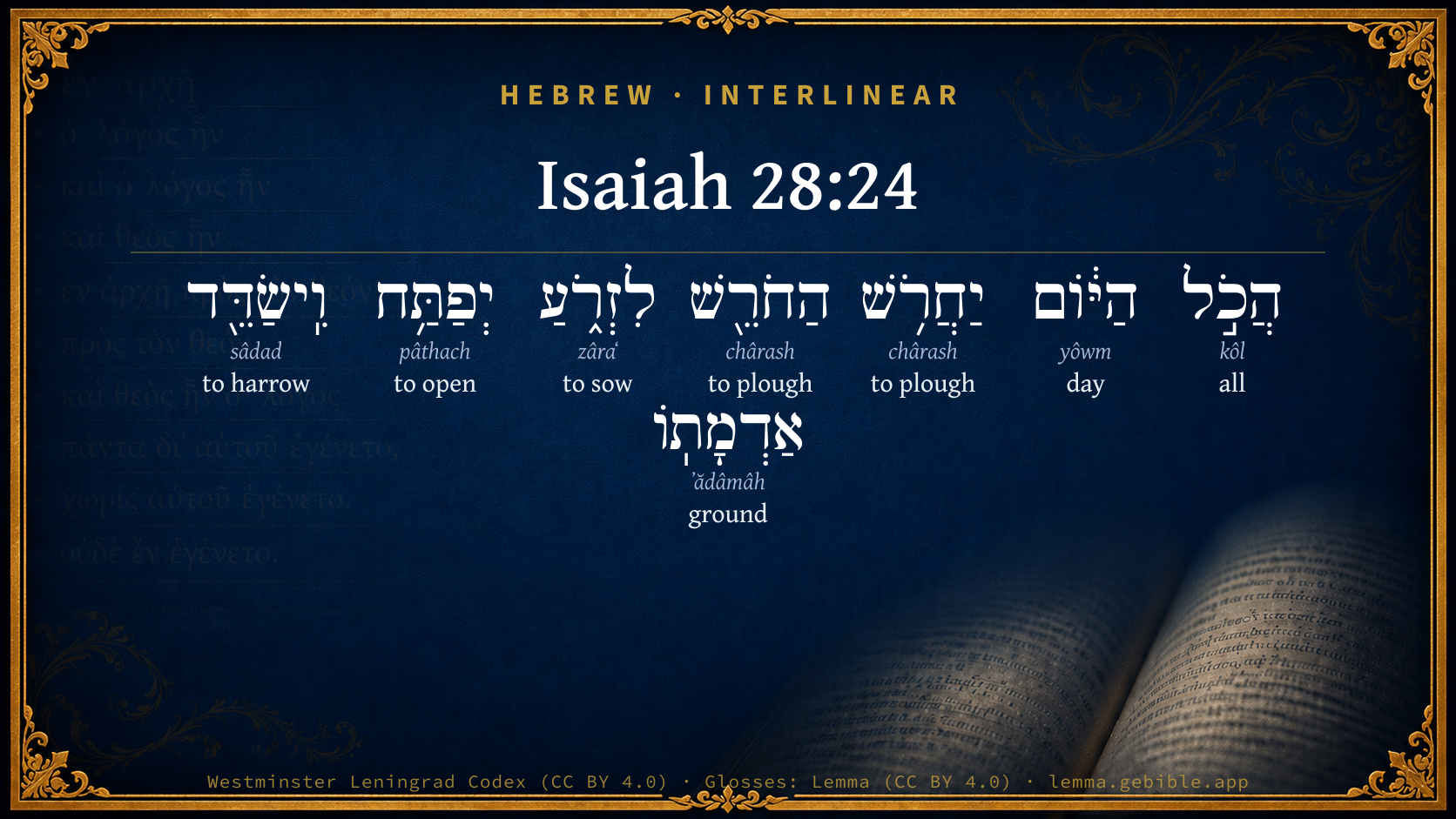
וִֽישַׂדֵּ֖ד
sâdad
H7702
“and · to harrow”
Conjunction + Verb, Piel, Imperfect, 3rd Person, Masculine, Singular
Part of Speech
Conjunction + Verb
Stem
Piel
Form
Imperfect
Person
3rd Person
Gender
Masculine
Number
Singular
Full BDB Definition

Origin: a primitive root

TWOT: 2235

(Piel) to harrow
  1. הֲכֹ֣ל kôl H3605 “all of” Particle, Interrogative + Noun, Common, Masculine, Singular, Construct
  2. הַיּ֔וֹם yôwm H3117 “the · day” Particle, Definite Article + Noun, Common, Masculine, Singular, Absolute
  3. יַחֲרֹ֥שׁ chârash H2790 “to plough” Verb, Qal, Imperfect, 3rd Person, Masculine, Singular
  4. הַחֹרֵ֖שׁ chârash H2790 “the · ploughing” Particle, Definite Article + Verb, Qal, Participle Active, Masculine, Singular, Absolute
  5. לִזְרֹ֑עַ zâraʻ H2232 “to sow” Preposition + Verb, Qal, Infinitive Construct
  6. יְפַתַּ֥ח pâthach H6605 “to open” Verb, Piel, Imperfect, 3rd Person, Masculine, Singular
  7. אַדְמָתֽוֹ ʼădâmâh H127 “ground · his” Noun, Common, Feminine, Singular, Construct + Suffix, Personal, 3rd Person, Masculine, Singular

About this verse

These counts appear in no published source. They are computed here, from the morphology-tagged text and Lemma’s own curated glosses. What Lemma adds →

8
words
7
distinct lemmas
Prophets
section

Notable vocabulary

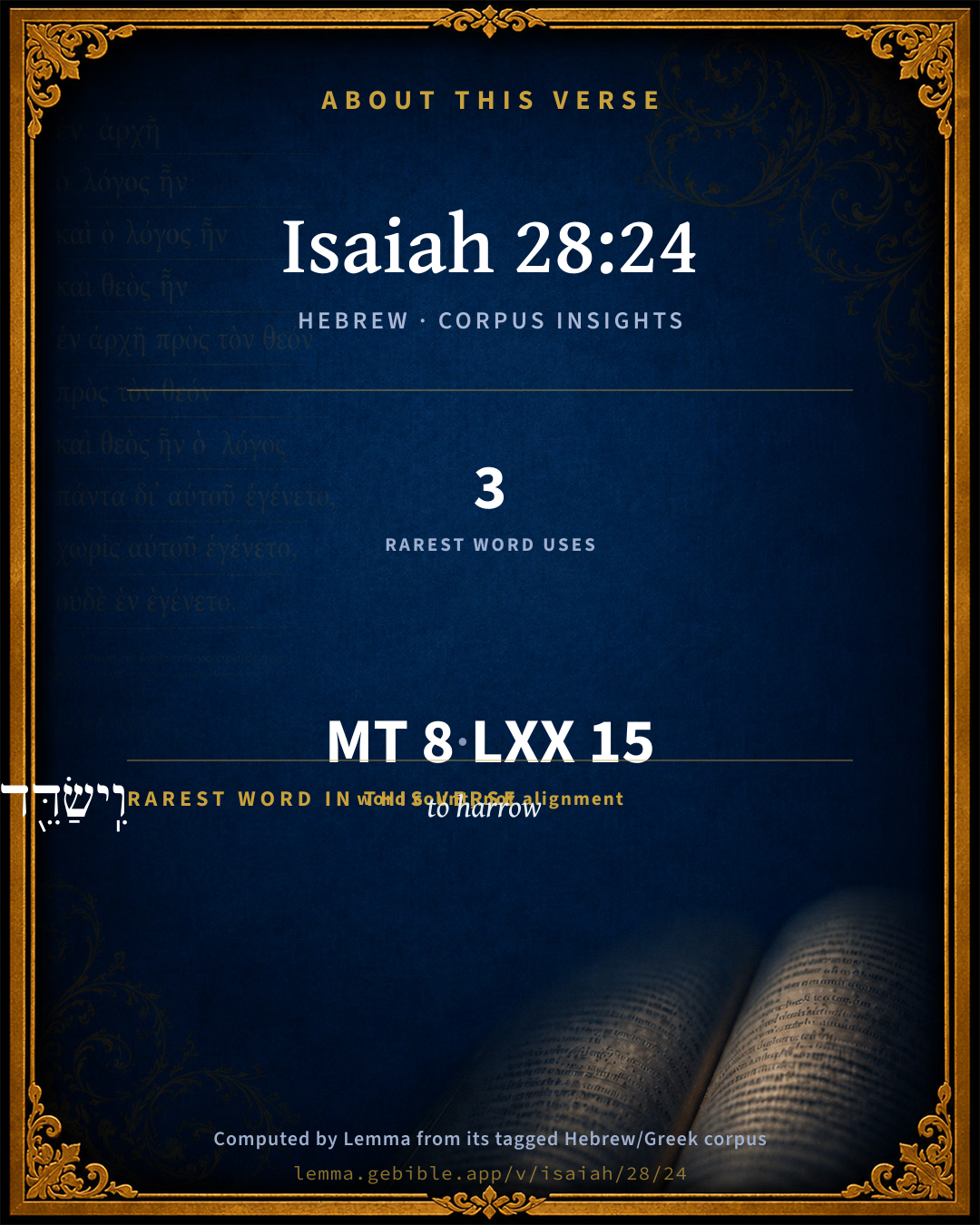
The rarest word here is וִֽישַׂדֵּ֖ד to harrow H7702 — appearing just 3 times in the whole Hebrew Bible.

Shared distinctive vocabulary

וִֽישַׂדֵּ֖ד to harrow H7702 occurs in 3 verses of the Hebrew Bible. Also found in:

Grammatical profile

  • 5 verbs
  • 3 nouns

Verb forms

  • יַחֲרֹ֥שׁ Qal · Imperfect
  • הַחֹרֵ֖שׁ Qal · Participle Active
  • לִזְרֹ֑עַ Qal · Infinitive Construct
  • יְפַתַּ֥ח Piel · Imperfect
  • וִֽישַׂדֵּ֖ד Piel · Imperfect

Repetition

A word recurs within this verse — often emphatic in Hebrew:

  • יַחֲרֹ֥שׁ to plough H2790 ×2

Hebrew & Septuagint length

In English translation the verse runs 16 words from the Hebrew and 19 from the Septuagint (LXX English) — closely comparable.

A rough comparison of the two English renderings, which tokenize alike — not a word-level alignment.

Word counts can differ between the Hebrew and the Greek without any difference in meaning — e.g. the Hebrew direct-object marker אֵת has no separate Greek word, and Greek often adds the article ὁ.

In the original languages it is 8 Hebrew tokens and 15 Greek tokens — but the two are counted differently (Hebrew bundles its prefixes and suffixes into one token; the Greek is in lemma form), so that isn’t a like-for-like length.

Cross-references

2

Topical passages linked to Isaiah 28:24 in the Treasury of Scripture Knowledge — connected by theme and wording, ordered by reader-vote popularity; previews shown in the World English Bible.

  • Jeremiah 4:3 For thus says Yahweh to the men of Judah and to Jerusalem, Break up your fallow ground, and don't sow among thorns.
  • Hosea 10:11–12 Ephraim is a trained heifer that loves to thresh; So I will put a yoke on her beautiful neck. I will set a rider on Ephraim. Judah will plow. Jacob will break his clods.

Cross-references courtesy of OpenBible.info (CC BY 4.0).

Hebrew and Greek witnesses Masoretic Hebrew ↔ Greek Septuagint

The same verse in the two great witnesses to the Old Testament, shown verse-for-verse.

These are two independent witnesses, not word-aligned to each other, and the Septuagint is shown in lemma (dictionary) form.

Hebrew Isaiah 28:24 Masoretic · Westminster Leningrad Codex

הֲכֹ֣ל הַיּ֔וֹם יַחֲרֹ֥שׁ הַחֹרֵ֖שׁ לִזְרֹ֑עַ יְפַתַּ֥ח וִֽישַׂדֵּ֖ד אַדְמָתֽוֹ

Does he who plows to sow plow continually? does he [continually] open and harrow his ground?

World English Bible · Public Domain

Greek LXX Isaiah 28:24 Septuagint · lemma form

μή ὅλος ὁ ἡμέρα μέλλω ὁ ἀροτριάω ἀροτριάω ἤ σπόρος προἑτοιμάζω πρίν ἐργάζομαι ὁ γῆ

Will the plowman plow all the day? or will he prepare the seed beforehand, before he tills the ground?

LXX2012 (modern English Septuagint) · Public Domain

On this verse, John Gill's Exposition discusses the Septuagint’s reading. Read the note in Commentary ↓

Hebrew: Westminster Leningrad Codex (CC BY 4.0). Greek: Septuagint (public domain); English from LXX2012 (modern English Septuagint) (Public Domain). How the Septuagint differs from the Hebrew →

Targum (Aramaic paraphrase)

1

The Targum is the ancient Jewish Aramaic paraphrase of the Hebrew Scriptures — an interpretive translation, not the Hebrew text itself. Onkelos (literal) and Pseudo-Jonathan (expansive) render the Torah, and Jonathan the Prophets. Coverage is partial: where no permissively-licensed English translation exists for a verse, only the Aramaic is shown. This is verse-level text, not a word-by-word alignment to the Hebrew.

  1. Targum Jonathan Prophets (Joshua–Malachi)
    בְּכָל עִדָן מִתְנַבָּן נְבִיַיָא לַאֲלָפָא מָאִים יִתְפַּתְּחָן אוּדְנֵי חַיָבַיָא וִיקַבְּלוּן אוּלְפַן:

    The prophets prophesied at all times in order to teach, if peradventure the ears of sinners might be opened, and receive instruction.

    Targum Jonathan — Aramaic: “Mikraot Gedolot” (public domain). English: “Sefaria Community Translation” (CC0 1.0 (public-domain dedication)); “London "Chaldee Paraphrase," 1871” (public domain). Text via Sefaria.

Commentary

Notes on Isaiah 28:24 from classic Christian and Jewish commentators (each source and its license shown beneath its notes). The classic Christian expositions comment on the surrounding passage and are grouped to its opening verse, so a note may address several verses; the Jewish commentaries on the Tanakh (Rashi and others) are per-verse, so they appear only where the commentator wrote on this verse.

Lemma curates 59 commentaries, every one of them public domain or Creative Commons licensed, each selected and text-cleaned for this edition rather than reprinted as found. About our sources →

Trapp's Complete Commentary

John Trapp

Isa 28:24 Doth the plowman plow all day to sow? doth he open and break the clods of his ground?

Ver. 24. Doth the plowman plow all day to sow?] {a} Or, Every day. Doth he not find him somewhat else to do besides? Sua sunt rebus omnibus agendis tempora, novandi, arandi, occandi, aequandi, serendi, metendi, colligandi et excernendi grani, et suae rationes singulis. And shall not the only wise God afflict his people with moderation and discretion? Yea, verily; for he is "a God of judgment, and waiteth to be gracious." {Isa 30:18} We are no longer ploughed than needs; and whereas we may think our hearts soft enough, it may be so for some grace; but God hath seeds of all sorts to cast in, the wheat and the rye, &c., and that ground which is soft enough for one, is not for another. God, saith Chrysostom doth like a lutanist, who will not let the strings be too slack, lest they mar the music; nor suffer them to be too hard stretched or screwed up, lest they break.

{a} Preponit parabolam rusticam, sed magna sapientia refertam.

John Trapp, A Commentary or Exposition upon All the Books of the Old and New Testament (1647–1656) — public domain. Text from a community e-Sword module.

The Preacher's Complete Homiletical Commentary

Joseph S. Exell (gen. ed.)

THE PARABLE OF THE HUSBANDMAN

Isa_28:24-25. Doth the plowman plow all day to sow? &c. [1117]

[1117] In this parable the mystery of the Divine Providence is laid open, its secret disclosed. All ploughing is for sowing; all threshing is intended for the preservation of the grain. When God chastens us, it is not that He means to destroy us, but because He has set His heart on saving us, because He has appointed us to life and not to death. He works with discrimination. He employs various methods, sends sorrows of all sorts and sizes, that He may adapt Himself to every man’s needs, and to all our varieties of place, time, and circumstances. Just as the husbandman varies his treatment of the soil, and allots to each kind of seed a soil and place suitable to its kind; just as, after the harvest has been gathered in, he employs only such instruments as are best adapted for separating the different kinds of grain from the straw and the chaff. With like wisdom and discretion God deals with us, assigning to each of us our proper station and lot, and, when we sin against Him, adapting His judgments to our several needs. The sorrows, losses, bereavements which befall us are but as the sharp edge of the share, or the keen teeth of the harrow, and are intended to prepare us to receive the good seed, and to bring forth much fruit. Or again, they are like the stroke of the flail, or the keen pressure of the sledge, or the ponderous oppression of the waggon-wheel, or the swift rattle of the horses’ hoofs; and are designed to separate the chaff from the grain, the worthless from the worthy, the evil from the good in us, that we may be made meet for the garner of God. “Cure sin and you cure sorrow,” say the reason and conscience of the world: and the sorrow comes that the sin may be cured, adds the prophet; the very miseries that spring from evil are intended to eradicate the evil from which they spring. The weeds call for the plough; and the plough comes at their call; but it comes and cuts up the weeds and the ground in which they have taken root, only that the seeds of wholesome herbs and herbs of grace may be sown in the furrows. The chaff calls for the flail, and the flail is sent, but sent only to beat out the nourishing grain. Would that this conception were as assured, and as familiar to us as to the old Hebrew prophets I For, sooner or later, we shall all have to endure Borrows, which rend our hearts as the ploughshare rends the ground, or which bruise our hearts as the flail bruises the corn.—S. Cox, D.D.: Expositor, vol. i. pp. 89–98.

Means adapted to the end must be used if any end is to be accomplished. The physician knows this. So does the general. So does the manufacturer. So does the farmer. He is not always ploughing. Nor always sowing. Nor always threshing. Nor does he treat every kind of produce in the same way. And God employs various methods in dealing with men. He aims to turn them from evil, and He adapts His methods. The teaching of the text may be applied to the divine dealing with men generally.

I. God intended to open a way of salvation. Man needs salvation because he is a sinner. Can conceive a state of things in which he would not need it, as of one who needs no physician. If he had continued holy and obedient. But that is not his case. He is a sinner, characterised by impurity, and exposed to perdition.—Now God, in His pitying love, would save us. How shall He proceed? Shall He, by His arbitrary will, sweep away the facts? Such a procedure would be entirely inconsistent with the existence of moral government and the rectitude of the divine character.

1. One part of the case to be dealt with was the condemned state of man under the divine law. Forgiveness could not righteously be given without some satisfaction. Man could not make it. God in Christ, in His whole personality and work, has made the satisfaction. The method adopted is exactly adapted to the nature of the case.

2. But the other part of the case was also to be dealt with. Sinfulness is deep-seated in man’s nature. He loves it. Until he is changed, he is not even inclined to sue for mercy, still less to escape from sin. The Lord Jesus Christ was sent to turn us from our iniquities. How does He do this?

(1.) By moral motive. The law was inadequate. He introduces a new motive. Not only the mercy, but the fact that it has been procured at such a cost, that the love was equal to such a sacrifice. It appeals directly to the heart, as well as to the judgment, for a condemnation of sin.

(2.) By spiritual influence. The influence of the Holy Spirit strives with those to whom the gospel is preached, with a view to the overcoming their indifference, reluctance, and sin.—The method is adapted, in both its sides, to the end in view. It only requires the sinner’s consent. Hence—

II. God intended the way of salvation to be made known to men. If consent to it and faith in it is requisite to participation of its blessings, it must be understood—

1. The information might have been imparted in a separate revelation by the Holy Spirit to every man. Would supersede all evidence, and all exercise of human faculty. Would not be adapted to man as a reasonable being.

2. Angelic ministry might have been employed. Open to similar objection. Would have made miracle the rule instead of the exception. It would have changed the order of nature.

3. The method adopted is the simple arrangement that those who are acquainted with it, believe it, consent to it, make the gospel known. A method exactly adapted to the nature of the case. According to the constitution of human nature, the Gospel thus approaches it for the purpose of gaining the understanding, the heart, and the will. Bear in mind the power of sympathy between human beings. He who has received a truth desires to impart it. He who has experienced the salvation pities those who need it as he did. He who speaks from his own experience speaks with tenderness, and earnestness, and influence. The sick heed the recommendation of a physician by those whom he has cured. On this principle of adaptation the Lord Jesus instituted the living ministry of apostles, evangelists, pastors, parents, all Christians. He inspired some to put on permanent record the truth as He revealed it, as a standard of appeal. They are to study it. They are to use the same principle of adaptation. There is youth, age, different measure of instruction, different classes, spheres, circumstances.

III. God intended to train those whom He saved. Believers are already saved, because pardoned and sanctified. But they require training into riper holiness, greater usefulness, greater fitness for the future heaven. Therefore the Saviour instituted such means as are adapted to secure these ends. Church fellowship, public worship, pastoral teaching, Christian habits of watchfulness, thoughtfulness, prayer. All these are adapted to the training of the spiritual plant.

Are you in sympathy with God’s end? In yourselves? In the world? Then adapt yourselves to its realisation.—J. Rawlinson.

In these verses there are three kinds of seed mentioned; fitches, cummin, and corn. The fitches and cummin were small seeds like the caraway or chickpea. When these smaller herbs had to be threshed, this was done by hand; but when the corn had to be threshed, that was thrown on the floor, and men would fasten horses or oxen to a cart with iron-dented wheels; that cart would be drawn round the threshing-floor, and so the work would be accomplished. And so the idea expressed is different kinds of threshing for different products.

I. We must all go through some kind of threshing process. The fact that you are devoting your life to honourable and noble purposes will not win you any escape. Wilber-force, the Christian Emancipator, was in his day derisively called “Doctor Cantwell.” Thomas Babington Macaulay, the advocate of all that was good long before he became the most conspicuous historian of his day, was caricatured in one of the Quarterly Reviews as “Bubble-tongue Macaulay.” Norman M‘Leod, the great friend of the Scotch poor, was industriously maligned in all quarters. All the small wits of London took after John Wesley, the father of Methodism. If such men could not escape the maligning of the world, neither can you expect to get rid of the sharp, keen stroke of the tribulum. All who will live godly in Christ Jesus must suffer persecution.

II. It is no compliment to us if we escape great trial. There are men who suppose they are the Lord’s favourites, simply because their barns are full, and their bank account is flush, and there are no funerals in the house. It may be because they are fitches and cummin, while down at the end of the lane, the poor widow may be the Lord’s corn. You are little pounded, because you are little worth, and she bruised and ground, because she is the best part of the harvest. By carefulness of the threshing, you may always conclude the value of the grain. (H. E. I., 189–196, 3692–3695).

III. God proportions our trials to what we can bear. The rod for the cummin, the staff for the fitches, the iron wheel for the corn. (H. E. I, 179–188, 3674–3695).

IV. God continues trials until we let go. As soon as the farmer sees that the straw has let go the grain, he stops the threshing. We hold on to this world with its pleasures, riches, and emoluments, as though for ever. God comes along with some threshing trouble, and beats us loose. Oh, let go! Depend upon it that God will keep upon you the staff, or the rod, or the iron wheel until you do let go.

V. Christian sorrow is going to have a sure terminus. “Bread corn is bruised, because He will not be ever threshing it.” So much of us as is wheat will be separated from so much of us as is chaff, and there will be no more need of pounding. “He will not ever be threshing it.” Blessed be God for that! (Rev_21:4).—T. De Witt Talmage, D.D.

The Preacher's Complete Homiletical Commentary (gen. ed. Joseph S. Exell; Funk & Wagnalls, c. 1892) — public domain (pre-1929). A full-Bible homiletical/sermon-outline anthology covering 65 of 66 books (2 John is absent from the source module). Text from a community e-Sword module.

Tyndale Open Study Notes

Tyndale Open Resources

28:24-29 A farmer knows that there are right and wrong ways to do things, but the leaders of Judah were not that intelligent.

Tyndale Open Study Notes — © Tyndale Open Resources, licensed CC BY-SA 4.0. Text via the HelloAO Bible API.

Jamieson, Fausset & Brown

Robert Jamieson, A. R. Fausset & David Brown

all day--emphatic; he is not always ploughing: he also "sows," and that, too, in accordance with sure rules (Isa 28:25).

doth he open--supply "always." Is he always harrowing?

Jamieson, Fausset & Brown — Commentary Critical and Explanatory on the Whole Bible (1871) — public domain (CC PDM 1.0). Text via the HelloAO Bible API.

Ellicott's Commentary for English Readers

(24) Doth the plowman plow all day . . .?—Better, every day. Ploughing represents naturally, as in Jer_4:3, the preparatory discipline by which the spiritual soil is rendered fit for the sower’s work. It is a means, and not an end, and is, therefore, in its very nature but for a season. To a nation passing through this stage, Assyrian invaders scoring their long furrows visibly on the surface of the land, the parable gave the hope that this was preparing the way for the seed-time of a better harvest.

A Bible Commentary for English Readers, edited by Charles John Ellicott (1878–1897) — public domain. Text from a community e-Sword module.

The Cambridge Bible for Schools and Colleges

gen. ed. J. J. S. Perowne

24. all day] i.e. continually (R.V.), “uninterruptedly.” The emphasis of the question lies on this word.

to sow is an awkward addition and may be a gloss. If genuine the sense must be paraphrased “seeing he has the intention of sowing.”

doth he open … ground] Trans. doth he (continually) open and narrow his ground?

24–26. Ploughing is followed by sowing.

The Cambridge Bible for Schools and Colleges (gen. ed. J. J. S. Perowne; Cambridge University Press, 1878–1918) — public domain. Text from a community e-Sword module.

John Gill's Exposition

When he hath made plain the face thereof,.... By harrowing it, after it is ploughed:

doth he not cast abroad the fitches, and scatter the cummin; in sowing them in the ground, prepared for them; the former of these does not seem to be the same we so call, but something else. The Septuagint version calls it the little "melanthion" (c), the same with the "nigella" (d) of the Latins, and is sometimes called "gith" (e), as in the Vulgate Latin version here. The Syriac and Arabic versions render it "anise", which is mentioned along with "cummin", as common with the Jews, and which, in Christ's time, were tithed, Mat 23:23 and both these in the text are by Kimchi said to be the food of man:

and cast in the principal wheat and the appointed barley and the rye in their place? each in their proper place, or in soil suitable for them; some land being more suitable for the one than for the other, which the husbandman understands: "wheat" is the choicest and most excellent grain, and therefore called "principal"; or else because it is "first" sown, or sown in the best and "principal" ground: "barley" is said to be "appointed", or to be sowed in a place appointed for it; or "marked" (f), referring either to places marked in the field, where it should be sown; which sense the Targum and the Jewish commentators favour; or to sacks of it marked, in which the best seed for sowing was put: "and the rye in its border" (g); appointed for that Jarchi thinks this refers to the different places of sowing; the wheat was sown in the middle of the field; barley round about the mark or sign for that purpose; and rye upon the borders. The Targum is,

"as wheat is sown in an uncultivated field, and barley by the signs, and rye by the borders;''

but the whole is intended to express the wisdom of the husbandman, in sowing different seeds, not in the same field, which was forbidden by the law, Lev 19:19 but in ground suitable to each of them; and in the mystical sense designs the execution of divine judgments on men, in proportion to their sins, after they have been admonished of them, and reproved for them; and may be applied also to the sowing of the seed of the word in the hearts of men, and illustrated by the parable of the sower in Mat 13:19.

(c) So Junius & Tremellius, and Piscator. (d) As here with Pagninus, Montanus. (e) So Vatablus and Castalio. (f) "hordeum signatum", Vatablus, Pagninus, Montanus; "signato loco", Tigurine version. (g) "speltam in termino ejus, vel suo", Pagninus, Montanus, Junius & Tremellius, Piscator.

John Gill's Exposition of the Whole Bible (1746–1763) — public domain (CC PDM 1.0). Text via the HelloAO Bible API.

Albert Barnes' Notes on the Bible

Doth the plowman ... - The question here asked implies that he does “not” plow all the day. The interrogative form is often the most emphatic mode of affirmation.

All day - The sense is, does he do nothing else but plow? Is this the only thing which is necessary to be done in order to obtain a harvest? The idea which the prophet intends to convey here is this. A farmer does not suppose that he can obtain a harvest by doing nothing else but plow. There is much else to be done. So it would be just as absurd to suppose that God would deal with his people always in the same manner, as it would be for the farmer to be engaged in nothing else but plowing.

Doth he open ... - That is, is he always engaged in opening, and breaking the clods of his field? There is much else to be done besides this. The word ‘open’ here refers to the furrows that are made by the plow. The earth is laid open as it were to the sunbeams, and to the showers of rain, and to the reception of seed. The word rendered ‘break’ (ישׁדד yshadēd) properly means “to harrow,” that is, to break up the clods by harrowing Job 39:10; Hos 10:11.

Albert Barnes' Notes on the Bible (1834–1885) — public domain. Text from a community e-Sword/MySword module.

Haydock's Catholic Bible Commentary

Sow. The works of the husbandman vary, so will God’s punishments be inflicted with measure, according to each one’s deserts, ver. 27., and Wisdom vi. 7. (Calmet)

George Leo Haydock (1774–1849), Haydock's Catholic Family Bible and Commentary, 1859 edition — public domain. Excludes Psalms (Douay-Rheims chapter numbering differs from Protestant) and Deuterocanonical books (Catholic canon only).

Matthew Poole's English Annotations

Doth the ploughman plough all day to sow? the ploughman doth not spend all his time in ploughing the ground, in order to the sowing it, or, as it follows, in opening it, and breaking its clods; but he hath several times for several works, a time for ploughing, and a time for sowing and harrowing, and a time for reaping, and a time for threshing, or beating, and bruising the corn for his own use; which wisdom God hath put into him. This is the sum of the similitude propounded here and in the following verses; the design and meaning whereof seems to be this, to teach them that God had his times and seasons for several works, and that the methods of his providence were various at several times, and towards several persons or people; and therefore that those scoffing Israelites were guilty of great folly, in flattering themselves, and despising God’s threatenings, because of God’s long patience towards them, and because of their present impunity and prosperity; for God would certainly and speedily take a time to thresh and break them with his judgments, as at present he ploughed and harrowed them, and so prepared them for it by his threatenings.

Doth he open; understand, all day, or continually, out of the foregoing clause.

And break the clods of his ground; which they used to do with a kind of harrow, or other proper instrument. See Jer 4:3; Hos 10:11,12

Matthew Poole's English Annotations on the Holy Bible (1683–1685) — public domain. Text from a community e-Sword/MySword module.

Whedon's Commentary on the Bible

Daniel D. Whedon

24-26. Doth the ploughman plough all day — That is, does he plough interminably, never cease?

To sow — In order to sow, in order to make the ground ready for sowing. The parallel number is of the same meaning. Common sense deigns not an answer.

Made plain — Level.

The face thereof — The surface of the fields.

Fitches… cummin — Garden seeds, the one Nigella sativa, used both as a condiment and as medicine, sprinkled upon loaves; the other, of warm, bitterish, aromatic flavour — a plant umbelliferous like fennel, used with salt as a sause. The Maltese are said to grow cummin and thresh it at this day in the same manner as described by Isaiah. — Bible Dictionary.

Principal wheat… appointed barley — The Hebrew is obscure in meaning, and critics conjecture it has been corrupted. “Wheat” and “barley” were always, as now, prime staples.

The “wheat” is supposed to have been sown in the inner parts of the field, and surrounded by spelt, or rye as a border, and the barley was sown in a field by itself, appropriate to it, or “appointed” for it. This may explain the text as to these terms. The “plough-man” is cited as acting in a sound, common sense way, as God has made him to act in these practical matters. So God acts in perfect accord with the highest wisdom and justice in his treatment of men. He saves all who will permit him to save them: he punishes forever those who hate him and will never yield to him. This is the lesson taught by the parable of the ploughman.

Daniel D. Whedon (gen. ed.), Commentary on the Old and New Testaments (1874–1909) — public domain. Text from a community e-Sword module.

The Pulpit Commentary

Doth the plowman plow all day? The Church of God, go often called a vineyard, is here compared to an arable field, and the processes by which God educates and disciplines his Church are compared to those employed by man in the cultivation of such a piece of ground, and the obtaining of a harvest, from it. First of all, the ground must be ploughed, the face of the earth "opened" and the "clods broken." This, however, does not go on forever; it is for an object that the seed may be sown; and, as soon as the ground is fit for the sowing to take place, the preparation of the soil ceases. Doth he open and break, etc.? Harrowing succeeds to ploughing in the natural order of things, the object of the harrowing being to break and pulverize the clods.

Vers. 24-28. The analogy of Divine to human methods of working.

Isaiah"s comparison in this chapter rests wholly upon the assumption of an analogy between God"s dealings and man"s, when the latter are such as are consonant with reason. Reason, the highest gift of God to man, be assumes to be an adumbration of some quality in the Divine nature, which bears a real resemblance to it. "Reason cometh forth from the Lord of hosts." It is the voice of God speaking in the soul of man. Let man follow it, and his actions are divinely guided. God"s mode of action in parallel matters may be gathered from his. The general principle is involved in the particular analogy here indicated. As in human husbandry, so in God"s tendance of that Church, which is his "vineyard" and "fruitful field," there are three principal processes.

I THE PREPARATION OF THE GROUND. Israel was prepared by the long course of Egyptian affliction, by the "ploughshares" and "harrows" of tyrannical overseers and taskmasters, which broke up and pulverized what would otherwise have been an ungenial and unpromising soil, very unapt to bear fruit. After this preparation had been made for four hundred and thirty years, there followed

II THE PUTTING IN OF THE SEED. God"s revelation of himself and of his will at Sinai was the sowing of the seed of his Word in the soil of Israel"s hearts. When he had sufficiently prepared the soil, he scattered the seed abundantly seed of various kinds which all fell in its "appointed place," and did its appointed work, "turning the hearts of the disobedient to the wisdom of the just," and differencing the Jews from their neighbors by a higher moral tone and a purer religion than prevailed elsewhere. Finally came

III THE GATHERING IS OF THE HARVEST. The seed is sown for the sake of the crop which it will produce. God is continually gathering in his crop by a process analogous to that which men pursue. He needs good grain for his garner, and to obtain this he must separate the grain from the husks and chaff with which it is accompanied. As men use various methods for this object, some gentler, some severer, so God, too, in the purifying of his grain, has many varieties of treatment. To each kind of grain he applies the treatment that is fittest. Some kinds are lightly beaten, as with slender rods; others more heavily, as with stout staves; some, on the other hand, are threshed, as it were, with spiked drags and rollers, to clear them of their encumbrances. No more force, however, is applied in any case than is necessary, nor is any force applied for a longer time than is needed. And even in the severest treatment there is gentleness. God has a care that the good grain shall never be "bruised."

The Pulpit Commentary (1880–1919), ed. H.D.M. Spence-Jones & Joseph S. Exell — public domain. Text from a community e-Sword module.

John Wesley's Explanatory Notes

Doth - The plowman doth not spend all his time in plowing the ground; but he has several times for several works. And so God has his times and seasons for several works, and his providence is various at several times, and towards several people. Therefore those scoffing Israelites were guilty of great folly, in flattering themselves, because of God's long patience towards them; for God will certainly take a time to thresh, and break them with his judgments, as at present he plowed and harrowed them, and so prepared them for it by his threatenings. Open - Understand, all day. Break - Which they used to do with a kind of harrow.

John Wesley, Explanatory Notes Upon the Whole Bible (1754–1765) — public domain. Text via the GEBible commentary corpus.

J. A. Alexander on Isaiah

Joseph Addison Alexander

“Does the ploughman plough every day to sow? Does he open and level his ground?” The common version, ‘all day’, though it seems to be a literal translation, does not convey the sense of the original expression, which is used both here and elsewhere to mean all the time or always. He may plough a whole day together when he as at it, but he does not plough every day in the year; he has other work to do besides ploughing. (Gill.) The interrogation may be confined to the first clause, and the second construed as an exhortation: (no) let him open and level his ground. But as there is a difficulty then in explaining what is meant by opening the ground, as distinct from opening the furrows with the plough, most interpreters suppose the interrogation to extend through the verse, and make the second clause a repetition of the first, with an additional reference to harrowing. As if he had said, ‘is the ploughman always ploughing; is he always ploughing and harrowing?’

Joseph Addison Alexander, The Prophecies of Isaiah (1846–1847; New York: Scribner, 1870–1878) — public domain. Text from a community e-Sword module.

Rashi

Rabbi Shlomo Yitzchaki (Rashi)

all day This is the interrogative. Therefore, it is voweled with a hataf pattah.

shall...plow One who plows to sow - does the one who plows to sow plow forever? If so, what does he accomplish? Similarly, the prophets admonish you to bring you back to do good deeds. Shall they admonish forever and not accomplish?

Shall he open and harrow his soil? Shall he never sow but always open the soil with plowshares and plowing implements? יְשַׂדֵּד is an expression of work of the field. Shall he open and harrow? First he makes wide furrows and later he makes small furrows. This we learned in the Midrash of Rabbi Tanhuma.

Rashi on the Tanakh — English translations: “The Judaica Press complete Tanach with Rashi, translated by A. J. Rosenberg” (CC BY 4.0); “Pentateuch with Rashi's commentary by M. Rosenbaum and A.M. Silbermann, 1929-1934” (public domain); “The Metsudah Tanach series, Lakewood, N.J” (CC BY 4.0); and “The Book of Joshua, Metsudah Publications, 1997” (CC BY 4.0). Text via Sefaria.

Ibn Ezra

Rabbi Abraham ibn Ezra

Doth the plowman, etc. The plowman tills the ground once and twice, and sows, then the earth by its natural power brings forth the increase.

יפתח He opens, וישדד and he breaks the clods, that is, he prepares the field; comp. Hos. 10:11. יפתח and וישדד are a repetition of the same idea in different words.

Ibn Ezra on the Tanakh — English translations: “Sefaria Community Translation” (CC0 1.0 (public-domain dedication)); “Yalkut, Sifsei Chachomim Chumash, Metsudah Publications, 2009” (CC BY 4.0); and “Commentary of Ibn Ezra on Isaiah - trans. by M. Friedlander, 1873” (public domain). Text via Sefaria.

Lesson kit

Teaching starters — assembled from the data on this page, not authored interpretation. Every prompt links to the verse data it draws on. Edit before teaching.

Isaiah, in the Prophets, opens this verse with 8 words (7 distinct Hebrew lemmas). Its most distinctive word is sâdad (“to harrow”). A historical commentator’s framing appears above. Read the whole chapter for the surrounding context.

Discussion questions

  1. How does “to harrow” (sâdad) shape what this verse is saying?
  2. How does Job 39:10, which shares the word «to harrow», read alongside this verse?
  3. What does the repetition of “to plough” (2× in this one verse) do in this verse?
  4. These translations render this verse differently. What is at stake in choosing one wording over another?
  5. «יַחֲרֹ֥שׁ» is a Qal Imperfect verb. How does that grammatical form shape the action described?
  6. Compare how Trapp's Complete Commentary and The Preacher's Complete Homiletical Commentary read this verse. Where do they agree or differ?

Things to notice

Reading settings

Reading text

Shown beneath each verse's original-language words.

Old Testament
Old Testament edition

Read the OT as the Masoretic Hebrew (MT) or the Greek Septuagint (LXX).

English shown for the Greek Septuagint (in the Hebrew ↔ Greek comparison).

Comparing translations? Open the Compare panel on any verse page to stack up to four side by side.