
1 Samuel 20:31

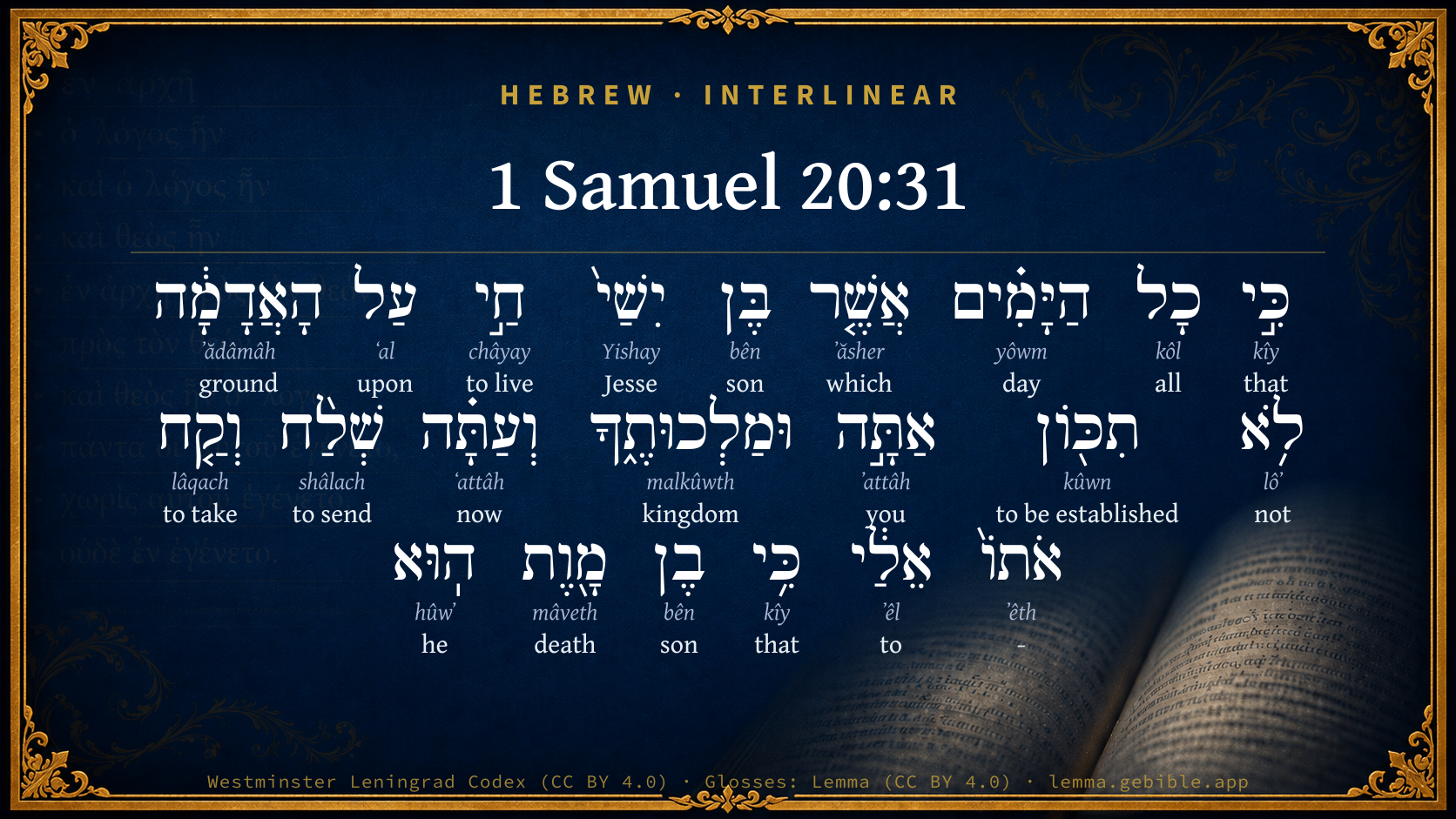
Hebrew (Westminster Leningrad Codex) 1 Samuel 20:31 appears in the Hebrew Old Testament. The text above is from the Westminster Leningrad Codex. Each word links to its Strong’s number, a concise gloss, and parsing drawn from the Open Scriptures Hebrew Bible morphology. Click any word for its full Brown-Driver-Briggs (BDB) entry.
Download image
Cite this verse

1 Samuel 20:31 (World English Bible). Public Domain. Lemma interlinear Bible study tool, https://lemma.gebible.app/v/1-samuel/20/31.

Show BibTeX & RIS
BibTeX
RIS
English Translation
For as long as the son of Jesse lives on the earth, you shall not be established, nor your kingdom. Therefore now send and bring him to me, for he shall surely die.
World English Bible · Public Domain
Download a study sheet

One document with this verse’s original text, its word-by-word gloss line, the meaning frame, cross-references with their text, attributed commentary, and full source and license credits — printable, and it pastes into notes with its structure intact.

This verse Autodidact and up

Study sheet (.html) Plain text (.txt)

A passage Seminary Student

Up to 50 verses in one chapter. A passage sheet keeps up to 6 commentary sources and 12 cross-references per verse, in the order this page ranks them, and says so on the sheet whenever that leaves anything out. Ask for a single verse and you get the Autodidact verse sheet above.

Everything on this page stays free to read, with no account — the sheet is a download of what is already on screen, not access to it.

Want to remove ads? Support Godless Engineer
Compare translations 3

The same verse in 3 English versions, stacked beneath the original-language interlinear above. Click any original word for its lexicon entry.

Each is an independent rendering of the whole verse — the interlinear is not word-aligned to these translations.

Highlighted words mark where these versions differ — a whole-verse word diff, not a word-by-word alignment.

  • World English Bible Public Domain
    For as long as the son of Jesse lives on the earth, you shall not be established, nor your kingdom. Therefore now send and bring him to me, for he shall surely die.
  • King James Version Public Domain
    For as long as the son of Jesse liveth upon the ground, thou shalt not be established, nor thy kingdom. Wherefore now send and fetch him unto me, for he shall surely die.
  • unfoldingWord Literal Text CC BY-SA 4.0
    For all of the days that the son of Jesse lives on the earth, you will not be established, nor your kingdom. And now, send and take him to me, for he a son of death.”

unfoldingWord Literal Text — © unfoldingWord, licensed CC BY-SA 4.0. Word-aligned USFM3 via Door43 (git.door43.org/unfoldingWord/en_ult).

Versions to compare (up to 4)

3 of 4 selected

Show all 18 translations

Every available English version of this verse, each an independent rendering of the whole verse.

  • World English Bible Public Domain
    For as long as the son of Jesse lives on the earth, you shall not be established, nor your kingdom. Therefore now send and bring him to me, for he shall surely die.
  • Berean Standard Bible Public Domain
    For as long as the son of Jesse lives on this earth, neither you nor your kingship shall be established. Now send for him and bring him to me, for he must surely die!”
  • Majority Standard Bible Public Domain
    For as long as the son of Jesse lives on this earth, neither you nor your kingdom shall be established. Now send for him and bring him to me, for he must surely die!”
  • King James Version Public Domain
    For as long as the son of Jesse liveth upon the ground, thou shalt not be established, nor thy kingdom. Wherefore now send and fetch him unto me, for he shall surely die.
  • American Standard Version (1901) Public Domain
    For as long as the son of Jesse liveth upon the ground, thou shalt not be established, nor thy kingdom. Wherefore now send and fetch him unto me, for he shall surely die.
  • Revised Version (1885) Public Domain
    For as long as the son of Jesse liveth upon the ground, thou shalt not be stablished, nor thy kingdom. Wherefore now send and fetch him unto me, for he shall surely die.
  • Geneva Bible (1599) Public Domain
    For as long as the sonne of Ishai liueth vpon the earth, thou shalt not be stablished, nor thy kingdome: wherefore now send and fet him vnto me, for he shall surely die.
  • Douay-Rheims (1899) Public Domain
    For as long as the son of Isai liveth upon earth, thou shalt not be established, nor thy kingdom. Therefore now presently send, and fetch him to me: for he is the son of death.
  • Young's Literal Translation Public Domain
    for all the days that the son of Jesse liveth on the ground thou art not established, thou and thy kingdom; and now, send and bring him unto me, for he `is' a son of death.'
  • Literal Standard Version CC BY-SA 4.0
    For all the days that the son of Jesse lives on the ground you are not established, you and your kingdom; and now, send and bring him to me, for he [is] a son of death.”
  • Unlocked Literal Bible CC BY-SA 4.0
    For as long as the son of Jesse lives on the earth, neither you nor your kingdom will be established. Now then, send and bring him to me, for he must surely die.”
  • unfoldingWord Literal Text CC BY-SA 4.0
    For all of the days that the son of Jesse lives on the earth, you will not be established, nor your kingdom. And now, send and take him to me, for he a son of death.”
  • Darby Bible Public Domain
    For as long as the son of Jesse lives upon earth, thou shalt not be established, nor thy kingdom. And now send and fetch him to me, for he must die.
  • World Messianic Bible Public Domain
    For as long as the son of Jesse lives on the earth, you will not be established, nor will your kingdom. Therefore now send and bring him to me, for he shall surely die!”
  • Webster's Bible Public Domain
    For as long as the son of Jesse liveth upon the earth, thou shalt not be established, nor thy kingdom. Wherefore now send and bring him to me, for he shall surely die.
  • Free Bible Version CC BY-SA 4.0
    While the son of Jesse remains alive, you and your kingship are not secure. Now go and bring him here to me, for he has to die!”
  • Bible in Basic English Public Domain
    For while the son of Jesse is living on the earth, your position is unsafe and your kingdom is in danger. So make him come here to me, for it is certainly right for him to be put to death.
  • JPS Tanakh (1917) Public Domain
    For as long as the son of Jesse liveth upon the earth, thou shalt not be established, nor thy kingdom. Wherefore now send and fetch him unto me, for he deserveth to die.'

Literal Standard Version (2020), Covenant Press — licensed CC BY-SA 4.0. Text via the HelloAO Bible API (eBible.org). Unlocked Literal Bible (unfoldingWord) — licensed CC BY-SA 4.0. Text via the HelloAO Bible API (eBible.org). unfoldingWord Literal Text — © unfoldingWord, licensed CC BY-SA 4.0. Word-aligned USFM3 via Door43 (git.door43.org/unfoldingWord/en_ult). Free Bible Version, Dr. Jonathan Gallagher — licensed CC BY-SA 4.0. Text via the HelloAO Bible API (eBible.org).

Word by word

More ways to search: Search by grammar → Find every occurrence → Compare this word →

Practice this passage: Drill this verse → Learn its vocabulary →

חַ֣י
châyay
H2425
“to live”
Verb, Qal, Perfect, 3rd Person, Masculine, Singular
Part of Speech
Verb
Stem
Qal
Form
Perfect
Person
3rd Person
Gender
Masculine
Number
Singular
Full BDB Definition

Origin: a primitive root [compare H2421 ]

TWOT: 644

to live, have life, remain alive, sustain life, live prosperously, live for ever, be quickened, be alive, be restored to life or health - (Qal) - to live - to have life - to continue in life, remain alive - to sustain life, to live on or upon - to live (prosperously) - to revive, be quickened - from sickness - from discouragement - from faintness - from death - (Piel) - to preserve alive, let live - to give life - to quicken, revive, refresh - to restore to life - to cause to grow - to restore - to revive - (Hiphil) - to preserve alive, let live - to quicken, revive - to restore (to health) - to revive - to restore to life
  1. כִּ֣י kîy H3588 “that” Conjunction
  2. כָל kôl H3605 “all of” Noun, Common, Masculine, Singular, Construct
  3. הַיָּמִ֗ים yôwm H3117 “the · days” Particle, Definite Article + Noun, Common, Masculine, Plural, Absolute
  4. אֲשֶׁ֤ר ʼăsher H834 “which” Particle, Relative
  5. בֶּן bên H1121 “son of” Noun, Common, Masculine, Singular, Construct
  6. יִשַׁי֙ Yishay H3448 “Jesse” Noun, Proper
  7. עַל ʻal H5921 “upon” Preposition
  8. הָאֲדָמָ֔ה ʼădâmâh H127 “the · ground” Particle, Definite Article + Noun, Common, Feminine, Singular, Absolute
  9. לֹ֥א lôʼ H3808 “not” Particle, Negative
  10. תִכּ֖וֹן kûwn H3559 “to be established” Verb, Niphal, Imperfect, 2nd Person, Masculine, Singular
  11. אַתָּ֣ה ʼattâh H859 “you” Pronoun, Personal, 2nd Person, Masculine, Singular
  12. וּמַלְכוּתֶ֑ךָ malkûwth H4438 “and · kingdom · your” Conjunction + Noun, Common, Feminine, Singular, Construct + Suffix, Personal, 2nd Person, Masculine, Singular
  13. וְעַתָּ֗ה ʻattâh H6258 “and · now” Conjunction + Adverb
  14. שְׁלַ֨ח shâlach H7971 “send” Verb, Qal, Imperative, 2nd Person, Masculine, Singular
  15. וְקַ֤ח lâqach H3947 “and · take” Conjunction + Verb, Qal, Imperative, 2nd Person, Masculine, Singular
  16. אֹתוֹ֙ ʼêth H853 “- · him” Particle, Direct Object + Suffix, Personal, 3rd Person, Masculine, Singular
  17. אֵלַ֔י ʼêl H413 “to · me” Preposition + Suffix, Personal, 1st Person, Common, Singular
  18. כִּ֥י kîy H3588 “that” Conjunction
  19. בֶן bên H1121 “son of” Noun, Common, Masculine, Singular, Construct
  20. מָ֖וֶת mâveth H4194 “death” Noun, Common, Masculine, Singular, Absolute
  21. הֽוּא hûwʼ H1931 “he” Pronoun, Personal, 3rd Person, Masculine, Singular

About this verse

These counts appear in no published source. They are computed here, from the morphology-tagged text and Lemma’s own curated glosses. What Lemma adds →

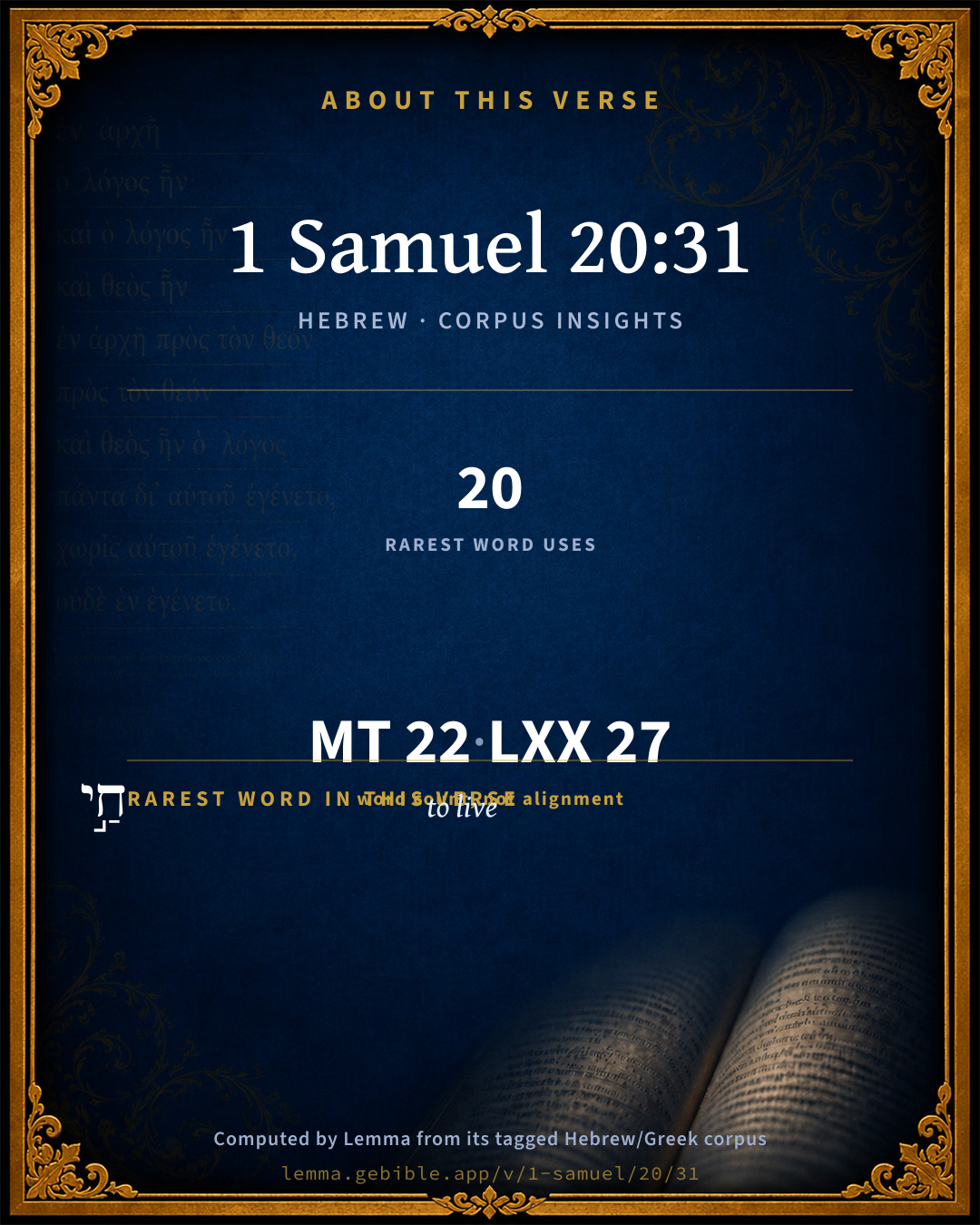
22
words
20
distinct lemmas
Historical
section

Notable vocabulary

The rarest word here is חַ֣י to live H2425 — appearing just 20 times in the whole Hebrew Bible.

Shared distinctive vocabulary

חַ֣י to live H2425 occurs in 20 verses of the Hebrew Bible. Also found in:

Grammatical profile

  • 4 verbs
  • 8 nouns
  • 2 pronouns
  • 2 prepositions
  • 2 conjunctions
  • 1 adverb
  • 3 particles

Verb forms

  • חַ֣י Qal · Perfect
  • תִכּ֖וֹן Niphal · Imperfect
  • שְׁלַ֨ח Qal · Imperative
  • וְקַ֤ח Qal · Imperative

Repetition

Words recur within this verse — often emphatic in Hebrew:

  • בֶּן son H1121 ×2
  • כִּ֣י that H3588 ×2

Hebrew & Septuagint length

In English translation the verse runs 33 words from the Hebrew and 31 from the Septuagint (LXX English) — closely comparable.

A rough comparison of the two English renderings, which tokenize alike — not a word-level alignment.

Word counts can differ between the Hebrew and the Greek without any difference in meaning — e.g. the Hebrew direct-object marker אֵת has no separate Greek word, and Greek often adds the article ὁ.

In the original languages it is 22 Hebrew tokens and 27 Greek tokens — but the two are counted differently (Hebrew bundles its prefixes and suffixes into one token; the Greek is in lemma form), so that isn’t a like-for-like length.

Cross-references

6

Topical passages linked to 1 Samuel 20:31 in the Treasury of Scripture Knowledge — connected by theme and wording, ordered by reader-vote popularity; previews shown in the World English Bible.

  • 1 Samuel 19:6 Saul listened to the voice of Jonathan: and Saul swore, As Yahweh lives, he shall not be put to death.
  • 1 Samuel 20:8 Therefore deal kindly with your servant; for you have brought your servant into a covenant of Yahweh with you: but if there be in me iniquity, kill me yourself; for why should you bring me to your father?
  • 1 Samuel 19:11–15 Saul sent messengers to David's house, to watch him, and to kill him in the morning: and Michal, David's wife, told him, saying, If you don't save your life tonight, tomorrow you will be slain.
  • 1 Samuel 26:16 This thing isn't good that you have done. As Yahweh lives, you are worthy to die, because you have not kept watch over your lord, Yahweh's anointed. Now see where the king's spear is, and the jar of water that was at his head.
  • 2 Samuel 19:28 For all my father's house were but dead men before my lord the king; yet you set your servant among those who ate at your own table. What right therefore have I yet that I should cry any more to the king?
  • Psalms 79:11 Let the sighing of the prisoner come before you. According to the greatness of your power, preserve those who are sentenced to death;

Cross-references courtesy of OpenBible.info (CC BY 4.0).

Hebrew and Greek witnesses Masoretic Hebrew ↔ Greek Septuagint

The same verse in the two great witnesses to the Old Testament, shown verse-for-verse.

These are two independent witnesses, not word-aligned to each other, and the Septuagint is shown in lemma (dictionary) form.

Hebrew 1 Samuel 20:31 Masoretic · Westminster Leningrad Codex

כִּ֣י כָל הַיָּמִ֗ים אֲשֶׁ֤ר בֶּן יִשַׁי֙ חַ֣י עַל הָאֲדָמָ֔ה לֹ֥א תִכּ֖וֹן אַתָּ֣ה וּמַלְכוּתֶ֑ךָ וְעַתָּ֗ה שְׁלַ֨ח וְקַ֤ח אֹתוֹ֙ אֵלַ֔י כִּ֥י בֶן מָ֖וֶת הֽוּא

For as long as the son of Jesse lives on the earth, you shall not be established, nor your kingdom. Therefore now send and bring him to me, for he shall surely die.

World English Bible · Public Domain

Greek LXX 1 Samuel 20:31 Septuagint · lemma form

ὅτι πᾶς ὁ ἡμέρα ὅς ὁ υἱός ιεσσαι ζάω ἐπί ὁ γῆ οὐ ἑτοιμάζω ὁ βασιλεία σύ νῦν οὖν ἀποστέλλω λαμβάνω ὁ νεανίας ὅτι υἱός θάνατος οὗτος

For so long as the son of Jessae lives upon the earth, your kingdom shall not be established: now then send and take the young man, for he shall surely die.

LXX2012 (modern English Septuagint) · Public Domain

Hebrew: Westminster Leningrad Codex (CC BY 4.0). Greek: Septuagint (public domain); English from LXX2012 (modern English Septuagint) (Public Domain). How the Septuagint differs from the Hebrew →

Targum (Aramaic paraphrase)

1

The Targum is the ancient Jewish Aramaic paraphrase of the Hebrew Scriptures — an interpretive translation, not the Hebrew text itself. Onkelos (literal) and Pseudo-Jonathan (expansive) render the Torah, and Jonathan the Prophets. Coverage is partial: where no permissively-licensed English translation exists for a verse, only the Aramaic is shown. This is verse-level text, not a word-by-word alignment to the Hebrew.

  1. Targum Jonathan Prophets (Joshua–Malachi)
    אֲרֵי כָּל יוֹמַיָא דְבַר יִשַׁי קַיָם עַל אַרְעָא לָא תִתְקַן אַתְּ וּמַלְכוּתָךְ וּכְעַן שְׁלַח וְאַיְתִינֵיהּ לְוָתִי אֲרֵי גְבַר חַיָב קְטוֹל הוּא:

    (no public-domain English translation for this verse)

    Targum Jonathan — Aramaic: “Mikraot Gedolot” (public domain). English: “Sefaria Community Translation” (CC0 1.0 (public-domain dedication)); “London "Chaldee Paraphrase," 1871” (public domain). Text via Sefaria.

Commentary

Notes on 1 Samuel 20:31 from classic Christian and Jewish commentators (each source and its license shown beneath its notes). The classic Christian expositions comment on the surrounding passage and are grouped to its opening verse, so a note may address several verses; the Jewish commentaries on the Tanakh (Rashi and others) are per-verse, so they appear only where the commentator wrote on this verse.

Lemma curates 59 commentaries, every one of them public domain or Creative Commons licensed, each selected and text-cleaned for this edition rather than reprinted as found. About our sources →

Trapp's Complete Commentary

John Trapp

1Sa 20:31 For as long as the son of Jesse liveth upon the ground, thou shalt not be established, nor thy kingdom. Wherefore now send and fetch him unto me, for he shall surely die.

Ver. 31. For he shall surely die.] Yea, but stay: "Unto God the Lord belong the issues of death"; {Psa 68:20} and "My times are in thine hand," saith David, not in Saul’s, whatever he may think of the matter: "the counsel of the Lord, that shall stand."

John Trapp, A Commentary or Exposition upon All the Books of the Old and New Testament (1647–1656) — public domain. Text from a community e-Sword module.

Joseph Benson's Commentary

1Sa 20:31. Thou shalt not be established, nor thy kingdom — Though Samuel had long before this declared to Saul, in the name of the Lord, that the kingdom should not continue with him, nor descend to his posterity; yet he seems to have had hopes that he should be able to prevent this declaration from being verified by his policy and taking proper measures.

Joseph Benson's Commentary on the Old and New Testaments (1811–1818) — public domain. Text from a community e-Sword module.

Geneva Bible (1599)

Geneva Bible translators

Hebrew, son of death.

Geneva Bible (1599) marginal notes — public domain. Text via Bolls.life.

Ellicott's Commentary for English Readers

(31) Thou shalt not be established.—Here the king gives expression to the thought which was ever torturing that poor diseased brain of his—David, his own kind physician, his faithful soldier, and his son’s dearest friend and loved companion, was plotting basely against that master for whom he had done so much, and the son whom he loved so well.

Saul, in his blind fury, goes on to betray his fell purpose when he exclaims, “he shall surely die.” His command, “Send and fetch him unto me,” tells us that the murder had been pre-arranged to take place at the feast. Doubtless those rough soldier chiefs sitting round the royal table would be ready at any moment to carry into effect their master’s savage behest.

A Bible Commentary for English Readers, edited by Charles John Ellicott (1878–1897) — public domain. Text from a community e-Sword module.

The Cambridge Bible for Schools and Colleges

gen. ed. J. J. S. Perowne

31. he shall surely die] Lit. “he is a son of death.” Cp. 2Sa_12:5; Psa_102:20; Mat_23:15; Joh_17:12.

The Cambridge Bible for Schools and Colleges (gen. ed. J. J. S. Perowne; Cambridge University Press, 1878–1918) — public domain. Text from a community e-Sword module.

John Gill's Exposition

For as long as the son of Jesse liveth upon the ground, thou shalt not be established, nor thy kingdom,.... He would not, though heir to the crown, be sure of it; it would be precarious to him, he would be in great danger of being deprived of it on the death of his father; and therefore it would be his highest wisdom to deliver David up to be slain, as it was his greatest folly to protect him, and provide for his satiety:

wherefore now send and fetch him unto me; send to Bethlehem for him to come to court directly:

for he shall surely die; or he is "the son of death" (g); guilty of death, as the Targum, deserves to die, and Saul was determined upon his death if possible.

(g) "filius mortis", V. L. Montanus, Vatablus, Piscator; "reus mortis", Junius & Tremellius.

John Gill's Exposition of the Whole Bible (1746–1763) — public domain (CC PDM 1.0). Text via the HelloAO Bible API.

Haydock's Catholic Bible Commentary

The son of death. That is, one that deserveth death, and shall surely be put to death. (Challoner) --- So people are often styled sons of perdition, of hell, of light, &c., (Calmet) when they are worthy of such things. (Haydock) --- All the crime of David, was his too exalted merit, which, under a jealous prince, is often fatal. Nec minus periculum ex magna fama, quam ex mala. (Tacitus, Agricola.)

George Leo Haydock (1774–1849), Haydock's Catholic Family Bible and Commentary, 1859 edition — public domain. Excludes Psalms (Douay-Rheims chapter numbering differs from Protestant) and Deuterocanonical books (Catholic canon only).

Matthew Poole's English Annotations

Thus he grossly mistakes the cause of Jonathan’s loss of the kingdom, which was not David’s art, but Saul’s sin; and vainly endeavours to prevent God’s irrevocable sentence.

Matthew Poole's English Annotations on the Holy Bible (1683–1685) — public domain. Text from a community e-Sword/MySword module.

Whedon's Commentary on the Bible

Daniel D. Whedon

31. As long as the son of Jesse liveth… thou shalt not be established — Here for the first time Saul reveals the reason of his wrath towards David; for though the probability of David’s attaining the throne may have been at other times talked over between himself and Jonathan, and others, (see note on 1Sa_20:13,) yet he seems to have been careful hitherto of expressing his own feelings on the subject.

Daniel D. Whedon (gen. ed.), Commentary on the Old and New Testaments (1874–1909) — public domain. Text from a community e-Sword module.

Lesson kit

Teaching starters — assembled from the data on this page, not authored interpretation. Every prompt links to the verse data it draws on. Edit before teaching.

1 Samuel, in the Historical, opens this verse with 22 words (20 distinct Hebrew lemmas). Its most distinctive word is châyay (“to live”). A historical commentator’s framing appears above. Read the whole chapter for the surrounding context.

Discussion questions

  1. The word châyay carries the sense “to live.” How does it shape the verse?
  2. Genesis 3:22 shares the word «to live» with this verse. How do the two illuminate each other?
  3. “son” occurs 2× in this one verse. What is the effect of the repetition?
  4. The translations on this page render this verse differently — a whole-verse word diff, not a word-by-word alignment. What might account for the different wordings?
  5. The verb «חַ֣י» is Qal Perfect. How does its form color the action?
  6. Reading how Trapp's Complete Commentary and Joseph Benson's Commentary read this verse, where do the two commentators agree and where do they part?

Things to notice

Reading settings

Reading text

Shown beneath each verse's original-language words.

Old Testament
Old Testament edition

Read the OT as the Masoretic Hebrew (MT) or the Greek Septuagint (LXX).

English shown for the Greek Septuagint (in the Hebrew ↔ Greek comparison).

Comparing translations? Open the Compare panel on any verse page to stack up to four side by side.