

Proverbs 12:11

Hebrew (Westminster Leningrad Codex) Proverbs 12:11 appears in the Hebrew Old Testament. The text above is from the Westminster Leningrad Codex. Each word links to its Strong’s number, a concise gloss, and parsing drawn from the Open Scriptures Hebrew Bible morphology. Click any word for its full Brown-Driver-Briggs (BDB) entry.
Download image
Cite this verse

Proverbs 12:11 (World English Bible). Public Domain. Lemma interlinear Bible study tool, https://lemma.gebible.app/v/proverbs/12/11.

Show BibTeX & RIS
BibTeX
RIS
English Translation
He who tills his land shall have plenty of bread, But he who chases fantasies is void of understanding.
World English Bible · Public Domain
Download a study sheet

One document with this verse’s original text, its word-by-word gloss line, the meaning frame, cross-references with their text, attributed commentary, and full source and license credits — printable, and it pastes into notes with its structure intact.

This verse Autodidact and up

Study sheet (.html) Plain text (.txt)

A passage Seminary Student

Up to 50 verses in one chapter. A passage sheet keeps up to 6 commentary sources and 12 cross-references per verse, in the order this page ranks them, and says so on the sheet whenever that leaves anything out. Ask for a single verse and you get the Autodidact verse sheet above.

Everything on this page stays free to read, with no account — the sheet is a download of what is already on screen, not access to it.

Want to remove ads? Support Godless Engineer
Compare translations 3

The same verse in 3 English versions, stacked beneath the original-language interlinear above. Click any original word for its lexicon entry.

Each is an independent rendering of the whole verse — the interlinear is not word-aligned to these translations.

Highlighted words mark where these versions differ — a whole-verse word diff, not a word-by-word alignment.

  • World English Bible Public Domain
    He who tills his land shall have plenty of bread, But he who chases fantasies is void of understanding.
  • King James Version Public Domain
    He that tilleth his land shall be satisfied with bread: but he that followeth vain persons is void of understanding.
  • unfoldingWord Literal Text CC BY-SA 4.0
    Bread will satisfy one who works his ground, but one who pursues empty things lacking of heart.

unfoldingWord Literal Text — © unfoldingWord, licensed CC BY-SA 4.0. Word-aligned USFM3 via Door43 (git.door43.org/unfoldingWord/en_ult).

Versions to compare (up to 4)

3 of 4 selected

Show all 18 translations

Every available English version of this verse, each an independent rendering of the whole verse.

  • World English Bible Public Domain
    He who tills his land shall have plenty of bread, But he who chases fantasies is void of understanding.
  • Berean Standard Bible Public Domain
    The one who works his land will have plenty of food, but whoever chases fantasies lacks judgment.
  • Majority Standard Bible Public Domain
    The one who works his land will have plenty of food, but whoever chases fantasies lacks judgment.
  • King James Version Public Domain
    He that tilleth his land shall be satisfied with bread: but he that followeth vain persons is void of understanding.
  • American Standard Version (1901) Public Domain
    He that tilleth his land shall have plenty of bread; But he that followeth after vain `persons' is void of understanding.
  • Revised Version (1885) Public Domain
    He that tilleth his land shall have plenty of bread: but he that followeth after vain persons is void of understanding.
  • Geneva Bible (1599) Public Domain
    He that tilleth his lande, shalbe satisfied with bread: but he that followeth the idle, is destitute of vnderstanding.
  • Douay-Rheims (1899) Public Domain
    He that tilleth his land shall be satisfied with bread: but he that pursueth idleness is very foolish. He that is delighted in passing his time over wine, leaveth a reproach in his strong holds.
  • Young's Literal Translation Public Domain
    Whoso is tilling the ground is satisfied `with' bread, And whoso is pursuing vanities is lacking heart,
  • Literal Standard Version CC BY-SA 4.0
    Whoever is tilling the ground is satisfied [with] bread, || And whoever is pursuing vanities is lacking heart,
  • Unlocked Literal Bible CC BY-SA 4.0
    The one who works his land will have plenty of food, but whoever chases after worthless projects has no sense.
  • unfoldingWord Literal Text CC BY-SA 4.0
    Bread will satisfy one who works his ground, but one who pursues empty things lacking of heart.
  • Darby Bible Public Domain
    He that tilleth his land shall be satisfied with bread; but he that followeth the worthless is void of understanding.
  • World Messianic Bible Public Domain
    He who tills his land shall have plenty of bread, but he who chases fantasies is void of understanding.
  • Webster's Bible Public Domain
    He that tilleth his land shall be satisfied with bread: but he that followeth vain persons is void of understanding.
  • Free Bible Version CC BY-SA 4.0
    If you cultivate the land you'll have plenty of food, but if you chase after worthless things you're stupid.
  • Bible in Basic English Public Domain
    He who does work on his land will not be short of bread; but he who goes after foolish men is without sense.
  • JPS Tanakh (1917) Public Domain
    He that tilleth his ground shall have plenty of bread; but he that followeth after vain things is void of understanding.

Literal Standard Version (2020), Covenant Press — licensed CC BY-SA 4.0. Text via the HelloAO Bible API (eBible.org). Unlocked Literal Bible (unfoldingWord) — licensed CC BY-SA 4.0. Text via the HelloAO Bible API (eBible.org). unfoldingWord Literal Text — © unfoldingWord, licensed CC BY-SA 4.0. Word-aligned USFM3 via Door43 (git.door43.org/unfoldingWord/en_ult). Free Bible Version, Dr. Jonathan Gallagher — licensed CC BY-SA 4.0. Text via the HelloAO Bible API (eBible.org).

Word by word

More ways to search: Search by grammar → Find every occurrence → Compare this word →

Practice this passage: Drill this verse → Learn its vocabulary →

About this verse

These counts appear in no published source. They are computed here, from the morphology-tagged text and Lemma’s own curated glosses. What Lemma adds →

8
words
8
distinct lemmas
Wisdom
section

Notable vocabulary

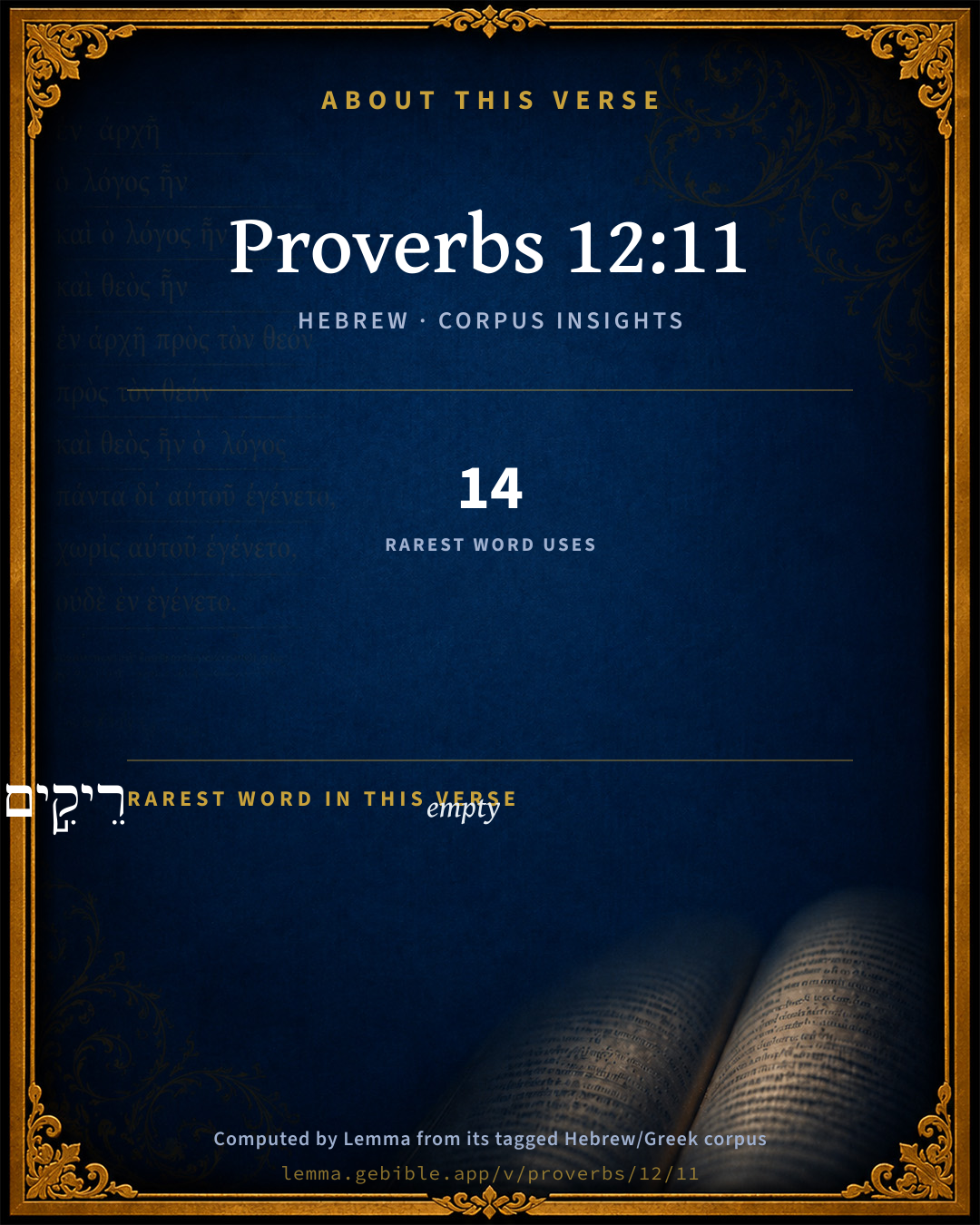
The rarest word here is רֵיקִ֣ים empty H7386 — appearing just 14 times in the whole Hebrew Bible.

Shared distinctive vocabulary

רֵיקִ֣ים empty H7386 occurs in 14 verses of the Hebrew Bible. Also found in:

Grammatical profile

  • 3 verbs
  • 3 nouns
  • 2 adjectives

Verb forms

  • עֹבֵ֣ד Qal · Participle Active
  • יִֽשְׂבַּֽע Qal · Imperfect
  • וּמְרַדֵּ֖ף Piel · Participle Active

Hebrew & Septuagint length

In English translation the verse runs 19 words from the Hebrew and 36 from the Septuagint (LXX English) — the Septuagint runs noticeably longer here. See the side-by-side →

A rough comparison of the two English renderings, which tokenize alike — not a word-level alignment.

Word counts can differ between the Hebrew and the Greek without any difference in meaning — e.g. the Hebrew direct-object marker אֵת has no separate Greek word, and Greek often adds the article ὁ.

Cross-references

22

Topical passages linked to Proverbs 12:11 in the Treasury of Scripture Knowledge — connected by theme and wording, ordered by reader-vote popularity; previews shown in the World English Bible.

  • Proverbs 28:19 One who works his land will have an abundance of food; But one who chases fantasies will have his fill of poverty.
  • Proverbs 14:23 In all hard work there is profit, But the talk of the lips leads only to poverty.
  • 1 Thessalonians 4:11–12 and that you make it your ambition to lead a quiet life, and to do your own business, and to work with your own hands, even as we charged you;
  • Psalms 128:2 For you will eat the labor of your hands. You will be happy, and it will be well with you.
  • Ephesians 4:28 Let him who stole steal no more; but rather let him labor, working with his hands the thing that is good, that he may have something to give to him who has need.
  • 2 Thessalonians 3:8 neither did we eat bread from anyone's hand without paying for it, but in labor and travail worked night and day, that we might not burden any of you;
  • Proverbs 9:6 Leave your simple ways, and live. Walk in the way of understanding."
  • Proverbs 7:7 I saw among the simple ones. I discerned among the youths a young man void of understanding,
  • Proverbs 14:4 Where no oxen are, the crib is clean, But much increase is by the strength of the ox.
  • Genesis 3:19 By the sweat of your face will you eat bread until you return to the ground, for out of it you were taken. For you are dust, and to dust you shall return."
  • Proverbs 13:20 One who walks with wise men grows wise, But a companion of fools suffers harm.
  • Proverbs 1:10–19 My son, if sinners entice you, don't consent.
  • Proverbs 4:14–15 Don't enter into the path of the wicked. Don't walk in the way of evil men.
  • Proverbs 6:32 He who commits adultery with a woman is void of understanding. He who does it destroys his own soul.
  • Titus 1:10–11 For there are also many unruly men, vain talkers and deceivers, especially those of the circumcision,
  • Judges 9:4 They gave him seventy [pieces] of silver out of the house of Baal Berith, with which Abimelech hired vain and light fellows, who followed him.
  • Psalms 26:4 I have not sat with deceitful men, Neither will I go in with hypocrites.
  • Proverbs 9:13 The foolish woman is loud, Undisciplined, and knows nothing.
  • Proverbs 9:16 "Whoever is simple, let him turn in here." As for him who is void of understanding, she says to him,
  • Proverbs 13:23 An abundance of food is in poor people's fields, But injustice sweeps it away.
  • Proverbs 27:27 There will be plenty of goats' milk for your food, For your family's food, And for the nourishment of your servant girls.
  • Jonah 2:8 Those who regard lying vanities forsake their own mercy.

Cross-references courtesy of OpenBible.info (CC BY 4.0).

Hebrew and Greek witnesses Masoretic Hebrew ↔ Greek Septuagint

The same verse in the two great witnesses to the Old Testament, shown verse-for-verse.

Here the Septuagint runs noticeably longer than the Hebrew — LXX2012 (modern English Septuagint) 36 words vs World English Bible 19. A rough length comparison of the two English translations, not a word-level alignment — read both below.

These are two independent witnesses, not word-aligned to each other, and the Septuagint is shown in lemma (dictionary) form.

Hebrew Proverbs 12:11 Masoretic · Westminster Leningrad Codex

עֹבֵ֣ד אַ֭דְמָתוֹ יִֽשְׂבַּֽע לָ֑חֶם וּמְרַדֵּ֖ף רֵיקִ֣ים חֲסַר לֵֽב

He who tills his land shall have plenty of bread, But he who chases fantasies is void of understanding.

World English Bible · Public Domain

Greek LXX Proverbs 12:11 Septuagint · lemma form

ὁ ἐργάζομαι ὁ ἑαυτοῦ γῆ ἐνπίμπλημι ἄρτος ὁ δέ διώκω μάταιος ἐνδεής φρήν ὅς εἰμί ἡδύς ἐν οἶνος διατριβή ἐν ὁ ἑαυτοῦ ὀχύρωμα καταλείπω ἀτιμία

He that tills his own land shall be satisfied with bread; but they that pursue vanities are void of understanding. He that enjoys himself in banquets of wine, shall leave dishonor in his own strong holds.

LXX2012 (modern English Septuagint) · Public Domain

On this verse, Bridges on Proverbs discusses the Septuagint’s reading. Read the note in Commentary ↓

Hebrew: Westminster Leningrad Codex (CC BY 4.0). Greek: Septuagint (public domain); English from LXX2012 (modern English Septuagint) (Public Domain). How the Septuagint differs from the Hebrew →

Commentary

Notes on Proverbs 12:11 from classic Christian and Jewish commentators (each source and its license shown beneath its notes). The classic Christian expositions comment on the surrounding passage and are grouped to its opening verse, so a note may address several verses; the Jewish commentaries on the Tanakh (Rashi and others) are per-verse, so they appear only where the commentator wrote on this verse.

Lemma curates 59 commentaries, every one of them public domain or Creative Commons licensed, each selected and text-cleaned for this edition rather than reprinted as found. About our sources →

Trapp's Complete Commentary

John Trapp

Pro 12:11 He that tilleth his land shall be satisfied with bread: but he that followeth vain [persons is] void of understanding.

Ver. 11. He that tilleth his land shall be satisfied, &c.] This is true of all other lawful callings, manual or mental, - the sweat of the brow or of the brain. Sin brought in sweat, {Gen 3:19} and now not to sweat increaseth sin. Men must earn their bread before they eat it, {2Th 3:12} and be diligent in their callings to serve God and men, themselves and others, with the fatness and sweetness thereof, and then they have a promise they shall be fed. {Psa 37:7}

But he that followeth vain persons, &c.] It is hard to be a good fellow and a good husband too. Qui aequo animo malis immiscetur, malus est, saith one, He that delights in bad company cannot be good.

John Trapp, A Commentary or Exposition upon All the Books of the Old and New Testament (1647–1656) — public domain. Text from a community e-Sword module.

The Biblical Illustrator

Joseph S. Exell

Pro_12:11

He that tilleth his land shall be satisfied with bread.

The law of labour

It is no mercy to be freed from the law of labour. Nor is it God that frees a man from that law. Among the opulent there are some who break the law of labour, and some who keep it. They keep it by working in their own province, in that state of life into which it has pleased God to call them. There is brain-toil as well as hand-toil; the wear and tear of the mental energies tend more to shorten life than the ordinary labourers wear and tear of body. Some kind of labour is enjoined upon all, by a law of Gods own framing. There is division of labour, but it is a labour nevertheless. Woe to him who craves an idle life, who would slumber existence away in listless reverie! The truth of the text is forcible, whether taken literally or applied spiritually. A contrast is drawn between the industrious and the loiterer. Solomon uses the words wise and foolish, and their kindred terms, in a deep spiritual sense--moral as well as mental, religious as well as intellectual. The fool is he who acts without reference to the Divine above him, and the everlasting before him. As we dare not let things take their course in our worldly business, so neither in our spiritual. Christianity is meant to hallow life in all its phases--to hallow business, labour, recreation. The Sabbath of the Christian is a life-long Sabbath, an every-day Sabbath. Bishop Taylor reminds us that the life of every man may be so ordered that it may be a perpetual serving of God--the greatest trouble, and most busy trade, and worldly encumbrances, when they are necessary, or charitable, or profitable, being a-doing Gods work. For God provides the good things of the world to serve the needs of nature, by the labours of the ploughman, the skill and pains of the artisan, and the dangers and traffic of the merchant. Idleness is called the sin of Sodom and her daughters, and indeed is the burial of a living man. The text suggests two pictures. In the one we have the persevering husbandman, who loses no time, who works with a good heart, and at last enjoys a noble harvest. In the other we have a slothful spendthrift, who whiles away lifes sunshine by basking in it, leaving the evening to care for itself, and heedless of coming night. But it is important to remember that no earthly seed-corn will produce fruit for another world--therefore the seed-corn must be supplied from the heavenly storehouse by the heavenly husbandman--it must be indigenous to the skies, an exotic upon earth. If thou be in earnest for God, He will multiply thy seed sown, and increase the fruits of thy righteousness. (Francis Jacox, B.A.)

Manly industry and parasitical indolence

I. Manly industry.

1. He has manly industry indicated. Agriculture is the oldest, divinest, healthiest, and most necessary branch of human industry.

2. He has manly industry rewarded. Skilled industry is seldom in want.

II. Parasitical indolence..

1. There are those who hang on others for their support.

2. Such persons are fools. They sacrifice self-respect. They expose themselves to degrading annoyances. (Homilist.)

There is great moral value in being well employed

The idle classes are waiting to become the vicious classes. This is vividly illustrated by the well-known story of a friendless girl who, about three generations ago, was thrown upon the world, uncared for. Her children and childrens children came to number over a hundred, desperate and dangerous men and women of crime. No record of earth can tell how many a bright young man or woman thrown out of employ has become a centre of equally dark and ever-widening circles. (Washington Gladden.)

The fate of drones

It will be profitable to idle people to observe the arrangement whereby nature condemns the drones to death in the bee community. No sooner is the business of swarming ended, and the worker-bees satisfied there will be no lack of fertile queens, when issues the terrible edict for the massacre of the drones. Poor fellows! It is to be hoped they comfort themselves with the reflection that their fate is an everlasting homily, presented by nature in dogmatical but most effective fashion, of the uselessness of all who labour not for their living. If one must die for the good of ones kind, by all means let it be as a martyr. Poor fellows! how they dart in and out, and up and down the hive, in the vain hope of escape! The workers are inexorable. (Scientific Illustrations.)

The Biblical Illustrator, edited by Joseph S. Exell (c. 1880s–1900s) — public domain. Text from a community e-Sword module.

Joseph Benson's Commentary

Pro 12:11. He that tilleth his land — That employeth his time and strength in an honest calling; shall be satisfied with bread — Shall, through the blessing of God, have food convenient for himself and his family; but he that followeth vain persons — That associates with them, and follows their idle course of living; is void of understanding — Will find at last, by the desperate courses into which they will lead him, that he wants not only bread; but understanding.

Joseph Benson's Commentary on the Old and New Testaments (1811–1818) — public domain. Text from a community e-Sword module.

The Preacher's Complete Homiletical Commentary

Joseph S. Exell (gen. ed.)

CRITICAL NOTES.—

Pro_12:11. Vain persons, or “vanity,” “emptiness.”

MAIN HOMILETICS OF Pro_12:11

SATISFACTION FROM TILLAGE

I. Satisfaction as the result of tillage depends—

1. Upon the performance of a Divine promise. It is long ago since God gave to Noah the promise that “While the earth remaineth, seedtime and harvest, and cold and heat, and summer and winter, and day and night shall not cease” (Gen_9:22), and it has been so invariably fulfilled that men have come to forget upon whom they are depending—in whom they are exercising faith—when they plough the ground and sow the seed. God’s regularity in His performance has bred in men a contempt for the promise and the promise maker. Men speak of the laws of nature and ignore the fact that it is by the Word of the Lord that the “rain cometh down and the snow from heaven, and returneth not thither, but watereth the earth, and maketh it bring forth and bud, that it may give seed to the sower and bread to the eater” (Isa_55:10). But so it is. The promise is the power that set the laws in motion at first and that have kept them in motion ever since. There can be no tillage without dependence upon God either acknowledged or unacknowledged. The promise is an absolute one, and implies power in God to fulfil it to the end of time. It can never fail unless God’s power fail, or unless He break His word; these are blessed impossibilities with Him. Therefore, so far as God is concerned the shall of the text is absolute. But it depends likewise—

2. Upon men’s fulfilment of their duties. First, it is not all tillage that will satisfy a man with bread, the tillage must be painstaking and intelligent. The promise of God does not set aside the necessity for the man to be very laborious and to study carefully the nature and needs of the soil which he tills. Agriculture is a science which must be acquired—a man must learn how to till the ground. God claims to be man’s instructor in this matter (Isa_28:26). Then, again, it must be his land that he tills, not land taken by fraud or violence from another. Neither if a man tills the land of another as his servant is he always paid sufficient wages to be satisfied with bread. But this is the greed of man interfering with God’s ordinaton.

II. The promise suggests symbolic teaching. We may look at it in relation to the human spirit. As land must be ploughed and sown with painstaking intelligence if a man is to have the satisfaction of reaping a harvest, so the human soul must be the object of spiritual tillage if it is ever to yield any satisfaction to God or man. There is very much to be got out of the land, but no man can obtain the full blessing unless he cultivate it. So it is with the man himself. A human soul left to lie barren can never become as a “field which the Lord hath blessed.”

(1) It must be prepared to receive the words of God. The “fallow ground” must be broken up, lest the sowing be “among thorns” (Jer_4:3), or the seed fall where it can find no entrance (Hos_10:12; Mat_13:4).

(2) Good seed must be sown. The word of God (Mar_4:14), that “incorruptible seed” by which men are “born again” (1Pe_1:23).

(3) And the spiritual sower must be persevering and prayerful. It is true of natural tillage that “He that observeth the wind shall not sow; and he that regardeth the clouds shall not reap” (Ecc_11:4); it is equally so of soul-husbandry. The world, the flesh, and the devil will be always putting difficulties in the way of a man’s caring for his “own soul.” But these obstacles must be surmounted, and if the seed is watered by prayer God will assuredly send down the rain of the Holy Ghost.

(4) And in spiritual tillage there is also a certainty of satisfaction. This also depends upon not one Divine promise but upon many—upon the revelation of God as a whole. (Upon the opposite character—him “that followeth vain persons,” or vanity, instead of tilling his land or his spiritual nature—see Homiletics on chapters Pro_6:11 and Pro_10:5, pages 79 and 147.)

OUTLINES AND SUGGESTIVE COMMENTS

We might have expected that the antithesis of the second clause would have ended with “shall lack bread,” but the real contrast goes deeper. Idleness leads to a worse evil than that of hunger.—Plumptre.

Vain persons or “empty people”—most signally the impenitent—for they are empty of all good. “That follows after empty people” is a fine characteristic of the impenitent man’s decline. Following others is the commonest influence to destroy the soul.—Miller.

Special honour is given to the work of tilling the land. God assigned it to Adam in Paradise. It was the employment of his eldest son. In ancient times it was the business or relaxation of kings. A blessing is ensured to diligence, sometimes abundant, always such as we should be satisfied with.—Bridges.

Of all the arts of civilised man agriculture is transcendantly the most essential and valuable. Other arts may contribute to the comfort, the convenience, and the embellishment of life, but the cultivation of the soil stands in immediate connection with our very existence. The life itself, to whose comfort, convenience, and embellishment other arts contribute, is by this sustained, so that others without it can avail nothing.—Wardlaw.

The only two universal monarchs practised husbandry.… Some people think that they cannot have enough unless they have more than the necessaries and decent comforts of life: but we are here instructed that bread should satisfy our desires. Having food and raiment, let us be therewith content. There are few that want these, and yet few are content.… To be satisfied with bread is a happy temper of mind, and is commonly the portion of the man of industry, which not only procures bread, but gives it a relish unknown to men that are above labour.—Lawson.

Sin brought in sweat (Gen_3:19), and now not to sweat increaseth sin.… “But he that followeth vain persons,” etc. It is hard to be a good fellow and a good husband too.—Trapp.

Here is encouragement to those who travail in husbandry. They are of as good note with God for their service, if they be faithful, as others whose trades are more gainful, and better esteemed among men. The merchants, and goldsmiths, and others of such places, are not so often mentioned in Scripture as they be, nor animated with so many consolations as they are. The grand promises for blessing on their labour are made to them in special, and the rest must deduct their comforts from thence by proportion.—Dod.

In a moral point of view the life of the agriculturist is the most pure and holy of any class of men; pure, because it is the most healthful, and holy, because it brings the Deity perpetually before his view, giving him thereby the most exalted notions of supreme power, and the most fascinating and endearing view of moral benignity.—Sir B. Maltravers.

Ill fares the land, to hastening ills a prey,

Where wealth accumulates and men decay;

Princes and lords may flourish, or may fade;

A breath can make them, as a breath has made:

But a bold peasantry, their country’s pride,

When once destroyed, can never be supplied.

Goldsmith.

The Preacher's Complete Homiletical Commentary (gen. ed. Joseph S. Exell; Funk & Wagnalls, c. 1892) — public domain (pre-1929). A full-Bible homiletical/sermon-outline anthology covering 65 of 66 books (2 John is absent from the source module). Text from a community e-Sword module.

Bridges on Proverbs

Charles Bridges

Special honour is given to the work of tilling the land. God assigned it to Adam in Paradise. (Gen 2:15 .) It was the employment of his eldest son. (Gen 4:2 .) Its origin appears to have been under immediate Divine Teaching. (Isa 28:23-26 .) In ancient times it was the business or relaxation of kings.†1 A blessing is ensured to diligence; sometimes abundant (Gen 26:12 ); always such as we should be satisfied with. (Pro 27:23-27 .)

The principle applies alike to every lawful calling. Industry is an ornamental grace (Pro 31:13-22 ), and a Christian obligation. (Rom 12:11 . 1Th 4:11 .) Most ample is its reward in the work of God. How rich is the harvest for the diligent student of the Scriptures! Truly he shall be satisfied with bread. But idleness is a spot upon our royal name. (2Th 3:10-12 .) As an old writer observes — ’The proud person is Satan’s throne, and the idle man his pillow. He sitteth in the former, and sleepeth quietly on the latter.’†2 The man therefore that followeth vain persons, instead of honest labour, proves himself to be void of understanding, and will reap the fruits of his folly (Pro 13:20 . Act 5:36-37 ) — perhaps throughout eternity.†3

Footnotes:

†1 2Ch 26:10 . ’Omnium rerum, ex quibus aliquid acquirtur, nihil est agriculturâ melius, nihil uberius, nihil dulcius, nihil homine libero dignius.’ Such was the judgment of the Roman Moralist. — Cicero De Offic. B. I. xliii. ’Of all the arts of civilized man, agriculture is transcendently the most essential and valuable. Other arts may contribute to the comfort, the convenience, and the embellishment of life. But the cultivation of the soil stands in immediate connexion with our very existence. The life itself, to whose comfort, and convenience, and embellishment, other arts contribute, is by this sustained: so that others without it can avail nothing.’ Wardlaw on Ecc 5:9 .

†2 Swinnock’s Christian Man’s Calling, Part I. 346.

†3 The LXX gives a curious addition to this verse, not without some wholesome application to young votaries of pleasure — ’He that is sweet in wine-parties shall leave behind disgrace in his strong places.’

Charles Bridges, An Exposition of the Book of Proverbs (1846) — public domain. Text from a community e-Sword module.

Tyndale Open Study Notes

Tyndale Open Resources

12:11 This proverb is repeated but with a different conclusion in 28:19.

Tyndale Open Study Notes — © Tyndale Open Resources, licensed CC BY-SA 4.0. Text via the HelloAO Bible API.

Geneva Bible (1599)

Geneva Bible translators

Or, defense.

Geneva Bible (1599) marginal notes — public domain. Text via Bolls.life.

Matthew Henry's Commentary

Note, 1. It is men's wisdom to mind their business and follow an honest calling, for that is the way, by the blessing of God, to get a livelihood: He that tills his land, of which he is either the owner or the occupant, that keeps to his word and is willing to take pains, if he do not raise an estate by it (what need is there of that?), yet he shall be satisfied with bread, shall have food convenient for himself and his family, enough to bear his charges comfortably through the world. Even the sentence of wrath has this mercy in it, Thou shalt eat bread, though it be in the sweat of thy face. Cain was denied this, Gen 4:12. Be busy, and that is the true way to be easy. Keep thy shop and thy shop will keep thee. Thou shalt eat the labour of thy hands. 2. It is men's folly to neglect their business. Those are void of understanding that do so, for then they fall in with idle companions and follow them in their evil courses, and so come to want bread, at least bread of their own, and make themselves burdensome to others, eating the bread out of other people's mouths.

Matthew Henry's Commentary on the Whole Bible (1708–1710) — public domain (CC PDM 1.0). Text via the HelloAO Bible API.

Jamieson, Fausset & Brown

Robert Jamieson, A. R. Fausset & David Brown

The idler's fate is the result of indolence and want of principle (Pro 6:32; Pro 7:7).

Jamieson, Fausset & Brown — Commentary Critical and Explanatory on the Whole Bible (1871) — public domain (CC PDM 1.0). Text via the HelloAO Bible API.

Adam Clarke's Commentary

Verse 11. He that tilleth his land] God's blessing will be in the labour of the honest agriculturist.

But he that followeth vain persons] He who, while he should be cultivating his ground, preparing for a future crop, or reaping his harvest, associates with fowlers, coursers of hares, hunters of foxes, or those engaged in any champaign amusements, is void of understanding; and I have known several such come to beggary.

To this verse the Septuagint add the following clause: ος εστιν ηδυς εν οινων διατριβαις, εν τοις εαυτου οχυρωμασι καταλειψει ατιμιαν. "He who is a boon companion in banquets, shall leave dishonour in his own fortresses." This has been copied by the Vulgate and the Arabic. That is The man who frequents the ale-house enriches that, while he impoverishes his own habitation.

Adam Clarke's Commentary on the Bible (1810–1826) — public domain. Text from a community e-Sword/MySword module.

Ellicott's Commentary for English Readers

(11) Vain persons.—Or, things, such as “searching for hid treasures” (Pro_2:4).

A Bible Commentary for English Readers, edited by Charles John Ellicott (1878–1897) — public domain. Text from a community e-Sword module.

The Cambridge Bible for Schools and Colleges

gen. ed. J. J. S. Perowne

11. vain persons] We may either supply persons, with A.V. and R.V. text: or things, with R.V. marg. and LXX. μάταια, Vulg. sectatur otium, and in accordance with the usage of this Book in following the Heb. verb here employed by an accus. of a thing, Pro_11:19, Pro_15:9. In the former case the argument expanded will be: To keep bad company argues want of understanding, because it leads not to plenty but to lack of bread. In the latter case we may understand by vain things, idle, useless occupations, thus preserving the contrast to the honest labour of the former clause of the verse.

The LXX. and Vulg. have an interesting addition:

“He that takes pleasure in tarrying long at the wine

Shall leave dishonour in his own stronghold;”

as an example probably of the general principle of the proverb. Comp. Pro_21:17.

The Cambridge Bible for Schools and Colleges (gen. ed. J. J. S. Perowne; Cambridge University Press, 1878–1918) — public domain. Text from a community e-Sword module.

John Gill's Exposition

He that tilleth his land shall be satisfied with bread,.... This was man's work in innocence; this he was doomed to do with the sweat of his brow after his fall; every man has his land to till, or some calling, work, or business, to be employed in, either civil or sacred; and it becomes him to be diligent therein, and such as are shall not want bread, but shall have a sufficiency of it;

but he that followeth vain persons is void of understanding: that neglects his business, loiters away his time, spends it in the company of vain, empty, and unprofitable persons; as he shows himself by such a choice that he is void of understanding, or "wants a heart" (s), to improve his time and talents; so before long it is much if he does not want a piece of bread. Thus he that is concerned to have the fallow ground of his heart ploughed up, and righteousness, truth, and holiness, sown therein, that it may bring forth fruit; or who is careful about the welfare and salvation of his immortal soul, and makes diligent use of all means to promote its spiritual good, shall be filled with the bread of life, shall find it and eat it, to the joy and rejoicing of his heart; and, on the contrary, he that associates himself with vain persons, empty of all that is spiritually good, that have only empty notions of religion; or who attend to the profane and vain boastings of antichrist, and all false teachers; and give heed to seducing spirits and doctrines of devils, whose words eat as do a canker; these, as they show themselves to want wisdom, so they are and will be brought into starving and famishing circumstances in a spiritual sense. Jarchi interprets the former clause of a man that is studious in his doctrine, that revolves it in his mind, that he may not forget it; and the Arabic version renders the last clause,

"they that run after false demons, their minds are deficient;''

see Rev 9:20.

(s) "deficiens corde", Pagninus; "carens corde", Montanus; "deficitur corde", Schultens.

John Gill's Exposition of the Whole Bible (1746–1763) — public domain (CC PDM 1.0). Text via the HelloAO Bible API.

Albert Barnes' Notes on the Bible

The contrast is carried on between the life of industry and that of the idle, “vain person” of the “baser sort” (the “Raca” of Mat 5:22). We might have expected that the second clause would have ended with such words as “shall lack bread,” but the contrast goes deeper. Idleness leads to a worse evil than that of hunger.

Albert Barnes' Notes on the Bible (1834–1885) — public domain. Text from a community e-Sword/MySword module.

Haydock's Catholic Bible Commentary

Idleness. Hebrew, "the idle." Their company is seducing. --- He that, &c. This occurs in the Septuagint, but not in the Hebrew or the new edition of St. Jerome. (Calmet) --- Wine. Or "in taverns." --- Holds. Soldiers have thus been often surprised. (Menochius) --- "Drunkenness is an incitement to lust and madness, the poison of wisdom." (St. Ambrose)

George Leo Haydock (1774–1849), Haydock's Catholic Family Bible and Commentary, 1859 edition — public domain. Excludes Psalms (Douay-Rheims chapter numbering differs from Protestant) and Deuterocanonical books (Catholic canon only).

Matthew Poole's English Annotations

That tilleth his land; that employeth his time and strength in an honest calling.

That followeth vain persons; that useth their society and idle course of living.

Is void of understanding; shall through his own folly want bread.

Matthew Poole's English Annotations on the Holy Bible (1683–1685) — public domain. Text from a community e-Sword/MySword module.

Whedon's Commentary on the Bible

Daniel D. Whedon

11. Satisfied with bread — Shall have plenty.

Vain persons — ריקים, (rekim,) the raca of Mat_5:22. Idle, profligate, empty-pated men; those who frequent saloons, taverns, ale houses, and other dissolute places, when they should be ploughing, or otherwise earning an honest living. The Septuagint here adds a proverb not in the Hebrew which is worthy of preservation: “He that enjoys himself (or spends his time) in banquets of wine, shall leave dishonour in his own strongholds.” The idea is, that he shall leave a heritage of dishonour to his household. Compare Pro_28:19; Gen_3:19.

Daniel D. Whedon (gen. ed.), Commentary on the Old and New Testaments (1874–1909) — public domain. Text from a community e-Sword module.

The Pulpit Commentary

A contrast between industry and idleness, repeated at Pro_28:19. He that tilleth his land. Agriculture was the first of industries, and always highly commended among the Jews, bringing a sure return to the diligent. (Pro_10:5 Pro_20:4 Pro_27:18, Pro_27:23-27; and Ecc 20:28) He that followeth after vain persons; rather, vain things; mataia , Septuagint, empty, useless employments, profitless business, in contrast to active labour on the land. The Vulgate renders, qui sectatur otium, "he who studieth ease;" but the original, reikim, will not bear this meaning. Is void of understanding; he not only, as is implied, will be reduced to poverty, but shows moral weakness and depravity. The Septuagint and Vulgate here introduce a paragraph not found in our Hebrew text: "He who takes pleasure (ov estin hduv ) in carouses of wine will leave disgrace in his strongholds (ocurwmasi )". (Isa_28:7, 8 Hab_2:16) Probably this verse is derived from the following, with some corruption of the text.

The Pulpit Commentary (1880–1919), ed. H.D.M. Spence-Jones & Joseph S. Exell — public domain. Text from a community e-Sword module.

John Wesley's Explanatory Notes

Tilleth - That employs his time in an honest calling. Vain persons - In an idle course of living.

John Wesley, Explanatory Notes Upon the Whole Bible (1754–1765) — public domain. Text via the GEBible commentary corpus.

Keil & Delitzsch

C. F. Keil & F. Delitzsch

11 He that tilleth his own ground is satisfied with bread,

And he that followeth after vain pursuits is devoid of understanding.

Yet more complete is the antithetic parallelism in the doublette, Pro 28:19 (cf. also Sir. 20:27a). The proverb recommends the cultivation of the field as the surest means of supporting oneself honestly and abundantly, in contrast to the grasping after vain, i.e., unrighteous means of subsistence, windy speculations, and the like (Fl.). ריקים are here not persons (Bertheau), but things without solidity and value (lxx μάταια; Aquila, Theodotion, κενά), and, in conformity with the contrast, not real business. Elsewhere also the mas. plur. discharges the function of a neut. noun of multitude, vid., נגידים, principalia, Pro 8:6, and זדים, Psa 19:14 - one of the many examples of the imperfect use of the gender in Hebr.; the speaker has in ריקים, vana et inania, not אנשׁים (Jdg 9:4), but דברים (Deu 32:47) in view. The lxx erroneously at Pro 28:19, and Symmachus and Jerome at both places understand ריקים of slothfulness.

Keil & Delitzsch — Biblical Commentary on the Old Testament (1861–1891) — public domain (CC PDM 1.0). Text via the HelloAO Bible API. (Old Testament only.)

Kretzmann's Popular Commentary

Paul E. Kretzmann

v. 11. He that tilleth his land shall be satisfied with bread, his industry ordinarily being rewarded in this manner; but he that followeth vain persons, vanity, idleness, laziness, is void of understanding, lacks the very principles of ordinary common sense.

Paul E. Kretzmann, Popular Commentary of the Bible (1921–1924) — public domain. Text from a community e-Sword module.

unfoldingWord translationNotes

Door43 World Missions Community

worthless projects

"worthless plans" or "worthless tasks"

the fruit

This refers to a person's actions and thoughts. Just as fruit on a tree shows what kind of tree it is, in the same way a person's words and actions reveal what his character is like.

translationWords

worthy

evil

fruit

unfoldingWord translationNotes — © Distant Shores Media and the Door43 World Missions Community, licensed CC BY-SA 4.0. Source: git.door43.org/Door43/en_tn.

Rashi

Rabbi Shlomo Yitzchaki (Rashi)

He who tills his soil will be sated with bread To be understood according to its apparent meaning, but according to its allegorical meaning, [this means] he who constantly reviews his studies lest they be forgotten.

Rashi on the Tanakh — English translations: “The Judaica Press complete Tanach with Rashi, translated by A. J. Rosenberg” (CC BY 4.0); “Pentateuch with Rashi's commentary by M. Rosenbaum and A.M. Silbermann, 1929-1934” (public domain); “The Metsudah Tanach series, Lakewood, N.J” (CC BY 4.0); and “The Book of Joshua, Metsudah Publications, 1997” (CC BY 4.0). Text via Sefaria.

Lesson kit

Teaching starters — assembled from the data on this page, not authored interpretation. Every prompt links to the verse data it draws on. Edit before teaching.

Proverbs, in the Wisdom, opens this verse with 8 words (8 distinct Hebrew lemmas). Its most distinctive word is rêyq (“empty”). The Greek Septuagint runs longer here. A historical commentator’s framing appears above. Read the whole chapter for the surrounding context.

Discussion questions

  1. How does “empty” (rêyq) shape what this verse is saying?
  2. Genesis 37:24 shares the word «empty» with this verse. How do the two illuminate each other?
  3. Compared with the Hebrew, the Septuagint runs longer here. What questions does that raise?
  4. The translations on this page render this verse differently — a whole-verse word diff, not a word-by-word alignment. What might account for the different wordings?
  5. The verb «עֹבֵ֣ד» is Qal Participle Active. How does its form color the action?
  6. Reading how Trapp's Complete Commentary and The Biblical Illustrator read this verse, where do the two commentators agree and where do they part?

Things to notice

Reading settings

Reading text

Shown beneath each verse's original-language words.

Old Testament
Old Testament edition

Read the OT as the Masoretic Hebrew (MT) or the Greek Septuagint (LXX).

English shown for the Greek Septuagint (in the Hebrew ↔ Greek comparison).

Comparing translations? Open the Compare panel on any verse page to stack up to four side by side.