
Genesis 47:26

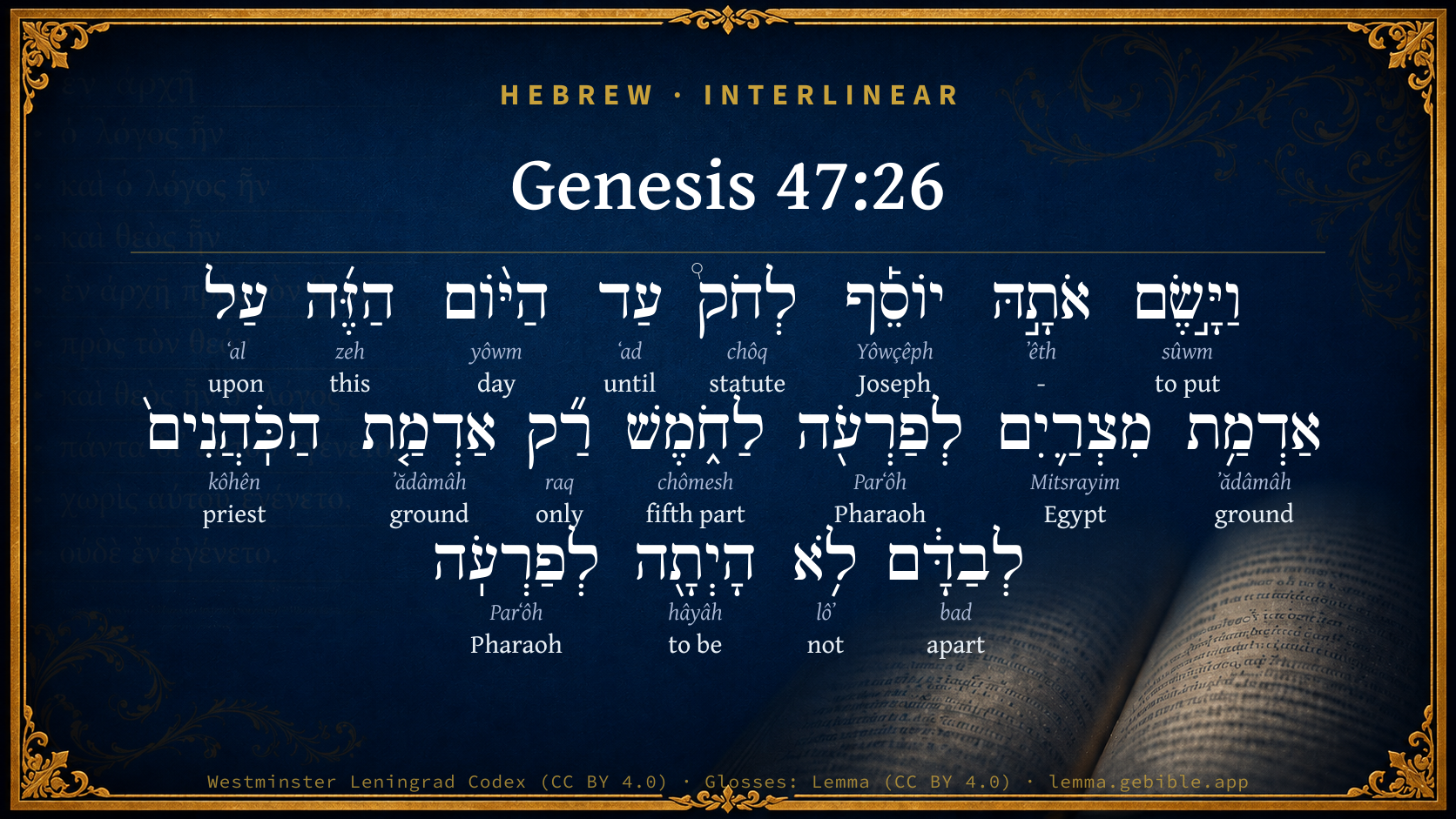
Hebrew (Westminster Leningrad Codex) Genesis 47:26 appears in the Hebrew Old Testament. The text above is from the Westminster Leningrad Codex. Each word links to its Strong’s number, a concise gloss, and parsing drawn from the Open Scriptures Hebrew Bible morphology. Click any word for its full Brown-Driver-Briggs (BDB) entry.
Download image
Cite this verse

Genesis 47:26 (World English Bible). Public Domain. Lemma interlinear Bible study tool, https://lemma.gebible.app/v/genesis/47/26.

Show BibTeX & RIS
BibTeX
RIS
English Translation
Joseph made it a statute concerning the land of Egypt to this day, that Pharaoh should have the fifth. Only the land of the priests alone didn't become Pharaoh's.
World English Bible · Public Domain
Highlights
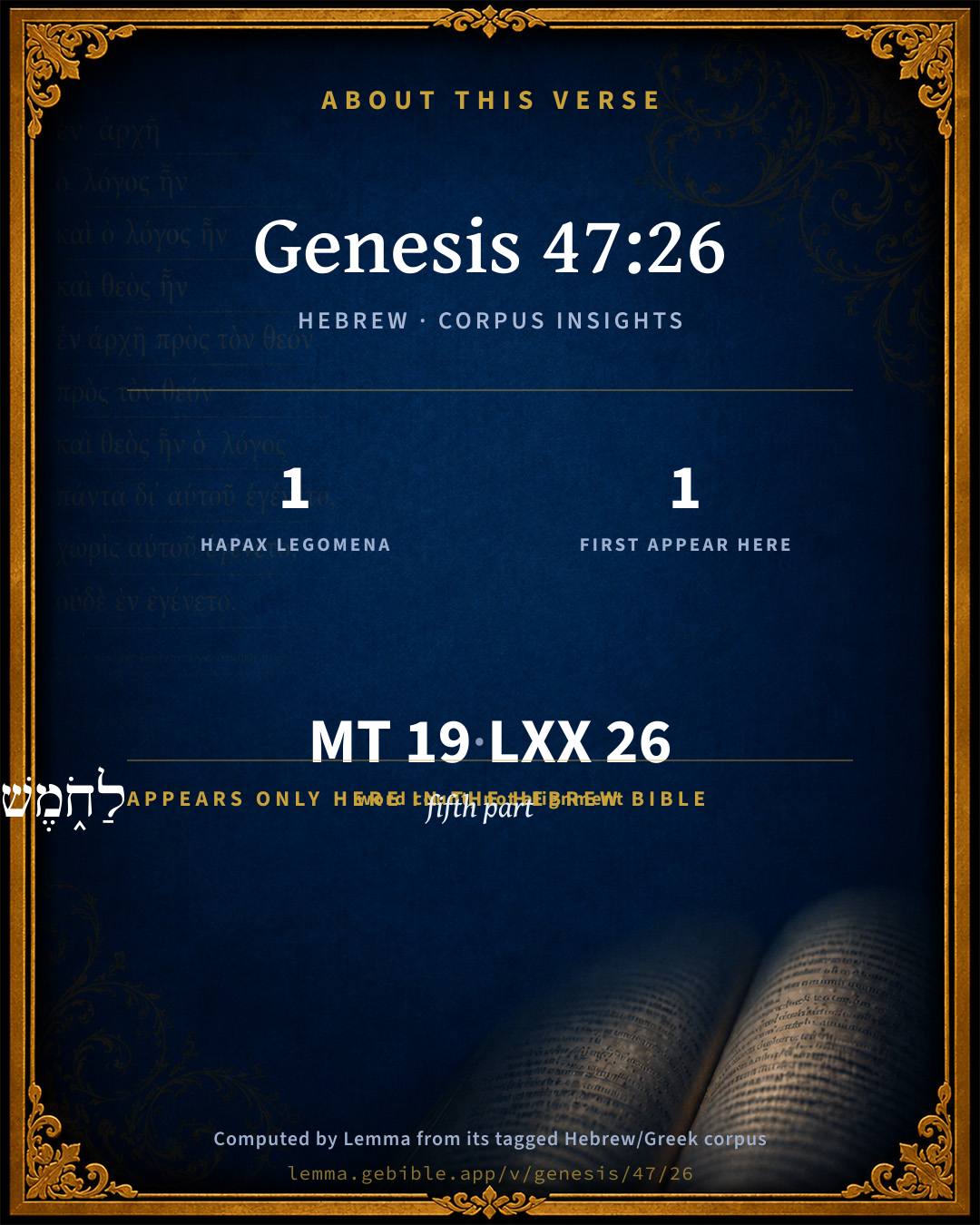
  • 1 hapax legomenon — only here in the Hebrew Bible
  • 1 first appearance in the Hebrew Bible
Full analysis ↓
Download a study sheet

One document with this verse’s original text, its word-by-word gloss line, the meaning frame, cross-references with their text, attributed commentary, and full source and license credits — printable, and it pastes into notes with its structure intact.

This verse Autodidact and up

Study sheet (.html) Plain text (.txt)

A passage Seminary Student

Up to 50 verses in one chapter. A passage sheet keeps up to 6 commentary sources and 12 cross-references per verse, in the order this page ranks them, and says so on the sheet whenever that leaves anything out. Ask for a single verse and you get the Autodidact verse sheet above.

Everything on this page stays free to read, with no account — the sheet is a download of what is already on screen, not access to it.

Want to remove ads? Support Godless Engineer
Compare translations 3

The same verse in 3 English versions, stacked beneath the original-language interlinear above. Click any original word for its lexicon entry.

Each is an independent rendering of the whole verse — the interlinear is not word-aligned to these translations.

Highlighted words mark where these versions differ — a whole-verse word diff, not a word-by-word alignment.

  • World English Bible Public Domain
    Joseph made it a statute concerning the land of Egypt to this day, that Pharaoh should have the fifth. Only the land of the priests alone didn't become Pharaoh's.
  • King James Version Public Domain
    And Joseph made it a law over the land of Egypt unto this day, that Pharaoh should have the fifth part, except the land of the priests only, which became not Pharaoh's.
  • unfoldingWord Literal Text CC BY-SA 4.0
    And Joseph established it as a law to this day concerning the land of Egypt, the fifth to Pharaoh. Only the land of the priests by itself did not become Pharaoh’s. Jacob’s Last Wishes 47:27-31

unfoldingWord Literal Text — © unfoldingWord, licensed CC BY-SA 4.0. Word-aligned USFM3 via Door43 (git.door43.org/unfoldingWord/en_ult).

Versions to compare (up to 4)

3 of 4 selected

Show all 18 translations

Every available English version of this verse, each an independent rendering of the whole verse.

  • World English Bible Public Domain
    Joseph made it a statute concerning the land of Egypt to this day, that Pharaoh should have the fifth. Only the land of the priests alone didn't become Pharaoh's.
  • Berean Standard Bible Public Domain
    So Joseph established a law that a fifth of the produce belongs to Pharaoh, and it is in effect in the land of Egypt to this day. Only the priests’ land does not belong to Pharaoh.
  • Majority Standard Bible Public Domain
    So Joseph established a law that a fifth of the produce belongs to Pharaoh, and it is in effect in the land of Egypt to this day. Only the priests’ land does not belong to Pharaoh.
  • King James Version Public Domain
    And Joseph made it a law over the land of Egypt unto this day, that Pharaoh should have the fifth part, except the land of the priests only, which became not Pharaoh's.
  • American Standard Version (1901) Public Domain
    And Joseph made it a statute concerning the land of Egypt unto this day, that Pharaoh should have the fifth; only the land of the priests alone became not Pharaoh's.
  • Revised Version (1885) Public Domain
    And Joseph made it a statute concerning the land of Egypt unto this day, that Pharaoh should have the fifth; only the land of the priests alone became not Pharaoh’s.
  • Geneva Bible (1599) Public Domain
    Then Ioseph made it a lawe ouer the land of Egypt vnto this day, that Pharaoh should haue the fift part, except the land of the priests only, which was not Pharaohs.
  • Douay-Rheims (1899) Public Domain
    From that time unto this day, in the whole land of Egypt, the fifth part is paid to the king, and it is become as a law, except the land of the priests, which was free from this covenant.
  • Young's Literal Translation Public Domain
    and Joseph setteth it for a statute unto this day, concerning the ground of Egypt, `that' Pharaoh hath a fifth; only the ground of the priests alone hath not become Pharaoh's.
  • Literal Standard Version CC BY-SA 4.0
    and Joseph sets it for a statute to this day, concerning the ground of Egypt, [that] Pharaoh has a fifth; only the ground of the priests alone has not become Pharaoh’s.
  • Unlocked Literal Bible CC BY-SA 4.0
    So Joseph made it a statute which is in effect in the land of Egypt to this day, that one-fifth belongs to Pharaoh. Only the land of the priests did not become Pharaoh's.
  • unfoldingWord Literal Text CC BY-SA 4.0
    And Joseph established it as a law to this day concerning the land of Egypt, the fifth to Pharaoh. Only the land of the priests by itself did not become Pharaoh’s. Jacob’s Last Wishes 47:27-31
  • Darby Bible Public Domain
    And Joseph made it a law over the land of Egypt to this day, [that] the fifth should be for Pharaoh, except the land of the priests: theirs alone did not become Pharaoh's.
  • World Messianic Bible Public Domain
    Joseph made it a statute concerning the land of Egypt to this day, that Pharaoh should have the fifth. Only the land of the priests alone didn’t become Pharaoh’s.
  • Webster's Bible Public Domain
    And Joseph made it a law over the land of Egypt to this day, that Pharaoh should have the fifth part; except the land of the priests only, which became not Pharaoh's.
  • Free Bible Version CC BY-SA 4.0
    So Joseph made it a law for Egypt which is still is in effect today that one-fifth of all produce from the land belongs to Pharaoh. Only the priests' land was exempt since it did not belong to Pharaoh.
  • Bible in Basic English Public Domain
    Then Joseph made a law which is in force to this day, that Pharaoh was to have the fifth part; only the land of the priests did not become his.
  • JPS Tanakh (1917) Public Domain
    And Joseph made it a statute concerning the land of Egypt unto this day, that Pharaoh should have the fifth; only the land of the priests alone became not Pharaoh's.

Literal Standard Version (2020), Covenant Press — licensed CC BY-SA 4.0. Text via the HelloAO Bible API (eBible.org). Unlocked Literal Bible (unfoldingWord) — licensed CC BY-SA 4.0. Text via the HelloAO Bible API (eBible.org). unfoldingWord Literal Text — © unfoldingWord, licensed CC BY-SA 4.0. Word-aligned USFM3 via Door43 (git.door43.org/unfoldingWord/en_ult). Free Bible Version, Dr. Jonathan Gallagher — licensed CC BY-SA 4.0. Text via the HelloAO Bible API (eBible.org).

Word by word

More ways to search: Search by grammar → Find every occurrence → Compare this word →

Practice this passage: Drill this verse → Learn its vocabulary →

לַחֹ֑מֶשׁ
chômesh
H2569
“to/for the · fifth part”
Preposition, Determined + Noun, Common, Masculine, Singular, Absolute
Part of Speech
Preposition + Noun
Type
Common
Gender
Masculine
Number
Singular
State
Absolute
Full BDB Definition

Origin: from H2567

TWOT: TWOT- 686b

fifth part
  1. וַיָּ֣שֶׂם sûwm H7760 “and · to put” Conjunction + Verb, Qal, Sequential Imperfect, 3rd Person, Masculine, Singular
  2. אֹתָ֣הּ ʼêth H853 “- · her” Particle, Direct Object + Suffix, Personal, 3rd Person, Feminine, Singular
  3. יוֹסֵ֡ף Yôwçêph H3130 “Joseph” Noun, Proper
  4. לְחֹק֩ chôq H2706 “to/for · statute” Preposition + Noun, Common, Masculine, Singular, Absolute
  5. עַד ʻad H5704 “until” Preposition
  6. הַיּ֨וֹם yôwm H3117 “the · day” Particle, Definite Article + Noun, Common, Masculine, Singular, Absolute
  7. הַזֶּ֜ה zeh H2088 “the · this” Particle, Definite Article + Pronoun, Demonstrative, Masculine, Singular
  8. עַל ʻal H5921 “upon” Preposition
  9. אַדְמַ֥ת ʼădâmâh H127 “ground of” Noun, Common, Feminine, Singular, Construct
  10. מִצְרַ֛יִם Mitsrayim H4714 “Egypt” Noun, Proper
  11. לְפַרְעֹ֖ה Parʻôh H6547 “to/for · Pharaoh” Preposition + Noun, Proper
  12. רַ֞ק raq H7535 “only” Particle, Accusative
  13. אַדְמַ֤ת ʼădâmâh H127 “ground of” Noun, Common, Feminine, Singular, Construct
  14. הַכֹּֽהֲנִים֙ kôhên H3548 “the · priests” Particle, Definite Article + Noun, Common, Masculine, Plural, Absolute
  15. לְבַדָּ֔ם bad H905 “to/for · apart · their” Preposition + Noun, Common, Masculine, Singular, Construct + Suffix, Personal, 3rd Person, Masculine, Plural
  16. לֹ֥א lôʼ H3808 “not” Particle, Negative
  17. הָיְתָ֖ה hâyâh H1961 “to be” Verb, Qal, Perfect, 3rd Person, Feminine, Singular
  18. לְפַרְעֹֽה Parʻôh H6547 “to/for · Pharaoh” Preposition + Noun, Proper

About this verse

These counts appear in no published source. They are computed here, from the morphology-tagged text and Lemma’s own curated glosses. What Lemma adds →

19
words
17
distinct lemmas
Pentateuch
section

Notable vocabulary

1 hapax legomenon — a word that appears only here in the entire Hebrew Bible:

  • לַחֹ֑מֶשׁ fifth part H2569

First appearance in Scripture

This word makes its first canonical appearance in the Hebrew Bible here:

  • לַחֹ֑מֶשׁ fifth part H2569

Grammatical profile

  • 2 verbs
  • 11 nouns
  • 1 pronoun
  • 2 prepositions
  • 3 particles

Verb forms

  • וַיָּ֣שֶׂם Qal · Sequential Imperfect
  • הָיְתָ֖ה Qal · Perfect

Repetition

Words recur within this verse — often emphatic in Hebrew:

  • אַדְמַ֥ת ground H127 ×2
  • לְפַרְעֹ֖ה Pharaoh H6547 ×2

Hebrew & Septuagint length

In English translation the verse runs 29 words from the Hebrew and 35 from the Septuagint (LXX English) — closely comparable.

A rough comparison of the two English renderings, which tokenize alike — not a word-level alignment.

Word counts can differ between the Hebrew and the Greek without any difference in meaning — e.g. the Hebrew direct-object marker אֵת has no separate Greek word, and Greek often adds the article ὁ.

In the original languages it is 19 Hebrew tokens and 26 Greek tokens — but the two are counted differently (Hebrew bundles its prefixes and suffixes into one token; the Greek is in lemma form), so that isn’t a like-for-like length.

Cross-references

2

Topical passages linked to Genesis 47:26 in the Treasury of Scripture Knowledge — connected by theme and wording, ordered by reader-vote popularity; previews shown in the World English Bible.

  • Genesis 47:22 Only he didn't buy the land of the priests, for the priests had a portion from Pharaoh, and ate their portion which Pharaoh gave them. That is why they didn't sell their land.
  • Ezekiel 7:24 Therefore I will bring the worst of the nations, and they shall possess their houses: I will also make the pride of the strong to cease; and their holy places shall be profaned.

Cross-references courtesy of OpenBible.info (CC BY 4.0).

Hebrew and Greek witnesses Masoretic Hebrew ↔ Greek Septuagint

The same verse in the two great witnesses to the Old Testament, shown verse-for-verse.

These are two independent witnesses, not word-aligned to each other, and the Septuagint is shown in lemma (dictionary) form.

Hebrew Genesis 47:26 Masoretic · Westminster Leningrad Codex

וַיָּ֣שֶׂם אֹתָ֣הּ יוֹסֵ֡ף לְחֹק֩ עַד הַיּ֨וֹם הַזֶּ֜ה עַל אַדְמַ֥ת מִצְרַ֛יִם לְפַרְעֹ֖ה לַחֹ֑מֶשׁ רַ֞ק אַדְמַ֤ת הַכֹּֽהֲנִים֙ לְבַדָּ֔ם לֹ֥א הָיְתָ֖ה לְפַרְעֹֽה

Joseph made it a statute concerning the land of Egypt to this day, that Pharaoh should have the fifth. Only the land of the priests alone didn't become Pharaoh's.

World English Bible · Public Domain

Greek LXX Genesis 47:26 Septuagint · lemma form

καί τίθημι αὐτός ιωσηφ εἰς πρόσταγμα ἕως ὁ ἡμέρα οὗτος ἐπί γῆ αἴγυπτος ὁ φαραώ ἀποπεμπτόω χωρίς ὁ γῆ ὁ ἱερεύς μόνον οὐ εἰμί ὁ φαραώ

And Joseph appointed it to them for an ordinance until this day; to reserve a fifth part for Pharao, on the land of Egypt, except only the land of the priests, that was not Pharao's.

LXX2012 (modern English Septuagint) · Public Domain

Hebrew: Westminster Leningrad Codex (CC BY 4.0). Greek: Septuagint (public domain); English from LXX2012 (modern English Septuagint) (Public Domain). How the Septuagint differs from the Hebrew →

Targum (Aramaic paraphrase)

2

The Targum is the ancient Jewish Aramaic paraphrase of the Hebrew Scriptures — an interpretive translation, not the Hebrew text itself. Onkelos (literal) and Pseudo-Jonathan (expansive) render the Torah, and Jonathan the Prophets. Coverage is partial: where no permissively-licensed English translation exists for a verse, only the Aramaic is shown. This is verse-level text, not a word-by-word alignment to the Hebrew.

  1. Targum Onkelos Torah (Genesis–Deuteronomy)
    וְשַׁוִּי יָתַהּ יוֹסֵף לִגְזֵרָא עַד יוֹמָא הָדֵין עַל אַרְעָא דְמִצְרַיִם דִּיהוֹן יָהֲבִין חַד מִן חַמְשָׁא לְפַרְעֹה לְחוֹד אַרְעָא דְכֻמָּרַיָּא בִּלְחוֹדֵיהוֹן לָא הֲוַת לְפַרְעֹה

    (no public-domain English translation for this verse)

    Targum Onkelos — Aramaic: “Onkelos Genesis” (public domain); “Onkelos Exodus” (public domain); “Onkelos Leviticus” (public domain); “Onkelos Numbers” (public domain); “Onkelos Deuteronomy” (public domain). English: “Sefaria Community Translation” (CC0 1.0 (public-domain dedication)); “J.W. Etheridge. The Targums of Onkelos and Jonathan Ben Uzziel on the Pentateuch. London: Longmans, Green, 1862” (public domain). Text via Sefaria.

  2. Targum Pseudo-Jonathan Torah (Genesis–Deuteronomy)
    וְשַׁוִי יוֹסֵף לִגְזֵירָא עַד יוֹמָא הָדֵין עַל אַרְעָא דְמִצְרַיִם לְפַרְעה לְמֵיתַב חוּמְשָׁא מִן עֲלַלְתָּא לְחוֹד אַרְעָא דְכוּמְרַנְיָא בִּלְחוֹדֵיהוֹן לָא הֲוָת לְפַרְעה

    And Joseph established it a law unto this day over the land of Mizraim to take to Pharoh a fifth part of the produce, except only the land of the priests which was not Pharoh's.

    Targum Pseudo-Jonathan — Aramaic: “Targum Jonathan on Genesis” (public domain); “Targum Jonathan on Exodus” (public domain); “Targum Jonathan on Leviticus” (public domain); “Targum Jonathan on Numbers” (public domain); “Targum Jonathan on Deuteronomy” (public domain). English: “The Targum of Jonathan ben Uzziel, trans. J. W. Etheridge, London, 1862” (public domain). Text via Sefaria.

Commentary

Notes on Genesis 47:26 from classic Christian and Jewish commentators (each source and its license shown beneath its notes). The classic Christian expositions comment on the surrounding passage and are grouped to its opening verse, so a note may address several verses; the Jewish commentaries on the Tanakh (Rashi and others) are per-verse, so they appear only where the commentator wrote on this verse.

Lemma curates 59 commentaries, every one of them public domain or Creative Commons licensed, each selected and text-cleaned for this edition rather than reprinted as found. About our sources →

Trapp's Complete Commentary

John Trapp

Gen 47:26 And Joseph made it a law over the land of Egypt unto this day, [that] Pharaoh should have the fifth [part]; except the land of the priests only, [which] became not Pharaoh’s.

Ver. 26. Except the land of the priests only.] {See Trapp on "Gen 47:22"}

John Trapp, A Commentary or Exposition upon All the Books of the Old and New Testament (1647–1656) — public domain. Text from a community e-Sword module.

Geneva Bible (1599)

Geneva Bible translators

Pharaoh in providing for Idolatrous priests, shall be a condemnation to all them which neglect the true ministers of God’s word.

Geneva Bible (1599) marginal notes — public domain. Text via Bolls.life.

Adam Clarke's Commentary

Verse 26. And Joseph made it a law] That the people should hold their land from the king, and give him the fifth part of the produce as a yearly tax. Beyond this it appears the king had no farther demands. The whole of this conduct of Joseph has been as strongly censured by some as applauded by others. It is natural for men to run into extremes in attacking or defending any position. Sober and judicious men will consider what Joseph did by Divine appointment as a prophet of God, and what he did merely as a statesman from the circumstances of the case, the complexion of the times, and the character of the people over whom he presided. When this is dispassionately done, we shall see much reason to adore God, applaud the man, and perhaps in some cases censure the minister. Joseph is never held up to our view as an unerring prophet of God. He was an honoured instrument in the hands of God of saving two nations from utter ruin, and especially of preserving that family from which the Messiah was to spring, and of perpetuating the true religion among them. In this character he is represented in the sacred pages. His conduct as the prime minister of Pharaoh was powerfully indicative of a deep and consummate politician, who had high notions of prerogative, which led him to use every prudent means to aggrandize his master, and at the same time to do what he judged best on the whole for the people he governed. See the conclusion of the 50th chapter. See Clarke on Ge 50:26.

Adam Clarke's Commentary on the Bible (1810–1826) — public domain. Text from a community e-Sword/MySword module.

The Cambridge Bible for Schools and Colleges

gen. ed. J. J. S. Perowne

26. a statute] The Israelites preserved this tradition concerning the origin of the system of land-tenure which prevailed in Egypt at a later time. For the expression “unto this day,” cf. Gen_22:14. Unfortunately it does not supply us with the date at which this section was written.

The Cambridge Bible for Schools and Colleges (gen. ed. J. J. S. Perowne; Cambridge University Press, 1878–1918) — public domain. Text from a community e-Sword module.

John Gill's Exposition

And Israel dwelt in the land of Egypt, in the country of Goshen,.... The historian returns to the account of the Israelites, having before observed the placing of them in Goshen by Joseph, at the direction of Pharaoh, in compliance with their own request; and here they continued until they were grown more numerous, when they were obliged to spread themselves further in this same country:

and they had possessions therein; fields and vineyards, as the Targum of Jonathan; all the land was Pharaoh's, and they rented of him as his people did, it may be supposed:

and grew, and multiplied exceedingly; even in Jacob's lifetime they grew rich and numerous.

John Gill's Exposition of the Whole Bible (1746–1763) — public domain (CC PDM 1.0). Text via the HelloAO Bible API.

Haydock's Catholic Bible Commentary

This day. When Moses wrote, and long after, as we learn from Josephus, Clement of Alexandria, Diodorus, &c. (Calmet)

George Leo Haydock (1774–1849), Haydock's Catholic Family Bible and Commentary, 1859 edition — public domain. Excludes Psalms (Douay-Rheims chapter numbering differs from Protestant) and Deuterocanonical books (Catholic canon only).

Matthew Poole's English Annotations

That Pharaoh should have the fifth part; that the propriety of the land should be Pharaoh’s; and that in token thereof the people should pay the fifth part of the products of it to Pharaoh.

Matthew Poole's English Annotations on the Holy Bible (1683–1685) — public domain. Text from a community e-Sword/MySword module.

Whedon's Commentary on the Bible

Daniel D. Whedon

26. Joseph made it a law — It has been thought exorbitant and oppressive that Pharaoh should have the fifth part of the produce of the land. But we should observe, 1) That during the years of plenty the land of Egypt yielded an excessive abundance, (Gen_41:47; Gen_41:49,) and the Egyptians had no difficulty in laying up one fifth. 2) The people made no objection to Joseph’s law. 3) The liability of that land to suffer from famine made it a simple matter of wise government to lay up stores of grain for such times of need. This law of Joseph maintained for the king an ample but not oppressive revenue, while at the same time it virtually restored the land to the people, and made the king’s relation to them that of a provident and nourishing father.

“All the main points in the statements of this chapter are confirmed by Herodotus, Diodorus, Strabo, and the monuments. Herodotus (ii, 109) says, that Sesostris divided the soil among the inhabitants, assigning square plots of land of equal size to all, and obtained his revenue from a rent paid annually by the holders. Diodorus (i, 54) says, that Sesoosis divided the whole country into thirty-six nomes, and set nomarchs over each to take care of the royal revenue and administer their respective provinces. Strabo (xvii, p. 787) tells us, that the occupiers of the land held it subject to a rent. Again, Diodorus (i, 73, 74) represents the land as possessed only by the priests, the king, and the warriors, which testimony is confirmed by the sculptures. Wilkinson, i, p. 263. The discrepancy of this from the account in Genesis is apparent in the silence of the latter concerning thelands assigned to the warrior caste. The reservation of their lands to the priests is expressly mentioned in Gen_47:22; but nothing is said of the warriors. There was, however, a marked difference in the tenure of land by the warriors from that by the priests. Herod. otus (ii, 168) says, that each warrior had assigned to him twelve arurae of land (each arura being a square of one hundred Egyptian cubits;) that is to say, there were no landed possessions vested in the caste, but certain fixed portions assigned to each person; and these, as given by the sovereign’s will, so apparently were liable to be withheld or taken away by the same will; for we find that Sethos, the contemporary of Sennacherib, and therefore of Hezekiah and Isaiah, actually deprived the warriors of those lands which former kings had conceded to them. Herod. 2:141. It is, therefore, as Knobel remarks, highly probable that the original reservation of their lands was only to the priests, and that the warrior caste did not come into possession of their twelve arurae each till after the time of Joseph. In the other important particulars the sacred and profane accounts entirely tally, namely, that by royal appointment the original proprietors of the land became crown tenants, holding their land by payment of a rent or tribute; whilst the priests only were left in full possession of their former lands and revenues. As to the particular king to whom this is attributed by Herodotus and Diodorus, Lepsius (Chronol. Egypt., i, p. 304) supposes that this was not the Sesostris of Manetho’s twelfth dynasty, (Osirtasen of the Monuments,) but a Sethos or Sethosis of the nineteenth dynasty, whomhe considers to be the Pharaoh of Joseph.

“The nineteenth dynasty is, however, certainly much too late a date for Joseph. It may be a question whether the division of the land into thirty-six nomes and into square plots of equal size by Sesostris, be the same transaction as the purchasing and restoring of the land by Joseph. The people were already in possession of their property when Joseph bought it, and they received it again on condition of paying a fifth of the produce as a rent. But whether or not this act of Sesostris be identified with that of Joseph, (or the Pharaoh of Joseph), the profane historians and the monuments completely bear out the testimony of the author of Genesis as to the condition of land tenure, and its origin in an exercise of the sovereign’s authority.” — Speaker’s Commentary.

Daniel D. Whedon (gen. ed.), Commentary on the Old and New Testaments (1874–1909) — public domain. Text from a community e-Sword module.

The Pulpit Commentary

And Joseph made it a law over the land of Egypt unto this day (i.e. the day of the narrator), that Pharaoh should have the fifth part; except the land of the priests only, which became not Pharaoh"s.

The account here given of the land tenure in Egypt, viz.,

(1) that after the time of Joseph the kings of Egypt became lords paramount of the soil,

(2) that the only free landholders in the country were the members of the priestly caste, and

(3) that the population generally occupied their farms at the uniform fixed rent of one fifth of their yearly produce, is abundantly corroborated by the statements of Herodotus (2. 109), that Sesostris divided the soil of Egypt among the inhabitants, "assigning square plots of equal size to all, and obtaining his chief revenue from the rent which the holders were required to pay him year by year; of Diodorus Siculus (1. 73), that the land in Egypt belonged either to the priests, to the king, or to the military order; and of Strabo (17. 787), that the peasants were not landowners, but occupiers of ratable land; as also by the monuments, which represent the king, priests, and warriors alone as having landed property (Wilkinson, Ken). Dr. Robinson quotes a modern parallel to this act of Joseph"s, which both illustrates its nature and by way of contrast exhibits its clemency. Up to the middle of the present century the people of Egypt had been the owners as well as tillers of the soil. "By a single decree the Pasha (Mohammed Ali) declared himself to be the sole owner of all lands in Egypt; and the people of course became at once-only his tenants at will, or rather his slaves." "The modern Pharaoh made no exceptions, and stripped the mosques and other religious and charitable institutions of their landed endowments as mercilessly as the rest. Joseph gave the people seed to sow, and required for the king only a fifth of the produce, leaving four-fifths to them as their own; but now, though seed is in like manner given out, yet every village is compelled to cultivate two-thirds of its lands with corn and other articles for the Pasha, and also to render back to him, in the form of taxes and exactions in kind, a large proportion of the produce remaining after" ("Biblical Researches," 1:42).

The Pulpit Commentary (1880–1919), ed. H.D.M. Spence-Jones & Joseph S. Exell — public domain. Text from a community e-Sword module.

Rashi

Rabbi Shlomo Yitzchaki (Rashi)

לחק AS A STATUTE — without repeal.

Rashi on the Tanakh — English translations: “The Judaica Press complete Tanach with Rashi, translated by A. J. Rosenberg” (CC BY 4.0); “Pentateuch with Rashi's commentary by M. Rosenbaum and A.M. Silbermann, 1929-1934” (public domain); “The Metsudah Tanach series, Lakewood, N.J” (CC BY 4.0); and “The Book of Joshua, Metsudah Publications, 1997” (CC BY 4.0). Text via Sefaria.

Lesson kit

Teaching starters — assembled from the data on this page, not authored interpretation. Every prompt links to the verse data it draws on. Edit before teaching.

Genesis, in the Pentateuch, opens this verse with 19 words (17 distinct Hebrew lemmas). Its most distinctive word is chômesh (“fifth part”). A historical commentator’s framing appears above. Read the whole chapter for the surrounding context.

Discussion questions

  1. How does “fifth part” (chômesh) shape what this verse is saying?
  2. 1 word here appears nowhere else in the Hebrew Bible. Why might the author reach for such rare wording?
  3. This is the first place “fifth part” appears in Scripture (first appears here). What does its debut here establish?
  4. How does Genesis 47:22, which shares this passage’s theme, read alongside this verse?
  5. What does the repetition of “ground” (2× in this one verse) do in this verse?
  6. The translations on this page render this verse differently — a whole-verse word diff, not a word-by-word alignment. What might account for the different wordings?
  7. «וַיָּ֣שֶׂם» is a Qal Sequential Imperfect verb. How does that grammatical form shape the action described?
  8. Compare how Trapp's Complete Commentary and Geneva Bible (1599) read this verse. Where do they agree or differ?

Things to notice

  • 1 word in this verse appears nowhere else in the Hebrew Bible.
  • 1 word makes its first canonical appearance in Scripture here.
  • This verse counts 19 Hebrew ↔ 26 Greek words.
  • These translations choose different wording for 23 words in this verse.
  • “ground” occurs 2× in this single verse.

Reading settings

Reading text

Shown beneath each verse's original-language words.

Old Testament
Old Testament edition

Read the OT as the Masoretic Hebrew (MT) or the Greek Septuagint (LXX).

English shown for the Greek Septuagint (in the Hebrew ↔ Greek comparison).

Comparing translations? Open the Compare panel on any verse page to stack up to four side by side.