
Deuteronomy 7:6

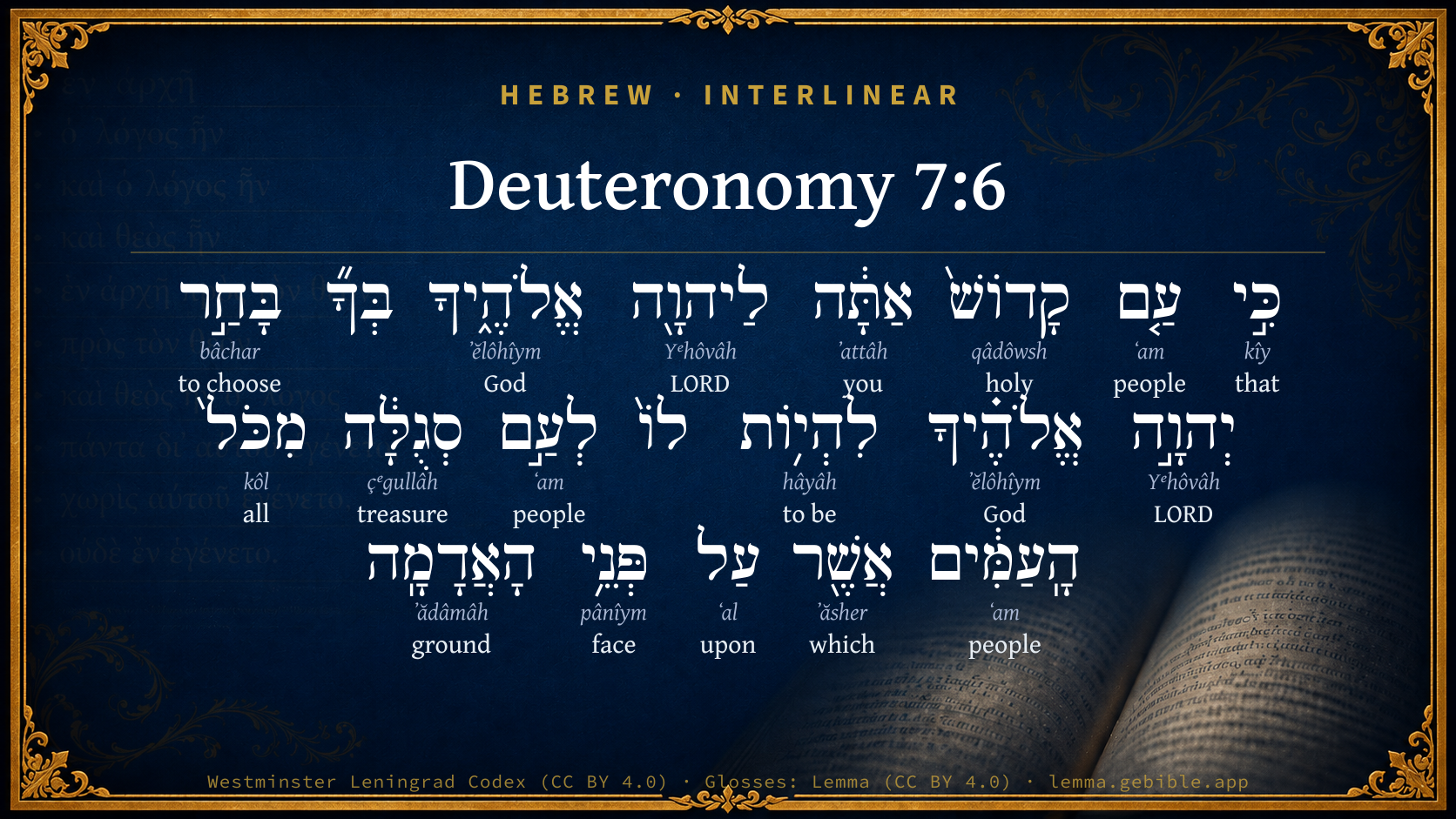
Hebrew (Westminster Leningrad Codex) Deuteronomy 7:6 appears in the Hebrew Old Testament. The text above is from the Westminster Leningrad Codex. Each word links to its Strong’s number, a concise gloss, and parsing drawn from the Open Scriptures Hebrew Bible morphology. Click any word for its full Brown-Driver-Briggs (BDB) entry.
Download image
Cite this verse

Deuteronomy 7:6 (World English Bible). Public Domain. Lemma interlinear Bible study tool, https://lemma.gebible.app/v/deuteronomy/7/6.

Show BibTeX & RIS
BibTeX
RIS
English Translation
For you are a holy people to Yahweh your God: Yahweh your God has chosen you to be a people for his own possession, above all peoples who are on the face of the earth.
World English Bible · Public Domain
Download a study sheet

One document with this verse’s original text, its word-by-word gloss line, the meaning frame, cross-references with their text, attributed commentary, and full source and license credits — printable, and it pastes into notes with its structure intact.

This verse Autodidact and up

Study sheet (.html) Plain text (.txt)

A passage Seminary Student

Up to 50 verses in one chapter. A passage sheet keeps up to 6 commentary sources and 12 cross-references per verse, in the order this page ranks them, and says so on the sheet whenever that leaves anything out. Ask for a single verse and you get the Autodidact verse sheet above.

Everything on this page stays free to read, with no account — the sheet is a download of what is already on screen, not access to it.

Want to remove ads? Support Godless Engineer
Compare translations 3

The same verse in 3 English versions, stacked beneath the original-language interlinear above. Click any original word for its lexicon entry.

Each is an independent rendering of the whole verse — the interlinear is not word-aligned to these translations.

Highlighted words mark where these versions differ — a whole-verse word diff, not a word-by-word alignment.

  • World English Bible Public Domain
    For you are a holy people to Yahweh your God: Yahweh your God has chosen you to be a people for his own possession, above all peoples who are on the face of the earth.
  • King James Version Public Domain
    For thou art an holy people unto the LORD thy God: the LORD thy God hath chosen thee to be a special people unto himself, above all people that are upon the face of the earth.
  • unfoldingWord Literal Text CC BY-SA 4.0
    For you are a sacred nation for Yahweh your God. Yahweh your God has chosen you to be a people for his possession, above all the peoples that are on the face of the earth.

unfoldingWord Literal Text — © unfoldingWord, licensed CC BY-SA 4.0. Word-aligned USFM3 via Door43 (git.door43.org/unfoldingWord/en_ult).

Versions to compare (up to 4)

3 of 4 selected

Show all 18 translations

Every available English version of this verse, each an independent rendering of the whole verse.

  • World English Bible Public Domain
    For you are a holy people to Yahweh your God: Yahweh your God has chosen you to be a people for his own possession, above all peoples who are on the face of the earth.
  • Berean Standard Bible Public Domain
    For you are a people holy to the LORD your God. The LORD your God has chosen you to be a people for His prized possession out of all peoples on the face of the earth.
  • Majority Standard Bible Public Domain
    For you are a people holy to the LORD your God. The LORD your God has chosen you to be a people for His prized possession out of all peoples on the face of the earth.
  • King James Version Public Domain
    For thou art an holy people unto the LORD thy God: the LORD thy God hath chosen thee to be a special people unto himself, above all people that are upon the face of the earth.
  • American Standard Version (1901) Public Domain
    For thou art a holy people unto Jehovah thy God: Jehovah thy God hath chosen thee to be a people for his own possession, above all peoples that are upon the face of the earth.
  • Revised Version (1885) Public Domain
    For thou art an holy people unto the LORD thy God: the LORD thy God hath chosen thee to be a peculiar people unto himself, above all peoples that are upon the face of the earth.
  • Geneva Bible (1599) Public Domain
    For thou art an holy people vnto the Lord thy God, the Lord thy God hath chosen thee, to be a precious people vnto himselfe, aboue all people that are vpon the earth.
  • Douay-Rheims (1899) Public Domain
    Because thou art a holy people to the Lord thy God. The Lord thy God hath chosen thee, to be his peculiar people of all peoples that are upon the earth.
  • Young's Literal Translation Public Domain
    for a holy people `art' thou to Jehovah thy God; on thee hath Jehovah thy God fixed, to be to Him for a peculiar people, out of all the peoples who `are' on the face of the ground.
  • Literal Standard Version CC BY-SA 4.0
    For you [are] a holy people to your God YHWH; your God YHWH has fixed on you, to be to Him for a peculiar people, out of all the peoples who [are] on the face of the ground.
  • Unlocked Literal Bible CC BY-SA 4.0
    For you are a nation that is set apart to Yahweh your God. He has chosen you to be a people for him to possess, more than all the other peoples that are on the face of the earth.
  • unfoldingWord Literal Text CC BY-SA 4.0
    For you are a sacred nation for Yahweh your God. Yahweh your God has chosen you to be a people for his possession, above all the peoples that are on the face of the earth.
  • Darby Bible Public Domain
    For a holy people art thou unto Jehovah thy God: Jehovah thy God hath chosen thee to be unto him a people for a possession, above all the peoples that are upon the face of the earth.
  • World Messianic Bible Public Domain
    For you are a holy people to the LORD your God. The LORD your God has chosen you to be a people for his own possession, above all peoples who are on the face of the earth.
  • Webster's Bible Public Domain
    For thou art a holy people to the LORD thy God: the LORD thy God hath chosen thee to be a special people to himself, above all people that are upon the face of the earth.
  • Free Bible Version CC BY-SA 4.0
    For you are the Lord your God's holy people. The Lord your God has chosen you to be his own special people, valued above all other peoples on the earth.
  • Bible in Basic English Public Domain
    For you are a holy people to the Lord your God: marked out by the Lord your God to be his special people out of all the nations on the face of the earth.
  • JPS Tanakh (1917) Public Domain
    For thou art a holy people unto the LORD thy God: the LORD thy God hath chosen thee to be His own treasure, out of all peoples that are upon the face of the earth.

Literal Standard Version (2020), Covenant Press — licensed CC BY-SA 4.0. Text via the HelloAO Bible API (eBible.org). Unlocked Literal Bible (unfoldingWord) — licensed CC BY-SA 4.0. Text via the HelloAO Bible API (eBible.org). unfoldingWord Literal Text — © unfoldingWord, licensed CC BY-SA 4.0. Word-aligned USFM3 via Door43 (git.door43.org/unfoldingWord/en_ult). Free Bible Version, Dr. Jonathan Gallagher — licensed CC BY-SA 4.0. Text via the HelloAO Bible API (eBible.org).

Word by word

More ways to search: Search by grammar → Find every occurrence → Compare this word →

Practice this passage: Drill this verse → Learn its vocabulary →

סְגֻלָּ֔ה
çᵉgullâh
H5459
“treasure”
Noun, Common, Feminine, Singular, Absolute
Part of Speech
Noun
Type
Common
Gender
Feminine
Number
Singular
State
Absolute
Full BDB Definition

Origin: from an unused root meaning to shut up

TWOT: 1460a

possession, property - valued property, peculiar treasure - treasure
  1. כִּ֣י kîy H3588 “that” Conjunction
  2. עַ֤ם ʻam H5971 “people” Noun, Common, Masculine, Singular, Absolute
  3. קָדוֹשׁ֙ qâdôwsh H6918 “holy” Adjective, Adjective, Masculine, Singular, Absolute
  4. אַתָּ֔ה ʼattâh H859 “you” Pronoun, Personal, 2nd Person, Masculine, Singular
  5. לַיהוָ֖ה Yᵉhôvâh H3068 “to/for · LORD” Preposition + Noun, Proper
  6. אֱלֹהֶ֑יךָ ʼĕlôhîym H430 “God(s) · your” Noun, Common, Masculine, Plural, Construct + Suffix, Personal, 2nd Person, Masculine, Singular
  7. בָּחַ֣ר bâchar H977 “to choose” Verb, Qal, Perfect, 3rd Person, Masculine, Singular
  8. יְהוָ֣ה Yᵉhôvâh H3068 “LORD” Noun, Proper
  9. אֱלֹהֶ֗יךָ ʼĕlôhîym H430 “God(s) · your” Noun, Common, Masculine, Plural, Construct + Suffix, Personal, 2nd Person, Masculine, Singular
  10. לִהְי֥וֹת hâyâh H1961 “to be” Preposition + Verb, Qal, Infinitive Construct
  11. לְעַ֣ם ʻam H5971 “to/for · people of” Preposition + Noun, Common, Masculine, Singular, Construct
  12. מִכֹּל֙ kôl H3605 “from · all of” Preposition + Noun, Common, Masculine, Singular, Construct
  13. הָֽעַמִּ֔ים ʻam H5971 “the · peoples” Particle, Definite Article + Noun, Common, Masculine, Plural, Absolute
  14. אֲשֶׁ֖ר ʼăsher H834 “which” Particle, Relative
  15. עַל ʻal H5921 “upon” Preposition
  16. פְּנֵ֥י pânîym H6440 “face(s) of” Noun, Common, Both, Plural, Construct
  17. הָאֲדָמָֽה ʼădâmâh H127 “the · ground” Particle, Definite Article + Noun, Common, Feminine, Singular, Absolute

About this verse

These counts appear in no published source. They are computed here, from the morphology-tagged text and Lemma’s own curated glosses. What Lemma adds →

20
words
14
distinct lemmas
Pentateuch
section

Notable vocabulary

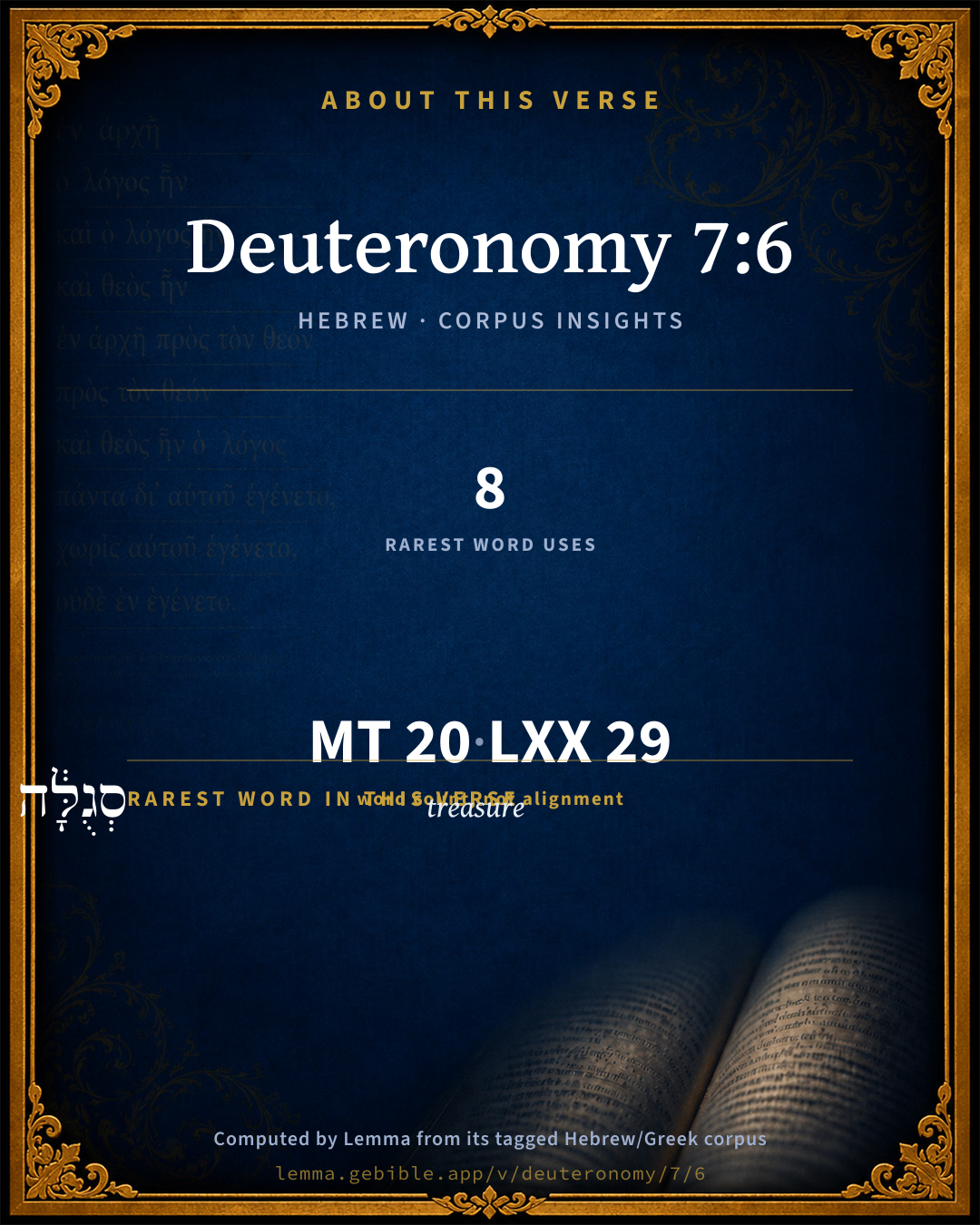
The rarest word here is סְגֻלָּ֔ה treasure H5459 — appearing just 8 times in the whole Hebrew Bible.

Shared distinctive vocabulary

סְגֻלָּ֔ה treasure H5459 occurs in 8 verses of the Hebrew Bible. Also found in:

Grammatical profile

  • 2 verbs
  • 11 nouns
  • 1 adjective
  • 1 pronoun
  • 3 prepositions
  • 1 conjunction
  • 1 particle

Verb forms

  • בָּחַ֣ר Qal · Perfect
  • לִהְי֥וֹת Qal · Infinitive Construct

Repetition

Words recur within this verse — often emphatic in Hebrew:

  • עַ֤ם people H5971 ×3
  • לַיהוָ֖ה LORD H3068 ×2
  • אֱלֹהֶ֑יךָ God H430 ×2

Hebrew & Septuagint length

In English translation the verse runs 35 words from the Hebrew and 36 from the Septuagint (LXX English) — closely comparable.

A rough comparison of the two English renderings, which tokenize alike — not a word-level alignment.

Word counts can differ between the Hebrew and the Greek without any difference in meaning — e.g. the Hebrew direct-object marker אֵת has no separate Greek word, and Greek often adds the article ὁ.

In the original languages it is 20 Hebrew tokens and 29 Greek tokens — but the two are counted differently (Hebrew bundles its prefixes and suffixes into one token; the Greek is in lemma form), so that isn’t a like-for-like length.

Cross-references

13

Topical passages linked to Deuteronomy 7:6 in the Treasury of Scripture Knowledge — connected by theme and wording, ordered by reader-vote popularity; previews shown in the World English Bible.

  • Deuteronomy 14:2 For you are a holy people to Yahweh your God, and Yahweh has chosen you to be a people for his own possession, above all peoples who are on the face of the earth.
  • Exodus 19:5–6 Now therefore, if you will indeed obey my voice, and keep my covenant, then you shall be my own possession from among all peoples; for all the earth is mine;
  • 1 Peter 2:9 But you are a chosen race, a royal priesthood, a holy nation, a people for God's own possession, that you may show forth the excellencies of him who called you out of darkness into his marvelous light:
  • Malachi 3:17 They shall be mine," says Yahweh of Hosts, "my own possession in the day that I make, and I will spare them, as a man spares his own son who serves him.
  • Deuteronomy 26:19 and to make you high above all nations that he has made, in praise, and in name, and in honor; and that you may be a holy people to Yahweh your God, as he has spoken.
  • 1 Corinthians 6:19–20 Or don't you know that your body is a temple of the Holy Spirit which is in you, which you have from God? You are not your own,
  • Jeremiah 2:3 Israel [was] holiness to Yahweh, the first fruits of his increase: all who devour him shall be held guilty; evil shall come on them, says Yahweh.
  • Amos 3:2 "You only have I chosen of all the families of the earth. Therefore I will punish you for all of your sins."
  • Titus 2:14 who gave himself for us, that he might redeem us from all iniquity, and purify for himself a people for his own possession, zealous for good works.
  • Psalms 50:5 "Gather my saints together to me, Those who have made a covenant with me by sacrifice."
  • Deuteronomy 28:9 Yahweh will establish you for a holy people to himself, as he has sworn to you; if you shall keep the commandments of Yahweh your God, and walk in his ways.
  • 2 Peter 2:5 and didn't spare the ancient world, but preserved Noah with seven others, a preacher of righteousness, when he brought a flood on the world of the ungodly;
  • 2 Peter 2:9 the Lord knows how to deliver the godly out of temptation and to keep the unrighteous under punishment for the day of judgment;

Cross-references courtesy of OpenBible.info (CC BY 4.0).

Hebrew and Greek witnesses Masoretic Hebrew ↔ Greek Septuagint

The same verse in the two great witnesses to the Old Testament, shown verse-for-verse.

These are two independent witnesses, not word-aligned to each other, and the Septuagint is shown in lemma (dictionary) form.

Hebrew Deuteronomy 7:6 Masoretic · Westminster Leningrad Codex

כִּ֣י עַ֤ם קָדוֹשׁ֙ אַתָּ֔ה לַיהוָ֖ה אֱלֹהֶ֑יךָ בְּךָ֞ בָּחַ֣ר יְהוָ֣ה אֱלֹהֶ֗יךָ לִהְי֥וֹת לוֹ֙ לְעַ֣ם סְגֻלָּ֔ה מִכֹּל֙ הָֽעַמִּ֔ים אֲשֶׁ֖ר עַל פְּנֵ֥י הָאֲדָמָֽה

For you are a holy people to Yahweh your God: Yahweh your God has chosen you to be a people for his own possession, above all peoples who are on the face of the earth.

World English Bible · Public Domain

Greek LXX Deuteronomy 7:6 Septuagint · lemma form

ὅτι λαός ἅγιος εἰμί κύριος ὁ θεός σύ καί σύ προαἱρέω κύριος ὁ θεός σύ εἰμί σύ αὐτός λαός περιούσιος παρά πᾶς ὁ ἔθνος ὅσος ἐπί πρόσωπον ὁ γῆ

For you are a holy people to the Lord your God; and the Lord your God chose you to be to him a peculiar people beyond all nations that are upon the face of the earth.

LXX2012 (modern English Septuagint) · Public Domain

On this verse, The Cambridge Bible for Schools and Colleges discusses the Septuagint’s reading. Read the note in Commentary ↓

Hebrew: Westminster Leningrad Codex (CC BY 4.0). Greek: Septuagint (public domain); English from LXX2012 (modern English Septuagint) (Public Domain). How the Septuagint differs from the Hebrew →

Targum (Aramaic paraphrase)

2

The Targum is the ancient Jewish Aramaic paraphrase of the Hebrew Scriptures — an interpretive translation, not the Hebrew text itself. Onkelos (literal) and Pseudo-Jonathan (expansive) render the Torah, and Jonathan the Prophets. Coverage is partial: where no permissively-licensed English translation exists for a verse, only the Aramaic is shown. This is verse-level text, not a word-by-word alignment to the Hebrew.

  1. Targum Onkelos Torah (Genesis–Deuteronomy)
    אֲרֵי עַם קַדִישׁ אַתְּ קֳדָם יְיָ אֱלָהָךְ בָּךְ אִתִּרְעֵי יְיָ אֱלָהָךְ לְמֶהֱוֵי לֵהּ לְעַם חַבִּיב מִכֹּל עַמְמַיָא דִי עַל אַפֵּי אַרְעָא

    (no public-domain English translation for this verse)

    Targum Onkelos — Aramaic: “Onkelos Genesis” (public domain); “Onkelos Exodus” (public domain); “Onkelos Leviticus” (public domain); “Onkelos Numbers” (public domain); “Onkelos Deuteronomy” (public domain). English: “Sefaria Community Translation” (CC0 1.0 (public-domain dedication)); “J.W. Etheridge. The Targums of Onkelos and Jonathan Ben Uzziel on the Pentateuch. London: Longmans, Green, 1862” (public domain). Text via Sefaria.

  2. Targum Pseudo-Jonathan Torah (Genesis–Deuteronomy)
    אֲרוּם עַמָּא קַדִּישָׁא אַתּוּן קֳדָם יְיָ אֱלָהָכוֹן וּבְכוֹן אִתְרְעֵי יְיָ אֱלָהָכוֹן מְטוֹל לְמֶהֱוֵי לֵיהּ לְעַם חָבִיב מִן כֻּלְהוֹן עַמְמַיָא דְעַל אַנְפֵּי אַרְעָא

    For you shall be a holy people before the Lord your God, as the Lord your God hath taken pleasure in you, that you may be a people more beloved before Him than all the peoples who are on the face of the earth.

    Targum Pseudo-Jonathan — Aramaic: “Targum Jonathan on Genesis” (public domain); “Targum Jonathan on Exodus” (public domain); “Targum Jonathan on Leviticus” (public domain); “Targum Jonathan on Numbers” (public domain); “Targum Jonathan on Deuteronomy” (public domain). English: “The Targum of Jonathan ben Uzziel, trans. J. W. Etheridge, London, 1862” (public domain). Text via Sefaria.

Commentary

Notes on Deuteronomy 7:6 from classic Christian and Jewish commentators (each source and its license shown beneath its notes). The classic Christian expositions comment on the surrounding passage and are grouped to its opening verse, so a note may address several verses; the Jewish commentaries on the Tanakh (Rashi and others) are per-verse, so they appear only where the commentator wrote on this verse.

Lemma curates 59 commentaries, every one of them public domain or Creative Commons licensed, each selected and text-cleaned for this edition rather than reprinted as found. About our sources →

The Cambridge Bible for Schools and Colleges

gen. ed. J. J. S. Perowne

6. an holy people unto Jehovah thy God] So Deu_14:2; Deu_14:21; Deu_26:19; Deu_28:9; cp. Exo_19:6 (J prob. expanded): an holy nation. As elsewhere in Deut., holy is here used in the formal sense of separated unto, or reserved for, Jehovah, and includes an ethical meaning only by implication, i.e. in so far as traffic with the heathen and the worship of their gods, which Israel, in consequence of his holiness to Jehovah, was forbidden to share, would necessarily involve the people in immoral practices. See the following note.

Holiness in Deut. and other O.T. Writers

The adj. holy (ḳadosh), and the noun holiness (ḳodesh), with the various forms of the verb (prob. denominative) to be holy, and to hallow or sanctify, require a separate note, especially in view of certain phenomena which distinguish the use of these terms in Deut. The meaning of the root ‘ḳ-d-sh’ ‘appears to be physical: ‘cut off,’ ‘separate,’ ‘set apart.’ But in Heb. and other Semitic languages the words derived from it are always used in a religious sense, both of God or the gods and of things and men in their relation to the deity. It is not certain whether they were first applied to deity as separate from, or at a distance above men, and then transferred to men and things belonging to the deity; or whether they were originally used of these as set apart from common use for the use of the god and then transferred to himself. But this is clear, that as the meaning of the terms grew in Israel’s use of them, the chief influence in that growth was the revealed nature of Israel’s God. At first the meaning of holy and holiness was purely formal, without ethical content, and negative. Even in Israel, and even with prophets who had very rich conceptions of the moral and metaphysical nature of God, the terms still often retain their original and negative character. To Hosea God is Holy as the Utter Contrast of man, Hos_11:9 : God and not man, the Holy One in the midst of thee; to the Prophet of the Exile He is the Incomparable, Isa_40:25 : to whom will ye liken me, that I should be equal to him? saith the Holy One. But as these passages show, the terms could not remain negative when used of God, but became positive and equivalent to godhead. In Phoenician (as A. B. Davidson points out) the phrase ‘the holy gods’ just means the divine gods. Similarly in Israel the contents of the term Holy came to be the contents of the nature of Jehovah as these were revealed to the prophets. To Hosea (Hos_11:9, see above) God’s holiness, His utter contrast with men, is His love and power of forgiving. To Isaiah it is His transcendence, majesty and awful purity, crushing and bewildering sinful man (Isa_6:1-5, high and lifted up, the foundations moved … the house was filled with smoke … woe is me, I am undone … a man of unclean lips), and His righteousness or justice (Isa_5:16, the Holy One is holy by righteousness); it is parallel to His glory (Isa_6:3). Yet ‘none of these attributes are synonyms of holiness strictly, they are rather elements in holiness’ (Davidson).

As applied to things holy simply means that they have been ceremonially set apart for the deity; so of the Sabbath (hallow it), the firstborn (sanctify them to me || they are mine), the sanctuary (miḳdash), its furniture, priests’ clothing, and foods (virtually equivalent to clean), etc. Similarly men are holy not because of their character, but from their devotion to the deity or His service, e.g. 1Sa_21:5 f. of soldiers (of divers characters) consecrated to war (see on Deu_20:1 ff., Deu_33:3); of a prophet, 2Ki_4:9; and frequently in P of priests, Levites and Nazirites. In E, Exo_22:31, holy is applied to the whole nation: they must not eat flesh torn by beasts of the field and not slain ritually, because they are men holy to Jehovah, His own and set apart for Him; while in Jer_2:3 holy = inviolable: as holiness to Jehovah, early Israel could not be devoured by other nations without guilt falling on these. Here also, however, the character of the God to whom Israel was sacred, gradually ethicised the term holy. This appears as early as J. Exo_19:5 f. (unless this passage is editorial), where it is announced that the people will be holy if they obey God’s voice and keep His covenant; and it is very clear in the formula, Be ye holy for I am holy, because of its connection with moral requirements, Lev_19:1-3; Lev_20:7. Even when Israel’s holiness is emphasised as incompatible with attendance on heathen cults, the notoriously immoral character of these implies that the holiness is not merely ceremonial but ethical as well. In Psalms 15, 24 only the upright and pure are fit to dwell in the holy place of God; yet even here holiness may mean no more than an awful sacredness (cp. Isa_33:14 f.). On the whole subject see A. B. Davidson, Theol. of the O.T. 144 ff., and J. Skinner, art. ‘Holiness in the O.T.’ in Hastings’ D.B.

In Deut., in which the use of holy and holiness is not so frequent or characteristic as it is in the Prophets and P, we find only some of the meanings described above; the whole range of them is not covered. The purely ritual sense, applied to things and men consecrated to God, is oftenest expressed: Deu_5:12 (the Sabbath); Deu_15:19 (firstling males); Deu_12:26, Deu_26:13 (all thy holy things, vows and tithes of the increase of fields and flocks); Deu_23:14 (the camp, because of God’s presence); cp. Deu_22:9 where R.V. forfeited, probably the exact meaning, is literally hallowed or consecrated; and Deu_23:17 f. where the men and women who sacrificed their chastity to the gods are called by the names they bore throughout the Semitic world (Ḳadesh and Ḳedeshah). Five times is Israel called a holy people—a people holy to Jehovah thy God. But in one of these passages, Deu_26:19, this means a people distinct from other nations, and high above them in renown; and in another, Deu_28:9 (as the context shows), an inviolable people just as in Jer_2:3, though the condition of such inviolableness is moral, their obedience to all the commandments of Jehovah. In two others, Deu_14:2; Deu_14:21, the phrase is used as the ground for their abstention from mutilation for the dead, and from eating what has not been ritually slain; while in Deu_7:6 it is given (as we have seen) as a reason for not treating or trafficking with the heathen or engaging in their cults. In these last three cases a moral meaning is doubtless implied in holy, because of the notoriously immoral character of such cults, but it is not explicit. This is strange after what we have seen of the moral contents of the term holy in the Prophets. But stranger still as coming after the Prophets (see above) is the fact that holy is nowhere in Deut. applied to God Himself (though in Deu_26:15 heaven is called His holy habitation); and He is not Styled as Isaiah so frequently styles Him the Holy One of Israel. Did the deuteronomists purposely avoid the association of this name with Jehovah because of some superstitious use of it (cp. Jeremiah’s repudiation of Isaiah’s conviction of the sanctity of the Temple, when this had become a mere fetish with the people), or because it was also applied to heathen gods?

Jehovah thy God hath chosen thee] The order of the original is much more emphatic: And (so Sam., LXX and some Heb. MSS) thee hath Jehovah thy God chosen. Similarly Deu_4:37, Deu_10:15, Deu_14:2 with Sg., and with Pl. only Deu_7:7. The idea and its expression are characteristic of D; it is not found in other documents of the Hex. nor in pre-deuteronomic writings (yet cp. Amo_3:2), but occurs frequently after D, in the deuteronomic Jer_33:24, and 1Ki_3:8; and frequently in Isa_41:8-9; Isa_43:10; Isa_44:1-2; cp. Isa_42:1; Isa_43:20; Isa_45:4; Isa_49:7; also of God’s restoration of the exiled Israel Isa_14:1. We must not impart into the phrase the full meaning of ‘election’ in the N.T. or Christian theology. As the passages in 2nd Isaiah show, ‘election’ by God is election to service (see the writer’s Isaiah xl.–lxvi. pp. 237 f.), and as Jeremiah 18 shows, it may be annulled if the object of it prove to be unworthy; yet, according to Isa_14:1, it may, on repentance being shown, be renewed; cp. below Deu_30:3 ff.

a peculiar people] Lit. a people of special possession; in late O.T. of the privy property of kings, 1Ch_29:3, Ecc_2:8; in N. H. the verb from which it is derived means to acquire property. Also in Deu_14:2 and Deu_26:18, like this passage, in Sg. Not certainly found before D, for Exo_19:5 is editorial. For details see note on that verse. The adj. has the sense which the noun ‘peculiar’ retains in Eng.

6–11. The reasons for the previous commands to destroy the peoples of the land, and to abstain from traffic with them, leading as this would to participation in their worship of other gods. Israel are for Jehovah alone: to this end He loved, chose, and redeemed them. This is one of the many cases in Deut. in which the principles or ideas offered for certain practices or acts of conduct commanded to Israel are of a far higher standard than these practices themselves, and therefore have endured as the essentials of religion when the practices are either no longer prescribed or actually forbidden (as in Christianity). The passage, which might appear to be founded on Exo_19:5 f., is not certainly so; for Exo_19:5 f. (on which see the note) has probably been expanded. The address changes to the Pl. in Deu_7:7-8, which are probably a later insertion: see below.

The Cambridge Bible for Schools and Colleges (gen. ed. J. J. S. Perowne; Cambridge University Press, 1878–1918) — public domain. Text from a community e-Sword module.

Trapp's Complete Commentary

John Trapp

Deu 7:6 For thou [art] an holy people unto the LORD thy God: the LORD thy God hath chosen thee to be a special people unto himself, above all people that [are] upon the face of the earth.

Ver. 6. For thou art a holy people.] viz., With a federal holiness; which yet without an inherent holiness in the heart and life, will profit a man no more than it did Dives in the flames that Abraham called him son; or Judas, that Christ called him friend. An empty title yields but an empty comfort at last.

John Trapp, A Commentary or Exposition upon All the Books of the Old and New Testament (1647–1656) — public domain. Text from a community e-Sword module.

Tyndale Open Study Notes

Tyndale Open Resources

7:6 Of all peoples on earth, God chose Israel as his special treasure. Israel had not done anything commendable; rather, God acted out of grace that was undeserved and freely given.

Tyndale Open Study Notes — © Tyndale Open Resources, licensed CC BY-SA 4.0. Text via the HelloAO Bible API.

Jamieson, Fausset & Brown

Robert Jamieson, A. R. Fausset & David Brown

For thou art an holy people unto the Lord thy God--that is, set apart to the service of God, or chosen to execute the important purposes of His providence. Their selection to this high destiny was neither on account of their numerical amount (for, till after the death of Joseph, they were but a handful of people); nor because of their extraordinary merits (for they had often pursued a most perverse and unworthy conduct); but it was in consequence of the covenant or promise made with their pious forefathers; and the motives that led to that special act were such as tended not only to vindicate God's wisdom, but to illustrate His glory in diffusing the best and most precious blessings to all mankind.

Jamieson, Fausset & Brown — Commentary Critical and Explanatory on the Whole Bible (1871) — public domain (CC PDM 1.0). Text via the HelloAO Bible API.

Adam Clarke's Commentary

Verse 6. Thou art a holy people] And therefore should have no connection with the workers of iniquity.

A special people] סגלה segullah, - Septuagint, λαον περιουσιον, - a peculiar people, a private property. The words as they stand in the Septuagint are quoted by the apostle, Deut 7:1; Deut 2:9.

Adam Clarke's Commentary on the Bible (1810–1826) — public domain. Text from a community e-Sword/MySword module.

Ellicott's Commentary for English Readers

(6) An holy people.—Not merely “a holy nation” (as in Exo_19:6), but “a holy people” i.e., a state of which holiness to Jehovah was the very constitution. If God pleased to establish such a state, manifestly its laws could allow no toleration of anything displeasing to Him. And it is also manifest that nothing but Divine revelation would authorise the establishment of such a constitution.

A special people.—The same word with the “peculiar treasure” of Exo_19:5 and the “jewels” of Mal_3:17. The private property of King David is described by the same word (1Ch_29:3), “mine own proper good.” (See also Deu_14:2; Deu_26:18; Psa_135:4 )

A Bible Commentary for English Readers, edited by Charles John Ellicott (1878–1897) — public domain. Text from a community e-Sword module.

John Gill's Exposition

For thou art an holy people unto the Lord thy God,.... Not sanctified in a spiritual sense, or having principles of grace and holiness in them, from whence holy actions sprang, at least not all of them; but they were separated from all other people in the world to the pure worship and service of God in an external manner, and therefore were to avoid all idolatry, and every appearance of it:

the Lord thy God hath chosen thee to be a special people unto himself above all people that are upon the face of the earth; for special service and worship, and to enjoy special privileges and benefits, civil and religious; though they were not chosen to special grace here, and eternal glory hereafter; at least not all of them, only a remnant, according to the election of grace; yet they were typical of the chosen people of God in a special sense; who are chosen out of the world to be a peculiar people, to be holy here and happy hereafter; to enjoy communion with God in this life and that to come, as well as to serve and glorify him now and for evermore.

John Gill's Exposition of the Whole Bible (1746–1763) — public domain (CC PDM 1.0). Text via the HelloAO Bible API.

Haydock's Catholic Bible Commentary

Peculiar. Hebrew sogula, laid up like something most precious and desirable. (Menochius) --- God seemed to have abandoned other nations to the corruption of their own heart. "This was, by a particular mystery, a prophetical nation." (St. Augustine, ep. cii.) (Exodus xix. 5.) (Calmet) --- Therefore must they destroy every idol in their land, to set a pattern to all other less favoured nations how they ought also to treat them.

George Leo Haydock (1774–1849), Haydock's Catholic Family Bible and Commentary, 1859 edition — public domain. Excludes Psalms (Douay-Rheims chapter numbering differs from Protestant) and Deuterocanonical books (Catholic canon only).

The Pulpit Commentary

A holy people; a people consecrated to God, to be holy as he is holy (cf. Lev_11:43-45 Lev_19:2 Lev_20:26 Lev_21:6 Deu_23:14) A special people unto himself; literally, to be to him for a people of property (hLgus), a people his own, his peculiar property (cf. Deu_14:2 Deu_26:18; and, for the meaning of the word, 1Ch_29:3, "mine own proper good;"; Ecc_2:8, "peculiar treasure of kings LXX, laosiov, applied by St. Paul to Christians as the chosen and special property of Christ. (Tit_2:14) Above all people; rather, out of or from among all the peoples.

Vers. 6-9. Reasons for non-conformity to the world, and for aggression on its evil.

I THE HOLINESS OF OUR CALLING. (Ver. 6.) The believer stands toGod in the relation described in this verse. He is one chosen from the unholy mass to be peculiarly God"s property. He belongs to God in body, soul, and spirit. He is a vessel for the Master"s use. His every power is to be consecrated. What higher dignity could a human being sustain than that? But the obligations are coextensive with the honor. This man is, in virtue of his holiness, summoned to take up an attitude of non-conformity to the. (Rom_12:2) In virtue of the same holiness, he is bound to unite with others in a sacred crusade against its evil.

II THE GRACE OF OUR ELECTION. (Ver. 7.) This puts another powerful weight into the scale. Standing in so close and honorable a relation to God, the believer is bid look to the rock whence he is hewn, and the hole of the pit whence he is digged. Who made him to differ? Whence this mercy shown peculiarly to him? We need not press texts on election in favor of any special theory. Sufficient that every believer is willing to confess, as regards his own salvation, that "it is not of him that willeth, nor of him that runneth, but of God that showeth mercy". (Rom_9:16) An elective purpose comes to light in his spiritual history. (Eph_1:4, Eph_1:5) When tracing his salvation to its source, he is constrained to say, "God, who is rich in mercy, for his great love wherewith he loved us, even when we were dead in sins, hath quickened us together with Christ". (Eph_2:4, Eph_2:5) All this implies special obligation to God"s service.

III THE NIGHT OF OUR REDEMPTION. (Ver. 8.) The redemption from Egypt, with its tragic accompaniments and mighty signs and wonders, was but a faint type of the greater deliverance which God has now wrought for his Israel in Christ. We are entitled to put the greater for the less, and to plead the stronger claimers which the redemption from sin and wrath establishes on the redeemed soul. The cost of our salvation is Christ"s blood. What return can we conceivably make exhaustive of our obligations to Father and Son for so great a sacrifice? J.O.

Vers. 6-8. On the election of rations.

We are here introduced to remarkable words touching the election of, or we might say, selection of the Jews. The leading principles of the Divine administration are here set before us. The following points may be noticed:

I THE JEWS WERE SELECTED NOT ON ACCOUNT OF ANY NATIONAL SUPERIORITY. Moses tells them that, numerically, they were the fewest of all people. It was not numerical strength, nor national advantages of any kind, which induced God to select them.

II THEY WERE SELECTED BECAUSE GOD CHOSE TO SET HIS LOVE UPON THEM. "The Lord did not set his love upon you, nor choose you, because ye were more in number than any people but because the Lord loved you." It was sovereign love which is its own reason. And, in the last resort, it is to this we must come. We can give no better account of the matter than that God chose to do it.

III THE DELIVERANCE FROM EGYPT WAS THE PROOF OF HIS SOVEREIGN LOVE. Hereby he kept his promise made to their fathers, and fulfilled his own gracious purpose. The series of judgments, the outcome of his mighty hand, which proved how infinitely stronger it was than the hand of Pharaoh, while severe to Egypt, were love-tokens to Israel.

IV THE CHOICE OF ISRAEL WAS WITH A VIEW TO THEIR BEING A HOLY PEOPLE AND A SPECIAL PEOPLE UNTO THE LORD. Electing love extended to a nation or a people is really a Divine investment. The result is the holiness and consecration of the people. It is this holiness, this sense of consecration, which proves the electing love of God. And this is all the more intense when it is seen clearly that God"s love is manifested, not on the ground of national or personal merit, but as a matter of free grace.

And, doubtless, the Jews proved themselves a special people, although far from a perfect people. They were the custodians of the holy oracles for ages. They showed, and they still show, wonderful linguistic and other qualifications. All this, let us believe, is due to that grace and Divine development through which, as a nation, they were permitted to pass.

The practical application of this subject is surely this:

1. To receive God"s mercy under an abiding sense that it is undeserved.

2. To cultivate the sense of obligation to God for his undeserved mercy, which it is intended to foster.

3. And to realize the consecration of spirit through which all that is noble in human life comes. God saves us that we may serve him. He shows us his loving-kindness that we may become through it "a peculiar people, zealous of good works. R.M.E.

The Pulpit Commentary (1880–1919), ed. H.D.M. Spence-Jones & Joseph S. Exell — public domain. Text from a community e-Sword module.

Keil & Delitzsch

C. F. Keil & F. Delitzsch

They were bound to do this by virtue of their election as a holy nation, the nation of possession, which Jehovah had singled out from all other nations, and brought out of the bondage of Egypt, not because of its greatness, but from love to them, and for the sake of the oath given to the fathers. This exalted honour Israel was not to cast away by apostasy from the Lord. It was founded upon the word of the Lord in Exo 19:5-6, which Moses brought to the recollection of the people, and expressly and emphatically developed. "Not because of your multitude before all nations (because ye were more numerous than all other nations) hath Jehovah turned to you in love (חשׁק, to bind oneself with, to hang upon a person, out of love), for ye are the littleness of all nations" (the least numerous). Moses could say this to Israel with reference to its descent from Abraham, whom God chose as the one man out of all the world, whilst nations, states, and kingdoms had already been formed all around (Baumgarten). "But because Jehovah loved you, and kept His oath which He had sworn to the fathers, He hath brought you out," etc. Instead of saying, He hath chosen you out of love to your fathers, as in Deu 4:37, Moses brings out in this place love to the people of Israel as the divine motive, not for choosing Israel, but for leading it out and delivering it from the slave-house of Egypt, by which God had practically carried out the election of the people, that He might thereby allure the Israelites to a reciprocity of love.

Keil & Delitzsch — Biblical Commentary on the Old Testament (1861–1891) — public domain (CC PDM 1.0). Text via the HelloAO Bible API. (Old Testament only.)

unfoldingWord translationNotes

Door43 World Missions Community

General Information:

Moses tells the people of Israel Yahweh's words as if the Israelites are one person. (See: Forms of You)

you are a nation that is set apart

Yahweh choosing the people of Israel to belong to him in a special way is spoken of as if Yahweh set them apart from all other nations. (See: Metaphor)

that are on the face of the earth

This is an idiom. AT: "that live on the earth" (See: Idiom)

translationWords

set apart

Yahweh

God

chosen one

people group

possess

face

earth

unfoldingWord translationNotes — © Distant Shores Media and the Door43 World Missions Community, licensed CC BY-SA 4.0. Source: git.door43.org/Door43/en_tn.

Ramban (Nachmanides)

Rabbi Moshe ben Nachman (Ramban / Nachmanides)

THE ETERNAL THY G-D HATH CHOSEN THEE TO BE HIS OWN TREASURE. For you have no chief, overseer, or ruler among all the angels on high, but you are the treasure of G-d under His power, and, therefore, you should not go astray to serve idols from among the gods of the peoples. I have already mentioned this many times. This is the sense of the verse, The Eternal did not set His love upon you, nor choose you, because ye were more in number than any people, for it would have been proper that the King’s [chosen people should] be the most numerous, as it is written, In the multitude of people is the king’s glory, and that He appoint captains of the host at the head of the rest of the people. But you are the fewest [of all peoples] — nevertheless He craved you and chose you!

Ramban (Nachmanides) on the Tanakh — English translation: “Commentary on the Torah by Ramban (Nachmanides). Translated and annotated by Charles B. Chavel. New York, Shilo Pub. House, 1971-1976” (CC BY 4.0). Text via Sefaria.

Ibn Ezra

Rabbi Abraham ibn Ezra

Treasured people. I have explained that this means something nice which cannot be found in every place. It has the same meaning in the verse, “Treasures of kings” (Koheles 2:8).

Ibn Ezra on the Tanakh — English translations: “Sefaria Community Translation” (CC0 1.0 (public-domain dedication)); “Yalkut, Sifsei Chachomim Chumash, Metsudah Publications, 2009” (CC BY 4.0); and “Commentary of Ibn Ezra on Isaiah - trans. by M. Friedlander, 1873” (public domain). Text via Sefaria.

Lesson kit

Teaching starters — assembled from the data on this page, not authored interpretation. Every prompt links to the verse data it draws on. Edit before teaching.

Deuteronomy, in the Pentateuch, opens this verse with 20 words (14 distinct Hebrew lemmas). Its most distinctive word is çᵉgullâh (“treasure”). A historical commentator’s framing appears above. Read the whole chapter for the surrounding context.

Discussion questions

  1. What does “treasure” (çᵉgullâh) contribute to the verse as a whole?
  2. Exodus 19:5 shares the word «treasure» with this verse. How do the two illuminate each other?
  3. “people” occurs 3× in this one verse. What is the effect of the repetition?
  4. These translations render this verse differently. What is at stake in choosing one wording over another?
  5. The verb «בָּחַ֣ר» is Qal Perfect. How does its form color the action?
  6. Reading how The Cambridge Bible for Schools and Colleges and Trapp's Complete Commentary read this verse, where do the two commentators agree and where do they part?

Things to notice

Reading settings

Reading text

Shown beneath each verse's original-language words.

Old Testament
Old Testament edition

Read the OT as the Masoretic Hebrew (MT) or the Greek Septuagint (LXX).

English shown for the Greek Septuagint (in the Hebrew ↔ Greek comparison).

Comparing translations? Open the Compare panel on any verse page to stack up to four side by side.