
Deuteronomy 26:10

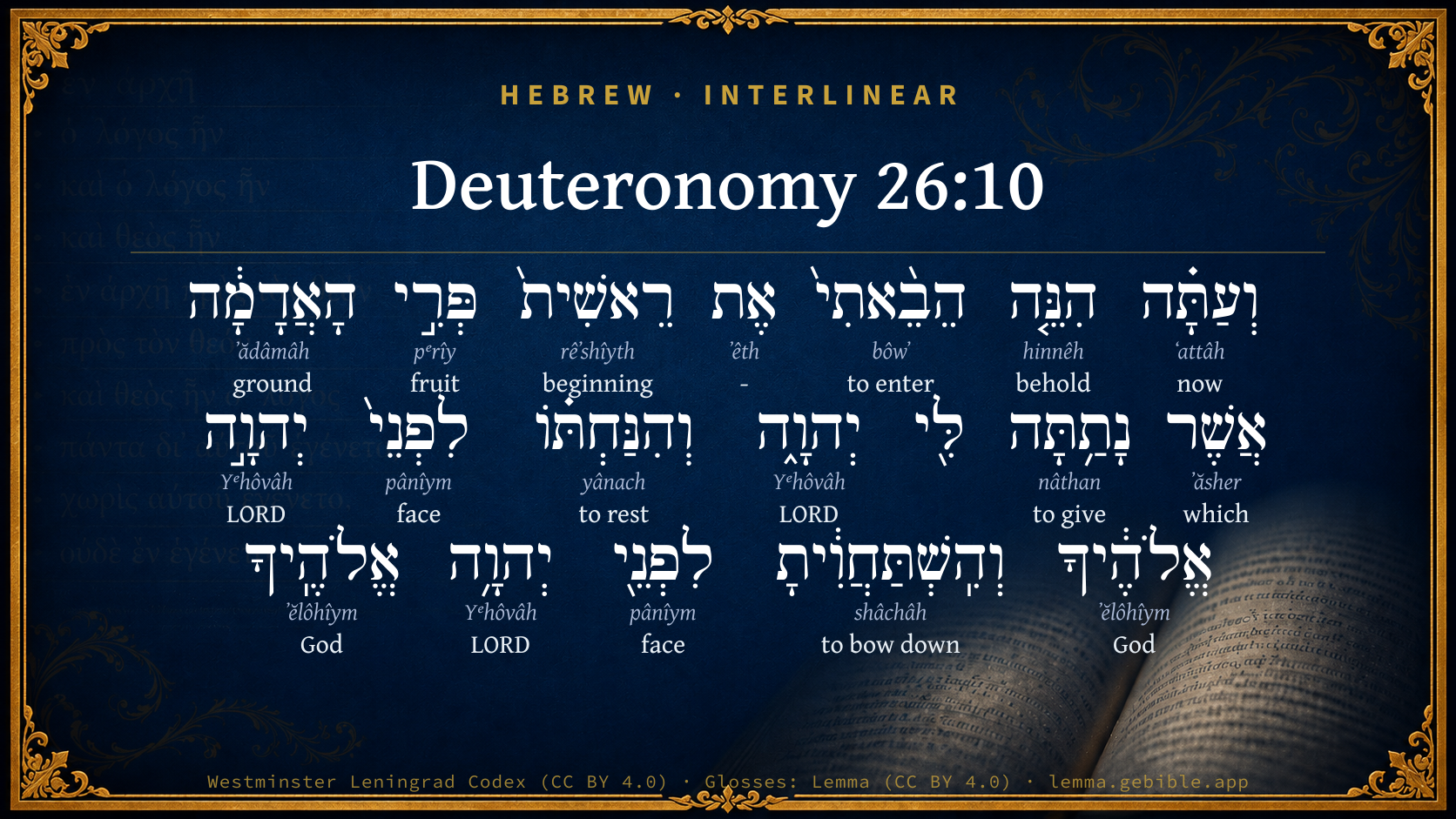
Hebrew (Westminster Leningrad Codex) Deuteronomy 26:10 appears in the Hebrew Old Testament. The text above is from the Westminster Leningrad Codex. Each word links to its Strong’s number, a concise gloss, and parsing drawn from the Open Scriptures Hebrew Bible morphology. Click any word for its full Brown-Driver-Briggs (BDB) entry.
Download image
Cite this verse

Deuteronomy 26:10 (World English Bible). Public Domain. Lemma interlinear Bible study tool, https://lemma.gebible.app/v/deuteronomy/26/10.

Show BibTeX & RIS
BibTeX
RIS
English Translation
Now, behold, I have brought the first of the fruit of the ground, which you, Yahweh, have given me. You shall set it down before Yahweh your God, and worship before Yahweh your God:
World English Bible · Public Domain
Download a study sheet

One document with this verse’s original text, its word-by-word gloss line, the meaning frame, cross-references with their text, attributed commentary, and full source and license credits — printable, and it pastes into notes with its structure intact.

This verse Autodidact and up

Study sheet (.html) Plain text (.txt)

A passage Seminary Student

Up to 50 verses in one chapter. A passage sheet keeps up to 6 commentary sources and 12 cross-references per verse, in the order this page ranks them, and says so on the sheet whenever that leaves anything out. Ask for a single verse and you get the Autodidact verse sheet above.

Everything on this page stays free to read, with no account — the sheet is a download of what is already on screen, not access to it.

Want to remove ads? Support Godless Engineer
Compare translations 3

The same verse in 3 English versions, stacked beneath the original-language interlinear above. Click any original word for its lexicon entry.

Each is an independent rendering of the whole verse — the interlinear is not word-aligned to these translations.

Highlighted words mark where these versions differ — a whole-verse word diff, not a word-by-word alignment.

  • World English Bible Public Domain
    Now, behold, I have brought the first of the fruit of the ground, which you, Yahweh, have given me. You shall set it down before Yahweh your God, and worship before Yahweh your God:
  • King James Version Public Domain
    And now, behold, I have brought the firstfruits of the land, which thou, O LORD, hast given me. And thou shalt set it before the LORD thy God, and worship before the LORD thy God:
  • unfoldingWord Literal Text CC BY-SA 4.0
    And now, behold, I have brought the first of the harvest of the land that Yahweh has given to me.’ And you shall set it down to the face of Yahweh your God and bow down to the face of Yahweh your God,

unfoldingWord Literal Text — © unfoldingWord, licensed CC BY-SA 4.0. Word-aligned USFM3 via Door43 (git.door43.org/unfoldingWord/en_ult).

Versions to compare (up to 4)

3 of 4 selected

Show all 18 translations

Every available English version of this verse, each an independent rendering of the whole verse.

  • World English Bible Public Domain
    Now, behold, I have brought the first of the fruit of the ground, which you, Yahweh, have given me. You shall set it down before Yahweh your God, and worship before Yahweh your God:
  • Berean Standard Bible Public Domain
    And now, behold, I have brought the firstfruits of the land that You, O LORD, have given me.” Then you are to place the basket before the LORD your God and bow down before Him.
  • Majority Standard Bible Public Domain
    And now, behold, I have brought the firstfruits of the land that You, O LORD, have given me.” Then you are to place the basket before the LORD your God and bow down before Him.
  • King James Version Public Domain
    And now, behold, I have brought the firstfruits of the land, which thou, O LORD, hast given me. And thou shalt set it before the LORD thy God, and worship before the LORD thy God:
  • American Standard Version (1901) Public Domain
    And now, behold, I have brought the first of the fruit of the ground, which thou, O Jehovah, hast given me. And thou shalt set it down before Jehovah thy God, and worship before Jehovah thy God:
  • Revised Version (1885) Public Domain
    And now, behold, I have brought the first of the fruit of the ground, which thou, O LORD, hast given me. And thou shalt set it down before the LORD thy God, and worship before the LORD thy God:
  • Geneva Bible (1599) Public Domain
    And now, lo, I haue brought ye first fruites of the land which thou, O Lord, hast giuen me, and thou shalt set it before the Lord thy God, and worship before the Lord thy God:
  • Douay-Rheims (1899) Public Domain
    And brought us into this place, and gave us this land flowing with milk and honey.
  • Young's Literal Translation Public Domain
    `And now, lo, I have brought in the first of the fruits of the ground which thou hast given to me, O Jehovah; -- and thou hast placed it before Jehovah thy God, and bowed thyself before Jehovah thy God,
  • Literal Standard Version CC BY-SA 4.0
    And now, behold, I have brought in the first of the fruits of the ground which you have given to me, O YHWH. (And you have placed it before your God YHWH, and bowed yourself before your God YHWH,
  • Unlocked Literal Bible CC BY-SA 4.0
    Now look, I have brought the first of the harvest of the land that you, Yahweh, have given me.' You must set it down before Yahweh your God and worship before him;
  • unfoldingWord Literal Text CC BY-SA 4.0
    And now, behold, I have brought the first of the harvest of the land that Yahweh has given to me.’ And you shall set it down to the face of Yahweh your God and bow down to the face of Yahweh your God,
  • Darby Bible Public Domain
    And now, behold, I have brought the first of the fruits of the land, which thou, Jehovah, hast given me. And thou shalt set it down before Jehovah thy God, and worship before Jehovah thy God.
  • World Messianic Bible Public Domain
    Now, behold, I have brought the first of the fruit of the ground, which you, the LORD, have given me.” You shall set it down before the LORD your God, and worship before the LORD your God.
  • Webster's Bible Public Domain
    And now, behold, I have brought the first-fruits of the land, which thou, O LORD, hast given me: and thou shalt set it before the LORD thy God, and worship before the LORD thy God:
  • Free Bible Version CC BY-SA 4.0
    Look, Lord! I have brought you the firstfruits of the land that you have given me.” You shall place the basket before the Lord your God and bow down in worship before him.
  • Bible in Basic English Public Domain
    So now, I have come here with the first of the fruits of the earth which you, O Lord, have given me. Then you will put it down before the Lord your God and give him worship:
  • JPS Tanakh (1917) Public Domain
    And now, behold, I have brought the first of the fruit of the land, which Thou, O LORD, hast given me.' And thou shalt set it down before the LORD thy God, and worship before the LORD thy God.

Literal Standard Version (2020), Covenant Press — licensed CC BY-SA 4.0. Text via the HelloAO Bible API (eBible.org). Unlocked Literal Bible (unfoldingWord) — licensed CC BY-SA 4.0. Text via the HelloAO Bible API (eBible.org). unfoldingWord Literal Text — © unfoldingWord, licensed CC BY-SA 4.0. Word-aligned USFM3 via Door43 (git.door43.org/unfoldingWord/en_ult). Free Bible Version, Dr. Jonathan Gallagher — licensed CC BY-SA 4.0. Text via the HelloAO Bible API (eBible.org).

Word by word

More ways to search: Search by grammar → Find every occurrence → Compare this word →

Practice this passage: Drill this verse → Learn its vocabulary →

רֵאשִׁית֙
rêʼshîyth
H7225
“beginning of”
Noun, Common, Feminine, Singular, Construct
Part of Speech
Noun
Type
Common
Gender
Feminine
Number
Singular
State
Construct
Full BDB Definition

Origin: from the same as H7218

TWOT: 2097e

first, beginning, best, chief - beginning - first - chief - choice part
  1. וְעַתָּ֗ה ʻattâh H6258 “and · now” Conjunction + Adverb
  2. הִנֵּ֤ה hinnêh H2009 “behold” Particle, Demonstrative
  3. הֵבֵ֨אתִי֙ bôwʼ H935 “to enter” Verb, Hiphil, Perfect, 1st Person, Common, Singular
  4. אֶת ʼêth H853 “-” Particle, Direct Object
  5. פְּרִ֣י pᵉrîy H6529 “fruit of” Noun, Common, Masculine, Singular, Construct
  6. הָאֲדָמָ֔ה ʼădâmâh H127 “the · ground” Particle, Definite Article + Noun, Common, Feminine, Singular, Absolute
  7. אֲשֶׁר ʼăsher H834 “which” Particle, Relative
  8. נָתַ֥תָּה nâthan H5414 “to give” Verb, Qal, Perfect, 2nd Person, Masculine, Singular
  9. יְהוָ֑ה Yᵉhôvâh H3068 “LORD” Noun, Proper
  10. וְהִנַּחְתּ֗וֹ yânach H3240 “and · to rest · him” Conjunction + Verb, Hiphil, Sequential Perfect, 2nd Person, Masculine, Singular + Suffix, Personal, 3rd Person, Masculine, Singular
  11. לִפְנֵי֙ pânîym H6440 “to/for · face(s) of” Preposition + Noun, Common, Both, Plural, Construct
  12. יְהוָ֣ה Yᵉhôvâh H3068 “LORD” Noun, Proper
  13. אֱלֹהֶ֔יךָ ʼĕlôhîym H430 “God(s) · your” Noun, Common, Masculine, Plural, Construct + Suffix, Personal, 2nd Person, Masculine, Singular
  14. וְהִֽשְׁתַּחֲוִ֔יתָ shâchâh H7812 “and · to bow down” Conjunction + Verb, Hishtaphel, Sequential Perfect, 2nd Person, Masculine, Singular
  15. לִפְנֵ֖י pânîym H6440 “to/for · face(s) of” Preposition + Noun, Common, Both, Plural, Construct
  16. יְהוָ֥ה Yᵉhôvâh H3068 “LORD” Noun, Proper
  17. אֱלֹהֶֽיךָ ʼĕlôhîym H430 “God(s) · your” Noun, Common, Masculine, Plural, Construct + Suffix, Personal, 2nd Person, Masculine, Singular

About this verse

These counts appear in no published source. They are computed here, from the morphology-tagged text and Lemma’s own curated glosses. What Lemma adds →

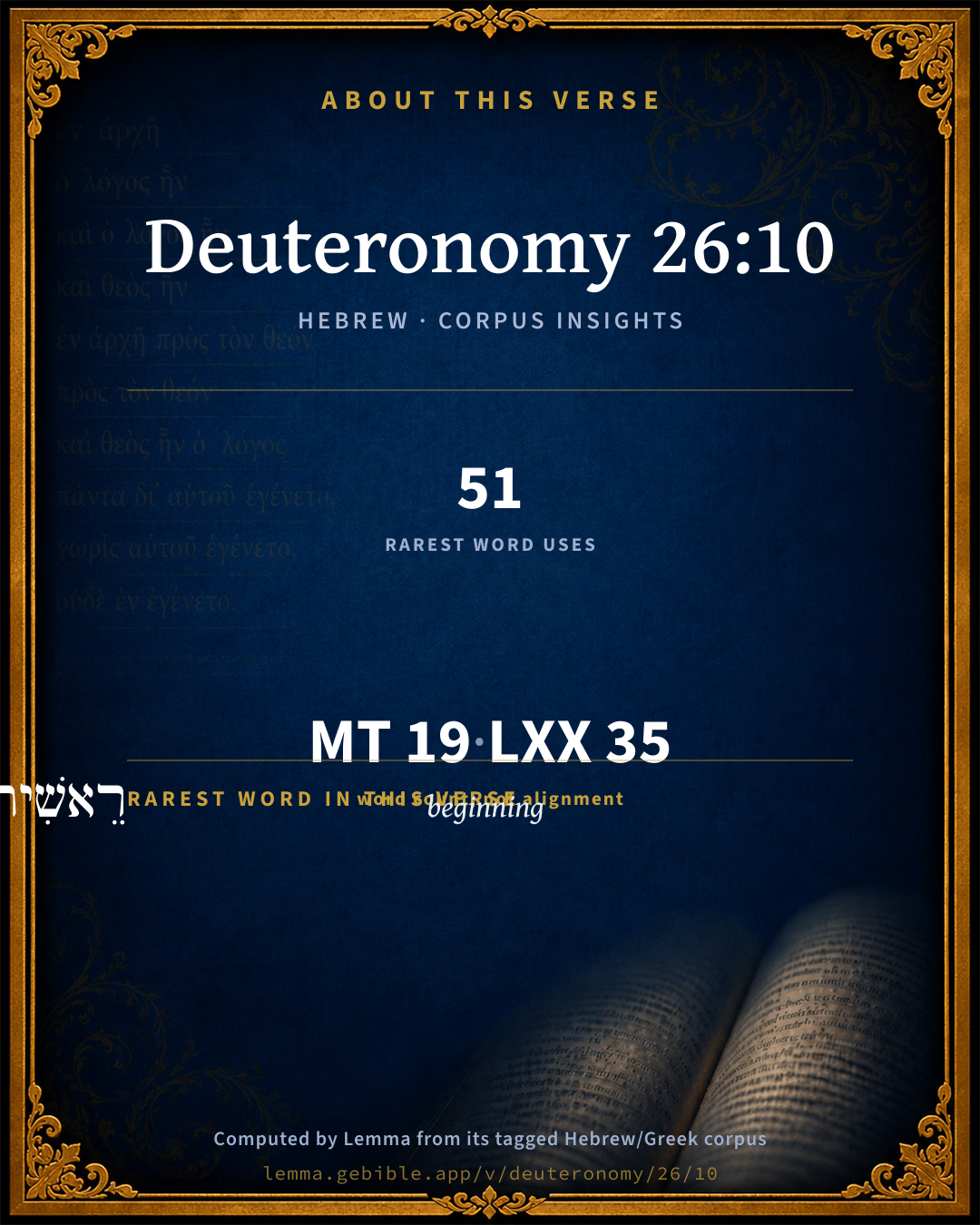
19
words
14
distinct lemmas
Pentateuch
section

Shared distinctive vocabulary

רֵאשִׁית֙ beginning H7225 occurs in 49 verses of the Hebrew Bible. Also found in:

Grammatical profile

  • 4 verbs
  • 10 nouns
  • 1 preposition
  • 1 adverb
  • 3 particles

Verb forms

  • הֵבֵ֨אתִי֙ Hiphil · Perfect
  • נָתַ֥תָּה Qal · Perfect
  • וְהִנַּחְתּ֗וֹ Hiphil · Sequential Perfect
  • וְהִֽשְׁתַּחֲוִ֔יתָ Hishtaphel · Sequential Perfect

Repetition

Words recur within this verse — often emphatic in Hebrew:

  • יְהוָ֑ה LORD H3068 ×3
  • לִפְנֵי֙ face H6440 ×2
  • אֱלֹהֶ֔יךָ God H430 ×2

Hebrew & Septuagint length

In English translation the verse runs 34 words from the Hebrew and 46 from the Septuagint (LXX English) — closely comparable.

A rough comparison of the two English renderings, which tokenize alike — not a word-level alignment.

Word counts can differ between the Hebrew and the Greek without any difference in meaning — e.g. the Hebrew direct-object marker אֵת has no separate Greek word, and Greek often adds the article ὁ.

In the original languages it is 19 Hebrew tokens and 35 Greek tokens — but the two are counted differently (Hebrew bundles its prefixes and suffixes into one token; the Greek is in lemma form), so that isn’t a like-for-like length.

Cross-references

18

Topical passages linked to Deuteronomy 26:10 in the Treasury of Scripture Knowledge — connected by theme and wording, ordered by reader-vote popularity; previews shown in the World English Bible.

  • Exodus 22:29 "You shall not delay to offer from your harvest and from the outflow of your presses. "You shall give the firstborn of your sons to me.
  • Numbers 18:11–13 This is your: the heave-offering of their gift, even all the wave-offerings of the children of Israel; I have given them to you, and to your sons and to your daughters with you, as a portion forever; everyone who is clean in your house shall eat of it.
  • Deuteronomy 6:10–13 It shall be, when Yahweh your God shall bring you into the land which he swore to your fathers, to Abraham, to Isaac, and to Jacob, to give you, great and goodly cities, which you didn't build,
  • Deuteronomy 18:4 The first fruits of your grain, of your new wine, and of your oil, and the first of the fleece of your sheep, shall you give him.
  • Deuteronomy 26:2 that you shall take of the first of all the fruit of the ground, which you shall bring in from your land that Yahweh your God gives you; and you shall put it in a basket, and shall go to the place which Yahweh your God shall choose, to cause his name to dwell there.
  • Deuteronomy 26:4 The priest shall take the basket out of your hand, and set it down before the altar of Yahweh your God.
  • Deuteronomy 26:17 You have declared Yahweh this day to be your God, and that you would walk in his ways, and keep his statutes, and his commandments, and his ordinances, and listen to his voice:
  • 1 Chronicles 29:14 But who am I, and what is my people, that we should be able to offer so willingly as this? For all things come of you, and of your own have we given you.
  • Psalms 22:27 All the ends of the earth shall remember and turn to Yahweh. All the relatives of the nations shall worship before you.
  • Psalms 22:29 All the rich ones of the earth shall eat and worship. All those who go down to the dust shall bow before him, Even he who can't keep his soul alive.
  • Psalms 86:9 All nations you have made will come and worship before you, Lord. They shall glorify your name.
  • Psalms 95:6 Oh come, let's worship and bow down. Let's kneel before Yahweh, our Maker,
  • Proverbs 3:9 Honor Yahweh with your substance, With the first fruits of all your increase:
  • Isaiah 66:23 It shall happen, that from one new moon to another, and from one Sabbath to another, shall all flesh come to worship before me, says Yahweh.
  • Romans 2:1 Therefore you are without excuse, O man, whoever you are who judge. For in that which you judge another, you condemn yourself. For you who judge practice the same things.
  • 1 Corinthians 10:31 Whether therefore you eat, or drink, or whatever you do, do all to the glory of God.
  • 1 Peter 4:10–11 According as each has received a gift, be ministering it among yourselves, as good stewards of the grace of God in its various forms.
  • Revelation 22:9 He said to me, "See you don't do it! I am a fellow bondservant with you and with your brothers, the prophets, and with those who keep the words of this book. Worship God."

Cross-references courtesy of OpenBible.info (CC BY 4.0).

Hebrew and Greek witnesses Masoretic Hebrew ↔ Greek Septuagint

The same verse in the two great witnesses to the Old Testament, shown verse-for-verse.

These are two independent witnesses, not word-aligned to each other, and the Septuagint is shown in lemma (dictionary) form.

Hebrew Deuteronomy 26:10 Masoretic · Westminster Leningrad Codex

וְעַתָּ֗ה הִנֵּ֤ה הֵבֵ֨אתִי֙ אֶת רֵאשִׁית֙ פְּרִ֣י הָאֲדָמָ֔ה אֲשֶׁר נָתַ֥תָּה לִּ֖י יְהוָ֑ה וְהִנַּחְתּ֗וֹ לִפְנֵי֙ יְהוָ֣ה אֱלֹהֶ֔יךָ וְהִֽשְׁתַּחֲוִ֔יתָ לִפְנֵ֖י יְהוָ֥ה אֱלֹהֶֽיךָ

Now, behold, I have brought the first of the fruit of the ground, which you, Yahweh, have given me. You shall set it down before Yahweh your God, and worship before Yahweh your God:

World English Bible · Public Domain

Greek LXX Deuteronomy 26:10 Septuagint · lemma form

καί νῦν ἰδού φέρω ὁ ἀπαρχή ὁ γένημα ὁ γῆ ὅς δίδωμι ἐγώ κύριος γῆ ῥέω γάλα καί μέλι καί ἀποἵημι αὐτός ἀπέναντι κύριος ὁ θεός σύ καί προςκυνέω ἐκεῖ ἔναντι κύριος ὁ θεός σύ

And now, behold, I have brought the first of the fruits of the land, which you gave me, O Lord, a land flowing with milk and honey: and you shall leave it before the Lord your God, and you shall worship before the Lord your God;

LXX2012 (modern English Septuagint) · Public Domain

On this verse, The Cambridge Bible for Schools and Colleges discusses the Septuagint’s reading. Read the note in Commentary ↓

Hebrew: Westminster Leningrad Codex (CC BY 4.0). Greek: Septuagint (public domain); English from LXX2012 (modern English Septuagint) (Public Domain). How the Septuagint differs from the Hebrew →

Targum (Aramaic paraphrase)

2

The Targum is the ancient Jewish Aramaic paraphrase of the Hebrew Scriptures — an interpretive translation, not the Hebrew text itself. Onkelos (literal) and Pseudo-Jonathan (expansive) render the Torah, and Jonathan the Prophets. Coverage is partial: where no permissively-licensed English translation exists for a verse, only the Aramaic is shown. This is verse-level text, not a word-by-word alignment to the Hebrew.

  1. Targum Onkelos Torah (Genesis–Deuteronomy)
    וּכְעַן הָא אַיְתֵתִי יָת רֵישׁ אִבָּא דְאַרְעָא דִיהַבְתְּ לִי יְיָ וְתַחְתִנֵהּ קֳדָם יְיָ אֱלָהָךְ וְתִסְגוּד קֳדָם יְיָ אֱלָהָךְ

    (no public-domain English translation for this verse)

    Targum Onkelos — Aramaic: “Onkelos Genesis” (public domain); “Onkelos Exodus” (public domain); “Onkelos Leviticus” (public domain); “Onkelos Numbers” (public domain); “Onkelos Deuteronomy” (public domain). English: “Sefaria Community Translation” (CC0 1.0 (public-domain dedication)); “J.W. Etheridge. The Targums of Onkelos and Jonathan Ben Uzziel on the Pentateuch. London: Longmans, Green, 1862” (public domain). Text via Sefaria.

  2. Targum Pseudo-Jonathan Torah (Genesis–Deuteronomy)
    וּכְדוֹן הָא אַיְתֵיתִי יַת שֵׁירוֹי בִּיכּוּרֵי אִבָּא דְאַרְעָא דִיהַבְתְּ לִי יְיָ וְתַחְתוּנֵיהּ קֳדָם יְיָ אֱלָהָךְ וְתִסְגוֹד קֳדָם יְיָ אֱלָהָךְ

    Now, therefore, behold, I have brought the early firstlings of the fruit of the land which thou hast given me, O Lord. And thou shalt lay them before the Lord thy God, and worship,

    Targum Pseudo-Jonathan — Aramaic: “Targum Jonathan on Genesis” (public domain); “Targum Jonathan on Exodus” (public domain); “Targum Jonathan on Leviticus” (public domain); “Targum Jonathan on Numbers” (public domain); “Targum Jonathan on Deuteronomy” (public domain). English: “The Targum of Jonathan ben Uzziel, trans. J. W. Etheridge, London, 1862” (public domain). Text via Sefaria.

Commentary

Notes on Deuteronomy 26:10 from classic Christian and Jewish commentators (each source and its license shown beneath its notes). The classic Christian expositions comment on the surrounding passage and are grouped to its opening verse, so a note may address several verses; the Jewish commentaries on the Tanakh (Rashi and others) are per-verse, so they appear only where the commentator wrote on this verse.

Lemma curates 59 commentaries, every one of them public domain or Creative Commons licensed, each selected and text-cleaned for this edition rather than reprinted as found. About our sources →

Joseph Benson's Commentary

Deu 26:10-11. Thou shalt set it — The basket of first-fruits; before the Lord — That is, before the sanctuary, where God was more especially present. This shows that the person offering this oblation was to hold the basket in his hand while he made the foregoing acknowledgment. And worship before the Lord — Bowing his body, as the original word imports, toward the holy place, which external sign of inward worship, in all truly pious men, was accompanied with gratitude of heart to God for his benefits, and with prayer for their continuance. And thou shalt rejoice — Thou shalt hereby be enabled to take comfort in all thy enjoyments, when thou hast sanctified them by giving God his portion. It is the will of God that we should be cheerful, not only in our attendance upon his holy ordinances, but in our enjoyment of the gifts of his providence. Whatever good thing God gives us, we should make the most comfortable use of it we can, still tracing the streams to the fountain of all consolation.

Joseph Benson's Commentary on the Old and New Testaments (1811–1818) — public domain. Text from a community e-Sword module.

Geneva Bible (1599)

Geneva Bible translators

In token of a thankful heart, and mindful of this benefit.

Geneva Bible (1599) marginal notes — public domain. Text via Bolls.life.

The Cambridge Bible for Schools and Colleges

gen. ed. J. J. S. Perowne

10. I have brought the first, etc.] Heb. reshîth, as in Deu_26:2. Not the local Baalim but He who has guided them thither shall have this tribute.

And thou shalt set it down] But the priest has already done this, Deu_26:4. If Deu_26:3 f. are original we must read the clause to mean ‘thus (with the rites prescribed in 4–10 a) shalt thou set it down, etc.’ (Dillm., Dri.). But see on 3 f.

worship] Lit. prostrate thyself. Brooke and McLean retain this clause in their text of the LXX although it is omitted by B and some other authorities.

The Cambridge Bible for Schools and Colleges (gen. ed. J. J. S. Perowne; Cambridge University Press, 1878–1918) — public domain. Text from a community e-Sword module.

John Gill's Exposition

And now, behold, I have brought the firstfruits of the land,

which thou, O Lord, hast given me,.... Directing his speech not to the priest, but to the Lord himself; owning that the part of the land he had, and the fruits he enjoyed, were the gifts of God to him, and therefore, as in gratitude bound, brought him the firstfruits:

and thou shalt set it before the Lord thy God; these are the words of Moses, or of the law, directing the man what further he had to do; and this, as Jarchi thinks, shows that he took it after the priest waved it, and laid hold on it with his hand while he was reading (his confession), turning and waving:

and worship before the Lord thy God; bow before him in a reverend and humble manner, sensible of his obligations to him, and dependence on him.

John Gill's Exposition of the Whole Bible (1746–1763) — public domain (CC PDM 1.0). Text via the HelloAO Bible API.

Haydock's Catholic Bible Commentary

God, with profound humility, acknowledging that all comes from him, (Haydock) and praying for a continuance of his fatherly protection. (Menochius)

George Leo Haydock (1774–1849), Haydock's Catholic Family Bible and Commentary, 1859 edition — public domain. Excludes Psalms (Douay-Rheims chapter numbering differs from Protestant) and Deuterocanonical books (Catholic canon only).

Matthew Poole's English Annotations

Thou shalt set, to wit, mediately, by the priest, who was to set it there, Deu 26:4. Set it, i.e. the basket of first-fruits, Deu 26:2.

Matthew Poole's English Annotations on the Holy Bible (1683–1685) — public domain. Text from a community e-Sword/MySword module.

Whedon's Commentary on the Bible

Daniel D. Whedon

10. And thou shalt set it before the Lord thy God — With this formula, which so impressively recalled Jehovah’s dealings with them as a people, and their reasons for thanksgiving, the basket, with its gifts, was to be set before the altar.

Daniel D. Whedon (gen. ed.), Commentary on the Old and New Testaments (1874–1909) — public domain. Text from a community e-Sword module.

The Pulpit Commentary

Thou shalt set it, etc.; either a general concluding remark, taking up the statement of ver. 4, or the offerer may have resumed hold of the basket, and after holding it in his hand while offering prayer, would solemnly deposit it before the altar.

The Pulpit Commentary (1880–1919), ed. H.D.M. Spence-Jones & Joseph S. Exell — public domain. Text from a community e-Sword module.

John Wesley's Explanatory Notes

It - The basket of first-fruits, ver. 2.

John Wesley, Explanatory Notes Upon the Whole Bible (1754–1765) — public domain. Text via the GEBible commentary corpus.

unfoldingWord translationNotes

Door43 World Missions Community

General Information:

Moses continues telling the Israelites what they must say when they bring theire first crops to Yahweh. He speaks to them as if they were one man, so the words "you" and "your" here are singular. (See: Forms of You)

first of the harvest

"first fruits of the harvest" or "first crops of the harvest"

You must set it down

"You must set the basket down."

you must rejoice in all the good that Yahweh your God has done for you

"you must rejoice and be grateful for all the good things that Yahweh your God has done for you"

translationWords

harvest

worship

joy

house

Levi

alien

unfoldingWord translationNotes — © Distant Shores Media and the Door43 World Missions Community, licensed CC BY-SA 4.0. Source: git.door43.org/Door43/en_tn.

Rashi

Rabbi Shlomo Yitzchaki (Rashi)

והנחתו AND THOU SHALT PLACE IT [BEFORE THE LORD THY GOD] — This tells us that he takes it after the priest has waved it, and holds it in his hand whilst he makes the declaration, and then again waves it (Sukkah 47b; cf. Sifrei Devarim 301:33).

Rashi on the Tanakh — English translations: “The Judaica Press complete Tanach with Rashi, translated by A. J. Rosenberg” (CC BY 4.0); “Pentateuch with Rashi's commentary by M. Rosenbaum and A.M. Silbermann, 1929-1934” (public domain); “The Metsudah Tanach series, Lakewood, N.J” (CC BY 4.0); and “The Book of Joshua, Metsudah Publications, 1997” (CC BY 4.0). Text via Sefaria.

Lesson kit

Teaching starters — assembled from the data on this page, not authored interpretation. Every prompt links to the verse data it draws on. Edit before teaching.

Deuteronomy, in the Pentateuch, opens this verse with 19 words (14 distinct Hebrew lemmas). Its most distinctive word is rêʼshîyth (“beginning”). A historical commentator’s framing appears above. Read the whole chapter for the surrounding context.

Discussion questions

  1. The word rêʼshîyth carries the sense “beginning.” How does it shape the verse?
  2. Genesis 1:1 shares the word «beginning» with this verse. How do the two illuminate each other?
  3. “LORD” occurs 3× in this one verse. What is the effect of the repetition?
  4. These translations render this verse differently; the difference is in the English rendering, not the original. What questions does that raise?
  5. The verb «הֵבֵ֨אתִי֙» is Hiphil Perfect. How does its form color the action?
  6. Reading how Joseph Benson's Commentary and Geneva Bible (1599) read this verse, where do the two commentators agree and where do they part?

Things to notice

Reading settings

Reading text

Shown beneath each verse's original-language words.

Old Testament
Old Testament edition

Read the OT as the Masoretic Hebrew (MT) or the Greek Septuagint (LXX).

English shown for the Greek Septuagint (in the Hebrew ↔ Greek comparison).

Comparing translations? Open the Compare panel on any verse page to stack up to four side by side.