
Ezekiel 13:9

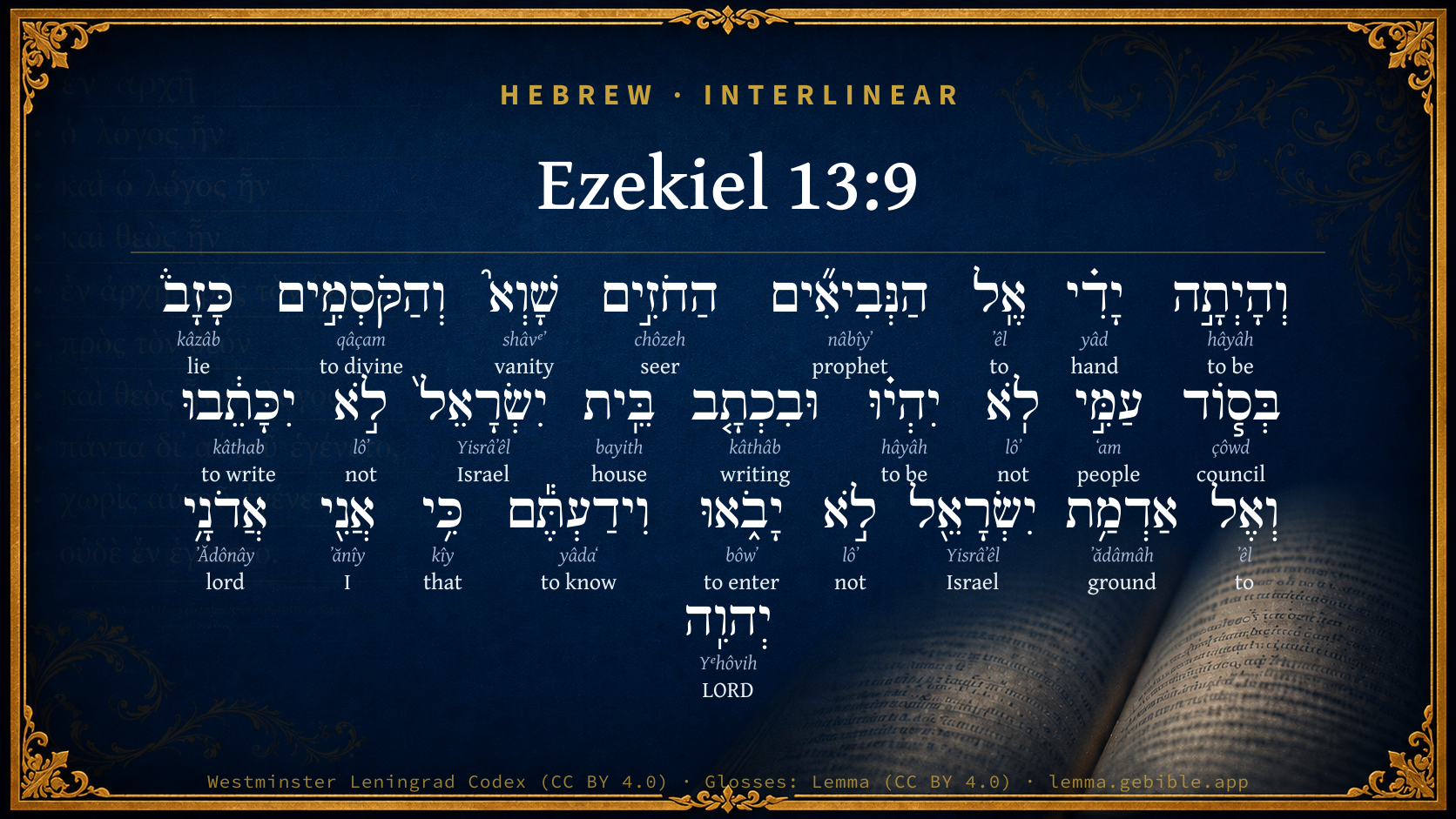
Hebrew (Westminster Leningrad Codex) Ezekiel 13:9 appears in the Hebrew Old Testament. The text above is from the Westminster Leningrad Codex. Each word links to its Strong’s number, a concise gloss, and parsing drawn from the Open Scriptures Hebrew Bible morphology. Click any word for its full Brown-Driver-Briggs (BDB) entry.
Download image
Cite this verse

Ezekiel 13:9 (World English Bible). Public Domain. Lemma interlinear Bible study tool, https://lemma.gebible.app/v/ezekiel/13/9.

Show BibTeX & RIS
BibTeX
RIS
English Translation
My hand shall be against the prophets who see false visions, and who divine lies: they shall not be in the council of my people, neither shall they be written in the writing of the house of Israel, neither shall they enter into the land of Israel; and you shall know that I am the Lord Yahweh.
World English Bible · Public Domain
Download a study sheet

One document with this verse’s original text, its word-by-word gloss line, the meaning frame, cross-references with their text, attributed commentary, and full source and license credits — printable, and it pastes into notes with its structure intact.

This verse Autodidact and up

Study sheet (.html) Plain text (.txt)

A passage Seminary Student

Up to 50 verses in one chapter. A passage sheet keeps up to 6 commentary sources and 12 cross-references per verse, in the order this page ranks them, and says so on the sheet whenever that leaves anything out. Ask for a single verse and you get the Autodidact verse sheet above.

Everything on this page stays free to read, with no account — the sheet is a download of what is already on screen, not access to it.

Want to remove ads? Support Godless Engineer
Compare translations 3

The same verse in 3 English versions, stacked beneath the original-language interlinear above. Click any original word for its lexicon entry.

Each is an independent rendering of the whole verse — the interlinear is not word-aligned to these translations.

Highlighted words mark where these versions differ — a whole-verse word diff, not a word-by-word alignment.

  • World English Bible Public Domain
    My hand shall be against the prophets who see false visions, and who divine lies: they shall not be in the council of my people, neither shall they be written in the writing of the house of Israel, neither shall they enter into the land of Israel; and you shall know that I am the Lord Yahweh.
  • King James Version Public Domain
    And mine hand shall be upon the prophets that see vanity, and that divine lies: they shall not be in the assembly of my people, neither shall they be written in the writing of the house of Israel, neither shall they enter into the land of Israel; and ye shall know that I am the Lord GOD.
  • unfoldingWord Literal Text CC BY-SA 4.0
    My hand will be against the prophets who have lying visions and who make false predictions. They will not be in the assembly of my people, or enrolled in the record of the house of Israel; they must not go to the land of Israel. For you will know that I am the Lord Yahweh!

unfoldingWord Literal Text — © unfoldingWord, licensed CC BY-SA 4.0. Word-aligned USFM3 via Door43 (git.door43.org/unfoldingWord/en_ult).

Versions to compare (up to 4)

3 of 4 selected

Show all 18 translations

Every available English version of this verse, each an independent rendering of the whole verse.

  • World English Bible Public Domain
    My hand shall be against the prophets who see false visions, and who divine lies: they shall not be in the council of my people, neither shall they be written in the writing of the house of Israel, neither shall they enter into the land of Israel; and you shall know that I am the Lord Yahweh.
  • Berean Standard Bible Public Domain
    My hand will be against the prophets who see false visions and speak lying divinations. They will not belong to the council of My people or be recorded in the register of the house of Israel, nor will they enter the land of Israel. Then you will know that I am the Lord GOD.
  • Majority Standard Bible Public Domain
    My hand will be against the prophets who see false visions and speak lying divinations. They will not belong to the council of My people or be recorded in the register of the house of Israel, nor will they enter the land of Israel. Then you will know that I am the Lord GOD.
  • King James Version Public Domain
    And mine hand shall be upon the prophets that see vanity, and that divine lies: they shall not be in the assembly of my people, neither shall they be written in the writing of the house of Israel, neither shall they enter into the land of Israel; and ye shall know that I am the Lord GOD.
  • American Standard Version (1901) Public Domain
    And my hand shall be against the prophets that see false visions, and that divine lies: they shall not be in the council of my people, neither shall they be written in the writing of the house of Israel, neither shall they enter into the land of Israel; and ye shall know that I am the Lord Jehovah.
  • Revised Version (1885) Public Domain
    And mine hand shall be against the prophets that see vanity, and that divine lies: they shall not be in the council of my people, neither shall they be written in the writing of the house of Israel, neither shall they enter into the land of Israel; and ye shall know that I am the Lord GOD.
  • Geneva Bible (1599) Public Domain
    And mine hande shalbe vpon the Prophets that see vanity, and diuine lies: they shall not be in the assemblie of my people, neither shall they be written in the writing of the house of Israel, neither shall they enter into the land of Israel: and yee shall know that I am the Lord God.
  • Douay-Rheims (1899) Public Domain
    And my hand shall be upon the prophets that see vain things, and that divine lies: they shall not be in the council of my people, nor shall they be written in the writing of the house of Israel, neither shall they enter into the land of Israel, and you shall know that I am the Lord God.
  • Young's Literal Translation Public Domain
    And My hand hath been on the prophets, Who are seeing vanity, and who are divining a lie, In the assembly of My people they are not, And in the writing of the house of Israel they are not written, And unto the ground of Israel they come not, And ye have known that I `am' the Lord Jehovah.
  • Literal Standard Version CC BY-SA 4.0
    And My hand has been on the prophets, || Who are seeing vanity, and who are divining a lie, || They are not in the assembly of My people, || And they are not written in the writing of the house of Israel, || And they do not come to the ground of Israel, || And you have known that I [am] Lord YHWH.
  • Unlocked Literal Bible CC BY-SA 4.0
    My hand will be against the prophets who have lying visions and who make false predictions. They will not be in the assembly of my people, or enrolled in the record of the house of Israel; they must not go to the land of Israel. For you will know that I am the Lord Yahweh!
  • unfoldingWord Literal Text CC BY-SA 4.0
    My hand will be against the prophets who have lying visions and who make false predictions. They will not be in the assembly of my people, or enrolled in the record of the house of Israel; they must not go to the land of Israel. For you will know that I am the Lord Yahweh!
  • Darby Bible Public Domain
    And my hand shall be against the prophets that see vanity and that divine lies: they shall not be in the council of my people, neither shall they be written in the register of the house of Israel, and they shall not enter into the land of Israel: and ye shall know that I [am] the Lord Jehovah.
  • World Messianic Bible Public Domain
    “My hand will be against the prophets who see false visions and who utter lying divinations. They will not be in the council of my people, neither will they be written in the writing of the house of Israel, neither will they enter into Eretz-Israel. Then you will know that I am the Lord GOD.”
  • Webster's Bible Public Domain
    And my hand shall be upon the prophets that see vanity, and that divine lies: they shall not be in the assembly of my people, neither shall they be written in the writing of the house of Israel, neither shall they enter into the land of Israel; and ye shall know that I am the Lord GOD.
  • Free Bible Version CC BY-SA 4.0
    I will punish the prophets who see false visions and give prophecies that are lies. They will not belong to the assembly of my people or be listed in the register of Israelites, and they won't be allowed to enter the country of Israel. Then you will know that I am the Lord God.
  • Bible in Basic English Public Domain
    And my hand will be against the prophets who see visions without substance and who make false use of secret arts: they will not be in the secret of my people, and they will not be recorded in the list of the children of Israel, and they will not come into the land of Israel; and it will be clear to you that I am the Lord.
  • JPS Tanakh (1917) Public Domain
    And My hand shall be against the prophets that see vanity, and that divine lies; they shall not be in the council of My people, neither shall they be written in the register of the house of Israel, neither shall they enter into the land of Israel; and ye shall know that I am the Lord GOD.

Literal Standard Version (2020), Covenant Press — licensed CC BY-SA 4.0. Text via the HelloAO Bible API (eBible.org). Unlocked Literal Bible (unfoldingWord) — licensed CC BY-SA 4.0. Text via the HelloAO Bible API (eBible.org). unfoldingWord Literal Text — © unfoldingWord, licensed CC BY-SA 4.0. Word-aligned USFM3 via Door43 (git.door43.org/unfoldingWord/en_ult). Free Bible Version, Dr. Jonathan Gallagher — licensed CC BY-SA 4.0. Text via the HelloAO Bible API (eBible.org).

Word by word

More ways to search: Search by grammar → Find every occurrence → Compare this word →

Practice this passage: Drill this verse → Learn its vocabulary →

וּבִכְתָ֤ב
kâthâb
H3791
“and · in/at · writing of”
Conjunction + Preposition + Noun, Common, Masculine, Singular, Construct
Part of Speech
Conjunction + Preposition + Noun
Type
Common
Gender
Masculine
Number
Singular
State
Construct
Full BDB Definition

Origin: from H3789

TWOT: 1053a

a writing, document, edict - register, enrolment, roll - mode of writing, character, letter - letter, document, a writing - a written edict - of royal enactment - of divine authority
  1. וְהָיְתָ֣ה hâyâh H1961 “and · to be” Conjunction + Verb, Qal, Sequential Perfect, 3rd Person, Feminine, Singular
  2. יָדִ֗י yâd H3027 “hand · my” Noun, Common, Both, Singular, Construct + Suffix, Personal, 1st Person, Common, Singular
  3. אֶֽל ʼêl H413 “to” Preposition
  4. הַנְּבִיאִ֞ים nâbîyʼ H5030 “the · prophets” Particle, Definite Article + Noun, Common, Masculine, Plural, Absolute
  5. הַחֹזִ֣ים chôzeh H2374 “the · seer” Particle, Definite Article + Verb, Qal, Participle Active, Masculine, Plural, Absolute
  6. שָׁוְא֮ shâvᵉʼ H7723 “vanity” Noun, Common, Masculine, Singular, Absolute
  7. וְהַקֹּסְמִ֣ים qâçam H7080 “and · the · divining” Conjunction + Particle, Definite Article + Verb, Qal, Participle Active, Masculine, Plural, Absolute
  8. כָּזָב֒ kâzâb H3577 “lie” Noun, Common, Masculine, Singular, Absolute
  9. בְּס֧וֹד çôwd H5475 “in/at · council of” Preposition + Noun, Common, Masculine, Singular, Construct
  10. עַמִּ֣י ʻam H5971 “people · my” Noun, Common, Masculine, Singular, Construct + Suffix, Personal, 1st Person, Common, Singular
  11. לֹֽא lôʼ H3808 “not” Particle, Negative
  12. יִהְי֗וּ hâyâh H1961 “to be” Verb, Qal, Imperfect, 3rd Person, Masculine, Plural
  13. בֵּֽית bayith H1004 “house of” Noun, Common, Masculine, Singular, Construct
  14. יִשְׂרָאֵל֙ Yisrâʼêl H3478 “Israel” Noun, Proper
  15. לֹ֣א lôʼ H3808 “not” Particle, Negative
  16. יִכָּתֵ֔בוּ kâthab H3789 “to write” Verb, Niphal, Imperfect, 3rd Person, Masculine, Plural
  17. וְאֶל ʼêl H413 “and · to” Conjunction + Preposition
  18. אַדְמַ֥ת ʼădâmâh H127 “ground of” Noun, Common, Feminine, Singular, Construct
  19. יִשְׂרָאֵ֖ל Yisrâʼêl H3478 “Israel” Noun, Proper
  20. לֹ֣א lôʼ H3808 “not” Particle, Negative
  21. יָבֹ֑אוּ bôwʼ H935 “to enter” Verb, Qal, Imperfect, 3rd Person, Masculine, Plural
  22. וִידַעְתֶּ֕ם yâdaʻ H3045 “and · to know” Conjunction + Verb, Qal, Sequential Perfect, 2nd Person, Masculine, Plural
  23. כִּ֥י kîy H3588 “that” Conjunction
  24. אֲנִ֖י ʼănîy H589 “I” Pronoun, Personal, 1st Person, Common, Singular
  25. אֲדֹנָ֥י ʼĂdônây H136 “Lord · my” Noun, Common, Masculine, Plural, Construct + Suffix, Personal, 1st Person, Common, Singular
  26. יְהוִֽה Yᵉhôvih H3069 “LORD” Noun, Proper

About this verse

These counts appear in no published source. They are computed here, from the morphology-tagged text and Lemma’s own curated glosses. What Lemma adds →

27
words
22
distinct lemmas
Prophets
section

Notable vocabulary

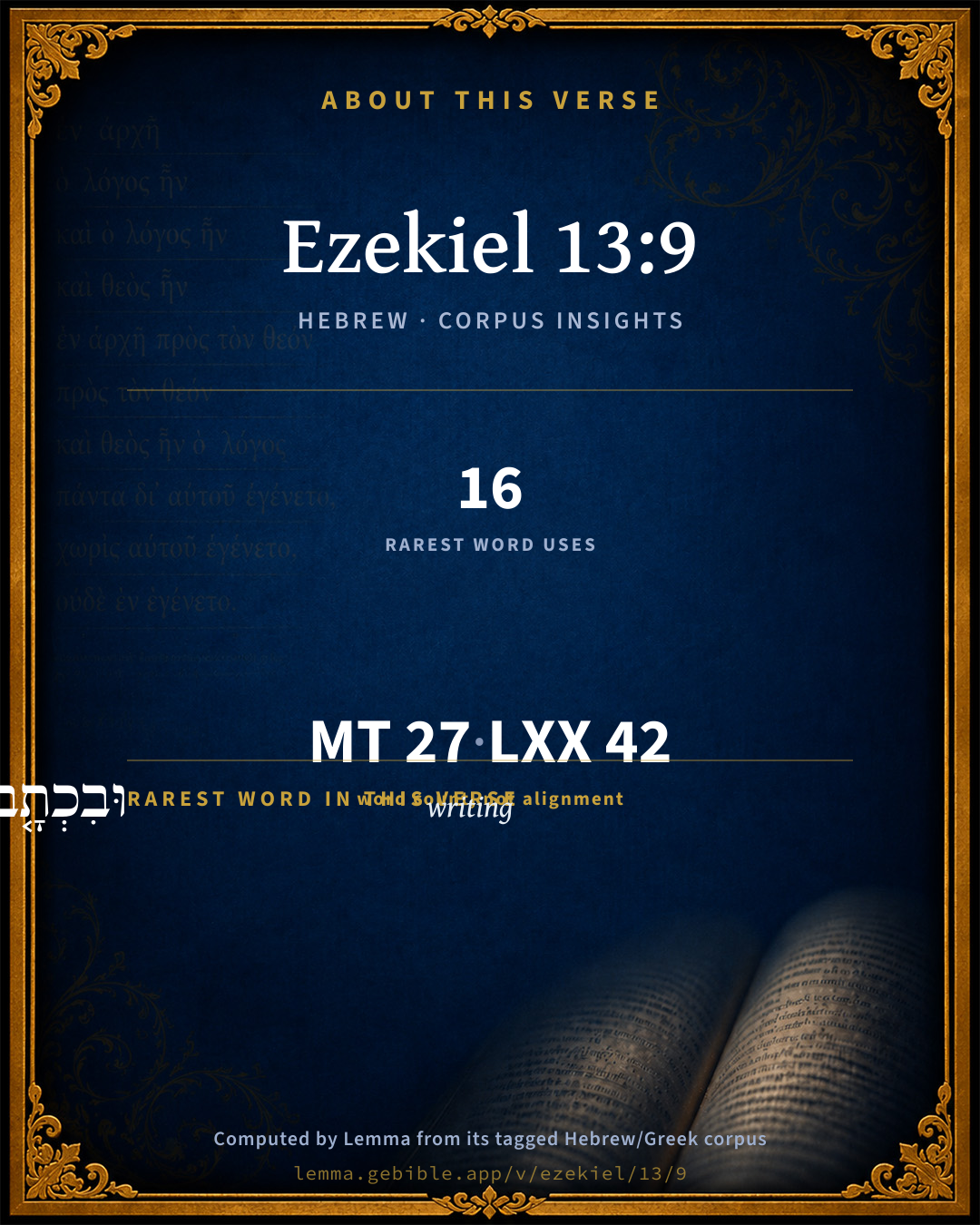
The rarest word here is וּבִכְתָ֤ב writing H3791 — appearing just 16 times in the whole Hebrew Bible.

Shared distinctive vocabulary

וּבִכְתָ֤ב writing H3791 occurs in 16 verses of the Hebrew Bible. Also found in:

Grammatical profile

  • 7 verbs
  • 13 nouns
  • 1 pronoun
  • 2 prepositions
  • 1 conjunction
  • 3 particles

Verb forms

  • וְהָיְתָ֣ה Qal · Sequential Perfect
  • הַחֹזִ֣ים Qal · Participle Active
  • וְהַקֹּסְמִ֣ים Qal · Participle Active
  • יִהְי֗וּ Qal · Imperfect
  • יִכָּתֵ֔בוּ Niphal · Imperfect
  • יָבֹ֑אוּ Qal · Imperfect
  • וִידַעְתֶּ֕ם Qal · Sequential Perfect

Repetition

Words recur within this verse — often emphatic in Hebrew:

  • וְהָיְתָ֣ה to be H1961 ×2
  • יִשְׂרָאֵל֙ Israel H3478 ×2
  • לֹֽא not H3808 ×3
  • אֶֽל to H413 ×2

Hebrew & Septuagint length

In English translation the verse runs 57 words from the Hebrew and 61 from the Septuagint (LXX English) — closely comparable.

A rough comparison of the two English renderings, which tokenize alike — not a word-level alignment.

Word counts can differ between the Hebrew and the Greek without any difference in meaning — e.g. the Hebrew direct-object marker אֵת has no separate Greek word, and Greek often adds the article ὁ.

In the original languages it is 27 Hebrew tokens and 42 Greek tokens — but the two are counted differently (Hebrew bundles its prefixes and suffixes into one token; the Greek is in lemma form), so that isn’t a like-for-like length.

Cross-references

31

Topical passages linked to Ezekiel 13:9 in the Treasury of Scripture Knowledge — connected by theme and wording, ordered by reader-vote popularity; previews shown in the World English Bible.

  • Psalms 69:28 Let them be blotted out of the book of life, And not be written with the righteous.
  • Psalms 87:6 Yahweh will count, when he writes up the peoples, "This one was born there." Selah.
  • Ezra 2:59 These were those who went up from Tel-melah, Tel Harsha, Cherub, Addan, [and] Immer; but they could not show their fathers' houses, and their seed, whether they were of Israel:
  • Jeremiah 28:15–17 Then said the prophet Jeremiah to Hananiah the prophet, Hear now, Hananiah: Yahweh has not sent you; but you make this people to trust in a lie.
  • Ezekiel 20:38 and I will purge out from among you the rebels, and those who disobey against me; I will bring them forth out of the land where they sojourn, but they shall not enter into the land of Israel: and you shall know that I am Yahweh.
  • Daniel 12:1 "At that time shall Michael stand up, the great prince who stands for the children of your people; and there shall be a time of trouble, such as never was since there was a nation even to that same time: and at that time your people shall be delivered, everyone who shall be found written in the book.
  • Psalms 101:7 He who practices deceit won't dwell within my house. He who speaks falsehood won't be established before my eyes.
  • Jeremiah 20:3–6 It happened on the next day, that Pashhur brought forth Jeremiah out of the stocks. Then said Jeremiah to him, Yahweh has not called your name Pashhur, but Magormissabib.
  • Exodus 32:32–33 Yet now, if you will, forgive their sin-- and if not, please blot me out of your book which you have written."
  • 1 Kings 22:24–25 Then Zedekiah the son of Chenaanah came near, and struck Micaiah on the cheek, and said, Which way went the Spirit of Yahweh from me to speak to you?
  • Ezra 2:62–63 These sought their register [among] those who were reckoned by genealogy, but they were not found: therefore were they deemed polluted and put from the priesthood.
  • Nehemiah 7:62 The children of Delaiah, the children of Tobiah, the children of Nekoda, six hundred forty-two.
  • Nehemiah 7:64 These sought their register [among] those who were reckoned by genealogy, but it was not found: therefore were they deemed polluted and put from the priesthood.
  • Psalms 69:5 God, you know my foolishness. My sins aren't hidden from you.
  • Isaiah 4:3 It will happen, that he who is left in Zion, and he who remains in Jerusalem, shall be called holy, even everyone who is written among the living in Jerusalem;
  • Jeremiah 17:13 Yahweh, the hope of Israel, all who forsake you shall be disappointed. Those who depart from me shall be written in the earth, because they have forsaken Yahweh, the spring of living waters.
  • Jeremiah 23:20 The anger of Yahweh shall not return, until he has executed, and until he have performed the intents of his heart: in the latter days you shall understand it perfectly.
  • Jeremiah 29:21–22 Thus says Yahweh of Hosts, the God of Israel, concerning Ahab the son of Kolaiah, and concerning Zedekiah the son of Maaseiah, who prophesy a lie to you in my name: Behold, I will deliver them into the hand of Nebuchadrezzar king of Babylon; and he shall kill them before your eyes;
  • Jeremiah 29:31–32 Send to all them of the captivity, saying, Thus says Yahweh concerning Shemaiah the Nehelamite: Because Shemaiah has prophesied to you, and I didn't send him, and he has caused you to trust in a lie;
  • Ezekiel 11:10 You shall fall by the sword; I will judge you in the border of Israel; and you shall know that I am Yahweh.
  • Ezekiel 11:12–13 and you shall know that I am Yahweh: for you have not walked in my statutes, neither have you executed my ordinances, but have done after the ordinances of the nations that are round about you.
  • Ezekiel 12:20 The cities that are inhabited shall be laid waste, and the land shall be a desolation; and you shall know that I am Yahweh.
  • Ezekiel 14:9–10 If the prophet be deceived and speak a word, I, Yahweh, have deceived that prophet, and I will stretch out my hand on him, and will destroy him from the midst of my people Israel.
  • Hosea 9:3 They won't dwell in Yahweh's land; But Ephraim will return to Egypt, And they will eat unclean food in Assyria.
  • Luke 10:20 Nevertheless, don't rejoice in this, that the spirits are subject to you, but rejoice that your names are written in heaven."
  • Philippians 4:3 Yes, I beg you also, true yoke-fellow, help these women, for they labored with me in the Gospel, with Clement also, and the rest of my fellow workers, whose names are in the book of life.
  • Hebrews 12:23 to the general assembly and assembly of the firstborn who are enrolled in heaven, to God the Judge of all, to the spirits of just men made perfect,
  • Revelation 13:8 All who dwell on the earth will worship him, everyone whose name has not been written from the foundation of the world in the book of life of the Lamb who has been killed.
  • Revelation 19:20 The beast was taken, and with him the false prophet who worked the signs in his sight, with which he deceived those who had received the mark of the beast and those who worshiped his image. These two were thrown alive into the lake of fire that burns with sulfur.
  • Revelation 20:12 I saw the dead, the great and the small, standing before the throne, and they opened books. Another book was opened, which is the book of life. The dead were judged out of the things which were written in the books, according to their works.
  • Revelation 20:15 If anyone was not found written in the book of life, he was cast into the lake of fire.

Cross-references courtesy of OpenBible.info (CC BY 4.0).

Hebrew and Greek witnesses Masoretic Hebrew ↔ Greek Septuagint

The same verse in the two great witnesses to the Old Testament, shown verse-for-verse.

These are two independent witnesses, not word-aligned to each other, and the Septuagint is shown in lemma (dictionary) form.

Hebrew Ezekiel 13:9 Masoretic · Westminster Leningrad Codex

וְהָיְתָ֣ה יָדִ֗י אֶֽל הַנְּבִיאִ֞ים הַחֹזִ֣ים שָׁוְא֮ וְהַקֹּסְמִ֣ים כָּזָב֒ בְּס֧וֹד עַמִּ֣י לֹֽא יִהְי֗וּ וּבִכְתָ֤ב בֵּֽית יִשְׂרָאֵל֙ לֹ֣א יִכָּתֵ֔בוּ וְאֶל אַדְמַ֥ת יִשְׂרָאֵ֖ל לֹ֣א יָבֹ֑אוּ וִידַעְתֶּ֕ם כִּ֥י אֲנִ֖י אֲדֹנָ֥י יְהוִֽה

My hand shall be against the prophets who see false visions, and who divine lies: they shall not be in the council of my people, neither shall they be written in the writing of the house of Israel, neither shall they enter into the land of Israel; and you shall know that I am the Lord Yahweh.

World English Bible · Public Domain

Greek LXX Ezekiel 13:9 Septuagint · lemma form

καί ἐκτείνω ὁ χείρ ἐγώ ἐπί ὁ προφήτης ὁ ὁράω ψευδής καί ὁ ἀποφθέγγομαι μάταιος ἐν παιδεία ὁ λαός ἐγώ οὐ εἰμί οὐδέ ἐν γραφή οἶκος ἰσραήλ οὐ γράφω καί εἰς ὁ γῆ ὁ ἰσραήλ οὐ εἰςἔρχομαι καί γιγνώσκω διότι ἐγώ κύριος

And I will stretch forth my hand against the prophets that see false visions, and those that utter vanities: they shall not partake of the instruction of my people, neither shall they be written in the roll of the house of Israel, and they shall not enter into the land of Israel; and they shall know that I am the Lord.

LXX2012 (modern English Septuagint) · Public Domain

Hebrew: Westminster Leningrad Codex (CC BY 4.0). Greek: Septuagint (public domain); English from LXX2012 (modern English Septuagint) (Public Domain). How the Septuagint differs from the Hebrew →

Targum (Aramaic paraphrase)

1

The Targum is the ancient Jewish Aramaic paraphrase of the Hebrew Scriptures — an interpretive translation, not the Hebrew text itself. Onkelos (literal) and Pseudo-Jonathan (expansive) render the Torah, and Jonathan the Prophets. Coverage is partial: where no permissively-licensed English translation exists for a verse, only the Aramaic is shown. This is verse-level text, not a word-by-word alignment to the Hebrew.

  1. Targum Jonathan Prophets (Joshua–Malachi)
    וּתְהֵי מְחַת גְבוּרְתִּי עַל נְבִיֵי שִׁקְרָא דְמִתְנַבֵּן שְׁקַר וּמַלְפִין כַּדִיבִין בְּרַז טַב דְגָנִיז לְעַמִי לָא יְהוֹן וּבִכְתַב חַיֵי עַלְמָא דִכְתִיב לְצַדִיקֵי בֵּית יִשְׂרָאֵל לָא יִתְכַּתְבוּן וּלְאַרְעָא דְיִשְׂרָאֵל לָא יַעֲלוּן וְתִידְעוּן אֲרֵי אֲנָא יְיָ אֱלֹהִים:

    (no public-domain English translation for this verse)

    Targum Jonathan — Aramaic: “Mikraot Gedolot” (public domain). English: “Sefaria Community Translation” (CC0 1.0 (public-domain dedication)); “London "Chaldee Paraphrase," 1871” (public domain). Text via Sefaria.

Commentary

Notes on Ezekiel 13:9 from classic Christian and Jewish commentators (each source and its license shown beneath its notes). The classic Christian expositions comment on the surrounding passage and are grouped to its opening verse, so a note may address several verses; the Jewish commentaries on the Tanakh (Rashi and others) are per-verse, so they appear only where the commentator wrote on this verse.

Lemma curates 59 commentaries, every one of them public domain or Creative Commons licensed, each selected and text-cleaned for this edition rather than reprinted as found. About our sources →

Trapp's Complete Commentary

John Trapp

Eze 13:9 And mine hand shall be upon the prophets that see vanity, and that divine lies: they shall not be in the assembly of my people, neither shall they be written in the writing of the house of Israel, neither shall they enter into the land of Israel; and ye shall know that I [am] the Lord GOD.

Ver. 9. And my hand shall be upon the prophets] God’s hand is a mighty hand; {1Pe 5:6} the heaven is spanned by it, the earth held in the hollow of it.

They shall not be in the assembly of my people,] {a} Or, In the secret, or councils; they shall have no communion with them. A heavy threat; for the communion of saints, next unto communion with God, is the greatest comfort here attainable.

Neither shall they be written,] As members of that commonwealth, - much less of the Jerusalem that is above, {Isa 4:4} - but rooted out of the world, written in the earth (Jer 17:13; see Psa 69:28).

Neither shall they enter.] They shall never come back out of Babylon, nor enter into heaven.

{a} Dicit eos fore prorsus extraneos ab Ecclesia. Tesseris Eeclesiae aspectabilibus abalienati permanebunt. - Jun.

John Trapp, A Commentary or Exposition upon All the Books of the Old and New Testament (1647–1656) — public domain. Text from a community e-Sword module.

Geneva Bible (1599)

Geneva Bible translators

That is, in the book of life, wherein the true Israelites are written.

Geneva Bible (1599) marginal notes — public domain. Text via Bolls.life.

Jamieson, Fausset & Brown

Robert Jamieson, A. R. Fausset & David Brown

mine hand--My power in vengeance.

not . . . in . . . assembly--rather, the "council"; "They shall not occupy the honorable office of councillors in the senate of elders after the return from Babylon" (Ezr 2:1-2).

neither . . . written in . . . Israel--They shall not even have a place in the register kept of all citizens' names; they shall be erased from it, just as the names of those who died in the year, or had been deprived of citizenship for their crimes, were at the annual revisal erased. Compare Jer 17:13; Luk 10:20; Rev 3:5, as to those spiritually Israelites; Joh 1:47, and those not so. Literally fulfilled (Ezr 2:59, Ezr 2:62; compare Neh 7:5; Psa 69:28).

neither . . . enter . . . land--They shall not so much as be allowed to come back at all to their country.

Jamieson, Fausset & Brown — Commentary Critical and Explanatory on the Whole Bible (1871) — public domain (CC PDM 1.0). Text via the HelloAO Bible API.

Adam Clarke's Commentary

Verse 9. They shall not be in the assembly of my people] They shall not be reputed members of my Church. They shall not be reckoned in the genealogy of true Israelites that return from captivity; and they shall never have a possession in the land; they shall be exhereditated and expatriated. They shall all perish in the siege, by the sword, the famine, and the pestilence.

Adam Clarke's Commentary on the Bible (1810–1826) — public domain. Text from a community e-Sword/MySword module.

John Calvin's Commentaries

Besides, he afterwards points out the punishment; my hand, says he, shall be against the prophets. For although God threatens to become an adversary to the reprobate, yet this is not sufficient to terrify them, they are so stupid. But it is necessary to use another stimulus, namely, that God should display his power. This is the reason why he now adds, his hand should be against the false prophets. The hand is sometimes taken for a blow: but because God sees the impious torpid amidst their sins, he says that he would not only be their enemy and an avenger of his glory, but he brings forward his own hand into the midst. It follows, they shall not be in the counsel of my people. Some explain the noun סוד, sod, more subtlety than they need for that experience of God which is offered to the elect for their salvation. But this explanation is forced, for they are deceived in thinking that the Prophet’s meaning is different in the second clause, where he adds, they shall not be written in the list of the house of Israel: he repeats the same thing in different words: in the first place he had said, they should not be in the secret of the people: for סוד, sod, signifies a secret, but it is taken for counsel: they shall not be therefore in the assembly of the people: afterwards he adds, they shall not be in the catalogue of the house of Israel. He mentions a catalogue, because judges and others elected to any office were written in a list. We see, therefore, what the Prophet intends — for I am compelled to break off here — namely, that those impostors who wished to enjoy the prophetic title, were altogether without the Church, since God had cast them off.

John Calvin's Commentaries (1540-1563) — public domain. Text from the Calvin Translation Society English edition (1840s-50s) via the Christian Classics Ethereal Library (ccel.org). Calvin's coverage is partial (roughly two-thirds of the Bible); uncommented books and verses are honest gaps, never fabricated. The 19th-century editor's footnotes and remarks are omitted so the notes are faithfully Calvin's own voice.

Ellicott's Commentary for English Readers

(9) The assembly of my people.—The original word bears also the meanings placed in the margin, but the sense here is correctly given in the text. The several clauses are intended to emphasise the utter exclusion of the false prophets from the people of God: they shall not be in the congregation; their names shall not be written in the genealogical registers of Israel; they shall not even enter the land when the purified and repentant people should once more return.

A Bible Commentary for English Readers, edited by Charles John Ellicott (1878–1897) — public domain. Text from a community e-Sword module.

The Cambridge Bible for Schools and Colleges

gen. ed. J. J. S. Perowne

9. The punishment is described in three steps, which form a climax. At present these prophets possess influence, they are counsellors and leaders; when Israel is a nation again upon her own land they shall have no place in the council of the people—read council for assembly as marg. Now they occupy a high place in the roll of citizens, and have names distinguished; then their names shall not be written in the writing (i.e. the book or register-roll) of the house of Israel; cf. Ezr_2:62; Isa_4:3. And finally, they shall not have a place in the land at all—Israel shall return, while they shall perish. Jeremiah had already used the same language in regard to Shemaiah, a prophet who misled the exiles, Jer_29:32.

The Cambridge Bible for Schools and Colleges (gen. ed. J. J. S. Perowne; Cambridge University Press, 1878–1918) — public domain. Text from a community e-Sword module.

John Gill's Exposition

Say unto them which daub it with untempered mortar,.... The false prophets, that flattered the people with peace, prosperity, and safety:

that it shall fall; the wall they have built and daubed over; the city of Jerusalem shall be taken and destroyed; the predictions of the prophets shall prove lies; and the vain hopes and expectations of the people fail:

there shall be an overflowing shower; that shall wash away the wall with its untempered mortar; meaning the Chaldean army, compared to an overflowing shower of rain, for the multitude of men it, and the force, power, and noise, with which it should come, bearing down all before it; see Isa 8:7;

and ye, O great hailstones, shall fall; upon the wall, and break it down: or, "ye, O great hailstones, shall cause it to fall" (h); or, "I will give great hailstones, and it shall fall" (i). The word "elgabish", which in some copies is one word, and in others two, as Kimchi and Ben Melech observe, is either the same with "gabish", which signifies a precious stone, and is rendered pearl in Job 28:18; or it may be, as it seems to be, an Arabic word; and Hottinger (k) takes it to be "gypsus", or lime, or the "lapis laminosus", or slate; so the Lord threatens to rain down lime or slate upon them from heaven, which should destroy the wall built with untempered mortar:

and a stormy wind shall rend it; this seems to signify the same as the overflowing shower, the Chaldean army, compared to a strong tempestuous wind; see Jer 4:11; as the hailstones, may signify the king of Babylon, with his princes, nobles, and generals.

(h) "et vos, O lapides grandinis, ruere facietis aedificium", Munster. (i) "Et dabo lapides grandinis, qui corruere facient parietem", Pagninus. (k) Smegma Oriental. l. 1. c. 7. p. 119.

John Gill's Exposition of the Whole Bible (1746–1763) — public domain (CC PDM 1.0). Text via the HelloAO Bible API.

Albert Barnes' Notes on the Bible

Assembly - Here “the congregation of the people.” These false prophets were to be struck off from “the writing” or, the rolls, in which the names of all Israelites were registered (compare Psa 87:6; Exo 32:32); and therefore when the restoration Eze 11:17 shall take place these men shall not have part in it.

Albert Barnes' Notes on the Bible (1834–1885) — public domain. Text from a community e-Sword/MySword module.

Haydock's Catholic Bible Commentary

Upon, to punish. --- Counsel. They shall not be consulted, or have any credit. --- Writing. They shall perish in the city, or in banishment. (Calmet) --- Their works shall not be accounted canonical. (Sixt. Bib. ii. 2.)

George Leo Haydock (1774–1849), Haydock's Catholic Family Bible and Commentary, 1859 edition — public domain. Excludes Psalms (Douay-Rheims chapter numbering differs from Protestant) and Deuterocanonical books (Catholic canon only).

Matthew Poole's English Annotations

Mine hand; my power striking them; so that it shall be evident they fall under Divine revenge, as Pelatiah, Eze 11:13, and Hananiah, Jer 28:15,16. Or if they escape this stroke,

they shall not be in the assembly of my people; have no seat among the rulers, nor voice among the counsellors, nor credit among the judges of my people; but, as false fellows, teachers of lies, be branded with infamy after the return from captivity. Or, they shall not be among those that return, dead before, or rejected as dangerous seducers and blasphemous abusers of the name of God. It may also refer to the excluding them out of. the assembly of glorified ones in heaven.

Neither shall they be written; registered among those that return, of which registry Ezr 2:1,2, but blotted out for their impiety; this literally: mystically, it may be an obliterating or blotting them out of the book of life; they shall not be written with such as shall escape spiritually, they shall not be found among the elect that shall live for ever.

Neither shall they ever more come into the land of Israel, not survive the captivity. Or, with disgrace cast off, shall die in strange lands. In brief, the approaching prosperity which they promise the people none shall see, Jer 29:21,32; but the prosperity after seventy years’ captivity, which I promise, my people shall see, but these false prophets never shall see, my hand shall be so against them. They shall not be written in the book of eternal life, which is written for the just ones of the house of Israel, saith the Chaldee paraphrast. See Eze 12:15.

Matthew Poole's English Annotations on the Holy Bible (1683–1685) — public domain. Text from a community e-Sword/MySword module.

Whedon's Commentary on the Bible

Daniel D. Whedon

9. Mine hand shall be upon the prophets — Ezekiel knew what it was to feel the weight of Jehovah’s hand (Eze_3:14). The controlling hand which forces the obedient prophet to do hard tasks will fall still heavier upon the disobedient. He who will not wear the gentle yoke of constraint must drag “as with a cart rope” his load of responsibility and sorrow. These false prophets, now praised for their patriotic citizenship, upon the return from the captivity shall not sit in the “council” as they do now, nor shall their names appear in the national register (Ezr_2:62). They boast of their special patriotism, but events shall prove that they are not even true Israelites. They will go into captivity, but they will never return again into the land of Israel. (See Eze_27:21.)

Daniel D. Whedon (gen. ed.), Commentary on the Old and New Testaments (1874–1909) — public domain. Text from a community e-Sword module.

The Pulpit Commentary

Mine hand shall be, etc. After Ezekiel"s manner, the thought of ver. 6 is repeated in an altered form in vers. 7, 8. What had been a statement appears as a question to which there could be but one answer. The prophet, as it were, cross examines his rivals. Could they deny the charge? Was not every word of it true? Then, after the statement of the sin of the false prophets, comes the proclamation of the punishment. The hand of Jehovah would be upon them for evil and not for good. In the assembly of my people. The Hebrew word indicates not a large popular gathering, but a secret council of those who deliberate together to carry out their. (Psa_89:7 Psa_111:1; Jer_6:11) The prophets who had acted together, and been looked up to by the people as forming such a council, should lose that position of authority. The words that follow point to a yet lower degradation. They should be in the strictest sense of the word excommunicated. The city of Jerusalem, perhaps every city of Judah, had its register of citizens. In such a register were inscribed also the names of proselytes of other races, (Psa_87:6) and so men came to think of a like register as kept by the King of kings, containing the names of those who were heirs of the "life" of the true Israel. (Exo_32:32; Dan_12:1) In neither of those registers, the earthly and the heavenly (but stress is probably laid upon the former), shall the false prophets find a place. Ezr_2:62 gives an example of the use made of such registers on the return from the Captivity. One notes the contrast between the my people" which recognizes Israel as still the heritage of Jehovah, and the thy people" used in Eze_3:11 of the rebellious house of the Captivity. For the false prophets there should be no return to the land of Israel such as that which the prophet anticipated for the faithful and the penitent. (Eze_37:21; comp. Isa_57:13) Here there is no specific mention of the name being struck out. The prophet contemplates a new register, in which their names will never even have appeared.

The Pulpit Commentary (1880–1919), ed. H.D.M. Spence-Jones & Joseph S. Exell — public domain. Text from a community e-Sword module.

John Wesley's Explanatory Notes

Mine hand - My power striking them. In the assembly - Have no seat among the rulers, nor voice among the counsellors. Written - Not registered among those that return, Ezra ii, 1, 2. Enter - They shall never come into the land of Israel. They shall not be written in the book of eternal life, which is written for the just ones of the house of Israel, saith the Chaldea paraphrast.

John Wesley, Explanatory Notes Upon the Whole Bible (1754–1765) — public domain. Text via the GEBible commentary corpus.

Lesson kit

Teaching starters — assembled from the data on this page, not authored interpretation. Every prompt links to the verse data it draws on. Edit before teaching.

Ezekiel, in the Prophets, opens this verse with 27 words (22 distinct Hebrew lemmas). Its most distinctive word is kâthâb (“writing”). A historical commentator’s framing appears above. Read the whole chapter for the surrounding context.

Discussion questions

  1. How does “writing” (kâthâb) shape what this verse is saying?
  2. 1 Chronicles 28:19 shares the word «writing» with this verse. How do the two illuminate each other?
  3. “to be” occurs 2× in this one verse. What is the effect of the repetition?
  4. These translations render this verse differently; the difference is in the English rendering, not the original. What questions does that raise?
  5. The verb «וְהָיְתָ֣ה» is Qal Sequential Perfect. How does its form color the action?
  6. Reading how Trapp's Complete Commentary and Geneva Bible (1599) read this verse, where do the two commentators agree and where do they part?

Things to notice

Reading settings

Reading text

Shown beneath each verse's original-language words.

Old Testament
Old Testament edition

Read the OT as the Masoretic Hebrew (MT) or the Greek Septuagint (LXX).

English shown for the Greek Septuagint (in the Hebrew ↔ Greek comparison).

Comparing translations? Open the Compare panel on any verse page to stack up to four side by side.