
Jeremiah 25:5

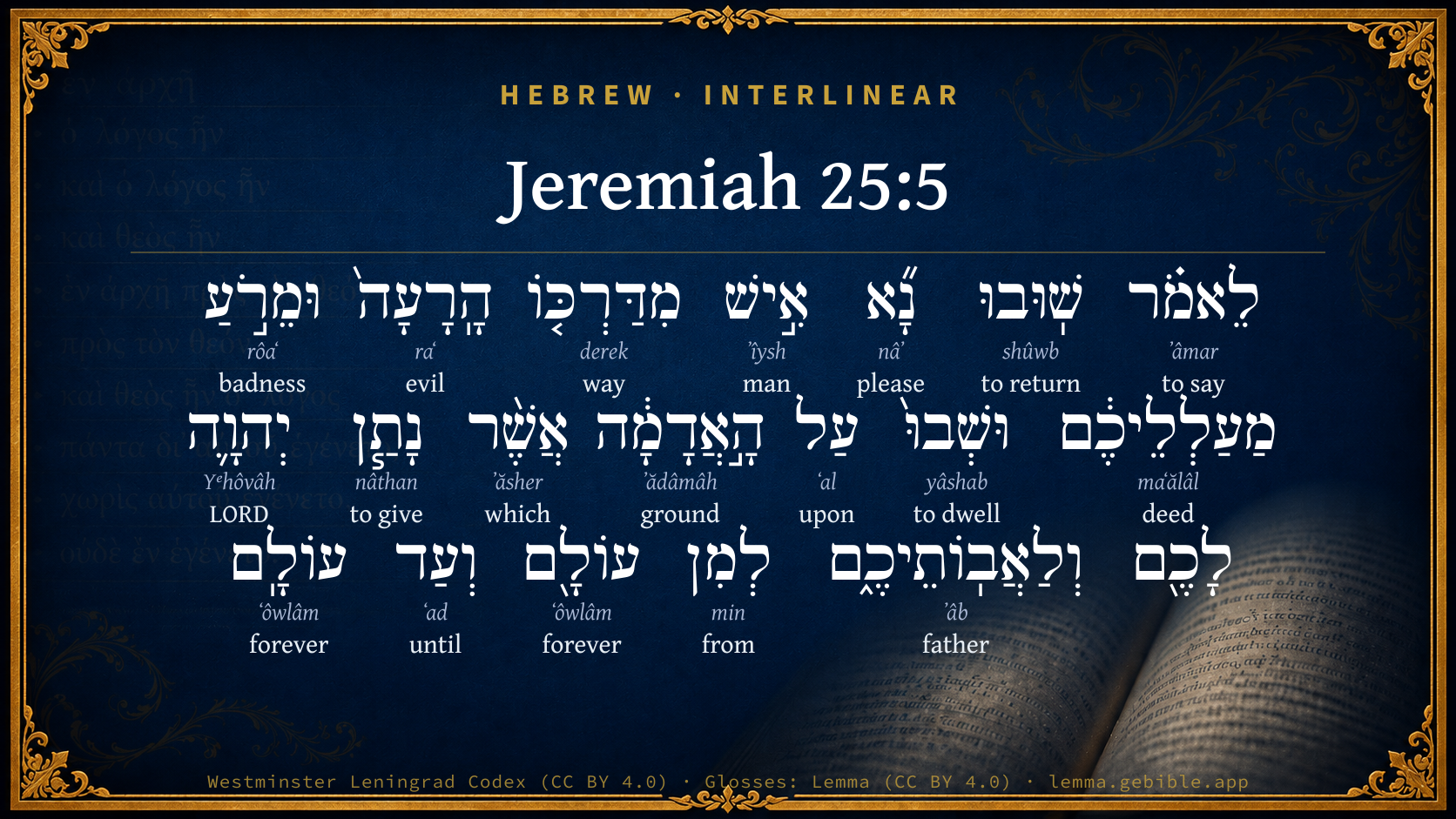
Hebrew (Westminster Leningrad Codex) Jeremiah 25:5 appears in the Hebrew Old Testament. The text above is from the Westminster Leningrad Codex. Each word links to its Strong’s number, a concise gloss, and parsing drawn from the Open Scriptures Hebrew Bible morphology. Click any word for its full Brown-Driver-Briggs (BDB) entry.
Download image
Cite this verse

Jeremiah 25:5 (World English Bible). Public Domain. Lemma interlinear Bible study tool, https://lemma.gebible.app/v/jeremiah/25/5.

Show BibTeX & RIS
BibTeX
RIS
English Translation
saying, Return you now everyone from his evil way, and from the evil of your doings, and dwell in the land that Yahweh has given to you and to your fathers, from of old and even forevermore;
World English Bible · Public Domain
Download a study sheet

One document with this verse’s original text, its word-by-word gloss line, the meaning frame, cross-references with their text, attributed commentary, and full source and license credits — printable, and it pastes into notes with its structure intact.

This verse Autodidact and up

Study sheet (.html) Plain text (.txt)

A passage Seminary Student

Up to 50 verses in one chapter. A passage sheet keeps up to 6 commentary sources and 12 cross-references per verse, in the order this page ranks them, and says so on the sheet whenever that leaves anything out. Ask for a single verse and you get the Autodidact verse sheet above.

Everything on this page stays free to read, with no account — the sheet is a download of what is already on screen, not access to it.

Want to remove ads? Support Godless Engineer
Compare translations 3

The same verse in 3 English versions, stacked beneath the original-language interlinear above. Click any original word for its lexicon entry.

Each is an independent rendering of the whole verse — the interlinear is not word-aligned to these translations.

Highlighted words mark where these versions differ — a whole-verse word diff, not a word-by-word alignment.

  • World English Bible Public Domain
    saying, Return you now everyone from his evil way, and from the evil of your doings, and dwell in the land that Yahweh has given to you and to your fathers, from of old and even forevermore;
  • King James Version Public Domain
    They said, Turn ye again now every one from his evil way, and from the evil of your doings, and dwell in the land that the LORD hath given unto you and to your fathers for ever and ever:
  • unfoldingWord Literal Text CC BY-SA 4.0
    saying, ‘Turn back, please, each man from his evil way and from the evil of your deeds, and dwell on the land that Yahweh gave to you and to your fathers from everlasting to everlasting.

unfoldingWord Literal Text — © unfoldingWord, licensed CC BY-SA 4.0. Word-aligned USFM3 via Door43 (git.door43.org/unfoldingWord/en_ult).

Versions to compare (up to 4)

3 of 4 selected

Show all 18 translations

Every available English version of this verse, each an independent rendering of the whole verse.

  • World English Bible Public Domain
    saying, Return you now everyone from his evil way, and from the evil of your doings, and dwell in the land that Yahweh has given to you and to your fathers, from of old and even forevermore;
  • Berean Standard Bible Public Domain
    The prophets told you, ‘Turn now, each of you, from your evil ways and deeds, and you can dwell in the land that the LORD has given to you and your fathers forever and ever.
  • Majority Standard Bible Public Domain
    The prophets told you, ‘Turn now, each of you, from your evil ways and deeds, and you can dwell in the land that the LORD has given to you and your fathers forever and ever.
  • King James Version Public Domain
    They said, Turn ye again now every one from his evil way, and from the evil of your doings, and dwell in the land that the LORD hath given unto you and to your fathers for ever and ever:
  • American Standard Version (1901) Public Domain
    saying, Return ye now every one from his evil way, and from the evil of your doings, and dwell in the land that Jehovah hath given unto you and to your fathers, from of old and even for evermore;
  • Revised Version (1885) Public Domain
    saying, Return ye now every one from his evil way, and from the evil of your doings, and dwell in the land that the LORD hath given unto you and to your fathers, from of old and even for evermore:
  • Geneva Bible (1599) Public Domain
    They sayde, Turne againe now euery one from his euill way, and from the wickednes of your inuentions, and ye shall dwell in the lande that the Lord hath giuen vnto you, and to your fathers for euer and euer.
  • Douay-Rheims (1899) Public Domain
    When he said: Return ye, every one from his evil way, and from your wicked devices, and you shall dwell in the land which the Lord hath given to you, and your fathers for ever and ever.
  • Young's Literal Translation Public Domain
    `Turn back, I pray you, each from his evil way, and from the evil of your doings, and dwell on the ground that Jehovah hath given to you and to your fathers from age unto age,
  • Literal Standard Version CC BY-SA 4.0
    Please turn back, each from his evil way, and from the evil of your doings, and dwell on the ground that YHWH has given to you and to your fathers from age to age,
  • Unlocked Literal Bible CC BY-SA 4.0
    These prophets said, 'Let each man turn from his wicked way and the corruption of his practices and return to the land that Yahweh gave in ancient times to your ancestors and to you, as a permanent gift.
  • unfoldingWord Literal Text CC BY-SA 4.0
    saying, ‘Turn back, please, each man from his evil way and from the evil of your deeds, and dwell on the land that Yahweh gave to you and to your fathers from everlasting to everlasting.
  • Darby Bible Public Domain
    when they said, Turn again now every one from his evil way, and from the wickedness of your doings, and dwell in the land that Jehovah hath given unto you and to your fathers from of old even for ever.
  • World Messianic Bible Public Domain
    saying, “Return now everyone from his evil way, and from the evil of your doings, and dwell in the land that the LORD has given to you and to your fathers, from of old and even forever more.
  • Webster's Bible Public Domain
    They said, Turn ye again now every one from his evil way, and from the evil of your doings, and dwell in the land that the LORD hath given to you and to your fathers for ever and ever:
  • Free Bible Version CC BY-SA 4.0
    The consistent message has been: Give up your evil ways and the evil things you're doing so you can live in the country that the Lord has given to you and your forefathers forever.
  • Bible in Basic English Public Domain
    Saying, Come back now, everyone from his evil way and from the evil of your doings, and keep your place in the land which the Lord has given to you and to your fathers, from times long past even for ever:
  • JPS Tanakh (1917) Public Domain
    saying: 'Return ye now every one from his evil way, and from the evil of your doings, and dwell in the land that the LORD hath given unto you and to your fathers, for ever and ever;

Literal Standard Version (2020), Covenant Press — licensed CC BY-SA 4.0. Text via the HelloAO Bible API (eBible.org). Unlocked Literal Bible (unfoldingWord) — licensed CC BY-SA 4.0. Text via the HelloAO Bible API (eBible.org). unfoldingWord Literal Text — © unfoldingWord, licensed CC BY-SA 4.0. Word-aligned USFM3 via Door43 (git.door43.org/unfoldingWord/en_ult). Free Bible Version, Dr. Jonathan Gallagher — licensed CC BY-SA 4.0. Text via the HelloAO Bible API (eBible.org).

Word by word

More ways to search: Search by grammar → Find every occurrence → Compare this word →

Practice this passage: Drill this verse → Learn its vocabulary →

וּמֵרֹ֣עַ
rôaʻ
H7455
“and · from · badness of”
Conjunction + Preposition + Noun, Common, Masculine, Singular, Construct
Part of Speech
Conjunction + Preposition + Noun
Type
Common
Gender
Masculine
Number
Singular
State
Construct
Full BDB Definition

Origin: from H7489

TWOT: 2191b

badness, evil - badness, bad quality - wilfulness - evil, badness (ethical) - sadness
  1. לֵאמֹ֗ר ʼâmar H559 “to say” Preposition + Verb, Qal, Infinitive Construct
  2. שֽׁוּבוּ shûwb H7725 “return” Verb, Qal, Imperative, 2nd Person, Masculine, Plural
  3. נָ֞א nâʼ H4994 “please” Particle, Exhortation
  4. אִ֣ישׁ ʼîysh H376 “man” Noun, Common, Masculine, Singular, Absolute
  5. מִדַּרְכּ֤וֹ derek H1870 “from · way · his” Preposition + Noun, Common, Both, Singular, Construct + Suffix, Personal, 3rd Person, Masculine, Singular
  6. הָֽרָעָה֙ raʻ H7451 “the · evil” Particle, Definite Article + Adjective, Adjective, Feminine, Singular, Absolute
  7. מַעַלְלֵיכֶ֔ם maʻălâl H4611 “deeds · your” Noun, Common, Masculine, Plural, Construct + Suffix, Personal, 2nd Person, Masculine, Plural
  8. וּשְׁבוּ֙ yâshab H3427 “and · dwell” Conjunction + Verb, Qal, Imperative, 2nd Person, Masculine, Plural
  9. עַל ʻal H5921 “upon” Preposition
  10. הָ֣אֲדָמָ֔ה ʼădâmâh H127 “the · ground” Particle, Definite Article + Noun, Common, Feminine, Singular, Absolute
  11. אֲשֶׁ֨ר ʼăsher H834 “which” Particle, Relative
  12. נָתַ֧ן nâthan H5414 “to give” Verb, Qal, Perfect, 3rd Person, Masculine, Singular
  13. יְהוָ֛ה Yᵉhôvâh H3068 “LORD” Noun, Proper
  14. וְלַאֲבֽוֹתֵיכֶ֑ם ʼâb H1 “and · to/for · fathers · your” Conjunction + Preposition + Noun, Common, Masculine, Plural, Construct + Suffix, Personal, 2nd Person, Masculine, Plural
  15. לְמִן min H4480 “to/for · from” Preposition + Preposition
  16. עוֹלָ֖ם ʻôwlâm H5769 “forever” Noun, Common, Masculine, Singular, Absolute
  17. וְעַד ʻad H5704 “and · until” Conjunction + Preposition
  18. עוֹלָֽם ʻôwlâm H5769 “forever” Noun, Common, Masculine, Singular, Absolute

About this verse

These counts appear in no published source. They are computed here, from the morphology-tagged text and Lemma’s own curated glosses. What Lemma adds →

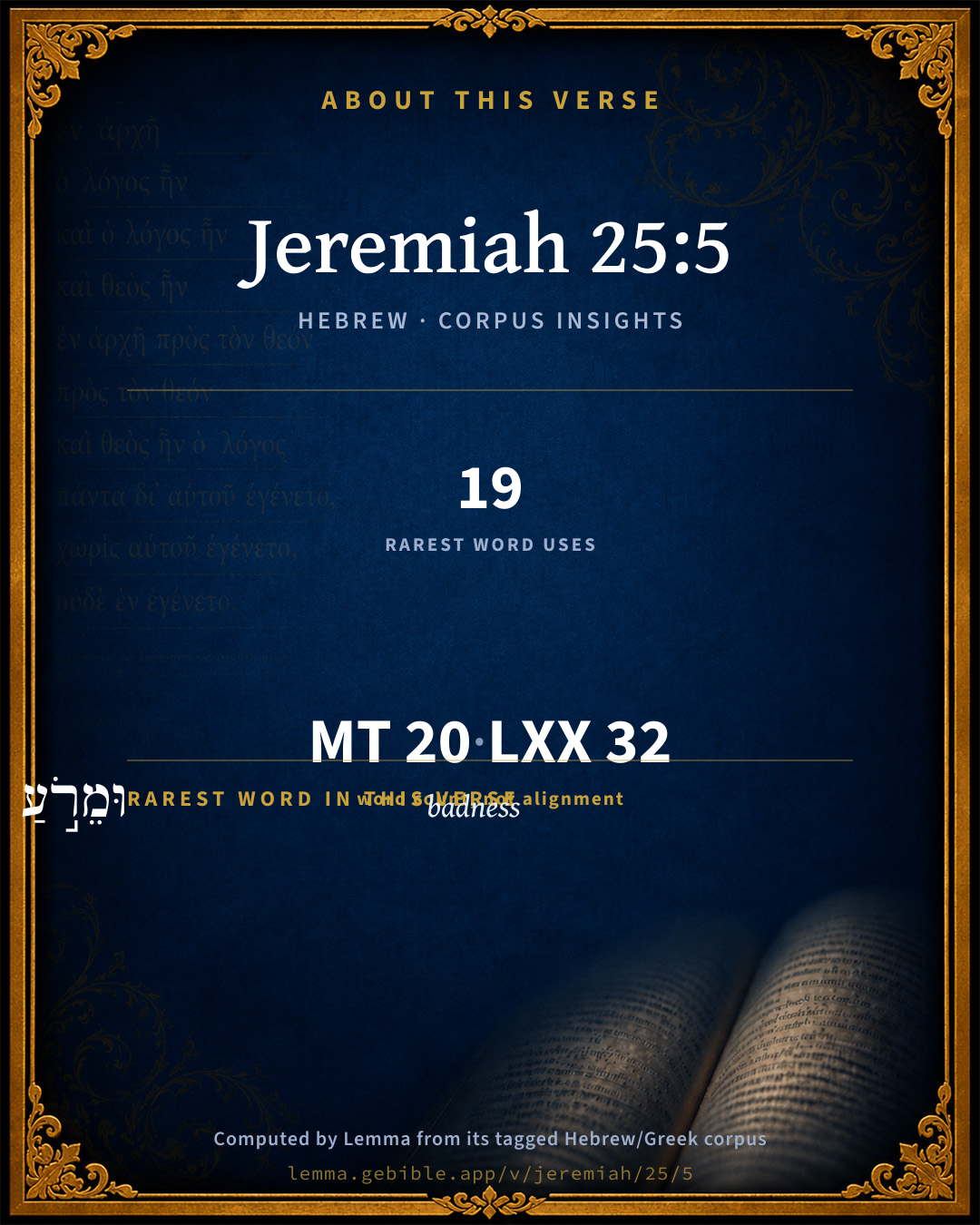
20
words
18
distinct lemmas
Prophets
section

Notable vocabulary

The rarest word here is וּמֵרֹ֣עַ badness H7455 — appearing just 19 times in the whole Hebrew Bible.

Shared distinctive vocabulary

וּמֵרֹ֣עַ badness H7455 occurs in 19 verses of the Hebrew Bible. Also found in:

Grammatical profile

  • 4 verbs
  • 9 nouns
  • 1 adjective
  • 4 prepositions
  • 2 particles

Verb forms

  • לֵאמֹ֗ר Qal · Infinitive Construct
  • שֽׁוּבוּ Qal · Imperative
  • וּשְׁבוּ֙ Qal · Imperative
  • נָתַ֧ן Qal · Perfect

Repetition

A word recurs within this verse — often emphatic in Hebrew:

  • עוֹלָ֖ם forever H5769 ×2

Hebrew & Septuagint length

In the original languages it is 20 Hebrew tokens and 32 Greek tokens — but the two are counted differently (Hebrew bundles its prefixes and suffixes into one token; the Greek is in lemma form), so that isn’t a like-for-like length.

Cross-references

16

Topical passages linked to Jeremiah 25:5 in the Treasury of Scripture Knowledge — connected by theme and wording, ordered by reader-vote popularity; previews shown in the World English Bible.

  • Jeremiah 7:7 then will I cause you to dwell in this place, in the land that I gave to your fathers, from of old even forevermore.
  • Genesis 17:8 I will give to you, and to your seed after you, the land where you are traveling, all the land of Canaan, for an everlasting possession. I will be their God."
  • Isaiah 55:6–7 Seek you Yahweh while he may be found; call you on him while he is near:
  • Jeremiah 17:25 then shall there enter in by the gates of this city kings and princes sitting on the throne of David, riding in chariots and on horses, they, and their princes, the men of Judah, and the inhabitants of Jerusalem; and this city shall remain forever.
  • Jeremiah 18:11 Now therefore, speak to the men of Judah, and to the inhabitants of Jerusalem, saying, Thus says Yahweh: Behold, I frame evil against you, and devise a device against you: return you now everyone from his evil way, and amend your ways and your doings.
  • Jeremiah 35:15 I have sent also to you all my servants the prophets, rising up early and sending them, saying, Return you now every man from his evil way, and amend your doings, and don't go after other gods to serve them, and you shall dwell in the land which I have given to you and to your fathers: but you have not inclined your ear, nor listened to me.
  • Ezekiel 18:30 Therefore I will judge you, house of Israel, everyone according to his ways, says the Lord Yahweh. Return you, and turn yourselves from all your transgressions; so iniquity shall not be your ruin.
  • Jonah 3:8–10 but let them be covered with sackcloth, both man and animal, and let them cry mightily to God. Yes, let them turn everyone from his evil way, and from the violence that is in his hands.
  • Zechariah 1:4–5 Don't you be like your fathers, to whom the former prophets proclaimed, saying: Thus says Yahweh of hosts, 'Return now from your evil ways, and from your evil doings;' but they did not hear, nor listen to me, says Yahweh.
  • 2 Kings 17:13–14 Yet Yahweh testified to Israel, and to Judah, by every prophet, and every seer, saying, Turn you from your evil ways, and keep my commandments and my statutes, according to all the law which I commanded your fathers, and which I sent to you by my servants the prophets.
  • Psalms 37:27 Depart from evil, and do good; Live securely forever.
  • Psalms 105:10–11 And confirmed the same to Jacob for a statute; To Israel for an everlasting covenant,
  • Ezekiel 33:11 Tell them, As I live, says the Lord Yahweh, I have no pleasure in the death of the wicked; but that the wicked turn from his way and live: turn you, turn you from your evil ways; for why will you die, house of Israel?
  • Luke 13:3–5 I tell you, no, but, unless you repent, you will all perish in the same way.
  • Acts 26:20 but declared first to them of Damascus, at Jerusalem, and throughout all the country of Judea, and also to the Gentiles, that they should repent and turn to God, doing works worthy of repentance.
  • James 4:8–10 Draw near to God, and he will draw near to you. Cleanse your hands, you sinners; and purify your hearts, you double-minded.

Cross-references courtesy of OpenBible.info (CC BY 4.0).

Hebrew and Greek witnesses Masoretic Hebrew ↔ Greek Septuagint

The same verse in the two great witnesses to the Old Testament, shown verse-for-verse.

These are two independent witnesses, not word-aligned to each other, and the Septuagint is shown in lemma (dictionary) form.

Hebrew Jeremiah 25:5 Masoretic · Westminster Leningrad Codex

לֵאמֹ֗ר שֽׁוּבוּ נָ֞א אִ֣ישׁ מִדַּרְכּ֤וֹ הָֽרָעָה֙ וּמֵרֹ֣עַ מַעַלְלֵיכֶ֔ם וּשְׁבוּ֙ עַל הָ֣אֲדָמָ֔ה אֲשֶׁ֨ר נָתַ֧ן יְהוָ֛ה לָכֶ֖ם וְלַאֲבֽוֹתֵיכֶ֑ם לְמִן עוֹלָ֖ם וְעַד עוֹלָֽם

saying, Return you now everyone from his evil way, and from the evil of your doings, and dwell in the land that Yahweh has given to you and to your fathers, from of old and even forevermore;

World English Bible · Public Domain

Greek LXX Structure differs

In the Septuagint, Jeremiah is about an eighth shorter than the Hebrew and arranges its material differently — the Oracles Against the Nations (Hebrew chapters 46–51) appear in the middle of the Greek book, after 25:13. Because the chapter and verse boundaries do not line up, a verse-for-verse comparison with the Hebrew is not shown.

A verse-for-verse comparison isn’t shown here because the chapters and verses don’t line up. Switch to the LXX edition with the MT / LXX toggle above to read the Greek directly.

Hebrew: Westminster Leningrad Codex (CC BY 4.0). Greek: Septuagint (public domain); English from a public-domain English Septuagint. How the Septuagint differs from the Hebrew →

Targum (Aramaic paraphrase)

1

The Targum is the ancient Jewish Aramaic paraphrase of the Hebrew Scriptures — an interpretive translation, not the Hebrew text itself. Onkelos (literal) and Pseudo-Jonathan (expansive) render the Torah, and Jonathan the Prophets. Coverage is partial: where no permissively-licensed English translation exists for a verse, only the Aramaic is shown. This is verse-level text, not a word-by-word alignment to the Hebrew.

  1. Targum Jonathan Prophets (Joshua–Malachi)
    לְמֵימָר תּוּבוּ כְעַן גְבַר מֵאוֹרְחֵיהּ בִּישְׁתָּא וּמִבִּישׁוּת עוֹבָדֵיכוֹן וְתִיבוּ עַל אַרְעָא דִיהַב יְיָ לְכוֹן וְלַאֲבָהַתְכוֹן לְמִן עַלְמָא וְעַד עַלְמָא:

    (no public-domain English translation for this verse)

    Targum Jonathan — Aramaic: “Mikraot Gedolot” (public domain). English: “Sefaria Community Translation” (CC0 1.0 (public-domain dedication)); “London "Chaldee Paraphrase," 1871” (public domain). Text via Sefaria.

Commentary

Notes on Jeremiah 25:5 from classic Christian and Jewish commentators (each source and its license shown beneath its notes). The classic Christian expositions comment on the surrounding passage and are grouped to its opening verse, so a note may address several verses; the Jewish commentaries on the Tanakh (Rashi and others) are per-verse, so they appear only where the commentator wrote on this verse.

Lemma curates 59 commentaries, every one of them public domain or Creative Commons licensed, each selected and text-cleaned for this edition rather than reprinted as found. About our sources →

Trapp's Complete Commentary

John Trapp

Jer 25:5 They said, Turn ye again now every one from his evil way, and from the evil of your doings, and dwell in the land that the LORD hath given unto you and to your fathers for ever and ever:

Ver. 5. They said, Turn ye again.] This was the sum of all the prophet’s sermons, as of the apostles’, "Repent ye and believe the gospel.," {Mar 1:15}

John Trapp, A Commentary or Exposition upon All the Books of the Old and New Testament (1647–1656) — public domain. Text from a community e-Sword module.

Tyndale Open Study Notes

Tyndale Open Resources

25:5-6 The Lord appealed to his people to turn from . . . the evil things they were doing that provoked his anger. Then he would not harm them, but instead pour out his covenant blessings.

Tyndale Open Study Notes — © Tyndale Open Resources, licensed CC BY-SA 4.0. Text via the HelloAO Bible API.

Geneva Bible (1599)

Geneva Bible translators

He showeth that the Prophets, wholly with one consent did labor to pull the people from those vices, which then reigned, to wit, from idolatry, and the vain confidence of men: for under these two all others were contained, 2 Kings 17:13; Jer. 18:11 and 35:15; Jonah 3:8.

Geneva Bible (1599) marginal notes — public domain. Text via Bolls.life.

Jamieson, Fausset & Brown

Robert Jamieson, A. R. Fausset & David Brown

Turn . . . dwell--In Hebrew there is expressed by sameness of sounds the correspondence between their turning to God and God's turning to them to permit them to dwell in their land: Shubu . . . shebu, "Return" . . . so shall ye "remain."

every one from . . . evil--Each must separately repent and turn from his own sin. None is excepted, lest they should think their guilt extenuated because the evil is general.

Jamieson, Fausset & Brown — Commentary Critical and Explanatory on the Whole Bible (1871) — public domain (CC PDM 1.0). Text via the HelloAO Bible API.

John Calvin's Commentaries

He afterwards explains what God required them to do, Turn ye, I pray, every one from his evil way and from the wickedness of your doings, and dwell in the land which Jehovah has given to you and your fathers from age even to age What God required was doubtless most just; for he demanded nothing from the Jews but to repent. There was also a promise added; God not only exhorted them to repent, but wished also to be reconciled to them, and having blotted out all memory of their sins, to shew them kindness: had they not been harder than stones, they must have been turned to his service by so kind a treatment. God might have indeed sharply reproved them, he might have threatened them, he might, in short, have cut off every hope of pardon; but he only required them to repent, and at the same time added a promise of free forgiveness. As then they had despised so great a favor, it follows that they must have been men of reprobate minds and of irreclaimable habits.

When they were bidden to repent of their evil way and of the wickedness of their doings, it was done for sake of amplifying; for the Prophet wished to take away from them every pretense for evasion, lest they should ask what was the wickedness or what was the evil way. He then intimates that they were fully proved guilty; and for this purpose he made the repetition. By way is designated a continued course of life; but as they had fully shewed themselves perverse in many ways, he refers to their fruits, as though he had said, that they in vain contended with God, by inquiring what had been their evil way, for their whole life sufficiently testified that they were wholly given to wickedness.

Now there is a striking alliteration in the verbs שבו and ושבו: the verb שבו, shebu, means sometimes to rebel, it means to return to the right way, and it means to rest or dwell in. He uses the same verb, though the sense is different when he says, “Return ye,” and “ye shall dwell.”

He also emphatically uses the word איש, aish “every one:” it means properly “man;” but it is taken in Hebrew for every one or each one, “each one from his evil way.” The Prophet exempted none, lest they thought that their fault was extenuated, had not the evil been universal. He hence says, that every one was given to wickedness; as though he had said, that impiety not only prevailed among the whole people, as the case commonly is, but that every one had become corrupt, so that there was not one sound or upright among the whole people.

And this is what ought to be observed; for we are wont, in a cold manner, to confess our sins, and to pray to God when we are proved guilty, except when each one is touched with the sense of his own guilt, and owns himself to be justly exposed to God’s judgment; for while every one mingles with the multitude, it so happens that no one acknowledges the heinousness of his own sins. Therefore, for true and sincere repentance this peculiar examination is necessary, so that every one may repent and not regard his friends.

When he says, Dwell ye in the land, though it be the imperative mood, yet it is a promise, by which God declared that he was ready to receive the Jews into favor, provided they returned from the heart to him: he proposed to them, as a symbol of his paternal layout, the possession of the land; for that land was as it were the pledge of their adoption; and the Jews, while they dwelt there, might have felt assured that God was their Father. He adds, From age even to age; as though he had said, “I am prepared to do you good not only for one day, or for a short time, but also to shew you kindness from age to age. It will then be your fault if ye be not happy, and if this happiness will not pass on from you to your children and grandchildren.” But the more delightful the invitation was, the more detestable became the impiety of the people, as it will be stated hereafter. He now adds, —

John Calvin's Commentaries (1540-1563) — public domain. Text from the Calvin Translation Society English edition (1840s-50s) via the Christian Classics Ethereal Library (ccel.org). Calvin's coverage is partial (roughly two-thirds of the Bible); uncommented books and verses are honest gaps, never fabricated. The 19th-century editor's footnotes and remarks are omitted so the notes are faithfully Calvin's own voice.

Ellicott's Commentary for English Readers

(5) Turn ye again now . . .—The sum and substance of the work of all true prophets has always been found, it need scarcely be said, in the call to repentance and conversion; but there is, perhaps, a special reference to the substance of their preaching as recorded in 2Ki_17:13. The words are interesting as showing that Jeremiah was probably seconded in his work by other prophets whose names have not come down to us.

A Bible Commentary for English Readers, edited by Charles John Ellicott (1878–1897) — public domain. Text from a community e-Sword module.

John Gill's Exposition

They said,.... The prophets: this was the substance of their discourses and prophecies, what follows:

turn ye again now everyone from his evil way, and from the evil of your doings; repent of sins, and reform from them; particularly their idolatries, to which they were prone, and are after mentioned:

and dwell in the land that the Lord hath given unto you to your fathers for ever and ever; that is, the land of Canaan, which was given to them, and their fathers before them, by the Lord, for an everlasting inheritance, provided they behaved towards him aright; for they held the possession of it by their obedience to his law; and now, notwithstanding all that they had done, or had been threatened with; yet, if they repented and reformed, they should still dwell in the land, and enjoy it, and all the blessings and privileges of it.

John Gill's Exposition of the Whole Bible (1746–1763) — public domain (CC PDM 1.0). Text via the HelloAO Bible API.

Albert Barnes' Notes on the Bible

Turn ye - i. e., Repent ye; the great summons of God to mankind at all times (Luk 24:47; Act 2:38; compare Mat 3:2).

Albert Barnes' Notes on the Bible (1834–1885) — public domain. Text from a community e-Sword/MySword module.

Matthew Poole's English Annotations

The substance both of their and my sermons hath been to persuade you to leave off those sinful courses wherein you have lived, and which you might have amended by virtue of that common grace which I did not deny you. We have not differed in our doctrine, to the practice of which you have also been encouraged both by them and me, with an assurance from God that if you did it, you should enjoy this good land, which the Lord promised and gave to you and your fathers, and you have now possessed from age to age.

Matthew Poole's English Annotations on the Holy Bible (1683–1685) — public domain. Text from a community e-Sword/MySword module.

The Pulpit Commentary

Vers. 5, 6. The chief purpose of prophecy.

Jeremiah here sums up the general purpose not only of his own mission extending now over twenty-three years but of that of the whole series of Hebrew prophets. We may thus see the one great aim towards which all their labors were directed.

I PROPHECY IS PRACTICAL. Jeremiah"s summary takes the form of an exhortation. The prophets were preachers, not philosophers. Their aim was not to satisfy curiosity but to affect conduct. In this they are an example to all preachers. The preacher"s duty is to lead men, not merely to teach doctrines. Still the exposition of truth is necessary to effect this end. The prophets did not content themselves with simple exhortations to good conduct. These exhortations needed the enforcement of clear conviction. Their authority was not magisterial (a mere command of superior power) nor priestly (an influence of spiritual rank erected on unquestioning faith), but reasonable (the authority of truth seen and felt). Hence their revelations of God and of the future. Yet these were all given for a practical end. The preacher should make his most abstract expositions of truth point towards some course of conduct.

II PROPHECY IS A CALL TO REPENTANCE. This urgent call rings through the messages of all the prophets. It was revived by John the Baptist, (Mat_3:2) adopted by our Lord (Mat_4:17) and his apostles, (e.g. St. Peter, Act_2:38; and St. Paul, Act_17:30) and by all great reformers, such as Savonarola, John Knox, John Wesley, etc.

1. Men must be preached to about their own condition as well as about God"s will. We want a Divine revelation that we may know ourselves just as much as that we may know God. A large part of the Bible is occupied with revelations of human nature.

2. Together with these revelations there comes the call to turn and change. The result of the exposure of mankind to itself is not satisfactory. This exposure alone is a call to turn from our evil ways. The mere exposure, however, is of little use. A Juvenal is not a Jeremiah. A satirist is not a prophet. There must be the call to a better life, and a declaration of the way to find it.

3. The prophets imply that men not only need to change but can change. The most fundamental change of heart must be through the influence of God. Yet this is only possible when men freely and willingly turn to him in repentance.

4. The special sin denounced was apostasy from God; the special repentance called for was a return to God. These are always the fundamental elements of sin and repentance.

III PROPHECY IS A VOICE OF WARNING AND OF PROMISE. Evil is denounced to the impenitent; good is promised to the penitent. This is the simplest form in which the motives to repentance can be put. But the tracing out of it is not simple. It required an inspired prophet to detect the seeds of ruin in riotous prosperity and the dawning of a day of redemption in the stormy night of adversity. The prophets not only detect these facts, they discern the principles that govern them. Thus they speak for all ages. They show us how sin is ruinous; how God has a sure blessedness in store for his faithful children a blessedness which is eternal.

The Pulpit Commentary (1880–1919), ed. H.D.M. Spence-Jones & Joseph S. Exell — public domain. Text from a community e-Sword module.

unfoldingWord translationNotes

Door43 World Missions Community

Let each man turn from his wicked way and the corruption of his practices

Jeremiah speaks of people who stop committing an action as if those people were turning away from that action. (See: Metaphor)

his wicked way and the corruption of his practices

The terms "wicked way" and "corruption of his practices" mean the same thing and refer to every sinful thing that they do. (See: Doublet)

the corruption of his practices

"his corrupt practices"

do not walk after other gods

Jeremiah speaks of a person being devoted to a god as if the person were walking behind the god. AT: "do not become devoted to other gods" (See: Metaphor)

do not provoke him with the work of your hands

The word "him" refers to Yahweh. Possible meanings for the phrase "the work of your hands" are 1) it is a reference to the idols that the people have made with their hands. AT: "do not provoke Yahweh with the idols that you have made" or 2) It is an idiom that refers to the actions of a person, with the word "hands" being a synecdoche that represents the person who does those actions. AT: "do not provoke Yahweh by the things that you do" (See: Assumed Knowledge and Implicit Information and Synecdoche and Idiom)

translationWords

turn

evil

gift

walk

false god

worship

bow

works

hand

unfoldingWord translationNotes — © Distant Shores Media and the Door43 World Missions Community, licensed CC BY-SA 4.0. Source: git.door43.org/Door43/en_tn.

Lesson kit

Teaching starters — assembled from the data on this page, not authored interpretation. Every prompt links to the verse data it draws on. Edit before teaching.

Jeremiah, in the Prophets, opens this verse with 20 words (18 distinct Hebrew lemmas). Its most distinctive word is rôaʻ (“badness”). A historical commentator’s framing appears above. Read the whole chapter for the surrounding context.

Discussion questions

  1. How does “badness” (rôaʻ) shape what this verse is saying?
  2. How does Genesis 41:19, which shares the word «badness», read alongside this verse?
  3. What does the repetition of “forever” (2× in this one verse) do in this verse?
  4. These translations render this verse differently. What is at stake in choosing one wording over another?
  5. «לֵאמֹ֗ר» is a Qal Infinitive Construct verb. How does that grammatical form shape the action described?
  6. Compare how Trapp's Complete Commentary and Tyndale Open Study Notes read this verse. Where do they agree or differ?

Things to notice

Reading settings

Reading text

Shown beneath each verse's original-language words.

Old Testament
Old Testament edition

Read the OT as the Masoretic Hebrew (MT) or the Greek Septuagint (LXX).

English shown for the Greek Septuagint (in the Hebrew ↔ Greek comparison).

Comparing translations? Open the Compare panel on any verse page to stack up to four side by side.