
Isaiah 14:1

Hebrew (Westminster Leningrad Codex) Isaiah 14:1 appears in the Hebrew Old Testament. The text above is from the Westminster Leningrad Codex. Each word links to its Strong’s number, a concise gloss, and parsing drawn from the Open Scriptures Hebrew Bible morphology. Click any word for its full Brown-Driver-Briggs (BDB) entry.
Download image
Cite this verse

Isaiah 14:1 (World English Bible). Public Domain. Lemma interlinear Bible study tool, https://lemma.gebible.app/v/isaiah/14/1.

Show BibTeX & RIS
BibTeX
RIS
English Translation
For Yahweh will have compassion on Jacob, and will yet choose Israel, and set them in their own land: and the foreigner shall join himself with them, and they shall cleave to the house of Jacob.
World English Bible · Public Domain
Download a study sheet

One document with this verse’s original text, its word-by-word gloss line, the meaning frame, cross-references with their text, attributed commentary, and full source and license credits — printable, and it pastes into notes with its structure intact.

This verse Autodidact and up

Study sheet (.html) Plain text (.txt)

A passage Seminary Student

Up to 50 verses in one chapter. A passage sheet keeps up to 6 commentary sources and 12 cross-references per verse, in the order this page ranks them, and says so on the sheet whenever that leaves anything out. Ask for a single verse and you get the Autodidact verse sheet above.

Everything on this page stays free to read, with no account — the sheet is a download of what is already on screen, not access to it.

Want to remove ads? Support Godless Engineer
Compare translations 3

The same verse in 3 English versions, stacked beneath the original-language interlinear above. Click any original word for its lexicon entry.

Each is an independent rendering of the whole verse — the interlinear is not word-aligned to these translations.

Highlighted words mark where these versions differ — a whole-verse word diff, not a word-by-word alignment.

  • World English Bible Public Domain
    For Yahweh will have compassion on Jacob, and will yet choose Israel, and set them in their own land: and the foreigner shall join himself with them, and they shall cleave to the house of Jacob.
  • King James Version Public Domain
    For the LORD will have mercy on Jacob, and will yet choose Israel, and set them in their own land: and the strangers shall be joined with them, and they shall cleave to the house of Jacob.
  • unfoldingWord Literal Text CC BY-SA 4.0
    For Yahweh will have compassion Jacob, and he will again choose Israel, and he will settle them on their land. And the sojourner will be joined to them, and they will attach themselves to the house of Jacob.

unfoldingWord Literal Text — © unfoldingWord, licensed CC BY-SA 4.0. Word-aligned USFM3 via Door43 (git.door43.org/unfoldingWord/en_ult).

Versions to compare (up to 4)

3 of 4 selected

Show all 18 translations

Every available English version of this verse, each an independent rendering of the whole verse.

  • World English Bible Public Domain
    For Yahweh will have compassion on Jacob, and will yet choose Israel, and set them in their own land: and the foreigner shall join himself with them, and they shall cleave to the house of Jacob.
  • Berean Standard Bible Public Domain
    For the LORD will have compassion on Jacob; once again He will choose Israel and settle them in their own land. The foreigner will join them and unite with the house of Jacob.
  • Majority Standard Bible Public Domain
    For the LORD will have compassion on Jacob; once again He will choose Israel and settle them in their own land. The foreigner will join them and unite with the house of Jacob.
  • King James Version Public Domain
    For the LORD will have mercy on Jacob, and will yet choose Israel, and set them in their own land: and the strangers shall be joined with them, and they shall cleave to the house of Jacob.
  • American Standard Version (1901) Public Domain
    For Jehovah will have compassion on Jacob, and will yet choose Israel, and set them in their own land: and the sojourner shall join himself with them, and they shall cleave to the house of Jacob.
  • Revised Version (1885) Public Domain
    For the LORD will have compassion on Jacob, and will yet choose Israel, and set them in their own land: and the stranger shall join himself with them, and they shall cleave to the house of Jacob.
  • Geneva Bible (1599) Public Domain
    For the Lord wil haue compassion of Iaakob, and wil yet chuse Israel, and cause them to rest in their owne lande: and the stranger shall ioyne him selfe vnto them, and they shall cleaue to the house of Iaakob.
  • Douay-Rheims (1899) Public Domain
    Her time is near at hand, and her days shall not be prolonged. For the Lord will have mercy on Jacob, and will yet choose out of Israel, and will make them rest upon their own ground: and the stranger shall be joined with them, and shall adhere to the house of Jacob.
  • Young's Literal Translation Public Domain
    Because Jehovah loveth Jacob, And hath fixed again on Israel, And given them rest on their own land, And joined hath been the sojourner to them, And they have been admitted to the house of Jacob.
  • Literal Standard Version CC BY-SA 4.0
    For YHWH loves Jacob, || And has fixed again on Israel, || And given them rest on their own land, || And the sojourner has been joined to them, || And they have been admitted to the house of Jacob.
  • Unlocked Literal Bible CC BY-SA 4.0
    Yahweh will have compassion on Jacob; he will again choose Israel and restore them into their own land. Foreigners will join with them and attach themselves to the house of Jacob.
  • unfoldingWord Literal Text CC BY-SA 4.0
    For Yahweh will have compassion Jacob, and he will again choose Israel, and he will settle them on their land. And the sojourner will be joined to them, and they will attach themselves to the house of Jacob.
  • Darby Bible Public Domain
    For Jehovah will have mercy on Jacob, and will yet choose Israel, and set them in rest in their own land; and the stranger shall be united to them, and they shall be joined to the house of Jacob.
  • World Messianic Bible Public Domain
    For the LORD will have compassion on Jacob, and will yet choose Israel, and set them in their own land. The foreigner will join himself with them, and they will unite with the house of Jacob.
  • Webster's Bible Public Domain
    For the LORD will have mercy on Jacob, and will yet choose Israel, and set them in their own land: and the strangers shall be joined with them, and they shall cleave to the house of Jacob.
  • Free Bible Version CC BY-SA 4.0
    But the Lord will be merciful to the descendants of Jacob. Once again he will choose Israel and he will bring them back to live once more in their own land. Foreigners will come and join them there, and they will unite with the descendants of Jacob.
  • Bible in Basic English Public Domain
    For the Lord will have mercy on Jacob, and will again make Israel his special people, and will put them in their land; and the man from a strange country will take his place among them and be joined to the family of Jacob.
  • JPS Tanakh (1917) Public Domain
    For the LORD will have compassion on Jacob, and will yet choose Israel, and set them in their own land; and the stranger shall join himself with them, and they shall cleave to the house of Jacob.

Literal Standard Version (2020), Covenant Press — licensed CC BY-SA 4.0. Text via the HelloAO Bible API (eBible.org). Unlocked Literal Bible (unfoldingWord) — licensed CC BY-SA 4.0. Text via the HelloAO Bible API (eBible.org). unfoldingWord Literal Text — © unfoldingWord, licensed CC BY-SA 4.0. Word-aligned USFM3 via Door43 (git.door43.org/unfoldingWord/en_ult). Free Bible Version, Dr. Jonathan Gallagher — licensed CC BY-SA 4.0. Text via the HelloAO Bible API (eBible.org).

Word by word

More ways to search: Search by grammar → Find every occurrence → Compare this word →

Practice this passage: Drill this verse → Learn its vocabulary →

וְנִסְפְּח֖וּ
çâphach
H5596
“and · to join”
Conjunction + Verb, Niphal, Sequential Perfect, 3rd Person, Common, Plural
Part of Speech
Conjunction + Verb
Stem
Niphal
Form
Sequential Perfect
Person
3rd Person
Gender
Common
Number
Plural
Full BDB Definition

Origin: a primitive root

TWOT: 1532 , 1534

to join, attach to, join together - (Qal) to join, attach to - (Niphal) to attach oneself - (Piel) joining (participle) - (Pual) to be joined together, hold oneself together - (Hithpael) to join oneself - (Piel) to cause a scab upon, smite with scab
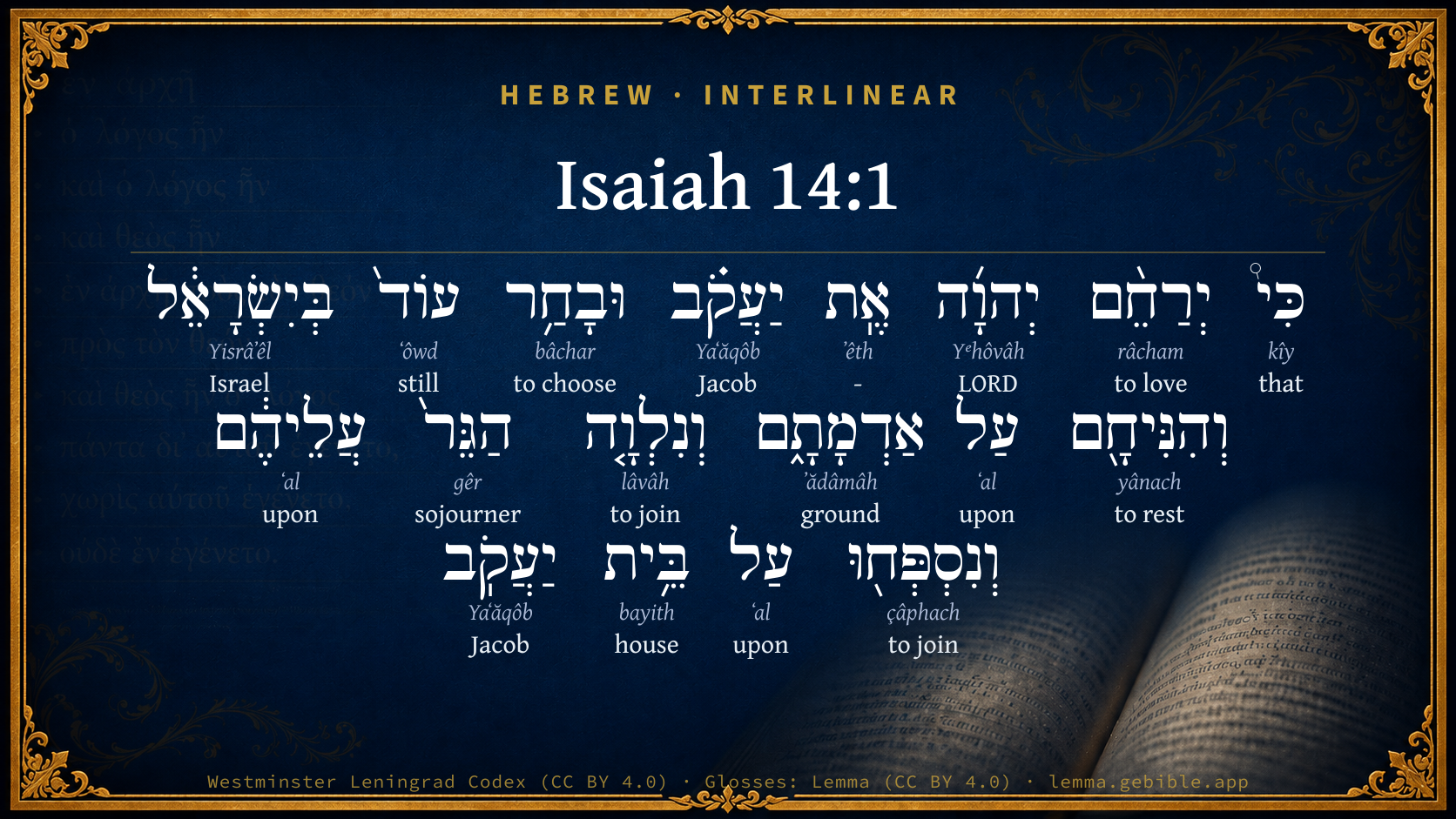
  1. כִּי֩ kîy H3588 “that” Conjunction
  2. יְרַחֵ֨ם râcham H7355 “to love” Verb, Piel, Imperfect, 3rd Person, Masculine, Singular
  3. יְהוָ֜ה Yᵉhôvâh H3068 “LORD” Noun, Proper
  4. אֶֽת ʼêth H853 “-” Particle, Direct Object
  5. יַעֲקֹ֗ב Yaʻăqôb H3290 “Jacob” Noun, Proper
  6. וּבָחַ֥ר bâchar H977 “and · to choose” Conjunction + Verb, Qal, Sequential Perfect, 3rd Person, Masculine, Singular
  7. עוֹד֙ ʻôwd H5750 “still” Adverb
  8. בְּיִשְׂרָאֵ֔ל Yisrâʼêl H3478 “in/at · Israel” Preposition + Noun, Proper
  9. וְהִנִּיחָ֖ם yânach H3240 “and · to rest · them” Conjunction + Verb, Hiphil, Sequential Perfect, 3rd Person, Masculine, Singular + Suffix, Personal, 3rd Person, Masculine, Plural
  10. עַל ʻal H5921 “upon” Preposition
  11. אַדְמָתָ֑ם ʼădâmâh H127 “ground · their” Noun, Common, Feminine, Singular, Construct + Suffix, Personal, 3rd Person, Masculine, Plural
  12. וְנִלְוָ֤ה lâvâh H3867 “and · to join” Conjunction + Verb, Niphal, Sequential Perfect, 3rd Person, Masculine, Singular
  13. הַגֵּר֙ gêr H1616 “the · sojourner” Particle, Definite Article + Noun, Common, Masculine, Singular, Absolute
  14. עֲלֵיהֶ֔ם ʻal H5921 “upon · them” Preposition + Suffix, Personal, 3rd Person, Masculine, Plural
  15. עַל ʻal H5921 “upon” Preposition
  16. בֵּ֥ית bayith H1004 “house of” Noun, Common, Masculine, Singular, Construct
  17. יַעֲקֹֽב Yaʻăqôb H3290 “Jacob” Noun, Proper

About this verse

These counts appear in no published source. They are computed here, from the morphology-tagged text and Lemma’s own curated glosses. What Lemma adds →

18
words
15
distinct lemmas
Prophets
section

Notable vocabulary

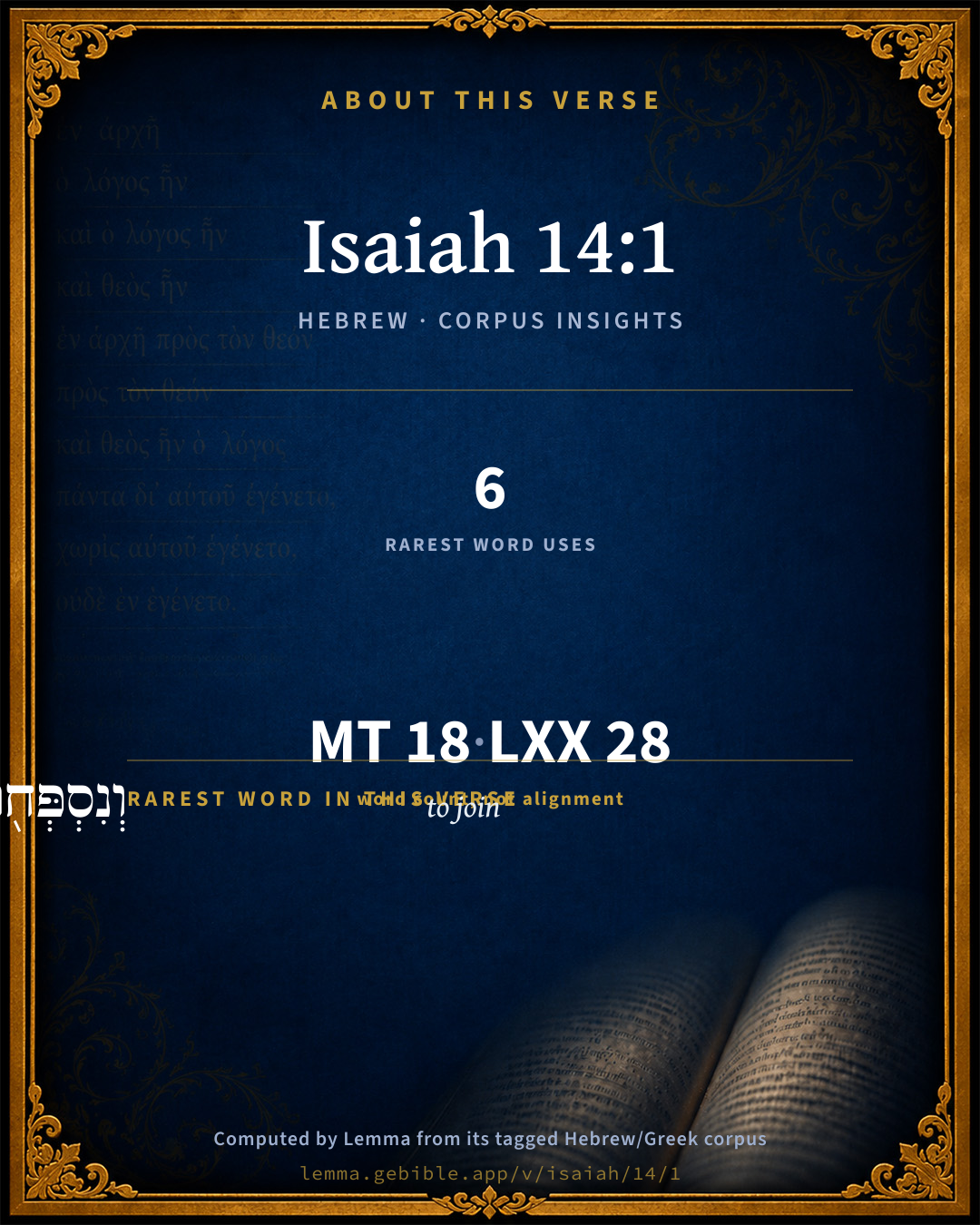
The rarest word here is וְנִסְפְּח֖וּ to join H5596 — appearing just 6 times in the whole Hebrew Bible.

Shared distinctive vocabulary

וְנִסְפְּח֖וּ to join H5596 occurs in 6 verses of the Hebrew Bible. Also found in:

Grammatical profile

  • 5 verbs
  • 7 nouns
  • 3 prepositions
  • 1 conjunction
  • 1 adverb
  • 1 particle

Verb forms

  • יְרַחֵ֨ם Piel · Imperfect
  • וּבָחַ֥ר Qal · Sequential Perfect
  • וְהִנִּיחָ֖ם Hiphil · Sequential Perfect
  • וְנִלְוָ֤ה Niphal · Sequential Perfect
  • וְנִסְפְּח֖וּ Niphal · Sequential Perfect

Repetition

Words recur within this verse — often emphatic in Hebrew:

  • עַל upon H5921 ×3
  • יַעֲקֹ֗ב Jacob H3290 ×2

Hebrew & Septuagint length

In English translation the verse runs 36 words from the Hebrew and 37 from the Septuagint (LXX English) — closely comparable.

A rough comparison of the two English renderings, which tokenize alike — not a word-level alignment.

Word counts can differ between the Hebrew and the Greek without any difference in meaning — e.g. the Hebrew direct-object marker אֵת has no separate Greek word, and Greek often adds the article ὁ.

In the original languages it is 18 Hebrew tokens and 28 Greek tokens — but the two are counted differently (Hebrew bundles its prefixes and suffixes into one token; the Greek is in lemma form), so that isn’t a like-for-like length.

Cross-references

45

Topical passages linked to Isaiah 14:1 in the Treasury of Scripture Knowledge — connected by theme and wording, ordered by reader-vote popularity; previews shown in the World English Bible.

  • Psalms 102:13 You will arise and have mercy on Zion; For it is time to have pity on her. Yes, the set time has come.
  • Zechariah 1:17 "Proclaim further, saying, 'Thus says Yahweh of Hosts: "My cities will again overflow with prosperity, and Yahweh will again comfort Zion, and will again choose Jerusalem."'"
  • Zechariah 8:22–23 Yes, many peoples and strong nations will come to seek Yahweh of Hosts in Jerusalem, and to entreat the favor of Yahweh."
  • Isaiah 54:7–8 For a small moment have I forsaken you; but with great mercies will I gather you.
  • Ephesians 2:12–19 that you were at that time separate from Christ, alienated from the commonwealth of Israel, and strangers from the covenants of the promise, having no hope and without God in the world.
  • Malachi 1:11 For from the rising of the sun even to the going down of the same, my name is great among the nations, and in every place incense will be offered to my name, and a pure offering: for my name is great among the nations," says Yahweh of Hosts.
  • Jeremiah 12:15–16 It shall happen, after that I have plucked them up, I will return and have compassion on them; and I will bring them again, every man to his heritage, and every man to his land.
  • Jeremiah 31:8–12 Behold, I will bring them from the north country, and gather them from the uttermost parts of the earth, [and] with them the blind and the lame, the woman with child and her who travails with child together: a great company shall they return here.
  • Jeremiah 32:37–41 Behold, I will gather them out of all the countries, where I have driven them in my anger, and in my wrath, and in great indignation; and I will bring them again to this place, and I will cause them to dwell safely:
  • Jeremiah 50:4–6 In those days, and in that time, says Yahweh, the children of Israel shall come, they and the children of Judah together; they shall go on their way weeping, and shall seek Yahweh their God.
  • Zechariah 2:11–12 Many nations shall join themselves to Yahweh in that day, and shall be my people; and I will dwell in the midst of you, and you shall know that Yahweh of Hosts has sent me to you.
  • Acts 15:14–17 Simeon has reported how God first visited the Gentiles, to take out of them a people for his name.
  • Leviticus 26:40–45 "'If they confess their iniquity, and the iniquity of their fathers, in their trespass which they trespassed against me, and also that, because they walked contrary to me,
  • Deuteronomy 4:29–31 But from there you shall seek Yahweh your God, and you shall find him, when you search after him with all your heart and with all your soul.
  • Deuteronomy 30:3–5 that then Yahweh your God will turn your captivity, and have compassion on you, and will return and gather you from all the peoples, where Yahweh your God has scattered you.
  • Ruth 1:14–18 They lifted up their voice, and wept again: and Orpah kissed her mother-in-law, but Ruth joined with her.
  • Isaiah 49:13 Sing, heavens; and be joyful, earth; and break forth into singing, mountains: for Yahweh has comforted his people, and will have compassion on his afflicted.
  • Jeremiah 24:6–7 For I will set my eyes on them for good, and I will bring them again to this land: and I will build them, and not pull them down; and I will plant them, and not pluck them up.
  • Jeremiah 30:18–22 Thus says Yahweh: Behold, I will turn again the captivity of Jacob's tents, and have compassion on his dwelling-places; and the city shall be built on its own hill, and the palace shall be inhabited after its own manner.
  • Jeremiah 50:33 Thus says Yahweh of hosts: The children of Israel and the children of Judah are oppressed together; and all who took them captive hold them fast; they refuse to let them go.
  • Ezekiel 39:25–29 Therefore thus says the Lord Yahweh: Now will I bring back the captivity of Jacob, and have mercy on the whole house of Israel; and I will be jealous for my holy name.
  • Luke 1:72–74 To show mercy towards our fathers, To remember his holy covenant,
  • Nehemiah 1:8–9 Remember, I beg you, the word that you commanded your servant Moses, saying, If you trespass, I will scatter you abroad among the peoples:
  • Esther 8:17 In every province, and in every city, wherever the king's commandment and his decree came, the Jews had gladness and joy, a feast and a good day. Many from among the peoples of the land became Jews; for the fear of the Jews was fallen on them.
  • Psalms 98:3 He has remembered his loving kindness and his faithfulness toward the house of Israel. All the ends of the earth have seen the salvation of our God.
  • Psalms 136:10–24 To him who struck down the Egyptian firstborn; For his loving kindness endures forever;
  • Psalms 143:12 In your loving kindness, cut off my enemies, And destroy all those who afflict my soul, For I am your servant.
  • Isaiah 19:24–25 In that day shall Israel be the third with Egypt and with Assyria, a blessing in the midst of the earth;
  • Isaiah 27:6 In days to come shall Jacob take root; Israel shall blossom and bud; and they shall fill the surface of the world with fruit.
  • Isaiah 40:1–2 Comfort you, comfort you my people, says your God.
  • Isaiah 41:8 But you, Israel, my servant, Jacob whom I have chosen, the seed of Abraham my friend,
  • Isaiah 44:1 Yet now hear, Jacob my servant, and Israel, who I have chosen:
  • Isaiah 44:21–22 Remember these things, Jacob, and Israel; for you are my servant: I have formed you; you are my servant: Israel, you shall not be forgotten by me.
  • Isaiah 49:7 Thus says Yahweh, the Redeemer of Israel, [and] his Holy One, to him whom man despises, to him whom the nation abhors, to a servant of rulers: Kings shall see and arise; princes, and they shall worship; because of Yahweh who is faithful, [even] the Holy One of Israel, who has chosen you.
  • Isaiah 49:16–23 Behold, I have engraved you on the palms of my hands; your walls are continually before me.
  • Isaiah 56:6–8 Also the foreigners who join themselves to Yahweh, to minister to him, and to love the name of Yahweh, to be his servants, everyone who keeps the Sabbath from profaning it, and holds fast my covenant;
  • Isaiah 60:3–5 Nations shall come to your light, and kings to the brightness of your rising.
  • Isaiah 66:20 They shall bring all your brothers out of all the nations for an offering to Yahweh, on horses, and in chariots, and in litters, and on mules, and on dromedaries, to my holy mountain Jerusalem, says Yahweh, as the children of Israel bring their offering in a clean vessel into the house of Yahweh.
  • Jeremiah 29:14 I will be found by you, says Yahweh, and I will turn again your captivity, and I will gather you from all the nations, and from all the places where I have driven you, says Yahweh; and I will bring you again to the place from where I caused you to be carried away captive.
  • Jeremiah 50:17–20 Israel is a hunted sheep; the lions have driven him away: first, the king of Assyria devoured him; and now at last Nebuchadrezzar king of Babylon has broken his bones.
  • Jeremiah 51:4–6 They shall fall down slain in the land of the Chaldeans, and thrust through in her streets.
  • Jeremiah 51:34–37 Nebuchadrezzar the king of Babylon has devoured me, he has crushed me, he has made me an empty vessel, he has, like a monster, swallowed me up, he has filled his maw with my delicacies; he has cast me out.
  • Ezekiel 36:24–28 For I will take you from among the nations, and gather you out of all the countries, and will bring you into your own land.
  • Luke 1:54 He has given help to Israel, his servant, that he might remember mercy,
  • Luke 2:32 A light for revelation to the Gentiles, And the glory of your people Israel."

Cross-references courtesy of OpenBible.info (CC BY 4.0).

Hebrew and Greek witnesses Masoretic Hebrew ↔ Greek Septuagint

The same verse in the two great witnesses to the Old Testament, shown verse-for-verse.

These are two independent witnesses, not word-aligned to each other, and the Septuagint is shown in lemma (dictionary) form.

Hebrew Isaiah 14:1 Masoretic · Westminster Leningrad Codex

כִּי֩ יְרַחֵ֨ם יְהוָ֜ה אֶֽת יַעֲקֹ֗ב וּבָחַ֥ר עוֹד֙ בְּיִשְׂרָאֵ֔ל וְהִנִּיחָ֖ם עַל אַדְמָתָ֑ם וְנִלְוָ֤ה הַגֵּר֙ עֲלֵיהֶ֔ם וְנִסְפְּח֖וּ עַל בֵּ֥ית יַעֲקֹֽב

For Yahweh will have compassion on Jacob, and will yet choose Israel, and set them in their own land: and the foreigner shall join himself with them, and they shall cleave to the house of Jacob.

World English Bible · Public Domain

Greek LXX Isaiah 14:1 Septuagint · lemma form

καί ἐλεέω κύριος ὁ ἰακώβ καί ἐκλέγω ἔτι ὁ ἰσραήλ καί ἀναπαύω ἐπί ὁ γῆ αὐτός καί ὁ γειώρας προςτίθημι πρός αὐτός καί προςτίθημι πρός ὁ οἶκος ἰακώβ

And the Lord will have mercy on Jacob, and will yet choose Israel, and they shall rest on their land: and the stranger shall be added to them, yes, shall be added to the house of Jacob.

LXX2012 (modern English Septuagint) · Public Domain

Hebrew: Westminster Leningrad Codex (CC BY 4.0). Greek: Septuagint (public domain); English from LXX2012 (modern English Septuagint) (Public Domain). How the Septuagint differs from the Hebrew →

Targum (Aramaic paraphrase)

1

The Targum is the ancient Jewish Aramaic paraphrase of the Hebrew Scriptures — an interpretive translation, not the Hebrew text itself. Onkelos (literal) and Pseudo-Jonathan (expansive) render the Torah, and Jonathan the Prophets. Coverage is partial: where no permissively-licensed English translation exists for a verse, only the Aramaic is shown. This is verse-level text, not a word-by-word alignment to the Hebrew.

  1. Targum Jonathan Prophets (Joshua–Malachi)
    אֲרֵי יְרַחֵם יְיָ עַל דְבֵית יַעֲקֹב וְיִתְרְעֵי עוֹד בְּיִשְׂרָאֵל וְיִשְׁרִינוּן עַל אַרְעֲהוֹן וְיִתּוֹסְפוּן גִיוֹרִין עֲלֵיהוֹן וְיִסְתַּמְכוּן עַל בֵּית יַעֲקֹב:

    For the Lord will have compassion upon the house of Jacob, and will delight again in Israel, and shall make them to dwell in their land; and proselytes shall be joined unto them, and they shall be united unto the house of Jacob.

    Targum Jonathan — Aramaic: “Mikraot Gedolot” (public domain). English: “Sefaria Community Translation” (CC0 1.0 (public-domain dedication)); “London "Chaldee Paraphrase," 1871” (public domain). Text via Sefaria.

Commentary

Notes on Isaiah 14:1 from classic Christian and Jewish commentators (each source and its license shown beneath its notes). The classic Christian expositions comment on the surrounding passage and are grouped to its opening verse, so a note may address several verses; the Jewish commentaries on the Tanakh (Rashi and others) are per-verse, so they appear only where the commentator wrote on this verse.

Lemma curates 59 commentaries, every one of them public domain or Creative Commons licensed, each selected and text-cleaned for this edition rather than reprinted as found. About our sources →

Matthew Henry's Commentary

This comes in here as the reason why Babylon must be overthrown and ruined, because God has mercy in store for his people, and therefore, 1. The injuries done to them must be reckoned for and revenged upon their persecutors. Mercy to Jacob will be wrath and ruin to Jacob's impenitent implacable adversaries, such as Babylon was. 2. The yoke of oppression which Babylon had long laid on their necks must be broken off, and they must be set at liberty; and, in order to this, the destruction of Babylon is as necessary as the destruction of Egypt and Pharaoh was to their deliverance out of that house of bondage. The same prediction is a promise to God's people and a threatening to their enemies, as the same providence has a bright side towards Israel and a black or dark side towards the Egyptians. Observe,

I. The ground of these favours to Jacob and Israel - the kindness God had for them and the choice he had made of them (Isa 14:1): "The Lord will have mercy on Jacob, the seed of Jacob now captives in Babylon; he will make it to appear that he has compassion on them and has mercy in store for them, and that he will not contend for ever with them, but will yet choose them, will yet again return to them; though he has seemed for a time to refuse and reject them, he will show that they are his chosen people and that the election stands sure." However it may seem to us, God's mercy is not gone, nor does his promise fail, Psa 77:8.

II. The particular favours he designed them. 1. He would bring them back to their native soil and air again: The Lord will set them in their own land, out of which they were driven. A settlement in the holy land, the land of promise, is a fruit of God's mercy, distinguishing mercy. 2. Many should be proselyted to their holy religion, and should return with them, induced to do so by the manifest tokens of God's favourable presence with them, the operations of God's grace in them, the operations of God's grace in them, and his providence for them: Strangers shall be joined with them, saying, We will go with you, for we have heard that God is with you, Zac 8:23. It adds much to the honour and strength of Israel when strangers are joined with them and there are added to the church many from without, Act 2:47. Let not the church's children be shy of strangers, but receive those whom God receives, and own those who cleave to the house of Jacob. 3. These proselytes should not only be a credit to their cause, but very helpful and serviceable to them in their return home: The people among whom they live shall take them, take care of them, take pity on them, and shall bring them to their place - as friends, loth to part with such good company - as servants, willing to do them all the good offices they could. God's people, wherever their lot is cast, should endeavour thus, by all the instances of an exemplary and winning conversation, to gain an interest in the affections of those about them, and recommend religion to their good opinion. This was fulfilled in the return of the captives from Babylon, when all that were about them, pursuant to Cyrus's proclamation, contributed to their removal (Ezr 1:4, Ezr 1:6), not as the Egyptians, because they were sick of them, but because they loved them. 4. They should have the benefit of their service when they had returned home, for many would of choice go with them in the meanest post, rather than not go with them: They shall possess them in the land of the Lord for servants and handmaids; and as the laws of that land saved it from being the purgatory of servants, providing that they should not be oppressed, so the advantages of that land made it the paradise of those servants that had been strangers to the covenants of promise, for there was one law to the stranger and to those that were born in the land. Those whose lot is cast in the land of the Lord, a land of light, should take care that their servants and handmaids may share in the benefit of it, who will then find it better to be possessed in the Lord's land than possessors in any other. 5. They should triumph over their enemies, and those that would not be reconciled to them should be reduced and humbled by them: They shall take those captives whose captives they were and shall rule over their oppressors, righteously, but not revengefully. The Jews perhaps bought Babylonian prisoners out of the hands of the Medes and Persians and made slaves of them. Or this might have its accomplishment in their victories over their enemies in the times of the Maccabees. It is applicable to the success of the gospel (when those were brought into obedience to it who had made the greatest opposition to it, as Paul) and to the interest believers have in Christ's victories over their spiritual enemies, when he led captivity captive, to the power they gain over their own corruptions, and to the dominion the upright shall have in the morning, Psa 49:14. 6. They should see a happy termination of all their grievances (Isa 14:3): The Lord shall give thee rest from thy sorrow and thy fear, and from thy hard bondage. God himself undertakes to work a blessed change, (1.) In their state. They shall have rest from their bondage; the days of their affliction, though many, shall have an end; and the rod of the wicked, though it lie long, shall not always lie on their lot. (2.) In their spirit. They shall have rest from their sorrow and fear, sense of their present burdens and dread of worse. Sometimes fear puts the soul into a ferment as much as sorrow does, and those must needs feel themselves very easy to whom God has given rest from both. Those who are freed from the bondage of sin have a foundation laid for true rest from sorrow and fear.

Matthew Henry's Commentary on the Whole Bible (1708–1710) — public domain (CC PDM 1.0). Text via the HelloAO Bible API.

Trapp's Complete Commentary

John Trapp

Isa 14:1 For the LORD will have mercy on Jacob, and will yet choose Israel, and set them in their own land: and the strangers shall be joined with them, and they shall cleave to the house of Jacob.

Ver. 1. For the Lord will have mercy upon Jacob.] And therefore destroy Babylon. {as Isa 13:1-22} Such is his love to his Church that for her sake, and in revenge of her wrongs, he will fall foul upon her enemies. Si in Hierosolymis fiat scrutinium, quanto magis in Babylon. {a}

And the strangers shall be joined with them.] Proselyted, especially when made partakers of the grace of the gospel.

{a} Bernard.

John Trapp, A Commentary or Exposition upon All the Books of the Old and New Testament (1647–1656) — public domain. Text from a community e-Sword module.

The Biblical Illustrator

Joseph S. Exell

Isa_14:1

For the Lord will have mercy on Jacob

Gods mercy and Israels converts

I.

THE PRINCIPLE OF GODS MORAL GOVERNMENT--Mercy. This people had grievously sinned.

1. They had sinned against light. The direct revelation of heaven had been given to them as a nation

2. They rebelled amid privileges. The Mighty God interfered to protect them from their foes.

3. They had sinned in spite of rebukes and punishments. The rebellious people had been carried captive into a heathen nation.

II. THE CONSTANCY OF DIVINE PURPOSES--I will yet choose, etc. Notwithstanding all their rebellion I will yet have mercy on them. Nothing can separate from the love of God.

III. THE RESTORATIVE BLESSEDNESS OF RELIGION. When God takes a man in hand, He restores him. In paradise he was the image and associate of God. Salvation will make him nothing more. Heaven will contain additional elements of joy, but the man will be restored.

IV. THE CONTAGION OF ENTHUSIASM. When the Jews should return, many of the heathen, leaving their own country and their idols, would return along with them. And the strangers shall be joined with them. This was part of Gods design in the Captivity. It was not only to punish His people for their sin, but also to render them a blessing to others. God often appoints the afflictions of His people for His own glory, and we must not mourn but rejoice if we are counted worthy of forwarding His cause.

V. THE ATTRACTIVENESS OF RELIGION. It commands affection and regard. It is our duty to render it attractive so as to win others. (Homilist.)

Gods passion to Israel

We have here in nuce the comforting substance of chaps. 40-46. Babylon falls in order that Israel may rise. (F. Delitzsch, D. D.)

The Biblical Illustrator, edited by Joseph S. Exell (c. 1880s–1900s) — public domain. Text from a community e-Sword module.

Joseph Benson's Commentary

Isa 14:1. For the Lord will have mercy on Jacob — Will pity and deliver his people; and therefore will destroy Babylon. which hinders their deliverance, and will raise up and exalt Cyrus, who shall promote it; and he will not prolong the time, but do these things speedily, as the prophet had just affirmed. For he is continuing his discourse concerning Babylon, and assigning the reason, not only of its fall, but of the speedy approach of that fall, as predicted in the last clause of the preceding chapter. It was not to be delayed, because the deliverance of the church of God depended upon it. And will yet choose Israel — Will renew his choice of them, for he had appeared to reject and cast them off: or he will still regard them as his chosen people, however he may seem to desert them by giving them up to their enemies, and scattering them among the nations. Israel is put for Judah, as it frequently is. Israel being the name which God gave to Jacob, as a mark of his favour, it is chiefly made use of by the prophets when they deliver some gracious promise, or announce some blessing from the mouth of God, especially such a one as concerns the twelve tribes, all equally descended from Jacob, as this prophecy, in its ultimate sense, undoubtedly does. And the strangers shall be joined to them — It is probable that many strangers were made proselytes to the Jewish religion during their captivity, who were willing to go along with them into Judea, there to enjoy the free exercise of their religion. And others, who had not been proselytes before, might be induced to become such, and unite themselves to them, either through the favour shown to the Jews in the Persian court, or by consideration of their wonderful deliverance taking place exactly at the time foretold by the prophets. But what was then begun was more fully accomplished at the coming of the Messiah.

Joseph Benson's Commentary on the Old and New Testaments (1811–1818) — public domain. Text from a community e-Sword module.

Lange's Commentary on the Holy Scriptures

2. THE DELIVERANCE OF ISRAEL

Isa_14:1-2

1          For the Lord will have mercy on Jacob,

And will yet choose Israel,

And set them in their own land:

And the strangers shall be joined with them,

And they shall cleave to the house of Jacob.

2     And 1the people shall take them, and bring them to their place:

And the house of Israel shall possess them in the land of the Lord

For servants and handmaids:

And 2they shall take them captives, 3whose captives they were;

And they shall rule over their oppressors.

GRAMMATICAL AND CRITICAL

Isa_14:1. הִנִּיחַ. comp. Isa_28:2; Isa_46:7. נלוה as to sense and construction like Isa_56:3; Isa_56:6, where alone the word occurs again in this sense.—Niph. נספח only here. Comp. Hithp. 1Sa_26:19 and on Isa_37:30.

Isa_14:2. Hithp. התנחל in Isa. only here.—The accusative depends on the transitive notion that is latent in the reflexive form. Comp. Num_33:54 and often. The expression אדמת י׳ occurs only here. But comp. Isa_14:25; Joe_1:6; 4:2; Jer_2:7, etc.—שׁבים. Comp. 1Ki_8:46-50.—רָדָה in Isa. only here, Isa_14:6; Isa_41:2 (Hiph.).—נֹגְשִׂים. Comp. Isa_3:12; Isa_9:3; Isa_60:17.

EXEGETICAL AND CRITICAL

1. The reason for the destruction of Babylon described in Isa_13:14-22 is here indicated by the Prophet to be the intention of Jehovah to have mercy again on His people, and bring them back into their land. That shall take place by the glad consent and even active co-operation of the heathen nations. These will join themselves to Israel—in fact lead Israel into their own land (Isa_14:1). Israel will then have them for servants and maids, and will hold those in prison who before devoted them to such a fate (Isa_14:2).

2. For the Lord—their oppressors.

Isa_14:1-2. Though Israel’s deliverance is not the sole motive of the Lord in destroying Babylon, it is yet a chief motive. Isaiah in the second part, and Jeremiah in the denunciations of judgments (Jeremiah 50, 51) that connect so closely with the present and the later prophecies of Isaiah on this subject, frequently declare that Babylon’s fall is to be Israel’s deliverance (e.g., Jer_50:4 sqq., Jer_50:8 sqq., Jer_50:28; Jer_51:6, Jer_50:36 sqq., Jer_50:45 sqq.). The adhesion of strangers, who would be witnesses of the mighty deeds of Jehovah in judging and delivering, is a trait that the second return from bondage will have in common with the first (Exo_12:19; Exo_12:38; Num_11:4, etc.). And the people shall take them, etc.—It is more exactly explained that this adhesion of strangers will not be to seek protection, but to form an honorable and serviceable attendance as friends and admirers. This is a thought that often recurs in the second part of Isa_44:5; Isa_49:22 sq.; Isa_55:5; Isa_60:4-9 sq., This notion that strangers should amicably attend Israel and then be enslaved for it occasions offence. But the heathen will only display this friendliness constrained thereto by the mighty deeds of Jehovah. And even if the Old Testament knows of a conversion of the heathen to Jehovah (Hos_2:23; Isa_65:1; comp. Rom_9:24 sqq.; Isa_10:18 sqq.)—yet, from the Old Testament view-point, there remains ever such a chasm between Israel and even the converted heathen that for the latter no other position was conceivable than that of those strangers who went along to Canaan out of Egypt or the desert, or of the Canaanites that remained (1Ki_9:20 sq). This is a consequence of that fleshly consciousness of nobility of which Israel was full. Only by Christ could that chasm be bridged over, in whom there is neither circumcision nor uncircumcision (Gal_5:6; Gal_3:28; Rom_10:12). [“The simple meaning of this promise seems to be that the church or chosen people and the other nations should change places, the oppressed becoming the oppressor, and the slave the master. This of course admits both an external and internal fulfilment. In a lower sense and on a smaller scale it was accomplished in the restoration of the Jews from exile; but its full accomplishment is yet to come, not with respect to the Jews as a people, for their pre-eminence has ceased forever, but with respect to the church, including Jews and Gentiles, which has succeeded to the rights and privileges, promises and actual possessions of God’s ancient people. The true principle of exposition is adopted even by the Rabbins. Jarchi refers the promise to the future, to the period of complete redemption. Kimchi more explicitly declares that its fulfilment is to be sought partly in the restoration from Babylon, and partly in the days of the Messiah.” J. A. Alex.in loc.]

Footnotes:

[1]Or, nations.

[2]Or, they shall be captors of their captors.

[3]Heb. that had taken them captives.

Lange's Commentary on the Holy Scriptures (Critical, Doctrinal, and Homiletical), ed. John Peter Lange, English translation edited by Philip Schaff (1864–1880) — public domain. Text from a community e-Sword module.

The Annotated Bible

Arno C. Gaebelein

CHAPTER 14

Israel’s Restoration and Blessing After Babylon is Fallen and the Burden of Philistia

1. Israel’s restoration and exaltation (Isa 14:1-2) 2. The proverb against the king of Babylon (Isa 14:3-11) 3. The triumph over Lucifer (Satan) (Isa 14:12-20) 4. Babylon’s destruction (Isa 14:21-23) 5. The Assyrian broken (Isa 14:24-27) 6. The burden of Philistia (Isa 14:28-32)When the last great Babylon is overthrown the Lord will remember His people and Jerusalem in mercy. He will then set His people in rest in their own land. The king of Babylon here in this chapter is not Nebuchadnezzar, nor his grandson Belshazzar, but the final great king of Babylon. It is the little horn of Dan 7:1-28, the great political head of the restored Roman Empire. Behind this final king of the times of the Gentiles looms up Satan, who energized that wicked and false king. The description of him who was “Lucifer,” the light-bearer, and his fall is of deep interest.

Arno C. Gaebelein, The Annotated Bible (1913–1922) — public domain. Text from a community e-Sword module.

Tyndale Open Study Notes

Tyndale Open Resources

14:1-2 This message for Israel separates two prophecies of judgment against Babylon (ch 13; 14:3-23).

14:1 The Hebrew word here translated mercy draws from the imagery of a woman’s maternal care for her child to illustrate God’s merciful love for his people (see also 49:15; 66:13). • God had initially chosen Israel as his special people when he called Abraham (see 41:8; Gen 12:1-3). Although their status did not change during the Exile, they faced God’s wrath like any other wicked nation because they had rejected him. • settle once again in their own land: This promise began to be fulfilled in 538 BC (see Ezra 1:1-11). • People from many different nations would join Israel as the people of God (see also Isa 2:3-4; 11:11-12; 19:18-25; 60:1-14).

Tyndale Open Study Notes — © Tyndale Open Resources, licensed CC BY-SA 4.0. Text via the HelloAO Bible API.

Geneva Bible (1599)

Geneva Bible translators

Meaning, that the Gentiles shalt be joined with the Church, and worship God.

He showeth why God will haste to destroy his enemies, to wit, because he will deliver his Church.

Geneva Bible (1599) marginal notes — public domain. Text via Bolls.life.

Adam Clarke's Commentary

CHAPTER XIV

Deliverance of Israel from captivity, which shall follow the

downfall of the great Babylonish empire, 1, 2.

Triumphant ode or song of the children of Jacob, for the signal

manifestation of Divine vengeance against their oppressors,

3-23.

Prophecy against the Assyrians, 24, 25.

Certainty of the prophecy, and immutability of the Divine

counsels, 26, 27.

Palestine severely threatened, 28-31.

God shall establish Zion in these troublous times, 32.

NOTES ON CHAP. XIV

Verse 1. And will yet choose Israel.] That is, will still regard Israel as his chosen people; however he may seem to desert them, by giving them up to their enemies, and scattering them among the nations. Judah is sometimes called Israel; see Eze 13:16; Mal 1:1; Mal 2:11: but the name of Jacob and of Israel, used apparently with design in this place, each of which names includes the twelve tribes, and the other circumstances mentioned in this and the next verse, which did not in any complete sense accompany the return from the captivity of Babylon, seem to intimate that this whole prophecy extends its views beyond that event.

Adam Clarke's Commentary on the Bible (1810–1826) — public domain. Text from a community e-Sword/MySword module.

Ellicott's Commentary for English Readers

XIV.

(1) For the Lord will have mercy on Jacob . . .—The words imply a prevision of the return of the Israelites from exile, and therefore of the exile itself. The downfall of Babylon was certain, because without it the mercy of the Lord to Israel could not be manifested. The whole section is an anticipation of the great argument of Isaiah 40-66, and the question of its authorship stands or falls on the same grounds.

The strangers shall be joined with them . . .—The thought is one specially characteristic of the later prophecies of Isaiah (Isa_44:5; Isa_55:5; Isa_56:3-6), but is prominent in the earlier also (Isa_2:2). In later Hebrew the same words came to be applied to the proselytes who are conspicuous in the apostolic age (Act_2:10; Act_6:5), and in them, as before in the adhesion and support of the Persian kings and satraps, and as afterwards in the admission of the Gentiles into the kingdom of the Christ, we may trace successive fulfilments of the prophet’s words.

A Bible Commentary for English Readers, edited by Charles John Ellicott (1878–1897) — public domain. Text from a community e-Sword module.

The Cambridge Bible for Schools and Colleges

gen. ed. J. J. S. Perowne

1. The immediate result of the judgment on Babylon will be the emancipation of Israel from captivity.

will yet choose Israel] Rather, will again choose, as formerly in Egypt (cf. Zec_2:12).

the strangers] the sojourner, or protected guest; here used, as in later Hebrew, with the sense of “proselyte”: ch. Isa_56:3-7; Zec_2:11; Zec_8:21-23.

The Cambridge Bible for Schools and Colleges (gen. ed. J. J. S. Perowne; Cambridge University Press, 1878–1918) — public domain. Text from a community e-Sword module.

John Gill's Exposition

For the Lord will have mercy on Jacob, will yet choose Israel,.... While the Jews were in captivity, the Lord seemed to have no pity for them, or compassion on them, and it looked as if he had rejected them, and wholly cast them off; but by delivering them from thence, he showed that he had a merciful regard unto them, and made it to appear that they were his chosen people, and beloved by him: and this is a reason why Babylon should be destroyed, and her destruction be no longer deferred, because the Lord's heart of compassion yearned towards his own people, so that his mercy to them brought ruin upon others: a choice of persons to everlasting salvation, though it is not made in time, but before the foundation of the world, yet is made to appear by the effectual calling, which therefore is sometimes expressed by choosing, Co1 1:26 and is the fruit and effect of sovereign grace and mercy, and may be intended here; the words may be rendered, "and will yet choose in Israel" (t), some from among them; that is, have mercy on them, and call them by his grace, and so show them to be a remnant, according to the election of grace; and such a chosen remnant there was among them in the times of Christ, and his apostles, by which it appeared that the Lord had not cast off the people whom he foreknew:

and set them in their own land: or "cause them to rest upon their own land" (u); for the word not only denotes settlement and continuance, but rest, which they had not in Babylon; but now should have, when brought into their own land; and no doubt but reference is had to the original character of the land of Canaan, as a land of rest; and hither shall the Jews be brought again, and be settled when mystical Babylon is destroyed:

and the stranger shall be joined with them, and they shall cleave to the house of Jacob; by which is meant, that proselytes should be made to the Jewish religion, who should be admitted into their church state, as well as into their commonwealth, and should abide faithful to the profession they made; which doubtless was fulfilled in part at the time of the Jews' return from the Babylonish captivity, when many, who had embraced their religion, cleaved to them, and would not leave them, but went along with them into their land, that they might join with them in religious worship there; but had a greater accomplishment in Gospel times, when Gentiles were incorporated into the same Gospel church state with the believing Jews, and became fellow heirs, and of the same body, and partakers of the same promises and privileges; and so Kimchi and Ben Melech apply this to the times of the Messiah; and Jarchi to time to come, when Israel should be redeemed with a perfect redemption: because from the word translated "cleave" is derived another, which signifies a scab; hence the Jews (w) have a saying,

"proselytes are grievous to Israel as a scab.''

(t) "et eliget adhuc in Israele", Pagninus, Montanus. (u) "et requiescere eos faciet", V. L. Pagninus, Montanus. (w) T. Bab. Yebamot, fol. 47. 2. & Kiddushin, fol. 70. 2.

John Gill's Exposition of the Whole Bible (1746–1763) — public domain (CC PDM 1.0). Text via the HelloAO Bible API.

Albert Barnes' Notes on the Bible

For the Lord will have mercy on Jacob - That is, he will pity the captive Jews in Babylon. He will not abandon them, but will remember them, and restore them to their own land.

And will yet choose Israel - Will show that he regards them as still his chosen people; or will again “choose” them by recovering them from their bondage, and by restoring them to their country as his people. The names ‘Jacob’ and ‘Israel’ here simply denote the Jews. They do not imply that all of those who were to be carried captive would return, but that as a people they would be restored.

And set them ... - Hebrew, ‘Will cause them to rest in their own country;’ that is, will give them peace, quietness, and security there.

And the stranger shall be joined to them - The ‘stranger,’ here, probably refers to those foreigners who would become proselytes to their religion, while they were in Babylon. Those proselytes would be firmly united with them, and would return with them to their own land. Their captivity would be attended with this advantage, that many even of those who led them away, would be brought to embrace their religion, and to return with them to their own country. If it is asked what “evidence” there is that any considerable number of the people of Chaldea became Jewish proselytes, I answer, that it is expressly stated in Est 8:17 : ‘And many of the people of the land became Jews, for the fear of the Jews fell upon them. Ezra, indeed, has not mentioned the fact, that many of the people of Babylonia became proselytes to the religion of the Jews, but it is in accordance with all that we know of their history, and their influence on the nations with which, from time to time, they were connected, that many should have been thus joined to them. We know that in subsequent times many of other nations became proselytes, and that multitudes of the Egyptians, the Macedonians, the Romans, and the inhabitants of Asia Minor, embraced the Jewish religion, or became what were called ‘proselytes of the gate.’ They were circumcised, and were regarded as entitled to a part of the privileges of the Jewish people (see Act 2:9-11; compare Act 17:4, Act 17:17). Tacitus, speaking of his time, says, that every abandoned man, despising the religion of his country, bears tribute and revenue to Jerusalem, whence it happens that the number of the Jews is greatly increased.’ - (“Hist.” v. 5.) That the Jews, therefore, who were in Babylon should induce many of the Chaldeans during their long captivity to become proselytes, is in accordance with all their history.

Albert Barnes' Notes on the Bible (1834–1885) — public domain. Text from a community e-Sword/MySword module.

Haydock's Catholic Bible Commentary

Prolonged. Babylon was taken one hundred and seventy-two years after. (Calmet) --- Yet this time is counted short, compared with the monarchy, which had lasted a thousand years. (Worthington) --- Ground. Cyrus restored the Jews; yet all did not return at that time. --- Stranger. Converts, Esther viii. 17. All Idumea received circumcision under Hyrcan.

George Leo Haydock (1774–1849), Haydock's Catholic Family Bible and Commentary, 1859 edition — public domain. Excludes Psalms (Douay-Rheims chapter numbering differs from Protestant) and Deuterocanonical books (Catholic canon only).

Matthew Poole's English Annotations

The Lord will have mercy on Jacob; God will pity and deliver his people; and therefore will destroy Babylon, which hinders it, and set up Cyrus, who shall promote it.

will yet choose Israel; will renew his choice of them; for he had refused and rejected them.

The stranger shall be joined with them: so they did in part at their coming from Babylon, being thereunto moved either by the favour which the Jews had in the Persian court, or by the consideration of their wonderful deliverance, and that exactly in the time designed by their holy prophets. But what was then begun was more fully accomplished at the coming of the Messiah.

Matthew Poole's English Annotations on the Holy Bible (1683–1685) — public domain. Text from a community e-Sword/MySword module.

Dummelow's Commentary on the Holy Bible

J. R. Dummelow

1. Strangers] The thought of the voluntary adhesion of strangers is prominent in the later chapters of the book (Isa_44:5; Isa_55:5; Isa_60:5).

2. People] RV 'peoples.' Similar anticipations are found in Isa_49:22; Isa_60:10; Isa_61:5 : these were in some measure fulfilled in the time of Ezra: Ezr_1:1-4; Ezr_6:7, Ezr_6:8.

4. Proverb] RV 'parable' (Hab_2:6), or 'taunting-song.' The King] Nabonidus was king of Babylon from 555 till its fall 549 b.c. Golden city] rather, RM, 'exactress,' or 'raging one.'

7. The nations rejoice in the peace which follows the fall of their oppressor.

9. The spirit of the dead king of Babylon is greeted by the shades in Hades. The dead] lit. 'feeble ones'; the word is used in Heb. for disembodied spirits (Psa_88:10). It hath raised, etc.] In Hades the dead monarchs are conceived as retaining some shadow of their former greatness: cp. Eze_32:21. n. The grave] RV 'hell,' as in Eze_32:9 i.e. Hades.

12. The fall of the mighty king is compared, first, to the fall of the bright star of dawn from the sky, then, by a sudden change of figure, to the felling of a great tree. Lucifer] RV 'day-star.' Weaken] RV 'lay low.'

13. The arrogant self-deification here put into the mouth of the Babylonian king finds a parallel in some of the Assyrian inscriptions.

Mount, etc.] not Zion, as many ancient commentators explain, comparing Psa_48:2, but the mount in the far N. where the gods are imagined to reside—the Babylonian Olympus: cp. Eze_28:12-14. Sides] RV 'uttermost parts,' and so in Isa_14:15.

16. The scene now shifts to the battle-field, where men gaze upon the dishonoured corpse of the dead king.

18. Lie] RV 'sleep.' In his own house] i.e. in a tomb of his own.

19. An abominable branch] i.e. a blighted branch cut off from a tree and left to rot upon the ground. And as the raiment.. slain] RV 'clothed with the slain.' The king's corpse lies under heaps of the slain on the field of defeat. The stones of the pit] referring to stones flung together in a hastily-made grave on the battle-field.

20. Shalt not be joined, etc.] To be excluded from burial was the extremest disgrace for a king: Jer_22:19; 2Ch_21:20; 2Ch_24:25. with them] i.e. the honourably buried kings (Isa_14:18).

Shall.. renowined] RV 'shall not be named for ever'; a similar curse is pronounced on Jehoiachin (Jer_22:30). The taunt-song ends with this verse, and in Isa_14:21-23 the prophet speaks in his own person.

21. With cities] as emblems of their dominion.

22. Nephew] RV 'son's son.'

23. Pools of water] The works of irrigation connected with the Euphrates being destroyed the land would become a morass. This, in fact, happened after the conquest of Babylon by Cyrus.

J. R. Dummelow, A Commentary on the Holy Bible (Macmillan, 1909) — public domain. Text from a community e-Sword module.

Whedon's Commentary on the Bible

Daniel D. Whedon

1. For — The word is a sign of a continued drift of thought from the foregoing chapter.

The Lord will have mercy — In accordance with a perpetual covenant. It was a mercy to punish with captivity. The discipline was needed.

On Jacob — Jacob and Israel are terms collective of the spiritual people — Jews purified through their afflictions in Babylon. Such carried the seeds of their religion with them, which grew to fruit-age. Thus the Lord has mercy on them and re-chooses them.

Strangers shall be joined with them — Proselytes in Babylon to the true religion. In like manner, from Est_8:17, we learn that “many of the people of the land became Jews,” as the effect of evidences that God had mercy on them and chose them. Many probably accompanied them back to their land.

Daniel D. Whedon (gen. ed.), Commentary on the Old and New Testaments (1874–1909) — public domain. Text from a community e-Sword module.

The Pulpit Commentary

Vers. 1-23. THE RESTORATION OF ISRAEL, AND HER SONG OF TRIUMPH OVER BABYLON. The destruction of Babylon is to be followed by the restoration of Israel, with the good will of the nations, and by their exercising rule over their late oppressors (vers. 1, 2). In this time of rest and refreshment they will sing a song of triumph over Babylon. The song extends from ver. 4 to ver. 23. It consists of five stanzas, or strophes, each comprising seven long lines, after which there is a brief epode, or epilogue, of a different character. This epode is comprised in vers. 22 and 23.

For the Lord will have mercy on Jacob. God"s purpose of mercy upon Israel requires, as its preliminary, the destruction of Babylon, and may be considered as the final cause of that destruction. His desire to have mercy on Israel soon is the reason why the days of Babylon are not prolonged. (see Isa_13:22) Will yet choose Israel. The Captivity was a rejection of Israel from their position as a favored race God"s peculiar people; their restoration was a fresh "choice" of them out of all the nations of the world, a free act of grace on his part; to which they had no claim or right whatsoever. And set them in their own land; or, on their own ground . The land that once was theirs, but which they had forfeited by their disobedience, could only become "their own" again by a fresh gift from God. The strangers shall be joined with them; rather, the stranger shall join himself to them. On the return from the Captivity, there would be an influx of proselytes from the nations, who would voluntarily join themselves to those whom they saw favored both by God and man. (comp. Est_8:17) Though the Jews did not commonly seek proselytes, they readily received such as offered themselves. A further fulfillment of the prophecy took place when the Gentiles flocked into the Church of God after the coming of Christ.

HOMILIES BY E. JOHNSON Vers. 1-23. Song of redeemed Israel

I THE OCCASION OF THE SONG. (Vers. 1-3.) The immediate purpose of that awful convulsion of the nations described in the preceding chapter was judgment; but beyond this lies the purpose of mercy. The inspired song of Israel is ever of "mercy and judgment." One loving purpose works, whether through the hiding of the cloud and the storm, or in the manifest brightness of the calm summer day. Whether he makes himself known to us amidst terror and trembling, or in peace and tranquilly flowing hours, "God"s in his heaven, all"s right with the world." After the storm comes the still small voice, heard in the sanctuary, echoed in the heart, "Fear not; I am with thee." Jehovah will give his people rest in their land from the cruel sufferings of slavery. The heathen will look on, astonished at the deliverance of Israel, and wilt be convinced that there is a truth in the religion of Israel superior to that of their own. They will escort the people of Jehovah to the sacred place, and there become attached to their service as dependents. To the prophetic conscience it seems that this is but in accordance with the law of compensation. It seems preposterous, nothing less than an invasion of the true order of things, for a community which holds the purest principles to be enslaved to one whose power is built on falsehood. The conscience of the prophet teaches him that as God is right, so there must be a rectification of the world"s wrong. The present first must become the last, and the last first, and the world must be turned upside down, that Israel may obtain and retain her destined lead among the nations. This is a leading ideal of prophecy, and we find it reappearing in the days of Christ. We may, indeed, without straining a point, say that such predictions, born of the profoundest religious convictions, have been fulfilled in the course of our religion. It will hardly be denied that the great spiritual principles summed up in the phrase, "the kingdom of God upon earth" have grown upon the world, have obtained a larger and more commanding recognition with every great change among the nations. Israel, Greece, broke up as nations only to resign their deposit of truth to a larger stewardship; and Rome"s work was fulfilled when she became the vehicle of Christianity to the wide Western world. The forms of Divine fulfillment seen by the prophets in their forecast may not have been always the truest forms, limited as they were by conditions of space and time. The substance and spirit of their message was of eternal truth.

II THE CONTENTS OF THE SONG. (Vers. 4-8,)

1. The picture of rest from tyranny. The Babylonian oppressor shall be quelled; his lordly pride and wrath shall cease. For the staff of authority wielded by impious hands shall be broken, the tyrant"s scepter dashed from his hand. His part will be reversed; having incessantly smitten the people in his cruel rage, and trodden them beneath Ills feet in the exercise of arbitrary and unchecked power, he will himself be powerless, as all injustice must be, disjoined from physical force. See the critical notes for the discussion of the meaning of the words, and the strong images of violence, inspired by tyrannic caprice and cruelty, which they call up in the imagination. "The oppressor"s scorn, the proud man"s contumely," are enumerated by our great poets among those conditions which tempt men to doubt the worth of existence. Take away the freedom of religious life, the placid enjoyment of old customs of family and social life, from a people, and you extract from them the relish for life. liberty, fair liberty alone, That gives the fleeting flower of life its sweetness and perfume.

There is no deeper passion, nor one more just, than the hatred of tyranny, m the human breast. If we look at the question from the point of view of the tyrant himself, his lot is odious. Xenophon represents Hiero of Syracuse lamenting to the poet Simonides his unhappiness. He must surround himself with guards whom he cannot trust. Intimate friendship, such as blesses the meanest of his subjects, must be to him denied. He cannot close the sleepless eye of suspicion. Amiable ha may be and sympathetic by nature, yet his heart may not expand in the chilling atmosphere which surrounds him. The cruel necessities of power may even render the lot of the oppressor less enviable than that of the oppressed. The heart of the people in every hind and age cries out against tyranny as an abuse of the moral order, a violence done to the nature of things. And the true prophet, ever feeling in unison with that heart, translating its dim yearnings into articulate oracles, denounces and predicts the downfall of tyranny as inevitable, if the kingdom of Jehovah on earth is a reality. "There remaineth a rest for the people of God." "The empire is peace." These words, once uttered vainly by a potentate in our time, and soon sternly refuted by the roar of artillery from around the walls of his fair city and from a score of battle-fields throughout his pleasant land, contain the policy of the kingdom of the Messiah. Selfishness, ambition, tyranny of individual wills, these are the most constant causes of restlessness and war. When "all man"s good" shall be "each man"s rule," such evils will be impossible; the "unsuffering kingdom" of the Messiah will come, and the meek will inherit the earth.

2. The sympathy of nature with man. How exquisite is the poetic feeling for nature in the next verses (7, 8)! Like all the imagery of Hebrew poesy, they are full of simplicity, sublimity, pathos. "Now resteth, now is quiet all the earth; songs of jubilation break forth. The cypresses rejoice on thy account, the cedars of Lebanon. Since thou liest low (they say) none will come up to lay the axe against us." The Chaldean used the wood of these trees, of great durability, for his buildings, his besieging apparatus, his ships. A small remnant, heirs of those magnificent trees on Lebanon of the prophet"s time, still stands on the spot. They seem, in their robust and beautiful forms, the very type of human life in the ideal freedom and independence of its growth. There is a strong poetic feeling for the tree in the Hebrew psalmists and prophets. The just man is like the tree planted by the flowing stream, or like the palm flourishing in the desert, the image of outward suffering and deprivation. We all yearn for the sight of the trees. We cannot see their leaves fall in autumn without something of a pang. We hail the returning blush on the beech woods of our own land in the springtime, and the dimly deepening green of the hedgerows. A silent sense of sympathy steals to our heart, as if sickness, old age, and death were illusions, life the only reality. The dimpling reflections of the sunlight on the leaves are as smiles, and as a whisper from the spiritual world the rustle or" the wind among them. We can understand how in olden time men felt the trees to be oracular, and believed, or half believed them to be tenanted by supernatural beings. A landscape without a tree, like a sea without a sail, is a sight we cannot long endure without pain. Such feelings have undoubtedly a religious meaning and value. As we listen to them and cultivate them, the faith grows stronger that a Divine love and sympathy is stirring at the very heart of things. It is an ill thing if we permit on every occasion our cold scientific conscience to chide us out of such a mood. In the present exalted mood of the prophet, the trees seem not merely to offer a silent sympathy, but to find tongue and to break forth into articulate triumph. Still more boldly, in Isa_4:1-2, they are conceived as clapping their hands in joy. Here the cypresses and cedars, appropriated by the patriotic eagerness of the prophet, as it were, exult in deliverance from the axe of the alien feller, as he exults in the breaking of the alien scepter.

III LESSON ON THE SYMPATHY OF MIND WITH NATURE. Let us not be tempted to idle words in speaking of that high faculty of poetic fancy exercised upon the objects and scenes of nature, and illustrated in this passage. A great spiritual poet of our age Wordsworth has taught us religiously to cherish it. We accept the teaching, but not in its exaggerated forms. It has been asserted as a principle of primary and universal import, that "it has pleased God to educate mankind from the beginning through impressions derived from the phenomena of the natural world." A sounder theology and a juster theory of the imagination teaches otherwise. The home, the school, the Church, the state, society, these are the scenes of our spirit"s training in religion and in morals, for time and for eternity. We cast upon the forms of the external world reflections of sentiments and truths we could not divine from that world. We know the physical cosmos through the moral cosmos, not vice versa. As to poets of the highest order, all have been at home in the grandeurs of the spiritual world, not all have been affected by the forms of nature. This has been especially remarked of Dante. This observation is fixed almost exclusively upon the Divine and human world. And, indeed, it must be admitted that the noblest objects of contemplation are God and man himself. "The universe and all its fair and glorious forms is indeed included in the wide empire of imagination; but she has placed her home and her sanctuary amidst the inexhaustible varieties and impenetrable mysteries of the human mind.... Is it not the fact that external objects never strongly excite our feelings but when they are contemplated with reference to man, as illustrating his destiny or as influencing his character?" (Macaulay). We can find in Nature only what we take to her. The key to her mystical meanings is to be found in the awakened conscience, the heart made pure. Petrarch, unlike Dante, loved the face of nature. But on one occasion, in the midst of a glow of delight in a glorious prospect, he remembered that he had a volume of St. Augustine in his pocket. Opening the book at random, he read these words: "Men go to admire the lofty mountains, the mighty sea-billows, the broad courses of the rivers, the circuit of the ocean, the orbit of the stars; and they neglect themselves." He closed the book and reproached himself. Even the heathen philosophers might have taught him a deeper truth. Doubtless. Socrates said that "trees did not teach him anything, but man." Let us adapt the saying to religious feeling. The trees will yield no oracles but those which have been first heard in the inmost conscience. And if there are times when they seem to whisper of gladness, or to smile and clap their hands for joy, it is because God has already opened a fountain of perennial trust and hope within the soul. Then "fruitful trees and all cedars" will praise the Lord, when the heart is filled with praise. "The outward face of nature is a religious communication to those who come to it with the religious element already in them, but no man can get a religion out of the beauty of nature. Those who have first made the knowledge of themselves and their own souls their care, its glory has ever turned to light and hope. They have read in nature an augury and a presage; they have found in it a language and a revelation" (Moztey). J.

HOMILIES BY W. CLARKSON Vers. 1-3. The reign of sin and the rest of God.

Taking the period of exile as a picture of the condition of the human soul when it is in a foreign land, under the sway of the enemy, apart and afar from its true heritage, and regarding the return and the "rest" (ver. 3) in their own laud as a picture of the soul"s condition when it has been brought back to God and has re-entered on his service, we have here some valuable suggestions.

I OUR SPIRITUAL CONDITION UNDER THE REIGN OF SIN.

1. It is one in which we may look for sorrow, and sorrow unrelieved by those alleviations in which godliness finds its solace (ver. 3). Sin and sorrow go hand-in-hand, or, if not thus conjoined, the latter follows surely and steadily on the steps of the former. The grosser transgressions bring the sterner miseries, but all departure from God and from rectitude leads down to trouble, to dissatisfaction, to sadness of spirit.

2. It is one in which anxiety is always appropriate. "Thy fear" (ver. 3). For it is a condition in which the Divine Disposer of everything is unreconciled to us, is decidedly and seriously displeased with us, is warning us of an evil doom; in which we have no right to reckon on the continuance of his kindness for another hour, and in which the termination of our earthly course places us before a judgment-bar at which we are not prepared to stand.

1. It is one of spiritual bondage. "Thy hard bondage" (ver. 3). How truly sin is a slavery we see when we regard it in its more flagrant forms. We see the drunkard, the opium-eater, the liar, so enslaved by their respective vices, that, try how they may to free themselves, they are held down as by

2. an unseverable chain. The children of folly are its pitiable victims, held in a "hard bondage" from which they strive to escape, and often strive in vain. All sin, that of omission as well as commission, is enslaving. The withholding from God that which he claims leads the soul down into a confirmed habit of neglect, of indifference, of procrastination, which holds it fast in its evil toils.

3. It is one of exile. They who are living in sin are living in a country which, emphatically, is not" their own land" (ver. 1). They were created to live with God, consciously near to him, rejoicing in him, engaged perpetually in his service; under the sway of sin, human souls are living afar off; in a foreign country, in a "strange land". (Psa_137:4)

II THE REST WHICH GOD GIVES US HERE.

1. He sets his heart on us to deliver us. He "has mercy on us; he chooses us" (ver. 1). He looks upon each one of us with distinguishing interest, affection, yearning. He "earnestly remembers" us, that he may save us.

2. He leads us back to himself. By different ways he leads us home, and "sets us in our own land." He so acts upon our souls, in his grace and in his providence, that we are led to penitence and faith, and thus find ourselves back in his favorer and his service.

3. The condition to which God restores us is one of spiritual rest.

(1) We rest from sorrow in the possession of inward peace and abiding joy.

(2) We rest from fear in the enjoyment of well-grounded trust, and a hope which will never make ashamed.

(3) We rest from bondage in the heritage of a spiritual freedom. (Joh_8:21 Gal_5:1, Gal_5:13)

4. The rest which we have from him is consistent with a large measure of holy usefulness. The children of Israel were to take back with them to their own land these "strangers," who were thenceforth to be their servants instead of their oppressors (vers. 1, 2). So are the children of God, by patient, strenuous activity, to win their adversaries to the faith and love of Christ; to make them possessors of the privileges of the kingdom of God even with themselves, and to secure their active help in the conquests they have still to make. C.

HOMILIES BY R. TUCK Ver. 1. God"s mercy may delay, it does not fail.

The captivity in Babylon seems to be in the thought of the prophet, and it would be a long and weary time, during which the people, even the faithful among the people, might think God had "forgotten to be gracious," or "delayed his coming;" so assurances are given that, however it may please God to tarry, holding back the fulfillment of his promises, they are always "yea and amen," and at the last it wilt be found that "not one word hath failed of all that the Lord hath spoken." The historical connection of the passage is that the fall of Babylon, to which previous reference has been made, was to be designed, overruled, by Jehovah for the fulfillment of his promise and the restoration of his people. God is said to "yet choose Israel," because permitting them to go into captivity was an appearance of having temporarily cast them off. In illustration of the topic suggested by the passage, we note

I MERCY CAN PROMISE. Judgment is always blended with mercy. Mercy must get in its gracious and comforting word. Judgment without mercy is only crushing. Mercy holds before us the hope that enables us to endure the judgment, and learn the lessons of it. Show what the Captivity would have been to Israel without the promises, and the hope of return when the judgment had wrought its work.

II MERCY CAN HOLD BACK FULFILMENT OF PROMISE. Illustrated in the forty years of wandering in the desert: an unexpected holding back, necessitated by the willfulness and murmuring of the people. Or by David, promised the kingdom, but required to wait for it, even after the death of Saul.

III MERCY CAN KEEP FIRM TO CONDITIONS OF PROMISE. This is the real reason of the delay. All promises are conditional; and it could be neither wisdom nor kindness on God"s part to show indifference to the conditions. Our not meeting conditions is the real reason for prolonged and renewed delays. God never really tarries. His deliverances and benedictions always come at the first possible moment. This may be shown in relation to the Captivity; and the promised Messiah only appeared "when the fullness of time was come.

IV MERCY CANNOT BE SATISFIED WITHOUT FULFILLING, PROMISES AT LAST. We are to think of God"s mercy as a most active attribute. It is watching for its opportunity; determined not to be frustrated; working to secure its ends; and, sooner or later, accomplishing its gracious purpose. Mercy will be finally triumphant. R.T.

The Pulpit Commentary (1880–1919), ed. H.D.M. Spence-Jones & Joseph S. Exell — public domain. Text from a community e-Sword module.

John Wesley's Explanatory Notes

Israel shall be delivered from the Babylonish captivity, their triumph over Babylon, ver. 1-13. God's purpose against Assyria, ver. 14-27. Palestina threatened, ver. 28-32.

Chuse - Will renew his choice of them; for he had rejected them.

John Wesley, Explanatory Notes Upon the Whole Bible (1754–1765) — public domain. Text via the GEBible commentary corpus.

J. A. Alexander on Isaiah

Joseph Addison Alexander

This verse declares God’s purpose in destroying the Babylonian power. “For Jehovah will pity (or have mercy upon) Jacob, and will again (or still) choose Israel and cause them to rest on their (own) land, and the stranger shall be joined to them, and they (the strangers) shall be attached to the house of Jacob.” Jacob and Israel are here used for the whole race. The plural pronoun them does not refer to Jacob and Israel as the names of different persons, but to each of them as a collective. By God’s still choosing Israel we are to understand His continuing to treat them as His chosen people. Or we may render it again, in which case the idea will be, that having for a time or in appearance cast them off and given them up to other lords, He would now take them to Himself again. This is not a mere promise of temporal deliverance and increase to Israel as a nation, but an assurance that the preservation of the chosen people was a necessary means for the fulfillment of God’s purposes of mercy to mankind in general. The literal fulfillment of the last clause in its primary sense is clear from such statements as the one in Est 8:17.

Joseph Addison Alexander, The Prophecies of Isaiah (1846–1847; New York: Scribner, 1870–1878) — public domain. Text from a community e-Sword module.

Kretzmann's Popular Commentary

Paul E. Kretzmann

The Deliverance of Israel

v. 1. For the Lord will have mercy on Jacob, it is His love for His spiritual people, for His Church, which caused Him to bring the judgment of destruction upon Babylon, and will yet choose Israel, in accordance with His divine plan of salvation, and set them in their own land, His Church being rightly called a peculiar people, 1Pe 2:9; and the strangers, people who are not members of Israel according to the flesh, shall be joined with them, in the great communion of saints, and they shall cleave to the house of Jacob, to be reckoned members of God’s people.

v. 2. And the people shall take them and bring them to their place, nations considering it a privilege to serve the believers; and the house of Israel shall possess them in the land of the Lord for servants and handmaids, the former enemies of the Lord being glad to serve Him in this manner; and they, the members of the spiritual Israel, the believers, shall take them captives whose captives they were, in returning good for evil in a most remarkable manner; and they shall rule over their oppressors, namely, with the rule of the Gospel-message.

v. 3. And it shall come to pass in the day that the Lord shall give thee rest from thy sorrow and from thy fear and from the hard bondage wherein thou wast made to serve, for the spiritual afflictions were included with those of the body in the Babylonian captivity,

v. 4. that thou shalt take up this proverb, a song of triumph, against the king of Babylon and say, How hath the oppressor ceased! the golden city ceased! literally, "Ended is the driving despot, ended the exacting" (of gold), or "the oppression"; for the greatest burden which Babylon laid upon the people under her dominion was that of tribute.

v. 5. The Lord hath broken the staff of the wicked and the scepter of the rulers, since it was used only for tyrannous oppression.

v. 6. He who smote the people in wrath with a continual stroke, namely, the scepter of the tyrant, he that ruled the nations in anger, is persecuted, and none hindereth, rather, "he subjugated in anger nations by hounding on without sparing," for such is the way of the enemies of God’s people at all times.

v. 7. The whole earth is at rest and is quiet, now that the enemy is overthrown, the peace of God’s kingdom being pictured; they break forth into singing, the believers praising the Lord for His deliverance.

v. 8. Yea, the fir-trees, or cypresses, rejoice at thee, at the tyrant’s misfortune, and the cedars of Lebanon, for their wood had been exported to the East for centuries, so that the great forests had practically disappeared, saying, Since thou art laid down, Babylon having fallen, no feller is come up against us, to strip the mountainsides of their forests. At the same time, however, while things have grown quiet on earth and the Church is enjoying peaceful growth, the realm of the dead and of the damned is in turmoil.

v. 9. Hell from beneath is moved for thee, the place of eternal torment being stirred, to meet thee at thy coming; it stirreth up the dead for thee, the specters or giants inhabiting hell, even all the chief ones, literally, "the leaders" or "great goats," of the earth, as many as are in the dominion of darkness; it hath raised up from their thrones all the kings of the nations. All these dwellers in the realms of everlasting torment are pictured as astonished and excited at the prospect of seeing the king of Babylon enter their place of abode, their words of greeting now being given by the prophet.

v. 10. All they shall speak and say unto thee, not in contempt and mockery, but in honest astonishment, Art thou also become weak as we, void of all strength? Art thou become like unto us?

v. 11. Thy pomp is brought down to the grave, all Babylon’s earthly glory and majesty destroyed, and the noise of thy viols, the sound of the harps which accompanied his feasts of merrymaking on earth; the worm, the flesh-eating maggot, is spread under thee, and the worms cover thee, the most repulsive creatures, symbols of decay, taking the place of the precious Babylonian carpets, tapestries, and coverings to which the king had been accustomed here on earth.

v. 12. How art thou fallen from heaven, O Lucifer, son of the morning! literally, "O day-star, son of the dawn," the reference being to the high and influential position occupied by the Babylonian ruler. How art thou cut down to the ground, like a giant tree which has been felled, which didst weaken the nations, in conquering and subduing them.

v. 13. For thou hast said in thine heart, in the pride of Nebuchadnezzar, Dan 4:30, I will ascend into heaven, I will exalt my throne above the stars of God, the residences of the spirits of God; I will sit also upon the mount of the congregation, in the sides of the North, this being said according to the idea of the Babylonians, who placed the sacred mountain of the gods in the far North;

v. 14. I will ascend above the heights of the clouds, considered the chariots and thrones of the ancient deities; I will be like the Most High, many of the emperors of old regarding themselves as the sons or the offspring of God and laying claim to divine honors. This pride is, in the final analysis, at the bottom of all enmity against Christ and His Church, for every one who opposes God, His Word and His work, thereby exalts himself above the majesty of Him who will not give His glory to another. The song of the specters in the realm of the damned is now merged into the prophecy of the Lord:

v. 15. Yet thou shalt be brought down to hell, to the sides of the pit, his reception in the place of everlasting destruction having just been pictured.

v. 16. They that see thee, after the great downfall which has been so graphically pictured, shall narrowly look upon thee and consider thee, musing upon the terrible fate which struck their former companion or acquaintance, saying, Is this the man that made the earth to tremble, that did shake kingdoms, as the great Babylonian empire often did;

v. 17. that made the world as a wilderness and destroyed the cities thereof; that opened not the house of his prisoners? showing no pity in dismissing them to their homes. Because the king of Babylon was guilty on every count here brought forward, for that reason he himself was pitilessly dealt with and now lay there as a deserted carcass, his empire sharing his fate.

v. 18. All the kings of the nations, even all of them, lie in glory, every one in his own house, their bodies, properly prepared for burial, lying in state in the tombs of their ancestors.

v. 19. But thou art cast out of thy grave like an abominable branch, like a worthless twig or parasite, which hinders the growth of the tree, and as the raiment of those that are slain, thrust through with a sword, that go down to the stones of the pit, for the garments of the fallen soldiers that were slashed to pieces and smeared with blood were not saved by their friends nor considered welcome plunder by their enemies, but were thrown into the pit with the carcasses; as a carcass trodden under feet, not even given the honor of a burial.

v. 20. Thou shalt not be joined with them in burial, his punishment reaching even beyond his death, because thou hast destroyed thy land and slain thy people, making it the instrument of his tyrannical lust of conquest; the seed of evil-doers shall never be renowned, his race becoming extinct as godless and cursed.

v. 21. Prepare slaughter for his children for the iniquity of their fathers, to which they agreed and on whose account his dynasty shall be destroyed, that they do not rise, nor possess the land, nor fill the face of the world with cities, thereby once more establishing their dominion and regaining their former power.

v. 22. For I will rise up against them, saith the Lord of hosts, here speaking directly through the prophet, and cut off from Babylon the name, and remnant, all the descendants that are left, and son, and nephew, saith the Lord.

v. 23. I will also make it, the site of Babylon, a possession for the bittern, or an animal something like the porcupine which inhabits the wastes of the Euphrates Valley, and pools of water, swamps resulting from the annual overflow of the river; and I will sweep it with the besom of destruction, treating it like a heap of rubbish, saith the Lord of hosts. As noted at the end of chapter 13, this prophecy was literally fulfilled, as the accounts of Babylonian excavations show.

Paul E. Kretzmann, Popular Commentary of the Bible (1921–1924) — public domain. Text from a community e-Sword module.

The Sermon Bible

William Robertson Nicoll (ed.)

Isa 14:32

"The Lord hath founded Zion;" this is the guarantee of His love and her stability. "The poor of her people shall trust in it"—or, as the margin has it, shall betake themselves unto it—this is one purpose of the Church’s mission upon earth,—the care, the teaching, the education, the guidance of the poor.

I. The strongest, most fundamental title of protection is creation. Even among ourselves, no one frames an object to destroy it; he who makes, makes that he may preserve. And if this be so in human nature, shall there be nothing to compare with it in the Divine? God, indeed, who is eternal, can require no successor to whom to devise His purposes of love; but all the claims that the thing framed can have on Him who framed it, hold with tenfold force when the object is not, as in our humbler works, the mere apposition of preexisting materials, in which nothing is ours except the order of arrangement, but is itself, alike in matter and in form, the direct offspring of His own inexhaustible power and goodness. (1) Behold, then, how as His own "God loved the world;" how as not only His own, but His own in pain and anguish, and endeared to His inmost heart as such, God hath loved His Church. He spoke to bid the one, He died to make the other, exist. (2) In this Church of His is His own honour pledged. He hath not covenanted with the world that now is to immortalise it; but He has passed His own word for the perpetuity of His Church. Nothing so framed was ever framed to perish; He has infused into it His own Spirit, and His Spirit is life. (3) Is not the Church in its ultimate perfection set forth as the very reward of all the sorrows of its Lord? and shall He be defrauded of His recompense? (4) There is more than creation to bind the Church to Christ, more than promise, more than reward; there is communion, oneness, identification. A man may desert his child; he cannot desert himself. With such a union there can be no separation; if Christ be immortal, the Church is so; when He dies she shall perish, but not till then.

II. The text predicts that this Zion of God shall be the resort of His poor, and the object of their trust. The Church of Christ is one vast institute for the benefit of the poor. He who loved all, eminently loved them; and His Church has ever, even in her darkest days, retained much of the character He thus impressed.

W. Archer Butler, Sermons Doctrinal and Practical, 2nd series, p. 227.

At first sight the prediction which closes the fourteenth chapter of Isaiah seems of temporary interest only, and to speak of judgments which within a very few years were destined to fall upon one of the most inveterate enemies of God’s ancient people; and yet I cannot but think those commentators right who, following the opinion of divers of the Fathers of the Church, have found in the passage an allusion to the Gospel and Church of Christ.

I. That the prophecy would be one of pressing and immediate interest to the contemporaries of the prophet is obvious from the manner in which it is ushered in: "In the year that king Ahaz died was this burden" (or, as we should nowadays say, this denunciation of wrath) against the Philistines. After bidding the inhabitants of Palestine howl for the judgments that were impending, Isaiah, speaking as he was moved by the Holy Ghost, makes the inquiry and gives the answer of the text. It was usual for neighbouring nations, who were friends and allies, to send ambassadors, and congratulate each other on success. When, therefore, the coming triumph over the Philistines should be known abroad, and the envoys of friendly states should inquire of Judah into the circumstances of his success, "Let this answer," said the prophet, "suffice: that the Lord hath founded Zion, and the poor of His people shall trust in it."

II. No one can read that promise and not feel that it was intended to have an ampler scope for its fulfilment than in the personal security of a handful of Jewish peasants; the whole turn of expression is redolent of Gospel times. Such words were never fully verified till Christ, the Son of David, had founded the Christian Church, and made His gracious offer to a world enslaved in the most cruel of all bondage: "Come unto Me, all ye that labour and are heavy-laden, and I will give you rest."

F. E. Paget, Sermons for Special Occasions, p. 65.

References: Isa 14:10.—Spurgeon, Morning by Morning, p. 178. Isa 16:1.—J. M. Neale, Sermons on Passages from the Prophets, vol. i., pp. 35,46. Isa 17:10, Isa 17:11.—A. Maclaren, Old Testament Outlines, p. 179.

The Sermon Bible, ed. William Robertson Nicoll (1888–1900) — public domain. Text from a community e-Sword module.

unfoldingWord translationNotes

Door43 World Missions Community

Yahweh will have compassion on Jacob

Here "Jacob" refers to the descendants of Jacob. AT: "Yahweh will have mercy on the descendants of Jacob" (See: Metonymy)

attach themselves to the house of Jacob

The house of Jacob refers to the descendants of Jacob, the Israelites. AT: "unite with the descendants of Jacob" (See: Metonymy)

The nations will bring them to their own place

"The nations will bring the descendants of Jacob back to the land of Israel"

the house of Israel

This refers to the Israelites, the descendants of Israel. AT: "the descendants of Israel" (See: Metonymy)

They will take captive those who had captured them

"The Israelite soldiers will take as captives those who had captured Israelites"

translationWords

Yahweh

compassion

Jacob

Israel

restore

alien

house

nation

servant

oppress

unfoldingWord translationNotes — © Distant Shores Media and the Door43 World Missions Community, licensed CC BY-SA 4.0. Source: git.door43.org/Door43/en_tn.

Rashi

Rabbi Shlomo Yitzchaki (Rashi)

For the Lord shall have mercy on Jacob to keep for them the promise of their redemption from Babylonia.

and again choose Israel in the future, He shall redeem them with a complete redemption.

and join And they shall be added on. Comp. (I Sam. 2:36) “Take me now into... (סָפְחֵנִי)” and also (ibid. 27:19) “From cleaving to the Lord’s heritage (מֵהִסְתַּפֵּחַ).”

Rashi on the Tanakh — English translations: “The Judaica Press complete Tanach with Rashi, translated by A. J. Rosenberg” (CC BY 4.0); “Pentateuch with Rashi's commentary by M. Rosenbaum and A.M. Silbermann, 1929-1934” (public domain); “The Metsudah Tanach series, Lakewood, N.J” (CC BY 4.0); and “The Book of Joshua, Metsudah Publications, 1997” (CC BY 4.0). Text via Sefaria.

Ibn Ezra

Rabbi Abraham ibn Ezra

For the Lord will have mercy, etc. When Babylon was taken, Cyrus allowed the exiled Jews to return home.

ונספחו And shall be joined. Comp. ספחני join me (1 Sam. 2:36)

Ibn Ezra on the Tanakh — English translations: “Sefaria Community Translation” (CC0 1.0 (public-domain dedication)); “Yalkut, Sifsei Chachomim Chumash, Metsudah Publications, 2009” (CC BY 4.0); and “Commentary of Ibn Ezra on Isaiah - trans. by M. Friedlander, 1873” (public domain). Text via Sefaria.

Lesson kit

Teaching starters — assembled from the data on this page, not authored interpretation. Every prompt links to the verse data it draws on. Edit before teaching.

Isaiah, in the Prophets, opens this verse with 18 words (15 distinct Hebrew lemmas). Its most distinctive word is çâphach (“to join”). A historical commentator’s framing appears above. Read the whole chapter for the surrounding context.

Discussion questions

  1. The word çâphach carries the sense “to join.” How does it shape the verse?
  2. How does 1 Samuel 2:36, which shares the word «to join», read alongside this verse?
  3. What does the repetition of “upon” (3× in this one verse) do in this verse?
  4. The translations on this page render this verse differently — a whole-verse word diff, not a word-by-word alignment. What might account for the different wordings?
  5. «יְרַחֵ֨ם» is a Piel Imperfect verb. How does that grammatical form shape the action described?
  6. Compare how Matthew Henry's Commentary and Trapp's Complete Commentary read this verse. Where do they agree or differ?

Things to notice

Reading settings

Reading text

Shown beneath each verse's original-language words.

Old Testament
Old Testament edition

Read the OT as the Masoretic Hebrew (MT) or the Greek Septuagint (LXX).

English shown for the Greek Septuagint (in the Hebrew ↔ Greek comparison).

Comparing translations? Open the Compare panel on any verse page to stack up to four side by side.