
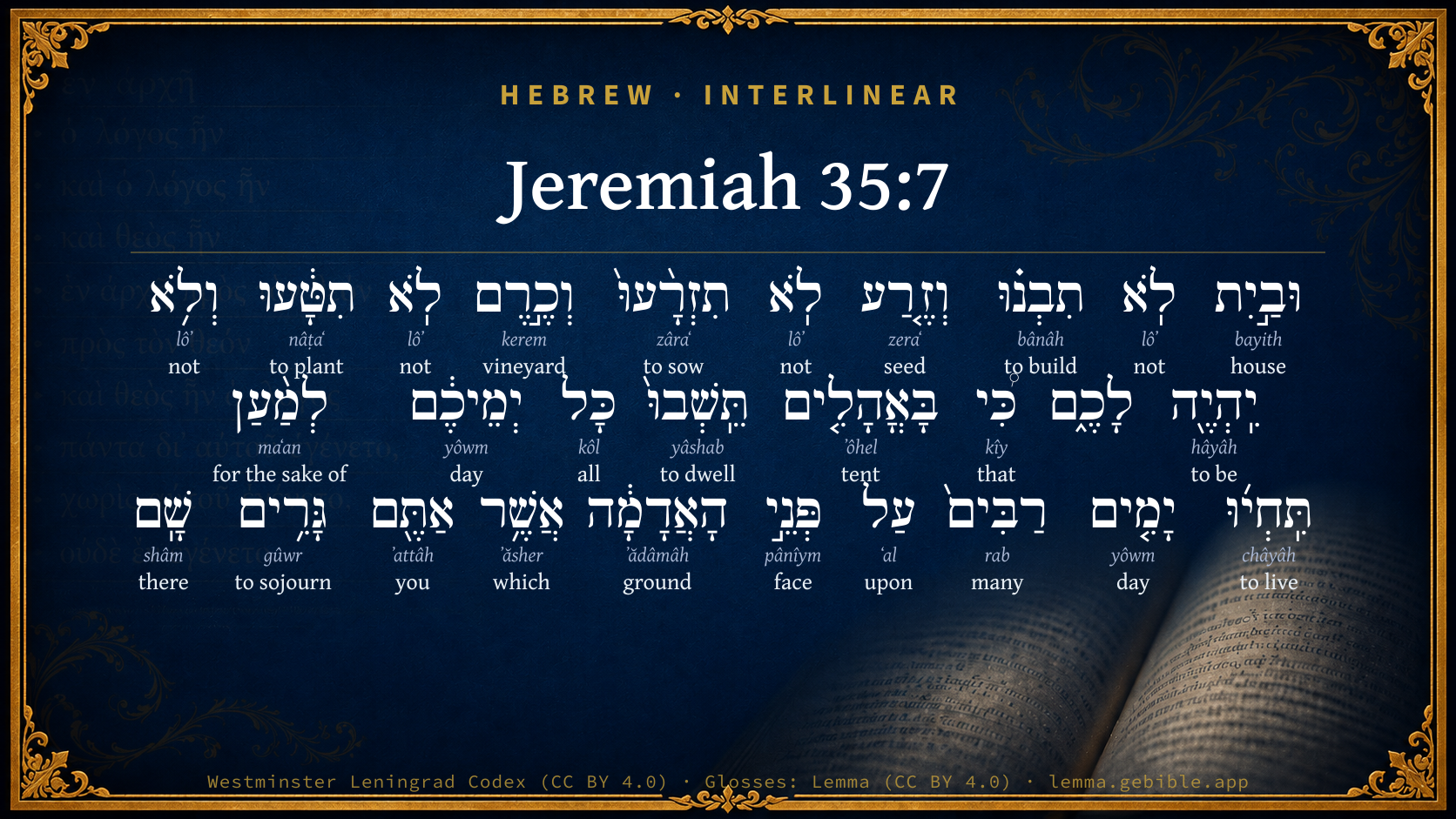
Jeremiah 35:7

Hebrew (Westminster Leningrad Codex) Jeremiah 35:7 appears in the Hebrew Old Testament. The text above is from the Westminster Leningrad Codex. Each word links to its Strong’s number, a concise gloss, and parsing drawn from the Open Scriptures Hebrew Bible morphology. Click any word for its full Brown-Driver-Briggs (BDB) entry.
Download image
Cite this verse

Jeremiah 35:7 (World English Bible). Public Domain. Lemma interlinear Bible study tool, https://lemma.gebible.app/v/jeremiah/35/7.

Show BibTeX & RIS
BibTeX
RIS
English Translation
neither shall you build house, nor sow seed, nor plant vineyard, nor have any; but all your days you shall dwell in tents; that you may live many days in the land in which you sojourn.
World English Bible · Public Domain
Download a study sheet

One document with this verse’s original text, its word-by-word gloss line, the meaning frame, cross-references with their text, attributed commentary, and full source and license credits — printable, and it pastes into notes with its structure intact.

This verse Autodidact and up

Study sheet (.html) Plain text (.txt)

A passage Seminary Student

Up to 50 verses in one chapter. A passage sheet keeps up to 6 commentary sources and 12 cross-references per verse, in the order this page ranks them, and says so on the sheet whenever that leaves anything out. Ask for a single verse and you get the Autodidact verse sheet above.

Everything on this page stays free to read, with no account — the sheet is a download of what is already on screen, not access to it.

Want to remove ads? Support Godless Engineer
Compare translations 3

The same verse in 3 English versions, stacked beneath the original-language interlinear above. Click any original word for its lexicon entry.

Each is an independent rendering of the whole verse — the interlinear is not word-aligned to these translations.

Highlighted words mark where these versions differ — a whole-verse word diff, not a word-by-word alignment.

  • World English Bible Public Domain
    neither shall you build house, nor sow seed, nor plant vineyard, nor have any; but all your days you shall dwell in tents; that you may live many days in the land in which you sojourn.
  • King James Version Public Domain
    Neither shall ye build house, nor sow seed, nor plant vineyard, nor have any: but all your days ye shall dwell in tents; that ye may live many days in the land where ye be strangers.
  • unfoldingWord Literal Text CC BY-SA 4.0
    Also, do not build any houses, sow any seeds, or plant any vineyards; this is not for you. For you must live in tents all your days, so that you might live many days in the land where you are staying as foreigners.’

unfoldingWord Literal Text — © unfoldingWord, licensed CC BY-SA 4.0. Word-aligned USFM3 via Door43 (git.door43.org/unfoldingWord/en_ult).

Versions to compare (up to 4)

3 of 4 selected

Show all 18 translations

Every available English version of this verse, each an independent rendering of the whole verse.

  • World English Bible Public Domain
    neither shall you build house, nor sow seed, nor plant vineyard, nor have any; but all your days you shall dwell in tents; that you may live many days in the land in which you sojourn.
  • Berean Standard Bible Public Domain
    Nor are you ever to build a house or sow seed or plant a vineyard. Those things are not for you. Instead, you must live in tents all your lives, so that you may live a long time in the land where you wander.’
  • Majority Standard Bible Public Domain
    Nor are you ever to build a house or sow seed or plant a vineyard. Those things are not for you. Instead, you must live in tents all your lives, so that you may live a long time in the land where you wander.’
  • King James Version Public Domain
    Neither shall ye build house, nor sow seed, nor plant vineyard, nor have any: but all your days ye shall dwell in tents; that ye may live many days in the land where ye be strangers.
  • American Standard Version (1901) Public Domain
    neither shall ye build house, nor sow seed, nor plant vineyard, nor have any; but all your days ye shall dwell in tents; that ye may live many days in the land wherein ye sojourn.
  • Revised Version (1885) Public Domain
    neither shall ye build house, nor sow seed, nor plant vineyard, nor have any: but all your days ye shall dwell in tents; that ye may live many days in the land wherein ye sojourn.
  • Geneva Bible (1599) Public Domain
    Neither shall ye build house, nor sow seede, nor plant vineyarde, nor haue any, but all your dayes ye shall dwell in tentes, that ye may liue a long time in the land where ye be strangers.
  • Douay-Rheims (1899) Public Domain
    Neither shall ye build houses, nor sow seed, nor plant vineyards, nor have any: but you shall dwell in tents all your days, that you may live many days upon the face of the earth, in which you are strangers.
  • Young's Literal Translation Public Domain
    and a house ye do not build, and seed ye do not sow, and a vineyard ye do not plant, nor have ye any; for in tents do ye dwell all your days, that ye may live many days on the face of the ground whither ye are sojourning.
  • Literal Standard Version CC BY-SA 4.0
    and you do not build a house, and you do not sow seed, and you do not plant a vineyard, nor have of [these]; for you dwell in tents all your days, that you may live many days on the face of the ground to where you are sojourning.
  • Unlocked Literal Bible CC BY-SA 4.0
    Also, do not build any houses, sow any seeds, or plant any vineyards; this is not for you. For you must live in tents all your days, so that you might live many days in the land where you are staying as foreigners.'
  • unfoldingWord Literal Text CC BY-SA 4.0
    Also, do not build any houses, sow any seeds, or plant any vineyards; this is not for you. For you must live in tents all your days, so that you might live many days in the land where you are staying as foreigners.’
  • Darby Bible Public Domain
    neither shall ye build house, nor sow seed, nor plant vineyard, nor shall ye have [any]; but all your days ye shall dwell in tents, that ye may live many days in the land where ye sojourn.
  • World Messianic Bible Public Domain
    You shall not build a house, sow seed, plant a vineyard, or have any; but all your days you shall dwell in tents, that you may live many days in the land in which you live as nomads.’
  • Webster's Bible Public Domain
    Neither shall ye build house, nor sow seed, nor plant vineyard, nor have any: but all your days ye shall dwell in tents; that ye may live many days in the land where ye are strangers.
  • Free Bible Version CC BY-SA 4.0
    Don't ever build houses or sow crops or plant vineyards. You're not to do this. Instead, you are to always live in tents so that you may have long lives as you move from place to place in the country.’
  • Bible in Basic English Public Domain
    And you are to make no houses, or put in seed, or get vine-gardens planted, or have any: but all your days you are to go on living in tents, so that you may have a long life in the land where you are living as in a strange country.
  • JPS Tanakh (1917) Public Domain
    neither shall ye build house, nor sow seed, nor plant vineyard, nor have any; but all your days ye shall dwell in tents, that ye may live many days in the land wherein ye sojourn.

Literal Standard Version (2020), Covenant Press — licensed CC BY-SA 4.0. Text via the HelloAO Bible API (eBible.org). Unlocked Literal Bible (unfoldingWord) — licensed CC BY-SA 4.0. Text via the HelloAO Bible API (eBible.org). unfoldingWord Literal Text — © unfoldingWord, licensed CC BY-SA 4.0. Word-aligned USFM3 via Door43 (git.door43.org/unfoldingWord/en_ult). Free Bible Version, Dr. Jonathan Gallagher — licensed CC BY-SA 4.0. Text via the HelloAO Bible API (eBible.org).

Word by word

More ways to search: Search by grammar → Find every occurrence → Compare this word →

Practice this passage: Drill this verse → Learn its vocabulary →

תִזְרָ֨עוּ֙
zâraʻ
H2232
“to sow”
Verb, Qal, Imperfect, 2nd Person, Masculine, Plural
Part of Speech
Verb
Stem
Qal
Form
Imperfect
Person
2nd Person
Gender
Masculine
Number
Plural
Full BDB Definition

Origin: a primitive root

TWOT: 582

to sow, scatter seed - (Qal) - to sow - producing, yielding seed - (Niphal) - to be sown - to become pregnant, be made pregnant - (Pual) to be sown - (Hiphil) to produce seed, yield seed
  1. וּבַ֣יִת bayith H1004 “and · house” Conjunction + Noun, Common, Masculine, Singular, Absolute
  2. לֹֽא lôʼ H3808 “not” Particle, Negative
  3. תִבְנ֗וּ bânâh H1129 “to build” Verb, Qal, Imperfect, 2nd Person, Masculine, Plural
  4. וְזֶ֤רַע zeraʻ H2233 “and · seed” Conjunction + Noun, Common, Masculine, Singular, Absolute
  5. לֹֽא lôʼ H3808 “not” Particle, Negative
  6. וְכֶ֣רֶם kerem H3754 “and · vineyard” Conjunction + Noun, Common, Both, Singular, Absolute
  7. לֹֽא lôʼ H3808 “not” Particle, Negative
  8. תִטָּ֔עוּ nâṭaʻ H5193 “to plant” Verb, Qal, Imperfect, 2nd Person, Masculine, Plural
  9. וְלֹ֥א lôʼ H3808 “and · not” Conjunction + Particle, Negative
  10. יִֽהְיֶ֖ה hâyâh H1961 “to be” Verb, Qal, Imperfect, 3rd Person, Masculine, Singular
  11. כִּ֠י kîy H3588 “that” Conjunction
  12. בָּאֳהָלִ֤ים ʼôhel H168 “in/at · tents” Preposition + Noun, Common, Masculine, Plural, Absolute
  13. תֵּֽשְׁבוּ֙ yâshab H3427 “to dwell” Verb, Qal, Imperfect, 2nd Person, Masculine, Plural
  14. כָּל kôl H3605 “all of” Noun, Common, Masculine, Singular, Construct
  15. יְמֵיכֶ֔ם yôwm H3117 “days · your” Noun, Common, Masculine, Plural, Construct + Suffix, Personal, 2nd Person, Masculine, Plural
  16. לְמַ֨עַן maʻan H4616 “for the sake of” Preposition
  17. תִּֽחְי֜וּ châyâh H2421 “to live” Verb, Qal, Imperfect, 2nd Person, Masculine, Plural
  18. יָמִ֤ים yôwm H3117 “days” Noun, Common, Masculine, Plural, Absolute
  19. רַבִּים֙ rab H7227 “many” Adjective, Adjective, Masculine, Plural, Absolute
  20. עַל ʻal H5921 “upon” Preposition
  21. פְּנֵ֣י pânîym H6440 “face(s) of” Noun, Common, Both, Plural, Construct
  22. הָאֲדָמָ֔ה ʼădâmâh H127 “the · ground” Particle, Definite Article + Noun, Common, Feminine, Singular, Absolute
  23. אֲשֶׁ֥ר ʼăsher H834 “which” Particle, Relative
  24. אַתֶּ֖ם ʼattâh H859 “you” Pronoun, Personal, 2nd Person, Masculine, Plural
  25. גָּרִ֥ים gûwr H1481 “sojourning” Verb, Qal, Participle Active, Masculine, Plural, Absolute
  26. שָֽׁם shâm H8033 “there” Adverb

About this verse

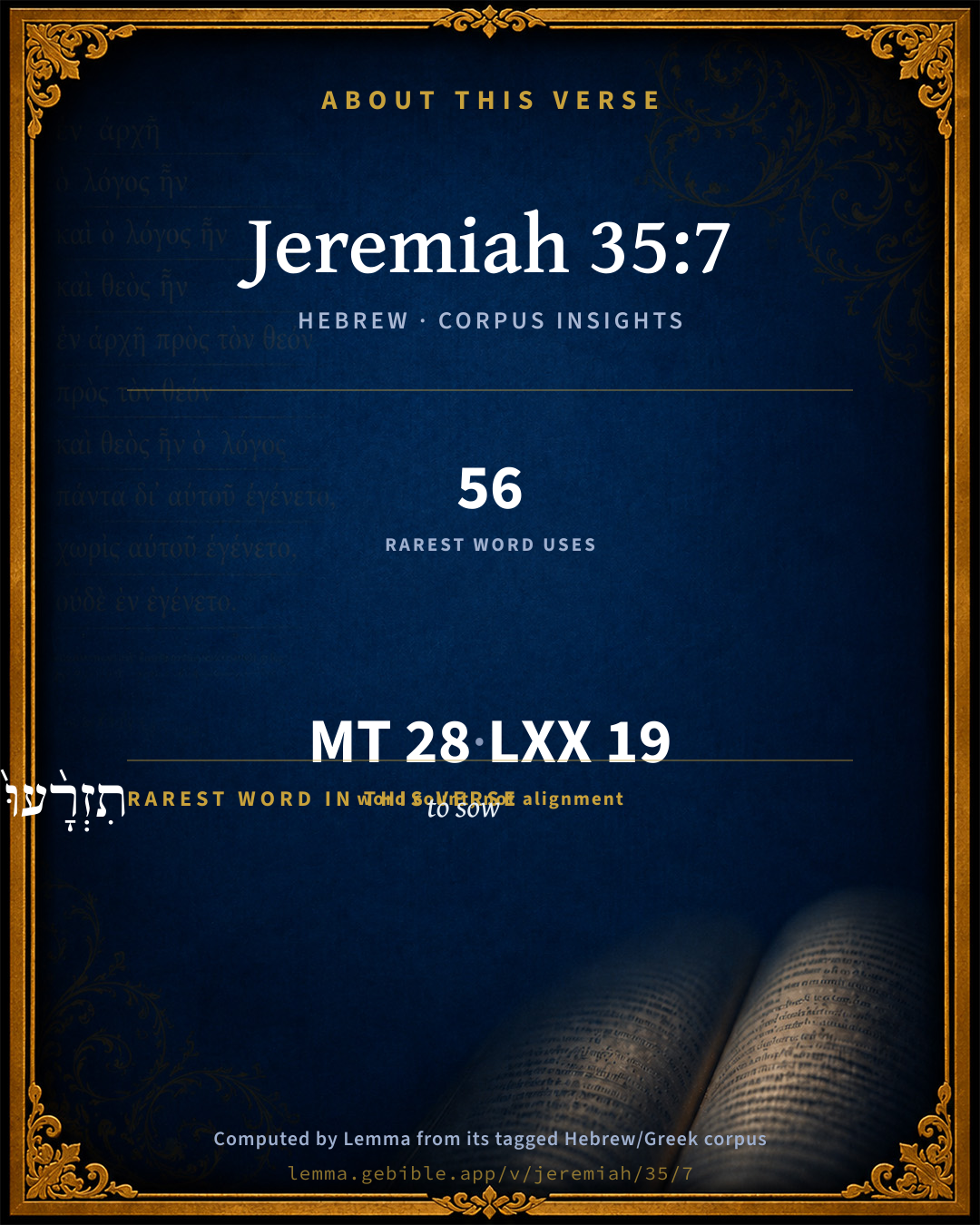
These counts appear in no published source. They are computed here, from the morphology-tagged text and Lemma’s own curated glosses. What Lemma adds →

28
words
23
distinct lemmas
Prophets
section

Shared distinctive vocabulary

תִזְרָ֨עוּ֙ to sow H2232 occurs in 54 verses of the Hebrew Bible. Also found in:

Grammatical profile

  • 7 verbs
  • 9 nouns
  • 1 adjective
  • 1 pronoun
  • 3 prepositions
  • 1 conjunction
  • 1 adverb
  • 5 particles

Verb forms

  • תִבְנ֗וּ Qal · Imperfect
  • תִזְרָ֨עוּ֙ Qal · Imperfect
  • תִטָּ֔עוּ Qal · Imperfect
  • יִֽהְיֶ֖ה Qal · Imperfect
  • תֵּֽשְׁבוּ֙ Qal · Imperfect
  • תִּֽחְי֜וּ Qal · Imperfect
  • גָּרִ֥ים Qal · Participle Active

Repetition

Words recur within this verse — often emphatic in Hebrew:

  • יְמֵיכֶ֔ם day H3117 ×2
  • לֹֽא not H3808 ×4

Hebrew & Septuagint length

In the original languages it is 28 Hebrew tokens and 19 Greek tokens — but the two are counted differently (Hebrew bundles its prefixes and suffixes into one token; the Greek is in lemma form), so that isn’t a like-for-like length.

Cross-references

9

Topical passages linked to Jeremiah 35:7 in the Treasury of Scripture Knowledge — connected by theme and wording, ordered by reader-vote popularity; previews shown in the World English Bible.

  • Jeremiah 35:10 but we have lived in tents, and have obeyed, and done according to all that Jonadab our father commanded us.
  • Genesis 25:27 The boys grew. Esau was a skillful hunter, a man of the field. Jacob was a quiet man, living in tents.
  • Exodus 20:12 "Honor your father and your mother, that your days may be long in the land which Yahweh your God gives you.
  • Leviticus 23:42–43 You shall dwell in booths seven days. All who are native-born in Israel shall dwell in booths,
  • Nehemiah 8:14–16 They found written in the law, how that Yahweh had commanded by Moses, that the children of Israel should dwell in booths in the feast of the seventh month;
  • Ephesians 6:2–3 "Honor your father and mother," which is the first commandment with a promise:
  • Ephesians 5:18 Don't be drunken with wine, in which is dissipation, but be filled with the Spirit,
  • Hebrews 11:9–13 By faith, he lived as an alien in the land of promise, as in a land not his own, dwelling in tents, with Isaac and Jacob, the heirs with him of the same promise.
  • 1 Peter 2:11 Beloved, I beg you as foreigners and pilgrims, to abstain from fleshly lusts, which war against the soul;

Cross-references courtesy of OpenBible.info (CC BY 4.0).

Hebrew and Greek witnesses Masoretic Hebrew ↔ Greek Septuagint

The same verse in the two great witnesses to the Old Testament, shown verse-for-verse.

These are two independent witnesses, not word-aligned to each other, and the Septuagint is shown in lemma (dictionary) form.

Hebrew Jeremiah 35:7 Masoretic · Westminster Leningrad Codex

וּבַ֣יִת לֹֽא תִבְנ֗וּ וְזֶ֤רַע לֹֽא תִזְרָ֨עוּ֙ וְכֶ֣רֶם לֹֽא תִטָּ֔עוּ וְלֹ֥א יִֽהְיֶ֖ה לָכֶ֑ם כִּ֠י בָּאֳהָלִ֤ים תֵּֽשְׁבוּ֙ כָּל יְמֵיכֶ֔ם לְמַ֨עַן תִּֽחְי֜וּ יָמִ֤ים רַבִּים֙ עַל פְּנֵ֣י הָאֲדָמָ֔ה אֲשֶׁ֥ר אַתֶּ֖ם גָּרִ֥ים שָֽׁם

neither shall you build house, nor sow seed, nor plant vineyard, nor have any; but all your days you shall dwell in tents; that you may live many days in the land in which you sojourn.

World English Bible · Public Domain

Greek LXX Structure differs

In the Septuagint, Jeremiah is about an eighth shorter than the Hebrew and arranges its material differently — the Oracles Against the Nations (Hebrew chapters 46–51) appear in the middle of the Greek book, after 25:13. Because the chapter and verse boundaries do not line up, a verse-for-verse comparison with the Hebrew is not shown.

A verse-for-verse comparison isn’t shown here because the chapters and verses don’t line up. Switch to the LXX edition with the MT / LXX toggle above to read the Greek directly.

On this verse, Haydock's Catholic Bible Commentary discusses the Septuagint’s reading. Read the note in Commentary ↓

Hebrew: Westminster Leningrad Codex (CC BY 4.0). Greek: Septuagint (public domain); English from a public-domain English Septuagint. How the Septuagint differs from the Hebrew →

Targum (Aramaic paraphrase)

1

The Targum is the ancient Jewish Aramaic paraphrase of the Hebrew Scriptures — an interpretive translation, not the Hebrew text itself. Onkelos (literal) and Pseudo-Jonathan (expansive) render the Torah, and Jonathan the Prophets. Coverage is partial: where no permissively-licensed English translation exists for a verse, only the Aramaic is shown. This is verse-level text, not a word-by-word alignment to the Hebrew.

  1. Targum Jonathan Prophets (Joshua–Malachi)
    וּבֵיתָא לָא תִבְנוּן וְזַרְעָא לָא תִזְרְעוּן וְכַרְמַיָא לָא תִצְבוּן וְלָא יְהֵי לְכוֹן אֲרֵי בְמַשְׁכְּנִין תֵּיתְבוּן כָּל יוֹמֵיכוֹן בְּדִיל דְתִתְקַיְמוּן יוֹמִין סַגִיאִין עַל אַפֵּי אַרְעָא דְאַתּוּן דַיְרִין תַּמָן:

    (no public-domain English translation for this verse)

    Targum Jonathan — Aramaic: “Mikraot Gedolot” (public domain). English: “Sefaria Community Translation” (CC0 1.0 (public-domain dedication)); “London "Chaldee Paraphrase," 1871” (public domain). Text via Sefaria.

Commentary

Notes on Jeremiah 35:7 from classic Christian and Jewish commentators (each source and its license shown beneath its notes). The classic Christian expositions comment on the surrounding passage and are grouped to its opening verse, so a note may address several verses; the Jewish commentaries on the Tanakh (Rashi and others) are per-verse, so they appear only where the commentator wrote on this verse.

Lemma curates 59 commentaries, every one of them public domain or Creative Commons licensed, each selected and text-cleaned for this edition rather than reprinted as found. About our sources →

Trapp's Complete Commentary

John Trapp

Jer 35:7 Neither shall ye build house, nor sow seed, nor plant vineyard, nor have [any]: but all your days ye shall dwell in tents; that ye may live many days in the land where ye [be] strangers.

Ver. 7. Neither shall ye build house.] But be content and dwell in tents, as the ancient patriarchs were, and as your ancestors in Midian, removing from place to place, after the manner of the old nomades; so shall ye be the better prepared for a change in the state, which this good old man might foresee and foresignify to his nephews, enjoining them therefore to follow their shepherdy only, as men less addicted to the world, and bent for heaven.

That ye may live many days in the land.] While ye obey my charge. Long life is promised to children that obey their parents.

Where ye be strangers] The Rechabites were originally Midianites; but Jethro, of whom they came, was a famous proselyte in the Church; his son Hobab a guide to God’s people in the wilderness; and his posterity imped and incorporated into the body of God’s people. {Jdg 1:16} Nevertheless they counted and called themselves "strangers," alienigenae, as those that looked for a better country above. See Heb 11:9.

John Trapp, A Commentary or Exposition upon All the Books of the Old and New Testament (1647–1656) — public domain. Text from a community e-Sword module.

Jamieson, Fausset & Brown

Robert Jamieson, A. R. Fausset & David Brown

tents-- (Jdg 4:17).

live many days--according to the promise connected with the fifth commandment (Exo 20:12; Eph 6:2-3).

strangers--They were not of the stock of Jacob, but sojourners in Israel. Types of the children of God, pilgrims on earth, looking for heaven as their home: having little to lose, so that losing times cost them little alarm; sitting loose to what they have (Heb 10:34; Heb 11:9-10, Heb 11:13-16).

Jamieson, Fausset & Brown — Commentary Critical and Explanatory on the Whole Bible (1871) — public domain (CC PDM 1.0). Text via the HelloAO Bible API.

The Cambridge Bible for Schools and Colleges

gen. ed. J. J. S. Perowne

7. neither shall ye build house, etc.] Cp. the description of the Nabataeans by Diodorus Siculus who says (19:94) that they neither sow seed, nor plant fruit-tree, nor use wine, nor build a house. In their case, however, it was not from religious motives, but to avoid risk at the hands of powerful neighbours.

The Cambridge Bible for Schools and Colleges (gen. ed. J. J. S. Perowne; Cambridge University Press, 1878–1918) — public domain. Text from a community e-Sword module.

John Gill's Exposition

Neither shall ye build house, nor sow seed, nor plant vineyard,

nor have any,.... That is, they were not to build houses, sow seed, or plant vineyards, for themselves, for their own profit and advantage; nor possess either of these through purchase or gift: all this was enjoined them, partly because they were strangers in the land of Israel, as is suggested in the latter part of the verse, and so were to have no inheritance in it; and partly because the pastoral life was what their ancestors had lived; and therefore Jonadab was desirous it should be continued in his posterity; as well as because by this means they would live not envied by the Israelites, among whom they were; since they did not covet to get any part of their possessions into their hands; as also these being their circumstances, upon any public calamity, as sword, famine, or pestilence, they could more easily remove to other places; and likewise, by observing these rules, would not be liable to some sins, as drunkenness, worldly mindedness, &c. which are often the cause of great calamities. The Essenes, a sect among the Jews afterwards, seem in some things to have copied after these Rechabites:

but all your days ye shall dwell in tents; which they could move from place to place, for the convenience of pasture for the cattle, the business they were brought up in, and were always to exercise:

that ye may live many days in the land where ye be strangers; for they were not Israelites, as before observed, but Kenites, the descendants of Jethro; they were proselytes of the gate only; and now, partly on account of their obedience to parents, which had annexed to it the promise of long life in the land in which they lived; and partly because they would, by such a course of life, give no umbrage to, nor raise any jealousy in, the minds of the inhabitants of it, they might expect a continuance in it.

John Gill's Exposition of the Whole Bible (1746–1763) — public domain (CC PDM 1.0). Text via the HelloAO Bible API.

Haydock's Catholic Bible Commentary

Days. The reward of dutiful children, Exodus xx. 12. These are models of those Christians who follow the rule of some virtuous person, in order to be at a greater distance from any transgression of the law, and to observe it with more perfection. (Calmet) --- "If a father could lay such an injunction on his descendants, and they receive commendation for observing it, why may not the fathers of the Church enjoin things which are not of themselves necessary, but....useful to avoid the occasions of evil, or to advance in virtue?" says Grotius, a Protestant, after St. Jerome, (Ad Paulin.) St. Augustine, in Psalm lxx., &c.) (Haydock) Jonadab exhorted, and prescribed this rule, but it was not properly a command, being too arduous. (Tirinus)

George Leo Haydock (1774–1849), Haydock's Catholic Family Bible and Commentary, 1859 edition — public domain. Excludes Psalms (Douay-Rheims chapter numbering differs from Protestant) and Deuterocanonical books (Catholic canon only).

Matthew Poole's English Annotations

The last words of the verse probably give us a reason of the former; they were no native Jews, but strangers amongst them, who commonly are envied when they are observed to thrive too much, or to live splendidly; and that envy of the natives of the place where they sojourn exposeth them to their hatred and malice, so as their lives are made uneasy to them. Jonadab therefore cautions his sons to avoid these inconveniencies by a thrifty, sober, laborious life, to which they had been bred, in keeping flocks, and to avoid any thing might expose them to envy, or hatred, or malice of the people amongst whom they were come to sojourn.

Matthew Poole's English Annotations on the Holy Bible (1683–1685) — public domain. Text from a community e-Sword/MySword module.

John Wesley's Explanatory Notes

That ye may live - Jonadab cautions his sons by a thrifty, sober, labourious life, to which they had been bred, in keeping flocks, to avoid any thing which might expose them to the envy or hatred of the people amongst whom they were come to sojourn.

John Wesley, Explanatory Notes Upon the Whole Bible (1754–1765) — public domain. Text via the GEBible commentary corpus.

Rashi

Rabbi Shlomo Yitzchaki (Rashi)

but you shall dwell in tents in the deserts where you dwell. They had no share in the land since they were the children of proselytes.

Rashi on the Tanakh — English translations: “The Judaica Press complete Tanach with Rashi, translated by A. J. Rosenberg” (CC BY 4.0); “Pentateuch with Rashi's commentary by M. Rosenbaum and A.M. Silbermann, 1929-1934” (public domain); “The Metsudah Tanach series, Lakewood, N.J” (CC BY 4.0); and “The Book of Joshua, Metsudah Publications, 1997” (CC BY 4.0). Text via Sefaria.

Lesson kit

Teaching starters — assembled from the data on this page, not authored interpretation. Every prompt links to the verse data it draws on. Edit before teaching.

Jeremiah, in the Prophets, opens this verse with 28 words (23 distinct Hebrew lemmas). Its most distinctive word is zâraʻ (“to sow”). A historical commentator’s framing appears above. Read the whole chapter for the surrounding context.

Discussion questions

  1. The word zâraʻ carries the sense “to sow.” How does it shape the verse?
  2. Genesis 1:11 shares the word «to sow» with this verse. How do the two illuminate each other?
  3. “day” occurs 2× in this one verse. What is the effect of the repetition?
  4. These translations render this verse differently; the difference is in the English rendering, not the original. What questions does that raise?
  5. The verb «תִבְנ֗וּ» is Qal Imperfect. How does its form color the action?
  6. Reading how Trapp's Complete Commentary and Jamieson, Fausset & Brown read this verse, where do the two commentators agree and where do they part?

Things to notice

Reading settings

Reading text

Shown beneath each verse's original-language words.

Old Testament
Old Testament edition

Read the OT as the Masoretic Hebrew (MT) or the Greek Septuagint (LXX).

English shown for the Greek Septuagint (in the Hebrew ↔ Greek comparison).

Comparing translations? Open the Compare panel on any verse page to stack up to four side by side.