
Ezekiel 25:3

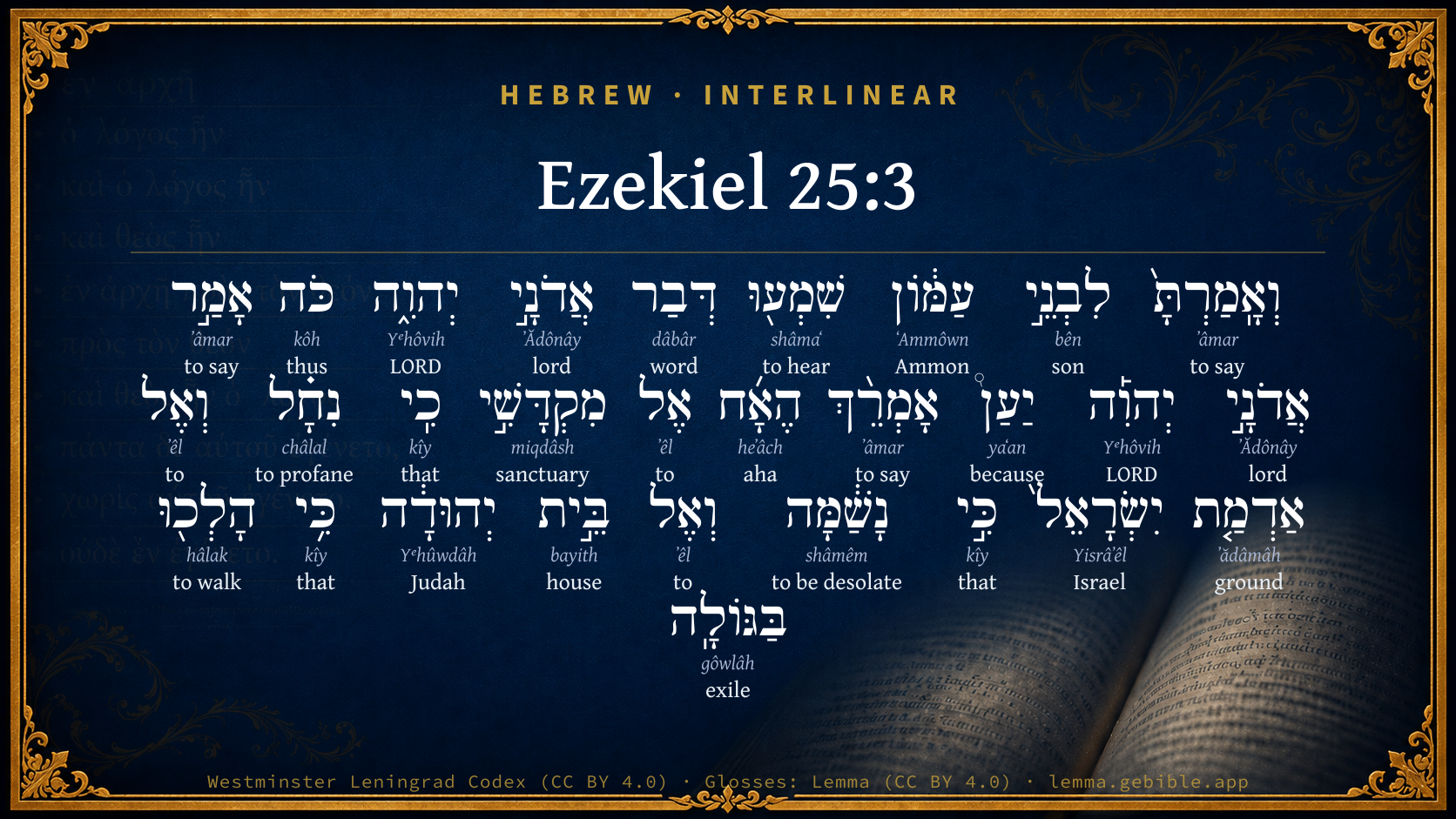
Hebrew (Westminster Leningrad Codex) Ezekiel 25:3 appears in the Hebrew Old Testament. The text above is from the Westminster Leningrad Codex. Each word links to its Strong’s number, a concise gloss, and parsing drawn from the Open Scriptures Hebrew Bible morphology. Click any word for its full Brown-Driver-Briggs (BDB) entry.
Download image
Cite this verse

Ezekiel 25:3 (World English Bible). Public Domain. Lemma interlinear Bible study tool, https://lemma.gebible.app/v/ezekiel/25/3.

Show BibTeX & RIS
BibTeX
RIS
English Translation
and tell the children of Ammon, Hear the word of the Lord Yahweh: Thus says the Lord Yahweh, Because you said, Aha, against my sanctuary, when it was profaned; and against the land of Israel, when it was made desolate; and against the house of Judah, when they went into captivity:
World English Bible · Public Domain
Download a study sheet

One document with this verse’s original text, its word-by-word gloss line, the meaning frame, cross-references with their text, attributed commentary, and full source and license credits — printable, and it pastes into notes with its structure intact.

This verse Autodidact and up

Study sheet (.html) Plain text (.txt)

A passage Seminary Student

Up to 50 verses in one chapter. A passage sheet keeps up to 6 commentary sources and 12 cross-references per verse, in the order this page ranks them, and says so on the sheet whenever that leaves anything out. Ask for a single verse and you get the Autodidact verse sheet above.

Everything on this page stays free to read, with no account — the sheet is a download of what is already on screen, not access to it.

Want to remove ads? Support Godless Engineer
Compare translations 3

The same verse in 3 English versions, stacked beneath the original-language interlinear above. Click any original word for its lexicon entry.

Each is an independent rendering of the whole verse — the interlinear is not word-aligned to these translations.

Highlighted words mark where these versions differ — a whole-verse word diff, not a word-by-word alignment.

  • World English Bible Public Domain
    and tell the children of Ammon, Hear the word of the Lord Yahweh: Thus says the Lord Yahweh, Because you said, Aha, against my sanctuary, when it was profaned; and against the land of Israel, when it was made desolate; and against the house of Judah, when they went into captivity:
  • King James Version Public Domain
    And say unto the Ammonites, Hear the word of the Lord GOD; Thus saith the Lord GOD; Because thou saidst, Aha, against my sanctuary, when it was profaned; and against the land of Israel, when it was desolate; and against the house of Judah, when they went into captivity;
  • unfoldingWord Literal Text CC BY-SA 4.0
    Say to the people of Ammon, ‘Hear the word of the Lord Yahweh. This is what the Lord Yahweh says: Because you said, “Aha!” over my sanctuary when it was profaned, and against the land of Israel when it was desolate, and against the house of Judah when they went into exile,

unfoldingWord Literal Text — © unfoldingWord, licensed CC BY-SA 4.0. Word-aligned USFM3 via Door43 (git.door43.org/unfoldingWord/en_ult).

Versions to compare (up to 4)

3 of 4 selected

Show all 18 translations

Every available English version of this verse, each an independent rendering of the whole verse.

  • World English Bible Public Domain
    and tell the children of Ammon, Hear the word of the Lord Yahweh: Thus says the Lord Yahweh, Because you said, Aha, against my sanctuary, when it was profaned; and against the land of Israel, when it was made desolate; and against the house of Judah, when they went into captivity:
  • Berean Standard Bible Public Domain
    Tell the Ammonites to hear the word of the Lord GOD, for this is what the Lord GOD says: ‘Because you exclaimed, “Aha!” when My sanctuary was profaned, when the land of Israel was laid waste, and when the house of Judah went into exile,
  • Majority Standard Bible Public Domain
    Tell the Ammonites to hear the word of the Lord GOD, for this is what the Lord GOD says: ‘Because you exclaimed, “Aha!” when My sanctuary was profaned, when the land of Israel was laid waste, and when the house of Judah went into exile,
  • King James Version Public Domain
    And say unto the Ammonites, Hear the word of the Lord GOD; Thus saith the Lord GOD; Because thou saidst, Aha, against my sanctuary, when it was profaned; and against the land of Israel, when it was desolate; and against the house of Judah, when they went into captivity;
  • American Standard Version (1901) Public Domain
    and say unto the children of Ammon, Hear the word of the Lord Jehovah: Thus saith the Lord Jehovah, Because thou saidst, Aha, against my sanctuary, when it was profaned; and against the land of Israel, when it was made desolate; and against the house of Judah, when they went into captivity:
  • Revised Version (1885) Public Domain
    and say unto the children of Ammon, Hear the word of the Lord GOD; Thus saith the Lord GOD: Because thou saidst, Aha, against my sanctuary, when it was profaned; and against the land of Israel, when it was made desolate; and against the house of Judah, when they went into captivity:
  • Geneva Bible (1599) Public Domain
    And say vnto the Ammonites, Heare the word of the Lord God, Thus saith the Lord God, Because thou saydest, Ha, ha, against my Sanctuarie, when it was polluted, and against the land of Israel, when it was desolate, and against the house of Iudah, when they went into captiuitie,
  • Douay-Rheims (1899) Public Domain
    And thou shalt say to the children of Ammon: Hear ye the word of the Lord God: Thus saith the Lord God: Because thou hast said: Ha, ha, upon my sanctuary, because it was profaned: and upon the land of Israel, because it was laid waste: and upon the house of Juda, because they are led into captivity:
  • Young's Literal Translation Public Domain
    and thou hast said to the sons of Ammon: Hear ye a word of the Lord Jehovah: Thus said the Lord Jehovah: Because of thy saying, Aha, to My sanctuary, Because it hath been polluted, And unto the ground of Israel, Because it hath been desolate, And unto the house of Judah, Because they have gone into a removal:
  • Literal Standard Version CC BY-SA 4.0
    and you have said to the sons of Ammon: Hear a word of Lord YHWH! Thus said Lord YHWH: Because of your saying, Aha, to My sanctuary, || Because it has been defiled, || And to the ground of Israel, || Because it has been desolate, || And to the house of Judah, || Because they have gone into a removal:
  • Unlocked Literal Bible CC BY-SA 4.0
    Say to the people of Ammon, 'Hear the word of the Lord Yahweh. This is what the Lord Yahweh says: Because you said, “Aha!” over my sanctuary when it was profaned, and against the land of Israel when it was desolate, and against the house of Judah when they went into exile,
  • unfoldingWord Literal Text CC BY-SA 4.0
    Say to the people of Ammon, ‘Hear the word of the Lord Yahweh. This is what the Lord Yahweh says: Because you said, “Aha!” over my sanctuary when it was profaned, and against the land of Israel when it was desolate, and against the house of Judah when they went into exile,
  • Darby Bible Public Domain
    and say unto the children of Ammon, Hear the word of the Lord Jehovah. Thus saith the Lord Jehovah: Because thou saidst, Aha, against my sanctuary, when it was profaned; and against the land of Israel, when it was made desolate; and against the house of Judah, when they went into captivity:
  • World Messianic Bible Public Domain
    Tell the children of Ammon, ‘Hear the word of the Lord GOD! The Lord GOD says, “Because you said, ‘Aha!’ against my sanctuary when it was profaned, and against Eretz-Israel when it was made desolate, and against the house of Judah when they went into captivity,
  • Webster's Bible Public Domain
    And say to the Ammonites, Hear the word of the Lord GOD; Thus saith the Lord GOD; Because thou saidst, Aha, against my sanctuary, when it was profaned; and against the land of Israel, when it was desolate; and against the house of Judah, when they went into captivity;
  • Free Bible Version CC BY-SA 4.0
    Tell the Ammonites to listen to the message from the Lord God, for this is what the Lord God says: Because you said, ‘Oh good!’ when my sanctuary was made unclean, when the country of Israel was turned into a wasteland, and when the people of Judah were taken into exile,
  • Bible in Basic English Public Domain
    And say to the children of Ammon, Give ear to the word of the Lord; this is what the Lord has said: Because you said, Aha! against my holy place when it was made unclean, and against the land of Israel when it was made waste, and against the people of Judah when they were taken away as prisoners;
  • JPS Tanakh (1917) Public Domain
    and say unto the children of Ammon: Hear the word of the Lord GOD: Thus saith the Lord GOD: Because thou saidst: Aha! against My sanctuary, when it was profaned, and against the land of Israel, when it was made desolate, and against the house of Judah, when they went into captivity;

Literal Standard Version (2020), Covenant Press — licensed CC BY-SA 4.0. Text via the HelloAO Bible API (eBible.org). Unlocked Literal Bible (unfoldingWord) — licensed CC BY-SA 4.0. Text via the HelloAO Bible API (eBible.org). unfoldingWord Literal Text — © unfoldingWord, licensed CC BY-SA 4.0. Word-aligned USFM3 via Door43 (git.door43.org/unfoldingWord/en_ult). Free Bible Version, Dr. Jonathan Gallagher — licensed CC BY-SA 4.0. Text via the HelloAO Bible API (eBible.org).

Word by word

More ways to search: Search by grammar → Find every occurrence → Compare this word →

Practice this passage: Drill this verse → Learn its vocabulary →

הֶאָ֜ח
heʼâch
H1889
“aha”
Particle, Interjection
Part of Speech
Particle
Type
Interjection
Full BDB Definition

Origin: from H1887 and H253

TWOT: 462

aha!
  1. וְאָֽמַרְתָּ֙ ʼâmar H559 “and · to say” Conjunction + Verb, Qal, Sequential Perfect, 2nd Person, Masculine, Singular
  2. לִבְנֵ֣י bên H1121 “to/for · sons of” Preposition + Noun, Common, Masculine, Plural, Construct
  3. עַמּ֔וֹן ʻAmmôwn H5983 “Ammon” Noun, Proper
  4. שִׁמְע֖וּ shâmaʻ H8085 “hear” Verb, Qal, Imperative, 2nd Person, Masculine, Plural
  5. דְּבַר dâbâr H1697 “word of” Noun, Common, Masculine, Singular, Construct
  6. אֲדֹנָ֣י ʼĂdônây H136 “Lord · my” Noun, Common, Masculine, Plural, Construct + Suffix, Personal, 1st Person, Common, Singular
  7. יְהוִ֑ה Yᵉhôvih H3069 “LORD” Noun, Proper
  8. כֹּה kôh H3541 “thus” Adverb
  9. אָמַ֣ר ʼâmar H559 “to say” Verb, Qal, Perfect, 3rd Person, Masculine, Singular
  10. אֲדֹנָ֣י ʼĂdônây H136 “Lord · my” Noun, Common, Masculine, Plural, Construct + Suffix, Personal, 1st Person, Common, Singular
  11. יְהוִ֡ה Yᵉhôvih H3069 “LORD” Noun, Proper
  12. יַעַן֩ yaʻan H3282 “because” Conjunction
  13. אָמְרֵ֨ךְ ʼâmar H559 “to say · you” Verb, Qal, Infinitive Construct + Suffix, Personal, 2nd Person, Feminine, Singular
  14. אֶל ʼêl H413 “to” Preposition
  15. מִקְדָּשִׁ֣י miqdâsh H4720 “sanctuary · my” Noun, Common, Masculine, Singular, Construct + Suffix, Personal, 1st Person, Common, Singular
  16. כִֽי kîy H3588 “that” Conjunction
  17. נִחָ֗ל châlal H2490 “to profane” Verb, Niphal, Perfect, 3rd Person, Masculine, Singular
  18. וְאֶל ʼêl H413 “and · to” Conjunction + Preposition
  19. אַדְמַ֤ת ʼădâmâh H127 “ground of” Noun, Common, Feminine, Singular, Construct
  20. יִשְׂרָאֵל֙ Yisrâʼêl H3478 “Israel” Noun, Proper
  21. כִּ֣י kîy H3588 “that” Conjunction
  22. נָשַׁ֔מָּה shâmêm H8074 “to be desolate” Verb, Niphal, Perfect, 3rd Person, Feminine, Singular
  23. וְאֶל ʼêl H413 “and · to” Conjunction + Preposition
  24. בֵּ֣ית bayith H1004 “house of” Noun, Common, Masculine, Singular, Construct
  25. יְהוּדָ֔ה Yᵉhûwdâh H3063 “Judah” Noun, Proper
  26. כִּ֥י kîy H3588 “that” Conjunction
  27. הָלְכ֖וּ hâlak H1980 “to walk” Verb, Qal, Perfect, 3rd Person, Common, Plural
  28. בַּגּוֹלָֽה gôwlâh H1473 “in/at the · exile” Preposition, Determined + Noun, Common, Feminine, Singular, Absolute

About this verse

These counts appear in no published source. They are computed here, from the morphology-tagged text and Lemma’s own curated glosses. What Lemma adds →

29
words
21
distinct lemmas
Prophets
section

Notable vocabulary

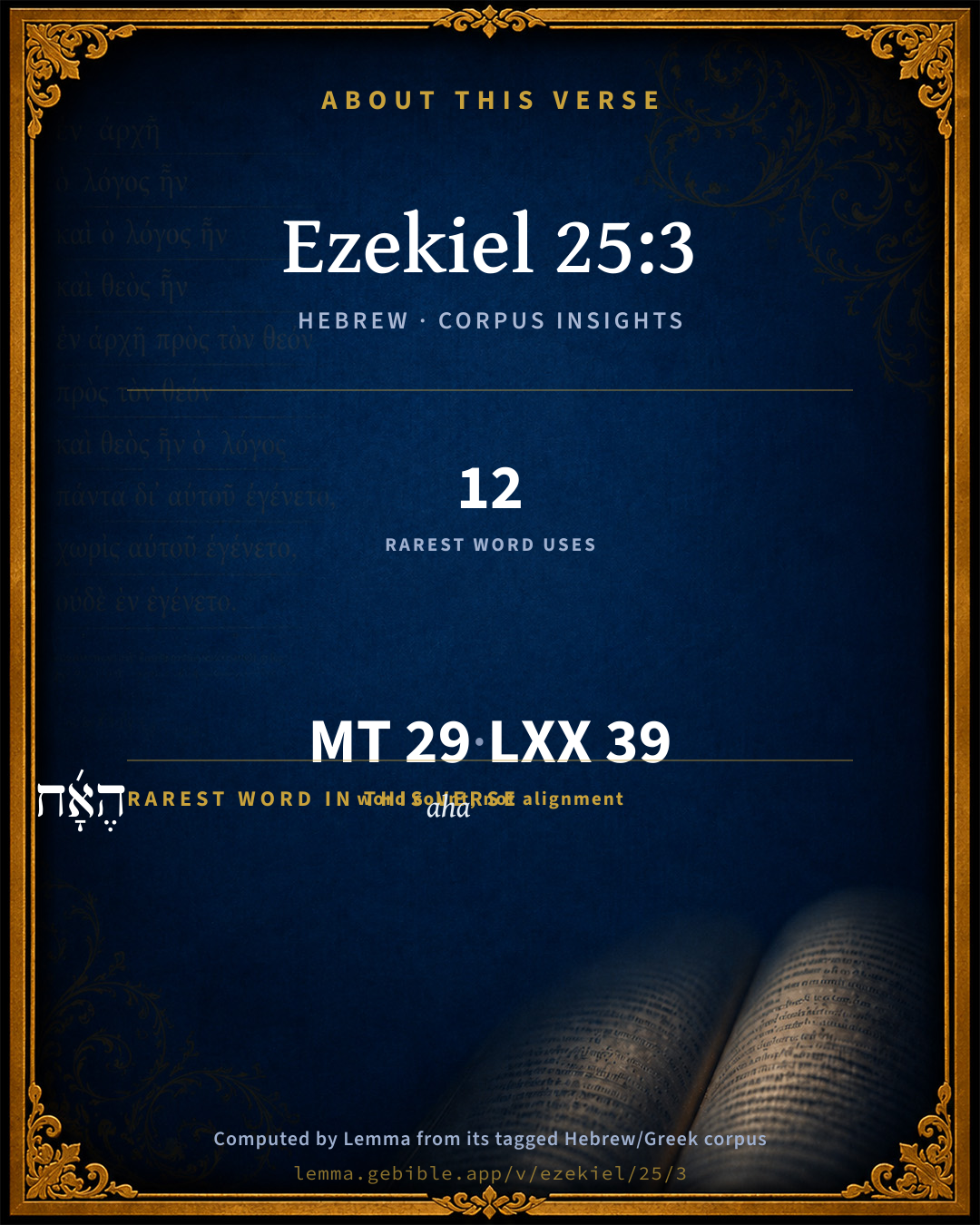
The rarest word here is הֶאָ֜ח aha H1889 — appearing just 12 times in the whole Hebrew Bible.

Shared distinctive vocabulary

הֶאָ֜ח aha H1889 occurs in 9 verses of the Hebrew Bible. Also found in:

Grammatical profile

  • 7 verbs
  • 13 nouns
  • 3 prepositions
  • 4 conjunctions
  • 1 adverb
  • 1 particle

Verb forms

  • וְאָֽמַרְתָּ֙ Qal · Sequential Perfect
  • שִׁמְע֖וּ Qal · Imperative
  • אָמַ֣ר Qal · Perfect
  • אָמְרֵ֨ךְ Qal · Infinitive Construct
  • נִחָ֗ל Niphal · Perfect
  • נָשַׁ֔מָּה Niphal · Perfect
  • הָלְכ֖וּ Qal · Perfect

Repetition

Words recur within this verse — often emphatic in Hebrew:

  • וְאָֽמַרְתָּ֙ to say H559 ×3
  • אֲדֹנָ֣י lord H136 ×2
  • יְהוִ֑ה LORD H3069 ×2
  • אֶל to H413 ×3
  • כִֽי that H3588 ×3

Hebrew & Septuagint length

In English translation the verse runs 51 words from the Hebrew and 54 from the Septuagint (LXX English) — closely comparable.

A rough comparison of the two English renderings, which tokenize alike — not a word-level alignment.

Word counts can differ between the Hebrew and the Greek without any difference in meaning — e.g. the Hebrew direct-object marker אֵת has no separate Greek word, and Greek often adds the article ὁ.

In the original languages it is 29 Hebrew tokens and 39 Greek tokens — but the two are counted differently (Hebrew bundles its prefixes and suffixes into one token; the Greek is in lemma form), so that isn’t a like-for-like length.

Cross-references

11

Topical passages linked to Ezekiel 25:3 in the Treasury of Scripture Knowledge — connected by theme and wording, ordered by reader-vote popularity; previews shown in the World English Bible.

  • Ezekiel 36:2 Thus says the Lord Yahweh: Because the enemy has said against you, Aha! and, The ancient high places are ours in possession;
  • Psalms 70:2–3 Let them be disappointed and confounded who seek my soul. Let those who desire my ruin be turned back in disgrace.
  • Proverbs 17:5 Whoever mocks the poor reproaches his Maker. He who is glad at calamity shall not be unpunished.
  • Proverbs 24:17–18 Don't rejoice when your enemy falls. Don't let your heart be glad when he is overthrown;
  • Ezekiel 25:6 For thus says the Lord Yahweh: Because you have clapped your hands, and stamped with the feet, and rejoiced with all the despite of your soul against the land of Israel;
  • Micah 7:8 Don't rejoice against me, my enemy. When I fall, I will arise. When I sit in darkness, Yahweh will be a light to me.
  • Lamentations 2:21–22 The youth and the old man lie on the ground in the streets; My virgins and my young men are fallen by the sword: You have killed them in the day of your anger; you have slaughtered, [and] not pitied.
  • Lamentations 4:21 Rejoice and be glad, daughter of Edom, that dwell in the land of Uz: The cup shall pass through to you also; you shall be drunken, and shall make yourself naked.
  • Ezekiel 25:8 Thus says the Lord Yahweh: Because Moab and Seir say, Behold, the house of Judah is like all the nations;
  • Ezekiel 26:2–21 Son of man, because Tyre has said against Jerusalem, Aha, she is broken: the gate of the peoples; she is turned to me; I shall be replenished, now that she is laid waste:
  • Ezekiel 35:10–15 Because you have said, These two nations and these two countries shall be mine, and we will possess it; whereas Yahweh was there:

Cross-references courtesy of OpenBible.info (CC BY 4.0).

Hebrew and Greek witnesses Masoretic Hebrew ↔ Greek Septuagint

The same verse in the two great witnesses to the Old Testament, shown verse-for-verse.

These are two independent witnesses, not word-aligned to each other, and the Septuagint is shown in lemma (dictionary) form.

Hebrew Ezekiel 25:3 Masoretic · Westminster Leningrad Codex

וְאָֽמַרְתָּ֙ לִבְנֵ֣י עַמּ֔וֹן שִׁמְע֖וּ דְּבַר אֲדֹנָ֣י יְהוִ֑ה כֹּה אָמַ֣ר אֲדֹנָ֣י יְהוִ֡ה יַעַן֩ אָמְרֵ֨ךְ הֶאָ֜ח אֶל מִקְדָּשִׁ֣י כִֽי נִחָ֗ל וְאֶל אַדְמַ֤ת יִשְׂרָאֵל֙ כִּ֣י נָשַׁ֔מָּה וְאֶל בֵּ֣ית יְהוּדָ֔ה כִּ֥י הָלְכ֖וּ בַּגּוֹלָֽה

and tell the children of Ammon, Hear the word of the Lord Yahweh: Thus says the Lord Yahweh, Because you said, Aha, against my sanctuary, when it was profaned; and against the land of Israel, when it was made desolate; and against the house of Judah, when they went into captivity:

World English Bible · Public Domain

Greek LXX Ezekiel 25:3 Septuagint · lemma form

καί εἶπον ὁ υἱός αμμων ἀκούω λόγος κύριος ὅδε λέγω κύριος ἀντί ὅς ἐπιχαίρω ἐπί ὁ ἅγιος ἐγώ ὅτι βεβηλόω καί ἐπί ὁ γῆ ὁ ἰσραήλ ὅτι ἀπο ἀναἵζω καί ἐπί ὁ οἶκος ὁ ιουδα ὅτι πορεύομαι ἐν αἰχμαλωσία

and you shall say to the children of Ammon, Hear you⌃ the word of the Lord; thus says the Lord; Forasmuch as you⌃ have rejoiced against my sanctuary, because it was profaned; and against the land of Israel, because it was laid waste; and against the house of Juda, because they went into captivity;

LXX2012 (modern English Septuagint) · Public Domain

Hebrew: Westminster Leningrad Codex (CC BY 4.0). Greek: Septuagint (public domain); English from LXX2012 (modern English Septuagint) (Public Domain). How the Septuagint differs from the Hebrew →

Targum (Aramaic paraphrase)

1

The Targum is the ancient Jewish Aramaic paraphrase of the Hebrew Scriptures — an interpretive translation, not the Hebrew text itself. Onkelos (literal) and Pseudo-Jonathan (expansive) render the Torah, and Jonathan the Prophets. Coverage is partial: where no permissively-licensed English translation exists for a verse, only the Aramaic is shown. This is verse-level text, not a word-by-word alignment to the Hebrew.

  1. Targum Jonathan Prophets (Joshua–Malachi)
    וְתֵימַר לִבְנֵי עַמוֹן קַבִּילוּ פִּתְגָמָא דַייָ אֱלֹהִים כִּדְנַן אֲמַר יְיָ אֱלֹהִים חֲלַף דַאֲמַרְתָּא חֶדְוָא עַל מַקְדְשִׁי אֲרֵי אִתְחַל וְעַל אַרְעָא דְיִשְׂרָאֵל אֲרֵי צְדִיאַת וְעַל דְבֵית יְהוּדָה אֲרֵי הַלִיכוּ בְגָלוּתָא:

    (no public-domain English translation for this verse)

    Targum Jonathan — Aramaic: “Mikraot Gedolot” (public domain). English: “Sefaria Community Translation” (CC0 1.0 (public-domain dedication)); “London "Chaldee Paraphrase," 1871” (public domain). Text via Sefaria.

Commentary

Notes on Ezekiel 25:3 from classic Christian and Jewish commentators (each source and its license shown beneath its notes). The classic Christian expositions comment on the surrounding passage and are grouped to its opening verse, so a note may address several verses; the Jewish commentaries on the Tanakh (Rashi and others) are per-verse, so they appear only where the commentator wrote on this verse.

Lemma curates 59 commentaries, every one of them public domain or Creative Commons licensed, each selected and text-cleaned for this edition rather than reprinted as found. About our sources →

Trapp's Complete Commentary

John Trapp

Eze 25:3 And say unto the Ammonites, Hear the word of the Lord GOD; Thus saith the Lord GOD; Because thou saidst, Aha, against my sanctuary, when it was profaned; and against the land of Israel, when it was desolate; and against the house of Judah, when they went into captivity;

Ver. 3. Because thou saidst, Aha.] Insolently insulting over mine Israel when under hatches; as when a tree is down, every man will be pulling at the branches, and Leoni mortuo vd mus insultat. But it is ill meddling against God’s Church, be it but by a frown or a trump, as here. An aha or an euge shall not escape unpunished. {Psa 35:21}

John Trapp, A Commentary or Exposition upon All the Books of the Old and New Testament (1647–1656) — public domain. Text from a community e-Sword module.

The Biblical Illustrator

Joseph S. Exell

Eze_25:3

I am against thee, O Tyrus.

On the importance of having God for our friend

That vengeance belongs unto God is emphatically declared in the book of God (Rom_12:19). And exemplary is the vengeance with which the Almighty has from time to time visited, not only those who had either arrayed themselves in hostility against Himself, His Word, or His servants; but those who had, without His sanction, either assailed or oppressed His people Nor individuals merely, but assemblages of men,--nay, cities,--and even nations, have often, in a sudden and calamitous overthrow, borne memorable testimony to the truth of these remarks. My text refers to an occasion of the kind. The Tyrians, so called from their chief city, Tyre, but also known by the name of Phoenicians, were at one time the most commercial, most opulent, and, at the same time, proudest people of the oriental world. Shipbuilding was prosecuted to a vast extent at this celebrated place. The carrying trade, too, of most of the mercantile world was in the hands of the Tyrians; besides which the city was the grand depot for the rarest and richest productions of distant nations. Gold, spices, and precious stones from Ethiopia, and the coast of Arabia;--emeralds, fine linen and embroidery work, coral, agate, and wool of delicate hue as well as texture, from Damascus and other parts of Syria;--chests of cedar for bestowing fragrancy on splendid apparel, and splendid apparel itself in ample quantity, from Mesopotamia and other bordering countries;--wheat, honey, oil, and balm, as well as wrought iron, steel, and aromatic gums, from various quarters of Palestine;--silver, iron, tin, and lead, from Tarshish, a place itself of considerable maritime trade;--brazen vessels, and, alas! slaves, from Ionia;--lambs, with other creatures used as provisions, from Arabia;--and ivory from sundry parts of the east:--all these commodities, useful, ornamental, costly, elegant, and various, brought in abundance into Tyre, were sold in her fairs and markets; whence they were exported, or otherwise dispersed, into different and distant countries, cities, and provinces. The consequence was, that Tyre spread itself till it was nearly twenty miles in circumference; containing, tis probable, nearly one million of souls. Further, such was the luxurious prodigality that sprung from the opulence which flowed in upon Tyre from her vast commerce, that not only were the people very generally clad in costly stuffs, dyed of the richest hues--among the rest the far-famed Tyrian purple--but even the very sails of their ships were of fine linen, with embroidered work from Egypt. This minuteness in description has appeared scarcely less than necessary to a proper comprehension of the force of that declaration in the text: I (God) am against thee, O Tyrus. Having learned from the detail how commercial, great, and splendid, how strong, opulent, and well-peopled a city Tyre was, we can easily deem how it was that the Tyrians, lifted up with pride, and full of self-confidence, had, in their hearts, set at nought the power of Almighty God, thinking that their mountain stood too strong for even His arm to shake. It was, in effect, we conclude, through such a spirit as this that they vaunted themselves over the Jewish people, and spoke scornfully of Jerusalem; though fully aware, at the same time, that the former were under the special patronage of God, and that the latter was the most favoured seat of His majesty and glory on earth. Such, then, as has been described, was the famous city of Tyre when the prophet Ezekiel was commanded to denounce it as marked out for particular judgment by the Most High. The reason is given in verse

2. Jerusalem had been taken and sacked by Nebuchadnezzar; but this should have been far, very far from ministering to the Tyrians occasion of self-gratulation and triumph. Yet did the latter not confine themselves to the manifestation of a selfish and brutal joy at the misfortunes of their Jewish neighbours--to a mere rejoicing over the circumstance that the trade of Jerusalem would from that time flow in Tyrian channels. There is but too full evidence of the fact that they went further than this--that they became ready purchasers of all the spoil which could be wrung from the unhappy people; and, not content even with thus abetting the cruelty and rapacity of others, bought with avidity the wretched Jews themselves--bought them in great numbers, and either kept or transferred them as slaves. Therefore, thus saith the Lord God, Behold, I am against thee, O Tyrus. On the particulars of the denunciation that follows, a very long and awful one, I need not dwell. My design next carries me to view the accomplishment of those predictions of vengeance which Ezekiel was thus commissioned to pour forth against the devoted city. Passing, says a celebrated traveller, by Tyre, from curiosity only, I came to be a mournful witness of the truth of the prophecy that Tyre, the queen of nations (queen of the sea, too, was she styled); that Tyre, the queen of nations, should be a rock to fishers to dry their nets on: two wretched fishermen with miserable nets had just given over their occupations. On the north side of Tyre, says another traveller, Maundrell, there is an old Turkish ungarrisoned castle; besides which you see nothing here but a mere babel of broken walls, pillars, vaults, etc.; there not being so much as one entire house left. Its present inhabitants are only a few wretches harbouring themselves in the vaults, and subsisting themselves chiefly upon fishing; who seemed to be preserved in this place by Divine Providence, as a visible argument how God has fulfilled His word concerning Tyre. Has not God then shown Himself indeed against Tyrus? Be it our endeavour, next, to inquire into the use which we should ourselves, with Gods help, make of this interesting piece of Bible history.

1. First, then, we may the more clearly discern the force of that scripture that vengeance belongs to God alone; to whom it must be left to repay evils or injuries done, derived, or wished against His people. The people of God are to repose their cause in the hands of God. And why are they so to act? Why, when the injuries which they receive are great and unquestionable, may they not themselves endeavour to take an adequate revenge? Because the truly religious temper, which only God can approve, is a temper that can have no affinity with a revengeful disposition. Neither is the retribution that God inflicts at all allied to revenge. It is the righteous chastisement of a lawgiver, whose statutes, holy, just, and good, have been inexcusably transgressed, and His authority set at nought, by those on whom the visitations fall.

2. We are taught from our subject that God will not fail to avenge, as far as shall be proper, His people, of their inveterate and irreclaimable adversaries.

3. We are taught by this scripture the severity of the Divine vengeance, when once the long-suffering of God has reached its limit, as well as the absolute impossibility of anyones escaping or avoiding the terrible effects of the aroused anger of the Almighty Jehovah. Long may His patience be tried, ere that holy anger be excited, but when once kindled, how resistless and destructive is its power. Dreadful, truly, is their condition who, being still in their sins, have God against them. Alarming would be the danger of that traveller who, unarmed, should discover a lion advancing towards him, in a path out of which he could not turn to escape the terrible beast; with which again, personal contest would be to all appearance hopeless. Yet would some possibility of escape in such a case exist. Aid, unknown to the stranger, might be at hand. To another object, a different kind of prey, the attention of the savage creature might be drawn off. Presence of mind, aiding the happy execution of some sudden thought, might render the jeoparded stranger victorious, or put him in unlocked for safety. Nay, the lion might, unstung by hunger, or with the magnanimity that some have been fond of ascribing to this animal, allow the other, unhurt, quietly to pass him. Such things have indeed happened. But no probabilities exist--no possibility exists, that he against whom God cometh as an avenging adversary, will be able to avoid encountering Him, and perishing in the encounter. None. His purposes change not; their execution nought can hinder. And as for Gods not troubling Himself about the evil that He cannot but see--think what is His own character. First, is He not of an infinite wisdom, purity, and holiness? Then think what He has done for sinful man, when a believer, repentant, and reformed; not because of mans own merit in being such, but when he is such;--given to him, that is, everlasting life in happiness and glory. Think of these things, and then let common sense answer the question, whether this all-holy and all-beneficent Being will or will not take notice of--will or will not tremendously punish--the unbelieving, impenitent, and unholy? (W. M. Wade.)

The Biblical Illustrator, edited by Joseph S. Exell (c. 1880s–1900s) — public domain. Text from a community e-Sword module.

Joseph Benson's Commentary

Eze 25:3. Say unto the Ammonites, Hear the word of the Lord God — Not the word of your god Chemosh, for, indeed, he is dumb, and utters no word; but the word of Jehovah, the God of Israel, who is also the God of the whole earth; because thou saidst, Aha, against my sanctuary — Because, when thou shouldst have pitied, thou didst proudly insult over my people, and show thyself glad at the calamities that had befallen them; rejoicing that the temple was profaned and burned by the victorious Chaldeans, the cities destroyed, the country wasted and depopulated, and the nation ruined. “The Ammonites, Moabites, and Edomites, though related in blood to the Jews, yet bore a constant hatred toward them, which they took all opportunities of showing, when the Jews were under any distress, and particularly at the time of their general captivity, and the destruction of their city and temple. For this they are often reproved by the prophets, and threatened with the like or severer judgments, and particularly the Ammonites.” See Lowth, and note on Eze 21:28. This hostile spirit and conduct of these neighbouring nations toward God’s ancient people, seem to have arisen partly from their envy at the wealth, and the good land which they enjoyed; partly from their fear of the growing power of the Jews, and partly from their hatred to the religion and the divine oracles with which they were favoured.

Joseph Benson's Commentary on the Old and New Testaments (1811–1818) — public domain. Text from a community e-Sword module.

Tyndale Open Study Notes

Tyndale Open Resources

25:3-7 Because the Ammonites rejoiced over Judah’s downfall and celebrated the destruction of Israel’s Temple, they would experience invasion and destruction, as the prophet had already warned (21:28-32). Others would eat the Ammonites’ produce and their people would be exterminated, just as had happened to Judah. The Ammonites’ gods would be unable to save them from the Lord’s wrath, and they would know that the Lord is the true God.

Tyndale Open Study Notes — © Tyndale Open Resources, licensed CC BY-SA 4.0. Text via the HelloAO Bible API.

Geneva Bible (1599)

Geneva Bible translators

Because ye rejoiced when the enemy destroyed my city and Temple.

Geneva Bible (1599) marginal notes — public domain. Text via Bolls.life.

The Cambridge Bible for Schools and Colleges

gen. ed. J. J. S. Perowne

3. when it was desolate] i.e. desolated. For the demeanour of the nations on the destruction of Jerusalem, cf. Eze_21:28; Eze_35:13; Eze_36:20; Oba_1:12; Lam_2:15-16.

The Cambridge Bible for Schools and Colleges (gen. ed. J. J. S. Perowne; Cambridge University Press, 1878–1918) — public domain. Text from a community e-Sword module.

John Gill's Exposition

And say unto the Ammonites,.... Either to their ambassadors at Babylon, or merchants there; or by letters to them, the prophet being in Chaldea, at a distance from them:

hear the word of the Lord God; not Chemosh their idol, nor their lying oracles, but the word of the true and living God; which is always accomplished, and is never frustrated:

thus saith the Lord God, because thou saidst, aha, against my sanctuary, when it was profaned; that is, expressed joy, as the Targum paraphrases it, at the destruction of the temple, when it was burnt by Nebuchadnezzar; it was foreknown by the Lord that they would do so, and are here threatened before hand; for as yet the temple was not destroyed; a proof this of God's prescience of future contingencies:

and against the land of when it was desolate; the country of the ten tribes, which had been desolate from the sixth year of Hezekiah, when the people of it were carried captive by Shalmaneser king of Assyria; this also was matter of joy to the Ammonites:

and against the house of Judah, when they went into captivity; the two tribes of Judah and Benjamin, who were carried captive by Nebuchadnezzar; part of which had already been carried captive under Jeconiah, and the rest would be, and were, under Zedekiah; which completed the destruction of Israel and Judah, and gave the utmost pleasure to their enemies the Ammonites; who were so impious as to rejoice at the destruction of their temple, the place of their religious worship, which they abhorred; and so inhuman as to express the delight and satisfaction they had in the ruin of their fellow creatures and neighbours, and who were originally related to them; this brutish and barbarous behaviour of theirs is resented by the Lord.

John Gill's Exposition of the Whole Bible (1746–1763) — public domain (CC PDM 1.0). Text via the HelloAO Bible API.

Matthew Poole's English Annotations

Say unto the Ammonites; either tell Ammonite merchants or travellers, of which some might likely be in Babylon for trade or to see its state; or else, send by letter to them of their nation who may serve in Nebuchadnezzar’s camp, which was in that time a school of arms, that they may tell others; or else, so plainly declare it that in time they may know this.

Hear the word of the Lord God; it is not the ambiguous or delusive oracle of your idols, but the plain, and true, and unfailing word of the only true God, the God of Israel, as Zep 2:9. Because thou saidst, Aha; when thou shouldst have pitied, and been sorry, thou didst rejoice, and proudly didst insult, magnified thyself, and reproachedst my people, wert glad that so great calamities were come upon them.

Against my sanctuary; both the temple and the worship of God: it is like, in their pride, they boasted their idols’ power to preserve their. temples, and blasphemed God as unable to preserve his sacred rites and worship.

When it was profaned; when the heathen entered into, and when they burnt it.

Against the land of Israel; they insulted on the ten tribes, the kingdom of Israel, when afflicted. When it was desolate; wasted by Pul and Tiglath-pileser, and captivated by Shalmaneser.

Against the land of Judah; the two tribes, the kingdom of Judah.

When it went into captivity; first with Jehoiakim, then with Jeconiah, and, which was worse than both these, when it was captivated with Zedekiah, and the city burnt; a most mournful sight, and at which none but inhuman, barbarous men could do less than weep, but these rejoice, and cry, Aha.

Matthew Poole's English Annotations on the Holy Bible (1683–1685) — public domain. Text from a community e-Sword/MySword module.

John Wesley's Explanatory Notes

Aha - When thou shouldest have pitied, thou didst proudly insult over my people.

John Wesley, Explanatory Notes Upon the Whole Bible (1754–1765) — public domain. Text via the GEBible commentary corpus.

unfoldingWord translationNotes

Door43 World Missions Community

General Information:

Yahweh tells Ezekiel what to say to the people of Ammon.

Hear the word of the Lord Yahweh

"Listen to this message from the Lord Yahweh"

you said, "Aha!"

"you cheered." The word "Aha" is a sound people make when they are happy about something. In this case the people were happy because bad things happened to Israel and Judah.

over my sanctuary when it was profaned

This can be stated in active form. AT: "against my sanctuary when the enemy army profaned it" (See: Active or Passive)

against the land ... against the house

"over the land ... over the house"

the house of Judah

The word "house" is a metonym for the family that lives in the house, in this case the descendants of Judah over many years. See how you translated these words in Ezekiel 3:1. AT: "the Judah people group" or "the people of Judah" (See: Metonymy)

behold

"look" or "listen" or "pay attention to what I am about to tell you"

I am giving you to a people in the east as their possession

This speaks of the enemy army conquering the land of Ammon and taking possession of the land and everything in it as if the enemy were taking the people of Ammon as their possession. It is not implied here that the enemy took the people of Ammon as slaves. AT: "I will cause an army from a land that is east of you to come and conquer you" (See: Metaphor)

They will set up camp against you and set up their tents among you

"They will set up tents and live in your country"

They will eat your fruit and they will drink your milk

It may be helpful to specify the source of the fruit and milk. AT: "They will eat the fruit from your trees and drink the milk from your cattle" (See: Assumed Knowledge and Implicit Information)

the people of Ammon a field for flocks

Here the phrase "the people of Ammon" refers to the land that belonged to the people of Ammon. Also, the understood information at the beginning of this phrase may be supplied. AT: "I will make the rest of the land of Ammon a field for flocks" (See: Metonymy and Ellipsis)

know that I am Yahweh

When Yahweh says that people will know that he is Yahweh, he is implying that they will know that he is the one true God who has supreme authority and power. See how you translated this in Ezekiel 6:7. AT: "understand that I am Yahweh, the one true God" or "realize that I, Yahweh, have supreme power and authority" (See: Assumed Knowledge and Implicit Information)

translationWords

Lord Yahweh

sanctuary

profane

Israel

desolate

house

Judah

exile

people group

Rabbah

camel

flocks

know

unfoldingWord translationNotes — © Distant Shores Media and the Door43 World Missions Community, licensed CC BY-SA 4.0. Source: git.door43.org/Door43/en_tn.

Rashi

Rabbi Shlomo Yitzchaki (Rashi)

Aha! An expression of joy.

because it was possessed [Heb. נִחָל.] Because it was possessed (נִנְחָל) and became an inheritance for others.

Rashi on the Tanakh — English translations: “The Judaica Press complete Tanach with Rashi, translated by A. J. Rosenberg” (CC BY 4.0); “Pentateuch with Rashi's commentary by M. Rosenbaum and A.M. Silbermann, 1929-1934” (public domain); “The Metsudah Tanach series, Lakewood, N.J” (CC BY 4.0); and “The Book of Joshua, Metsudah Publications, 1997” (CC BY 4.0). Text via Sefaria.

Lesson kit

Teaching starters — assembled from the data on this page, not authored interpretation. Every prompt links to the verse data it draws on. Edit before teaching.

Ezekiel, in the Prophets, opens this verse with 29 words (21 distinct Hebrew lemmas). Its most distinctive word is heʼâch (“aha”). A historical commentator’s framing appears above. Read the whole chapter for the surrounding context.

Discussion questions

  1. The word heʼâch carries the sense “aha.” How does it shape the verse?
  2. How does Job 39:25, which shares the word «aha», read alongside this verse?
  3. What does the repetition of “to say” (3× in this one verse) do in this verse?
  4. These translations render this verse differently; the difference is in the English rendering, not the original. What questions does that raise?
  5. «וְאָֽמַרְתָּ֙» is a Qal Sequential Perfect verb. How does that grammatical form shape the action described?
  6. Compare how Trapp's Complete Commentary and The Biblical Illustrator read this verse. Where do they agree or differ?

Things to notice

Reading settings

Reading text

Shown beneath each verse's original-language words.

Old Testament
Old Testament edition

Read the OT as the Masoretic Hebrew (MT) or the Greek Septuagint (LXX).

English shown for the Greek Septuagint (in the Hebrew ↔ Greek comparison).

Comparing translations? Open the Compare panel on any verse page to stack up to four side by side.